Review

Advanced Microwave Imaging Techniques for Early Detection of Breast Cancer: A Review and Future Perspectives

1
School of Engineering and Physical Sciences, University of Lincoln, Brayford Pool, Lincoln LN6 7TS, UK
2
Wolfson School of Mechanical, Electrical and Manufacturing Engineering, Loughborough University, Loughborough LE11 3TU, UK
3
Department of Engineering, Central Tehran Branch, Islamic Azad University, Tehran 1148963537, Iran
*
Author to whom correspondence should be addressed.
Submission received: 19 October 2025 / Revised: 16 January 2026 / Accepted: 19 January 2026 / Published: 3 February 2026
(This article belongs to the Topic Machine Learning and Deep Learning in Medical Imaging)

Abstract

Breast cancer remains the most frequently diagnosed cancer in women worldwide, with outcomes strongly dependent on stage at detection. Conventional imaging modalities such as mammography, ultrasound and MRI are limited by reduced sensitivity in dense breasts, radiation exposure, high cost and restricted availability in low-resource settings. This review critically examines microwave imaging (MWI) as a non-invasive, radiation-free and an emerging resource-efficient breast imaging modality that exploits dielectric contrast between healthy and malignant breast tissues. We first summarise experimental and clinical evidence on breast dielectric properties and their implications for numerical phantoms and device design. We then review passive, active (tomographic and radar-based) and hybrid MWI systems, including key clinical prototypes such as SAFE, MammoWave, MARIA and Wavelia, and analyse associated image-reconstruction algorithms from classical inverse scattering to advanced beamforming, Huygens-based methods and AI based reconstruction. Finally, we discuss outstanding challenges—tissue heterogeneity, calibration, hardware constraints and computational complexity—and identify future directions including AI-assisted reconstruction, multimodal hybrid imaging and large-scale clinical validation needed to translate MWI into routine breast cancer screening and diagnosis.

1. Introduction

Breast cancer remains one of the most prevalent malignancies worldwide and a major contributor to cancer-related mortality in women. It develops from abnormal proliferation of breast tissue cells and is influenced by hormonal, genetic, and lifestyle factors, with global incidence continuing to rise due to aging populations, reproductive-pattern changes, and increased detection. According to the latest GLOBOCAN 2022 estimates, breast cancer accounted for 2,308,897 new cases (11.6% of all cancers) and 665,684 deaths (6.9% of all cancer deaths), making it the most commonly diagnosed cancer and the leading cause of cancer mortality among women [1]. Comparative data between 2020 and 2022 also show an increase of 354,521 new cases, illustrating a clear upward trend in the global burden of the disease [2]. Although mortality has declined in many high-income regions due to advances in screening and treatment, significant disparities persist in low- and middle-income countries where late diagnosis and limited access to care continue to drive poorer outcomes.
The disease involves abnormal cell growth in breast tissues, classified as in situ (confined) or invasive (spreading), with early detection critical for effective management [3]. Recently, microwave imaging (MWI) has emerged as a promising alternative to traditional screening methods like mammography and MRI. MWI exploits the higher water content and dielectric properties of cancerous tissue to generate distinctive electromagnetic signals [4,5]. Its two primary techniques microwave tomography and radar based imaging offer potential for earlier cancer detection, particularly in dense breast tissue, with tomography providing detailed tissue mapping and radar-based imaging delivering faster measurements [6]. Despite its potential, current MWI systems typically achieve spatial resolutions on the order of a few millimetres to centimetres, which limits reliable detection of very small lesions such as sub-millimetre microcalcifications. Image quality is further affected by antenna configuration, tissue heterogeneity, and reconstruction artifacts, requiring careful system design and signal processing to ensure clinically meaningful performance [7,8].

MWI Systems

Several microwave breast-imaging systems have progressed into clinical evaluation, with SAFE, MammoWave, MARIA, and Wavelia representing the most extensively investigated prototypes.
The SAFE (Scan and Find Early) microwave imaging system has undergone multiple clinical evaluations, demonstrating its ability to detect breast lesions using non-ionizing broadband electromagnetic signals. In its first clinical study involving 115 patients, SAFE achieved an overall sensitivity of 63%, with performance strongly influenced by breast size [9]. A subsequent expanded study using XGBoost-based analysis reported improved performance, achieving 80% sensitivity, 81% specificity and 81% accuracy, with particularly high sensitivity in dense breasts (91%) and younger patients (83%) [10]. These results indicate SAFE’s potential as a supplemental, radiation-free screening tool, especially in populations where mammography underperforms. Janjic et al. [11] conducted clinical evaluations of the SAFE microwave breast imaging system for automated benign–malignant lesion classification using raw bistatic S21 scattering data and machine-learning models (AdaBoost and Gradient Boosting). Across cohorts of 54 and 113 patients with BI-RADS 4–5 lesions, SAFE achieved sensitivity of 79–80%, specificity of 77–83%, and accuracy of 78–81% using 5-fold cross-validation. The mechanically rotating bistatic system operating between 0.6–8 GHz (36 × 36 measurements) enabled standardized data acquisition, while real-part S21 features allowed direct data-driven classification without image reconstruction. Performance was influenced by breast density, size, and lesion size, with improved sensitivity for larger lesions (82–87%) and successful classification of lesions as small as 4 mm. Overall, these studies highlight SAFE’s potential as a non-ionizing, ML-assisted adjunct for early breast lesion assessment, particularly in younger and dense-breast populations [12].
MammoWave is a CE-marked microwave breast-imaging device that operates in free space using two azimuthally rotating antennas (1–9 GHz), capturing multi-bistatic S21 data without compression or matching liquid. Clinical feasibility studies show that MammoWave can distinguish breasts with and without radiological findings, with feature-based analysis achieving sensitivities of 74–82%, particularly improved in dense breasts [13]. Machine-learning augmentation using PCA + SVM-RBF further improved diagnostic performance, reaching 91% accuracy, 84.4% sensitivity, and 97.2% specificity in a cohort of 61 breasts [14]. Together, these studies demonstrate that MammoWave provides a non-ionizing, patient-comfortable modality with clinically validated lesion-detection capability supported by both image-based and ML-based analyses [15]. Álvarez Sánchez-Bayuela et al. reported the first multicentric, prospective European clinical investigations evaluating the MammoWave microwave imaging (MWI) system for breast cancer detection in both symptomatic and asymptomatic women. Their earlier trial validated lesion detection by integrating MWI with conventional radiological assessments and histological reference standards, using Huygens-principle-based image reconstruction and quantitative feature analysis to discriminate breasts with and without radiological findings. Building on this foundation, a subsequent large-scale population-based screening protocol extends MammoWave evaluation to asymptomatic women across multiple European countries. This later study prospectively validates an AI-assisted classification framework, targeting clinically relevant sensitivity and specificity thresholds with long-term follow-up. Together, these studies represent the only comprehensive, prospective, multicentric validation of MWI in screening-relevant populations. Collectively, they provide critical evidence supporting the clinical translation of microwave breast imaging as a non-ionising, complementary screening modality, particularly relevant for dense breasts and younger women [16,17].
MARIA is a prone-position microwave breast-imaging system that uses a hemispherical multistatic antenna array to measure dielectric contrast and reconstruct 3D maps of tissue properties, enabling non-ionizing lesion detection. The early MARIA M4 clinical study in 86 symptomatic patients reported a lesion-correspondence sensitivity of 74%, with performance remaining high in dense breasts (86%) and across menopausal groups. A larger multicentre trial using the MARIA M5 system (n = 225) demonstrated an overall sensitivity of 76%, detecting both benign and malignant lesions with similar accuracy and showing stable performance across all breast-density categories. The most recent MARIA M6 evaluation in London reported malignant-lesion correspondence in 47% of cancers, with improved detection in invasive compared to in-situ disease, and consistently good patient tolerance. Collectively, these clinical investigations show progressive system refinement but also highlight MARIA’s current limitations in sensitivity/specificity, supporting its role as an emerging adjunct modality rather than a standalone diagnostic tool [18,19,20].
Wavelia is a multistatic microwave breast-imaging system that uses prone positioning, a circular Vivaldi-antenna array, and TR-MUSIC reconstruction to generate 3D dielectric-contrast maps without compression. In the First-in-Human clinical investigation, Wavelia detected 9/11 invasive cancers and 12/13 benign lesions, achieving an overall lesion-detection performance of 87.5%, including successful identification of a radiographically occult invasive lobular carcinoma [21]. A complementary analysis using mammography-derived tissue-density mapping validated Wavelia’s capability to associate 3D microwave findings with mammographic ROIs, supporting clinical interpretability [22]. Technical evaluations further demonstrated that Wavelia’s morphological and texture-based descriptors can differentiate lesion types, with malignant–benign discrimination errors as low as 11–12% in controlled studies [23]. Overall, Wavelia demonstrates strong feasibility, high patient acceptability, and promising diagnostic performance, although sensitivity declines for lesions < 10 mm, indicating the need for next-generation hardware refinement [24]. Recent work has advanced microwave breast imaging (MWBI) by rationalizing its imaging and image-analysis outputs towards standardization and clinical translation. The Wavelia Phase#2 study integrated volumetric MWBI reconstruction with automated region-of-interest extraction and multidimensional radiomic analysis, moving beyond earlier handcrafted features. By embedding PyRadiomics into the MWBI pipeline, statistically significant texture and intensity features were identified for malignant-to-benign lesion discrimination, demonstrating objective interpretability of MWBI findings. In addition, multi-parametric imaging under varying dielectric assumptions and customized preprocessing filters were introduced to handle tissue heterogeneity and imaging artefacts. Together, these methodological developments support the standardization of MWBI outputs and represent an important step toward clinical acceptance of the modality [25].

2. Conventional Methods for Breast Cancer Detection

The reviewed breast cancer detection techniques [26], including mammography, ultrasound, and MRI, face several limitations, such as reduced sensitivity in dense breast tissues, operator dependency, and high costs. In addition, newer methods such as computer-aided detection and nuclear imaging show promise but often suffer from issues such as increased false positives and radiation exposure. These limitations highlight the need to combine different technologies or improve existing ones to improve diagnostic accuracy and minimize risks.

2.1. Mammography

Mammography, which uses low-dose X-rays, is a common breast cancer screening method due to its ability to detect early signs like microcalcifications. Mammography, though the global screening standard, shows markedly reduced sensitivity in women with dense breast tissue, where dense parenchyma masks lesions and leads to higher false-negative and interval cancer rates. This limitation aligns with the DIMASOS2 findings, where clinicians reported significant diagnostic challenges in 10% of women with very dense breasts, resulting in missed tumors despite normal mammograms. Asian populations face an even greater disadvantage, as higher baseline breast density further degrades image clarity and contributes to elevated false-positive and false-negative outcomes. The limited visibility of malignancies also increases inter-observer variability in BI-RADS classification, complicating consistent interpretation across screening centres. These cumulative limitations reinforce the conclusion of the DIMASOS2 study that mammography alone is insufficient for reliable early detection in dense-breasted women, necessitating structured supplemental imaging pathways [27,28].

2.2. Ultrasound

Ultrasound is one of the primary imaging modalities used in breast cancer diagnosis and screening, especially valuable when mammography is limited by dense breast tissue, as it provides real-time visualization of soft tissue without ionizing radiation. It improves lesion detection by distinguishing masses that share similar X-ray attenuation with surrounding glandular tissue, making it an essential supplemental tool in dense-breasted women [29]. Ultrasound screening is limited by strong operator dependency and lengthy acquisition times in handheld systems, reducing consistency and scalability for population screening. Existing ABUS platforms also require precise positioning and coupling, making them prone to artifacts—including motion, reverberation, and nipple shadowing—that can obscure lesions and degrade diagnostic reliability. Additionally, ABUS systems suffer from poor elevational resolution inherent to linear transducers, limiting out-of-plane detail and the accurate characterization of small lesions [30].

2.3. Magnetic Resonance Image

MRI demonstrates markedly higher sensitivity than mammography for women with familial risk, detecting cancers earlier and reducing interval cancers in the FaMRIsc trial. Women screened with MRI perceived early detection as its major advantage and showed greater trust in MRI results compared with mammography. Despite this clinical benefit, MRI also introduces burdens including lying in a confined tunnel, noise, longer examination time, and the need for contrast injection which influence acceptance and comfort [31]. Additionally, MRI can generate false-positive findings, increasing downstream diagnostic interventions, and its benefits vary by age group, with limited added value when used alone in older high-risk women where mammography still contributes to increased sensitivity [32].
These constraints together with mammography’s, ultrasound’s, and MRI’s inherent limitations—underscore the need for alternative technologies, positioning microwave imaging (MWI) as a promising non-ionizing, contrast-free and potentially more accessible modality capable of addressing many of these diagnostic and practical challenges.

3. Search Strategy

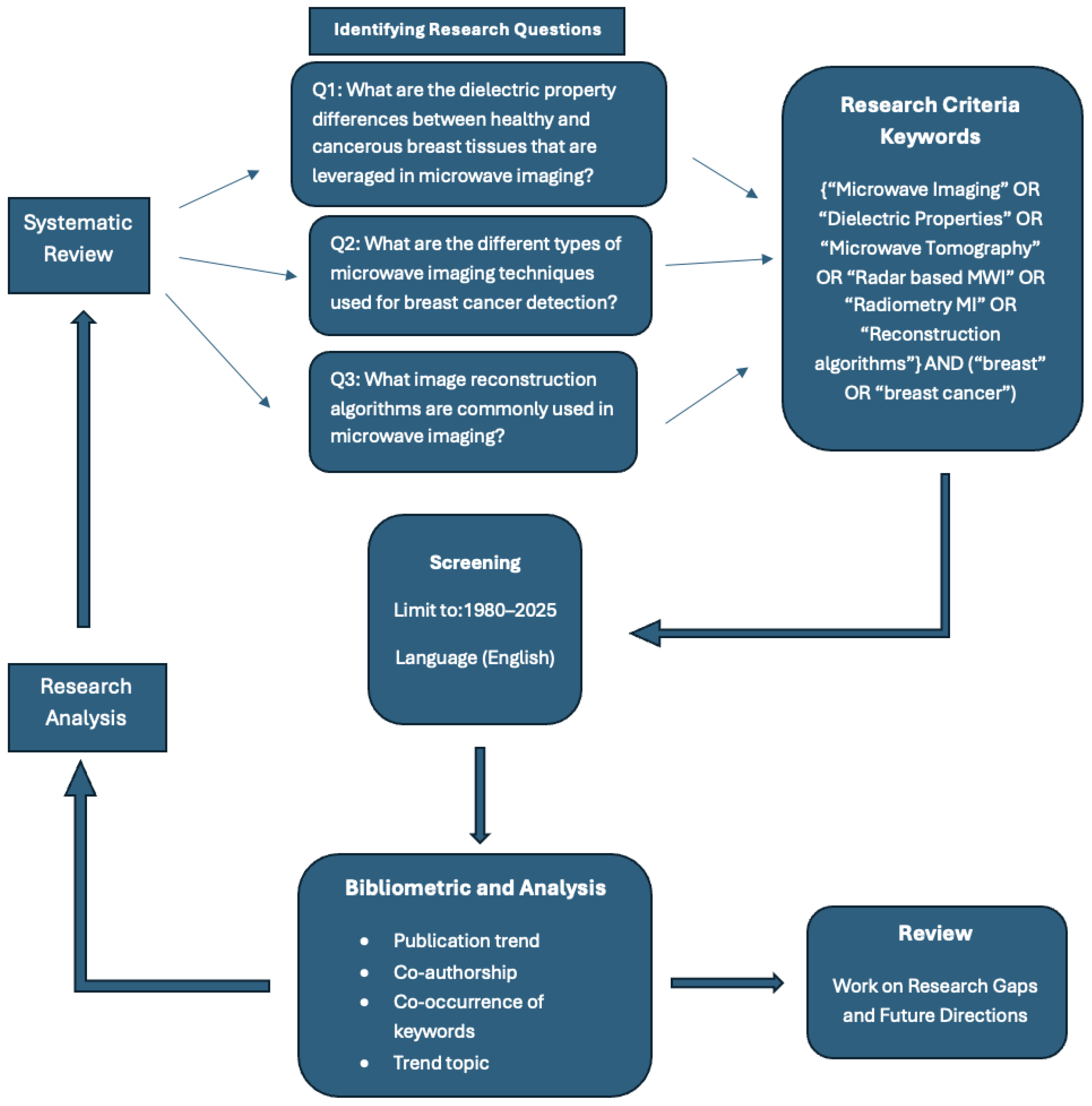
The search strategy adopted for this study followed the systematic framework shown in Figure 1 and was driven by three research questions: Q1 on dielectric property differences between healthy and cancerous breast tissue, Q2 on types of microwave imaging techniques used for breast cancer detection, and Q3 on image-reconstruction algorithms for microwave imaging. These questions directly map to the three analysis sections of the review: dielectric properties of breast tissue (Q1), types of microwave imaging techniques (Q2), and reconstruction algorithms (Q3). A comprehensive literature search was conducted using Google Scholar [33] as a unified gateway to peer-reviewed content indexed in major sources (including journals typically covered by PubMed, IEEE Xplore and Scopus). Boolean combinations of the core keywords from Figure 1 were used, for example: (“Microwave Imaging” OR “Dielectric Properties” OR “Microwave Tomography” OR “Radar based MWI” OR “Radiometry MI” OR “Reconstruction algorithms”) AND (“breast” OR “breast cancer”), with additional term permutations to capture modality- or algorithm-specific variants. The custom date filter was set to 1980–2025, and results were restricted to English-language records. Inclusion criteria were: (i) original journal articles or full conference papers; (ii) human, phantom, or numerical studies reporting experimental or modelled dielectric properties of breast tissues (Q1), development or evaluation of microwave-based breast imaging systems such as radiometry, tomography or radar imaging (Q2), or image-reconstruction algorithms explicitly applied to microwave breast imaging (Q3); and (iii) sufficient methodological detail to extract parameters relevant to imaging performance. After title/abstract screening and full-text assessment, the final data set was exported and descriptively analyzed, summarizing publication-year trends and thematically grouping studies by dielectric-property measurements, imaging modality, and reconstruction approach to characterize research directions in microwave breast imaging.

4. Dielectric Properties of Human Breast

In this section, the focus is on addressing the question: What are the dielectric property differences between healthy and cancerous breast tissues that are leveraged in microwave imaging? by providing a detailed analysis of the concepts illustrated in the block diagram Figure 1.
The dielectric properties of breast tissues differ based on their composition, such as glandular, adipose, and fibroconnective tissues, exhibiting frequency-dependent variations. Recent advancements have enabled the creation of anatomically realistic numerical breast phantoms, using MRI-derived voxel intensities mapped accurately to these dielectric properties via a Gaussian mixture model. These phantoms represent a significant improvement, providing a comprehensive tool to enhance microwave imaging technologies, and facilitate better differentiation between normal and cancerous tissues, thereby advancing computational research for breast cancer detection and treatment [34]. Ex-vivo characterization studies have demonstrated that malignant and benign tumor types exhibit measurable permittivity differences relative to normal breast tissue, providing foundational dielectric profiles for validating microwave imaging and spectroscopy systems [35]. Clinical in-vivo measurements extend these findings, showing significant contrasts between benign versus malignant nodules and between metastatic versus non-metastatic lymph nodes, with lower-frequency permittivity ranges (20–100 MHz) most strongly reflecting underlying pathology and offering potential real-time diagnostic value during surgical procedures [36]. Complementing these biological measurements, methodological advances in open-ended coaxial probe design have improved the accuracy of dielectric assessment by quantifying effective sensing depth and optimizing probe aperture for heterogeneous tissue environments, thereby enhancing the reliability of dielectric data used in breast phantom modelling and microwave device development [37].
The dielectric properties of breast tissues, such as permittivity and conductivity, are key in distinguishing between adipose, glandular, and tumor tissues. To study these properties, breast tissue phantoms are used, replicating real tissue characteristics. Glandular tissue typically has higher dielectric values compared to fatty tissue, which helps in imaging methods like UWB for breast cancer detection [38].
Surowiec et al. [39] studied the dielectric properties of breast carcinoma and surrounding tissues using specimens from seven patients, measured at frequencies ranging from 20 kHz to 100 MHz. They found marked contrasts between malignant and non-malignant samples, with tumors exhibiting higher permittivity, likely linked to increased cellular heterogeneity. These results highlight the relevance of dielectric characterization for enhancing radio-frequency–based electromagnetic imaging in breast cancer detection and diagnosis.
Campbell and Land [40] measured the dielectric properties of female breast tissues at 3.2 GHz using a resonant cavity technique. They found that dielectric values for benign and malignant tissues were similar, suggesting that microwave imaging might not differentiate between them effectively. The study also indicated that bound water and β -dispersion effects contribute significantly to the dielectric properties of breast tissue. These findings are crucial for understanding tissue response during microwave based treatments.
Alireza Mashal et al. [41] explored the use of single-walled carbon nanotubes (SWCNTs) as theranostic agents for breast cancer detection and treatment. Their study demonstrated that incorporating SWCNTs into tissue-mimicking materials significantly enhanced dielectric properties and heating response. The increase in dielectric contrast could potentially improve the sensitivity of microwave imaging for tumor detection. Moreover, SWCNTs facilitated more efficient heating, supporting their use in microwave hyperthermia. These findings suggest SWCNTs could play a vital role in future breast cancer theranostics.
Dwija Jithin et al. [42] studied the dielectric properties of four different breast cancer cell lines (MCF7, MDA-MB-231, HS578T, and T47D) over a frequency range of 200 MHz to 13.6 GHz. Using an open-ended coaxial probe, they observed that the dielectric permittivity decreased and conductivity increased with frequency. These findings indicate significant changes in dielectric behavior due to the presence of cancer cells. This study provides useful insights for improving microwave-based breast cancer detection technologies by characterizing the dielectric properties of cancerous cells.
S. Di Meo et al. [43] conducted an experimental study on the dielectric properties of breast cancer tissues up to 50 GHz using an open-ended coaxial probe. They measured 124 breast samples, including both healthy and cancerous tissues, from 45 patients. Their findings demonstrated significant dielectric contrast between healthy and cancerous tissues, supporting the potential of microwave imaging for breast cancer detection. This second campaign validated previous results, confirming the reliability of the dielectric data for enhancing microwave and mm-wave imaging techniques.
S. M. Hesabgar et al. [44] measured the dielectric properties of normal and malignant breast tissues in xenograft mice at low frequencies (100 Hz–1 MHz). They found that tumors exhibited significantly higher permittivity and conductivity compared to normal tissues, with tumor-to-normal ratios averaging 10.9:1 for permittivity and 3.5:1 for conductivity. These findings suggest that electrical permittivity could serve as an effective biomarker for breast cancer detection at low frequencies. The study used a custom experimental setup and finite element analysis to enhance measurement accuracy.
Yiou Cheng and Minghuan Fu [45] investigated the dielectric properties of normal, benign, and malignant breast tissues using microwave frequencies between 0.5 GHz and 8 GHz. They used an open-ended coaxial probe to measure permittivity and conductivity in freshly excised breast samples from 98 patients. Their results demonstrated significantly higher dielectric values in malignant tissues compared to benign and normal tissues, with the narrowest standard deviation observed around 2.5 GHz. The findings support the potential use of microwave technology for non-invasive breast cancer detection.
Eliana Canicattì et al. [46] conducted a blinded feasibility study to evaluate a custom open-ended coaxial probe for distinguishing between benign and malignant breast tissues. Using a virtual transmission line model (VTLM), they achieved sensitivity, specificity, and accuracy of 81.6%, 61.5%, and 73.4%, respectively. The dielectric properties were measured immediately after biopsy, providing rapid tissue classification that supports pathology prioritization. The findings indicate potential clinical applications of this probe in pre-classifying breast biopsy tissues and reducing diagnostic delays.
Refer to Table 1 for an overview of studies focused on the dielectric properties of breast tissue, including their methodologies and key findings.

5. Microwave Imaging

This section aims to explore the question: What are the different types of microwave imaging techniques used for breast cancer detection? by offering a comprehensive analysis of the concepts presented in the block diagram Figure 1.
Microwave imaging (MWI) has emerged as a promising technique for breast cancer detection, particularly advantageous for early diagnosis. Unlike traditional imaging methods such as mammography, which involve ionizing radiation and can be less effective for dense breast tissue, MWI offers a non-invasive and radiation-free alternative. MWI capitalizes on the contrast in dielectric properties between healthy and malignant tissues to differentiate between them, making it highly suitable for breast cancer screening [49]. An ultrawideband radar-based MWI system demonstrated an overall detection sensitivity of approximately 74% in symptomatic patients, with sensitivity increasing to 86% in mammographically dense breasts, highlighting the robustness of MWI performance in tissue types where conventional mammography is known to be less effective [18].
Regarding clinical trials and prototype validation, multiple research groups have reported promising results using microwave imaging (MWI) for breast cancer detection. The University of Bristol in collaboration with Micrima Ltd. (UK) clinically evaluated the MARIA® multistatic radar-based MWI system on symptomatic patients, reporting a sensitivity of approximately 74–76%, with performance increasing to 86% in dense breasts, demonstrating robustness where mammography is limited. Umbria Bioengineering Technologies (Italy) conducted clinical trials on the MammoWave® system, involving 61 breasts from 35 patients, and, when augmented with machine-learning–based classification, achieved an accuracy of 91%, sensitivity of 84.4%, and specificity of 97.2% for breast lesion detection. Mitos Medical Technologies (Turkey) evaluated their SAFE (Scan and Find Early) MWI prototype on 115 patients, achieving an overall sensitivity of 63%, with higher sensitivity in larger breasts (74%) and lower performance in dense and small breasts. These studies collectively demonstrate the clinical feasibility of radar-based and tomographic MWI systems, while highlighting variability in sensitivity due to breast size, density, and system configuration [9,14,50].
Recent advancements in microwave imaging (MWI) have focused on improving quantitative capability, imaging speed, and clinical feasibility. Mojabi et al. [51] developed a next-generation transmission-based MWI system using high-density planar antenna arrays in direct contact with the breast to enable fast quantitative permittivity reconstruction without full-wave inverse scattering. The approach assumes straight-line propagation and reconstructs 2D/3D permittivity maps from wideband transmission data with reconstruction errors below 10%. Phantom studies showed reliable detection and localization of inclusions (≥1 cm) with good agreement to CT references, while pilot in-vivo scans correlated well with mammographic breast density. Overall, this work significantly advances transmission-based MWI toward clinically scalable and deployable breast imaging systems [52].
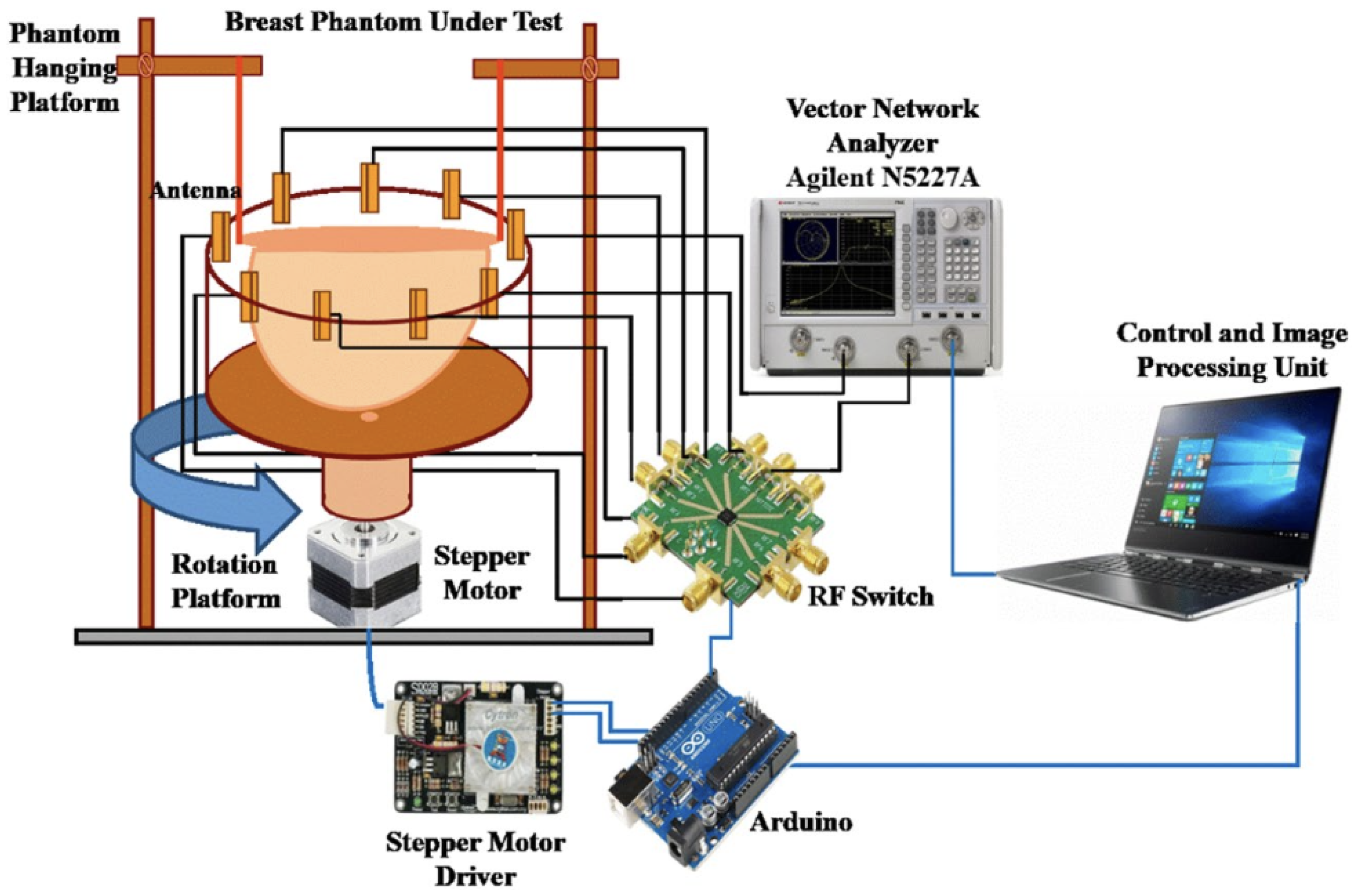
In literature [53] Figure 2 provides a detailed illustration of the microwave imaging system. It depicts a circular arrangement of antennas surrounding a breast phantom, with one antenna transmitting signals and the remaining antennas receiving the reflected signals. These antennas are mounted on a rotating platform, allowing systematic and comprehensive scanning of the phantom. A Vector Network Analyzer (VNA) connected through an RF switch collects the microwave signals, while a personal computer equipped with MATLAB processes the received signals using advanced algorithms for image reconstruction.
The study explored [54] the application of machine learning techniques for autonomous lesion detection in microwave breast imaging. Using clinical data from MammoWave scanners, the researchers employed PCA for feature extraction and trained an SVM model for ternary classification. The findings demonstrated a classification accuracy of 0.80, with synthetic data augmentation via GANs improving dataset balance and model performance. More recently, Taghipour-Gorjikolaie et al. [55] proposed an AI-based hierarchical diagnostic infrastructure operating directly on MammoWave scattering data from 1024 breasts collected in multicentre clinical trials. The method first applies agglomerative clustering to partition heterogeneous MGx matrices into two main groups and then trains dedicated binary classifiers within each group, while jointly optimising sub-band selection, feature extraction, normalisation and classifier choice via an optimisation algorithm. This hierarchical design improves robustness to inter-patient variability and class imbalance, achieving an overall balanced performance of around 70% across sensitivity, specificity and accuracy, and demonstrating the feasibility of AI-enabled decision support on MammoWave MWI data.
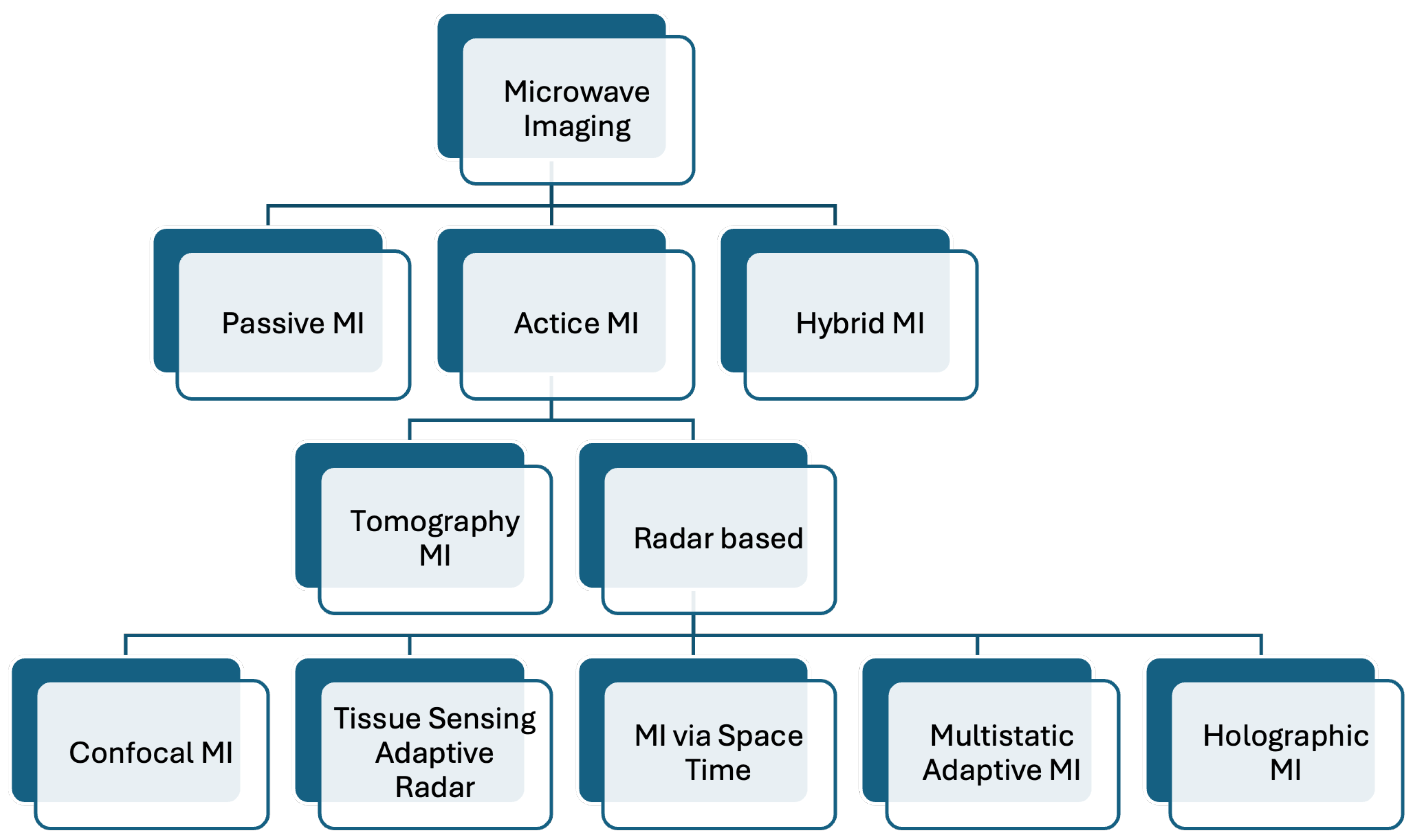
MWI is classified into three main approaches: passive, active, and hybrid as shown in Figure 3. Passive imaging relies on detecting natural thermal radiation differences between tissues, while active imaging involves transmitting microwaves and analyzing reflected signals. Active MWI can be further divided into two methods: microwave tomography (MWT), which aims to reconstruct the quantitative dielectric properties of breast tissue, and radar-based imaging, which utilizes time-delay information to detect tumors. Hybrid imaging combines with the other imaging techniques to enhance accuracy.
The affordability, non-ionizing nature, and effectiveness of MWI in detecting tumors in dense breast tissue make it a valuable tool to supplement existing breast cancer screening methods, particularly in resource-limited settings. Despite its potential, MWI still faces challenges in terms of commercialization and implementation, primarily due to the complexity of the imaging algorithms and hardware limitations [56,57,58,59].

5.1. Passive MWI

Passive microwave radiometry (MWR) is a noninvasive technique that measures natural electromagnetic emissions from tissues in the 1–10 GHz range to estimate internal temperature at depths of up to 6 cm, unlike infrared thermography which is restricted to surface temperatures. It has been investigated for early diagnosis of breast cancer and other pathologies by detecting thermal asymmetries between symmetric regions [60,61]. MWR systems typically employ Dicke radiometer configurations to stabilise gain, together with waveguide or microstrip antennas optimised for focusing at specific depths. Radiometric reconstruction algorithms combine overlapping measurements into weighted temperature maps, generating images that highlight abnormal thermal patterns, while dedicated microcomputer units control probe operation, image formation, and data storage [62,63,64,65]. It remains limited by low spatial resolution due to volume-averaged temperature measurements within the antenna field of view, making accurate tumor location and reliable detection of small or deep lesions challenging [66,67,68].
Bardati and Iudicello [69] used a coupled thermal–electromagnetic breast model to analyse the radiometric detectability of tumours, showing that, with optimised antenna design, lesions as small as 6 mm are theoretically detectable within 1 cm of depth and 10-mm tumours up to 2.8 cm. Fisher et al. [70] combined passive MWR with circulating microRNA profiling and AI-based classification, demonstrating that internal and skin temperature patterns together with miRNA signatures can yield high predictive performance for high-risk breast cancer (F1-score of 0.933).
Passive microwave radiometry (sometimes termed passive microwave imaging) operates in the same frequency range as active MWI and can yield spatially resolved measurements, but its contrast arises from temperature-related emissions rather than dielectric properties. In this review, “microwave imaging” therefore refers primarily to active, dielectric-contrast techniques, while passive radiometric methods are discussed separately as complementary thermal approaches rather than core MWI systems.

5.2. Active MWI

Active Microwave Imaging is a technique that uses transmitted microwaves to detect and analyze breast tissues by measuring reflected or scattered signals. It is divided into two groups: radar-based imaging, which relies on backscattered reflections, and microwave tomography, which uses inverse scattering algorithms to reconstruct tissue properties. Both methods exploit differences in the dielectric properties of healthy and malignant tissues for tumor detection [6].

5.2.1. Microwave Tomography

Microwave tomography operates on the principle of transmitting microwave signals through breast tissue and analyzing the reflected, scattered, or absorbed signals. These signals are processed using an inverse scattering algorithm, which reconstructs the dielectric properties of the tissues, highlighting differences indicative of tumors [71]. Microwave tomography for breast cancer imaging, as presented in this study [72], used a Gauss-Newton iterative reconstruction algorithm with a logarithmic magnitude transformation to improve the recovery of high-contrast objects. The algorithm minimized the objective function, defined as:
min | | Γ m Γ c ( k ) 2 | | 2 + | | Φ m Φ c ( k ) 2 | | 2
where Γ m and Γ c represent the measured and computed signal log magnitudes, respectively, while Φ m and Φ c are the associated phase values. The complex wavenumber squared ( k 2 ) was defined as:
k 2 = ω 2 μ ϵ + j ω μ σ
with ω as the angular frequency, μ the magnetic permeability, ϵ the permittivity, and σ the conductivity. A circular array of monopole antennas was used for data acquisition, with a finite difference time domain (FDTD)-based algorithm for reconstructing unbiased images without a priori information. The findings demonstrated that the system could successfully detect and differentiate tumors based on elevated permittivity and conductivity values, even in the presence of complex tissue structures such as edema, emphasizing the sensitivity of microwave imaging for monitoring neoadjuvant chemotherapy.
Microwave tomography imaging, as presented in this study [73], employs a sophisticated 2-D reconstruction technique to detect breast cancer by exploiting the dielectric property variations between healthy and malignant tissues. The imaging process begins with illuminating the breast sample using a bowtie antenna at a frequency of 3000 MHz, followed by capturing scattered signals with a receiving antenna positioned at specific angular intervals. The image reconstruction employs the distorted Born iterative method, which simplifies the complex inverse scattering problem by linearizing it and iteratively updating the dielectric contrast of the object. The integral equation used for forward and inverse solutions is formulated as a Fredholm integral equation of the second kind. The imaging area is discretized into 16 × 16 pixels, and the optimization technique helps minimize error by employing a cost functional to solve the ill-posed inverse problem. In the experimental setup, four breast tissue samples were used, collected from different patients shortly after mastectomy. Each sample included both normal and cancerous tissues, with specific configurations such as a single malignant inclusion or multiple scattered inclusions embedded in normal tissue. The results demonstrated that the reconstructed images effectively highlighted the dielectric contrasts, allowing clear differentiation of malignant tissue. The dielectric permittivity values of the cancerous regions were significantly higher than those of the normal tissue, which was clearly visible in the reconstructed tomographic images. The findings were consistent with dielectric property measurements obtained using the cavity perturbation technique, further validating the accuracy of the imaging method. The use of corn syrup as a coupling medium, with dielectric properties closely matching those of normal breast tissue, minimized reflection losses and improved the clarity and resolution of the reconstructed images. This approach ensured a more accurate characterization of the dielectric profiles, achieving a resolution of 2 mm in the imaging process.
Meaney et al. [74] developed a clinical prototype for active microwave imaging of the breast, intended to serve as a complementary tool to conventional mammography. The system employed by the authors integrates a 16-element transceiving monopole antenna array, designed to actively illuminate the breast over the frequency range of 300–1000 MHz. The examination procedure utilizes a water-coupled interface, where the breast is positioned pendant within a saline bath, ensuring efficient coupling of microwave signals into the tissue. A key technological feature of the prototype is the use of model-based image reconstruction, which processes the microwave signals to produce spatial maps of the breast’s electrical properties, specifically permittivity and conductivity. The findings of Meaney et al. are promising, highlighting that the recovered relative permittivity values show a correlation with radiographic breast density categorization. Specifically, it was observed that the average relative permittivity of the breast in vivo is considerably higher than previously reported values from ex vivo studies, which implies a need to re-evaluate certain assumptions about breast tissue properties. These results may influence future system designs, particularly concerning the selection of an optimal coupling medium. Additionally, the prototype was able to detect differences between various tissue types, including regions influenced by previous surgical interventions, such as lumpectomy scars. The imaging results presented by Meaney et al. demonstrate consistency across the subjects examined and suggest that active microwave imaging can provide clinically relevant insights into tissue composition.
Son et al. [75] present a preclinical prototype of a Microwave Tomography (MT) system designed for breast cancer detection, using iterative Gauss-Newton reconstruction algorithms to solve the nonlinear inverse scattering problem and generate detailed dielectric and conductivity profiles. The technical setup involves a circular array of 16 monopole antennas in a liquid medium, creating high-sensitivity imaging zones at varying depths to enhance resolution. The MT system’s imaging algorithm uses Tikhonov regularization for stable parameter updates, enabling reliable and informative image reconstructions across seven imaging planes. The dual-mesh strategy, comprising fine and coarse meshes, is implemented to optimize computation and minimize resource consumption. In experimental trials with breast phantoms embedded with cylindrical or spherical tumors, the MT system demonstrated high spatial resolution, successfully identifying tumor locations with diameters as small as 5 mm.
Grzegorczyk et al. [76] designed a 3-D microwave imaging system that leverages a discrete dipole approximation (DDA) and Gauss–Newton iterative approach to address breast cancer detection challenges by enhancing both data acquisition and processing efficiency. The primary equation governing the image reconstruction process involves minimizing the difference between the measured electric field and the field calculated from the model, represented as:
min Δ p J T J + λ I Δ p = J T E meas E calc
where Δ p represents the update to dielectric properties (permittivity ϵ and conductivity σ ), J is the Jacobian matrix derived analytically to increase accuracy, λ is the regularization parameter to control noise, and E meas and E calc are the measured and calculated electric fields, respectively. This iterative approach adjusts ϵ and σ to minimize the residual error between measured and modeled fields, providing a detailed reconstruction of breast tissue properties.
Simonov et al. [77] presented a novel 3D microwave breast imaging system based on the multistatic radar concept, aimed at early-stage breast cancer detection. The study focuses on microwave tomography (MT) that reconstructs the dielectric properties of the breast by solving a nonlinear inverse scattering problem. The MT system utilizes a multistatic multi-illumination radar concept, where a circular array of 16 antennas is used to transmit and receive signals for effective 3D reconstruction. A unique feature of this system is its use of a 3D finite-difference time-domain (FDTD) solver with GPU acceleration to solve the nonlinear inverse scattering problem, providing enhanced computational efficiency. Key findings show that MT provides more informative images compared to UWB radar by reconstructing dielectric profiles rather than just the scatterer distribution, making it advantageous for breast cancer diagnostics. The images reconstructed in this study demonstrate significant contrast between healthy tissue and potential tumors, facilitating earlier detection.
Aleksandar Janjic [12] and his team conducted a clinical investigation into the SAFE Microwave Imaging (MWI) system for breast cancer detection, focusing on its ability to classify breast lesions as benign or malignant. They employed the Adaptive Boosting (AdaBoost) machine learning model, which analyzes backscattered signals based on the distinct dielectric properties of healthy and cancerous tissues. In their study, 113 breast samples (70 benign, 43 malignant) were examined, yielding a sensitivity of 79%, specificity of 77%, and accuracy of 78%. SAFE performed better with non-dense breast tissues and younger patients. The researchers concluded that SAFE, a non-invasive and radiation-free tool, holds potential for early breast cancer screening, with further studies planned to confirm and expand upon these findings.
Costanzo and Lopez [78] propose a phaseless contrast source inversion (P-CSI) technique for microwave tomography in breast imaging. The phaseless approach is designed to avoid the phase-recovery stage, simplifying the imaging process while maintaining accuracy. The methodology involves the formulation of scattering phenomena using contrast sources, followed by an iterative optimization problem involving amplitude-only measurements of the total field. The iterative optimization uses a conjugate gradient scheme to alternately update the contrast source and dielectric properties of the tissue. Numerical simulations performed on a 2D breast model successfully differentiated tissue types, including a tumor, validating the approach.
Baran et al. [79] introduce a novel approach combining microwave tomography (MWT) with a radar-based region estimation technique for breast cancer imaging. The radar-based method segments breast tissues into regions and estimates their dielectric properties, which are then incorporated into an MWT algorithm using the finite element contrast source inversion (FEM-CSI) method. This combination improves reconstruction accuracy, particularly by using prior information about tissue structures. Numerical simulations demonstrated improved imaging quality compared to using MWT or radar-based methods alone. The results indicate a reduction in errors and enhanced detection of fine details within the breast tissue. The combined approach also offers robust performance across different immersion media and frequencies, indicating its potential applicability in clinical settings. Advances in microwave tomography focus on enhancing diagnostic precision by refining antenna design and reconstruction algorithms. The tomographic system uses custom antennas supported by a 3D-printed structure, enabling efficient data acquisition with minimized surface reflections. Data is collected via a vector network analyzer and switch matrix, which supports multiple transmission and reception combinations. The system employs a hybrid imaging approach, integrating a qualitative delay-and-sum (DAS) technique with a quantitative inexact-Newton/Landweber (INLW) method. This sequence first locates high-contrast regions, then refines them for accurate dielectric property mapping. Preliminary tests validate the system’s effectiveness in precise localization and estimation, suggesting strong adaptability for complex tomographic applications [80].
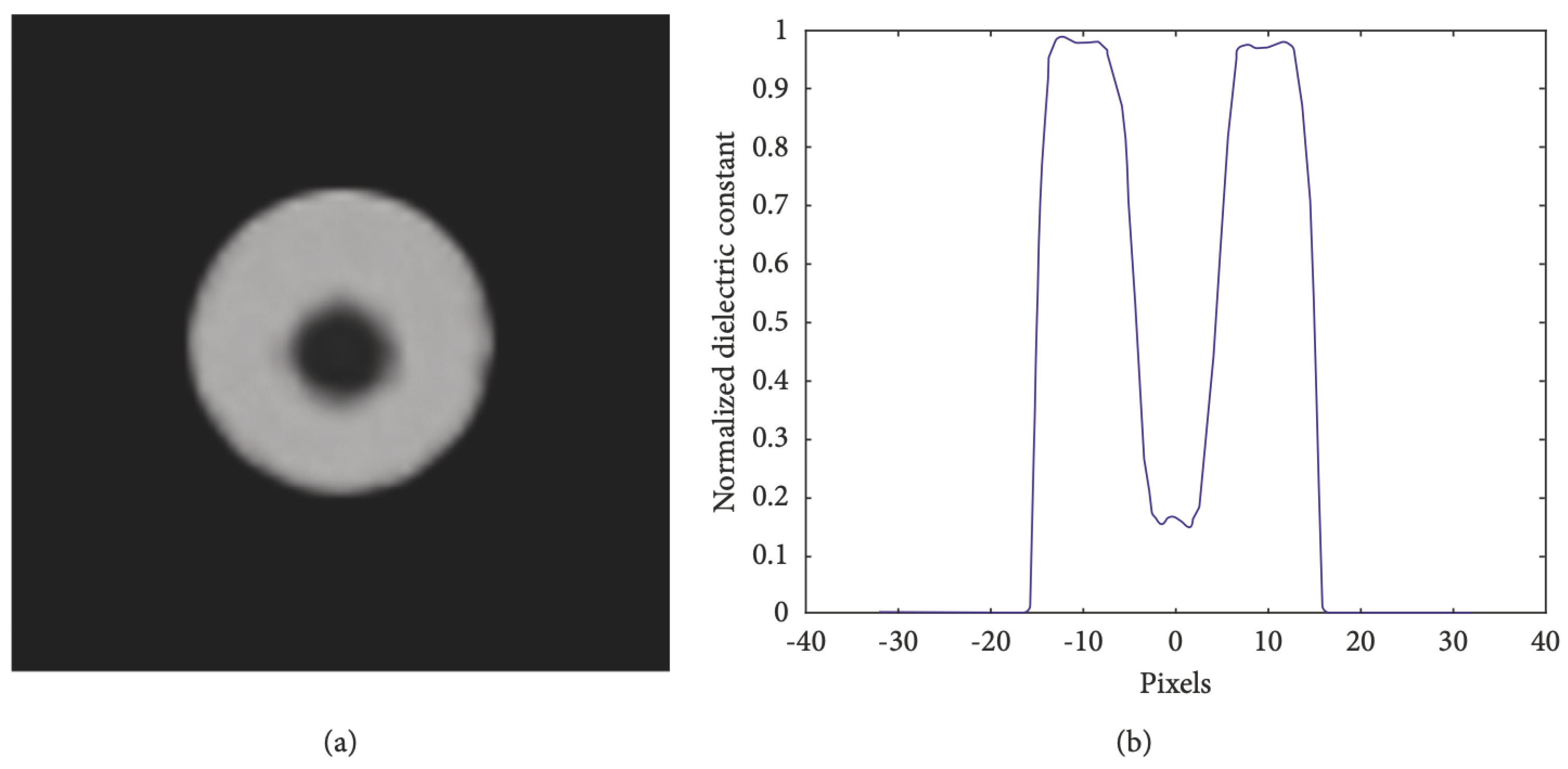
Mehedi et al. [81] conducted research on microwave tomography for breast tumor localization, which utilizes the differences in dielectric properties between normal and malignant tissues. The technology involves the use of patch antennas operating at 2.4 GHz for transmitting and receiving microwave signals, allowing for effective imaging. The study developed paraffin wax-based breast phantoms with a glycerin-water mixture to mimic tumor characteristics. The experimental setup involved rotating the tissue phantom on a table to collect data from multiple angles, while an AI-based filtered back-projection (FBP) algorithm was utilized for image reconstruction. The reconstructed images Figure 4 demonstrate successful detection of tumors, supporting the potential of microwave tomography as a alternative to conventional imaging techniques, offering precise tumor localization without the use of ionizing radiation.
Palmeri et al. [82] present an innovative approach to tackle the challenges of microwave imaging by addressing nonlinear inverse scattering problems. The proposed Distorted Iterated Virtual Experiments (DIVE) method enhances the traditional distorted Born iterative method (DBIM) through the use of virtual experiments, which iteratively refine the contrast profile and mitigate issues of nonlinearity and ill-posedness. DIVE employs compressive sensing-inspired regularization to promote sparsity, significantly improving imaging accuracy. Additionally, truncated singular value decomposition (TSVD) is used as a generalized regularization tool. Numerical and experimental results demonstrate that DIVE outperforms DBIM, offering enhanced robustness and accuracy, making it particularly promising for biomedical imaging and subsurface diagnostics.
Xiuzhu Ye and Xudong Chen [83] propose a Subspace-Based Distorted-Born Iterative Method (S-DBIM) for solving electromagnetic inverse scattering problems. The S-DBIM extends the traditional DBIM by employing subspace techniques to retrieve only the deterministic part of the induced current, which improves both convergence speed and accuracy of the solution. In this method, the Green’s function for the inhomogeneous background is iteratively updated, and singular value decomposition (SVD) is utilized to separate radiating and non-radiating components of the induced current, focusing on the radiating portion to enhance the estimation of the total electric field. To address the challenge of selecting an appropriate Tikhonov regularization parameter, a second version called S-DBIM-v2 is introduced, which uses only the number of leading singular values as a regularization parameter, making it more robust against noise and easier to implement. Numerical simulations demonstrate that both S-DBIM and S-DBIM-v2 achieve faster convergence and higher resolution in imaging, even in the presence of noise, compared to the conventional DBIM. These advancements make S-DBIM and its variant promising for applications such as biomedical imaging and remote sensing, where conventional methods face limitations in dealing with nonlinearity and noise. Refer to Table 2 for a summary of several studies on microwave tomography for breast imaging, outlining their methodologies and key results.

5.2.2. Radar Based Approaches

Radar-based microwave imaging techniques for breast cancer detection work by transmitting microwave signals into the breast and measuring the scattered waves. These techniques rely on differences in dielectric properties between normal and malignant tissues, allowing for tumor detection [6]. Radar-based approaches for breast cancer detection use ultra-wideband signals to detect strongly scattering objects, such as tumors, by analyzing reflections from the breast tissue. These techniques employ simpler imaging algorithms compared to tomographic approaches, focusing on identifying the location of anomalies rather than mapping the entire tissue structure. Systems like MIST and TSAR utilize ultra-wideband pulses, typically between 1 and 10 GHz, to illuminate the breast and analyze back-scattered signals for preliminary detection. The approach is conceptually similar to ground-penetrating radar used for detecting anomalies in a heterogeneous background, resulting in simplified breast images that highlight potential tumor locations based on coherent signal reflections from tumors, making the system less complex than tomographic methods [90,91]. An integrated ultra-wideband (UWB) microwave imaging radar system was developed for breast cancer screening, it employs a stepped-frequency continuous-wave (SFCW) approach across 2–16 GHz, synthetically generating short UWB pulses for high-resolution radar imaging. The radar front-end is implemented as a 65-nm CMOS transceiver directly integrated with dual wideband patch antennas, forming a compact array module that supports monostatic or bistatic operation without external switching networks. Imaging experiments on realistic breast phantoms demonstrated detection of small tumor targets with approximately 3 mm resolution, indicating the feasibility of this approach for early-stage breast cancer detection [92].
Amdaouch et al. [93] proposed a low-cost UWB radar-based microwave imaging system that enhances conventional delay-and-sum (DAS) reconstruction by incorporating the specific absorption rate (SAR) to guide antenna positioning. By relocating a directive Vivaldi antenna near the tumor region, the method improves image resolution while reducing the number of antenna positions and computational time. Simulation results demonstrated reliable tumor detection for varying sizes and dielectric properties, highlighting the potential of fast and efficient confocal MWI systems for early breast cancer detection.
Hagness et al. [94] developed the first pulsed radar system for breast cancer detection, using a two-dimensional finite-difference time-domain (FDTD) analysis. This system employed a pulsed microwave confocal approach with both fixed-focus and antenna-array sensors. The methodology focused on enhancing the detection of malignant tumors by leveraging the high dielectric contrast between normal and cancerous breast tissues. Experimental simulations demonstrated that the system could accurately detect tumors as small as 2 mm in diameter while achieving a lateral spatial resolution of approximately 0.5 cm. The use of time-gating effectively minimized the impact of background clutter from tissue heterogeneity, allowing for precise identification of tumor locations.
Radar-based microwave imaging (MI) techniques can be categorized into five main types confocal microwave imaging (CMI), tissue sensing adaptive radar (TSAR), microwave imaging through space-time (MIST), multi-static adaptive (MSA) microwave imaging, and holographic microwave imaging (HMI) [56].
Hagness et al. conducted a three-dimensional finite-difference time-domain (FDTD) analysis to evaluate a resistively loaded bowtie antenna array for confocal microwave imaging (CMI) of breast tumors. The study successfully detected tumors as small as 1.76 mm in diameter at depths up to 5.0 cm. By leveraging the cross-polarized sensing capabilities of the bowtie antenna, the system minimized clutter from the chest wall, enabling the detection of early-stage tumors, including those adjacent to the chest wall. The findings highlight the effectiveness of the resistively loaded bowtie antenna in providing high sensitivity and dynamic range for detecting nonpalpable breast tumors [95].Fear et al. explored Confocal Microwave Imaging (CMI) for breast cancer detection by employing synthetic focusing of backscattered signals using cylindrical and planar antenna arrays, achieving successful localization of small tumors (6 mm in diameter) in three dimensions. This technique offers a non-invasive approach with robust image reconstruction, addressing limitations of conventional mammography [96].
Fear et al. investigated the use of tissue sensing adaptive radar (TSAR) for breast tumor detection, focusing on differences in electrical properties between healthy and malignant tissues. Their study used experimental models consisting of a PVC pipe and a wooden hemisphere, as well as simulations involving cylindrical and hemispherical breast models. The finite difference time domain (FDTD) method was used for simulations, while a resistively loaded monopole antenna collected data. The phantom was scanned through 16 rotations to create an image perpendicular to the pipe axis, and in 2.5 cm increments to create an image parallel to the pipe axis. Tumors with diameters of 6 mm and 2.5 cm were successfully detected in simulations and experimental setups, respectively [97]. Shannon et al. introduced a novel approach to breast cancer detection using a dielectric-filled ultra-wideband Slotline Bowtie Hybrid (SBH) antenna in conjunction with TSAR. The SBH antenna, designed with a compact Vivaldi profile for improved impedance matching, demonstrated effective microwave imaging by exploiting dielectric contrasts between tissues. The antenna achieved a half-power beamwidth of 2 cm and a fidelity above 0.9, ensuring high-quality imaging. Simulations via the FDTD method indicated low insertion loss and consistent radiation control, suggesting the antenna’s suitability for precise breast cancer detection [98].
Bond et al. proposed the use of microwave imaging via space-time (MIST) beamforming for early detection of breast cancer. The technology utilizes an ultrawideband (UWB) signal transmitted by an array of antennas positioned around the breast. Each antenna sequentially transmits a signal, and the backscattered signals are recorded. The MIST beamforming approach spatially focuses these backscattered signals by time-aligning them to a hypothesized scatterer location, using finite impulse response (FIR) filters to adjust for frequency-dependent effects. This process allows the beamformer to enhance the detection of malignant tissues by reducing noise and clutter, which are caused by the heterogeneity of normal breast tissues. The data-adaptive algorithm is used to remove artifacts from the skin-breast interface, further improving detection accuracy. The study demonstrated successful detection of very small (2 mm) malignant tumors embedded in complex breast tissue structures. The results suggest that MIST beamforming offers enhanced sensitivity for detecting early-stage breast cancer, outperforming previous UWB-based methods [99]. In [100] utilizes MIST beamforming to detect breast tumors as small as 4 mm. The technique employs an array of ultrawideband (UWB) antennas that transmit signals into a breast phantom containing a synthetic tumor. The dominant backscatter from the skin is removed using a data-adaptive algorithm, and the remaining signals are processed through a space-time beamformer to create a 3D image of the backscattered energy. This approach effectively discriminates between normal tissue and tumor tissue, successfully localizing millimeter-sized tumors based on their dielectric properties. O’Halloran et al. [101] developed a quasi-multistatic MIST beamforming technique for early breast cancer detection, this method extends the monostatic MIST by employing a multistatic approach where an ultrawideband (UWB) signal is transmitted by one antenna and received by an array, allowing improved imaging results. The modified artifact removal and beamforming algorithms were tested using a 2D anatomically accurate FDTD model of the breast. The results demonstrated a significant enhancement in the signal-to-clutter ratio, indicating better tumor localization and reduced clutter compared to traditional monostatic MIST beamforming.
Multistatic Adaptive Microwave Imaging (MAMI) is utilized to enhance early breast cancer detection by using a robust Capon beamforming algorithm. The procedure involves a two-stage adaptive imaging method where an ultra-wideband pulse is transmitted by each antenna in a hemispherical array, with all antennas receiving the backscattered signals. The algorithm processes these signals to localize and estimate the backscattered energy, leading to improved resolution and reduced interference. The study successfully detected tumors as small as 4 mm in diameter, demonstrating better tumor localization, higher resolution, and superior clutter rejection compared to other microwave imaging methods [102].
Microwave holographic imaging involves the use of coherent microwave sources to generate holographic images of biological tissues. The method utilizes phase and amplitude information from scattered microwaves to reconstruct a three-dimensional image of the target. By applying Fourier transform techniques, holographic images provide insights into the spatial distribution of dielectric properties, enabling detailed analysis of tissue structures [103]. Lulu Wang et al. [104] present a study on three-dimensional far-field holographic microwave imaging (3D-HMI) for dielectric object detection and reconstruction. The experimental setup involved a 16-antenna array operating at 12.6 GHz, capturing phase and magnitude data to create 3D images from sequential 2D measurements taken at different vertical heights. The study successfully demonstrated that the proposed imaging method could detect small inclusions with high accuracy, as evidenced by the reconstructed images, which precisely localized embedded objects. Kumari et al. [105] proposed a near-field indirect microwave holography technique using directive Vivaldi antennas and angular spectrum reconstruction to image breast tumors. Experiments were performed on anatomically realistic 3D-printed phantoms with raisin inclusions as tumors. The method reconstructed both amplitude and phase to estimate dielectric permittivity from phase differences. Results demonstrated detection of tumors as small as 4 mm at depths up to 25 mm with permittivity accuracy within ±5%, indicating feasibility for low-cost early breast cancer screening. Refer to Table 3 for a summary of several studies on microwave radar-based breast imaging, highlighting their techniques and significant findings.

5.3. Hybrid

The hybrid microwave imaging technique for breast cancer detection is an innovative technique that combines microwave imaging with other imaging modalities to improve the accuracy and effectiveness of breast cancer screening. In this study [111] The hybrid microwave tomography technique combines Ultrawide Band Microwave Radar (UWBMR) and microwave tomography (MT) to improve breast cancer imaging. Initially, UWBMR is employed to detect the spatial location and dimensions of scatterers by analyzing reflections from the scanned area. This data is then refined using the Finite Difference Time Domain (FDTD) method combined with Genetic Algorithm (GA) optimization, allowing for the reconstruction of a dielectric map that differentiates malignant tissues from normal ones. The hybrid microwave-thermography technique in this study [112] utilizes microwaves as a radiation source and an infrared thermography method to detect abnormal heat patterns in breast tissue. Microwaves penetrate the breast, and the transmitted electromagnetic waves are absorbed by a sensitive film placed behind the breast, generating a heat distribution pattern. An infrared camera captures these heat patterns, which are indicative of abnormalities. A Convolutional Neural Network (CNN) further enhances detection by analyzing the heat patterns to determine the tumor’s location and size, providing a highly effective non-invasive detection modality.
Carr et al. [113] present a dual mode microwave system designed to enhance early cancer detection by combining a passive microwave radiometer with an active transmitter. The system utilizes the temperature difference between tumors and surrounding tissue to non-invasively identify cancerous regions. A radiometer operating at 4.7 GHz detects subsurface temperatures, while a 1.6 GHz transmitter provides localized heating to highlight potential tumors. The authors used a low-noise RF amplifier and a Dicke switch to improve sensitivity and minimize noise. The system successfully identified hot spots in patients, correlating well with clinical diagnoses of breast carcinoma.
Veerlapalli and Dutta [114] proposed a hybrid deep learning framework called BCDGAN that integrates a Generative Adversarial Network (GAN) with CNN-based models like InceptionResNetV2 and VGG16 for breast cancer detection using thermogram images. The GAN generates synthetic regions of interest (ROIs) to balance the dataset and enhance feature extraction. This combination improves classification performance and model generalization on thermographic data. Their proposed model achieved an impressive accuracy of 98.56%, outperforming existing deep learning methods.
Awotunde et al. [115] proposed a hybrid rule-based feature selection model integrated with a deep learning algorithm for breast cancer diagnosis. The technique used a rule-based and genetic search mechanism to remove irrelevant attributes and feed only significant features into an Artificial Neural Network (ANN) for classification. The model was tested on the Wisconsin Breast Cancer Dataset (WBCD) and achieved a superior detection capability. Their experimental results showed an outstanding accuracy of 99.9%, outperforming all existing models on the same dataset.
Liu et al. [116] proposed an Adaptive Window-based Hybrid Artifact Removal (AW-HAR) method to enhance Ultra-Wide Band (UWB) microwave imaging for early breast cancer detection. The technique combines adaptive time window division, two-stage filtering, and Savitzky-Golay (S-G) smoothing to eliminate artifacts and improve image clarity. This hybrid method effectively suppresses skin and clutter noise while enhancing tumor visibility in confocal imaging. The simulation and phantom experiments confirmed its high precision, showing significant image enhancement and reliable tumor localization performance.
Lin et al. [117] proposed a hybrid microwave medical imaging (MMI) approach that combines quantitative and qualitative algorithms to improve dielectric permittivity mapping accuracy in human tissue imaging. The method iteratively exchanges a priori information between electromagnetic tomography (EMT) and radar-based confocal imaging to visualize both tissue boundaries and strong scatterers. The technique was tested for bone fracture detection using a physical phantom model. The results demonstrated a 33% reduction in relative error compared to conventional quantitative MMI, achieving more accurate and clearer internal body images.
Han et al. [118] proposed a 3D hybrid microwave imaging (MWI) technique combining the Linear Sampling Method (LSM), Born Iterative Method (BIM), and a CNN U-Net to improve quantitative imaging accuracy. The LSM provides approximate shapes of unknown objects, while the CNN U-Net refines these shapes before BIM performs quantitative reconstruction of dielectric parameters. This threefold integration enhances reconstruction precision and reduces computational cost. The method achieved the lowest model misfit of less than 1%, outperforming conventional BIM in both speed and accuracy.
Zhang and Xu [119] proposed a hybrid input scheme that integrates the Direct Sampling Method (DSM) and Back-Propagation (BP) algorithm to train a U-Net convolutional neural network for quantitative microwave imaging. DSM extracts spatial information of the target, while BP retrieves its dielectric properties, and their combined output enhances CNN learning. This hybrid approach optimizes BP results by introducing DSM-derived spatial data, improving overall imaging accuracy and clarity. Numerical simulations demonstrated that the hybrid scheme achieved significantly lower reconstruction errors compared to the single BP-based CNN.
Abdollahi et al. [120] employed a hybrid artificial intelligence approach that combines a Multilayer Perceptron (MLP) neural network with a Genetic Algorithm (GA) for breast cancer metastasis detection. They evaluated this hybrid model on the Wisconsin Breast Cancer dataset from the UCI repository (357 benign and 212 malignant samples), comparing its performance against several standalone classifiers including logistic regression, k-nearest neighbors, random forest, support vector machines, and a standard MLP. The MLP-GA hybrid achieved the highest overall performance, with significantly improved accuracy, sensitivity, and specificity compared to any individual algorithm. In particular, the hybrid model attained an accuracy of up to 99.7% (with k-fold cross-validation) and around 98% under a holdout evaluation, alongside correspondingly high sensitivity and specificity. These results were consistent across both cross-validation and holdout methods, indicating that the MLP-GA approach can expedite diagnosis while maintaining superior predictive performance.

6. Reconstruction Algorithm for Image

This section addresses the following question: What image reconstruction algorithms are commonly used in microwave imaging? by providing a detailed examination of the concepts demonstrated in the block diagram Figure 1.
Recent advances in computational methods and microwave hardware have led researchers to consider MWI as an emerging option for breast cancer screening, focusing on reconstructing and assessing image quality. In the context of image reconstruction, microwave tomography (MWT) serves as a powerful modality for biomedical imaging, utilizing inverse scattering methods to retrieve internal structural details and reconstruct the dielectric properties of tissues. The reconstruction process involves collecting data on the scattered electromagnetic fields, which are generated by transmitting known incident fields through the tissue. These scattered fields are then measured using an array of receivers surrounding the object. By minimizing discrepancies between the measured and simulated electric fields through numerical solvers, MWT reconstructs detailed images of the dielectric properties of the tissues. Given the ill-posed nature of this problem, regularization techniques such as Tikhonov and Gauss-Newton Inversion are employed to achieve stable solutions. Iterative approaches, including the Born Iterative Method (BIM), are implemented to enhance resolution, effectively managing complexities like the high dielectric contrast often encountered in biological tissues [121]. MWT, UWB radar-based imaging algorithms discussed in the paper [122] include both data-independent and data-adaptive techniques for breast cancer detection. The Delay-And-Sum (DAS) algorithm aligns and sums signals to emphasize tumor reflections, while Delay-Multiply-and sum (DMAS) enhances clutter suppression through pairing multiplication. Improved Delay-And-Sum (IDAS) and Coherence Factor-based DAS (CF-DAS) introduce coherence-based weighting for enhanced image quality. Channel Ranked DAS (CR-DAS) adjusts signals to reward shorter propagation paths, and the Robust Capon Beamformer (RCB) uses adaptive weighting to attenuate noise while preserving tumor signals. Each algorithm shows varying effectiveness in clutter reduction and tumor detection accuracy.
The delay-and-sum (DAS) technique is used in imaging to enhance the clarity of targeted regions by coherently focusing signals. In an antenna array, each element is excited individually, and the backscattered signals are recorded. These signals are then time-shifted and coherently summed to emphasize reflections from specific points of interest. This approach effectively reduces background clutter by enhancing the signal of the desired target, such as a tumor, while suppressing noise from surrounding heterogeneous tissues. The coherent addition improves spatial resolution, enabling precise imaging and detection of small anomalies, such as tumors as small as 2 mm. Time-gating is also employed to achieve better depth resolution, enhancing the overall imaging quality [94].
The Delay-Multiply-and-Sum (DMAS) algorithm, proposed for breast cancer detection using ultra-wideband confocal microwave imaging [123], significantly enhances tumor localization compared to the traditional Delay-and-Sum (DAS) approach. In DMAS, backscattered signals are time-shifted, multiplied in pairs, and summed to synthesize a focal point. This process reduces clutter and noise while improving tumor detection sensitivity, effectively detecting tumors as small as 2 mm in diameter.
Klemm et al. [124] proposed an improved Delay-and-Sum (DAS) beamforming algorithm that incorporates a quality factor (QF) to enhance microwave imaging for breast cancer detection. The algorithm computes QF at each focal point using energy collection curves, normalized by the standard deviation of energy from radar signals, and fitted to a second-order polynomial. The improved DAS effectively suppresses clutter and highlights tumor responses by weighting signals based on their coherence. Experimental results demonstrated significant improvements in signal-to-clutter ratio, achieving gains of 2.65 dB and 4.4 dB for 10 mm and 7 mm tumors, respectively.
The CF-DAS algorithm is a data-independent method that employs coherence factor-weighted summation to enhance imaging stability and accuracy, particularly in noisy environments. In this study [125], an iteratively corrected CF-DAS variant was introduced to mitigate artifacts like ghosting and improve resolution in scenarios with multiple targets, such as detecting breast tumors in phantom models. This enhanced algorithm iteratively refines time-delay calculations to account for dielectric variations, leading to significant improvements in signal-to-mean ratio (SMR) and image clarity.
The Channel-Ranked Delay-and-Sum (CR-DAS) algorithm optimizes imaging in complex scenarios by ranking and weighting channels based on their contributions to the coherent addition of backscatter signals. This approach effectively reduces the influence of low-quality channels, minimizing clutter and improving signal-to-clutter ratio (SCR). By leveraging channel-specific rankings, CR-DAS enhances tumor localization accuracy while maintaining computational efficiency, making it particularly suitable for confocal microwave imaging systems [96].
Pato et al. introduced the Channel-Ranked Delay-Multiply-And-Sum (CR-DMAS) algorithm, which enhances microwave imaging for axillary lymph node detection by combining channel-ranking with signal multiplication. The algorithm assigns higher weights to shorter propagation distance signals, reducing clutter and improving signal-to-clutter (SCR) and signal-to-mean ratios (SMR). CR-DMAS works by first time-aligning signals from multiple channels, ranking them based on propagation distance, and then multiplying signal pairs before summing and squaring them to form an image. This process effectively suppresses noise and artifacts, achieving superior resolution and detection accuracy, even in complex anatomical scenarios with closely spaced lymph nodes [126].
The Robust Capon Beamforming (RCB) algorithm enhances microwave imaging for breast cancer detection by adaptively minimizing noise and interference through precise weighting of backscattered signals. The algorithm calculates the covariance matrix of received signals and dynamically adjusts the weighting vector for each pixel to improve imaging accuracy. Unlike standard beamforming methods, RCB incorporates spatial smoothing and a constraint-based optimization to suppress strong noise from tissue interfaces, such as fatty tissue and chest walls. The energy values are reconstructed for each pixel by integrating and processing the signals received from multiple antennas. RCB demonstrates significant improvements in reducing noise and achieving higher resolution, especially in complex anatomical environments. This approach is computationally efficient and robust, making it suitable for clinical applications [127].
The study employs [5] an image reconstruction approach based on the Huygens Principle (HP), which avoids complex inverse problem-solving typically needed in microwave imaging. The HP-based procedure propagates the scattered electromagnetic fields to reconstruct images, offering a computationally efficient alternative. The method uses transmitted and received signals across multiple angular positions to generate a reconstructed field intensity map. To enhance the imaging accuracy, five different artifact removal methods were evaluated, including Rotation Subtraction (RS) and Local Average Subtraction (LAS), which were found to effectively reduce clutter and transmitter reflections [128]. HP leveraging Green’s function to propagate electromagnetic fields from the measurement surface inward. This method involves combining frequency-domain measurements and simulations to reconstruct the electric field intensity, with artifact removal achieved through subtraction of electric fields at different transmitting positions. The technique efficiently detects dielectric inhomogeneities and is validated using both anthropomorphic head models and multilayer phantoms [129]. In this study [130], it simulates ultra-wideband (UWB) signals in a multilayered cylindrical phantom, reconstructing images at frequencies between 3–5 GHz. Noise impact is evaluated by applying Gaussian (amplifier) and uniform (quantization) noise at various amplitudes, with the resulting images analyzed using the Signal-to-Clutter Ratio (SCR) metric. The HP-based approach effectively detects inclusions, with results demonstrating a decrease in SCR and image quality as noise amplitude increases.

AI Based Image Reconstruction

Recent studies have explored deep learning–based image reconstruction to enhance fine structural details that are poorly visible in low-resolution medical images. Veeramani and Jayaraman [131] proposed an AI-based super-resolution reconstruction framework (MELIIGAN) that reformulates image reconstruction as a generative adversarial learning problem, enabling recovery of high-frequency texture and edge information. The method integrates stacked residual attention blocks with a hybrid loss function to suppress artifacts and preserve structural fidelity during reconstruction. Quantitative results demonstrate substantial improvements in reconstruction quality, achieving higher PSNR and SSIM compared with conventional interpolation, SRCNN, and GAN-based super-resolution methods.
Three-dimensional breast image reconstruction from infrared (IR) thermographic data has been explored to extend diagnostic information beyond conventional 2D thermal maps. Pereira de Sá and Conci [132] introduced a Gaussian Splatting–based reconstruction framework, utilizing the pixelSplat model to generate detailed 3D breast representations from sparse IR views. The method models breast tissue using anisotropic Gaussian primitives, enabling efficient rendering, improved surface continuity, and real-time novel-view synthesis without explicit camera pose estimation. This approach demonstrates the potential of AI-driven 3D reconstruction to enhance structural and thermal visualization for breast cancer assessment.
Rugină et al. [133] reviewed the role of artificial intelligence in breast reconstruction, highlighting how AI-driven image analysis and 3D reconstruction support preoperative planning and surgical decision-making. The review reports that deep learning–based imaging models enable accurate anatomical reconstruction from MRI and CT data, improving visualization of breast volume, tissue distribution, and symmetry assessment. AI-assisted reconstruction frameworks were shown to reduce inter-observer variability and enhance precision in modelling patient-specific anatomy. Overall, the study positions image reconstruction as a foundational component for AI-supported breast reconstruction workflows, while noting the need for robust validation and standardized datasets.

7. Challenges and Future Directions

Despite encouraging pre-clinical and early clinical evidence, microwave imaging (MWI) for breast cancer detection remains at a pre-commercial stage. Several systems such as SAFE, MammoWave, MARIA and Wavelia have undergone clinical feasibility studies, but no MWI device is yet approved as a primary screening or diagnostic tool by major regulatory agencies, and all are currently positioned as adjunct modalities. Taylor et al. [134] reports several FDA-cleared AI tools for breast cancer detection, most of which are deployed in mammography to support and improve image interpretation. Key barriers include the difficulty of robustly imaging highly heterogeneous breasts, the relatively small dielectric contrast (often on the order of 10%) between dense fibroglandular tissue and malignancy, and the stringent hardware and calibration requirements needed to obtain reproducible, patient-specific measurements in a clinical environment [47,135]. Reconstruction algorithms pose an additional challenge. Full 3D inverse scattering remains computationally demanding and sensitive to modelling assumptions, noise, and imperfect knowledge of the coupling medium and breast geometry. While recent work on advanced regularization, phaseless and hybrid inversion schemes, and beamforming improvements has demonstrated better image quality, these approaches must be translated into fast, numerically stable pipelines that can operate within realistic clinical time and hardware constraints. Furthermore, the integration of artificial intelligence and deep learning is currently limited by data scarcity: most published models are trained on small, single-centre datasets with device-specific characteristics and incomplete ground truth, raising concerns about generalizability and regulatory acceptance.
Future research should therefore prioritise rigorous, prospective multi-centre clinical trials with standardized acquisition protocols, harmonised reconstruction pipelines, and transparent reporting of sensitivity, specificity, and incremental value over established imaging pathways. Such studies should include diverse populations and breast-density categories and be designed in consultation with regulators to support eventual pathways to approval and reimbursement. On the technology side, there is scope to explore multi-band and higher-frequency extensions, including millimetre-wave and terahertz (THz) approaches, to push spatial resolution below 1 mm. Any move into the THz regime must, however, carefully balance increased resolution against reduced penetration depth, stricter safety margins, and higher system complexity. Finally, hybrid imaging strategies—for example, co-registered MWI with ultrasound or MRI—are a promising direction, allowing structural information from conventional modalities to constrain or guide microwave reconstructions, improve interpretability, and facilitate acceptance by radiologists. Coupled with larger shared datasets and robust AI methods, these developments could enable MWI to progress from prototype to clinically impactful breast imaging tool in the coming years.

8. Conclusions

This review synthesised four decades (1980–2025) of work on microwave imaging (MWI) for breast cancer detection, spanning dielectric property characterisation, development of numerical and physical breast phantoms, a range of active imaging architectures, and associated reconstruction algorithms. Evidence from ex-vivo, in-vivo and phantom studies shows that, over a broad frequency range, malignant tissues generally exhibit higher permittivity and conductivity than benign and normal tissues, providing the physical basis for contrast-driven MWI and guiding realistic breast models for system optimisation. We reviewed diverse active MWI configurations, including tomographic, confocal, multistatic and hybrid radar–tomography schemes, together with clinical systems such as SAFE, MammoWave, MARIA and Wavelia. These platforms demonstrate the feasibility of non-ionizing breast imaging, good patient acceptability and encouraging lesion-detection performance, particularly in dense breasts where X-ray mammography is less effective. Despite this progress, MWI remains at a pre-commercial stage and is currently positioned as an adjunct rather than a standalone screening or diagnostic modality. Key barriers include modest dielectric contrast in dense fibroglandular tissue, strong inter-patient heterogeneity, stringent requirements on antenna design, coupling and calibration, and the ill-posed, computationally intensive nature of full 3D inverse scattering in realistic breast geometries. Future work should prioritise rigorous multi-centre clinical trials with standardised acquisition and reporting, robust and fast 3D reconstruction pipelines, higher-frequency and multi-band systems with improved array and coupling designs, and data-efficient AI methods trained on diverse, well-curated datasets. Integrating MWI with established modalities such as ultrasound and MRI, using structural priors to guide microwave reconstructions and aid interpretation, may be crucial for clinical acceptance. If these technical and translational challenges are addressed, MWI could mature into an accessible, radiation-free complement to existing breast-imaging pathways, supporting earlier diagnosis and helping to reduce global disparities in breast cancer outcomes.

Author Contributions

A.S., F.I., R.B. and A.A. conceptualized the research. A.S. and F.I. conducted the research, while A.A. and B.S. supervised the work. A.S., F.I., R.B. and A.R. prepared the initial draft, and A.S. with F.I. revised and wrote the current version. All authors have read and agreed to the published version of the manuscript.

Funding

This research received no external funding.

Institutional Review Board Statement

Not applicable.

Informed Consent Statement

Not applicable.

Data Availability Statement

No new data were created or analyzed in this study. Data sharing is not applicable to this article.

Conflicts of Interest

The authors declare no conflicts of interest.

Abbreviations

The following abbreviations are used in this manuscript:
MWIMicrowave imaging
HIPHealth insurance plan
MRIMagnetic resonance imaging
UWBUltrawideband
DIMASODDensity-Indicated Mammographic-Sonographic Breast Cancer Screening
ABUSAutomated Breast Ultrasound
SWCNTssingle-walled carbon nanotubes)
VTLMVirtual transmission line model
VNAVector network analyzer
PCAPrinciple component analysis
SVMSupport vector machine
GANsGenerative adversarial networks
MWTMicrowave tomography
MWRMicrowave radiometry
MicRNAMicroRNA
FDTDFinite difference time domain
MTMicrowave tomography
DDADiscrete dipole approximation
GPUGraphic processing unit
SAFEScan and find early
AdaBoostAdaptive Boosting
P-CSIPhaseless contrast source inversion
FEM-CSIFinite element contrast source inversion
DASDelay and sum
INLWInexact-Newton/Landweber
FBPFiltered back projection
DIVEDistorted iterated virtual experiments
DBIMDistorted born iterative method
TSVDTruncated singular value decomposition
S-DBIMSubspace-Born distorted iterative method
SVDSingular value decomposition
CMIConfocal microwave imaging
TSARTissue sensing adaptive radar
MISTMicrowave imaging through space-time
MSAMulti-static adaptive
HMIHolographic microwave imaging
HSBSlotline bowtie hybrid
FIRFinite impulse response
MAMIMultistatic Adaptive Microwave imaging
3D-HMIThree dimensional far-field holographic microwave imaging
UWBMRUltrawideband microwave radar
GAGenetic Algorithm
CNNConvolution neural network
ROIsRegions of interest
ANNArtificial neural network
WBCDWisconsin breast cancer network
AW-HARAdaptive window-based hybrid artificial removal
S-GSavitzky-Golay
EMTElectromagnetic tomography
LSMLinear sampling method
DSMDirect sampling method
BPBack propagation
DMADDelay multiple and sum
IDASImproved delay and sum
CF-DASCoherence factor based DAS
CR-DASChannel ranked DAS
RCBRobust capon beamformer
QFQuality factor
SCRSignal to clutter ratio
SMRSignal to mean ratio
HPHuygens principle
LASLocal average subtraction
RBFRadial Basis Function
TR-MUSICTime-Reversal Multiple Signal Classification

References

  1. Bray, F.; Laversanne, M.; Sung, H.; Ferlay, J.; Siegel, R.L.; Soerjomataram, I.; Jemal, A. Global cancer statistics 2022: GLOBOCAN estimates of incidence and mortality worldwide for 36 cancers in 185 countries. CA A Cancer J. Clin. 2024, 74, 229–263. [Google Scholar] [CrossRef]
  2. Cao, W.; Qin, K.; Li, F.; Chen, W. Comparative study of cancer profiles between 2020 and 2022 using global cancer statistics (GLOBOCAN). J. Natl. Cancer Cent. 2024, 4, 128–134. [Google Scholar] [CrossRef]
  3. Bandyopadhyay, S.K.; Maitra, I.K.; Banerjee, S. Digital imaging in pathology towards detection and analysis of human breast cancer. In 2010 2nd International Conference on Computational Intelligence, Communication Systems and Networks; IEEE: New York, NY, USA, 2010; pp. 295–300. [Google Scholar]
  4. Conceiçao, R.C.; Mohr, J.J.; O’Halloran, M. An Introduction to Microwave Imaging for Breast Cancer Detection; Springer: Berlin/Heidelberg, Germany, 2016. [Google Scholar]
  5. Sohani, B.; Khalesi, B.; Ghavami, N.; Ghavami, M.; Dudley, S.; Rahmani, A.; Tiberi, G. Detection of haemorrhagic stroke in simulation and realistic 3-D human head phantom using microwave imaging. Biomed. Signal Process. Control 2020, 61, 102001. [Google Scholar] [CrossRef]
  6. Kwon, S.; Lee, S. Recent advances in microwave imaging for breast cancer detection. Int. J. Biomed. Imaging 2016, 2016, 5054912. [Google Scholar] [CrossRef]
  7. Naghibi, T.; Attari, A.R. Near-field radar-based microwave imaging for breast cancer detection: A study on resolution and image quality. IEEE Trans. Antennas Propag. 2021, 69, 3606–3617. [Google Scholar] [CrossRef]
  8. Razzicchia, E.; Chowdhury, S.; Zhang, Y.; Porter, E.; Farshkaran, A. Breast cancer screening: Impact of antenna array configurations on microwave imaging quality. In Proceedings of the IEEE MTT-S International Microwave Biomedical Conference (IMBioC), Kaohsiung, Taiwan, 15–17 April 2025; pp. 1–4. [Google Scholar]
  9. Janjic, A.; Cayoren, M.; Akduman, I.; Yilmaz, T.; Onemli, E.; Bugdayci, O.; Aribal, M.E. SAFE: A Novel Microwave Imaging System Design for Breast Cancer Screening and Early Detection—Clinical Evaluation. Diagnostics 2021, 11, 533. [Google Scholar] [CrossRef] [PubMed]
  10. Yurtseven, A.; Janjic, A.; Cayoren, M.; Bugdayci, O.; Aribal, M.E.; Akduman, I. XGBoost Enhances the Performance of SAFE: A Novel Microwave Imaging System for Early Detection of Malignant Breast Cancer. Cancers 2025, 17, 214. [Google Scholar] [CrossRef]
  11. Janjic, A.; Akduman, I.; Cayoren, M.; Bugdayci, O.; Aribal, M.E. Gradient-boosting algorithm for microwave breast lesion classification—SAFE clinical investigation. Diagnostics 2022, 12, 3151. [Google Scholar] [CrossRef]
  12. Janjic, A.; Akduman, I.; Cayoren, M.; Bugdayci, O.; Aribal, M.E. Microwave breast lesion classification—results from clinical investigation of the SAFE microwave breast cancer system. Acad. Radiol. 2023, 30, S1–S8. [Google Scholar] [CrossRef]
  13. Sani, L.; Vispa, A.; Loretoni, R.; Duranti, M.; Ghavami, N.; Alvarez Sánchez-Bayuela, D.; Caschera, S.; Paoli, M.; Bigotti, A.; Badia, M.; et al. Breast lesion detection through MammoWave device: Empirical detection capability assessment of microwave images’ parameters. PLoS ONE 2021, 16, e0250005. [Google Scholar] [CrossRef] [PubMed]
  14. Rana, S.P.; Dey, M.; Loretoni, R.; Duranti, M.; Sani, L.; Vispa, A.; Ghavami, M.; Dudley, S.; Tiberi, G. Radial Basis Function for Breast Lesion Detection from MammoWave Clinical Data. Diagnostics 2021, 11, 1930. [Google Scholar] [CrossRef]
  15. Rana, S.P.; Dey, M.; Tiberi, G.; Sani, L.; Vispa, A.; Raspa, G.; Duranti, M.; Ghavami, M.; Dudley, S. Machine Learning Approaches for Automated Lesion Detection in Microwave Breast Imaging Clinical Data. Sci. Rep. 2019, 9, 10510. [Google Scholar] [CrossRef]
  16. Álvarez Sánchez-Bayuela, D.; Ghavami, N.; Romero Castellano, C.; Bigotti, A.; Badia, M.; Papini, L.; Raspa, G.; Palomba, G.; Ghavami, M.; Loretoni, R.; et al. A multicentric, single-arm, prospective, stratified clinical investigation to confirm MammoWave’s ability in breast lesions detection. Diagnostics 2023, 13, 2100. [Google Scholar] [CrossRef]
  17. Sánchez-Bayuela, D.Á.; Martín, J.F.; Tiberi, G.; Ghavami, N.; González, R.G.; Hernánez, L.M.C.; Angulo, P.M.A.; Gómez, A.D.M.; Sánchez, A.R.; Bigotti, A.; et al. Microwave imaging for breast cancer screening: Protocol for an open, multicentric, interventional, prospective, non-randomised clinical investigation to evaluate cancer detection capabilities of the MammoWave system on an asymptomatic population across multiple European countries. BMJ Open 2024, 14, e088431. [Google Scholar] [CrossRef]
  18. Preece, A.W.; Craddock, I.; Shere, M.; Jones, L.; Winton, H.L. MARIA M4: Clinical evaluation of a prototype ultrawideband radar scanner for breast cancer detection. J. Med Imaging 2016, 3, 033502. [Google Scholar] [CrossRef] [PubMed]
  19. Shere, M.; Lyburn, I.; Sidebottom, R.; Massey, H.; Gillett, C.; Jones, L. MARIA M5: A multicentre clinical study to evaluate the ability of the Micrima radio-wave radar breast imaging system (MARIA) to detect lesions in the symptomatic breast. Eur. J. Radiol. 2019, 116, 61–67. [Google Scholar] [CrossRef] [PubMed]
  20. Sidebottom, R.; Webb, D.; Bishop, B.; Mohammed, K.; Allen, S. Results for the London investigation into dielectric scanning of lesions study of the MARIA M6 breast imaging system. Br. J. Radiol. 2024, 97, 549–552. [Google Scholar] [CrossRef] [PubMed]
  21. Moloney, B.M.; McAnena, P.F.; Abd Elwahab, S.M.; Fasoula, A.; Duchesne, L.; Gil Cano, J.D.; Glynn, C.; O’Connell, A.; Ennis, R.; Lowery, A.J.; et al. Microwave Imaging in Breast Cancer—Results from the First-In-Human Clinical Investigation of the Wavelia System. Acad. Radiol. 2022, 29, S211–S222. [Google Scholar] [CrossRef]
  22. Abdoush, Y.; Fasoula, A.; Duchesne, L.; Gil Cano, J.D.; Moloney, B.M.; Abd Elwahab, S.; Kerin, M.J. Validation of Wavelia Microwave Breast Imaging System Using Mammography Breast Density. In European Conference on Antennas and Propagation (EuCAP); IEEE: New York, NY, USA, 2021. [Google Scholar]
  23. Fasoula, A.; Duchesne, L.; Gil Cano, J.D.; Robin, G.; Bernard, J.-G.; Abd Elwahab, S.; Moloney, B.M.; Kerin, M.J. Pilot Patient Study with the Wavelia Microwave Breast Imaging System: Clinical Feasibility and Technical Challenges. In EuCAP Conference Proceedings; IEEE: New York, NY, USA, 2020. [Google Scholar]
  24. Abdoush, Y.; Fasoula, A.; Duchesne, L.; Gil Cano, J.D.; Moloney, B.M.; Abd Elwahab, S.; Kerin, M.J. 3D Localization of Lesions for Wavelia Microwave Breast Imaging Using Mammography-Derived ROI Reconstruction. In IEEE Conference Proceedings; IEEE: New York, NY, USA, 2021. [Google Scholar]
  25. Ferri, G.; Migliorelli, M.; Donato, L.D.; Donato, P.D.; Gentili, A.; Calderini, M.; Paolucci, F.; Crocco, L.; Tafuri, A. Rationalization of microwave breast imaging outputs using radiomics for objective lesion discrimination: Results from the Wavelia Phase#2 clinical study. Cancers 2025, 17, 2973. [Google Scholar]
  26. Nover, A.B.; Jagtap, S.; Anjum, W.; Yegingil, H.; Shih, W.-Y.; Shih, W.-H.; Brooks, A.D. Modern breast cancer detection: A technological review. Int. J. Biomed. Imaging 2009, 2009, 902326. [Google Scholar] [CrossRef]
  27. Elsner, S.A.; Haußmann, E.; Grieger, P.; Hadwiger, M.; Rieck, A.; Hacker, A.; Heywang-Köbrunner, S.; Katalinic, A. Optimising breast cancer screening in national mammography screening centres: Challenges and insights on implementing additional ultrasound for women with dense breast tissue—A qualitative study. BMC Cancer 2025, 25, 1684. [Google Scholar] [CrossRef] [PubMed]
  28. Amin, A.; Acharya, D.U.; Koteshwara, P.; Siddalingaswamy, P.C.; Mathew, S. A systematic literature review on mammography: Deep learning techniques for breast cancer detection with global and Asian perspectives. BMC Cancer 2025, 25, 1627. [Google Scholar] [CrossRef]
  29. Nikolaev, A.V.; de Jong, L.; Weijers, G.; Groenhuis, V.; Mann, R.M.; Siepel, F.J.; Maris, B.M.; Stramigioli, S.; Hansen, H.H.G.; de Korte, C.L. Quantitative evaluation of an automated cone-based breast ultrasound scanner for MRI–3D US image fusion. IEEE Trans. Med. Imaging 2021, 40, 1229–1239. [Google Scholar] [CrossRef]
  30. Park, C.K.S.; Trumpour, T.; Aziz, A.; Bax, J.S.; Tessier, D.; Gardi, L.; Fenster, A. Cost-effective, portable, patient-dedicated three-dimensional automated breast ultrasound for point-of-care breast cancer screening. Sci. Rep. 2023, 13, 14390. [Google Scholar] [CrossRef]
  31. Geuzinge, H.A.; Heijnsdijk, E.A.M.; Obdeijn, I.-M.; de Koning, H.J.; Tilanus-Linthorst, M.M.A.; on behalf of the FaMRIsc study group. Experiences, expectations and preferences regarding MRI and mammography as breast cancer screening tools in women at familial risk. Breast 2021, 56, 1–6. [Google Scholar] [CrossRef]
  32. Saccarelli, C.R.; Bitencourt, A.G.V.; Morris, E.A. Breast Cancer Screening in High-Risk Women: Is MRI Alone Enough? JNCI J. Natl. Cancer Inst. 2020, 112, 121–122. [Google Scholar] [CrossRef] [PubMed]
  33. Google Scholar. Available online: https://scholar.google.com/ (accessed on 9 December 2025).
  34. Zastrow, E.; Davis, S.K.; Lazebnik, M.; Kelcz, F.; Van Veen, B.D.; Hagness, S.C. Development of anatomically realistic numerical breast phantoms with accurate dielectric properties for modeling microwave interactions with the human breast. IEEE Trans. Biomed. Eng. 2008, 55, 2792–2800. [Google Scholar] [CrossRef]
  35. Fernández-Aranzamendi, E.G.; Castillo-Araníbar, P.R.; Castillo, E.G.S.R.; Oller, B.S.; Ventura-Zaa, L.; Eguiluz-Rodriguez, G.; González-Posadas, V.; Segovia-Vargas, D. Dielectric characterization of ex-vivo breast tissues: Differentiation of tumor types through permittivity measurements. Cancers 2024, 16, 793. [Google Scholar] [CrossRef]
  36. Chen, Q.; Rao, X.; Cao, D.; Huang, Q.; Xia, X.; Wang, S.; Zhang, X.; Cai, Z.; Chen, S.; Peng, X.; et al. Real-Time Differentiation Between Benign and Malignant Breast Tumors and Other Tissues Using Dielectric Properties. Med. Sci. Monit. 2025, 31, e947531. [Google Scholar] [CrossRef]
  37. Chen, S.; Lu, Z.; Huang, Q.; Zhao, G.; Sun, Z.; Zhou, J.; Liao, Y. An optimized sliding rail-assisted micrometer system for sensing volume measurement of open-ended coaxial probes in breast cancer dielectric property analysis. Front. Bioeng. Biotechnol. 2025, 13, 1575142. [Google Scholar] [CrossRef] [PubMed]
  38. Alshehri, S.; Jantan, A.; Abdullah, R.S.A.R.; Mahmud, R.; Khatun, S.; Awang, Z. A UWB imaging system to detect early breast cancer in heterogeneous breast phantom. In International Conference on Electrical, Control and Computer Engineering 2011 (InECCE); IEEE: New York, NY, USA, 2011; pp. 238–242. [Google Scholar]
  39. Surowiec, A.J.; Stuchly, S.S.; Barr, J.R.; Swarup, A.A.S.A. Dielectric properties of breast carcinoma and the surrounding tissues. IEEE Trans. Biomed. Eng. 1988, 35, 257–263. [Google Scholar] [CrossRef]
  40. Campbell, A.M.; Land, D.V. Dielectric properties of female human breast tissue measured in vitro at 3.2 GHz. Phys. Med. Biol. 1992, 37, 193. [Google Scholar] [CrossRef]
  41. Mashal, A.; Sitharaman, B.; Li, X.; Avti, P.K.; Sahakian, A.V.; Booske, J.H.; Hagness, S.C. Toward carbon-nanotube-based theranostic agents for microwave detection and treatment of breast cancer: Enhanced dielectric and heating response of tissue-mimicking materials. IEEE Trans. Biomed. Eng. 2010, 57, 1831–1834. [Google Scholar] [CrossRef]
  42. Jithin, D.; Hussein, M.I.; Awwad, F.; Irtini, R. Dielectric characterization of breast cancer cell lines using microwaves. In 2016 5th International Conference on Electronic Devices, Systems and Applications (ICEDSA); IEEE: New York, NY, USA, 2016; pp. 1–4. [Google Scholar]
  43. Di Meo, S.; Espin-Lopez, P.; Martellosio, A.; Pasian, M.; Bozzi, M.; Peregrini, L.; Mazzanti, A.; Svelto, F.; Summers, P.; Renne, G.; et al. Experimental validation of the dielectric permittivity of breast cancer tissues up to 50 GHz. In 2017 IEEE MTT-S International Microwave Workshop Series on Advanced Materials and Processes for RF and THz Applications (IMWS-AMP); IEEE: New York, NY, USA, 2017; pp. 1–3. [Google Scholar]
  44. Hesabgar, S.M.; Sadeghi-Naini, A.; Czarnota, G.; Samani, A. Dielectric properties of the normal and malignant breast tissues in xenograft mice at low frequencies (100 Hz–1 MHz). Measurement 2017, 105, 56–65. [Google Scholar] [CrossRef]
  45. Cheng, Y.; Fu, M. Dielectric properties for non-invasive detection of normal, benign, and malignant breast tissues using microwave theories. Thorac. Cancer 2018, 9, 459–465. [Google Scholar] [CrossRef] [PubMed]
  46. Canicattì, E.; Sánchez-Bayuela, D.Á.; Romero Castellano, C.; Aguilar Angulo, P.M.; Giovanetti González, R.; Cruz Hernández, L.M.; Ruiz Martín, J.; Tiberi, G.; Monorchio, A. Dielectric Characterization of Breast Biopsied Tissues as Pre-Pathological Aid in Early Cancer Detection: A Blinded Feasibility Study. Diagnostics 2023, 13, 3015. [Google Scholar] [CrossRef]
  47. Lazebnik, M.; Popovic, D.; McCartney, L.; Watkins, C.B.; Lindstrom, M.J.; Harter, J.; Sewall, S.; Ogilvie, T.; Magliocco, A.; Breslin, T.M.; et al. A large-scale study of the ultrawideband microwave dielectric properties of normal, benign and malignant breast tissues obtained from cancer surgeries. Phys. Med. Biol. 2007, 52, 6093. [Google Scholar] [CrossRef]
  48. Ozsobaci, H.; Onemli, V.; Aydinalp, C.; Yilmaz, T. Measurement and Analysis of In Vivo Microwave Dielectric Properties Collected From Normal, Benign, and Malignant Rat Breast Tissues: Classification Using Supervised Machine Learning Algorithms. In IEEE Transactions on Instrumentation and Measurement; IEEE: New York, NY, USA, 2024. [Google Scholar]
  49. Sohani, B.; Rahmani, A.; Aliyu, A. Biomedical Robots and Devices in Healthcare; Elsevier: Amsterdam, The Netherlands, 2024. [Google Scholar]
  50. Rana, S.P.; Dey, M.; Tiberi, G.; Dudley, S.; Ghavami, M. Machine learning–Based breast lesion detection using MammoWave. PLoS ONE 2021, 16, e0250005. [Google Scholar]
  51. Mojabi, P.; Bourqui, J.; Fear, E. Fast 3D Breast Imaging With a Transmission-Based Microwave System. IEEE Trans. Med Imaging 2025, 44, 2206–2217. [Google Scholar] [CrossRef]
  52. Mojabi, P.; Bourqui, J.; Lasemiimeni, Z.; Grewal, B.; Fear, E. Microwave imaging for breast cancer detection: Performance assessment of a next-generation transmission system. IEEE Trans. Biomed. Eng. 2025, 72, 1787–1799. [Google Scholar] [CrossRef]
  53. Islam, M.T.; Mahmud, M.Z.; Islam, M.T.; Kibria, S.; Samsuzzaman, M. A low cost and portable microwave imaging system for breast tumor detection using UWB directional antenna array. Sci. Rep. 2019, 9, 15491. [Google Scholar] [CrossRef]
  54. Shadwell, H.; Nnadi, S.N.; Aliyu, A.; Ghavami, N.; Ghavami, M.; Tiberi, G.; Sohani, B. Machine Learning Techniques for Autonomous Lesion Detection in Microwave Breast Imaging Clinical Data. In 2024 18th International Symposium on Medical Information and Communication Technology (ISMICT); IEEE: New York, NY, USA, 2024; pp. 95–98. [Google Scholar]
  55. Taghipour-Gorjikolaie, M.; Ghavami, N.; Papini, L.; Badia, M.; Fracassini, A.; Bigotti, A.; Palomba, G.; Sanchez-Bayuela, D.A.; Castellano, C.R.; Loretoni, R.; et al. AI-based hierarchical approach for optimizing breast cancer detection using MammoWave device. Biomed. Signal Process. Control 2025, 100, 107143. [Google Scholar] [CrossRef]
  56. Wang, L. Early diagnosis of breast cancer. Sensors 2017, 17, 1572. [Google Scholar] [CrossRef]
  57. Bhargava, D.; Rattanadecho, P.; Jiamjiroch, K. Microwave imaging for breast Cancer detection-A Comprehensive review. Eng. Sci. 2024, 30, 1116. [Google Scholar] [CrossRef]
  58. AlSawaftah, N.; El-Abed, S.; Dhou, S.; Zakaria, A. Microwave imaging for early breast cancer detection: Current state, challenges, and future directions. J. Imaging 2022, 8, 123. [Google Scholar] [CrossRef] [PubMed]
  59. Aldhaeebi, M.A.; Alzoubi, K.; Almoneef, T.S.; Bamatraf, S.M.; Attia, H.; Ramahi, O.M. Review of microwaves techniques for breast cancer detection. Sensors 2020, 20, 2390. [Google Scholar] [CrossRef] [PubMed]
  60. Goryanin, I.; Karbainov, S.; Shevelev, O.; Tarakanov, A.; Redpath, K.; Vesnin, S.; Ivanov, Y. Passive microwave radiometry in biomedical studies. Drug Discov. Today 2020, 25, 757–763. [Google Scholar] [CrossRef]
  61. Groumpas, E.I.; Koutsoupidou, M.; Karanasiou, I.S. Biomedical passive microwave imaging and sensing: Current and future trends. IEEE Antennas Propag. Mag. 2022, 64, 84–111. [Google Scholar] [CrossRef]
  62. Carr, K.L. Microwave radiometry: Its importance to the detection of cancer. IEEE Trans. Microw. Theory Tech. 1989, 37, 1862–1869. [Google Scholar] [CrossRef]
  63. Sterzer, F.; Paglione, R.; Wozniak, F.; Mendecki, J.; Friedenthal, E.; Botstein, C. A self-balancing microwave radiometer for non-invasively measuring the temperature of subcutaneous tissues during localized hyperthermia treatments of cancer. In 1982 IEEE MTT-S International Microwave Symposium Digest; IEEE: New York, NY, USA, 1982; pp. 438–440. [Google Scholar]
  64. Bocquet, B.; van de Velde, J.; Mamouni, A.; Leroy, Y.; Giaux, G.; Delannoy, J.; Delvalee, D. Microwave radiometric imaging at 3 GHz for the exploration of breast tumors. IEEE Trans. Microw. Theory Tech. 1990, 38, 791–793. [Google Scholar] [CrossRef]
  65. Carr, K.L.; Cevasco, P.; Dunlea, P.; Shaeffer, J. Radiometric sensing: An adjuvant to mammography to determine breast biopsy. In 2000 IEEE MTT-S International Microwave Symposium Digest; IEEE: New York, NY, USA, 2000; Volume 2, pp. 929–932. [Google Scholar]
  66. Hinrikus, H.; Krasavin, J.; Beilenhoff, K.; Hartnagel, H.L. Calculation of microwave radiometric signal in multilayered biological tissue. In Proceedings of 17th International Conference of the Engineering in Medicine and Biology Society; IEEE: New York, NY, USA, 1995; Volume 2, pp. 1583–1584. [Google Scholar]
  67. Stec, B.; Dobrowolski, A.; Susek, W. Multifrequency microwave thermograph for biomedical applications. IEEE Trans. Biomed. Eng. 2004, 51, 548–550. [Google Scholar] [CrossRef]
  68. A Kostopoulos, S.; Savva, A.D.; A Asvestas, P.; Nikolopoulos, C.D.; Capsalis, C.N.; A Cavouras, D. Early breast cancer detection method based on a simulation study of single-channel passive microwave radiometry imaging. J. Phys. Conf. Ser. 2015, 633, 012120. [Google Scholar] [CrossRef]
  69. Bardati, F.; Iudicello, S. Modeling the visibility of breast malignancy by a microwave radiometer. IEEE Trans. Biomed. Eng. 2007, 55, 214–221. [Google Scholar] [CrossRef] [PubMed]
  70. Fisher, L.; Fisher, O.; Chebanov, D.; Vesnin, S.; Goltsov, A.; Turnbull, A.; Dixon, M.; Kudaibergenova, I.; Osmonov, B.; Karbainov, S.; et al. Passive Microwave Radiometry and microRNA Detection for Breast Cancer Diagnostics. Diagnostics 2022, 13, 118. [Google Scholar] [CrossRef]
  71. Kwon, K.-C.; Lim, Y.-T.; Kim, C.-H.; Kim, N.; Park, C.; Yoo, K.-H.; Son, S.-H.; Jeon, S.-I. Microwave tomography analysis system for breast tumor detection. J. Med. Syst. 2012, 36, 1757–1767. [Google Scholar] [CrossRef]
  72. Meaney, P.M.; Fanning, M.W.; di Florio-Alexander, R.M.; Kaufman, P.A.; Geimer, S.D.; Zhou, T.; Paulsen, K.D. Microwave tomography in the context of complex breast cancer imaging. In 2010 Annual International Conference of the IEEE Engineering in Medicine and Biology; IEEE: New York, NY, USA, 2010; pp. 3398–3401. [Google Scholar]
  73. Bindu, G.N.; Abraham, S.; Lonappan, A.; Thomas, V.; Aanandan, C.K.; Mathew, K. Active microwave imaging for breast cancer detection. Prog. Electromagn. Res. 2006, 58, 149–169. [Google Scholar] [CrossRef]
  74. Meaney, P.M.; Fanning, M.W.; Li, D.; Poplack, S.P.; Paulsen, K.D. A clinical prototype for active microwave imaging of the breast. IEEE Trans. Microw. Theory Tech. 2000, 48, 1841–1853. [Google Scholar] [CrossRef]
  75. Son, S.-H.; Simonov, N.; Kim, H.-J.; Lee, J.-M.; Jeon, S.-I. Preclinical prototype development of a microwave tomography system for breast cancer detection. ETRI J. 2010, 32, 901–910. [Google Scholar] [CrossRef]
  76. Grzegorczyk, T.M.; Meaney, P.M.; Kaufman, P.A.; Paulsen, K.D. Fast 3-D tomographic microwave imaging for breast cancer detection. IEEE Trans. Med Imaging 2012, 31, 1584–1592. [Google Scholar] [CrossRef] [PubMed]
  77. Simonov, N.A.; Jeon, S.-I.; Son, S.-H.; Lee, J.-M.; Kim, H.-J. 3D microwave breast imaging based on multistatic radar concept system. In 2011 3rd International Asia-Pacific Conference on Synthetic Aperture Radar (APSAR); IEEE: New York, NY, USA, 2011; pp. 1–4. [Google Scholar]
  78. Costanzo, S.; Lopez, G. Phaseless microwave tomography assessment for breast imaging: Preliminary results. Int. J. Antennas Propag. 2020, 2020, 5780243. [Google Scholar] [CrossRef]
  79. Baran, A.; Kurrant, D.J.; Zakaria, A.; Fear, E.C.; LoVetri, J. Breast imaging using microwave tomography with radar-based tissue-regions estimation. Prog. Electromagn. Res. 2014, 149, 161–171. [Google Scholar] [CrossRef]
  80. Fedeli, A.; Maffongelli, M.; Monleone, R.; Pagnamenta, C.; Pastorino, M.; Poretti, S.; Randazzo, A.; Salvadè, A. A tomograph prototype for quantitative microwave imaging: Preliminary experimental results. J. Imaging 2018, 4, 139. [Google Scholar] [CrossRef]
  81. Mehedi, I.M.; Rao, K.P.; Al-Saggaf, U.M.; Alkanfery, H.M.; Bettayeb, M.; Jannat, R. Intelligent tomographic microwave imaging for breast tumor localization. Math. Probl. Eng. 2022, 2022, 4090351. [Google Scholar] [CrossRef]
  82. Palmeri, R.; Bevacqua, M.T.; Crocco, L.; Isernia, T.; Donato, L.D. Microwave imaging via distorted iterated virtual experiments. IEEE Trans. Antennas Propag. 2016, 65, 829–838. [Google Scholar] [CrossRef]
  83. Ye, X.; Chen, X. Subspace-based distorted-born iterative method for solving inverse scattering problems. IEEE Trans. Antennas Propag. 2017, 65, 7224–7232. [Google Scholar] [CrossRef]
  84. Souvorov, A.E.; Bulyshev, A.E.; Semenov, S.Y.; Svenson, R.H.; Tatsis, G.P. Two-dimensional computer analysis of a microwave flat antenna array for breast cancer tomography. IEEE Trans. Microw. Theory Tech. 2000, 48, 1413–1415. [Google Scholar] [CrossRef]
  85. Meaney, P.M.; Fang, Q.; Kogel, C.A.; Poplack, S.P.; Kaufman, P.A.; Paulsen, K.D. Microwave imaging for neoadjuvant chemotherapy monitoring. In 2006 First European Conference on Antennas and Propagation; IEEE: New York, NY, USA, 2006; pp. 1–4. [Google Scholar]
  86. Meaney, P.M.; Kaufman, P.A.; Muffly, L.S.; Click, M.; Poplack, S.P.; Wells, W.A.; Schwartz, G.N.; Di Florio-Alexander, R.M.; Tosteson, T.D.; Li, Z.; et al. Microwave imaging for neoadjuvant chemotherapy monitoring: Initial clinical experience. Breast Cancer Res. 2013, 15, 1–16. [Google Scholar] [CrossRef]
  87. Franceschini, S.; Autorino, M.M.; Ambrosanio, M.; Pascazio, V.; Baselice, F. A Deep Learning Approach for Diagnosis Support in Breast Cancer Microwave Tomography. Diagnostics 2023, 13, 1693. [Google Scholar] [CrossRef]
  88. Meaney, P.M.; Kordiboroujeni, Z.; Player, G.; Golnabi, A.; Yang, X.; Eastlake, T.; Paulsen, K.D. MR/Microwave Tomography Integrated Breast Cancer Imaging. In 2024 18th European Conference on Antennas and Propagation (EuCAP); IEEE: New York, NY, USA, 2024; p. 10501345. [Google Scholar] [CrossRef]
  89. Wu, J.; Yang, F.; Zheng, J.; Nguyen, H.T.; Chai, R. Subspace-Based Two-Step Iterative Shrinkage/Thresholding Algorithm for Microwave Tomography Breast Imaging. Sensors 2025, 25, 1429. [Google Scholar] [CrossRef] [PubMed]
  90. Fear, E.C. Microwave imaging of the breast. Technol. Cancer Res. Treat. 2005, 4, 69–82. [Google Scholar] [CrossRef]
  91. Liu, G.D.; Zhang, Y.R. An overview of active microwave imaging for early breast cancer detection. J. Nanjing Univ. Posts Telecommun. (Natural Sci.) 2010, 30, 64–70. [Google Scholar]
  92. Bassi, M.; Caruso, M.; Khan, M.S.; Bevilacqua, A.; Capobianco, A.-D.; Neviani, A. An Integrated Microwave Imaging Radar With Planar Antennas for Breast Cancer Detection. IEEE Trans. Microw. Theory Techn. 2013, 61, 2108–2118. [Google Scholar] [CrossRef]
  93. Amdaouch, I.; Saban, M.; Gueri, J.E.; Chaari, M.Z.; Alejos, A.V.; Alzola, J.R.; Muñoz, A.R.; Aghzout, O. A Novel Approach of a Low-Cost UWB Microwave Imaging System with High Resolution Based on SAR and a New Fast Reconstruction Algorithm for Early-Stage Breast Cancer Detection. J. Imaging 2022, 8, 264. [Google Scholar] [CrossRef]
  94. Hagness, S.C.; Taflove, A.; Bridges, J.E. Two-dimensional FDTD analysis of a pulsed microwave confocal system for breast cancer detection: Fixed-focus and antenna-array sensors. IEEE Trans. Biomed. Eng. 1998, 45, 1470–1479. [Google Scholar] [CrossRef]
  95. Hagness, S.C.; Taflove, A.; Bridges, J.E. Three-dimensional FDTD analysis of an ultrawideband antenna-array element for confocal microwave imaging of nonpalpable breast tumors. In IEEE Antennas and Propagation Society International Symposium. 1999 Digest. Held in Conjunction with: USNC/URSI National Radio Science Meeting (Cat. No.99CH37010); IEEE: New York, NY, USA, 1999; Volume 3, pp. 1886–1889. [Google Scholar]
  96. Fear, E.C.; Li, X.; Hagness, S.C.; Stuchly, M.A. Confocal microwave imaging for breast cancer detection: Localization of tumors in three dimensions. IEEE Trans. Biomed. Eng. 2002, 49, 812–822. [Google Scholar] [CrossRef] [PubMed]
  97. Fear, E.G.; Sill, J.M. Preliminary investigations of tissue sensing adaptive radar for breast tumor detection. In Proceedings of the 25th Annual International Conference of the IEEE Engineering in Medicine and Biology Society (IEEE Cat. No.03CH37439); IEEE: New York, NY, USA, 2003; Volume 4, pp. 3787–3790. [Google Scholar]
  98. Shannon, C.J.; Okoniewski, M.; Fear, E.C. A dielectric filled ultra-wideband antenna for breast cancer detection. In Proceedings of the 25th Annual International Conference of the IEEE Engineering in Medicine and Biology Society (IEEE Cat. No.03CH37439); IEEE: New York, NY, USA, 2003; Volume 1, pp. 218–221. [Google Scholar]
  99. Bond, E.J.; Li, X.; Hagness, S.C.; Van Veen, B.D. Microwave imaging via space-time beamforming for early detection of breast cancer. IEEE Trans. Antennas Propag. 2003, 51, 1690–1705. [Google Scholar] [CrossRef]
  100. Li, X.; Hagness, S.C.; Van Veen, B.D.; van der Weide, D. Experimental investigation of microwave imaging via space-time beamforming for breast cancer detection. IEEE MTT-S Int. Microw. Symp. Dig. 2003, 1, 379–382. [Google Scholar]
  101. O’Halloran, M.; Jones, E.; Glavin, M. Quasi-multistatic MIST beamforming for the early detection of breast cancer. IEEE Trans. Biomed. Eng. 2009, 57, 830–840. [Google Scholar] [CrossRef]
  102. Xie, Y.; Guo, B.; Xu, L.; Li, J.; Stoica, P. Multistatic adaptive microwave imaging for early breast cancer detection. IEEE Trans. Biomed. Eng. 2006, 53, 1647–1657. [Google Scholar] [CrossRef]
  103. Farhat, N.H. Microwave holography and coherent tomography. In Medical Applications of Microwave Imaging; IEEE Press: New York, NY, USA, 1986; pp. 66–81. [Google Scholar]
  104. Wang, L.; Simpkin, R.; Al-Jumaily, A.M. Three-dimensional far-field holographic microwave imaging: An experimental investigation of dielectric object. Prog. Electromagn. Res. B 2014, 61, 169–184. [Google Scholar] [CrossRef]
  105. Kumari, V.; Ahmed, A.; Kanumuri, T.; Shakher, C.; Sheoran, G. Early detection of cancerous tissues in human breast utilizing near field microwave holography. Int. J. Imaging Syst. Technol. 2020, 30, 391–400. [Google Scholar] [CrossRef]
  106. Shannon, C.J.; Okoniewski, M.; Fear, E.C. A dielectric filled ultra-wideband antenna for breast cancer detection. IEEE Antennas Propag. Soc. Int. Symp. 2003, 1, 218–221. [Google Scholar]
  107. Fear, E.C.; Sill, J.; Stuchly, M.A. Experimental feasibility study of confocal microwave imaging for breast tumor detection. IEEE Trans. Microw. Theory Tech. 2003, 51, 887–892. [Google Scholar] [CrossRef]
  108. Özmen, H.; Kurt, M.B. Radar-based microwave breast cancer detection system with a high-performance ultrawide band antipodal Vivaldi antenna. Turk. J. Electr. Eng. Comput. Sci. 2021, 29, 2326–2345. [Google Scholar] [CrossRef]
  109. Bicer, M.B. Radar-Based Microwave Breast Imaging Using Neurocomputational Models. Diagnostics 2023, 13, 930. [Google Scholar] [CrossRef]
  110. Yıldız, S.; Kurt, M.B. Breast Cancer Detection Using a High-Performance Ultra-Wideband Vivaldi Antenna in a Radar-Based Microwave Breast Cancer Imaging Technique. Appl. Sci. 2025, 15, 6015. [Google Scholar] [CrossRef]
  111. Sabouni, A.; Flores-Tapia, D.; Noghanian, S.; Thomas, G.; Pistorius, S. Hybrid microwave tomography technique for breast cancer imaging. In 2006 International Conference of the IEEE Engineering in Medicine and Biology Society; IEEE: New York, NY, USA, 2006; pp. 4273–4276. [Google Scholar]
  112. Alsaedi, D.; Melnikov, A.; Muzaffar, K.; Mandelis, A.; Ramahi, O.M. A microwave-thermography hybrid technique for breast cancer detection. IEEE J. Electromagn. RF Microwaves Med. Biol. 2021, 6, 153–163. [Google Scholar] [CrossRef]
  113. Carr, K.L.; El-Mahdi, A.N.M.; Shaeffer, J. Dual-mode microwave system to enhance early detection of cancer. IEEE Trans. Microw. Theory Tech. 1981, 29, 256–260. [Google Scholar] [CrossRef]
  114. Veerlapalli, P.; Dutta, S.R. A hybrid GAN-based deep learning framework for thermogram-based breast cancer detection. In Scientific Reports; Nature Publishing Group: London, UK, 2025; Volume 15, p. 19665. [Google Scholar]
  115. Awotunde, J.B.; Panigrahi, R.; Khandelwal, B.; Garg, A.; Bhoi, A.K. Breast cancer diagnosis based on hybrid rule-based feature selection with deep learning algorithm. Res. Biomed. Eng. 2023, 39, 115–127. [Google Scholar] [CrossRef]
  116. Liu, G.; Xiao, X.; Song, H.; Lu, M.; Kikkawa, T. An adaptive window-based hybrid artifact removal method for Ultra-Wide Band imaging enhancement of early breast cancer detection. Biomed. Signal Process. Control 2021, 70, 102980. [Google Scholar] [CrossRef]
  117. Lin, X.; Ding, Y.; Gong, Z.; Chen, Y. Hybrid Microw. Med Imaging Approach Comb. Quant. Qual. Algorithms. IEEE Antennas Wirel. Propag. Lett. 2021, 20, 438–442. [Google Scholar] [CrossRef]
  118. Han, F.; Zhong, M.; Fei, J. Hybrid Microw. Imaging 3-D Objects Using LSM BIM Aided A CNN U-Net. IEEE Trans. Geosci. Remote Sens. 2022, 60, 2006809. [Google Scholar] [CrossRef]
  119. Zhang, L.; Xu, K. A hybrid input scheme for deep-learning based quantitative microwave imaging. In Proceedings of the 2021 International Applied Computational Electromagnetics Society (ACES–China) Symposium; IEEE: New York, NY, USA, 2021; pp. 1–2. [Google Scholar]
  120. Abdollahi, J.; Keshandehghan, A.; Gardaneh, M.; Panahi, Y.; Gardaneh, M. Accurate detection of breast cancer metastasis using a hybrid model of artificial intelligence algorithm. Arch. Breast Cancer 2020, 7, 22–28. [Google Scholar] [CrossRef]
  121. Noghanian, S. Microwave tomography for biomedical quantitative imaging. J. Elec. Electron. 2012, 1, 3. [Google Scholar] [CrossRef]
  122. Elahi, M.A.; Lavoie, B.R.; Porter, E.; Olavini, M.; Jones, E.; Fear, E.C.; O’HAlloran, M. Comparison of radar-based microwave imaging algorithms applied to experimental breast phantoms. In 2017 URSI GASS; IEEE: New York, NY, USA, 2017; pp. 1–4. [Google Scholar]
  123. Lim, H.B.; Nhung, N.T.T.; Li, E.-P.; Thang, N.D. Confocal microwave imaging for breast cancer detection: Delay-multiply-and-sum image reconstruction algorithm. IEEE Trans. Biomed. Eng. 2008, 55, 1697–1704. [Google Scholar] [PubMed]
  124. Klemm, M.; Craddock, I.J.; Leendertz, J.A.; Preece, A.; Benjamin, R. Improved delay-and-sum beamforming algorithm for breast cancer detection. Int. J. Antennas Propag. 2008, 2008, 761402. [Google Scholar] [CrossRef]
  125. Kibria, S.; Samsuzzaman, M.; Islam, M.T.; Mahmud, M.Z.; Misran, N.; Islam, M.T. Breast phantom imaging using iteratively corrected coherence factor delay and sum. IEEE Access 2019, 7, 40822–40832. [Google Scholar] [CrossRef]
  126. Pato, M.; Eleutério, R.; Conceiçao, R.C.; Godinho, D.M. Evaluating the performance of algorithms in axillary microwave imaging towards improved breast cancer staging. Sensors 2023, 23, 1496. [Google Scholar] [CrossRef]
  127. Liu, B.; Xiao, X.; Liu, X. Ultra-wideband microwave image reconstruction by robust capon beamforming algorithm for early breast cancer detection. In 2011 International Conference on Control, Automation and Systems Engineering (CASE); IEEE: New York, NY, USA, 2011; pp. 1–4. [Google Scholar]
  128. Sohani, B.; Puttock, J.; Khalesi, B.; Ghavami, N.; Ghavami, M.; Tiberi, G. Developing artefact removal algorithms to process data from a microwave imaging device for haemorrhagic stroke detection. Sensors 2020, 20, 5545. [Google Scholar] [CrossRef] [PubMed]
  129. Sohani, B.; Tiberi, G.; Ghavami, N.; Ghavami, M.; Dudley, S.; Rahmani, A. Microwave imaging for stroke detection: Validation on head-mimicking phantom. In 2019 PIERS-Spring; IEEE: New York, NY, USA, 2019; pp. 940–948. [Google Scholar]
  130. Sohani, B.; Abdallah, A.D.; Tiberi, G.; Ghavami, N.; Ghavami, M.; Dudley, S. An analytically based approach for evaluating the impact of the noise on the microwave imaging detection. In 2021 Photonics & Electromagnetics Research Symposium (PIERS); IEEE: New York, NY, USA, 2021; pp. 296–304. [Google Scholar]
  131. Veeramani, N.; Jayaraman, P. A promising AI based super resolution image reconstruction technique for early diagnosis of skin cancer. Sci. Rep. 2025, 15, 5084. [Google Scholar] [CrossRef] [PubMed]
  132. Pereira de Sá, F.; Conci, A. On Breast Reconstruction using IR Images by AI Techniques. In Proceedings of the ACM International Conference on Interactive Media Experiences (IMX ’25), Niterói, Brazil, 3–6 June 2025. [Google Scholar]
  133. Rugină, A.I.; Ungureanu, A.; Giuglea, C.; Marinescu, S.A. Artificial Intelligence in Breast Reconstruction: A Narrative Review. Medicina 2025, 61, 440. [Google Scholar] [CrossRef]
  134. Taylor, C.R.; Monga, N.; Johnson, C.; Hawley, J.R.; Patel, M. Artificial Intelligence Applications in Breast Imaging: Current Status and Future Directions. Diagnostics 2023, 13, 2041. [Google Scholar] [CrossRef] [PubMed]
  135. Kuhn, M.J.; Awida, M.; Mahfouz, M.R.; Fathy, A.E. Open-ended coaxial probe measurements for breast cancer detection. In 2010 IEEE Radio and Wireless Symposium (RWS); IEEE: New York, NY, USA, 2010; pp. 512–515. [Google Scholar]
Figure 1. Framework for conducting a systematic review and bibliometric analysis of microwave imaging for breast cancer detection. Arrows indicate the directional and iterative flow of the review process, from research question formulation and keyword selection through screening, bibliometric analysis, and final review, with feedback loops supporting research analysis and refinement.
Biomed 06 00006 g001
Figure 2. Schematic diagram of the microwave imaging system showing the circular antenna configuration, rotating scan platform, and signal processing chain; arrows denote the direction of rotation and signal/control flow. [53].
Biomed 06 00006 g002
Figure 3. A block diagram illustrating the various modalities investigated for microwave-based breast cancer detection.
Biomed 06 00006 g003
Figure 4. (a) Reconstructed image of the tissue phantom, including abnormality in the center. (b) line plot of the normalized dielectric vs. pixels through the center [81].
Biomed 06 00006 g004
Table 1. Parameters of studies based on dielectric properties of the human breast.
Author, YearMeasuring TechniqueFrequency (Hz)No. of Breast SamplesSample of BreastFindingsLimitations
M. Lazebnik
 et al. [47]
2007
Precision
open-ended
coaxial probe
0.5–20 GHZ319 Freshly excisedSignificant contrast
in dielectric
properties
between
malignant and
normal breast tissues
Limited by
variability of tissue
composition and
limited sample
of benign cases
Alireza et al. [41]
2010
Coaxial Probe,
Heating
Experiment
0.6–20 GHZTissue-
mimicking
materials
Tissue-
mimicking
with SWCNTs
Incorporation of
SWCNTs significantly
enhanced dielectric
properties and
heating response
of tissues
SWCNT
toxicity,
heating
efficiency
consistency
Dwija
Jithin et al. [42]
2016
Open-ended
coaxial probe
0.2–13.6 GHZ12 Breast cancer
cell lines
Conductivity
increases and
permittivity
decreases with
frequency for
all cell lines
Limited by using
only cell lines
and not human
tissue samples
S. Di Meo
 et al. [43]
2016
Open-ended
coaxial probe
(Keysight 85070E)
0.5–50 GHZ124 Freshly excisedHigh dielectric
contrast between
healthy and
tumorous tissues
up to 50 GHz
Small sample
size,
variability in
tissue properties
S.M. Hesabgar
 et al. [44]
2017
Custom-made
experimental setup
with inverse finite
element framework
100–1 MHZ10 Xenograft
mice samples
Both conductivity
and permittivity
were significantly
greater in
tumors than
in normal tissues
Limited by
specimen
variability and
small
sample size
Y. Cheng
and M. Fu [45]
2018
Open-ended
coaxial method
0.5–8 GHZ509 Freshly excisedEffective dielectric
permittivity and
conductivity are
higher in malignant
tissues than
benign or normal
Limited by
specimen variability
(adipose and
fibroconnective
tissue)
affecting dielectric
properties
E. Canicatti
et al. [46]
2023
Open-ended
coaxial probe
method
0.5–9 GHZ64 Biopsy samplesDielectric properties
allowed differentiation
between malignant
and benign
tissues with 73.4%
accuracy
Limited
specificity
due to similarity
between blood
and cancerous
tissues
dielectric properties
E. Ozsobaci
et al. [48]
2024
open-ended
coaxial probe
(DPs computed via
Agilent/Keysight
85070E Dielectric
Probe Kit software).
0.5–6 GHz 1180 in vivo
measurements
Rat mammary
tissues (in vivo)
Reported dielectric
propertie separations
across the band:
relative
permittivity
differences of 11%
and 25%;
conductivity
differences
of 9.2% and 24.1%.
errors from
mathematical
assumptions,
tissue
heterogeneity,
user
factors; single
measurements
are insufficient
because class
error bars overlap.
Table 2. Parameters of Studies based on Microwave Tomography for breast Imaging.
Author, YearType of StudyFrequencyAntenna, DimensionForward and Inverse Problem SolutionsFindings
Alexandre E.
Souvorov et al. [84],
2000
Simulation 2 GHz “Flat antenna array
with 31 elements”
cell, 2D
Newton iterative
scheme for inverse
problems; dual-mesh
approach for
solving direct
and inverse problems
using rectangular and
polar meshes.
The flat antenna
array effectively
imaged structures
up to 3–4 cm deep,
though deeper
layers showed
limited clarity.
Paul M.
Meaney et al. [85],
2005
Clinical Study
on Neoadjuvant
Chemotherapy
Monitoring
500–2100 MHz monopole antenna,
2D Imaging with
coronal plan focus
Used a 2D
Gauss-Newton
reconstruction
with log-
magnitude/phase
and hybrid BEM-
FEM methods.
MWI effectively
tracked tumor
shrinkage during
chemotherapy,
aligning with
MRI and clinical
results.
Tomasz M.
Grzegorczyk et al. [76],
2012
Clinical 3D Microwave Imaging Study 1.3 GHz 16 monopole
antennas organized
in a circular array,
3D
DDA for forward
problem andnGauss–
Newton algorithm for
iterative solution
of the inverse problem
Demonstrated the first
clinical 3D MWI system,
clearly visualizing
tumors, distinguishing
sizes, and tracking
therapy, validated
against MRI.
Paul M.
Meaney et al. [86],
2013
Pilot Study on
Neoadjuvant
Chemotherapy
Monitoring
700–1700 MHz monopole antenna
in a circular
array, 2D
FDTD based
algorithm for
forward modeling
and a 2D Gauss-
Newton iterative
reconstruction
approach for
inverse modeling.
MWT tracked tumor
property changes
during chemotherapy,
accurately distinguishing
complete and partial
responders.
Ibrahim M.
Mehedi et al. [81],
2022
Experimental Study 2.4 GHz Patch antennas
designed and
fabricated for
ISM frequency
band, 3D
Filtered back-
projection algorithm
was implemented to
reconstruct
tomographic
images of the breast
tissue phantom.
Results show the
localization of
abnormalities based
on dielectric
contrasts, validating
the feasibility of
the proposed setup.
Franceschini et al. [87],
2023
Simulation-based 1 GHz multiview–multistatic
MIMO, 2D
Forward: FFT-CG
Method-of-Moments,
Inverse: CNN
classifier
Tumor detectability
remained stable for
small tumors.
Processing of a single
scattering matrix is
near-instantaneous
after training.
Meaney et al. [88],
2024
System integration
+ phantom experiment
1.3 GHz monopole antennas
and 3D breast
phantom
Forward: 3D finite-
element Inverse:
iterative microwave
tomographic
reconstruction of
permittivity and
conductivity
In the presented
low-contrast case at
1.3 GHz, recovered
adipose and tumor
properties trend
correctly relative
to background but
are less
extreme than desired
Wu et al. [89],
2025
numerical simulation0.8–1.5 GHz30-element circular
array antennas,
2D
Forward: 2D FDTD
EM solver,
Inverse: subspace-
based TwIST
  Demonstrated improved
noise robustness
vs DBIM/TwIST:
stable reconstructions
across 0–20
dB SNR without
needing prior
noise knowledge.
Table 3. Parameters of studies based on microwave radar based for breast imaging.
Author, YearType of StudyMWI MethodFrequencyMeasurement SystemFindings
C. I. Shannon [106],
2003
Antenna Design
and Simulation
Tissue Sensing
Adaptive Radar
(TSAR)
500 MHz–10 GHz 3D FDTDDesigned a
dielectric-filled
UWB antenna with
>0.9 fidelity,
2cm beamwidth,
and <2 dB insertion
loss for TSAR imaging.
Elise C.
Fear et al. [107], 2003
Experimental
Feasibility Study
Confocal Microwave
Imaging (CMI)
50 MHz to 20 GHz
(Monopole)
1 to 18 GHz
(Horn)
VNA, Monopole
and
Horn Antennas
  Successfully detected
2D/3D tumors
with ∼1.8 cm
resolution,
identifying tumors
as small as 3 mm.
Yao Xie et al. [102],
2006
Numerical SimulationMultistatic Adaptive
Microwave Imaging
(MAMI)
1 to 10 GHz3D FDTD, Real
Aperture Antenna
Array
  Detected 6 mm
tumors with high
resolution and
strong noise rejection,
outperforming existing
beamforming methods.
Martin
O’Halloran et al. [101],
2010
Numerical and Experimental StudyQuasi-Multistatic
Microwave
MIST Beamforming
0.5 to 10 GHz FDTD Model,
Antenna Array with
Modified Monostatic
and Multistatic
Beamforming
Algorithms
   Achieved higher
S/C ratios and
detected 5mm tumors
in heterogeneous
breast models.
Özmen and Kurt [108],
2021
CST simulations +
experimental
phantom
Monostatic radar-based MWI 3.05–12.2 GHz VNASimulation: successfully
localized the small
tumor but tumor still
imaged at the correct
region. Experiment:
successfully
detected and visualized
the 19 mm tumor.
Bicer [109],
2023
numerical simulation
study + limited
experimental phantom
measurements
monostatic
circular synthetic
aperture
radar(CSAR)
1–10 GHz VNAMeasurement-based
examples showed
strong localization,
with an observed
error case
attributed to limited
measured training
samples
Yıldız and
Kurt [110],
2025
simulation (CST) + experimental phantom validation using a UWB
antipodal
Vivaldi antenna;
Gaussian pulse excitation;
preprocessing +
adaptive Wiener
filtering; image
formation with DMAS
3.6–13 GHz CST Microwave
Studio,
Vivaldi antenna
as Tx/Rx VNA
time-domain
measurements.
Simulation: 0.9 mm
tumor detected
Experiment: 16 mm
tumor detected
detection limited
by VNA dynamic
range and weaker
response in
glandular phantom.
Disclaimer/Publisher’s Note: The statements, opinions and data contained in all publications are solely those of the individual author(s) and contributor(s) and not of MDPI and/or the editor(s). MDPI and/or the editor(s) disclaim responsibility for any injury to people or property resulting from any ideas, methods, instructions or products referred to in the content.