Interesting Images

Esophageal Abscess Following Suspected Fish Bone Impaction: A Case Description

1
Department of Emergency Medicine, HsinChu Mackay Memorial Hospital, Hsinchu 300044, Taiwan
2
Graduate Institute of Injury Prevention and Control, College of Public Health, Taipei Medical University, Taipei 11031, Taiwan
3
Department of Emergency Medicine, Mackay Memorial Hospital, Taipei 104217, Taiwan
*
Author to whom correspondence should be addressed.
Submission received: 4 December 2025 / Revised: 31 December 2025 / Accepted: 4 January 2026 / Published: 6 January 2026

Abstract

A 57-year-old man presented with fever and progressive odynophagia three days after a suspected fish bone impaction. Laboratory tests revealed leukocytosis (17,400/µL) and an elevated C-reactive protein level (8.93 mg/dL). Initial chest radiography was unremarkable, ruling out pneumomediastinum. Contrast-enhanced computed tomography (CT) of the neck revealed focal thickening of the cervical esophageal wall, along with a low-attenuation collection and mild fat stranding surrounding the esophagus. Also, extraluminal air was absent. These findings supported the diagnosis of intramural abscess rather than free perforation. Upper endoscopy revealed a submucosal bulging lesion with a pinpoint mucosal defect that was actively draining pus, consistent with a contained intramural collection. Water-soluble contrast esophagogram confirmed smooth passage without extravasation, obstruction, or the double-lumen sign. The patient received bowel rest, intravenous piperacillin/tazobactam, and close observation. Symptoms and inflammatory markers improved, and follow-up CT confirmed the resolution of the intramural collection. Esophageal intramural abscesses develop when an infection spreads within the submucosa after a mucosal breach. In East Asia, this often occurs due to fish bone impaction. Early CT enables the differentiation of esophageal intramural abscess from perforation or dissection and guides the selection of conservative, rather than interventional, management.

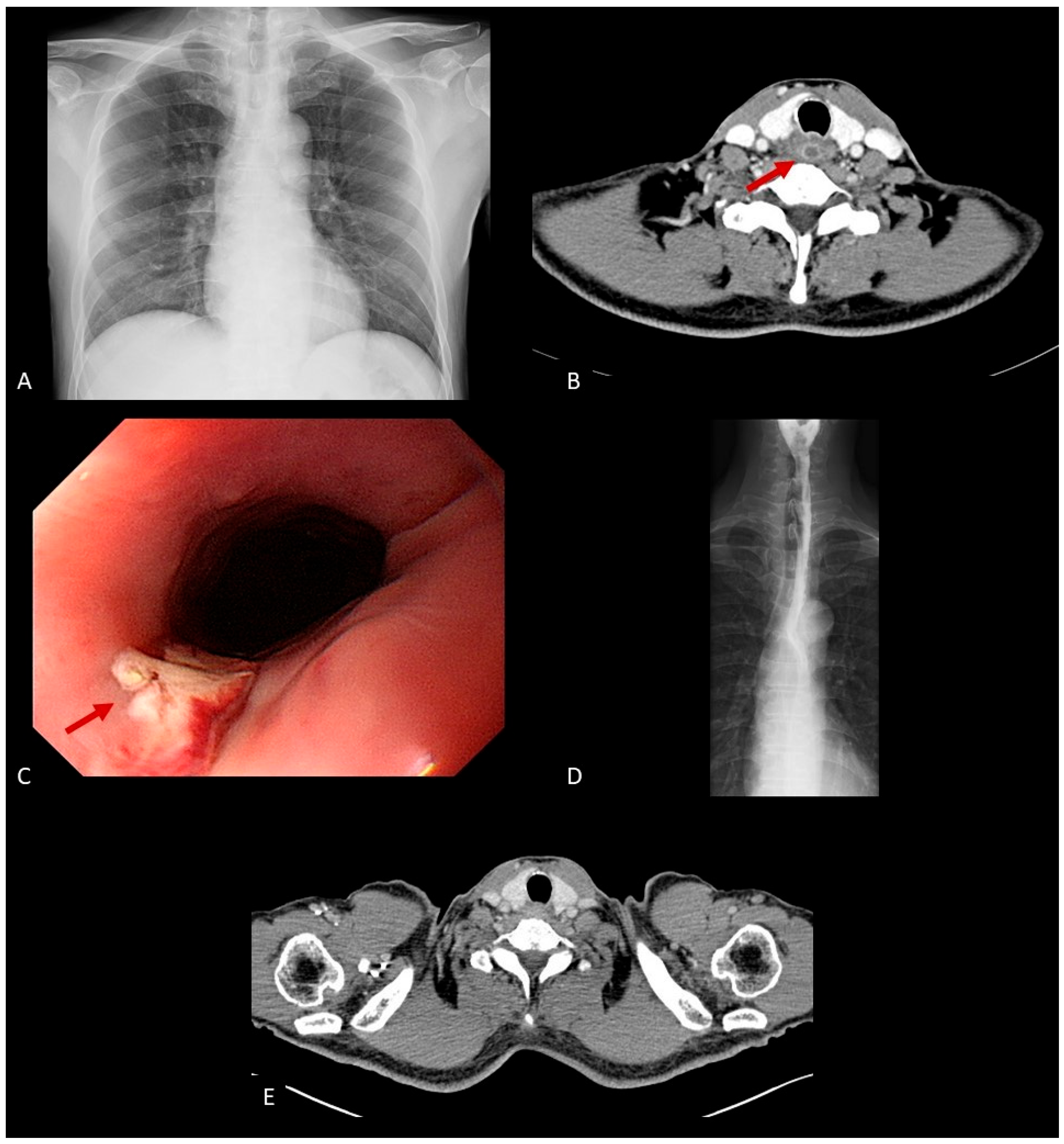
Figure 1. Imaging and endoscopic findings of intramural esophageal abscess secondary to suspected fish bone injury. (A) Chest radiograph showing no evidence of pneumomediastinum. (B) Contrast-enhanced CT of the neck demonstrating circumferential thickening of the cervical esophageal wall with a well-demarcated, low-attenuation intramural collection and mild adjacent fat stranding (arrow). (C) Upper endoscopy revealing submucosal bulging and a pinpoint mucosal defect with active pus discharge in the upper esophagus (arrow), without signs of transmural perforation or a retained foreign body. (D) Water-soluble contrast esophagogram showing smooth passage of contrast without extravasation, obstruction, or double-lumen sign, consistent with an intramural lesion. (E) Follow-up CT on day 7 indicating an interval reduction of the intramural fluid collection. The etiology of esophageal abscess, which is a rare intramural infection caused by mucosal breach without full-thickness perforation [1,2], includes iatrogenic trauma and contiguous spread, and fish bone ingestion is a leading trigger in East Asia [1,2,3,4]. The symptoms of esophageal abscess are nonspecific, and early radiographs are often normal; therefore, contrast-enhanced computed tomography (CT) should be prioritized in cases with suspicious esophageal injury [2,3,5,6,7]. Here, we report the case of a patient diagnosed with cervical esophageal abscess following fish bone impaction to underscore the need for early CT and increased clinical vigilance for the timely diagnosis of this under-recognized condition. The patient was a 57-year-old man. His medical history was notable for hypertension treated with amlodipine; he had no prior surgical history, reported a 33-year smoking history, and denied alcohol use. He presented with a 1-day history of fever and progressive odynophagia that began 3 days after a suspected fish bone impaction. Upon arrival, his vital signs were as follows: temperature, 37.7 °C; heart rate, 107 beats/min; respiratory rate, 18 breaths/min; and blood pressure, 135/66 mmHg. Neck erythema, swelling, and subcutaneous emphysema were absent on physical examination. Laboratory tests revealed leukocytosis (17,400/µL) and an elevated C-reactive protein level (8.93 mg/dL). Chest radiography was normal, ruling out pneumomediastinum (A). Contrast-enhanced CT of the neck showed circumferential thickening of the cervical esophageal wall with a well-demarcated, intramural collection with low attenuation and mild fat stranding in adjacent tissue in the absence of extraluminal air, supporting the diagnosis of intramural esophageal abscess (B). Upper endoscopy revealed submucosal bulging with a pinpoint mucosal defect that was actively discharging pus in the upper esophagus without transmural perforation or a clear sign of a retained foreign body (C). Water-soluble contrast esophagogram confirmed smooth passage without extravasation, obstruction, or the double-lumen sign, supporting the diagnosis of an intramural lesion (D). Blood cultures and pus cultures obtained during endoscopy showed no bacterial growth. The patient was initially kept nil per os and maintained with intravenous fluids for 5 days. He was treated conservatively with intravenous piperacillin/tazobactam and close observation, leading to improvement in symptoms and inflammatory marker levels. For pain control, he required only intermittent NSAID injections. The follow-up CT on day 7 of admission revealed a decline in the intramural fluid accumulation (E). He completed a 10-day course of intravenous piperacillin/tazobactam and was discharged without complications, with an additional 5-day course of oral amoxicillin/clavulanate prescribed after discharge. The patient was followed in the outpatient clinic at 1 week, 3 weeks, and 3 months. He reported no persistent or recurrent symptoms at all follow-up visits. Laboratory tests at 1 week and 3 months demonstrated normal WBC and CRP levels. Repeat CT or endoscopy was discussed, but the patient declined further evaluation because he remained asymptomatic. Esophageal abscess, an uncommon presentation, results from a mucosal laceration that enables intraluminal infection to extend into the submucosa, leading to longitudinal intramural collection without causing full-thickness perforation [1,2]. Esophageal abscesses are most commonly reported in older women and after iatrogenic manipulation or anticoagulation treatment [2]. Although rare, descending infection from parapharyngeal or tonsillar sources has also been documented [1]. In East Asia, fish bones are the predominant cause of esophageal foreign bodies, reported as the cause in 46–72% of all reported esophageal abscesses, and delayed presentation beyond 24 h increases the risk of perforation and the development of mediastinal abscesses [4]. Typically, fish bones lodge in the cervical or upper thoracic esophagus, whereas meat boluses tend to impact at more distal sites with physiologic narrowing, such as the esophageal hiatus [3,5]. Patients with esophageal abscesses typically present with retrosternal chest pain, odynophagia, dysphagia, and occasionally hematemesis [2]. Early chest or neck radiographs are often unremarkable, which can delay diagnosis [2]. CT is the most sensitive modality for detecting fish bones and intramural collections [3,5,8]. Differential diagnosis includes intramural dissection, characterized by a mucosal flap and the double-lumen sign on esophagography [7,9,10], and phlegmonous esophagitis, defined as a diffuse suppurative mural infection with rapid systemic deterioration [1]. In the present case, CT revealed a localized submucosal cavity, endoscopy showed a pinpoint draining defect, and contrast esophagogram excluded leaks and the double-lumen sign, consistent with the diagnosis of an intramural abscess. The management of esophageal abscesses centers on early sepsis control, withholding oral intake, administration of broad-spectrum intravenous antibiotics targeting oral aerobic and anaerobic flora, early nutritional support, and cross-sectional CT to determine the extent of involvement and plan intervention [1,6]. Conservative management is appropriate when the patient is hemodynamically stable without clinical sepsis, and imaging suggests a contained intramural lesion without extraluminal air or contrast leak and without extensive mediastinal or pleural contamination [1,6]. In patients with intramural collections without transmural perforation, endoscopic mucosal incision/intraluminal drainage achieves rapid decompression with clinical and radiologic resolution, and is increasingly preferred as the first-line therapeutic option [11,12]. In patients with an extensive esophageal abscess and those for whom endoscopic therapy is not feasible, surgical drainage with thoracotomy and placement of intramural and pleural drains may be necessary, while percutaneous catheter drainage can control persistent mediastinal or abdominal sepsis [1,4]. Cultures commonly yield oral streptococci [4,6], and antibiotic regimens should be tailored and de-escalated based on culture results, when feasible [4,6,13]. The constellation of imaging findings in the present case, including the presence of an intramural, low-attenuation collection without extraluminal air on CT images and the absence of a leak and the double-lumen sign on contrast esophagogram, mirrors patterns highlighted in radiologic and emergency guidelines and reliably distinguishes intramural abscess from free perforation and intramural dissection [5,7,10]. In conclusion, esophageal abscess is a rare but potentially life-threatening complication of fish bone impaction. Early CT-based diagnosis and timely antibiotic therapy are critical for favorable outcomes.
Biomed 06 00002 g001

Author Contributions

Investigation, D.-S.H.; writing—original draft preparation, D.-S.H.; investigation and writing—review and editing, T.-H.C. All authors have read and agreed to the published version of the manuscript.

Funding

This research received no external funding.

Institutional Review Board Statement

The design and execution of this retrospective study were approved by the Institutional Review Board of MacKay Memorial Hospital (25MMHIS310e; 7 August 2025).

Informed Consent Statement

Written informed consent has been obtained from the patient to publish this paper.

Data Availability Statement

Not applicable.

Conflicts of Interest

The authors declare no conflicts of interest.

Abbreviation

The following abbreviation is used in this manuscript:
CTComputed Tomography

References

  1. Amiraraghi, N.; Ewan, L.C.; Ansari, S.; Robertson, K. Intramural oesophageal abscess: An unusual complication of tonsillitis. BMJ Case Rep. 2019, 12, e226010. [Google Scholar] [CrossRef]
  2. Kumar, S.; Sakthivel, M.K.; Bosemani, T. Intramural Esophageal Abscess Complicated with Pleural Fistula: A Case Report. Cureus 2020, 12, e6846. [Google Scholar] [CrossRef]
  3. Kim, H.U. Oroesophageal Fish Bone Foreign Body. Clin. Endosc. 2016, 49, 318–326. [Google Scholar] [CrossRef] [PubMed]
  4. Han, J.H.; Cha, R.R.; Kwak, J.Y.; Jeon, H.; Lee, S.S.; Jung, J.J.; Cho, J.K.; Kim, H.J. Two Cases of Severe Complications Due to an Esophageal Fish Bone Foreign Body. Medicina 2023, 59, 1504. [Google Scholar] [CrossRef] [PubMed]
  5. Birk, M.; Bauerfeind, P.; Deprez, P.H.; Hafner, M.; Hartmann, D.; Hassan, C.; Hucl, T.; Lesur, G.; Aabakken, L.; Meining, A. Removal of foreign bodies in the upper gastrointestinal tract in adults: European Society of Gastrointestinal Endoscopy (ESGE) Clinical Guideline. Endoscopy 2016, 48, 489–496. [Google Scholar] [CrossRef]
  6. Chirica, M.; Kelly, M.D.; Siboni, S.; Aiolfi, A.; Riva, C.G.; Asti, E.; Ferrari, D.; Leppaniemi, A.; Ten Broek, R.P.G.; Brichon, P.Y.; et al. Esophageal emergencies: WSES guidelines. World J. Emerg. Surg. 2019, 14, 26. [Google Scholar] [CrossRef] [PubMed]
  7. Young, C.A.; Menias, C.O.; Bhalla, S.; Prasad, S.R. CT features of esophageal emergencies. Radiographics 2008, 28, 1541–1553. [Google Scholar] [CrossRef] [PubMed]
  8. Woo, S.H.; Kim, K.H. Proposal for methods of diagnosis of fish bone foreign body in the Esophagus. Laryngoscope 2015, 125, 2472–2475. [Google Scholar] [CrossRef]
  9. Khil, E.K.; Lee, H.; Her, K. Spontaneous intramural full-length dissection of esophagus treated with surgical intervention: Multidetector CT diagnosis with multiplanar reformations and virtual endoscopic display. Korean J. Radiol. 2014, 15, 173–177. [Google Scholar] [CrossRef] [PubMed]
  10. Yeom, S.K.; Lee, C.H.; Cha, S.H. “Double barreled esophagus” sign in the intramural dissection of esophagus. Abdom. Radiol. 2017, 42, 983–984. [Google Scholar] [CrossRef] [PubMed]
  11. Zhang, J.; Wang, H.; Liu, D. Treatment of a spontaneous intramural esophageal abscess by endoscopic mucosal incision: An easy and effective therapy. Endoscopy 2022, 54, E937–E938. [Google Scholar] [CrossRef]
  12. Kim, J.W.; Ahn, H.Y.; Kim, G.H.; Kim, Y.D.; I, H.; Cho, J.S. Endoscopic Intraluminal Drainage: An Alternative Treatment for Phlegmonous Esophagitis. Korean J. Thorac. Cardiovasc. Surg. 2019, 52, 165–169. [Google Scholar] [CrossRef] [PubMed]
  13. Li, D.; Zeng, W.; Chen, J. Fish bone migration: Complications, diagnostic challenges, and treatment strategies. World J. Emerg. Surg. 2025, 20, 35. [Google Scholar] [CrossRef]
Disclaimer/Publisher’s Note: The statements, opinions and data contained in all publications are solely those of the individual author(s) and contributor(s) and not of MDPI and/or the editor(s). MDPI and/or the editor(s) disclaim responsibility for any injury to people or property resulting from any ideas, methods, instructions or products referred to in the content.