1. Introduction
In recent decades, there has been growing recognition that mathematics is not a culturally neutral body of knowledge but rather a human activity deeply embedded in social, historical, and cultural contexts [
1,
2]. This perspective has been strongly advanced through the development of ethnomathematics, which highlights the diverse mathematical practices that emerge within specific cultural groups [
3]. Such practices include counting systems, spatial reasoning, measurement techniques, and patterns found in traditional artifacts [
4,
5], all of which demonstrate that mathematical thinking is shaped by cultural experiences and worldviews.
Parallel to this development, Realistic Mathematics Education (RME) has emphasized the importance of meaningful contexts in supporting students’ mathematical understanding [
6,
7]. RME promotes the idea that learning mathematics should begin with situations that are experientially real to learners, allowing them to engage in progressive mathematization from informal strategies toward formal mathematical concepts [
8]. In many educational settings, particularly in culturally diverse societies such as Indonesia, this principle has encouraged the integration of local cultural contexts—such as traditional games [
9], crafts [
10], and architectural practices [
11]—into mathematics instruction.
The convergence of ethnomathematics and RME has generated integrative approaches such as Ethno-Realistic Mathematics Education (Ethno-RME), which aim to connect students’ cultural knowledge with formal mathematical learning processes [
12,
13]. While this approach holds significant promise, a critical challenge remains that the selection and use of cultural contexts often risk becoming superficial or artificial. In many cases, cultural elements are merely appended to mathematical problems without reflecting the lived experiences, values, and perceptual frameworks of the learners [
14]. Consequently, the intended meaningfulness of context is attenuated, limiting students’ opportunities to engage with mathematics in ways that are experientially and conceptually significant.
Despite the significant contributions of ethnomathematics and RME, a fundamental conceptual gap remains insufficiently addressed. Existing approaches have largely focused on what counts as mathematics in culture, emphasizing the identification and incorporation of cultural practices into mathematics education [
12,
13]. However, comparatively limited attention has been directed toward understanding how mathematics becomes recognizable within culture—that is, how individuals perceive, interpret, and identify mathematically meaningful structures embedded in their everyday sociocultural environments. This gap highlights the need for a theoretical framework that explains the culturally mediated processes underlying the recognition of mathematical meaning.
Furthermore, this challenge also points to a fundamental gap in the existing literature: the lack of a conceptual framework that explains how individuals perceive, interpret, and assign meaning to culturally embedded mathematical phenomena. Although concepts such as sense-making [
15,
16], mathematical sense [
17], and cultural competence [
18] have been widely discussed, they do not fully capture the complex, culturally mediated processes through which learners come to recognize and engage with mathematical structures in everyday life. In particular, insufficient attention has been given to the dynamic interplay among sensory experience, cultural schemas, and socially constructed forms of “common sense” in shaping mathematical understanding.
To address this gap, this entry introduces and develops the concept of Ethno Sense as a theoretical construct in mathematics education. Ethno Sense is conceptualized as a culturally grounded capacity that enables individuals to perceive, select, and interpret mathematically meaningful patterns and relationships within their sociocultural environment. It extends beyond mere knowledge of cultural artifacts by emphasizing the role of sensory perception, cultural scripts, and value systems in guiding mathematical sense-making [
15,
19].
By situating Ethno Sense within interdisciplinary perspectives, including anthropology of the senses [
20], ethnolinguistics [
21], ethnoscience [
22], and ethnomathematics [
4], this study seeks to establish a comprehensive conceptual foundation for understanding the reciprocal relationship between culture and mathematics. Furthermore, Ethno Sense is positioned as a critical mechanism within Ethno-RME, enabling educators to identify and design authentic, culturally resonant learning contexts that foster meaningful and inclusive mathematical engagement.
This entry provides a structured overview of the existing literature on culture, perception, and mathematics education. It aims to conceptualize Ethno Sense and its foundational components, explicate the mechanisms through which it operates in identifying meaningful learning contexts, and examine its implications for the design and implementation of culturally responsive mathematics instruction. The analysis draws primarily on peer-reviewed publications indexed in major international databases, including Scopus, spanning disciplines such as ethnomathematics, RME, Ethno-RME, cultural studies, linguistics, and anthropology. Where relevant, historical and cultural sources are considered insofar as they are critically examined within the scholarly literature. Methodologically, the study is informed by a historical–cultural perspective and employs conceptual and comparative analysis to trace how meanings are constructed, negotiated, and reinterpreted across different cultural contexts.
The remainder of this entry is structured as follows. The next section establishes the theoretical foundations underpinning the development of Ethno Sense by synthesizing perspectives from ethnomathematics, realistic mathematics education, and cultural approaches to perception and cognition. This is followed by a conceptual elaboration of Ethno Sense as a bridging construct between culture and mathematical meaning, including a detailed account of its underlying mechanism. Subsequent sections examine the role of Ethno Sense within Ethno-Realistic Mathematics Education (Ethno-RME), with particular attention to its applications and educational implications in culturally responsive pedagogy. The entry concludes by consolidating its theoretical contributions and outlining the broader significance of Ethno Sense for advancing culturally situated approaches to mathematics education.
Finally, although Ethno Sense is grounded in culturally mediated processes, its underlying mechanism reflects a general human capacity for perceiving, organizing, and interpreting meaningful patterns in experience, suggesting its potential relevance across diverse cultural and educational contexts. In doing so, this study contributes to ongoing efforts to reconceptualize mathematics education as a culturally grounded practice, offering a systematic lens through which the reciprocal relationship between culture and mathematics can be more rigorously understood and meaningfully enacted.
2. Theoretical Background
Understanding the concept of Ethno Sense requires a comprehensive theoretical foundation that integrates perspectives from ethnomathematics, realistic mathematics education, cultural studies, and interdisciplinary approaches to human cognition and perception. The relationship between culture and mathematics has been widely explored, yet often through fragmented lenses that emphasize either cultural practices or pedagogical strategies without fully accounting for the underlying processes of meaning-making [
14,
15,
16,
17,
18,
19]. To address this limitation, it is necessary to situate Ethno Sense within a broader intellectual landscape that connects how mathematical knowledge is culturally produced, how it is pedagogically mediated, and how it is perceptually and cognitively experienced by learners. This section therefore draws on key theoretical domains—including ethnomathematics, RME, and cultural approaches to perception and knowledge—to establish a coherent framework for understanding how mathematical meaning emerges from culturally embedded experiences. By synthesizing these perspectives, the discussion provides the conceptual grounding needed to position Ethno Sense as a bridging construct between cultural experience and mathematical cognition.
2.1. Ethnomathematics: Mathematics as a Cultural Practice
The recognition of mathematics as a cultural practice has been significantly shaped by the development of ethnomathematics. Introduced by D’Ambrosio [
4], ethnomathematics challenges the notion of mathematics as a universal and culture-free discipline by emphasizing that mathematical ideas and practices are embedded within specific sociocultural contexts. It encompasses a wide range of activities, including counting, measuring, classifying, designing, and explaining phenomena as they occur in diverse cultural settings.
Ethnomathematics highlights that different cultural groups develop distinct ways of organizing and interpreting quantitative and spatial relationships [
23]. These practices are not merely informal or pre-mathematical but rather represent coherent systems of knowledge that are functional within their respective contexts. As such, ethnomathematics serves both as a critique of the dominance of Eurocentric mathematical traditions and as a framework for recognizing the legitimacy of diverse mathematical epistemologies [
24].
In educational contexts, ethnomathematics has been instrumental in promoting culturally responsive pedagogy by incorporating local knowledge and practices into mathematics instruction [
4,
23]. However, its implementation often faces challenges related to the depth of cultural integration. In some cases, cultural elements are treated as illustrative examples rather than as epistemological foundations, leading to a disconnect between students’ lived experiences and formal mathematical learning [
2,
24].
Beyond the foundational contributions of D’Ambrosio [
4], subsequent scholars have further elaborated the scope and significance of ethnomathematics. Gerdes [
25,
26], for instance, emphasized the importance of uncovering mathematical ideas embedded in cultural artifacts and practices, particularly through the study of indigenous designs, patterns, and techniques. His work highlights how mathematical thinking can be reconstructed from cultural activities such as weaving, basketry, and architecture, demonstrating that mathematical structures are often implicit within everyday practices [
25]. This perspective extends ethnomathematics beyond documentation toward analytical reconstruction of culturally situated mathematical knowledge.
In a complementary vein, Bishop’s [
14] notion of mathematical enculturation provides a broader framework for understanding how mathematical ideas are culturally transmitted and socially constructed. Bishop [
27] identifies fundamental mathematical activities, such as counting, locating, measuring, designing, playing, and explaining, as universal yet culturally shaped practices through which individuals develop mathematical understanding. From this perspective, mathematics learning is not merely the acquisition of abstract knowledge, but a process of participation in culturally organized forms of activity [
14,
27]. This view reinforces the argument that mathematical cognition is deeply embedded within cultural experience.
Together, these perspectives strengthen the view that mathematics is both culturally situated and socially mediated [
4,
14,
23,
25,
26,
27]. They also provide an important foundation for the development of Ethno Sense, which seeks to explain not only the presence of mathematical ideas in culture, but also the processes through which such ideas become perceptually and interpretively accessible to learners.
2.2. Realistic Mathematics Education: Context and Sense-Making
RME, developed in the Netherlands, offers a complementary perspective by emphasizing the role of meaningful contexts in learning mathematics [
7,
8]. Central to RME is the idea that mathematics should be experienced as a human activity, where learners actively construct knowledge through engagement with situations that are experientially real [
8]. Furthermore, a key concept in RME is progressive mathematization, which refers to the process by which students move from informal, context-bound strategies toward more formal and abstract mathematical reasoning [
7]. This process is supported by the use of contexts that are meaningful to students, enabling them to develop what is often referred to as mathematical sense-making [
28].
Despite its strengths, the notion of “realistic” contexts in RME has been subject to varying interpretations [
7]. What is considered meaningful or realistic is not universally defined, but rather depends on learners’ cultural backgrounds, experiences, and perceptual frameworks. Without careful consideration of these factors, contexts used in RME may fail to resonate with students, reducing their effectiveness in supporting deep understanding.
2.3. Toward Integration: Ethno-Realistic Mathematics Education
The integration of ethnomathematics and RME has led to the emergence of Ethno-RME, an approach that seeks to connect culturally grounded knowledge with the principles of realistic mathematics learning [
12]. Ethno-RME utilizes cultural artifacts, practices, and local activities as starting points for mathematical exploration, thereby bridging informal cultural knowledge and formal mathematical concepts [
13].
Empirical studies, particularly in culturally rich contexts such as Indonesia, have demonstrated that Ethno-RME can enhance students’ conceptual understanding, critical thinking, and engagement [
9,
10]. By situating mathematics within familiar cultural settings, this approach allows learners to perceive mathematics as relevant and meaningful to their daily lives.
However, a persistent challenge in Ethno-RME lies in the identification and selection of appropriate cultural contexts. Not all cultural elements inherently support mathematical learning, and the process of determining which contexts are meaningful often lacks a clear theoretical basis. This raises an important question: how do educators recognize and interpret culturally embedded phenomena as mathematically significant?
2.4. Cultural Perception and the Anthropology of the Senses
To address this question, it is necessary to consider insights from the anthropology of the senses, which examines how sensory perception is shaped by cultural systems [
20]. This field argues that perception is not merely a biological process, but is mediated by cultural norms, practices, and values that influence how individuals experience and interpret the world [
22].
Different cultures prioritize and organize sensory experiences in distinct ways, leading to what can be described as culturally specific sensory models [
29]. These models affect how individuals attend to their environment, what they consider significant, and how they construct meaning from sensory input. Consequently, the recognition of patterns, relationships, and structures—including those that can be interpreted mathematically—is influenced by culturally conditioned perception.
In addition, anthropological perspectives on common sense suggest that everyday knowledge is socially constructed and taken for granted within a cultural group [
30]. This form of practical knowledge guides individuals’ actions and interpretations in routine situations, providing an implicit framework for understanding the world. In the context of mathematics learning, such culturally embedded common sense can serve as a foundation for mathematical reasoning, even if it is not explicitly recognized as such.
2.5. Cultural Linguistics and Ethnoscience: Meaning, Knowledge, and Interpretation
Further insights can be drawn from ethnolinguistics [
21] and ethnoscience [
22], which explore how language and knowledge systems shape human understanding. Ethnolinguistics emphasizes that language encodes cultural meanings and categories, influencing how individuals conceptualize and communicate their experiences [
21]. Cultural scripts, keywords, and semantic structures reflect shared ways of thinking that guide interpretation and interaction.
Ethnoscience, on the other hand, examines how different cultures develop systematic knowledge about their environment [
22]. It recognizes that local and indigenous knowledge systems are structured, logical, and adapted to specific ecological and social contexts [
18]. These knowledge systems include methods of classification, measurement, and explanation that can be seen as parallel to scientific and mathematical reasoning.
These perspectives from ethnolinguistics [
21] and ethnoscience [
22] are not only relevant as supporting theoretical domains but also play a central role in informing the conceptualization of Ethno Sense. Ethnolinguistics, through its focus on cultural meanings encoded in language, provides insight into how interpretive schemas are shaped and activated in context [
21]. Linguistic structures, cultural scripts, and shared semantic categories influence how individuals organize experience and assign meaning to observed phenomena, including those with potential mathematical relevance [
31].
Similarly, ethnoscience contributes to understanding how culturally structured knowledge systems guide classification, pattern recognition, and relational thinking [
22]. These knowledge systems reflect systematic ways of organizing the world, often involving implicit principles that parallel mathematical reasoning [
16,
19]. As such, they form an important basis for the recognition of mathematically salient structures within everyday practices.
By integrating these perspectives, Ethno Sense can be understood as emerging from the interaction between perception, language, and culturally organized knowledge. This integration reinforces the view that the recognition of mathematical meaning is not solely a cognitive process, but one that is deeply shaped by cultural systems of interpretation and understanding [
16,
19]. Consequently, ethnolinguistics and ethnoscience provide essential conceptual support for explaining how schema activation and value-informed interpretation operate within the mechanism of Ethno Sense.
2.6. Identifying the Conceptual Gap
Across these theoretical perspectives, a common theme emerges: mathematics, perception, and meaning-making are deeply intertwined with culture [
15,
16,
17,
18,
19]. Ethnomathematics emphasizes cultural practices [
4], RME highlights contextual learning [
7], and anthropological and linguistic approaches reveal the cultural nature of perception and interpretation [
20,
21]. However, there remains a lack of a unifying construct that explains how individuals, particularly learners and educators, perceive and make sense of mathematically relevant phenomena within their cultural environments.
Existing concepts such as mathematical sense-making [
19] and cultural competence [
18] provide partial insights, but they do not fully account for the sensory, perceptual, and schema-based processes involved in recognizing mathematical meaning in cultural contexts. This gap underscores the need for a more integrated conceptual framework that can bridge these perspectives. Therefore, it is within this context that the notion of Ethno Sense is proposed, serving as a theoretical lens to explain how culturally mediated perception and cognition enable individuals to identify, interpret, and engage with mathematical structures embedded in everyday life.
3. Ethno Sense as a Bridge Between Culture and Mathematical Meaning
Building upon the intersection of ethnomathematics, cultural studies, and mathematics education, Ethno Sense is proposed to address the shift from understanding what counts as mathematics in culture toward explaining how mathematics becomes recognizable within culture through culturally mediated processes of perception and interpretation. At its core, Ethno Sense refers to a culturally mediated capacity through which individuals perceive, interpret, and assign mathematical meaning to phenomena embedded in their sociocultural environment.
In its concise form, Ethno Sense can be defined as a culturally mediated cognitive–perceptual capacity through which individuals discern, select, and interpret mathematically salient structures embedded in socially situated practices. This definition foregrounds three interrelated processes—perception, selection, and interpretation—which operate as the foundational mechanisms through which mathematical meaning emerges from everyday experience.
Extending this formulation, Ethno Sense encompasses the activation of culturally shared sensory orientations, interpretive schemas, and value-laden systems of meaning. These elements collectively shape how individuals attend to their environment, determine what is considered significant, and construct interpretations that may carry mathematical relevance. In this sense, Ethno Sense is not merely an individual cognitive ability, but a culturally situated mode of engagement with the world.
Importantly, Ethno Sense can be conceptualized as a pre-formal layer of mathematical cognition. At this level, culturally conditioned perception and interpretation guide the recognition of potentially mathematical structures prior to their formalization into symbolic or abstract representations. This positioning distinguishes Ethno Sense from more established constructs such as mathematical reasoning [
32] or problem-solving [
33], which typically operate after mathematical structures have already been identified.
By framing Ethno Sense in this way, the focus of mathematics education shifts from how learners solve problems to how they come to recognize situations as mathematically meaningful in the first place. This shift is particularly significant in culturally diverse contexts, where what counts as “meaningful” is shaped by shared experiences, practices, and value systems [
34].
In a more elaborative sense, Ethno Sense reflects an integrated form of awareness that combines sensory perception, embodied experience, and culturally situated knowledge. It enables individuals to recognize patterns, relationships, and structures that may not be immediately apparent within formal mathematical frameworks yet are meaningful and functional within specific cultural contexts. As such, Ethno Sense provides a critical conceptual bridge between lived experience and formal mathematical understanding. This perspective aligns with broader views of human cognition in which perception is inherently linked to association, pattern recognition, and interpretation, forming the basis through which individuals construct meaning from their everyday experiences.
3.1. Core Characteristics of Ethno Sense
Ethno Sense can be understood through several defining characteristics that distinguish it from existing constructs:
3.1.1. Culturally Mediated Perception
Perception is not treated as a purely biological process but as one shaped by cultural practices and norms [
35]. Individuals from different cultural backgrounds may attend to different aspects of the same phenomenon, leading to varied interpretations of what is considered significant or meaningful [
36].
3.1.2. Embodied and Sensory-Based Understanding
Ethno Sense involves the integration of sensory experiences [
20,
29]—such as visual patterns, spatial arrangements, tactile interactions, and auditory rhythms—into the process of meaning-making [
15,
16]. These sensory engagements are culturally organized and contribute to how mathematical ideas are experienced and internalized.
3.1.3. Schema-Driven Interpretation
Cultural schemas, including scripts, routines, and shared practices, play a crucial role in guiding interpretation [
37]. Ethno Sense allows individuals to draw upon these schemas to make sense of situations, identifying implicit structures that can be mathematized.
3.1.4. Value-Laden Meaning-Making
The interpretation of phenomena is influenced by cultural values and historical contexts [
38]. What is considered relevant, useful, or meaningful is not universal, but shaped by collective beliefs and social priorities.
3.1.5. Context-Sensitive Recognition of Mathematical Structures
Ethno Sense enables individuals to identify mathematical relationships within authentic contexts, rather than relying solely on decontextualized or abstract representations.
3.2. Dimensions of Ethno Sense
To further operationalize the construct, Ethno Sense can be conceptualized as consisting of three interrelated dimensions:
3.2.1. Sensory-Cultural Perception
This dimension refers to the culturally shaped ways in which individuals perceive and attend to their environment [
35,
39]. It involves recognizing cues, patterns, and signals that are meaningful within a particular cultural setting. For example, patterns in traditional textiles or spatial arrangements in local architecture may be perceived differently depending on one’s cultural familiarity.
3.2.2. Cultural Schema Activation
This dimension involves the activation of culturally embedded knowledge structures that guide interpretation [
36]. These schemas include habitual practices, social norms, and shared understandings that provide a framework for making sense of experiences. Through this process, individuals can interpret everyday activities—such as trading, crafting, or playing traditional games—as structured and potentially mathematical.
3.2.3. Contextual Meaning-Making
This dimension refers to the process of assigning meaning to perceived phenomena by integrating sensory input and cultural schemas with situational context [
34,
38]. It is through this integration that mathematical relevance emerges, allowing individuals to recognize opportunities for quantification, measurement, patterning, or modeling.
These dimensions are not discrete stages, but rather dynamically interact in shaping how individuals engage with culturally embedded mathematical phenomena.
3.3. Distinguishing Ethno Sense from Related Constructs
While Ethno Sense shares conceptual space with several established constructs, it offers a distinct perspective:
3.3.1. Mathematical Sense/Number Sense
These concepts focus primarily on numerical intuition and cognitive abilities related to mathematical reasoning [
40]. In contrast, Ethno Sense emphasizes the cultural and perceptual processes that precede and inform such reasoning.
3.3.2. Sense-Making in Mathematics Education
Sense-making generally refers to the process of constructing meaning during problem-solving [
19,
30,
33]. Ethno Sense extends this notion by highlighting the cultural and sensory foundations that shape what is perceived as meaningful in the first place.
3.3.3. Cultural Competence
Cultural competence involves the ability to interact effectively across cultures [
37,
38]. While related, it does not specifically address the perception and interpretation of mathematical structures within cultural practices.
3.3.4. Funds of Knowledge
This concept recognizes the knowledge embedded in household and community practices [
41]. Ethno Sense complements this by focusing on the mechanisms through which such knowledge is perceived and transformed into mathematical understanding. While Funds of Knowledge emphasizes the presence of culturally embedded knowledge within households and communities, Ethno Sense extends this perspective by explicating the perceptual and interpretive mechanisms through which such knowledge becomes recognizable as mathematically meaningful.
Through these distinctions, Ethno Sense positions itself as a bridging construct that connects cultural experience with mathematical cognition, offering a more nuanced understanding of how learners engage with mathematics in culturally meaningful ways.
3.4. Ethno Sense as a Foundational Lens
As a conceptual lens, Ethno Sense provides a foundation for rethinking how mathematical contexts are identified and utilized in educational settings. It shifts the focus from merely incorporating cultural elements to understanding how learners perceive and interpret those elements as meaningful and mathematically relevant.
By foregrounding the role of culturally mediated perception and interpretation, Ethno Sense opens new possibilities for designing learning experiences that are not only contextually relevant but also epistemologically grounded in learners’ lived realities. This perspective is particularly significant for approaches such as Ethno-RME, where the authenticity of context plays a central role in supporting meaningful learning [
12,
13]. Finally, while Ethno Sense is conceptually related to existing constructs in mathematics education, it is important to delimit its scope. Ethno Sense does not aim to replace ethnomathematics or RME, nor does it function as a pedagogical model or instructional design framework. Instead, it is proposed as a pre-formal, cognitive–perceptual construct that explains how individuals come to recognize mathematical meaning within culturally embedded experiences. In this sense, Ethno Sense operates at a different analytical level, focusing on the processes of perception, selection, and interpretation that precede formal mathematical reasoning and instructional design.
4. Mechanism of Ethno Sense
To move beyond a purely definitional account, Ethno Sense must be understood in terms of how it functions as a mechanism through which individuals recognize and construct mathematical meaning from culturally embedded experiences. As a culturally mediated, pre-formal layer of mathematical cognition, Ethno Sense operates through a dynamic interplay of perceptual, interpretive, and evaluative processes that guide attention toward mathematically salient features of everyday practices. These processes are further shaped by culturally structured linguistic and knowledge systems, as highlighted in ethnolinguistics and ethnoscience, which influence how schemas are activated, refined, and applied in specific contexts.
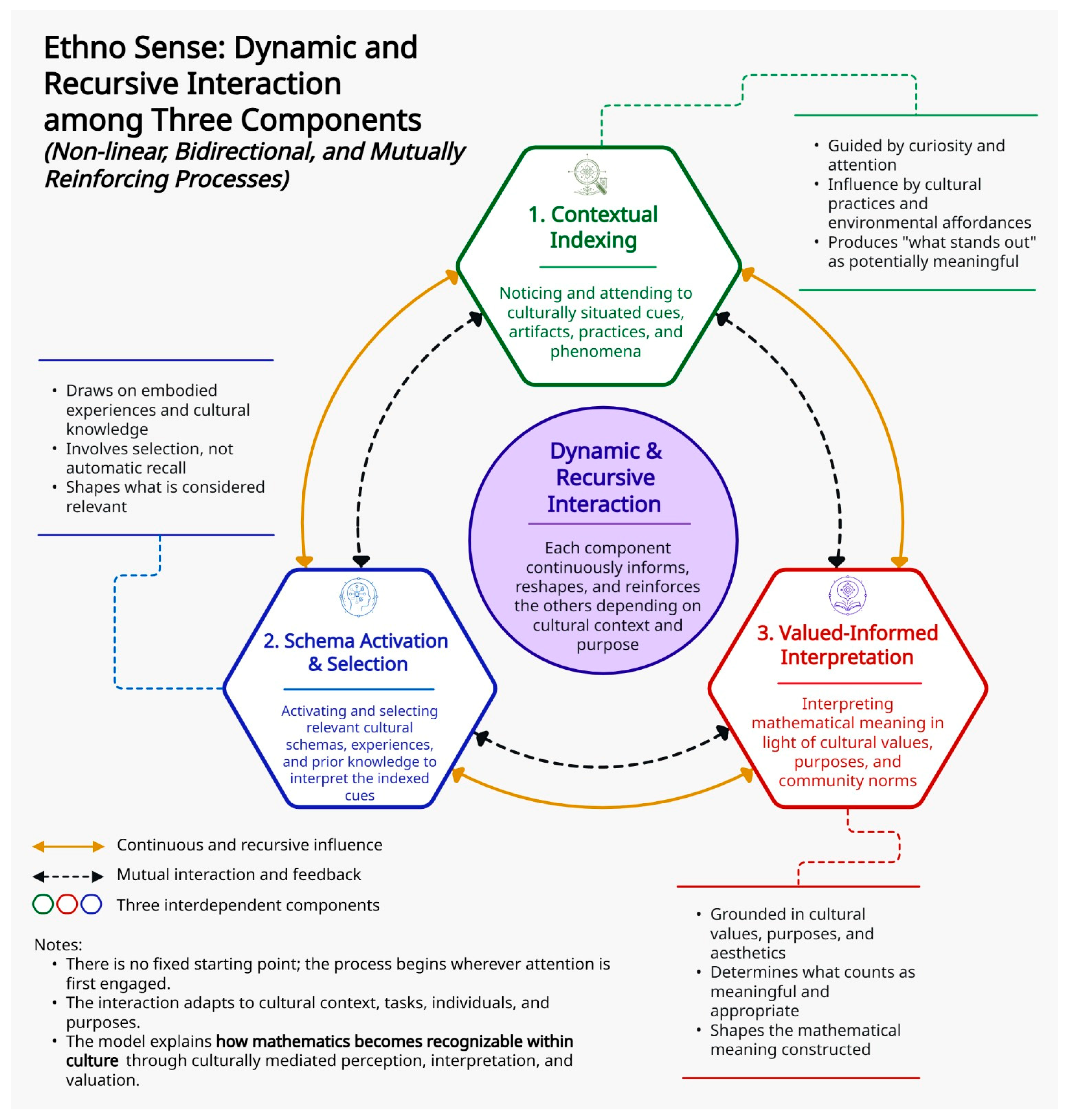
This entry conceptualizes the mechanism of Ethno Sense as a recursive process consisting of three interrelated components, namely contextual indexing, schema activation and selection, and value-informed interpretation. These components do not operate linearly; rather, they interact dynamically, shaping and reinforcing one another as individuals engage with their sociocultural environment as illustrated in
Figure 1. It explains the dynamic and recursive interaction among the components of Ethno Sense. The three processes, namely contextual indexing, schema activation and selection, and value-informed interpretation, operate in a non-linear and mutually reinforcing manner. Rather than following a fixed sequence, each component continuously informs and reshapes the others in a bidirectional and recursive manner.
4.1. Contextual Indexing
The first component, contextual indexing, refers to the process by which individuals identify and attend to culturally meaningful cues within a given situation. These cues may include visual patterns, spatial arrangements, repetitive actions, linguistic markers, or socially structured activities that signal potential relevance.
Contextual indexing is inherently selective and culturally conditioned. What is noticed as significant in one cultural setting may be overlooked in another, as attention is guided by culturally shaped sensory orientations and prior experiences. For example, in traditional practices such as weaving, construction, or local games, certain regularities or structures may be perceived as ordinary by insiders but remain invisible to outsiders.
Through contextual indexing, individuals begin to isolate elements of a situation that may serve as entry points for further interpretation. Importantly, this process does not yet involve formal mathematical reasoning; rather, it establishes the perceptual groundwork upon which mathematical meaning can emerge.
4.2. Schema Activation and Selection
The second component, schema activation and selection, involves the mobilization of culturally embedded knowledge structures that provide interpretive frameworks for understanding the indexed context. These schemas include habitual practices, social norms, procedural routines, and culturally shared “scripts” that inform how situations are typically understood and navigated.
When individuals encounter a context, multiple schemas may be potentially relevant. Ethno Sense enables the selective activation of those schemas that align with the perceived cues and the sociocultural framing of the situation. This selection process is critical, as it determines whether a phenomenon is interpreted in ways that reveal underlying structures, including those that may be mathematized.
For instance, an activity such as a traditional game may be interpreted merely as entertainment, or alternatively as a structured system involving fairness, chance, or strategic distribution. The activation of particular schemas influences whether such mathematical dimensions become salient.
4.3. Value-Informed Interpretation
The third component, value-informed interpretation, refers to the process by which individuals assign meaning and significance to the interpreted structures based on culturally embedded values and historical contexts. At this stage, perception and schema-based understanding are further filtered through value systems that determine what is considered relevant, useful, or worthy of attention.
Values such as cooperation, efficiency, balance, hierarchy, or harmony may shape how individuals interpret patterns and relationships within a context. These values influence not only what is recognized as meaningful, but also how it is evaluated in relation to broader social and cultural purposes.
Within this component, mathematically salient structures begin to emerge more explicitly, as individuals recognize relationships such as symmetry, proportionality, iteration, or distribution as meaningful within the given context. However, these recognitions remain situated and informal, prior to formal abstraction.
4.4. Recursive and Dynamic Interaction
Although presented as distinct components, contextual indexing, schema activation, and value-informed interpretation operate recursively rather than sequentially. Interpretation may redirect attention to new cues, while emerging meanings may trigger the activation of alternative schemas. This dynamic interaction reflects the fluid nature of meaning-making in real-world contexts.
As individuals engage repeatedly with similar cultural practices, these processes become increasingly refined, leading to a more developed Ethno Sense. Over time, this refinement enhances the ability to recognize mathematically meaningful structures with greater sensitivity and precision.
4.5. From Ethno Sense to Mathematical Formalization
The mechanism of Ethno Sense ultimately serves as a bridge between lived experience and formal mathematics. By guiding the recognition of mathematically salient structures within culturally meaningful contexts, Ethno Sense creates the conditions for subsequent processes of mathematization.
Once structures have been identified through Ethno Sense, they can be progressively formalized through the introduction of symbols, representations, and generalizations. In this way, Ethno Sense does not replace formal mathematical reasoning, but rather precedes and enables it by shaping how situations are initially perceived and interpreted. This perspective highlights the importance of cultivating Ethno Sense in educational settings, as it determines not only how students solve mathematical problems, but also how they come to see the world as mathematically meaningful.
4.6. Illustrative Example of Ethno Sense in Practice
To clarify how the mechanism of Ethno Sense operates in real contexts, consider the example of students engaging with traditional batik patterns. When students are invited to observe a batik cloth, they may first notice recurring diagonal lines or symmetrical motifs. This initial noticing represents contextual indexing, where culturally familiar visual cues are identified as salient features.
Subsequently, students may relate these patterns to their prior cultural experiences, such as observing batik-making processes or traditional weaving practices within their community. This process reflects schema activation and selection, as culturally embedded knowledge structures are mobilized to interpret the observed phenomena.
At a deeper level, students may interpret the patterns through culturally shared values, such as keselarasan (harmony), balance, or continuity. This stage corresponds to value-informed interpretation, where meaning is constructed in relation to socio-cultural beliefs and practices. At this point, the patterns are not yet understood in formal mathematical terms but are recognized as meaningful and structured within a cultural frame.
Building upon this pre-formal recognition, the teacher can then guide students toward mathematical formalization, for example by identifying transformations such as symmetry, reflection, or translation within the observed patterns. In this way, Ethno Sense serves as a foundational mechanism that enables the transition from culturally situated perception to formal mathematical reasoning.
5. Ethno Sense in Ethno-RME: Applications and Educational Implications
The integration of Ethno Sense into Ethno-RME offers a robust conceptual foundation for addressing a central challenge in culturally responsive mathematics pedagogy: the identification and use of meaningful, non-artificial learning contexts. By theorizing Ethno Sense as a pre-formal, culturally mediated layer of mathematical cognition, it becomes possible to reconceptualize how contexts are selected, interpreted, and transformed into opportunities for mathematical learning. Rather than positioning mathematics as a collection of ready-made abstractions to be memorized, Ethno Sense foregrounds the importance of engaging learners in culturally meaningful activities through which mathematical structures can be discerned, negotiated, and progressively formalized.
5.1. Ethno Sense as an Epistemological Foundation of Ethno-RME
Within Ethno-RME, learning is expected to emerge from contexts that are experientially real and culturally meaningful to students. However, the notion of “realistic” has often been interpreted in a general or universal sense, without sufficient attention to cultural specificity [
7]. Ethno Sense addresses this limitation by providing a lens through which “realistic” contexts are understood as culturally constructed and perceptually mediated.
In this regard, Ethno Sense functions as an epistemological foundation of Ethno-RME. It shifts the focus from merely incorporating cultural artifacts into instruction to understanding how such artifacts are perceived, interpreted, and experienced by learners. This perspective ensures that cultural contexts are not treated as superficial embellishments, but as authentic sources of mathematical meaning grounded in students’ lived realities.
5.2. Guiding the Selection of Culturally Meaningful Contexts
One of the primary applications of Ethno Sense lies in its role as a guiding framework for selecting instructional contexts. Through the mechanism of contextual indexing, schema activation, and value-informed interpretation, educators can more systematically identify cultural practices that contain mathematically salient structures.
Rather than selecting contexts based solely on their apparent cultural relevance, Ethno Sense encourages educators to consider:
Whether the context carries recognizable sensory cues for learners,
Whether it activates familiar cultural schemas, and
Whether it embodies values that resonate with students’ social experiences.
This approach increases the likelihood that students will perceive the context as meaningful and engage more deeply in the process of mathematization. For example, traditional practices such as local or traditional games [
9], craft-making [
10], or community-based activities [
11] may offer rich opportunities for exploring mathematical ideas when they are approached through the lens of Ethno Sense.
5.3. Supporting Progressive Mathematization
Ethno Sense plays a critical role in facilitating progressive mathematization, a core principle of RME [
8]. By enabling learners to recognize mathematically relevant structures within familiar contexts, Ethno Sense provides the initial grounding necessary for the transition from informal reasoning to formal mathematical representation.
In this process, students do not begin with abstract symbols, but with culturally meaningful experiences that “make sense” within their own frames of reference. Ethno Sense allows these experiences to be perceived as structured and interpretable, thereby supporting the emergence of mathematical ideas such as pattern, relation, measurement, and transformation.
As learners engage in guided reinvention, the teacher’s role is to scaffold the transition from culturally situated understanding to more formal mathematical concepts. Ethno Sense thus operates as the entry point for mathematization, ensuring that abstraction is rooted in meaningful experience rather than imposed externally.
5.4. Strengthening Sense of Place and Cultural Identity
Another important implication of Ethno Sense is its contribution to the development of a rooted sense of place in mathematics learning. By engaging with contexts that are embedded in local culture, students are encouraged to see mathematics as connected to their community, environment, and identity. This connection fosters a sense of belonging and relevance, counteracting the perception of mathematics as detached or culturally alien. Ethno Sense supports this process by highlighting how mathematical meaning is already present within students’ lived experiences, rather than something that must be imported from external or dominant knowledge systems.
In culturally diverse societies, this approach is particularly valuable for promoting inclusive education. It affirms the legitimacy of local knowledge systems and encourages learners to view their cultural background as an asset in mathematical thinking [
42].
5.5. Facilitating the Internalization of Socio-Cultural Values
Ethno Sense also enables the identification and integration of socio-cultural values within mathematics learning. Cultural practices are not value-neutral; they embody norms, beliefs, and principles that shape how individuals interact with one another and their environment [
43].
By engaging with culturally meaningful contexts, students are exposed to values such as cooperation, fairness, balance, and collective responsibility. Through the interpretive processes of Ethno Sense, these values can be recognized and reflected upon alongside mathematical structures. This integration aligns with broader educational goals that emphasize character development and holistic learning. In this sense, Ethno-RME informed by Ethno Sense does not only support cognitive development but also contributes to the cultivation of socially and culturally grounded learners.
5.6. Implications for Teaching Practice
The incorporation of Ethno Sense into teaching practice requires a shift in the role of the teacher from a transmitter of knowledge to a designer of culturally meaningful learning experiences. Teachers are expected to develop their own Ethno Sense in order to:
Recognize mathematically rich phenomena within local cultural practices,
Interpret these phenomena through culturally informed perspectives, and
Design tasks that enable students to engage in meaningful mathematization.
This process involves ongoing reflection, cultural sensitivity, and familiarity with students’ sociocultural backgrounds. It also requires moving beyond standardized or decontextualized instructional materials toward more flexible and context-responsive approaches.
5.7. Toward Literacy, Matheracy, and Technoracy
Finally, the development of Ethno Sense contributes to broader educational competencies, including literacy, matheracy, and technoracy. By engaging with culturally meaningful contexts, students enhance their ability to interpret information, reason mathematically, and apply knowledge in practical and socially relevant ways.
Ethno Sense supports the integration of these competencies by situating learning within contexts that require interpretation, analysis, and application. As such, it aligns with contemporary educational frameworks that emphasize not only knowledge acquisition, but also the capacity to navigate complex, culturally diverse environments.
In summary, Ethno Sense provides a critical conceptual and practical bridge within Ethno-RME, linking cultural experience with mathematical learning. It enables the selection of authentic contexts, supports the process of mathematization, strengthens cultural identity, and integrates socio-cultural values into instruction. Through these contributions, Ethno Sense enhances the potential of Ethno-RME to deliver meaningful, inclusive, and contextually grounded mathematics education.
6. The Impact of Defining Ethno Sense in the Ethno-RME Learning Approach
This entry set out to address a fundamental gap in mathematics education: the lack of a conceptual framework that explains how culturally embedded experiences are perceived and recognized as mathematically meaningful. While existing approaches such as ethnomathematics [
4,
23] and RME [
6,
7,
8] have emphasized the importance of culture and context, they have provided limited insight into the underlying processes through which individuals come to identify mathematical structures within everyday life. In response, this study introduced and developed the concept of Ethno Sense as a culturally mediated, pre-formal layer of mathematical cognition.
The proposed construct contributes to the field in several important ways. First, it advances the theoretical discourse in ethnomathematics by shifting the focus from the documentation of cultural mathematical practices to the mechanisms through which such practices are perceived and interpreted [
23,
24]. This shift moves the conversation beyond “what counts as mathematics in culture” toward “how mathematics becomes recognizable within culture.” In doing so, Ethno Sense offers a more process-oriented understanding of the relationship between culture and mathematics.
Second, Ethno Sense provides a conceptual bridge between ethnomathematics and RME. While ethnomathematics emphasizes cultural diversity in mathematical practices and RME highlights the importance of meaningful contexts, Ethno Sense explains how these contexts become meaningful in the first place. By positioning perception [
29,
35], schema activation [
37], and value-informed interpretation as central processes [
34,
36], this construct integrates cultural and cognitive dimensions of learning in a coherent framework.
Third, the notion of Ethno Sense responds to ongoing critiques regarding the superficial integration of culture in mathematics education. In many instructional practices, cultural elements are included as decorative or contextual additions without engaging the underlying systems of meaning that make them significant to learners [
15,
16,
17,
18,
19,
20]. Ethno Sense addresses this issue by emphasizing the need for culturally grounded perception and interpretation, thereby supporting the selection of authentic and resonant learning contexts.
From a broader perspective, the introduction of Ethno Sense aligns with global movements toward more inclusive and culturally responsive education. It resonates with efforts to decolonize knowledge systems by challenging the dominance of universalist and decontextualized views of mathematics [
4]. By recognizing that mathematical meaning is, at least in part, culturally mediated, this framework affirms the legitimacy of diverse ways of knowing and interpreting the world.
While ethnomathematics focuses on identifying and valuing mathematical practices within cultural contexts, and RME emphasizes the use of meaningful contexts for learning, neither framework explicitly explains the underlying processes through which such contexts become recognizable as mathematically meaningful. Ethno Sense addresses this gap by shifting the focus from what constitutes mathematics in culture and how mathematics is taught through context toward how mathematical meaning is perceptually and interpretively constituted within cultural experience. This distinction positions Ethno Sense as a complementary, rather than overlapping, construct that operates at the level of culturally mediated cognition.
However, the conceptual nature of this study also presents certain limitations. The framework has been developed through an interpretive synthesis of existing literature and has not yet been empirically validated. As such, its explanatory power and practical applicability require further investigation in real educational settings. Additionally, the interdisciplinary scope of the concept may pose challenges in operationalization, particularly in translating abstract components such as sensory orientations and cultural schemas into observable or measurable constructs.
These limitations point to several directions for future research. Empirical studies are needed to examine how Ethno Sense manifests in classroom interactions, how it can be developed among teachers and students, and how it influences learning outcomes. Design-based research could explore how instructional materials and tasks can be systematically informed by Ethno Sense. Furthermore, cross-cultural studies may provide insights into how different sensory and cultural configurations shape mathematical perception and understanding.
7. Conclusions
This entry has proposed Ethno Sense as a novel conceptual construct that captures the culturally mediated processes through which individuals perceive, select, and interpret mathematically meaningful structures within their everyday environments. By positioning Ethno Sense as a pre-formal layer of mathematical cognition, this study underscores the critical role of perception and interpretation as foundational stages in the development of mathematical understanding.
Drawing on insights from ethnomathematics, RME, and related interdisciplinary fields, the entry has developed a coherent theoretical framework that integrates cultural, cognitive, and perceptual dimensions of learning. The proposed mechanism of Ethno Sense—comprising contextual indexing, schema activation and selection, and value-informed interpretation—provides a systematic account of how mathematical meaning emerges from culturally embedded experiences.
Within the context of Ethno-RME, Ethno Sense functions as both a conceptual lens and a practical guide. It supports educators in identifying authentic cultural contexts, facilitates the process of progressive mathematization, and enables the integration of cognitive and socio-cultural aspects of learning. Through these contributions, Ethno Sense enhances the potential of mathematics education to become more meaningful, inclusive, and responsive to learners’ lived realities.
More broadly, Ethno Sense contributes to a reorientation of mathematics education as a culturally situated practice. It shifts the emphasis from viewing mathematics as a fixed and decontextualized body of knowledge toward understanding it as a dynamic process of meaning-making grounded in human experience. This perspective opens new avenues for both research and practice that acknowledge and leverage the reciprocal relationship between culture and mathematics. By foregrounding the role of culturally mediated perception in mathematical thinking, this study invites educators and researchers to reconsider a fundamental question: not only how mathematics is taught or learned, but how it is first recognized as meaningful.
Author Contributions
Conceptualization, R.C.I.P. and N.R.N.P.; methodology, R.C.I.P. and I.A.; validation, W.H., I.A., R.C.I.P. and N.R.N.P.; investigation, R.C.I.P. and W.H.; writing—original draft preparation, R.C.I.P. and W.H.; writing—review and editing, R.C.I.P., W.H., N.R.N.P. and I.A.; visualization, R.C.I.P.; supervision, I.A. All authors have read and agreed to the published version of the manuscript.
Funding
This research received no external funding. However, the preparation of this article was undertaken as part of the Fulbright Visiting Scholar (FVS) Program, which was fully funded by Fulbright for a six-month period at Western Michigan University.
Institutional Review Board Statement
Not applicable.
Informed Consent Statement
Not applicable.
Data Availability Statement
No new data were created or analyzed in this study. Data sharing is not applicable to this article.
Acknowledgments
The authors express their profound gratitude to the late Ubiratan D’Ambrosio and Hans Freudenthal for their foundational contributions to the fields of ethnomathematics and Realistic Mathematics Education, which have deeply informed the conceptual and intellectual orientation of this work. The authors also extend their sincere appreciation to Milton Rosa, Zulkardi, Daniel Clark Orey, and Sutarto Hadi for their scholarly contributions and for advancing the development and dissemination of ethnomathematics and Realistic Mathematics Education, which have directly and indirectly influenced this study. In addition, the authors gratefully acknowledge the institutional support provided by Universitas Ahmad Dahlan, Institut Keguruan dan Ilmu Pendidikan Siliwangi, Universitas Muhammadiyah Makassar, and Western Michigan University. The resources, academic environment, and access to scholarly materials offered by these institutions were instrumental in facilitating the completion of this systematic review. The authors would also like to thank Pujianto for inspiring the initial idea for this paper and Dwi Astuti for her valuable assistance in refining the graphical representation of the Ethno Sense framework. Finally, generative AI tools, including NotebookLM, Perplexity Pro, ChatGPT Go, and Scopus AI, were used in a limited, supportive capacity to assist with preliminary idea exploration, identification of relevant literature, language refinement, and minor phrasing adjustments. These tools were not employed for the generation of substantive scholarly content. All aspects of the study’s conceptualization, analytical procedures, interpretation of findings, and synthesis of the literature were carried out independently by the authors and were critically verified to ensure academic rigor, accuracy, and integrity. The authors have carefully reviewed and edited all text and take full responsibility for the content of this publication.
Conflicts of Interest
The authors declare no conflicts of interest.
Abbreviations
The following abbreviations are used in this manuscript:
| RME | Realistic Mathematics Education |
| Ethno-RME | Ethno-Realistic Mathematics Education |
References
- Civil, M. Culture and mathematics: A community approach. J. Intercult. Stud. 2002, 23, 133–148. [Google Scholar] [CrossRef]
- Nasir, N.I.S.; Hand, V.; Taylor, E.V. Culture and mathematics in school: Boundaries between “cultural” and “domain” knowledge in the mathematics classroom and beyond. Rev. Res. Educ. 2008, 32, 187–240. [Google Scholar] [CrossRef]
- Batiibwe, M.S.K. Ethnomathematics as a pedagogical tool for mathematics education: Opportunities and challenges. SN Soc. Sci. 2025, 5, 221. [Google Scholar] [CrossRef]
- D’Ambrosio, U. Ethnomathematics and its place in the history and pedagogy of mathematics. Learn. Math. 1985, 5, 44–48. [Google Scholar]
- Kabuye Batiibwe, M.S. The role of ethnomathematics in mathematics education: A literature review. Asian J. Math. Educ. 2024, 3, 383–405. [Google Scholar] [CrossRef]
- Fredriksen, H. Exploring realistic mathematics education in a flipped classroom context at the tertiary level. Int. J. Sci. Math. Educ. 2021, 19, 377–396. [Google Scholar] [CrossRef]
- Van den Heuvel-Panhuizen, M.; Drijvers, P. Realistic mathematics education. In Encyclopedia of Mathematics Education; Lerman, S., Ed.; Springer: Berlin/Heidelberg, Germany, 2020; pp. 713–717. [Google Scholar] [CrossRef]
- Gravemeijer, K.; Terwel, J. Hans Freudenthal: A mathematician on didactics and curriculum theory. J. Curric. Stud. 2000, 32, 777–796. [Google Scholar] [CrossRef]
- Rahmah, N.A.; Prahmana, R.C.I.; Payadnya, I.P.A.A.; Astuti, D. Culturally responsive mathematics education: Utilizing the traditional Paser game as a promising context in teaching probability and statistical concepts. J. Honai Math 2025, 8, 339–400. [Google Scholar] [CrossRef]
- Khasanah, B.A.; Prahmana, R.C.I.; Adiputra, S.; Khalil, I.A.; Pepkolaj, L. Leveraging Javanese batik motives in teaching number patterns: The preliminary phase in ethno-realistic mathematics education approach. Barekeng J. Ilmu Mat. Terap. 2025, 19, 3019–3032. [Google Scholar] [CrossRef]
- Azmi, N.; Arif, S.; Sofyan, H.; Oktavia, R. Bridging geometry and cultures for junior high school level: Rumoh Aceh design from a computational thinking perspective. J. Math. Educ. 2025, 16, 383–406. [Google Scholar] [CrossRef]
- Prahmana, R.C.I. Ethno-realistic mathematics education: The promising learning approach in the city of culture. SN Soc. Sci. 2022, 2, 257. [Google Scholar] [CrossRef]
- Prahmana, R.C.I.; Arnal-Palacián, M.; Risdiyanti, I.; Ramadhani, R. Trivium curriculum in Ethno-RME approach: An impactful insight from ethnomathematics and realistic mathematics education. J. Elem. 2023, 9, 298–316. [Google Scholar] [CrossRef]
- Bishop, A.J. Mathematics education in its cultural context. Educ. Stud. Math. 1988, 19, 179–191. [Google Scholar] [CrossRef]
- Arcavi, A. Symbol sense: Informal sense-making in formal mathematics. Learn. Math. 1994, 14, 24–35. [Google Scholar]
- Chamberlin, S.; Payne, A.M.; Kettler, T. Mathematical modeling: A positive learning approach to facilitate student sense making in mathematics. Int. J. Math. Educ. Sci. Technol. 2022, 53, 858–871. [Google Scholar] [CrossRef]
- Reich, E.C. Development of the mathematical sense in deaf children. Am. Ann. Deaf. 1952, 97, 427–437. [Google Scholar]
- Kolovou, M. Embracing culturally relevant education in mathematics and science: A literature review. Urban Rev. 2023, 55, 133–172. [Google Scholar] [CrossRef]
- Gupta, A.; Elby, A. Beyond epistemological deficits: Dynamic explanations of engineering students’ difficulties with mathematical sense-making. Int. J. Sci. Educ. 2011, 33, 2463–2488. [Google Scholar] [CrossRef]
- Classen, C. Foundations for an anthropology of the senses. Int. Soc. Sci. J. 1997, 49, 401–412. [Google Scholar] [CrossRef]
- Lenneberg, E.H. Cognition in ethnolinguistics. Language 1953, 29, 463–471. [Google Scholar] [CrossRef]
- Sturtevant, W.C. Studies in ethnoscience. In Theory in Anthropology; Manners, R.A., Kaplan, D., Eds.; Routledge: London, UK, 2013; pp. 475–500. [Google Scholar] [CrossRef]
- D’Ambrosio, U. The program ethnomathematics and the challenges of globalization. Circumscribere Int. J. Hist. Sci. 2006, 1, 74–82. [Google Scholar]
- Baker, M. The western mathematic and the ontological turn: Ethnomathematics and cosmotechnics for the pluriverse. In Indigenous Knowledge and Ethnomathematics; Vandendriessche, E., Pinxten, R., Eds.; Springer: Berlin/Heidelberg, Germany, 2023; pp. 243–276. [Google Scholar] [CrossRef]
- Gerdes, P. Reflections on ethnomathematics. Learn. Math. 1994, 14, 19–22. [Google Scholar]
- Gerdes, P. On culture and mathematics teacher education. J. Math. Teach. Educ. 1998, 1, 33–53. [Google Scholar] [CrossRef]
- Bishop, A.J. Mathematical Enculturation: A Cultural Perspective on Mathematics Education; Springer Science & Business Media: Berlin/Heidelberg, Germany, 1991. [Google Scholar] [CrossRef]
- Turner, E.E.; Gutiérrez, M.V.; Simic-Muller, K.; Díez-Palomar, J. “Everything is math in the whole world”: Integrating critical and community knowledge in authentic mathematical investigations with elementary Latina/o students. Math. Think. Learn. 2009, 11, 136–157. [Google Scholar] [CrossRef]
- Low, K.E.Y. Theorising sensory cultures in Asia: Sociohistorical perspectives. Asian Stud. Rev. 2019, 43, 618–636. [Google Scholar] [CrossRef]
- Crehan, K. Gramsci’s concept of common sense: A useful concept for anthropologists? J. Mod. Ital. Stud. 2011, 16, 273–287. [Google Scholar] [CrossRef]
- Moschkovich, J.N. Language and Mathematics Education: Multiple Perspectives and Directions for Research; Emerald Publishing Limited: England, UK, 2010. [Google Scholar] [CrossRef]
- Jeannotte, D.; Kieran, C. A conceptual model of mathematical reasoning for school mathematics. Educ. Stud. Math. 2017, 96, 1–16. [Google Scholar] [CrossRef]
- Liljedahl, P.; Santos-Trigo, M.; Malaspina, U.; Bruder, R. Problem solving in mathematics education. In Problem Solving in Mathematics Education; Liljedahl, P., Santos-Trigo, M., Malaspina, U., Bruder, R., Eds.; Springer: Berlin/Heidelberg, Germany, 2016; pp. 1–39. [Google Scholar] [CrossRef]
- Katrini, E. Sharing culture: On definitions, values, and emergence. Sociol. Rev. 2018, 66, 425–446. [Google Scholar] [CrossRef]
- Hasse, C. Postphenomenology: Learning cultural perception in science. Hum. Stud. 2008, 31, 43–61. [Google Scholar] [CrossRef]
- Sam, D.L.; Berry, J.W. Acculturation. Perspect. Psychol. Sci. 2010, 5, 472–481. [Google Scholar] [CrossRef]
- Boutyline, A.; Soter, L.K. Cultural schemas: What they are, how to find them, and what to do once you’ve caught one. Am. Sociol. Rev. 2021, 86, 728–758. [Google Scholar] [CrossRef]
- Hall, J.R. Cultural meanings and cultural structures in historical explanation. Hist. Theory 2000, 39, 331–347. [Google Scholar] [CrossRef]
- Matsumoto, D. Culture, context, and behavior. J. Personal. 2007, 75, 1285–1320. [Google Scholar] [CrossRef] [PubMed]
- Jordan, N.C.; Devlin, B.L.; Botello, M. Core foundations of early mathematics: Refining the number sense framework. Curr. Opin. Behav. Sci. 2022, 46, 101181. [Google Scholar] [CrossRef]
- Moll, L.C. Elaborating funds of knowledge: Community-oriented practices in international contexts. Lit. Res. Theory Method Pract. 2019, 68, 130–138. [Google Scholar] [CrossRef]
- Abrams, E.; Taylor, P.C.; Guo, C.-J. Contextualizing culturally relevant science and mathematics teaching for indigenous learning. Int. J. Sci. Math. Educ. 2013, 11, 1–21. [Google Scholar] [CrossRef]
- Ferrero, D.J. Does ‘research based’ mean ‘value neutral’? Phi Delta Kappan 2005, 86, 424–432. [Google Scholar] [CrossRef]
| Disclaimer/Publisher’s Note: The statements, opinions and data contained in all publications are solely those of the individual author(s) and contributor(s) and not of MDPI and/or the editor(s). MDPI and/or the editor(s) disclaim responsibility for any injury to people or property resulting from any ideas, methods, instructions or products referred to in the content. |




 ,
,