Entry

Real-Time Digitalisation: The Future of Post-Occupancy Evaluation in Buildings

by
Eziaku Onyeizu Rasheed
School of Built Environment, Massey University, Auckland 0632, New Zealand
Encyclopedia 2026, 6(5), 103; https://doi.org/10.3390/encyclopedia6050103
Submission received: 24 February 2026 / Revised: 18 April 2026 / Accepted: 27 April 2026 / Published: 6 May 2026
(This article belongs to the Section Engineering)

Definition

Real-time digitalisation refers to the continuous collection, integration, and analysis of operational building data, enabled by the integration of digital technologies into building management platforms. It is an advanced extension of building post-occupancy evaluation (POE) that transforms it from a static, retrospective evaluation process into a dynamic, data-driven methodology. In this entry, real-time digitalisation is discussed in relation to its role within the POE framework. The discussion includes a review of its evolution from early automation systems to contemporary cyber-physical infrastructures, supported by advanced analytics and machine learning. In addition, its dual benefits are highlighted as both a measurement tool and a decision-support system. Prevalent implementation complexities that limit its practicality in the building industry are also discussed. Real-time digitalisation is unlikely to replace conventional POE; instead, it broadens its capabilities, reconfiguring the process into a continuous, evidence-based building performance management process. The future relevance of real-time digitalisation to POE depends on its ability to become less technology-focused and more human-centric. Its infrastructure needs to align with occupant-subjective metrics, become more affordable, and increase its capacity to translate data into practical building management actions. As buildings become increasingly socio-technical systems, real-time digitalisation is emerging as a core methodological component of mainstream POE, with its importance spanning the entire lifecycle of buildings.

1. Introduction

Post-occupancy evaluation (POE) relies on historical data from periodic building audits, occupant satisfaction surveys, and other retrospective performance assessments to determine whether buildings are performing as intended in relation to set targets such as energy use, environmental quality, and system function. While helpful, decision-making based on these time-bound data has made POE reactive rather than proactive, highlighting a performance gap in which projected performance gains from remedial actions do not match actual performance. The advent of real-time digitalisation promises to bridge this gap by enabling the continuous monitoring and acquisition of performance-related data through interconnected sensors, building management systems, and analytical platforms.
For example, research demonstrates its ability to support adaptive building management across the operational lifecycle by capturing granular, time-dependent data on various aspects of a building’s operations in real time [1]. These data may include building energy consumption, indoor environmental quality (IEQ), system operation, and occupant behaviour [2]. This enables the evaluation and even modification of the building’s performance while it is in use.
Real-time digitalisation can be described as a POE method that operates across two interconnected but distinct aspects, functioning as both a measurement tool and a decision-support system. As a measurement tool, it enables conventional POE to be extended towards greater diagnostic, predictive, preventive, and corrective capabilities [3,4]. Descriptive questions like “what is wrong”, “why is it happening”, and “where is the problem originating from” can be asked and addressed in real time as the problem arises. As a decision-support system, continuous real-time data enable decision-making by supporting the analytical modelling of potential solutions to identified issues, as well as the benchmarking, comparison, verification, and modification of these solutions into strategic interventions [5]. These two aspects position real-time digitalisation as a meaningful extension of POE.
This entry extends these discussions and examines whether this technological advancement represents the future of POE as a methodological evolution or a technological replacement.

2. Conceptual Positioning Within Post-Occupancy Evaluation

POE encompasses methods for assessing how buildings perform in practice, particularly with respect to energy efficiency, occupant comfort, and system reliability [1,2,5]. POE requires the systematic interpretation of performance data against predefined benchmarks, targets, and user expectations [6]. Traditionally, POE approaches—such as manual energy audits, user satisfaction and perception surveys, and operational performance benchmarking—typically provide time-bound or snapshot-based insights. These are often conducted months or years after occupancy. While effective for low-level diagnosis and compliance, these methods are usually limited in their ability to capture building performance variability in real time, which, in some cases, can compound operational problems [7].
In response, building performance evaluation (BPE) has emerged as a broader concept that extends these traditional POE approaches to capture building evaluation across the entire lifecycle—from design intent and construction delivery to operation and facilities management (FM)—thereby forming a continuous evaluative process. By broadening the framework for building evaluation, the role of POE can be better understood as a well-established, methodologically grounded component within the wider BPE paradigm rather than as a standalone approach. The shift reflects a move away from post hoc, time-bound assessments towards continuous, integrated performance evaluation.
This is where real-time digitalisation comes in. By introducing continuous measurement and feedback to the narrative, it does not merely extend POE’s capacity. Rather, it facilitates the integration of POE within the BPE framework, enabling POE to function as a key component of a continuous, lifecycle-based decision-support process. Ongoing evaluation can be conducted across various cycles, such as hourly, daily, seasonally, and even operationally, rather than at discrete intervals. This allows for a deeper diagnostic assessment of how changes in building performance respond over time to diverse factors such as occupancy, weather conditions, and control strategies.
Within the POE framework, real-time digitalisation is positioned at the intersection of building monitoring, analytics, and control [8,9,10]. This is because it provides a platform that integrates predictive, preventive, and corrective strategies for managing building operations and complements existing POE methods. With the continuous availability of real-time data, simulated building operation can be verified against operational evidence.
Likewise, proactive measures to anticipate building-related problems can be identified through early analysis and prediction of outcomes. With increasing variability in occupant needs and expectations, real-time digitalisation serves as an enabling infrastructure that enhances understanding of the interrelationship between subjective user feedback and objective performance metrics.
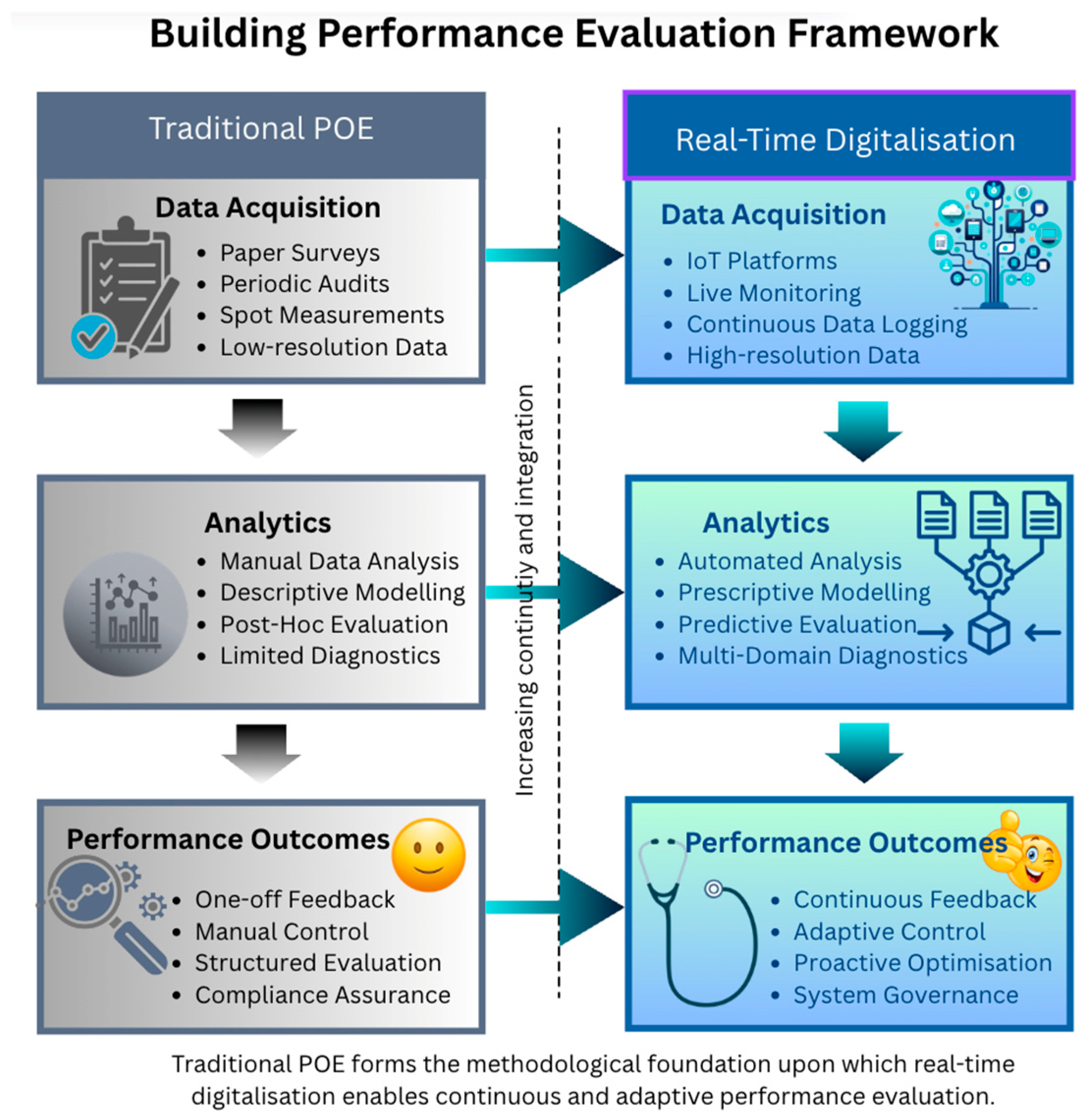
A comparative illustration of real-time digitalisation in POE and traditional POE processes is presented in Figure 1 below. This illustration should not be interpreted merely as a technological comparison; rather, it demonstrates that integrating real-time digitalisation into POE transforms it from a periodic, retrospective evaluation tool into a process that enables faster detection of performance issues, improved operational decision-making, and more effective optimisation of building performance.
In fact, while traditional POE is often characterised by limited outcomes, such as delayed feedback and constrained diagnostic capability, that result in reactive management (as illustrated in Figure 1), it remains the methodological foundation of building performance evaluation, particularly in its capacity to accommodate qualitative, user-centred insights and to provide structured performance criteria for evaluating buildings. Real-time digitalisation, therefore, does not supplant traditional POE but relies on it to contextualise, evaluate, and translate continuous data streams into meaningful performance judgements and actions.
As such, real-time digitalisation should be viewed as a long-anticipated digital evolution of POE and FM that addresses a longstanding gap in current industry practice. This gap includes the retrospective nature of traditional POE, which is often reactive and triggered by complaints or by the need to comply with statutory requirements such as Building Warrant of Fitness (BWOF) [11,12,13]. The solutions it supports explain why real-time digitalisation is increasingly used in complex contexts, where high-performance building systems are expected, and dynamic interactions among occupants, systems, and external conditions continuously and significantly influence outcomes.

3. Evolution of Real-Time Digitalisation

The history and evolution of real-time digitalisation in POE can be traced to the introduction of early building automation and energy management systems in the late twentieth century. These early systems focused on centralised monitoring and control of mechanical and electrical services, with limited data resolution and integration [3]. Performance evaluation of buildings was periodic and after the fact, relying on scheduled inspections and, at times, mostly on historical data [14].
With advances in digital sensing, communication protocols, and computing infrastructure, continuous and more distributed data collection became possible [9]. The embedding of sensors, smart meters, and Building Management Systems (BMSs) has increased the granularity of contextual data and expanded the range of factors that can be monitored and measured [5]. These developments coincided with growing empirical evidence of a persistent “performance gap”, i.e., discrepancies between predicted and actual building performance, especially in terms of energy and environmental performance [15,16], which undermined the traditional POE process. This highlighted the limitations of snapshot-based POE methods for identifying dynamic operational inefficiencies that emerge over time.
More recently, real-time digitalisation has advanced, contributing to the narrowing of this “performance gap” through the convergence of advanced analytics, machine learning, and virtual modelling environments. For instance, it is now possible to envisage buildings as cyber-physical systems in which physical operation and management and digital representation are continuously linked [8,9] through Digital Twins (DTs). The introduction of DTs has enabled live data streams to inform simulation, diagnosis, and optimisation [17,18].
As such, POE has evolved from a traditional post hoc evaluative activity that was predominant in the industry to an a priori predictive process that is continuously embedded in the operation and management of buildings. This shift has enabled the integration of more complex methodological components, such as fault detection and diagnostics and predictive analytics, resulting in faster, more proactive diagnosis of building-related problems [3,19].
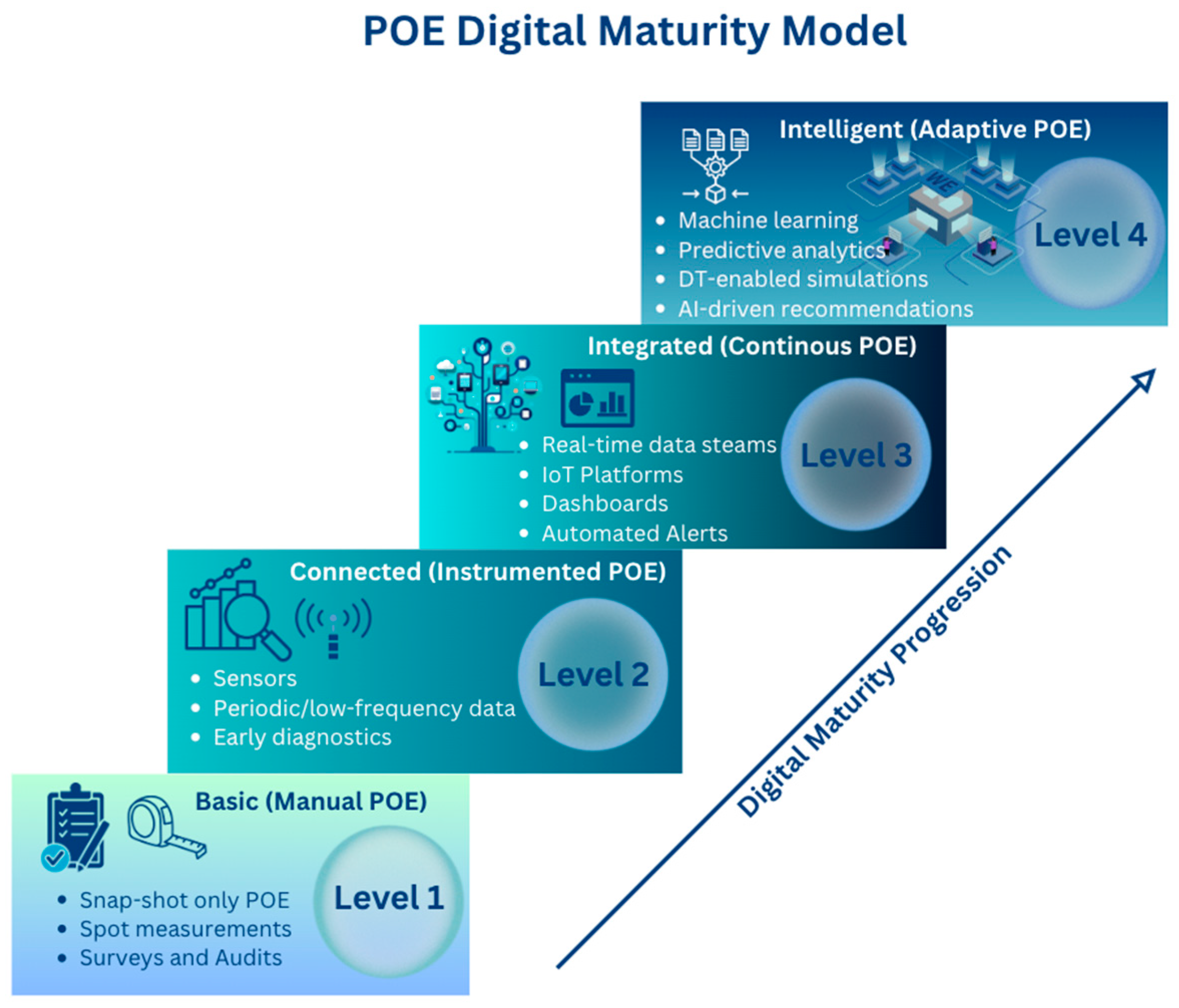
A conceptual digital maturity model is provided below, depicting the evolution of POE as digital integration increases. Similar to Building Information Management (BIM) maturity levels, POE can be understood to have evolved from total reliance on manual methods that provide only occasional snapshots of building performance (level 1—Basic) to the use of sensors to collect periodic, low-frequency data (level 2—Connected). These allow for the early identification of building performance issues. At level 3 (Integrated), facilities are embedded with Internet of Things (IoT) systems, dashboards, and analytics platforms, enabling continuous monitoring and faster feedback. Level 4 (Intelligent) extends the benefits of real-time digitalisation to predictive analytics, machine learning, and DTs that support adaptive, proactive building management.
This evolution has more recently afforded POE a more visible role in the lifecycle of facilities. It is increasingly recognised as an integral process rather than, as long-held, an afterthought considered only when issues arise or for compliance purposes.

4. Strengths and Limitations of Real-Time Digitalisation

4.1. Strengths

Real-time digitalisation is a step-change solution that has transformed the building industry from a static, reactive system into a continuous, proactive one, enabling a constant loop of diagnosis, solution, and feedback in building performance evaluation. Key benefits are discussed below.

4.1.1. Continuous Feedback and Timely Intervention

A defining benefit of real-time digitalised POE is the presence of feedback mechanisms. As previously stated, POE feedback mechanisms have long been characterised by time-bound or snapshot-based insights that focus solely on measurement and reporting and that offer a one-off occupant perception of building performance. Decision-making based on this type of feedback was often outdated and out of step with current conditions, leading to after-the-fact interventions and resulting in occupant dissatisfaction and complaints [20,21].
By contrast, performance insights enabled by real-time digitalisation are communicated through dashboards, alerts, and reports, and in some cases, can trigger automated control responses [22]. These real-time capabilities enable timely intervention and support adaptive control strategies that adjust system operation in response to changing conditions [23], where appropriate. This capability distinguishes real-time digitalisation from traditional POE approaches by shortening the gap between problem occurrence, detection, and action, enabling precise, timely, and evidence-based solutions.

4.1.2. Integrated Multi-Domain Performance Diagnostics

Real-time digitalisation enables the simultaneous evaluation of multiple building performance domains. For instance, continuous energy monitoring, with detailed analysis of consumption patterns, system efficiency, and peak demand behaviour, can be conducted alongside IEQ monitoring (temperature, indoor air quality, lighting, and, where applicable, acoustics) and occupant satisfaction [24,25]. In this way, the interdependencies, relationships, and interactions between these domains can be identified. Such a continuous flow of information on the state of IEQ, occupant comfort, and energy efficiency enables explicit evaluation of trade-offs between these factors, particularly in buildings with varied occupancy or mixed-use functions. As such, deviations from expected performance can be identified promptly, enabling targeted operational adjustments.

4.1.3. Occupant Behaviour and Operational Reliability

Occupant behaviour and interaction with building systems are important aspects of building performance that are often inadequately captured by conventional POE methods [26]. With real-time digitalisation, it is possible to capture and infer occupant behavioural patterns from operational data, reducing reliance on assumed or static user profiles [27,28]. In addition, continuous monitoring supports early fault detection and predictive maintenance by identifying abnormal system behaviour before failure [29]. Collectively, these capabilities extend POE beyond static technical assessment to include operational reliability and user interaction.

4.1.4. Applicability Across Building Types and Scales

The benefits of real-time digitalisation have been extensive in commercial and mixed-use buildings. In offices and healthcare facilities, continuous monitoring supports operational optimisation, IEQ management, and fault detection. That said, its fundamental purpose and design also make it suitable for residential, institutional, and public buildings [5]. For example, in educational buildings, the various occupancy needs (teaching, studying, etc.) of researchers, students, teachers, and support staff can be efficiently managed through adaptive operations. At portfolio scales, aggregated real-time data support benchmarking, comparative analysis, and strategic asset management. Real-time digitalisation is also increasingly applied in building retrofits, where continuous feedback can inform the staged performance of implemented improvements [1,4].

4.2. Complexities

While the benefits of real-time digitalisation are notable, it has not been without its challenges. A prominent misconception about the role of real-time digitalisation is that it can replace or make traditional POE redundant. While real-time digitalisation enables the continuous monitoring of building performance factors, it remains a monitoring system only. Its benefit to building performance relies on evaluation against predefined benchmarks and targets, which traditional POE provides [14]. POE remains the analytical, judgment-based process that interprets these data. As such, caution should be exercised when deciding to discard traditional POE functions, as real-time digitalisation enhances the evidentiary basis of POE. Key limitations of real-time digitalisation of POE are discussed below.

4.2.1. Implementation Requirements

Although the concept of real-time digitalisation in POE is compelling and widely regarded as a positive advancement in building performance management, its practical implementation requires multiple complex, interdependent components that pose critical integration challenges. This is because these interdependent components continually expand and improve their artificial intelligence capabilities to accommodate the varied needs of building operations, management, and user expectations. Several of these components reflect the dependence of real-time digitalisation on collaboration and communication among diverse areas of expertise and systems across various disciplines and industries. For instance, data needs to be continuously sourced from digital systems such as sensors, meters, and building control systems to capture operational, environmental, and behavioural conditions, including energy use, thermal conditions, indoor air quality (IAQ), lighting levels, system status, and occupancy patterns. While these data fall within the domain of facilities managers or building surveyors, obtaining them in real time requires effective data connectivity and infrastructure (such as the IoT) to support data sharing and transmission [26,30,31]. Likewise, ensuring data quality requires methodological rigour, which depends on appropriate sensor selection, placement, calibration, and sampling frequency, as these factors directly affect data validity and interpretability [32]. These requirements often necessitate the expertise of data engineers, analysts, or scientists who have traditionally not been a part of the FM team.

4.2.2. Integration with Digital Twins (DTs)

One of the most celebrated technological advancements in the POE process is the integration of real-time data streams with DTs to provide a dynamic virtual representation of a building’s as-built behaviour. DTs link the physical building to simulation models that reflect the building’s current operating conditions. This integration supports performance visualisation, scenario testing, and evaluation of operational interventions without disrupting building users [8,10]. The caveat is that such integration requires continuous access to real-time data, which must be fed into the virtual models. In most cases, wireless infrastructure is used in complex buildings to support the integration and storage of collected data on a platform accessible to current and future stakeholders, ensuring data access is not limited by the availability of a stakeholder or on-site servers. In such cases, reliability, scalability, and cybersecurity become critical considerations, given the reliance on uninterrupted data flows [33].

4.2.3. Data Analysis Challenges

A prevalent problem with real-time digitalisation in the building industry is not the collection of real-time data (which has been enabled by technological advancements); rather, it is how to analyse and transform these data into building performance indicators, diagnostics, or even alerts for optimal building operation. The building industry is increasingly “data-rich but information-poor” as the availability of real-time data does not inherently guarantee improved building performance. Often, organisations hold large volumes of data, unaware of the potential the data holds for the successful management of their buildings and facilities. To realise this potential, advanced techniques that are beyond the capabilities of conventional data analysts are needed. These include hybrid analytical and statistical methods, as well as machine learning models that can identify anomalies, inefficiencies, and performance trends [28,29]. This becomes more challenging in situations where adaptive systems continuously update analytical models as new data is obtained, enabling more predictive and proactive performance management. As such, while real-time digitalisation is a valuable tool that provides greater data visibility, it is not the solution to improved building performance. Its relationship with building performance is not automatic but conditional, as performance improvements require interpreting this data and taking subsequent action.

4.2.4. Capturing Occupant–Building Interactions

A defining complexity with the role that real-time digitalisation plays in POE is capturing the relationship between occupant behaviour and interaction with building systems. Occupant behaviour and interaction with building systems represent a critical performance dimension that is often inadequately captured by conventional POE methods [27,34,35]. While most real-time digitalised POE has been highly focused on technological enhancements to building performance, its position within the socio-technical systems perspective is still evolving. There is a need to advance inference capabilities to determine behavioural patterns from real-time operational data, reducing reliance on assumed or static user profiles. For instance, whereas sensor-derived data provide objective indicators of environmental conditions, subjective indicators such as occupant satisfaction, comfort, productivity, and well-being remain difficult to capture in real time.
It is worth noting that some recent works are beginning to explore this possibility, using various advanced technological approaches. One example is low-resolution on-site feedback mechanisms, such as the “smiley-face” polling stations commonly found in public places like airports, museums, restrooms, and retail centres for user experience [36]. An extension of this mechanism is the Ecological Momentary Assessment (EMA), an IoT-enabled tool delivered through mobile applications to individual occupants that captures real-time data. Unlike conventional POE methods, EMAs can be prompted at any time to ask multiple or tailored questions (depending on the purpose), capture occupant behaviour and demographic information for richer data, and even prompt context-specific solutions relevant to the situation. Examples include the Right-Here-Right-Now surveys via smartwatches by Tartarini et al. [37] to predict thermal preferences, the personalised thermal comfort study via the Cozie App, which captured thermal fingerprinting to visualise comfort patterns [38], and more recently, the AT-The-Moment occupant comfort control system developed by Rasheed et al. [26], which enabled occupant responsiveness to IAQ control.
Interestingly, these approaches often require user feedback elements, which traditional POE provides but that cannot be reliably inferred from sensor data alone. Established traditional tools, such as interviews and structured feedback, remain integral to more occupant-centric, context-aware POE applications. The integration of both objective and subjective data ensures that the digitalisation of POE remains human-centred, aligning with the social dimensions of building use [39].

5. Sector-Based Use of Real-Time Digitalisation in POE

The strengths and limitations of real-time digitalisation discussed above vary considerably across the building sector. These differences are shaped by sector-specific priorities, regulatory environments, users’ needs and patterns, and the level of digital maturity, as presented in Figure 2.
The commercial building sector dominates the use of real-time digitalisation in POE, as it operates primarily at the higher end of the digital maturity spectrum. This is mainly due to its early integration of BMS and Computerised Maintenance and Management Systems (CMMS), as well as the increasing use of machine learning-based analytics. This sector also represents the largest share of the global DT market for buildings. According to Market Intelo [40], the Global Facility Digital Twin market size was valued at USD 1.7 billion in 2024 and is forecast to reach USD 13.2 billion by 2033, growing at a Compound Annual Growth Rate (CAGR) of 25.8%. In fact, 50% of DT revenue is attributed to applications in asset performance management and predictive maintenance [40]. This rapid global growth can be attributed to the increasing demand for data-driven proactive decision-making in building operations and return on investment [40].
The application of real-time digitalisation in this sector has been aligned with sustainability-related improvements, such as in building energy management. Extensive research has also been conducted in this area [41,42]. For example, Costa et al. [41] produced an integrated toolkit to support energy management across various building processes and activities, including structured performance using BIM, performance monitoring and analysis, evaluation of building operation strategies, automated fault detection, and integration of energy management strategies. Similarly, Gökçe and Gökçe [42] developed a multidimensional system for energy monitoring, analysis, and optimisation for energy-efficient building operation by integrating BIM and other advanced technologies, thereby reducing energy consumption and enhancing building efficiency. Al-Ali et al. [43] proposed an energy management system that leveraged big data analytics and IoT to monitor and control energy consumption across building systems and appliances, resulting in a 30% reduction in energy consumption.
Similarly, healthcare facilities have relatively advanced digital infrastructure to support FM practices, mainly due to their stringent indoor environmental control requirements. These strict IEQ parameters are fundamental to safeguarding patient health and ensuring compliance with healthcare regulatory standards [44]. As such, many healthcare facilities operate with relatively advanced BMS, IAQ monitoring, and increasingly, DT technologies [45]. Vallee [46] noted that DT technology is revolutionising the way healthcare systems are managed and patients are cared for. In particular, DT has been significant in predicting and recommending preventive maintenance for healthcare facilities. This proactive approach improves resource allocation within healthcare systems by informing maintenance strategies and improving system reliability across complex healthcare infrastructures [47,48].
That said, healthcare adoption of real-time digitalisation for POE remains specialised and constrained by privacy and cybersecurity concerns, highly complex operational environments, and the governance of sensitive clinical and operational regulations. In developing countries, the case may be more dire as maintenance documentation was noted as a major construct for efficient management and a prerequisite for the adoption of DT in the management of healthcare constructed facilities [49].
In the education sector, educational buildings experience highly dynamic and fluctuating occupancy patterns, with students, teachers/lecturers, and staff frequently moving across learning spaces, laboratories, and offices. These conditions make real-time digitalisation highly beneficial for ensuring that occupant conditions are conducive and appropriate to the nature of the activities they are conducting or participating in. These include IEQ indicators such as Carbondioxide (CO2) concentration, thermal comfort, ventilation effectiveness, and space utilisation. Several studies have shown that integrating real-time POE in educational buildings supports improved cognitive performance and learning outcomes by enhancing IEQ, reducing energy consumption through demand-responsive building operations, and enabling more effective operational planning based on occupancy analytics [25,26].
Nevertheless, implementation challenges hinder the advancement of digital maturity in educational buildings [50,51,52]. Institutions, particularly publicly funded ones, often face budgetary constraints that limit investment in advanced digital infrastructure [51]. At the same time, there are perceptual challenges whereby the need for technological advancement in FM is not regarded as essential, especially in developing countries. For instance, Mohammed and Amoah [52] noted this lack of technological adoption in African university FM and argued that a paradigm shift is needed towards technology-driven FM strategies in African university facilities. Additionally, many campuses are housed in heritage or historic buildings that operate outdated or fragmented IT systems [50]. Furthermore, the FM teams may lack the technical expertise to interpret complex analytical outputs [50].
Residential buildings typically operate at the lower end of the digital maturity spectrum. Several factors contribute to this, such as affordability, limited technological infrastructure, lack of standardisation, a fragmented technology ecosystem, and the absence of sophisticated control systems, such as BMS or enterprise-level data platforms. Interestingly, these limitations highlight the digital maturity divide between small and complex buildings, particularly in smaller buildings that lack access to advanced analytics or continuous monitoring systems. For instance, unlike commercial or healthcare sectors, which typically rely on BMS, homes tend to use standalone, brand-specific devices and sensors. This creates a fragmented ecosystem where data is stored separately—often in incompatible formats—and homeowners must manage multiple applications, interfaces, and platforms. Also, integration costs increase as these smart systems become more complex to integrate into existing conventional building stock [53,54]. In addition, the complexity of these technologies and the lack of technical skills and knowledge required can create resistance to adoption among building owners and occupants [55]. Another barrier to adoption is heightened privacy concerns about data collected in personal living spaces [56], especially the inadequate privacy controls that could expose sensitive information about occupants [57].
Despite these challenges, several low-cost technologies that enable real-time digitalisation demonstrate strong application potential in residential settings. These devices are primarily used to track energy efficiency, occupant health, and comfort. Devices such as Dylos, Foobot, and AirVisual Pro are reported to be reliable, low-cost options for IAQ monitoring [45]. Bluetooth-enabled monitors like Foobot have been incorporated into smart home systems to detect elevated levels of Volatile Organic Compounds (VOCs) and particulate matter, providing real-time alerts through smartphone applications and prompting behavioural changes, such as increasing ventilation or switching to low-emission cleaning products [45]. At a broader municipal scale, initiatives such as the Paris Smart City project illustrate the potential of scalable real-time technologies, including LoRaWAN-enabled IAQ sensors, which were used to assess neighbourhood-level air quality over 12 months [45]. The deployment achieved a 90% correlation with reference-grade stations, demonstrating the technology’s accuracy and reliability while maintaining significantly lower operational costs. Similarly, Olu-Ajayi et al. [58] demonstrated how advanced analytics can enhance energy performance evaluation within the residential sector by developing a predictive energy model using deep learning and machine learning techniques.
Table 1 below provides a summary of sector-based use of real-time digitalisation in POE.

6. The Future of Real-Time Digitalisation in Post-Occupancy Evaluation

With these complexities discussed, the central question is: Is real-time digitalisation the future of POE? The answer depends on several key factors.
First, the management of building operations differs significantly across sectors. For instance, while large, complex buildings such as airports and hospitals have benefited from the advanced capabilities of real-time digitalisation systems, similar benefits should also be extended to smaller-scale buildings such as homes, which do not have or require sophisticated infrastructure. These smaller-scale buildings often require simplified performance dashboards, low-cost sensor kits, and analytics platforms [30,59]. Without appropriately tiered solutions available in the market, real-time digitalisation risks contributing to the existing digital divide in building performance management.
Second, the trajectory of real-time digitalisation in POE should be defined by occupant- or human-centred rather than system-centred performance. Historically, building evaluations have prioritised system efficiency, focusing on HVAC systems, energy use, system reliability, and compliance with standards. There is no doubt that these indicators are critical to the functioning of buildings; however, they do not provide a complete picture of how buildings meet performance targets from the perspective of those who matter most—the occupants or users. As such, even when system-centred performance demonstrates optimal system efficiency, research has shown that such buildings often fail to deliver appropriate IEQ for occupants [26,60]. An occupant-centred performance trajectory would reposition real-time digitalisation from monitoring mechanical systems to understanding users’ lived experiences. The emphasis would then shift from “is the system operating efficiently?” to “is the building supporting occupant wellbeing, comfort, and productivity?”.
Third, regulatory frameworks and standards must develop alongside the technological capabilities and principles of real-time digitalisation. For instance, while ISO 55000 [61] recognises technological advances in facilities and asset management, such as BMS and CMMS, it has yet to provide explicit guidelines on the use of artificial intelligence in building operations and management. Cui et al. [33] noted that the absence of a common security framework contributes to cautious adoption, particularly where concerns arise regarding data privacy, informed consent, cybersecurity, and algorithmic transparency. Quinello and Costa [62] noted that, even with harmonisation efforts such as those outlined in ISO 19650-1:2018 [63] for standard BIM processes, information management and data exchange across projects, vendor lock-in, and proprietary standards limit interoperability, as these frameworks cannot enforce uniform technical formats or prevent companies from using closed systems. This limitation may be linked to the low adoption of real-time digitalisation across sectors, as data privacy, informed consent, and transparency in data sharing are critical to maintaining stakeholder trust. Such systems must be standardised, interoperable, and capable of producing auditable outputs. Without robust frameworks and government standards, real-time digitalisation risks industry resistance and reputational harm.
The affordability and usability of the systems required for real-time digitalisation are also essential to enabling broader adoption across sectors. Future developments are expected to support greater integration with artificial intelligence, occupant-centred performance metrics, and alignment with regulatory performance reporting frameworks. However, these advancements will be of limited value if facilities managers cannot interpret or operationalise outputs from these sophisticated platforms. User-centred interface design, clear visualisation, and actionable recommendations are as important as algorithmic sophistication. Similarly, viable options must be available for small-scale building operations and management. Cost structures must reflect the financial realities of public infrastructure and small-scale private operators.

7. Concluding Thoughts

Real-time digitalisation has significantly extended the POE methodology and processes. The continuous monitoring and capture of building performance data enable a move beyond inherent snapshot-based analysis and decision-making. This has provided a broader, more granular understanding of various aspects of building performance, such as variations in energy consumption, IEQ, and occupant behaviour, which would otherwise remain undetected.
That said, research has demonstrated that real-time digitalisation is not without challenges that threaten its future in POE practice. These challenges include but are not limited to sensor calibration, data interoperability, cybersecurity, and system maintenance, which must be addressed to ensure reliability and scalability. Like other evolving technological advances, the governance of data ownership, privacy, and standardisation intensifies these challenges, limiting the widespread adoption of real-time digitalisation. If not addressed, these issues could limit its ability to identify inefficiencies, optimise system performance, and support evidence-based decision-making throughout the building lifecycle.
As modern buildings increasingly operate as adaptive, responsive systems, capable of interacting with occupants, environmental conditions, and energy networks, real-time digitalisation is poised to become an essential methodological component of mainstream POE. With the aim of improving operational efficiency and occupant comfort, real-time digitalisation is also poised to support sustainability objectives, such as reducing energy consumption and mitigating carbon emissions. Ultimately, integrating real-time digitalisation within standard POE practice and processes is a revolutionary step towards more innovative, evidence-based building management and the realisation of much-needed resilient, low-carbon built environments.
As buildings increasingly function as adaptive systems, real-time digitalisation is likely to become a core methodological component of mainstream post-occupancy evaluation across the building lifecycle.

Funding

This research received no external funding.

Institutional Review Board Statement

Not applicable.

Informed Consent Statement

Not applicable.

Data Availability Statement

No new data were created or analyzed in this study. Data sharing is not applicable to this article.

Conflicts of Interest

The author declares no conflicts of interest.

Abbreviations

The following abbreviations are used in this manuscript:
POEPost-Occupancy Evaluation
IEQIndoor Environmental Quality
BMSBuilding Management System
BIMBuilding Information Management
IAQIndoor Air Quality
CMMSComputerised Maintenance Management System
DTDigital Twin
BPEBuilding Performance Evaluation
BWOFBuilding Warrant Of Fitness
IoTInternet of Things
EMAEcological Momentary Assessment
CAGRCompound Annual Growth Rate
CO2Carbondioxide
FMFacilities Management
VOCVotalic Organic Compounds
HVACHeating, Ventilation & Air Conditioning

References

  1. Tsang, T.W.; Mui, K.W.; Wong, L.T.; Chan, A.C.Y.; Chan, R.C.W. Real-Time Indoor Environmental Quality (IEQ) Monitoring Using an IoT-Based Wireless Sensing Network. Sensors 2023, 24, 6850. [Google Scholar] [CrossRef]
  2. Jørgensen, B.N.; Ma, Z. Towards energy efficient buildings-by digital transformation of the building lifecycle. Energy Inform. 2024, 7, 81. [Google Scholar] [CrossRef]
  3. Katipamula, S.; Brambley, M.R. Methods for Fault Detection, Diagnostics, and Prognostics for Building Systems—A Review. HVACR Res. 2005, 11, 3–25. [Google Scholar] [CrossRef]
  4. Sghiri, A.; Gallab, M.; Merzouk, S.; Assoul, S. Leveraging Digital Twins for Enhancing Building Energy Efficiency: A Literature Review of Applications, Technologies, and Challenges. Buildings 2025, 15, 498. [Google Scholar] [CrossRef]
  5. Granderson, J.; Piette, M.A.; Ghatikar, G.; Price, P. Building energy information systems: State of the technology and user case studies. Energy Effic. 2011, 4, 279–294. [Google Scholar] [CrossRef]
  6. Elsayed, M.; Pelsmakers, S.; Pistore, L.; Castaño-Rosa, R.; Romagnoni, P. Post-occupancy evaluation in residential buildings: A systematic literature review. Build. Environ. 2023, 236, 110307. [Google Scholar] [CrossRef]
  7. Bae, S.; Martin, C.S. The impact of measurable findings from pre- and post-occupancy evaluations of indoor environmental quality in the primary workspace. Buildings 2023, 13, 2486. [Google Scholar] [CrossRef]
  8. Boje, C.; Guerriero, A.; Kubicki, S.; Rezgui, Y. Towards a semantic Construction Digital Twin: Directions for future research. Autom. Constr. 2020, 114, 103179. [Google Scholar] [CrossRef]
  9. Choudhary, A. Internet of Things: A comprehensive overview, architectures, applications, simulation tools, challenges and future directions. Discov. Internet Things 2024, 4, 31. [Google Scholar] [CrossRef]
  10. Lu, Q.; Xie, X.; Parlikad, A.K.; Schooling, J. Digital Twin-enabled anomaly detection. Autom. Constr. 2020, 118, 103277. [Google Scholar] [CrossRef]
  11. Rasheed, E.; Vilasini, N.; Weerasinghe, A.; Rotimi, J. Proactive post-occupancy evaluation. Build 2021, 185, 68–69. [Google Scholar]
  12. Blanch, S.; Frazer, A. Understanding Post-occupancy Evaluation Processes for Public Healthcare Facilities in Australia and Aotearoa New Zealand. HERD 2023, 16, 69–81. [Google Scholar] [CrossRef] [PubMed]
  13. Rasheed, E.O.; Khoshbakht, M.; Baird, G. “Do office workers’ comments corroborate the ratings they give their buildings?” A qualitative analysis of comments on operational factors in the workplace. Facilities 2024, 42, 274–320. [Google Scholar] [CrossRef]
  14. Preiser, W.F.E.; Vischer, J.C. Assessing Building Performance; Elsevier: Amsterdam, The Netherlands, 2005. [Google Scholar]
  15. de Wilde, P. The gap between predicted and measured energy performance of buildings. Autom. Constr. 2014, 41, 40–49. [Google Scholar] [CrossRef]
  16. Darkaleh, S.; Zaker, A. Evaluating energy demand discrepancies between theoretical and actual energy performance in renovated listed buildings case study on a renovation plan for a non-residential to residential heritage building. Energy Rep. 2025, 14, 2831–2848. [Google Scholar] [CrossRef]
  17. Antoun, M.; Elhajj, I.H.; Sayour, M.; Papadopoulos, P.K.; Zarpalas, D.; Rizk, A.; Islam, A.T.; Huerta, I.; Toledo, L.; Arvanitis, G.; et al. Interactive digital twins enabling responsible extended reality applications. Sci. Rep. 2025, 15, 34539. [Google Scholar] [CrossRef]
  18. Opoku, D.J.; Perera, S.; Osei-Kyei, R.; Rashidi, M. Digital twin application in the construction industry: A literature review. J. Build. Eng. 2021, 40, 102726. [Google Scholar] [CrossRef]
  19. Fan, C.; Xiao, F.; Yan, C. A framework for knowledge discovery in massive building automation data and its application in building diagnostics. Autom. Constr. 2015, 50, 81–90. [Google Scholar] [CrossRef]
  20. Altomonte, S.; Saadouni, S.; Kent, M.G.; Schiavon, S. Satisfaction with indoor environmental quality in BREEAM and non-BREEAM certified office buildings. Archit. Sci. Rev. 2019, 62, 343–355. [Google Scholar] [CrossRef]
  21. Candido, C.; Kim, J.; de Dear, R.; Thomas, L. BOSSA: A multidimensional post-occupancy evaluation tool. Build. Res. Inf. 2016, 44, 214–228. [Google Scholar] [CrossRef]
  22. Asif, M.; Naeem, G.; Khalid, M. Digitalization for sustainable buildings: Technologies, applications, potential, and challenges. J. Clean. Prod. 2024, 450, 141814. [Google Scholar] [CrossRef]
  23. Abdelatif, M. An Integrated Bond Graph Methodology for Building Performance Simulation. Energies 2025, 18, 4168. [Google Scholar] [CrossRef]
  24. Kim, J.; Schiavon, S.; Brager, G. Personal comfort models—A new paradigm in thermal comfort for occupant-centric environmental control. Build. Environ. 2018, 132, 114–124. [Google Scholar] [CrossRef]
  25. Rasheed, E.O.; Wang, K. Do overall findings correlate with granular findings? An analysis of factors influencing office workers’ thermal comfort and indoor air quality. Int. J. Build. Pathol. Adapt. 2025. [Google Scholar] [CrossRef]
  26. Rasheed, E.; Wang, K.; Hashemi, A.; Mahmoodi, M.; Panchalingam, K. Integrating Internet of Things (IoT) Approach to Post-Occupancy Evaluation (POE). Buildings 2024, 14, 2095. [Google Scholar] [CrossRef]
  27. D’Oca, S.; Hong, T.; Langevin, J. The human dimensions of energy use in buildings: A review. Renew. Sustain. Energy Rev. 2017, 81, 731–742. [Google Scholar] [CrossRef]
  28. Uddin, M.N.; Wei, H.H.; Chi, H.L.; Ni, M. Influence of Occupant Behavior for Building Energy Conservation: A Systematic Review Study of Diverse Modeling and Simulation Approach. Buildings 2021, 11, 41. [Google Scholar] [CrossRef]
  29. Ahmed Murtaza, A.; Saher, A.; Hamza Zafar, M.; Kumayl Raza Moosavi, S.; Faisal Aftab, M.; Sanfilippo, F. Paradigm shift for predictive maintenance and condition monitoring from Industry 4.0 to Industry 5.0: A systematic review, challenges and case study. Results Eng. 2024, 24, 102935. [Google Scholar] [CrossRef]
  30. Lawal, K.; Rafsanjani, H.N. Trends, benefits, risks, and challenges of IoT implementation in residential and commercial buildings. Energy Built Environ. 2022, 3, 251–266. [Google Scholar] [CrossRef]
  31. Atzori, L.; Iera, A.; Morabito, G. The Internet of Things: A survey. Comput. Netw. 2010, 54, 2787–2805. [Google Scholar] [CrossRef]
  32. Sharma, R.; Razakamanantsoa, A.; Kumar, A.; Thajudeen, T.; Jullien, A. Performance and applicability of low-cost PM sensors to assess global pollution variability through machine learning techniques. Atmos. Environ. X 2025, 26, 100331. [Google Scholar] [CrossRef]
  33. Cui, L.; Xie, G.; Qu, Y.; Gao, L.; Yang, Y. Security and Privacy in Smart Cities: Challenges and Opportunities. IEEE Access 2018, 6, 46134–46145. [Google Scholar] [CrossRef]
  34. Hong, T.; Yan, D.; D’Oca, S.; Chen, C. Ten questions concerning occupant behavior in buildings: The big picture. Build. Environ. 2017, 114, 518–530. [Google Scholar] [CrossRef]
  35. Weerasinghe, A.S.; Rotimi, J.O.B.; Rasheed, E.O. An Innovative Tool for Empowering Occupants; Springer: Berlin/Heidelberg, Germany, 2025. [Google Scholar]
  36. Lassen, N.; Goia, F.; Schiavon, S.; Pantelic, J. Field investigations of a smiley-face polling station for recording occupant satisfaction with indoor climate. Build. Environ. 2020, 185, 107266. [Google Scholar] [CrossRef]
  37. Tartarini, F.; Schiavon, S.; Quintana, M.; Miller, C. Personal comfort models based on a 6-month experiment using environmental parameters and data from wearables. Indoor Air 2022, 32, e13160. [Google Scholar] [CrossRef]
  38. Malakhatka, E.; Lodder, T.; Teli, D.; Sindelar, D.; Miller, C.; Wallbaum, H. Insights into personalized thermal comfort through innovative data collection: Case study from HSB Living Lab. J. Phys. Conf. Ser. 2025, 3140, 072016. [Google Scholar] [CrossRef]
  39. Altomonte, S.; Allen, J.; Bluyssen, P.M.; Brager, G.; Heschong, L.; Loder, A.; Schiavon, S.; Veitch, J.; Wang, L.; Wargocki, P. Ten questions concerning well-being in the built environment. Build. Environ. 2020, 180, 106949. [Google Scholar] [CrossRef]
  40. Market Intelo. Facility Digital Twin Market Report 2033. 2025. Available online: https://marketintelo.com/report/facility-digital-twin-market#:~:text=10.,at%20a%20CAGR%20of%2025.8%25 (accessed on 20 April 2026).
  41. Costa, A.; Keane, M.M.; Torrens, J.I.; Corry, E. Building operation and energy performance: Monitoring, analysis and optimisation toolkit. Appl. Energy 2013, 101, 310–316. [Google Scholar] [CrossRef]
  42. Gökçe, H.U.; Gökçe, K.U. Multi dimensional energy monitoring, analysis and optimization system for energy efficient building operations. Sustain. Cities Soc. 2014, 10, 161–173. [Google Scholar] [CrossRef]
  43. Al-Ali, A.R.; Zualkernan, I.A.; Rashid, M.; Gupta, R.; Alikarar, M. A smart home energy management system using IoT and big data analytics approach. IEEE Trans. Consum. Electron. 2017, 63, 426–434. [Google Scholar] [CrossRef]
  44. Loureiro, A.; Ferreira, A.; Barros, N. Systematic review of the literature on indoor air quality in healthcare units and its effects on health. BMC Public Health 2025, 25, 2398. [Google Scholar] [CrossRef] [PubMed]
  45. Bashir, M.T.; Alrowais, R.; Lal, R.; Bashir, M.; Sikandar, M.A.; Zahid, N.; Hayet Khan, M.M.; Saad, S.; Abbas, M.I.; Khan, M.W.; et al. Synergizing Health and Technology in Green Buildings: A Critical Review of Indoor Air Quality Monitoring and Solutions. Indoor Air 2024, 2025, 1281155. [Google Scholar] [CrossRef]
  46. Vallée, A. Digital twin for healthcare systems. Front. Digit. Health 2023, 5, 1253050. [Google Scholar] [CrossRef]
  47. Van Dinter, R.; Tekinerdogan, B.; Catal, C. Predictive maintenance using digital twins: A systematic literature review. Inf. Softw. Technol. 2022, 151, 107008. [Google Scholar] [CrossRef]
  48. Chaparro-Cárdenas, S.L.; Ramirez-Bautista, J.A.; Terven, J.; Córdova-Esparza, D.M.; Romero-Gonzalez, J.A.; Ramírez-Pedraza, A.; Chavez-Urbiola, E.A. A Technological Review of Digital Twins and Artificial Intelligence for Personalized and Predictive Healthcare. Healthcare 2024, 13, 1763. [Google Scholar] [CrossRef]
  49. Ebiloma, D.O.; Aigbavboa, C.O.; Anumba, C. Towards Digital Twin Maintenance Management of Health Facilities in Nigeria: The Need for Maintenance Documentation. Buildings 2023, 13, 1339. [Google Scholar] [CrossRef]
  50. Singun, A. Unveiling the barriers to digital transformation in higher education institutions: A systematic literature review. Discov. Educ. 2025, 4, 37. [Google Scholar] [CrossRef]
  51. Gkrimpizi, T.; Peristeras, V.; Magnisalis, I. Classification of Barriers to Digital Transformation in Higher Education Institutions: Systematic Literature Review. Educ. Sci. 2023, 13, 746. [Google Scholar] [CrossRef]
  52. Mohammed, A.S.; Amoah, C. Integration of technology in decision-making in university facilities management: A literature review. Facilities 2025, 43, 1018–1052. [Google Scholar] [CrossRef]
  53. Vargas, R.V.; Soares, C.A.; Rodrigues, A.M.; Chinelli, C.K.; Qualharini, E.L.; Haddad, A. Barriers and challenges of smart buildings projects in the context of construction 4.0. In Proceedings of the 3rd Latin American Conferemce on Sustainable Development of Energy Water and Environment Systems; Sdewes: Zagreb, Croatia, 2022. [Google Scholar]
  54. Kiu, M.S.; Chin, Y.J.; Chia, F.C.; Wong, P.F. The readiness of IoT enabled Smart Buildings in Malaysia. J. Phys. Conf. Ser. 2021, 2053, 012001. [Google Scholar] [CrossRef]
  55. Affonso, E.O.; Branco, R.R.; Menezes, O.V.; Guedes, A.L.; Chinelli, C.K.; Haddad, A.N.; Soares, C.A. The Main Barriers Limiting the Development of Smart Buildings. Buildings 2024, 14, 1726. [Google Scholar] [CrossRef]
  56. Gobbo, J., Jr.; Souza, M.; Gobbo, S. Barriers and challenges to smart buildings’ concepts and technologies in Brazilian social housing projects. Int. J. Sustain. Real Estate Constr. Econ. 2017, 1, 31. [Google Scholar]
  57. Pathmabandu, C.; Grundy, J.; Chhetri, M.B.; Baig, Z. Privacy for IoT: Informed Consent Management in Smart Buildings. Future Gener. Comput. Syst. 2023, 145, 367–383. [Google Scholar] [CrossRef]
  58. Olu-Ajayi, R.; Alaka, H.; Sulaimon, I.; Sunmola, F.; Ajayi, S. Machine learning for energy performance prediction at the design stage of buildings. Energy Sustain. Dev. 2022, 66, 12–25. [Google Scholar] [CrossRef]
  59. Talon, C. IoT Bridging the Gap for Intelligent Small and Medium Buildings (Intel-Sponsored White Paper). Navigant Consulting 2016, Inc. Available online: https://www.intel.com/content/dam/www/public/us/en/documents/IoT/iot-bridging-the-gap-for-intelligent-small-and-medium-buildings.pdf (accessed on 20 April 2026).
  60. Yang, T.; Bandyopadhyay, A.; Wen, J.; Dong, B. From occupants to occupants: A review of the occupant information understanding for building HVAC occupant-centric control. Build. Simul. 2021, 15, 913. [Google Scholar] [CrossRef] [PubMed]
  61. ISO 55000; Asset Management—Overview, Principles and Terminology. ISO: Geneva, Switzerland, 2014.
  62. Quinello, R.; Costa, B.K. Critical Success Factors for the Adoption of Artificial Intelligence in Facilities Management: Second-Order Systematic Review. J. Technol. Manag. Innov. 2025, 20, 103–119. [Google Scholar] [CrossRef]
  63. ISO 19650-1:2018; Organization and digitization of information about buildings and civil engineering works, including building information modelling (BIM)—Information management using building information modelling—Part 1: Concepts and principles. ISO: Geneva, Switzerland, 2018. Available online: https://www.iso.org/obp/ui/en/#iso:std:iso:19650:-1:ed-1:v1:en (accessed on 20 April 2026).
Figure 1. Progressive evolution of POE within the BPE framework. Created by the author.
Encyclopedia 06 00103 g001
Figure 2. POE digital maturity model. Created by the author.
Encyclopedia 06 00103 g002
Table 1. Sector-based use of real-time digitalisation in POE. Created by the author.
SectorPrimary DriversTypical ApplicationsMajor Barriers/Limitations
CommercialEnergy cost reduction and sustainability targets, operational efficiency, tenant comfort and productivityReal-time energy monitoring, automated fault detection and diagnostics, occupancy analytics, smart lighting/Heating, Ventilation and Air Conditioning (HVAC) control, analytics dashboards for building performance optimisationHigh upfront integration costs, interoperability challenges between systems, data analytics capability gaps, slower adoption among small and medium-sized enterprises
HealthcareStrict IEQ requirements, patient safety, regulatory complianceContinuous IEQ monitoring and control, predictive maintenance of HVAC and critical systems, digital twins for space optimisation and operational simulationData privacy and cybersecurity risks, strict regulatory compliance requirements, integration complexity with hospital systems, highly complex operational environments
Educational Fluctuating occupancy patterns, need for healthy learning environments, energy efficiency in publicly funded facilitiesCO2 and IAQ monitoring in classrooms, demand-responsive HVAC control, occupancy analytics for space utilisation, thermal comfort monitoringBudget constraints, ageing infrastructure, fragmented IT systems, limited facility management technical expertise
ResidentialOccupant health and comfort, energy efficiency, housing quality, smart home adoptionLow-cost IAQ and CO2 sensors, smart thermostats, energy consumption tracking, comfort analytics, smart home automation platformsFragmented technology ecosystem, lack of standardisation, privacy concerns, limited integration with building-scale systems
Disclaimer/Publisher’s Note: The statements, opinions and data contained in all publications are solely those of the individual author(s) and contributor(s) and not of MDPI and/or the editor(s). MDPI and/or the editor(s) disclaim responsibility for any injury to people or property resulting from any ideas, methods, instructions or products referred to in the content.