Entry

Defining Imitative Coinage in the Roman Imperial Period on the Territory of the Empire

by
Marc Bouzas Sabater
Institut de Recerca Històrica, Universitat de Girona, Plaça Ferrater Mora, 1, 17820 Girona, Spain
Encyclopedia 2026, 6(3), 62; https://doi.org/10.3390/encyclopedia6030062
Submission received: 29 December 2025 / Revised: 18 February 2026 / Accepted: 3 March 2026 / Published: 13 March 2026
(This article belongs to the Section Arts & Humanities)

Definition

Imitative coinage is understood to be any currency issued outside of the official known coin series. This currency could have been issued by individuals or state agents, and its main function was not profit, but rather it responded to currency shortages and acted as a currency of necessity. It must be distinguished from the currency itself, which had a lucrative intent on the part of the issuers. Coin imitation was a phenomenon that occurred during various chronological periods throughout the Roman Imperial era, essentially linked to historical events that caused a monetary shortage. This refers to a phenomenon where coinage not issued by the official authority was introduced into circulation and utilized in commercial exchanges of various kinds, a fact that can be demonstrated archaeologically. Imitative coinage can be detected through detailed numismatic studies, revealing variability in stylistic elements, as well as physical characteristics (such as weight or diameter) when compared to the official issue. Coin imitation should not be confused with monetary counterfeiting, as its intention was not to profit the unofficial issuer, but rather to facilitate daily commercial exchanges. Even so, the characteristics of both can be similar in some cases, which can make it difficult to assign them to one type or the other. The imitative pieces, primarily in bronze types though not limited to them, played a highly significant role in maintaining Roman economic systems during periods of decline in official currency.

1. Genesis and History

The study of Roman coinage is a discipline that underwent a particularly important period at the end of the 19th century and the beginning of the 20th century. At this time, the major institutions with coin collections began to classify their numismatic materials, and subsequently, large coin catalogs were produced. The first notable catalog in the Roman world was compiled by Henry Cohen between 1880 and 1892 [1]. The paradigmatic example of these classifications was Roman Imperial Coinage, a major 10-volume work published between 1923 and 1994 by various authors (H. Mattingly, E. Sydenham, H. Sutherland) based on the coins in the British Museum [2]. As this was one of the main, if not the main, catalog, some Roman coins were already detected that differed from the rest in certain aspects such as weight, diameter, or the artistry of the dies. At that time, scholars began to discuss possible irregular issues. Although it should be noted that late 18th-century coin catalogs, such as that of J.H. Eckhel, already referred to Roman coins as very crude or barbaric [3], clearly alluding to what would later be understood as imitation coins.
Over the years, this phenomenon was detected and began to be studied in various paradigmatic studies on the subject, such as the works of Boon [4], Brickstock [5], Bastien [6,7,8], and Callu [9]. Other works, such as the studies by Adelson and Kustas, also detected the presence of tiny coins in hoards that could be dated to the 5th and 6th centuries, which they called minimi [10]. In these works, as well as in later ones, the concept of imitation or imitative coinage began to be clearly defined. Some authors emphasized the need to distinguish it from counterfeit coinage [8] and also that it could come from issuers who did not intend to deceive.
Later works began to incorporate the concept of monetary circulation, that is, the use and life of these coins and also imitation coins in Roman times. This fact is closely linked to advances in archaeological recording and excavation techniques, as well as to interpretative archaeology postulates that emphasize the idea of the context of the object, in this case, of the coins. Some examples of this could be the works on the excavations at Sirmium [11], or the Belgica Secunda territory in which Bastien developed a study of monetary circulation [12]. This fact was strongly reinforced by the incorporation into studies of coins from archaeological excavations, which made it possible to accurately date the use of different imitation coins with non-numismatic archaeological material, such as ceramics. Many studies have been carried out in this field, an excellent example being that based on the excavations at Tolmo de Minateda (Hellín, Spain) [13].
Comparison with archaeological sources made it possible to refine, contrast, or, in some cases, contradict and correct data from documentary sources that clearly specify the prohibition of coin imitation or counterfeiting [14], as well as their use and circulation.
In this regard, it is important to note that, even at this early stage, three major waves of imitation coins were established. Although these are not the only ones known, they would be: the imitations of Claudius I in Gaul and Hispania [15,16], the imitations of Antoninianus coins from the Gallic Empire [17,18,19], and also the imitation issues from the second half of the 4th century and the beginning of the 5th century, which particularly affected the western part of the Empire [8,20,21].
In more recent times, there has been a proliferation of works from different parts of Europe presenting findings of imitation coins in various archaeological contexts. These are sometimes treated in monographs and sometimes included in studies of monetary circulation in a generic manner.
The study of imitation coins has traditionally been approached on the basis of numismatic studies. This type of study, which is already well defined in the parameters of Roman Imperial Coinage [2] and also by other authors in monographs, such as M. Campo [22], sets out clear guidelines for the study of coins. Firstly, it proposes the study of physical elements (metal, weight, diameter, axes, and degree of wear) and secondly, aspects to be inferred from the coin: denomination, mint, chronology, issuing authority, obverse and reverse designs, status (whether imitation, official, or counterfeit), and a corresponding bibliographic reference [22]. In the case of imitation coins, a very detailed formal study will be key, as it will allow the numismatist or archaeologist to establish whether or not the coin is an imitation.
On occasions, this practical study has been combined with different metal analyses which, in the case of imitation coins, can provide very interesting data given their different metallic composition. Some examples of this are the studies on imitation coins from the Gallic Empire, where a different chemical composition was proposed depending on the mint [23].
The emergence of the application of archaeological techniques to numismatics has added the contextual study of the pieces to this method. This study is based on establishing a chronology of use or deposition of monetary elements based on the archaeological context in which they are found. The application of this method has made it possible to clarify some aspects that were previously unclear in the case of imitation coins, such as their chronology of manufacture, circulation, and abandonment of use.
The combination of these elements is what will allow the correct identification of the phenomenon of imitation in a broad sense, far beyond the mere documentation of imitation or crude coins, thus explaining their insertion into the Roman imperial economy and their use in some cases at later times.

2. Related Concepts

A brief mention should be made of a related concept known as counterfeit coinage. It is important to emphasize that, although some studies have treated these terms as synonymous, they are not synonymous in any case. Imitation coins are a type of coin that arises from the need for currency in times when the economic, social, or political situation has led to a shortage or scarcity of coins.
Counterfeit coins, on the other hand, are the result of coin production by fraudulent workshops [24] that sought to defraud the state and profit privately by putting counterfeit coins into circulation. A well-known example of this practice is the denarii fourrées, although there are also examples of counterfeit coin workshops that imitate other coins [25].
Another concept that can sometimes be related to the phenomenon of imitation coins is the imitation of Roman coins by non-Roman peoples. This is a well-known phenomenon with some notable cases, such as the Gauls (at the end of the Republican era) [26] or, in late antiquity, the Visigoth [27] and Vandal [28] coinages. This is considered to be another type of coin imitation and does not fulfill the same economic function as imitative coinage.
A different phenomenon from the one discussed here is the imitation of Roman currency by non-Roman peoples in border areas and beyond (Barbaricum). This phenomenon has been documented in different areas, for example, among Celtic peoples [29], in areas of the Danube [30], and also in areas of present-day Denmark [31] and Poland [32]. The complexity of the phenomenon, which affects multiple economic systems, including non-Roman ones, as well as the nature of these coins, means that it is not included in the study but should be mentioned in this section.

3. Theory

In this section, we aim to define, based on research carried out in the sector by many authors, what is meant by imitation currency. This is currency which, as explained above, should not be understood as counterfeit currency, but rather as currency of necessity. This concept, published and mentioned by various authors and also applied to counterfeit coinage [33,34,35], perfectly defines what this type of coin is: monetary issues that occur when official issues, for one reason or another, do not meet the currency needs of an economy that, it can be inferred, needed to use currency for a significant part of its exchanges. The definition of necessity coinage given above can be applied to imitation coinage, as the archaeological evidence is clear: these coins were used for long periods of time and are found mixed in with official issues.
The phenomenon of imitation currency mainly affected bronze denominations, those of lesser value and also those that underwent the most reforms, as explained in detail by some authors [36,37], and changes in their system, and usually occurs in times of monetary scarcity. In other words, certain political, economic, or social circumstances directly affect the issuance of currency, for example, the closure of municipal mints by Claudius in the 1st century AD [15,16] or the problems in the Gallic mints in the 4th century [38]. This event causes a break in the manufacture of coins, but not in their use and circulation, which leads to the issuance of imitation coins. This occurs during specific periods, which is why some authors refer to it as an epidemic, as opposed to counterfeit coins, which can be considered endemic [8].
Conceptually, this fact is part of a larger debate: the degree of monetization of the Roman Empire. Although there are different positions on this issue, archaeological evidence from documentation of imitation coins shows that, at least to a significant extent, coins were needed to facilitate exchanges, essentially of low value.
The phenomenon mainly affected parts of the Roman West, where there was a chronic shortage of coins. There are some examples in the East, such as coins from late antiquity, but in this text we will focus on the concept in the western part of the empire.
Given the reason for the existence of this type of coinage, another key question concerns the identity of the issuers—whether they were state agents or private individuals. Although it is very difficult to determine with the existing data, the evidence seems to point in the direction of these coins being issued by private agents. In some cases, cities have been mentioned, but in any case, they are tolerated by the state. The imitations are so characteristic that it is impossible that they were not detected by the state. In other words, this emergency solution, this coin of necessity, was accepted, perhaps tacitly, as a valid method of exchange by the Roman state, even though it was not the promoter of the issues [18].
Another relevant element is the value of these coins. How much would they have been worth? In this case, the data is even more partial, but everything seems to indicate that they would have had values similar to those of the official or standardized currency of the time. A clear example of this is the late imperial coin issues that reproduce various types where the original is larger (such as Ae2 or Ae3) in small types such as Ae4 [20,21]. In other words, a modular adaptation of the coin to a more or less reliable currency in circulation at any given time can be detected.
Another issue that arises is whether these coins were really able to fulfill their purpose, whether they could help alleviate the shortage of currency and facilitate transactions. The answer is complex, but the evidence strongly suggests an affirmative conclusion. Archaeological finds of this type of coin are very common in excavations throughout the western territories of the empire. This fact alone shows that these coins were indeed used in exchanges and not only that, they were also hoarded, saved, or placed in votive contexts. In short, they had the same life and usefulness as official Roman coins.
As explained in previous section and as will be explained again in the detection and classification section, these coins have clear differences that allow numismatists and archaeologists to detect them.

4. Detection and Classification

To illustrate the explanatory text with images, examples of imitation coins are shown below:
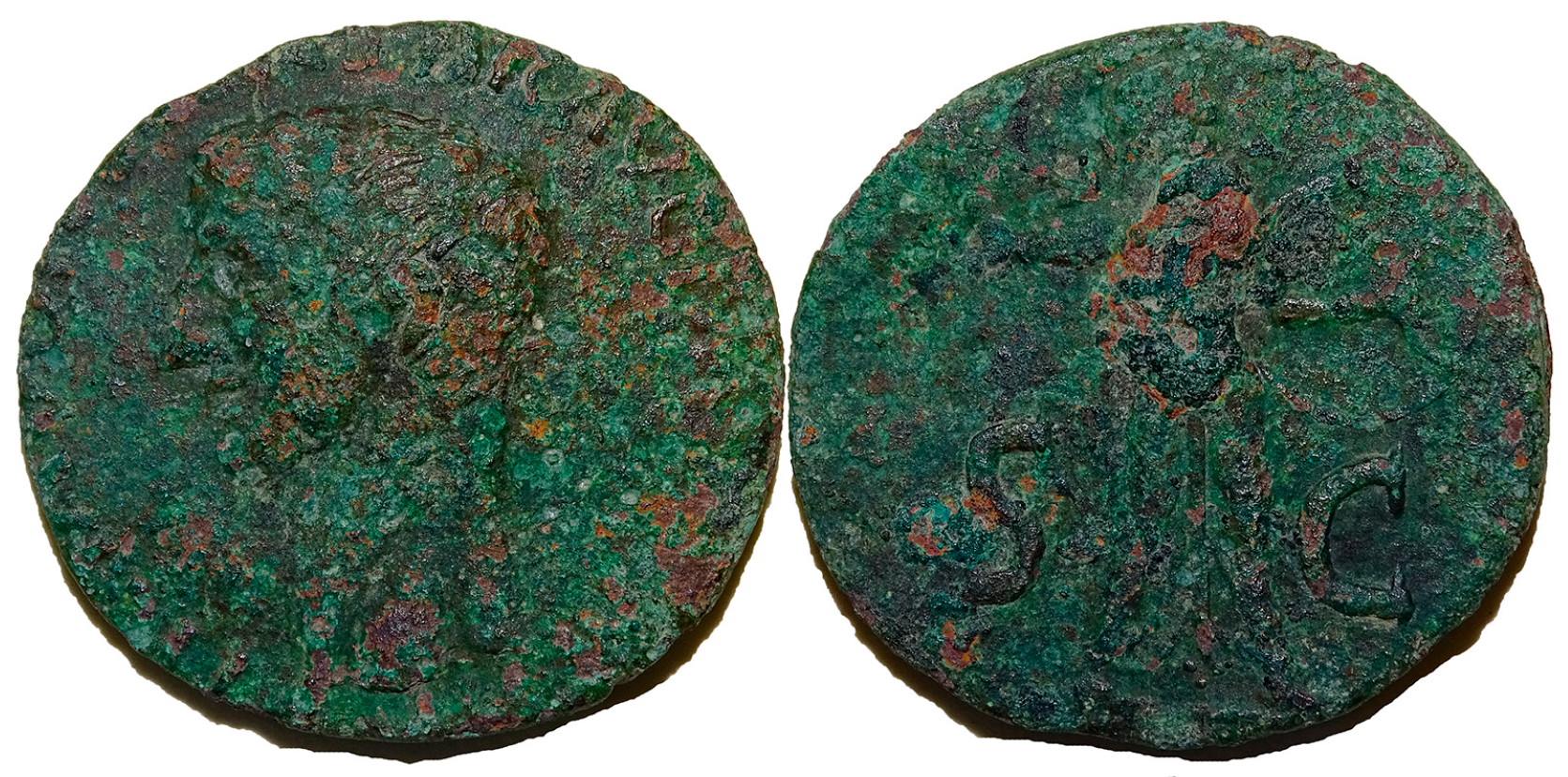
Firstly, we present imitation asses from the reign of Claudius. These asses are similar in size to official asses, and variations in weight have been detected on some occasions. They are essentially made of bronze and were theoretically issued between 41 and 54 AD, remaining in circulation until the 70s of the 1st century AD [16,39]. As with other types of imitation coins, they are notable for their crude design on both the obverse and reverse sides. Examples of this type of imitation coin can be seen below (Figure 1 and Figure 2).
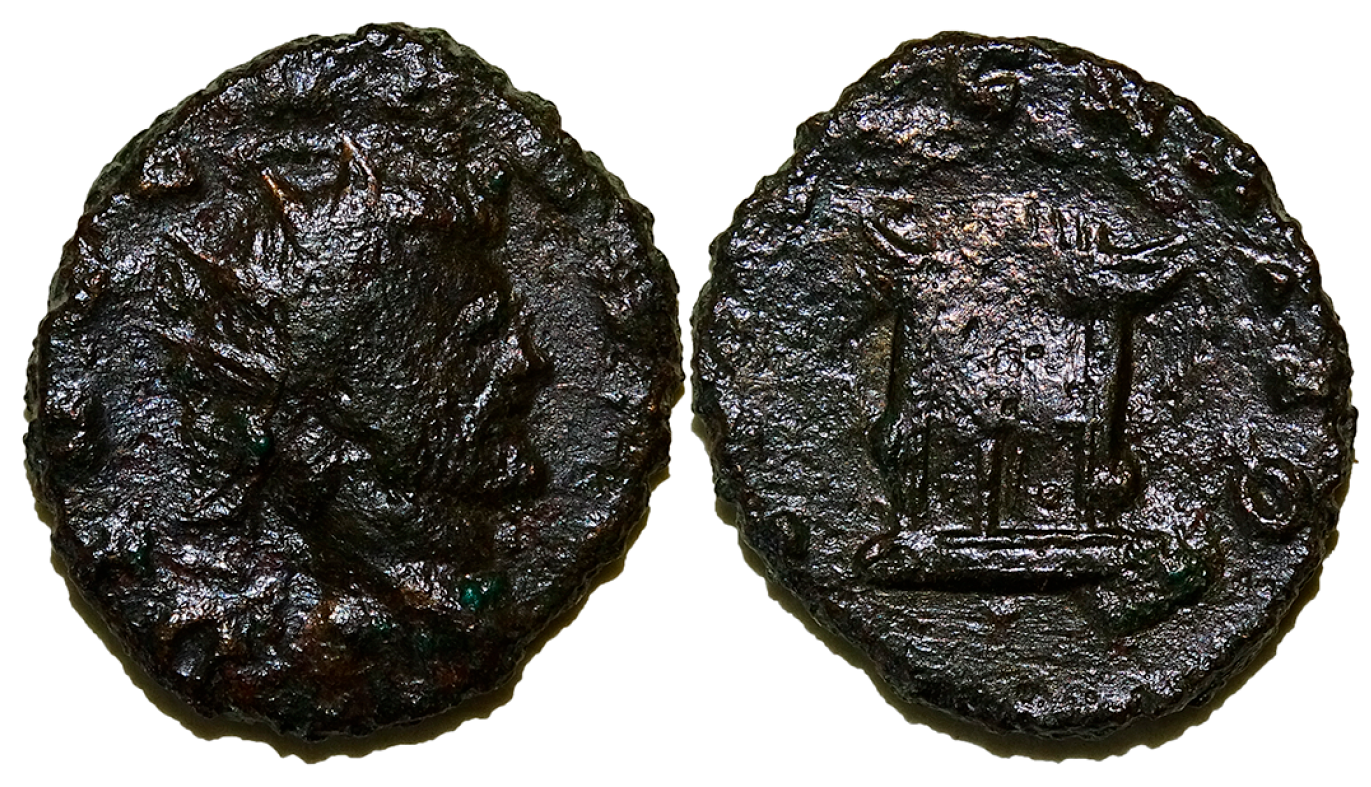
Secondly, the case of the “barbarous radiates” or “radiate copies” must be explained. These pieces, made of bronze, imitated the Antoninianus. This is a type of coin that has a variable weight and metrology, but the documented imitation radiates can measure between 10 and 16 mm and the weights are highly variable. They were widely circulated in Gallic and Hispanic territories and remained in circulation for centuries after their issue in the third quarter of the third century. Mints of this type of coin have been documented in different areas of Gaul [17,18]. In fact, this type of currency is widely used and has been studied in the context of Italy and Malta, for example [41]. As in the other cases discussed, the obverse and reverse sides feature crude artwork, which can vary greatly from one coin to another. This imitative type is illustrated below with a documented example (Figure 3).
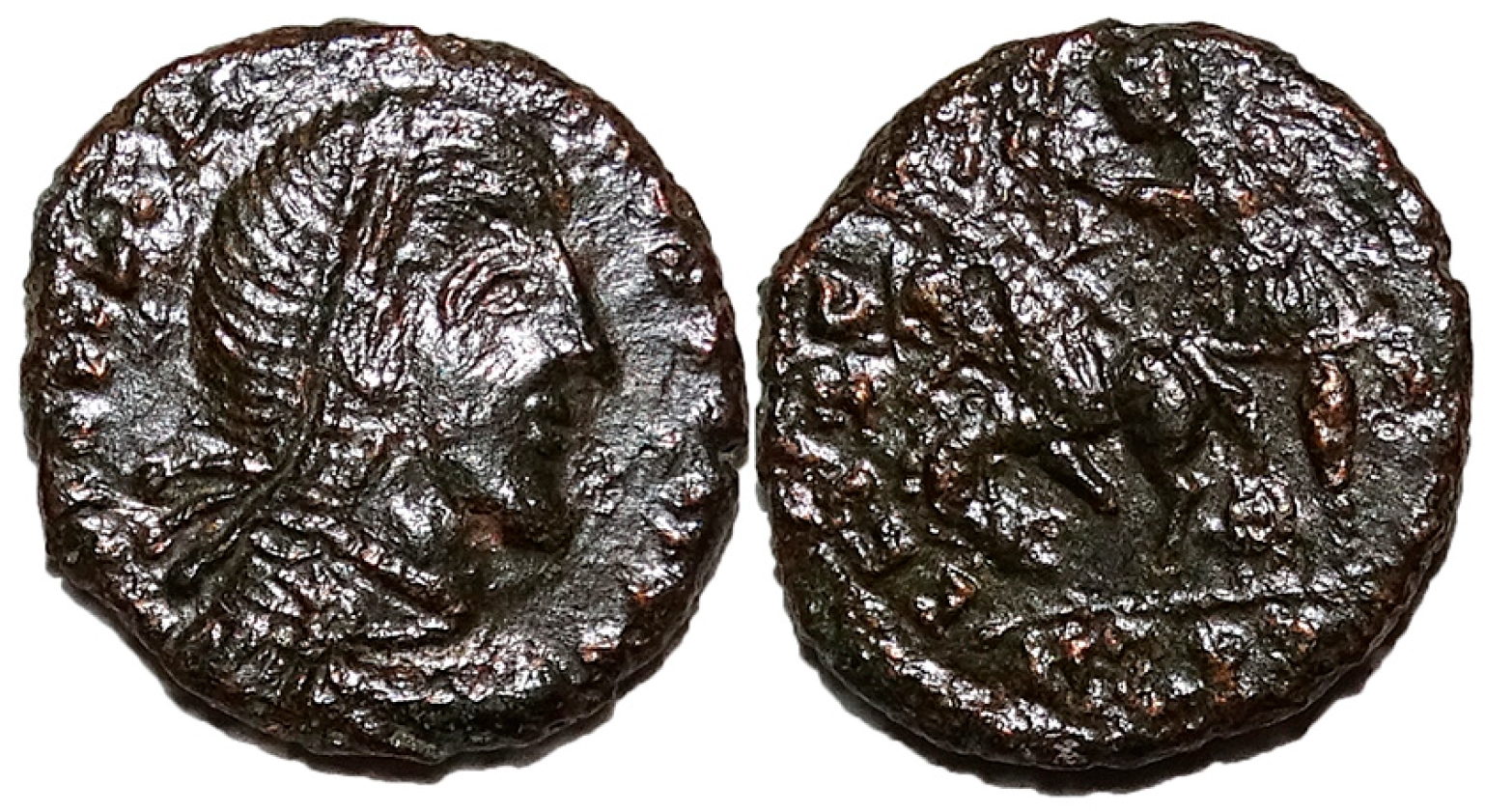
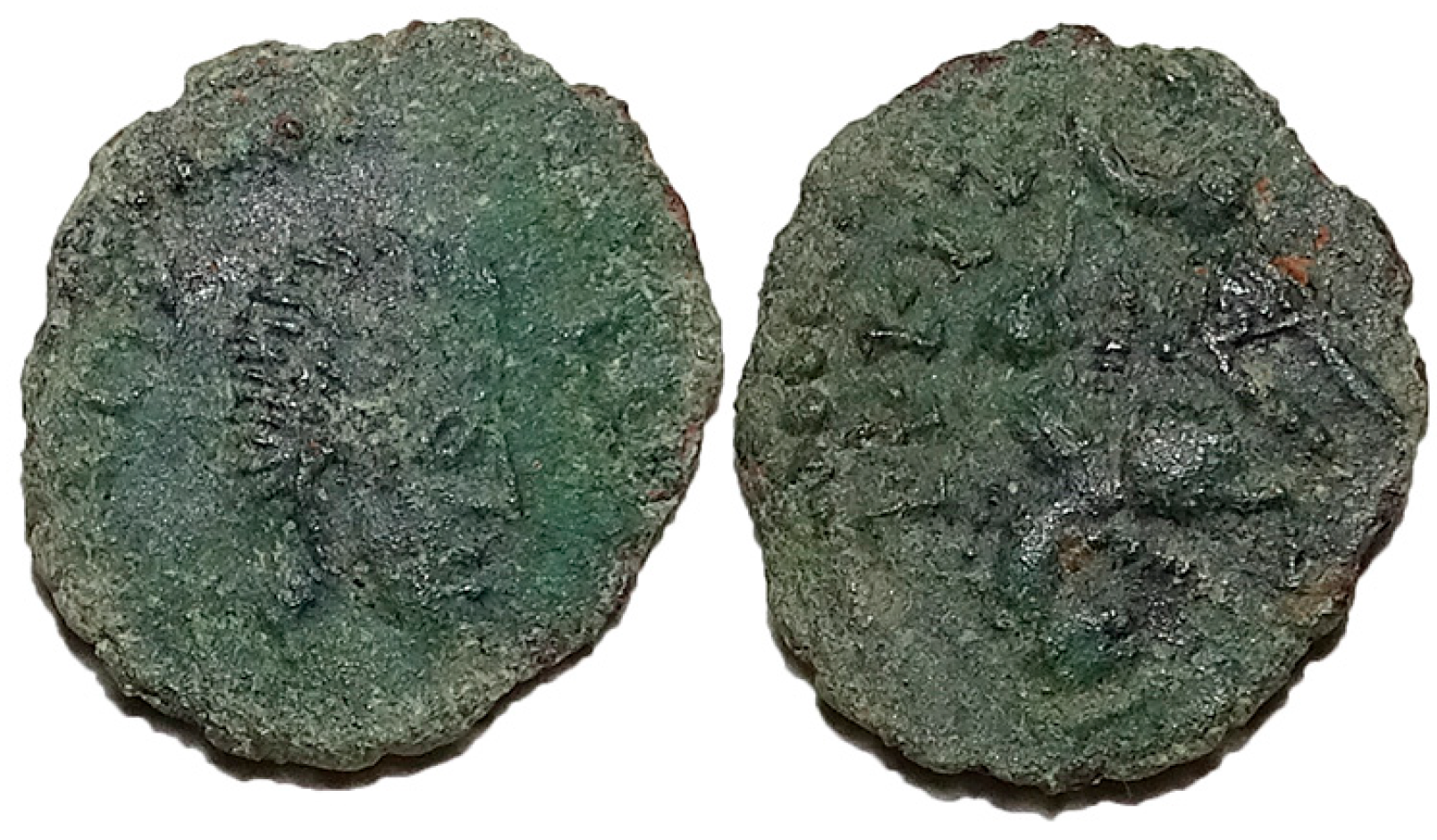
Finally, the imitation coin from the late fourth and early fifth centuries mainly imitates the types officially issued in the mid-fourth century. It essentially imitates bronze coins and, regardless of the dimensions of the original coin, is usually imitated in the AE4 module (less than 15 mm) or in minimi module, defined by Bijovksi, among others, as less than 11 mm [42]. Although imitations of various types can be documented, the imitations mainly copy the type of the soldier spearing a fallen barbarian horseman (FEL TEMP REPARATIO) or the type of the emperor standing on the left with a globe and spear (SPES REIPVBLICAE). The arts on the obverse and reverse are usually very crude in most cases. It is not known exactly where they were issued and in how many places, but it seems plausible that some workshops were located in the Iberian Peninsula or Gaul. These imitations have been documented as having large circulation cycles and may have remained in circulation during the 5th and 6th centuries and, in some cases, even later centuries [21]. This last type of imitation coin is exemplified by two specimens (Figure 4 and Figure 5).
In summary, it could be said that, in order to correctly identify an imitation coin, one should first look at the roughness of the engraving on the obverse and reverse sides of the coin, since many counterfeit coins have rough-looking obverse and reverse sides. If this is the case, the module of the coin, its weight, and its diameter should be checked to see if they can be compared with the standards for the type of reverse side of the coin. The variation should be established based on the modules appearing in manuals such as Roman Imperial Coinage [2]. The criteria are therefore not strictly objective, but in cases of doubt, checking the module can be key to determining whether or not a coin is an imitation.

5. Conclusions

The importance of imitation coins in the economy and monetary circulation of the Roman period should be emphasized. It is essential to differentiate this phenomenon from others such as counterfeit coins or non-Roman coins that imitate Roman issues. Roman imitation coins were a response by public or private agents to a monetary shortage, which is why they have been defined as coins of necessity. Archaeology has made it possible to document the real importance of this phenomenon, as classical sources are fairly silent on the subject. The implications of imitation coins are many and highlight the need to conduct trade using coins, which existed in the Roman Empire.
This phenomenon did not occur at a single moment in time, but rather repeated itself on several occasions, all of which were marked by a widespread shortage of currency. It therefore appears to have been a recurring resource used by the official authorities to alleviate problems in the supply of currency.
This text has sought to define this phenomenon in broad terms, highlighting various issues and considerations that are intended to be useful for experts in the field, as well as archaeologists, historians, and students.

Funding

The APC was funded by Universitat de Girona.

Institutional Review Board Statement

Not applicable.

Informed Consent Statement

Not applicable.

Data Availability Statement

Dataset available on request from the authors.

Conflicts of Interest

The author declares no conflicts of interest.

References

  1. Cohen, H.; Gaidoschik, R.; Feuardent, G.L.; Probszt, G. Description Historique des Monnaies Frappees sous L’Empire Romain Communement Appelees Medailles Imperiales, 2nd ed.; Akademische Druck- und Verlagsanstalt: Graz, Austria, 1955; Volumes 1–9. [Google Scholar]
  2. Mattingly, H.; Sydenham, E.A.; Sutherland, C.H.V.; Carson, R.A.G. (Eds.) The Roman Imperial Coinage; Spink & Son: London, UK, 1923–1994; Volumes 1–10. [Google Scholar]
  3. Eckhel, J.H. Doctrina Numorum Veterum; Typographia Academica: Vindobonae, Austria, 1792–1798. [Google Scholar]
  4. Boon, G. Les monnaies fausses de l’époque impériale et la valeur des espèces courantes. In Les «Dévaluations» à Rome. Epoque Républicaine et Impériale; École Française de Rome: Rome, Italy, 1978; pp. 99–106. [Google Scholar]
  5. Brickstock, R.J. Copies of the Fel Temp Reparatio Coinage in Britain: A study of Their Chronology and Archaeological Significance Including Gazetters of Hoards and Archaeological Reports British Series; British Archeological Reports, British Series, 176; B.A.R.: Oxford, UK, 1987. [Google Scholar]
  6. Bastien, P. Imitations de Folles de la première tétrarchie. Riv. Ital. Numis. 1980, 82–83, 123–129. [Google Scholar]
  7. Bastien, P. Imitations du monnayage des Tétrarques et de la famille constantinienne. Bull. Cercle Études Numis. 1981, 18, 32–38. [Google Scholar]
  8. Bastien, P. Imitations of roman bronze coins, A.D. 318-363. Am. Numis. Soc. Mus. Notes 1985, 30, 143–177. [Google Scholar]
  9. Callu, J.P.; Garnier, J.P. Minimi constantiniens trouvés a Reims. Recherches sur les imitations à prototypes des années 330 a 348. Quad. Ticinesi Numis. Antichita Class. 1977, 6, 281–315. [Google Scholar]
  10. Adelson, H.; Kustas, G. A bronze hoard of the period of Zeno I. Numis. Notes Monogr. 1962, 148, 2–89. [Google Scholar]
  11. Brenot, C.; Barrate, F.; Vasic, M.; Popovic, V. Sirmium VIII. Etudes de Numismatique Danubienne. Trésors, Lingots, Imitations, Monnaies de Fouilles. IVe au XIIe Siècle; École Française de Rome: Rome, Italy, 1978. [Google Scholar]
  12. Bastien, P. Trésors de la Gaule septentrionale. La circulation monétaire à la fin du IIIème et au début du IVème siècles. Rev. Nord 1978, 239, 789–812. [Google Scholar] [CrossRef]
  13. Domenech Belda, C.; Amorós Ruiz, V.; Garrigós i Albert, I.; Gutiérrez Lloret, S. Arqueonumismática: Pervivencia y usos monetarios en la ciudad altomedieval de El Tolmo de Minateda; Publicaciones de la Universidad de Alicante: Alicante, Spain, 2025. [Google Scholar]
  14. Marlasca, O. La regulación de la falsificación de monedas en el Derecho romano y en la ley de los visigodos. Anu. Hist. Derecho Esp. 2000, 70, 405–422. [Google Scholar]
  15. Ripollès, P. La moneda romana imperial y su circulación en Hispania. Arch. Esp. Arqueol. 2002, 75, 195–214. [Google Scholar] [CrossRef]
  16. Van Heesch, J. Decades without bronze minting in the first century ad: Their significance and impact on coin circulation. In Volume II: Roman Numismatics, Proceedings of the XVI International Numismatic Congress, Warsaw, Poland, 11–16 September 2022; Bodzek, J., Bursche, A., Zapolska, A., Eds.; Brepols Publishers: Turnhout, Belgium, 2025; Volume 2, pp. 157–164. [Google Scholar]
  17. Kropff, A. “Radiate copies”: Late third century Roman emergency coins. Rev. Belge Numis. Sigillogr. 2005, 151, 75–96. [Google Scholar]
  18. Pilon, F. Initiators, status, degree of tolerance of authorities and other key features of irregular radiates: An updated overview. In Volume II: Roman Numismatics, Proceedings of the XVI International Numismatic Congress, Warsaw, Poland, 11–16 September 2022; Bodzek, J., Bursche, A., Zapolska, A., Eds.; Brepols Publishers: Turnhout, Belgium, 2025; Volume 2, pp. 647–654. [Google Scholar]
  19. Frey-Kupper, S.; Stannard, C. Evidence for the importation and monetary use of blocks of foreign and obsolete bronze coins in the ancient world. In Infrastructure and Distribution in Ancient Economies; Woytek, B., Ed.; Verlag der Österreichischen Akademie der Wissenschaften: Vienna, Austria, 2019; pp. 283–354. [Google Scholar]
  20. Marot, T. La península Ibérica en los siglos V-VI: Consideraciones sobre provisión, circulación y usos monetarios. Pyrenae 2001, 31–32, 133–160. [Google Scholar]
  21. Bouzas, M. El fenómeno de la imitación de moneda en época bajo-imperial: Consideraciones generales y tipologías a partir del ejemplo del territorium gerundesis. Vegueta Anu. Fac. Geogr. Hist. 2025, 25.2, 885–904. [Google Scholar]
  22. Campo, M. Numismàtica: Dades per a la Documentació Numismàtica; Generalitat de Catalunya, Direcció General del Patrimoni Artístic, Servei de Museus: Barcelona, Spain, 1987. [Google Scholar]
  23. Toschke, Y.; Wolke-Hanenkamp, S.; Wolf, E.; Becker, H. Non-destructive, specular laser reflectometry and X-ray fluorescence analysis applied to coins of the Gallic Roman Empire. Heritage 2025, 8, 202. [Google Scholar] [CrossRef]
  24. Chameroy, J.; Guihard, P.M. L’officine de faux-monnayeurs de La Coulonche (Orne): Nummi coulés de la Tétrarchie en Occident. Numis. Chron. 2014, 174, 153–191. [Google Scholar]
  25. Dymowski, A. The manufacture and use of Roman Imperial denarii subaerati by barbarian inhabitants of Central, Eastern, and Northern Europe: An overview. In Volume II: Roman Numismatics, Proceedings of the XVI International Numismatic Congress, Warsaw, Poland, 11–16 September 2022; Bodzek, J., Bursche, A., Zapolska, A., Eds.; Brepols Publishers: Turnhout, Belgium, 2025; Volume 11, pp. 753–762. [Google Scholar]
  26. Feugère, M.; Py, M. Dictionnaire des Monnaies Découvertes en Gaule Méditerranéenne (530-27 av. notre ère); Éditions Monique Mergoil: Montagnac, France; Bibliothèque Nationale de France: Paris, France, 2011. [Google Scholar]
  27. Pliego, R. Rethinking the minimi of the Iberian Peninsula and Balearic Islands in late antiquity. J. Mediev. Iber. Stud. 2020, 12, 125–154. [Google Scholar] [CrossRef]
  28. Ladich, M. Monete Vandale; Diana Editrice: Cassino, Italy, 2013. [Google Scholar]
  29. Tapavicki Ilić, M. Relations of Celtic minting to Roman monetary system: Show on the example of Scordisci and Treveri. Starinar 2005, 55, 35–51. [Google Scholar] [CrossRef]
  30. Moisil, D. The Danube Limes and the Barbaricum (294–498 AD). Symp. Thracologica 2002, 8, 89–102. [Google Scholar]
  31. Dymowski, A. The Problem of the Presence of Barbarian Imitations of Roman Imperial Denarii in the Lands of Present-Day Poland. An Attempt at a Balance. Notae Numis. Zap. Numis. 2019, 14, 123–145. [Google Scholar]
  32. Bursche, A. Roman coins from Illerup Ådal (Denmark). Notae Numis. Zap. Numis. 2014, 9, 89–110. [Google Scholar]
  33. Kunisz, A. La monnaie de nécessité dans les provinces rhénanes et danubiennes de l’Empire romain dans la première moitié du IIIe siècle. In Les « Dévaluations » à Rome. Epoque Républicaine et Impériale; École Française de Rome: Rome, Italy, 1980; Volume 2, pp. 129–139. [Google Scholar]
  34. Carrié, J.M. Ressources métalliques, politiques monétaires, production et circulation des espèces dans l’empire romain tardif. In Produktion und Recyceln von Münzen in der Spätantike: 1. Internationales Numismatikertreffen; Chameroy, J., Guihard, P.M., Eds.; Verlag des Römisch-Germanischen Zentralmuseums: Mainz, Germany, 2016; pp. 265–277. [Google Scholar]
  35. Orlandonni, M. Imitazioni di monete romane in bronzo emessa fra il IV ed il V secolo D.C. rinvenute negli scavi archeologici in Valle d’Aosta. In Ermanno A. Arslan Studia Dicata; Arslan, E., Martini, R., Vismara, N., Eds.; Ennere: Milan, Italy, 1991. [Google Scholar]
  36. Depeyrot, G. Le système monétaire de Dioclétien à la fin de l’Empire Romain. Rev. Belge Numis. Sigillogr. 1992, 138, 33–106. [Google Scholar]
  37. King, C.E. The fourth century coinage. In L’Inflazione Nel Quarto Secolo D.C.: Atti Dell’Incontro di Studio, Roma 1988; Istituto Italiano di Numismatica: Rome, Italy, 1993; pp. 1–35. [Google Scholar]
  38. Wigg-Wolf, D. Supplying a dying empire? The mint of Trier in the Late 4th century. In Produktion und Recyceln von Münzen in der Spätantike: 1. Internationales Numismatikertreffen; Chameroy, J., Guihard, P.M., Eds.; Verlag des Römisch-Germanischen Zentralmuseums: Mainz, Germany, 2016; pp. 217–233. [Google Scholar]
  39. Campo, M. El Problema de las monedas de imitación de Claudio I en Hispania. Acta Numis 1974, 4, 155–163. [Google Scholar]
  40. Bouzas, M.; Burch, J.; Nolla, J.M. Catàleg de monedes de la vil·la romana de Pla de Palol (Castell-Platja d’Aro). Estud. Baix Empordà 2021, 40, 13–57. [Google Scholar]
  41. Perassi, C. Antoniniani e imitazioni radiate dal territorio maltese. In Suadente Nummo Vetere. Scritti in Onore di Giovanni Gorini; Asolati, M., Callegher, B., Saccocci, A., Eds.; Esedra: Padova, Italy, 2016; pp. 267–285. [Google Scholar]
  42. Bijovsky, G. Gold Coin and Small Change: Monetary Circulation in Fifth-Seventh Century Byzantine Palestine; Polymnia Numismatica antica e medievale. Studi 2; EUT Edizioni Università di Trieste: Trieste, Italy, 2012. [Google Scholar]
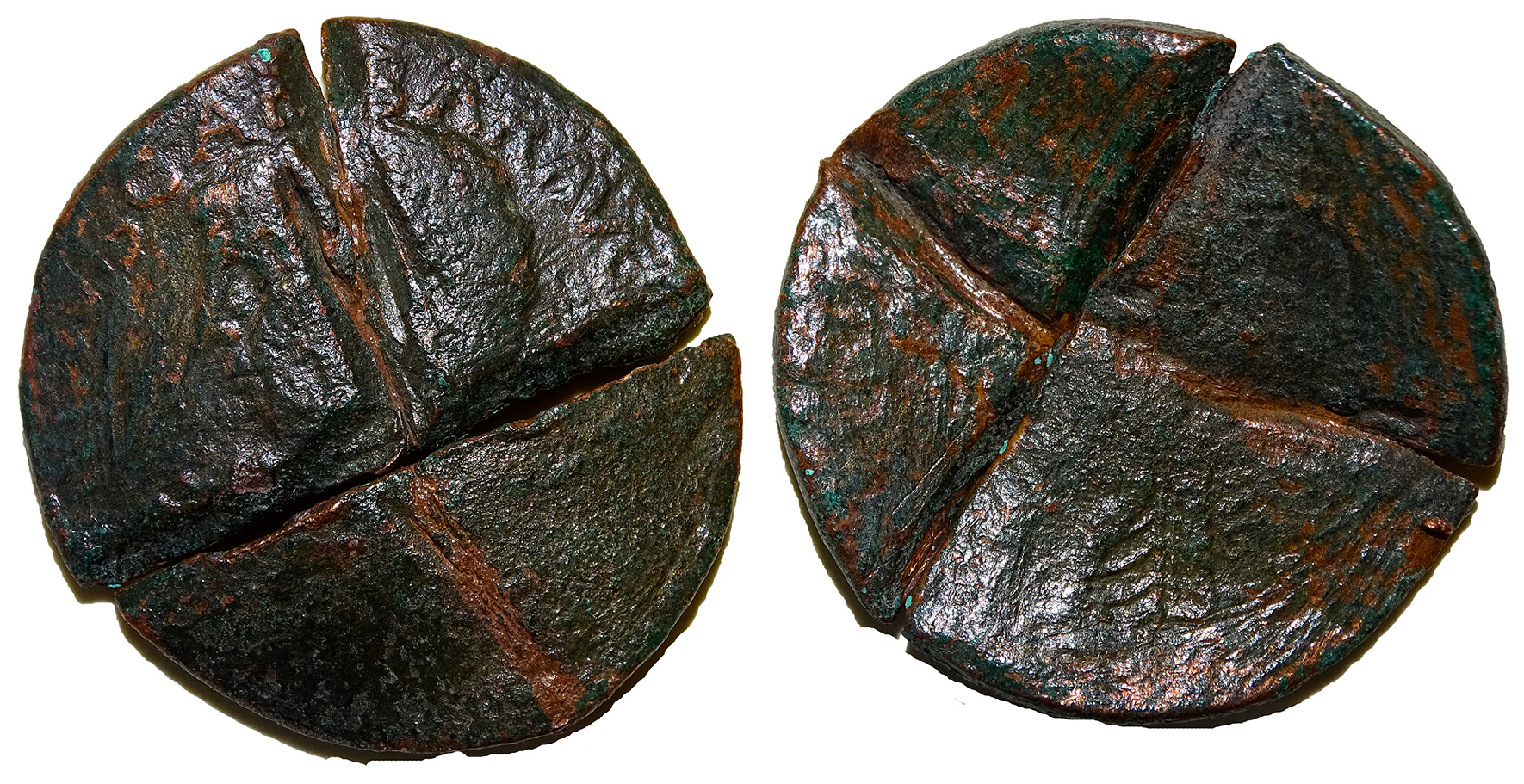
Figure 1. As of Claudius dated to the middle of the 1st century AD. Obverse: bust of Claudius on the left. Legend: …VS.CAESARAVG… Reverse: Minerva standing on the right equipped with a shield and spear, with S and C on either side. Bronze; 9.90 g; 29 mm; 9 h. RIC I 100 (or similar). Evidence of an attempt to split the coin into four parts. Adapted from the specific publication on the coins of the Roman villa of Pla de Palol [40].
Encyclopedia 06 00062 g001
Figure 2. As of Claudius dated to the middle of the 1st century AD. Obverse: bust of Claudius on the left. Legend: …SARAVG… Reverse: Minerva standing on the right equipped with shield and spear, on the S and C sides. Bronze; 7.27 g; 26 mm; 6 h. Ref.bibl: RIC I 100 (or similar). Adapted from the specific publication on the coins of the Roman villa of Pla de Palol [40].
Encyclopedia 06 00062 g002
Figure 3. Imitation Antoninianus of Claudius II, dated to the third quarter of the 3rd century. Obverse: bust of Claudius II with radiate crown and beard, facing right. Legend: DIVO… Reverse: altar of Claudius’ consecration. Legend: …CRATIO. Bronze; 2.58 g; 17 mm; 12 h. Adapted from the specific publication on the coins of the Roman villa of Pla de Palol [40].
Encyclopedia 06 00062 g003
Figure 4. Ae4, dated to the late 4th or early 5th century (imitation issue). Obverse: male bust wearing a diadem on the right. Reverse: Roman soldier spearing a fallen barbarian horseman. Bronze; 0.94 g; 12 mm; 12 h. Adapted from the specific publication on the coins of the Roman villa of Pla de Palol [40].
Encyclopedia 06 00062 g004
Figure 5. Ae4, dated to the late 4th or early 5th century (imitative issue). Obverse: diademed male bust facing right. Reverse: Roman soldier spearing a fallen barbarian horseman. Bronze; 1.82 g; 14 mm; 6 h. Adapted from the specific publication on the coins of the Roman villa of Pla de Palol [40].
Encyclopedia 06 00062 g005
Disclaimer/Publisher’s Note: The statements, opinions and data contained in all publications are solely those of the individual author(s) and contributor(s) and not of MDPI and/or the editor(s). MDPI and/or the editor(s) disclaim responsibility for any injury to people or property resulting from any ideas, methods, instructions or products referred to in the content.