Entry

Bilingual Education in the U.S.

by
Swati Dontamsetti
1,*,
Claudia M. Castillo-Lavergne
2 and
Vandeen A. Campbell
2
1
Graduate School of Education, Rutgers University, New Brunswick, NJ 08901, USA
2
The Joseph C. Cornwall Center for Metropolitan Studies, Rutgers University, Newark, NJ 07102, USA
*
Author to whom correspondence should be addressed.
Encyclopedia 2026, 6(1), 4; https://doi.org/10.3390/encyclopedia6010004

Submission received: 30 September 2025 / Revised: 13 December 2025 / Accepted: 22 December 2025 / Published: 25 December 2025
(This article belongs to the Section Social Sciences)

Definition

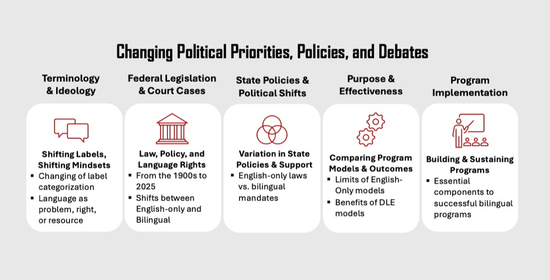
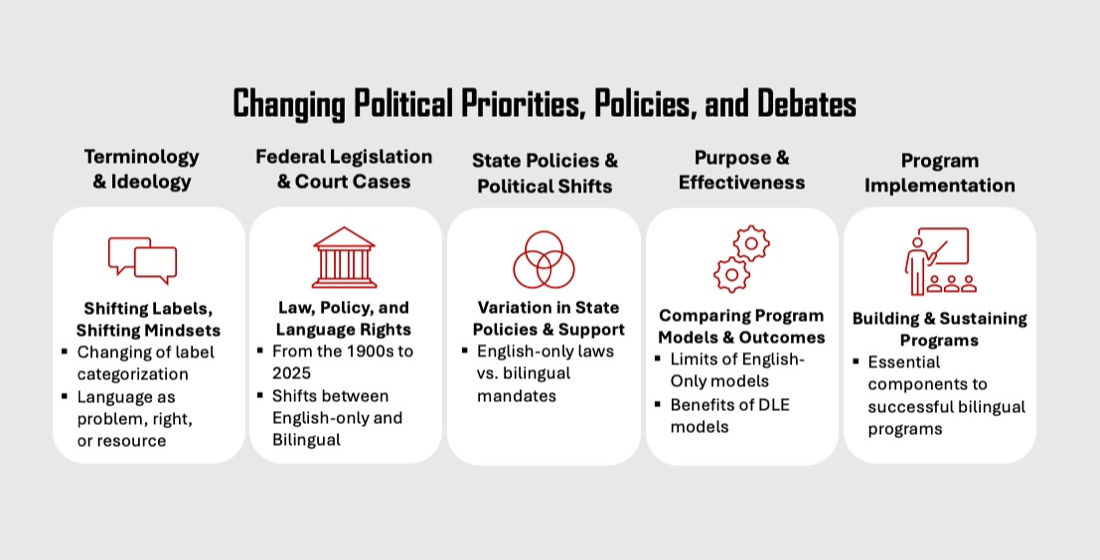
Bilingual education in the United States encompasses programs that use both English and students’ home languages to promote learning. It has been shaped by changing political priorities, policies, and debates over assimilation versus linguistic diversity. This entry reviews the history of bilingual education in the United States and how public opinion and political attitudes have shifted over time. It traces how policymakers and practitioners have viewed English language acquisition as either a tool of assimilation or as a resource for learning, and how support has moved from English-only immersion to dual language education programs. The discussion highlights how current assessment practices, focused on English-only standardized testing, have not kept pace with changing views of bilingual education. The entry concludes by identifying gaps in research and urging states to evaluate how comprehensively they serve their bilingual student population through their education policies and programs.

Graphical Abstract

1. Introduction

Bilingual education in the United States has long occupied contested terrain, shaped by shifting political ideologies, landmark court decisions, and competing views of linguistic diversity. While some policies have framed students’ home languages as obstacles to overcome, others have recognized their value as resources for learning and identity. This tension has produced a cyclical history of expansion and retrenchment in bilingual programming, reflecting broader debates about equity, assimilation, and national identity.
This entry examines the evolution and effectiveness of bilingual education in the United States, focusing on three interrelated lines of inquiry: how evolving terminology reflects underlying ideologies, how policies have supported or undermined bilingualism over time, and what research reveals about the benefits of bilingual approaches. In doing so, this entry highlights research debates about the enduring value of home language instruction, the promise of dual language education, and the limitations of current assessment and accountability systems. The entry concludes by identifying gaps in implementation and research, underscoring the need for sustained investment in programs that advance equity by treating linguistic diversity as a foundational educational asset.

2. History of Bilingual Education in the United States

2.1. Terminology and Ideological Debates

There have been many changes to the labels used to describe students who are in the process of learning English. Common terms have included limited English proficiency (LEP), English language learner (ELL), English learner (EL), emergent bilingual (EB), dual language learner (DLL), and multilingual learner (ML) [1]. The shift from deficit-based terms such as LEP to more asset-based terms such as EB and ML reflects deeper ideological debates about how students learning English in bilingual programs are positioned in schools [2,3]. Before the 2015 Every Student Succeeds Act (ESSA) reauthorized the 1965 Elementary and Secondary Education Act (ESEA), the U.S. Department of Education used LEP instead of the now-preferred term EL [2,3,4]. ESSA, like its predecessor, the No Child Left Behind Act (NCLB) of 2002, retained annual standardized testing requirements but transferred most accountability from the federal government to the states in order to close student achievement gaps [4]. While EL is used legally, some argue for terms that foreground students’ bilingual or multilingual potential [5]. Thirty-nine states and the District of Columbia’s department of education continue to use ELL or EL, while others, including New York, Washington, and Texas, have shifted to labels such as ML or EB [1].
Many educators still commonly use the term English as Second Language (ESL) students, reflecting the specific classes students take and the certified teachers who work with them. The persistence of ESL in educational discourse reveals a deficit-oriented framework embedded in institutional language, even as scholarship increasingly promotes asset-based perspectives through terms such as EB and ML [2,3]. At the same time, researchers and educators acknowledge that retaining the term EL serves important institutional and analytical functions [6]. The EL designation corresponds to a federally recognized category that determines access to language-support services and allows for accountability and longitudinal data tracking across educational systems [6]. These overlapping but distinct labels differ in scope: EB highlights developing bilingualism, ML centers multilingual identity and resource orientation, and EL reflects a legal and policy-based classification [6]. Recognizing this coexistence affirms both the ideological shift toward asset-based terminology and the pragmatic need for clarity in policy and research contexts.
The debate over labels matters because terminology reflects how policymakers and educators view the role of students’ home languages other than English. Research has shown that how students are labeled indicates whether home language is treated as a problem, a right, or a resource [7]. The early Bilingual Education Act of 1968 reflected a “language-as-problem” orientation, framing EB students as obstacles to instruction because of their lack of English comprehension [2] (p. 314). More recently, a “language-as-resource” perspective that finds all languages as valuable and useful resources to be supported has gained traction, as seen in the growth of dual language programs and equity-focused research [2] (p. 315). In this entry, we use EB when discussing students to reflect its growing use in the research literature as an asset-based term that emphasizes students’ bilingual potential rather than their lack of English comprehension [8,9,10]. EB captures the educational goal of fostering bilingual and biliterate competence. This framing aligns with the purpose of this entry to examine the historical, ideological, and policy developments that have shaped bilingual education in the United States, with particular attention to how evolving program models reflect broader debates about equity, language, and educational opportunity.
Just as terminology describing EBs has evolved toward more inclusive and asset-based language, similar shifts have occurred in how bilingual program models are labeled and understood. Earlier frameworks used dual language immersion (DLI) to describe classrooms integrating English-dominant and EB students [11]. Over time, the term dual language education (DLE) became more widely used to capture a range of program models that promote bilingualism and biliteracy through instruction in two languages [11]. DLE programs include both one-way models, which serve primarily EBs, and two-way models that integrate English-dominant and EB students to promote bilingualism for both types of learners [12]. More recently, the term dual language bilingual education (DLBE) has been used to emphasize that programs are not just about immersion but educating students bilingually [11,12]. These changes reflect growing awareness of how program goals shape outcomes for EB students [12].
Earlier scholarship commonly used DLI to describe programs integrating students from two language groups. Current scholarship uses DLE as a broader term for programs that teach in more than one language. In this manuscript, we use DLBE to emphasize bilingualism and biliteracy as the central goals, reflecting common usage in recent literature. Accordingly, DLI is used only when referring to earlier terminology; DLE is used when the program model is unspecified; and DLBE is used when highlighting the emphasis on bilingualism as the program outcome.
While this entry does not review ESL programs, it is important to clarify how they differ from bilingual education. In practice, there are two main approaches in classrooms across the states to educate EBs in grades pre-K to 12: (1) ESL, where English is the primary language of instruction and where the objective is to learn English, and (2) bilingual approaches, where both English and students’ home languages are used with the goal of bilingualism [13]. Within bilingual education, programs can vary based on student demographics, the community context, and the ideological goals that guide the types of bilingualism that are fostered [12]. DLE and DLBE can include one-way programs that largely serve EBs in order develop home language alongside English [11,12,14]. Two-way models integrate English-dominant and EB students and are guided by the idea that both sets of students contribute equally and can share in the benefits of learning two languages [11,12,14].

2.2. Federal Legislation and Court Cases

Bilingual education emerged in the United States around the time of the Civil Rights Movement and the War on Poverty initiatives of the 1960s. Before then, English-only immersion (i.e., sink-or-swim) programs were argued to be the best way to promote literacy [15]. One of the most extreme examples of this approach occurred during the Civil War when “the U.S. government began to pursue an aggressive Indian deculturation and domestication program” [15] (p. 20). The practice of separating families and sending children to boarding schools, where they were taught to devalue their culture and forbidden to speak their home language, is now widely regarded as dehumanizing, unethical, and a form of cultural genocide [16]. Moreover, such tactics did not promote English literacy [15]. Even 30 years ago, research indicated that bilingual education was more effective than sink-or-swim approaches [15].
Lack of English language skills has long been used as part of school segregation efforts. In 1914, Francisco Maestas et al. v. George H. Shone et al. challenged the Alamosa, Colorado, school board and superintendent for forcing Mexican American children to attend a segregated “Mexican school,” claiming language deficiency as justification even though all Mexican American students were required to attend regardless of English proficiency [17]. The district court judge ruled that Mexican American children who spoke English had the right to attend public schools near their homes [17]. Seventeen years later, in the 1930 Del Rio ISD v. Salvatierra case, the school district of Del Rio, Texas, used the migrant nature of their parents and the lack of English proficiency of Mexican American children to create a “Mexican school” [18]. A district judge ruled in favor of the Mexican American parents, but later the Court of Civil Appeals of San Antonio reversed the ruling allowed for the segregated schools [18]. At the same time in California, Roberto Alvarez v. the board of trustees of the Lemon Grove School District, known simply as the Lemon Grove Incident of 1931, challenged efforts by the local school board to segregate Mexican and Mexican American students [19]. The San Diego Superior Court rejected school officials’ claims that separating children who spoke only Spanish would better address their language needs [19]. More than a decade later, the first federal court case on the school segregation of Mexican Americans, Mendez et al. v. Westminster School District of Orange County, et al. (1946), found that Spanish-speaking students learned English more successfully in integrated classrooms [13]. And in Texas, in 1948, Delgado v. Bastrop Independent School District overturned the earlier Del Rio case by ending school segregation for Mexican American students, except in the case of standardized testing that could show a lack of English language proficiency [18]. These legal precedents helped set the stage for Brown v. Board of Education and influenced early federal involvement in bilingual education [13].
A 1966 National Education Association report revealed that English-only schooling practices undermined Mexican American students’ self-esteem, engagement, and academic achievement [9,20]. In 1967, Senator Ralph Yarborough of Texas introduced the Bilingual Education Act (BEA), the first federal law acknowledging the need for targeted support for EBs. Established as Title VII of the Elementary and Secondary Education Amendments, the BEA funded programs that encouraged bilingualism by supporting instruction in both English and students’ home languages [21]. Federal support for providing EBs instruction in their own language was further strengthened after the landmark Lau v. Nichols decision in January 1974. The parents of Kinney Kinmon Lau and other Chinese students sued the San Francisco Unified School District in California for the over 1800 non-English-speaking Chinese students not provided with equal educational opportunities [2]. In Lau, the Supreme Court found that “providing identical education programs for both English- and non-English-speaking students did not constitute equal education opportunity, and that special language instruction was necessary to allow non-English speakers real access to the content of the education services” [22] (p. vii). Though the BEA originally supported bilingualism by setting instruction in both English and EBs’ home language as a goal, most of the bilingual education programs created were transitional in nature, framing the use of students’ home languages as a temporary accommodation rather than a sustained medium of instruction [9,21].
As a condition for receiving BEA funding, schools were required to administer language proficiency assessments in both English and Spanish to identify students eligible for bilingual education programs. Many students performed poorly on these “decontextualized assessments that did not align with the dynamic bilingualism of their lived experiences” and were labelled “semilingual,” or not fully proficient in either English or Spanish [23] (p. 21). In 1978, the American Institutes for Research conducted an evaluation of bilingual education and reported that such programs did not demonstrate a consistent or statistically significant effect on student achievement in English language arts, reading, or mathematics [9]. The test scores and supposed ineffectiveness of bilingual education programs bolstered critics who saw bilingual education as a threat to national unity. Moreover, Lau did not enshrine language rights, and later decisions like Castañeda v. Pickard (1981) diluted its force by allowing wide local discretion in defining the necessary “appropriate action to overcome language barriers” for students [1,24] (p. 1). The Fifth Circuit established a three-prong test for districts to determine whether their programming met the Equal Educational Opportunities Act [EEOA], which was central to Castañeda: (1) based in sound educational theory, (2) implemented effectively with consideration to resources and personnel, and (3) successfully overcoming language barriers for students [2,24]. Scholars have contended that the standard was vague enough to allow for varied interpretations of what constitutes an effective bilingual education program [25,26].
The political attack on bilingual education led to California Senator S. I. Hayakawa and Dr. John Tanton launching U.S. English in 1983, “a movement that sought to make English the official language of the United States and to ban bilingual education in U.S. public schools” [9] (p. 22). Political shifts in the 1980s reshaped federal bilingual education policy. The 1984 reauthorization of the BEA authorized funding for English-only programs and limited bilingual program participation to three years [9]. When William J. Bennett, a critic of bilingual education, became Secretary of Education in 1985, subsequent regulations allowed districts increased discretion to phase out non-English instructional practices for EBs [9]. However, amid this increased political opposition to bilingualism, DLE gained prominence. The two-way immersion model originated in 1965 in Montreal, Canada, as an initiative by English-speaking middle-class parents who sought bilingual, biliterate, and bicultural education for their children without compromising academic success [27]. Concurrently, an English-Spanish bilingual program emerged in Miami-Dade County [27]. The goals of bilingual education in the two countries differed markedly: in the United States, programs were evaluated based on students’ progress in English literacy, whereas in Canada, the objective was academic proficiency in both languages [27]. Moreover, bilingual services vary by community, and students of means are the most likely to access DLE [9].
The 1994 Improving America’s Schools Act, a reauthorization of the ESEA, reinstated the federal emphasis on bilingual education [21]. The reauthorization lifted the quota for English-only programs and increased attention to two-way immersion programs, in which both EB students and English-dominant students are kept together long-term so that all students develop proficiency in two languages [9,10]. This represented a departure from earlier models of bilingual education, which focused on primarily helping EB students learn English and transition out of additional supports.
In 2002, NCLB replaced BEA with Title III, the English Language Acquisition, Language Enhancement, and Academic Achievement Act [9,21]. NCLB tied language instruction more closely to accountability systems [13]. Under NCLB, schools, districts, and states were explicitly held responsible for EB students’ academic progress through Title I accountability provisions, including consequences for institutions that failed to meet performance targets for this subgroup [13]. At the same time, Title III reinforced standards-based reform by requiring states to develop English language proficiency standards and administer yearly assessments aligned with those standards [13]. Funding mechanisms also shifted, as Title III allocations moved from competitive grants to formula-based distributions calculated primarily on the size of EB student populations [13]. Federal oversight during this era relied heavily on the enduring Castañeda standards, which guided Title VI enforcement of EB program adequacy by the U.S. Departments of Justice and Education [13]. This period also saw efforts to integrate language development with academic content, exemplified by the Council of Chief State School Officers’ “ELP/D Framework,” which emphasized students’ use of language in academic practices such as discourse, argumentation, and text-based reasoning, rather than treating language development as mere vocabulary acquisition [13].
Concerns over the rigidity and punitive nature of NCLB’s federally driven accountability system later contributed to a policy shift under ESSA. Signed into law in December 2015, ESSA redistributed much of the responsibility for accountability, standards, and instructional oversight from the federal government to states and local education agencies [13]. The law also expanded its attention to family and community involvement. Under Title I, schools must inform families about their children’s placement in language programs, proficiency levels, available services, and school performance in a manner that is accessible and, when feasible, communicated in families’ home languages. Title III calls for the active involvement of parents and communities in supporting EB programs, and Title IV includes provisions to assist schools and districts in strengthening school-family partnerships [13]. Financial support for EBs now flows through multiple channels, including Title I, Title III formula and discretionary grants, and additional programs serving migrant, Native American, Alaska Native, and Native Hawaiian students [13].
Following ESSA’s enactment, the U.S. Department of Justice and the U.S. Department of Education issued a joint “Dear Colleague” letter reiterating that state education agencies remain responsible for ensuring districts comply with federal civil rights obligations toward EB students, even when states do not provide services directly [28]. This guidance reaffirmed that EB protections are rooted in anti-discrimination law based on national origin, rather than in formal recognition of language rights themselves [29]. Legal decisions have reflected this framework. In Horne v. Flores (2009), the Supreme Court granted states greater flexibility in determining how they meet EB obligations, emphasizing student outcomes over levels of financial investment, a position that critics argue weakened accountability for adequate services [30]. By contrast, Issa v. School District of Lancaster (2017) reaffirmed that districts violate federal law when they deny immigrant EB students, such as the six plaintiffs who are refugees from Somalia, Sudan, Democratic Republic of Congo, and Burma, access to public education and appropriate language supports, as the court ruled that such practices infringed upon the Equal Educational Opportunities Act [31].
More recently, shifts at the federal level illustrate the political vulnerability of these protections. The second Trump administration rescinded the 2015 “Dear Colleague” letter, which had served as an important, though nonbinding, resource for districts seeking to meet their legal obligations to EBs [28,29]. Although this action did not alter existing civil rights statutes, advocacy groups have expressed concern that it weakens oversight and leaves schools with less clarity about compliance expectations [29]. These changes have occurred alongside proposed reductions to Title III funding, significant staffing cuts to the Office of English Language Acquisition, and budget reductions to the Office for Civil Rights, as well as executive actions declaring English the official language and discouraging multilingual services [32,33]. Taken together, these developments demonstrate how U.S. policy continues to position language access primarily within a civil rights compliance framework, making protections for EB students highly contingent on shifting political climates.

2.3. State Policies and Political Shifts

Politically, bilingual education has swung between support and retrenchment. State-level policies reflect this tension: from states with English-only mandates to Bilingual Education requirements [34]. There is great variety in state mandates. Even when a state requires a certain educational model, there is still diversity in how school districts serve their student population [34]. The range in statewide policy support for bilingual education can also be contradictory. The following touches on key distinctions but does not address every state’s situation.
On the English-only side of the spectrum, four states have explicit English-only laws: Arizona, Arkansas, New Hampshire, and West Virginia [34]. Though all four states allow leeway to various degrees in using alternative models for EB instruction, Arizona’s Superintendent has been suing schools using non-English-only curriculums since 2023 and is currently asking the state Supreme Court for the power to enforce the original English-only proposition from 2000 [35,36]. Some use English being the official language of their state to avoid providing home language assessments without being English-only or explicitly restricting bilingual services: Florida, Georgia, Mississippi, South Carolina, Tennessee, and Virginia [34]. Still, most of these states either run their own DLE program or offer the option for school districts to offer the program based on their needs. Two states have repealed previous English-only mandates and allow for multiple program options for EBs: California and Massachusetts [5,34]. For critics who argue that U.S. policy remains anchored in a “language-as-problem” orientation, with rights grounded more in civil rights law than in recognition of language itself, these English-only mandates serve as a clear example of the issue [2,37]. In this framework, violations of language rights for EBs can be addressed only when they are tied to discrimination based on race, color, or national origin, rather than to the denial of language-based opportunities itself, especially as Castañeda allows for interpretation of best practices. This reinforces the idea that language is a barrier to be managed rather than a resource to be fostered [2].
On the other end of the spectrum, several states have goals or outright mandates requiring bilingual instruction. Seven states have value statements promoting bilingual education: Delaware, Georgia, New Mexico, North Carolina, Rhode Island, Utah, and Washington [34]. A few states require districts with 20 or more EB students in the same grade level from the same home language to be provided bilingual education: Connecticut, Illinois, New Jersey, New York, and Texas [5,34]. Alaska requires school districts to provide bilingual education when a school enrolls at least eight EBs, and to create a local Native language curriculum advisory board when the majority of students in a district are Alaska Natives [34].
Even with this state-by-state variation, all 50 states and the District of Columbia have adopted the Seal of Biliteracy [13,38]. The Seal of Biliteracy is an initiative that recognizes all students who are proficient in two or more languages by high school graduation [13]. It is available to all learners who achieve mastery in standard academic English as well as any other language, including American Sign Language [38]. Many languages have established assessments, such as Advanced Placement Tests or International Baccalaureate, to measure proficiency [38]. For languages without existing tests, some districts create their own evaluation methods and apply a shared scoring rubric aligned with World Language Standards [38]. California first developed and implemented the Seal statewide in 2011. South Dakota became the last and final statewide adopter in 2024 [13,38]. Many schools and districts even offer Bilingual Pathway Awards that celebrate students’ ongoing progress toward biliteracy at earlier points in their schooling, like preschool and elementary school, in addition to the high school Seal that appears on graduation diplomas [38].

3. The Purpose and Effectiveness of Bilingual Education

Part of the reason for shifts in bilingual education has been the ongoing debate over the best way to teach students a new language. At the center of this debate is a fundamental question: should the goal be rapid acquisition of the dominant language, or the development of students who are bicultural, biliterate, and bilingual? Closely related is the role of the home language: does it support learning a new language, and is there value in continuing instruction in the home language alongside English? Advocates of bilingual education maintain that instruction in students’ home languages supports the development of those languages and provides a foundation for acquiring academic skills in English [39,40]. In contrast, critics contend that using students’ home languages in instruction may hinder English development, reduce English achievement, and delay students’ integration into mainstream classrooms [39,40]. Research has documented a longstanding misconception that raising children bilingually confuses them and inhibits their cognitive development [15] (p. 19). This misconception was upheld by generations of research and shaped much of the opposition to bilingual education that encouraged many parents not to use their home language with their children [15]. English-only instruction was also promoted as the best way to achieve literacy, even if this approach often limited children’s opportunities to maintain their home language and communicate fully with their parents or grandparents [15]. English-only models can also contribute to further marginalization of EB students by signaling that their cultural and linguistic identities are less valued in school, which can limit their sense of belonging and engagement with rigorous content through the use of students’ full linguistic repertoires [9,11,12,41].
While English-only education promotes literacy, is it more or less effective than a program that still values linguistic diversity like bilingual education? In 1987, the Association for Supervision and Curriculum Development reported that it was unclear which approach was better [42]. Recent research has increasingly indicated that English-only instructional approaches may not be the most effective means of supporting the linguistic and academic development of EBs [21]. Researcher Claude Goldenberg (2013) states that “numerous experimental studies have been conducted over the past 40 years, and the consensus—although it is by no means unanimous—is that learning to read in their home language helps ELs boost reading skills in English” [39] (p. 9). Bilingual education boosts English literacy outcomes in the medium and long term, even if English-only immersion students initially appear to advance more quickly [43]. Meta-analyses conclude that bilingual programs yield moderate to large academic benefits in both ELA and math [5]. Goldenberg [39] reiterates this point and argues that:
  • bilingual education tends to produce better outcomes in English; at worst, it produces outcomes in English equivalent to those produced by English immersion. In other words, bilingual education helps students become bilingual—something that is valuable for anyone, not just “ELs [39] (p. 9).
Beyond academics, bilingualism enhances executive functioning, metalinguistic awareness, and problem-solving [5,44]. It also supports positive identity development, self-efficacy, and family connections [5]. Economically, bilingualism is associated with higher employment, earnings, and occupational prestige [5]. Thus, bilingual education is not simply a remedial service but a pathway to academic, cultural, and economic enrichment.
While opponents to bilingual education argue that teaching in a home language is counter to the goal of English learning, research demonstrates that academic instruction in a student’s home language is a reliable predictor of cognitive/academic English language proficiency [45]. Yet research shows that, in the long-term, bilingual education has the same outcomes in language acquisition as English-only programs [39]. As learning in a home language does not come at the expense of achievement in English, the question remains whether policymakers value the home language.

3.1. Supporting Home Language Development to Foster Bilingualism

Home languages, long marginalized in U.S. schools, are often devalued even as foreign language study is celebrated. In this entry, home languages refer to languages other than English that students speak in their homes and communities. These differ from foreign languages, which typically describe additional languages learned through formal instruction. Goldenberg (2013) notes that “there is no controversy over the positive effects of home language instruction on home language skills” [39] (p. 9). So, the question remains whether to promote home language skills. Foreign language is seen as a 21st century skill that not only increases career opportunities but also fosters “respect for other people, tolerance toward otherness, versatility when it comes to forming social and/or business relationships, ability to comprehend different art forms and communication media, and the disposition to abandon stereotypes and biases” [46] (p. 181). Yet the transitional nature of most EL programs, and the rarity of DLE, demonstrates that the goal of bilingual education in the U.S. remains “linguistic assimilation into classrooms dominated by the majority language” and that “at best, transitional bilingual education accommodates minority languages” [5] (pp. 183–184). As a result, students can perceive their home language as liabilities rather than assets [40,47]. Research consistently shows that home language proficiency can serve as a foundation for academic success, and that bilingualism in English and Spanish correlates with better academic outcomes than fluency in only one [40]. Instruction in students’ home languages facilitates English development and builds intergenerational communication, cultural identity, and community ties [5]. While this discussion centers on the educational and social value of students’ home languages, it also underscores that maintaining and developing these languages is integral to fostering bilingualism and biliteracy more broadly.
Scholars also argue that continued home language growth should be seen as an important outcome in itself, as bilingualism and biliteracy (whether school-attained or home-brewed) have numerous intellectual, cultural, and economic advantages [15,39,43]. But even in DLE, there is a difference in program design based on the goal. Flores and Garcia [9] note:
  • When teaching children bilingually is the goal, their dynamic bilingualism and cultural identities are made central to the curriculum in ways that are meant to instill cultural pride and improve their self-esteem. When teaching two languages is the goal, the dynamic bilingualism of Latinx and other minoritized communities becomes a barrier to instruction that seeks to police the boundaries between “English time” and “Spanish time” [9] (p. 25).
Despite this, U.S. bilingual programs remain largely transitional, privileging English assimilation over sustained bilingualism [15]. Expanding assessments of home language proficiency, as in California’s Spanish language arts initiatives, offers one way to legitimize and track students’ growth in their home languages [5].

3.2. Dual Language Bilingual Education

Dual Language Bilingual Education (DLBE) programs represent one of the most comprehensive approaches to bilingual education, with the explicit goal of fostering high levels of bilingualism and biliteracy for all students. Unlike transitional bilingual models, which use the home language as a temporary bridge to English, DLBE programs deliberately integrate English-dominant and EB students in classrooms where both languages are used as mediums of instruction. Increasingly, researchers use the term DLBE to emphasize the importance of bilingualism as the goal of dual language models [12]. Research comparing bilingual program types shows that DLBE supports long-term academic and biliteracy outcomes more than transitional programs, which focus on short-term home language support with the goal of transferring to English-only classes [11,12]. Evidence from a randomized control trial leveraging a school system’s lottery and a longitudinal multiple cohort study shows that EBs in DLBE programs outperform peers in ESL or English-only programs academically, while maintaining high levels of bilingual proficiency [48,49]. Longitudinal studies indicate benefits lasting into high school and even into higher education, including higher rates of reclassification, stronger test scores, and better college access [5,43]. DLBE also elevates the status of languages other than English and fosters cross-cultural integration, though tensions remain around unequal power dynamics and segregation risks [5,44]. While DLBE is widely recognized in the research literature as the leading approach for promoting equitable bilingualism in U.S. schools, challenges to its implementation include teacher preparation, quality of instruction, and EB access to programs.
Ultimately, the promise of DLBE lies in its potential to reshape how schools value and leverage linguistic diversity. Rather than treating bilingualism as a temporary hurdle, DLBE programs position it as a long-term asset that enriches students’ academic and social experiences by promoting educational achievement and fostering cultural pride and cross-cultural understanding [10]. In doing so, they challenge the assimilationist logic that has historically dominated U.S. education policy and instead imagine schools as spaces where multiple languages and identities are nurtured [40]. As evidence continues to show that DLBE students thrive academically and socially, the question is not whether such programs work, but rather how variation in implementation influences outcomes, and whether there is the political and institutional will to expand these programs broadly and equitably.

4. What We Measure When We Evaluate Success

Current measures of success for EB students focus narrowly on English proficiency, often at the expense of academic and bilingual outcomes. Members of the WIDA Consortium, which includes “41 states, territories and federal agencies dedicated to the research, design and implementation of a high-quality, culturally and linguistically appropriate system to support multilingual learners in K-12 contexts” [50] (p. 1), use the ACCESS suite of assessments as a tool to measure EB’s proficiency in English. ACCESS captures only English skills, reinforcing transitional models and overlooking bilingual growth [9]. Students are assessed in four domains: Speaking, Listening, Reading, and Writing [51]. The test allows students to demonstrate their comprehension and communication in English and helps teachers determine whether students have the proficiency needed to fully participate in the classroom [52]. All students identified as EBs must participate in the assessments even if parents/guardians decline EL services, as students cannot be exited from EL programs, services, or status until they demonstrate English proficiency on an English language proficiency assessment in speaking, listening, reading, and writing [53].
There are six proficiency levels –Entering, Emerging, Developing, Expanding, Bridging, and Reaching [54]. The proficiency level score is expressed as a decimal number [51]. The whole number part represents the student’s overall proficiency level, while the fractional part indicates the extent of progress the student has made in that level [51]. Therefore, a score of 4.5, the minimum score required to be considered English language proficient, means that the student at proficiency level 4 and is halfway toward achieving proficiency level 5. Reaching is the final stage and describes students who have progressed across the entire continuum [54].
ACCESS scores provide information solely on students’ English language proficiency and do not assess academic achievement or content knowledge [51]. While ACCESS offers important information about students’ English proficiency, research in bilingual and dual language education consistently shows that English-only assessment frameworks fail to capture the full linguistic and academic development of emergent bilingual students [55]. Because students in DLE programs develop academic language and content knowledge across both English and a partner language, scholars argue that evaluation systems must assess learning in both languages to accurately reflect student achievement and program effectiveness [55].
Guidance for DLE programs similarly emphasizes that schools should assess students in both English and the partner language to monitor progress toward academic achievement, biliteracy, and content mastery [56]. The Center for Applied Linguistics notes that high-quality DLE programs should include assessment systems in both languages aligned to program goals, including biliteracy and academic content learning [56]. However, most state accountability systems continue to rely almost exclusively on English-based measures, which obscures students’ growth in their home or partner language and underrepresents learning in additive bilingual programs [56].
WIDA notes that the Overall Proficiency Level is calculated from all four language domain scores, with Reading and Writing carrying the greatest weight, and is used by schools to determine whether a student requires continued EL services [57]. Students can exit EL programs and services by achieving English language proficiency and acquiring content knowledge [53].
In contrast to English-only proficiency testing systems, several assessment tools have been developed to measure bilingualism, biliteracy, and academic achievement in the partner language. A 2007 report by the Center for Applied Linguistics provides a comprehensive overview of Spanish-language literacy, oral language, and academic achievement assessments for PreK–12 bilingual settings, demonstrating that tools to measure partner-language development do exist [58].
Some districts have adopted Spanish academic assessments such as the i-Ready Diagnostic: Spanish Reading to evaluate students’ foundational literacy development, vocabulary, and comprehension in Spanish within bilingual and dual language programs [59]. Others use multilingual proficiency measures such as the Avant STAMP 4S, which assesses reading, writing, listening, and speaking in multiple world languages and is used to document bilingual proficiency and biliteracy development [60].
In California, recent policy initiatives also signal growing recognition of partner-language achievement. The state’s Global California 2030 initiative promotes multilingualism and biliteracy as explicit educational outcomes and supports the development of instruction and assessment in languages other than English [61]. Despite these developments, partner-language and biliteracy assessments remain inconsistently implemented across districts and are rarely incorporated into formal reclassification or accountability systems for emergent bilingual students.
Taken together, this literature suggests that while DLE programs emphasize bilingualism and biliteracy as core goals, current large-scale assessment systems have not evolved to adequately measure those outcomes. By using an exam that only evaluates English language proficiency and as a milestone for ending EL services, the U.S. education system continues to largely prioritize a transitional bilingual education model. Moreover, a reliance on English-only metrics contributes to exclusionary tracking, as EBs are frequently placed in remedial courses that limit access to advanced pathways [44]. By contrast, research shows that additive, holistic bilingual programs yield higher academic achievement and stronger biliteracy than subtractive, quick-exit models [62]. Scholars call for accountability metrics that capture students’ enrollment in rigorous coursework, biliteracy (e.g., Seal of Biliteracy), and home language development [5].
Currently, there is no consistently published data on the state of students’ progress in DLE programs beyond ACCESS and other annual standardized examinations that are in English. There is a need for data that evaluates the success of DLE programs whose purpose is to advance bicultural, biliterate, and bilingual students. Such data should include systematic measures of partner-language literacy development, content mastery in both languages, and longitudinal biliteracy outcomes, rather than relying almost exclusively on English-based standardized assessments.

5. Implementation of a Successful Bilingual Program

The success of bilingual education depends not only on policy mandates but also on the quality and sustainability of program implementation. Research highlights several essential components: recruiting and retaining high-quality bilingual educators, providing sustained opportunities for biliteracy development, integrating culturally sustaining pedagogy, engaging families, and ensuring adequate resources [5]. Yet programs regularly face political resistance and chronic underfunding [5,9]. Teacher preparation programs reflect the orientations of bilingual programs. Most states offer certification in ESL, bilingual, or multilingual education [13], yet shortages of certified bilingual teachers and uneven preparation across institutions remain persistent challenges [10]. Researchers emphasize that effective bilingual teacher preparation must intentionally develop educators who are both linguistically and ideologically clear on the goals of bilingual education [63]. This includes the development of teacher preparation programs and professional development that supports connecting teachers’ language and cultural experiences to their pedagogical practices, emphasizing the role of mentors and instructional coaches who can model effective practices such as translanguaging, and build awareness of how school and state policies influence their teaching and advocacy [63].
Promising initiatives, such as “grow-your-own” bilingual teacher pipelines in states like Washington, Oregon, and Illinois, aim to address teacher shortages by supporting paraprofessionals and community members in becoming certified bilingual teachers [5]. Sustaining these efforts requires stable funding models not tied solely to EL classification so that programs remain supported as students are reclassified [5]. Beyond workforce development, effective implementation also depends on ensuring equitable access to rigorous coursework. EL-classified students are disproportionately excluded from core content courses or placed in lower track courses, which can inhibit placement into advanced courses, which limits college and career readiness pathways [5,44]. Integrating bilingual education into secondary curricula, including through programs like the International Baccalaureate, can align biliteracy with rigorous academic expectations and expand access to advanced coursework for EBs [5].
Ultimately, successful implementation requires locally adaptable programs grounded in equity and full bilingualism. Without stable funding, well-prepared teachers, and culturally sustaining practices, even the most promising mandates risk reproducing inequities. Conversely, when these conditions are met, bilingual education can fulfill its transformative potential: producing students who are not only proficient in English but also biliterate, culturally connected, and better positioned for economic and civic participation. This vision of implementation reframes bilingual education from a remedial service into a cornerstone of educational equity. If policymakers, educators, and communities commit to addressing structural challenges, bilingual education can move from being an exception to becoming a standard of U.S. schooling.

6. Gaps in the Research

Despite robust evidence on the benefits of bilingual education, significant gaps remain. Research has seldom examined state-by-state variation in implementation, leaving uncertainty about how local contexts shape outcomes. Moreover, many accountability systems do not measure bilingualism but English proficiency, which reinforces the use of English as a standard metric for EB achievement. Research has called for broader indicators, including access to advanced coursework, uptake of the Seal of Biliteracy, and measures of home language proficiency [5]. Another gap lies in research on how multilingualism is valued beyond K-12 schooling. Few studies address whether college admissions practices or employers recognize bilingualism as an asset, and how such recognition might influence the goals of bilingual education in the formative years. Additionally, bilingual education cannot by itself dismantle broader inequities such as racial hierarchies, segregation, and poverty, which continue to constrain opportunities for EB students [5]. Addressing these systemic barriers, while expanding research on diverse state policies, will be critical for advancing equity for EB students.

7. Conclusions

The history of bilingual education in the United States reveals a persistent struggle over how schools conceptualize language and identity. From early “sink-or-swim” approaches to contemporary DLBE programs, the dominant question has been whether linguistic diversity is a problem to overcome or a resource to cultivate. Evidence from decades of research shows that bilingual education strengthens, not hinders, students’ academic achievement, English proficiency, and socio-emotional development. More importantly, it affirms students’ cultural identities and opens pathways for economic and civic participation that monolingual education cannot provide.
Yet policy and practice remain misaligned with this evidence. The narrow focus on English-only assessments, the transitional nature of most bilingual programs, and the uneven implementation of federal and state mandates reveal a system still dominated by assimilationist logic. DLBE programs show what is possible when schools commit to valuing bilingualism as an asset. But scaling these successes will require not only stronger research and accountability metrics, but also political will, sustainable funding, and a commitment to equity that extends beyond language policy to address broader systemic inequities.
Beyond English language acquisition, bilingual education has been described as an approach that supports students’ full linguistic, cultural, and intellectual development. This broader framing positions bilingual education as one way schools can respond to the realities of a multilingual, interconnected world.

Author Contributions

Conceptualization, S.D. and V.A.C.; formal analysis, S.D.; resources, S.D.; writing—original draft preparation, S.D.; writing—review and editing, S.D., C.M.C.-L. and V.A.C.; supervision, V.A.C.; project administration, V.A.C. All authors have read and agreed to the published version of the manuscript.

Funding

This research was funded by the Institute for the Study of Global Racial Justice at Rutgers-Newark. The APC was funded by the Joseph C. Cornwall Center for Metropolitan Studies at Rutgers University-Newark.

Institutional Review Board Statement

Not applicable.

Informed Consent Statement

Not applicable.

Data Availability Statement

No new data were created or analyzed in this study. Data sharing is not applicable to this article.

Conflicts of Interest

The authors declare no conflicts of interest.

Abbreviations

The following abbreviations are used in this manuscript:
BEABilingual Education Act
DLEDual language education
DLBEDual language bilingual education
DLIDual language immersion
DLLDual language learner
EBEmergent bilingual
ELEnglish learner
ELLEnglish language learner
ESEAElementary and Secondary Education Act
ESLEnglish as a second language
ESSAEvery Student Succeeds Act
LEPLimited English proficiency
MLMultilingual learner
NCLBNo Child Left Behind Act
WIDAWorld-Class Instructional Design and Assessment

References

  1. Snyder, S.; Staehr Fenner, D.; Smith, S.; Singh, J. Terminology to Describe Multilingual Learners: Labels and Their Implications; SupportEd: Washington, DC, USA, 2023; Available online: https://supported.com/wp-content/uploads/Terminology-for-Multilingual-Learners_SupportEd_3.22.23.pdf (accessed on 23 September 2025).
  2. Coady, M.R.; Ankeny, B.; Ankeny, R. Is language a ‘right’ in U.S. education?: Unpacking Castañeda’s reach across federal, state, and district lines. Lang. Policy 2022, 21, 305–329. [Google Scholar] [CrossRef] [PubMed]
  3. Najarro, I. The Debate Over English Learner Terminology, Explained; EducationWeek: Bethesda, MD, USA, 2023; Available online: https://www.edweek.org/teaching-learning/the-debate-over-english-learner-terminology-explained/2023/03 (accessed on 23 September 2025).
  4. U.S. Department of Education. Every Student Succeeds Act (ESSA). Available online: https://www.ed.gov/laws-and-policy/laws-preschool-grade-12-education/every-student-succeeds-act-essa (accessed on 23 September 2025).
  5. Porter, L.; Vázquez Cano, M.; Umansky, I. Bilingual Education and America’s Future: Evidence and Pathways; Civil Rights Project/Proyecto Derechos Civiles, UCLA: Los Angeles, CA, USA, 2023; Available online: https://escholarship.org/uc/item/7t494794 (accessed on 23 September 2025).
  6. Kanno, Y.; Ríos-Aguilar, C.; Bunch, G.C. English Learners? Emergent Bilinguals? Multilingual Learners?: Goals, Contexts, and Consequences in Labeling Students. TESOL J. 2024, 15, e797. [Google Scholar] [CrossRef]
  7. Ruíz, R. Orientations in Language Planning. NABE J. 1984, 8, 15–34. [Google Scholar] [CrossRef]
  8. García, O. Bilingual Education in the 21st Century: A Global Perspective; Wiley-Blackwell: Malden, MA, USA, 2009. Lang. Soc. 2013, 42, 344–345. [Google Scholar] [CrossRef]
  9. Flores, N.; García, O. A Critical Review of Bilingual Education in the United States: From Basements and Pride to Boutiques and Profit. Annu. Rev. Appl. Linguist. 2017, 37, 14–29. [Google Scholar] [CrossRef]
  10. Ascenzi-Moreno, L.; Espinosa, C. Centering Emergent Bilinguals in Literacy Education. In Handbook of Bilingual and Multilingual Education, 2nd ed.; García, O., Lin, A.M.Y., May, S., Eds.; Routledge: New York, NY, USA, 2023. [Google Scholar]
  11. Sánchez, M.T.; García, O.; Solorza, C. Reframing Language Allocation Policy in Dual Language Bilingual Education. Biling. Res. J. 2017, 40, 5–23. [Google Scholar] [CrossRef]
  12. Wright, W.E.; Choi, W. DLBE Program Types for Different Target Populations. In The Handbook of Dual Language Bilingual Education; Freire, J.A., Alfaro, C., de Jong, E.J., Eds.; Routledge: New York, NY, USA, 2024; pp. 94–114. [Google Scholar]
  13. National Academies of Sciences, Engineering, and Medicine. Promoting the Educational Success of Children and Youth Learning English: Promising Futures; The National Academies Press: Washington, DC, USA, 2017. [Google Scholar] [CrossRef]
  14. Dorner, L.M.; Moon, J.-M.; Freire, J.; Gambrell, J.; Kasun, G.S.; Cervantes-Soon, C.G. Dual Language Bilingual Education as a Pathway to Racial Integration? A Place-Based Analysis of Policy Enactment. Peabody J. Educ. 2023, 98, 185–204. [Google Scholar] [CrossRef]
  15. Wiley, T.G. Literacy and Language Diversity in the United States; Center for Applied Linguistics: Washington, DC, USA, 1996. Available online: https://files.eric.ed.gov/fulltext/ED440557.pdf (accessed on 23 September 2025).
  16. Native American Rights Fund. Boarding School Healing; Native American Rights Fund: Boulder, CO, USA, 2025; Available online: https://narf.org/cases/boarding-school-healing/ (accessed on 23 September 2025).
  17. Donato, R.; Guzmán, G.; Hanson, J. Francisco Maestas et al. v. George H. Shone et al.: Mexican American Resistance to School Segregation in the Hispano Homeland, 1912–1914. J. Latinos Educ. 2017, 16, 3–17. [Google Scholar] [CrossRef]
  18. Carmona, M. Unity in the Face of Discrimination. Rice Hist. Rev. 2023, 8, 6–25. Available online: https://repository.rice.edu/server/api/core/bitstreams/9766b80d-b00d-49d2-b3a7-25ea962b4392/content (accessed on 23 September 2025).
  19. Alvarez, R.R., Jr. The Lemon Grove Incident. J. San Diego Hist. 1986, 32, 2. Available online: https://sandiegohistory.org/journal/1986/april/lemongrove/ (accessed on 23 September 2025).
  20. National Education Association. The Invisible Minority: Report of the NEA-Tucson Survey on the Teaching of Spanish to the Spanish-Speaking; ERIC Clearinghouse: Washington, DC, USA, 1966. Available online: https://files.eric.ed.gov/fulltext/ED017222.pdf (accessed on 23 September 2025).
  21. Zabala, J. Moving Forward…By Bringing Back Key Elements of the Bilingual Education Act. Commentary: English Learners 2023. Available online: https://tcf.org/content/commentary/moving-forwardby-bringing-back-key-elements-of-the-bilingual-education-act (accessed on 23 September 2025).
  22. Parker, L.L. Introduction. In Bilingual Education: Current Perspectives; Center for Applied Linguistics: Washington, DC, USA, 1977; Volume 4, pp. vii–ix. [Google Scholar]
  23. Flores, N. Accountable to Semilingualism. In Becoming the System; Flores, N., Ed.; Oxford University Press: New York, NY, USA, 2024; pp. 60–73. [Google Scholar] [CrossRef]
  24. Equal Educational Opportunities Act of 1974, 20 U.S.C. §1703(f). Available online: https://uscode.house.gov/view.xhtml?req=(title:20%20section:1703%20edition:prelim) (accessed on 23 September 2025).
  25. Escamilla, K.; Shannon, S.; García, J. Four Decades after Castañeda: A Critical Analysis of Bilingual/Dual Language Education in Colorado. Lang. Policy 2022, 21, 357–379. [Google Scholar] [CrossRef] [PubMed]
  26. Del Valle, S. Language Rights and the Law in the United States; Multilingual Matters: Clevedon, UK, 2003. [Google Scholar]
  27. Mattheoudakis, M.; Maligkoudi, C. (Eds.) Exploring Modern Greek as a Second, Foreign, and Heritage Language; Routledge: New York, NY, USA, 2024. [Google Scholar]
  28. Najarro, I. Trump Admin. Quietly Rescinds Guidance on English Learners’ Rights; EducationWeek: Bethesda, MD, USA, 2025; Available online: https://www.edweek.org/teaching-learning/trump-admin-quietly-rescinds-guidance-on-english-learners-rights/2025/08 (accessed on 17 November 2025).
  29. Belsha, K. Trump Administration Rolls Back Pivotal Guidance About Educational Rights of English Learners; Chalkbeat: New York, NY, USA, 2025; Available online: https://www.chalkbeat.org/2025/08/20/trump-administration-rescinds-school-guidance-for-serving-english-learners/ (accessed on 17 November 2025).
  30. UCLA Civil Rights Project. Resources Related to Horne v. Flores; UCLA Civil Rights Project: Los Angeles, CA, USA, 2010; Available online: https://civilrightsproject.ucla.edu/reports/resources-related-to-horne-v-flores/ (accessed on 17 November 2025).
  31. American Civil Liberties Union of Pennsylvania (ACLU-PA). Issa v. School District of Lancaster; ACLU of Pennsylvania: Philadelphia, PA, USA, 2025; Available online: https://www.aclupa.org/cases/issa-v-school-district-lancaster/ (accessed on 17 November 2025).
  32. Meltzer, E. Trump Budget Proposal Slashes $6 Billion from K-12 Spending but Gives Charters a Bump; Chalkbeat: New York, NY, USA, 2025; Available online: https://www.chalkbeat.org/2025/05/03/trump-budget-proposal-slashes-education-spending-gives-states-power/ (accessed on 17 November 2025).
  33. Belsha, K. Trump Education Department Decimates Office Serving 5 Million English Learners in Public Schools; Chalkbeat: New York, NY, USA, 2025; Available online: https://www.chalkbeat.org/2025/03/21/trump-education-department-dismantles-office-for-students-learning-english/ (accessed on 17 November 2025).
  34. New America. State Legislation on English Learners; New America: Washington, DC, USA; Available online: https://www.newamerica.org/education-policy/topics/english-learners/state-legislation/ (accessed on 17 November 2025).
  35. Ritchie, K.; Fischer, H. Horne Asks AZ Supreme Court to Allow Him to Enforce English-Only Instruction; KJZZ: Tempe, AZ, USA, 2025; Available online: https://www.kjzz.org/politics/2025-08-25/horne-asks-az-supreme-court-to-allow-him-to-enforce-english-only-instruction (accessed on 17 November 2025).
  36. Cuellar, C. Arizona Is the Only State That Separates Students Under English-Only Laws. A Mountain of Evidence Shows It Doesn’t Work; Arizona Luminaria: Tucson, AZ, USA, 2024; Available online: https://azluminaria.org/2024/11/22/arizona-is-the-only-state-that-separates-students-under-english-only-laws-a-mountain-of-evidence-shows-it-doesnt-work/ (accessed on 17 November 2025).
  37. Hornberger, N.H. Nichols to NCLB: Local and Global Perspectives on US Language Education Policy. In Imagining Multilingual Schools; García, O., Skutnabb-Kangas, T., Torres-Guzmán, M.E., Eds.; Multilingual Matters: Clevedon, UK, 2006; pp. 223–237. [Google Scholar] [CrossRef]
  38. Seal of Biliteracy. Frequently Asked Questions (FAQ); Seal of Biliteracy: Washington, DC, USA, 2025; Available online: https://sealofbiliteracy.org/faq (accessed on 17 November 2025).
  39. Goldenberg, C. Unlocking the research on English Learners: What we know—And don’t yet know—About effective instruction. Am. Educ. 2013, 37, 4–38. Available online: https://files.eric.ed.gov/fulltext/EJ1014021.pdf (accessed on 23 September 2025).
  40. Moses, M.S. Why Bilingual Education Policy Is Needed: A Philosophical Response to the Critics. Biling. Res. J. 2000, 24, 333–354. [Google Scholar] [CrossRef]
  41. García-Mateus, S.; Núñez, I.; Urrieta, L. Identity Construction and Students in DLBE Classrooms. In The Handbook of Dual Language Bilingual Education; Freire, J.A., Alfaro, C., de Jong, E.J., Eds.; Routledge: New York, NY, USA, 2024; pp. 373–392. [Google Scholar]
  42. Rossell, C.; Baker, K. The Educational Effectiveness of Bilingual Education. Res. Teach. Engl. 1996, 30, 7–74. [Google Scholar] [CrossRef]
  43. Umansky, I.M.; Reardon, S.F. Reclassification Patterns Among Latino English Learner Students in Bilingual, Dual Immersion, and English Immersion Classrooms. Am. Educ. Res. J. 2014, 51, 879–912. [Google Scholar] [CrossRef]
  44. Morita-Mullaney, T.; Renn, J.; Chiu, M.M. Obscuring Equity in Dual Language Bilingual Education: A Longitudinal Study of Emergent Bilingual Achievement, Course Placements, and Grades. TESOL Q. 2020, 54, 685–718. [Google Scholar] [CrossRef]
  45. Cummins, J. The Entry and Exit Fallacy in Bilingual Education. NABE J. 1980, 4, 25–59. [Google Scholar] [CrossRef]
  46. Nikolaou, G. K–12 Foreign Language Education in the US. In Exploring Modern Greek as a Second, Foreign, and Heritage Language; Mattheoudakis, M., Maligkoudi, C., Eds.; Routledge: New York, NY, USA, 2024; pp. 181–198. [Google Scholar] [CrossRef]
  47. Hakuta, K. Mirror of Language: The Debate on Bilingualism; Basic Books: New York, NY, USA, 1986. [Google Scholar]
  48. Steele, J.L.; Slater, R.O.; Zamarro, G.; Miller, T.; Li, J.; Burkhauser, S.; Bacon, M. Effects of Dual-Language Immersion Programs on Student Achievement: Evidence from Lottery Data. Am. Educ. Res. J. 2017, 54, 282–306. [Google Scholar] [CrossRef]
  49. Valentino, R.A.; Reardon, S.F. Effectiveness of Four Instructional Programs Designed to Serve English Language Learners: Variation by Ethnicity and Initial English Proficiency. Educ. Eval. Policy Anal. 2015, 37, 612–637. [Google Scholar] [CrossRef]
  50. WIDA. WIDA Consortium; Board of Regents of the University of Wisconsin System: Madison, WI, USA, 2025; Available online: https://wida.wisc.edu/about/consortium (accessed on 23 September 2025).
  51. WIDA. ACCESS for ELLs: Interpretive Guide for Score Reports Grades K–12; Board of Regents of the University of Wisconsin System: Madison, WI, USA, 2024; Available online: https://wida.wisc.edu/sites/default/files/resource/Interpretive-Guide.pdf (accessed on 23 September 2025).
  52. WIDA. What Is ACCESS for ELLs? Board of Regents of the University of Wisconsin System: Madison, WI, USA, 2020; Available online: https://wida.wisc.edu/sites/default/files/resource/ACCESS-Parent-Handout-English.pdf (accessed on 23 September 2025).
  53. Office for Civil Rights. Ensuring English Learner Students Can Participate Meaningfully and Equally in Educational Programs; U.S. Department of Education: Washington, DC, USA, 2015. Available online: https://www.ed.gov/sites/ed/files/about/offices/list/ocr/docs/dcl-factsheet-el-students-201501.pdf (accessed on 23 September 2025).
  54. WIDA. Annual Technical Report for ACCESS for ELLs Paper ELP Test, Series 602, 2023–2024 (redacted version); Board of Regents of the University of Wisconsin System: Madison, WI, USA, 2025; Available online: https://wida.wisc.edu/resources/annual-technical-report-access-ells-paper-elp-test-series-602 (accessed on 17 December 2025).
  55. National Academies of Sciences, Engineering, and Medicine. English Learners in STEM Subjects: Transforming Classrooms, Schools, and Lives; The National Academies Press: Washington, DC, USA, 2018; Available online: https://nap.nationalacademies.org/catalog/25182 (accessed on 17 November 2025).
  56. Howard, E.R.; Sugarman, J.; Christian, D. Guiding Principles for Dual Language Education, 3rd ed.; Center for Applied Linguistics: Washington, DC, USA, 2018; Available online: https://www.cal.org/twi/guiding-principles/ (accessed on 17 November 2025).
  57. WIDA. WIDA Alternate ACCESS: Understanding Your Child’s Scores; Board of Regents of the University of Wisconsin System: Madison, WI, USA, 2024; Available online: https://wida.wisc.edu/sites/default/files/resource/Parent-Guide-for-Alt-ACCESS-Score-Reports-English.pdf (accessed on 23 September 2025).
  58. Sugarman, J. Spanish-Language Assessments for Dual Language Programs; Center for Applied Linguistics: Washington, DC, USA, 2007; Available online: https://www.cal.org/twi/assessments.pdf (accessed on 17 November 2025).
  59. Curriculum Associates. i-Ready Diagnostic: Spanish Reading Assessment; Curriculum Associates: North Billerica, MA, USA, 2023; Available online: https://www.curriculumassociates.com/programs/i-ready-assessment/adaptive-spanish-reading (accessed on 17 November 2025).
  60. Avant Assessment. Dual Language Programs: Who We Serve; Avant Assessment: Eugene, OR, USA, 2025; Available online: https://www.avantassessment.com/about-avant/who-we-serve/dual-language-programs (accessed on 17 November 2025).
  61. California Department of Education. Global California 2030; California Department of Education: Sacramento, CA, USA, 2018. Available online: https://www.cde.ca.gov/sp/ml/documents/globalca2030.pdf (accessed on 17 December 2025).
  62. Strunc, A.; Berg, H.; Godwin, A.J. A Strategic Exploration of Bilingual Education Policy: An Interpretive Policy Analysis. Sch. Leadersh. Rev. 2023, 17, 10. Available online: https://scholarworks.sfasu.edu/slr/vol17/iss2/10 (accessed on 23 September 2025).
  63. Alfaro, C.; Hernández, A.M. Dual Language Bilingual Teacher Preparation: The Braided Relationship of Ideology, Identity, Language, and Culture. In The Handbook of Dual Language Bilingual Education; Freire, J.A., Alfaro, C., de Jong, E.J., Eds.; Routledge: New York, NY, USA, 2024; pp. 598–614. [Google Scholar]
Disclaimer/Publisher’s Note: The statements, opinions and data contained in all publications are solely those of the individual author(s) and contributor(s) and not of MDPI and/or the editor(s). MDPI and/or the editor(s) disclaim responsibility for any injury to people or property resulting from any ideas, methods, instructions or products referred to in the content.