Next Article in Journal
Access to Heritage for People with Neurodevelopmental Disorders (NDDs): A Systematic Review
Previous Article in Journal
A SWOT Analysis of Modular Construction
error_outline You can access the new MDPI.com website here. Explore and share your feedback with us.
 
 
Systematic Review

A Systematic Review of the Effects of Saccharomyces boulardii on Diabetes Mellitus in Experimental Mice Models


by
Laverdure Tchamani Piame
* and
Yandiswa Yolanda Yako
*
Department of Human Biology, Faculty of Health Sciences, Walter Sisulu University, 5117 Nelson Mandela Drive, Mthatha 5100, South Africa
*
Authors to whom correspondence should be addressed.
Encyclopedia 2026, 6(1), 14; https://doi.org/10.3390/encyclopedia6010014
Submission received: 30 October 2025 / Revised: 17 December 2025 / Accepted: 4 January 2026 / Published: 8 January 2026
(This article belongs to the Section Biology & Life Sciences)

Abstract

Diabetes mellitus (DM) is a chronic disease characterised by chronic hyperglycaemia due to a defect in the production of or cell insensitivity to insulin. If left untreated, it might result in severe side effects such retinal, nephropathy, neuropathy, and cardiovascular disease. Extensive research has been made to develop more effective and less expensive alternatives to existing treatment regimes. This review aims to evaluate research done thus far to test the effect of Saccharomyces boulardii (S. boulardii or Sb) in treating DM and its complications. Searches were conducted using Scopus, Web of Science, PubMed and Google Scholar on 26 July 2025. Overall, 227 articles were identified, and 5 fulfilled the inclusion criteria. Results extracted were from two models of diabetes (type 1 and 2) and two strains of Sb. In type 1 diabetes models, a significant reduction in glycaemia was observed, while in type 2 diabetes models, a non-significant effect was noted, depending on the strain used. Furthermore, an improvement in cardiac function was observed through reduced heart rate variability, a decrease in blood pressure, an increase in C-peptide and hepatic glycogen stores, enhanced liver healing, a nephroprotective effect, as well as a reduction in oxidative stress, blood triglyceride levels, and the inflammatory response. Administration of Sb induced positive modulation of the intestinal microbiota, with a decrease in pathobionts in the stools. Overall, the few studies evaluated indicate that the use of Sb appears to be a promising approach to improve the management of diabetes and its associated metabolic and related complications. The protocol of this review is registered in PROSPERO under ID CRD420251012919.

1. Introduction

Diabetes is a long-term health condition characterised either by the body’s inability to properly use glucose or by insufficient insulin production by the pancreas, insulin being the hormone responsible for managing blood sugar levels [1]. According to the 11th edition of the International Diabetes Federation (IDF) Diabetes Atlas (2025), about 589 million people aged 20–79 years old worldwide are living with diabetes, of which 90% are type 2 (T2D) and 10% type 1 diabetes (T1D) [2]. Characterised by deficient insulin secretion or, in some cases, excessive glucagon release, type 1 diabetes is associated with the presence of autoantibodies (anti-GAD [Glutamic Acid Decarboxylase], anti-insulin, anti-IA2 [Insulinoma-Associated Protein-2], anti-ZnT8 [Zinc Transporter 8]), which are typically absent in T2D, where insulin resistance together with reduced insulin secretion are predominant [3,4]. It is estimated that by the year 2050 the number would increase to 853 million adults (13%). Generally, diabetes is associated with multiple systemic complications, particularly metabolic disorders affecting the liver such as hepatic steatosis, inflammation and fibrosis. These types of diseases tend to affect the quality of life and can lead to mortality [2].
There are effective anti-diabetic drugs used for patient management (insulin, metformin, hypoglycaemic sulphonamides, GLP [Glucagon Like Peptide]-1 agonists and SGLT2 [Sodium-Glucose Cotransporter] inhibitors), depending on the type of diabetes [5]. However, these are lifelong treatment regimens that are not easily accessible, particularly in rural Sub-Saharan Africa, due to their high cost. In addition, the adverse effects of these drugs, such as hypoglycaemia, gastrointestinal disorders, heart failure, renal failure and genitourinary infections, can compromise patient adherence to treatment [6,7]. The challenges of using conventional treatments have prompted investigations towards finding alternative therapeutic strategies such as probiotic supplements, which have gained increasing interest due to their potential in diabetes management.
Discovered by Henri Boulard in 1920, S. boulardii was the first yeast to be recognised as a probiotic, and its health claims are based on the results of around 80 clinical trials [8,9]. However, the activities observed were strain-dependent. S. boulardii has properties that guide its application in humans. It grows optimally at 37 °C, and has up to 75% viability at a pH of 2 and in the presence of bile salts; it is therefore able to cross the chemical barriers of the digestive tract [8,9]. This is despite the bile salts and organic acids being identified as one of the main stressors of gut microbiome (GM) in the gastrointestinal tract. However, unlike other probiotics, such as Lactobacillus or Bifidobacterium, S. boulardii has poor adhesion to the intestinal wall. One of the advantages of using S. boulardii is its insensitivity to antibiotics and it can therefore be consumed by patients undergoing antibiotic therapy [10]. Its use in the clinical context has other beneficial effects such as restoring liver wounds, reducing digestive tract dysfunction, boosting immunity and reducing inflammation and oxidative stress [11,12], but their role in diabetes remains largely unclear. Generally associated with probiotics for their ability to stimulate their growth and beneficial effects, prebiotics are non-digestible food compounds, primarily of plant origin. In patients with chronic diseases, often characterised by dysbiosis and systemic inflammation (including diabetes), probiotic colonisation is frequently impaired [13]. Under these conditions, prebiotics help to overcome this barrier by improving the survival, adhesion, and proliferation of probiotics, while positively modulating immune response and inflammation [14]. By rebalancing the Firmicutes/Bacteroidetes ratio in favour of Bacteroidetes, a change often observed during supplementation with Lactobacillus and Bifidobacterium [1,2], an increase in the production of short-chain fatty acids (SCFA) can be noted, which contributes to enhancing the aforementioned effects and achieving better glycaemic control in patients with diabetes [3]. However, several factors such as drug treatments, the patient’s immune status, and the initial composition of the microbiota, influence the effectiveness of this prebiotic-probiotic synergy [15,16].
Traditionally studied for its anti-diarrhoeal and immunomodulatory properties, S. boulardii has now attracted attention as a promising therapeutic candidate for metabolic disorders such as diabetes [17,18,19], particularly characterised by stress related to an imbalance in antioxidant defence mechanisms, which is exacerbated by chronic hyperglycaemia, this stress is promoted through several mechanisms, including glucose auto-oxidation, protein glycation, activation of the polyol pathway, and overproduction of superoxide radicals by mitochondria and NADPH (Reduced form of Nicotinamide Adenine Dinucleotide Phosphate) oxidase [20,21]. Literature data clearly support the antioxidant properties of S. boulardii in response to stress by reducing the activity of key antioxidant enzymes such as superoxide dismutase (SOD), catalase (CAT), malondialdehyde (MDA), and glutathione peroxidase (GPx), as well as by decreasing protein carbonylation [19,21,22,23]. In this context, the question arises whether S. boulardii consumption as a probiotic would effectively eradicate clinical symptoms associated with diabetes and its complications. Thus, this review aims to find any existing evidence that demonstrates the anti-diabetic effect of S. boulardii.

2. Materials and Methods

This systematic review was carried out following the guidelines outlined in the Preferred Reporting Items for Systematic Reviews and Meta-Analyses (PRISMA) 2020 statement (See Supplementary File S1) [24]. The review protocol was registered in the PROSPERO database, an international registry for systematic review protocols, under the registration number CRD420251012919.

2.1. Search Strategy

The literature search was carried out in three databases on 26 July 2025 using keywords and Boolean operators as illustrated below: Pubmed: (“Saccharomyces boulardii” [Title/Abstract]) AND (diabetes [Title/Abstract]); Scopus: (TITLE-ABS-KEY (Saccharomyces boulardii) AND TITLE-ABS-KEY (diabetes)); Web of Science: Saccharomyces boulardii (Topic) and diabetes (Topic). The Google Scholar search was conducted using predefined keywords, and a manual sweep enabled a comprehensive review of all the results. The filter was applied to ensure that only original papers were obtained. Additionally, the grey literature was thoroughly reviewed to identify any potentially relevant and eligible studies for this review. No language restrictions had been imposed, as all the retrieved articles were written in English.

2.2. Selection Criteria

Studies were selected according to predefined inclusion and exclusion criteria to ensure methodological consistency. Eligible studies were original peer-reviewed research articles reporting experimental in vivo investigations in which S. boulardii was administered as a single probiotic strain to murine models of diabetes mellitus, including T1D and T2D. Articles were required to include a diabetic control group and at least one intervention group receiving S. boulardii, with clearly described dose, duration of administration, and route of delivery. Studies reporting outcomes related to glycaemic control, inflammatory, oxidative stress, cardiovascular, renal, hepatic, or gut microbiota parameters were eligible for inclusion.
The exclusion criteria comprised reviews, meta-analyses, editorials, conference abstracts, case reports, and studies involving the co-administration of S. boulardii with other probiotics, as well as in vitro or ex vivo studies and animal studies lacking appropriate controls. Following duplicate removal, titles and abstracts were independently screened, and potentially relevant articles were subsequently assessed in full text to confirm eligibility before final inclusion in the review.

2.3. Assessing Bias Risk and Quality of Evidence

Extracted data were rigorously analysed using SYRCLE version 2.0 and scored using the Cochrane Risk of Bias Tool (RoB 2), designed specifically to evaluate interventional studies conducted in animal models [25]. The two authors (L.T.P. and Y.Y.Y.) independently carried out data extraction. A further check was made to ensure the accuracy and reliability of the data collected. Any disagreements between the two researchers were resolved jointly to make a final analysis of the extracted data.
The quality of methodology was assessed based on pre-established criteria, resulting in an overall score. The studies were classified into three categories according to the score obtained: high (8 to 6), moderate (5 to 4) and low (3 to 0). In addition, the risk of bias was categorised according to the percentage of positive responses obtained (low ≥ 70%, moderate ≥ 50 and ≤69% and high ≤ 49%). Three of the studies included were of low risk, while 1 was of moderate risk (Table 1).

3. Results

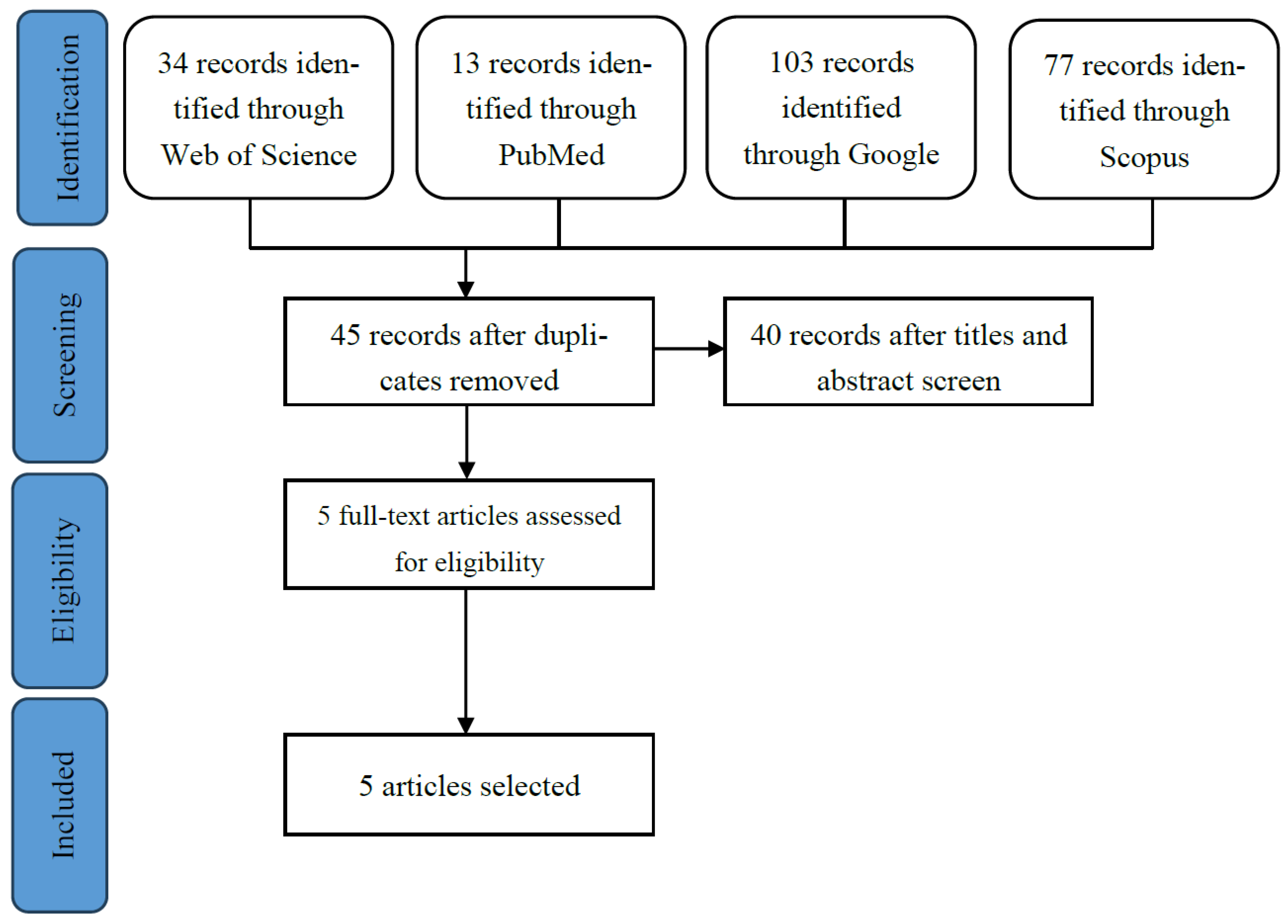
The initial literature search identified a total of 227 articles across four major databases: Web of Science (34), PubMed (13), Google Scholar (103), and Scopus (77). After removing duplicates, 42 publications were retained for the preliminary screening based on titles and abstracts. Following this screening, 5 articles were deemed potentially relevant and were assessed in full text before being included in the systematic review. The rigorous selection process is illustrated in Figure 1. The limited number of studies included reflects not only the strict selection criteria applied but also the relative scarcity of available research on this topic at the time this manuscript was written.

3.1. Comparison of Mice Models of Diabetes and Experimental Protocols

The studies included in this systematic review mainly focus on murine models of T1D and T2D (Table 2). Albuquerque et al. [17], Barssotti et al. [19], Abreu et al. [26] and Brandão et al. [27] induced male C57BL/6 mice by single intraperitoneal injection of streptozotocin (STZ) for the development of T1D. This model reproduces the selective cytotoxic effect of STZ on pancreatic beta cells, resulting in persistent hyperglycaemia. In contrast, Everard et al. [18] used a genetic model of T2D, db/db mice with a leptin mutation. It should be noted that this mutation disrupts the regulation of satiety by the central nervous system, progressively leading to persistent hyperphagia, insulin resistance, and obesity secondary to T2D [28]. The age of the mice varied from 6 weeks [17,18,27] to 5 weeks [19] with a weight of between 15 and 20 g [17,19,26].
Experimental protocols varied slightly between studies, but several parameters were common (Table 2). Albuquerque et al. [17], Barssotti et al. [19], Abreu et al. [26] and Brandão et al. [27] administered a daily dose of 0.5 × 10⁸ CFU of S. boulardii THT 500101 for 8 weeks. Experimental groups included a control group, a non-treated diabetic group, and a diabetic group treated with S. boulardii, with a total of 6 to 14 mice per group. Conversely, Everard et al. [18] did not specify the dose administered of Sb (a different strain from the Biocodex brand), and a larger number of mice (n = 15 per group) were treated for a shorter duration of 4 weeks. This heterogeneity could influence the results observed, particularly the effects on blood sugar levels. However, the differences in mice models allowed a comparison of the effects of S. boulardii on different pathophysiological mechanisms of diabetes.

3.2. Effects of Saccharomyces boulardii on Glycaemia and Metabolic Markers

Regarding anti-diabetic effects, the results differ between T1D and T2D mice models. Except for the study by Everard et al., all other studies reported a significant reduction in blood glucose levels in diabetic mice treated with Sb 500101. Moreover, a decrease in triglyceride levels was observed, along with a normalisation of renal Ang-II concentration [27], a reduction in proteinuria and polyuria [26], as well as an increase in C-peptide levels and hepatic glycogen stores [17] (Table 2). In contrast, Everard et al. [18] reported no significant blood glucose change in the T2D model (Table 2). Such lack of effect may be due to the short duration of the intervention (4 weeks), the nature of the S. boulardii strain or intrinsic differences in the db/db mouse model, which exhibits pronounced insulin resistance.

3.3. Impact on Oxidative Stress, Inflammation and Intestinal Microbiota

Several beneficial effects have been reported on other parameters. From an inflammatory perspective, the probiotic treatment was associated with a reduction in cardiac interleukin-6 (IL-6) levels, a pro-inflammatory cytokine, as well as an increase in IL-10 levels, an anti-inflammatory cytokine, suggesting a shift towards a more protective immune profile. These changes were accompanied by improvements in heart rate variability and blood pressure, as well as a reduction in cardiac congestion. Histomorphologically, a decrease in the thickness of the left ventricular posterior wall, both in systole and diastole, was observed [27]. Abreu et al. [26] noted a modulation of the renal renin-angiotensin system, a reduction in oxidative stress with an increase in catalase and glutathione peroxidase, as well as a decrease in pathobiont (Proteus spp., Escherichia spp. and Shigella spp.) in the stools. Albuquerque et al. [17] also observed a decrease in blood triglycerides, a reduction in liver inflammation and a positive modulation of GM. In addition, Barssotti et al. [19] reported a normalisation of renin-angiotensin system peptides, a reduction in hepatic oxidative stress and a decrease in liver damage. Everard et al. [18] identified a reduction in hepatic steatosis and systemic inflammation, as well as a change in the GM with an increase in Bacteroidetes and a decrease in Firmicutes and Proteobacteria (Table 2). These observations emphasise that S. boulardii has pleiotropic effects that are not limited to reducing hyperglycaemia, but also involve benefits on oxidative stress, inflammation and the composition of GM.

3.4. Risk of Bias

The risk of bias of the included studies was assessed using SYRCLE’s Risk of Bias tool complemented by the Cochrane RoB 2 tool adapted for animal studies. Overall, four studies were judged to have a low risk of bias and one a moderate risk. All studies adequately reported random sequence generation, baseline comparability, allocation concealment and random housing of animals, indicating a low risk of selection and performance bias. However, blinding of caregivers, investigators and outcome assessors was insufficiently reported across all studies, and none explicitly described random selection of animals for outcome assessment, representing the main sources of potential performance and detection bias. Attrition and reporting biases were considered low, as incomplete outcome data were appropriately addressed and predefined outcomes were consistently reported. Overall, despite acceptable methodological quality, the lack of systematic blinding constitutes a recurring limitation.

4. Discussion

This systematic review synthesises the available experimental evidence regarding the effects of Saccharomyces boulardii (Sb) in murine models of diabetes. Overall, the included studies (n = 5) report beneficial metabolic outcomes most notably a reduction in blood glucose levels, particularly in T1D models, increased hepatic glycogen stores, elevated C-peptide concentrations, improvements in cardiac parameters, nephroprotective effects (including reduced proteinuria), attenuation of oxidative stress and systemic inflammation, as well as favourable modulation of the GM characterised by a decrease in potentially pathogenic faecal bacteria. The findings demonstrate the efficacy in streptozotocin-induced T1D models, in contrast to the lack of effect on glycaemia observed in the db/db T2D model. This disparity can be attributed to the fundamental differences in the underlying pathophysiological mechanisms: autoimmune destruction of pancreatic β-cells in T1D versus central leptin resistance and marked insulin resistance in the db/db model.
The findings of this review should be interpreted in light of the methodological limitations identified. The main source of bias across studies was the absence of clearly reported blinding procedures and random outcome assessment, which may influence subjective outcomes such as histological, cardiovascular and microbiota analyses. Nonetheless, the consistent use of appropriate diabetic controls, clearly defined intervention protocols and validated analytical methods supports the internal validity of the results. The convergence of findings, particularly in streptozotocin-induced T1D models, suggests that the reported effects of S. boulardii are unlikely to be solely attributable to bias.
Systematic reviews evaluating the effects of S. boulardii on diabetes mellitus and its complications are virtually non-existent; therefore, we referred to studies focusing on specific probiotic strains or genera administered as a single strain. A meta-analysis by Emily et al. [29] demonstrated the efficacy of probiotics belonging to the Bifidobacterium genus in animal and human models of metabolic syndrome and T2D. A significant reduction in fasting blood glucose (FBG) was observed in animal models, whereas no effect was detected in human subjects. Similar findings were reported for Lactobacillus plantarum, which significantly reduced blood glucose levels in patients with type 2 diabetes [30]. Conversely, a meta-analysis including 21 clinical trials showed that Bifidobacterium probiotics had no significant effect on glycaemic parameters (FBG and HbA1c) in obese patients [31]. It is worth noting that none of these studies reported significant effects on biochemical parameters related to diabetic complications. Overall, these findings suggest that the synthesis of observations made in our study aligns with previously reported positive effects on glycaemia, in addition to the anti-inflammatory, antioxidant, hepatoprotective, and regulatory effects on C-peptide and angiotensin II, despite the absence of a dedicated meta-analysis.
Although underexplored in the diabetes treatment literature, several mechanisms support the effects observed in our study. The regulation of fasting blood glucose occurs through the restoration of the insulin signalling pathway IRS-1/PI3K/Akt [32], in which S. boulardii promotes the activation of phosphoinositide 3-kinase via the production of metabolites such as 2-hydroxyisocaproic acid and phenyllactic acid [33]. This activation triggers a reaction cascade leading to Akt activation and GSK-3β inhibition, thereby relieving the suppression of glycogen synthase and stimulating hepatic glycogen synthesis [33,34]. This mechanism may explain the enhanced reduction in blood glucose levels in favour of hepatic glycogen accumulation [35]. Furthermore, S. boulardii also modulates the gut microbiota by enriching it with SCFAs-producing genera (Akkermansia muciniphila, Bacteroides spp., Ruminococcus spp., Prevotella spp., Bifidobacterium spp., Roseburia, Faecalibacterium prausnitzii, and Anaerobutyricum soehngenii) [13,36,37,38]. These SCFAs activate free fatty acid receptors 2 and 3 (FFAR2/3) on intestinal L-cells, stimulating the secretion of glucagon-like peptide 1 (GLP-1), which enhances peripheral insulin sensitivity and glucose-dependent insulin secretion [38]. Known for its antioxidant properties, S. boulardii exerts its protective effects mainly through the modulation of endogenous antioxidant systems, with a significant increase in the activity of key antioxidant enzymes (SOD, CAT, and GPx) that constitute the first line of defence against reactive oxygen species generated by chronic hyperglycaemia. In addition, the modulation of the gut microbiota by S. boulardii contributes to this antioxidant protection by reducing endotoxaemia (through the decrease in pathobionts such as Proteus, Escherichia, and Shigella) [17,26], thereby limiting the activation of pro-oxidant NF-κB pathways and the production of inflammatory cytokines that generate reactive oxygen species. This inhibition reduces the transcription of pro-inflammatory IL-6 and increases that of anti-inflammatory IL-10, creating a protective cytokine environment. Concomitantly, the increase in SCFAs production helps maintain intestinal integrity and, consequently, reduces systemic inflammation, partly supported by the normalisation and reduction in angiotensin II and the activation of the ACE2-Mas axis, which produces angiotensin (1–7) with anti-inflammatory and antioxidant properties [19,26,27].
The contrasting effect of S. boulardii supplementation in different murine models of diabetes appears to be primarily dictated by their fundamentally different pathophysiologies. In the STZ-induced model of T1D, autoimmune destruction of pancreatic β-cells causes severe insulin deficiency, making glycaemic control highly dependent on β-cell survival and functional restoration [3]. In this setting, S. boulardii has been shown to exert a significant protective role via reduction in oxidative stress and inflammation, along with beneficial modulation of the renin-angiotensin system: all of which favour β-cell preservation, increased insulin secretion (as indicated by elevated C-peptide) [17], and improvement in the glycaemic profile. Indeed, in STZ-diabetic mice, S. boulardii reduces hepatic oxidative damage, increases activity of antioxidant enzymes such as superoxide dismutase and glutathione peroxidase [19,26]. Simultaneously, it positively modulates the GM, promoting SCFAs producers, which stimulate incretin hormones (GLP-1, PYY), further enhancing peripheral insulin sensitivity and glucose regulation. By contrast, in the db/db model of T2D, characterised by a leptin mutation leading to central leptin resistance, hyperphagia, obesity, and pronounced peripheral insulin resistance, metabolic dysregulation extends far beyond simple β-cell impairment [39]. Although S. boulardii may reduce systemic inflammation and partially correct intestinal dysbiosis in such models, its glycaemic effects remain modest. This relative inefficacy is likely due to a deep-seated insensitivity to metabolic signals governed by leptin, severe insulin resistance, and the complex pathophysiology of T2D.
In addition to the intrinsic pathophysiological differences forementioned, the heterogeneity observed in the experimental protocols across studies likely contributes substantially to the variability and apparent inconsistency of the reported outcomes. One major source of heterogeneity relates to the strain of S. boulardii used. Most studies employed the well-characterised strain THT 500101, whereas Everard et al. used a commercial Biocodex-derived strain, whose probiotic properties, metabolic activity, and bioactive metabolite profile may differ. Given the documented strain-dependent effects of S. boulardii, such differences may directly influence glycaemic, inflammatory, and microbiota-related outcomes. Indeed, each strain has specific characteristics that make it unique; therefore, the effects observed in one strain cannot be extrapolated to another [23]. Furthermore, intervention dose and unit of administration differed markedly between studies. While four studies administered S. boulardii as a defined viable dose expressed in colony-forming units (0.5 × 10⁸ CFU/day), Everard et al. reported the dose in milligrams (120 mg/day) without specifying the corresponding viable CFU count. This lack of dose standardisation not only complicates direct comparisons but also reflects non-linear dose-responses in insulin-resistant models, where high doses (>1010 CFU) can induce intestinal “crowding” effects reducing efficacy, and may partly explain the absence of significant glycaemic effects observed in the db/db model [17,40]. The duration of the intervention also represents an important confounding factor. Studies reporting significant improvements in glycaemia and metabolic parameters typically applied an 8-week supplementation period, whereas the only study showing no effect on blood glucose employed a shorter intervention duration of 4 weeks. Given the progressive nature of metabolic adaptation, gut microbiota modulation, and insulin signalling restoration, shorter exposure periods may be insufficient to elicit measurable glycaemic improvements, particularly in severe insulin-resistant models such as db/db mice [17,40,41].
Collectively, these sources of methodological heterogeneity (strain specificity, dosing strategy, and intervention duration) likely interact with the underlying disease model to influence treatment responsiveness. Therefore, the differential effects of S. boulardii observed across studies should not be attributed solely to diabetes pathophysiology but rather interpreted as the combined result of biological and experimental variability.

5. Limitations and Perspectives

The limited number of included studies (n = 5) restricts the results’ generalisability and the relevance of conclusions. The heterogeneity of experimental protocols, notably the differences in S. boulardii strains (THT 500101 vs. Biocodex), the variability in intervention durations (4 vs. 8 weeks), and the variation in physiological models of diabetes induction (STZ-induced T1D and leptin mutation-induced T2D) significantly affects the quality of the synthesis. It limits the possibility of conducting a meta-analysis to draw more robust conclusions. Although numerous metabolic parameters were measured, the authors of the included studies did not evaluate the absence of HbA1c assessment, the benchmark marker of long-term glycaemic control in clinical practice. This constitutes a significant limitation, preventing the assessment of therapeutic efficacy according to standard clinical criteria. Considering the higher efficacy of S. boulardii in T1D, it would be relevant to evaluate specific T1D markers (anti-GAD, anti-insulin, anti-IA2, anti-ZnT8) while addressing the significant protocol differences. It should also prioritise transparent reporting of blinding and outcome assessment to enhance the quality of evidence in future studies. Finally, translational studies in humans could be envisaged to confirm the relevance of the preclinical results and to adapt these interventions for therapeutic purposes.

6. Conclusions and Recommendations

Saccharomyces boulardii has been shown to improve metabolic parameters in mouse models of diabetes, notably by reducing glycaemia, increasing C-peptide levels, and enhancing hepatic glycogen stores. Improvements in cardiac function have also been observed, including reduced heart rate variability, decreased blood pressure, enhanced liver healing, nephroprotective effects, and reductions in oxidative stress, blood triglyceride levels, and inflammatory responses. The beneficial effects include improved renal function and attenuation of oxidative stress, mediated by increased catalase and glutathione peroxidase activities. Additionally, S. boulardii positively modulates the gut microbiota, with a notable reduction in pathogenic bacteria. Nonetheless, more standardised protocols and long-term studies are required to strengthen and refine these results. Overall, the use of S. boulardii represents a promising strategy for improving diabetes management and its associated metabolic and renal complications and warrants greater attention from the scientific community.

Supplementary Materials

The following supporting information can be downloaded at: https://www.mdpi.com/article/10.3390/encyclopedia6010014/s1, Supplementary File S1: Completed PRISMA 2020 checklist for systematic review. Reference [42] is cited in the Supplementary Material.

Author Contributions

The conception of this work, the development of the protocol, the literature search and the screening of the articles were carried out by Y.Y.Y. and L.T.P. The manuscript was written by L.T.P. and the final version was revised by Y.Y.Y. All authors have read and agreed to the published version of the manuscript.

Funding

This research received no external funding.

Institutional Review Board Statement

Not applicable.

Informed Consent Statement

Not applicable.

Data Availability Statement

No new data were created or analysed in this study. Data sharing is not applicable to this article.

Acknowledgments

The authors are grateful to Walter Sisulu University for providing access to various electronic databases.

Conflicts of Interest

The authors declare no conflicts of interest.

Abbreviations

The following abbreviations are used in this manuscript:
IAAAnti-insulin antibody
Anti-GADAnti-Glutamic Acid Decarboxylase antibody
Anti-IA2 Insulinoma-Associated Protein-2
Anti-ZnT8 Zinc Transporter 8 autoantibodies
DMDiabetes Mellitus
LC-MS/MS, MRM modeLiquid chromatography coupled with tandem mass spectrometry in multiple reaction monitoring mode
T1DType 1 Diabetes
T2DType 2 Diabetes
GLP-1Glucagon Like-Peptide 1
SGLT2Sodium-Glucose Cotransporter 2
PRISMAPreferred Reporting Items for Systematic Reviews and Meta-Analyses
PROSPEROInternational Prospective Register of Systematic Reviews
SYRCLESystematic Review Centre for Laboratory animal Experimentation
RoB 2Risk of Bias 2.0
STZStreptozotocin
ILInterleukin
Ang-IIAngiotensin II
SODSuperoxide Dismutase
GPxGlutathione Peroxidase

References

  1. Zhou, B.; Lu, Y.; Hajifathalian, K.; Bentham, J.; Di Cesare, M.; Danaei, G.; Bixby, H.; Cowan, M.J.; Ali, M.K.; Taddei, C.; et al. Worldwide trends in diabetes since 1980: A pooled analysis of 751 population-based studies with 4.4 million participants. Lancet 2016, 387, 1513–1530. [Google Scholar] [CrossRef]
  2. Kong, A.P.; Xu, G.; Brown, N.; So, W.-Y.; Ma, R.C.; Chan, J.C. Diabetes and its comorbidities—Where East meets West. Nat. Rev. Endocrinol. 2013, 9, 537–547. [Google Scholar] [CrossRef]
  3. O’Neal, K.S.; Johnson, J.L.; Panak, R.L. Recognizing and Appropriately Treating Latent Autoimmune Diabetes in Adults. Diabetes Spectr. 2016, 29, 249–252. [Google Scholar] [CrossRef]
  4. Krause, M.; De Vito, G. Type 1 and Type 2 Diabetes Mellitus: Commonalities, Differences and the Importance of Exercise and Nutrition. Nutrients 2023, 15, 4279. [Google Scholar] [CrossRef] [PubMed]
  5. DeMarsilis, A.; Reddy, N.; Boutari, C.; Filippaios, A.; Sternthal, E.; Katsiki, N.; Mantzoros, C. Pharmacotherapy of type 2 diabetes: An update and future directions. Metabolism 2022, 137, 155332. [Google Scholar] [CrossRef] [PubMed]
  6. Ghatage, T.; Jarag, R.; Jadhav, S.; Raut, R. A review on adverse drug reactions of antidiabetic drugs. Int. J. Allied Med. Sci. Clin. Res. 2017, 5, 426–433. [Google Scholar]
  7. Akiyode, O.F.; Adesoye, A.A. Adverse Effects Associated With Newer Diabetes Therapies: A Review Article. J. Pharm. Pract. 2017, 30, 238–244. [Google Scholar] [CrossRef] [PubMed]
  8. Fietto, J.L.; Araújo, R.S.; Valadão, F.N.; Fietto, L.G.; Brandão, R.L.; Neves, M.J.; Gomes, F.C.; Nicoli, J.R.; Castro, I.M. Molecular and physiological comparisons between Saccharomyces cerevisiae and Saccharomyces boulardii. Can. J. Microbiol. 2004, 50, 615–621. [Google Scholar] [CrossRef]
  9. Edwards-Ingram, L.; Gitsham, P.; Burton, N.; Warhurst, G.; Clarke, I.; Hoyle, D.; Oliver, S.G.; Stateva, L. Genotypic and physiological characterization of Saccharomyces boulardii, the probiotic strain of Saccharomyces cerevisiae. Appl. Environ. Microbiol. 2007, 73, 2458–2467. [Google Scholar] [CrossRef]
  10. Piame, L.T.; Kaktcham, P.M.; Kouam, E.M.F.; Techeu, U.D.F.; Ngouénam, R.J.; Ngoufack, F.Z. Technological characterisation and probiotic traits of yeasts isolated from Sha’a, a Cameroonian maize-based traditional fermented beverage. Heliyon 2022, 8, e10850. [Google Scholar]
  11. Duman, D.G.; Kumral, Z.N.Ö.; Ercan, F.; Deniz, M.; Can, G.; Yeğen, B.Ç. Saccharomyces boulardii ameliorates clarithromycin-and methotrexate-induced intestinal and hepatic injury in rats. Br. J. Nutr. 2013, 110, 493–499. [Google Scholar] [CrossRef]
  12. Justino, P.F.; Melo, L.F.; Nogueira, A.F.; Costa, J.V.; Silva, L.M.; Santos, C.M.; Mendes, W.O.; Costa, M.R.; Franco, A.X.; Lima, A.A. Treatment with Saccharomyces boulardii reduces the inflammation and dysfunction of the gastrointestinal tract in 5-fluorouracil-induced intestinal mucositis in mice. Br. J. Nutr. 2014, 111, 1611–1621. [Google Scholar] [CrossRef]
  13. Piame, L.T. Potential of Non-Dairy Probiotic Beverages to Modulate Gut Microbiota and Improve Management of Non-Communicable Diseases. Nov. Res. Microbiol. J. 2025, 9, 198–213. [Google Scholar]
  14. You, S.; Ma, Y.; Yan, B.; Pei, W.; Wu, Q.; Ding, C.; Huang, C. The promotion mechanism of prebiotics for probiotics: A review. Front. Nutr. 2022, 9, 1000517. [Google Scholar] [CrossRef] [PubMed]
  15. Wieërs, G.; Belkhir, L.; Enaud, R.; Leclercq, S.; Philippart De Foy, J.-M.; Dequenne, I.; De Timary, P.; Cani, P.D. How Probiotics Affect the Microbiota. Front. Cell. Infect. Microbiol. 2020, 9, 454. [Google Scholar] [CrossRef] [PubMed]
  16. Markowiak, P.; Śliżewska, K. Effects of Probiotics, Prebiotics, and Synbiotics on Human Health. Nutrients 2017, 9, 1021. [Google Scholar] [CrossRef]
  17. Albuquerque, R.C.M.F.; Brandão, A.B.P.; De Abreu, I.C.M.E.; Ferreira, F.G.; Santos, L.B.; Moreira, L.N.; Taddei, C.R.; Aimbire, F.; Cunha, T.S. Saccharomyces boulardii Tht 500101 changes gut microbiota and ameliorates hyperglycaemia, dyslipidaemia, and liver inflammation in streptozotocin-diabetic mice. Benef. Microbes 2019, 10, 12. [Google Scholar] [CrossRef] [PubMed]
  18. Everard, A.; Matamoros, S.; Geurts, L.; Delzenne, N.M.; Cani, P.D. Saccharomyces boulardii administration changes gut microbiota and reduces hepatic steatosis, low-grade inflammation, and fat mass in obese and type 2 diabetic db/db mice. mBio 2014, 5, e01011-14. [Google Scholar] [CrossRef]
  19. Barssotti, L.; Abreu, I.C.M.E.; Brandão, A.B.P.; Albuquerque, R.C.M.F.; Ferreira, F.G.; Salgado, M.A.C.; Dias, D.D.S.; De Angelis, K.; Yokota, R.; Casarini, D.E.; et al. Saccharomyces boulardii modulates oxidative stress and renin angiotensin system attenuating diabetes-induced liver injury in mice. Sci. Rep. 2021, 11, 9189. [Google Scholar] [CrossRef]
  20. Chen, X.; Xie, N.; Feng, L.; Huang, Y.; Wu, Y.; Zhu, H.; Tang, J.; Zhang, Y.; Gao, T. Oxidative stress in diabetes mellitus and its complications: From pathophysiology to therapeutic strategies. Chin. Med. J. 2025, 138, 15–27. [Google Scholar]
  21. Caturano, A.; D’Angelo, M.; Mormone, A.; Russo, V.; Mollica, M.P.; Salvatore, T.; Galiero, R.; Rinaldi, L.; Vetrano, E.; Marfella, R.; et al. Oxidative Stress in Type 2 Diabetes: Impacts from Pathogenesis to Lifestyle Modifications. Curr. Issues Mol. Biol. 2023, 45, 6651–6666. [Google Scholar] [CrossRef]
  22. Babaei, F.; Navidi-Moghaddam, A.; Naderi, A.; Ghafghazi, S.; Mirzababaei, M.; Dargahi, L.; Mohammadi, G.; Nassiri-Asl, M. The preventive effects of Saccharomyces boulardii against oxidative stress induced by lipopolysaccharide in rat brain. Heliyon 2024, 10, e30426. [Google Scholar] [CrossRef]
  23. Czerucka, D.; Rampal, P. Diversity of Saccharomyces boulardii CNCM I-745 mechanisms of action against intestinal infections. World J. Gastroenterol. 2019, 25, 2188–2203. [Google Scholar] [CrossRef]
  24. Page, M.J.; Moher, D.; Bossuyt, P.M.; Boutron, I.; Hoffmann, T.C.; Mulrow, C.D.; Shamseer, L.; Tetzlaff, J.M.; Akl, E.A.; Brennan, S.E. PRISMA 2020 explanation and elaboration: Updated guidance and exemplars for reporting systematic reviews. BMJ 2021, 372, n160. [Google Scholar] [CrossRef] [PubMed]
  25. Hooijmans, C.R.; Rovers, M.M.; De Vries, R.B.; Leenaars, M.; Ritskes-Hoitinga, M.; Langendam, M.W. SYRCLE’s risk of bias tool for animal studies. BMC Med. Res. Methodol. 2014, 14, 43. [Google Scholar] [CrossRef] [PubMed]
  26. Abreu, I.; Albuquerque, R.; Brandão, A.B.P.; Barssotti, L.; de Souza, L.B.; Ferreira, F.G.; Oliveira, L.C.G.; Yokota, R.; Sparvoli, L.G.; Dias, D.D.S.; et al. Saccharomyces boulardii exerts renoprotection by modulating oxidative stress, renin angiotensin system and uropathogenic microbiota in a murine model of diabetes. Life Sci. 2022, 301, 120616. [Google Scholar] [CrossRef] [PubMed]
  27. Brandão, A.B.P.; Albuquerque, R.C.M.F.; de Abreu, I.C.M.E.; Ferreira, F.G.; Santos, L.B.; Jensen, L.; de Souza, L.E.; Ferreira, S.G.; de Souza, L.B.; Lo Schiavo, E.; et al. From the gut to the heart: Probiotic therapy with Saccharomyces boulardii and its potential role on diabetic cardiomyopathy in a murine model. Arch. Physiol. Biochem. 2025, 1–14. [Google Scholar] [CrossRef] [PubMed]
  28. Vijayashankar, U.; Ramashetty, R.; Rajeshekara, M.; Vishwanath, N.; Yadav, A.K.; Prashant, A.; Lokeshwaraiah, R. Leptin and ghrelin dynamics: Unraveling their influence on food intake, energy balance, and the pathophysiology of type 2 diabetes mellitus. J. Diabetes Metab. Disord. 2024, 23, 427–440. [Google Scholar] [CrossRef]
  29. Van Syoc, E.P.; Damani, J.; DiMattia, Z.; Ganda, E.; Rogers, C.J. The Effects of Bifidobacterium Probiotic Supplementation on Blood Glucose: A Systematic Review and Meta-Analysis of Animal Models and Clinical Evidence. Adv. Nutr. 2024, 15, 100137. [Google Scholar] [CrossRef]
  30. Zhong, H.; Wang, L.; Jia, F.; Yan, Y.; Xiong, F.; Li, Y.; Hidayat, K.; Guan, R. Effects of Lactobacillus plantarum supplementation on glucose and lipid metabolism in type 2 diabetes mellitus and prediabetes: A systematic review and meta-analysis of randomized controlled trials. Clin. Nutr. ESPEN 2024, 61, 377–384. [Google Scholar] [CrossRef]
  31. Huang, J.; Cheng, H. Effects of Bifidobacterium on metabolic parameters in overweight or obesity adults: A systematic review and meta-analysis. Front. Microbiol. 2025, 16, 1633434. [Google Scholar] [CrossRef]
  32. Neves, A.F.; Lubaczeuski, C.; Bozadjieva Kramer, N.; Andrade Louzada Neto, R.; Bernal-Mizrachi, E. 1735-P: AKT Modulates Glucose Sensing and Glucagon Secretion in Alpha Cells. Diabetes 2024, 73, 1735-P. [Google Scholar] [CrossRef]
  33. Fu, J.; Liu, J.; Wen, X.; Zhang, G.; Cai, J.; Qiao, Z.; An, Z.; Zheng, J.; Li, L. Unique Probiotic Properties and Bioactive Metabolites of Saccharomyces boulardii. Probiotics Antimicrob. Proteins 2023, 15, 967–982. [Google Scholar]
  34. Tchamani Piame, L. Bioactive Metabolites from Yeasts Presumptively Qualified as Safe as Functional Agents in the Management of Type 2 Diabetes. Appl. Microbiol. 2025, 5, 84. [Google Scholar] [CrossRef]
  35. Khorami, S.A.H.; Movahedi, A.; Huzwah, K.; Sokhini, A. PI3K/AKT pathway in modulating glucose homeostasis and its alteration in diabetes. Ann. Med. Biomed. Sci. 2015, 1, 46–55. [Google Scholar]
  36. Grasset, E.; Puel, A.; Charpentier, J.; Klopp, P.; Christensen, J.E.; Lelouvier, B.; Servant, F.; Blasco-Baque, V.; Tercé, F.; Burcelin, R. Gut microbiota dysbiosis of type 2 diabetic mice impairs the intestinal daily rhythms of GLP-1 sensitivity. Acta Diabetol. 2022, 59, 243–258. [Google Scholar]
  37. Olaniyi, K.S.; Owolabi, M.N.; Atuma, C.L.; Agunbiade, T.B.; Alabi, B.Y. Acetate rescues defective brain-adipose metabolic network in obese Wistar rats by modulation of peroxisome proliferator-activated receptor-γ. Sci. Rep. 2021, 11, 18967. [Google Scholar] [PubMed]
  38. Arora, T.; Tremaroli, V. Therapeutic potential of butyrate for treatment of type 2 diabetes. Front. Endocrinol. 2021, 12, 761834. [Google Scholar] [CrossRef]
  39. Capcarova, M.; Kalafova, A. Zucker diabetic fatty rats for research in diabetes. In Animal Models in Medicine and Biology; IntechOpen: London, UK, 2019. [Google Scholar]
  40. Udayappan, S.; Manneras-Holm, L.; Chaplin-Scott, A.; Belzer, C.; Herrema, H.; Dallinga-Thie, G.M.; Duncan, S.H.; Stroes, E.S.G.; Groen, A.K.; Flint, H.J.; et al. Oral treatment with Eubacterium hallii improves insulin sensitivity in db/db mice. npj Biofilms Microbiomes 2016, 2, 16009. [Google Scholar] [CrossRef] [PubMed]
  41. Ruan, Y.; Sun, J.; He, J.; Chen, F.; Chen, R.; Chen, H. Effect of Probiotics on Glycemic Control: A Systematic Review and Meta-Analysis of Randomized, Controlled Trials. PLoS ONE 2015, 10, e0132121. [Google Scholar] [CrossRef]
  42. Page, M.J.; McKenzie, J.E.; Bossuyt, P.M.; Boutron, I.; Hoffmann, T.C.; Mulrow, C.D.; Shamseer, L.; Tetzlaff, J.M.; Akl, E.A.; Brennan, S.E.; et al. The PRISMA 2020 statement: An updated guideline for reporting systematic reviews. BMJ 2021, 372, n71. [Google Scholar] [CrossRef] [PubMed]
Figure 1. Methodical Screening of Studies for the Systematic Review.
Encyclopedia 06 00014 g001
Table 1. Risk of bias of selected studies.
QuestionStudy
Albuquerque et al. [17]Abreu et al. [26]Everard et al. [18]Barssotti et al. [19]Brandão et al. [27]
1. Was the allocation sequence adequately generated and applied?YesYesYesYesYes
2. Were the groups similar at baseline, or were they adjusted for confounders in the analysis?YesYesYesYesYes
3. Was the allocation to the different groups adequately concealed?YesYesYesYesYes
4. Were the animals randomly housed during the experiment?YesYesYesYesYes
5. Were the caregivers and/or investigators blinded from knowledge of the intervention each animal received during the experiment?UnclearUnclearUnclearUnclearUnclear
6. Were animals selected randomly for outcome assessment?NoNoNoNoNo
7. Was the outcome assessor blinded?UnclearUnclearUnclearUnclearUnclear
8. Were incomplete outcome data adequately addressed?YesYesYesYesYes
9. Are reports of the study free of selective outcome reporting?YesYesYesYesYes
10. Was the study apparently free of other problems that could result in high risk of bias?YesYesNoYesYes
Total77677
Bias Risk (%)Low (77.77)Low (77.77)Moderate
(66.66)
Low (77.77)Low (77.77)
Table 2. Effects of Saccharomyces boulardii on metabolic parameters and GM in mice models of diabetes.
StudyOrganismsAgeDisease ModelParticipants per GroupDose and Duration of InterventionMethod/TechnologyMain Observations
Brandão et al. [27]C57BL/6 male mice6 weeks (w)Diabetic cardiomyopathy
(STZ-induced T1D)
Control (n = 14), Control + Sb (n = 14),
Diabetic (n = 14),
Diabetic + Sb (n = 14)
0.5 × 10⁸ cfu of Sb THT 500101 in 0.3 mL of sterile water for 8 wEnzymatic colorimetric assay↓ blood glucose
Enzymatic kits,
Enzyme-linked immunosorbent assay (ELISA) kits
↓ triglycerides,
↓ cardiac IL-6 levels and ↑ cardiac IL-10 levels
Histopathological analysis and non-invasive cardiovascular monitoringImprovement in heart rate variability and blood pressure, cardiac congestion;
↓ left ventricular posterior wall thickness in systole and diastole
Abreu et al. [26]C57BL/6 male mice6 w
(15–20 g)
Streptozotocin (STZ)-induced T1DControl (n = 9), Control + Sb (n = 9), Diabetic (n = 6), Diabetic + Sb (n = 8)0.5 × 10⁸ cfu of Sb THT 500101 in 0.3 mL of sterile water for 8 wGlucometer (Accu-Check) ↓ blood glucose
Liquid chromatography coupled with tandem mass spectrometry in multiple reaction monitoring mode (LC-MS/MS, MRM mode)Normalisation of Ang-II
Colorimetric kits
Urine measurement (mL/24 h)
↓ proteinuria
↓ polyuria
Spectrophotometric methods↓ oxidative stress (↑ catalase and glutathione peroxidase)
DNA extraction-Amplification-Sequencing and beta-diversity assessment↓ pathogenic bacteria in stools (Proteus spp., Escherichia spp., and Shigella spp.)
Barssotti et al. [19]C57BL/6 male mice5 w
(15–20 g)
STZ-induced T1DControl (n = 6–9), Diabetic (n = 6–9), Diabetic + Sb (n = 6–9)0.5 × 10⁸ cfu of Sb THT 500101 in 0.3 mL of sterile for 8 wGlucometer (Accu-Check) ↓ Blood glucose (−30%)
Spectrophotometric methods↓ Liver oxidative stress: ↑ antioxidant enzymes (SOD, CAT, GPx)
LC-MS/MS, MRM modeNormalisation of peptides from the renin-angiotensin II system
Microscopic observation (haematoxylin and eosin-stained sections)↓ liver damage (hydropic degeneration, vascular congestion)
Albuquerque et al. [17]C57BL/6 male mice6 w
(15–20 g)
STZ-induced T1DControl (n = 9), Diabetic (n = 8), Diabetic + Sb (n = 8)0.5 × 10⁸ cfu of Sb THT 500101 in 0.3 mL of sterile water for 8 wGlucometer (Accu-Check) ↓ Blood glucose (−31%),
Phenol-sulfuric acid method↑ Liver glycogen
Enzyme immunoassay kit↑ C peptide, ↓ liver inflammation,
Enzymatic colorimetric assay kits↓ Serum triglycerides,
DNA extraction-Amplification-Sequencing and diversity assessmentModulation of intestinal microbiota
Everard et al. [18]db/db mice (obese and type 2 diabetics)6 wGenetic model of T2D (leptin mutation)Control (n = 15), Diabetic (n = 15),
Diabetic + Sb (n = 15)
Sb
Administered for 4 w
(120 mg in saline solution)
/No significant effect on glycaemia
Extraction in CHCl3-methanol ↓ hepatic steatosis
Bio-Plex Pro cytokine assay kit ↓ systemic and hepatic inflammation
DNA extraction-Amplification-Sequencing and diversity assessmentModification of the microbiota (↑ Bacteroidetes, ↓ Firmicutes and Proteobacteria).
Correlation between microbiota composition and metabolic parameters.
↑: increase; ↓: decrease.
Disclaimer/Publisher’s Note: The statements, opinions and data contained in all publications are solely those of the individual author(s) and contributor(s) and not of MDPI and/or the editor(s). MDPI and/or the editor(s) disclaim responsibility for any injury to people or property resulting from any ideas, methods, instructions or products referred to in the content.