1. Introduction
The coronavirus disease 2019 (COVID-19) pandemic had a profound global impact on mental health, with numerous studies reporting elevated levels of depression, anxiety, and stress across populations [
1,
2]. Lockdowns, social distancing, economic uncertainty, and fear of infection contributed to increased psychological distress, particularly among groups exposed to high occupational and emotional demands [
1,
3]. These findings underscore the importance of examining how such symptoms evolve over time and which individual and work-related factors may buffer or exacerbate distress [
2,
4].
Healthcare professionals, including psychologists, were among the most affected by the mental health consequences of the pandemic [
5,
6]. Cross-sectional and longitudinal studies show that frontline workers experienced higher rates of depression, anxiety, and stress, often linked to workload, fear of contagion, and moral distress [
7,
8]. In Brazil, research with nurses and other health professionals similarly reports high levels of psychological distress during the pandemic peak, highlighting the broad impact of the crisis on the healthcare workforce [
5,
7,
9].
Data collection for Time 1 (April 2021) coincided precisely with Brazil’s most devastating weeks of the pandemic, when the Ministry of Health recorded the highest weekly COVID-19 deaths in the country’s history [
10]. This extreme epidemiological context—characterized by overwhelmed healthcare systems, mass grief, and unprecedented service demand—placed psychologists under acute dual burden: serving as essential mental health providers during sharply increased demand while exposed to the same psychosocial stressors as the general population [
11,
12].
Psychologists face particular vulnerability to occupational hazards including burnout, vicarious trauma, and even suicide, with 40–60% reporting professional disruption due to distress [
13]. A Brazilian study using the Depression, Anxiety and Stress Scale–21 (DASS-21; Vignola & Tucci [
14]) found high prevalence of clinically significant symptoms among psychologists during the pandemic, with many reporting changes in mood, sleep, and work routines [
11]. Despite their expertise in psychological care, substantial proportions reported limited attention to their own well-being and self-care practices, pointing to a critical gap between professional knowledge and personal behavior [
13,
15,
16]. Neglecting self-care not only risks ethical violations but also impairs therapeutic alliance, patient trust, and care quality, key predictors of clinical outcomes [
17,
18].
The Present Study
In the present study, self-care was assessed across multiple dimensions, including perceived self-care satisfaction, daily working hours, work–life balance, and use of psychotherapy or psychiatric care. Following Norcross and VandenBos [
17], self-care is understood here as the intentional, proactive practices clinicians used to sustain their own psychological functioning. We acknowledge that these indicators are conceptually heterogeneous: perceived self-care satisfaction and work–life balance most directly reflect self-care behaviours, whereas working hours index working conditions and psychotherapy/psychiatric care index help-seeking. We therefore treat them as a set of related self-care and support indicators rather than a single unidimensional construct, and we interpret their associations with distress as correlational rather than causal. Previous research indicates that higher perceived self-care, shorter working hours, and better work–life balance are associated with lower levels of depression, anxiety, and stress among health professionals [
19,
20,
21]. Conversely, longer working hours, blurred boundaries between professional and personal life, and reduced engagement in mental health care are associated with greater psychological distress and burnout, including in post-acute pandemic contexts [
4,
7].
Additional variables included practice modalities (telehealth, in-person, hybrid) and professional experience (years of practice). The rapid shift to telehealth increased flexibility but blurred temporal–spatial boundaries, extending workdays and hindering disengagement [
22,
23]. Structured hybrid models may preserve work–life balance when boundaries are clear [
23,
24]. Years of experience show mixed effects: greater resilience through coping skills versus accumulated stress/emotional exhaustion [
7,
19]. Sociodemographic factors (age, marital status, education) shape social support access and coping resources [
3,
20].
Repeated cross-sectional studies suggest gradual mental health improvements post-pandemic peak in general populations and other occupational groups, yet trajectories for mental health professionals remain unclear [
2,
4]. For psychologists, distress persistence threatens not only individual well-being but also therapeutic effectiveness and public mental health system capacity amid Brazil’s growing demand and professional shortages [
25,
26]. In Brazil, where Time 1 captured peak mortality, understanding 3-year trajectories fills a critical evidence gap for workforce sustainability [
13,
17].
The present study examines psychological distress, measured by the DASS-21, and multidimensional self-care among Brazilian psychologists at the Brazil’s COVID-19 Mortality Peak (April 2021) and three years later (April 2024), using repeated cross-sectional samples. By comparing these time points while controlling for sociodemographic characteristics, professional factors, and self-care indicators, this research addresses long-term mental health impacts on mental health professionals and tests self-care as a buffer for sustainable clinical practice, informing policy, training, and ethical guidelines for psychologist well-being [
16,
18].
Accordingly, this study addressed three research questions. First, did psychological distress (depression, anxiety, and stress) differ between the pandemic mortality peak (T1, 2021) and three years later (T2, 2024)? Second, were self-care and work-organization indicators associated with distress at each wave, and did their inclusion attenuate any observed temporal differences? Third, did the temporal differences in distress vary as a function of perceived self-care and practice modality? Building on evidence that acute pandemic-related anxiety and stress tend to recede as threat subsides while depressive symptoms may be more persistent, we anticipated larger reductions for anxiety and stress than for depression, and we expected higher perceived self-care and better work–life balance to be associated with lower distress. Given the repeated cross-sectional design, these propositions were framed at the level of the sample rather than the individual.
2. Materials and Methods
2.1. Design and Setting
This study used a repeated cross-sectional design with two independent samples of Brazilian psychologists assessed at two time points: during the COVID-19 peak in Brazil (T1: April 2021) and three years later (T2: April 2024). Data were collected through an online survey (Google Forms) administered between 12–30 April 2021 (T1) and 1–24 April 2024 (T2). Because participants were not tracked across waves and no individual linkage was performed, the two samples were treated as independent.
Eligibility criteria were: (a) being a licensed psychologist (degree in Psychology), and (b) being currently active in professional practice, either in private clinical psychology practice or in a healthcare institution (public or private). Recruitment relied on dissemination through professional organizations and networks (e.g., councils/associations and social media groups); in T2, dissemination sought to reach the same types of groups, entities, and institutions used in T1 to maximize comparability between waves. Responses were obtained from all Brazilian states, supporting nationwide coverage. All participants provided electronic informed consent prior to completing the questionnaire. After data collection, responses were screened for data quality (e.g., duplicate entries, missingness patterns, and eligibility), and ineligible or clearly problematic responses were excluded prior to analysis.
2.2. Participants
An a priori power analysis was conducted in G*Power version 3.1.9.7 (Heinrich-Heine-Universität Düsseldorf, Düsseldorf, Germany) [
27,
28] to estimate the minimum sample size required to detect between-wave differences in DASS-21 outcomes using two-tailed tests for two independent groups (T1 vs. T2). Assuming a small effect size (Cohen’s
d = 0.20), α = 0.05, and power (1 −
β) = 0.80, the required sample size was approximately 394 participants per group. Because three primary DASS-21 subscales (depression, anxiety, stress) were evaluated, a conservative significance threshold was also considered (α = 0.017), yielding an estimated requirement of approximately 523 participants per group for
d = 0.20 at 80% power. The final analytic sample (T1:
n = 578; T2:
n = 524) met or exceeded these targets for detecting small effects in continuous DASS-21 subscale scores.
The sample comprised
N = 1102 actively practicing psychologists (working in private practice or in a healthcare institution [public or private]) distributed across two independent waves: T1 (2021) and T2 (2024). Women predominated at both time points (T1: 87.2%; T2: 83.8%). The approximate mean age was 40.0 years (SD = 12.0) at T1 and 41.7 years (SD = 12.5) at T2. Most participants were married (T1: 45.5%; T2: 50.0%) and had completed a postgraduate specialization (approximately 56% in both waves). Private practice was more frequent at T1 (69.0%), whereas the proportion working in healthcare institutions increased at T2 (43.5%). Most respondents reported more than 10 years of professional experience (T1: 41.0%; T2: 46.2%). Practice modality shifted markedly over time: telehealth decreased (27.7% to 11.1%) and in-person work increased (11.6% to 37.8%); hybrid practice remained the most common modality (T1: 60.7%; T2: 51.1%). Most participants reported being satisfied with their overall self-care (T1: 56.4%; T2: 59.2%), with approximately 30% reporting dissatisfaction in both waves (T1: 31.1%; T2: 30.2%); “very dissatisfied” decreased from 4.0% (T1) to 2.3% (T2). Most participants reported working 0–8 h/day (T1: 58.8%; T2: 55.3%) or 9–12 h/day (T1: 32.9%; T2: 34.4%). Agreement with work–family–social life balance increased over time (53.6% to 60.7%). The proportion reporting psychotherapy use during the pandemic was higher at T1 (73.4%) than at T2 (63.0%), while psychiatric care was reported by approximately 25% at T1 and 28% at T2. Full details about sample characteristics by time point are provided in
Supplementary Table S1–S5.
2.3. Instruments
2.3.1. Depression Anxiety Stress Scales (DASS-21)
The Depression Anxiety Stress Scales–21 (DASS-21; Vignola & Tucci [
14]) is a Brazilian Portuguese translated and shortened self-report measure comprising 21 items distributed across three subscales, Depression, Anxiety, and Stress (7 items each), assessing the frequency/intensity of symptoms over the past week. Items are rated on a 4-point Likert scale ranging from 0 (“Did not apply to me at all”) to 3 (“Applied to me very much, or most of the time”). Subscale scores were computed by summing the corresponding items (range 0–21) and, for interpretation according to the original DASS scoring system, multiplying by two (range 0–42), applying conventional severity cutoffs (normal to extremely severe). In the Brazilian validation study, internal consistency was high (Depression α = 0.92; Anxiety α = 0.86; Stress α = 0.90). In the present samples, the internal consistency of the DASS-21 subscales was likewise high (Depression α = 0.90; Anxiety α = 0.85; Stress α = 0.89, pooled across waves; all α ≥ 0.84 within each wave). In addition, recent psychometric evidence suggests that, in some non-clinical samples, a general distress factor may explain a substantial proportion of variance, supporting the use of a total score as an indicator of overall psychological distress [
29].
2.3.2. Sociodemographic, Professional, and Self-Care Questionnaire
A self-report questionnaire assessed sociodemographic characteristics (gender, age, marital status, education), professional characteristics (currently practicing as a psychologist, practice setting, years in practice, practice modality), and self-care/support indicators (overall self-care perception, working hours per day, work–family–social life balance, and current engagement in psychotherapy and/or psychiatric care).
2.4. Procedures
The survey was administered using Google Forms (Google LLC, Mountain View, CA, USA) and disseminated through Brazilian psychologists’ professional organizations and councils, as well as social media groups targeting psychologists and graduate-level training programs (lato sensu specialization and stricto sensu master’s/doctoral programs in psychology). Data were collected between 12 and 30 April 2021 (T1) and between 1 and 24 April 2024 (T2). Before accessing the questionnaire, participants viewed an information page and provided electronic informed consent. After data collection closed, responses were screened to ensure data quality. This screening included checks for duplicate submissions, missing data patterns, and inconsistent or implausible entries (e.g., apparent typing errors) as well as verification of eligibility criteria. Responses that were duplicate, incomplete in key variables, contained clear data-entry problems, or did not meet inclusion criteria were excluded prior to analysis. In total, 61 responses (37 at T1 and 24 at T2) were removed on these grounds, not being a licensed psychologist, not being currently active in professional practice, or not practising in private practice or a healthcare institution, as well as for missing data, corresponding to approximately 5.2% of the 1163 responses received (T1: 6.0%; T2: 4.4%). The final analytic sample comprised 1102 participants (T1 n = 578; T2 n = 524).
2.5. Data Analysis
Analyses followed a repeated cross-sectional framework because different participants responded at the two time points (T1: April 2021; T2: 2024). Data were screened for completeness and plausibility. Time point was modeled as a binary indicator (T2 = 1; T1 = 0) in all inferential models. DASS-21 items (0–3) were summed within each subscale (Depression, Anxiety, Stress) and multiplied by two (0–42). Severity categories were used to derive binary “moderate-or-higher” outcomes (Moderate+ = Moderate or Severe/Extremely severe). Sample characteristics were summarized overall and by time point using n (%) for categorical variables; age was collected in bands and was reported as a distribution and as an approximate mean (SD) using band midpoints.
2.5.1. Main Analyses
Primary analyses used blockwise (hierarchical) regression to estimate associations between time point and outcomes under sequential adjustment. For continuous DASS-21 subscales, OLS models with heteroskedasticity-robust (HC3) standard errors were estimated: M0 (time only), M1 (+sociodemographics: gender, age band, marital status, education), M2 (+professional variables: work setting, years in practice, modality, daily working hours), and M3 (+self-care/support: self-care rating, work–family–life balance, psychotherapy, psychiatric care). Parallel blockwise logistic regression models were fitted for Moderate+outcomes (OR, 95% CI). Additional analyses modeled self-care indicators as outcomes (ordinal logistic for self-care rating and working hours; logistic for balance, psychotherapy, and psychiatric care, adjusting for sociodemographic and professional variables), estimated adjusted marginal means across self-care levels (dose–response), and tested moderation by including time × self-care interaction terms in adjusted OLS models (joint Wald tests) (the interaction/moderation analyses were treated as exploratory), with interactions visualized using adjusted marginal means plots. Multiplicity across the three primary DASS-21 subscales was addressed using the Benjamini–Hochberg false discovery rate (FDR) procedure within families of related hypotheses.
2.5.2. Sensitivity Analyses
Given right-skewed distributions and occasional extreme values, robustness checks included nonparametric/robust comparisons (medians via Mann–Whitney; 20% trimmed means with bootstrap CIs and permutation p-values) and re-estimation of fully adjusted models using outlier-resistant approaches (winsorization at the 1st–99th percentiles and Huber robust regression). Analyses were conducted in Python 3.13 (Python Software Foundation, Wilmington, DE, USA) and R (R Foundation for Statistical Computing, Vienna, Austria) run in RStudio 2025.05.1+513 (Posit Software, PBC, Boston, MA, USA), and figures were generated using Matplotlib 3.10 (Matplotlib Development Team, NumFOCUS, Austin, TX, USA).
3. Results
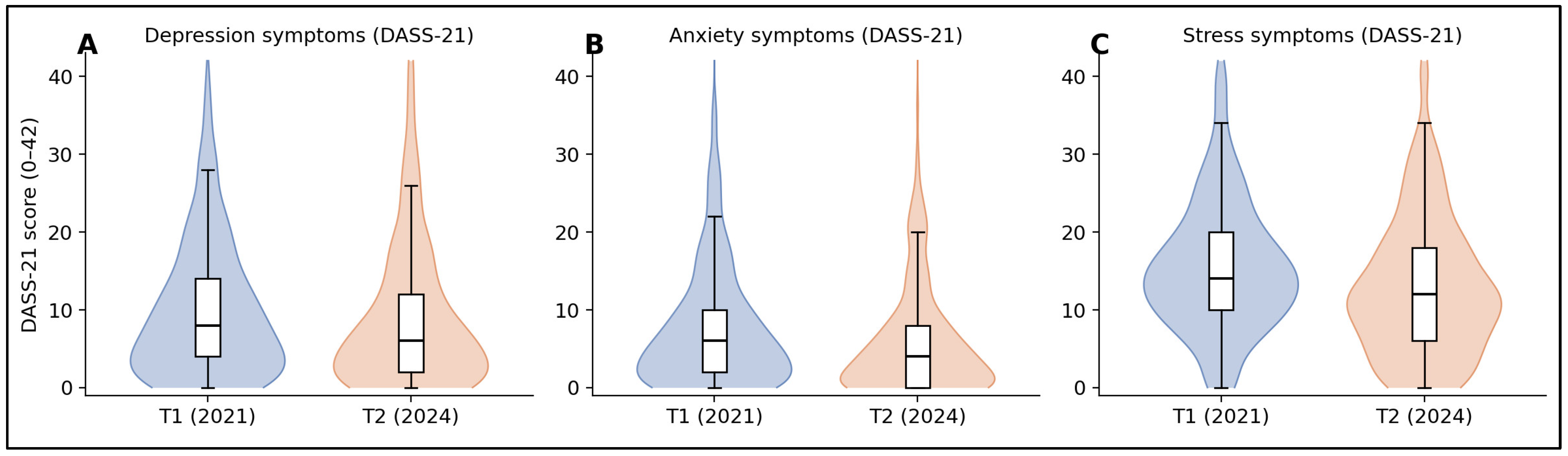
Figure 1 displays the distribution of DASS-21 subscale scores at the COVID-19 peak (T1/2021) and three years later (T2/2024). At the descriptive level, mean depression scores were similar across time points (T1: M = 9.77, SD = 8.59; T2: M = 8.91, SD = 9.17). In contrast, anxiety and stress scores were lower at T2 (Anxiety-T1: M = 7.51, SD = 7.59; T2: M = 5.78, SD = 6.85; Stress-T1: M = 15.41, SD = 8.32; T2: M = 12.69, SD = 8.84). The distributions in
Figure 1 suggest that changes were not restricted to central tendency, with visible shifts in the overall score distributions, particularly for anxiety and stress.
Because DASS-21 scores showed right-skewed distributions with a small number of extreme values (
Figure 1), we conducted sensitivity analyses to evaluate whether conclusions were driven by outliers and distributional asymmetry. Specifically, we (a) compared time points using robust location measures (medians with Mann–Whitney tests) and 20% trimmed means (bootstrap confidence intervals with permutation-based
p-values), and (b) re-estimated the fully adjusted models using approaches less sensitive to extreme observations, including winsorized outcomes (1st–99th percentiles) and robust regression (Huber M-estimation). Across these sensitivity checks, the main findings for anxiety and stress were consistent, indicating that the observed reductions at T2 were not attributable to a small number of extreme scores. For depression, nonparametric/trimmed comparisons suggested a modest shift in central tendency, whereas fully adjusted robust models yielded no clear time effect, suggesting that any depression changes may be smaller and/or more dependent on covariate adjustment rather than driven by outliers.
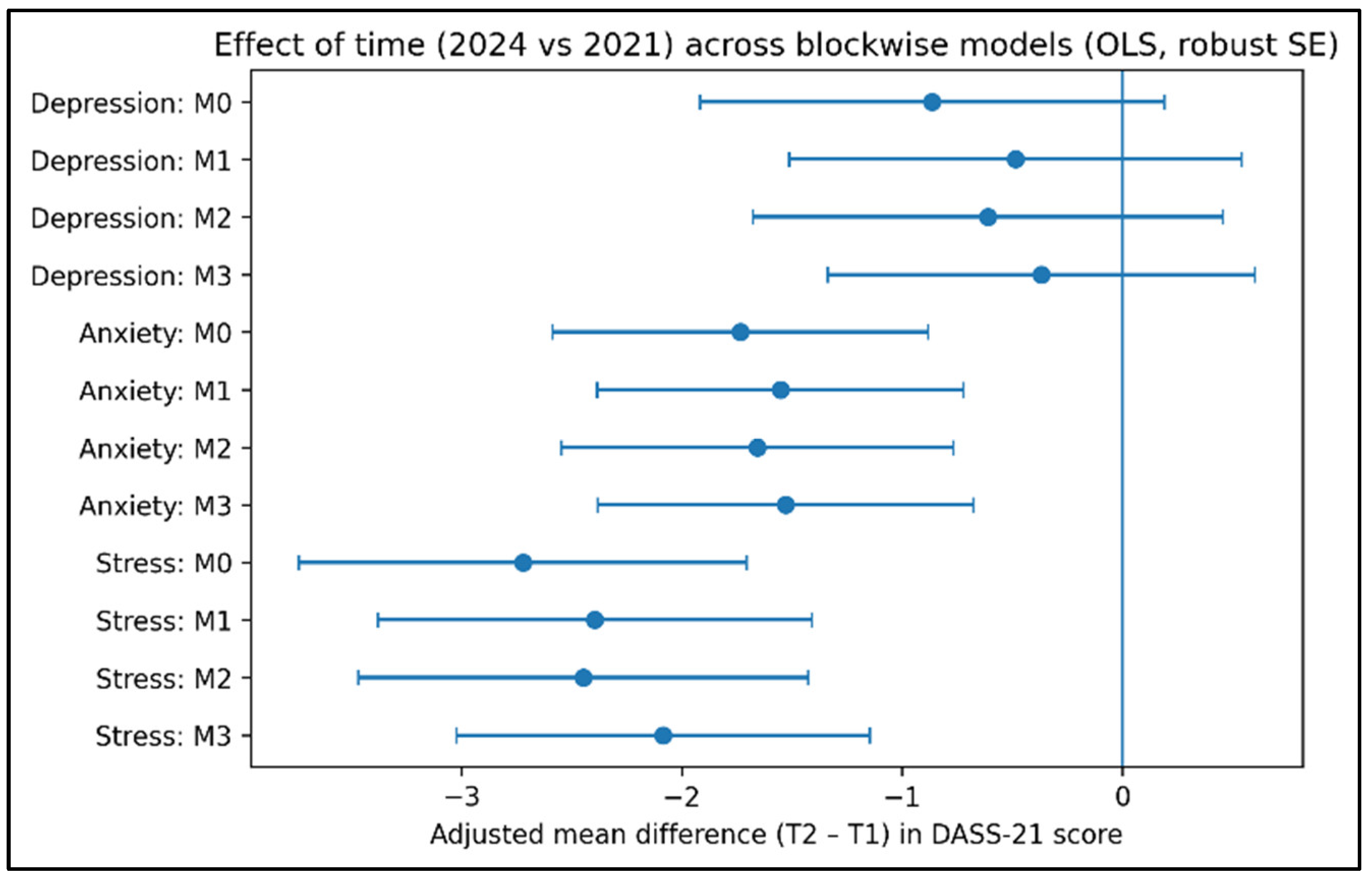
To quantify between-wave differences, we first estimated crude (unadjusted) mean differences (M0 models;
Figure 2). Relative to T1, mean anxiety (
β = −1.73, 95% CI [−2.59, −0.88],
p < 0.001) and stress (
β = −2.72, 95% CI [−3.74, −1.70],
p < 0.001) were lower at T2, whereas depression showed no clear evidence of change (
β = −0.86, 95% CI [ −1.92, 0.19],
p = 0.108). These findings remained substantively similar after sequential adjustment for sociodemographic and professional covariates (M1–M2), with time effects persisting for anxiety and stress (
Figure 2). After additional adjustment for self-care/support variables (M3), time remained associated with lower anxiety (
β = −1.53, 95% CI [ −2.38, −0.67],
p < 0.001) and lower stress (
β = −2.08, 95% CI [−3.02, −1.15],
p < 0.001), while depression remained non-significant (
β = −0.37, 95% CI [−1.34, 0.60],
p = 0.456). After Benjamini–Hochberg false discovery rate (FDR) correction across the three subscales within each model tier, time effects remained significant for anxiety and stress (
q < 0.001 in all tiers), but not for depression (
q > 0.10). Details are shown in
Supplementary Tables S2 and S5.
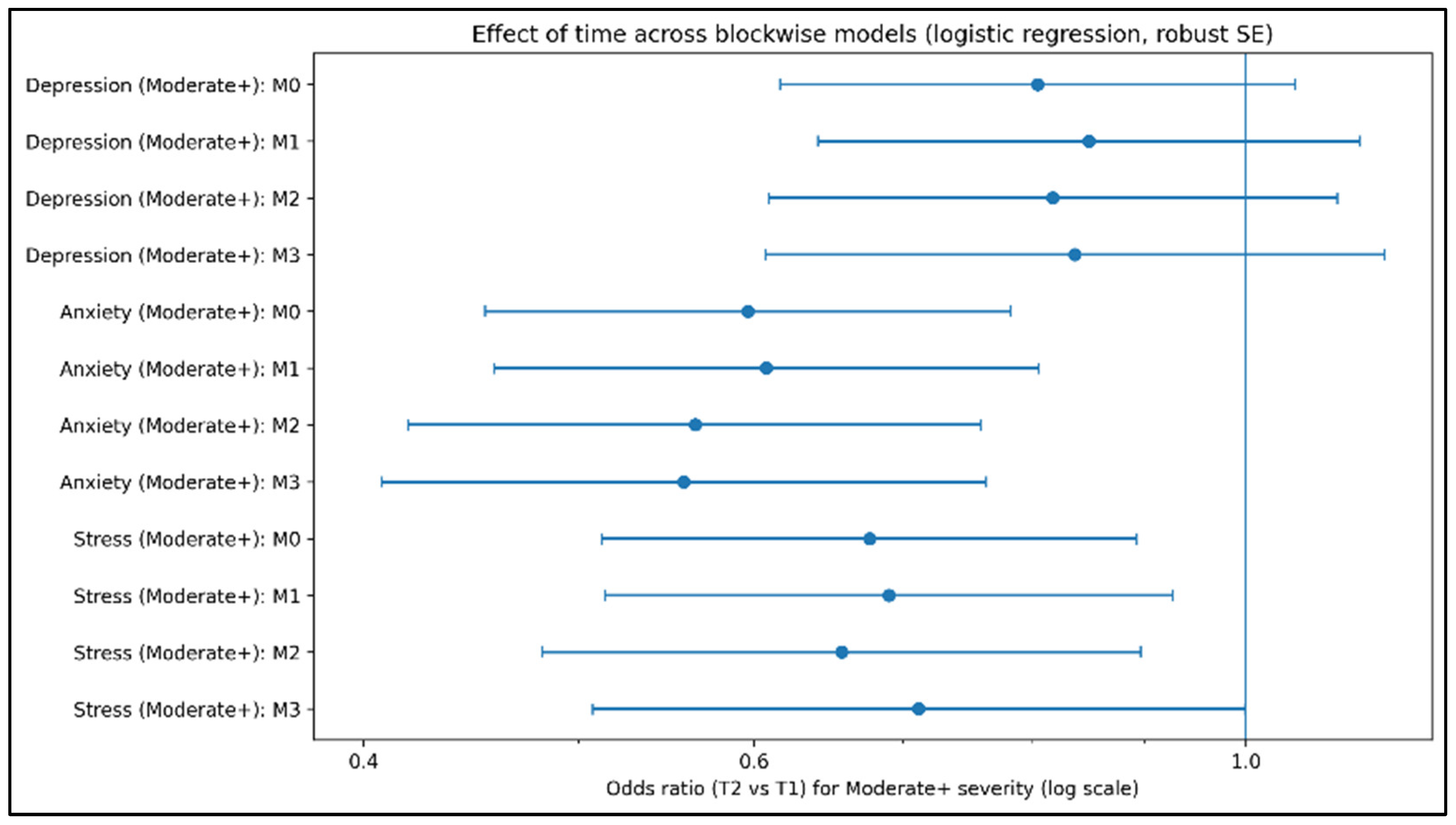
Figure 3 summarizes the association between time point and clinically elevated symptom severity, operationalized as “Moderate+” (moderate or severe/extremely severe) for each subscale using blockwise logistic regression. In crude models (M0), the odds of Moderate+anxiety were lower at T2 (OR = 0.60, 95% CI [0.45, 0.78],
p < 0.001), and Moderate+stress was also less frequent at T2 (OR = 0.68, 95% CI [0.51, 0.89],
p = 0.006), whereas Moderate+depression did not differ clearly across time (OR = 0.81, 95% CI [0.62, 1.05],
p = 0.112). After full adjustment (M3), the reduction in Moderate+anxiety remained robust (OR = 0.56, 95% CI [0.41, 0.76],
p < 0.001), while the estimate for Moderate+stress attenuated and was borderline (OR = 0.71, 95% CI [0.51, 1.00],
p = 0.049). Under FDR correction across the three Moderate+outcomes within M3, the time effect remained significant for anxiety (
q < 0.001), whereas stress did not meet the corrected threshold (
q ≈ 0.074), and depression remained non-significant. Details are shown in
Supplementary Table S3.
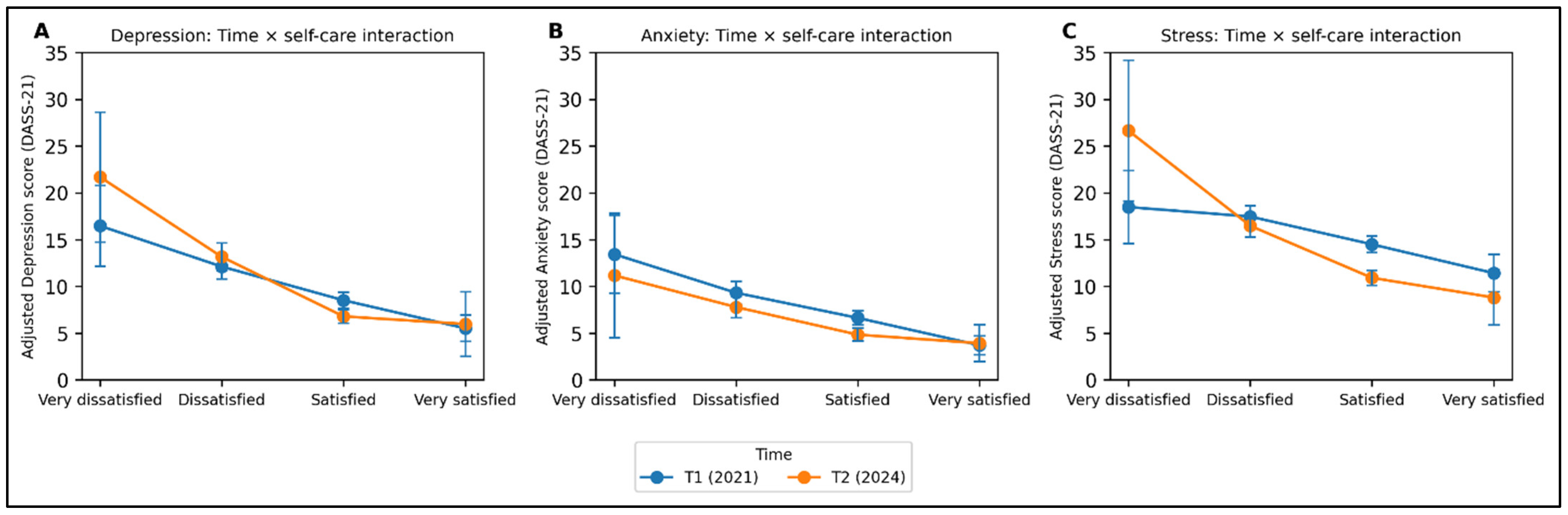
Figure 4 presents adjusted marginal means of DASS-21 scores by self-care level at each time point, illustrating both a dose–response pattern and potential moderation by time. Across both waves, higher perceived self-care was consistently associated with lower depression, anxiety, and stress scores (
Figure 4).
The time × self-care and time × modality analyses reported in this and the following paragraphs were treated as exploratory and are interpreted with caution, given the differing subgroup sizes and the shifts in sample composition between the two waves. Formal interaction tests indicated that the time × self-care interaction was statistically significant for stress (joint Wald test p = 0.006; FDR-corrected q ≈ 0.018), suggesting that changes over time differed by self-care level. In particular, among participants reporting being “satisfied” with self-care, stress decreased from T1 to T2 (Δ = −3.58, 95% CI [−4.78, −2.38]), whereas estimates among the “very dissatisfied” group were imprecise (wide CIs), consistent with smaller subgroup sizes. For depression, the interaction was weaker (joint p = 0.044) and did not remain significant after FDR correction (q ≈ 0.066), although a decrease was observed among those reporting being “satisfied” with self-care (Δ = −1.72, 95% CI [−2.88, −0.57]). For anxiety, the time x self-care interaction was not supported (joint p = 0.404), indicating that the temporal reduction in anxiety was comparatively consistent across self-care levels.
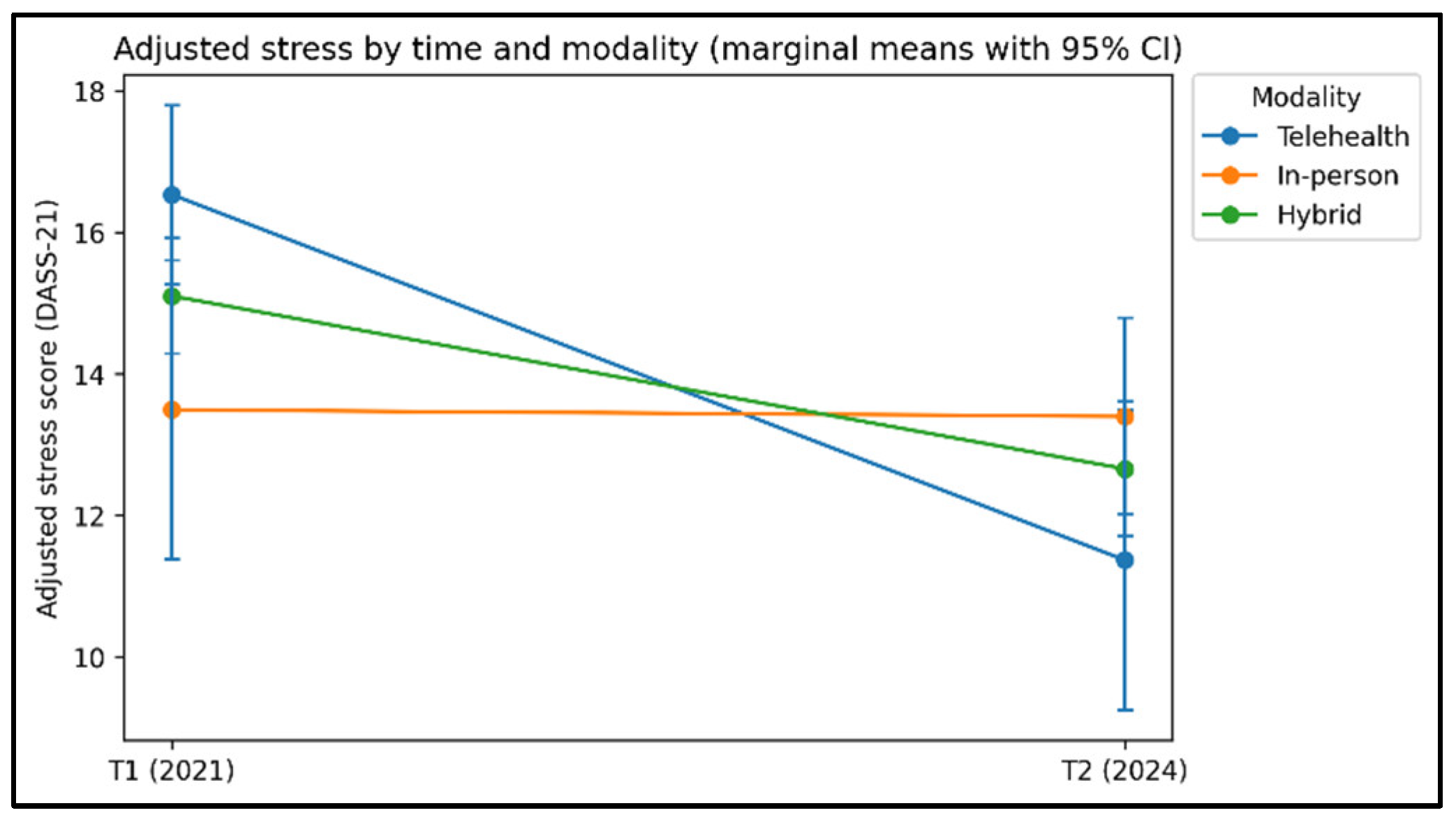
Figure 5 shows the time × modality interaction for stress, based on adjusted marginal means from an OLS model including the interaction and controlling for sociodemographic and professional covariates. Stress declined markedly over time among psychologists working primarily via telehealth (T1: 16.53, 95% CI [15.26, 17.80]; T2: 11.37, 95% CI [9.25, 13.49]; Δ = −5.17, 95% CI [−7.61, −2.73]). Stress also decreased among those working in a hybrid modality (T1: 15.10, 95% CI [14.28, 15.92]; T2: 12.66, 95% CI [11.70, 13.61]; Δ = −2.44, 95% CI [−3.69, −1.19]).
As shown in
Figure 5 and consistent with the estimates reported above, stress declined over time among telehealth and hybrid practitioners, whereas there was no evidence of change among those working exclusively in-person (Δ = −0.09, 95% CI [−2.59, 2.40];
p = 0.942). Full estimates are provided in
Supplementary Table S4.
4. Discussion
4.1. Principal Findings
This repeated cross-sectional study compared psychological distress and self-care indicators among Brazilian psychologists during the COVID-19 peak (April 2021) and three years later (2024). Anxiety and stress were consistently lower in 2024 than in 2021 across unadjusted analyses and sequentially adjusted block models, and remained robust after false discovery rate correction and sensitivity analyses. Depression showed a more heterogeneous pattern: although robust/nonparametric comparisons suggested modest shifts in central tendency, fully adjusted models did not yield clear evidence of a time effect.
Self-care indicators and work organization were strongly associated with distress, with a clear dose–response gradient between perceived self-care and all DASS-21 subscales. Differences in stress across time also varied according to self-care levels and practice modality.
Clinically elevated symptom severity (Moderate+) showed a convergent pattern. The odds of Moderate+anxiety were consistently lower in 2024 across all models, indicating reduced clinically relevant anxiety symptoms. Moderate+stress was also lower in crude and partially adjusted models, with attenuation after accounting for self-care/support variables, whereas Moderate+depression did not differ clearly between time points.
4.2. Temporal Changes in Distress
The reductions in anxiety and stress from 2021 to 2024 are consistent with evidence that acute pandemic-related distress tends to improve as infection risk and uncertainty recede [
2,
3,
6], and with longitudinal findings among healthcare workers showing declines as routines became more predictable [
12,
30,
31]. Although psychologists differ from other healthcare workers, the direction of change observed here is compatible with post-peak “decompression” of threat-related responding and strain.
Depression did not show a comparable pattern in fully adjusted models. Depressive symptoms may reflect more persistent mechanisms, such as cumulative exhaustion, reduced reward sensitivity, and prolonged emotional demands. Among mental health professionals, sustained exposure to clients’ distress and emotional labour may contribute to this pattern [
11,
14], consistent with Brazilian studies reporting substantial distress in psychologists during pandemic phases [
11]. The differential recovery observed here, clear reductions in anxiety and stress but not in depression, mirrors longitudinal evidence in which anxiety symptoms improve most as the acute threat recedes, whereas depressive symptoms are comparatively persistent and tied to slower-moving occupational factors such as sustained burnout, changes in social support, and heavy work schedules [
32]. Consistent with this, in the exploratory time × self-care analysis a decrease in depression was observed among participants satisfied with their self-care (Δ = −1.72), suggesting that any easing of depressive symptoms may be concentrated among clinicians able to sustain adequate self-care rather than being uniform across the sample. Persistent depressive symptoms among psychologists may therefore reflect cumulative emotional labour and residual strain that outlast the acute phase and are less responsive to the general easing of pandemic conditions [
11,
33]. While repeated cross-sectional design does not allow inferences about within-person change, these findings highlight depression as a domain potentially requiring longer-term monitoring and intervention.
4.3. Self-Care, Boundaries, and Work Organization
Across both waves, perceived self-care was strongly associated with lower levels of depression, anxiety, and stress, reinforcing the relevance of self-care practices and boundary regulation for sustainable professional functioning [
16,
17]. Because self-care and related constructs were captured with brief, single-item indicators, however, these associations should be regarded as preliminary and require confirmation with comprehensive, validated self-care measures. These findings align with prior evidence linking self-care to better adjustment among mental health professionals [
21] and to lower burnout in Brazilian psychologists during the pandemic [
19].
Work–life balance appeared improved at T2, consistent with evidence that it buffers occupational stress [
20,
24]. Differences in stress between time points varied according to self-care levels, suggesting that improvements may have been more pronounced among professionals able to maintain or re-establish adequate self-care routines, while estimates for the most dissatisfied subgroup remained imprecise.
4.4. Practice Modality and Help-Seeking
Differences in stress between time points were not uniform across practice modalities: larger reductions were observed among telehealth and hybrid practitioners, with minimal change among exclusively in-person professionals. Remote and hybrid formats may have become more integrated into professional routines over time, potentially offering greater flexibility [
22,
23,
34].
However, compositional differences between groups and substantial shifts in modality prevalence across waves limit interpretation. More broadly, because recruitment was conducted online and the two waves differed on several professional characteristics, most notably practice setting (more health-institution practice at T2) and working modality (less telehealth and more in-person work at T2), the samples are not strictly equivalent. Observed temporal differences should therefore be read as comparisons between two independent samples surveyed under different conditions rather than as changes within the same individuals, and residual confounding by unmeasured compositional differences cannot be excluded. Regulatory stabilization of telepsychology in Brazil [
26] may also have contributed to a more predictable practice context in 2024.
Psychotherapy use was lower in 2024 compared to 2021, whereas psychiatric care remained relatively stable. This pattern may reflect reduced acute distress but may also indicate barriers to sustained help-seeking. Previous studies suggest that treatment-seeking increased early in the pandemic and later stabilized [
34], and that distress may coexist with access barriers [
1,
35]. Considering the less consistent improvement in depression, reduced psychotherapy uptake warrants further attention.
4.5. Practical Implications
These findings have actionable implications for the psychology workforce. First, given the strong dose–response association between self-care and distress, training programs and continuing professional development may consider giving greater attention to self-care and boundary-setting, supported by supervision models that monitor workload, recovery time, and signs of overload; because these self-care indicators were brief and preliminary, such recommendations should be viewed as tentative pending validation with comprehensive measures. Second, organizations and professional bodies can reduce occupational stress by promoting feasible workload standards, protected breaks, and access to confidential mental health support for clinicians, particularly those reporting low self-care satisfaction. Third, the differential stress trajectories across practice modalities suggest that telehealth and hybrid work may be sustainable when implemented with explicit boundary protections (e.g., scheduling norms, limits on after-hours messaging, administrative support, and ergonomic/digital-workload guidance); however, modality decisions should be tailored to organizational context and clinician needs. Finally, lower psychotherapy uptake in 2024 alongside persistent psychiatric care underscores the need to normalize help-seeking among psychologists and remove structural barriers (time, cost, stigma) to sustained care.
4.6. Strengths, Limitations, and Implications
Strengths include the large sample, assessment at two key pandemic-related time points, use of validated DASS-21 measures, sequential adjustment strategies, and robustness analyses. Limitations include repeated cross-sectional design, reliance on self-report data, relatively brief indicators of self-care, categorical age measurement, and potential selection bias due to online recruitment. The models did not incorporate the evolving epidemiological context between waves; changes in disease progression, vaccination coverage, successive waves of infection, shifts in public sentiment, and variations in governmental restrictions were not measured and may have contributed to the observed differences. As a repeated cross-sectional design with independent samples, this study does not permit inferences about causality or about individual (within-person) change; the results reflect trends at the level of the sample rather than the trajectories of specific participants. Additional limitations include the potential non-equivalence of the two samples, the absence of information on participants’ previous mental health history, the exploratory nature of the interaction analyses, and the consequent inability to attribute the observed changes causally to the evolution of the pandemic.
Future research should prioritize longitudinal designs and more detailed assessment of workload, organizational support, and prior mental health status to clarify mechanisms underlying persistent depressive symptoms. Given the link between clinician well-being and service quality, sustained attention to workforce mental health may have broader implications for care provision [
36].



 ,
,