
Epidemiological Management of Preeclampsia–Eclampsia Cases in the Intensive Care Unit Before and During the Health Crisis

 , , , and
Abstract
1. Introduction
2. Materials and Methods
2.1. Study Methodology
2.2. Participants
2.3. Tools
2.4. Data Collection and Analysis
3. Results
3.1. Quantitative Results
3.2. Qualitative Results
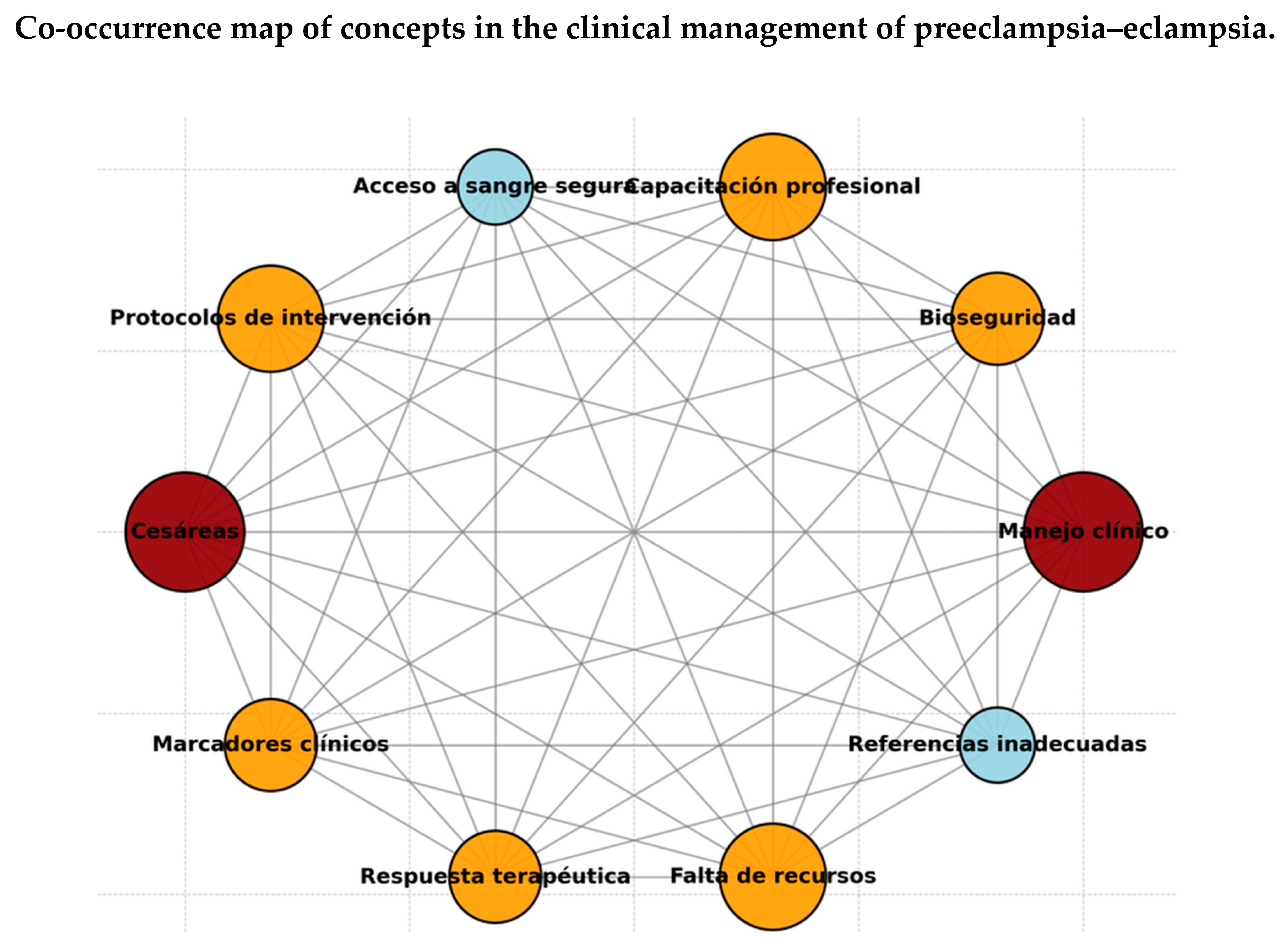
Co-Occurrence of Concepts
4. Discussion
5. Conclusions
Author Contributions
Funding
Institutional Review Board Statement
Informed Consent Statement
Data Availability Statement
Conflicts of Interest
References
- World Health Organization. Clinical Management of COVID-19 [Internet]; WHO: Geneva, Switzerland, 2020; Available online: https://www.who.int/publications/i/item/ (accessed on 18 December 2025).
- World Health Organization. WHO Recommendations for Prevention and Treatment of Pre-Eclampsia and Eclampsia [Internet]; WHO: Geneva, Switzerland; Available online: https://www.who.int/publications/i/item/9789241548335 (accessed on 18 December 2025).
- Eunice Kennedy Shriver National Institute of Child Health and Human Development. Preeclampsia and Eclampsia; NICHD: Bethesda, MD, USA, 2022. Available online: https://www.nichd.nih.gov/health/topics/preeclampsia (accessed on 18 December 2025).
- Di Cesare, M. El Perfil Epidemiológico de América Latina y el Caribe: Desafíos, Límites y Acciones; CEPAL: Santiago, Chile, 2011; Available online: https://repositorio.cepal.org/handle/11362/3852 (accessed on 18 December 2025).
- Pan American Health Organization. Pan American Health Organization Response to COVID-19 up to 31 December 2021; PAHO: Washington, DC, USA, 2022; Available online: https://iris.paho.org/handle/10665.2/56162 (accessed on 18 December 2025).
- United Nations. Salud y Bienestar (ODS 3); United Nations: New York, NY, USA, 2026; Available online: https://www.un.org/sustainabledevelopment/es/health/ (accessed on 18 December 2025).
- Blanco, E.; Marin, M.; Nuñez, L.; Retamal, E.; Ossa, X.; Woolley, K.E.; Oludotun, T.; Bartington, S.E.; Delgado-Saborit, J.M.; Harrison, R.M.; et al. Adverse pregnancy and perinatal outcomes in Latin America and the Caribbean: A systematic review and meta-analysis. Rev. Panam. Public Health 2022, 46, e21. [Google Scholar] [CrossRef] [Scilit]
- Conde-Agudelo, A.; Romero, R. SARS-CoV-2 infection during pregnancy and risk of preeclampsia: A systematic review and meta-analysis. Am. J. Obstet. Gynecol. 2022, 226, 68–89. [Google Scholar] [CrossRef] [Scilit]
- Ministerio de Salud del Perú; Centro Nacional de Epidemiología, Prevención y Control de Enfermedades. Situación Epidemiológica de la Mortalidad Materna en el Perú, 2022–2023 (SE 18); MINSA: Lima, Peru, 2023; Available online: https://www.dge.gob.pe/portal/docs/vigilancia/sala/2023/SE18/mmaterna.pdf (accessed on 18 December 2025).
- Centro Nacional de Epidemiología, Prevención y Control de Enfermedades. Análisis Epidemiológico de la Situación Actual del COVID-19 en el Perú; MINSA/DGE: Lima, Peru, 2020; Available online: https://www.dge.gob.pe/portal/docs/notas_prensa/2020/notaprensa032020.pdf (accessed on 18 December 2025).
- Chmielewska, B.; Barratt, I.; Townsend, R.; Kalafat, E.; van der Meulen, J.; Gurol-Urganci, I.; O’Brien, P.; Morris, E.; Draycott, T.; Thangaratinam, S.; et al. Effects of the COVID-19 pandemic on maternal and perinatal outcomes: A systematic review and meta-analysis. Lancet Glob. Health 2021, 9, e759–e772. [Google Scholar] [CrossRef] [Scilit]
- Capobianco, G.; Saderi, L.; Aliberti, S.; Mondoni, M.; Piana, A.; Dessole, F.; Dessole, M.; Cherchi, P.L.; Dessole, S.; Sotgiu, G. COVID-19 in pregnant women: A systematic review and meta-analysis. Eur. J. Obstet. Gynecol. Reprod. Biol. 2020, 252, 543–558. [Google Scholar] [CrossRef] [Scilit] [PubMed]
- Devi, K.; Longjam, N.; Angomchanu, R.; Kongkham, T.; Salam, S.; Singh, M. Case series study of patients with severe preeclampsia/eclampsia with maternal and perinatal mortality during the third wave of the COVID-19 pandemic in a tertiary care center. Int. J. Sci. Res. 2023, 12, 1. Available online: https://www.ijsronline.com/openaccess/10.36106/ijsr/3703213 (accessed on 18 December 2025).
- Knight, M.; Bunch, K.; Vousden, N.; Morris, E.; Simpson, N.; Gale, C.; O’Brien, P.; Quigley, M.; Brocklehurst, P.; Kurinczuk, J.J. Characteristics and outcomes of pregnant women admitted to hospital with confirmed SARS-CoV-2 infection in UK: National population based cohort study. BMJ 2020, 369, m2107. [Google Scholar] [CrossRef] [Scilit]
- Hernández-Sampieri, R.; Mendoza, C.P. Metodología de la Investigación: Las Rutas Cuantitativa, Cualitativa y Mixta, 6th ed.; McGraw-Hill Education: Ciudad de México, Mexico, 2018; Available online: https://www.mheducation.com.mx (accessed on 18 December 2025).
- Gao, Y.J.; Ye, L.; Zhang, J.S.; Yin, Y.X.; Liu, M.; Yu, H.B.; Zhou, R. Clinical characteristics and outcomes of pregnant women with COVID-19: A systematic review and meta-analysis. Sci. Rep. 2021, 11, 823. [Google Scholar]
- Chen, H.; Guo, J.; Wang, C.; Luo, F.; Yu, X.; Zhang, W.; Li, J.; Zhao, D.; Xu, D.; Gong, Q.; et al. Clinical characteristics and intrauterine vertical transmission potential of COVID-19 infection in nine pregnant women: A retrospective review of medical records. Lancet 2020, 395, 809–815. [Google Scholar] [CrossRef] [Scilit] [PubMed]
- The National Commission for the Protection of Human Subjects of Biomedical and Behavioral Research. The Belmont Report: Ethical Principles and Guidelines for the Protection of Human Subjects of Research; DHEW: Washington, DC, USA, 1979. Available online: https://www.hhs.gov/ohrp/regulations-and-policy/belmont-report/read-the-belmont-report/index.html (accessed on 18 December 2025).
- da-Costa-Santos, J.; Reis, V.V.L.; Japecanga, R.R.; Seabra, M.; Carvalho, M.A.; Oliveira, A.J.G.; Vinchi, L.C.; Righi, A.B.P.; Mayrink, J.; Guida, J.P.S.; et al. The impact of the COVID-19 pandemic on the diagnosis and management of pre-eclampsia: Identifying healthcare delays. Int. J. Gynaecol. Obstet. 2026, 172, 953–961. [Google Scholar] [CrossRef] [Scilit]
- Martínez-González, B.; Garza-Reséndez, N.; Contreras-Garza, N.Y.; González-Oropeza, D. Risk combination: COVID-19 and preeclampsia. Case series and literature review. Ginecol. Obstet. Mex. 2021, 89, 622–634. [Google Scholar] [CrossRef]
- Allotey, J.; Stallings, E.; Bonet, M.; Stallings, E.; Yap, M.; Kew, T.; Zhou, D.; Coomar, D.; Sheikh, J.; Lawson, H.; et al. Clinical manifestations, risk factors, and maternal and perinatal outcomes of coronavirus disease 2019 in pregnancy: Living systematic review and meta-analysis. BMJ 2020, 370, m3320. [Google Scholar] [CrossRef] [Scilit]
- Martínez-Portilla, R.J.; Sotiriadis, A.; Chatzakis, C.; Torres-Torres, J.; Espino y Sosa, S.; Sandoval-Mandujano, K.; Castro-Bernabe, D.A.; Medina-Jimenez, V.; Monarrez-Martin, J.C.; Figueras, F.; et al. Pregnant women with SARS-CoV-2 infection are at higher risk of death and pneumonia: Propensity score matched analysis of a nationwide prospective cohort (COV19Mx). Ultrasound Obstet. Gynecol. 2021, 57, 224–231. [Google Scholar] [CrossRef] [Scilit] [PubMed]
- Papageorghiou, A.T.; Deruelle, P.; Gunier, R.B.; Rauch, S.; García-May, P.K.; Mhatre, M.; Usman, M.A.; Abd-Elsalam, S.; Etuk, S.; Simmons, L.E.; et al. Preeclampsia and COVID-19: Results from the INTERCOVID prospective longitudinal study. Am. J. Obstet. Gynecol. 2021, 225, 289.e1–289.e17. [Google Scholar] [CrossRef] [Scilit]
- American College of Obstetricians and Gynecologists. Gestational hypertension and preeclampsia: ACOG Practice Bulletin No. 222. Obstet. Gynecol. 2020, 135, e237–e260. [Google Scholar] [CrossRef] [Scilit]
- Sathiya, R.; Rajendran, J.; Sumathi, S. COVID-19 and Preeclampsia: Overlapping Features in Pregnancy. Rambam Maimonides Med. J. 2022, 13, e0007. [Google Scholar] [CrossRef] [Scilit] [PubMed]
- Mendoza, M.; Garcia-Ruiz, I.; Maiz, N.; Rodo, C.; Garcia-Manau, P.; Serrano, B.; Lopez-Martinez, R.M.; Balcells, J.; Fernandez-Hidalgo, N.; Carreras, E.; et al. Preeclampsia-like syndrome induced by severe COVID-19: A prospective observational study. BJOG Int. J. Obstet. Gynaecol. 2020, 127, 1374–1380. [Google Scholar] [CrossRef] [Scilit] [PubMed]
- do Nascimento, M.I.; de Almeida Cunha, A.; Rangel Netto, N.F.; dos Santos, R.A.; Barroso, R.R.; Rodrigues de Carvalho Alves, T.; Soares, W.E. COVID-19 and Preeclampsia: A Systematic Review of Pathophysiological Interactions. Rev. Bras. Ginecol. Obstet. 2023, 45, 347–355. [Google Scholar] [CrossRef]
- Herington, J.; Shand, J.; Holden-Wiltse, J.; Corbett, A.; Dees, R.; Ching, C.-L.; Shaw, M.; Cai, X.; Zand, M. Ethical trade-offs in crisis standards of care using ventilator allocation protocols: A simulation study. PLoS ONE 2024, 19, e0300951. [Google Scholar] [CrossRef] [Scilit]
- Poon, L.C.; Yang, H.; Kapur, A.; Melamed, N.; Dao, B.; Divakar, H.; McIntyre, H.D.; Kihara, A.B.; Ayres-de-Campos, D.; Ferrazzi, E.M.; et al. Global interim guidance on coronavirus disease 2019 (COVID-19) during pregnancy and puerperium from FIGO and allied partners: Information for healthcare professionals. Int. J. Gynaecol. Obstet. 2020, 149, 273–286. [Google Scholar] [CrossRef] [Scilit] [PubMed] [PubMed Central]
- Villar, J.; Ariff, S.; Gunier, R.B.; Thiruvengadam, R.; Rauch, S.; Kholin, A.; Roggero, P.; Prefumo, F.; Vale, M.S.D.; Cardona-Perez, J.A.; et al. Maternal and neonatal morbidity and mortality among pregnant women with and without COVID-19 infection: The INTERCOVID multinational cohort study. JAMA Pediatr. 2021, 175, 817–826. [Google Scholar] [CrossRef] [Scilit]
- Lopes de Sousa, Á.F.; Carvalho, H.E.F.D.; Oliveira, L.B.D.; Schneider, G.; Camargo, E.L.S.; Watanabe, E.; de Andrade, D.; Fernandes, A.F.C.; Mendes, I.A.C.; Fronteira, I. Effects of COVID-19 infection during pregnancy and neonatal outcome: What is the evidence? Int. J. Environ. Res. Public Health 2020, 17, 4176. [Google Scholar] [CrossRef] [Scilit] [PubMed]


| Clinical and Epidemiological Profile of Preeclampsia–Eclampsia | Cases Before COVID-19 (2015–2019) | Cases During COVID-19 (2020–2022) | p-Value |
|---|---|---|---|
| Clinical Profile | |||
| Type of preeclampsia–eclampsia | 1.000 | ||
| With severe features | 28 (84.8%) | 13 (86.7%) | |
| Without severe features | 5 (15.2%) | 2 (13.3%) | |
| Signs and symptoms | 0.298 | ||
| Proteinuria | 5 (15.2%) | 0 (0.0%) | |
| Liver disorder | 6 (18.2%) | 4 (26.7%) | |
| PA + Proteinuria | 1 (3.0%) | 0 (0.0%) | |
| All of the above | 21 (63.6%) | 11 (73.3%) | |
| Delivery method | p < 0.001 | ||
| Normal | 25 (75.8%) | 1 (6.7%) | |
| Cesarean section | 8 (24.2%) | 14 (93.3%) | |
| Obstetric complications | 1.000 | ||
| HELLP syndrome + eclampsia | 29 (87.9%) | 13 (86.7%) | |
| Other | 4 (12.1%) | 2 (13.3%) | |
| Condition at the time of discharge | 0.662 | ||
| With treatment | 29 (87.9%) | 12 (80.0%) | |
| Deceased | 4 (12.1%) | 3 (20.0%) | |
| Epidemiological profile | |||
| Age | 0.768 | ||
| Average age (years) | 29.4 ± 5.3 | 30.1 ± 4.9 | |
| Gestational age | 1.000 | ||
| <27 weeks | 4 (12.1%) | 2 (13.3%) | |
| 28–36 weeks | 29 (87.9%) | 13 (86.7%) | |
| Marital status | 0.542 | ||
| Married | 3 (9.1%) | 0 (0.0%) | |
| Cohabitant | 30 (90.9%) | 15 (100.0%) | |
| Level of education | 0.583 | ||
| Without instruction | 2 (6.1%) | 0 (0.0%) | |
| Primary | 27 (81.8%) | 13 (86.7%) | |
| Secondary | 4 (12.1%) | 2 (13.3%) | |
| Personal background | 1.000 | ||
| Diabetes/hypertension | 27 (81.8%) | 13 (86.7%) | |
| Diabetes | 6 (18.2%) | 2 (13.3%) | |
| Poor obstetric history | 0.094 | ||
| Previous CST | 3 (9.1%) | 3 (20.0%) | |
| Previous preeclampsia | 1 (3.0%) | 1 (6.7%) | |
| Preeclampsia/gestational diabetes | 21 (63.5%) | 11 (73.3%) | |
| CST + preeclampsia | 8 (24.2%) | 0 (0.0%) | |
| Prenatal care | 1.000 | ||
| Revised | 5 (15.2%) | 2 (13.3%) | |
| Not controlled | 28 (84.8%) | 13 (86.7%) | |
| Characterization of the Management of the Clinical Profile of Preeclampsia–Eclampsia | Before COVID-19 (2015–2019) | During COVID-19 (2020–2022) | p-Value | ||
|---|---|---|---|---|---|
| Advantages | n | % | n | % | p < 0.001 |
| Simplicity | 15 | 31.3 | 2 | 4.17 | |
| Fast service | 8 | 16.7 | 23 | 47.92 | |
| High cost/benefit | 18 | 37.4 | 19 | 39.58 | |
| The suspected agents were identified | 7 | 14.6 | 4 | 8.33 | |
| Total | 48 | 100.00 | 48 | 100.00 | |
| Disadvantages | n | % | n | % | p = 0.009 |
| The risk was not quantified | 7 | 14.6 | 2 | 4.17 | |
| It lacked sequentiality | 25 | 52.1 | 14 | 29.17 | |
| Limited personal references | 11 | 22.9 | 19 | 39.58 | |
| It leads to false interpretations | 5 | 10.4 | 13 | 27.80 | |
| Total | 48 | 100 | 48 | 100.00 | |
| Characterization of the Management of the Epidemiological Profile of Preeclampsia–Eclampsia | Before COVID-19 (2015–2019) | During COVID-19 (2020–2022) | p-Value | ||
|---|---|---|---|---|---|
| Advantages | n | % | n | % | 0.011 |
| Structured in indicators | 11 | 22.9 | 3 | 6.3 | |
| Easy to verify and reference for treatments | 28 | 58.9 | 16 | 33.3 | |
| It allows us to know the prevalence and incidence | 7 | 14.6 | 20 | 41.7 | |
| It allows for the analysis of the medical–social context | 2 | 4.2 | 9 | 18.8 | |
| Disadvantages | n | % | n | % | 0.655 |
| It does not provide adequate information about the risks | 2 | 4.2 | 14 | 29.2 | |
| It lacks sequentiality | 11 | 22.9 | 6 | 12.5 | |
| It does not provide complete case references | 18 | 37.5 | 23 | 47.9 | |
| It leads to false interpretations | 17 | 35.4 | 5 | 10.4 | |
| Total | 48 | 100 | 48 | 100.00 | |
Disclaimer/Publisher’s Note: The statements, opinions and data contained in all publications are solely those of the individual author(s) and contributor(s) and not of MDPI and/or the editor(s). MDPI and/or the editor(s) disclaim responsibility for any injury to people or property resulting from any ideas, methods, instructions or products referred to in the content. |
© 2026 by the authors. Licensee MDPI, Basel, Switzerland. This article is an open access article distributed under the terms and conditions of the Creative Commons Attribution (CC BY) license.
Share and Cite
Lora-Loza, M.; Hernández Angulo, J.N.; Cabrejo Paredes, J.E.; Díaz Espinoza, M.; Zapata Rojas, J.C. Epidemiological Management of Preeclampsia–Eclampsia Cases in the Intensive Care Unit Before and During the Health Crisis. COVID 2026, 6, 65. https://doi.org/10.3390/covid6040065
Lora-Loza M, Hernández Angulo JN, Cabrejo Paredes JE, Díaz Espinoza M, Zapata Rojas JC. Epidemiological Management of Preeclampsia–Eclampsia Cases in the Intensive Care Unit Before and During the Health Crisis. COVID. 2026; 6(4):65. https://doi.org/10.3390/covid6040065
Chicago/Turabian StyleLora-Loza, Miryam, Jean Neil Hernández Angulo, José Elías Cabrejo Paredes, Maribel Díaz Espinoza, and Jean Carlos Zapata Rojas. 2026. "Epidemiological Management of Preeclampsia–Eclampsia Cases in the Intensive Care Unit Before and During the Health Crisis" COVID 6, no. 4: 65. https://doi.org/10.3390/covid6040065
APA StyleLora-Loza, M., Hernández Angulo, J. N., Cabrejo Paredes, J. E., Díaz Espinoza, M., & Zapata Rojas, J. C. (2026). Epidemiological Management of Preeclampsia–Eclampsia Cases in the Intensive Care Unit Before and During the Health Crisis. COVID, 6(4), 65. https://doi.org/10.3390/covid6040065