1. Introduction
Novel coronavirus disease 2019 (COVID-19) has displayed a broad spectrum of pathologies. In severe cases, it causes a massive inflammatory state, most notably leading to Acute Respiratory Distress Syndrome (ARDS) [
1]. Klok et al. reported a high incidence of venous thromboembolism (VTE) events in a cohort of critically ill COVID-19 patients [
2]. This risk appears to be enhanced by the presence of vascular access devices, including central venous catheters (CVCs) and arterial lines which are often required in ARDS patients. Sebolt et al. reported that among patients hospitalized with COVID-19, those who had vascular access devices placed had four-fold greater odds of a VTE (defined as an upper or lower extremity VTE with or without catheter, or pulmonary embolism) than those who did not [
3]. In patients who required vascular access for hemodialysis, thrombosis of both arteriovenous access sites and dialysis catheters were the most common complications related to hemodialysis in patients with COVID-19 [
4,
5,
6]. CVC occlusions are a common occurrence in all ICU-level patients, and if flushes or thrombolytic therapies fail, lines must be replaced [
7,
8]. If COVID-19 patients are at an increased risk of developing line-occluding thrombosis or infections, they would also require more line replacements. There has been no study to date investigating line replacement rates and reasons for line replacement in COVID-19 patients compared to similarly ill non-COVID-19 patients.
The incidence of central-line associated bloodstream infections (CLABSIs) had seen a dramatic spike nationally during the pandemic [
9]. Hospitals reported significantly increased incidence of CLABSIs in patients with COVID-19 [
10]. This is likely related to a variety of factors including reduced compliance with CLABSI prevention measures, increased time spent prone, and prolonged severe illness in patients with COVID-19 [
9,
10]. The proposed increased incidence of thrombosis in COVID-19 patients and the subsequent need for anticoagulation may increase bleeding risk, yet line-related bleeding has not been adequately assessed. While some studies suggest a high rate of line complications in COVID-19 cohorts, it is worth considering whether this increase in complication rates is unique to COVID-19 or if it is associated with ARDS of all etiologies [
11].
To elucidate whether COVID-19 presented unique and unforeseen challenges in terms of vascular access compared to prior experiences in patients with ARDS, we focused our analysis on a few key questions regarding mechanically ventilated ICU patients. Our primary objective was to determine whether more lines were placed in critically ill patients with COVID-19 compared to those without COVID-19 and whether those lines were replaced more often. Our secondary aim was to determine whether COVID-19 patients experienced more line-related infections, catheter-occluding thrombosis, and post-insertion bleeding, as well as whether anticoagulation was associated with more thrombosis and bleeding in COVID-19 patients. To study these questions, we analyzed data from a cohort of mechanically ventilated patients admitted to a community hospital ICU with severe ARDS secondary to COVID-19 infection, and a cohort of mechanically ventilated patients admitted to the same facility with ARDS resulting from non-COVID-19 etiologies.
2. Methods
This was a single-center, retrospective cohort study approved by the Institutional Review Board of Trinity Health St. Joseph Mercy Ann Arbor Hospital. Patient consent was not required due to the study being a retrospective chart review. The inclusion criteria for the COVID-19 group were as follows: all patients were aged ≥18 years, had confirmed COVID-19 (defined as a positive SARS-CoV-2 reverse-transcriptase polymerase chain reaction [RT-PCR] test by nasopharyngeal swab), required mechanical ventilation for ARDS (defined by the Berlin criteria), and required admission to the medical ICU at Trinity Health St. Joseph Mercy Ann Arbor Hospital. The exclusion criteria were any patient who did not meet the inclusion criteria as stated above and who had ICU admissions less than 24 h. All patients admitted to the medical ICU from 15 March 2020 through 18 May 2020 (three months and three days) were screened according to the inclusion and criteria as above. Data was obtained retrospectively from patients treated at Trinity Health St. Joseph Mercy Ann Arbor by manual chart review of the electronic medical record; data was collected on all patients from admission through discharge or death. The non-COVID-19 cohort consisted of patients admitted to Trinity Health St. Joseph Mercy Ann Arbor Hospital medical ICU who required mechanical ventilation and were diagnosed with ARDS. This cohort included patients admitted from 10 October 2016 through 3 April 2017 (6 months and 24 days). This cohort was derived from a patient database utilized in prior retrospective studies of ARDS patients and screened according to the inclusion/exclusion. criteria as above, except for COVID-19 positivity. Data on included patients was collected from admission to discharge. The larger number of patients in the study cohort compared to the control group is due the surge of critically ill COVID-19 patients in early 2020. This was accommodated in our hospital by dramatically increasing the available number of ICU beds and staff including nurses and physicians. Data was obtained by manual chart review of the electronic medical record of patients treated at Trinity Health St. Joseph Mercy Ann Arbor. Data was collected on all patients from admission through discharge or death. Data was also collected by the study investigators and entered into a secure REDcap database. The deidentified data was analyzed by a hospital-affiliated statistician and the study investigators.
Central venous catheters and dialysis catheters were triple-lumen and were placed in the internal jugular or femoral veins. Arterial catheters were single-lumen and were placed in the radial or femoral arteries. All catheters were placed with ultrasound guidance using the direct Seldinger technique. All lines were placed under strict sterile conditions by either the medical ICU house staff or advanced practice providers who adhered to standard barrier precautions. Biopatch™ (Ethicon, Somerville, NJ, USA) foam was applied prior to the sterile dressing for all central lines and dialysis catheters. Catheter care was done according to the nursing protocols at the institution. We are not aware of any differences in nursing catheter care protocols between the two cohorts.
Patient data included demographics, relevant comorbidities, hospital length of stay, ICU length of stay, duration of mechanical ventilation, and outcomes of hospitalization. Severity of ARDS was determined based on the P:F ratio utilizing the lowest PaO2 obtained from arterial blood gas and correlating FiO2 while the patient was on high-flow nasal cannula, non-invasive ventilation, or mechanical ventilation. Vascular access data included the number of arterial lines, central lines, and dialysis lines placed, and number of times each was replaced. Line complications were based on the reason for catheter replacement based on a review of associated procedure and progress notes. This included infections (which was confirmed with associated positive blood culture drawn from the line, or localized infection of the catheter insertion site), thrombosis in the line vessel (confirmed by ultrasound Doppler imaging), and post-insertion bleeding from line sites. Further collected data included anticoagulation use, reasons for anticoagulant initiation, and need for dialysis and/or continuous renal replacement therapy (CRRT). Due to constraints of the electronic medical record, we were unable to accurately collect data describing individual catheter dwell times. Data regarding steroid exposure was not collected due to inconsistencies in their use in managing COVID-19 ARDS during the study period. None of the patients in either cohort were supported with Extracorporeal Membrane Oxygenation (ECMO).
Summary statistics for baseline demographics and comorbidities are presented in
Table 1. Means and standard deviations are presented for continuous variables and counts and percentages for categorical variables. Chi-squared, Fisher’s exact, and t-tests were performed to test for significant differences between the groups. Comparisons of the outcomes between the two cohorts are presented in
Table 2. For all other outcomes, Chi-squared or Fisher’s exact tests were performed depending on the distribution of the variable. The replacement rate model specifications are the same as the models for the raw counts, with an offset added for the ICU length of stay.
3. Results
Table 1 compares demographics and comorbidities between the non-COVID-19 and COVID-19 groups. Demographically, the COVID-19 group had significantly higher percentage of non-white patients (
p < 0.001). Significant differences in comorbidities included higher rates of obesity (
p = 0.003) and diabetes in the COVID-19 cohort. Differences among comorbidities were otherwise non-significant. ARDS severity was also not significantly different among the two groups.
Patient outcome statistics are presented in
Table 2. The COVID-19 cohort had significantly longer average length of hospitalization (
p < 0.001), ICU length of stay (
p < 0.001), and duration on mechanical ventilation (
p < 0.001). The COVID-19 cohort also had a significantly larger number of patients who expired during their hospitalizations or after being discharged to hospice (
p = 0.018). A greater percentage of the COVID-19 cohort was started on renal replacement therapy, and a significantly greater percentage of the COVID-19 cohort was placed on CRRT (
p = 0.015). We noted that the COVID-19 cohort was more likely to be placed on therapeutic anticoagulation due to presumed (without confirmation by radiology) and radiologically diagnosed VTE (
p = 0.007).
Line-related outcome comparisons between COVID-19 and non-COVID-19 patients are presented in
Table 3. The COVID-19 group had a higher total average number of lines per patient (
p < 0.001). This difference was driven by a significantly higher average number of arterial lines (
p = 0.003) and dialysis catheters (
p = 0.002) in that group. The COVID-19 cohort had significantly more patients who required arterial line (
p = 0.027) and dialysis catheter (
p = 0.048) replacement at least once. This is further illustrated in
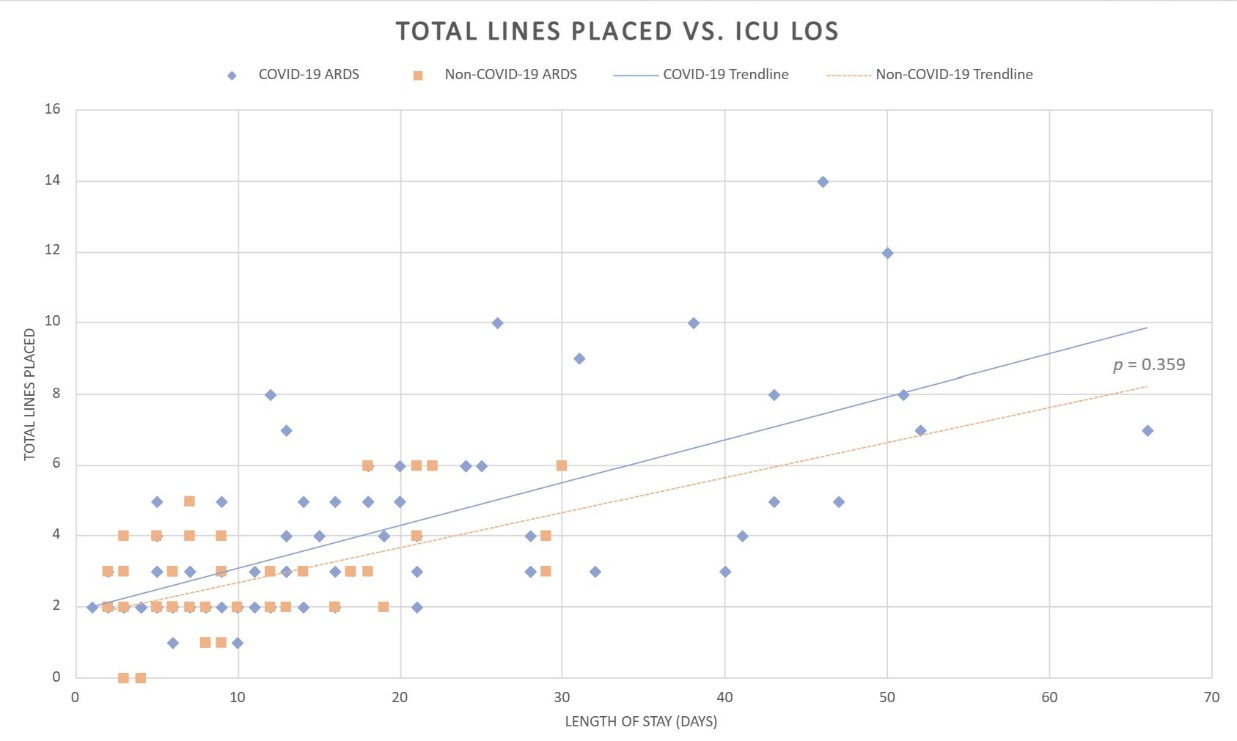
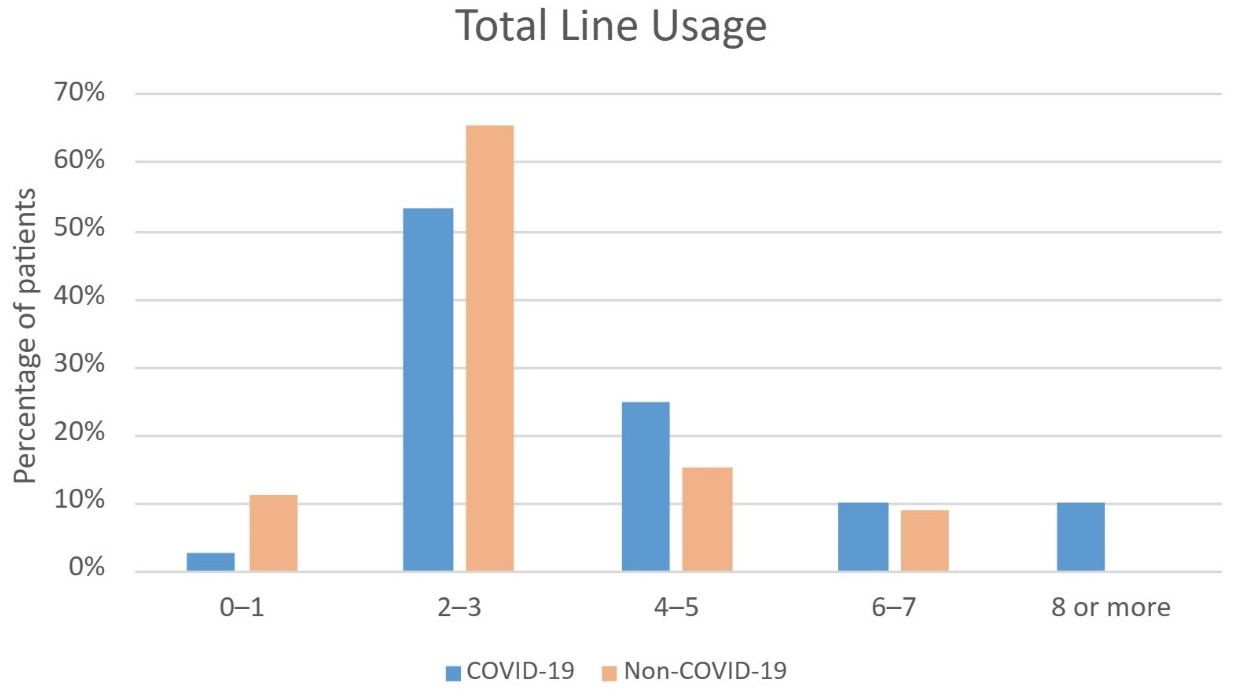
Figure 1, which shows that 44.45% of the COVID-19 cohort had at least four total lines placed, compared to 23.92% of the non-COVID-19 cohort. However, when adjusting for length of stay in the ICU, the differences in lines placed per day were not significant for any of the catheter types. This is further demonstrated in the scatter plot in
Figure 2, which shows the contrast in total lines and lengths of stays in the ICU, but the slope between the two groups was similar.
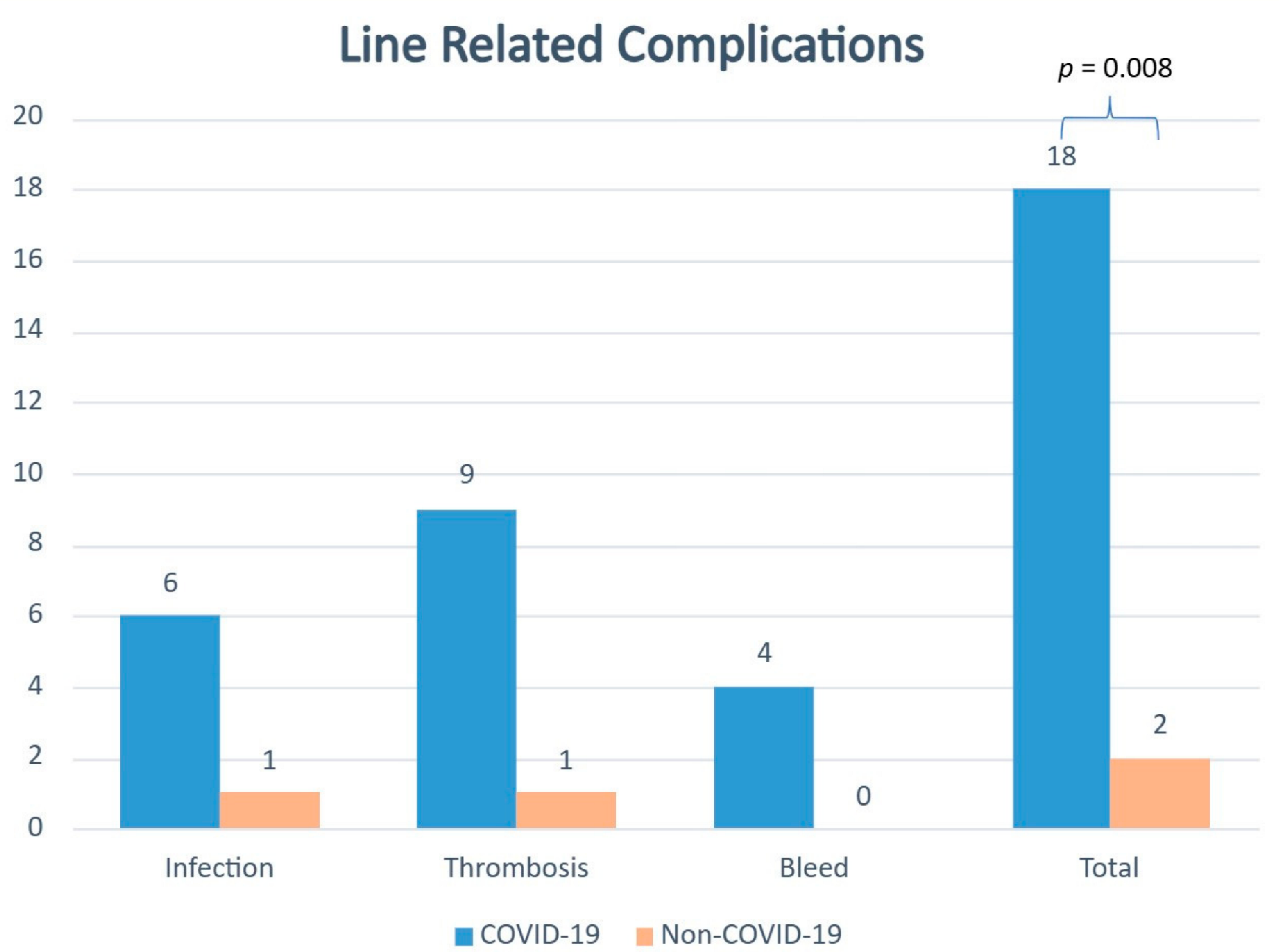
Line-related complication rates were numerically higher for COVID-19 patients in all categories: bleeding, infections, and thrombosis. The combined endpoint of thrombosis, bleeding and infections was statistically higher in the COVID-19 cohort, as shown in
Figure 3 (
p = 0.008). When adjusted for 1000 catheter days, complication rate did not meet statistical significance (
p = 0.058). Of the four patients in the COVID-19 cohort who had a line-related bleed, all were on full-dose anticoagulation at the time of the bleed. Three of those patients had minor bleeds, and one had a major bleed based on the International Society of Thrombosis and Haemostasis (ISTH) definition. Of the patients with minor bleeds, two were anticoagulated for “presumed VTE,” one continued on chronic anticoagulation from admission, and one was also on an antiplatelet agent at the time of bleed. None of the patients with minor bleeds had significantly elevated INR or severe thrombocytopenia. The patient with major bleed had bleeding from multiple sites and also noted to have elevated INR and moderate thrombocytopenia. None of the patients in the study or control groups developed pneumothorax from catheter placement. The non-COVID-19 cohort featured a higher percentage of catheters placed in the femoral vein or artery compared to the COVID-19 cohort. We did not find a difference of complication rates associated with line position. Additionally, 11% of patients in the COVID-19 cohort had catheter occlusions treated with alteplase, compared to 20% of the non-COVID-19 cohort.
4. Discussion
We report the use of vascular access devices and associated complications in 81 patients with ARDS due to COVID-19, and 46 patients with ARDS without COVID-19. Our primary goal was to determine whether more vascular access catheters were used and whether patients experienced more catheter-related complications in COVID-19 ARDS patients compared with non-COVID-19 ARDS patients prior to the pandemic. The COVID-19 cohort had a significantly greater number of lines placed per patient and more patients who required multiple lines placed. As illustrated in
Figure 2, this appears to be correlated with the longer length of stay in the ICU in the COVID-19 cohort rather than due to the etiology of ARDS itself. Moreover, when adjusted for length of stay, there were no significant differences for any of the three catheter types. Removing a vascular access device as soon as possible is one of the cornerstones of prevention of line-related infections and other complications, and our findings reinforce the importance of expeditious line removal in critically ill patients [
9,
10].
We found that there was a significant difference in line-related complications; the complication rate was higher in COVID-19 patients, even when corrected for the greater total number of lines used. Factors that likely contribute to increased line-related infections in COVID-19 patients include use of steroids, longer time on the ventilator, and possibly less monitoring earlier on in the pandemic due to COVID-19 precautions. Increasing data has confirmed the higher rate of thrombosis in COVID-19 patients compared to similar ARDS cohorts [
12,
13]. While this correlated with our findings of increased incidence of thrombosis in the COVID-19 cohort, we were unable to make a causative inference given the retrospective nature of this study. Catheters were more likely to be placed in the internal jugular vein in the COVID-19 cohort, and we did not find any association between complications and catheter location. We were unable to collect data on complications associated with prone positioning in either cohort.
In the early stages of the pandemic, we had difficulty obtaining CT angiography and Doppler images to diagnose VTE due to safety restrictions and severity of illness. As a result, many patients could have had thrombosis that were undiagnosed, and many patients were empirically anticoagulated for presumed VTE (based on clinical symptoms but without confirmation by radiology). This puts patients at higher risk of bleeding, including from catheter insertion sites. We had four patients with COVID-19 who developed line-related bleeding, compared to none in the non-COVID-19 cohort. The higher bleeding rates in COVID-19 patients were likely related to greater use of anticoagulants, given that all patients with bleeding were on full dose anticoagulation at the time of the bleeding. Our limited data appears to correlate with studies that found that critically ill patients with COVID-19 experienced higher rates of bleeding events when placed on therapeutic anticoagulation compared to standard prophylactic dosing [
14].
Several confounding factors may have affected our results. There were significantly more obese and diabetic patients in the COVID-19 cohort, and these comorbidities are both independent risk factors for catheter-associated infections [
15,
16]. Diabetic patients have a higher risk of peripheral artery disease (PAD) and stiffer arterial walls in distal arteries [
17,
18]. This could lead to higher incidence of arterial line dysfunction necessitating replacement. Difficulties in obtaining and retaining intra-arterial access in obese patients also presents its own technical challenges related to body habitus and ease of keeping line sites clean [
19]. The racial disparity between the two study groups was also notable; the COVID-19 cohort had a greater percentage of Black patients, which is consistent with national data [
20]. This may have altered the risk factors for our line-related outcomes given the overall higher incidence of diabetes, cardiovascular, and renal disease in Black patients [
21]. Our results indicated that the COVID-19 patients experienced significantly more acute renal failure necessitating use of CRRT, which brings about significant complicating factors, notably clotting of the extracorporeal circuit and the temporary dialysis catheter, as well as bleeding or hemorrhage from the catheter insertion site [
22].
Limitations of our study include the lower number of patients in the non-COVID-19 cohort, which limited the power of the statistical analysis. This was due to our reliance on an available patient database from a prior retrospective study at the same hospital. Given this, we did not perform a power analysis. Furthermore, the non-COVID-19 cohort was admitted over three years prior to the COVID-19 cohort, and over that time there have been changes in the standard practice surrounding vascular access devices, particularly with limiting their use to prevent CLABSI, although we would expect to see better outcomes in more recent patients, which we did not find. We also did not collect data on elements of ARDS management such as the use of prone position, paralytics, and corticosteroids. Any differences in usage of those interventions may have played a role in our line-related outcomes and complications. Finally, our COVID-19 study population occurred early in the pandemic, and therefore our findings do not account for the significant advancements in COVID-19 management and availability of COVID-19 vaccinations.
Given that this was a retrospective observational study, there are inherent limitations with regard to cohort matching. The previously described differences in demographics and comorbidities were such that attempting to match populations would have likely reduced our already limited cohort sizes. As shown in
Table 1, both cohorts were similar in terms of severity of ARDS, and we believe that was the most important factor in determining an adequate cohort to compare to our COVID-19 population.
5. Conclusions
In the early stages of the COVID-19 pandemic, patients with COVID-19 ARDS had significantly more vascular access devices placed when compared to a cohort of patients with ARDS unrelated to COVID-19, which was likely related to the longer ICU length of stay. Vascular access devices in COVID-19 patients are more likely to develop infections, thrombosis, or bleeding. We conclude that the use of vascular access devices should be limited as much as possible in patients with COVID-19 ARDS and that further studies are needed to devise strategies to minimize line-related complications. While central and arterial access are cornerstones of ICU care, providers should continue to adhere to adequate routines for catheter selection, care protocols, and swift removal when no longer needed to help minimize the number of complications.
Author Contributions
Conceptualization, R.B., M.M., T.T. and A.A. Data curation, R.B., M.M., and T.T. Formal analysis, R.B., M.M., T.T. and A.A. Investigation, R.B., M.M. and T.T. Methodology, R.B., M.M., T.T. and A.A. Project administration, R.B. Supervision, R.B. and A.A. Validation, R.B. Visualization, R.B. Writing—original draft, R.B., M.M., T.T. and A.A. Writing—review & editing, R.B., M.M., T.T. and A.A. All authors have read and agreed to the published version of the manuscript.
Funding
This research received no external funding.
Institutional Review Board Statement
Since this was a retrospective analysis and patient data was de-identified, it was exempt from ethics review and approved by the hospital IRB by exemption category 4(iii). Trinity Health Ann Arbor IRB, Protocol number: e-20-887, approval date: 4 June 2020.
Informed Consent Statement
This was a retrospective analysis with de-identified data, exempt from and therefore informed consent was not required as per IRB exemption category 4.
Data Availability Statement
The original contributions presented in this study are included in the article. Further inquiries can be directed to the corresponding author.
Acknowledgments
We thank Ibolya Csernak and Dixy Rajkumar (Trinity Health Ann Arbor) for their contributions to this research study and continued support.
Conflicts of Interest
The authors declare no conflicts of interest.
References
- Wang, D.; Hu, B.; Hu, C.; Zhu, F.; Liu, X.; Zhang, J.; Wang, B.; Xiang, H.; Cheng, Z.; Xiong, Y.; et al. Clinical Characteristics of 138 Hospitalized Patients with 2019 Novel Coronavirus-Infected Pneumonia in Wuhan, China. JAMA 2020, 323, 1061–1069. [Google Scholar] [CrossRef] [Scilit]
- Klok, F.A.; Kruip, M.J.H.A.; van der Meer, N.J.M.; Arbous, M.S.; Gommers, D.A.M.P.J.; Kant, K.M.; Kaptein, F.H.J.; van Paassen, J.; Stals, M.A.M.; Huisman, M.V.; et al. Incidence of thrombotic complications in critically ill ICU patients with COVID-19. Thromb. Res. 2020, 191, 145–147. [Google Scholar] [CrossRef] [Scilit] [PubMed]
- Sebolt, J.; Buchinger, J.; Govindan, S.; Zhang, Q.; O’mAlley, M.; Chopra, V. Patterns of vascular access device use and thrombosis outcomes in patients with COVID-19: A pilot multi-site study of Michigan hospitals. J. Thromb. Thrombolysis 2021, 53, 257–263. [Google Scholar] [CrossRef] [Scilit] [PubMed]
- Shi, J.; Yan, J.-J.; Chen, J.; Zhang, Q.-H.; Yang, Y.; Xing, X.; Cheng, A.-Y.; Wang, Y.-N.; Xu, G.; He, F. The management of vascular access in hemodialysis patients during the coronavirus disease 2019 epidemic: A multicenter cross-sectional study. J. Vasc. Access 2021, 22, 280–287. [Google Scholar]
- Desbuissons, G.; Michon, A.; Attias, P.; Burbach, M.; Diaconita, M.; Karie-Guiges, S.; Novelli, L.; Rjeili, M.A.; Awad, S.; Besse, F.; et al. Arteriovenous fistulas thrombosis in hemodialysis patients with COVID-19. J. Vasc. Access 2021, 23, 412–415. [Google Scholar] [CrossRef] [Scilit] [PubMed]
- Shabaka, A.; Gruss, E.; Landaluce-Triska, E.; Gallego-Valcarce, E.; Cases-Corona, C.; Ocaña, J.; Tato-Ribera, A.; Lopez-Revuelta, K.; Furaz-Czerpak, K.R.; Fernández-Juárez, G. Late thrombotic complications after SARS-CoV-2 infection in hemodialysis patients. Hemodial. Int. 2021, 25, 507–514. [Google Scholar] [CrossRef] [Scilit]
- Zhong, L.; Wang, H.-L.; Xu, B.; Yuan, Y.; Wang, X.; Zhang, Y.-Y.; Ji, L.; Pan, Z.-M.; Hu, Z.-S. Normal saline versus heparin for patency of central venous catheters in adult patients—A systematic review and meta-analysis. Crit. Care 2017, 21, 5. [Google Scholar] [CrossRef] [Scilit]
- Baskin, J.L.; Reiss, U.; Wilimas, J.A.; Metzger, M.L.; Ribeiro, R.C.; Pui, C.-H.; Howard, S.C. Thrombolytic therapy for central venous catheter occlusion. Haematologica 2012, 97, 641–650. [Google Scholar] [CrossRef] [Scilit]
- Fakih, M.G.; Bufalino, A.; Sturm, L.; Huang, R.-H.; Ottenbacher, A.; Saake, K.; Winegar, A.; Fogel, R.; Cacchione, J. Coronavirus disease 2019 (COVID-19) pandemic, central-line–associated bloodstream infection (CLABSI), and catheter-associated urinary tract infection (CAUTI): The urgent need to refocus on hardwiring prevention efforts. Infect. Control Hosp. Epidemiol. 2022, 43, 26–31. [Google Scholar] [CrossRef] [Scilit]
- Haroun, P.; Ben-Aderet, M.; Madhusudhan, M.; Almario, M.J.; Raypon, R.C.; Fawcett, S.E.; Grein, J. COVID-19 on the Line: A significant increase in CLABSI in hospitalized patients with COVID-19 at a major teaching hospital. Open Forum Infect. Dis. 2021, 8, S482–S483. [Google Scholar] [CrossRef] [Scilit]
- Gidaro, A.; Vailati, D.; Gemma, M.; Lugli, F.; Casella, F.; Cogliati, C.; Canelli, A.; Cremonesi, N.; Monolo, D.; Cordio, G.; et al. Retrospective survey from vascular access team Lombardy net in COVID-19 era. J. Vasc. Access 2021, 23, 532–537. [Google Scholar] [CrossRef] [Scilit]
- Al-Samkari, H.; Leaf, R.S.K.; Dzik, W.H.; Carlson, J.C.T.; Fogerty, A.E.; Waheed, A.; Goodarzi, K.; Bendapudi, P.K.; Bornikova, L.; Gupta, S.; et al. COVID-19 and coagulation: Bleeding and thrombotic manifestations of SARS-CoV-2 infection. Blood 2020, 136, 489–500. [Google Scholar] [CrossRef] [Scilit]
- Marini, C.P.; Lewis, E.; Petrone, P.; Zenilman, A.; Lu, Z.; Rivera, A.; McNelis, J. Incidence and effects of deep vein thrombosis on the outcome of patients with coronarvirus disease 2019 infection. J. Vasc. Surg. Venous Lymphat. Disord. 2021, 10, 803–810. [Google Scholar] [CrossRef] [Scilit] [PubMed]
- REM-CAP; ACTIV-4a; ATTACC Investigators. Therapeutic anticoagulation with heparin in critically ill patients with COVID-19. N. Engl. J. Med. 2021, 385, 777–789. [CrossRef] [Scilit] [PubMed]
- Buetti, N.; Souweine, B.; Mermel, L.; Mimoz, O.; Ruckly, S.; Loiodice, A.; Mongardon, N.; Lucet, J.-C.; Parienti, J.-J.; Timsit, J.-F. Obesity and risk of catheter-related infections in the ICU. A post hoc analysis of four large randomized controlled trials. Intensive Care Med. 2021, 47, 435–443. [Google Scholar] [CrossRef] [Scilit] [PubMed]
- Bomberg, H.; Kubulus, C.; List, F.; Albert, N.; Schmitt, K.; Gräber, S.; Kessler, P.; Steinfeldt, T.; Standl, T.; Gottschalk, A.; et al. Diabetes: A risk factor for catheter-associated infections. Reg. Anesth. Pain Med. 2015, 40, 16–21. [Google Scholar] [CrossRef] [Scilit]
- Suzuki, E.; Kashiwagi, A.; Nishio, Y.; Egawa, K.; Shimizu, S.; Maegawa, H.; Haneda, M.; Yasuda, H.; Morikawa, S.; Inubushi, T.; et al. Increased arterial wall stiffness limits flow volume in the lower extremities in type 2 diabetic patients. Diabetes Care 2001, 24, 2107–2114. [Google Scholar] [CrossRef] [Scilit]
- Thiruvoipati, T.; Kielhorn, C.E.; Armstrong, E.J. Peripheral artery disease in patients with diabetes: Epidemiology, mechanisms, and outcomes. World J. Diabetes 2015, 6, 961–969. [Google Scholar] [CrossRef] [Scilit]
- Schumann, R.; Meidert, A.; Bonney, I. Intraoperative blood pressure monitoring in obese patients: Arterial catheter, finger cuff, and oscillometry. Anesthesiology 2021, 134, 179–188. [Google Scholar] [CrossRef] [Scilit]
- Mude, W.; Oguoma, V.M.; Nyanhanda, T.; Mwanri, L.; Njue, C. Racial disparities in COVID-19 pandemic cases, hospitalisations, and deaths: A systematic review and meta-analysis. J. Glob. Health 2021, 11, 05015. [Google Scholar] [CrossRef] [Scilit]
- Saab, K.R.; Kendrick, J.; Yracheta, J.M.; Lanaspa, M.A.; Pollard, M.; Johnson, R.J. New insights on the risk for cardiovascular disease in African Americans: The role of added sugars. J. Am. Soc. Nephrol. 2015, 26, 247–257. [Google Scholar] [CrossRef] [Scilit] [PubMed]
- Gaudry, S.; Palevsky, P.M.; Dreyfuss, D. Extracorporeal kidney-replacement therapy for acute kidney injury. N. Engl. J. Med. 2022, 386, 964–975. [Google Scholar] [CrossRef] [Scilit] [PubMed]
| Disclaimer/Publisher’s Note: The statements, opinions and data contained in all publications are solely those of the individual author(s) and contributor(s) and not of MDPI and/or the editor(s). MDPI and/or the editor(s) disclaim responsibility for any injury to people or property resulting from any ideas, methods, instructions or products referred to in the content. |