Article

Unmasking COVID-19 Headaches in Healthcare Professionals: Phenotypic Continuity Across Infection, Reinfection, Vaccination and Post-COVID


by
Marta Domínguez Gallego
1,2,
Paula Panos Basterra
1,
Alba Somovilla
1,
Alicia Gonzalez-Martinez
1,2,
Carmen Ramos
1,
Ana Belen Lopez-Rodriguez
1,
Álvaro Morales Caballero
3,
Amparo López-Guerrero Almansa
3,
Manuela García Cebrián
3,
Jose Vivancos Mora
1 and
Ana Beatriz Gago-Veiga
1,2,*
1
Department of Neurology, Hospital Universitario de La Princesa & Instituto de Investigación Sanitaria Princesa (IIS-Princesa), Universidad Autónoma de Madrid (UAM), 28006 Madrid, Spain
2
Headache Unit, Department of Neurology, Hospital Universitario de La Princesa & Instituto de Investigación Sanitaria Princesa (IIS-Princesa), Universidad Autónoma de Madrid (UAM), 28006 Madrid, Spain
3
Occupational Medicine Department, Hospital Universitario de La Princesa & Instituto de Investigación Sanitaria Princesa (IIS-Princesa), Universidad Autónoma de Madrid (UAM), 28006 Madrid, Spain
*
Author to whom correspondence should be addressed.
COVID 2026, 6(1), 14; https://doi.org/10.3390/covid6010014
Submission received: 21 November 2025 / Revised: 13 December 2025 / Accepted: 30 December 2025 / Published: 6 January 2026
(This article belongs to the Section COVID Clinical Manifestations and Management)

Abstract

Headache is a common symptom during SARS-CoV-2 infection and may persist beyond three months. Both tension-type and migraine-like headaches have been described during SARS-CoV-2 infection and after immunization. The main objective was to characterize headache phenotype during SARS-CoV-2 infection and its relationship with headache recurrence following reinfection and COVID-19 vaccination in a cohort of healthcare professionals. Secondary aims included profiling primary headaches and identifying predictors of post-COVID-19 headache persistence. We included 109 participants (86.2% women, mean age 45.3 ± 2.5 years). During infection, 49.5% met ICHD-3 criteria for tension-type headache and 12.8% for migraine. Headache recurred in 62.5% after reinfection and 59.2% after vaccination. A primary-headache history was present in 77.9% of sampled patients (25.9% migraine, 47.1% tension-type). The COVID-19 headache phenotype typically mirrored patients’ previous headache type during reinfection and post-vaccination. Persistent headache beyond three months from SARS-CoV-2 infection occurred in 22.9% and was associated with fibromyalgia and obesity. These findings suggest that COVID-19-related headache often mirrors the patient’s pre-existing primary headache and tends to recur with the same phenotype following reinfection or vaccination.

1. Introduction

Headache is a frequent symptom in patients with SARS-CoV-2 infection [1,2], with a reported frequency of 10–75% across different series [3,4,5]. It may occur in individuals with or without a history of primary headache [3,6,7]. Despite its frequency, it remains poorly characterized in terms of phenotype, evolution, and prognostic implications.
Most patients with headache during SARS-CoV-2 infection meet the criteria for acute systemic viral headache [8], with a temporal association with the onset, course, and resolution of infection [8,9]. The underlying mechanisms remain under investigation, with hypotheses including direct trigeminovascular activation by SARS-CoV-2 or systemic inflammation with cytokine release [3,6,10,11]. When headache persists for more than three months, it is referred to as chronic systemic viral headache, as defined in the International Classification of Headache Disorders, 3rd edition (ICHD-3) [7]. In 5–20% of patients, headache persists beyond three months, known as post-COVID-19 persistent headache [3,12,13].
The semiology of headache in COVID-19 appears heterogeneous, though bilateral, throbbing pain in temporoparietal or frontal regions of moderate-to-severe intensity is commonly reported [9,11]. A recent phenotyping study of COVID-19 headache described two predominant subtypes: migraine-like and tension-type headache [10,14], with migraine phenotype being more frequent after SARS-CoV-2 acute infection [9,11]. Furthermore, headache is also a commonly reported adverse event following COVID-19 vaccination, with incidence ranging from 30% to 52% across vaccine trials [7,15,16,17]. This post-vaccination headache may resemble either migraine or tension-type profiles [11].
Most existing studies have focused on the general population samples or hospitalized patients, where clinical attention is focused on respiratory or systemic complications. In contrast, up to our knowledge, headache among healthcare professionals remains underexplored. This subpopulation represents a unique group with high exposure, self-awareness of symptoms, and a strong representation of women. According to the World Health Organization’s “State of the World’s Nursing 2020” report, women make up approximately 90% of the global nursing workforce [18]. This is especially relevant given the higher prevalence of headache disorders in women, particularly migraine, which occurs two to three times more frequently in females than males [19,20,21].
Understanding headache in this setting may provide valuable insights into how pre-existing headache profiles influence COVID-19-related symptoms, and whether a phenotypic continuity exists across infection, reinfection, post-COVID stages, and vaccination. Thus, we performed an observational study in a cohort of healthcare professionals to characterize headache phenotype across these three periods and explore its relationship with clinical variables, primary headache history, and persistence.
Our hypothesis is that both reinfection and COVID-19 vaccination may trigger headaches resembling those observed during initial SARS-CoV-2 infection and that individual headache history could shape both the acute and persistent post-COVID headache presentation.

2. Materials and Methods

2.1. Study Population

This one-year observational study included a retrospective cohort of healthcare workers with COVID-19 headache from a tertiary hospital in Madrid, spanning March 2020 to March 2021. During this time, mRNA-based vaccines were used: Comirnaty (Pfizer/BioNTech) for the first two doses (January–February 2021) and Spikevax (Moderna) for the third dose.
Patients were initially evaluated via a questionnaire from the Occupational Medicine Department. Headache-related data were collected through semi-structured telephone interviews by neurologists, specifically focused on evaluating the characteristics of headache prior to the administration of any analgesic or symptomatic treatment. Recruitment followed a non-probabilistic convenience sampling method and all patients with COVID-19 headache were assessed for eligibility. Most participants had mild to moderate COVID-19 and were managed as outpatients. No hospitalizations or severe systemic complications were reported.

2.2. Inclusion and Exclusion Criteria

Inclusion criteria referred to healthcare workers with PCR-confirmed SARS-CoV-2 infection who experienced infection-related headache, had documentation from the Occupational Medicine Department, and consented to participate in the study. This period was labeled as “Infection”.
Reinfection was defined as a positive RT-PCR result (Ct < 35) over 90 days after the initial infection, regardless of symptom presence [22]. The post-vaccination period was defined as the seven days following administration of the COVID-19 vaccine. We only considered cases in which patients themselves clearly reported a direct and temporally close relationship between their prior infection or vaccination and the onset or change in headache characteristics.
The exclusion criteria were individuals under 18 years and those with severe neurological disease hindering communication.

2.3. Variables Included in the Study

Demographic and clinical variables recorded included sex, age, weight (kg), body mass index (BMI) and previous documented pathologies such as obesity (BMI 30 ≥ kg/m2), high blood pressure (HBP), dyslipidemia (DL), diabetes mellitus (DM), smoker history, obstructive sleep apnea syndrome (OSAS), anxiety, depression, fibromyalgia, history of headache and frequency (<1 pain day per month, 1–10 days and >10 days).
Neurologists assessed headache characteristics via phone interviews conducted soon after symptom onset to minimize recall bias. Variables included location (holocranial/hemicranial), quality (pulsatile/stabbing/oppressive), intensity (0–10 scale), and associated symptoms (photophobia, phonophobia, osmophobia, nausea, vomiting, clinophilia). These variables were assessed during the acute SARS-CoV-2 infection, reinfection, and post-vaccination periods.
Headache was classified using the International Classification of Headache Disorders, 3rd edition (ICHD-3) [7]; if insufficient data were available, it was classified as “other.” Cases with uncertainty underwent a follow-up call with a neurologist.
Patients with COVID-19-related headache >3 months were classified as having post-COVID-19 persistent headache, in line with WHO criteria [23,24]. Additionally, other persistent symptoms (present for more than 3 months) were also recorded: tachycardia, fever, cough, dyspnea, myalgia, asthenia, ageusia, anosmia, odynophagia, insomnia, lack of concentration, nausea, arthralgia, dizziness, paresthesia, and gait instability.

2.4. Statistical Analysis

Sample size was calculated based on estimated rates of headache after reinfection and vaccination. For α = 0.05 and power = 80%, a minimum of 32 patients were needed. Quantitative variables with a normal distribution are presented using means and standard deviations (SD), while those with non-normal distribution are reported as medians and interquartile ranges (IQR). Qualitative variables are expressed as relative frequencies and percentages. Normality was assessed using the Kolmogorov–Smirnov test. Non-parametric tests were applied when appropriate.
A two-step logistic regression model was applied: first univariate, then multivariate using forward stepwise selection followed by backward elimination. For this purpose, the step function in R was used, which considers the Akaike information criterion for model selection, with the input and output p values set to 0.15. Results include the odds ratios (OR), 95% confidence intervals (CI), the estimate beta, SD, Z values, and p values. Two-tailed tests were used, with a significance level of 5%. Analyses were performed using R 4.2.1 (http://www.R-project.org; accessed on 23 June 2022; the R Foundation for Statistical Computing, Vienna, Austria).

2.5. Ethics Committee Approval

The study was approved by the Clinical Research Ethics Committee of the Hospital Universitario de La Princesa (Number: 4507), in accordance with the Declaration of Helsinki [25].

3. Results

3.1. Population Demography

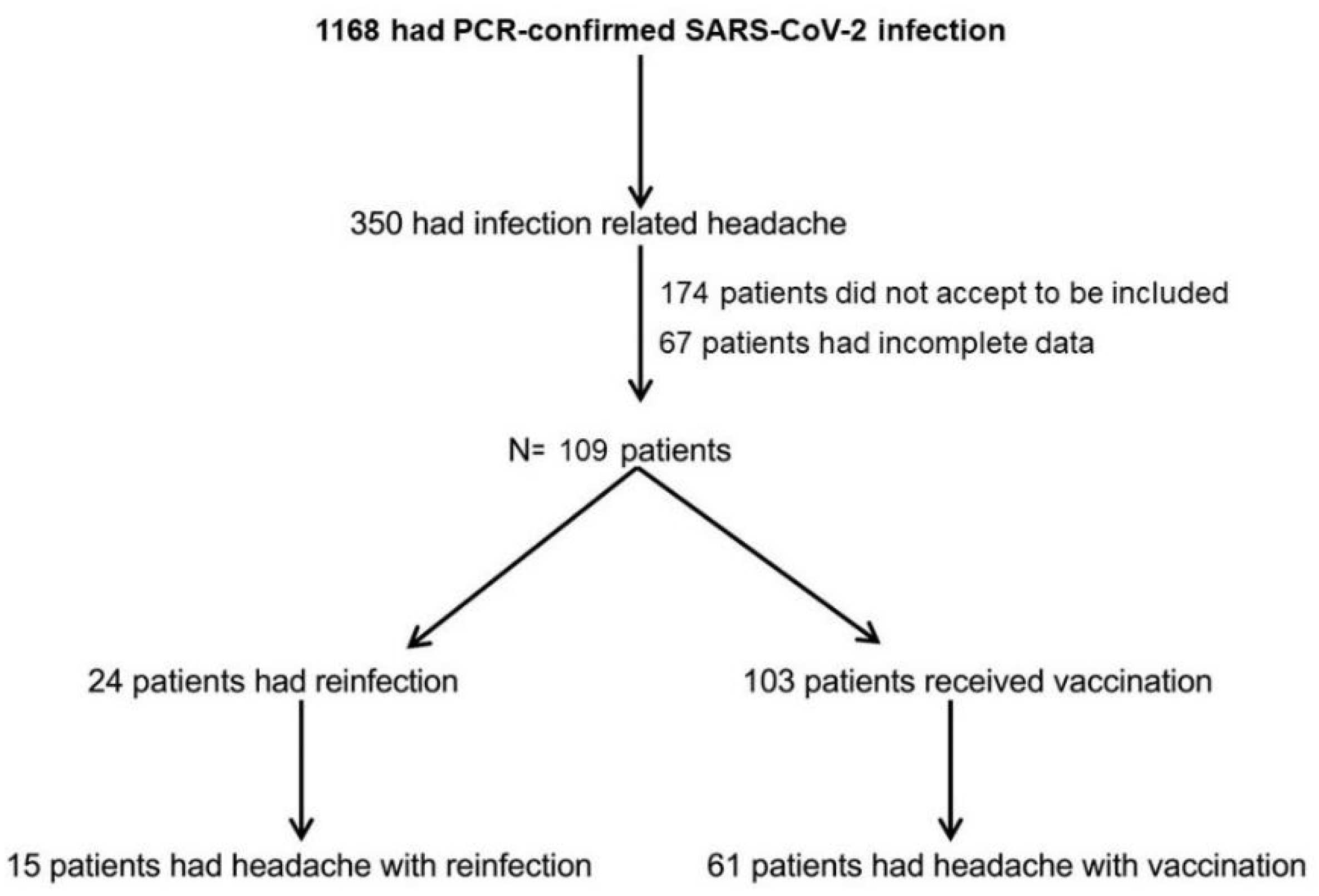
Out of 1168 healthcare workers at the Hospital Universitario de La Princesa with SARS-CoV-2 infection, 350 had COVID-19 headache, and 109 patients agreed to participate in the study. Among them, 15 reported headache during reinfection, and 61 experienced headache following vaccination (Figure 1).
Among the 109 patients with COVID-19-related headache included in the study, 49.5% (54/109) met the ICHD-3 criteria for tension-type headache and 12.8% (14/109) for migraine. Baseline characteristics of the study population, stratified by COVID-19 headache phenotype (migraine, tension-type, or other), are presented in Table 1. The cohort was predominantly female, with 86.2% (n = 94) being women. Obesity was more frequently observed in patients with a migraine-like headache phenotype (28%) compared to those with tension-type (5%) or other headache types (7%) during COVID-19 infection (p = 0.045).

3.2. Profile of COVID-19 Headache in Relation to Primary Headache, During Reinfection and Post-Vaccination

Among patients with COVID-19-related headache, 77.9% (85/109) had a prior diagnosis of primary headache, and 67% (73/109) had previously been evaluated by a neurologist. Of those with a history of primary headache, 25.9% (22/85) met criteria for migraine, whereas tension-type headache was more frequent, 47.1% (40/85) (Table A1).
During reinfection, 62.5% (15/24) reported headache, of which 20% (3/15) were migraine and 46.6% (7/15) tension type. Following vaccination, 59.2% (61/103) presented headache, with 13.1% (8/61) showing migraine-like and 42.6% (26/61) tension-type (Table A1). Post-vaccination headache occurred more frequently after the first (75.4%, 46/61) and second doses (82%, 50/61), decreasing to 60.6% (37/61) after the third dose.
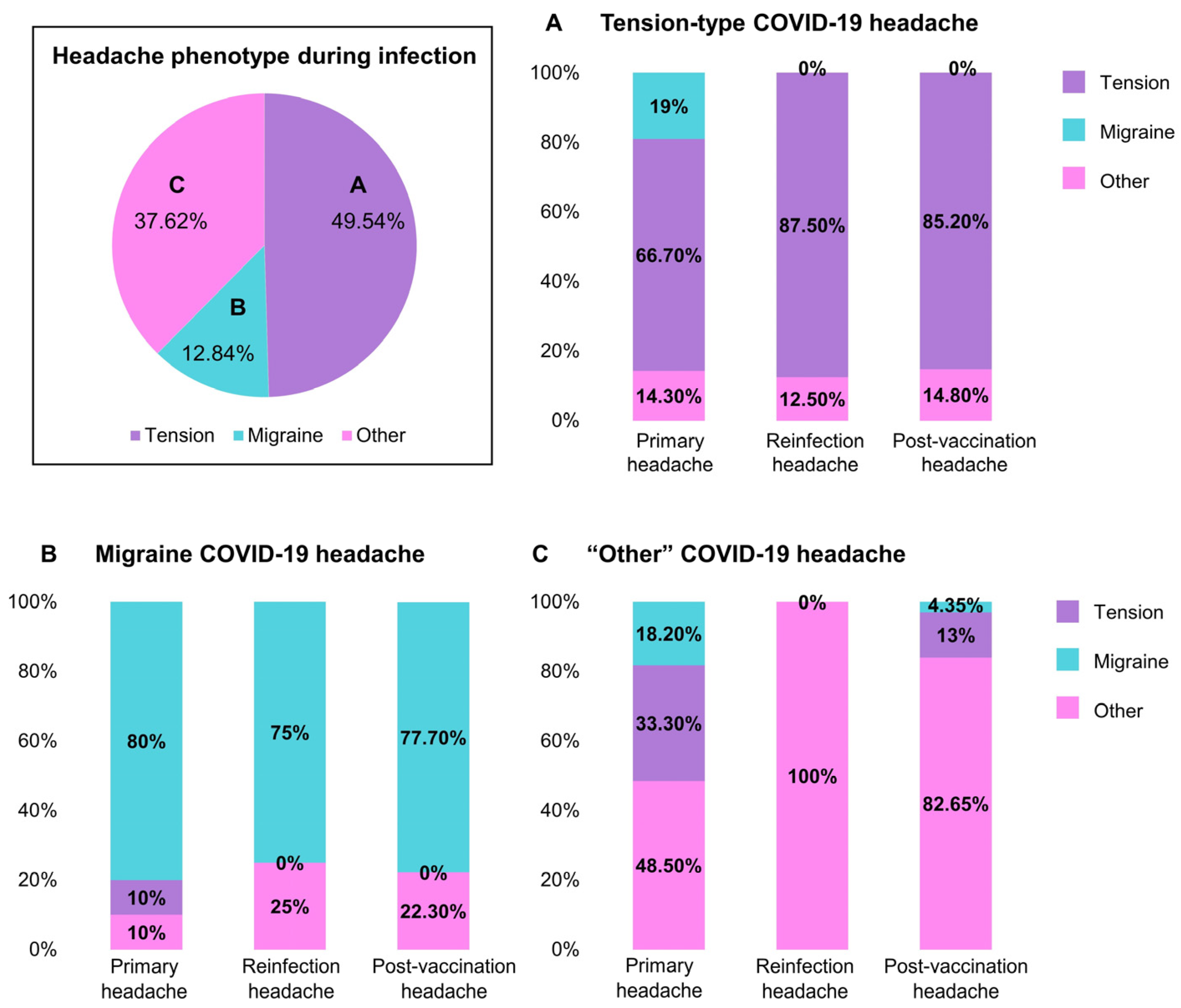
To analyze headache phenotypes during SARS-CoV-2 infection, data were grouped by COVID-19 headache phenotype and stratified by prior primary headache, reinfection-related headache, and post-vaccination headache. Primary headache prevalence ranged from 70% to 80% across all groups. Similar to primary headache distribution, tension-type headache was the most frequent phenotype during COVID-19 (49.54%), followed by migraine (12.84%) and “other” (37.61%) (Figure 2, upper panel).
Patients with a tension-type COVID-19 headache (Figure 2A) were significantly more likely to have a history of primary tension-type headache (p = 0.001), whereas those with a migraine-like COVID-19 headache (Figure 2B) were significantly more likely to have a history of primary migraine (p = 0.001) (Statistics in Table A1).
Reinfection rates did not differ by COVID-19 headache phenotype (p = 0.511, Table A1). However, patients with tension-type COVID-19 headache typically experienced tension-type headache during reinfection (Figure 2A: 87.5% vs. 0%; p = 0.001), and similarly, migraine-like COVID-19 headache predicted migraine-like reinfection headache (Figure 2B: 75% vs. 0%; p = 0.011).
Post-vaccination headache prevalence did not differ significantly among groups (p = 0.527, Table A1), but phenotype concordance persisted: tension-type COVID-19 headache typically experienced a tension-type headache after vaccination (Figure 2A: 85.2% vs. 0%; p < 0.001), whereas those with a migraine-like COVID-19 headache were more likely to experience a migraine-type headache post-vaccination (Figure 2B: 77.7% vs. 0%; p < 0.001). Headache characteristics of the headache classified as “other” are included in Figure 2C and Table A2.
Multivariate analysis showed that prior migraine [OR 0.17 (0.04–0.60), p = 0.026] and tension-type headache [OR 0.21 (0.07–0.624), p = 0.019] were independently associated with the COVID-19 headache profile. This indicates that, after adjusting for potential confounders, the type of pre-existing primary headache appears to influence the clinical presentation of COVID-19-related headache.

3.3. Post-COVID-19 Persistent Headache Profile

In our cohort, 22.9% (25/109) of the patients presented with persistent COVID-19 headache. As shown in Table 2, these patients were more likely to be obese (28.0% vs. 3.57%; p = 0.001) and had a higher prevalence of anxiety (p = 0.041) and fibromyalgia (p = 0.028) compared to those without persistent headache.
No significant differences were found in other baseline characteristics or with the primary headache profile. In addition, no significant differences were observed in other persistent post-COVID symptoms (such as asthenia, dysnea, anosmia or lack of concentration) between patients with and without persistent headache, as shown in Table A3. Several semiological features of COVID-19 headache, particularly those commonly associated with migraine-like features, such as hemicranial location or moderate-to-severe intensity, were significantly associated with persistent headache (Table 3). Specifically, hemicranial location (p = 0.004), as well as mild-to-moderate (p = 0.038) and moderate-to-severe headache intensity (p = 0.038), was linked to a higher likelihood of persistence headache. Additionally, we observed a trend suggesting that a stabbing quality of the COVID-19 headache may also be associated with headache persistence (p = 0.054). No other characteristics were associated with the presence of “other” post-COVID-19 persistent headache (Table A2).
In the multivariate model we found that the presence of fibromyalgia [OR 28.8 (5.32–317.68), p = 0.003] and obesity [OR 14.1 (3.3–77.05), p = 0.004] were independently associated with persistent headache (Table 4).

4. Discussion

The results of this observational study in a healthcare professional’s cohort in Spain show an association between the headache profile during SARS-CoV-2 infection and the pain phenotype during reinfection and post-vaccination period, as well as with the patient’s prior history of primary headache. To our knowledge, the simultaneous relationship of headache phenotypes across these three contexts has not been previously described in a healthcare professional cohort.
The cohort was predominantly female (86.2%, n = 94), aligning with both the demographic structure of the healthcare workforce [18] and the higher prevalence of headache, especially migraine, in women [20,21]. Furthermore, previous studies have shown that COVID-19 headache is also more prevalent in women [12,25]. Headache prevalence varies between 6.5% and 71% depending on the population and data collection methods [12,26], with higher rates observed in healthcare workers. It is important to highlight the occupational context of this cohort. Healthcare workers experienced extraordinary psychological and organizational stress during the COVID-19 pandemic, which may have increased their vulnerability to recurrent or chronic headache. As noted by Carta et al. (2023) [27], systemic factors, such as staff shortages, vaccination policies, and institutional preparedness, may influence not only infection risk, but also the persistence of post-COVID symptoms. Therefore, this distribution reflects the characteristics of the eligible study population and enhances the relevance of our findings.
Headache characteristics were assessed through semi-structured telephone interviews conducted by neurologists, specifically before the initiation of any symptomatic treatment to avoid medication-induced bias. Individuals with prior migraine or tension-type headache tended to report a corresponding phenotype during infection. Most participants experienced mild to moderate COVID-19 and were managed in the outpatient setting, and none required hospitalization or presented complications.
Tension-type headache was most frequent during SARS-CoV-2 infection (49.5%), followed by migraine (12.8%). These results are supported by previous works indicating a frequency of 50% and 20% of tension-type headache and migraine, respectively [5,28]. The migraine phenotype (high-intensity, pulsating quality and associated with nausea) has been associated with higher inflammatory markers linked to more severe COVID-19 presentations, such as thrombocytopenia, lymphopenia, and hyperferritinemia. In contrast, the tension-type phenotype (oppressive quality and mild–moderate intensity) was present in patients with lower levels of these inflammatory markers [14]. The phenotype reported during infection may also be influenced by patients’ pre-existing primary headache patterns, as secondary headaches are frequently described in the literature as resembling prior headache disorders [29].
The prevalence of primary headache in our cohort before SARS-CoV-2 infection was 70–80%, indicating that most patients with COVID-19-related headache had a history of known primary headache, consistent with previous data [5,30]. The baseline characteristics across the three groups were similar, with the exception of a higher percentage of obesity among patients with a migraine phenotype.
During reinfection, over half of patients presented headache (46.6% tension type vs. 20% migraine type), with similar characteristics to their initial COVID-19 episode. These findings suggest a potential continuity in headache phenotype during reinfection, although further research is needed to validate these patterns.
Post-vaccination headache was reported by 59.2% of patients, mainly tension-type (42.6%), with some presenting migraine-like symptoms (13.1%). In most cases, it was described as a transient, self-limited symptom, typically arising within the first few days post-vaccination and resolving in less than 24 h [11,31,32]. The phenotypes typically mirrored prior headache patterns, especially those with chronic and high-frequency headache [33]. These patterns may reflect a tendency for patients to experience post-vaccination headache in line with their usual headache phenotype.
We also found that headache frequency was slightly higher after the second dose (82%) in comparison with the first dose (75.4%), aligning with previous studies [4,5], although others have observed a greater frequency following the first dose [11,23]. Vaccination triggers an innate immune response, leading to the release of cytokines that mediate the acute phase. Serum concentrations of some cytokines, such as gamma interferon or interleukin-6, have been found to increase after the second vaccine dose, which could explain a higher prevalence of headache after the second immunization [11]. Given the differences in vaccine formulation and timing, as well as possible immunological priming effects, variations in headache frequency across doses could be multifactorial. However, our study was not designed to compare vaccines directly, and further research is warranted to assess whether specific mRNA formulations influence headache occurrence.
Post-COVID-19 persistent headache, defined as headache lasting more than three months [7], was reported in 22.9% of patients in our cohort. These findings are consistent with previous studies reporting that up to 20% of post-COVID patients experience persistent headache [5,13]. Headache is one of the most common symptoms within what the WHO defines as post-COVID-19 condition [34], also referred to as long COVID. This syndrome is increasingly observed in clinical practice [35,36] and is frequently associated with a migrainous phenotype, leading some authors to propose a process of migraine chronification, particularly in individuals with a prior history of migraine. The possibility of an acquired activation of the trigeminovascular system after infection has also been proposed [13,35].
Although no statistically significant differences were observed in the overall headache profiles between patients with and without persistent headache, and both groups showed a similar pattern of other persistent post-COVID symptoms, migraine-like features were more frequently reported among those with persistent headache. In the univariate analysis, obesity, fibromyalgia, and anxiety were significantly more prevalent in the persistent headache group. When adjusting for potential confounders in the multivariate model, obesity and fibromyalgia remained independently associated with the development of persistent headache. These findings suggest that certain comorbid conditions may increase the risk of prolonged headache following COVID-19 infection.
This study presents some limitations. Its retrospective, single-center design and the relatively small sample size, particularly in reinfection and persistent-headache subgroups, may limit the generalizability of the findings and reduce statistical power, preventing firm causal inferences. Although neurologist-led semi-structured interviews allowed for high-quality phenotypic characterization, reliance on self-reported data may introduce some recall bias. Additionally, certain potentially relevant confounders, such as analgesic overuse or more detailed psychiatric assessment, were not systematically collected, and the study was not designed to comprehensively describe all post-COVID-19 sequelae beyond headache. Despite these limitations, the study has important strengths, including a homogeneous cohort of highly exposed healthcare professionals, the systematic application of ICHD-3 criteria, and detailed neurologist-led evaluations across infection, reinfection, and post-vaccination periods.
Our findings suggest that headache phenotype during COVID-19, reinfection, and vaccination often mirrors the individual’s primary headache pattern. Persistent headache was more common among those with obesity and fibromyalgia and frequently displayed a migraine-like phenotype. These results may support more targeted, phenotype-based treatment approaches and help clinicians identify patients at higher risk of prolonged headache. Further prospective studies are needed to validate these associations and to explore the underlying mechanisms.

Author Contributions

Conceptualization, A.B.G.-V. and M.D.G.; methodology, A.B.G.-V. and M.D.G.; formal analysis, A.B.G.-V., M.D.G., A.G.-M., P.P.B., A.S., C.R., A.B.L.-R., Á.M.C., A.L.-G.A., M.G.C., J.V.M.; investigation, M.D.G., P.P.B., A.S., Á.M.C., A.L.-G.A., M.G.C.; data curation, M.D.G., P.P.B. and A.G.-M.; writing—original draft preparation, A.B.G.-V. and M.D.G.; writing—review and editing, A.B.G.-V., M.D.G., A.G.-M., P.P.B., A.S., C.R., A.B.L.-R., Á.M.C., A.L.-G.A., M.G.C., J.V.M.; supervision, A.B.G.-V., J.V.M. and M.G.C. All authors have read and agreed to the published version of the manuscript.

Funding

This research received no external funding.

Institutional Review Board Statement

The study was conducted in accordance with the Declaration of Helsinki and approved by the Clinical Research Ethics Committee of the Hospital Universitario de La Princesa (Number: 4507, approved on 5 October 2021).

Informed Consent Statement

Informed consent was obtained from all subjects involved in the study.

Data Availability Statement

Anonymized data will be shared at the request of any qualified researcher.

Acknowledgments

We would like to thank all the participating patients, without whom this study would not have been possible.

Conflicts of Interest

Dr. Alicia Gonzalez-Martinez has received education funding from Lilly, Novartis, Roche, Teva, AbbVie-Allergan, & Daiichi Sankyo. Dr. José Vivancos has served as speaker, consultant, and advisory member for or has received research funding from MSD, Pfizer, Daiichi Sankyo, Bayer, Sandoz, Bristol Myers Squibb, Lilly, Boehringer Ingelheim, Almirall, Sanofi-Aventis and Ferrer. Dr. Ana Beatriz Gago-Veiga has received honoraria from Lilly, Novartis, Teva, AbbVie-Allergan, Exeltis & Chiesi. The rest of the authors declare that they have no potential conflicts of interest with respect to the research, authorship and/or publication of this article.

Abbreviations

The following abbreviations are used in this manuscript:
BMIBody Mass Index
CIConfidence Interval
DLDyslipidemia
DMDiabetes Mellitus
HBPHigh Blood Pressure
ICHD-3International Classification of Headache Disorders
IQRInterquartile Ranges
OROdds Ratio
OSASObstructive Sleep Apnea Syndrome
SDStandard Deviation
SEStandard Error

Appendix A

Table A1. COVID-19 headache phenotype according to primary headache, headache during re-infection and headache after vaccine. * p < 0.05; ** p < 0.01; *** p < 0.001.
COVID-19
Headache
Migraine
N = 14
COVID-19
Headache
Tension-Type
N = 54
COVID-19
Headache
Other
N = 41
p Value
Primary headache phenotype (85/109) 110/14 (71.4%)42/54 (77.7%)33/41 (80.4%)
Migraine (22/85)8/10 (80.0%)8/42 (19.0%)6/33 (18.2%)0.001 ***
Tension-type (40/85)1/10 (10.0%)28/42 (66.7%)11/33 (33.3%)0.001 ***
Other (23/85)1/10 (10.0%)6/42 (14.3%)16/33 (48.5%)0.002 **
Reinfected (24/109)4/14 (28.57%)13/54 (24.07%)7/41 (17.1%)0.511
Headache phenotype after reinfection (15/24) 24/4 (100%)8/13 (61.5%)3/7 (42.8%)0.402
Migraine (3/15)3/4 (75.0%)0/8 (0.00%)0/3 (0.00%)0.011 *
Tension-type (7/15)0/4 (0.00%)7/8 (87.5%)0/3 (0.00%)0.001 ***
Other (5/15)1/4 (25.0%)1/8 (12.5%)3/3 (100%)0.030 *
Vaccinated (103/109)13/14 (92.8%)50/54 (92.5%)40/41 (97.5%)
Headache phenotype after vaccine (61/103) 39/13 (69.2%)27/50 (54.0%)25/40 (62.5%)0.527
Migraine (8/61)7/9 (77.7%)0/27 (0.00%)1/25 (4.35%)<0.001 ***
Tension-type (26/61)0/9 (0.00%)23/27 (85.2%)3/25 (13.0%)<0.001 ***
Other (27/61)2/9 (22.2%)4/27 (14.8%)21/25 (84%)<0.001 ***
1 Out of the total patients with primary headache, in each group. 2 Out of the total patients with headache in reinfection, in each group. 3 Out of the total vaccinated patients with headache after vaccine, in each group.
Table A2. Headache characteristics of headache classified as other primary and other COVID-19 headache.
VariablesOther Primary Headache (23)Other COVID-19 Headache (41)
Hemicranial, n (%)8 (35)1 (3)
Holocranial, n (%)1 (5)5 (12)
Throbbing, n (%)6 (26)1 (3)
Oppressive, n (%)5 (22)7 (17)
Mild–moderate intensity, n (%)5 (22)5 (12)
Moderate–severe intensity, n (%)18 (78)8 (20)
Clinophilia, n (%)10 (43)3 (7)
Nausea/vomit, n (%)4 (17)8 (20)
Photophobia, n (%)6 (26)10 (41)
Phonophobia, n (%)2 (9)4 (10)
Table A3. Persistent symptoms in post-COVID-19 persistent headache.
Non-Persistent (N = 84)Persistent
(N = 25)
p Value
Tachycardia, n (%)3 (5.26)0 (0)0.553
Fever, n (%)0 (0)1 (4.3)0.288
Cough, n (%)11 (19.3)2 (8.7)0.328
Dyspnea, n (%)22 (38.6)14 (60.9)0.118
Muscle pain, n (%)18 (31.6)10 (41.7)0.538
Asthenia, n (%)37 (64.9)16 (66.7)1.000
Ageusia, n (%)10 (17.2)7 (29,2)0.243
Anosmia, n (%)13 (22.8)6 (25)1.000
Odynophagia, n (%)5 (8.6)1 (4,2)0.666
Insomnia, n (%)2 (3.4)0 (0)1.000
Lack of concentration, n (%)3 (5.2)2 (8.30)0.627
Nausea, n (%)0 (0)2 (8.30)0.083
Arthralgia, n (%)1 (1.7)1 (4.20)0.502
Dizziness, n (%)7 (12.1)0 (0)0.100
Paresthesia, n (%)2 (3.4)2 (8.30)0.577
Gait instability, n (%)0 (0)1 (4.20)0.293

References

  1. Fernández-de-las-Peñas, C.; Navarro-Santana, M.; Gómez-Mayordomo, V.; Cuadrado, M.L.; García-Azorín, D.; Arendt-Nielsen, L.; Plaza-Manzano, G. Headache as an acute and post-COVID-19 symptom in COVID-19 survivors: A meta-analysis of the current literature. Eur. J. Neurol. 2021, 28, 3820–3825. [Google Scholar] [CrossRef]
  2. Gonzalez-Martinez, A.; Fanjul, V.; Ramos, C.; Ballesteros, J.S.; Bustamante, M.; Villa Martí, A.; Álvarez, C.; del Álamo, Y.G.; Vivancos, J.; Gago-Veiga, A.B. Headache during SARS-CoV-2 infection as an early symptom associated with a more benign course of disease: A case–control study. Eur. J. Neurol. 2021, 28, 3426–3436. [Google Scholar] [CrossRef] [PubMed]
  3. Mao, L.; Jin, H.; Wang, M.; Hu, Y.; Chen, S.; He, Q.; Chang, J.; Hong, C.; Zhou, Y.; Wang, D.; et al. Neurologic Manifestations of Hospitalized Patients with Coronavirus Disease 2019 in Wuhan, China. JAMA Neurol. 2020, 77, 683–690. [Google Scholar] [CrossRef]
  4. Caronna, E.; Van Den Hoek, T.C.; Bolay, H.; Garcia-Azorin, D.; Gago-Veiga, A.B.; Valeriani, M.; Takizawa, T.; Messlinger, K.; Shapiro, R.E.; Goadsby, P.J.; et al. Headache attributed to SARS-CoV-2 infection, vaccination and the impact on primary headache disorders of the COVID-19 pandemic: A comprehensive review. Cephalalgia 2023, 43, 03331024221131337. [Google Scholar] [CrossRef]
  5. Cebrian, J.; Gonzalez-Martinez, A.; Garcia-Blanco, M.J.; Celdran-Vivancos, D.; Palacios, E.L.; Reig-Rosello, G.; Casado-Fernandez, L.; Vivancos, J.; Gago-Veiga, A.B. Headache and impaired consciousness level associated with SARS-CoV-2 in CSF: A case report. Neurology 2020, 95, 266–268. [Google Scholar] [CrossRef]
  6. Porta-Etessam, J.; Matías-Guiu, J.A.; González-García, N.; Iglesias, P.G.; Santos-Bueso, E.; Arriola-Villalobos, P.; García-Azorín, D.; Matías-Guiu, J. Spectrum of Headaches Associated With SARS-CoV-2 Infection: Study of Healthcare Professionals. Headache 2020, 60, 1697–1704. [Google Scholar] [CrossRef]
  7. Olesen, J.; Bes, A.; Kunkel, R.; Lance, J.W.; Nappi, G.; Pfaffenrath, V.; Headache Classification Committee of the International Headache Society (IHS). The International Classification of Headache Disorders, 3rd edition (beta version). Cephalalgia 2013, 33, 629–808. [Google Scholar]
  8. Baykan, B.; Özge, A.; Ertaş, M.; Atalar, A.Ç.; Bolay, H. Urgent need for ICHD criteria for COVID-19-related headache: Scrutinized classification opens the way for research. Noropsikiyatri Ars. 2021, 58, 79–80. [Google Scholar]
  9. López, J.T.; García-Azorín, D.; Planchuelo-Gómez, Á.; García-Iglesias, C.; Dueñas-Gutiérrez, C.; Guerrero, Á.L. Phenotypic characterization of acute headache attributed to SARS-CoV-2: An ICHD-3 validation study on 106 hospitalized patients. Cephalalgia 2020, 40, 1432–1442. [Google Scholar]
  10. Castaldo, M.; Waliszewska-Prosół, M.; Koutsokera, M.; Robotti, M.; Straburzyński, M.; Apostolakopoulou, L.; Capizzi, M.; Çibuku, O.; Ambat, F.D.F.; Frattale, I.; et al. Headache onset after vaccination against SARS-CoV-2: A systematic literature review and meta-analysis. J. Headache Pain 2022, 23, 41. [Google Scholar] [PubMed]
  11. Caronna, E.; Ballvé, A.; Llauradó, A.; Gallardo, V.J.; Ariton, D.M.; Lallana, S.; Maza, S.L.; Gadea, M.O.; Quibus, L.; Restrepo, J.L.; et al. Headache: A striking prodromal and persistent symptom, predictive of COVID-19 clinical evolution. Cephalalgia 2020, 40, 1410–1421. [Google Scholar] [CrossRef]
  12. Garcia-Azorin, D.; Layos-Romero, A.; Porta-Etessam, J.; Membrilla, J.A.; Caronna, E.; Gonzalez-Martinez, A.; Mencia, Á.S.; Segura, T.; Gonzalez-García, N.; Díaz-de-Terán, J.; et al. Post-COVID-19 persistent headache: A multicentric 9-months follow-up study of 905 patients. Cephalalgia 2022, 42, 804–809. [Google Scholar] [CrossRef]
  13. Planchuelo-Gómez, Á.; Trigo, J.; de Luis-García, R.; Guerrero, Á.L.; Porta-Etessam, J.; García-Azorín, D. Deep Phenotyping of Headache in Hospitalized COVID-19 Patients via Principal Component Analysis. Front. Neurol. 2020, 11, 583870. [Google Scholar] [CrossRef] [PubMed]
  14. Meo, S.A.; Bukhari, I.A.; Akram, J.; Meo, A.S.; Klonoff, D.C. COVID-19 vaccines: Comparison of biological, pharmacological characteristics and adverse effects of pfizer/BioNTech and moderna vaccines. Eur. Rev. Med. Pharmacol. Sci. 2021, 25, 1663–1679. [Google Scholar]
  15. Göbel, C.H.; Heinze, A.; Karstedt, S.; Morscheck, M.; Tashiro, L.; Cirkel, A.; Hamid, Q.; Halwani, R.; Temsah, M.-H.; Ziemann, M.; et al. Clinical characteristics of headache after vaccination against COVID-19 (coronavirus SARS-CoV-2) with the BNT162b2 mRNA vaccine: A multicentre observational cohort study. Brain Commun. 2021, 3, fcab169. [Google Scholar] [PubMed]
  16. Göbel, C.H.; Heinze, A.; Karstedt, S.; Morscheck, M.; Tashiro, L.; Cirkel, A.; Hamid, Q.; Halwani, R.; Temsah, M.-H.; Ziemann, M.; et al. Headache Attributed to Vaccination Against COVID-19 (Coronavirus SARS-CoV-2) with the ChAdOx1 nCoV-19 (AZD1222) Vaccine: A Multicenter Observational Cohort Study. Pain Ther. 2021, 10, 1309–1330. [Google Scholar] [CrossRef]
  17. Garg, R.K.; Paliwal, V.K. Spectrum of neurological complications following COVID-19 vaccination. Neurol. Sci. 2022, 43, 3–40. [Google Scholar] [CrossRef]
  18. Olesen, J. Headache Classification Committee of the International Headache Society (IHS) The International Classification of Headache Disorders, 3rd edition. Cephalalgia 2018, 38, 1–211. [Google Scholar] [CrossRef]
  19. World Health Organization. State of the World’s Nursing 2020: Investing in Education, Jobs and Leadership. 2020. Available online: https://www.who.int/publications/i/item/9789240003279 (accessed on 20 June 2025).
  20. Lipton, R.B.; Bigal, M.E.; Diamond, M.; Freitag, F.; Reed, M.L.; Stewart, W.F. Migraine prevalence, disease burden, and the need for preventive therapy. Neurology 2007, 68, 343–349. [Google Scholar] [CrossRef] [PubMed]
  21. Burch, R.; Rizzoli, P.; Loder, E. The prevalence and impact of migraine and severe headache in the United States: Updated age, sex, and socioeconomic-specific estimates from government health surveys. Headache 2021, 61, 60–68. [Google Scholar] [CrossRef]
  22. Safiri, S.; Pourfathi, H.; Eagan, A.; Mansournia, M.A.; Khodayari, M.T.; Sullman, M.J.; Kaufman, J.; Collins, G.; Dai, H.; Bragazzi, N.L.; et al. Global, regional, and national burden of migraine in 204 countries and territories, 1990 to 2019. Pain 2022, 163, E293–E309. [Google Scholar] [CrossRef]
  23. Yahav, D.; Yelin, D.; Eckerle, I.; Eberhardt, C.S.; Wang, J.; Cao, B.; Kaiser, L. Definitions for coronavirus disease 2019 reinfection, relapse and PCR re-positivity. Clin. Microbiol. Infect. 2021, 27, 315–318. [Google Scholar] [CrossRef]
  24. World Health Organization. A Clinical Case Definition of Post COVID-19 Condition by a Delphi Consensus, 6 October 2021. Available online: https://www.who.int/publications/i/item/WHO-2019-nCoV-Post_COVID-19_condition-Clinical_case_definition-2021.1 (accessed on 20 June 2025).
  25. World Medical Association declaration of Helsinki: Ethical principles for medical research involving human subjects. JAMA 2013, 310, 2191–2194. [CrossRef] [PubMed]
  26. Caronna, E.; Pozo-Rosich, P. Headache as a Symptom of COVID-19: Narrative Review of 1-Year Research. Curr. Pain Headache Rep. 2021, 25, 73. [Google Scholar] [CrossRef]
  27. Carta, M.G.; Orrù, G.; Littera, R.; Firinu, D.; Chessa, L.; Cossu, G.; Primavera, D.; Del Giacco, S.; Tramontano, E.; Manocchio, N.; et al. Comparing the responses of countries and National Health Systems to the COVID-19 pandemic: A critical analysis with a case-report series. Eur. Rev. Med. Pharmacol. Sci. 2023, 27, 7868–7880. [Google Scholar]
  28. Bolay, H.; Gül, A.; Baykan, B. COVID-19 is a Real Headache! Headache 2020, 60, 1415–1421. [Google Scholar] [CrossRef] [PubMed]
  29. Schankin, C.J.; Straube, A. Secondary headaches: Secondary or still primary? J. Headache Pain 2012, 13, 263–270. [Google Scholar] [CrossRef] [PubMed]
  30. Al-Hashel, J.Y.; Abokalawa, F.; Alenzi, M.; Alroughani, R.; Ahmed, S.F. Coronavirus disease-19 and headache; impact on pre-existing and characteristics of de novo: A cross-sectional study. J. Headache Pain 2021, 22, 97. [Google Scholar] [CrossRef]
  31. Silvestro, M.; Tessitore, A.; Orologio, I.; Sozio, P.; Napolitano, G.; Siciliano, M.; Tedeschi, G.; Russo, A. Headache worsening after covid-19 vaccination: An online questionnaire-based study on 841 patients with migraine. J. Clin. Med. 2021, 10, 5914. [Google Scholar] [CrossRef]
  32. Ekizoglu, E.; Gezegen, H.; Yalınay Dikmen, P.; Orhan, E.K.; Ertaş, M.; Baykan, B. The characteristics of COVID-19 vaccine-related headache: Clues gathered from the healthcare personnel in the pandemic. Cephalalgia 2022, 42, 366–375. [Google Scholar] [CrossRef]
  33. Sekiguchi, K.; Watanabe, N.; Miyazaki, N.; Ishizuchi, K.; Iba, C.; Tagashira, Y.; Uno, S.; Shibata, M.; Hasegawa, N.; Takemura, R.; et al. Incidence of headache after COVID-19 vaccination in patients with history of headache: A cross-sectional study. Cephalalgia 2022, 42, 266–272. [Google Scholar] [CrossRef]
  34. Cai, C.; Peng, Y.; Shen, E.; Huang, Q.; Chen, Y.; Liu, P.; Guo, C.; Feng, Z.; Gao, L.; Zhang, X.; et al. A comprehensive analysis of the efficacy and safety of COVID-19 vaccines. Mol. Ther. 2021, 29, 2794–2805. [Google Scholar] [CrossRef] [PubMed]
  35. Ceban, F.; Ling, S.; Lui, L.M.W.; Lee, Y.; Gill, H.; Teopiz, K.M.; Rodrigues, N.B.; Subramaniapillai, M.; Di Vincenzo, J.D.; Cao, B.; et al. Fatigue and cognitive impairment in Post-COVID-19 Syndrome: A systematic review and meta-analysis. Brain Behav. Immun. 2022, 101, 93–135. [Google Scholar] [CrossRef] [PubMed]
  36. Fernández-De-las-peñas, C.; Palacios-Ceña, D.; Gómez-Mayordomo, V.; Cuadrado, M.L.; Florencio, L.L. Defining post-covid symptoms (Post-acute covid, long covid, persistent post-covid): An integrative classification. Int. J. Environ. Res. Public Health 2021, 18, 2621. [Google Scholar] [CrossRef] [PubMed]
Figure 1. Flowchart of the patients included in the study.
Covid 06 00014 g001
Figure 2. Pie-chart distribution of COVID-19 headache phenotype during SARS-CoV-2 infection. Phenotypic distribution in patients that reported tension-type (A), migraine (B) and “other” (C) COVID-19 headache, stratified by primary, reinfection and post-vaccination headache.
Covid 06 00014 g002
Table 1. Clinical and demographic characteristics of study population according to COVID-19 associated headache phenotype. SD: Standard Deviation. * p < 0.05.
VariableMigraine
N = 14
Tension-Type
N = 54
Other
N = 41
p Value
Women, n (%)13 (92.9)46 (85.2)35 (85.4)0.859
Age, years, mean (SD)44.5 (11.4)45.7 (13.0)44.8 (12.3)0.920
Weight, mean (SD)68.4 (15.8)64.1 (12.8)65.8 (12.3)0.526
Obesity, n (%)4 (28.6)3 (5.56)3 (7.32)0.045 *
Hypertension, n (%)0 (0.00)5 (9.26)5 (12.2)0.525
Hyperlipidemia, n (%)2 (14.3)9 (16.7)9 (22.0)0.782
Diabetes Mellitus, n (%)0 (0.00)0 (0.00)1 (2.44)0.505
History of smoking, n (%)2 (14.3)7 (13.0)6 (14.6)1.000
Obstructive sleep apnea syndrome, n (%)0 (0.00)1 (1.85)1 (2.44)1.000
Comorbid anxiety, n (%)3 (21.4)7 (13.0)5 (12.2)0.584
Comorbid depression, n (%)1 (7.14)3 (5.56)3 (7.32)1.000
Fibromyalgia, n (%)3 (21.4)5 (9.26)4 (9.76)0.437
Table 2. Baseline characteristics between patients with persistent and non-persistent headache. HBP: High blood pressure; DL: Dyslipidemia; BMI: Body Mass Index, OSAS: obstructive sleep apnea syndrome. * p < 0.05.
Non-Persistent
N = 84
Persistent
N = 25
p Value
Women, n (%)10 (11.9)5 (20.0)0.328
Age, mean years (SD)44.7 (12.3)46.9 (12.9)0.454
Weight, mean kg (SD)63.2 (12.2)72.3 (13.4)0.005 *
Obesity, n (%)3 (3.57)7 (28.0)0.001 *
HBP, n (%)8 (9.52)2 (8)1.000
DL, n (%)17 (20.2)3 (12.0)0.556
DM, n (%)1 (1.19)0 (0)1.000
Smoker, n (%)11 (13.1)4 (16)0.744
OSAS, n (%)1 (1.19)1 (4)0.408
Anxiety, n (%)8 (9.52)7 (28)0.041 *
Depression, n (%)4 (4.76)3 (12)0.196
Fibromyalgia, n (%)6 (7.14)6 (24)0.028 *
Previous headache
Migraine, n (%)
Tension, n (%)
Other, n (%)

18 (27.3)
31 (47.0)
17 (25.8)

4 (21.1)
9 (47.4)
6 (31.6)

0.769
1.000
0.833
Table 3. COVID-19 headache characteristics associated with persistent headache. * p < 0.05.
Non-Persistent
N = 84
Persistent
N = 25
p Value
Location
Holocranial, n (%)
Hemicranial, n (%)

36 (65.5)
3 (5.45)

10 (47.6)
7 (33.3)

0.246
0.004 *
Quality
Pulsatile, n (%)
Stabbing, n (%)
Oppressive, n (%)

7 (12.7)
10 (18.2)
32 (59.3)

2 (9.52)
9 (42.9)
14 (66.7)

1.000
0.054
0.743
Intensity
Mild–moderate, n (%)
Moderate–severe, n (%)

19 (23.5)
62 (76.5)

1 (4)
24 (96)

0.038 *
0.038 *
Photo/Phonophobia, n (%)10 (18.9)5 (27.8)0.276
Nausea/vomit, n (%)13 (26.5)4 (21.1)0.761
Clinophilia, n (%)25 (50)7 (38.9)0.593
COVID-19 headache
Migraine, n (%)
Tension-type, n (%)
Other, n (%)

11 (13.1)
43 (51.2)
30 (35.7)

3 (12)
11 (44)
11 (44)

1.000
0.687
0.606
Table 4. Multivariate model with association between baseline characteristics and persistent headache. SE: Standard Error. OR: Odds Ratio. CI: Confidence Interval. * p < 0.05.
VariablesEstimateSEZORCI Lower LimitCI
Upper Limit
p Value
Obesity2.65230.9272.86014.1863.30177.0510.004 *
Fibromyalgia3.36251.1612.89528.8615.321317.6830.003 *
Disclaimer/Publisher’s Note: The statements, opinions and data contained in all publications are solely those of the individual author(s) and contributor(s) and not of MDPI and/or the editor(s). MDPI and/or the editor(s) disclaim responsibility for any injury to people or property resulting from any ideas, methods, instructions or products referred to in the content.