
The Empowerment Spiral: From Constraint to Transformation in Rural Indonesian Women’s Entrepreneurship



Abstract
1. Introduction
- Objective 1: Identify the socio-cultural and structural constraints shaping rural Indonesian women’s entrepreneurial activity.
- Objective 2: Examine how women exercise negotiated agency (e.g., role negotiation, resilience, networks) within culturally sanctioned boundaries.
- Objective 3: Distinguish adaptive practices from outcomes indicative of broader change (access, legitimacy, opportunity structures), consistent with a GAD lens.
- Objective 4: Derive practice implications aligned with practical and strategic gender needs.
2. Literature Review and Theoretical Framework
2.1. Women’s Entrepreneurship in Rural Contexts: Constraints and Debates
2.2. From Women in Development (WID) to Gender and Development (GAD): An Analytical Lens
2.3. Intersectionality
2.4. Practical vs. Strategic Gender Needs
2.5. Research Gap and Positioning
3. Theoretical Framework
3.1. Gender and Development (GAD) as an Analytical Lens
3.2. GAD in Rural Indonesian Entrepreneurship
3.3. Positioning GAD in This Study
- How women experience constraint;
- How they exercise agency through negotiation, adaptation, and resilience;
- How these actions contribute, incrementally or collectively, to social transformation.
3.4. Gender and Development Analysis: Intersectionality
3.5. Power Relations
3.6. Strategic and Practical Gender Needs
4. Methodology
4.1. Reflexive Thematic Analysis Aligned with the GAD Framework
- Familiarization through repeated reading of transcripts.
- Open coding of meaning units reflecting constraints, agency, and transformation.
- Axial grouping to connect related codes and identify subthemes.
- Interpretive review of each theme against the GAD distinction between practical and strategic gender needs [55].
- Refinement and naming of themes based on resonance with the GAD constructs of structure, agency, and transformation.
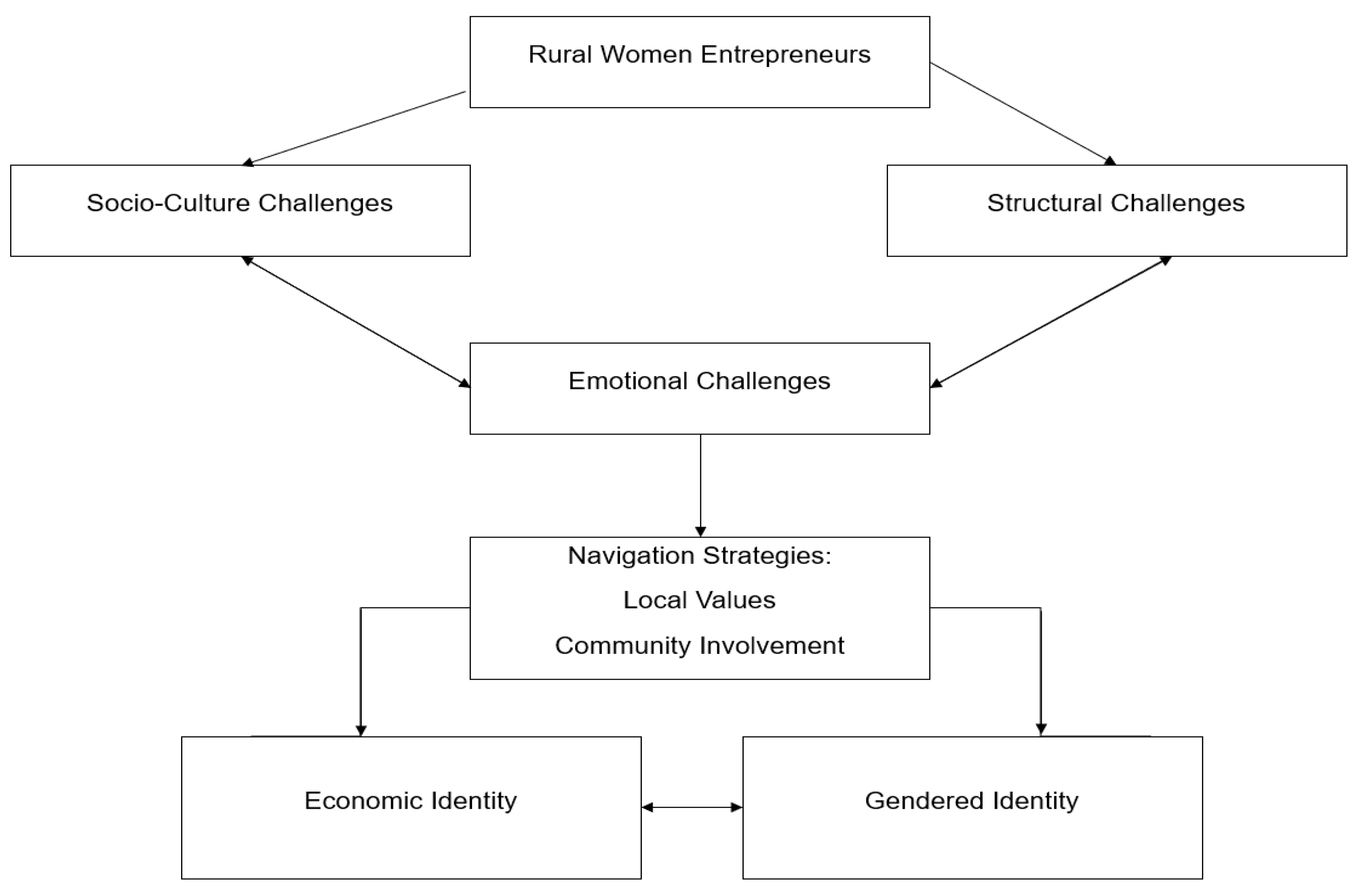
- Synthesis into a thematic map illustrating the transition from constraint to empowerment among rural Indonesian women entrepreneurs.
4.2. Thematic Map
4.3. Analytical Sufficiency, Saturation, and Researcher Positionality
5. Findings
5.1. Constraint: Patriarchal Norms and Structural Limitations
“People usually ask, ‘How old are you now? Where do you work?’ From there, the next questions often come: ‘When will you get married? When will you have children?’ These questions and society’s expectations narrow my space to grow as a woman because I feel chased by the timeline to become a housewife, to marry, or to live with someone, before I can choose to grow in the path I want.”(Interviewee 1)
“Because the mindset of people outside is different… comments like, ‘you’re a girl, if you’re not married, you must get married.’ That’s pressure.”(Interviewee 4)
“Sometimes when there’s training, I have to leave halfway because my child is sick… It’s hard to balance, but we have to keep going.”(Interviewee 2)
“At first, it was difficult because I live with my family and have to help with household chores. Fortunately, my sewing workspace is also at home, so after finishing house chores early in the morning, I can immediately start sewing or organizing orders. But because my sewing place is at home, my time often overlaps—sometimes my mother suddenly asks me to help cook or take care of other things.”(Interviewee 4)
5.2. Agency: Negotiation, Resilience, Collective Support, and Local Values as Navigation Strategies
“In public, my husband is the one talking, but behind the scenes, I handle everything, the bookkeeping, suppliers, even prices.”(Interviewee 5)
“Coincidentally, I used to be active in organizations, so I have experience in the activist world. And I also married a husband who has a good understanding of gender. Meaning he is not patriarchal and is very supportive. … when there is a clash with cultural expectations, usually my husband becomes the shield. He is the one who gives the reasons, takes my place, or does the work that I should have done.”(Interviewee 3)
“As I said earlier, I should not highlight my role or appear too much. Even though in reality it’s not like that, when dealing with people like that, or those whose views cannot be changed, whether I want to or not, I have to follow that path. The purpose is so that in people’s eyes, my husband is still respected. Even though in reality, I always respect my husband, both on and off stage, but not everyone knows that. … I give it to my husband. We cannot stand against such a strong current. … In decision-making, we still discuss, and I still have a big role in operational decisions and others.”(Interviewee 18)
“When my business faced difficulties, I kept reminding myself that God has brought me this far, so He will not leave me halfway. Every time I pray, I feel calmer and more focused on solving the problem.”(Interview 9)
“I’ve already come this far. God has brought me this far. There must be something good for this business.”(Interview 12)
“I always start the day with prayer and gratitude. When orders are few or when people doubt my work, I say to myself that Allah will open the door in His time. That belief gives me energy to keep going.”(Interview 16)
“I deal with the pressure by praying and talking with my mom or close friends. Usually, after that, I feel calmer.”(Interview 3)
“I’ve already come this far. God has brought me this far. There must be something good for this business. So as long as it’s halal, I keep fighting.”(Interview 4)
“The women entrepreneurs all supported and encouraged each other… if one friend was struggling, others gave support.”(Interview 12)
“Even if they don’t help directly with concrete solutions, I believe they bring prayers. That’s important for me. I have friends, all of them women, with different job backgrounds. If I have a problem, usually I invite them to meet. That’s where we share stories with each other… it helps a lot.”(Interview 20)
“When we talk about local traditions that support this business, it’s very evident in the way the mama-mama (women artisans) work… The senior artisans still hold on to the belief that a noken must be made the right way, using natural materials like tree bark and fibers that have been used by our ancestors for generations… When I came up with new ideas, like making pouches or slings, at first they were hesitant… but after I explained the purpose, they started to open up. We’re not just selling bags; we’re sharing stories and a way of life that has existed for a long time in the land of Papua.”(Interview 15)
“I think people in Dobo have this natural habit from our local traditions of helping one another without saying much… when a ship arrives late at night and I can’t go to the port, my neighbors or relatives will say, ‘Don’t worry, we’ll help unload.’ There’s no discussion about payment… I’ve also learned from my parents’ values, that when you work, you must be honest and not greedy.”(Interview 18)
“What I’m grateful for is that in Sumba, woven fabrics hold very high cultural value. Almost every traditional ceremony requires woven fabric… This helps me always have material supplies… And when tourists come to the village, they help promote my products as souvenirs. This kind of support means a lot because it’s not only about business, but also about mutual trust.”(Interviewee 16)
5.3. Transformation: Digital Empowerment and Gender-Conscious Leadership
“I learned about digital marketing and how to use social media to sell products… now I have customers from outside Flores.”(Interview 1)
“At first, I only sold to neighbors and people around the village, but after joining online training, I started using Instagram and WhatsApp Business. Now my customers come from other islands, even Java and Bali.”(Interview 10)
“Now I employ mostly women. They are like my younger sisters. I want them to grow, too.”(Interview 6)
“When I recruit staff, I deliberately look for women who don’t yet have confidence. I tell them, ‘You can do this; we’ll learn together.’ Some of them were housewives before, and now they can earn and help their families. That makes me proud.”(Interview 16)
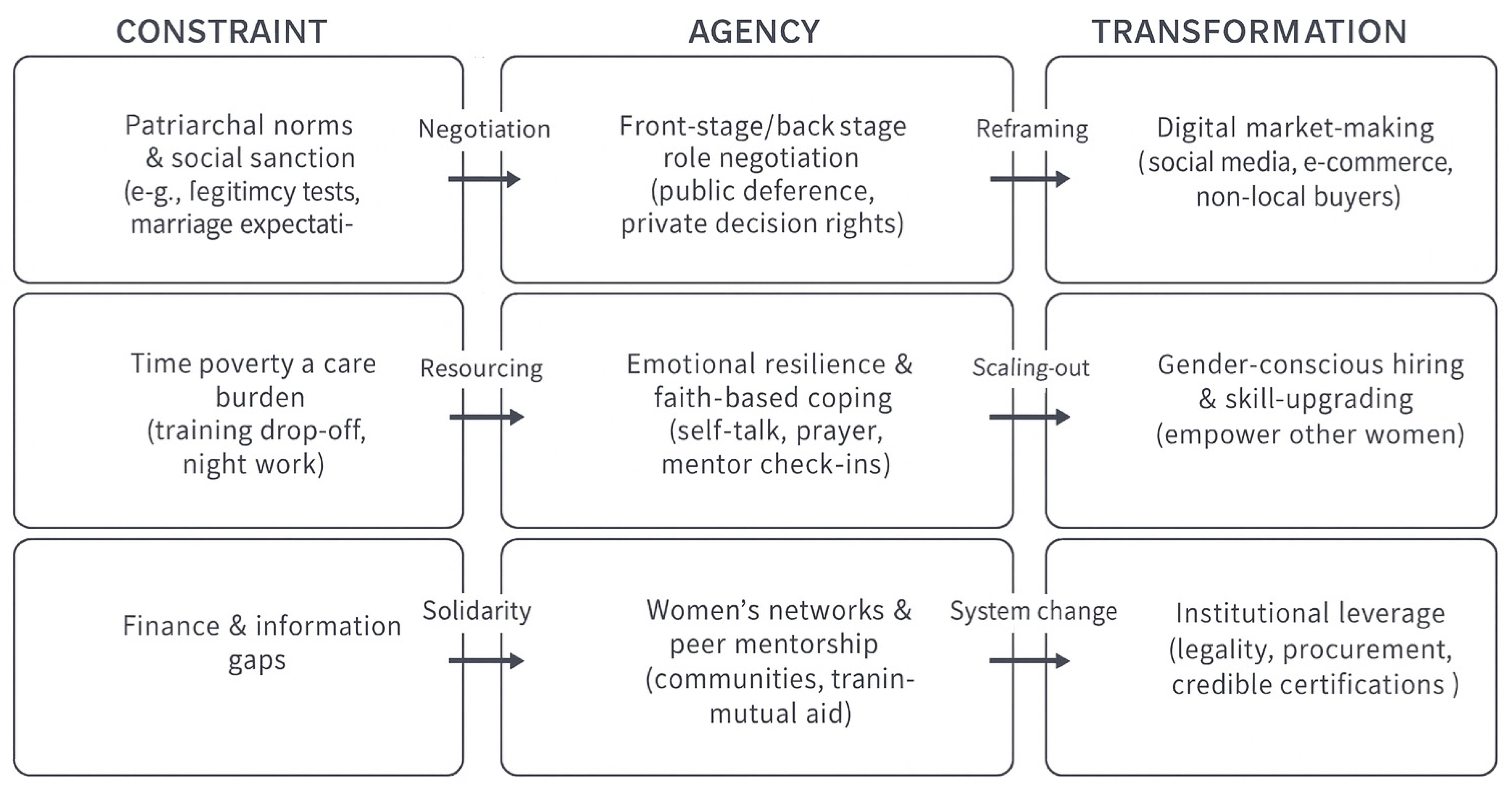
5.4. Integrative Interpretation
6. Discussion and Implications
6.1. Implications to Theory
6.2. Implications to Practice
7. Conclusions and Recommendations
Limitations and Recommendations for Further Research
Author Contributions
Funding
Institutional Review Board Statement
Informed Consent Statement
Data Availability Statement
Conflicts of Interest
References
- Goncalves, M.; Vasquez, K.G. Exploring women’s entrepreneurial leadership in Mexico: A role-based analysis of motivation and decision-making. Int. J. Export. Mark. 2024, 6, 4–43. [Google Scholar]
- GEM. Global Entrepreneurship Monitor 2023/2024 Global Report: 25 Years and Growing; GEM: London, UK, 2024; Available online: https://www.gemconsortium.org/report/global-entrepreneurship-monitor-gem-20232024-global-report-25-years-and-growing (accessed on 9 December 2025).
- Hendratmi, A.; Agustina, T.S.; Sukmaningrum, P.S.; Widayanti, M.A. Livelihood strategies of women entrepreneurs in Indonesia. Heliyon 2022, 8, e10520. [Google Scholar] [CrossRef] [Scilit] [PubMed]
- Purba, H.J.; Rachmawati, R.R.; Irawan, A.R.; Rola-Rubzen, M.F.; Sudaryanto, T.; Erwidodo, E.; Dermoredjo, S.K.; Yaumidin, U.K. Linkages between gender and rural transformation in Indonesia. Asia Pac. Policy Stud. 2025, 12, e70027. [Google Scholar] [CrossRef] [Scilit]
- Imanuella, R.; Santosa, H.; Riantini, D. Women in local governance: Constraints and strategies in Indonesia. J. Southeast Asian Stud. 2025, 56, 201–220. [Google Scholar]
- Stacey, N.; Gibson, E.; Loneragan, N.R.; Warren, C.; Wiryawan, B.; Adhuri, D.S.; Steenbergen, D.J.; Fitriana, R. Developing sustainable small-scale fisheries livelihoods in Indonesia: Trends, enabling and constraining factors, and future opportunities. Mar. Policy 2021, 132, 104654. [Google Scholar] [CrossRef] [Scilit]
- Aravik, H.; Hamzani, A.I.; Khasanah, N. Women Entrepreneurship in Indonesia: Opportunities and Challenges. Islam. Bank. J. Pemikir. Pengemb. Perbank. Syariah 2025, 10, 327–348. [Google Scholar] [CrossRef] [Scilit]
- Setyaningrum, R.P.; Norisanti, N.; Fahlevi, M.; Aljuaid, M.; Grabowska, S. Women and entrepreneurship for economic growth in Indonesia. Front. Psychol. 2023, 13, 975709. [Google Scholar] [CrossRef] [Scilit]
- Inkumsah, S.G. Female Entrepreneur’s Perspective on Gender Equality and Strategies for Sustainable Entrepreneurship—A Qualitative Study of Female Entrepreneurs’ Motivation, Challenges, and Contribution to Gender Equality and Sustainability in Entrepreneurship. Master’s Thesis, Gothenburg University Publications Electronic Archive (GUPEA), Gothenburg, Sweden, 2024. Available online: https://gupea.ub.gu.se/items/6a831258-3f51-4853-bc1d-350701dc5ae6 (accessed on 12 September 2025).
- Chikwe, C.F.; Kuteesa, K.N.; Ediae, A.A. Gender equality advocacy and socioeconomic inclusion: A comparative study of community-based approaches in promoting women’s empowerment and economic resilience (2022). Int. J. Sci. Res. Updates 2024, 8, 110–121. [Google Scholar] [CrossRef] [Scilit]
- Kitole, F.A.; Genda, E.L. Empowering her drive: Unveiling the resilience and triumphs of women entrepreneurs in rural landscapes. In Women’s Studies International Forum; Pergamon: Oxford, UK, 2024; Volume 104, p. 102912. [Google Scholar]
- Merluzzi, J.; Burt, R.S. One path does not fit all: A career path approach to the study of professional women entrepreneurs. Entrep. Theory Pract. 2021, 45, 1366–1393. [Google Scholar] [CrossRef] [Scilit]
- Yusuf, H.; Fahrudin, A.; Fahrudin, F.I. Inequality and Cultural Obstacles of Women Empowerment: The Case of Indonesia. In The Palgrave Handbook of Global Social Problems; Springer: Berlin/Heidelberg, Germany, 2024; pp. 1–13. [Google Scholar]
- Goncalves, M.; Ahumada, E.D.L.V. A Bibliometric Analysis of Women Entrepreneurship: Current Trends and Challenges. Merits 2025, 5, 9. [Google Scholar] [CrossRef] [Scilit]
- Goncalves, M.; Vasquez, K.G. Leadership and entrepreneurial choices: Understanding the motivational dynamics of women entrepreneurs in Mexico. Int. J. Export. Mark. 2024, 6, 161–205. [Google Scholar] [CrossRef] [Scilit]
- Goncalves, M.; Haidar, N.; Celik, E. Drivers and motivations of Lebanese women entrepreneurs: Insights from the demand-constraint-choice framework. Cogent Bus. Manag. 2024, 11, 2371068. [Google Scholar] [CrossRef] [Scilit]
- Goncalves, M.; Papagelis, S.; Nicolitsas, D. Drivers for Women Entrepreneurship in Greece: A Case Analysis of Early-Stage Companies. Businesses 2025, 5, 1. [Google Scholar] [CrossRef] [Scilit]
- Goncalves, M.; Trainor, M.; Ursini, A. Exploring Barriers and Enablers for Women Entrepreneurs in Urban Ireland: A Qualitative Study of the Greater Dublin Area. Soc. Sci. 2025, 14, 412. [Google Scholar] [CrossRef] [Scilit]
- Challa, R. Equity, not equality: Rethinking gender in development policy. Gend. Dev. Stud. 2025, 29, 25–42. [Google Scholar]
- MacArthur, J.; Carrard, N.; Davila, F.; Grant, M.; Megaw, T.; Willetts, J.; Winterford, K. Gender-transformative approaches in international development: A brief history and five uniting principles. In Women’s Studies International Forum; Pergamon: Oxford, UK, 2022; Volume 95, p. 102635. [Google Scholar]
- Tagaza, R.; Manalansan, D. Teaching gender and culture: A historical and pedagogical inquiry into gender and development in Philippine education. Int. J. Cult. Hist. Relig. 2025, 7, 482–496. [Google Scholar] [CrossRef] [Scilit]
- Haque, M.N.; Beckers, D.; Costales, E.; Aad, S.; Sharifi, A.; Mora, L. A systematic review of research on just, equitable, responsible, and inclusive smart cities. Technol. Soc. 2025, 83, 103050. [Google Scholar] [CrossRef] [Scilit]
- Moser, C.O. From gender planning to gender transformation: Positionality, theory and practice in cities of the global South. Int. Dev. Plan. Rev. 2021, 43, 205–229. [Google Scholar] [CrossRef] [Scilit]
- Unesco. Education for All 2000 Assessment: Global Synthesis. 2000. Available online: https://unesdoc.unesco.org/ark:/48223/pf0000120058 (accessed on 8 December 2025).
- Lima, R. Social innovation through regenerative perspectives: A theoretical approach on gender-based violence system. In Proceedings of the IASDR 2023: Life-Changing Design, Milan, Italy, 9–13 October 2023. [Google Scholar] [CrossRef] [Scilit]
- Goncalves, M.; Sartipi, S.; Asadi Damavandi, G. Leadership and Entrepreneurial Choices: Understanding the Motivational Dynamics of Women Entrepreneurs in Iran. Merits 2025, 5, 1. [Google Scholar] [CrossRef] [Scilit]
- Kiradoo, G. The role of women entrepreneurs in advancing gender equality and social change. Res. Asp. Arts Soc. Stud. 2023, 8, 122–131. [Google Scholar]
- Mwije, S. Network governance as an alternative policy response to managing infectious disease outbreaks: Lessons from Uganda’s response to the COVID-19 crisis. Risk Hazards Crisis Public Policy 2024, 15, 47–66. [Google Scholar] [CrossRef] [Scilit]
- Seliga, L.G. Unpacking the Gendered Discourse of Peace Policy: A Feminist Poststructural Analysis of the United Nations Peacebuilding Commission Gender Strategy. Ph.D. Thesis, Kent State University, Kent, OH, USA, 2023. Available online: https://rave.ohiolink.edu/etdc/view?acc_num=kent1699782620930722 (accessed on 8 December 2025).
- Rinaldi, P.N.; Machado, R.S. Women in development vs. Gender and Development in the United Nations Development agenda (1970–1999)|Mulheres no Desenvolvimento x Gênero e Desenvolvimento na agenda de desenvolvimento da ONU (1970–1999). Mural Int. 2025, 16, e82103. [Google Scholar] [CrossRef] [Scilit]
- Bazbauers, A.R.; Madkour, N. Gender and the Multilateral Development Banks: From WID to GAD to Retroliberal WID. Prog. Dev. Stud. 2024, 24, 165–184. [Google Scholar] [CrossRef] [Scilit]
- Cullen, B.; Lefore, N.; Debevec, L.; Snyder, K.A. The Tyranny of Tools: The Politics of Knowledge Production in Gender Research. In Gender, Power and Politics in Agriculture: Revisiting Theory and Practice; Springer International Publishing: Cham, Switzerland, 2024; pp. 137–166. [Google Scholar] [CrossRef] [Scilit]
- Silalahi, W.E.H.; Malau, H.; Sinaga, J.T. Pengaruh Struktur Modal Dan Pertumbuhan Penjualan Terhadap Profitabilitas Pada Perusahaan Sektor Transportasi Yang Terdaftar Di Bursa Efek Indonesia Tahun 2021–2023. PESHUM J. Pendidik. Sos. Dan Hum. 2025, 4, 4952–4960. [Google Scholar]
- Greig, A.; Kimmel, M.; Lang, J. Men, masculinities, and the GAD framework: Beyond women-only empowerment. Gend. Dev. 2023, 31, 44–58. [Google Scholar]
- Loh, X.M.; Lee, V.H.; Tan, G.W.H.; Ooi, K.B.; Dwivedi, Y.K. Switching from cash to mobile payment: What’s the hold-up? Internet Res. 2021, 31, 376–399. [Google Scholar] [CrossRef] [Scilit]
- Guthridge, M.; Kirkman, M.; Penovic, T.; Giummarra, M.J. Promoting gender equality: A systematic review of interventions. Soc. Justice Res. 2022, 35, 318–343. [Google Scholar] [CrossRef] [Scilit]
- Edwards, G.A.S.; Cornwall, A. New Democratic spaces? The politics and dynamics of institutionalised participation. IDS Bull. 2014, 35, 1–10. [Google Scholar]
- Farhane-Medina, N.Z.; Luque, B.; Tabernero, C.; Castillo-Mayén, R. Factors associated with gender and sex differences in anxiety prevalence and comorbidity: A systematic review. Sci. Prog. 2022, 105, 00368504221135469. [Google Scholar] [CrossRef] [Scilit]
- Rathgeber, E.M. WID, WAD, GAD: Trends in research and practice. J. Dev. Areas 1990, 24, 489–502. [Google Scholar]
- Freeman, C. Women entrepreneurs in rural Indonesia: Resistance, resilience, and reinvention. Asian J. Women’s Stud. 2015, 21, 289–308. [Google Scholar]
- Chen, C. The healing economy: Women entrepreneurs and emotional labor in rural China. Asian J. Women’s Stud. 2024, 30, 123–140. [Google Scholar]
- Mosedale, S. Assessing women’s empowerment: Towards a conceptual framework. J. Int. Dev. 2005, 17, 243–257. [Google Scholar] [CrossRef] [Scilit]
- Davis, K. Intersectionality as critical methodology. In Writing Academic Texts Differently; Routledge: London, UK, 2014; pp. 17–29. [Google Scholar]
- Lindberg, M.; Forsberg, L.; Karlberg, H. Gender dimensions in women’s networking for social innovation. Innov. Eur. J. Soc. Sci. Res. 2016, 29, 410–423. [Google Scholar] [CrossRef] [Scilit]
- Siam, I.M.; Khalifeh, A.; Wahsheh, F.R.M.; Alshihabat, K. Entrepreneurship Education For Pre-University Students In The Kingdom of Jordan. J. Namib. Stud. 2023, 34, 5247. [Google Scholar]
- Utami, L.D.; Amin, M.; Mustafiyanti, M.; Alon, F. Masjid Friendly: Mosque Based Economic Empowerment. Pengabdi. J. Abdimas 2023, 1, 97–106. [Google Scholar] [CrossRef] [Scilit]
- Nikghadam-Hojjati, S.; Marchetti, E.; Gustavsson, M.; Ferrada, F.; Oliveira, A.I.; Halvarsson Lundqvist, A.; Fogelberg Eriksson, A.; Matei, O.; Barata, J.; Andreica, L.; et al. Gender-Responsive Research and Innovation: Issues and Initiatives. Sustainability 2025, 17, 6215. [Google Scholar] [CrossRef] [Scilit]
- Khoo, Y.H.; Wijeratne, P.; Genda, J. Rethinking gender in community tourism: Case studies from Sri Lanka and Tunisia. Tour. Hosp. Res. 2023, 23, 14–29. [Google Scholar]
- Tovar-García, E.D. Factors Contributing to the Relatively Low Gender Gap in Entrepreneurship in Russia. Change Soc. Personal. 2025, 9, 218–241. [Google Scholar] [CrossRef] [Scilit]
- Ahmad, I.; Islam, M.R. Empowerment and participation: Key strategies for inclusive development. In Building Strong Communities: Ethical Approaches to Inclusive Development; Emerald Publishing Limited: Leeds, UK, 2024; pp. 47–68. [Google Scholar] [CrossRef] [Scilit]
- Lahiri-Dutt, K. Translating the feminist theory of intersectionality into gender analytical frameworks for gender and development. Fem. Theory 2025, 26, 446–467. [Google Scholar] [CrossRef] [Scilit]
- Nurlinah; Haryanto. Transmigration village development: The state and community organizations in rural Indonesia. Front. Political Sci. 2024, 6, 1441393. [Google Scholar] [CrossRef] [Scilit]
- Lestari, P.; Kurniawan, G.F. Intersectionality and Political Representation: Challenges and Policy Implications for Marginalized Women in Indonesia. J. Soc. Stud. Educ. Res. 2025, 16, 1–38. [Google Scholar]
- Moser, C. Gender Planning and Development: Theory, Practice and Training; Routledge: London, UK, 2012. [Google Scholar]
- Burns, M.; Bally, J.; Burles, M.; Holtslander, L.; Peacock, S. Constructivist grounded theory or interpretive phenomenology? Methodological choices within specific study contexts. Int. J. Qual. Methods 2022, 21, 16094069221077758. [Google Scholar] [CrossRef] [Scilit]
- Braun, V.; Clarke, V.; Hayfield, N.; Davey, L.; Jenkinson, E. Doing reflexive thematic analysis. In Supporting Research in Counselling and Psychotherapy: Qualitative, Quantitative, and Mixed Methods Research; Springer International Publishing: Cham, Switzerland, 2023; pp. 19–38. [Google Scholar]
- Chakrabarty, A. An Analysis of Power in gender, Energy, and Sustainable Development (GAD) Framework. In Women as Creators and Subjects Across Disciplines and Cultures; Cambridge Scholars Publishing: Newcastle upon Tyne, UK, 2024; p. 193. [Google Scholar]
- Chakrabarty, A. Gendering development: Rethinking agency and transformation. Dev. Pract. 2024, 34, 157–169. [Google Scholar]
- Thorne, S. Interpretive Description: Qualitative Research for Applied Practice; Taylor & Francis: Abingdon, UK, 2025; p. 354. [Google Scholar]
- Adomako, S.; Danso, A.; Boso, N. Resilience and entrepreneurial orientation: Empirical insights from female-owned small firms. J. Small Bus. Manag. 2023, 61, 34–58. [Google Scholar]
- Begum, A.; Amin, R.; Nath, H.; Nath, D.; Paul, M.; Khatun, M. Intersectionality of Gender with Race, Class and Ethnicity and its Impact on Economic Development: A Complex and Multi-Layered Framework. Libr. Prog.-Libr. Sci. Inf. Technol. Comput. 2024, 44, 16816. [Google Scholar]
- Brush, C.G.; de Bruin, A.; Welter, F. A gender-aware framework for women’s entrepreneurship. Int. J. Gend. Entrep. 2018, 10, 2–24. [Google Scholar]
- Imanuella, S.F.; Idris, A.; Kamaruddin, N. Social entrepreneurship and rural development in post-independence Indonesia. Soc. Enterp. J. 2025, 21, 46–66. [Google Scholar] [CrossRef] [Scilit]



| Interviewee | Age | Marital Status | Education | Role | Years of Exp. | Industry |
|---|---|---|---|---|---|---|
| Interviewee 1 | 37 | Married | Bachelor of Nursing | Owner | 8 | Food & Beverage |
| Interviewee 2 | 28 | Single | Bachelor of Business Management | Co-Owner | 8 | Food & Beverage |
| Interviewee 3 | 41 | Married | Vocational High School | Owner | 10 | Food & Beverage |
| Interviewee 4 | 38 | Married | Senior High School | Owner | 5 | Food & Beverage |
| Interviewee 5 | 39 | Single | Bachelor of Agribusiness | Owner | 17 | Agribusiness |
| Interviewee 6 | 36 | Married | Bachelor of Public Health | Owner | 7 | Food & Beverage |
| Interviewee 7 | 41 | Single | Bachelor of Biotechnology | Owner | 7 | Food & Beverage |
| Interviewee 8 | 36 | Married | Bachelor of Economy | Owner | 12 | Fashion/Traditional Woven |
| Interviewee 9 | 58 | Married | Junior High School | Owner | 20 Years | Food & Beverage |
| Interviewee 10 | 33 | Single | Bachelor of Accounting | Owner | 3 Years | Handicraft |
| Interviewee 11 | 26 | Single | Bachelor of Education | Owner | 4 Years | Food & Beverages |
| Interviewee 12 | 24 | Single | Bachelor of Management | Owner | 3 Years | Food & Beverage |
| Interviewee 13 | 39 | Single | Senior High School | Owner | 10 Years | Food & Beverage |
| Interviewee 14 | 55 | Married | Bachelor | Owner | 12 Years | Food & Beverage |
| Interviewee 15 | 28 | Single | Bachelor of Tourism | Owner | 4 Years | Handicraft |
| Interviewee 16 | 26 | Single | Bachelor of Economy | Owner | 6 Years | Fashion, Traditional Woven |
| Interviewee 17 | 39 | Married | Senior High School | Owner | 4 Years | Food & Beverage |
| Interviewee 18 | 34 | Married | Bachelor of Public Administration | Owner | 6 Years | Logistic/Shipping |
| Interviewee 19 | 35 | Married | Senior High School | Owner | 4 Years | Fashion/Accessories |
| Interviewee 20 | 37 | Single | Bachelor of English Literature | Owner | 8 Years | Fashion/Traditional Woven |
| Interviewee 21 | 28 | Married | Bachelor of Arts in Dance | Owner | 5 Years | Creative Industry- Performing Arts |
| Interviewee 22 | 35 | Married | Bachelor of Tourism | Owner | 6 Years | Tour Guide/Tourism |
| Theme | Subthemes | Illustrative Quote | GAD Dimension |
|---|---|---|---|
| 1. Patriarchal structures and social sanction | Gendered legitimacy tests; expectations for deference to men; family and cultural surveillance | “Because the mindset of people outside is different… comments like, ‘you’re a girl, if you’re not married, you must have a boyfriend, you must get married.’ That’s pressure.” | Structural constraint/social norms |
| 2. Frontstage/back-stage negotiation of roles | Tactical compliance; public deference, private leadership | “In public, my husband is the one talking, but behind the scenes, I handle everything—the bookkeeping, suppliers, even prices.” | Agency within constraint |
| 3. Care burden and time poverty | Domestic work overload; childcare–business trade-offs | “Sometimes when there’s training, I have to leave halfway because my child is sick… It’s hard to balance, but we have to keep going.” | Practical gender needs |
| 4. Limited access to capital and information | Barriers to credit, collateral, and visibility; information asymmetry | “Funding? It’s been very difficult to get access to financial support… there’s rarely any socialization about it from the government.” | Structural inequality/resource access |
| 5. Community regulation and social policing | Gossip, envy, and legitimacy through moral conduct | “Sometimes, when someone’s business progresses, others may feel threatened. But in our women’s community, we support instead of compete.” | Social constraint and collective agency |
| 6. Local Values as Cultural Navigation Strategies | Intergenerational skills and cultural knowledge; Communal reciprocity and mutual support; Traditional ceremonies as market opportunities | “Here, whenever there is a traditional ceremony or a large family event, people usually buy local products to serve. That becomes a form of indirect support, because my products automatically get used.” | Cultural legitimacy and collective agency |
| 7. Emotional resilience and psycho-social coping | Faith, optimism, and emotional self-regulation | “I’ve already come this far. God has brought me this far. There must be something good for this business.” | Agency/personal empowerment |
| 8. Networks, mentorship, and peer empowerment | Women-led communities; emotional and practical mutual aid | “The women entrepreneurs all supported and encouraged each other… if one friend was struggling, others gave support.” | Empowerment and solidarity |
| 9. Digital innovation and market diversification | Social-media adoption; new markets beyond local norms | “I learned about digital marketing and how to use social media to sell products… now I have customers from outside Flores.” | Structural transformation/agency |
| 10. Gender-conscious leadership and empowerment spillovers | Hiring and training other women; intergenerational empowerment | “Now I employ mostly women. They are like my younger sisters. I want them to grow, too.” | Strategic gender interest/transformative change |
Disclaimer/Publisher’s Note: The statements, opinions and data contained in all publications are solely those of the individual author(s) and contributor(s) and not of MDPI and/or the editor(s). MDPI and/or the editor(s) disclaim responsibility for any injury to people or property resulting from any ideas, methods, instructions or products referred to in the content. |
© 2026 by the authors. Licensee MDPI, Basel, Switzerland. This article is an open access article distributed under the terms and conditions of the Creative Commons Attribution (CC BY) license.
Share and Cite
Tamatur, Y.; Goncalves, M.; Rhyne, E. The Empowerment Spiral: From Constraint to Transformation in Rural Indonesian Women’s Entrepreneurship. Merits 2026, 6, 5. https://doi.org/10.3390/merits6010005
Tamatur Y, Goncalves M, Rhyne E. The Empowerment Spiral: From Constraint to Transformation in Rural Indonesian Women’s Entrepreneurship. Merits. 2026; 6(1):5. https://doi.org/10.3390/merits6010005
Chicago/Turabian StyleTamatur, Yosefiani, Marcus Goncalves, and Elizabeth Rhyne. 2026. "The Empowerment Spiral: From Constraint to Transformation in Rural Indonesian Women’s Entrepreneurship" Merits 6, no. 1: 5. https://doi.org/10.3390/merits6010005
APA StyleTamatur, Y., Goncalves, M., & Rhyne, E. (2026). The Empowerment Spiral: From Constraint to Transformation in Rural Indonesian Women’s Entrepreneurship. Merits, 6(1), 5. https://doi.org/10.3390/merits6010005