Article

Effective Energy Harvesting in Polymer Solar Cells Using NiS/Co as Nanocomposite Doping

by
Jude N. Ike
* and
Raymond Tichaona Taziwa
Department of Applied Sciences, Faculty of Natural Sciences, Walter Sisulu University, Old King William Town Road, Potsdam Site, East London 5200, South Africa
*
Author to whom correspondence should be addressed.
Micro 2026, 6(1), 22; https://doi.org/10.3390/micro6010022
Submission received: 24 February 2026 / Revised: 17 March 2026 / Accepted: 19 March 2026 / Published: 21 March 2026
(This article belongs to the Section Microscale Physics)

Abstract

Over the past two decades, organic semiconductors have attracted significant research interest due to their advantageous features, including low-cost fabrication, lightweight properties, and portability, for photonic device applications. In this study, nickel sulfide doped with cobalt ( N i S / C o ) nanocomposites were successfully synthesized via a wet-chemical processing technique and used as a dopant in the active layer of thin-film organic solar cells (TFOSCs). The poly(3-hexylthiophene) (P3HT) and [6,6]-phenyl-C61-butyric acid methyl ester (PC61BM) blend was used as the active layer in this investigation. The devices were fabricated with N i S / C o nanocomposites at 1 wt%, 2 wt%, and 3 wt% in the active layer to determine the optimal dopant concentration. However, the experimental evidence clearly showed that the solar cell’s performance depends on the concentration of the N i S / C o nanocomposites. As a result, the highest power conversion efficiency (PCE) recorded in this experimental work was 6.11% at a 1% doping concentration, compared with 2.48% for the pristine reference device under AM 1.5G illumination (100 mW/cm2) in ambient conditions. The optical and electrical properties of the active layers are found to be strongly influenced by the inclusion of N i S / C o nanocomposites in the medium. However, the device doped with 1 wt% N i S / C o nanocomposite exhibits the highest absorption intensity, consistent with the better performance observed in this study, which can be attributed to the localized surface plasmon resonance (LSPR) effect. The optical and morphological characteristics of the synthesized N i S / C o nanocomposites were comprehensively analyzed using high-resolution transmission electron microscopy (HRTEM), high-resolution scanning electron microscopy (HRSEM), and additional complementary techniques.

1. Introduction

Over the past two decades, thin-film organic solar cells (TFOSCs) have garnered significant attention due to their advantageous properties and promising potential for photonic device applications. TFOSCs have been extensively investigated as a promising technology to meet growing energy demands, offering substantially lower production costs, mechanical flexibility, and lightweight characteristics compared to conventional silicon-based solar cells [1,2,3,4,5]. These advantages have positioned TFOSCs as one of the fastest-growing fields in thin-film solar cell research [6,7,8]. Moreover, recent advances in material design and device engineering have enabled modern TFOSCs to achieve power conversion efficiencies (PCEs) exceeding 20% using non-fullerene acceptors [9,10,11]. The primary obstacles currently faced by TFOSCs are inefficient charge collection and the instability of polymer molecules under ambient environmental conditions. To address this challenge, researchers have explored the development of new active-layer designs by adopting bulk-heterojunction (BHJ) structures, well-known device architectures that have become a cornerstone for improving charge collection in polymer-based materials. The BHJ organic solar cell typically consists of a photoactive layer sandwiched between two electrodes, where the active layer is a blend of electron-donating and electron-accepting molecules intimately mixed at the nanoscale, creating a large interfacial area for efficient charge separation [12]. When light is absorbed, excitons are generated within this blend and can quickly dissociate at the donor–acceptor interfaces, allowing electrons to be transported to the acceptor phase and holes to the donor phase, ultimately being collected at the respective electrodes driven by an internal electric field formed by the work-function difference of the electrodes [12,13,14]. Despite the development of several donor–acceptor (D-A) material combinations, poly(3-hexylthiophene) (P3HT) and [6,6]-phenyl-C61-butyric acid methyl ester (PCBM) remain extensively studied, owing to their favorable optoelectronic properties and ease of solution processing [15,16,17]. However, organic photoactive layers, including P3HT/PCBM, exhibit intrinsic limitations, notably low charge-carrier mobility resulting from structural disorder and a comparatively narrow optical absorption range. This spectral limitation, particularly in the near-infrared (NIR) region, restricts the efficient harvesting of the full solar spectrum, thereby diminishing solar cell performance [15]. To address these challenges, numerous strategies have been explored to improve TFOSC performance. These approaches include implementing light-trapping techniques, using solvent additives, incorporating metallic nanocomposites, and applying thermal or solvent annealing treatments [18,19]. Nevertheless, incorporating metallic nanocomposites offers a promising strategy for enhanced light harvesting by inducing localized surface plasmon resonance (LSPR), resulting in strong local electromagnetic field enhancement and increased optical absorption. The incorporation of metallic nanocomposites has been widely investigated in various solar cell technologies owing to their ability to enhance light absorption over a broad spectral range through strong scattering cross-sections and localized near-field electromagnetic effects [20,21]. In addition to near-field electromagnetic enhancement, metallic nanocomposites act as efficient scattering centers, increasing the effective optical path length within thin-film architectures and thereby improving photon-harvesting efficiency [22,23]. Table 1 summarizes representative studies illustrating the impact of incorporating metallic nanocomposites on the performance metrics of organic solar cells (OSCs) across various device architectures.
Moreover, it has been reported that nickel sulfide (NiS) nanocomposites are a stable form of transition metal sulfide, easily synthesized via low-temperature colloidal chemistry [31,32]. The NiS nanocomposites exhibit exceptional properties, including low charge-transfer resistance, excellent stability, and impressive optical transparency [32]. These attributes make it a remarkable material for applications in solar energy, catalysis, and optoelectronics [33,34]. However, cobalt (Co) is introduced to improve the optoelectronic properties of nanocomposites, thereby enhancing their functionality in organic solar cell applications [30,35]. Co can also act as a transitional metal, tuning its optical and electrical properties to enhance charge transport and increase the capture of incident photons in OSCs [35]. In this study, we report a significant enhancement in device performance resulting from the incorporation of newly synthesized cobalt-doped nickel sulfide ( N i S / C o ) at various concentrations (1, 2, and 3 wt%) into the photoactive layer of TFOSCs. The highest PCE achieved in this study is 6.11% compared to the pristine reference cell (2.48%). The enhancement in PCE is primarily attributed to the improved short-circuit current density ( J s c ) and fill factor (FF), resulting from enhanced light harvesting and more efficient charge transport induced by the incorporation of N i S / C o nanocomposites.

2. Materials and Methods

2.1. Materials

All chemicals required for the synthesis of cobalt-doped nickel sulfide ( N i S / C o ) nanocomposites were procured from commercial sources and used directly without any further purification. These reagents included nickel nitrate ( N i ( N O 3 ) 2 > 99 % ) , cobalt nitrate ( C o ( N O 3 ) 2 > 98 % ) , thiourea ( C H 4 N 2 S ) , and sodium borohydride ( N a B H 4 > 99.98 % ) , all procured from Sigma-Aldrich (St. Louis, MO, USA). The polymers used are Poly-(3-hexylthiophene) (P3HT) as an electron donor, [6,6]-phenyl-C61-butyric acid methyl (PC61BM) ester as an electron acceptor, and poly-(3,4-ethylene dioxythiophene): poly-(styrene-sulfonate) (PEDOT: PSS). Glass substrates precoated with indium tin oxide (ITO), with a sheet resistance of 8–12 Ω/square, were acquired from Ossila Co., Ltd., Sheffield, UK.

2.2. Synthesis of N i S / C o Nanocomposites

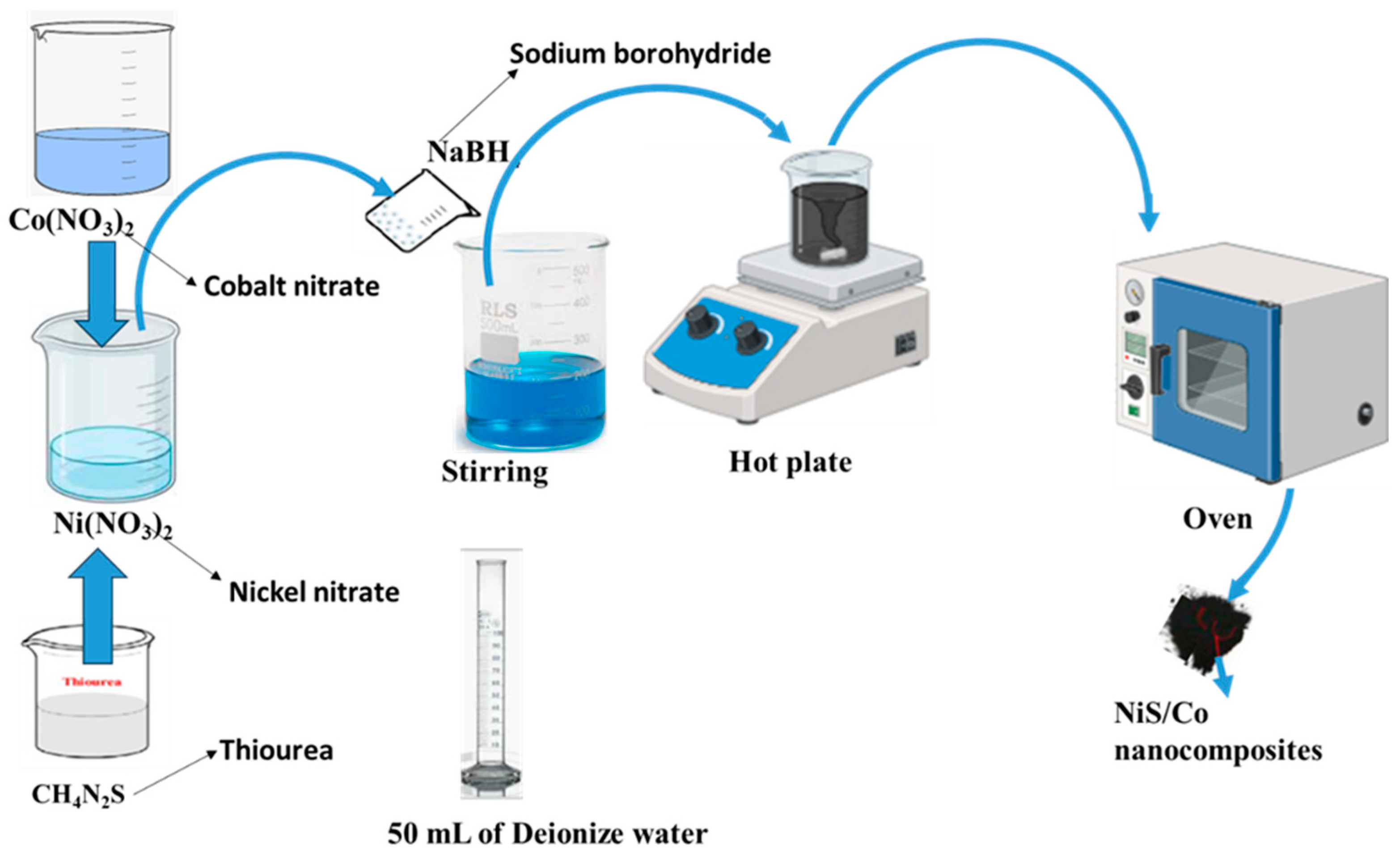
The N i S / C o nanocomposites were synthesized via a wet-chemical processing method, which offers excellent control over cobalt doping and is therefore critical for engineering the nanocomposites’ optical properties. In this study, aqueous precursor solutions were prepared using 0.2 M C H 4 N 2 S , 0.2 M N i ( N O 3 ) 2 , 0.1 M C o ( N O 3 ) 2 , and 0.3 M N a B H 4 . Each compound was dissolved separately in 50 mL of deionized (DI) water using four clean, distinct flasks. Solutions of nickel nitrate, thiourea, and cobalt nitrate were added successively to a 500 mL beaker and mixed thoroughly. The nickel nitrate solution was first combined with thiourea, and the cobalt nitrate solution was then added dropwise under constant stirring to ensure homogeneity. Thereafter, the sodium borohydride solution was added under stirring, serving as the reducing agent. The resulting blend was constantly stirred on a hot plate with a magnetic stirrer at an average temperature of 45 °C for 3 h to improve miscibility (see Figure 1). To remove residual sodium ions, the resultant mixture was thoroughly washed and filtered with DI water. The purified product was subsequently dried in a vacuum oven at 85 °C for 2 h, resulting in N i S / C o nanocomposites.

2.3. Device Fabrication

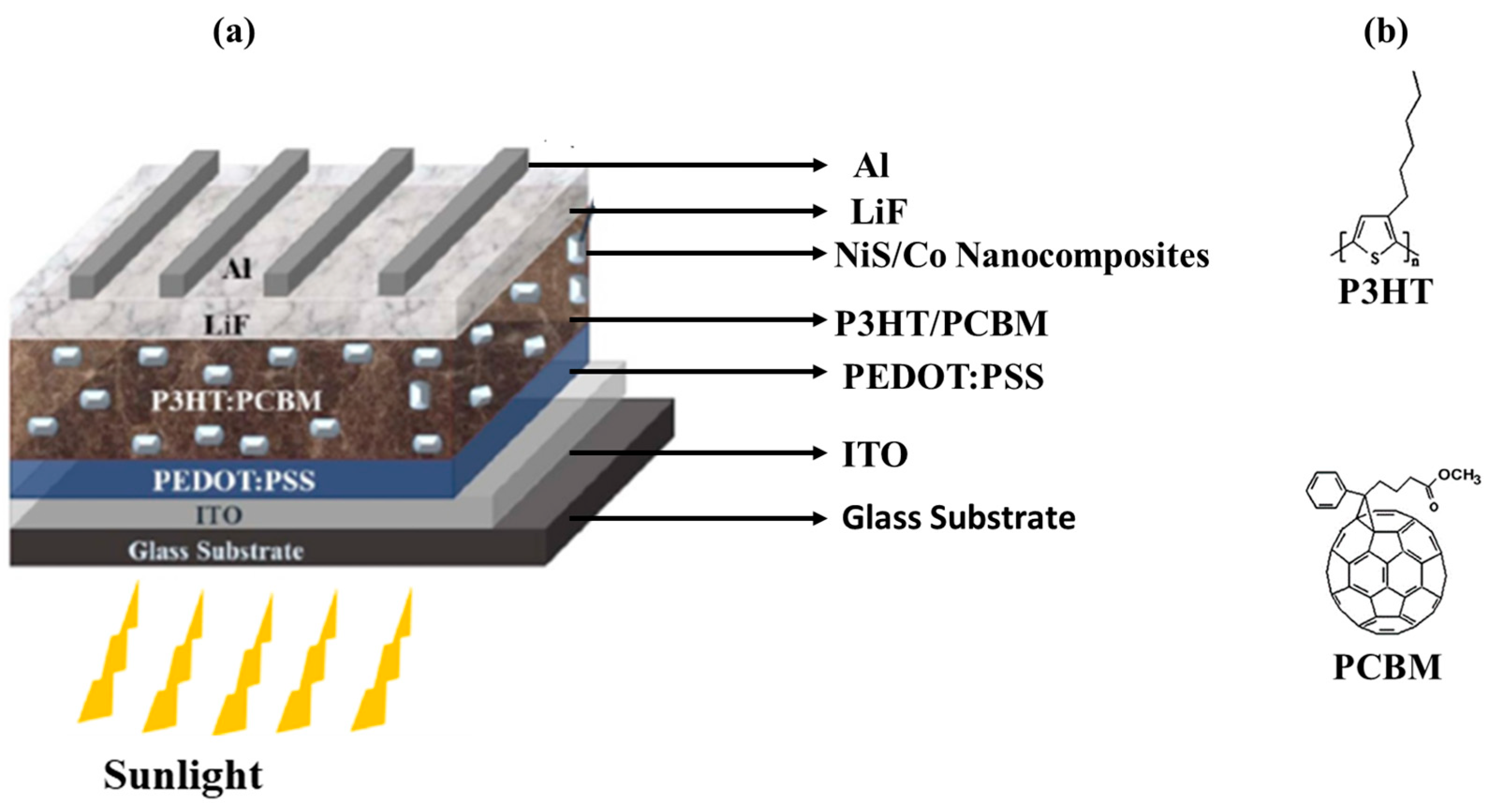
The TFOSCs were fabricated on ITO-coated glass substrates using a conventional device architecture. Figure 2 shows the schematic of the conventional device structure: glass/ITO/PEDOT: PSS/P3HT: PC61BM+NiS/Co/LiF/Al. The substrates were thoroughly cleaned by sequential sonication in DI water, acetone, and isopropanol for 15 min each. The substrates were thermally annealed in an oven at 100 ° C for 25 min to remove residual solvents. The thin PEDOT: PSS layer was deposited onto the ITO substrates by spin-coating at 3500 rpm for 60 s, resulting in a uniform film thickness of approximately 40 nm. The films were subsequently annealed at 100 ° C for 25 min to enhance adhesion. The P3HT and PC61BM blended solution, with a concentration of 20 mg/mL, was prepared by dissolving the active layer in a mixed solvent of chloroform at a ratio of 1:1 by weight. However, N i S / C o nanocomposites were incorporated into the mixture solution at 1 wt%, 2 wt%, and 3 wt% concentrations, with each concentration prepared in a separate solution. To evaluate the influence of N i S / C o nanocomposites, three independent solutions containing 1, 2, and 3 wt% of the nanocomposite were stirred on a hot plate at 45   ° C for 4 h to achieve homogeneous dispersion. The solutions were deposited onto the PEDOT: PSS by spin-coating at 1200 rpm for 40 s, yielding an active layer, followed by thermal annealing in a furnace at 100   ° C for 8 min under a nitrogen atmosphere to improve film morphology. Finally, the devices were transferred to a vacuum chamber, where a 0.6 nm LiF electron transport layer (ETL) and an 85 nm Al electrode were sequentially deposited at a pressure of 10−6 mbar.
After post-deposition annealing for 5 min in a nitrogen atmosphere, electrical characterization of the devices was performed in ambient conditions using a Keithley HP2420 source meter under AM 1.5G illumination (100 mW/cm2) provided by a solar simulator (model SS50AAA). The charge-transport properties were analyzed using space-charge-limited current (SCLC) measurements conducted under dark conditions. The optical properties of the thin-film photoactive layers were investigated using UV–Vis absorption spectroscopy, measured with a spectrophotometer (T80, PG Instruments Ltd., Leicester, UK).

3. Results and Discussion

3.1. Morphological and Structural Analysis via Electron Microscopy of N i S / C o Nanocomposites

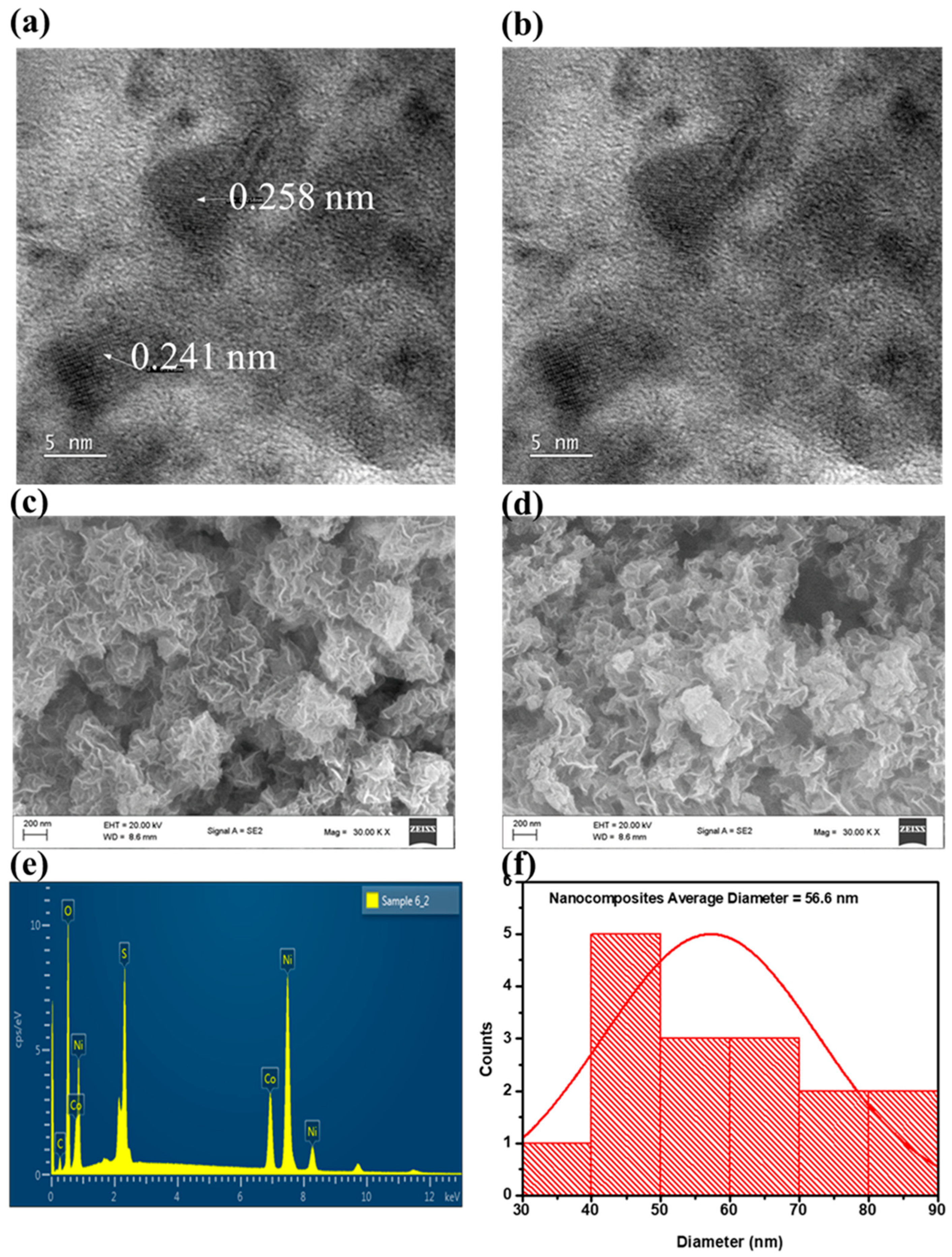
High-resolution scanning electron microscopy (HRSEM) and high-resolution transmission electron microscopy (HRTEM) were employed to analyze the comprehensive surface morphology and structural characteristics of the synthesized N i S / C o nanocomposites. The images in Figure 3 depict the morphological and structural characteristics of N i S / C o nanocomposites in powder form, clearly showing the particle morphology. Comparable morphologies have been reported for NiS nanocrystals prepared by wet-chemical methods, suggesting that the observed particle shapes are typical of this synthesis approach [32]. As shown in Figure 3a,b, the HRTEM images display sphere-like nanostructures with well-aligned lattice fringes. The HRTEM images reveal well-resolved lattice fringes with interplanar spacings of d = 0.258 nm and d = 0.241 nm, measured from two distinct crystallographic orientations visible in Figure 3a. These spacings are assigned to the (101) and (110) planes of the hexagonal NiS phase (millerite, JCPDS card no. 12-0041), respectively, consistent with previously reported values for NiS and Co-doped NiS nanocrystals [31,32]. The presence of multiple crystallographic planes within individual particles confirms the polycrystalline character of the nanocomposites and indicates high crystallinity. The observed contrast in the HRTEM images suggests the formation of a core–shell structure, with variations in particle size and shape. Specifically, Figure 3a,b illustrate a dark central core encircled by lighter-colored shells, supporting the existence of a core–shell-like morphology with distinct size and shape distributions. The HRTEM particle size exhibited a normal distribution ranging from 30 to 90 nm, with an average diameter of approximately 56.6 nm, as confirmed by the size distribution analysis shown in Figure 3f. Nanocomposites within this size range are expected to integrate well into polymer blends, maintaining phase stability and promoting efficient charge transport [30]. The elemental mapping of the HRSEM images in Figure 3c,d indicates a uniform distribution of Ni, S, and Co, supporting the formation of N i S / C o nanocomposites showcasing the flower-like microstructure.
It is worth noting that the apparent discrepancy between the near-spherical particle morphology observed in the HRTEM images and the flower-like microstructure evident in the HRSEM images reflects two different length scales of observation. At the nanoscale, individual N i S / C o crystallites adopt a near-spherical form, as resolved by HRTEM. At the mesoscale, these primary particles self-assemble into hierarchical flower-like aggregates through van der Waals interactions and surface energy minimization during the drying stage of the synthesis, as revealed by HRSEM. This hierarchical architecture may have contributed to increased surface area within the photoactive layer and enhanced light scattering, thereby further improving photon-harvesting efficiency. On the other hand, the energy-dispersive X-ray (EDX) spectrum shown in Figure 3e indicates that Ni, S, and Co are the main elements present in the synthesized nanocomposite powder. The minor carbon signal observed in the EDX spectrum is attributed to the carbon-coated copper grid used for HRTEM analysis and does not originate from the synthesized N i S / C o nanocomposites. A secondary contribution from adventitious organic surface contamination, commonly adsorbed onto high-surface-area nanomaterials upon exposure to ambient atmosphere, cannot be excluded. Critically, this carbon signal does not originate from surface oxidation of a metal sulfide, which would yield sulfate species or metal oxide phases, not elemental carbon, and its presence does not compromise the chemical integrity of the synthesized N i S / C o nanocomposites. Finally, phase identification by X-ray diffraction was not performed in this study; the crystal plane assignments are therefore based on HRTEM lattice-fringe measurements and comparisons with published d-spacing values for NiS systems [31,32]. Future work will include XRD characterization to confirm phase purity and to rule out the presence of secondary sulfide or oxide phases.

3.2. Fourier Transform Infrared Spectroscopy of N i S / C o Nanocomposites

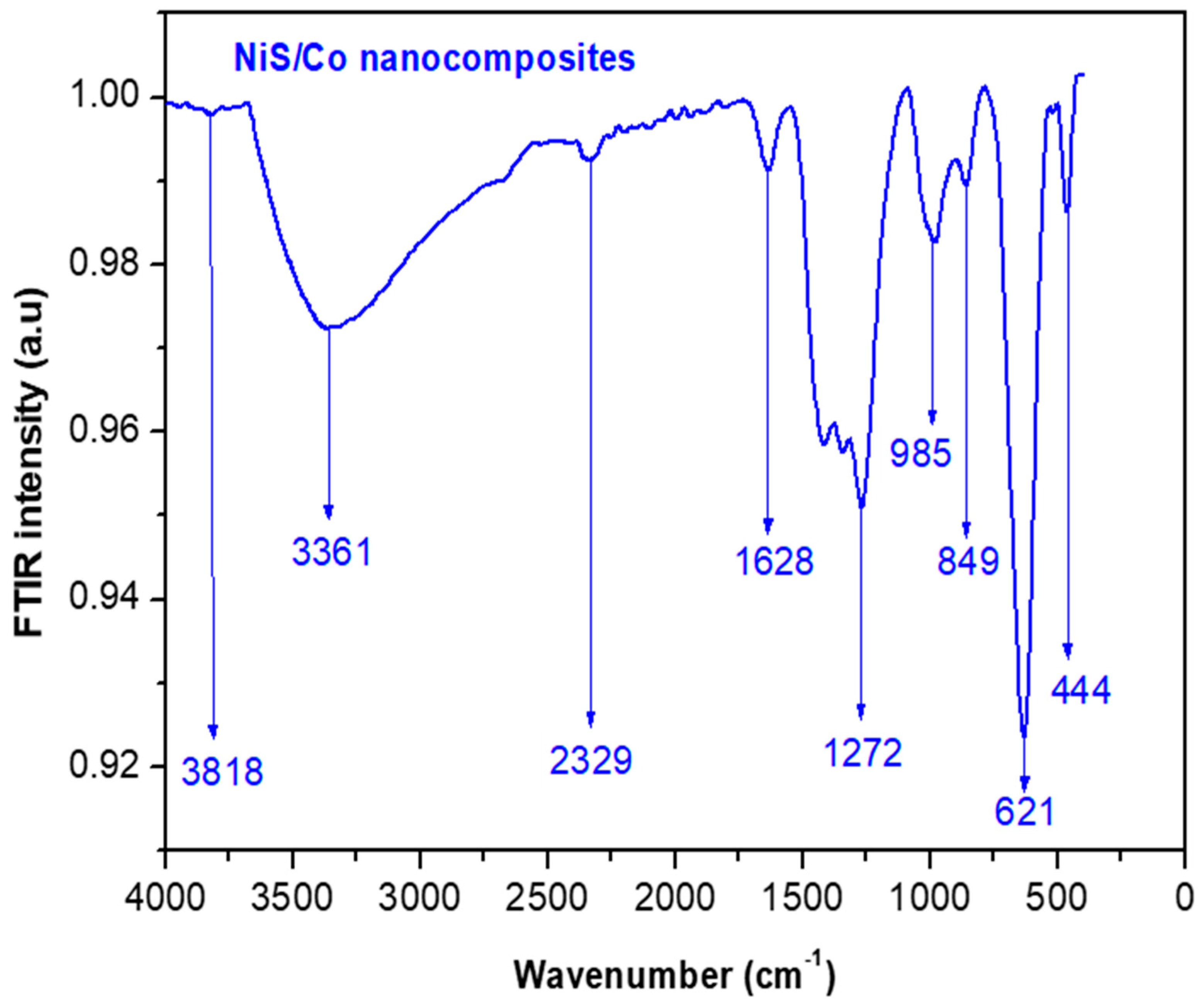
The Fourier transform infrared (FTIR) spectrophotometer shown in Figure 4 was used to analyze the chemical structure of the synthesized N i S / C o nanocomposite powder suspension. FTIR is a widely used technique for identifying the characteristic peaks of the prepared nanostructures and providing insight into their additional properties. The characteristic vibrational modes in the FTIR spectrum substantiate the formation of the NiS lattice and indicate the successful incorporation of Co (cobalt) into the host structure as a dopant. The FTIR transmittance spectra of the synthesized N i S / C o nanocomposites were measured over the wavenumber range of 400–4000 cm−1. The absorption band at 621 cm−1 falls within the characteristic Ni–S stretching and bending vibrational range of 400–720 cm−1 and is consistent with Ni–S bond formation as reported for NiS and Co-doped NiS systems in the literature [36,37]. Comparable vibrational features at 690 cm−1 and 511 cm−1 have also been documented in the NiS literature [37,38], supporting the successful formation of the NiS lattice and its stabilization by cobalt incorporation. While the FTIR peak in the same region has been reported for Co-doped ZnS systems [39], such a comparison is qualitative, given the significant differences in bond ionicity and force constants between Zn–S and Ni–S; the assignment here is principally supported by the NiS-specific literature cited above.
However, the analysis of the mid- to high-frequency regions of the FTIR spectrum yielded valuable insights into surface-bound functional groups and residual species. The broad absorption band observed at 3361 cm−1 was attributed to O–H stretching vibrations, suggesting the presence of hydroxyl groups and/or physically adsorbed water molecules on the surface. These surface functional groups are crucial to photocatalytic activity, as they facilitate the formation of reactive hydroxyl radicals (•OH) under irradiation. The absorption band at 1272 cm−1 was attributed to H–O–H bending vibrations of molecular water, with a possible contribution from C=O stretching arising from atmospheric CO2 absorption. The presence of this peak, in conjunction with those at 985 cm−1 and 849 cm−1, may indicate Co(H–O–H) bending interactions, suggesting coordination between cobalt ions and surface-adsorbed water molecules on the nanocomposites. Notably, the absorption bands observed at 3818 cm−1, 2329 cm−1, 1628 cm−1, 1272 cm−1, 985 cm−1, and 849 cm−1 are consistent with the presence of residual water and carbon dioxide molecules.

3.3. Optical Properties of N i S / C o Nanocomposite-Doped Active Layer

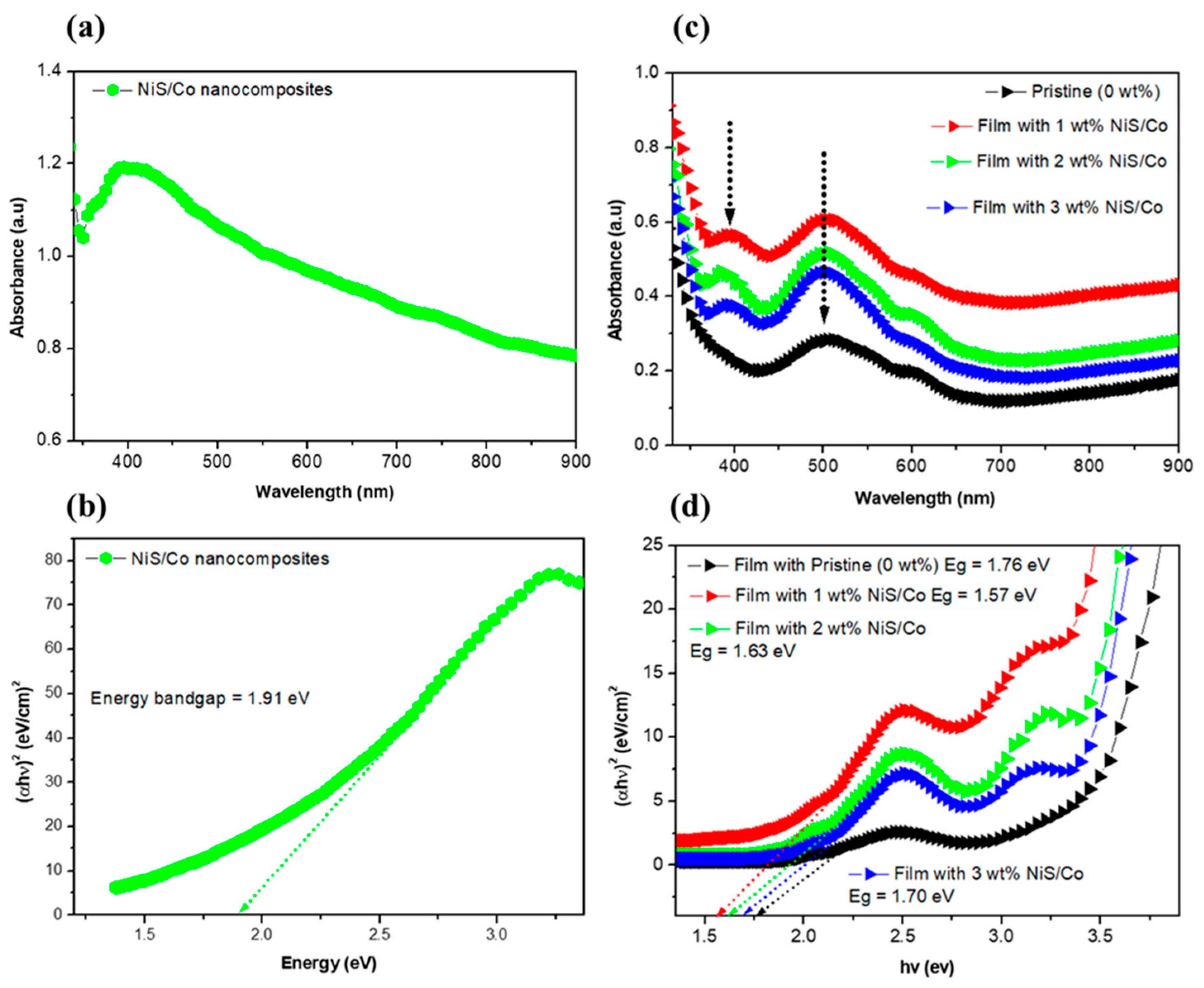
The optical absorption properties of the photoactive layers containing different concentrations of N i S / C o nanocomposites were investigated using a UV–Vis spectrometer, Leicester, United Kingdom. Figure 5a presents the optical absorbance spectrum of a powdered suspension of the synthesized N i S / C o nanocomposites dispersed in deionized (DI) water. The aqueous suspension exhibits broadband absorption across the UV–visible region (383–523 nm), with a central peak at 403 nm. The broadband optical absorption of the N i S / C o nanocomposites, centered at 403 nm, is attributed to a combination of inter-band electronic transitions, localized near-field optical resonance arising from the high dielectric contrast between the nanocomposites and the surrounding polymer matrix, and charge-transfer transitions between Ni and Co d-orbitals. However, the observed absorption enhancement can be attributed to the localized surface plasmon resonance (LSPR) effect, which arises from the interaction between the electromagnetic field of incident light and the surface electron plasma of the nanoparticles [32]. In addition, the presence of N i S / C o nanocomposites in the active layer induces near-field optical enhancement, thereby improving light-harvesting capability and promoting efficient exciton dissociation. The observed absorption feature at approximately 403 nm is therefore consistent with an LSPR effect, which is expected to intensify the near-field electromagnetic environment within the photoactive layer and increase the effective optical cross-section of the P3HT/PC61BM blend.
The effective optical band gap energy E g of N i S / C o nanocomposites was estimated using Tauc’s equation and its relationship with the absorption spectrum, as demonstrated below:
α h v = β ( h v E g ) n
here, h is Planck’s constant, α is the absorption coefficient, v is the photon frequency, E g is the effective optical energy band gap, β is the material-dependent constant, and n is an exponent, which depends on the nature of the transition, while n = 2 for a direct transition [40]. As shown in Figure 5b, the value of E g can be determined from the intercept of the tangent line to the curve at ( α h v ) 2 = 0 in the plot of ( α h v ) versus h v , and the effective optical band gap of N i S / C o nanocomposites was found to be 1.91 eV.
The absorption spectra were recorded for thin films with glass/ITO/PEDOT:PSS/P3HT:PC61BM + NiS;Co, along with the pristine P3HT/PC61BM active layer for comparison (see Figure 5c). The pristine reference film shows a broad absorption peak centered at approximately 500 nm, which is typical of the P3HT/PCBM blend, as provided in Figure 5c. On the other hand, the films doped with 1 wt%, 2 wt%, and 3 wt% N i S / C o nanocomposites exhibit additional absorption features, including a peak at 395 nm, a vibronic shoulder in the 578–629 nm region, and enhanced extended absorption toward ~870 nm compared to the pristine reference film. Such absorption band enhancements are attributed to the incorporation of N i S / C o nanocomposites into the photoactive layer of the solar cells. The extensive absorption observed in the 700–870 nm region can be attributed to LSPR effects and increased light scattering within the film in N i S / C o nanocomposites with doping levels of 1, 2, and 3 wt%. However, the device doped with 1 wt% N i S / C o nanocomposite exhibits the highest absorption intensity, consistent with the superior performance observed in this study, which can be attributed to its lower defect concentration and reduced series resistance ( R s ) compared to the other devices. The effective energy band gap values of the device films are shown in Figure 5d and summarized in Table 2. The photon energy loss ( E l o s s ) was evaluated by analyzing the effective energy band gap of the absorber films. It is mathematically defined as E l o s s =   E g q V o c , where q V o c corresponds to the energy extracted from the cell. A small reduction in E l o s s is observed at doping levels of 1, 2, and 3 wt%, indicating suppressed nonradiative recombination and enhanced charge-transfer efficiency at the D–A interface compared to the pristine reference cell. The incorporation of N i S / C o nanocomposites into the active layer suppresses carrier losses and promotes the collection of photogenerated carriers at the electrodes, thereby increasing the device performance, as shown by J s c , fill factor (FF), and PCE values (see Table 2).

3.4. Photovoltaic Performance of N i S / C o -Doped Solar Cell Devices

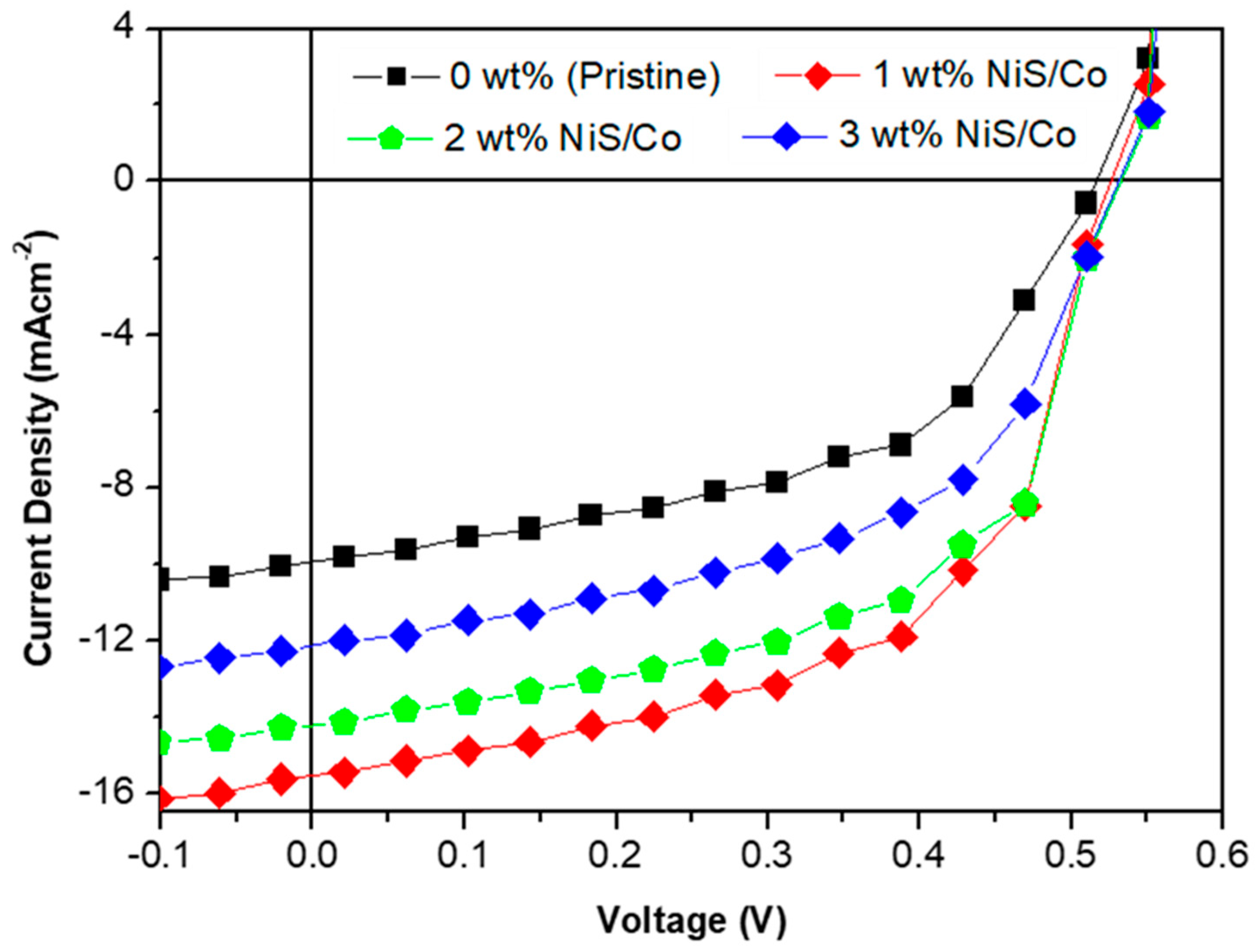
The photovoltaic performance of the fabricated devices was evaluated by conducting current density–voltage (J–V) measurements under illumination. Figure 6 illustrates the J–V characteristics curve of devices incorporating P3HT/PC61BM polymer blends, both with and without N i S / C o nanocomposites as dopants in the active layer, while the corresponding photovoltaic parameters are summarized in Table 2. The active layer was systematically modified with N i S / C o nanocomposites at various concentrations of 1 wt%, 2 wt%, and 3 wt%, which significantly improved device performance compared to that of the pristine reference cell. The pristine reference cell without the inclusion of N i S / C o nanocomposites in the photoactive layer displayed a V o c of 0.55 V, a J s c of 10.21 m A / c m 2 , an FF of 45.33%, and a PCE of 2.48%, with a high energy loss of 1.21 eV, which reduces device conductivity due to current leakage and high series resistance ( R s ) of 770 c m 2 (see Table 2). Notably, incorporating N i S / C o nanocomposites into the photoactive layer at varying concentrations (1, 2, and 3 wt%) led to a significant improvement in device performance. The optimal device performance was achieved at a N i S / C o concentration of 1 wt%, yielding a V o c of 0.56 V, a J s c enhanced to 16.01 m A / c m 2 , an FF improved to 56.71%, and a PCE to 6.11%, corresponding to approximately a 146% enhancement in efficiency compared to the pristine device. The observed enhancement in J s c and FF at 1 wt% N i S / C o doping is ascribed to remarkably reduced current leakage, arising from the near-field effect that augmented exciton dissociation [41,42], together with a substantial decrease in R s from 770 c m 2 to 282 c m 2 . Furthermore, the energy loss decreased from 1.21 eV for the pristine device to 1.01 eV at optimal doping, suggesting improved charge separation and suppressed recombination losses. The reduced R s (from 770 to 282 c m 2 ) and reduced energy loss (from 1.21 to 1.01 eV) are reflected in the improved J s c and FF.
However, the reduction in series resistance and energy loss at 1 wt% doping directly correlates with the observed 57% increase in J s c and 25% increase in FF, respectively.
The improvement in high-current generation could be attributed to better light absorption resulting from the incorporation of dopants in the active layer, which, in turn, facilitated the extraction of more excitons. These findings with N i S / C o nanocomposites as dopants can be attributed to LSPR-enhanced light absorption, which facilitates more efficient exciton dissociation and improved charge transport.

3.5. Charge-Transport Characteristics of N i S / C o Nanocomposites

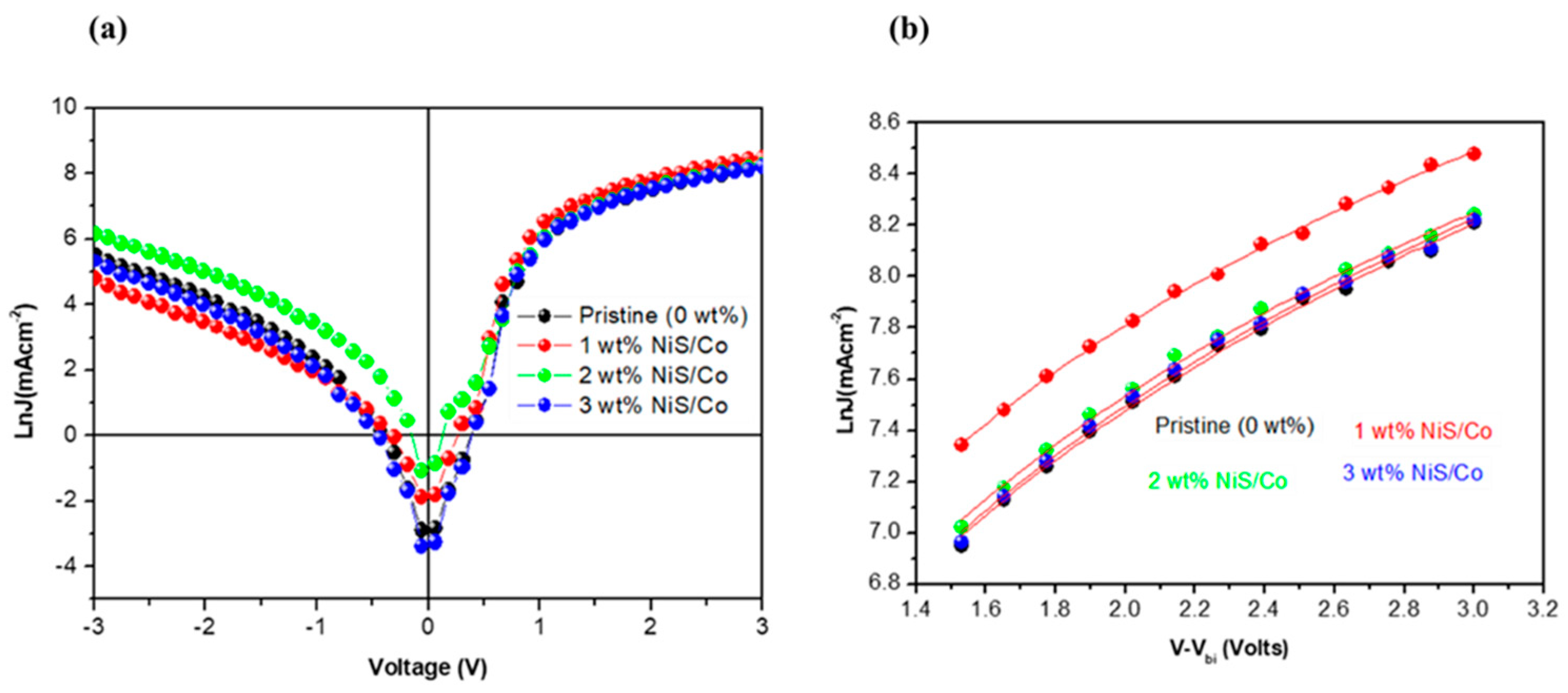
The space-charge-limited current (SCLC) method provides an effective and well-established framework for evaluating charge-transport properties in the active layer of solar cell devices. The SCLC data were collected under dark conditions, where photon-induced charge generation is suppressed, and traps in the medium are filled (see Figure 7a). The charge mobility was extracted from the SCLC regime by fitting the data using the Mott–Gurney law.
The Mott–Gurney model was applied to fit the space-charge-limited current (SCLC) region, enabling determination of the field-dependent mobility, as described in Equation (2) [32,43].
J S C L C = 9 8 ε ε 0 μ 0 V 2 L 3 e x p 0.89 γ V L
where ε is the relative dielectric permittivity of the photoactive layer (ε = 3), and ε0 = 8.85 × 10 12   F / m , which is the permittivity of free space, while µ0 and γ are the zero-field mobility and the field-activation factor, and V is the applied voltage corrected for built-in voltage ( V b i ), and L denotes the photoactive layer’s thickness, which is 100 nm in the device [44]. The zero-field charge mobility (µ0) and field-activation factor (γ) for both the pristine reference and N i S / C o nanocomposite-incorporated devices are summarized in Table 3. However, previous studies have successfully determined important charge-transport parameters in several semiconductor media, notably the zero-field charge mobility and the field-activation factor [32]. The results indicate that the zero-field mobility (μ0) measured for devices containing 1 wt%, 2 wt%, and 3 wt% N i S / C o nanocomposite doping is approximately one order of magnitude higher than that of the pristine reference device, resulting in a notable enhancement in short-circuit current and fill factor. This is likely due to reduced recombination in devices with 1 wt%, 2 wt%, and 3 wt% doping, as also reflected in their improved fill factors compared to the pristine reference device. The mobility of the polymer solar cells decreases at high applied electric fields, as indicated by the negative values of the field-activation factor reported in the literature [35]. Overall, this clearly demonstrates the effect of dopants, incorporated at different concentrations into the photoactive layer, on enhancing charge transport and promoting charge dissociation in thin-film organic solar cells.

4. Conclusions

The N i S / C o nanocomposites are synthesized using a wet method and successfully incorporated into the P3HT/PCBM photoactive layer of solution-processed thin-film organic solar cells (TFOSCs). The experimental results demonstrate that incorporating N i S / C o nanocomposites into the active layer significantly enhances PCE, J s c , and FF. The observed variations in device performance are attributed to the LSPR and enhanced light scattering, as confirmed by optical absorption measurements. The N i S / C o nanocomposites were incorporated into the photoactive layer at concentrations of 1 wt%, 2 wt%, and 3 wt% by weight, resulting in enhanced device performance compared to the pristine device. The optimal concentration of 1 wt% N i S / C o nanocomposites resulted in a PCE of 6.11% compared to the pristine device (2.48%). These findings underscore the promising role of N i S / C o nanocomposites in enhancing TFOSCs’ performance, offering a pathway toward more efficient and sustainable solar energy technologies. This approach offers a promising pathway to enhance the efficiency of organic photovoltaic devices and may encourage further research into solar cells based on non-fullerene acceptors.

Author Contributions

J.N.I.—conceptualization; investigation; software; formal analysis; data curation; validation; visualization; writing—original draft; writing—review and editing. R.T.T.—conceptualization; investigation; validation; funding acquisition; supervision; writing—review and editing. All authors have read and agreed to the published version of the manuscript.

Funding

This manuscript is financially supported by the National Research Foundation (NRF), South Africa (Grant number: 138079).

Institutional Review Board Statement

Not applicable.

Informed Consent Statement

Not applicable.

Data Availability Statement

Data presented in this work are available upon request from the corresponding author to maintain data privacy.

Conflicts of Interest

The authors declare no conflicts of interest.

References

  1. Yang, C.; Zhang, S.; Ren, J.; Gao, M.; Bi, P.; Ye, L.; Hou, J. Molecular design of a non-fullerene acceptor enables a P3HT-based organic solar cell with 9.46% efficiency. Energy Environ. Sci. 2020, 13, 2864–2869. [Google Scholar] [CrossRef]
  2. Inganäs, O. Organic photovoltaics over three decades. Adv. Mater. 2018, 30, 1800388. [Google Scholar] [CrossRef]
  3. Wadsworth, A.; Moser, M.; Marks, A.; Little, M.S.; Gasparini, N.; Brabec, C.J.; Baran, D.; McCulloch, I. Critical review of the molecular design progress in non-fullerene electron acceptors towards commercially viable organic solar cells. Chem. Soc. Rev. 2019, 48, 1596–1625. [Google Scholar] [CrossRef]
  4. Hu, Z.; Wang, J.; Ma, X.; Gao, J.; Xu, C.; Yang, K.; Wang, Z.; Zhang, J.; Zhang, F. A critical review on semitransparent organic solar cells. Nano Energy 2020, 78, 105376. [Google Scholar] [CrossRef]
  5. Cui, Y.; Yao, H.; Zhang, J.; Xian, K.; Zhang, T.; Hong, L.; Wang, Y.; Xu, Y.; Ma, K.; An, C.; et al. Single-junction organic photovoltaic cells with approaching 18% efficiency. Adv. Mater. 2020, 32, 1908205. [Google Scholar] [CrossRef]
  6. Ali, I.; Islam, M.R.; Yin, J.; Eichhorn, S.J.; Chen, J.; Karim, N.; Afroi, S. Advances in smart photovoltaic textiles. ACS Nano 2024, 18, 3871–3915. [Google Scholar] [CrossRef]
  7. Du, J.; Tong, B.; Yuan, S.; Dai, N.; Liu, R.; Zhang, D.; Cheng, H.M.; Ren, W. Advances in flexible optoelectronics based on chemical vapor deposition-grown graphene. Adv. Funct. Mater. 2022, 32, 2203115. [Google Scholar] [CrossRef]
  8. Hamed, M.S.; Ike, J.N.; Wang, Y.; Zhou, K.; Ma, W.; Mola, G.T. Reducing energy loss in polymer solar cell through optimization of novel metal nanocomposite. Energy Fuels 2023, 37, 6129–6137. [Google Scholar] [CrossRef]
  9. Li, C.; Song, J.; Lai, H.; Zhang, H.; Zhou, R.; Xu, J.; Huang, H.; Liu, L.; Gao, J.; Li, Y.; et al. Non-fullerene acceptors with high crystallinity and photoluminescence quantum yield enable > 20% efficiency organic solar cells. Nat. Mater. 2025, 24, 433–443. [Google Scholar] [CrossRef]
  10. Sun, Y.; Wang, L.; Guo, C.; Xiao, J.; Liu, C.; Chen, C.; Xia, W.; Gan, Z.; Cheng, J.; Zhou, J.; et al. π-extended nonfullerene acceptor for compressed molecular packing in organic solar cells to achieve over 20% efficiency. J. Am. Chem. Soc. 2024, 146, 12011–12019. [Google Scholar] [CrossRef]
  11. Jiang, Y.; Sun, S.; Xu, R.; Liu, F.; Miao, X.; Ran, G.; Liu, K.; Yi, Y.; Zhang, W.; Zhu, X. Non-fullerene acceptor with asymmetric structure and phenyl-substituted alkyl side chain for 20.2% efficiency organic solar cells. Nat. Energy 2024, 9, 975–986. [Google Scholar] [CrossRef]
  12. Cheng, P.; Zhan, X. Versatile third components for efficient and stable organic solar cells. Mater. Horiz. 2015, 2, 462–485. [Google Scholar] [CrossRef]
  13. Waketola, A.G.; Hone, F.G.; Geldasa, F.T.; Genene, Z.; Mammo, W.; Tegegne, N.A. Enhancing the performance of wide-bandgap polymer-based organic solar cells through silver nanorod integration. ACS Omega 2024, 9, 8082–8091. [Google Scholar] [CrossRef]
  14. Lai, Y.-Y.; Cheng, Y.-J.; Hsu, C.-S. Applications of functional fullerene materials in polymer solar cells. Energy Environ. Sci. 2014, 7, 1866–1883. [Google Scholar] [CrossRef]
  15. Laquai, F.; Andrienko, D.; Mauer, R.; Blom, P.W. Charge carrier transport and photogeneration in P3HT: PCBM photovoltaic blends. Macromol. Rapid Commun. 2015, 36, 1001–1025. [Google Scholar] [CrossRef]
  16. Alam, S.; Anand, A.; Islam, M.M.; Meitzner, R.; Djoumessi, A.S.; Slowik, J.; Teklu, Z.; Fischer, P.; Kästner, C.; Khan, J.I.; et al. P3HT: PCBM polymer solar cells from a didactic perspective. J. Photonics Energy 2022, 12, 035501. [Google Scholar] [CrossRef]
  17. Liu, F.; Chen, D.; Wang, C.; Luo, K.; Gu, W.; Briseno, A.L.; Hsu, J.W.; Russell, T.P. Molecular weight dependence of the morphology in P3HT: PCBM solar cells. ACS Appl. Mater. Interfaces 2014, 6, 19876–19887. [Google Scholar] [CrossRef]
  18. Liu, C.; Wang, K.; Gong, X.; Heeger, A.J. Low bandgap semiconducting polymers for polymeric photovoltaics. Chem. Soc. Rev. 2016, 45, 4825–4846. [Google Scholar] [CrossRef]
  19. Holliday, S.; Ashraf, R.S.; Wadsworth, A.; Baran, D.; Yousaf, S.A.; Nielsen, C.B.; Tan, C.H.; Dimitrov, S.D.; Shang, Z.; Gasparini, N.; et al. High-efficiency and air-stable P3HT-based polymer solar cells with a new non-fullerene acceptor. Nat. Commun. 2016, 7, 11585. [Google Scholar] [CrossRef]
  20. Alkhalayfeh, M.A.; Aziz, A.A.; Pakhuruddin, M.Z. An overview of enhanced polymer solar cells with embedded plasmonic nanoparticles. Renew. Sustain. Energy Rev. 2021, 141, 110726. [Google Scholar] [CrossRef]
  21. Li, Y.-F.; Kou, Z.L.; Feng, J.; Sun, H.B. Plasmon-enhanced organic and perovskite solar cells with metal nanoparticles. Nanophotonics 2020, 9, 3111–3133. [Google Scholar] [CrossRef]
  22. Fahimi-Kashani, N.; Orouji, A.; Ghamsari, M.; Sahoo, S.K.; Hormozi-Nezhad, M.R. Plasmonic noble metal (Ag and Au) nanoparticles: From basics to colorimetric sensing applications. In Gold and Silver Nanoparticles; Elsevier: Amsterdam, The Netherlands, 2023; pp. 1–58. [Google Scholar] [CrossRef]
  23. Craciun, A.M.; Focsan, M.; Magyari, K.; Vulpoi, A.; Pap, Z. Surface plasmon resonance or biocompatibility—Key properties for determining the applicability of noble metal nanoparticles. Materials 2017, 10, 836. [Google Scholar] [CrossRef]
  24. Ng, A.; Yiu, W.K.; Foo, Y.; Shen, Q.; Bejaoui, A.; Zhao, Y.; Gokkaya, H.C.; Djurišić, A.B.; Zapien, J.A.; Chan, W.K.; et al. Enhanced performance of PTB7: PC71BM solar cells via different morphologies of gold nanoparticles. ACS Appl. Mater. Interfaces 2014, 6, 20676–20684. [Google Scholar] [CrossRef]
  25. Dlamini, M.W.; Mbuyise, X.G.; Mola, G.T. ZnO: Ag nano-particles decorated hole transport layer for improved photon harvesting. Appl. Phys. A 2022, 128, 125. [Google Scholar] [CrossRef]
  26. Liu, S.; Jiang, R.; You, P.; Zhu, X.; Wang, J.; Yan, F. Au/Ag core–shell nanocuboids for high-efficiency organic solar cells with broadband plasmonic enhancement. Energy Environ. Sci. 2016, 9, 898–905. [Google Scholar] [CrossRef]
  27. Nair, A.T.; Anoop, C.S.; Vinod, G.A.; Reddy, V.S. Efficiency enhancement in polymer solar cells using combined plasmonic effects of multi-positional silver nanostructures. Org. Electron. 2020, 86, 105872. [Google Scholar] [CrossRef]
  28. Ashagre, S.; Ogundele, A.K.; Ike, J.N.; Gebremichael, B.; Bekele, M.; Sharma, G.D.; Mola, G.T. Synergistic contribution of potassium sulfide doped with silver nanoparticles on the performance of thin film organic solar cells. J. Phys. Chem. Solids 2023, 177, 111290. [Google Scholar] [CrossRef]
  29. Mahajan, P.; Singh, A.; Datt, R.; Gupta, V.; Arya, S. Realization of inverted organic solar cells by using sol-gel synthesized ZnO/Y2O3 core/shell nanoparticles as electron transport layer. IEEE J. Photovolt. 2020, 10, 1744–1749. [Google Scholar] [CrossRef]
  30. Ike, J.N.; Taziwa, R.T. Optimizing Organic Photovoltaic Efficiency Through Controlled Doping of ZnS/Co Nanoparticles. Solids 2025, 6, 69. [Google Scholar] [CrossRef]
  31. Kristl, M.; Dojer, B.; Gyergyek, S.; Kristl, J. Synthesis of nickel and cobalt sulfide nanoparticles using a low cost sonochemical method. Heliyon 2017, 3, e00273. [Google Scholar] [CrossRef]
  32. Hamed, M.S.; Oseni, S.O.; Kumar, A.; Sharma, G.; Mola, G.T. Nickel sulphide nano-composite assisted hole transport in thin film polymer solar cells. Sol. Energy 2020, 195, 310–317. [Google Scholar] [CrossRef]
  33. Reddy, P.L.; Deshmukh, K.; Kovářík, T.; Reiger, D.; Nambiraj, N.A.; Lakshmipathy, R.; SK, K.P. Enhanced dielectric properties of green synthesized Nickel Sulphide (NiS) nanoparticles integrated polyvinylalcohol nanocomposites. Mater. Res. Express 2020, 7, 064007. [Google Scholar] [CrossRef]
  34. Buchmaier, C.; Glänzer, M.; Torvisco, A.; Poelt, P.; Wewerka, K.; Kunert, B.; Gatterer, K.; Trimmel, G.; Rath, T. Nickel sulfide thin films and nanocrystals synthesized from nickel xanthate precursors. J. Mater. Sci. 2017, 52, 10898–10914. [Google Scholar] [CrossRef]
  35. Ike, J.N.; Jili, N.; Kumar, A.; Sharma, G.; Mola, G.T. The impact of Ag/Co nanocomposite on organic charge transport medium for improved photocurrent in polymer solar cell. J. Polym. Sci. 2023, 61, 2721–2732. [Google Scholar] [CrossRef]
  36. Roushdy, N.; Elnouby, M.S.; Farag, A.A.M.; Ramadan, M.; El-Shazly, O.; El-Wahidy, E.F. Structural and electrical characterization of nickel sulfide nanoparticles. Opt. Quantum Electron. 2024, 56, 1794. [Google Scholar] [CrossRef]
  37. Seemab, M.; Nabi, G. Structural transformations and enhanced electrochemical performance of Co doped NiS2 nanosheets for supercapacitor applications. Ceram. Int. 2024, 50, 27856–27866. [Google Scholar] [CrossRef]
  38. Aiswarya, K.; Raguram, T.; Rajni, K. Synthesis and characterisation of nickel cobalt sulfide nanoparticles by the solvothermal method for dye-sensitized solar cell applications. Polyhedron 2020, 176, 114267. [Google Scholar] [CrossRef]
  39. Mohamed, W.S.; Ezzeldien, M.; Alshammari, A.H.; Alshammari, K.; Alhassan, S.; Hadia, N.M.A. Facile hydrothermal synthesis and characterization of novel Co-doped ZnS nanoparticles with superior physical properties. Opt. Mater. 2024, 157, 116345. [Google Scholar] [CrossRef]
  40. Makuła, P.; Pacia, M.; Macyk, W. How to correctly determine the band gap energy of modified semiconductor photocatalysts based on UV–Vis spectra. J. Phys. Chem. Lett. 2018, 9, 6814–6817. [Google Scholar] [CrossRef]
  41. Wang, C.; MacKenzie, R.C.; Würfel, U.; Neher, D.; Kirchartz, T.; Deibel, C.; Saladina, M. Transport resistance dominates the fill factor losses in record organic solar cells. Adv. Energy Mater. 2025, 16, 2405889. [Google Scholar] [CrossRef]
  42. Mousavifar, S.M.; Ghasemi, M.; Haidari, G. Near and far-field plasmonic enhancement from thermally evaporated Ag nanostructures in polymer photovoltaic cells: Simulation and experimental study. IEEE J. Photovolt. 2020, 10, 1735–1743. [Google Scholar] [CrossRef]
  43. Röhr, J.A.; Moia, D.; Haque, S.A.; Kirchartz, T.; Nelson, J. Exploring the validity and limitations of the Mott–Gurney law for charge-carrier mobility determination of semiconducting thin-films. J. Phys. Condens. Matter 2018, 30, 105901. [Google Scholar] [CrossRef]
  44. Seimela, T.E.; Hamed, M.S.; Diale, M. Enhancing organic solar cell performance via Cu nanorods-doped PEDOT: PSS: A pathway to efficient charge transport and plasmonic enhancement. RSC Adv. 2025, 15, 25929–25939. [Google Scholar] [CrossRef]
Figure 1. Schematic representation of the synthesis process for N i S / C o nanocomposites using the wet-chemical technique.
Micro 06 00022 g001
Figure 2. (a) Fabricated solar cell device structure and (b) the polymer materials used in this experiment.
Micro 06 00022 g002
Figure 3. (a,b) High-resolution transmission electron microscopy (HRTEM) images of N i S / C o in powder form. (c,d) High-resolution scanning electron microscopy (HRSEM) images of N i S / C o in powder form. (e) Energy-dispersive X-ray (EDX) spectrum confirming the elemental composition of N i S / C o in powder form. (f) Particle size distribution with an average diameter of N i S / C o nanocomposites.
Micro 06 00022 g003
Figure 4. Fourier transform infrared (FTIR) spectrum of N i S / C o nanocomposites, showing the characteristic of Ni−S stretching and bending vibrations and surface-bound functional groups, indicating successful synthesis and Co incorporation.
Micro 06 00022 g004
Figure 5. (a) Optical absorbance spectrum of the N i S / C o nanocomposites. (b) Tauc plot derived from the absorbance data in (a), used to estimate the effective optical band gap. (c) Optical absorbance spectra of polymer films incorporating 0, 1, 2, and 3 wt% N i S / C o nanocomposites. (d) Tauc’s plots corresponding to the films in (c), used to evaluate the effective energy band gap variation with doping concentrations of N i S / C o nanocomposites.
Micro 06 00022 g005
Figure 6. J–V characteristics of TFOSC devices at different concentrations of N i S / C o nanocomposites measured under illumination.
Micro 06 00022 g006
Figure 7. (a) J–V characteristics curve measured under dark conditions at different concentrations, and (b) SCLC of the fabricated devices with/without N i S / C o nanocomposites in the active layer.
Micro 06 00022 g007
Table 1. Summary of previous research on metallic nanoparticles and the progress of their efficiency enhancement in organic solar cells (OSCs).
Device ArchitectureNPsNPs LocationPCE (%) Without NPsPCE (%) with NPsRef
ITO/PEDOT:PSS:Au/PTB7:PC71BM/CaAuPEDOT:PSS7.508.10[24]
ITO/PEDOT:PSS-ZnO:Ag/P3HT:PCBM/LiF/AlZnO/AgP3HT:PCBM2.564.88[25]
ITO/PEDOT:PSS/PTB7:PC71BM/Ca/AlAu@Ag@SiO2PEDOT:PSS7.729.04[26]
ITO/ZnO/PTB7:PCBM/MoO3/AlAgZnO6.537.25[27]
ITO/PEDOT:PSS/P3HT:PCBM:NPs/LiF/AlK2S/AgP3HT:PCBM2.305.12[28]
ITO/ZnS/Y2O3/PTB7:PC71BM/MoO3/AgZnO/Y2O3ZnO5.776.22[29]
ITO/PEDOT:PSS/PTB7:PC71BM/Ca/AlAu@Ag@SiO2PTB7:PC71BM7.729.56[26]
ITO/PEDOT:PSS/P3HT:PCBM:NPs/LiF/AlZnS/CoP3HT:PCBM2.354.76[30]
Table 2. J–V performance of TFOSCs with different amounts of N i S / C o nanocomposites in the P3HT/PC61BM-active layer.
N i S / C o
(wt%)
E g
(eV)
E l o s s
(eV)
V o c
(V)
J s c
(mAcm−2)
F F
(%)
P C E
(%)
R s
(Ωcm2)
0% (Pristine)1.761.210.5510.2145.332.48770
1%1.571.010.5616.0156.716.11282
2%1.631.070.5614.7952.535.03463
3%1.701.140.5612.6450.683.85549
Table 3. The charge-transport parameters for solar cells fabricated at different concentrations of N i S / C o nanocomposites.
N i S / C o
(wt%)
μ 0
( c m 2 S 1 V 1 )
γ
( c m V 1 )
0% (Pristine) 1.1077 × 10 4 6.7266 × 10 4
1% 1.9349 × 10 3 6.0527 × 10 4
2% 1.2470 × 10 3 6.1843 × 10 4
3% 1.1250 × 10 3 6.2203 × 10 4
Disclaimer/Publisher’s Note: The statements, opinions and data contained in all publications are solely those of the individual author(s) and contributor(s) and not of MDPI and/or the editor(s). MDPI and/or the editor(s) disclaim responsibility for any injury to people or property resulting from any ideas, methods, instructions or products referred to in the content.