1. Introduction
Adsorption is a fundamental surface phenomenon whereby particles (atoms, ions, molecules) from a fluid phase accumulate on the surface of a solid or liquid substrate, the adsorbent, and form a simple or multilayer film on the surface [
1,
2,
3,
4]. The relationship between the amount of a substance adsorbed on a surface and its equilibrium concentration or pressure in the bulk, measured at a constant temperature, is called an adsorption isotherm. Adsorption is typically an exothermic process that depends strongly on temperature. Adsorption is a universal surface phenomenon that governs how materials interact with their environment. From thin-film deposition and self-assembly to detergency, sensing, and electrochemistry, adsorption defines the structure, reactivity, and functionality of interfaces. It therefore represents one of the most pervasive and interdisciplinary concepts in modern science and technology. The role of adsorption is central to a variety of natural and industrial processes, including heterogeneous catalysis, gas storage, wastewater treatment, and environmental pollution control [
5,
6,
7,
8,
9,
10,
11,
12].
Several adsorption isotherm models have been proposed since the beginning of the 20th century. Among the most widely applied are the Langmuir isotherm [
13,
14,
15], which assumes monolayer adsorption on a homogeneous surface with a finite number of identical sites, and the Freundlich isotherm, an empirical model which is not physically founded and that accounts for adsorption on heterogeneous surfaces with a non-uniform energy distribution [
16]. Other models, such as the Temkin [
17] and BET (Brunauer–Emmett–Teller) isotherms [
18], extend these concepts to include adsorption potential dependence on the adsorbate amount and multilayer adsorption phenomena. These models and their generalizations [
19,
20,
21,
22] provide valuable insights into adsorption mechanisms, surface properties, and the thermodynamic parameters governing the process. A detailed review on adsorption models is given in [
23,
24,
25,
26,
27,
28].
Considering the atomic structure of a surface, the Langmuir’s model assumes that adsorption occurs on a homogeneous surface with a finite number of identical sites, each capable of holding one particle, and that there is no interaction between adsorbed species. The model further assumes a dynamic equilibrium between adsorption and desorption processes. The rate of adsorption is proportional to both the pressure (or concentration) of the adsorbate and the fraction of vacant sites, while the rate of desorption is proportional to the fraction of occupied sites. At equilibrium, the rates of adsorption and desorption are equal, leading to the classical Langmuir expression:
where
is the fractional surface coverage,
P is the gas pressure (or concentration
C in solution), and
K is the equilibrium constant of adsorption. As
,
, indicating that all adsorption sites are occupied, this represents the condition of saturation. Saturation in the Langmuir model reflects the limited number of adsorption sites on the surface. When each site is occupied by one adsorbate molecule, the surface cannot accommodate any additional molecules, and the adsorption rate becomes zero. Any further increase in adsorbate concentration does not increase the number of adsorbed particles, producing the characteristic plateau in Langmuir-type adsorption isotherms.
Discrete-site adsorption models, such as the Langmuir, Fowler–Guggenheim, and Frumkin isotherms, as well as Hill, Ising, and other lattice-based approaches, require prior knowledge of the total number of adsorption sites. However, there exists a broad class of materials for which well-defined adsorption sites cannot be identified. These systems may be described by continuous adsorption models. Such behavior is characteristic of amorphous materials (e.g., glasses), low-surface-energy materials dominated by van der Waals interactions and lacking directional chemical bonding, and liquid and soft interfaces, including polymeric materials. For these systems, the number of adsorption sites cannot be predefined.
In the present paper, we propose an alternative perspective that results in the saturation effect without assuming a limiting number of active sites for adsorption on the adsorbent surface in contact with a fluid reservoir; that is, the proposed toy model functions within the continuous-media approximation for the adsorbent substrate. The mechanism that introduces saturation is the repulsive inter-adsorbate-particle interaction, which, in general, could be of steric nature or arise from a distant-effective interaction between adsorbate particles in the presence of the fluid solvent and the substrate. In
Section 2, we recall briefly the state of the art. In
Section 3, we present our toy model and the derived results. Finally,
Section 4 is devoted to discussion and conclusions.
2. Current Approach (Discrete Case)
The adsorption phenomenon is related to the presence of surface forces responsible for an increase or decrease in the particles’ concentration close to a limiting surface. The effect is present in all limited systems, and the surface forces could be due to a direct interaction of the particles with the substrate or to the incomplete interaction between the bulk molecules. There are several phenomenological models proposed to describe the adsorption phenomenon of bulk molecules from a surface, as discussed in the introduction. In all models, the concept of the bulk density of adsorbable particles (particles per unit volume),
n, is introduced, along with the surface density of adsorbed particles (particles per unit surface),
, and a kinetic equation for the time variation of the surface density is built in terms of
n and
. Since adsorption is a dynamical phenomenon depending on the adsorption of particles from the bulk and the desorption of particles from the surface, in general, the kinetic equation is of the kind
where
and
describe the adsorption and desorption phenomena, and
n is the bulk density of adsorbable particles just in front of the adsorbing surface. In the state of equilibrium,
, and the values of equilibrium of
n and
, which we indicate by
and
, are such that
The actual values of and are determined by taking into account the conservation of particles or the presence of an external reservoir.
In the latter case of the presence of an external reservoir fixing
, from (
3), it is possible to derive
. In this case, the sample under investigation is not a closed system, since it can exchange particles with the reservoir.
On the contrary, if the system is a closed system, the number of adsorbate particles remains constant. In the simple situation in which the sample is a slab of thickness
d limited by two identical adsorbing surfaces, the conservation of the particles is
where
is the bulk density of particles in the absence of adsorption, and it has been supposed that in the equilibrium state, the bulk density of particles is homogeneous across the sample. This hypothesis is based on the assumption that the surface forces are of short range.
From Equation (
3), it follows that for small variations from the equilibrium state,
and
, the time variation of
is given, at the first order in
and
, by
where
A widely used kinetic equation to describe adsorption phenomenon is the one proposed by Langmuir:
where
k, with units of
, and
, with units of
s, are phenomenological parameters known as the adsorption coefficient and desorption time. For
, the surface does not desorb, and
increases with the time. The adsorption term is proportional to the bulk density of particles just in front of the adsorbing surface
n, and the desorption time is proportional to the surface density of adsorbed particles
. Equation (
7) is similar to (
6). Hence, it can be considered as an approximation of a more general adsorption kinetic equation.
In the case in which a reservoir is present, and
, Equation (
7) can be rewritten as
and the time evolution of
can be easily determined. In this case,
tends to the equilibrium value
with a relaxation time
. From (
9), it follows that for
,
.
By contrast, if the sample is a closed system in the shape of a slab, and assuming the validity of Equation (
4) for all
t, i.e.,
, Equation (
7) can be rewritten as
From (
10), we get that, in the considered approximations, the effective desorption time depends on the thickness of the sample, and it tends to
for
. In the equilibrium state,
and
are found to be
From (
9) and (
11), it follows that
is a characteristic length related to the adsorption. In the presence of a reservoir,
coincides with the adsorption of particles contained in the surface layer of thickness
ℓ. In the case in which the sample is a slab, from (
11), it follows that for
, i.e.,
,
and
; i.e., all the adsorbable particles are adsorbed by the limiting surfaces. The expression for
in Equation (
11) indicates that, for fixed
k and
,
. However, since the adsorbed particles are not point-like,
given by (
9) or (
11) cannot increase without limit. The considered model is then valid in the limit of small
, i.e., for diluted solutions.
In the case of large
, it is necessary to modify (
7) in such a manner that
tends to a limiting value for
. The simplest generalization of (
7) to describe saturation effects is [
29]
where
is the maximum surface density of adsorbed particles, related to the adsorption mechanism. It could be called the surface density of adsorbing sites. The phenomenological expression (
12) in the limit of
gives (
7).
In the presence of a reservoir, since
, from (
12), the equilibrium value of the surface density of adsorbed particles is
which, for
, reduces to (
9).
In the case where the sample is a slab, taking into account condition (
4) on the conservation of particles, in the equilibrium state from (
12), we get for
where
,
, and
is the maximum value of the adsorbed particles for the given solution and sample. The influence of the saturation effects described by the kinetic equation (
12) on the time evolution toward the equilibrium state has been discussed in [
30]. Of course, Equation (
14) is one possible generalization of Equation (
7) derived by
with
[
30]. Of some interest is the case with
, which could be related to the case in which the adsorbate particles are electrically charged.
The generalizations of (
7) along the line described above are completely phenomenological. It is based on the obvious idea that the surface density of adsorbed particles in concentrated solutions has to tend to a saturation value
. Consequently, the effective adsorption coefficient has to change sign for
. Instead, to attribute the origin of
to the finite number of adsorbing sites on the surface, the origin of
could be attributed to the repulsive forces between the adsorbed particles. The goal of our investigation is to relate
to this repulsive part of the interaction.
3. An Alternative Approach (Continuous System)
As stressed above, the Langmuir Equation (
7) and its generalization (
15) are phenomenological and based on plausible arguments, without considering the forces responsible for the adsorption. In the absence of adsorption, the bulk density of adsorbate is homogeneous. The presence of an adsorbing substrate introduces a surface field, localized close to the substrate and vanishing in the bulk, which is responsible for a position dependence of the adsorbate density that approaches its equilibrium value far enough from the surface. In the steady state, the drift current of particles balances the diffusion current, and the bulk density profile is given by the Boltzmann distribution. A description of the adsorption phenomenon based on the concept of adsorption energy can therefore be formulated within the framework of statistical mechanics [
31,
32,
33,
34]. The aim of the present section is to analyze the adsorption phenomenon using Boltzmann statistics, introducing an adsorption energy that contains both attractive and repulsive contributions, and relaxing the condition of a predefined number of adsorptions sites. The attractive term accounts for the interaction between the adsorbate particles and the adsorbent substrate, while the repulsive term represents the inter-particle interactions.
In this context, let us consider the half-space approximation, with the
z-axis originating at the adsorbing surface. The adsorption phenomenon is related to a potential energy, indicating that for the particles, it is energetically more favorable to remain near the surface than in the bulk. If
is the potential energy, arising, for instance, from van der Waals interactions, the steady-state distribution of particles is given, according to Boltzmann statistics, by
where
is the bulk density in the absence of adsorption, and
is the inverse thermal energy. When
does not depend on the adsorbed particles,
is the solution of the problem. If
is strongly peaked near the surface, like a kind of Dirac-like function,
becomes very large close to
and rapidly approaches
as
z increases. We denote by
the range of
, defined by
for
, and
for
. The rapid decay of
allows us to define a surface density of particles, due to the adsorption via the relation
In this way, it is possible to relate the adsorption coefficient
k entering in (
7) with the adsorption energy [
35].
All these considerations are straightforward and well known, and so far we have not introduced the concept of available adsorption sites. To proceed further, we can assume that the adsorption energy depends on
. In the simple case of electro-adsorption [
29], the effective surface field is
, where
is the external electric field and
is the reaction field. In the case of pure adsorption, that is, in the absence of an external field, the potential energy per particle,
, describing the adsorption, can be well approximated by
where
A is related to the Hamaker constant, and
is the characteristic length of the interaction between the adsorbate particles in the bulk and the substrate. If the effective adsorption energy depends on
, through a repulsive inter-particle interaction
(such as electrostatic or hard-sphere interactions), the mean field acting on the particle is then given by
In this framework, Equation (
16) has to be rewritten as
from which it follows that the equilibrium distribution of particles is
Equation (
21) allows us to define a new
, and consequently a new adsorption coefficient, without introducing the concept of discrete adsorption sites, which is inconsistent with a continuum description. The task now is to express the potential
as a function of
. For electrostatic interactions, the analysis is simple because the electric field is determined by the charge density through the Poisson equation, whereas for neutral particles, an explicit form of
must be found. Deep in the bulk, where
, the equilibrium density of particles is
. This implies that
. Consequently, we can write
; i.e.,
depends on the deviation of the particle density from its equilibrium value in the bulk and therefore its dependence on
z is indirect via
. In a first-order expansion around the bulk density,
can be written as
where
depends on the inter-particle interaction which, hereafter, is assumed to be repulsive (
) to exclude aggregation effects. At this point, we note that the linear approximation adopted for
does not imply a simple linear spatial interaction among adsorbate particles. In this framework, the bulk density of particles is given by
Equation (
23) is a nonlinear implicit algebraic equation for
and it was solved numerically on a discrete grid using the secant method (Python/SciPy), with cross-checks using secant and Newton methods in Mathematica and working precision between 20 and 50 digits. Convergence required: (i)
, (ii) number of iteration less than 80, (iii) solver reported convergence, (iv) absolute and relative tolerances of
. For the numerical calculations presented below, we chose for the potential
the van der Waals expression given by Equation (
18). Energy is measured in units of
, and lengths in units of
, so that
. For the numerical calculations, the values
and
were used.
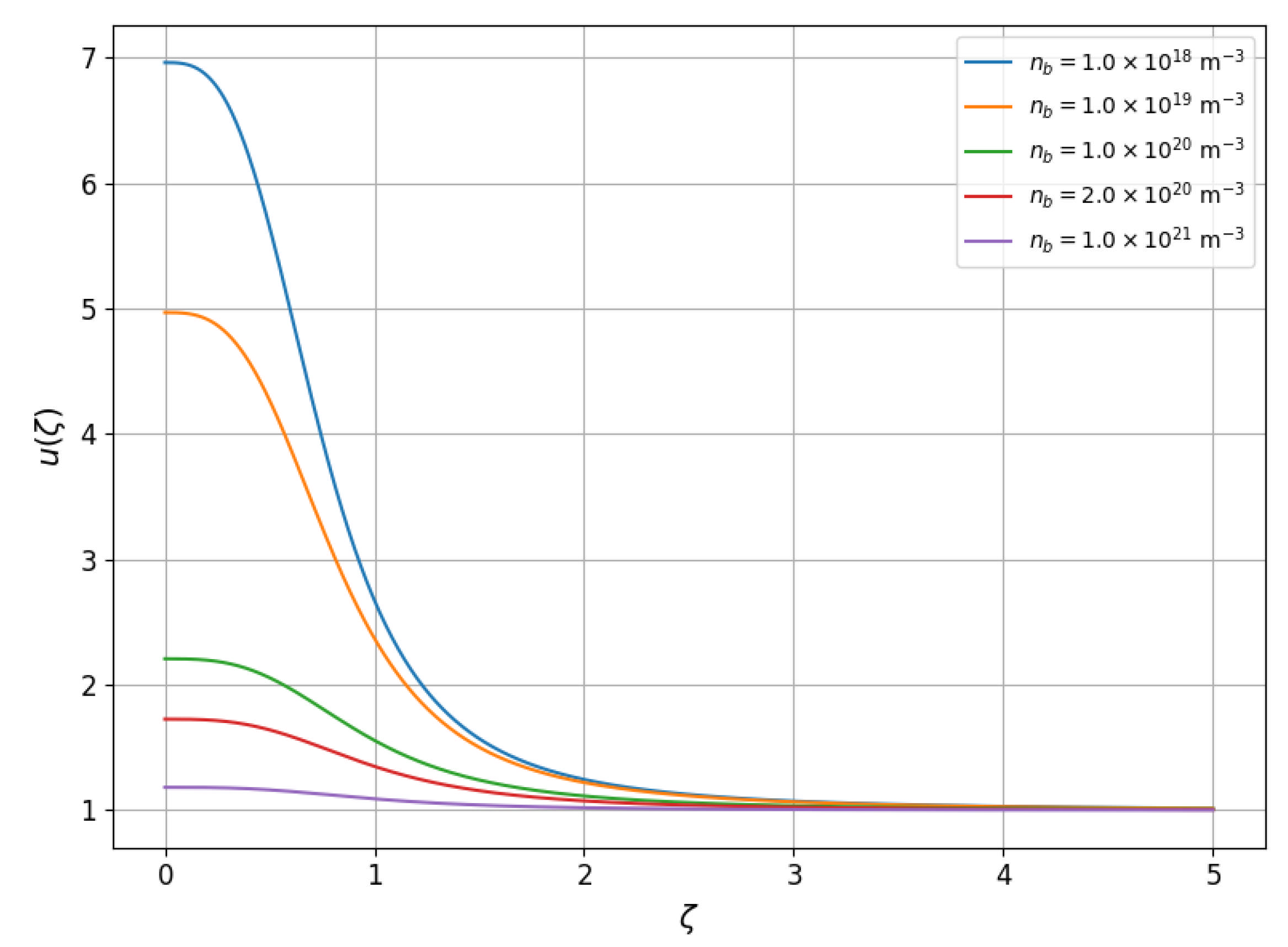
Figure 1 shows the reduced density profile
for different values of the bulk adsorbate density
. The particle density presents an abrupt variation near the limiting surface, and its profile decreases with the distance from the substrate. As
increases, the relative variation of
decreases monotonically.
Now, if we define the surface density of particles by means of Equation (
17), it becomes possible to investigate the dependence of
on
.
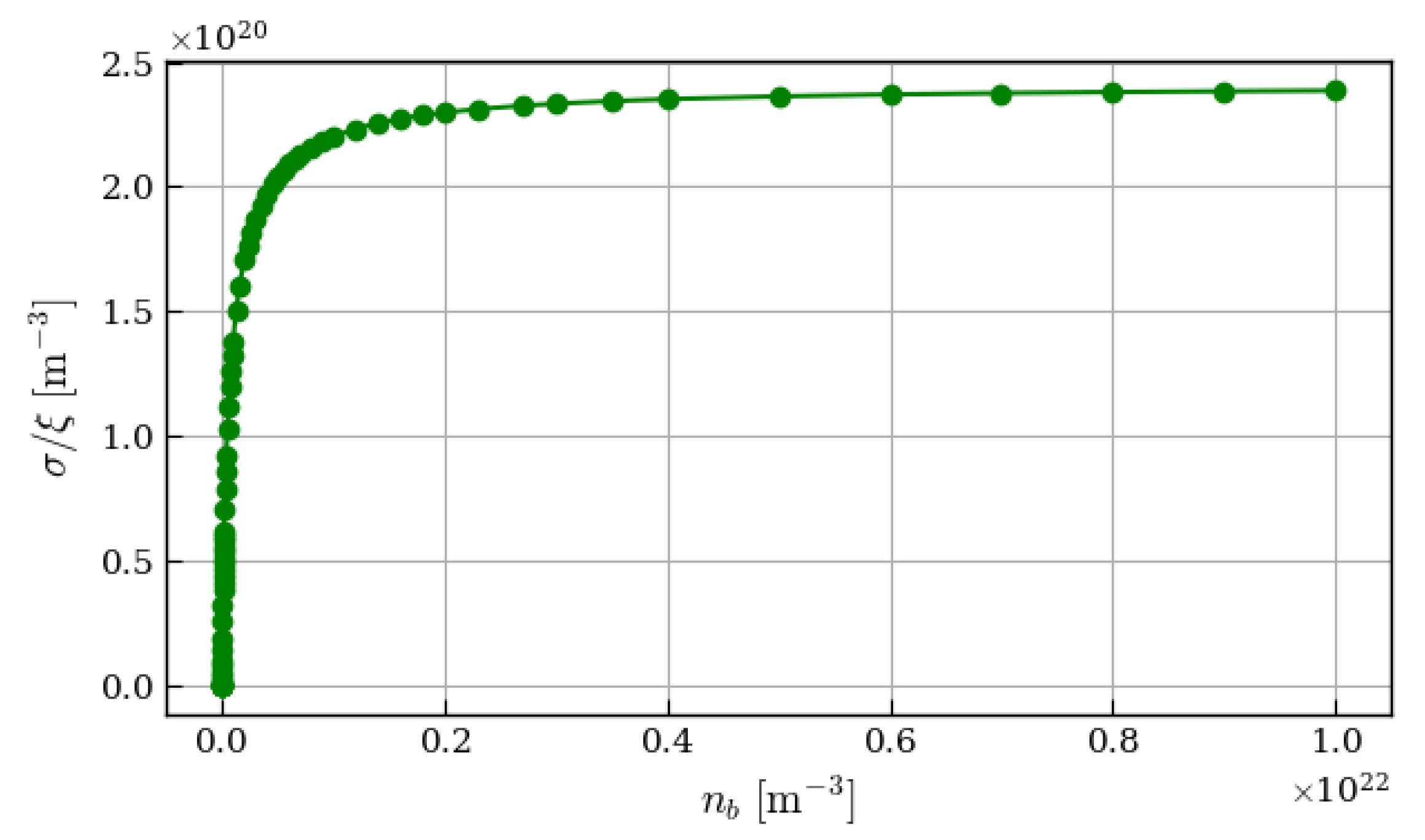
Figure 2 shows
as a function of
, assuming for
A,
, and
the same values used to draw
Figure 1.
From this figure, it follows that
is proportional to
for low values of
, while for large enough
, it approaches a limiting value
. This saturation effect is related to the reaction field
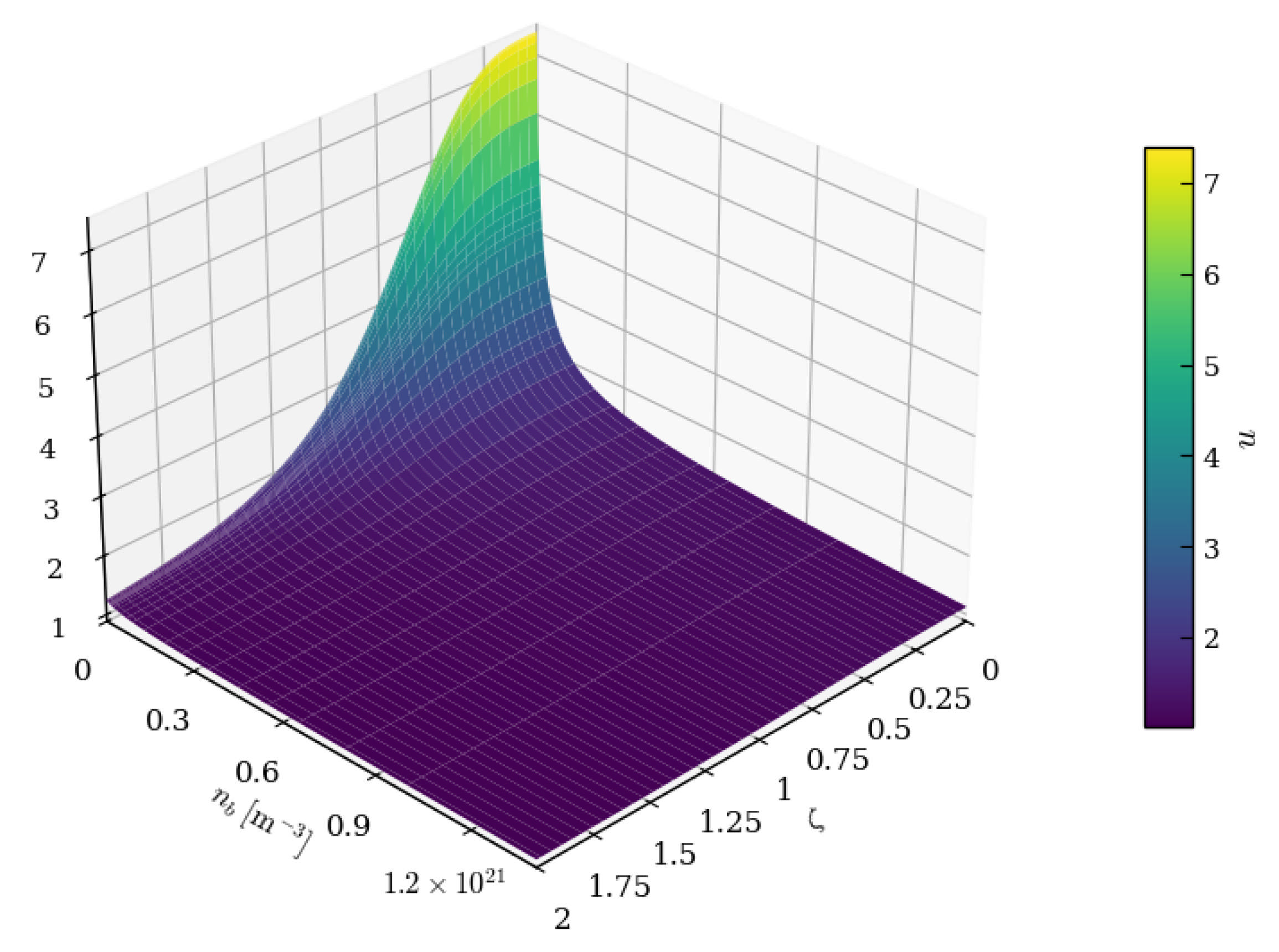
. Note that no assumption of a limited number of adsorption sites on the substrate has been introduced. A 3D representation of the surface
is given in
Figure 3.
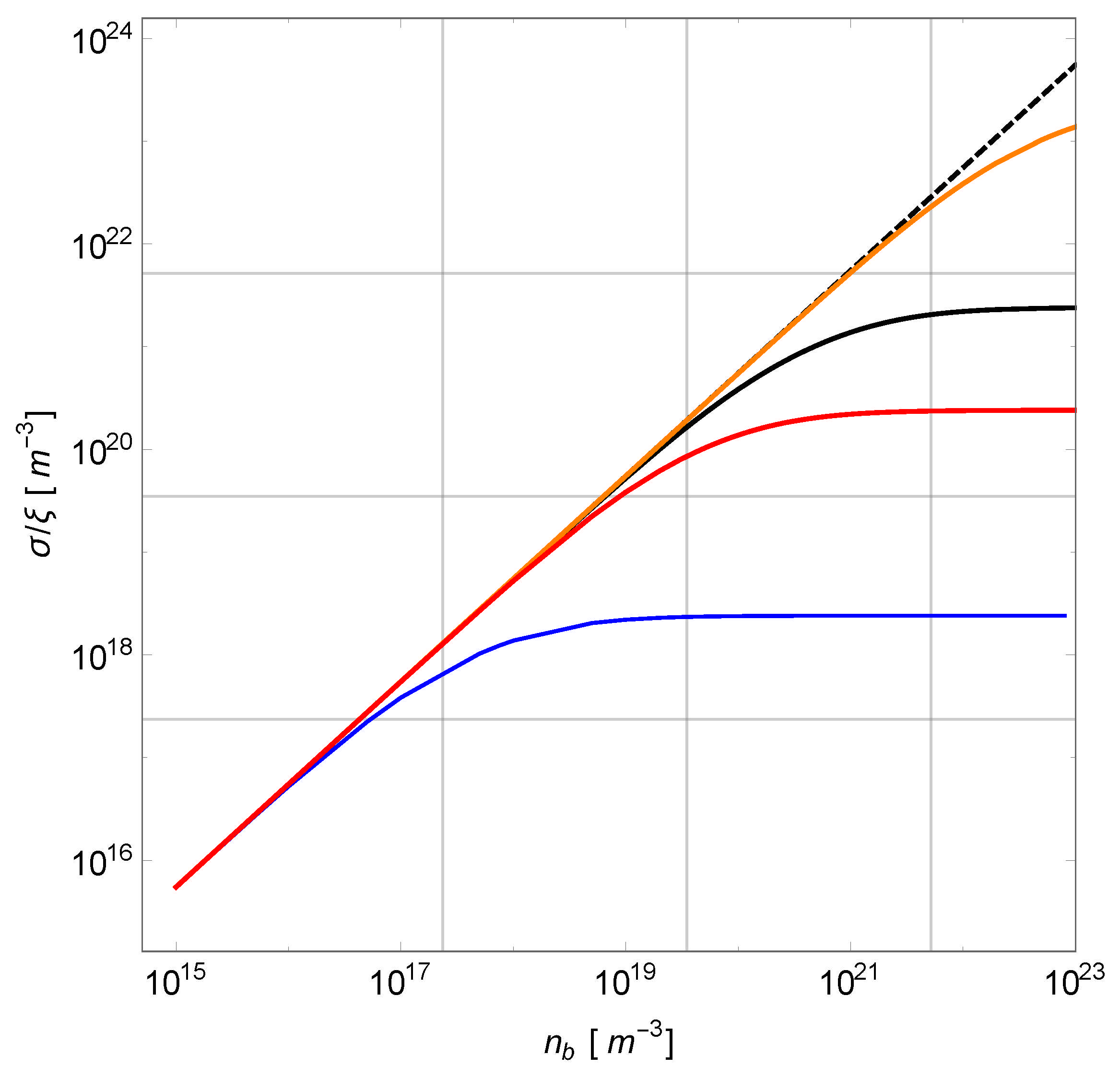
The impact of the reaction potential strength
on saturation is shown in
Figure 4, where
is plotted against
for several representative values of
, measured in
units. When
(dashed line),
increases linearly with
without bound (case of non-interacting point-like particles). When
, saturation always appears, and its value
decreases as the strength of the inter-particle potential increases.
In the following, we use the numerical data to determine the dependence of
on
.
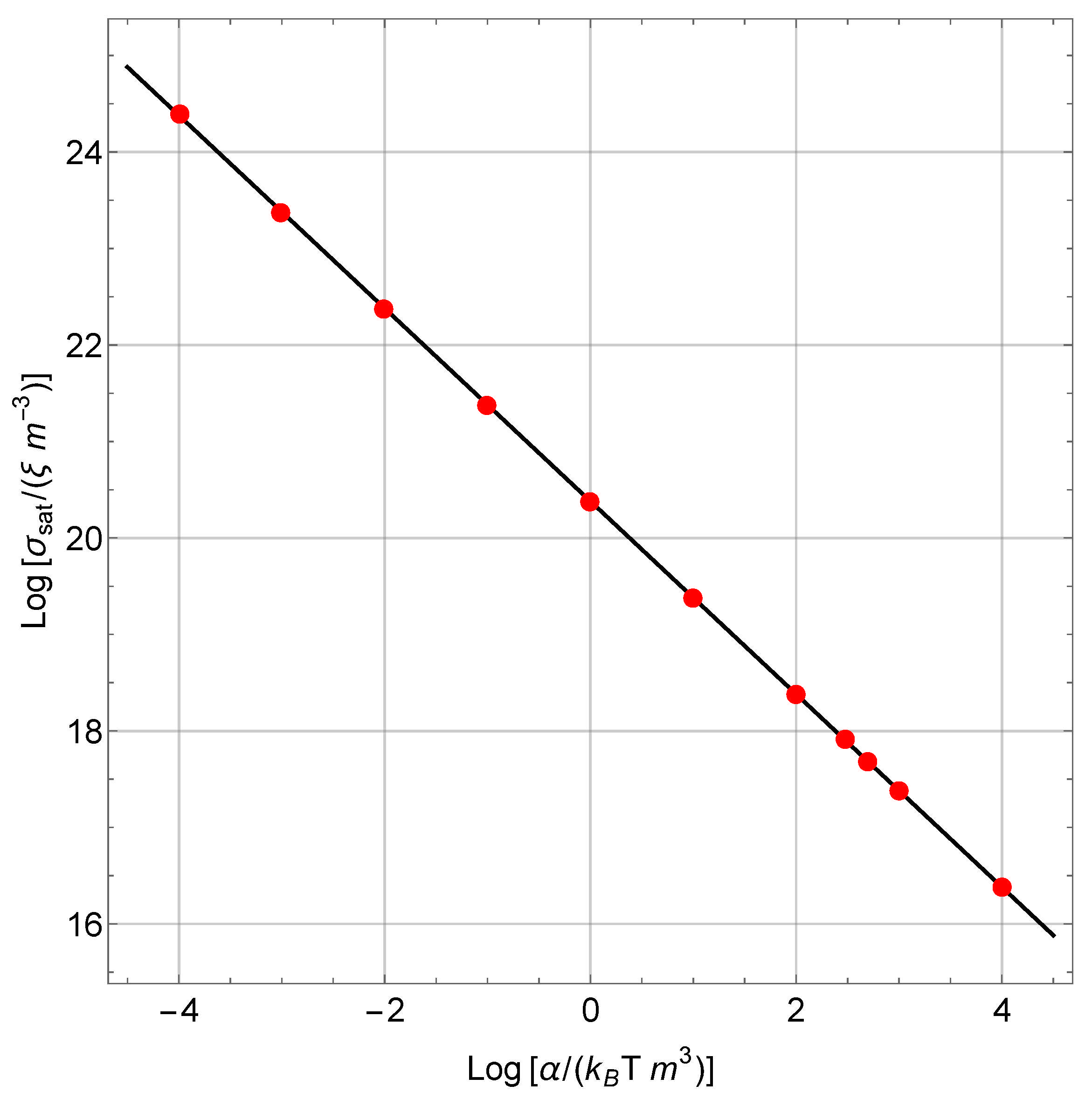
Figure 5 shows the logarithm of
as a function of the logarithm of the reaction field strength
in Equation (
22) over a range of eight decades. Solid points are numerically calculated, while the continuous line is a fitting performed by using the expression
The fit gives
,
and
. Hence, we conclude that
, as expected, since for
,
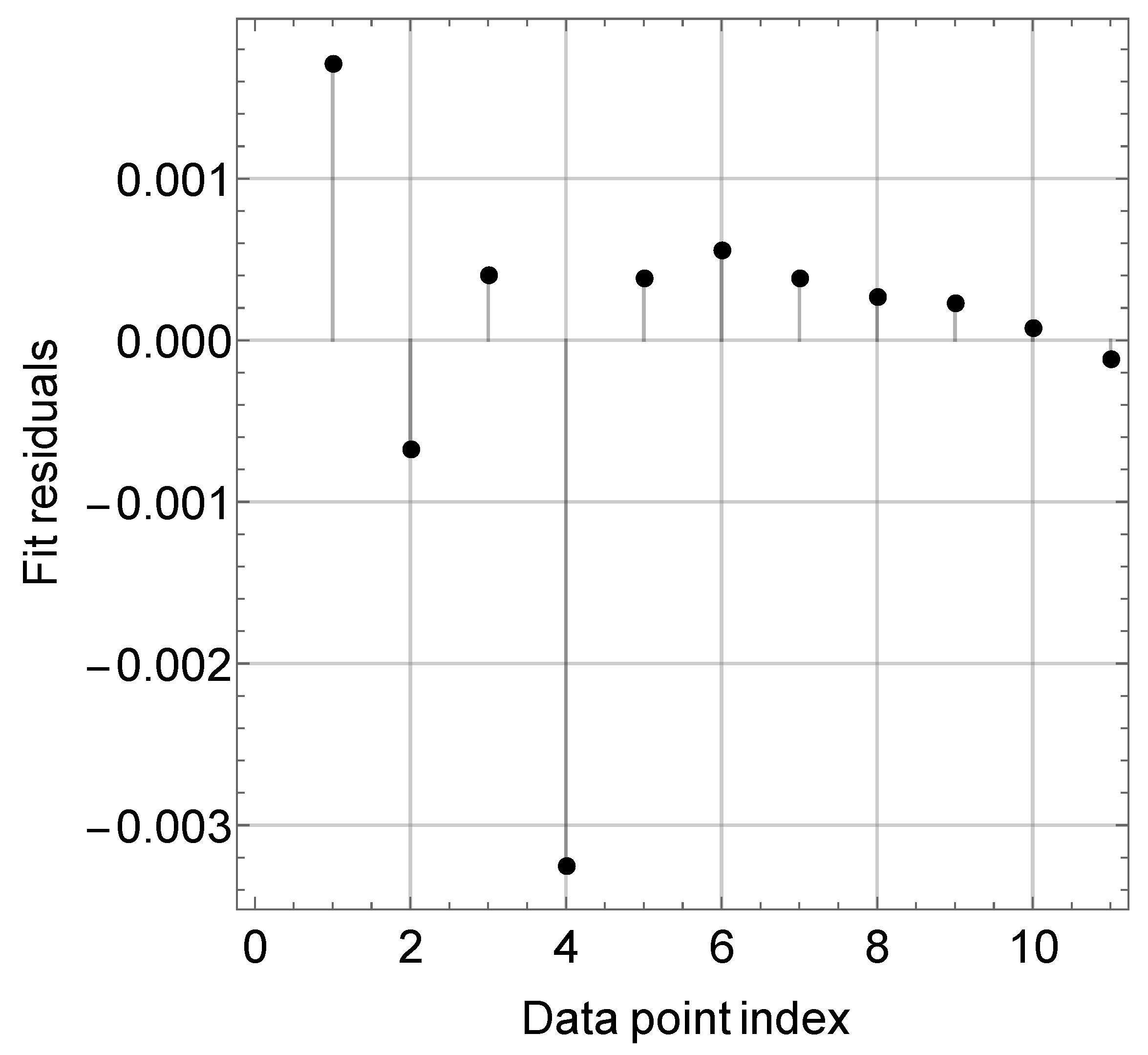
, recovering the ideal gas limit. The fit residuals are given in
Figure 6.
A word of caution is necessary here. The above scaling law,
, is valid in the linear approximation of the potential
in powers of
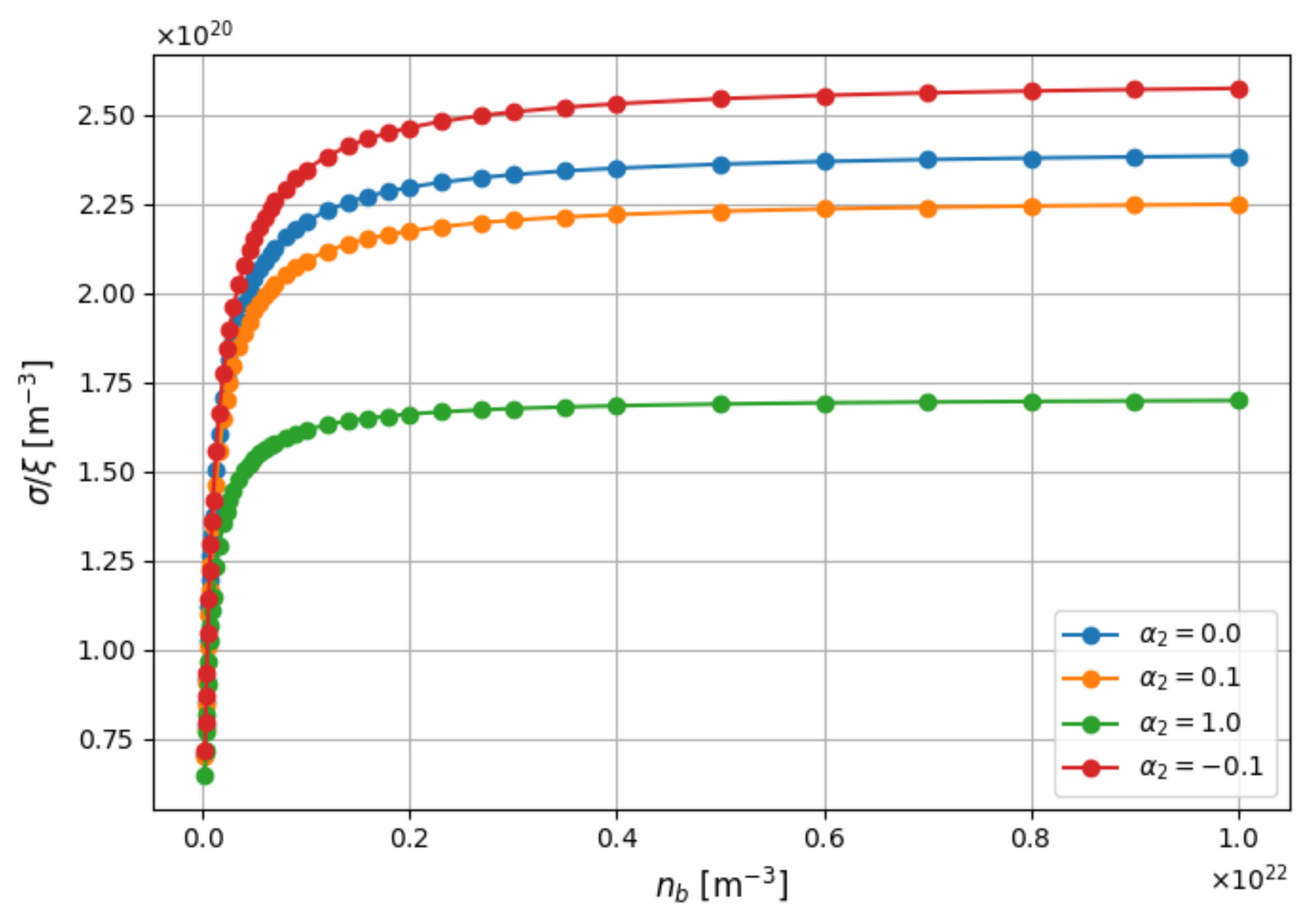
. This scaling law is not expected to be valid if a quadratic term in the expansion is kept, for this second-order term cannot be treated as a perturbation. As shown in
Figure 7, when the second-order term is kept, that is
then for
the saturation level changes. That is, the saturation effect is always present but the above scaling law is modified in the presence of the quadratic term.