Perspective

Phase Separation in Nonaqueous Systems Induced by a Solid Component

by
Tadeusz Hofman
* and
Wojciech Tomaszewski
Faculty of Chemistry, Warsaw University of Technology, 00-661 Warsaw, Poland
*
Author to whom correspondence should be addressed.
Liquids 2026, 6(1), 10; https://doi.org/10.3390/liquids6010010
Submission received: 31 December 2025 / Revised: 9 February 2026 / Accepted: 19 February 2026 / Published: 21 February 2026
(This article belongs to the Section Physics of Liquids)

Abstract

The research on nonaqueous two-phase systems, i.e., ternary nonaqueous systems with a liquid–liquid phase split induced by a solid component, is discussed. Previous scattered reports are reviewed and summarized. The first systematic studies are described in detail. These included qualitative testing of numerous ternary systems (a solid component and two liquid solvents, significantly different in polarity) to determine whether a liquid–liquid phase split occurred. Some correlations between this occurrence and the Hofmeister series were suggested. The liquid–liquid equilibrium was determined experimentally in a few systems, and the problems encountered during this determination are discussed. Possible applications and further topics of investigation are suggested.

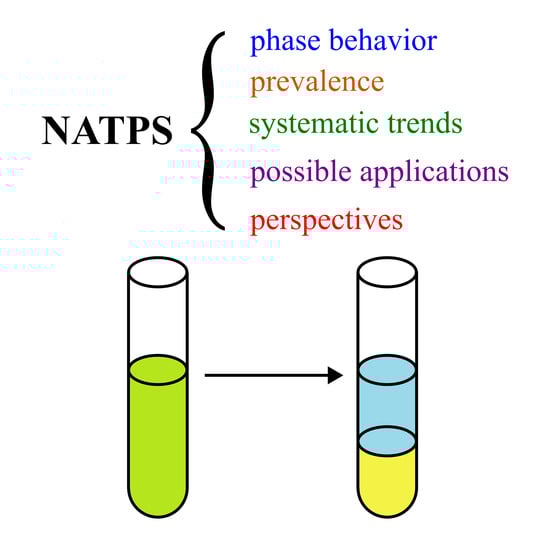
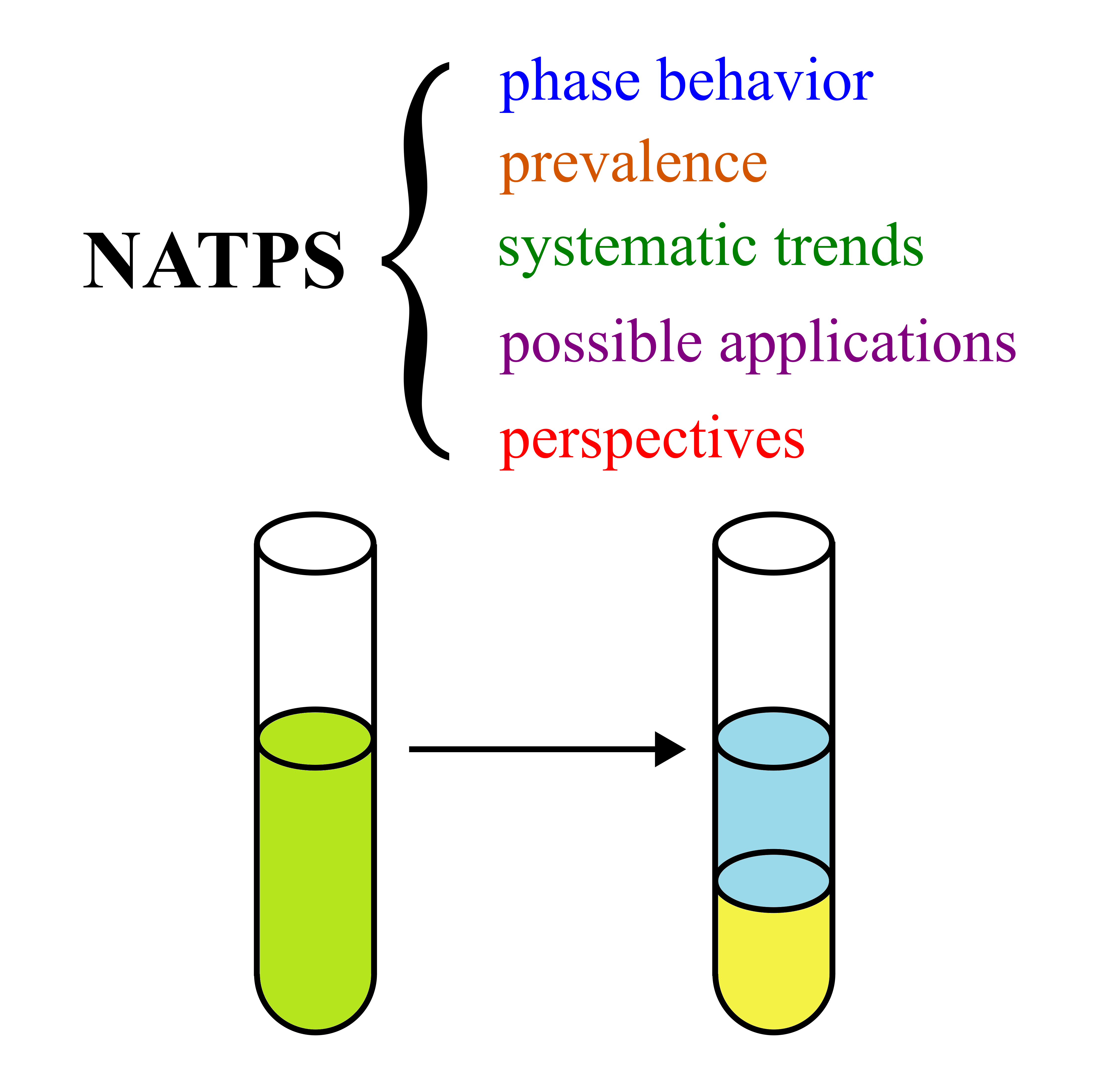
Graphical Abstract

1. Introduction

Aqueous two-phase systems (ATPS) were introduced many years ago. Their first appearance in the literature dates back to 1910 [1]. They consist of a salt or another solid component and two liquid compounds, including water. This solid component acts as an agent that induces phase separation. As a result, a homogeneous binary liquid solvent splits into two liquid phases. This observation has been very fruitful, mainly because of the specific character of both liquid phases. In fact, they are both hydrophilic because they contain considerable amounts of water. Such systems have proven effective for the extraction of numerous compounds of biological significance [2].
This idea, in which a solid additive induces a liquid-phase separation in a homogeneous liquid mixture, need not be restricted to aqueous solutions. It is expected that focusing on different nonaqueous solvents will expand the field of exploration and potential applications.
When we first recognized this issue a few years ago, we found only a few articles on “nonaqueous two-phase systems” (NATPS). These were isolated communications with no continuity, and no systematic examination was performed. The oldest is probably that of Tatsievskaya et al. [3]. The authors measured vapor–liquid equilibria in a chloroform + methanol + lithium chloride system and, by chance, observed that within a certain parameter range, two coexisting liquid phases appear. Later, Liu et al. [4] observed that a quaternary surfactant can induce liquid–liquid phase separation when added to a binary nonaqueous solution. They studied this phenomenon using a few quaternary ammonium surfactants—butanlene-α,ω-bis(dimethylalkyl-ammonium bromides) (Cm-4-Cm·2Br (m = 8,10,12)) and two compounds that can be interpreted as their “monomers”—decyltrimethylammonium bromide (C10TABr) and dodecyltrimethylammonium bromide (C12TABr). The authors recognized that the binary solvent should be composed of one polar and one nonpolar compound. The solid agent should be more easily solubilized in the former than in the latter. For C10-4-C10·2Br, fourteen binary solvent mixtures were tested, including chloroalkanes except carbon tetrachloride, ethers, esters, alkanols, and acetone as the polar component and cyclohexane, n-heptane, and carbon tetrachloride as the nonpolar component. In six systems, liquid–liquid phase separation was observed. Its occurrence seemed to depend mainly on the solvent’s polar component. It appeared in systems with asymmetrical chloroalkanes (dichloromethane and chloroform) or in those containing acetone. Surprisingly, it did not occur with n-butanol or n-hexanol, despite the surfactant’s high solubility in these alkanols. Finally, the authors concluded that the surfactant’s “medium” solubility in the corresponding polar solvent is the key factor for the appearance of liquid–liquid phase separation. Other surfactants were tested only for the acetone + cyclohexane mixture. Liquid–liquid phase separation has been observed for C8-4-C8·2Br, C10-4-C10·2Br, and C10TABr [4].
Generally, the problem can be described as inducing liquid–liquid phase separation in a homogeneous solvent mixture at ambient temperature. Because the condition “ambient temperature” is not precisely defined, it may be extended to include the significant influence of an additional solid component on a heterogeneous binary liquid system. Indeed, such an enhancement of the miscibility gap by a salt has been observed and studied. The first report was probably by Howard and Patterson in 1926 [5]. Two partially miscible binary systems were examined—ethanol with “paraffin” and methanol with n-hexane. It was confirmed that all 28 simple salts added increased the liquid–liquid solubility temperature and simultaneously enhanced the miscibility gap. Eckfeldt and Lucasse [6] determined solubility curves in the cyclohexane + methanol system in the presence of the inorganic sodium salts NaCl, NaBr, NaI, NaNO3, and NaSCN at various concentrations. Again, all the salts enlarged the miscibility gap, although significant differences in their strengths were observed. The ability of anions to enhance the miscibility gap changed in the following order: I > B r S C N > N O 3 > C l . Yang et al. [7] studied the liquid–liquid equilibria in ternary systems consisting of benzene, cyclohexane, N,N-dimethylacetamide, and ammonium thiocyanate (NH4SCN). The salt was added to increase selectivity in these extraction systems. It was shown that its influence is significant, and an additional enhancement of the miscibility gap was observed.
Several studies indicate that some bis(trifluoromethanesulfonyl)imide (TFSI) salts can induce miscibility gaps in nonaqueous mixtures. Recently, Wu et al. [8] studied liquid–liquid phase separation in PEO + PS polymer blends induced by a small concentration of the LiTFSI salt. Wang et al. found that a mixture of LiTFSI and LiNO3 induces liquid stratification in a diethyl ether—N,N-dimethylacetamide solution [9]. Other studies report liquid–liquid phase separation in mixtures of ethers and organic carbonates upon addition of Mg(TFSI)2 or Zn(TFSI)2 [10]. Although not a NATPS per se, the monoglyme + Mg(TFSI)2 system exhibits analogous phase behavior: salting-out behavior is observed in the binary system [11,12,13,14]. This phenomenon may be described as salt-induced liquid polymorphism. The existence of numerous independent reports on bis(trifluoromethanesulfonyl)imide NATPSs suggests that they offer a promising direction for further research.

2. Possible Applications of NATPS

Although research on NATPSs to date has been largely experimental and theoretical, several potential applications can be proposed. These ideas may stem from the practical applications of ATPSs or other mixed aqueous–organic solutions, where liquid–liquid coexistence plays a crucial role.
ATPSs are commonly used in homogeneous liquid–liquid extraction processes for the isolation and purification of various substance classes (e.g., proteins [15,16], nucleic acids [15], other biomolecules [17], active pharmaceutical ingredients [18], and larger assemblies cells [16], organelles [15,16], viruses [16,19], virus-like particles [19]). Both salts and carbohydrates are used as phase-separation agents (salting-out- and sugaring-out-assisted liquid–liquid extractions [20,21]). ATPSs are also useful in microextraction processes [22].
Because many NATPS formulations contain organic solvents that are incompatible with sensitive biomolecules, they would be of limited interest to biotechnology. Yet they would offer a promising alternative to conventional methods for extracting and hydrolyzing water-sensitive compounds (e.g., labile organometallic compounds) or serving as solvent systems for the reactive extraction of such substances. Other potential applications may include metal ion extraction or the extractive isolation of bitumen from oil sands, since these processes are carried out using nonaqueous solvents [23,24,25,26]. Additionally, extractive processes involving NATPSs could be applied to sample processing (analyte preconcentration) in analytical chemistry, including homogeneous liquid–liquid microextraction [27,28].
One can envision a possible application of the discussed systems in homogeneous catalysis. The following hypothetical periodic process may be proposed: (1) Two nonaqueous liquid phases are mixed—one containing substrate(s) dissolved in solvent A, and the other containing a catalyst dissolved in solvent B. (2) After stirring, the mixture becomes homogeneous. (3) The reaction proceeds in a homogeneous system. (4) Liquid–liquid phase separation occurs upon adding a salt or carbohydrate (or other miscibility gap-inducing compound). (5) The catalyst-containing phase is reused in subsequent cycles. In contrast, the phase containing both the product(s) and the phase separation-inducing agent is removed from the reactor (Figure 1).
For this process to occur, several solubility conditions must be met. The catalyst must be poorly soluble in pure solvent A, while the products and the phase separation-inducing agent must be poorly soluble in pure solvent B. Additionally, both solvents must be fully miscible in the absence of the phase separation-inducing component. The proposed method for splitting the post-reaction NATPS mixture is an alternative to using tunable [29,30] or thermomorphic [31] solvents, or to adding an immiscible solvent [32]. It is important to note that several existing industrial processes bear partial resemblance to the proposed catalytic reaction: Ruhrchemie–Rhône-Poulenc aqueous biphasic hydroformylation [33], Shell higher olefin process (nonaqueous biphasic olefin oligomerization) [34], and Institut Français du Pétrole olefin dimerization processes (Dimersol and Difasol) [35,36], yet none of those form a perfect match.
Various catalytic reactions can be carried out using phase-transfer catalysis [37], in which NATPSs can serve as reaction media. Because several nonaqueous solvent mixtures exhibit KSCN-, NaSCN-, KOCN-, and NaOCN-induced phase separations [38,39], one could expect such systems to be used for synthesizing organic isocyanates and isothiocyanates, which are known to undergo hydrolysis [40,41].
Suspension and emulsion polymerizations (usually carried out in water-containing biphasic mixtures) could be performed under nonaqueous conditions using NATPSs. Adding salt would induce a miscibility gap between the continuous and dispersed phases, forcing the reaction to proceed. So far, several nonaqueous suspensions [42,43] and emulsions [44,45,46,47] for polycondensations and polymerizations have been proposed, but in each case, the solvents have limited miscibility in the binary solvent subsystem.
Recently, Wang et al. constructed a working lithium-sulfur (Li-S) battery based on a quaternary NATPS of diethyl ether (DEE) + N,N-dimethylacetamide (DMA) + LiTFSI + LiNO3 [9]. Such a nonaqueous biphasic self-stratified battery (BSB) was found to overcome several drawbacks of aqueous BSBs [9,48,49,50,51]. Substituting water for an organic solvent widens the electrochemical window and enables operation at higher voltages. Batteries based on nonaqueous self-stratified electrolytes also exhibit significantly higher power density than their aqueous counterparts [9]. In BSBs, a membrane separating two liquid phases (as in redox flow batteries) is not required, since electrolyte immiscibility alone keeps the phases separated [48] and reduces the shuttling phenomenon by preventing polysulfide migration to the anode [9].
Both aqueous and nonaqueous BSBs are emerging areas of electrochemical research with potential future applications, including grid energy storage [9,49,52], Li-S [9], and aqueous zinc metal batteries [50,52]. Because the ternary monoglyme + Mg(TFSI)2 + MgCl2 system (based on the binary polyamorphic monoglyme + Mg(TFSI)2 system [11]) is a promising electrolyte candidate for rechargeable magnesium batteries (RMBs) [53,54], it might also enable novel RMB implementations based on the salting-out effect in nonaqueous mixtures.

3. Our Research

We recognized the potential significance of studying whether a solid component could induce liquid–liquid phase separation in nonaqueous systems around 2022. It was surprising that the success of aqueous two-phase systems (ATPS) did not inspire further research into systems containing a nonaqueous polar liquid component. Finally, it was decided to explore this topic. Because the scope of the phenomenon was unclear, it was decided at the outset to conduct a comprehensive qualitative study to determine whether the phenomenon, reported so rarely, is indeed rare or merely common but unnoticed. Both answers seemed probable. On the one hand, water’s properties are unique; on the other, many polar compounds could replace it.
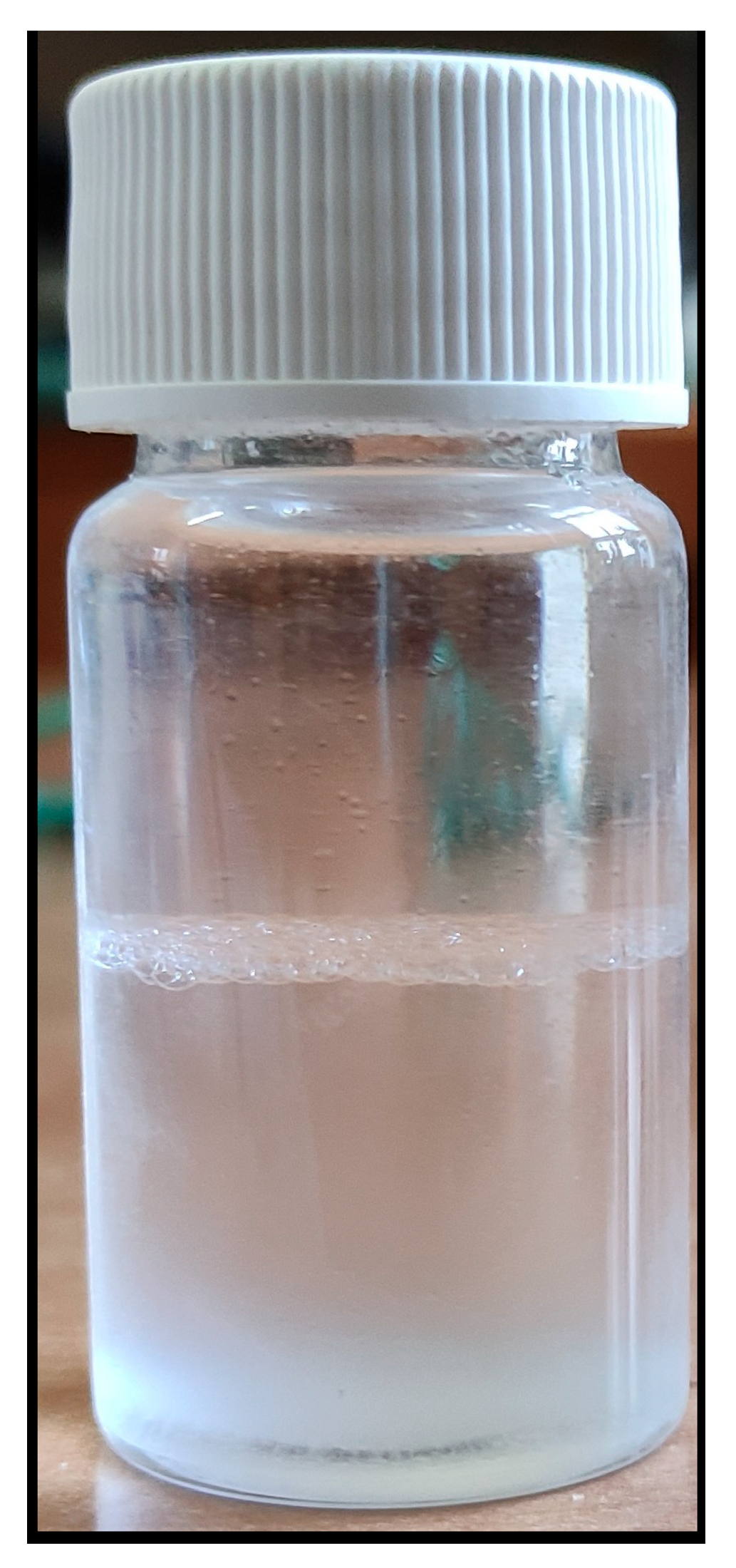
In this investigation [38], a large number of possible NATPSs, using numerous salts and a few carbohydrates, were evaluated. Altogether, 2557 ternary systems, including 117 pairs of solvents, 22 salts, and 3 carbohydrates, were tested—see, for example, Figure 2. The binary solvent mixtures were selected to be potentially able to split into two liquid phases if a solid agent is introduced. The preferred conditions for phase split are as follows: (i) the binary solvent should exhibit high positive deviations from ideality; however, these should not be sufficient to generate phase split by themselves; (ii) the solid component (S) should easily dissolve in one solvent component (A) and poorly in the second one (B). In terms of deviations from ideality, it is expected that mixture (A + S) shows negative deviations, while (B + S) shows positive deviations. The explanation is simple and purely phenomenological. If a binary homogeneous system exhibits strong positive deviations from ideality, it is close to separating into two liquid phases, and even a weak additional factor can induce the phase split. The addition of a third component can serve as such a factor. Good solubility in one solvent reduces the likelihood of solid–liquid equilibrium. Low solubility in the second solvent is a simple consequence of a strong positive deviation from ideality in a binary solvent. This systematic study and collection of a large number of observations could reveal additional aspects and lead to the discovery of regularities.
It seems natural to look for correlations with the ion-specific series when considering ion properties. The Hofmeister series is the natural choice.
The main conclusion from these screening tests is that phase splitting in nonaqueous systems induced by a solid is quite common. Its presence has been confirmed in about 12% of the systems examined, i.e., 311 out of 2557. Its occurrence depends strongly on the nature of the solid and the polar solvent component. At the same time, a less- or nonpolar cosolvent is less important, provided that a significant difference between the solvents is preserved. Although only three carbohydrates or alditols (sucrose, D-sorbitol, and D-fructose) were tested, their strong ability to induce phase separation is noteworthy. Their superiority over the studied salts is so significant that it may reflect a general rule: carbohydrates are stronger phase-separation-inducing agents than salts. Indeed, for D-fructose, about 43% of the studied systems were liquid–liquid heterogeneous, while the most effective salts, calcium and lithium chlorides, were successful in about 25% of cases. There appear to be significant differences between salt abilities. Although not all ions were checked, and the observations for the series of salts of different cations and a fixed anion or vice versa are limited, some regularities can be noticed or at least suggested. For cations, the ability to induce phase splitting approximately follows the pattern C a 2 + > L i + > N H 4 + > N a + > S r 2 + > B a 2 + > K + , while for anions, it follows S C N > I > N O 3 > B r > C l > C H 3 C O O > H C O O   . It resembles the modern version of the Hofmeister series, or strictly speaking, its reversed formulation [55]. This means that the lower the ability to precipitate proteins, the greater the ability to induce liquid–liquid phase separation in nonaqueous solvents. This correspondence with the Hofmeister series is more strict for anions than for cations. Indeed, in the cations’ order, the positions of some ions do not agree with the Hofmeister series. In accordance with the latter, the S r 2 + and B a 2 + cations should be placed close to C a 2 + , and N H 4 + should be removed to the end of the series.
Some solvent preferences have also been observed, focusing only on the polar component. Differences between solvents have been noted depending on the salt or carbohydrate added. For salts, five polar solvents proved most effective: formamide, ethylene glycol, dimethyl sulfoxide, ethanol, and N-methylformamide (Table 1). The first two were apparently outstanding, yielding about 20% effectiveness. For carbohydrates, this group of solvents remains significant, except for ethanol, which has been shown to be totally ineffective. The order of effectiveness also changes. Formamide can still be counted among the best, but it now shares the top spot with dimethyl sulfoxide. The high position of N-methylformamide is also remarkable. These results are not fully comparable because more systems containing particular solvent mixtures were examined with salts than with carbohydrates. Nevertheless, the number of systems is sufficiently high to consider this observation a strong indication.
The scope of the first screening study was broadened by assessing combinations of two organic solvents with a solid protein denaturant (urea, thiourea, guanidine hydrochloride) [56]. Experiments confirmed that each denaturant can induce a liquid–liquid miscibility gap in selected binary solvent mixtures. However, guanidine hydrochloride (GdnHCl) is much more effective than urea or thiourea—liquid-phase demixing occurred in ~17% of systems containing GdnHCl. In contrast, the corresponding percentages for urea and thiourea are both ~2%.

3.1. Determination of LLE in the Particular NATPSs

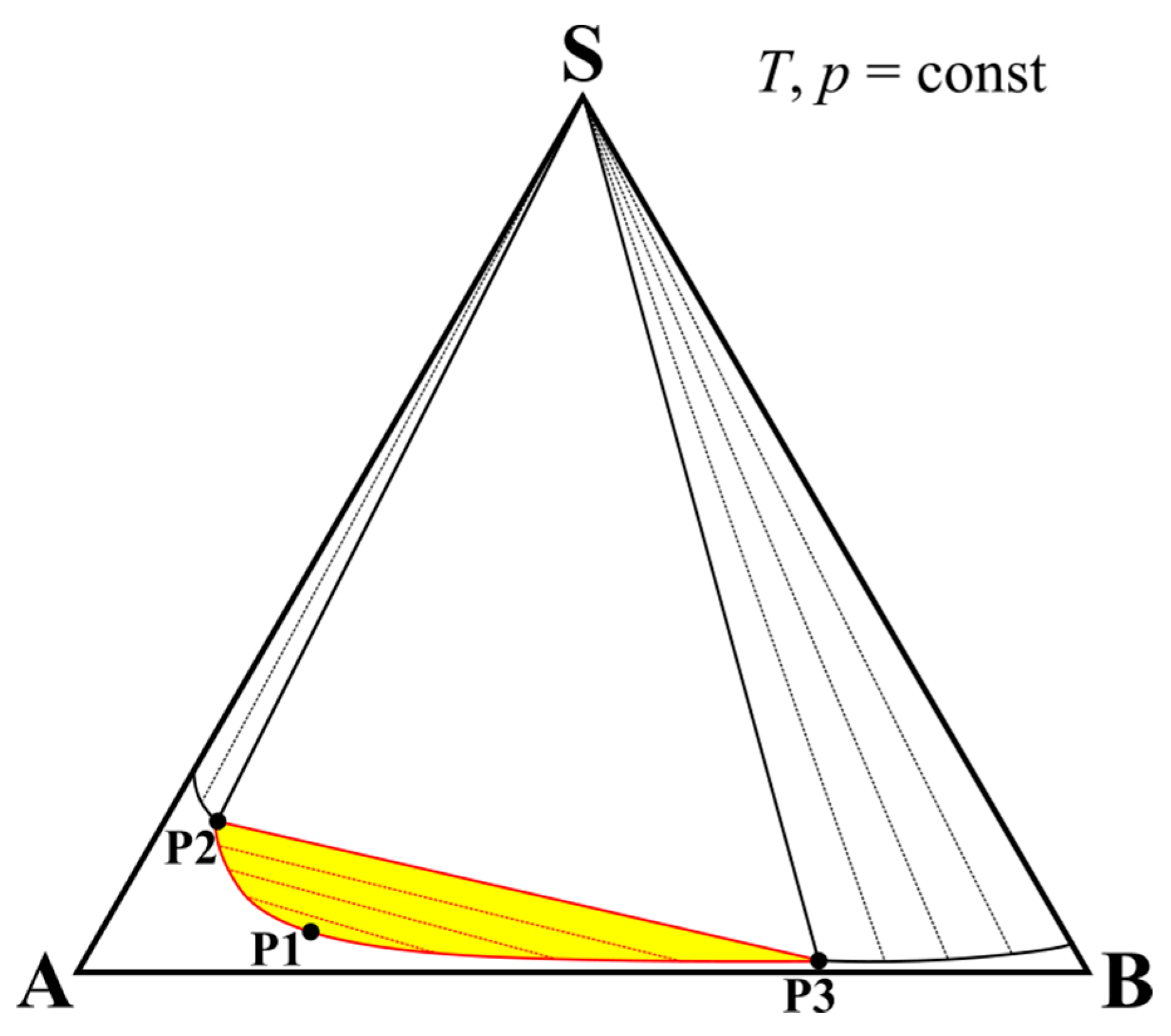
A more detailed study of liquid–liquid equilibrium in systems containing a salt, carbohydrate, or alditol, along with a two-component solvent, has been conducted [57,58,59]. In total, nine systems were examined, the majority of which (six) contained formamide as the polar solvent. The remaining polar solvents were methanol, ethanol, and acetone. The less polar solvents varied widely, including both nonpolar and undoubtedly polar solvents: n-hexane, (R)-limonene, dibutyl ether, ethyl acetate, 1-pentanol, 1-butanol, and acetonitrile. Among the solid agents, three sodium salts were used: NaBr (2), NaNO3 (2), NaSCN (2), and NaI (1). Additionally, the carbohydrates D-sorbitol and D-fructose were included. The following systems were studied isothermally: NaBr + formamide + ethyl acetate, NaSCN + ethanol + (R)-limonene, NaSCN + methanol + dibutyl ether, and NaI + acetone + n-hexane [58,59]. All of them exhibited the same pattern of the isothermal liquid–liquid miscibility gap, as shown in Figure 3. The two-liquid area is relatively small, bounded on one side by the solid–liquid–liquid area. It is asymmetrical, with one edge very close to the solvent–solvent triangle side and containing a very small amount of the solid component. It is expected that the isothermal critical point is characterized by similar concentrations of the two components forming the solvent. However, its precise experimental determination is difficult because of the binodal curve’s flatness. The binodal curve has a characteristic shape. Its part with a high concentration of the less polar component approaches the solid–liquid–liquid segment at a very small angle. By contrast, the other end of the binodal curve, corresponding to the high concentration of the polar component, meets this segment almost at a right angle.
For the following systems: NaBr + formamide + 1-pentanol; NaNO3 + formamide + 1-pentanol; NaNO3 + formamide + 1-butanol; D-sorbitol + formamide + 1-butanol; D-fructose + formamide + acetonitrile, an attempt was made to determine the three-dimensional binodal surface as a function of temperature [57]. No tie-lines were determined, but the cloud points were well defined at ternary concentrations. This approach aimed to explain how the liquid–liquid miscibility gap changes with temperature and at what temperature it disappears. Because these cloud points lie on the binodal surface, they can reconstruct its shape and extent.
The average temperature range of the determined cloud points was about 100 K, starting at about 275 K. The miscibility gap for salt-containing systems extends to higher temperatures, up to about 380 K, whereas that for carbohydrates disappears at about 355 K. However, the number of measured systems is too low to draw general conclusions.

3.2. Model Description

3.2.1. Thermodynamic Modeling

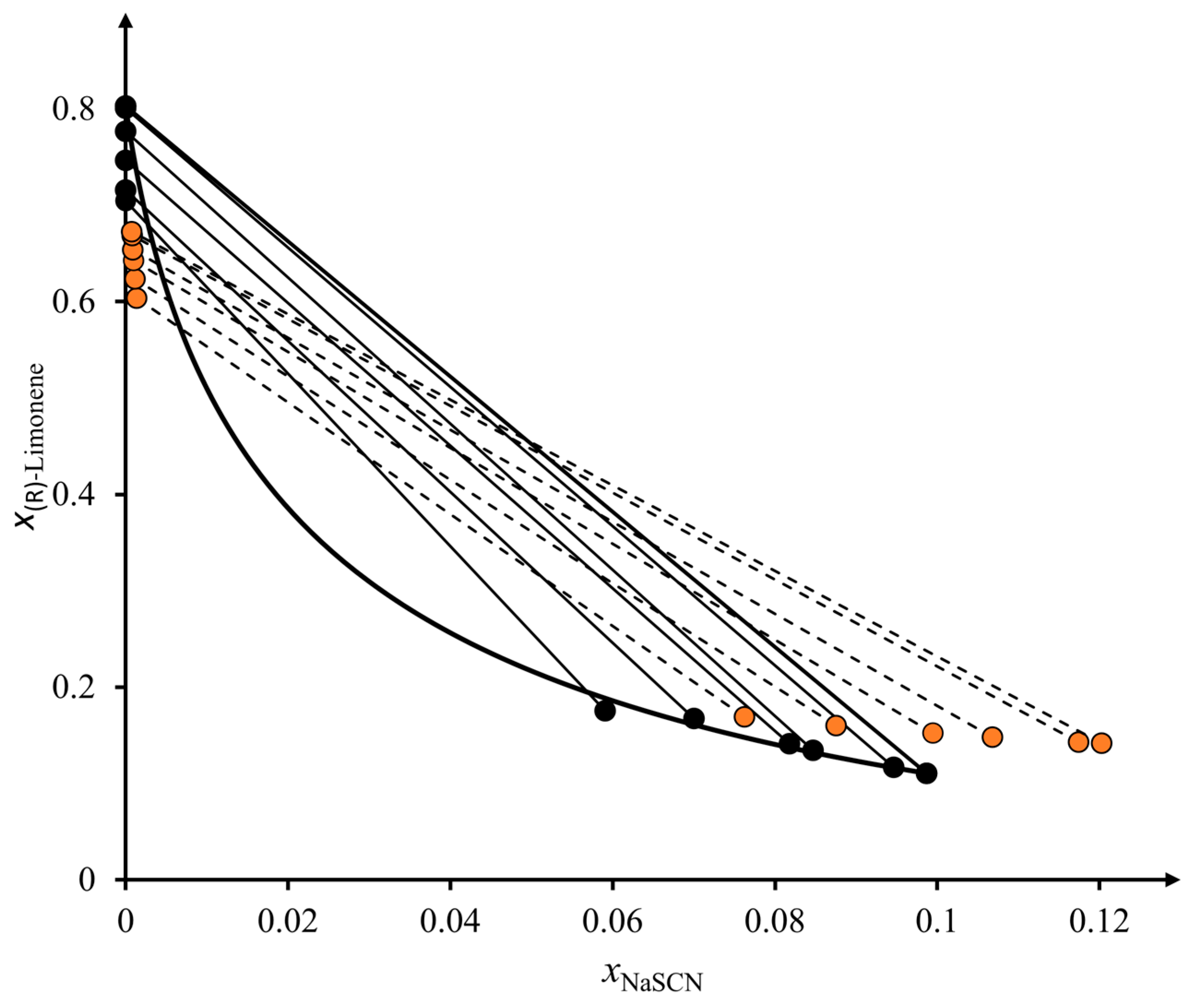
Significant difficulties have been encountered in describing the LLE data using a thermodynamic model. The obvious choices are the NRTL [60] and UNIQUAC [61] models; both are among the most frequently applied for liquid–liquid equilibria and are widely recognized as the most appropriate [62,63]. The primary obstacle is the atypical, highly asymmetrical shape of the binodal curve for isothermal data. Nevertheless, the NRTL model was applied to these data to minimize the number of adjustable parameters. This approach is possible only if phase equilibrium data for binary subsystems (solid–liquid or vapor–liquid) are available. If such data are available, the binary model parameters can be determined separately. The remaining unknown parameters had to be adjusted to fit the ternary liquid–liquid equilibrium tie-lines. For the measured systems, solubility data for the salt + less-polar solvent were unavailable; therefore, the model parameters for this pair were adjusted using ternary data, sometimes supplemented by parameters from the solvent subsystem. Finally, the number of parameters adjusted to the ternary liquid–liquid equilibrium data was two or four, corresponding to one or two binary subsystems. The standard deviations in mole fraction ranged from 0.026 to 0.061. However, the overall reproducibility is biased by the very low concentration of one component (the less-polar solvent). Also, the slope of the tie-lines clearly disagrees with reality. This is an obvious consequence of the highly asymmetrical shape of the binodal curve. Undoubtedly, fully empirical correlations give lower standard deviations [58]. All these problems are clearly visible in Figure 4, which shows the experimental data for NaSCN + ethanol + (R)-limonene at 313.2 K, along with the model application [58].
The model description of the non-isothermal binodal surface proved even more difficult [57]. Although the NRTL equation accounts for temperature dependence, it is insufficient, and the parameters vary with temperature when the model is fitted at different temperatures [60]. This dependence has been assumed to be linear or higher-order [64,65]. Formally, for ternary systems, the model provides three isoactivity equations that must be solved for the temperature and the concentration of the vanishing liquid phase, given the known concentration of the dominant phase. The latter concentration equals the mixture’s global concentration. Unfortunately, the temperature could not be calculated effectively using standard algorithms in many cases, even if the temperature dependence of the parameters was neglected. Moreover, the calculated temperature proved very sensitive to even small changes in the model parameters. On the other hand, the experimental cloud-point temperatures were determined with rather low accuracy due to the very steep slope of the binodal surface. At this time, it is recognized that applying a thermodynamic model to describe the binodal surface is not possible. Finally, we used a strictly empirical correlation to reproduce this surface [57].

3.2.2. Machine Learning

The large number of confirmed and potentially existing NATPSs suggests the need for a tool to help identify them. This task would be strictly qualitative, focusing on the properties of all three components that guarantee a high probability of liquid–liquid phase separation. Since a vast amount of experimental data already exists [38], it is possible to find correlations between the desired state and certain molecular descriptions of the components. We have taken this approach using machine learning.
Machine learning (ML) is a rapidly developing branch of data science. It has been used in several studies [66,67,68] to describe phase behavior. The collected experimental data for systems containing salts and protein denaturants (i.e., the presence or absence of phase separation) were used to develop several ML models describing phase behavior (a binary classification task) [39,56]. The F1 score (the harmonic mean of precision and recall) was selected as an appropriate evaluation metric for the resulting models, since it is suitable for imbalanced classification [69].
The application of ML to the study of the salt-induced miscibility gap in nonaqueous mixtures [39] had to account for both solvent and ion properties. Various feature combinations based on Abraham linear solvation energy relationship parameters [70], Hansen solubility parameters [71], and liquid openness (the percentage of free volume in the bulk liquid) [72] were used to characterize solvent properties. Ion-specific descriptors (polarizability, conceptual DFT parameters, and ad hoc properties—Cartledge ionic potential [73], Górski electronegativity force [74]) were chosen for salt modeling. This parametrization enabled a chemically intuitive interpretation of the results.
The mean F1 scores on the test sets (obtained via Monte Carlo cross-validation) ranged from 0.50 to 0.55 for the best feature combinations and classifiers [39,56]. The presented models could be used to pre-screen potential ternary NATPS candidates (e.g., for the applications described in this paper) and to identify and describe the influence of various physicochemical properties on observed salting-out phenomena, thereby enhancing understanding of the driving forces responsible for demixing.

4. Conclusions and Future Works

The most important conclusion from these studies is the experimental evidence that the systems discussed are not rare anomalies but occur commonly. It was also possible to determine the factors that characterize components that favor liquid–liquid phase separation.
We have sought to demonstrate that exploring nonaqueous two-phase systems (NATPS) is a promising new field of research. It offers new possibilities for extraction, catalysis, and other technological processes. The most promising application is in batteries, where two-liquid heterogeneous mixtures can serve as electrolytes [9]. However, these potential applications are merely suggestions that require further examination and verification. Nevertheless, given the large number of NATPSs already confirmed or expected to exist, we believe such applications are possible.
Some topics require further research because overall knowledge of these systems remains limited. In our search for NATPSs, we have limited our investigations to basic solids, mainly salts and commonly used solvents [38]. Given potential applications, both solids and solvents should be chosen more intentionally. For example, in the context of electrolyte batteries, some carbonates, such as ethylene, dimethyl, and diethyl carbonates, should be considered as solvents. The high effectiveness of carbohydrates, by no means, requires further study and confirmation. Generally, new experimental data are needed.
The NATPSs exhibit highly differentiated intermolecular interactions, which manifest as an atypical shape of the solubility curve and as difficulties in model description. There is a serious need to develop physically based models that can reproduce these systems.

Author Contributions

Conceptualization, T.H. and W.T.; methodology, T.H. and W.T.; data curation, T.H.; writing—original draft preparation, T.H. and W.T.; writing—review and editing, T.H.; visualization, W.T.; supervision, T.H. All authors have read and agreed to the published version of the manuscript.

Funding

This research was funded by Warsaw University of Technology. Grant Number: 504/04113/1020/44.000000.

Data Availability Statement

No new data were created or analyzed in this study. Data sharing is not applicable to this article.

Conflicts of Interest

The authors declare no conflicts of interest.

References

  1. Beijerinck, M.W. Ueber Emulsionsbildung Bei Der Vermischung Wässeriger Lösungen Gewisser Gelatinierender Kolloide. Z. Für Chem. Ind. Kolloide 1910, 7, 16–20. [Google Scholar] [CrossRef]
  2. Asenjo, J.A.; Andrews, B.A. Aqueous Two-Phase Systems for Protein Separation: A Perspective. J. Chromatogr. A 2011, 1218, 8826–8835. [Google Scholar] [CrossRef]
  3. Tatsievskaya, G.I.; Vitman, T.A.; Kushner, T.M.; Serafimov, L.A. Study of the Phase Equilibrium of Liquid–Vapor–Solid Phase. 2. Chloroform–Methanol–Lithium Chloride System. Zh Fiz. Khim 1982, 56, 2353–2356. [Google Scholar]
  4. Liu, J.; Zhao, J.; Chen, Z. Phase Separation in Nonaqueous Mixed Solvents Induced by Quaternary Ammonium Surfactants. Acta Phys.-Chim. Sin. 2006, 22, 845–849. [Google Scholar] [CrossRef]
  5. Howard, E.J.; Patterson, W.H. CCCLXVIII—The Influence of Dissolved Salts on the Mutual Miscibility Temperature of the Systems Ethyl Alcohol or Methyl Alcohol–Paraffins. J. Chem. Soc. 1926, 129, 2787–2791. [Google Scholar] [CrossRef]
  6. Eckfeldt, E.L.; Lucasse, W.W. The Liquid–Liquid Phase Equilibria of the System Cyclohexane–Methyl Alcohol in the Presence of Various Salts as Third Components. J. Phys. Chem. 1943, 47, 164–183. [Google Scholar] [CrossRef]
  7. Yang, X.; Fu, Y.; Zhang, X.; Dong, H.; Wang, Y.; Yue, G.; Liu, J. Liquid–Liquid Equilibria of Benzene + Cyclohexane + N, N-Dimethyl Acetamide + Ammonium Thiocyanate at 298.15 K and Atmospheric Pressure. J. Chem. Eng. Data 2015, 60, 971–975. [Google Scholar] [CrossRef]
  8. Wu, X.; Song, T.; Wei, Z.; Shen, L.; Jiang, H.; Ke, Y.; He, C.; Yang, H.; Shi, W. Promoted Liquid-Liquid Phase Separation of PEO/PS Blends with Very Low LiTFSI Fraction. Polymer 2022, 260, 125307. [Google Scholar] [CrossRef]
  9. Wang, Z.; Ji, H.; Zhou, J.; Zheng, Y.; Liu, J.; Qian, T.; Yan, C. Exploiting Nonaqueous Self-Stratified Electrolyte Systems toward Large-Scale Energy Storage. Nat. Commun. 2023, 14, 2267. [Google Scholar] [CrossRef]
  10. Chen, Y.; Ryu, J.; Bazak, J.D.; Nguyen, D.T.; Han, K.S.; Li, Z.; Hu, J.Z.; Mueller, K.T.; Murugesan, V. Ion Solvation-Driven Liquid–Liquid Phase Separation in Divalent Electrolytes with Miscible Organic Solvents. J. Phys. Chem. C 2023, 127, 15443–15453. [Google Scholar] [CrossRef]
  11. Salama, M.; Shterenberg, I.; Gizbar, H.; Eliaz, N.N.; Kosa, M.; Keinan-Adamsky, K.; Afri, M.; Shimon, L.J.W.; Gottlieb, H.E.; Major, D.T.; et al. Unique Behavior of Dimethoxyethane (DME)/Mg(N(SO2CF3)2)2 Solutions. J. Phys. Chem. C 2016, 120, 19586–19594. [Google Scholar] [CrossRef]
  12. Kubisiak, P.; Eilmes, A. Solvation of Mg2+ Ions in Mg(TFSI)2–Dimethoxyethane Electrolytes—A View from Molecular Dynamics Simulations. J. Phys. Chem. C 2018, 122, 12615–12622. [Google Scholar] [CrossRef]
  13. Holin, O.; Gofer, Y.; Major, D.T.; Aurbach, D. Understanding the Unique Thermodynamic Behavior of MgTFSI2/DME Solutions. Part 1: Phase Diagram, Partial Volumes, and Densities. J. Phys. Chem. C 2023, 127, 14856–14862. [Google Scholar] [CrossRef]
  14. Holin, O.; Gofer, Y.; Major, D.T.; Aurbach, D. Understanding the Unique Thermodynamic Behavior of MgTFSI2/DME Solutions. Part 2: Thermodynamic Hypothesis, Raman Analyses, and Driving Forces. J. Phys. Chem. C 2023, 127, 14863–14873. [Google Scholar] [CrossRef]
  15. Raja, S.; Murty, V.R.; Thivaharan, V.; Rajasekar, V.; Ramesh, V. Aqueous Two Phase Systems for the Recovery of Biomolecules–A Review. Sci. Technol. 2011, 1, 7–16. [Google Scholar] [CrossRef]
  16. Teixeira, A.G.; Agarwal, R.; Ko, K.R.; Grant-Burt, J.; Leung, B.M.; Frampton, J.P. Emerging Biotechnology Applications of Aqueous Two-Phase Systems. Adv. Healthc. Mater. 2018, 7, 1701036. [Google Scholar] [CrossRef]
  17. Segaran, A.; Chua, L.S. Review of Recent Applications and Modifications of Aqueous Two-Phase System for the Separation of Biomolecules. Int. J. Biol. Macromol. 2024, 276, 133856. [Google Scholar] [CrossRef]
  18. McQueen, L.; Lai, D. Ionic Liquid Aqueous Two-Phase Systems from a Pharmaceutical Perspective. Front. Chem. 2019, 7, 135. [Google Scholar] [CrossRef] [PubMed]
  19. Molino, J.V.D.; de Viana, M.D.A.; Junior, A.P.; Mazzola, P.G.; Gatti, M.S.V. Different Types of Aqueous Two-Phase Systems for Biomolecule and Bioparticle Extraction and Purification. Biotechnol. Prog. 2013, 29, 1343–1353. [Google Scholar] [CrossRef] [PubMed]
  20. Tang, Y.Q.; Weng, N. Salting-Out Assisted Liquid–Liquid Extraction for Bioanalysis. Bioanalysis 2013, 5, 1583–1598. [Google Scholar] [CrossRef] [PubMed]
  21. Zhang, J.; Myasein, F.; Wu, H.; El-Shourbagy, T.A. Sugaring-out Assisted Liquid/Liquid Extraction with Acetonitrile for Bioanalysis Using Liquid Chromatography–Mass Spectrometry. Microchem. J. 2013, 108, 198–202. [Google Scholar] [CrossRef]
  22. Miličević, N.; Panić, M.; Valinger, D.; Cvjetko Bubalo, M.; Benković, M.; Jurina, T.; Gajdoš Kljusurić, J.; Radojčić Redovniković, I.; Jurinjak Tušek, A. Development of Continuously Operated Aqueous Two-Phase Microextraction Process Using Natural Deep Eutectic Solvents. Sep. Purif. Technol. 2020, 244, 116746. [Google Scholar] [CrossRef]
  23. Nikakhtari, H.; Vagi, L.; Choi, P.; Liu, Q.; Gray, M.R. Solvent Screening for Non-Aqueous Extraction of Alberta Oil Sands. Can. J. Chem. Eng. 2013, 91, 1153–1160. [Google Scholar] [CrossRef]
  24. Lin, F.; Stoyanov, S.R.; Xu, Y. Recent Advances in Nonaqueous Extraction of Bitumen from Mineable Oil Sands: A Review. Org. Process Res. Dev. 2017, 21, 492–510. [Google Scholar] [CrossRef]
  25. Batchu, N.K.; Vander Hoogerstraete, T.; Banerjee, D.; Binnemans, K. Non-Aqueous Solvent Extraction of Rare-Earth Nitrates from Ethylene Glycol to n-Dodecane by Cyanex 923. Sep. Purif. Technol. 2017, 174, 544–553. [Google Scholar] [CrossRef]
  26. Li, Z.; Dewulf, B.; Binnemans, K. Nonaqueous Solvent Extraction for Enhanced Metal Separations: Concept, Systems, and Mechanisms. Ind. Eng. Chem. Res. 2021, 60, 17285–17302. [Google Scholar] [CrossRef]
  27. Hammad, S.F.; Abdallah, I.A.; Bedair, A.; Mansour, F.R. Salting-out Induced Liquid–Liquid Microextraction for Alogliptin Benzoate Determination in Human Plasma by HPLC/UV. BMC Chem. 2021, 15, 2. [Google Scholar] [CrossRef]
  28. Gupta, M.; Dsouza, A. Salting-out Homogeneous Liquid-Liquid Microextraction for the Spectrophotometric Determination of Iodate in Food Grade Salt. J. Food Compos. Anal. 2020, 87, 103396. [Google Scholar] [CrossRef]
  29. Lu, J.; Lazzaroni, M.J.; Hallett, J.P.; Bommarius, A.S.; Liotta, C.L.; Eckert, C.A. Tunable Solvents for Homogeneous Catalyst Recycle. Ind. Eng. Chem. Res. 2004, 43, 1586–1590. [Google Scholar] [CrossRef]
  30. Blasucci, V.M.; Husain, Z.A.; Fadhel, A.Z.; Donaldson, M.E.; Vyhmeister, E.; Pollet, P.; Liotta, C.L.; Eckert, C.A. Combining Homogeneous Catalysis with Heterogeneous Separation Using Tunable Solvent Systems. J. Phys. Chem. A 2010, 114, 3932–3938. [Google Scholar] [CrossRef] [PubMed]
  31. Bianga, J.; Künnemann, K.U.; Gaide, T.; Vorholt, A.J.; Seidensticker, T.; Dreimann, J.M.; Vogt, D. Thermomorphic Multiphase Systems: Switchable Solvent Mixtures for the Recovery of Homogeneous Catalysts in Batch and Flow Processes. Chem. Eur. J. 2019, 25, 11586–11608. [Google Scholar] [CrossRef]
  32. Horváth, I.T.; Rábai, J. Facile Catalyst Separation Without Water: Fluorous Biphase Hydroformylation of Olefins. Science 1994, 266, 72–75. [Google Scholar] [CrossRef]
  33. Kohlpaintner, C.W.; Fischer, R.W.; Cornils, B. Aqueous Biphasic Catalysis: Ruhrchemie/Rhône-Poulenc Oxo Process. Hoelderich Spec. Issue 2001, 221, 219–225. [Google Scholar] [CrossRef]
  34. Lutz, E.F. Shell Higher Olefins Process. J. Chem. Educ. 1986, 63, 202. [Google Scholar] [CrossRef]
  35. Commereuc, D.; Chauvin, Y.; Leger, G.; Gaillard, J. Aspects Chimiques Du Procédé DIMERSOL de Dimérisation Des Oléfines. Rev. Inst. Fr. Pét 1982, 37, 639–649. [Google Scholar] [CrossRef]
  36. Olivier-Bourbigou, H.; Favre, F.; Forestière, A.; Hugues, F. Ionic Liquids and Catalysis: The IFP Biphasic Difasol Process. In Handbook of Green Chemistry; John Wiley & Sons: Hoboken, NJ, USA, 2010; pp. 101–126. ISBN 978-3-527-62869-8. [Google Scholar]
  37. Mąkosza, M.; Fedoryński, M. Phase Transfer Catalysis. Catal. Rev. 2003, 45, 321–367. [Google Scholar] [CrossRef]
  38. Sikorski, P.; Tomaszewski, W.; Kosiek, K.; Hofman, T. The Phase Split Forced by Salts or Carbohydrates in Nonaqueous Systems. Fluid Phase Equilibria 2023, 570, 113790. [Google Scholar] [CrossRef]
  39. Tomaszewski, W.; Paduszyński, K.; Lesiuk, M.; Sikorski, P.; Kosiek, K.; Nocuń, K.; Hofman, T. Liquid-Liquid Phase Separation in Nonaqueous Two-Phase Systems Containing Salts: A Machine Learning Study. Fluid Phase Equilibria 2026. to be submitted.. [Google Scholar]
  40. Ben-Efraim, D.A. Detection and Determination of Cyanates, Isocyanates, Isothiocyanates, and Thiocyanates. In Cyanates and Their Thio Derivatives (1977); PATAI’S Chemistry of Functional Groups; John Wiley & Sons: Hoboken, NJ, USA, 1977; p. 197. ISBN 978-0-470-77152-5. [Google Scholar]
  41. Joseph, V.B.; Satchell, D.P.N.; Satchell, R.S.; Wassef, W.N. Hydrolysis of Aryl and Alkyl Isothiocyanates in Aqueous Perchloric Acid. J. Chem. Soc. Perkin Trans. 1992, 2, 339–341. [Google Scholar] [CrossRef]
  42. Wang, P.; Wang, K.; Zhang, J.; Luo, G. Non-Aqueous Suspension Polycondensation in NMP-CaCl2/Paraffin System—A New Approach for the Preparation of Poly(p-Phenylene Terephthalamide). Chin. J. Polym. Sci. 2015, 33, 564–575. [Google Scholar] [CrossRef]
  43. Georgiadou, S.; Thomas, N.L.; Gilbert, M.; Brooks, B.W. Nonaqueous Polymerization of Vinyl Chloride: An Environmentally Friendly Process. J. Appl. Polym. Sci. 2009, 112, 2472–2481. [Google Scholar] [CrossRef]
  44. Ganta, S.; Drechsler, C.; Chen, Y.-T.; Clever, G.H. Nonaqueous Emulsion Polycondensation Enabled by a Self-Assembled Cage-like Surfactant. Chem. Eur. J. 2022, 28, e202104228. [Google Scholar] [CrossRef]
  45. Müller, K.; Klapper, M.; Müllen, K. Synthesis of Conjugated Polymer Nanoparticles in Non-Aqueous Emulsions. Macromol. Rapid Commun. 2006, 27, 586–593. [Google Scholar] [CrossRef]
  46. Müller, K.; Klapper, M.; Müllen, K. Polyester Nanoparticles by Non-Aqueous Emulsion Polycondensation. J. Polym. Sci. Part. Polym. Chem. 2007, 45, 1101–1108. [Google Scholar] [CrossRef]
  47. Carr, E.L.; Johnson, P.H. Nonaqueous Emulsion Polymerization Systems. Ind. Eng. Chem. 1949, 41, 1588–1592. [Google Scholar] [CrossRef]
  48. Navalpotro, P.; Neves, C.M.S.S.; Palma, J.; Freire, M.G.; Coutinho, J.A.P.; Marcilla, R. Pioneering Use of Ionic Liquid-Based Aqueous Biphasic Systems as Membrane-Free Batteries. Adv. Sci. 2018, 5, 1800576. [Google Scholar] [CrossRef]
  49. Wang, Z.; Zhou, J.; Ji, H.; Liu, J.; Zhou, Y.; Qian, T.; Yan, C. Principles and Design of Biphasic Self-Stratifying Batteries Toward Next-Generation Energy Storage. Angew. Chem. Int. Ed. 2024, 63, e202320258. [Google Scholar] [CrossRef] [PubMed]
  50. Zhao, X.; Fu, J.; Chen, M.; Wang, Y.; Huang, C.; Qian, K.; Feng, G.; Li, B.; Zhou, D.; Kang, F. A Self-Phase Separated Electrolyte toward Durable and Rollover-Stable Zinc Metal Batteries. J. Am. Chem. Soc. 2025, 147, 2714–2725. [Google Scholar] [CrossRef] [PubMed]
  51. Navalpotro, P.; Santos, C.S.; Alcantara, M.L.; Muñoz-Perales, V.; Ibañez, S.E.; Martínez-Bejarano, A.; Jiyane, N.; Neves, C.M.S.S.; Rubio-Presa, R.; Quast, T.; et al. Enhancing the Stability of Aqueous Membrane-Free Flow Batteries: Insights into Interphase Processes. Angew. Chem. Int. Ed. 2025, 64, e202424650. [Google Scholar] [CrossRef]
  52. Zhang, K.; Ge, Y.; Yu, Q.; Zhang, P.; Feng, Y.; Tie, Z.; Ma, J.; Jin, Z. Self-Stratified Aqueous Biphasic Zn–I and Zn–Br Batteries Enabled by Spontaneous Phase Separation and Halogen Extraction Effects of Ionic Liquids. Energy Storage Mater. 2024, 67, 103296. [Google Scholar] [CrossRef]
  53. Shterenberg, I.; Salama, M.; Yoo, H.D.; Gofer, Y.; Park, J.-B.; Sun, Y.-K.; Aurbach, D. Evaluation of (CF3SO2)2N−(TFSI) Based Electrolyte Solutions for Mg Batteries. J. Electrochem. Soc. 2015, 162, A7118. [Google Scholar] [CrossRef]
  54. Gao, T.; Hou, S.; Wang, F.; Ma, Z.; Li, X.; Xu, K.; Wang, C. Reversible S0/MgSx Redox Chemistry in a MgTFSI2/MgCl2/DME Electrolyte for Rechargeable Mg/S Batteries. Angew. Chem. Int. Ed. 2017, 56, 13526–13530. [Google Scholar] [CrossRef] [PubMed]
  55. Gregory, K.P.; Elliott, G.R.; Robertson, H.; Kumar, A.; Wanless, E.J.; Webber, G.B.; Craig, V.S.J.; Andersson, G.G.; Page, A.J. Understanding Specific Ion Effects and the Hofmeister Series. Phys. Chem. Chem. Phys. 2022, 24, 12682–12718. [Google Scholar] [CrossRef]
  56. Tomaszewski, W.; Nocuń, K.; Hofman, T. Nonaqueous Two-Phase Systems Containing Protein Denaturants. J. Solut. Chem. 2026. to be submitted.. [Google Scholar]
  57. Sikorski, P.; Hofman, T. Temperature Dependence of Liquid–Liquid Equilibria in Nonaqueous Two–Phase Systems Based on Formamide. J. Chem. Thermodyn. 2024, 195, 107293. [Google Scholar] [CrossRef]
  58. Sikorski, P.; Kosiek, K.; Więckowski, M.; Hofman, T. Ternary Liquid-Liquid Equilibria in a Few Nonaqueous Two-Phase Systems. J. Solut. Chem. 2025, 54, 377–391. [Google Scholar] [CrossRef]
  59. Tomaszewski, W.; Nocuń, K.; Hofman, T. Liquid-Liquid Equilibria in the Ternary Acetone + n-Hexane + NaI System. J. Chem. Eng. Data 2026. to be submitted.. [Google Scholar]
  60. Renon, H.; Prausnitz, J.M. Local Compositions in Thermodynamic Excess Functions for Liquid Mixtures. AIChE J. 1968, 14, 135–144. [Google Scholar] [CrossRef]
  61. Abrams, D.S.; Prausnitz, J.M. Statistical Thermodynamics of Liquid Mixtures: A New Expression for the Excess Gibbs Energy of Partly or Completely Miscible Systems. AIChE J. 1975, 21, 116–128. [Google Scholar] [CrossRef]
  62. Sørensen, J.M.; Magnussen, T.; Rasmussen, P.; Fredenslund, A. Liquid—Liquid Equilibrium Data: Their Retrieval, Correlation and Prediction Part II: Correlation. Fluid Phase Equilibria 1979, 3, 47–82. [Google Scholar] [CrossRef]
  63. Reyes-Labarta, J.A.; Olaya, M.M.; Velasco, R.; Serrano, M.D.; Marcilla, A. Correlation of the Liquid–Liquid Equilibrium Data for Specific Ternary Systems with One or Two Partially Miscible Binary Subsystems. Fluid Phase Equilibria 2009, 278, 9–14. [Google Scholar] [CrossRef]
  64. Park, S.-J.; Hwang, I.-C.; Kwak, H.-Y. Binary Liquid−Liquid Equilibrium (LLE) for Dibutyl Ether (DBE) + Water from (288.15 to 318.15) K and Ternary LLE for Systems of DBE + C1 ∼ C4 Alcohols + Water at 298.15 K. J. Chem. Eng. Data 2008, 53, 2089–2094. [Google Scholar] [CrossRef]
  65. Rečková, Z.; Řehák, K.; Voňka, P.; Pokki, J.-P. Liquid−Liquid Equilibria in Ternary Systems 2-Methylbutane + 2-Methyl-2-Propanol + Water and Pentane + 2-Methyl-2-Propanol + Water at 293.15 K. J. Chem. Eng. Data 2009, 54, 417–422. [Google Scholar] [CrossRef]
  66. Feng, C.; Liang, Y.; Sun, J.; Wang, R.; Sun, H.; Dong, H. Predicting Miscibility in Binary Compounds: A Machine Learning and Genetic Algorithm Study. Phys. Chem. Chem. Phys. 2025, 27, 4121–4128. [Google Scholar] [CrossRef] [PubMed]
  67. Aoki, Y.; Wu, S.; Tsurimoto, T.; Hayashi, Y.; Minami, S.; Tadamichi, O.; Shiratori, K.; Yoshida, R. Multitask Machine Learning to Predict Polymer–Solvent Miscibility Using Flory–Huggins Interaction Parameters. Macromolecules 2023, 56, 5446–5456. [Google Scholar] [CrossRef]
  68. Ma, Y.-G.; Pang, L.-G.; Wang, R.; Zhou, K. Phase Transition Study Meets Machine Learning. Chin. Phys. Lett. 2023, 40, 122101. [Google Scholar] [CrossRef]
  69. Brownlee, J. Imbalanced Classification with Python: Better Metrics, Balance Skewed Classes, Cost-Sensitive Learning; Machine Learning Mastery: Victoria, Australia, 2020; p. 64. [Google Scholar]
  70. Taft, R.W.; Abboud, J.-L.M.; Kamlet, M.J.; Abraham, M.H. Linear Solvation Energy Relations. J. Solut. Chem. 1985, 14, 153–186. [Google Scholar] [CrossRef]
  71. Hansen, C.M. The Three Dimensional Solubility Parameter and Solvent Diffusion Coefficient: Their Importance in Surface Coating Formulation; Danish Technical Press: Vanloese, Denmark, 1967; p. 14. [Google Scholar]
  72. Marcus, Y. Effect of Ions on the Structure of Water: Structure Making and Breaking. Chem. Rev. 2009, 109, 1346–1370. [Google Scholar] [CrossRef]
  73. Cartledge, G.H. Studies on the Periodic System. I. The Ionic Potential as a Periodic Function. J. Am. Chem. Soc. 1928, 50, 2855–2863. [Google Scholar] [CrossRef]
  74. Zachara, J.; Wiśniewski, W. Electronegativity Force of Cations and Thermal Decomposition of Complex Fluorides. J. Therm. Anal. 1995, 44, 363–373. [Google Scholar] [CrossRef]
Figure 1. Diagram depicting the hypothetical periodic catalytic process.
Liquids 06 00010 g001
Figure 2. The ammonium bromide (NH4Br) + DMSO + ethyl acetate system mixed for a 1:5:5 mass ratio at 25 °C.
Liquids 06 00010 g002
Figure 3. Schematic phase diagram of the ternary NATPS system. S—solid, A—polar solvent component, B—less polar solvent component. The liquid–liquid miscibility gap is shown in yellow. P1—critical point, P2-P3—solid–liquid–liquid tie line.
Liquids 06 00010 g003
Figure 4. The experimental LLE data for NaSCN + ethanol + (R)-limonene at 313.2 K [58]. Solid tie-lines with filled black circles show experimental datapoints; dashed lines with orange circles were calculated using the NRTL model. The solid binodal curve was calculated by an empirical correlation.
Liquids 06 00010 g004
Table 1. Ability of the polar solvents to induce the liquid–liquid phase split.

Polar Solvent
Percentage of the Systems
with Liquid–Liquid Phase Split
Induced by
SaltCarbohydrate/
Alditol
Formamide2364
Ethane-1,2-diol1925
Dimethyl sulfoxide1369
Ethanol110
N-methylformamide943
Disclaimer/Publisher’s Note: The statements, opinions and data contained in all publications are solely those of the individual author(s) and contributor(s) and not of MDPI and/or the editor(s). MDPI and/or the editor(s) disclaim responsibility for any injury to people or property resulting from any ideas, methods, instructions or products referred to in the content.