Article

Optimizing Protease Production in Metarhizium robertsii to Improve the Efficacy of Beauveria bassiana


1
Centro de Investigación Tibaitatá, Corporación Colombiana de Investigación Agropecuaria—AGROSAVIA, Km 14 vía Mosquera—Bogotá, Cundinamarca 250047, Colombia
2
Sede Central, Corporación Colombiana de Investigación Agropecuaria—AGROSAVIA, Km 14 vía Mosquera—Bogotá, Cundinamarca 250047, Colombia
*
Author to whom correspondence should be addressed.
Appl. Microbiol. 2026, 6(7), 79; https://doi.org/10.3390/applmicrobiol6070079
Submission received: 11 May 2026 / Revised: 19 June 2026 / Accepted: 23 June 2026 / Published: 13 July 2026

Abstract

Entomopathogenic fungi of the genus Metarhizium can degrade and penetrate the insect cuticle through the coordinated action of hydrolytic enzymes, mainly lipases, proteases, and chitinases, whose production varies according to the fungal species and fermentation conditions. These enzymes can be generated via submerged fermentation and subsequently employed to enhance the insecticidal activity of fungal conidia. This study aimed to increase protease production from Metarhizium robertsii Mt015 to strengthen biological control agents based solely on fungal biomass. The culture medium composition and physicochemical parameters were optimized using a statistical design approach. Biological activity assays were then performed using Tuta absoluta larvae as the target insect and Beauveria bassiana as the reference control, tested both alone and in combination with the protease extract. Optimization identified wheat bran, casein, and an initial pH of 8–10 as the most influential variables, achieving a 5.5-fold increase in protease activity compared to the basal medium. When the protease extract was combined with B. bassiana conidia, the mortality rate reached 78.2%, significantly higher than the 55.6% achieved with B. bassiana conidia alone. Bliss independence analysis indicated that the observed larval mortality exceeded the additive expectation (Δ = 23.3 percentage points; 95% CI: 16.7–30.0), supporting a synergistic interaction between B. bassiana and the protease extract at 0.68 U/mL. These results demonstrate that enzymatic supplementation markedly improves the insecticidal performance of entomopathogenic fungi, supporting the use of enzyme-enriched formulations as a complementary strategy to strengthen biological control agents and advance the development of next-generation biopesticides.

1. Introduction

The use of proteases has shown considerable potential in recent years for the biological control of insects, phytopathogens, and nematodes [1,2]. Proteases used in biocontrol have been recovered from various biological sources, including plants, bacteria, and fungi [1,3]. Entomopathogenic fungi produces lytic enzymes such as proteases, chitinases, and lipases, which are essential for the penetration of host cuticles and are key virulence factors [4,5]. These features enable them to control a wide range of pests, including Lepidoptera, Hymenoptera, Coleoptera, and Diptera [6,7,8,9].
Beyond their natural role in fungal pathogenicity, these proteins also hold promise as additive enhancers in biocontrol formulations. Biological control agents often face limitations such as relatively low virulence, the need for high conidial concentrations, and a comparatively slow speed of action. The incorporation of virulence inducers such as enzymes, secondary metabolites, or microbial toxins into formulations has been proposed as a strategy to overcome these drawbacks and reduce the performance gap with chemical insecticides [10]. Such additives can synergistically stimulate conidial germination and enzyme production, thereby reducing lethal times and concentrations and, in some cases, broadening the host range [11,12,13].
Among high-priority agricultural pests, Tuta absoluta (tomato leafminer) is considered one of the most destructive worldwide, causing severe yield losses and rapidly developing resistance to chemical insecticides [14]. Previous studies have demonstrated that Beauveria bassiana can effectively infect and suppress T. absoluta populations under laboratory, greenhouse, and field conditions [15,16]. However, the practical performance of entomopathogenic fungi in the field may be influenced by environmental factors such as temperature, humidity, and UV exposure, as well as by the relatively slow mode of action characteristic of fungal biocontrol agents [15,17]. These limitations highlight the need for strategies that can enhance fungal performance and improve the reliability of biological control under practical conditions.
Against this background, the genus Metarhizium emerges as a promising resource. Besides being effective entomopathogens, Metarhizium species are prolific producers of extracellular proteases such as subtilisin-like Pr1, trypsin-like Pr2, chymotrypsins, and metalloproteases [5,18] and have been highlighted as highly relevant biotechnological and ecological candidates for biocontrol [19]. Building on previous work where M. robertsii was isolated and its enzymatic activity characterized using a basic culture medium [12], the present study sought to optimize media composition and physicochemical conditions for M. robertsii Mt015 to maximize protease production. By increasing enzymatic yield, crude extracts could be obtained with greater protease activity, enabling their evaluation as synergistic additives to enhance the insecticidal efficacy of B. bassiana against T. absoluta. This proof-of-concept underscores both the potential of enzyme–fungus interactions in biological control and the biotechnological significance of optimizing media composition and physicochemical conditions as a step toward next-generation biopesticides.

2. Materials and Methods

2.1. Microorganisms

The fungal strains used in this study were obtained from the Microorganism Bank of AGROSAVIA and stored at −20 °C until use. For reactivation, the strains were cultured on Potato Dextrose Agar (PDA) (Scharlau, Barcelona, España) medium and then incubated at 25 ± 2 °C for 14 days. The conidia formed were collected by scraping the surface of the culture medium with a sterile spatula. Finally, a homogeneous conidial suspension was prepared in a sterile 0.1% Tween 80 solution at the desired concentration depending on the experiment.

2.2. Designing Statistically Based Experiments for Maximizing Protease Production

2.2.1. Plackett Burman Design

Firstly, a Plackett–Burman design (PBD) was employed to identify the factors influencing the production of proteases by M. robertsii Mt015 [20]. The selected variables were based on literature reports and included the type and concentration of both carbon and nitrogen sources, inoculum concentration, pH, temperature, agitation, and/or inducing substances [21,22,23]. Each variable was tested at the following three levels: high (1), medium (0), and low (−1). The substances evaluated, along with their respective levels, are described in Table 1. A total of 23 experiments were conducted, including three replicates at the central point (Supplementary Table S1). The submerged fermentation was conducted in a 250 mL flask with a working volume of 50 mL at 28 °C for 14 days; the initial pH, agitation speed, and inoculum concentration depended on the specific experiment number. All experiments were supplemented with the following mineral salts (g/L): KH2PO4, 3.0; K2HPO4, 1.0; MgSO4, 0.7; NaCl, 0.5; CaCl2, 0.5; with an initial pH of 5.6 [24]. The microelements solution comprised (g/L): FeCl3•6H2O, 8; ZnSO4•7H2O, 0.1; CuSO4•5H2O, 0.1; CoCl•7H2O, 0.1; MnSO4•5H2O, 0.1. All the reagents for optimization were purchased from Merck KGaA, Darmstadt, Germany.
The response variable was the protease activity (U/mL) in the medium extract. The magnitude and significance of the main effects were visualized using a Pareto chart with a confidence level of 90% (α = 0.1). Statistical analyses were performed using the online software Protimiza Experimental Design [25].

2.2.2. Response Surface Methodology

The statistically significant variables identified through the PBD were subsequently evaluated and optimized using a rotatable central composite design (CCRD) [26] to refine the culture medium and physicochemical conditions for protease production by M. robertsii Mt015. The CCRD comprised two-star (+α, −α) points and three center-point replicates, totaling 27 experiments (Supplementary Table S2). The independent variables evaluated in the CCRD, identified from the PBD as statistically significant variables influencing protease production, are shown in Table 2. These variables were studied at four levels (−1, +1, +α, and −α), as detailed in Table 2. The submerged fermentation conditions were conducted as stated in Section 2.2.1. at 150 rpm, and an inoculum concentration of 1.0 × 10⁵ conidia/mL.
The quadratic model to predict the optimal point was expressed according to Equation (1).
Y = b0 + ∑ biXi + ∑ biiXi2 + ∑bijXiXj
where Y is the response variable (protease activity U/mL), b is the regression coefficient, and X are the independent variables. Regression analysis of the experimental data obtained from the CCRD was performed to estimate the model parameters and generate the response surface plots. Analysis of variance (ANOVA) was used to evaluate the statistical significance of the model and its terms at a 95% confidence level (α = 0.05), using the online software Protimiza Experimental Design [25].

2.2.3. Validation of the Model

The fermentation was conducted according to the conditions outlined in Section 2.2.2 for 14 days, utilizing the medium composition and initial pH predicted by the software with three replicates. Upon completion of the fermentation time, protease activity was measured, and the resulting experimental value was compared with the optimal value determined by the design. The model validation fit was assessed as the ratio of the experimental protease concentration to the value predicted by the model for M. robertsii Mt015.

2.3. Growth Kinetics of M. robertsii Mt015 in the Optimized Medium

The growth of M. robertsii Mt015 was conducted in an optimized medium containing (g/L): casein 10, yeast extract 5, wheat bran 10, KH2PO4 3.0, K2HPO4 1.0, MgSO4 0.7, (NH4)2SO4 1.4, NaCl 0.5, and CaCl2, with an initial pH of 8.5. Submerged fermentation conditions included a stirring speed of 150 rpm at a temperature of 28 °C, with the incubation period extended to 20 days. Every two days, 200 µL samples of the culture medium were collected, centrifuged at 10,000 rpm for 10 min, and the resulting supernatant was retained for measuring protease, lipase, and chitinase activity, and total protein quantification. pH levels were also recorded at each sampling point.

2.4. Enzyme Activity

Protease activity was determined based on the method described by Cupp-Enyard (2008) [27], with minor adjustments. Briefly, 25 µL of crude enzyme extract were combined with 130 µL of substrate solution consisting of 0.65% casein prepared in 50 mM Tris–HCl buffer (pH 7.5) (Merck KGaA, Darmstadt, Germany). The mixture was incubated at 37 °C for 10 min, after which the reaction was terminated by adding 130 µL of 110 mM trichloroacetic acid (TCA) (Merck KGaA, Darmstadt, Germany). Samples were further incubated at 37 °C for 20 min and subsequently centrifuged at 12,000 rpm for 10 min. An aliquot of 50 µL of the supernatant was transferred to a new tube, mixed with 125 µL of 500 mM sodium carbonate (Na2CO3), and then reacted with 25 µL of Folin–Ciocalteu reagent (Merck KGaA, Darmstadt, Germany). Following incubation at 37 °C for 30 min, absorbance was recorded at 600 nm. One unit of protease activity was defined as the amount of enzyme required to release 1 µmol of tyrosine per minute under the assay conditions. In addition to protease activity, chitinase and lipase activities were measured to assess the enzymatic specificity of the optimized extract and to evaluate whether the fermentation conditions selected for protease production also induced the synthesis of other hydrolytic enzymes relevant to entomopathogenic activity.
Chitinase activity was assessed according to the procedure reported by Santos et al. (2017) [28]. In brief, 20 µL of crude extract was mixed with 100 µL of substrate solution containing 1 mg/mL N-acetyl-β-D-glucosamine (Merck KGaA, Darmstadt, Germany) in 0.5 M citrate buffer (pH 5.0). The reaction mixture was incubated at 37 °C for 30 min and then stopped by adding 150 µL of 10 M glycine–NaOH. Absorbance was measured at 400 nm. One unit of chitinase activity corresponded to the amount of enzyme releasing 1 µmol of p-nitrophenol per minute under the specified conditions.
Lipase activity was quantified following the methods of Beys Silva et al. (2005) and Glogauer et al. (2011), with modifications [29,30]. Briefly, 20 µL of crude extract was added to 230 µL of substrate solution prepared by dissolving 3 mg of p-nitrophenyl palmitate (Merck KGaA, Darmstadt, Germany) in 1 mL of isopropanol and subsequently diluting it in 9 mL of 50 mM Tris–HCl buffer (pH 8.0). The reaction was incubated at 37 °C for 30 min, and absorbance was measured at 400 nm. One unit of lipase activity was defined as the amount of enzyme that releases 1 µmol of p-nitrophenol per minute under the assay conditions.

2.5. Biological Assay

The entomopathogenic fungus B. bassiana Bv066 was suspended at a concentration of 2 × 10⁵ conidia/mL, corresponding to its previously determined LC50 against Tuta absoluta larvae. Treatments included the fungus alone, the fungus combined with protease extract at concentrations of 0.17, 0.34, and 0.68 U/mL, and the protease extract alone at 0.68 U/mL to assess its direct effect on larval mortality. These enzyme concentrations were selected based on previous assays conducted with recombinant chitinase, as reported by Lovera et al. (2020) [10], and were prepared by dilution in 50 mM phosphate buffer pH 7.5.
Tomato leaves were sprayed on each side with 2 mL of treatment using a Potter® tower to ensure uniform coverage. After air drying, the leaves were cut into 2.5 × 2.5 cm pieces and placed individually into 0.5 oz plastic cups containing a sterile water-moistened filter paper. Two neonate larvae of T. absoluta were carefully transferred onto each leaf fragment using a fine brush. Untreated leaves served as absolute control. Each experimental unit consisted of one cup with two larvae, and five units (10 larvae) constituted a single replicate.
The bioassay was established under a completely randomized design with three replicates per treatment. Larval mortality data were analyzed using a generalized linear model (GLM) with binomial error distribution and logit link function. The numbers of dead and surviving larvae within each replicate were used as the response variable. Pairwise comparisons among treatments were performed using estimated marginal means with p-values adjusted for multiple comparisons. Analyses were conducted in R version 4.5.0.
Synergistic or antagonistic effects between B. bassiana and the enzymatic extract were evaluated using the Bliss Independence model [31,32], which assumes independent action of the agents. The expected additive mortality (E) was calculated as follows:
E = A + B − (A × B)
where E is the expected mortality of the combination, A is the mortality caused by the fungus alone, and B is the mortality caused by the extract alone (all expressed as proportions between 0 and 1). Deviations between observed and expected mortality were interpreted according to the Bliss Independence criterion. To assess whether observed mortality significantly exceeded the Bliss expectation, bootstrap resampling was performed using replicate-level mortality data. For each bootstrap iteration, replicate mortalities from the fungus-alone, extract-alone, and combination treatments were resampled with replacement, and the difference between observed mortality and the Bliss-predicted mortality (Δ = Mobs − MBliss) was calculated. A total of 10,000 bootstrap iterations were performed, and 95% confidence intervals were obtained from the empirical percentile distribution. Synergism was inferred when the confidence interval of Δ was entirely above zero.
Observed values greater than E indicated a synergistic interaction, whereas values lower than E suggested antagonism. The interpretation of these interactions followed the framework proposed by Cedergreen [33].

3. Results

3.1. Screening of Significant Factors by Plackett–Burman Design (PBD)

A PBD was conducted with 14 variables to identify those with the most statistically significant effects. The Pareto chart (Figure 1) indicate that wheat bran, yeast extract, casein, and initial pH had a statistically significant positive impact on protease production. Conversely, the salt solution and ammonium nitrate had a statistically significantly negative effect on protease activity. Additionally, the significant curvature indicates that the relationship between the variables and protease production is not purely linear, suggesting the presence of higher-order effects.

3.2. Response Surface Methodology

Table 3 summarizes the experimental results obtained from the central composite rotatable design, showing the effects of wheat bran, yeast extract, casein, and pH on protease production by M. robertsii Mt015. A broad range of protease activity was observed across the experimental runs, with values varying from 1.3 to 24.6 U/mL, reflecting the strong influence of the tested factors and their combinations. Notably, higher protease production was achieved under specific combinations of yeast extract and pH, while elevated casein concentrations tended to reduce enzyme activity in several treatments. The central points (runs 25–27) showed relatively consistent values, indicating good experimental reproducibility.
The data obtained from the CCRD were subjected to multiple regression analysis to develop a model describing the relationship between the variables and protease production of day 10 of fermentation (see Table 4). Based on these data, the fitted regression model revealed that yeast extract (x2) had a significant positive linear and quadratic effect on protease production (p < 0.01), while casein (x3) exhibited a significant negative linear effect (p < 0.01). In addition, significant interaction effects were observed between wheat bran and yeast extract (x1 · x2) and between wheat bran and casein (x1 · x3), suggesting that the combined levels of these factors play an important role in enzyme production. In contrast, wheat bran (x1) and pH (x4) did not show significant individual effects within the studied range.
Y2 = 6.78 + 0.65 x1 + 1.17 x12 + 2.45 x2 + 2.63 x22 − 2.43 x3 + 0.38 x32 + 1.11 x4 + 1.15 x42 + 2.71 x1 x2 + 2.21 x1 x3 + 0.22 x1 x4 + 1.38 x2 x3 + 0.25 x2 x4 + 0.93 x3 x4
Y = 9.67 + 0.65x1 + 2.45x2 + 2.09x22 − 2.43x3 + 2.71x1 x_2 + 2.21x1 x3 + 1.38 x2 x3
Here, Y represents protease activity (U/mL) at day 14, while x1, x2, and x3 denote the concentrations of wheat bran, yeast extract, and casein, respectively. The reparameterized model achieved an R-sq of 70.65, and the model’s fit to the experimental data was confirmed through an ANOVA test, yielding satisfactory values that validate the model’s quality, as shown in Table 5.
The adequacy of the quadratic model was verified through analysis of variance (ANOVA). The calculated F-value for the regression/residuals was higher than the tabulated F-value (2.76), indicating that the model was significant and adequately explained the variation in protease production. In contrast, the F-value for the lack of fit/pure error was lower than the corresponding tabulated F-value (19.4), demonstrating that the lack of fit was not significant when compared with the pure error. These results confirm that the model assumptions were satisfied and that the fitted equation appropriately represents the experimental data.
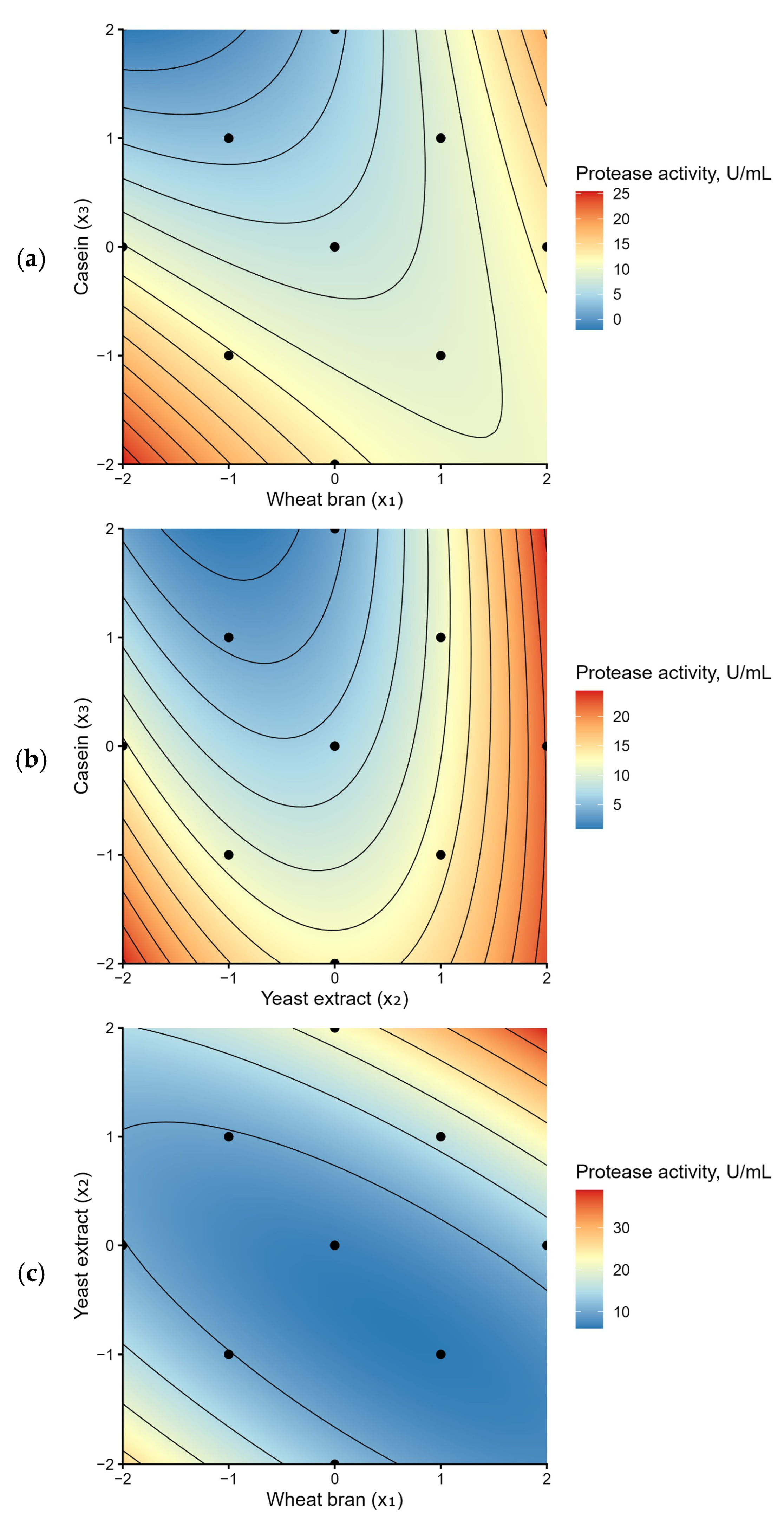
The interaction of factors and their effects on protease concentration at day 14 are illustrated in Figure 2 in the form of contour plots. Concerning casein (Figure 2a,b), the lowest value optimizes protease production in both graphs; thus, a concentration of 10 g/L was selected. Conversely, yeast extract (Figure 2b,c) should be adjusted to the highest value (5 g/L) as it enhances protease activity. Finally, wheat bran exhibits two maxima at the endpoints of the convex curve in its interactions with casein and yeast extract (Figure 2c). Therefore, it was determined to evaluate both the highest and lowest values of wheat bran (10 g/L and 25 g/L) in the forthcoming validation stage. Given that the pH within the studied range does not influence protease concentration, any of the assessed values may be utilized, and it was established at the lowest value of 8.5.

3.3. Model Validation

The model validation was conducted using the optimal concentrations of the factors that allowed for predicting the highest protease activity, identified in the previous section, which corresponded to yeast extract 5 g/L, casein 10 g/L, and pH 8.5. For wheat bran, validation was performed using 10 g/L. The average of experimental data was 18.47 for experiment 1 and 13.52 for experiment 2. In experiment 1, the experimental value was 16.1% below the value predicted by the quadratic model, while in experiment 2, the experimental value was 13.5% less than the predicted value. This can be attributed to the inherent variability of such experiments, and these variation percentages can be minimized by conducting more replicates of the experiments. However, the results are close to the predicted range.
Thus, the optimal condition for protease production with M. robertsii Mt015 was selected as the medium composed of: wheat bran 10 g/L, casein 10 g/L, yeast extract 5 g/L, KH2PO4 3 g/L, K2HPO4 1 g/L, NaCl 0.5 g/L, CaCl2 0.5 g/L, MgSO4 0.7 g/L with a pH of 8.5, incubation temperature of 28 °C, 150 rpm, and an inoculum concentration of 1.0 × 10⁵ conidia/mL.

3.4. Kinetics of Enzyme Production by M. robertsii Mt015 in the Optimized Medium

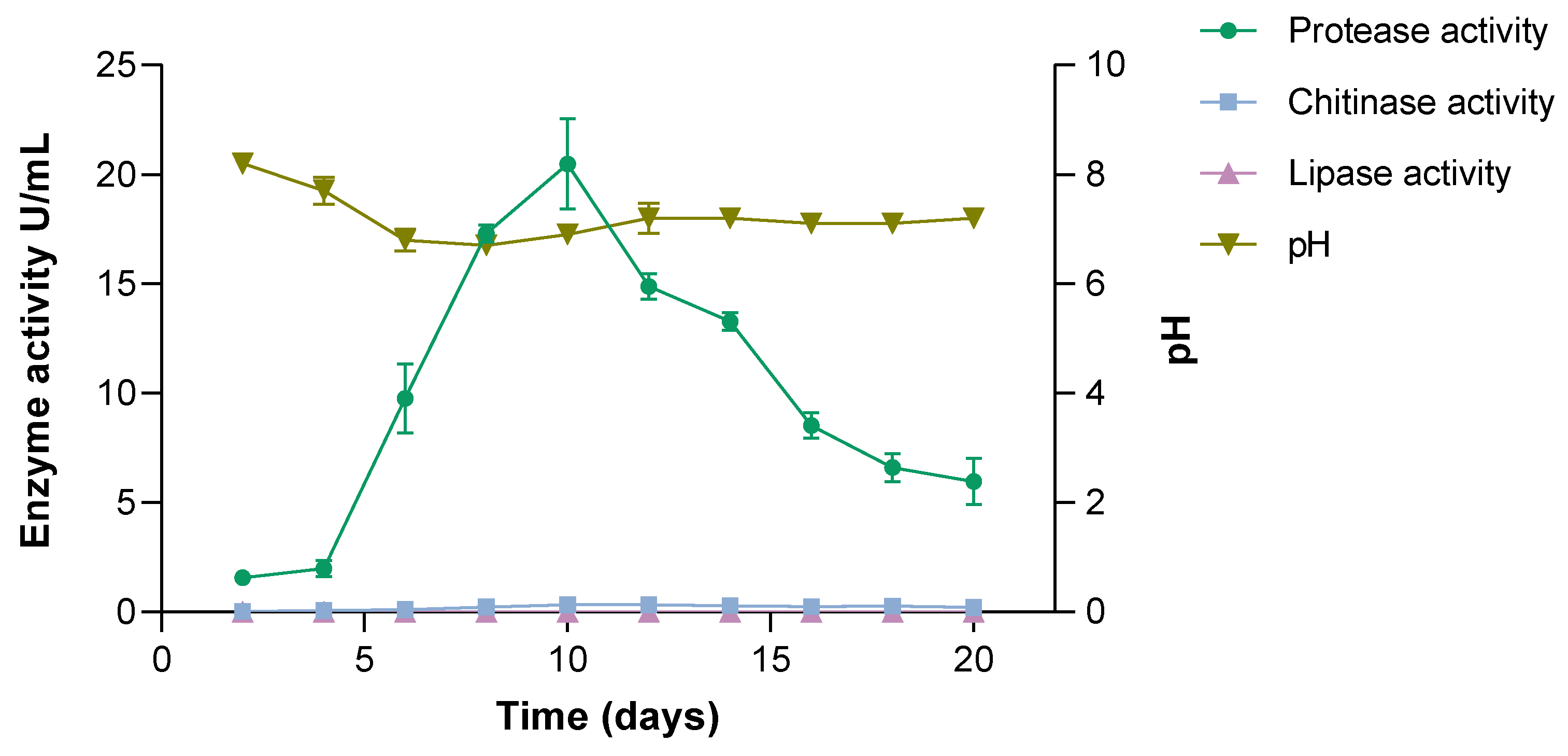
Although protease activity was the primary target of optimization, chitinase and lipase activities were also monitored throughout fermentation to assess the enzymatic specificity of the extract and to determine whether the optimized conditions selectively favored protease synthesis over other hydrolytic enzymes relevant to entomopathogenic fungi. At the selected optimal conditions, a fermentation kinetics study was conducted over 20 days, with measurements taken every two days for chitinases, proteases, lipases, and pH. As shown in Figure 3, the highest protease production occurred on day 10, with this enzyme showcasing the greatest activity, though low activity of chitinases (below 0.3 U/mL) and lipases (below 0.006 U/mL) was also observed. Furthermore, a notable decline in protease activity began on day 12. The pH displayed the most significant drop during the first 10 days of fermentation, decreasing from 8.18 ± 0.05 to 6.66 ± 0.05, and then remained relatively stable around seven for the remainder of the fermentation.
The protein content exhibited a highly variable kinetic pattern during the fermentation days. It initially decreased over the first 8 days and then started to increase until day 12. This increase may correlate with the rise in protease activity, which could be solubilizing the present protein in the wheat bran. Later, as protease production began to decline, the protein concentration also decreased and remained stable at around 4 mg/mL.

3.5. Bioassay—Effect of Protease Extract on B. bassiana Efficacy Against T. absoluta

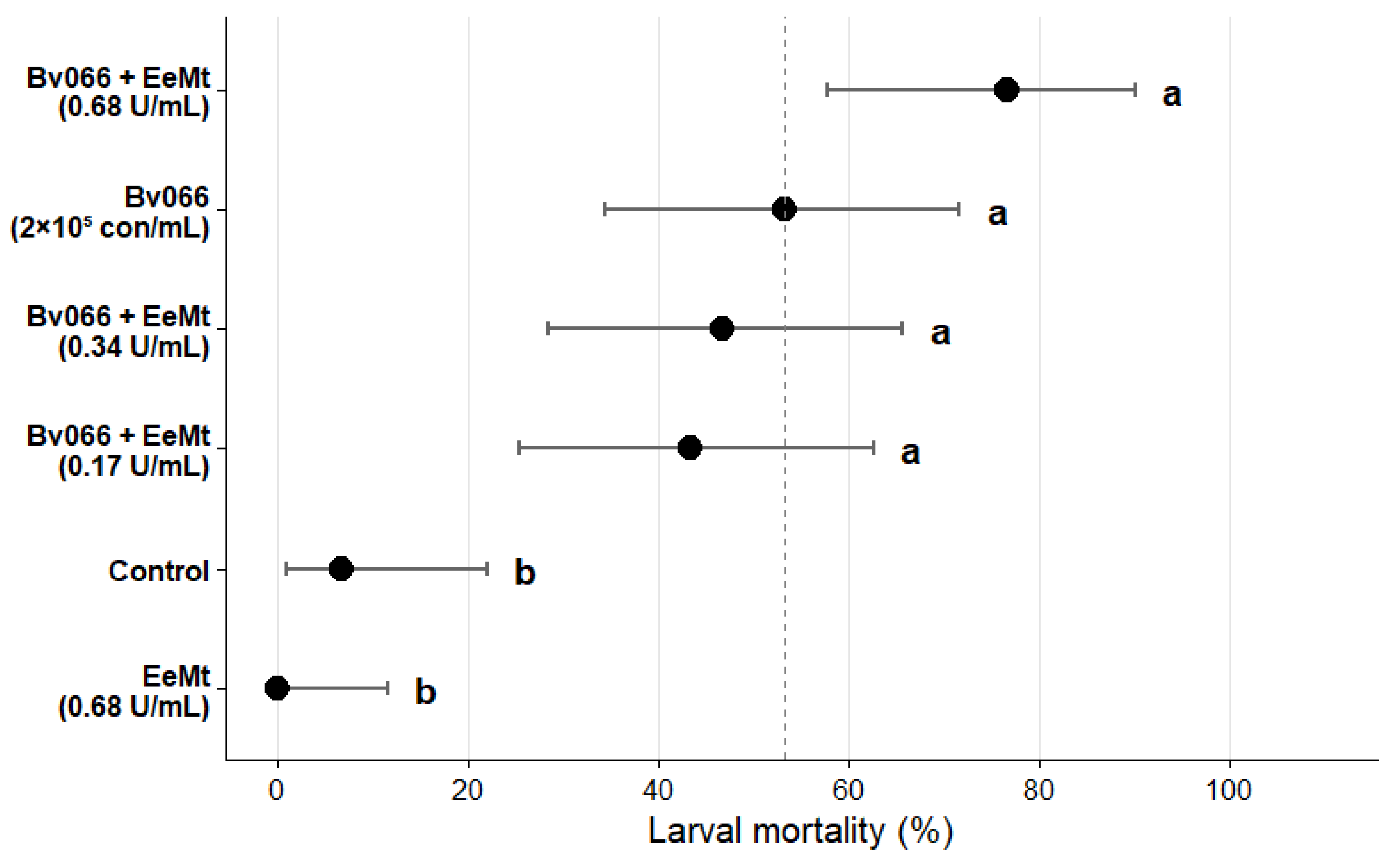
Mortality data were reanalyzed using a binomial GLM. Relative to B. bassiana alone, the combinations containing 0.17 and 0.34 U/mL protease extract did not significantly affect larval mortality (Figure 4). The combination containing 0.68 U/mL protease extract showed the highest mortality and a positive effect relative to B. bassiana alone (β = 1.06; OR = 2.88), although this difference did not reach conventional statistical significance (p = 0.062). This result may reflect the limited statistical power associated with the sample size. Consistent with this trend, Bliss analysis combined with bootstrap resampling indicated that observed mortality exceeded the additive expectation by 23.3 percentage points (95% CI: 16.7–30.0 percentage points), providing statistical support for a synergistic interaction between B. bassiana and the protease extract at 0.68 U/mL.
Effect size comparisons among Beauveria-containing treatments indicated negligible to small differences between B. bassiana alone and the formulations containing 0.17 or 0.34 U/mL protease extract (h = 0.13–0.20), whereas the formulation containing 0.68 U/mL showed a moderate effect relative to B. bassiana alone (h ≈ 0.50). The addition of 0.68 U mL−1 protease extract increased the odds of larval mortality by approximately 2.9-fold relative to B. bassiana alone (Supplementary Table S2).

4. Discussion

Metarhizium species are distinguished by their multifunctionality within ecosystems and are therefore regarded as some of the most versatile entomopathogens, with substantial ecological contributions [19,34]. These species have been investigated for their potential in insect pest control, plant growth promotion, tolerance to water stress, bioremediation, among other applications [34,35,36]. Their multifunctionality is largely attributed to their metabolic plasticity, characterized by the production of a broad spectrum of enzymes and metabolites [5].
Among these enzymes, proteases are of relevance in agriculture. These enzymes have attracted increasing attention in recent years due to their potential role in biological pest management, thereby reducing reliance on agrochemicals. Notably, bacterial, fungal, and plant-derived proteases have been evaluated for their effectiveness in controlling pests and diseases [1,37,38,39].
The use of agro-industrial residues for enzyme production has been widely documented and exemplifies the principles of the bioeconomy, as it fosters sustainable production processes by reducing medium-related costs [40]. Among these residues, wheat bran is particularly suitable as a fungal substrate due to its nutrient richness and low lignin content [41]. In the present study, wheat bran was identified as the most effective substrate of protease production in M. robertsii Mt015 at both day 10 and day 14 of fermentation, a result likely linked to its protein content of 13–18% [42]. The second most effective substrate was yeast extract, which has previously been shown to stimulate protease production in fungal strains such as Beauveria bassiana [43].
Fermentation kinetics revealed that pH declined from 8.5 to approximately 7 during early fermentation, likely as a result of metabolic activity, and remained stable throughout the productive phase. The fact that protease activity was highest under these near-neutral conditions is consistent with the activity profiles reported for aminopeptidases (optimal activity ~pH 7) or metalloproteases (optimal activity pH 6–8), although further characterization would be needed to confirm the enzyme class. Previous studies with M. anisopliae have shown that, despite the ability of these fungi to grow across a wide pH range (2.5–10.5), their gene regulation mechanisms restrict enzyme and metabolite synthesis to those compatible with the prevailing pH conditions [44]. In addition, although the culture medium was optimized for protease production, a threefold increase in chitinase activity was observed in M. robertsii compared to the basal medium; however, this chitinase activity is low compared to protease activity quantified in the enzymatic extract. This increase may be attributed to the incorporation of wheat bran, which is known to act as an inducer of chitinase activity [45,46]. Few studies have focused on the optimization of protease production by Metarhizium species [22,47]. However, this genus shows great potential for the production of proteases with applications in biological control. In the present study, M. robertsii demonstrated high protease activity within a relatively short fermentation period of 10 days, highlighting its efficiency and potential for industrial or agricultural applications.
Our results demonstrate that supplementing B. bassiana Bv066 with a protease extract enhanced larval mortality against T. absoluta in a threshold-dependent manner, with an effect observed only at the highest concentration evaluated (0.68 U/mL). The extract alone at any of the concentrations tested produced no larval mortality, indicating that lethal activity was attributable exclusively to the fungus. Bliss independence analysis further supported a synergistic interaction at this concentration, suggesting that the protease extract potentiates fungal pathogenicity rather than acting as an independent insecticidal agent. This enhancement is consistent with the established role of cuticle-degrading enzymes in fungal pathogenicity, as subtilisin-like Pr1 proteases facilitate host penetration by degrading structural cuticular proteins [48]. Previous studies have shown that elevated protease and chitinase activity accelerates infection and reduces LT50 in lepidopteran hosts [49], supporting the rationale for enzyme supplementation to enhance natural infection processes.
Although proteases represented the predominant enzymatic activity in the extract, low levels of chitinase and lipase activities were also detected during fermentation. These enzymes may have contributed to the observed enhancement, as chitinases facilitate the degradation of chitin-containing structures in the cuticle and peritrophic matrix, while lipases can disrupt epicuticular lipids and improve fungal adhesion and penetration [50,51,52]. Therefore, the enhanced larval mortality observed in this study should be attributed to the combined action of the crude enzymatic extract rather than exclusively to proteases.
Despite the trends observed in larval mortality, the bioassay was conducted using a relatively limited number of insects. Therefore, these results should be considered as proof of concept, and future studies involving larger sample sizes, additional fungal isolates, and different target species will be necessary to confirm the robustness and broader applicability of the observed synergistic effect.
Our findings are in line with recent reports showing that crude enzymatic extracts from M. robertsii and Trichoderma harzianum significantly enhanced the insecticidal activity of B. bassiana against Diatraea saccharalis [12], as well as evidence of improved pathogenicity against Bactrocera dorsalis [53]. Collectively, these studies confirm that protease-rich extracts can act as effective virulence enhancers across diverse host–pathogen systems.
The underlying mechanism likely relates to the enzymatic breakdown of insect cuticle, which shares structural similarities across species [51,54]. Enzymatic supplementation may therefore improve fungal penetration and colonization across different insect hosts and entomopathogenic genera. At the protease concentrations evaluated in this study (0.17–0.68 U/mL), the extract alone did not cause larval mortality, indicating that the entomopathogenic fungus remains the primary killing agent. Although this may suggest a lower risk to non-target organisms, dedicated ecotoxicological studies are required before any conclusions regarding environmental safety can be made. This distinction not only enhances target specificity but also provides an additional layer of environmental safety for beneficial insects and non-target arthropods [55], positioning this approach as a potentially safer alternative to genetic modification strategies for enhancing virulence.
From a practical standpoint, enzyme-supplemented biocontrol may offer advantages by improving the insecticidal activity of entomopathogenic fungi. Since biological control agents often require high spore concentrations and extended lethal times, strategies that enhance virulence or accelerate host mortality could potentially reduce the amount of fungal biomass needed to achieve effective control [56,57]. In the present study, supplementation with protease extract increased the larval mortality of B. bassiana without increasing the fungal dose applied. This improvement may represent an attractive strategy for strengthening biological control programs, as increased biocontrol efficacy could contribute to more reliable pest suppression and reduce dependence on synthetic chemical pesticides. Although the implications of this approach for large-scale implementation remain to be established, this proof-of-concept highlights the potential of enzyme supplementation as a complementary strategy for improving the performance of fungal biocontrol agents while maintaining or reducing the required fungal dose.
Finally, the present study provides proof of concept that optimizing protease production in M. robertsii enables the generation of extracts with measurable biological impact when combined with B. bassiana against T. absoluta. By improving fungal efficacy at lower conidial doses, enzyme supplementation could strengthen integrated pest management programs in tomato cultivation, reduce reliance on chemical insecticides, and contribute to the development of more reliable and sustainable next-generation biopesticides.

Supplementary Materials

The following supporting information can be downloaded at https://www.mdpi.com/article/10.3390/applmicrobiol6070079/s1, Table S1. The analysis of variance (ANOVA) for the variables study with a PBD design; Table S2. Results of the binomial logistic generalized linear model (GLM) for the effect of treatment on larval mortality of Tuta absoluta following treatment with Beauveria bassiana Bv066 alone or combined with protease extract (EeMt), showing coefficients (β), odds ratios (OR = exp(β)), and p-values.

Author Contributions

Conceptualization, C.M. (Cindy Mejía), J.G.-V., E.J.B. and G.B.; methodology, C.M. (Cindy Mejía), C.M. (Claudia Mesa), J.G.-V., C.R., E.J.B., L.M. and G.B. formal analysis, C.M. (Cindy Mejía), C.M. (Claudia Mesa), J.G.-V., C.R., E.J.B., L.M. and G.B.; investigation, C.M. (Cindy Mejia), C.M. (Claudia Mesa), J.G.-V., C.R., E.J.B., L.M. and G.B.; writing—original draft preparation, C.M. (Cindy Mejía), J.G.-V., E.J.B., L.M. and G.B.; writing—review and editing, C.M. (Cindy Mejía), J.G.-V., E.J.B. and G.B.; supervision, C.M. (Cindy Mejía), J.G.-V. and G.B.; project administration, J.G.-V. and G.B.; funding acquisition, J.G.-V., E.J.B. and G.B. All authors have read and agreed to the published version of the manuscript.

Funding

This research was funded by the General System of Royalties (Sistema General de Regalías) of Cundinamarca, within the framework of Agreement No. 2010.

Data Availability Statement

The original contributions presented in this study are included in the article/Supplementary Materials. Further inquiries can be directed to the corresponding author(s).

Acknowledgments

This work was made possible thanks to the support of the Colombian Agricultural Research Corporation (AGROSAVIA) and the Ministry of Agriculture and Rural Development (MADR), under the project “Desarrollo de bioplaguicidas potenciados de nueva generación para el mejoramiento de la productividad e inocuidad del cultivo de tomate y crucíferas en el departamento de Cundinamarca”, financed by the General System of Royalties (Sistema General de Regalías) of Cundinamarca, within the framework of Agreement No. 2010. This project provided the physical, human, and financial resources required for the development of this research. We also thank the technical and scientific team who collaborated in the development of this project.

Conflicts of Interest

The authors declare no conflicts of interest. The funders had no role in the design of the study; in the collection, analyses, or interpretation of data; in the writing of the manuscript; or in the decision to publish the results.

Abbreviations

The following abbreviations are used in this manuscript:
PBDPlackett–Burman design
CCRDRotatable central composite design

References

  1. Castro, H.L.B.; Braga, F.R.; de Freitas Soares, F.E. Potential of Plant Cysteine Proteases against Crop Pests and Animal Parasites. J. Nat. Pestic. Res. 2023, 6, 100049. [Google Scholar] [CrossRef] [Scilit]
  2. Thongkaewyuan, A.; Chairin, T. Biocontrol of Meloidogyne incognita by Metarhizium guizhouense and Its Protease. Biol. Control 2018, 126, 142–146. [Google Scholar] [CrossRef] [Scilit]
  3. de Freitas Soares, F.E.; Ferreira, J.M.; Genier, H.L.A.; Al-Ani, L.K.T.; Aguilar-Marcelino, L. Biological Control 2.0: Use of Nematophagous Fungi Enzymes for Nematode Control. J. Nat. Pestic. Res. 2023, 4, 100025. [Google Scholar] [CrossRef] [Scilit]
  4. Mondal, S.; Baksi, S.; Koris, A.; Vatai, G. Journey of Enzymes in Entomopathogenic Fungi. Pac. Sci. Rev. A Nat. Sci. Eng. 2016, 18, 85–99. [Google Scholar] [CrossRef] [Scilit]
  5. Saciloto-de-Oliveira, L.R.; Innocente-Alves, C.; de Fraga Sant’Ana, J.; Marques, A.L.; Schrank, A.; Naretto Rangel, D.E.; Santi, L.; Beys-da-Silva, W.O. Proteomics in Metarhizium Parasitism of Arthropods. Fungal Biol. Rev. 2025, 51, 100409. [Google Scholar] [CrossRef] [Scilit]
  6. Figueroa, L.B.P.; Ferreira, J.M.; Mamani, R.C.C.; Soares, F.E.F. Biochemistry, Pathogenesis, and Parasitism of Beauveria. In Entomopathogenic Fungi; Kumar Deshmukh, S., Ramaiah Sridhar, K., Eds.; Springer: Singapore, 2024. [Google Scholar]
  7. Ferreira, J.M.; Fernandes, É.K.K.; Kim, J.S.; Soares, F.E.F. The Combination of Enzymes and Conidia of Entomopathogenic Fungi against Aphis gossypii Nymphs and Spodoptera frugiperda Larvae. J. Fungi 2024, 10, 292. [Google Scholar] [CrossRef] [Scilit] [PubMed]
  8. Alves, A.C.; Soares, F.E.F. Production and Application of Enzymes from Entomopathogenic Fungi in Biological Control. In Frontiers in Entomopathogenic Fungi; Springer: Singapore, 2026. [Google Scholar]
  9. Swathy, K.; Parmar, M.K.; Vivekanandhan, P. Biocontrol Efficacy of Entomopathogenic Fungi Beauveria bassiana Conidia against Agricultural Insect Pests. Environ. Qual. Manag. 2024, 34, 22174. [Google Scholar] [CrossRef] [Scilit]
  10. Lovera, A.; Belaich, M.; Villamizar, L.; Patarroyo, M.A.; Barrera, G. Enhanced Virulence of Beauveria bassiana against Diatraea saccharalis Using a Soluble Recombinant Enzyme with Endo- and Exochitinase Activity. Biol. Control 2020, 144, 104211. [Google Scholar] [CrossRef] [Scilit]
  11. Jackson, M.A.; Dunlap, C.A.; Jaronski, S.T. Ecological Considerations in Producing and Formulating Fungal Entomopathogens for Use in Insect Biocontrol. Ecol. Fungal Entomopathog. 2010, 55, 129–145. [Google Scholar] [CrossRef] [Scilit]
  12. Mejía, C.; Bautista, E.J.; García, L.; Barrios Murcia, J.C.; Barrera, G. Assessment of Fungal Lytic Enzymatic Extracts Produced Under Submerged Fermentation as Enhancers of Entomopathogens’ Biological Activity. Curr. Microbiol. 2024, 81, 217. [Google Scholar] [CrossRef] [Scilit] [PubMed]
  13. Zhang, Y.J.; Feng, M.G.; Fan, Y.H.; Luo, Z.B.; Yang, X.Y.; Wu, D.; Pei, Y. A Cuticle-Degrading Protease (CDEP-1) of Beauveria bassiana Enhances Virulence. Biocontrol Sci. Technol. 2008, 18, 551–563. [Google Scholar] [CrossRef] [Scilit]
  14. Zhang, C.; Wang, Y.X.; Liu, X.D.; Iqbal, A.; Wang, Q.; Wang, Y. Integrated Pest Management Strategies for Controlling Phthorimaea (Tuta) Absoluta: Advances in Biological, Pheromone, and Cultural Control Methods. Insects 2026, 17, 441. [Google Scholar] [CrossRef] [Scilit] [PubMed]
  15. Aynalem, B.; Muleta, D.; Jida, M.; Shemekite, F.; Aseffa, F. Biocontrol Competence of Beauveria bassiana, Metarhizium anisopliae and Bacillus thuringiensis against Tomato Leaf Miner, Tuta Absoluta Meyrick 1917 under Greenhouse and Field Conditions. Heliyon 2022, 8, e09694. [Google Scholar] [CrossRef] [Scilit] [PubMed]
  16. Xu, B.; Huang, C.; Cheng, S.; Romeis, J.; Collatz, J.; Zhang, G.; Zhang, Y.; Zhang, G.; Wan, F. Screening of Highly Virulent Beauveria bassiana Strains Against Tuta Absoluta Larvae and Evaluation of Their Endophytic Colonization-Mediated Suppression in Tomato Plants. Plants 2025, 14, 2932. [Google Scholar] [CrossRef] [Scilit] [PubMed]
  17. Sharma, A.; Sharma, S.; Yadav, P.K. Entomopathogenic Fungi and Their Relevance in Sustainable Agriculture: A Review. Cogent Food Agric. 2023, 9, 2180857. [Google Scholar] [CrossRef] [Scilit]
  18. Beys-Da-Silva, W.O.; Santi, L.; Berger, M.; Calzolari, D.; Passos, D.O.; Guimarães, J.A.; Moresco, J.J.; Yates, J.R. Secretome of the Biocontrol Agent Metarhizium anisopliae Induced by the Cuticle of the Cotton Pest Dysdercus peruvianus Reveals New Insights into Infection. J. Proteome Res. 2014, 13, 2282–2296. [Google Scholar] [CrossRef] [Scilit] [PubMed]
  19. Boaventura, H.A.; Quintela, E.D. The Multifunctionality of the Fungus metarhizium Spp. and Its Use in Brazilian Agriculture. Bragantia 2025, 84, e20240183. [Google Scholar] [CrossRef] [Scilit]
  20. Vasiee, A.; Behbahani, B.A.; Yazdi, F.T.; Moradi, S. Optimization of the Production Conditions of the Lipase Produced by Bacillus cereus from Rice Flour through Plackett-Burman Design (PBD) and Response Surface Methodology (RSM). Microb. Pathog. 2016, 101, 36–43. [Google Scholar] [CrossRef] [Scilit] [PubMed]
  21. Dias, B.; Neves, P.; Furlaneto-Maia, L.; Furlaneto, M.C. Cuticle-Degrading Proteases Produced by the Entomopathogenic Fungus Beauveria bassiana in the Presence of Coffee Berry Borer Cuticle. Braz. J. Microbiol. 2008, 39, 301–306. [Google Scholar] [CrossRef] [Scilit]
  22. Ferreira, J.M.; Pinto, S.M.N.; Soares, F.E.F. Metarhizium robertsii Protease and Conidia Production, Response to Heat Stress and Virulence against Aedes aegypti Larvae. AMB Express 2021, 11, 166. [Google Scholar] [CrossRef] [Scilit] [PubMed]
  23. Dhar, P.; Kaur, G. Cuticle-Degrading Proteases Produced by Metarhizium anisopliae and Their Induction in Different Media. Indian J. Microbiol. 2010, 50, 449–455. [Google Scholar] [CrossRef] [Scilit] [PubMed]
  24. Dhawan, M.; Joshi, N. Enzymatic Comparison and Mortality of Beauveria bassiana against Cabbage Caterpillar Pieris brassicae LINN. Braz. J. Microbiol. 2017, 48, 522–529. [Google Scholar] [CrossRef] [Scilit] [PubMed]
  25. Rodrigues, M.I.; Costa, P. Protimiza Experimental Design. Online Software for Experimental Design and Response Surface Methodology. Available online: https://experimental-design.protimiza.com.br/ (accessed on 16 June 2026).
  26. Ding, J.; Fu, Z.; Zhu, Y.; He, J.; Ma, L.; Bu, D. Enhancing Docosahexaenoic Acid Production of Schizochytrium Sp. by Optimizing Fermentation Using Central Composite Design. BMC Biotechnol. 2022, 22, 39. [Google Scholar] [CrossRef] [Scilit] [PubMed]
  27. Cupp-Enyard, C. Sigma’ s Non-Specific Protease Activity Assay—Casein as a Substrate. J. Vis. Exp. 2008, 19, e899. [Google Scholar] [CrossRef] [Scilit] [PubMed]
  28. Santos Díaz, A.M.; De Brito Brandão, P.F.; Villamizar Rivero, L.F. Efecto de Estrés Térmico y de Irradiación Con Luz Ultravioleta (UV-B) Sobre Características de Nomuraea rileyi Nm006. Rev. Colomb. Biotecnol. 2017, 19, 81–91. [Google Scholar] [CrossRef] [Scilit]
  29. Beys Silva, W.O.; Mitidieri, S.; Schrank, A.; Vainstein, M.H. Production and Extraction of Extracellular Lipase from Entomopathogenic Fungus Metarhizium anisopliae. Process Biochem. 2005, 40, 321–326. [Google Scholar] [CrossRef] [Scilit]
  30. Glogauer, A.; Martini, V.P.; Faoro, H.; Couto, G.H.; Müller-Santos, M.; Monteiro, R.A.; Mitchell, D.A.; de Souza, E.M.; Pedrosa, F.O.; Krieger, N. Identification and Characterization of a New True Lipase Isolated through Metagenomic Approach. Microb. Cell Fact. 2011, 10, 54. [Google Scholar] [CrossRef] [Scilit] [PubMed]
  31. Bliss, C.I. The toxicity of poisons applied jointly. Ann. Appl. Biol. 1939, 26, 585–615. [Google Scholar] [CrossRef] [Scilit]
  32. Demidenko, E.; Miller, T.W. Statistical Determination of Synergy Based on Bliss Definition of Drugs Independence. PLoS ONE 2019, 14, e0224137. [Google Scholar] [CrossRef] [Scilit] [PubMed]
  33. Cedergreen, N. Quantifying Synergy: A Systematic Review of Mixture Toxicity Studies within Environmental Toxicology. PLoS ONE 2014, 9, e96580. [Google Scholar] [CrossRef] [Scilit] [PubMed]
  34. Litwin, A.; Nowak, M.; Różalska, S. Entomopathogenic Fungi: Unconventional Applications. Rev. Environ. Sci. Biotechnol. 2020, 19, 23–42. [Google Scholar] [CrossRef] [Scilit]
  35. Wu, C.; Tang, D.; Dai, J.; Tang, X.; Bao, Y.; Ning, J.; Zhen, Q.; Song, H.; St. Leger, R.; Fang, W. Bioremediation of Mercury-Polluted Soil and Water by the Plant Symbiotic Fungus Metarhizium robertsii. PNAS Microbiol. 2022, 119, e2214513119. [Google Scholar] [CrossRef] [Scilit] [PubMed]
  36. Naz, A.; Rohman, M.M.; Haque, M.A.; Mim, M.F.; Chowdhury, M.Z.H.; Sultana, R.; Islam, S.M.N. Metarhizium anisopliae Seed Priming Alleviates Drought-Induced Oxidative Stress and Improves Growth of Barley (Hordeum vulgare L.). Plant Stress 2024, 14, 100664. [Google Scholar] [CrossRef] [Scilit]
  37. Wang, X.; Zhang, S.; Xu, B. Characterization of the Serine Protease TlSP1 from Trichoderma longibrachiatum T6 and Its Function in the Control of Heterodera avenae in Wheat. J. Fungi 2024, 10, 569. [Google Scholar] [CrossRef] [Scilit] [PubMed]
  38. Ajuna, H.B.; Lim, H.I.; Moon, J.H.; Won, S.J.; Choub, V.; Choi, S.I.; Yun, J.Y.; Ahn, Y.S. The Prospect of Hydrolytic Enzymes from Bacillus Species in the Biological Control of Pests and Diseases in Forest and Fruit Tree Production. Int. J. Mol. Sci. 2023, 24, 16889. [Google Scholar] [CrossRef] [Scilit] [PubMed]
  39. Admassie, M.; Woldehawariat, Y.; Alemu, T. In Vitro Evaluation of Extracellular Enzyme Activity and Its Biocontrol Efficacy of Bacterial Isolates from Pepper Plants for the Management of Phytophthora capsici. BioMed Res. Int. 2022, 2022, 6778352. [Google Scholar] [CrossRef] [Scilit] [PubMed]
  40. Cuadrado-Osorio, P.D.; Ramírez-Mejía, J.M.; Mejía-Avellaneda, L.F.; Mesa, L.; Bautista, E.J. Agro-Industrial Residues for Microbial Bioproducts: A Key Booster for Bioeconomy. Bioresour. Technol. Rep. 2022, 20, 101232. [Google Scholar] [CrossRef] [Scilit]
  41. Cunha, F.M.; Vasconcellos, V.M.; Florencio, C.; Badino, A.C.; Farinas, C.S. On-Site Production of Enzymatic Cocktails Using a Non-Conventional Fermentation Method with Agro-Industrial Residues as Renewable Feedstocks. Waste Biomass Valorization 2017, 8, 517–526. [Google Scholar] [CrossRef] [Scilit]
  42. Apprich, S.; Tirpanalan, Ö.; Hell, J.; Reisinger, M.; Böhmdorfer, S.; Siebenhandl-Ehn, S.; Novalin, S.; Kneifel, W. Wheat Bran-Based Biorefinery 2: Valorization of Products. LWT 2014, 56, 222–231. [Google Scholar] [CrossRef] [Scilit]
  43. Rao, Y.K.; Lu, S.C.; Liu, B.L.; Tzeng, Y.M. Enhanced Production of an Extracellular Protease from Beauveria bassiana by Optimization of Cultivation Processes. Biochem. Eng. J. 2006, 28, 57–66. [Google Scholar] [CrossRef] [Scilit]
  44. St. Leger, R.J.; Joshi, L.; Roberts, D. Ambient PH Is a Major Determinant in the Expression of Cuticle-Degrading Enzymes and Hydrophobin by Metarhizium anisopliae. Appl. Environ. Microbiol. 1998, 64, 709–713. [Google Scholar] [CrossRef] [Scilit] [PubMed]
  45. Baldoni, D.B.; Antoniolli, Z.I.; Mazutti, M.A.; Jacques, R.J.S.; Dotto, A.C.; de Oliveira Silveira, A.; Ferraz, R.C.; Soares, V.B.; de Souza, A.R.C. Chitinase Production by Trichoderma koningiopsis UFSMQ40 Using Solid State Fermentation. Braz. J. Microbiol. 2020, 51, 1897–1908. [Google Scholar] [CrossRef] [Scilit]
  46. Suresh, P.V.; Chandrasekaran, M. Impact of Process Parameters on Chitinase Production by an Alkalophilic Marine Beauveria bassiana in Solid State Fermentation. Process Biochem. 1999, 34, 257–267. [Google Scholar] [CrossRef] [Scilit]
  47. Muazu, S.A.; Cobelli, P.; Wangsomboondee, T. Optimization of Metarhizium koreanum MN031-Mt 46: Nutritional Supplementation to Improve Conidia and Cuticle-Degrading Enzyme Production by Solid-State Fermentation. J. Microbiol. Biotechnol. 2025, 35, 12079. [Google Scholar] [CrossRef] [Scilit] [PubMed]
  48. St Leger, R.; Joshi, L.; Bidochka, M.J.; Roberts, D.W. Construction of an Improved Mycoinsecticide Overexpressing a Toxic Protease. Proc. Natl. Acad. Sci. USA 1996, 93, 6349–6354. [Google Scholar] [CrossRef] [Scilit] [PubMed]
  49. Fang, W.; Feng, J.; Fan, Y.; Zhang, Y.; Bidochka, M.J.; Leger, R.J.S.; Pei, Y. Expressing a Fusion Protein with Protease and Chitinase Activities Increases the Virulence of the Insect Pathogen Beauveria bassiana. J. Invertebr. Pathol. 2009, 102, 155–159. [Google Scholar] [CrossRef] [Scilit] [PubMed]
  50. Berini, F.; Caccia, S.; Franzetti, E.; Congiu, T.; Marinelli, F.; Casartelli, M.; Tettamanti, G. Effects of Trichoderma viride Chitinases on the Peritrophic Matrix of Lepidoptera. Pest Manag. Sci. 2016, 72, 980–989. [Google Scholar] [CrossRef] [Scilit] [PubMed]
  51. Ortiz-Urquiza, A.; Keyhani, N.O. Action on the Surface: Entomopathogenic Fungi versus the Insect Cuticle. Insects 2013, 4, 357–374. [Google Scholar] [CrossRef] [Scilit] [PubMed]
  52. Supakdamrongkul, P.; Bhumiratana, A.; Wiwat, C. Characterization of an Extracellular Lipase from the Biocontrol Fungus, Nomuraea rileyi MJ, and Its Toxicity toward Spodoptera litura. J. Invertebr. Pathol. 2010, 105, 228–235. [Google Scholar] [CrossRef] [Scilit] [PubMed]
  53. Ullah, S.; Naeem, H.; Murtaza, A.; Shareef, U.; Sarfaraz, S.; Ali, F.; Ullah, S.; Sumbal, G.A.K.; Ullah, U.; Kanwal, M. Extraction and characterization of cuticle degrading enzymes of Beauveria bassiana for enhanced pathogenicity against Bactrocera dorsalis. Plant Prot. 2023, 7, 225–235. [Google Scholar]
  54. Andersen, S.O. Insect Cuticular Sclerotization: A Review. Insect Biochem. Mol. Biol. 2010, 40, 166–178. [Google Scholar] [CrossRef] [Scilit] [PubMed]
  55. Zimmermann, G. Review on Safety of the Entomopathogenic Fungi Beauveria bassiana and Beauveria brongniartii. Biocontrol Sci. Technol. 2007, 17, 553–596. [Google Scholar] [CrossRef] [Scilit]
  56. Mascarin, G.M.; Jaronski, S.T. The Production and Uses of Beauveria bassiana as a Microbial Insecticide. World J. Microbiol. Biotechnol. 2016, 32, 177. [Google Scholar] [CrossRef] [Scilit] [PubMed]
  57. Jaronski, S.T. Ecological Factors in the Inundative Use of Fungal Entomopathogens. BioControl 2010, 55, 159–185. [Google Scholar] [CrossRef] [Scilit]
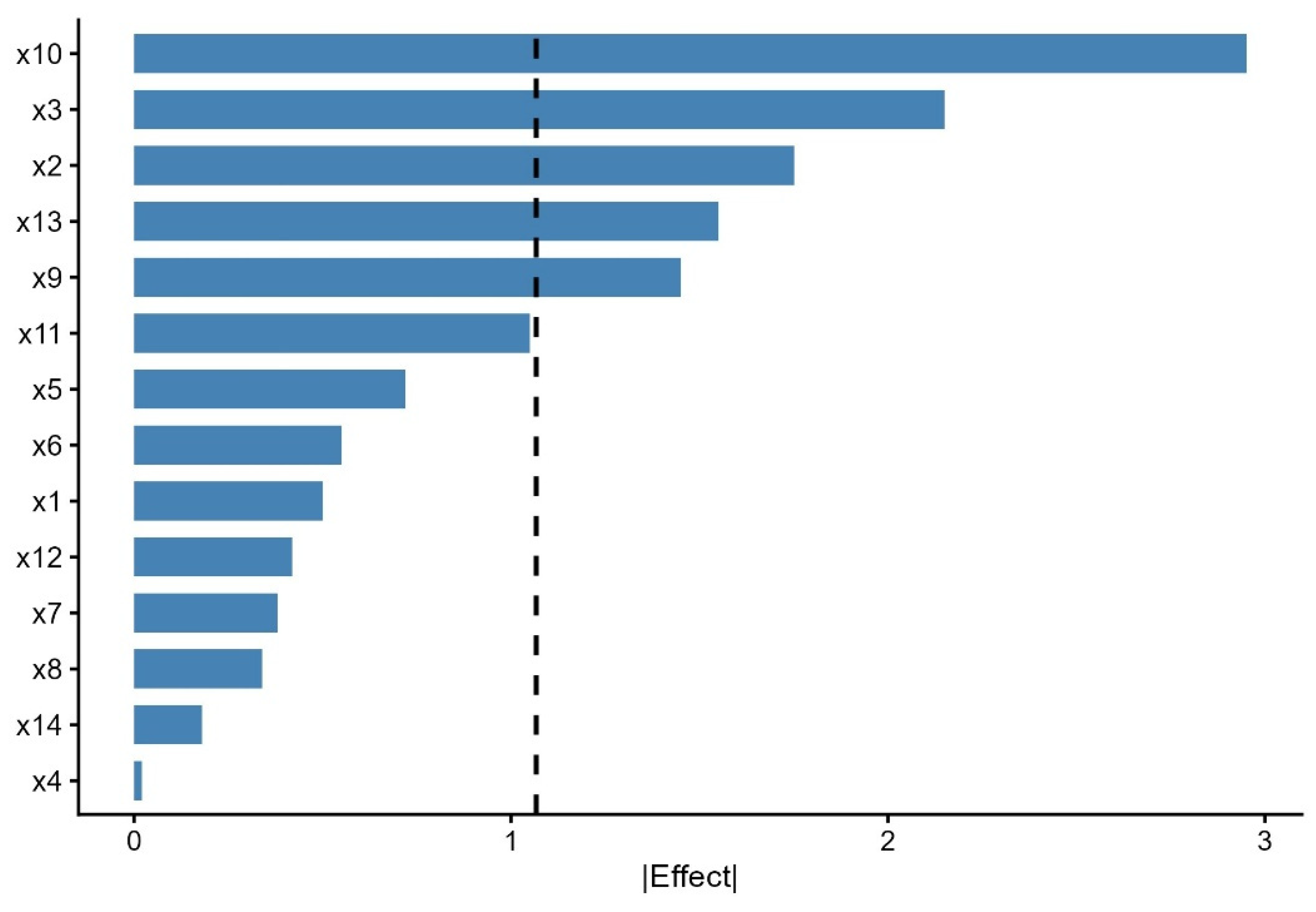
Figure 1. Pareto chart ranking the absolute effects of the factors on protease production by M. robertsii Mt015. The dashed vertical line indicates the significance threshold; factors with absolute effects greater than this value were considered significant.
Applmicrobiol 06 00079 g001
Figure 2. Contour plot for protease activity (U/mL) at day 10 of fermentation as a function of the different interactions between the selected variables. (a) Casein vs. wheat bran. (b) Casein vs. yeast extract (c) Yeast extract vs. wheat bran. Black dots indicate the experimental design points used for model fitting.
Applmicrobiol 06 00079 g002
Figure 3. Kinetics of protease, chitinase, lipase production, and pH dynamics during the 20 days of fermentation of M. robertsii Mt015. The error bars correspond to the standard deviation of the experiments performed in triplicate.
Applmicrobiol 06 00079 g003
Figure 4. Larval mortality of Tuta absoluta following treatment with B. bassiana Bv066 alone or combined with protease extract (EeMt). Points represent observed mortality proportions and horizontal bars indicate exact 95% binomial confidence intervals. The dashed vertical line represents the baseline condition corresponding to spore-only application. Different letters indicate significant differences among treatments according to the binomial GLM (p < 0.05).
Applmicrobiol 06 00079 g004
Table 1. Variables used in Plackett–Burman Design for M. robertsii Mt015 proteases.
CodeVariableUnitsLevel
−101
X1Ammonium Sulfateg/L01.53
X2Sodium Nitrateg/L01.53
X3Yeast Extractg/L012
X4Peptoneg/L048
X5Tween 80g/L01 mL2
X6Glucoseg/L048
X7Ureag/L024
X8Skim Milkg/L01020
X9Caseing/L01020
X10Wheat Brang/L01020
X11Microelements SolutionmL/L00.51
X12Inoculum Concentrationcon/mL1.0 × 1075.0 × 1071.0 × 108
X13Initial pH-789
X14Agitationrpm150175200
Table 2. Independent variables and their concentration ranges selected for the optimization of protease production by M. robertsii Mt015.
VariableUnits−11−α
X1Wheat Brang/L15253010
X2Yeast Extractg/L2451
X3Caseing/L15253010
X4Initial pH-8.59.510.08.0
Table 3. Rotatable central composite design matrix showing the protease production of M. robertsii Mt015.
RunWheat Bran g/LYeast Extract g/LCasein g/LpHProtease U/mL
1152158.522.7
2252158.515.2
3154158.522.4
4254158.58.9
5152258.53.9
6252258.51.4
7154258.51.3
8254258.520.8
9152159.516.6
10252159.57.2
11154159.515.8
12254259.520.6
13152259.56.7
14252259.54.1
15154259.55.6
16254259.523.0
171032099.6
183032093.9
1920120914.5
2020520924.6
2120310916.8
222033091.9
232032084.3
24203201012.7
252032093.7
262032093.9
272032094.6
Table 4. Regression analysis of the CCRD results.
VariableCoefficientStandard ErrorCalculated tp-Value
Mean6.782.213.070.0097
x10.650.780.840.4195
x121.170.831.420.182
x22.450.783.130.0087
x222.630.833.180.0079
x3−2.430.78−3.110.009
x320.380.830.460.6538
x41.110.781.430.179
x421.150.831.380.1913
x1 · x22.710.962.830.0152
x1 · x32.210.962.310.0392
x1 · x40.220.960.230.8254
x2 · x31.380.961.440.176
x2 · x40.250.960.260.7958
x3 · x40.930.960.970.3504
Table 5. ANOVA for the model obtained from the CCRD.
Variation
Source
Sum of
Squares
Degrees of FreedomMean
Square
Fcalcp-Value
Regression727.914523.60.01693
Residuals175.71214.6
Lack of Fit173.21017.3140.06833
Pure Error2.521.2
Total903.626
R2 = 80.56%
Disclaimer/Publisher’s Note: The statements, opinions and data contained in all publications are solely those of the individual author(s) and contributor(s) and not of MDPI and/or the editor(s). MDPI and/or the editor(s) disclaim responsibility for any injury to people or property resulting from any ideas, methods, instructions or products referred to in the content.