Review

New Insight into Endophytic Fungi–Plant Symbioses Under Climate Change: Molecular Crosstalk, Nutrient Exchange, and Ecosystem Resilience


1
Key Laboratory for Protection and Genetic Improvement of Qinghai Tibet Plateau Germplasm Resources (Co-construction by Ministry and Province), Academy of Agriculture and Forestry Sciences of Qinghai University, Xining 810003, China
2
College of Life Science and Technology, State Key Laboratory Incubation Base for Conservation and Utilization of Bio-Resource in Tarim Basin, Tarim University, Alar 843300, China
3
State Key Laboratory of Water Resources Engineering and Management, Wuhan University, Wuhan 430072, China
4
Pesticide Quality Control Laboratory Multan, Ayub Agriculture Research Institute Faisalabad, Faisalabad 38000, Pakistan
5
National Key Laboratory for Germplasm Innovation and Utilization of Horticultural Crops, College of Horticulture and Forestry Sciences, Huazhong Agricultural University, Wuhan 430070, China
6
Soil and Water Science Department, Indian River Research and Education Center, Institute of Food and Agricultural Sciences, University of Florida, Fort Pierce, FL 34945, USA
*
Authors to whom correspondence should be addressed.
Appl. Microbiol. 2026, 6(3), 47; https://doi.org/10.3390/applmicrobiol6030047
Submission received: 14 February 2026 / Revised: 12 March 2026 / Accepted: 13 March 2026 / Published: 17 March 2026

Abstract

Fungal endophytes are microorganisms that inhabit plant tissues without causing disease and emerge as critical mediators of plant stress tolerance, nutrient acquisition, and ecosystem resilience under diverse climate change scenarios. Their unique position within the host allows them to modulate physiological responses more closely than external microbiota. This review explores how endophytic fungi contribute to plant adaptation under climate-induced stresses such as heat, salinity, drought, pollution, and nutrient limitation, with a focus on molecular crosstalk, functional trait modules, and metabolic trade-offs. Key findings emphasize multilayered signaling systems, including MAMP/DAMP recognition, phytohormone regulation, immune tuning, ROS dynamics, and effector deployment, while emerging mechanisms such as cross-kingdom RNA and extracellular vesicle (EV)-mediated exchange are discussed as promising but currently limited in empirical validation within many endophytic systems. Endophytes also enhance nutrient exchange through conditional carbon-for-benefit trade and may shape rhizosphere microbiota and soil activities through plant-mediated inputs. Integrative multi-omics approaches provide predominantly correlational insights into the mechanistic basis of these effects, linking molecular function to ecosystem and community outcomes. These insights have potential applications in climate-resilient agriculture, phytoremediation, and ecosystem restoration; however, their large-scale implementation requires further field-based validation and context-specific assessment. Future priorities should focus on trait-based selection, ecological modeling, and biosafety evaluation to translate microbial functions into reliable field-level strategies that support sustainable crop performance under accelerating environmental stress.

1. Introduction

Fungal endophytes are microbes that inhabit internal plant tissues without causing apparent harm and have emerged as critical but often overlooked components of the plant microbiome, influencing growth, immunity, stress tolerance, and ecosystem sustainability [1]. Unlike rhizosphere microbes that primarily interact with plant roots through the root-soil boundary, endophytic fungi develop internal tissue-resident connections across multiple plant tissues, including roots, stems, leaves, and seeds. These associations are affected by complex recruitment dynamics, which involve transitional niches during fungal establishment and growth [2]. Symbiotic relationships, based on fungal identity, environmental conditions, and host genotype, can range from mutualistic to parasitic states driven by mechanistic regulation occurring through host-pathogen recognition systems and metabolic trade-offs [3]. With climate change driving increased environmental variability, endophytes are being reassessed not only as microbial partners but also as potential regulators of plant resilience and adaptive capacity; however, their effects remain highly dependent on ecological and physiological context [4].
Anthropogenic climate change is escalating stressors such as heatwaves, salinity, drought and pollution that challenge plant productivity, survival and ecological balance [5]. These stresses modify plant physiology, metabolism, and immunity, while also reconfiguring microbial community assembly and interaction dynamics [6]. In this changing environment, endophytic fungi have been proposed to act as biological buffers. They modulate host responses through molecular mechanisms that include hormonal crosstalk, immune suppression or priming, nutrient mobilization, and antioxidant modulation [1]. However, empirical support varies among systems, and in some cases endophyte colonization may confer neutral or conditionally negative outcomes. Their unique ability to function within host tissues positions them to influence plant health from the inside out, offering advantages under complex stress where external microbial support (rhizosphere bacteria) may be destabilized or insufficient [7].
Despite growing interest, much remains unknown about how endophyte–plant interactions are formed, maintained, and reprogrammed under environmental stress [8]. Molecular compatibility is not assured: endophyte colonization must be tolerated by the host immune system while providing tangible functional benefits such as improved nutrient uptake, water-use efficiency and defense improvement [9]. Understanding this compatibility requires detailed analysis of plant–fungal molecular interactions, particularly the mechanisms governing recognition, metabolite exchange and immune tuning. These processes are regulated by a network of phytohormones (ABA, SA, JA, auxin), reactive oxygen species (ROS), and effector-like proteins. Additional signaling molecules, including MAMPs/DAMPs and, in some fungal systems, emerging communication vectors such as extracellular vesicles and cross-kingdom RNAs, also contribute; however, direct evidence for these latter mechanisms in many endophytic associations remains limited [10]. Together, they form a composite signaling system that determines whether an endophyte is tolerated, beneficial or rejected.
A critical ecological aspect is the metabolic exchange between plant–fungal partners, often described as a reciprocal biological interaction: plants provide photosynthetic carbon, while endophytes provide stress-tolerance pathways or promote nutrient acquisition. In response to climate stress, this exchange can be disrupted. For example, drought or nutrient challenges restrict the plant’s carbon supply while progressively increasing the fungal maintenance costs. The cost-benefit balance of endophyte colonization is not static but transitions along a continuum, with outcomes ranging from mutualism to antagonism. This metabolic diversity emphasizes the need to understand endophyte symbionts in terms of evolutionary strategies, focusing on carbon allocation, transporter regulation, and the physiological adaptability of both the plant and fungal partners under environmental stress.
Recent advances in multi-omics technologies, particularly transcriptomics, metabolomics, and proteomics, are transforming our ability to examine endophyte functions and their ecological impacts. Metabolite profiling, isotope tracing and dual RNA-seq are disclosing how fungal colonization reshapes host metabolism, alters exudate chemistry, and reconfigures rhizosphere microbiota. Combining these molecular approaches with ecological network analysis and trait-based modeling provides primarily correlational insights into how endophytes influence community dynamics, nutrient cycling, and biogeochemical feedback across different levels. However, translating this mechanistic knowledge into field-ready applications remains a major challenge, particularly given the variability in endophyte performance across soils, genotypes and changing climates.
The main analytical goals of the review are to analyze the molecular mechanisms of endophyte–plant symbiosis, with a focus on the regulation of hormones, immune modulation, and oxidative stress management; investigate the role of endophytes in stress buffering and nutrient exchange; and examine how these functions contribute to plant resilience under drought, salinity, and heat stress. The review also explores the environmental implications of endophyte interactions on ecosystem resilience, including their influence on soil microbiota, nutrient cycling, and community dynamics, and advocates for practical solutions for the application of fungal endophytes in sustainable agriculture, ecosystem restoration, and climate-smart resilient land management by enhancing multi-omics and ecological data.
The literature included in this review was identified through searches of major scientific databases, including Scopus, PubMed, Web of Science, and Google Scholar. Search terms included combinations of keywords such as fungal endophytes, abiotic stress, plant–fungal endophyte interactions, plant resilience, stress tolerance, climate change, nutrient cycling and molecular mechanisms. The review focused primarily on literature published between 2008 and 2026 while also incorporating a limited number of earlier studies relevant to providing conceptual background.

2. Climate Change Alters Endophyte Specificity and Interaction Stability

Endophytic fungi are asymptomatic, internal, non-parasitic symbionts that form strong connections with plant tissues, including leaves, stems, roots, seeds, and vascular tissues. In contrast to rhizosphere microbes, which primarily interact at the soil–root interface, endophytes occupy internal plant tissues and act as direct regulators of plants’ physiological processes [11]. This internal ecological niche enables endophytes to progressively affect multiple host functions, including growth promotion, immune regulation, nutrient acquisition, and tolerance to both abiotic and biotic stresses [12]. The diversity of major endophytic fungal lineages and their reported contributions to plant stress adaptation are summarized in Table 1.
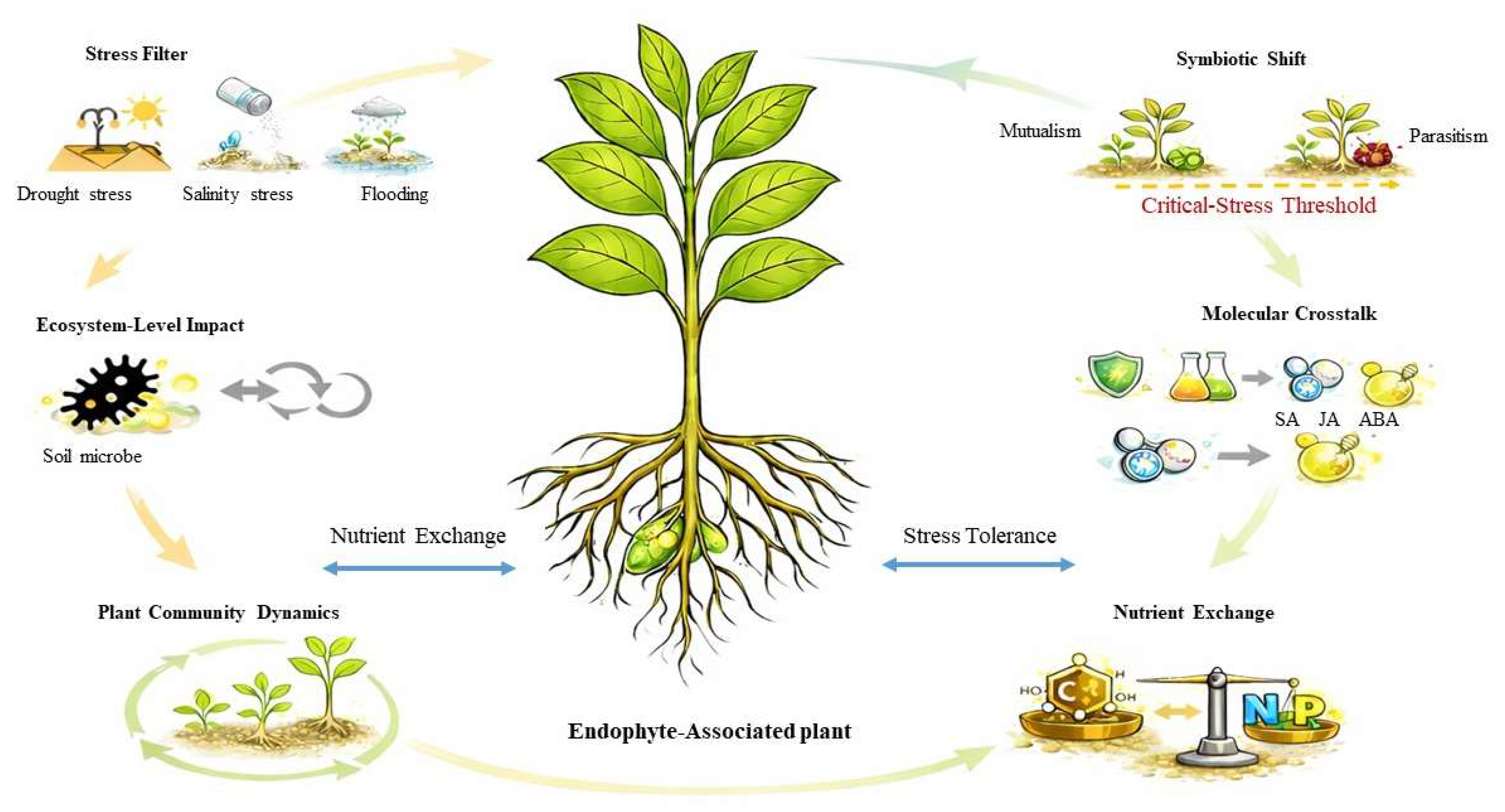
Growing evidence suggests that endophytes should no longer be regarded as dormant dwellers but as active modulators of plant functional traits; however, the magnitude and direction of these effects remain context dependent [28]. A conceptual overview of molecular crosstalk, resource exchange, and adaptive mechanisms under climate-induced stresses is illustrated in Figure 1.
Endophytes promote plant biomass and productivity across various systems by modulating hormone-related activities such as regulation of auxin and gibberellin, which promote root system development and photosynthetic efficiency [29]. Simultaneously, they may enhance defense capacity by conditioning immune pathways and generating antimicrobial metabolites that decrease disease pressure. Endophytes occupy a functional niche as integral in planta components of the microbiome, which can enhance the host phenotype beyond the plant genome and support adaptive performance under fluctuating environments [30]. The importance of endophytic symbiosis becomes more evident under climate change, which alters temperature regimes, precipitation patterns, and leads to severe events such as droughts, heatwaves, salinity, and flooding [31]. These environmental shifts act as ecological filters, reshaping plant performance and concurrently affecting the composition, stability, and function of microbial communities. The global environmental changes can therefore be viewed as stress filters, altering the cost dynamics, benefits, and stability within plant-endophyte associations. Under moderate stress, specific endophytes start contributing positively to plant growth and resilience; however, under severe stress conditions, these symbioses may shift towards a neutral state. This transfer represents a dynamic change along the mutualism–parasitism spectrum that can be experimentally measured by determining plant growth metrics, stress tolerance markers, and fungal colonization efficiency at different stress levels [32]. These shifts highlight the context-dependent nature of endophyte-mediated resilience, where the symbiotic outcome manifests as a result of the interplay between host genotype, fungal genotype, and environmental factors. Experimental approaches, such as controlled climate simulations and omics-based analyses, assist in measuring these dynamic interactions and provide insights into how the plant-endophyte relationship fluctuates across various environmental stress thresholds.
There are several ways in which climate change can reorganize endophyte symbioses: by modifying fungal colonization success and transmission, altering host resource allocation and immune thresholds, and affecting the broader microbial community that competes with or complements endophyte functions [33]. For example, drought-induced carbon limitation can reduce host allocation of photosynthates to endophytes, potentially destabilizing mutualistic interactions when fungal benefits decline or carbon demand increases. Conversely, during periods of stress, plants may exhibit preferential tolerance toward endophytes that provide protective metabolites, antioxidant capacity, or enhanced nutrient mobilization. This process, described as stress-mediated symbiotic filtering, appears to be strongly dependent on host genotype, fungal identity, and environmental context [34].
The plant resilience–ecosystem interface is partially dependent on endophyte-mediated nutrient acquisition. The reduction of soil quality, changes in precipitation, intensified agriculture, and the combined effects of warming and drought on soil nutrient cycling have increased the occurrence of nutrient limitation in many ecosystems [35]. Within these constraints, endophytes engage in nutrient mobilization through pathways that are partly similar to, yet distinct from, mycorrhizal mechanisms. Endophytes enhance availability of nitrogen and phosphorus through extracellular release of enzymes, organic acids, and siderophores, thereby mobilizing nutrient pools that are otherwise less accessible to plants [36]. Nevertheless, nutrient exchange between plant and endophyte is governed less by cooperative intent and more by resource economics and reciprocal cost–benefit trade-offs. During nutrient-limited conditions, endophytes may allocate a greater proportion of host-derived carbon toward their own growth and stress-adaptive compound synthesis, particularly under severe environmental constraints. This fungal investment may also generate metabolites that contribute to host protection against osmotic stress, oxidative damage, or pathogen invasion [37]. Therefore, nutrient exchange in endophytic symbioses can be viewed as a conditional exchange: plants provide carbon to endophytes, and endophytes provide services in nutrient mobilization, defense, and stress buffering [38]. The stability of this exchange is environmentally contingent and may shift with changes in plant carbon status, nutrient availability, and fungal metabolic demand.
Resource exchange at the molecular level is managed by a complex communication network at the plant–fungus interface [39]. Establishment of endophytic symbiosis requires a fine balance: the fungus must colonize host tissues without triggering full pathogenic defense responses, and the plant must permit controlled entry while maintaining immune competence. This equilibrium is achieved through molecular crosstalk involving immune signaling pathways, phytohormone modulation, redox homeostasis, and metabolic reprogramming [40]. Endophytes can regulate host immunity by attenuating specific defense branches or by priming faster responses to stress. They may also influence hormone networks—including jasmonate, salicylic acid, ethylene, abscisic acid, and auxin—to favor stress tolerance without substantial growth penalties. Simultaneously, endophytes can affect plant metabolism and nutrient delivery through changes in host transporter and enzyme expression related to carbon distribution and nutrient uptake [41]. Recent studies, primarily from pathogenic and specialized fungal systems, indicate that fungal-secreted effectors, small metabolites, and in some cases extracellular vesicles and cross-kingdom RNAs may contribute to stable accommodation and long-term integration. However, direct functional evidence for these advanced mechanisms in many endophytic associations remains limited [42]. Despite rapid methodological advances, the molecular architecture underlying endophyte-mediated nutrient interaction under ecologically relevant stress conditions is not fully understood. Disentangling causality, whether endophytes actively reprogram host metabolism or preferentially colonize already tolerant phenotypes, remains a conceptual and experimental challenge.
A second critical gap relates to specificity in how climate change influences partner selection and the stability of plant–endophyte associations. Host identity, tissue niche, microclimate, soil conditions, and the surrounding microbial species pool influence endophyte community assembly [43]. These determinants are themselves shifting under global change, potentially disrupting established symbiotic associations while facilitating new ones. Stress may increase host permissiveness to certain fungi, reduce colonization barriers, or promote opportunistic behavior among endophytic taxa. Such changes can generate unpredictable outcomes, including the emergence of latent pathogens or the loss of beneficial specialist endophytes [44]. Advancing understanding of specificity therefore requires a shift beyond descriptive diversity surveys toward trait-based and mechanistic frameworks that explain why particular endophytes persist, dominate, or decline under climate-driven pressures.

3. Anthropogenic and Environmental Stressors: Drought, Pollution, Invasion as Interaction Reprogrammers

The selective regime in which plant–fungal endophyte symbioses evolve, survive, and provide services is increasingly shaped by anthropogenic pressures, including changes in land use, pollution, and climate warming, which result in heightened environmental stress [45]. The existing evidence suggests that drought/heat, heavy-metal pollution, and biological invasion or land-use disturbance are not merely external constraints. They actively reshape interactions by altering host carbon availability, immune set-points, and microbial competition within plant tissues and the rhizosphere. In practice, the stressors redefine the functional balance of symbioses. The ability of the host to subsidize the fungal partner changes, and conversely the potential of fungi to provide benefits such as stress buffering, nutrient mobilization, or defense modulation is altered [46]. Recent syntheses of fungal endophyte-mediated abiotic stress tolerance suggest mechanisms involving osmotic regulation, antioxidant defense, hormone tuning, and molecular or epigenetic modulation. However, the magnitude and direction of these effects are strongly dependent on host × strain × environment interactions, precisely those conditions being intensified by global change [47].
Drought and heatwaves are increasingly conceptualized as pulse-like disturbances that impose repeated switches in plant hydration status and metabolic modes [48]. Under water shortage, plants lower stomatal conductance and photosynthesis, reducing the carbon budget available for endophyte maintenance and reciprocal nutrient exchange [49]. Simultaneously, drought disrupts rhizosphere substrate diffusion and redox microenvironments, indirectly altering the pool of microbes available for recruitment [50]. Heatwaves exacerbate these dynamics by increasing evaporative demand and oxidative stress, destabilizing cellular membranes and redox homeostasis. Empirical studies suggest that fungal endophytes sourced from severe or extreme ecological conditions can elevate plant activity under sequential stresses, typically via antioxidant reinforcement and improved physiological stress responses. However, these benefits are not universal and may diminish under prolonged or repeated stress due to energetic constraints on both partners [51].
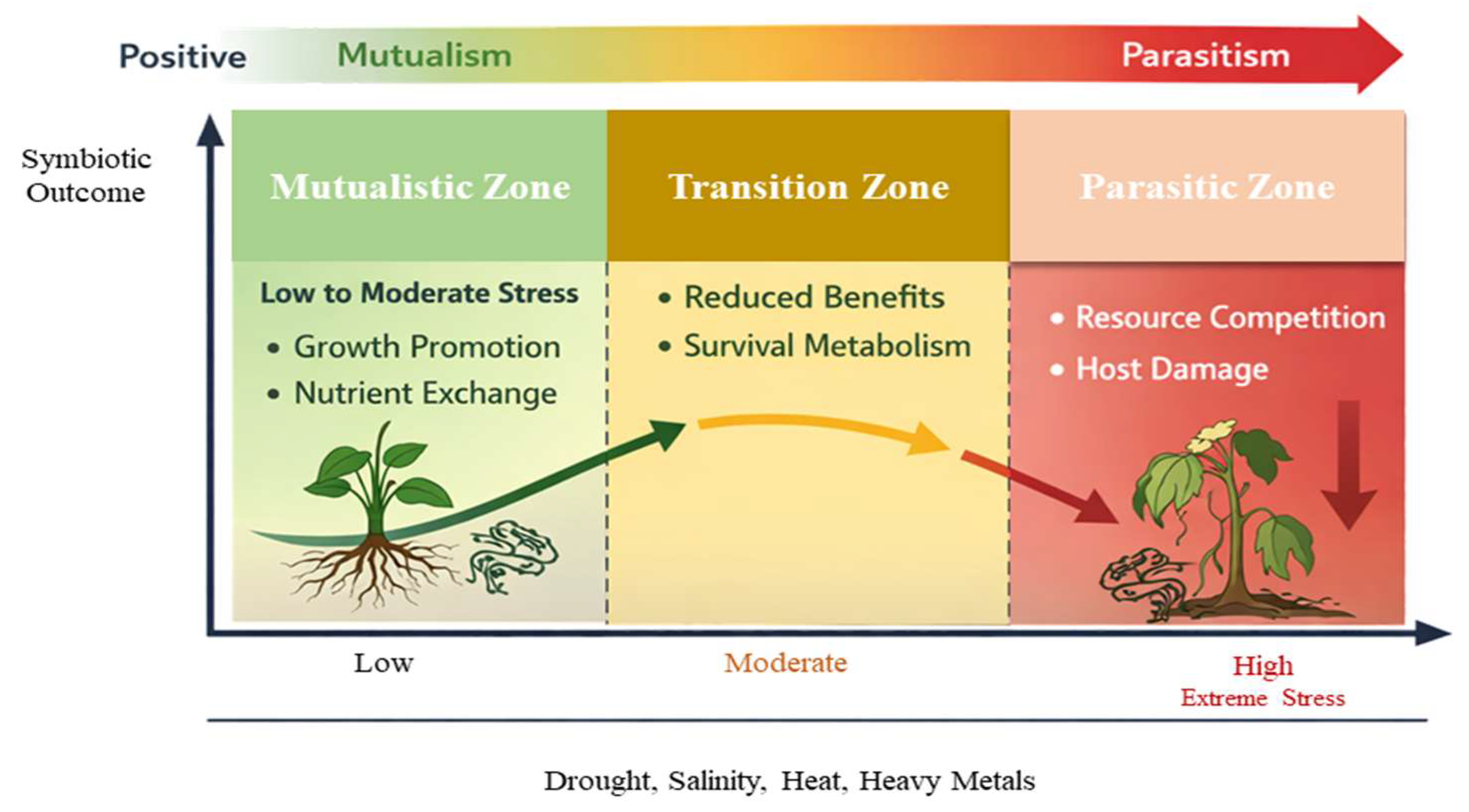
The emerging threshold-based framework conceptualizes fungal endophytes as stabilizers of host function at intermediate stress levels through osmotic and redox buffering, but beyond critical stress thresholds, fungal metabolism may shift toward survival, reducing host-benefit output, while the host may restrict carbon allocation, thereby diminishing mutualistic benefits. Pollution and heavy-metal contamination operate along a different axis, functioning as physiological toxicants and strong ecological filters on plant-associated fungal communities [52]. Metal pollution reshapes fungal community composition along contamination gradients, altering the pool of potential colonizing taxa and overall community architecture [53]. Metals such as Cd, Pb, As, and Cr provoke chronic oxidative stress and enzyme inhibition in plants, and fungal endophytes may contribute to detoxification through chelation, precipitation, enzymatic transformation, and induction of host antioxidant and secondary-metabolite defenses [54]. The latest framing emphasizes trade-offs: resources allocated to detoxification and stress protection may reduce investment in nutrient provisioning, growth promotion, or immune defense, particularly under carbon-limited drought conditions [55]. Figure 2 illustrates the progression of the plant-endophyte relationship from mutualism to parasitism as stress intensity elevates, with three key zones—Mutualistic, Transition, and Parasitic—marking this shift. It effectively demonstrates how endophytes contribute to plant resilience under low to moderate stress, while the relationship may become more neutral or even harmful as stress levels rise.
Symbiosis specificity can also be disturbed by pollution, tissue decomposition, and immune homeostasis, potentially enhancing exposure to opportunistic colonizers and altering positions along the mutualism–antagonism spectrum [56]. Biological invasion and land-use change further compound endophyte symbioses by restructuring ecological networks and reshaping the regional pool of microbial taxa [57]. Recent syntheses indicate that fungal endophytes can modulate invasion success by influencing plant growth, reproduction, stress tolerance, and resistance to herbivores and pathogens. However, the magnitude and direction of these effects are highly context-dependent, varying with invasion stage, host identity, and local ecological conditions [58]. Notably, invasive plants may co-invade with native endophytes, acquire novel symbionts from neighboring species, or exploit restructured microbial communities in disturbed ecosystems. Experimental and observational studies indicate that local interactions between neighboring native plants can influence endophyte assembly in invaders, further indicating that invasion outcomes may be mediated by microbial recruitment processes rather than solely by intrinsic plant traits [59]. Land-use changes (intensification, grazing shifts, fragmentation) may select for stress-tolerant endophytes and disrupt established symbiotic relationships, simplifying connections while increasing functional variability and opportunism [60].
Importantly, these stressors are increasingly co-occurring, producing non-linear multi-stressor effects [61]. Salinity or metal stress is often amplified by drought-induced oxidative stress and heat-related physiological disruption, while disturbance intensifies invasion pressure, collectively destabilizing native symbioses. From a translational perspective, this implies that endophyte benefits should be evaluated under compound-stressor conditions and pulse dynamics, since stability depends on thresholds (carbon limitation, detoxification costs, immune dysregulation, altered microbial competition) rather than responses to individual factors alone [62].

4. Molecular Crosstalk: Communication Pathways That Govern Mutualism

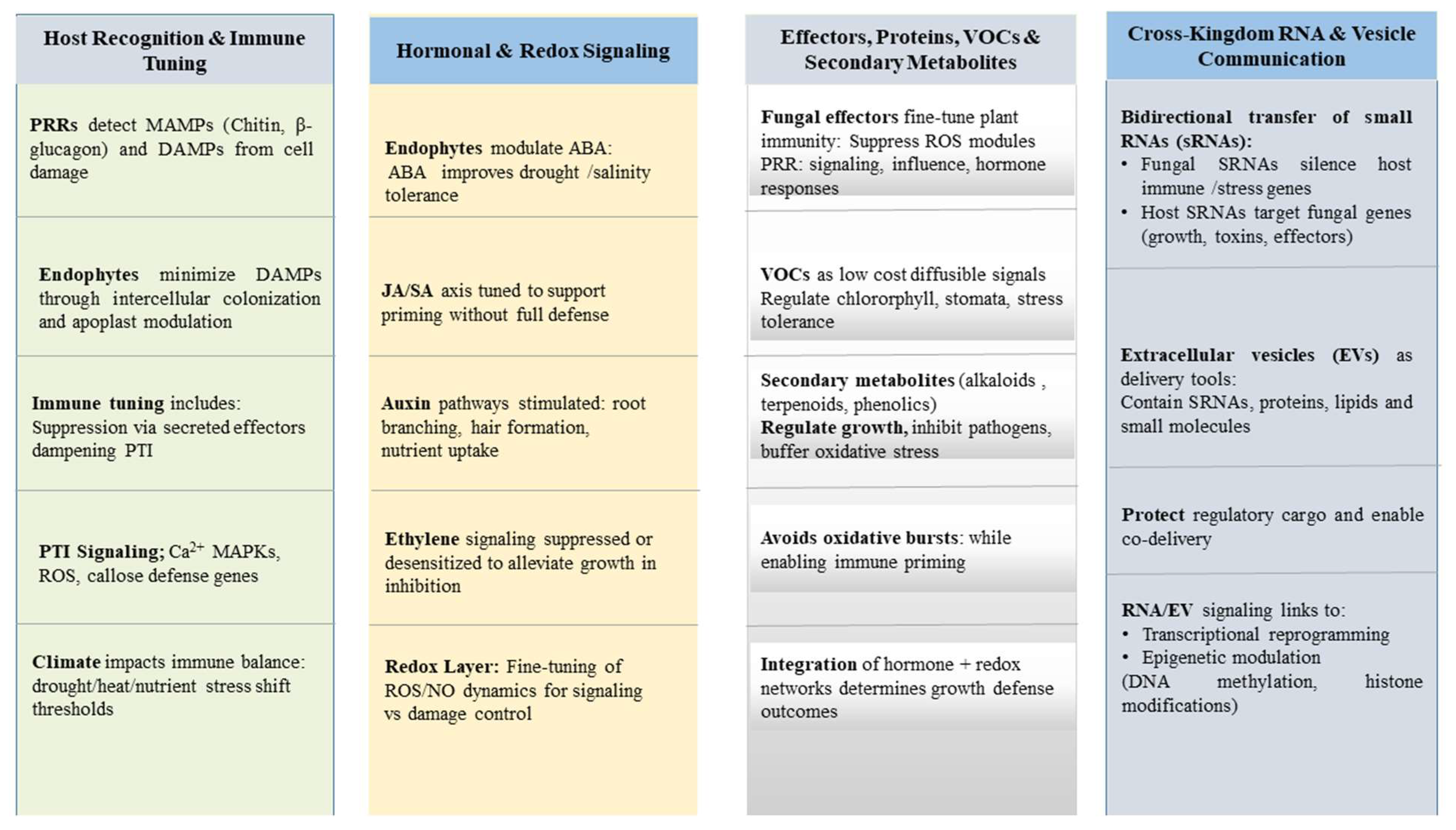
The central regulatory layer that determines whether endophytic fungi are accommodated within beneficial relationships or recognized as potential threats is molecular crosstalk. This molecular crosstalk ultimately shapes the stability and functional outcomes of mutualism under normal and stress conditions [63]. Table 2 provides an overview of key molecular signaling pathways that mediate endophyte–plant interactions, including hormonal, oxidative, and immune signaling mechanisms. Due to their internal localization, successful symbiosis requires a finely regulated process of controlled accommodation, in which plants detect fungal-derived molecular patterns without triggering excessive immune responses. The balance is maintained by cooperative recognition and immune tuning, including MAMP/DAMP signaling pathways, which selectively modulate plant responses toward tolerance, defense priming, or partial suppression rather than full immune activation.
Beyond immune gating, chemical and molecular interactions further stabilize symbiosis by reprogramming host physiology. This involves complex phytohormonal networks, ethylene and redox-linked signaling molecules such as reactive oxygen species (ROS) and nitric oxide (NO), which integrate stress sensing with metabolic adaptation. Endophytes can also modulate the partnership through secreted effectors, including proteins, fungal volatiles, and secondary metabolites that influence growth–defense trade-offs, nutrient delivery, and stress adaptation [71].
Some emerging mechanisms, such as cross-kingdom RNA communication and extracellular vesicle (EV)-mediated cargo exchange, are primarily documented in pathogenic or mycorrhizal systems. Their presence in endophyte symbioses is currently speculative but potentially enables fungi and plants to exchange regulatory small RNAs and signaling molecules that can affect transcriptional programs and epigenetic states [72].
The molecular dialogue between plants and fungi operates through four interconnected signaling layers, whose integrated output indicates whether the interaction stabilizes toward mutualism or immunity (Figure 3). These associated layers establish endophytic mutualism and define its plasticity in response to climate stress. Furthermore, it includes priming, stress memory, and resilience over time, though empirical support for some of the advanced mechanisms in endophyte systems remains challenging.

4.1. Host Recognition and Immune Tuning During Endophyte Accommodation

The endophytic fungi colonize internal plant tissues in a passive manner, facilitated by immune recognition and fine-tuned immune modulation, frequently described as controlled accommodation [73]. Pattern recognition receptors (PRRs) detect fungal infiltration by recognizing conserved microbe-associated molecular patterns (MAMPs) such as chitin fragments, β-glucans, and other cell wall fungal components [74]. In pathogenic associations, MAMP recognition triggers pattern-triggered immunity (PTI) resulting in responses such as Ca2+ influx, MAPK cascades, ROS bursts, callose deposition, and the activation of defense genes [75]. However, during endophytic symbiosis, these PTI responses are generally suppressed or spatially confined, allowing the endophytes to survive within the plant without causing harm to the host [76].
In addition to MAMPs, tissue disruption leads to the release of damage-associated molecular patterns (DAMPs), which are host-derived signals indicating cellular damage [77]. Effective endophytes can decrease DAMP activation by enhancing intercellular colonization, minimizing active cell-wall degradation, and regulating apoplastic conditions. Endophytic associations can result in immune regulation in two main ways: immune suppression or immune priming [78]. Immune suppression occurs when endophytes secrete effector molecules that inhibit the outputs of PTI, preventing costly, inflammation-like immune responses. A clear example of this is the effector proteins secreted by Fusarium species, which suppress plant immune responses and facilitate continuous colonization. In contrast, immune priming maintains a low, basal level of immune activation that accelerates defense responses when the plant encounters a pathogen, thus increasing induced resistance. Notably, immune priming is seen in Piriformospora indica, which primes plant defenses without compromising the symbiotic relationship [79]. Environmental factors such as drought, heat, and nutrient limitations can disturb the hormonal and redox balance in plants, thereby altering immune thresholds and affecting the compatibility of endophyte regulation [80]. Controlled accommodation is thus a dynamic, context-dependent method that determines whether endophytes persist as beneficial symbionts or are perceived as threats, especially under changing environmental conditions.

4.2. Hormonal and Redox Signaling in Plant–Fungal Endophyte Symbiosis

After colonization, fungal endophytes regulate host physiology primarily by rewiring phytohormone and redox signaling pathways that affect growth–defense trade-offs [81]. During abiotic stress, many fungal endophytes have been shown to coordinate abscisic acid (ABA) pathways to enhance drought and salinity tolerance by adjusting water-use efficiency and osmotic regulation, and inducing the expression of stress-response genes [82]. Because ABA may antagonize key immune signaling components, fungal endophytes often fine-tune ABA-regulated stress responses to maintain host defense competence, helping mitigate immunity tolerance trade-offs [83]. Simultaneously, fungal endophytes regulate jasmonic acid (JA) and salicylic acid (SA) pathways, which are major regulators of induced resistance [84]. Rather than inducing a strong immunity that could inhibit colonization, endophytes often establish a primed state. In this state JA- or SA-responsive mechanisms are poised for rapid activation upon pathogen attack while enabling symbiotic compatibility. Growth hormones are also targeted. Many fungal endophytes stimulate auxin-related pathways, enhancing root branching, root hair development, and nutrient foraging, which promote nitrogen and phosphorus acquisition under challenging conditions. Ethylene signaling is another common target: under stress conditions such as drought or salinity, ethylene levels often increase and inhibit growth. Fungal endophytes can regulate ethylene signaling or sensitivity, mitigating the growth-inhibitory effects of stress [85].
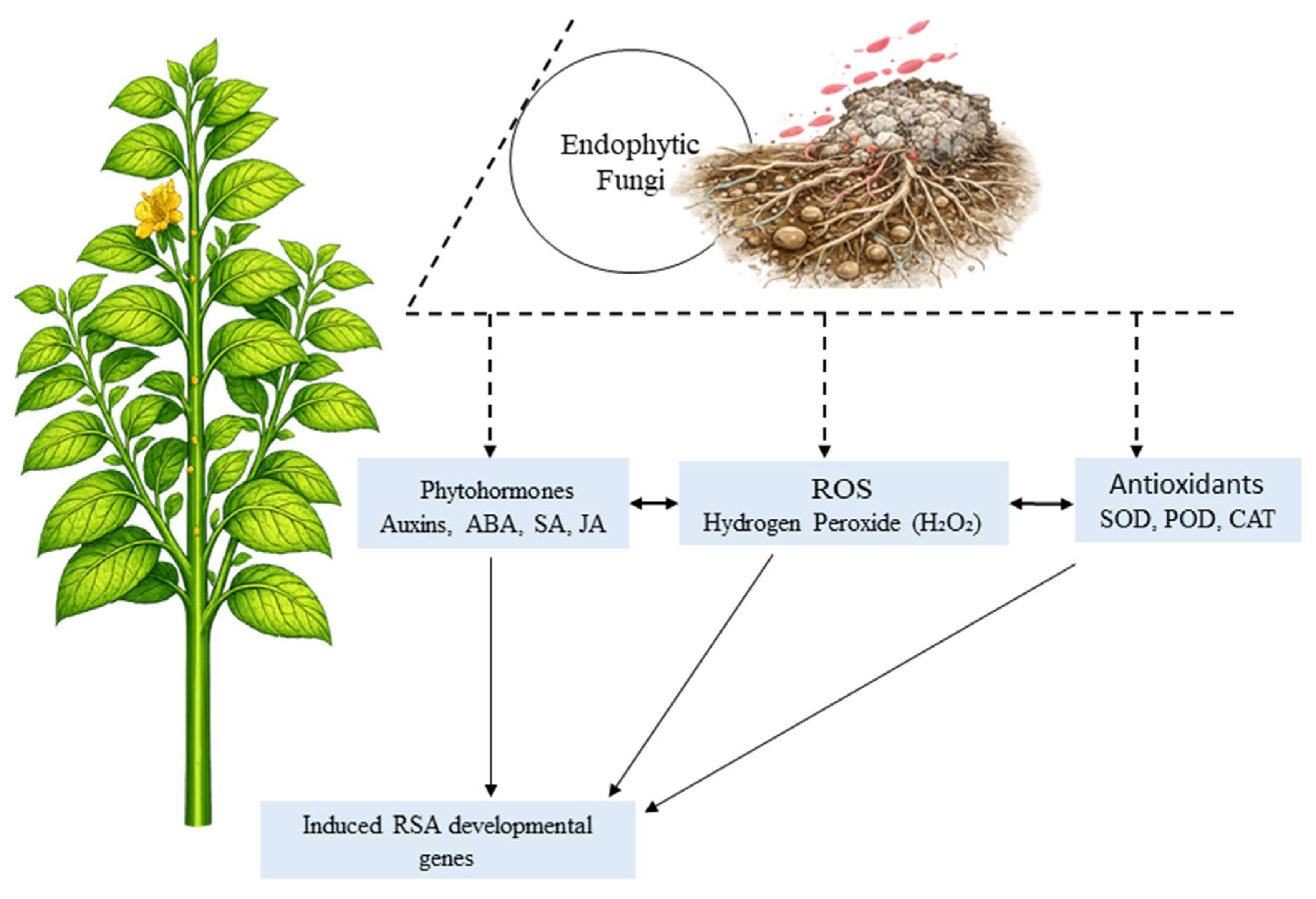
At the redox level, damaging oxidative bursts are typically constrained, while controlled ROS/NO connections required for cellular communication, immune priming, and metabolic adaptation are maintained [86]. This redox buffering is particularly beneficial under climatic stress, as oxidative damage threatens both host tissue integrity and the stability of endophytic mutualism. Endophytic fungi thus rewire phytohormonal networks (auxin, JA, ABA, SA, ethylene) and redox signaling to activate root system architecture (RSA) genes and antioxidant enzymes (CAT, SOD, POD), promoting root architecture, maintaining growth–defense trade-offs and supporting mutualistic stability under stress (Figure 4).

4.3. Effector-like Proteins, Volatiles, and Secondary Metabolites in Plant–Fungal Endophyte Communication

One of the key reasons fungal endophytes can remain in living plant tissues without causing disease is that they actively modify the host environment by releasing communication molecules, such as effector-like proteins, volatile organic compounds (VOCs), and various secondary metabolites [87]. During colonization, fungal endophytes secrete effector-like proteins that regulate host recognition and downstream immune responses [88]. In contrast to aggressive pathogen effectors, which lead to high susceptibility, endophytic effectors tend to work subtly, fine-tuning defense levels to enable controlled accommodation. These proteins can interfere with MAMP-induced signaling, reduce excessive ROS generation, regulate cell wall reinforcement, and mediate hormone-associated immunity responses [89]. This interconnection establishes symbiotic compatibility while preserving host defensive capacity, balance essential for the persistence of long-term mutualism.
Simultaneously, fungal endophytes synthesize VOCs, which are low-cost, long-range signals that may affect host physiology and linked microbiomes, although evidence from field conditions remains a challenge [90]. VOCs produced by endophytes may enhance plant development, increase chlorophyll content, modulate stomatal activity, and promote drought and salinity tolerance by priming stress-response pathways [91]. They also indirectly decrease pathogen abundance, forming a chemical barrier that contributes to plant health. However, these effects are context-dependent and not universally validated across systems.
Fungal endophytes also modulate symbioses through secondary metabolites, including alkaloids, polyketides, terpenoids, phenolics, and non-ribosomal peptides [92]. These compounds can have multifunctional activities: they can deter pathogens and herbivores, alleviate oxidative stress via antioxidant activity, and influence hormonal signaling networks. However, production of these metabolites carries ecological trade-offs; at high concentrations, some can be dangerous to livestock and non-target organisms [93]. Therefore, regulating effector release and metabolite production under climate stress is a key factor both for predicting mutualistic stability and for exploiting endophytes in climate-smart resilient agriculture and ecosystem restoration. However, the production of secondary metabolites, especially alkaloids, represents an ecological trade-off. When the concentrations of these metabolites are high, they can be phytotoxic, inhibiting plant growth and potentially harming non-target organisms such as livestock. This trade-off highlights the delicate balance that endophytes must maintain in promoting metabolite production without causing detrimental effects on the plant while providing defensive benefits.

4.4. Cross-Kingdom RNAs and Extracellular Vesicles: Frontier Mechanisms Linking Symbiosis to Stress Memory

Plant–fungal endophyte symbioses are also reported to undergo cross-kingdom regulation at the molecular level, particularly involving small RNAs (sRNAs) and extracellular vesicles (EVs) [94]. These processes have been primarily observed in model systems, and their prevalence in endophytic interactions remains largely unvalidated. Fungal endophytes may synthesize regulatory sRNAs that can enter plant cells and potentially modulate host transcripts involved in immune activation or stress responses, which could facilitate colonization at a lower metabolic cost [95]. Conversely, plants can produce sRNAs that may target fungal genes involved in hyphal growth or metabolite production, suggesting a potential mechanism for maintaining symbiotic balance. While this two-way RNA communication is hypothesized to allow rapid and adaptable regulation of mutualism under changing conditions, direct empirical evidence in endophyte systems is limited [96].
EVs can transport regulatory cargo, including sRNAs, proteins, lipids, and metabolites, between interacting cells [97]. EV-mediated secretion may protect signaling molecules from degradation and enable concurrent delivery of multiple regulators, such as effectors and RNA molecules, that could influence host or fungal transcriptional programs [98]. Although these pathways are proposed to be relevant under climate stress for adjusting hormone networks, antioxidant responses, and nutrient transport pathways, evidence in natural endophyte–plant systems remain sparse.
Notably, the proposed link between cross-kingdom RNA/EV signaling and epigenetic stress memory is largely speculative. Symbiotic fungi may stimulate long-term modifications in plant chromatin (e.g., DNA methylation, histone modifications), potentially affecting responses to drought, heat, salinity, or pathogens [99]. These effects remain hypothetical in endophytic systems, and their contribution to long-term tolerance traits is a key area for future research rather than an established network [100].

5. Mutualistic Nutrient Exchange Under Deficiency: Carbon Economics and Resource Allocation

Recent literature describes plant-endophyte mutualism under nutrient limitation as a resource economic exchange: plants allocate photosynthetically derived carbon; in return, endophytes provide nutrient provisioning and stress buffering functions. This interaction is often conditional and becomes unstable under climate stress, where limited carbon supply or increased metabolic costs of endophyte maintenance break the balance [101]. Studies, including isotope-tracing experiments, have demonstrated that under conditions of nitrogen (N) or phosphorus (P) deficiency, endophytes act as effective carbon sinks within plant roots and other colonized tissues. These endophytes attract host-fixed carbon by regulating growth and aiding the synthesis of metabolites that enhance fungal resistance [102]. Importantly, isotope-labeling studies have quantitatively confirmed the movement of carbon from host plants to endophytes, strengthening the idea that carbon allocation to endophytes is not inherently detrimental. Indeed, this process often supports the fungal functions that result in benefits to the host, such as stress tolerance and growth regulation [103].
In recent mechanistic reports and syntheses, phosphorus mobilization emerges as a key mechanism in nutrient-poor soil. Endophytic fungi may enhance P availability through the secretion of organic acids and phosphatases, and by altering root physiology to increase P uptake capacity [104]. Recent evidence suggests that endophyte-induced rewiring of host lipid and hormonal metabolism may promote plant permissiveness to colonization while simultaneously improving P uptake efficiency, indicating that nutrient returns are optimized through host metabolic reprogramming [105]. With regard to nitrogen, it is claimed that the current perspective focuses on indirect yet strong pathways: endophytes facilitate root system architecture, enhance internal N-use efficiency, and enhance local organic N turnover by means of enzyme-mediated mineralization. Combinations of these routes can sustain chlorophyll and growth in the presence of limited external N supply, especially in conditions where drought would be predicted to inhibit rhizosphere nutrient flux [106]. Iron acquisition has gained momentum as a third nutrient return pillar during times of stress. Many fungal endophytes secrete siderophores that chelate iron (Fe) where Fe solubility is limited, especially in alkaline or saline soils [107]. Redox coupling is also a focus of newer discussions. With the ability to affect localized redox chemistry and ROS balance, endophytes can have an indirect effect on Fe speciation, increase the accessibility of micronutrients, and reduce oxidative stress on host photosystems. This function is particularly important as it often co-occurs during drought and heat stress, resulting in a bottleneck that can be mitigated by endophytes [108].
Another significant development in recent literature is the shift towards a transport-based model of exchange. The concept of nutrient trade is now increasingly viewed as the concerted control of membrane transport across the symbiotic interface on either side of the membrane [109]. Carbohydrate partitioning and sugar export on the plant side determine the magnitude of carbon allocation to colonized tissues, whereas fungal uptake systems regulate nutrient acquisition from microsites and their subsequent transfer towards the host interface [110]. Recent mechanistic studies consistently identify reprogramming of host nutrient uptake pathways, particularly P transport systems, as a central outcome of successful colonization, suggesting that endophytes can induce a high-uptake state in host transport capacity. Accommodation of carbon export and nutrient import capacities are not only compatible in this framework, but they are synchronized.
Finally, the benefit–cost curve for endophyte symbioses under stress gradients serves as a conceptual tool to understand dynamic interactions. With moderate nutrient limitation, the net effects of carbon costs are overcome by enhanced N, P, and Fe uptake and reduction of stress, which have a strong positive net impact [111]. As stress intensifies, particularly under combined nutrient limitation with drought and heat, host photosynthesis and carbon supply decline while fungal maintenance costs rise. Beyond the critical threshold, the benefit–cost curve may shift such that the relationship becomes mildly parasitic rather than mutualistic [112]. This instability emphasizes predictable challenges under global change, including limited carbon supply, depleted nutrient pools, or failure of transporter coordination, where sites of carbon export occur without proportional nutrient import. Practically, this revised framework emphasizes that endophytes should be evaluated not only for promoting growth but also for carbon costs, nutrient recovery efficiency, and stable performance under fluctuating stress, recognizing that mutualism is dynamic [113].

6. Functional Diversity and Scaling of Fungal Endophyte Symbioses

Recent studies indicate that species richness is not a good predictor of plant benefit, particularly under climate variability in which plants are now living [114]. Consequently, the field is shifting towards a trait-based functional approach where endophyte communities are characterized based on the “symbiotic relationships” that they have and express in specific environmental conditions. This methodological shift emphasizes measuring functional traits and their ecological expression rather than cataloging species identities, integrating empirical and synthetic studies. The identity of an endophyte is less important than the endophyte’s functional contributions, and the consistent plant outcomes are linked to functional traits that match the needs of the host plant and the stress regimes [115]. Thus, functional diversity is more appropriately understood as a collection of traits within the assembly of endophyte members. Modern studies are important for understanding how these traits influence individual host performance, the resilience of groups, the tenacity of communities, and the functioning of entire ecosystems.
A trait-based framework provides a structured classification for fungal endophyte functions into different functional groups that can be mapped directly to plant survival and performance measures [116]. In the context of global change, four modules of resilience are often mentioned. First, osmotic tolerance modules increase tolerance to drought and salinity through osmotic accumulation, membrane stabilization, and increased water use efficiency. This modulation of stomatal and root hydraulic behavior is extremely valuable in arid and semi-arid systems where precipitation patterns are becoming increasingly erratic [117,118]. Second, detoxification capacity modules involve endophytes in the toleration of heavy metals and pollutants. They include chelation, sequestration, antioxidant up-regulation, and manipulation of host detoxification pathways [119]. This module’s contribution is context-dependent, varying with pollutant type, intensity, and the host-endophyte combination. Third, hormone/ROS modulation modules reveal potential roles for endophytes in regulating phytohormone networks such as ABA, jasmonate, salicylate, ethylene, and auxin, as well as ROS/NO networks to stabilize growth–defense trade-offs [120]. Fourth, nutrient acquisition modules involve both the solubilization and mineralization of phosphorus and nitrogen turnover and assimilation support, as well as iron acquisition via the production of siderophores and redox-linked mobilization [121]. These functions are critical when diffusion of nutrients is limited due to drought and the bioavailability of micronutrients is compromised. The appearance of these modules occurs quite often in combination, for example by drought resilience commonly resulting from integrated multi-trait sets of osmotic, redox buffering and nutrient acquisition traits that stabilize host function under compound environmental stress.
The functional organization of endophyte communities is shaped by the balance between keystone endophytes and functional redundancy [122]. Keystone endophytes are taxa or strains whose expressed traits crucially determine host phenotype or community outcomes under certain conditions, often dominated by mechanisms such as ROS buffering, P mobilization or the production of antimicrobial metabolites [123]. Experimental evidence indicates that in some systems, a single keystone strain can disproportionately influence host performance, though the effect size is highly context dependent. In many plant systems, a single, high-impact endophyte can have a profound effect on growth or stress recovery, which identifies functional dominance that outweighs differences in species richness for explaining observed variance in host performance. The value of functional redundancy is emphasized under fluctuating environmental conditions, as it allows for the persistence of core functions despite turnover in community composition. Functional redundancy occurs when several endophytes perform the same function, which can be retained if specific species decline due to warming, drought pulses, or seasonal turnover [124]. This redundancy acts as ecological insurance: despite the changes in community membership manifesting in these shifts, key community resilience services are still available. Empirical evidence indicates that high redundancy could impart ecosystem-level stability but may also obscure mechanistic signals, as the same phenotypes can be generated by different community configurations [125]. Accordingly, the great challenge is to identify the circumstances under which redundancy enhances resilience versus outcomes when redundancy leads to operational neutrality through poor trait expression or poor colonization compatibility.
Scaling from individual hosts to plant communities requires linking the expression of fungal traits within hosts to plant–plant interactions [126]. Endophytes regulate host growth rate, nutrient absorption efficiency, stress tolerance, and pathogen resistance, all characteristics that have a fundamental impact on determining competitive hierarchies [127]. In heterogeneous environments, endophytes might promote coexistence by allowing different plant species or genotypes to coexist within different stress niches, promoting the stability of the community. For example, the use of drought-tolerant endophyte modules stabilizes perennial grass during periods of drought stress, and nutrient-mobilizing modules can be particularly important for plants that are otherwise poorly adapted to living in low-fertility soils [128]. Conversely, endophytes can increase dominance: when a plant recruits modules that disproportionately promote resource capture or defense, it can outcompete neighbors at the expense of diversity. Thus, the effect of endophytes on community structure is context-dependent, with the potential to stabilize community structure through niche differentiation or destabilize it through competitive exclusion.
These scaling effects are further amplified under a disturbance regime, and when ecosystems face repeated temporary stress, their stability depends not only on resistance but also on recovery dynamics. Endophytes can enhance resistance by maintaining growth under stress conditions while simultaneously boosting post-stress recovery by maintaining nutrient uptake capacity, reducing oxidative injury and preserving meristem integrity [129]. At the community level, such resilience has the potential to dampen the synchrony of declines in productivity across species, creating portfolio effects that dampen aggregate biomass. However, the sustainability of these benefits is limited by temporal variability in colonization and trait expression, which may reduce observed functional contributions over time. Endophyte colonization or indicator trait expression can be seasonally inconstant, potentially undermining community-level resilience without short-term visible gains [130]. Hence, interpreting stability induced by endophytes requires a temporal perspective: for a system to be sustainable, resilience must include persistence, continuity of function, and compatibility under several subsequent climatic shocks rather than singular and exceptional effects [131].
Endophytes also play an important role in invasion resistance, a subject of increasing importance in the context of global change ecology [132]. The combinations conferred by endophytes have the potential to reinforce native plant stress tolerance and defense and thus can also increase plant resistance to invasion. On the other hand, invasive plants may use endophytes to gain a competitive advantage, either through co-introduction of their own symbionts or by acquiring novel beneficial endophytes in the invaded range [133]. As it stands, certain endophyte modules (most notably those contributing to nutrient acquisition and defense priming) can favor the establishment of invaders in harsh environments, as they enable the colonization of saline, drought-prone or disturbed environments [134]. Additionally, endophyte-mediated changes in the microbial community of the soil can alter feedback mechanisms that regulate the dynamics of invasions and sometimes favor invasive dominance. Consequently, endophytes may be both promising tools for restoration and potential hidden drivers of invasion success, highlighting the need for careful and continuous monitoring of endophyte functions and performance assessment [135].
To describe these multi-scale dynamics, more recent studies make increasing efforts to use ecological network approaches. Rather than investigating endophytes as passenger microbes, network ecology takes a holistic perspective on plant-associated microbiomes as interaction webs operating under the principles of cooperation, competition, facilitation, and antagonism [136]. Keystone endophytes may manifest as high centrality nodes that shape community interactions, while redundancy can enhance network robustness when taxa are lost. Network analyses also reveal functional trade-offs, such as pathogen suppression by endophytes potentially decreasing support for different mutualists, emphasizing the need to interpret network stability measures alongside functional results.
Overall, the emerging consensus is that functional diversity is the operative unit in fungal endophyte symbioses and scaling up to resilience. This involves the distribution of trait modules among hosts and the balance of keystone effects and redundancy, with microbial networks mediating indirect interactions [137,138]. The framework offers a powerful foundation for predicting the climatic conditions under which endophytes can enhance ecosystem stability and how to select endophyte communities with trait-based information for sustainable agricultural production and restoration [139].

7. Endophyte-Driven Plant–Soil Feedback and Biogeochemical Cycling

Fungal endophytes largely influence soil functioning through indirect control over plant inputs and the quality of the root zone habitat, shaping the assembly of the rhizosphere and subsequent biogeochemical processes. Because endophytes regulate host metabolism, they can change both the quantity and composition of rhizodeposition (sugars, amino acids, organic acids, phenolics) and the chemistry of litter entering decomposition mechanisms [140]. These shifts are important because rhizodeposits and litter chemistry are key regulators of the growth strategies, enzyme investments and composition of microbial communities in the soil matrix [141]. Practically, endophyte-colonized plants may exude compounds that selectively promote certain microbial groups (e.g., phosphate mobilizers, stress-tolerant decomposers) while inhibiting others through antimicrobial molecules. Endophyte-colonized plants also change their nutrient stoichiometry, which in turn creates an environment conducive to some microbial groups and less suitable for others, establishing a plant-mediated selection mechanism that can persist seasonally [142].
Evidence from recent studies suggests that endophytes have the capacity to restructure microbial rhizosphere recruitment through alterations in root architecture, root turnover, and signaling chemistry that determine which bacteria and fungi are enriched in the vicinity of roots [143]. For example, studies on vertically transmitted (seed) endophytes indicate that internal microbes can restructure rhizosphere microbiota during initial plant establishment, supporting the hypothesis that the internal endosphere can “precondition” soil microbial communities via host physiological outputs rather than direct soil colonization [144]. In parallel, field-scale inoculation experiments in crops have provided a potential link between fungal endophyte influence on plant traits (i.e., exudation, aggregation, residue quality) and soil biogeochemistry, indicating a causal relationship between the biochemical traits regulated by endophytes [145].
An important outcome of this plant–soil feedback is its influence on carbon stabilization and soil organic carbon (SOC) formation. Endophyte-mediated alterations in root exudation also have the potential to increase microbial processing of carbon inputs and enhance the formation of mineral-associated organic matter and the physical protection of carbon within aggregates [146]. Conversely, endophytes could modify decomposition trajectories by altering litter lignin/cellulose accessibility or by reshaping decomposer community composition and enzyme activity profiles [147,148]. Comparisons of net ecosystem carbon gain (SOC + aboveground biomass − litter losses) with soil carbon content across different habitats reveal that loss rates in waterlogged soil are approximately twice those observed in forests, though they are generally comparable across other plant systems. Recent field work reporting endophyte-associated increases in SOC fractions supports the concept of a stabilization pathway linked to altered rhizodeposition and aggregation rather than a simplistic “more biomass equals more SOC” model [149].
Endophyte effects on nitrogen cycling seem particularly significant under climate stress because drought, warming, and fertilization may destabilize nitrification/denitrification balances [150]. Endophytes can influence nitrogen cycling both indirectly, by modifying plant N demand and rhizosphere oxygen conditions (through rooting patterns and microbial respiration), and directly, by altering microbial functional gene abundance related to nitrification and denitrification [151]. For example, recent work on Epichloë symbiosis reveals changes in the abundance and diversity of rhizosphere genes involved in nitrogen cycling, suggesting that a foliar or systemic fungal association can impact rhizosphere functional potential via host-driven effects [152]. Such shifts are important because they may influence nitrate availability to plants, nitrogen retention versus loss, and the sensitivity of N transformations to short periods of rainfall [153].
These processes are closely linked to greenhouse gas dynamics under stress. Climate extremes often trigger rapid changes in soil aeration and substrate availability, which can influence CO2 and N2O emissions [154]. Endophytes may affect the magnitude of these pulses by regulating carbon inputs (rhizodeposition and litter), shaping microbial community composition, and altering the balance of aerobic and anaerobic processes occurring at microsites [155]. While many greenhouse gas studies focus on mycorrhizae or bulk soil drivers, emerging microbiome research suggests that manipulating plant-associated microbes, including endophytes, may help achieve climate-smart outcomes by coupling plant carbon allocation to soil microbial activity [156].
Overall, fungal endophytes may be considered key regulators of plant–soil coupling. They can reprogram host input chemistry and stress physiology, filter and structure microbial populations in the rhizosphere, reshape microbial functional potential, and affect SOC dynamics, nitrogen transformations, and greenhouse gas fluxes. A key research priority is to quantify the conditions under which this feedback renders ecosystems more stable (enhanced carbon retention, tighter nitrogen cycling, faster post-stress recovery) versus unstable (accelerated decomposition or increased gaseous N losses), particularly under realistic multi-stress field conditions [157].

8. Integrative Multi-Omics and Ecology to Resolve Fungal Endophyte Function

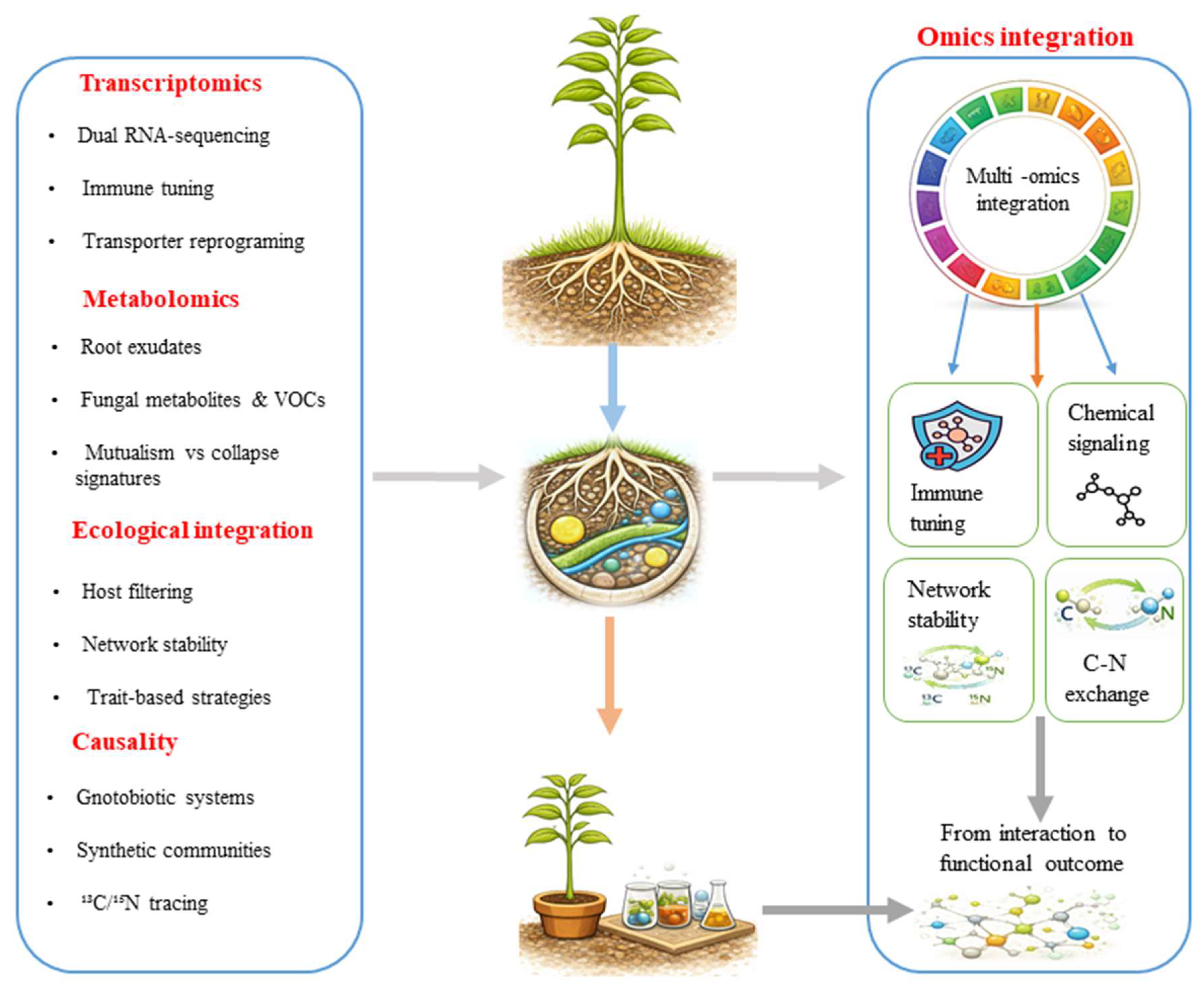
Integrating multi-omics with ecological inference is now the most rigorous pathway towards solving the problem of what fungal endophytes do and why outcomes shift from mutualism to neutrality under climate stress. Recent studies increasingly understand that endophyte function cannot be inferred solely from presence or absence. Instead, it must be associated with host molecular states (immune tuning and reprogramming of transporters, stress response activation), metabolic end products (root exudate chemistry, fungal metabolites, VOCs), and community- and ecosystem-level consequences (microbiome recruitment, network stability, nutrient cycling) [158]. For transcriptomics, the trend is tipped towards dual profiling approaches and comparative designs that contrast the closely related endophytic versus pathogenic lifestyles in planta. These approaches allow for clean identification of host immune markers and fungal colonization programs that segregate exposure with accommodation and disease modes of action [159]. In parallel, root exudate metabolomics facilitate higher-resolution insights into exudation dynamics and chemical signals that structure microbiome community assembly, providing a mechanistic bridge between plant physiology and rhizosphere shifts [160].
Critically, the integration of multi-omics (transcriptomics and metabolomics) is increasingly being conducted together with both ecological network analyses and trait-based modeling aimed at producing a testable set of hypotheses about resilience mechanisms, rather than simply describing associations only [161]. To establish causality, the most robust designs now attach synthetic communities (SynComs), gnotobiotic systems, and stable isotope tracing (13C/15N) to quantify carbon–nutrient exchange and directly attribute functional consequences to important endophyte modules under controlled yet ecologically relevant stress regimes [162]. By integrating multi-omics data within an ecological framework, we were able to move from identifying correlative signatures of immune tuning to establishing the causal mechanisms driving functional outcomes (Figure 5).

8.1. Transcriptomics

Dual RNA-seq is now an integral approach to resolving plant–fungal endophyte function by profiling both partners in the same colonized tissue and distinguishing between beneficial and harmful interactions. Recent research on beneficial root endophytes reports that asymptomatic colonization is associated with host immune tuning: genes encoding markers of pattern-triggered immunity and defense transcription factors are up-regulated at low levels, while hypersensitive signaling modules leading to cell death and long-lasting outputs of oxidative burst are maintained at low levels [163]. In parallel, stress response genes (ABA/heat shock/antioxidant networks) are often reweighed towards tolerance rather than full defense, enabling better performance under drought, heat, or low-nutrient conditions [164]. Low-phosphate symbioses are often associated with the activation of phosphate-starvation regulons and phosphate transporter transcripts, suggesting a reprogramming by endophytes of host uptake capacity coupled with fungal activation of nutrient acquisition machinery [165]. For Colletotrichum tofieldiae, host phosphate regulators and transporters are up- or downregulated under low Pi during colonization [166]. Fungal reads usually enrich for secreted megaphyll effectors, cell wall remodeling, and nutrient scavenging pathways that enable intercellular growth without causing excessive damage [167]. Comparative transcriptomics between endophytic and pathogenic lifestyles also suggests that compatibility corresponds to low-level expression of aggressive necrotrophic programs, as well as stricter temporal control of virulence-associated genes [168]. Together, dual RNA-Seq associations link immune markers, stress mechanisms, and transporter-centered exchanges to long-term stable mutualism.

8.2. Metabolomics

Metabolomics has emerged as the most advanced means of “reading out” the function of plant–fungal endophytes because it reflects the chemical phenotype that bridges molecular signaling and ecological outcomes, evident in root exudate chemistry, fungal metabolites, and volatile organic compounds (VOCs). High-resolution LC-MS/MS profiling of exudates is beginning to reveal that plants actively manipulate rhizosphere recruitment through specific release of sugars, amino acids, organic acids, and specialized metabolites, with particular compounds having been found to correlate with changes in bacterial/fungal community structure [169]. In parallel, endophyte colonization can induce host secondary metabolism, often with increased production of phenylpropanoids/terpenoids and pools of antioxidants, with fungi contributing their own bioactive metabolites (in host defense, stress tolerance, and/or competition suppression) [170]. VOC metabolomics (e.g., SPME-GC-MS) is particularly interesting in the context of fungal endophytes since VOCs can exert diffusible signaling and antimicrobial functions; recent reviews are devoted to summarizing VOC classes and their relevance for biocontrol and stress mitigation in endophytic fungi [171]. A practical objective is the identification of biomarkers of mutualism vs. collapse. “Mutualism signatures” frequently contain elevated osmoprotectants and antioxidant-related metabolites (responsible for drought/salinity buffering) and changes in exudates that enrich beneficial rhizosphere guilds [172]. In contrast, “collapse signatures” are suggested by the strong accumulation of defense phytoalexins, lipid peroxidation products, and stress-damage metabolites, indicative of immune escalation and metabolic cost, and perhaps in association with fungal toxin-like compounds or VOC profiles linked to antagonism rather than coexistence [173].

8.3. Ecological Integration

Recent studies of endophytes are also evolving away from treating function as an individual- or taxon-level phenomenon, towards considering it a community-level phenomenon, such as by integrating (i) analyses of community assembly in different compartments (bulk soil → rhizosphere → root endosphere) into (ii) network inference analyses of endophyte community hubs/keystones and stability signatures, and (iii) trait-based models that incorporate logic from omics mechanisms into resilience predictions [174]. Field compartmental surveying indicates that root endosphere communities are highly filtered compared to surface pools within the rhizosphere/soil, guiding host-microbiome selection by microhabitat constraints, which in turn may drive both internal and propagule persistence. This implies that functional capacities at the propagule level can scale upward to influence ecosystem function [175]. At the same time, co-occurrence networks can be used to quantify the effects of drought or management on network topology (e.g., modularity, centrality, hub taxa), which can indicate changes in robustness and competitive structure. Water-stress microbiome studies show how bacterial and fungal subnetworks may reorganize differently under stress, implying distinct stabilizing or destabilizing roles [176]. The field is rapidly embracing the use of genome-informed, trait-informed modeling to bridge the identification of microbial strategies (resource acquisition, growth efficiency, stress tolerance) to observe community dynamics and plant outcomes [177]. A notable step forward is dynamic energy budget, trait-based modeling, which can predict emergent microbiome behavior from trait distributions rather than taxonomy, providing a route to predicting resilience in a changing environment [178]. Coupled with community ecology (turnover, beta diversity, dispersal limitation) and network diagnostics, trait-based models allow for a “mechanisms → community shifts → resilience” pipeline, which is becoming the preferred standard for scaling endophyte biology to ecosystem-level predictions.

8.4. Causality

Causal inference in the study of plant–fungal endophytic interactions is becoming more dependent on experimental designs that make both microbial identities and their interaction types explicitly measurable. First, gnotobiotic plant systems (sterile plant growth systems, where microbes are reintroduced in predetermined assemblages) can provide rigorous tests to determine whether a candidate endophyte is sufficient to elicit a given phenotype under controlled nutrient or stress regimes. Modern systems (peat/soil-mimic platforms like Flow-Pot/GnotoPot and Litterbox) are widely adopted as they provide a more faithful model of soil aeration and nutrient dynamics than traditional assays on agar [179]. Second, synthetic communities (SynComs) apply this reasoning to multilateral causality: when simplified, modular microbial consortia are built, investigators can measure additive versus interactive effects (synergy vs. antagonism), identify keystone members, and assess the stability of these consortia across a stress gradient while maintaining traceability of community composition [180]. Third, stable-isotope approaches provide unique evidence of exchange. ^13C labeling (plant carbon) together with ^15N tracing (nutrient acquisition) enables quantification of carbon-for-nutrient exchange and can reveal mutualistic weakening under stress. Recent dual-isotope studies have resolved preferential C-N exchange dynamics in endophytic root symbioses and associated nutrient-trading fungi [181]. Collectively, gnotobiotic systems, SynComs, and isotope tracing form a robust experimental pipeline for moving from mere association to mechanistic understanding and defining critical points where endophyte benefits fail under climate-linked constraints.

9. Deploying Fungal Endophytes for Climate-Resilient Agriculture and Ecosystem Restoration

Deployment of fungal endophytes in climate-resilient agriculture and restoration has moved beyond establishing proof of concept for the benefits observed under controlled conditions, with the main challenge being to ensure reliability under variable climatic events [182]. Field environments are discontinuous in temperature and moisture regimes, and soils may have unusual chemistry and harbor complex resident microbiomes that can suppress introduced strains or modify their function. This degree of dependency on context explains the variability in endophyte benefit reports: while the potential benefits delivered by endophytes associated with plant tissues have been the focus of numerous studies in well-characterized grass symbioses in recent years, analyses have shown that symbiosis does not necessarily lead to increased drought tolerance. Because of this conditional dependency, endophyte effects should be treated as contingent on a specific set of circumstances, rather than guaranteed.
Consequently, the question arises: under what circumstances do fungal endophytes thrive, and when and why do they fail [183]? Under drought and heatwave regimes, some fungal endophytes can enhance tolerance through osmotic and antioxidant buffering and hormone regulation, most notably balancing abscisic acid (ABA)/ethylene while maintaining root function. Nevertheless, drought decreases carbon supply from the host, which might destabilize the carbon-for-benefit trade if the fungus continues to act as a robust carbon sink, potentially reducing plant yields. This is consistent with observations that host genotype, fungal strain, and environment affect drought outcomes and drive drought-induced changes in the structure of fungal communities in soil, which may influence the establishment and persistence of inoculant fungi.
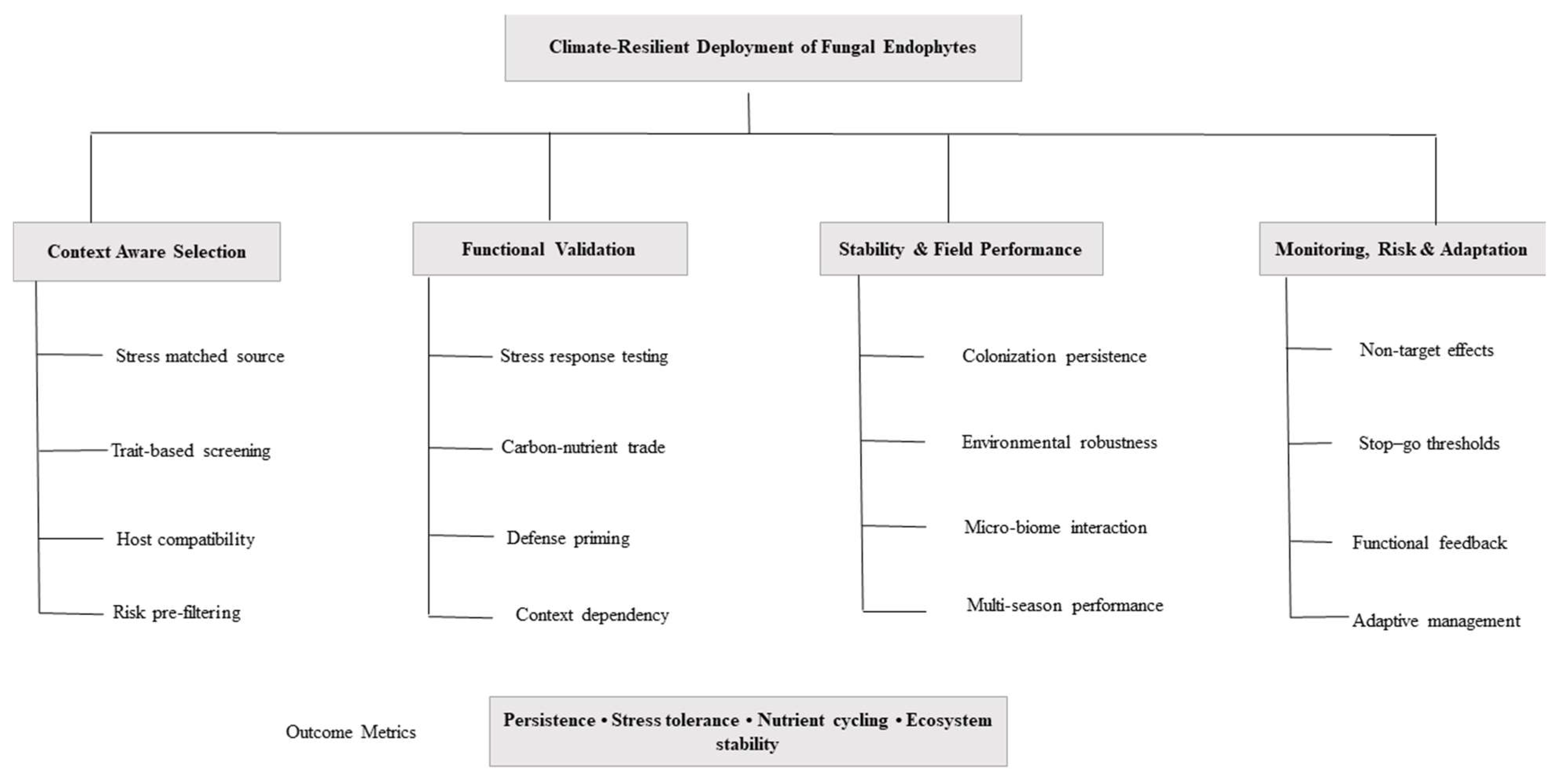
The practical aspects of “success” in drought-prone grasslands require accounting for (i) target hosts being locally adapted individuals, (ii) fungal endophytes originating from environments with similar stress levels, and (iii) multi-season persistence being validated rather than relying on short-term trials [184]. To translate mechanistic understanding into practical solutions, we implemented a multi-stage deployment pipeline (Figure 6) that integrates context-aware strain selection with rigorous field validation and adaptive monitoring to ensure both efficiency and ecological safety.
Restoration of drought-prone grasslands is an example of a high-value application because stress buffering translates into population maintenance and erosion control. In this context, fungal endophytes should be introduced with a focus on stability rather than yield enhancement: priority endpoints are survival, recovery after short-term stress, and reduced synchrony of species failure. However, there are biosafety considerations. Certain grass endophytes (e.g., clavicipitaceous lineages in cool-season grasses) can affect herbivory and forage quality, so restoration programs need to actively screen for non-target risks and ensure compatibility with grazing uses [185]. A meta-level synthesis of drought responses described by grass endophyte systems supports a trait- and context-driven deployment strategy rather than blanket recommendations [186].
Saline soil deployment is often more predictable because salinity is a strong selective pressure favoring stress-tolerant fungal trait groups (osmoprotection, ion homeostasis, redox buffering). Recent crop-specific research shows that salt-tolerant fungal endophytes isolated from salt-tolerant plants can improve the growth and physiological performance of salt-sensitive plants upon inoculation. Importantly, this observation provides a practical selection rule: endophytes should be sourced from saline-adapted plants, and their transferability validated in target hosts rather than using generic inoculants [187]. Contemporary work also highlights the need to match specific soil limitations (e.g., alkaline salinity with low iron availability) and to measure strong functional endpoints such as ion balance, photosystem integrity, and root hydraulic traits, rather than simply short-term biomass increases [188].
Polluted ecosystems and phytoremediation represent a third area for fungal endophyte deployment. Their intracellular habitat enables regulation of detoxification mechanisms, oxidative stress defenses, and metal absorption/translocation. Recent reviews summarize several mechanisms, such as chelation/complexation, enzymatic transformation, and transporter regulation, and conclude that endophytes can enhance phytoremediation efficiency when coupled with tolerant host plants. Empirical studies support inoculation with specific fungal strains to reduce heavy metal stress and improve plant growth under contaminated soils (e.g., maize under Zn/Ni stress) [189]. At the same time, polluted soils reshape endophytic fungal communities, so introduced strains must compete in a new microbial environment, and their persistence and containment need monitoring to avoid unintended spread or changes in metal mobility [190].
Reliability testing is a critical component of a deployment roadmap under uncertainty. Inoculants must be tested across a range of stress conditions, including moderate to extreme levels, in different seasons and soils with diverse resident microbiomes, and failure cases should be documented. Field experiments are essential because formulation and delivery are critical to performance. Monitoring and metrics should define success across levels, including colonization stability, host physiological indicators (water status, ion balance, redox), and ecosystem endpoints (cover persistence, invasion suppression, soil stabilization). In contaminated sites, monitoring should also include metal partitioning and potential off-site transfer. Biosafety and non-target assessments are crucial due to variability in fungal metabolites and species composition, and screening should consider plant toxicity, livestock relevance (especially in grasslands), and impacts on resident mutualists (e.g., mycorrhizae) and pathogen dynamics. Scalability and formulation depend on stable production, shelf life, carrier compatibility, quality control, and consistent field establishment [191]. There have been key challenges over the past two decades for microbial inoculants in general, which are directly pertinent to fungal endophytes.

10. Challenges, Knowledge Gaps, and Future Prospects

Despite significant advances in understanding plant–fungal endophyte mutualisms, many challenges and gaps limit our ability to predict and utilize these interactions under ongoing climate change. A major problem is the dependency of symbiotic outcomes. The benefits of endophytic fungi can vary across host genotypes, stress conditions, and environmental contexts, making it difficult to generalize mechanisms identified in controlled laboratory or greenhouse experiments to field conditions. For example, salinity- or drought-tolerance conferred by endophytes may be robust under moderate stress but may collapse at higher stress levels when carbon supply is altered or immune responses are deregulated. This threshold-dependent shift highlights the need for dynamic, multifactorial models that capture nonlinear responses rather than relying on static benefit estimates.
One ongoing knowledge gap is the mechanistic understanding of stress tolerance pathways. Experimental studies under controlled conditions suggest roles for phytohormone modulation, antioxidant networks, and nutrient mobilization in endophyte-mediated stress tolerance; however, many of these mechanisms remain incompletely validated under natural field conditions. For instance, endophyte-associated changes in ion transport, osmolyte accumulation, or hormonal signaling have been reported in several experimental systems, but the causal molecular pathways underlying these responses remain only partially characterized. Likewise, the relative contributions of host plasticity versus fungal influence on observed phenotypes are rarely validated in field experiments.
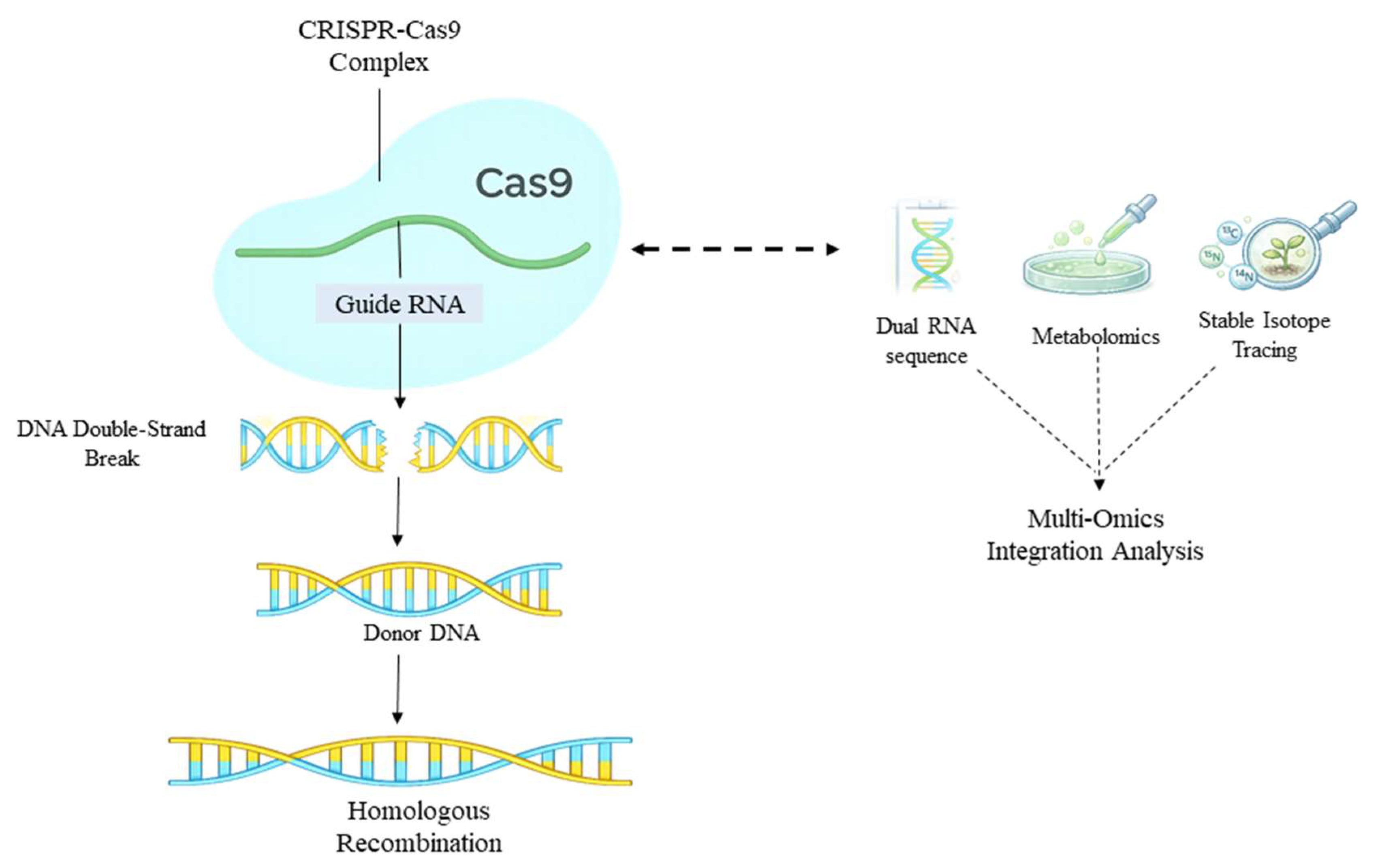
Recent advancements in fungal endophyte research offer exciting future prospects, yet significant gaps remain, especially in integrating multi-omics approaches and cutting-edge biotechnological tools for large-scale applications. One major gap lies in the genetic modification of endophytes using genome editing tools such as CRISPR-Cas9 (Figure 7). This technology has the potential to modify endophyte traits, such as stress tolerance and nutrient mobilization, which may enhance their functional interactions with crops under changing environmental conditions, although experimental validation remains limited. Additionally, the use of CRISPR-Cas9 in field applications remains limited, and regulatory challenges along with regional disparities reduce its widespread adoption.
To address this, research must focus on optimizing the stability and efficacy of CRISPR-edited endophytes across diverse agricultural fields. Additionally, integrating multi-omics technologies, including RNA-seq, stable isotope tracing, and metabolomics, provides an opportunity to explore the molecular underpinnings of plant–endophyte interactions. By combining these approaches with synthetic community experiments and ecological modeling, researchers may be able to identify causal links between genetic modifications and functional plant responses, which could influence processes such as nutrient cycling or plant stress resilience. These approaches may facilitate the development of predictive models to evaluate when and where genetically modified endophytes could be beneficial in agricultural systems. Furthermore, emerging mechanisms such as extracellular vesicles and cross-kingdom RNA transfer could offer novel strategies to enhance the balance and performance of these modified microbes under stress. Although considerable progress has been made in identifying physiological and molecular mechanisms underlying endophyte-mediated stress tolerance, translating these findings into ecosystem-scale processes and long-term resilience remains an important area for future research, particularly through field-based and multi-season studies. Importantly, understanding these regulatory mechanisms will be essential for managing risks associated with the use of genetically engineered endophytes, ensuring biosafety and minimizing unintended ecological impacts. Addressing these gaps through integrated research efforts will pave the way for the deployment of fungal endophytes in ecosystem restoration and climate-resilient agriculture.

11. Conclusions

Fungal endophytes emerge as key modulators for sustainable and climate-resilient agriculture. Their capacity to optimize host immune responses, modulate hormonal and redox networks and engage in complex molecular dialogues positions them as a dynamic group in enhancing plant resilience under stress. This review highlights how multilayered communication regulates plant-endophyte interactions. These processes include MAMP/DAMP recognition and immune tuning, effector deployment, volatile signaling, and cross-kingdom RNA exchange. Together, they enable a controlled accommodation process that maintains symbiotic balance without triggering harmful defense responses. These interactions are not static; rather, they are deeply context-dependent and modulated by environmental cues, such as nutrient deficiencies, heat stress and drought. Recent advances in transcriptomics, metabolomics, and extracellular vesicle science have shown the mechanistic basis through which endophytic fungi enhance plant physiology and stress adaptation. However, their full potential lies in bridging the gap between molecular understanding and ecological function. Integrating multi-omics data with ecological network analysis and trait-based modeling is essential to predict when, where and how endophytes enhance plant performance under changing environmental conditions. Furthermore, addressing stability, biosafety and scalability will be important for transitioning endophyte applications from controlled experiments to field deployment.
As climatic conditions become more extreme, fungal endophytes offer a flexible, adaptive tool for buffering crops and ecosystems against stress. Their symbiotic plasticity, mediated by highly evolved molecular crosstalk, can support ecosystem restoration, sustainable agriculture and long-term climate resilience. Future efforts should focus on translating mechanistic insights into applied strategies, ensuring that endophyte-based solutions are reliable, robust and sustainable.

Author Contributions

Conceptualization, A.A. (Ayaz Ahmad) and M.M.A.; software, A.A. (Aadab Akhtar); validation, R.U. and M.A.; investigation, M.B.K.; resources, A.A. (Ayaz Ahmad); data curation, M.M.A. and Z.Z.; writing—original draft preparation, A.A. (Ayaz Ahmad); writing—review and editing, M.M.A.; visualization, A.A. (Aadab Akhtar); supervision, C.S. and M.A.; project administration, Z.H.; funding acquisition, M.B.K. All authors have read and agreed to the published version of the manuscript.

Funding

This work was supported by the Open Project of Key Laboratory for Protection and Genetic Improvement of Qinghai Tibet Plateau Germplasm Resources (Co-construction by Ministry and Province), Academy of Agriculture and Forestry Sciences of Qinghai University (2023-SYS-01), the National Natural Science Foundation of China (Grant No. 32260356), the Corps Science and Technology Program (Outstanding Youth Project, Grant No. 2025DB003).

Institutional Review Board Statement

Not applicable.

Informed Consent Statement

Not applicable.

Data Availability Statement

No new data were created or analyzed in this study.

Acknowledgments

The authors gratefully acknowledge the research platform provided by the State Key Laboratory Incubation Base for Conservation and Utilization of Bio-Resource in the Tarim Basin. We also extend our sincere thanks to the anonymous reviewers for their valuable comments and suggestions, which have greatly improved the quality of this manuscript.

Conflicts of Interest

The authors declare no conflicts of interest.

Abbreviations

The following abbreviations are used in this manuscript:
ABAAbscisic Acid
ACC1-Aminocyclopropane-1-Carboxylate
AsArsenic
ATPAdenosine Triphosphate
Ca2+Calcium Ions
CATCatalase
CdCadmium
CRISPR-Cas9Clustered Regularly Interspaced Short Palindromic Repeats–CRISPR Associated Protein 9
DAMPDamage-Associated Molecular Pattern
DNADeoxyribonucleic Acid
EVExtracellular Vesicle
FeIron
GC-MSGas Chromatography–Mass Spectrometry
H2O2Hydrogen Peroxide
IAAIndole-3-Acetic Acid (Auxin)
ISRInduced Systemic Resistance
JAJasmonic Acid
LC-MS/MSLiquid Chromatography–Tandem Mass Spectrometry
MAMPMicrobe-Associated Molecular Pattern
MAPKMitogen-Activated Protein Kinase
NNitrogen
N2ONitrous Oxide
NONitric Oxide
PPhosphorus
PbLead
PODPeroxidase
PRPathogenesis-Related (proteins)
PRRPattern Recognition Receptor
PTIPattern-Triggered Immunity
RNARibonucleic Acid
RNA-seqRNA Sequencing
ROSReactive Oxygen Species
RSARoot System Architecture
SASalicylic Acid
SARSystemic Acquired Resistance
SOCSoil Organic Carbon
SODSuperoxide Dismutase
SPME-GC-MSSolid-Phase Microextraction Gas Chromatography–Mass Spectrometry
sRNASmall RNA
SynComSynthetic Community
VOCVolatile Organic Compound

References

  1. Fan, Y.; Shi, B. Endophytic Fungi from the Four Staple Crops and Their Secondary Metabolites. Int. J. Mol. Sci. 2024, 25, 6057. [Google Scholar] [CrossRef]
  2. Chen, Z.; Bi, Y.; Niu, Y.; Chen, J.; Wang, C.; You, L.; Fu, H.; Zhu, Z.; Lin, W.; Chen, S.; et al. Transcriptomic Insights into Endophytic Fungus-Mediated Enhancement of Root Growth and Stress Resistance in Phoebe bournei. Biology 2026, 15, 229. [Google Scholar] [CrossRef]
  3. Saxena, S.; Dufossé, L.; Deshmukh, S.K.; Chhipa, H.; Gupta, M.K. Endophytic Fungi: A Treasure Trove of Antifungal Metabolites. Microorganisms 2024, 12, 1903. [Google Scholar] [CrossRef]
  4. Sena, L.; Mica, E.; Valè, G.; Vaccino, P.; Pecchioni, N. Exploring the potential of endophyte-plant interactions for improving crop sustainable yields in a changing climate. Front. Plant Sci. 2024, 15, 1349401. [Google Scholar] [CrossRef]
  5. Morales-Vargas, A.T.; López Ramírez, V.; Alvarez Mejia, C.; Vázquez Martínez, J. Endophytic Fungi for Crops Adaptation to Abiotic Stresses. Preprints 2024, 2024021287. [Google Scholar] [CrossRef]
  6. Ameen, M.; Mahmood, A.; Sahkoor, A.; Zia, M.A.; Ullah, M.S. The Role of Endophytes to Combat Abiotic Stress in Plants. Plant Stress 2024, 12, 100435. [Google Scholar] [CrossRef]
  7. Chen, H.; Xu, J.; Shao, D.; Zhao, C.; Xu, X.; Xu, X.; Chen, C. Growth Promotion of Rice and Arabidopsis thaliana by Volatile Organic Compounds Produced by Endophytic Clonostachys Species. J. Fungi 2024, 10, 754. [Google Scholar] [CrossRef] [PubMed]
  8. Tiwari, P.; Bae, H. Endophytic Fungi: Key Insights, Emerging Prospects, and Challenges in Natural Product Drug Discovery. Microorganisms 2022, 10, 360. [Google Scholar] [CrossRef] [PubMed]
  9. Khan, Y.; Shah, S.; Li, D.; Yang, F. Arbuscular mycorrhizal fungi-mediated abiotic stress tolerance: Emerging roles in nutrient exchange, antioxidant defence, and hormonal crosstalk. Plant Stress 2025, 18, 101068. [Google Scholar] [CrossRef]
  10. Kamran, M.; Burdiak, P.; Karpiński, S. Crosstalk Between Abiotic and Biotic Stresses Responses and the Role of Chloroplast Retrograde Signaling in the Cross-Tolerance Phenomena in Plants. Cells 2025, 14, 176. [Google Scholar] [CrossRef] [PubMed]
  11. Pattnaik, S.S.; Paramanantham, P.; Busi, S. Agricultural importance of phyllosphere microbiome: Recent trends and future perspectives. In The Plant Microbiome in Sustainable Agriculture; John Wiley and Sons: Hoboken, NJ, USA, 2020; pp. 119–139. [Google Scholar] [CrossRef]
  12. Wani, Z.A.; Ashraf, N.; Mohiuddin, T.; Riyaz-Ul-Hassan, S. Plant-endophyte symbiosis, an ecological perspective. Appl. Microbiol. Biotechnol. 2015, 99, 2955–2965. [Google Scholar] [CrossRef]
  13. Dhar, I.; Sharma, A.; Kumawat, A.; Dadhich, A.; Priyadarshi, H.; Sharma, L.; Sharma, M.M. Bioengineered Endophyte-Integrated Biosensors: A New Frontier in Environmental Monitoring and Remediation. In Experimental and Computational Advances in Materials; Springer: Singapore, 2026; pp. 339–382. [Google Scholar] [CrossRef]
  14. Baltruschat, H.; Fodor, J.; Harrach, B.D.; Niemczyk, E.; Barna, B.; Gullner, G.; Janeczko, A.; Kogel, K.H.; Schäfer, P.; Schwarczinger, I.; et al. Salt tolerance of barley induced by the root endophyte Piriformospora indica is associated with a strong increase in antioxidants. N. Phytol. 2008, 180, 501–510. [Google Scholar] [CrossRef]
  15. Badawy, A.A.; Alotaibi, M.O.; Abdelaziz, A.M.; Osman, M.S.; Khalil, A.M.; Saleh, A.M.; Mohammed, A.E.; Hashem, A.H. Enhancement of seawater stress tolerance in barley by the endophytic fungus Aspergillus ochraceus. Metabolites 2021, 11, 428. [Google Scholar] [CrossRef]
  16. Ali, R.; Gul, H.; Rauf, M.; Arif, M.; Hamayun, M.; Husna Khilji, S.A.; Ud-Din, A.; Sajid, Z.A.; Lee, I.J. Growth-promoting endophytic fungus (Stemphylium lycopersici) ameliorates salt stress tolerance in maize by balancing ionic and metabolic status. Front. Plant Sci. 2022, 13, 890565. [Google Scholar] [CrossRef]
  17. Khan, A.L.; Hamayun, M.; Ahmad, N.; Hussain, J.; Kang, S.M.; Kim, Y.H.; Adnan, M.; Tang, D.S.; Waqas, M.; Radhakrishnan, R.; et al. Salinity stress resistance offered by endophytic fungal interaction between Penicillium minioluteum LHL09 and Glycine max L. J. Microbiol. Biotechnol. 2011, 21, 893–902. Available online: https://www.academia.edu/97536200/Salinity_Stress_Resistance_Offered_by_Endophytic_Fungal_Interaction_Between_Penicillium_minioluteum_LHL09_and_Glycine_max_L (accessed on 12 March 2016).
  18. Moghaddam, M.S.H.; Safaie, N.; Soltani, J.; Hagh-Doust, N. Desert-adapted fungal endophytes induce salinity and drought stress resistance in model crops. Plant Physiol. Biochem. 2021, 160, 225–238. [Google Scholar] [CrossRef]
  19. Ali, A.H.; Abdelrahman, M.; Radwan, U.; El-Zayat, S.; El-Sayed, M.A. Effect of Thermomyces fungal endophyte isolated from extreme hot desert-adapted plant on heat stress tolerance of cucumber. Appl. Soil Ecol. 2018, 124, 155–162. [Google Scholar] [CrossRef]
  20. Waqas, M.; Khan, A.L.; Shahzad, R.; Ullah, I.; Khan, A.R.; Lee, I.J. Mutualistic fungal endophytes produce phytohormones and organic acids that promote japonica rice plant growth under prolonged heat stress. J. Zhejiang Univ. Sci. B 2015, 16, 1011–1018. Available online: https://link.springer.com/article/10.1631/jzus.B1500081 (accessed on 12 March 2016). [CrossRef]
  21. Ismail, I.; Hussain, A.; Mehmood, A.; Qadir, M.; Husna, H.; Iqbal, A.; Hamayun, M.; Khan, N. Thermal stress alleviating potential of endophytic fungus Rhizopus oryzae inoculated to sunflower (Helianthus annuus L.) and soybean (Glycine max L.). Pak. J. Bot. 2020, 52, 1857–1865. [Google Scholar] [CrossRef] [PubMed]
  22. Karimi, R.; Amini, H.; Ghabooli, M. Root endophytic fungus Piriformospora indica and zinc attenuate cold stress in grapevine by influencing leaf phytochemicals and minerals content. Sci. Hortic. 2022, 293, 110665. [Google Scholar] [CrossRef]
  23. Acuña-Rodríguez, I.S.; Ballesteros, G.I.; Atala, C.; Gundel, P.E.; Molina-Montenegro, M.A. Hardening blueberry plants to face drought and cold events by the application of fungal endophytes. Agronomy 2022, 12, 1000. [Google Scholar] [CrossRef]
  24. Husna; Hussain, A.; Shah, M.; Hamayun, M.; Qadir, M.; Iqbal, A. Heavy metal tolerant endophytic fungi Aspergillus welwitschiae improves growth, ceasing metal uptake and strengthening antioxidant system in Glycine max L. Environ. Sci. Pollut. Res. 2022, 29, 15501–15515. Available online: https://link.springer.com/article/10.1007/s11356-021-16640-1 (accessed on 12 March 2016). [CrossRef]
  25. Mei, L.I.; Hua, L.I.A.N.; Xiao-lin, S.U.; Ying, T.I.A.N.; Jie, M.E.I. The effects of Trichoderma on preventing cucumber fusarium wilt and regulating cucumber physiology. J. Integr. Agric. 2019, 18, 607–617. [Google Scholar] [CrossRef]
  26. Koza, N.A.; Adedayo, A.A.; Babalola, O.O.; Kappo, A.P. Microorganisms in plant growth and development: Roles in abiotic stress tolerance and secondary metabolites secretion. Microorganisms 2022, 10, 1528. [Google Scholar] [CrossRef]
  27. Boorboori, M.R.; Zhang, H.Y. The role of Serendipita indica (Piriformospora indica) in improving plant resistance to drought and salinity stresses. Biology 2022, 11, 952. [Google Scholar] [CrossRef]
  28. Anand, U.; Pal, T.; Yadav, N.; Singh, V.K.; Tripathi, V.; Choudhary, K.K.; Shukla, A.K.; Sunita, K.; Kumar, A.; Bontempi, E.; et al. Current scenario and future prospects of endophytic microbes: Promising candidates for abiotic and biotic stress management for agricultural and environmental sustainability. Microb. Ecol. 2023, 86, 1455–1486. [Google Scholar] [CrossRef]
  29. Hajji-Hedfi, L.; Wannassi, T.; El-Maradny, Y.A. Fungal endophytes: Insight into evolution, classification, and ecological functions in plants. Microb. Biosyst. 2025, 10, 51–67. [Google Scholar] [CrossRef]
  30. Joseph, L.A. Recent advances in the applications of endophytic Trichoderma spp. for biocontrol and plant growth promotion. Mycol. Prog. 2025, 24, 51. [Google Scholar] [CrossRef]
  31. Wippel, K. Plant and microbial features governing an endophytic lifestyle. Curr. Opin. Plant Biol. 2023, 76, 102483. [Google Scholar] [CrossRef] [PubMed]
  32. Jaiswal, D.K.; Gawande, S.J.; Soumia, P.S.; Krishna, R.; Vaishnav, A.; Ade, A.B. Biocontrol strategies: An eco-smart tool for integrated pest and diseases management. BMC Microbiol. 2022, 22, 324. [Google Scholar] [CrossRef] [PubMed]
  33. El-Metwally, M.M.; Mekawey, A.A.I.; El-Halmouch, Y.; Naga, N.G. Symbiotic relationships with fungi: From Mutualism to parasitism. In Plant Mycobiome: Diversity, Interactions and Uses; Springer International Publishing: Cham, Switzerland, 2023; pp. 375–413. [Google Scholar] [CrossRef]
  34. Mengistu, A.A. Endophytes: Colonization, behaviour, and their role in defense mechanism. Int. J. Microbiol. 2020, 2020, 6927219. [Google Scholar] [CrossRef]
  35. Gowtham, H.G.; Hema, P.; Murali, M.; Shilpa, N.; Nataraj, K.; Basavaraj, G.L.; Singh, S.B.; Aiyaz, M.; Udayashankar, A.C.; Amruthesh, K.N. Fungal endophytes as mitigators against biotic and abiotic stresses in crop plants. J. Fungi 2024, 10, 116. [Google Scholar] [CrossRef]
  36. Imran, M.; Tahir, M.; Murtaza, S.; Nadeem, M.; Ashraf, M.I.; Waris, A.A.; Ayub, M.A. Influence of Climate Change on Soil Nutrient Cycling: Consequences for Ecosystem Sustainability and Agricultural Production. J. Health Clim. Change 2025, 4. Available online: https://jhcc.supp.journalrmc.com/index.php/public/article/view/17 (accessed on 12 March 2026). [CrossRef]
  37. Gupta, S.; Kumar, D.; Joshi, M.D.; Marahatta, S.; Tamrakar, A.; Sunita, K.; Vishwavidyalaya, B.G.G.; Sunita, K.; Zacharia, A.G.; Hasan, W. Harnessing the Power of Microflora Diversity: Exploring Alternative Solutions to Phosphorus Scarcity in the Soil-Plant System. Int. J. Agric. Appl. Sci. 2024, 5, 52–67. [Google Scholar] [CrossRef]
  38. Brown, A.J. Fungal resilience and host–pathogen interactions: Future perspectives and opportunities. Parasite Immunol. 2023, 45, e12946. [Google Scholar] [CrossRef]
  39. Harman, G.E.; Uphoff, N. Symbiotic root-endophytic soil microbes improve crop productivity and provide environmental benefits. Scientifica 2019, 2019, 9106395. [Google Scholar] [CrossRef]
  40. Wipf, D.; Krajinski, F.; van Tuinen, D.; Recorbet, G.; Courty, P.E. Trading on the arbuscular mycorrhiza market: From arbuscules to common mycorrhizal networks. New Phytol. 2019, 223, 1127–1142. [Google Scholar] [CrossRef]
  41. Nawaz, H.; Irum, A.; Nasim, W.; Hussain, N.; Usman, M.; Alam, J. Hormonal cross-talk mechanisms and plant immunity or defense: An overview. Horm. Cross-Talk Plant Def. Dev. 2023, 1–12. [Google Scholar] [CrossRef]
  42. Wu, F.; Yang, Y.; Qu, D.; Zhou, J.; Li, S.; Wang, X.; Zhao, X.; Yang, L.; Wang, L.; Zhang, X.; et al. Endophytic fungus Su100 enhances phosphorus solubilization and growth in sweet cherry via organic acids and metabolic reprogramming under phosphorus limitation. Tree Physiol. 2025, 46, tpaf161. [Google Scholar] [CrossRef] [PubMed]
  43. Perlin, M.H.; Poulin, R.; de Bekker, C. Invasion of the four kingdoms: The parasite journey across plant and non-plant hosts. Biol. Rev. 2025, 100, 936–968. [Google Scholar] [CrossRef] [PubMed]
  44. Zhang, Z.; Huang, Z.; Chen, X.; Zhang, G.; Li, M.; Li, A.; Lin, X.; Zhou, Y.; Zhang, Y.; Chen, S.; et al. Host selection shapes structure and network of microbial community of Epimedium plants along the soil–rhizosphere–plant continuum. Rhizosphere 2025, 33, 101010. [Google Scholar] [CrossRef]
  45. González-Teuber, M.; Palma-Onetto, V.; Aguilera-Sammaritano, J.; Mithöfer, A. Roles of leaf functional traits in fungal endophyte colonization: Potential implications for host–pathogen interactions. J. Ecol. 2021, 109, 3972–3987. [Google Scholar] [CrossRef]
  46. Orozco-Mosqueda, M.D.C.; Glick, B.R.; Santoyo, G. Cross-talk within plant niches: Endophytic and arbuscular mycorrhizal fungi for sustainable crop production. FEMS Microbiol. Rev. 2025, 50, fuaf063. [Google Scholar] [CrossRef]
  47. Verma, A.; Shameem, N.; Jatav, H.S.; Sathyanarayana, E.; Parray, J.A.; Poczai, P.; Sayyed, R.Z. Fungal endophytes to combat biotic and abiotic stresses for climate-smart and sustainable agriculture. Front. Plant Sci. 2022, 13, 953836. [Google Scholar] [CrossRef] [PubMed]
  48. Gonzalez Guzman, M.; Cellini, F.; Fotopoulos, V.; Balestrini, R.; Arbona, V. New approaches to improve crop tolerance to biotic and abiotic stresses. Physiol. Plant. 2022, 174, e13547. [Google Scholar] [CrossRef] [PubMed]
  49. Flores, G.A.; Cusumano, G.; Venanzoni, R.; Angelini, P. Biodiversity-Driven Natural Products and Bioactive Metabolites. Plants 2026, 15, 104. [Google Scholar] [CrossRef]
  50. Sancho-Knapik, D.; Mendoza-Herrer, Ó.; Alonso-Forn, D.; Saz, M.Á.; Martín-Sánchez, R.; dos Santos Silva, J.V.; Ogee, J.; Peguero-Pina, J.J.; Gil-Pelegrín, E.; Ferrio, J.P. Vapor pressure deficit constrains transpiration and photosynthesis in holm oak: A comparison of three methods during summer drought. Agric. For. Meteorol. 2022, 327, 109218. [Google Scholar] [CrossRef]
  51. Willing, C.E.; Pellitier, P.T.; Van Nuland, M.E.; Alvarez-Manjarrez, J.; Berrios, L.; Chin, K.N.; Villa, L.M.; Yeam, J.J.; Bourque, S.D.; Tripp, W.; et al. A risk assessment framework for the future of forest microbiomes in a changing climate. Nat. Clim. Change 2024, 14, 448–461. [Google Scholar] [CrossRef]
  52. Javed, J.; Rauf, M.; Arif, M.; Hamayun, M.; Gul, H.; Ud-Din, A.; Ud-Din, J.; Sohail, M.; Rahman, M.M.; Lee, I.J. Endophytic fungal consortia enhance basal drought-tolerance in Moringa oleifera by upregulating the antioxidant enzyme (APX) through Heat shock factors. Antioxidants 2022, 11, 1669. [Google Scholar] [CrossRef]
  53. Malik, A.A.; Bouskill, N.J. Drought impacts on microbial trait distribution and feedback to soil carbon cycling. Funct. Ecol. 2022, 36, 1442–1456. [Google Scholar] [CrossRef]
  54. Karnwal, A.; Martolia, S.; Dohroo, A.; Al-Tawaha, A.R.M.S.; Malik, T. Exploring bioremediation strategies for heavy metals and POPs pollution: The role of microbes, plants, and nanotechnology. Front. Environ. Sci. 2024, 12, 1397850. [Google Scholar] [CrossRef]
  55. Turetsky, M.R.; Weston, D.J.; Cox, W.D.; Petro, C.; Shaw, A.J. The challenging but unique eco-evolutionary aspects of Sphagnum moss. New Phytol. 2025, 247, 1608–1621. [Google Scholar] [CrossRef]
  56. Munyaneza, V.; Zhang, W.; Haider, S.; Ren, L.; Song, H.; Yi, B.; Wang, C.; Shi, L.; Xu, F.; Kant, S.; et al. Soil Microorganisms as Drivers of Pollutant Degradation, Metal Detoxification, and Sustainable Agriculture. J. Agric. Food Chem. 2026, 74, 2485–2500. [Google Scholar] [CrossRef]
  57. Kurepa, J.; Smalle, J.A. Plant hormone modularity and the survival-reproduction trade-off. Biology 2023, 12, 1143. [Google Scholar] [CrossRef]
  58. Mishra, S.; Srivastava, A.; Singh, A.; Pandey, G.C.; Srivastava, G. An overview of symbiotic and pathogenic interactions at the fungi-plant interface under environmental constraints. Front. Fungal Biol. 2024, 5, 1363460. [Google Scholar] [CrossRef]
  59. Catford, J.A.; Wilson, J.R.; Pyšek, P.; Hulme, P.E.; Duncan, R.P. Addressing context dependence in ecology. Trends Ecol. Evol. 2022, 37, 158–170. [Google Scholar] [CrossRef]
  60. Dawson, W.; Schrama, M. Identifying the role of soil microbes in plant invasions. J. Ecol. 2016, 104, 1211–1218. [Google Scholar] [CrossRef]
  61. Qiao, X.; Yan, X.; Dong, C.; Tao, L.; Aili, A.; Waheed, A. From microbiome collapse to recovery: A roadmap for microbiome-informed grassland restoration under global change. Front. Microbiol. 2026, 17, 1741287. [Google Scholar] [CrossRef]
  62. del Carmen Orozco-Mosqueda, M.; Santoyo, G. Plant-microbial endophytes interactions: Scrutinizing their beneficial mechanisms from genomic explorations. Curr. Plant Biol. 2021, 25, 100189. [Google Scholar] [CrossRef]
  63. Munson, A.; Cortese, D.; Killen, S.S. Multiple stressors. In Behavioural Responses to a Changing World; Oxford University Press: Oxford, UK, 2024; Volume 171. [Google Scholar] [CrossRef]
  64. Nie, W.; He, Q.; Guo, H.; Zhang, W.; Ma, L.; Li, J.; Wen, D. Arbuscular mycorrhizal fungi: Boosting crop resilience to environmental stresses. Microorganisms 2024, 12, 2448. [Google Scholar] [CrossRef]
  65. Liu, R.; Yang, L.; Zou, Y.; Wu, Q. Root-associated endophytic fungi modulate endogenous auxin and cytokinin levels to improve plant biomass and root morphology of trifoliate orange. Hortic. Plant J. 2023, 9, 463–472. [Google Scholar] [CrossRef]
  66. Muhammad Aslam, M.; Waseem, M.; Jakada, B.H.; Okal, E.J.; Lei, Z.; Saqib, H.S.A.; Yuan, W.; Xu, W.; Zhang, Q. Mechanisms of abscisic acid-mediated drought stress responses in plants. Int. J. Mol. Sci. 2022, 23, 1084. [Google Scholar] [CrossRef] [PubMed]
  67. Sachdev, S.; Ansari, S.A.; Ansari, M.I.; Fujita, M.; Hasanuzzaman, M. Abiotic stress and reactive oxygen species: Generation, signaling, and defense mechanisms. Antioxidants 2021, 10, 277. [Google Scholar] [CrossRef]
  68. Roychowdhury, R.; Hada, A.; Biswas, S.; Mishra, S.; Prusty, M.R.; Das, S.P.; Ray, S.; Kumar, A.; Sarker, U. Jasmonic acid (JA) in plant immune response: Unravelling complex molecular mechanisms and networking of defence signalling against pathogens. J. Plant Growth Regul. 2025, 44, 89–114. Available online: https://link.springer.com/article/10.1007/s00344-024-11264-4 (accessed on 12 March 2016). [CrossRef]
  69. Roychowdhury, R.; Mishra, S.; Anand, G.; Dalal, D.; Gupta, R.; Kumar, A.; Gupta, R. Decoding the molecular mechanism underlying salicylic acid (SA)-mediated plant immunity: An integrated overview from its biosynthesis to the mode of action. Physiol. Plant. 2024, 176, e14399. [Google Scholar] [CrossRef]
  70. Gamalero, E.; Lingua, G.; Glick, B.R. Ethylene, ACC, and the plant growth-promoting enzyme ACC deaminase. Biology 2023, 12, 1043. [Google Scholar] [CrossRef]
  71. Muhammad, A.; Khan, Z.U.; Khan, J.; Mashori, A.S.; Ali, A.; Jabeen, N.; Han, Z.; Li, F. A comprehensive review of crop stress detection: Destructive, non-destructive, and ML-based approaches. Front. Plant Sci. 2025, 16, 1638675. [Google Scholar] [CrossRef]
  72. Alfiky, A.; Weisskopf, L. Deciphering Trichoderma–plant–pathogen interactions for better development of biocontrol applications. J. Fungi 2021, 7, 61. [Google Scholar] [CrossRef]
  73. Choudhary, P.; Jaiswal, S.K.; Upadhyay, P. Host Recognition Mechanisms: Unraveling the Signaling Pathways in Endophyte Communication. In Multi-Omics Approach to Investigate Endophyte Diversity; Springer Nature: Singapore, 2025; pp. 203–223. [Google Scholar] [CrossRef]
  74. Zhao, Y.; Zhou, Y.; Xu, J.; Fan, S.; Zhu, N.; Meng, Q.; Dai, S.; Yuan, X. Cross-Kingdom RNA Transport Based on Extracellular Vesicles Provides Innovative Tools for Plant Protection. Plants 2024, 13, 2712. [Google Scholar] [CrossRef] [PubMed]
  75. Tripathi, A.; Pandey, V.K.; Jha, A.K.; Srivastava, S.; Jakhar, S.; Vijay; Singh, G.; Rustagi, S.; Malik, S.; Choudhary, P. Intricacies of plants’ innate immune responses and their dynamic relationship with fungi: A review. Microbiol. Res. 2024, 285, 127758. [Google Scholar] [CrossRef]
  76. Pinto, L.; Soler-López, L.; Serrano, A.; Sánchez-Rodríguez, C. Between Host and Invaders: The Subcellular Cell Wall Dynamics at the Plant–Pathogen Interface. Annu. Rev. Plant Biol. 2025, 76, 255–284. [Google Scholar] [CrossRef] [PubMed]
  77. Sun, L.; Wang, Y.; Zhang, J. Calcium signaling in plant defense. New Plant Prot. 2025, e70028. [Google Scholar] [CrossRef]
  78. Thakur, M.P.; Van der Putten, W.H.; Cobben, M.M.; van Kleunen, M.; Geisen, S. Microbial invasions in terrestrial ecosystems. Nat. Rev. Microbiol. 2019, 17, 621–631. [Google Scholar] [CrossRef]
  79. Caballero-Herrero, M.J.; Jumilla, E.; Buitrago-Ruiz, M.; Valero-Navarro, G.; Cuevas, S. Role of damage-associated molecular patterns (DAMPS) in the postoperative period after colorectal surgery. Int. J. Mol. Sci. 2023, 24, 3862. [Google Scholar] [CrossRef]
  80. Enebe, M.C.; Erasmus, M. Susceptibility and plant immune control—A case of mycorrhizal strategy for plant colonization, symbiosis, and plant immune suppression. Front. Microbiol. 2023, 14, 1178258. [Google Scholar] [CrossRef]
  81. Casadevall, A. Immunity to invasive fungal diseases. Annu. Rev. Immunol. 2022, 40, 121–141. [Google Scholar] [CrossRef]
  82. Rivero, R.M.; Mittler, R.; Blumwald, E.; Zandalinas, S.I. Developing climate-resilient crops: Improving plant tolerance to stress combination. Plant J. 2022, 109, 373–389. [Google Scholar] [CrossRef] [PubMed]
  83. Ramatsitsi, N.; Manyevere, A. Roles of endophytic fungi in plant resilience under abiotic stress: A mechanistic review with implications for climate-smart agriculture. Plant Signal. Behav. 2025, 20, 2578712. [Google Scholar] [CrossRef]
  84. Rabiae, M.; Abdelglil, M.I.; Foda, N.; Sayedahmed, M.M.; Khedr, E.H.; Abdel-Haleem, M. Leveraging endophytic fungi for enhancing plant resilience to abiotic stresses. J. Crop Health 2025, 77, 141. [Google Scholar] [CrossRef]
  85. Meddya, S.; Meshram, S.; Sarkar, D.S.R.; Datta, R.; Singh, S.; Avinash, G.; Kondeti, A.K.; Savani, A.K.; Thulasinathan, T. Plant stomata: An unrealized possibility in plant defense against invading pathogens and stress tolerance. Plants 2023, 12, 3380. [Google Scholar] [CrossRef] [PubMed]
  86. Mathew, S.A.; Helander, M.; Saikkonen, K.; Vankova, R.; Dobrev, P.I.; Dirihan, S.; Fuchs, B. Epichloë endophytes shape the foliar endophytic fungal microbiome and alter the auxin and salicylic acid phytohormone levels in two meadow fescue cultivars. J. Fungi 2023, 9, 90. [Google Scholar] [CrossRef]
  87. Rehman, B.; Javed, J.; Rauf, M.; Khan, S.A.; Arif, M.; Hamayun, M.; Gul, H.; Khilji, S.A.; Sajid, Z.A.; Kim, W.-C.; et al. ACC deaminase-producing endophytic fungal consortia promotes drought stress tolerance in M. oleifera by mitigating ethylene and H2O2. Front. Plant Sci. 2022, 13, 967672. [Google Scholar] [CrossRef]
  88. García, P.; Singh, S.; Graciet, E. New insights into the connections between flooding/hypoxia response and plant defenses against pathogens. Plants 2024, 13, 2176. [Google Scholar] [CrossRef]
  89. Todd, J.N.A.; Carreón-Anguiano, K.G.; Islas-Flores, I.; Canto-Canché, B. Microbial effectors: Key determinants in plant health and disease. Microorganisms 2022, 10, 1980. [Google Scholar] [CrossRef]
  90. Hong, S.; Shang, J.; Sun, Y.; Tang, G.; Wang, C. Fungal infection of insects: Molecular insights and prospects. Trends Microbiol. 2024, 32, 302–316. [Google Scholar] [CrossRef] [PubMed]
  91. Barman, A. Surveillance at the surface: Pattern-and damage-triggered immunity in plants. In Advances in Biochemical and Molecular Mechanisms of Plant–Pathogen Interaction; IOP Publishing: Bristol, UK, 2025; pp. 1–2. [Google Scholar] [CrossRef]
  92. Ventura-Aguilar, R.I.; Lucas-Bautista, J.A.; Arévalo-Galarza, M.D.L.; Bosquez-Molina, E. Volatile Organic Compounds as a Diagnostic Tool for Detecting Microbial Contamination in Fresh Agricultural Products: Mechanism of Action and Analytical Techniques. Processes 2024, 12, 1555. [Google Scholar] [CrossRef]
  93. Luna-Fontalvo, J.A.; Balocchi, O.; Martínez, O.; Alonso, M.; Ferrada, E. Symbiosis Between Epichloë Fungi and Bromus Grasses: A Review of Current Knowledge and Future Directions. J. Fungi 2025, 11, 807. Available online: https://www.mdpi.com/2309-608X/11/11/807 (accessed on 12 March 2016). [CrossRef]
  94. Jha, P.; Kaur, T.; Chhabra, I.; Panja, A.; Paul, S.; Kumar, V.; Malik, T. Endophytic fungi: Hidden treasure chest of antimicrobial metabolites interrelationship of endophytes and metabolites. Front. Microbiol. 2023, 14, 1227830. [Google Scholar] [CrossRef] [PubMed]
  95. Mierziak, J.; Wojtasik, W. Epigenetic weapons of plants against fungal pathogens. BMC Plant Biol. 2024, 24, 175. Available online: https://link.springer.com/article/10.1186/s12870-024-04829-8 (accessed on 12 March 2016). [CrossRef]
  96. Mahanty, B.; Mishra, R.; Joshi, R.K. Cross-kingdom small RNA communication between plants and fungal phytopathogens-recent updates and prospects for future agriculture. RNA Biol. 2023, 20, 109–119. [Google Scholar] [CrossRef]
  97. Mapuranga, J.; Chang, J.; Zhang, L.; Zhang, N.; Yang, W. Fungal secondary metabolites and small RNAs enhance pathogenicity during plant-fungal pathogen interactions. J. Fungi 2022, 9, 4. [Google Scholar] [CrossRef] [PubMed]
  98. De Meo, E.; Baldisseri, A.; Loreti, E.; Perata, P. RNA interference shapes stress responses in Arabidopsis thaliana. Front. Plant Sci. 2025, 16, 1699198. [Google Scholar] [CrossRef]
  99. Urzì, O.; Gasparro, R.; Ganji, N.R.; Alessandro, R.; Raimondo, S. Plant-RNA in extracellular vesicles: The secret of cross-kingdom communication. Membranes 2022, 12, 352. [Google Scholar] [CrossRef]
  100. Fang, Y.; Wang, Z.; Liu, X.; Tyler, B.M. Biogenesis and biological functions of extracellular vesicles in cellular and organismal communication with microbes. Front. Microbiol. 2022, 13, 817844. [Google Scholar] [CrossRef]
  101. Davila, B.; He, B. Extracellular vesicle-mediated RNA warfare: A cross-kingdom battleground. Curr. Opin. Plant Biol. 2025, 86, 102741. [Google Scholar] [CrossRef] [PubMed]
  102. Bashir, S.; Zargar, S.M.; Husaini, A.M. Epigenetic-modifications induced by plant-microbial interactions modulate plant immunity, Defense-response and mutualistic associations. Mol. Biol. Rep. 2026, 53, 86. Available online: https://link.springer.com/article/10.1007/s11033-025-11253-0 (accessed on 12 March 2016). [CrossRef] [PubMed]
  103. Bell, C.A.; Magkourilou, E.; Ault, J.R.; Urwin, P.E.; Field, K.J. Phytophagy impacts the quality and quantity of plant carbon resources acquired by mutualistic arbuscular mycorrhizal fungi. Nat. Commun. 2024, 15, 801. [Google Scholar] [CrossRef]
  104. Zhang, Y.; Feng, H.; Druzhinina, I.S.; Xie, X.; Wang, E.; Martin, F.; Yuan, Z. Phosphorus/nitrogen sensing and signaling in diverse root–fungus symbioses. Trends Microbiol. 2024, 32, 200–215. Available online: https://www.cell.com/trends/microbiology/fulltext/S0966-842X(23)00236-6 (accessed on 12 March 2016). [CrossRef]
  105. Bunn, R.A.; Corrêa, A.; Joshi, J.; Kaiser, C.; Lekberg, Y.; Prescott, C.E.; Sala, A.; Karst, J. What determines transfer of carbon from plants to mycorrhizal fungi? New Phytol. 2024, 244, 1199–1215. [Google Scholar] [CrossRef]
  106. An, X.; Liu, J.; Liu, X.; Ma, C.; Zhang, Q. Optimizing phosphorus application rate and the mixed inoculation of arbuscular mycorrhizal fungi and phosphate-solubilizing bacteria can improve the phosphatase activity and organic acid content in alfalfa soil. Sustainability 2022, 14, 11342. [Google Scholar] [CrossRef]
  107. Qin, X.; Xu, J.; An, X.; Yang, J.; Wang, Y.; Dou, M.; Wang, M.; Huang, J.; Fu, Y. Insight of endophytic fungi promoting the growth and development of woody plants. Crit. Rev. Biotechnol. 2024, 44, 78–99. [Google Scholar] [CrossRef] [PubMed]
  108. Parastesh, F.; Lajayer, B.A.; Dell, B. Plant Growth-Promoting Rhizobacteria and Biochar as Drought Defense Tools: A Comprehensive Review of Mechanisms and Future Directions. Curr. Issues Mol. Biol. 2025, 47, 1040. Available online: https://pmc.ncbi.nlm.nih.gov/articles/PMC12732273/ (accessed on 12 March 2016). [CrossRef]
  109. Srivastava, N. Siderophore production in iron uptake and plant biofortification. In Plant Microbiome for Plant Productivity and Sustainable Agriculture; Springer Nature: Singapore, 2023; pp. 313–329. Available online: https://link.springer.com/chapter/10.1007/978-981-19-5029-2_13 (accessed on 12 March 2016).
  110. Sadia, A.; Munshi, A.R.; Kataoka, R. Harnessing Endophytic Fungi for Sustainable Agriculture: Interactions with Soil Microbiome and Soil Health in Arable Ecosystems. Sustainability 2026, 18, 872. [Google Scholar] [CrossRef]
  111. Li, Y.; Liu, Q.; Zhang, D.X.; Zhang, Z.Y.; Xu, A.; Jiang, Y.L.; Chen, Z.C. Metal nutrition and transport in the process of symbiotic nitrogen fixation. Plant Commun. 2024, 5, 100829. [Google Scholar] [CrossRef] [PubMed]
  112. de Vries, R.P. Colony differentiation of saprobic and pathogenic fungi in relation to carbon utilization. Fungal Genet. Biol. 2025, 179, 104001. [Google Scholar] [CrossRef]
  113. Hanzelková, K. Characterization of Natural Biostimulants and Their Effect on Soil Properties. Master’s Thesis, Charles University, Prague, Czech Republic, 2024. Available online: https://dspace.cuni.cz/handle/20.500.11956/190679 (accessed on 12 March 2016).
  114. Bell, C.A.; Magkourilou, E.; Urwin, P.E.; Field, K.J. Disruption of carbon for nutrient exchange between potato and arbuscular mycorrhizal fungi enhanced cyst nematode fitness and host pest tolerance. New Phytol. 2022, 234, 269–279. Available online: https://nph.onlinelibrary.wiley.com/doi/full/10.1111/nph.17958 (accessed on 12 March 2016). [CrossRef]
  115. Fite, T.; Kebede, E.; Tefera, T.; Bekeko, Z. Endophytic fungi: Versatile partners for pest biocontrol, growth promotion, and climate change resilience in plants. Front. Sustain. Food Syst. 2023, 7, 1322861. [Google Scholar] [CrossRef]
  116. Cosner, J.; Pandharikar, G.; Tremble, K.; Nash, J.; Rush, T.A.; Vilgalys, R.; Veneault-Fourrey, C. Fungal endophytes. Curr. Biol. 2025, 35, R904–R910. [Google Scholar] [CrossRef]
  117. Pathak, P.; Rai, V.K.; Can, H.; Singh, S.K.; Kumar, D.; Bhardwaj, N.; Roychowdhury, R.; de Azevedo, L.C.B.; Kaushalendra; Verma, H.; et al. Plant-endophyte interaction during biotic stress management. Plants 2022, 11, 2203. [Google Scholar] [CrossRef] [PubMed]
  118. Aguilar-Trigueros, C.A.; Boddy, L.; Rillig, M.C.; Fricker, M.D. Network traits predict ecological strategies in fungi. ISME Commun. 2022, 2, 2. [Google Scholar] [CrossRef]
  119. Byregowda, R.; Prasad, S.R.; Prasannakumar, M.K. Construing the resilience to osmotic stress using endophytic fungus in maize (Zea mays L.). Plant Mol. Biol. 2025, 115, 22. Available online: https://link.springer.com/article/10.1007/s11103-025-01550-4 (accessed on 12 March 2016). [CrossRef]
  120. Wang, C.; Wang, H.; Yuan, S. Precipitation governing vegetation patterns in an arid or semi-arid environment. J. Math. Biol. 2023, 87, 22. Available online: https://link.springer.com/article/10.1007/s00285-023-01954-0 (accessed on 12 March 2016). [CrossRef] [PubMed]
  121. Zheng, J.; Xie, X.; Li, C.; Wang, H.; Yu, Y.; Huang, B. Regulation mechanism of plant response to heavy metal stress mediated by endophytic fungi. Int. J. Phytoremediation 2023, 25, 1596–1613. [Google Scholar] [CrossRef]
  122. Jabborova, D.; Chaudhary, M.; Juraev, J.; Kurbanbaev, I.D.; Narimanov, A.; Sanaev, N.; Xakimov, A.; Jabborov, M.; Hajji-Hedfi, L.; Abdel-Azeem, A.M. Harnessing the soybean microbiome: An integrated approach for abiotic stress resilience and sustainable production. Microb. Biosyst. 2025, 10. [Google Scholar] [CrossRef]
  123. Singh, S.K.; Wu, X.; Shao, C.; Zhang, H. Microbial enhancement of plant nutrient acquisition. Stress Biol. 2022, 2, 3. [Google Scholar] [CrossRef]
  124. Zhao, C.; Onyino, J.; Gao, X. Current advances in the functional diversity and mechanisms underlying endophyte–plant interactions. Microorganisms 2024, 12, 779. [Google Scholar] [CrossRef]
  125. Pandey, P.; Tripathi, A.; Dwivedi, S.; Lal, K.; Jhang, T. Deciphering the mechanisms, hormonal signaling, and potential applications of endophytic microbes to mediate stress tolerance in medicinal plants. Front. Plant Sci. 2023, 14, 1250020. [Google Scholar] [CrossRef]
  126. Whitham, T.G.; Young, W.P.; Martinsen, G.D.; Gehring, C.A.; Schweitzer, J.A.; Shuster, S.M.; Wimp, G.M.; Fischer, D.G.; Bailey, J.K.; Lindroth, R.L.; et al. Community and ecosystem genetics: A consequence of the extended phenotype. Ecology 2003, 84, 559–573. [Google Scholar] [CrossRef]
  127. Cantwell-Jones, A.; Larson, K.; Ward, A.; Bates, O.K.; Cox, T.; Gibbons, C.; Richardson, R.; Al-Hayali, A.M.R.; Svedin, J.; Aronsson, M.; et al. Mapping trait versus species turnover reveals spatiotemporal variation in functional redundancy and network robustness in a plant-pollinator community. Funct. Ecol. 2023, 37, 748–762. [Google Scholar] [CrossRef]
  128. Han, B.; Wang, Y.; Zhang, S.; Mi, X.; Chen, L.; Liu, X.; Ma, K.; Liang, Y. Molecular functional diversity of foliar endophytic fungi and their contributions to seedling survival in a subtropical forest. Ecol. Lett. 2025, 28, e70290. [Google Scholar] [CrossRef]
  129. Kamran, M.; Imran, Q.M.; Ahmed, M.B.; Falak, N.; Khatoon, A.; Yun, B.W. Endophyte-mediated stress tolerance in plants: A sustainable strategy to enhance resilience and assist crop improvement. Cells 2022, 11, 3292. [Google Scholar] [CrossRef]
  130. Manzur, M.E.; Garello, F.A.; Omacini, M.; Schnyder, H.; Sutka, M.R.; Garcia-Parisi, P.A. Endophytic fungi and drought tolerance: Ecophysiological adjustment in shoot and root of an annual mesophytic host grass. Funct. Plant Biol. 2022, 49, 272–282. [Google Scholar] [CrossRef] [PubMed]
  131. Lastochkina, O.; Yakupova, A.; Avtushenko, I.; Lastochkin, A.; Yuldashev, R. Effect of seed priming with endophytic Bacillus subtilis on some physio-biochemical parameters of two wheat varieties exposed to drought after selective herbicide application. Plants 2023, 12, 1724. [Google Scholar] [CrossRef]
  132. Liu, X.; Salles, J.F. Drivers and consequences of microbial community coalescence. ISME J. 2024, 18, wrae179. [Google Scholar] [CrossRef] [PubMed]
  133. Sykes, B.E. Temporal, Spatial, and Phylogenetic Factors That Structure Foliar Fungal Endophyte Communities Across Scales. Doctoral Dissertation, The University of Arizona, Tucson, AZ, USA, 2025. Available online: https://www.proquest.com/openview/fadcbcaf27e1f58d0a66bb9a0ca30eb5/1?pq-origsite=gscholar&cbl=18750&diss=y (accessed on 12 March 2016).
  134. Bastías, D.A.; Ueno, A.C.; Gundel, P.E. Global change factors influence plant-Epichloë associations. J. Fungi 2023, 9, 446. [Google Scholar] [CrossRef] [PubMed]
  135. Kentjens, W.; Casonato, S.; Kaiser, C. Californian thistle (Cirsium arvense): Endophytes and Puccinia punctiformis. Pest Manag. Sci. 2024, 80, 115–121. [Google Scholar] [CrossRef]
  136. Bazany, K.E. Drought Influences the Plant Microbiome Community Structure. Doctoral Dissertation, Colorado State University, Fort Collins, CO, USA, 2024. Available online: https://www.proquest.com/openview/ccfde3f78dbadd82ac9d57a4f20a912f/1?pq-origsite=gscholar&cbl=18750&diss=y (accessed on 12 March 2016).
  137. Robinson, J.M.; Hodgson, R.; Krauss, S.L.; Liddicoat, C.; Malik, A.A.; Martin, B.C.; Mohr, J.J.; Moreno-Mateos, D.; Muñoz-Rojas, M.; Peddle, S.D.; et al. Opportunities and challenges for microbiomics in ecosystem restoration. Trends Ecol. Evol. 2023, 38, 1189–1202. Available online: https://www.cell.com/trends/ecology-evolution/fulltext/S0169-5347(23)00211-2 (accessed on 12 March 2016). [CrossRef]
  138. Maurice, K.; Laurent-Webb, L.; Bourceret, A.; Boivin, S.; Boukcim, H.; Selosse, M.A.; Ducousso, M. Networking the desert plant microbiome, bacterial and fungal symbionts structure and assortativity in co-occurrence networks. Environ. Microbiome 2024, 19, 65. [Google Scholar] [CrossRef]
  139. Dundore-Arias, J.P.; Michalska-Smith, M.; Millican, M.; Kinkel, L.L. More than the sum of its parts: Unlocking the power of network structure for understanding organization and function in microbiomes. Annu. Rev. Phytopathol. 2023, 61, 403–423. [Google Scholar] [CrossRef] [PubMed]
  140. Runnel, K.; Tedersoo, L.; Krah, F.S.; Piepenbring, M.; Scheepens, J.F.; Hollert, H.; Johann, S.; Meyer, N.; Bässler, C. Toward harnessing biodiversity–ecosystem function relationships in fungi. Trends Ecol. Evol. 2025, 40, 180–190. [Google Scholar] [CrossRef]
  141. Miranda, V.; Silva-Castro, G.A.; Ruiz-Lozano, J.M.; Fracchia, S.; García-Romera, I. Fungal Endophytes Enhance Wheat and Tomato Drought Tolerance in Terms of Plant Growth and Biochemical Parameters. J. Fungi 2023, 9, 384. [Google Scholar] [CrossRef] [PubMed]
  142. Olanrewaju, O.S.; Babalola, O.O. The rhizosphere microbial complex in plant health: A review of interaction dynamics. J. Integr. Agric. 2022, 21, 2168–2182. [Google Scholar] [CrossRef]
  143. Tong, J.; Cao, M.; Jing, J.; Liu, J.; Chai, B. Endophytic fungi and soil microbial community characteristics over different years of phytoremediation in a copper tailings dam of Shanxi, China. Sci. Total Environ. 2017, 574, 881–888. [Google Scholar] [CrossRef]
  144. Chen, Z.; White, J.F.; Malik, K.; Chen, H.; Jin, Y.; Yao, X.; Wei, X.; Li, C.; Nan, Z. Soil nutrient dynamics relate to Epichloë endophyte mutualism and nitrogen turnover in a low nitrogen environment. Soil Biol. Biochem. 2022, 174, 108832. [Google Scholar] [CrossRef]
  145. Cui, J.; Nie, F.; Zhao, Y.; Zhang, D.; Zhou, D.; Wu, J.; Qu, L.; Xiao, L.; Liu, L. A review on plant endophytes in response to abiotic stress. Environ. Pollut. Bioavailab. 2024, 36, 2323123. [Google Scholar] [CrossRef]
  146. Wani, N.A.; Mushtaq, N.U.; Manzoor, A.; Rehman, R.U. Impact of Fungal Endophytes on Nutrient Cycling and Related Microbes in the Rhizosphere Microbiome. In Multi-omics Approach to Investigate Endophyte Diversity; Springer: Singapore, 2025; pp. 83–101. [Google Scholar] [CrossRef]
  147. Muhammad, M.; Wahab, A.; Waheed, A.; Hakeem, K.R.; Mohamed, H.I.; Basit, A.; Toor, M.D.; Liu, Y.-H.; Li, L.; Li, W.-J. Navigating climate change: Exploring the dynamics between plant–soil microbiomes and their impact on plant growth and productivity. Glob. Change Biol. 2025, 31, e70057. [Google Scholar] [CrossRef] [PubMed]
  148. Misganaw, G. Microbial Endophytes’ Best Alternatives to Synthetic Agrochemicals to Increase and Improve Crop Productivity Under Climate Change. In Handbook of Nature-Based Solutions to Mitigation and Adaptation to Climate Change; Springer: Cham, Switzerland, 2024; pp. 1–32. [Google Scholar] [CrossRef]
  149. Yan, Y.; Wang, C.; Wan, R.; Li, S.; Yang, Y.; Lv, C.; Li, Y.; Yang, G. Influence of weeding methods on rhizosphere soil and root endophytic microbial communities in tea plants. Front. Microbiol. 2024, 15, 1334711. [Google Scholar] [CrossRef]
  150. Azeem, A.M.A.; Yadav, A.N.; Yadav, N. (Eds.) Endophytic Fungi: The Full Story of the Untapped Treasure; Academic Press: Cambridge, MA, USA, 2024. [Google Scholar]
  151. Pitzschke, A. Molecular dynamics in germinating, endophyte-colonized quinoa seeds. Plant Soil 2018, 422, 135–154. [Google Scholar] [CrossRef]
  152. Joshi, S.; Joshi, S.R. Geomycology: Exploring Fungal Roles in Elemental Cycling. In Mineral Transformation and Bioremediation by Geo-Microbes; Springer: Singapore, 2025; pp. 169–199. [Google Scholar] [CrossRef]
  153. Singh, V.; Gamage, H.; Jones, A.; Wood, H.V.; Bruning, B.; James, A.; Van Drie, P.; Purushotham, N.; Oppenheimer, R.; Dalal, R.C. Fungal endophytes influence soil organic carbon and nitrogen fractions promoting carbon sequestration and improving grain yield in soybean. Sci. Rep. 2025, 15, 11402. [Google Scholar] [CrossRef]
  154. Rasmussen, S.; Parsons, A.J.; Russell, J.; Bastías, D.A.; Liu, Q. Plant species, nitrogen status and endophytes are drivers of soil microbial communities in grasslands. Crop Pasture Sci. 2024, 75, CP23149. [Google Scholar] [CrossRef]
  155. Li, W.; Wang, H.; Lv, G.; Wang, J.; Li, J. Regulation of drought stress on nutrient cycle and metabolism of rhizosphere microorganisms in desert riparian forest. Sci. Total Environ. 2024, 954, 176148. [Google Scholar] [CrossRef]
  156. Kumar, D.; Sattiraju, K.S.; Reddy, M.S. A Systems Approach to Endophyte-Mediated Plant Holobiont and Microbiome Dynamics. Plants 2026, 15, 802. [Google Scholar] [CrossRef] [PubMed]
  157. Gu, Y.; Chen, X.; Shen, Y.; Chen, X.; He, G.; He, X.; Wang, G.; He, H.; Lv, Z. The response of nutrient cycle, microbial community abundance and metabolic function to nitrogen fertilizer in rhizosphere soil of Phellodendron chinense Schneid seedlings. Front. Microbiol. 2023, 14, 1302775. [Google Scholar] [CrossRef]
  158. Li, J.M.; Zhao, R.; Ye, T.Y.; Zhu, C.H.; Chen, J.; Huang, P.; Yang, X.Q. Rhizosphere fungal community and microbial networks shape N2O emissions and crop yield in a rice-rapeseed rotation system under varying nitrogen levels: A case study from Southwest China. Agric. Ecosyst. Environ. 2026, 398, 110130. [Google Scholar] [CrossRef]
  159. Wang, Y.; Xin, J.; Song, W.; Yu, W.; Wu, Z.; Jin, Y. Effects of tillage practices in stover-return on endosphere and rhizosphere microbiomes. npj Sustain. Agric. 2025, 3, 57. [Google Scholar] [CrossRef]
  160. Zhang, C.; Meng, Y.; Zhao, M.; Wang, M.; Wang, C.; Dong, J.; Fan, W.; Xu, F.; Wang, D.; Xie, Z. Advances and mechanisms of fungal symbionts in improving the salt tolerance of crops. Plant Sci. 2024, 349, 112261. [Google Scholar] [CrossRef] [PubMed]
  161. Vaishnav, A.; Shukla, A.K.; Sharma, A.; Kumar, R.; Choudhary, D.K. Endophytic bacteria in plant salt stress tolerance: Current and future prospects. J. Plant Growth Regul. 2019, 38, 650–668. [Google Scholar] [CrossRef]
  162. Tamosiune, I.; Baniulis, D.; Stanys, V. Role of Endophytic Bacteria in Stress Tolerance of Agricultural Plants: Diversity of Microorganisms and Molecular Mechanisms. In Probiotics in Agroecosystem; Springer: Singapore, 2017; pp. 1–29. [Google Scholar] [CrossRef]
  163. Murindangabo, Y.T.; Kopecký, M.; Perná, K.; Konvalina, P.; Bohatá, A.; Kavková, M.; Nguyen, T.G.; Hoang, T.N. Relevance of entomopathogenic fungi in soil–plant systems. Plant Soil 2024, 495, 287–310. [Google Scholar] [CrossRef]
  164. Li, H.; Yang, Y.-Y.; Chokkakula, S.; Sathishkumar, K.; Alam, M.M.; Al-Sehemi, A.G.; Zhang, X.; Chong, S.; Jeyaraj, G. Fungi between threat and promise: Global perspectives on health and innovation. Front. Microbiol. 2026, 17, 1743670. [Google Scholar] [CrossRef]
  165. Imran; Ortas, I. Mechanism in soil health improvement with soil microbial actions and its role in potential agriculture. Commun. Soil Sci. Plant Anal. 2025, 56, 2066–2087. [Google Scholar] [CrossRef]
  166. Adeleke, B.S.; Akinola, S.A.; Adedayo, A.A.; Glick, B.R.; Babalola, O.O. Synergistic relationship of endophyte-nanomaterials to alleviate abiotic stress in plants. Front. Environ. Sci. 2022, 10, 1015897. [Google Scholar] [CrossRef]
  167. Xu, Z.; Guo, X.; Allen, W.J.; Hu, Y.; Wang, J.; Li, M.; Wu, L.; Guo, W. Soil fungi influence the relationship between plant diversity and ecosystem multifunctionality. Nat. Commun. 2025, 16, 5521. [Google Scholar] [CrossRef] [PubMed]
  168. Taniguchi, T.; Isobe, K.; Imada, S.; Eltayeb, M.M.; Akaji, Y.; Nakayama, M.; Allen, M.F.; Aronson, E.L. Root endophytic bacterial and fungal communities in a natural hot desert are differentially regulated in dry and wet seasons by stochastic processes and functional traits. Sci. Total Environ. 2023, 899, 165524. [Google Scholar] [CrossRef]
  169. Islam, W.; Zhihao, Z.; Khan, K.A.; Zeng, F. Resilience and Adaptation in Desert Ecosystems: Unveiling Microbial Legacies and Plant Functional Trait Coordination Under Climate Change. Glob. Change Biol. 2026, 32, e70678. [Google Scholar] [CrossRef]
  170. Afkhami, M.E.; Classen, A.T.; Dice, C.G.; Hernandez, D.J.; Li, V.W.; Rawstern, A.H.; Rudgers, J.A.; Stinchcombe, J.R.; Crawford, K.M. Unraveling complexity in climate change effects on beneficial plant–microbe interactions: Mechanisms, resilience, and future directions. New Phytol. 2026, 249, 93–113. [Google Scholar] [CrossRef]
  171. Mao, W.; Wu, Y.; Li, F.; Tang, W.; Gong, W.; Han, X.; White, J.F.; Ji, X.; Li, H. Seed endophytes and their roles in host plant stress resistance. J. Soil Sci. Plant Nutr. 2023, 23, 2927–2937. [Google Scholar] [CrossRef]
  172. Ye, Q.; Li, X.; Long, J.; He, X. Dark septate endophytes enhance the drought tolerance of Haloxylon ammodendron in sterilized and nonsterilized soil. Pedobiologia 2024, 105, 150971. [Google Scholar] [CrossRef]
  173. Naz, S.; Verma, S. Diversity and Conservation Implications of Tropical Endophyte Fungi in Ecologically Vital Tropical Forests. In Natural Bioactives from the Endophytes of Medicinal Plants; CRC Press: Boca Raton, FL, USA, 2025; pp. 24–34. [Google Scholar] [CrossRef]
  174. Sawankar, M.B. Future Direction and Challenges in Understanding Plant-Fungal Interaction. In Exploring the Mycology and Parasitology of Plant Life: Roots and Rivals; Cambridge Scholars Publishing: Newcastle upon Tyne, UK, 2025; p. 319. [Google Scholar]
  175. Yadav, A.N.; Kour, D.; Kaur, T.; Devi, R.; Yadav, A. Endophytic fungal communities and their biotechnological implications for agro-environmental sustainability. Folia Microbiol. 2022, 67, 203–232. [Google Scholar] [CrossRef] [PubMed]
  176. Ahlawat, O.P.; Yadav, D.; Kashyap, P.L.; Khippal, A.; Singh, G. Wheat endophytes and their potential role in managing abiotic stress under changing climate. J. Appl. Microbiol. 2022, 132, 2501–2520. [Google Scholar] [CrossRef]
  177. Yue, H.; Sun, X.; Wang, T.; Zhang, A.; Han, D.; Wei, G.; Song, W.; Shu, D. Host genotype-specific rhizosphere fungus enhances drought resistance in wheat. Microbiome 2024, 12, 44. [Google Scholar] [CrossRef] [PubMed]
  178. Sudadi, S.; Rosariastuti, M.R.; Hadiwiyono; Luthfi, I. The density and diversity of endophytic bacteria and fungi of drought stress-resistant plant: Case study in Karanganyar District, Central Java, Indonesia. BIO Web Conf. 2025, 155, 01026. [Google Scholar] [CrossRef]
  179. Tang, H.; Hassan, M.U.; Feng, L.; Nawaz, M.; Shah, A.N.; Qari, S.H.; Liu, Y.; Miao, J. The critical role of arbuscular mycorrhizal fungi to improve drought tolerance and nitrogen use efficiency in crops. Front. Plant Sci. 2022, 13, 919166. [Google Scholar] [CrossRef]
  180. Devi, R.; Verma, R.; Dhalaria, R.; Kumar, A.; Kumar, D.; Puri, S.; Thakur, M.; Chauhan, S.; Chauhan, P.P.; Nepovimova, E.; et al. A systematic review on endophytic fungi and its role in the commercial applications. Planta 2023, 257, 70. [Google Scholar] [CrossRef]
  181. Priyashantha, A.H.; Dai, D.-Q.; Bhat, D.J.; Stephenson, S.L.; Promputtha, I.; Kaushik, P.; Tibpromma, S.; Karunarathna, S.C. Plant–fungi interactions: Where it goes? Biology 2023, 12, 809. [Google Scholar] [CrossRef]
  182. Zenteno-Alegría, C.O.; Yarzábal Rodríguez, L.A.; Ciancas Jiménez, J.; Álvarez Gutiérrez, P.E.; Gunde-Cimerman, N.; Batista-García, R.A. Fungi beyond limits: The agricultural promise of extremophiles. Microb. Biotechnol. 2024, 17, e14439. [Google Scholar] [CrossRef]
  183. Nasif, S.O.; Siddique, A.B.; Siddique, A.B.; Islam, M.M.; Hassan, O.; Deepo, D.M.; Hossain, A. Prospects of endophytic fungi as a natural resource for the sustainability of crop production in the modern era of changing climate. Symbiosis 2023, 89, 1–25. [Google Scholar] [CrossRef]
  184. Hornstein, E.D.; Sederoff, H. Back to the future: Re-engineering the evolutionarily lost arbuscular mycorrhiza host trait to improve climate resilience for agriculture. Crit. Rev. Plant Sci. 2024, 43, 1–33. [Google Scholar] [CrossRef]
  185. Sethi, S. Utilization of beneficial fungal strain/bacterial strains in climate-resilient agriculture. In Microbiome under Changing Climate; Woodhead Publishing: Cambridge, UK, 2022; pp. 313–331. [Google Scholar] [CrossRef]
  186. Wang, H.; Yang, Y.; Zhang, H.; Chen, X.; Zhang, R.; Hou, W.; Zhang, G. Symbiotic N-Fixing Bacteria in the Root and Leaf of Typical Alpine Grassland Plants. Microb. Ecol. 2025, 88, 127. [Google Scholar] [CrossRef]
  187. Babalola, O.O.; Adedayo, A.A. Endosphere microbial communities and plant nutrient acquisition toward sustainable agriculture. Emerg. Top. Life Sci. 2023, 7, 207–217. [Google Scholar] [CrossRef]
  188. Iqbal, U.N.; Moin, A.; Alam, M. Salinity-induced stress in plants vis-à-vis endophytic microorganisms: Searching for a sustainable solution to feed the future world. Phytochem. Rev. 2025, 24, 4825–4851. [Google Scholar] [CrossRef]
  189. Gupta, A.; Meshram, V.; Gupta, M.; Goyal, S.; Qureshi, K.A.; Jaremko, M.; Shukla, K.K. Fungal endophytes: Microfactories of novel bioactive compounds with therapeutic interventions; a comprehensive review on the biotechnological developments in the field of fungal endophytic biology over the last decade. Biomolecules 2023, 13, 1038. [Google Scholar] [CrossRef]
  190. Kumar, P.; Jaisuriyan, K.; Mathpal, B. Physiological and Molecular Insights into Heavy Metal Stress Resilience Efficiency and Sustainability. In Sugarcane Production; Apple Academic Press: Cambridge, MA, USA, 2026; pp. 123–172. [Google Scholar] [CrossRef]
  191. Musa, M.; Jan, F.G.; Hamayun, M.; Jan, G.; Khan, S.A.; Rehman, G.; Ali, S.; Lee, I.-J. An endophytic fungal isolate Paecilomyces lilacinus produces bioactive secondary metabolites and promotes growth of Solanum lycopersicum under heavy metal stress. Agronomy 2023, 13, 883. [Google Scholar] [CrossRef]
Figure 1. Conceptual overview of endophytic fungi–plant symbiosis under climate change conditions, illustrating molecular crosstalk, nutrient exchange pathways, stress-response signaling, and their collective roles in enhancing plant adaptation and ecosystem resilience.
Applmicrobiol 06 00047 g001
Figure 2. Schematic representation of the plant–endophyte relationship under varying stress intensities, illustrating the transitions across three key zones: Mutualistic, Transition, and Parasitic.
Applmicrobiol 06 00047 g002
Figure 3. Molecular dialogue governing plant–fungal recognition and immune modulation.
Applmicrobiol 06 00047 g003
Figure 4. Endophyte-mediated modulation of plant hormonal and redox networks drives root system architecture remodeling.
Applmicrobiol 06 00047 g004
Figure 5. Multi-omics integration reveals causal mechanisms in plant–fungal symbiosis.
Applmicrobiol 06 00047 g005
Figure 6. A translational pipeline for climate-resilient deployment of fungal endophytes.
Applmicrobiol 06 00047 g006
Figure 7. Causal dissection of symbiosis mechanisms through genetic perturbation and multi-omics.
Applmicrobiol 06 00047 g007
Table 1. Endophytic fungal lineages and their contributions to plant stress adaptation.
Endophytic Fungus/Plant HostPlant BenefitsAbiotic StressEvidence TypeReferences
Piriformospora indica/barleyEnhances plant growth and yield; improves water and nutrient use efficiency; strengthens antioxidant defensesSalt stressGreenhouse study[13]
Aspergillus ochraceus/barleyIncreases antioxidant capacity; produces growth hormones (IAA); enhances plant stress toleranceSalt stressLaboratory/greenhouse study[14]
Stemphylium lycopersici/maizeImproves chlorophyll content; increases carotenoids and secondary metabolites; enhances antioxidant enzyme activity; reduces lipid peroxidation; improves ion balanceSalt stressGreenhouse study[15]
Penicillium minioluteum/soybeanIncreases shoot growth and biomass; enhances chlorophyll and flavonoid levels; improves leaf area and nitrogen uptake; regulates plant hormonesSalt stressGreenhouse study[16]
Periconia macrospinosa, Neocamarosporium chichastianum, Neocamarosporium goegapense/cucumber, tomatoIncreases chlorophyll content, proline accumulation, and antioxidant enzyme activitySalt stressLaboratory/greenhouse study[17]
Thermomyces sp./cucumberEnhances heat tolerance; improves photosynthesis, water use efficiency, and root growth; increases antioxidant activity and metabolitesTemperature stressGreenhouse study[18]
Paecilomyces formosus/japonica riceIncreases plant height, biomass, and chlorophyll content; improves tolerance to high temperatureTemperature stressGreenhouse study[19]
Rhizopus oryzae/sunflower, soybeanIncreases antioxidants, proline, phenolics, flavonoids, sugars, proteins, and lipids; enhances chlorophyll content and plant biomass under heat stressTemperature stressGreenhouse study[20]
Piriformospora indica/grapevineReduces leaf damage and ROS accumulation; increases osmolytes (sugars, proline, proteins) and phenolics; enhances cold toleranceTemperature stressControlled pot/greenhouse study[21]
Penicillium rubens, P. bialowienzense/highbush blueberryImproves photosynthetic efficiency; reduces oxidative stress; enhances cold toleranceTemperature stressGreenhouse study[22]
Aspergillus welwitschiae/soybeanPromotes hormone production and phosphate solubilization; enhances root growth and biomass; strengthens antioxidant defenseToxic metal stressLaboratory/greenhouse study[23]
Trichoderma spp./maize, tomato, cucumberPromotes root growth and enhances water and nutrient uptakeDrought stressPot and greenhouse study[24]
Trichoderma, Fusarium, Aspergillus spp.Enhances nutrient mobilization, ROS scavenging, and hormonal regulation (IAA, ABA); increases osmolyte accumulationDrought, salinity, heavy metalsInferred/multiple studies[25]
Piriformospora indica, Serendipita spp., Rhizoctonia spp.Induces ligninolytic enzymes, cell wall remodeling, and root growth; enhances stress toleranceSalinity, heat, droughtInferred/experimental studies[26]
Mucor, Rhizopus, Mortierella alpinaStress-induced sporulation; ion chelation; phosphate solubilizationDrought, nutrient stress, heavy metalsReview/experimental studies[27]
Table 2. Molecular signaling pathways in endophyte–plant interactions.
Signaling PathwayFungal SignalsPlant ResponsesKey Molecules (Hormones/Metabolites)Functional OutcomeReferences
Auxin (IAA) signalingProduction of fungal auxinsEnhanced root development and branchingIndole-3-acetic acid (IAA)Improved nutrient and water uptake; better plant growth[64]
Abscisic acid (ABA) pathwayInduction of ABA biosynthesis and signalingStomatal regulation; improved drought toleranceABA, osmolytes, prolineIncreased resistance to drought and salinity stress[65]
Reactive oxygen species (ROS) signalingROS modulation and antioxidant enzyme activationActivation of stress defense pathwaysH2O2, superoxide, catalase, peroxidaseStress priming and reduced oxidative damage[66]
Jasmonic acid (JA) signalingElicitation of JA-dependent defense pathwaysEnhanced resistance to pathogens and herbivoresJasmonic acid, defense proteinsInduced systemic resistance (ISR)[67]
Salicylic acid (SA) signalingStimulation of SA-mediated immune responsesActivation of plant immune genesSalicylic acid, PR proteinsSystemic acquired resistance (SAR)[68]
Ethylene signalingModulation of ethylene production via ACC deaminase activityRegulation of stress and growth responsesEthylene, ACC deaminaseReduced stress ethylene and improved plant growth[69]
Secondary metabolite signalingProduction of fungal bioactive metabolitesActivation of plant defense and metabolic pathwaysPhenolics, flavonoids, alkaloidsEnhanced tolerance to abiotic and biotic stress[70]
Disclaimer/Publisher’s Note: The statements, opinions and data contained in all publications are solely those of the individual author(s) and contributor(s) and not of MDPI and/or the editor(s). MDPI and/or the editor(s) disclaim responsibility for any injury to people or property resulting from any ideas, methods, instructions or products referred to in the content.