
Integrated Use of Plant Growth-Promoting Rhizobacteria and Chemical Fertilizers Improves the Growth and Yield of the Tomato Plant


Abstract
1. Introduction
2. Materials and Methods
2.1. Site Characterization, Soil Sampling, and Analysis
2.2. Isolation and Characterization of Bacterial Isolates
2.3. Screening for Plant Growth-Promoting Traits and Compatibility Testing
2.4. Molecular Identification and Phylogenetic Analysis
2.5. Plant Material and Pot Preparation
2.6. Preparation of Bacterial Consortium
2.7. Experimental and Treatment Designs
2.8. Data Analysis
3. Results
3.1. Soil Characterization
3.2. Isolation and Characterization of Bacterial Isolates
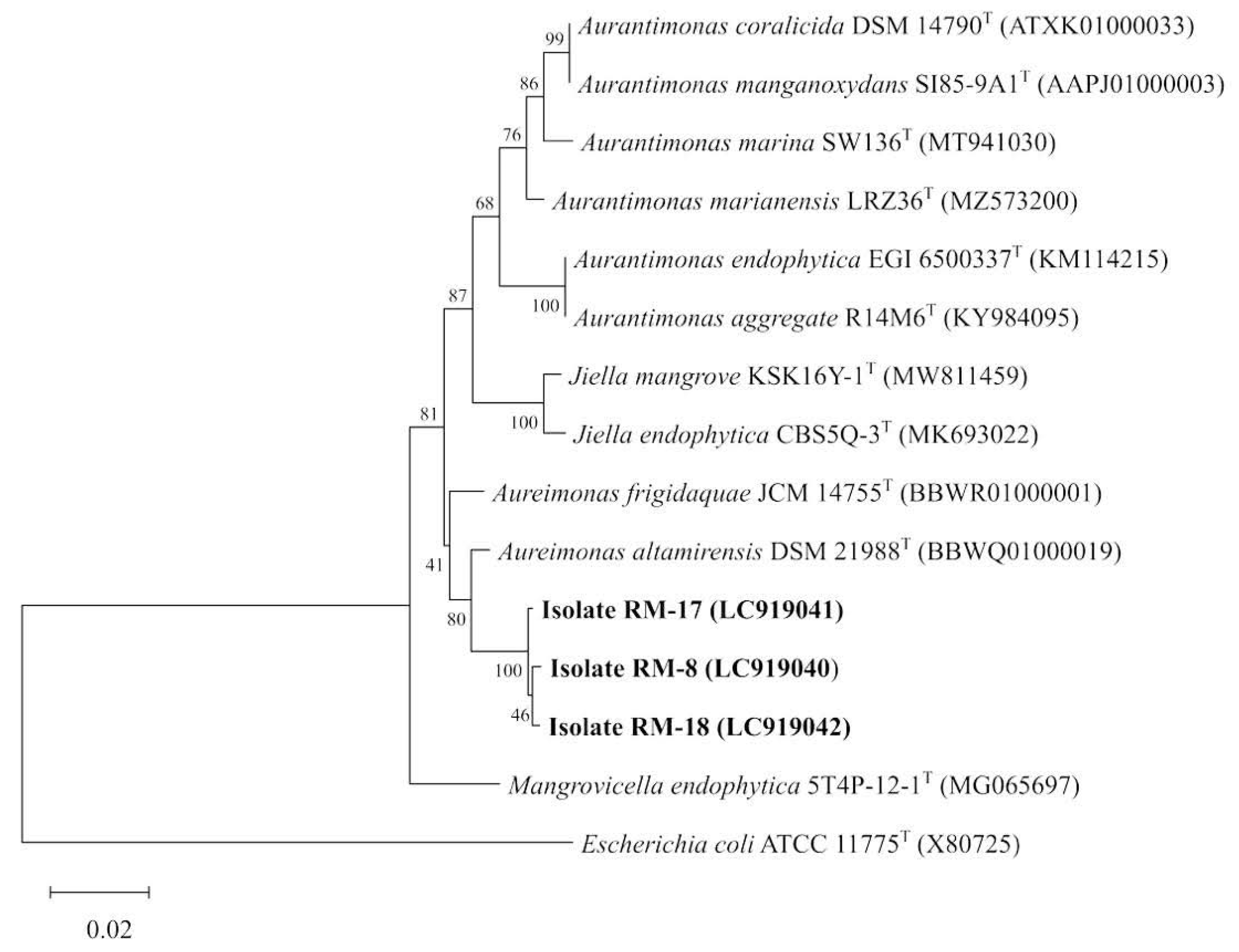
3.3. Phylogenetic Tree Analysis
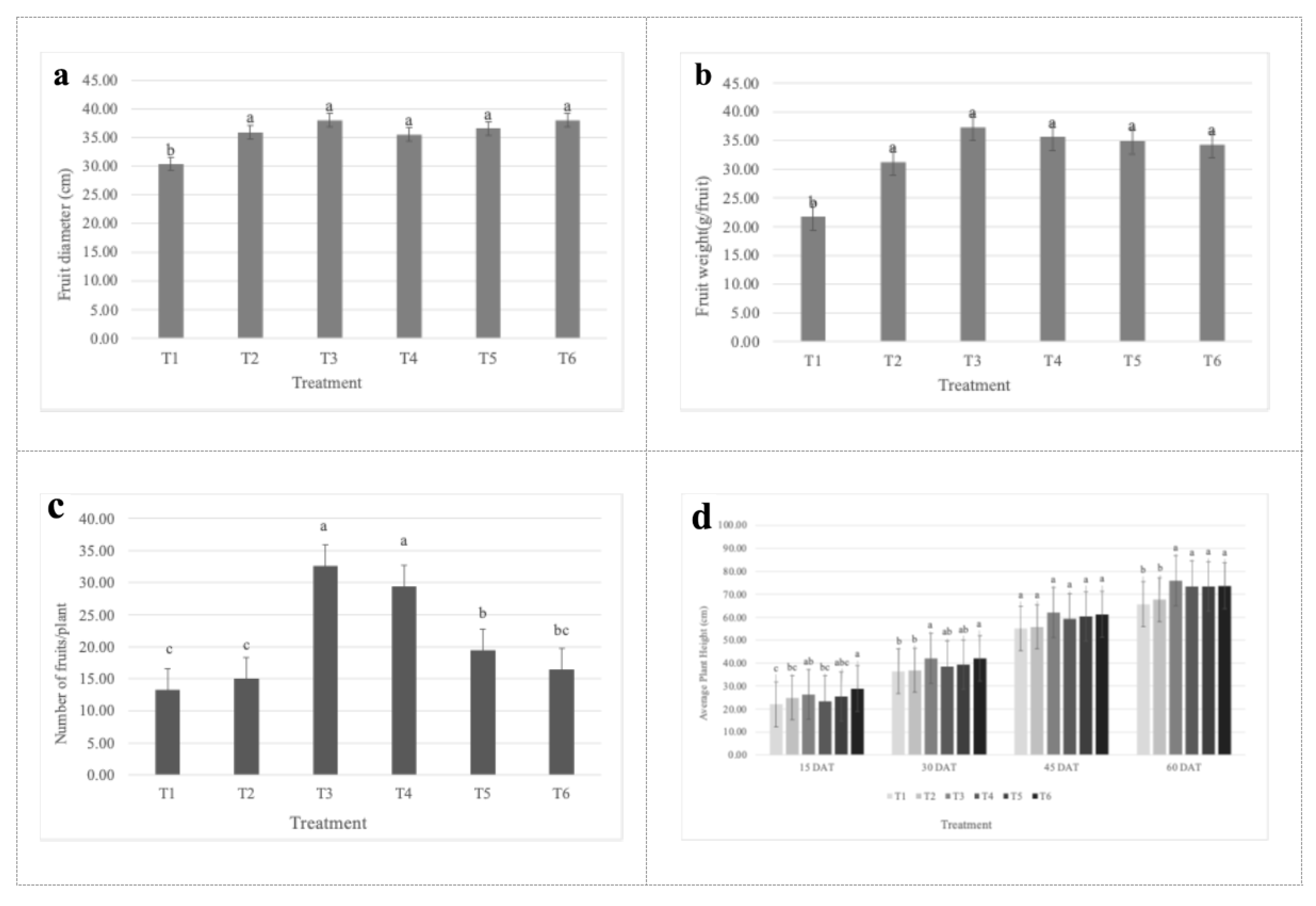
3.4. Influence of Bacterial Consortia Application on the Growth and Yield of Tomatoes
4. Discussion
5. Conclusions
Author Contributions
Funding
Institutional Review Board Statement
Informed Consent Statement
Data Availability Statement
Acknowledgments
Conflicts of Interest
Abbreviations
| YMA | Yeast extract mannitol agar |
| YMB | Yeast extract mannitol broth |
| PKV | Pikovskaya agar |
| PSI | Phosphorus solubilization index |
| KSI | Potassium solubilization index |
| PGPR | Plant growth-promoting rhizobacteria |
| RM-CARES | Ramon Magsaysay-Center for Agricultural Resources and Environment Studies |
| CLSU | Central Luzon State University |
| DA | Department of Agriculture |
| ACC | 1-aminocyclopropane-1-carboxylate deaminase |
| NCBI | National Center for Biotechnology Information |
| AES | Atomic emission spectroscopy |
| AAS | Atomic absorption spectroscopy |
Appendix A

| Treatments | Plant Height (cm) 45DAT | Fruit Diameter (cm) | Number of Fruits/Plant | Fruit Weight (g/Fruit) |
|---|---|---|---|---|
| T1—Control (no application) | 55.20 | 30.36 b | 13.27 c | 21.71 b |
| T2—100% inorganic fertilizer | 55.80 | 35.91 a | 15.03 c | 31.31 a |
| T3—75% inorganic fertilizer + bacterial consortia | 62.10 | 39.56 a | 32.60 a | 37.34 a |
| T4—50% inorganic fertilizer + bacterial consortia | 60.37 | 36.56 a | 19.47 b | 34.94 a |
| T5—25% inorganic fertilizer + bacterial consortia | 59.27 | 35.55 a | 29.40 a | 35.63 a |
| T6—Bacterial consortia | 61.33 | 37.26 a | 16.47 bc | 34.29 a |
References
- Pankievicz, V.C.S.; Irving, T.B.; Maia, L.G.S.; Ané, J.-M. Are we there yet? The long walk towards the development of efficient symbiotic associations between nitrogen-fixing bacteria and non-leguminous crops. BMC Biol. 2019, 17, 99. [Google Scholar] [CrossRef] [PubMed]
- Pereira, F.; Pereira, A.; Menezes, L.D.; Sawaikar, R. Rhizobium as a biofertilizer for non-leguminous plants. Discov. Food 2024, 4, 85. [Google Scholar] [CrossRef]
- Adedayo, A.A.; Babalola, O.O.; Prigent-Combaret, C.; Cruz, C.; Stefan, M.; Kutu, F.; Glick, B.R. The application of plant growth-promoting rhizobacteria in Solanum lycopersicum production in the agricultural system: A review. PeerJ 2022, 10, e13405. [Google Scholar] [CrossRef] [PubMed]
- Adesemoye, A.Q.; Torbert, H.A.; Kloepper, J.W. Enhanced plant nutrient use efficiency with PGPR and AMF in an integrated nutrient management system. Can. J. Microbiol. 2008, 54, 876–886. [Google Scholar] [CrossRef] [PubMed]
- Assainar, S.K.; Abbott, L.K.; Mickan, B.S.; Whiteley, A.S.; Siddique, K.H.M.; Solaiman, Z.M. Response of Wheat to a Multiple Species Microbial Inoculant Compared to Fertilizer Application. Front. Plant Sci. 2018, 9, 1601. [Google Scholar] [CrossRef]
- Bhardwaj, I.; Kumar, V.; Singh, S.; Sharma, A.J.; Kumari, S.; Bhardwaj, N.; Dulta, K.; Peter, L.; Verma, R.; Kumar, N.; et al. Evaluation of Stress-Tolerant Serratia and Enterobacter as PGPR for Nutrient Solubilization and Dose-Dependent Bioformulation to Enhance Tomato Seedlings. Plants 2025, 14, 2154. [Google Scholar] [CrossRef]
- Rehan, M.; Al-Turki, A.; Abdelmageed, A.H.A.; Abdelhameid, N.H.; Omar, A.F. Performance of Plant-Growth-Promoting Rhizobacteria (PGPR) Isolated from Sandy Soil on Growth of Tomato (Solanum lycopersicum L.). Plants 2023, 12, 1588. [Google Scholar] [CrossRef]
- Aye, P.P.; Pinjai, P.; Tawornpruek, S. Effect of Phosphorus Solubilizing Bacteria on Soil Available Phosphorus and Growth and Yield of Sugarcane. Walailak J. Sci. Technol. 2021, 18, 10754. [Google Scholar] [CrossRef]
- Meena, M.L.; Gehlot, V.S.; Meena, D.C.; Kishor, S.; Kumar, S.; Meena, J.K. Impact of biofertilizers on growth, yield and quality of tomato (Lycopersicon esculentum Mill.) cv. Pusa Sheetal. J. Pharmacog. Phytochem. 2017, 6, 1579–1583. [Google Scholar]
- Gen-Jiménez, A.; Flores-Félix, J.D.; Rincón-Molina, C.I.; Manzano-Gomez, L.A.; Rogel, M.A.; Ruíz-Valdiviezo, V.M.; Rincón-Molina, F.A.; Rincón-Rosales, R. Enhance of tomato production and induction of changes on the organic profile mediated by Rhizobium biofortification. Front. Microbiol. 2023, 14, 1235930. [Google Scholar] [CrossRef]
- Khoso, M.A.; Wagan, S.; Alam, I.; Hussain, A.; Ali, Q.; Saha, S.; Poudel, T.R.; Manghwar, H.; Liu, F. Impact of plant growth-promoting rhizobacteria (PGPR) on plant nutrition and root characteristics: Current perspective. Plant Stress 2024, 11, 100341. [Google Scholar] [CrossRef]
- El Hjouji, H.; Qessaoui, R.; Chafiki, S.; Mayad, E.H.; Houmairi, H.; Dari, K.; Bencharki, B.; Aassila, H. Enhancement of Tomato Growth Through Rhizobacteria and Biocontrol of Associated Diseases. Life 2025, 15, 997. [Google Scholar] [CrossRef] [PubMed]
- Yilmaz, Y.; Erdinc, C.; Akkopru, A.; Kipcak, S. Use of Plant Growth Promoting Rhizobacteria Against Salt Stress for Tomato (Solanum lycopersicum L.) Seedling Growth. Acta Sci. Pol. Hortorum Cultus 2020, 19, 15–29. [Google Scholar] [CrossRef]
- Antoun, H.; Beauchamp, C.J.; Goussard, N.; Chabot, R.; Lalande, R. Potential of Rhizobium and Bradyrhizobium as plant growth promoting rhizobacteria on non-legumes: Effect on radishes (Raphanus sativus L.). Plant Soil 1998, 204, 57–67. [Google Scholar] [CrossRef]
- Sharma, R.; Kapoor, N.; Ohri, P. Ameliorative effect of rhizobacteria Bradyrhizobium japonicum on antioxidant enzymes, cell viability and biochemistry in tomato plant under nematode stress. Sci. Rep. 2025, 15, 8017. [Google Scholar] [CrossRef]
- Nishihata, S.; Kondo, T.; Tanaka, K.; Ishikawa, S.; Takenaka, S.; Kang, C.; Yoshida, K. Bradyrhizobium diazoefficiens USDA110 PhaR fucntions for pleiotropic regulation of cellular processes besides OHB accumulation. BMC Microbiol. 2018, 18, 156. [Google Scholar] [CrossRef]
- Mason, M.L.T.; De Guzman, B.L.T.; Yamamoto, A.; Saeki, Y. Symbiotic performance of indigenous bradyrhizobia from the Philippines with soybean (Glycine max [L.] Merill) cultivars harboring different Rj genotypes. Symbiosis 2021, 83, 55–63. [Google Scholar] [CrossRef]
- Chen, L.; Hao, Z.; Li, K.; Sha, Y.; Wang, E.; Sui, X.; Mi, G.; Tian, C.; Chen, W. Effects of growth-promoting rhizobacteria on maize growth and rhizosphere microbial community under conservation tillage in Northern China. Microb. Biotechnol. 2020, 14, 535–550. [Google Scholar] [CrossRef]
- Soil Governance Analysis: The Philippines. Available online: https://openknowledge.fao.org/server/api/core/bitstreams/a6798dba-64ae-4861-a355-2e2a001df1ae/content (accessed on 15 January 2026).
- Sameshima-Saito, R.; Chiba, K.; Minamisawa, K. New method of denitrification analysis of Bradyrhizobium field isolates by gas chromatographic determination of 15N-labeled N2. Appl. Environ. Microbiol. 2004, 70, 2886–2891. [Google Scholar] [CrossRef]
- Mengesha, A.S.; Legesse, N.H. Isolation and characterization of phosphate solubilizing bacteria from the rhizosphere of lentil (Lens culinaris M.) collected from Hagere Mariam district, Central Ethiopia. PLoS ONE 2024, 19, e0308915. [Google Scholar] [CrossRef]
- Rajawat, M.V.S.; Singh, S.; Tyagi, S.P.; Saxena, A.K. A modified plate assay for rapid screening of potassium-solubilizing bacteria. Pedosphere 2016, 26, 768–773. [Google Scholar] [CrossRef]
- Mason, M.L.T.; Tabing, B.L.C.; Yamamoto, A.; Saeki, Y. Influence of flooding and soil properties on the genetic diversity and distribution of indigenous soybean-nodulating bradyrhizobia in the Philippines. Heliyon 2018, 4, e00921. [Google Scholar] [CrossRef] [PubMed]
- Hiraishi, A.; Kamagata, Y.; Nakamura, K. Polymerase chain reaction amplification and restriction fragment length polymorphism analysis of 16S rRNA genes from Methanogens. J. Ferment. Bioeng. 1995, 79, 523–529. [Google Scholar] [CrossRef]
- Weisburg, W.G.; Barns, S.M.; Pelletier, D.A.; Lane, D.J. 16S ribosomal DNA amplification for phylogenetic study. J. Bacteriol. 1991, 173, 697–703. [Google Scholar] [CrossRef]
- Rossi-Tamisier, M.; Benamar, S.; Raoult, D.; Fournier, P.E. Cautionary tale of using 16S rRNA gene sequence similarity values in identification of human-associated bacterial species. Int. J. Syst. Evol. Microbiol. 2015, 65, 1929–1934. [Google Scholar] [CrossRef]
- Toledo Cabrera, B. Effect of Rhizobium Inoculation on Tomato (Solanum lycopersicum L.) Yield in Protected Crops. Biol. Life Sci. Forum 2021, 3, 52. [Google Scholar] [CrossRef]
- Goldstein, R.M.; Mallory, L.M.; Alexander, M. Reasons for Possible Failure of Inoculation to Enhance Biodegradation. Appl. Environ. Microbiol. 1985, 50, 977–983. [Google Scholar] [CrossRef]
- Papin, M.; Philippot, L.; Breuil, M.C.; Bru, D.; Dreux-Zigha, A.; Mounier, A.; Le Roux, X.; Rouard, N.; Spor, A. Survival of a microbial inoculant in soil after recurrent inoculations. Sci Rep. 2024, 14, 4177. [Google Scholar] [CrossRef]
- Fournier, P.E.; Raoult, D. Current knowledge on phylogeny and taxonomy of Rickettsia spp. Ann. N. Y. Acad. Sci. 2009, 1166, 1–11. [Google Scholar] [CrossRef]
- Janda, J.M.; Abbott, S.L. 16S rRNA gene sequencing for bacterial identification in the diagnostic laboratory: Pluses, perils, and pitfalls. J. Clin. Microbiol. 2007, 45, 2761–2764. [Google Scholar] [CrossRef]
- Silva, T.D.; Ferrarezi, R.S.; Selari, P.J.R.G.; Lennon, J.; da Silva, B.; da Silva, M.V.; Mesquita, M.; de Oliveira, H.F.E. Microbial Inoculation Strategies for Optimal Cherry Tomato production. Physiol. Plant. 2025, 177, e70655. [Google Scholar] [CrossRef] [PubMed]
- Salas, A.; Cabrera, J.J.; Jimenez-Leiva, A.; Mesa, S.; Bedmar, E.J.; Richardson, D.J.; Gates, A.J.; Delgado, A.J. Bacterial Nitric Oxide Metabolism: Recent insights in rhizobia. Adv. Microbiol. Physiol. 2021, 78, 259–315. [Google Scholar]
- Kumar, M.; Giri, V.P.; Pandey, S.; Gupta, A.; Patel, M.K.; Bajpai, A.B.; Jenkins, S.; Siddique, K.H.M. Plant-Growth-Promoting Rhizobacteria Emerging as an Effective Bioinoculant to Improve the Growth, Production, and Stress Tolerance of Vegetable Crops. Int. J. Mol. Sci. 2021, 22, 12245. [Google Scholar] [CrossRef] [PubMed]
- Glick, B.R.; Cheng, Z.; Czarny, J.; Duan, J. Promotion of plant growth by ACC deaminase-producing soil bacteria. In New Perspectives and Approaches in Plant Growth-Promoting Rhizobacteria Research; Springer: Dordrecht, The Netherlands, 2007; Volume 119, pp. 329–339. [Google Scholar]
- Sun, N.; Wang, Y.; Zhang, M.; Ma, P.; Wang, Z.; Zhao, H.; Cao, C. The effect of chilli pepper-Chinese chives intercropping on rhizosphere microorganisms and root-stem endophytes. Front. Microbiol. 2025, 16, 1716326. [Google Scholar] [CrossRef]
- Salehin, A.; Puri, R.R.; Hafiz, M.H.R.; Itoh, K. Effect of Co-Inoculation of Bacillus sp. Strain with Bacterial Endophytes on Plant Growth and Colonization in Tomato Plant (Solanum lycopersicum). Microbiol. Res. 2021, 12, 480–490. [Google Scholar] [CrossRef]
- Mwangi, M.W.; Monda, E.O.; Okoth, S.A.; Jefwa, J.M. Inoculation of tomato seedlings with Trichoderma harzianum and arbuscular mycorrhizal fungi and their effect on growth and control of wilt in tomato seedlings. Braz. J. Microbiol. 2011, 42, 508–513. [Google Scholar] [CrossRef]
- Xu, Z.; Pehlivan, N.; Ghorbani, A.; Wu, C. Effects of Azorhizobium caulinodans and Piriformospora indica Co-Inoculation on Growth and Fruit Quality of Tomato (Solanum lycopersicum L.) under Salt Stress. Horticulturae 2022, 8, 302. [Google Scholar] [CrossRef]
- Gurubasahar, N.; Basaiah, T. Integrating microbial consortia into biofertilizers for sustainable agriculture: Enhancing plant productivity and soil health. Arch. Agric. Environ. Sci. 2025, 10, 157–163. [Google Scholar] [CrossRef]
- Bahadir, P.S.; Liaqat, F.; Eltem, R. Plant growth promoting properties of phosphate solubilizing Bacillus species isolated from the Aegean Region of Turkey. Turk. J. Bot. 2018, 42, 183–196. [Google Scholar] [CrossRef]
- Leiva-Mora, M.; Mera Guzmán, P.E.; Mera-Andrade, R.I.; Zabala Haro, A.M.; Saa, L.R.; Loján, P.; Silva Agurto, C.L.; Salazar-Garcés, L.F.; González Osorio, B.B.; Cabrera Mederos, D.; et al. Isolation and Characterization of Phosphate-Solubilizing Rhizobacteria from Solanum tuberosum with Plant Growth-Promoting Activity. Appl. Microbiol. 2026, 6, 8. [Google Scholar] [CrossRef]
- Raji, M.; Thangavelu, M. Isolation and screening of potassium solubilizing bacteria from saxicolous habitat and their impact on tomato growth in different soil types. Arch. Microbiol. 2021, 203, 3147–3161. [Google Scholar] [CrossRef]
- Shome, S.; Barman, A.; Solaiman, Z.M. Rhizobium and Phosphate Solubilizing Bacteria Influence the Soil Nutrient Availability, Growth, Yield, and Quality of Soybean. Agriculture 2022, 12, 1136. [Google Scholar] [CrossRef]
- Timofeeva, A.M.; Galyamova, M.R.; Sedykh, S.E. Plant Growth-Promoting Soil Bacteria: Nitrogen Fixation, Phosphate Solubilization, Siderophore Production, and Other Biological Activities. Plants 2023, 12, 4074. [Google Scholar] [CrossRef]


| Parameter | Unit | Value |
|---|---|---|
| Texture | – | Clay loam |
| pH | – | 7.25 |
| Electrical conductivity | mS cm−1 | 0.76 |
| Phosphorus | mg kg−1 | 141.91 |
| Potassium | cmol kg−1 | 1.42 |
| Organic matter | % | 3.04 |
| Total nitrogen | % | 0.16 |
| Calcium | cmol kg−1 | 17.23 |
| Magnesium | cmol kg−1 | 6.67 |
| Sodium | cmol kg−1 | 0.26 |
| Cation exchange capacity | cmol kg−1 | 14.76 |
| Copper | mg kg−1 | 14.62 |
| Iron | mg kg−1 | 29.98 |
| Manganese | mg kg−1 | 2.78 |
| Zinc | mg kg−1 | 11.95 |
| Isolate | N Fixation | Solubilization Index | Compatibility with B. diazoefficiens | |
|---|---|---|---|---|
| P | K | |||
| RM-1 | ++ | 2.27 | 8.80 | No |
| RM-2 | + | 2.92 | 5.40 | No |
| RM-3 | + | 2.37 | 6.10 | No |
| RM-4 | + | 2.16 | 10.00 | No |
| RM-5 | + | 2.08 | 8.00 | No |
| RM-6 | ++ | 2.04 | 9.90 | No |
| RM-7 | + | 2.60 | 6.10 | No |
| RM-8 | ++ | 2.84 | 8.20 | Yes |
| RM-9 | ++ | 1.69 | 8.10 | No |
| RM-10 | + | 2.16 | 8.70 | No |
| RM-11 | + | 2.62 | 7.50 | No |
| RM-12 | + | 2.34 | 6.40 | No |
| RM-13 | ++ | 4.66 | 6.60 | No |
| RM-14 | + | 2.32 | 7.80 | No |
| RM-15 | + | 2.40 | 8.90 | No |
| RM-16 | + | 2.18 | 6.60 | No |
| RM-17 | ++ | 3.47 | 8.60 | Yes |
| RM-18 | ++ | 4.41 | 7.90 | Yes |
| B. diazoefficiens NE1-65 | ++ | -- | -- | |
Disclaimer/Publisher’s Note: The statements, opinions and data contained in all publications are solely those of the individual author(s) and contributor(s) and not of MDPI and/or the editor(s). MDPI and/or the editor(s) disclaim responsibility for any injury to people or property resulting from any ideas, methods, instructions or products referred to in the content. |
© 2026 by the authors. Licensee MDPI, Basel, Switzerland. This article is an open access article distributed under the terms and conditions of the Creative Commons Attribution (CC BY) license.
Share and Cite
De Guzman, B.L.T.; Mason, M.L.T.; Chulaka, P.; Pinjai, P. Integrated Use of Plant Growth-Promoting Rhizobacteria and Chemical Fertilizers Improves the Growth and Yield of the Tomato Plant. Appl. Microbiol. 2026, 6, 43. https://doi.org/10.3390/applmicrobiol6030043
De Guzman BLT, Mason MLT, Chulaka P, Pinjai P. Integrated Use of Plant Growth-Promoting Rhizobacteria and Chemical Fertilizers Improves the Growth and Yield of the Tomato Plant. Applied Microbiology. 2026; 6(3):43. https://doi.org/10.3390/applmicrobiol6030043
Chicago/Turabian StyleDe Guzman, Baby Lyn T., Maria Luisa T. Mason, Pariyanuj Chulaka, and Pechrada Pinjai. 2026. "Integrated Use of Plant Growth-Promoting Rhizobacteria and Chemical Fertilizers Improves the Growth and Yield of the Tomato Plant" Applied Microbiology 6, no. 3: 43. https://doi.org/10.3390/applmicrobiol6030043
APA StyleDe Guzman, B. L. T., Mason, M. L. T., Chulaka, P., & Pinjai, P. (2026). Integrated Use of Plant Growth-Promoting Rhizobacteria and Chemical Fertilizers Improves the Growth and Yield of the Tomato Plant. Applied Microbiology, 6(3), 43. https://doi.org/10.3390/applmicrobiol6030043