Article

Legume Performance in the Foloi Region (Western Greece): A First Step for Agricultural Revitalization in the Plateau


by
Ioannis Gazoulis
1,2,*,
Aikaterini Kasimati
3,
Nikolaos Antonopoulos
1,
Panagiotis Kanatas
2,
Metaxia Kokkini
1,
Andreas Rekkas
1 and
Ilias Travlos
1,*
1
Department of Crop Science, Agricultural University of Athens, 75, Iera Odos Str., 11855 Athens, Greece
2
Department of Crop Science, University of Patras, 30200 Mesolonghi, Greece
3
Department of Natural Resources Management & Agricultural Engineering, Agricultural University of Athens, 75, Iera Odos Str., 11855 Athens, Greece
*
Authors to whom correspondence should be addressed.
Crops 2026, 6(3), 60; https://doi.org/10.3390/crops6030060
Submission received: 8 May 2026 / Revised: 17 June 2026 / Accepted: 20 June 2026 / Published: 22 June 2026

Abstract

Legume cultivation offers a chance for agricultural development on lands that have been abandoned over the years. In this study, simple agronomic indicators on the growth and yield of faba bean (Vicia faba L.), pea (Pisum sativum L.), and white lupin (Lupinus albus L.) were assessed on the abandoned agricultural lands of Foloi Plateau in Western Greece. Field trials were conducted from October 2023 to July 2025, and the legumes were grown either according to the false seedbed concept or with conventional seedbed preparation practices (direct sowing). The false seedbed involves pre-sowing weed control following initial seedbed preparation, and in these trials, it suppressed weed density by 62–77%. The Normalized Difference Vegetation Index (NDVI) of faba bean and pea increased by 13% on the false seedbed plots, while white lupin NDVI was not affected by treatments (p ≥ 0.05). Destructive crop biomass measurements were in accordance with NDVI assessments. Faba bean and pea seed yield demonstrated an increase of 17% and 23%, respectively, in the false seedbed plots compared to direct sowing plots. White lupin seed yield was not significantly affected by false seedbed (p ≥ 0.05). This study provides preliminary evidence supporting the use of legume crops as a component of sustainable agricultural revitalization in the Foloi region. However, further research is required to optimize legume cultivation on the abandoned lands of the wider region as a first step towards the agricultural revitalization in the Plateau.

1. Introduction

Marginal lands are usually characterized by suboptimal soil pH, inadequate nutrient levels, restricted water access, and unfavorable topography creating significant challenges to sustainable agricultural production [1]. The majority of these degraded areas are reported to have acidic soils. These soil types have a pH < 5.5 and compose approximately 30–40% of global arable land and more than 50% of potentially arable land [2,3]. Therefore, these high-acidity areas impose further constraints, mostly due to phosphorus (P) deficiency and aluminum (Al) toxicity, which are among the main reasons for hindered root function and growth as well as limited crop yields [4,5,6].
Addressing these challenges is vital for enabling marginal lands to support sustainable biomass production and contribute to food security [7]. Nowadays, land degradation has worsened significantly due to industrial pollution, especially through poisonous effluents from steel manufacturing that lead to soil organic matter and nutrient depletion [8]. The risks of growing crops in such areas are high [9,10]. Despite their constraints and the fact that they recover slowly without intervention, such degraded lands have received international recognition as they can enhance food security, facilitate bioenergy generation, and provide ecological benefits [11]. Furthermore, these regions can be restored if more proactive and holistic approaches are implemented [12].
Plants have a profound impact on soil biological communities and also affect ecological services such as the accumulation of carbon and nitrogen, water absorption, and nutrient circulation [13,14,15,16]. Plant-driven processes can create a feedback system that optimizes nutrient acquisition and alters the composition of plant communities [17,18,19]. After in-depth investigation of a variety of species, researchers were able to discover important genes and quantitative trait loci (QTLs) that were considered vital factors of resilience in degraded and acidic soils. In particular, these genes were found to maximize aluminum resistance and phosphorus efficiency, demonstrating superior results in wheat and leguminous crops [20,21,22,23,24].
The utilization of sustainable management practices, especially those based on ecosystem approaches that contribute to soil fertility improvement, is key to unlocking the full production potential of these degraded lands [12]. Among all the various approaches available, the cultivation of legume crops has demonstrated some of the most promising outcomes in terms of land restoration.
Among their many ecosystem services, legumes’ ability to fix atmospheric nitrogen and attract beneficial microbial communities makes them essential components of regenerative agriculture and restoration ecology [15,25]. In low-input agricultural systems, including legumes in the rotation provides nitrogen for subsequent crops, thus supporting long-term soil fertility and enabling soil organic carbon sequestration [26,27,28]. Research has shown that legumes can boost both forage and seed production in degraded areas, deal with soil acidity, and increase soil organic carbon, even up to 30% [29,30,31,32].
In addition, legume crops promote the establishment of native grassland species, promote quick vegetation regrowth, and also suppress weed populations, contributing significantly to land stabilization [33,34,35,36,37,38]. Lastly, grass–legume mixes have been found to greatly boost biomass production, enhance soil structure, and lower restoration expenses [11]. In addition, legumes establish symbiotic relationships with arbuscular mycorrhizal fungi (AMF) and nitrogen-fixing rhizobia that improve soil fertility and stress resilience [39]. By leveraging the insights mentioned above, it is possible to develop legume cultivars that are more adapted to marginal soils. That would be achieved, though, by utilizing both conventional breeding methods and modern molecular approaches [22,40].
Agricultural abandonment across the Foloi plateau is driven by a distinct convergence of biophysical and structural pressures, specifically localized soil acidification from the Quercus frainetto forest canopy, severe land fragmentation, and the inability of high-altitude farming to compete with the modernized, irrigated plains of lowland Elis. In the Foloi region, where agricultural land abandonment is widespread, the introduction of legume crops may contribute to land restoration while supporting the re-establishment of productive agricultural systems. Therefore, this study aimed to evaluate the agronomic performance of three leguminous crops which were faba bean, field pea, and white lupin. Our trials aimed to identify the adaptability potential of these legumes especially when established according to the false seedbed cultural practice which can suppress the early flushes of weeds that can hinder crop establishment in any given environment. We hypothesized that the false seedbed system would reduce weed pressure and improve crop growth and yield relative to conventional seedbed preparation. This study is the first to systematically compare the comprehensive effects of false seedbed on three legume crops in the Foloi region.

2. Materials and Methods

2.1. Site Description

Field trials were established from October 2023 to July 2025 in the region of Foloi, Greece (37°43′54.8″ N 21°44′17.4″ E). The soil type of the experimental field was clay loam (CL), with the following particle size distribution: 20.21% sand, 43.30% silt and 36.49% clay. Soil pH was 4.27 as measured in a 1:2 soil-to-water suspension (active acidity), and the electrical conductivity of the soil was 0.0927 dS m−1. The percentage of total soil nitrogen was 0.19%, and its organic matter content was 3.41%. Phosphorus (P), potassium (K) and sodium (Na) concentrations were 12.6 mg kg−1, 108.5 mg kg−1 and 98.5 mg kg−1. The climatic data on the trial area are summarized below (Table 1).
Because crop establishment and reproductive development occurred under different climatic conditions in the two growing seasons, climatic data are presented by year. However, the absence of significant Year and Year × Treatment effects indicates that treatment responses were consistent across seasons.
Regarding crop rotation history and crop adaptability in the wider region, lupin species (Lupinus spp.) and oat (Avena sativa L.) had traditionally been grown for animal feed production.

2.2. Experimental Setup

In late September, the experimental field was ploughed to a depth of 30 cm. Subsequently, the field was cultivated twice with a cultivator to a depth of 20 cm for seedbed preparation and incorporation of a complete fertilizer (N-P-K; 18-20-0; Power NP, Yara Hellas, Athens, Greece). The basal fertilization provided the crops with 72 kg N ha−1 and 80 kg P2O5 ha−1.
Three legume crops were studied, which were, faba bean (Vicia faba L. cv. Solon), pea (Pisum sativum L.; cv. Andrea), and white lupin (Lupinus albus L. cv. Nelly). For each crop, two seedbed-management systems were evaluated: conventional seedbed preparation (direct sowing) and false seedbed preparation. Direct sowing and false seedbed were the treatments tested in three replications for all crops according to the Randomized Complete Block Design (RCBD). Plot size was 25 m2 (2.5 m long and 10 m wide), and the total experimental area for each crop had a total of six experimental units and a size of 150 m2. Weed-free borders of 1 m2 were maintained between adjacent plots throughout the whole growing season.
The false seedbed treatment necessarily involved a delayed sowing date (approximately four weeks later than direct sowing on late November), because weed emergence was first stimulated and subsequently controlled prior to crop establishment. In particular, weed emergence had been stimulated from tillage operations during seedbed preparation and subsequent rainfalls. All crops were sown with a hand seeder at a rate of 120 kg ha−1, 160 kg ha−1 and 110 kg ha−1 for faba bean, pea and white lupin, respectively (Table 2).
Concerning the plant material selected, the cultivars were selected because they are very popular with Greek farmers for specific reasons. ‘Solon’ is a Greek faba bean breeding creation, derived from the synthesis of related clones. It is an early-maturing, winter-type synthetic variety characterized by high-quality yields. It adapts excellently to Greek environments and exhibits high resistance to Sclerotinia spp. as well as to faba bean viral diseases. The seed constitutes an excellent protein source (23–25%) with a favorable natural amino acid profile, serving as a rich source of energy and phosphorus. The ‘Andrea’ pea cultivar is a very productive genotype developed in Czech Republic with excellent drought and frost tolerance (up to −18 °C), rapid growth rates, and earliness that can be utilized both for seed and silage production. The ‘Nelly’ cultivar is a German–bred sweet white lupin characterized by an exceptionally low alkaloid content (≤0.02%) that eliminates the need for debittering, rendering the seed directly suitable for both livestock feed and human consumption. It develops a vigorous taproot system and has robust cold tolerance (up to −10 °C). It is a medium-to-late maturing high-yielding cultivar with high seed protein content (≥33%). It is a potential alternative to soybean (Glycine max (L.) Merr.) in animal feed production.
The handseeder was calibrated to the following sowing depths to carry out sowing in crop rows: 3.5 cm for pea, 4 cm for white lupin, and 6 cm for faba bean. Row spacing was 30 cm for all crops. Rows were created with handmade tools equipped with metal edges shaped like equilateral triangles with a side length of 5 cm. The row markers used had six metal edges at a distance of 30 cm from each other. To form rows, in both cases the metal edges were inserted into the soil at a depth of 2–3 cm, and the row markers were pulled by hand at an angle of about 45° to the ground to the end of the plot. Each plot had 30 crop rows since the rows close to plot edges were destroyed when plants were at the cotyledon growth stages. This decision was made to minimize edge effects on measurements collected later in the growing season.
Pendimethalin (Pendinova 330 EC, Ellagret S.A., Athens, Greece) was applied to faba bean and pea crops, as a pre-emergence herbicide, at a rate of 1650 g a.i. ha−1. Aclonifen (Challenge 600 SC, Bayer Hellas S.A., Athens, Greece) was applied to the white lupin trial field as a pre-emergence herbicide, at a rate of 1800 g a.i. ha−1, two days after sowing. The herbicides were applied using a Volpi V. Black E-Pro 16 L (Davide & Luigi Volpi S.p.a., Casalromano, Italy) backpack sprayer delivering 300 L ha−1 of spray solution at a pressure of 200 kPa through a brass hollow cone nozzle. Soil incorporation of all soil residual pre-emergence herbicides was facilitated by rainfall. Furthermore, no serious disease or insect pest infestations were detected in any of the three legume crops studied in the experimental fields throughout the crop growing seasons.

2.3. Data Collection

Weed density measurements were conducted two months after sowing. Specifically, weeds were harvested from four randomly positioned 0.25 m2 metal quadrats that were placed near the center of each plot in order to avoid the edge effect and ensure the uniformity of weed flora composition. For these measurements, weeds were cut at a height of 2–3 cm. The weed samples, after being placed in pre–labeled plastic bags, were brought to the laboratory for density estimation.
Approximately two weeks after treatments were applied in each crop, the Normalized Difference Vegetation Index (NDVI) was measured with a portable Trimble® GreenSeeker® handheld optical–electronic sensor (Trimble Agriculture Division, Westminster, CO, USA). The sensor utilizes self–contained illumination in both the red and near-infrared (NIR) spectral regions and measures reflectance in both the red (visible; 660 nm) and NIR (near-infrared; 770 nm) regions of the electromagnetic spectrum according to the equation below (Equation (1)):
NDVI = NIR RED NIR + RED
NDVI measurements were taken around midday on sunny, rain-free days. The handheld sensor was positioned approximately 40 cm above the crops’ canopy in order to scan the green area of vegetation. All crops were harvested on 30 June 2024 and 8 July 2025 from four 0.25 m2 metal frames on central areas of each plot. Bean, pea, and white lupin crops were harvested and oven-dried at 70 °C until constant weight was achieved.
Seed yield was estimated indirectly from plant density, pods per plant, seeds per pod, and mean seed weight rather than determined from whole-plot machine harvest. Consequently, the reported yield values should be interpreted as agronomic estimates rather than direct measurements.
Economic estimations were based on current local market prices for inputs (seeds, fertilizers, fuel) and the average wholesale prices for legumes in Greece during the 2023–2025 period. Gross margin was calculated by subtracting the total variable costs from the gross revenue (yield × price), providing a preliminary economic indicator for the proposed revitalization strategy.

2.4. Statistical Analysis

The Shapiro–Wilk test was utilized to evaluate the normal distribution of all data [41], while the homoscedasticity of variances was evaluated with Levene’s test [42]. Prior to pooling data across years, a two-way ANOVA was conducted for each crop using Year, Treatment, and the Year × Treatment interaction as fixed effects. Since neither the main effect of Year nor the Year × Treatment interaction was statistically significant (p > 0.05), data were subsequently pooled across years and analyzed using one-way ANOVA to evaluate treatment effects. The effects of treatments were considered fixed, while those of replications were considered random to run the model. Mean pairwise comparisons were carried out using Fischer’s Least Significant Difference test (LSD). Statgraphics Centurion 19 was the software used for all analysis (Statgraphics Technologies, Inc., The Plains, VA, USA).

3. Results

The two-year analysis indicated that Year and the Year × Treatment interaction were not significant for weed density, NDVI, biomass, or seed yield in any of the three legume species (p > 0.05). Therefore, pooled means across years are presented below.

3.1. Faba Bean

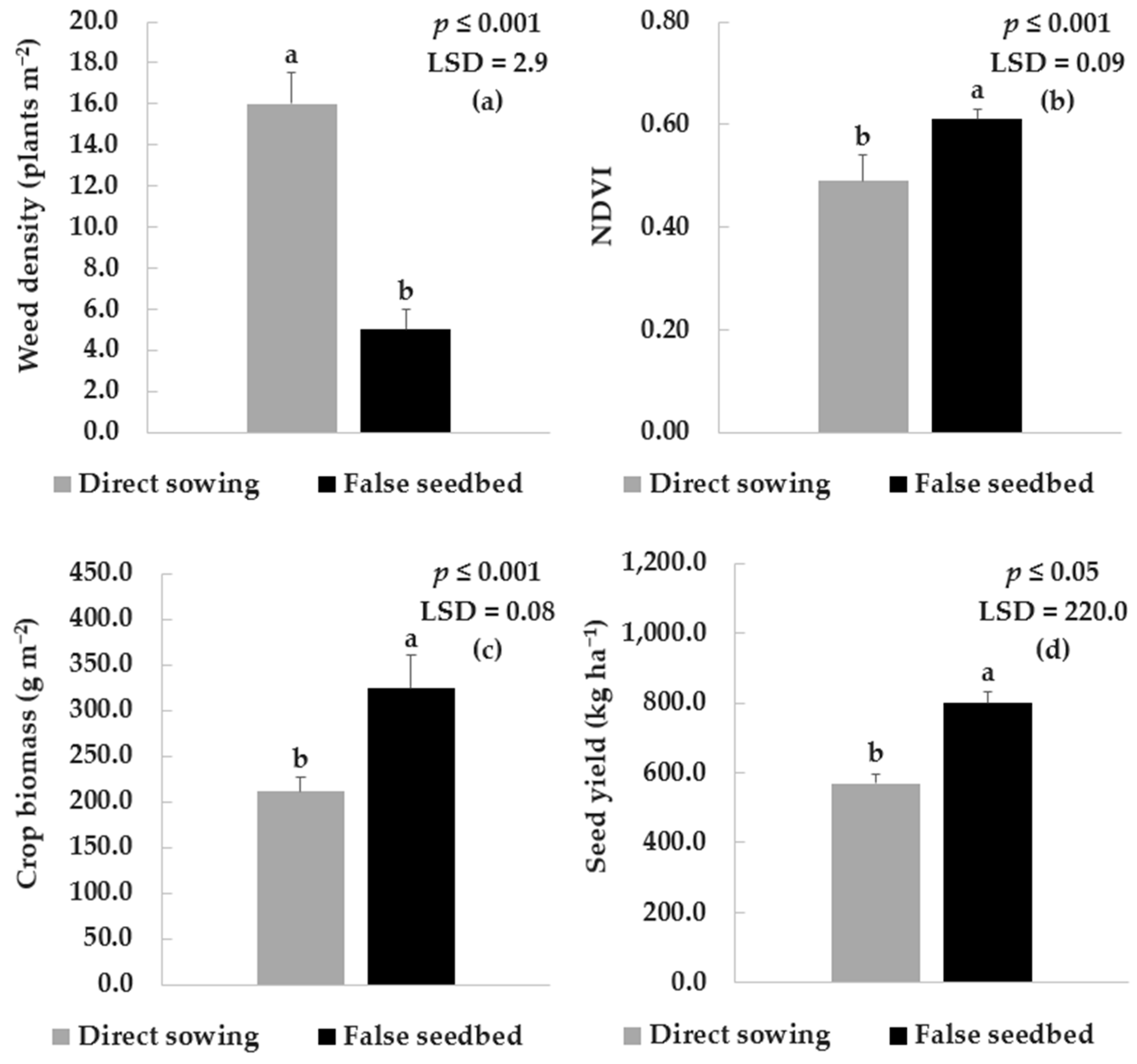
False seedbed resulted in a 62% decrease in weed density compared to the direct sowing treatment (Figure 1a). The values of NDVI on the false seedbed plots increased by 13% compared to the values on conventional plots (Figure 1b). Additionally, false seedbed increased crop biomass by 31% (Figure 1c). Finally, seed yield was significantly affected by treatments (p ≤ 0.05) and displayed a 17% increase in false seedbed plots (Figure 1d).

3.2. Pea

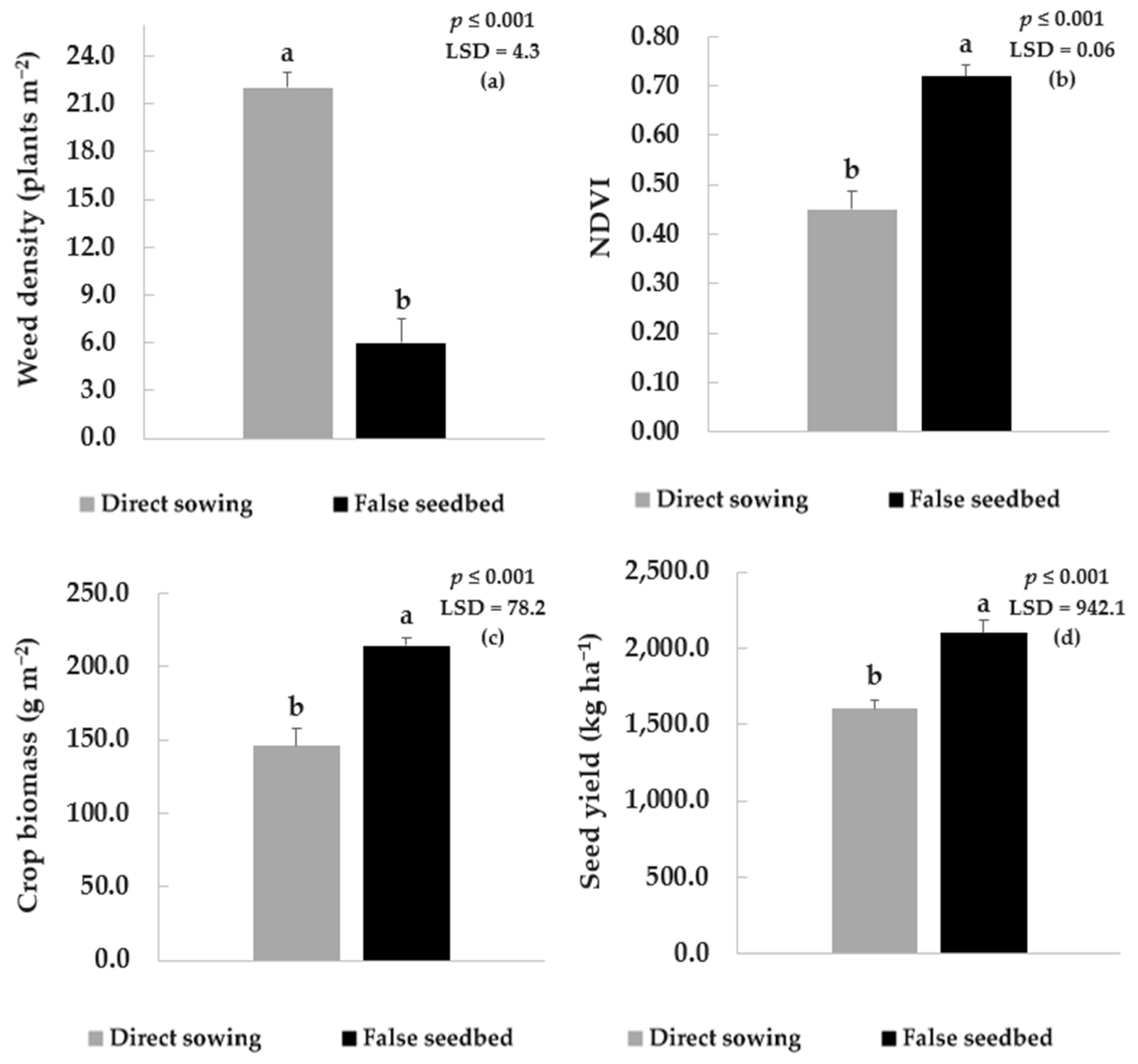
The different treatments significantly affected weed density (p ≤ 0.001). False seedbed controlled the emerged weed seedlings, resulting in a 62% decrease in weed density, compared to direct sowing (Figure 2a). The values of NDVI in false seedbed plots showed an increase of 13% compared to the values or direct sowing plots (Figure 2b).
Additionally, crop biomass was significantly affected by the various treatments (p ≤ 0.001). Pea biomass in the false seedbed plots indicated an increase of 31% in comparison to the conventional seedbed plots (Figure 2c).
Lastly, seed yield was also significantly affected by treatments (p ≤ 0.001). Pea seed yield demonstrated an increase of 23% in the false seedbed plots (Figure 2d).

3.3. White Lupin

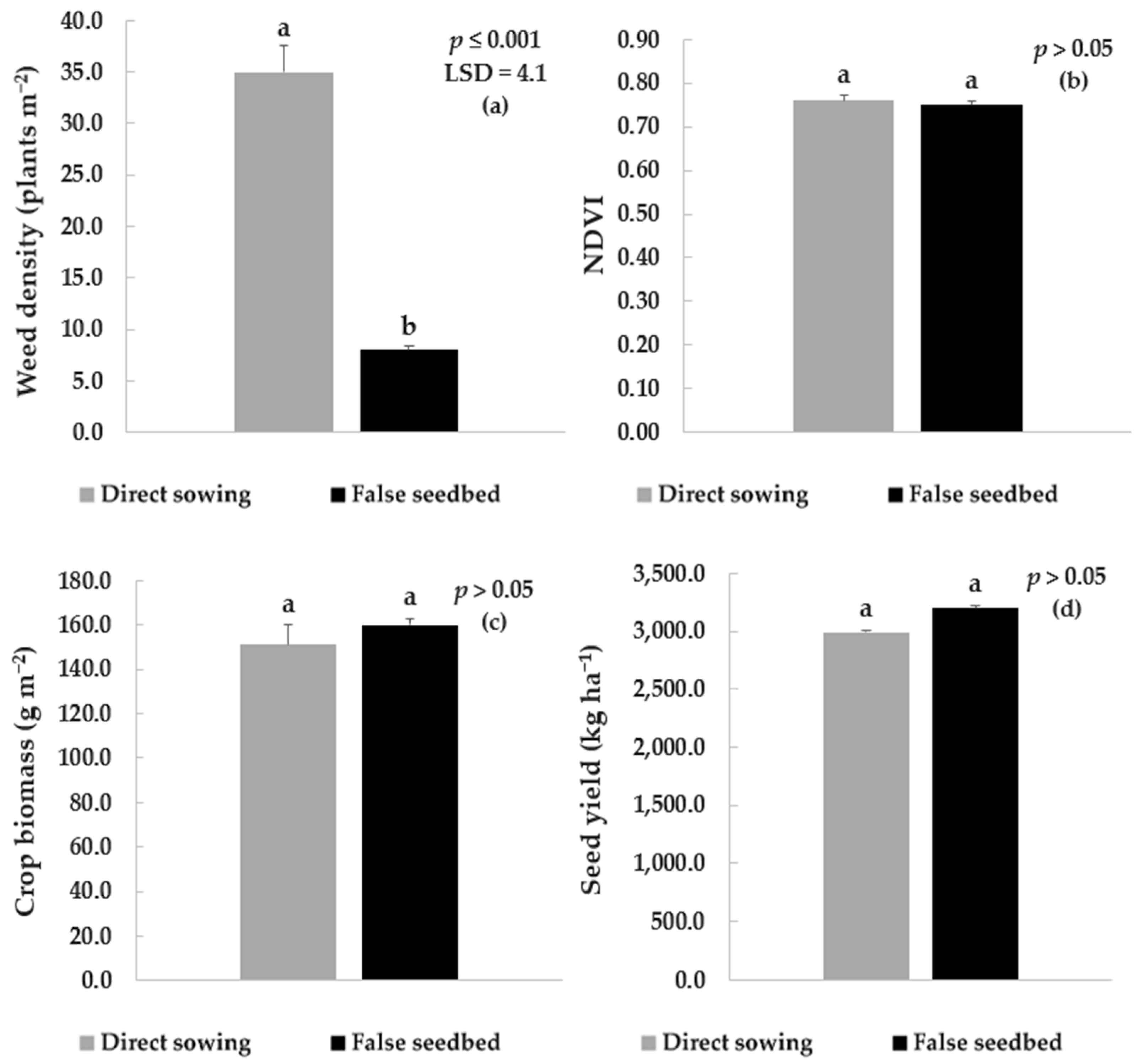
The different treatments significantly affected weed density (p ≤ 0.001). False seedbed technique managed weed populations effectively, demonstrating a significant decrease of 77% in weed density compared to the conventional one (Figure 3a). Furthermore, the NDVI index values were not significantly affected by the various treatments (p > 0.05) (Figure 3b).
Moreover, crop biomass was also not affected significantly enough by the various treatments (p > 0.05). The biomass of white lupin crops in the false seedbed plots demonstrated a small increase of 6%, compared to the direct sowing ones (Figure 3c). Last but not least, the variation of treatments did not significantly affect seed yield (p > 0.05). The false seedbed treatment resulted in an increase of 7% in seed yield, compared to the conventional seedbed one (Figure 3d).

4. Discussion

False seedbed resulted in a substantial reduction in weed density compared to the conventional sowing practice, and its efficacy as a weed management strategy was maximized in the white lupin field. This can be attributed to the fact that false seedbed eliminates the first flush of weeds, and crops are then able to form a dense canopy that effectively shades the ground and suppresses weed growth [43]. In November 2023 and November 2024, significant precipitation (112.8 mm and 283.8 mm, respectively) stimulated the early emergence of weed seedlings which were then effectively controlled by shallow tillage before crop sowing (in December) as in other previous studies [44]. Consequently, rainfall patterns likely contributed to the effectiveness of the false-seedbed treatment by promoting weed emergence prior to crop sowing; however, the relative contribution of climatic conditions and management practices cannot be separated conclusively in the present study.
Regarding its effects on legume crops, Gopinath et al. [45] demonstrated that false seedbed followed by one hand-weeding pass significantly reduced weed pressure by up to 77% in pea under organic management. Furthermore, Kanatas et al. [46] reported that stale (false) seedbed practices successfully reduced weed density in legumes like soybean by 36–41%, enhancing crop establishment and reducing the competition for resources. Comparable results have also been reported in other major cropping systems and particularly in cereals. For instance, false seedbed prior to maize sowing resulted in a reduction in weed biomass of approximately 86%, while its combination with shallow tillage decreased wild oat’s biomass by 66–75% and enhanced barley grain production by 29–30% [47,48,49]. In any case, it is possible that the overall low weed density may be attributed to low winter temperatures that prevented weed seed germination and weed seedling growth. The observed weed suppression cannot be attributed exclusively to the false seedbed treatment because seasonal environmental conditions may also have influenced weed emergence and establishment. Therefore, further research must be conducted to assess the false seedbed cultural practice as a component of Integrated Weed Management (IWM) across a variety of cropping systems and environments.
False seedbed plots also exhibited higher NDVI values in most cases. The lower NDVI values of pea and faba bean in direct sowing plots during early growth can be attributed to the combined stress of nutrient competition with weeds and the intermittent dry periods recorded between major rainfall events in the winter months. This interpretation is consistent with Tremblay et al. [50], who reported that reductions in NDVI are frequently associated with biotic and abiotic stresses affecting crop growth. However, treatment effects on white lupin NDVI were not significant, possibly due to the fact that white lupin can grow very effectively in acidic soils and has increased tolerance to drought conditions [49], such as those in the Foloi region, independently of weed presence.
Concerning seed yields, white lupin displayed sufficient productivity, especially in the false seedbed plots (3520 kg ha−1), exceeding the yields of pea and faba bean by 40% and 70%, respectively. White lupin’s performance in these soil types is in accordance with the studies of Quiñones et al. [50] and Zavalin et al. [51]. Pea ranked second in terms of productivity, reaching a seed yield of 2100 kg ha−1 in the false seedbed plots. However, crop performance was inferior to that of white lupin because pea adapts best to soils that have a pH between 6.0 and 7.5 [52]. Faba bean displayed the lowest productivity, since its seed yield was low (800 kg ha−1) compared to values obtained usually under optimal growing conditions (2000–2500 kg ha−1). According to Ashango [53], acidic soils with a pH below 5.5 contain toxic concentrations of H+, Al3+, Fe2+, and Mn2+ ions, which can damage plant roots and hinder nutrient uptake. For optimal growth and yield, faba beans should be sown in well-drained, fertile soils within a pH range of 6.5 to 7.0. When soil pH decreases below this threshold, especially under 5.5, liming is advised to help neutralize soil acidity, thereby enhancing nutrient uptake and reducing the toxic effects associated with high soil acidity [54]. The same cultural practice is recommended when pea growth is planned and soil pH is a limiting factor [55]. Other factors resulting in poor pea and faba bean performance may be the potential effects of aluminum or manganese toxicity [56,57,58,59,60].
However, a limitation of the present study is the lack of quantitative data regarding exchangeable acidity preventing the calculation of rates of lime application to soil [56]. To deal with this limitation, research incorporating buffer pH measurements and aluminum (Al) saturation levels to provide precise soil amendment guidelines for local farmers is underway. Potential differences in root architecture and mycorrhizal symbiosis should also be considered.
The superior performance of white lupin can be linked to its developmental plasticity and deeper root system, which allowed it to withstand the severe water stress observed during the spring months of the experimental period. Specifically, precipitation in April was extremely low in both years (11.8 mm in 2024 and 14.2 mm in 2025), coinciding with the critical flowering and pod-filling stages of faba bean and pea, where drought stress has severe effects on seed yield [61]. The lack of rainfall and the drought conditions during critical crop growth stages in addition to soil acidity can probably explain the low yields of these two legumes.
From an economic perspective, following a simplistic approach based on yields, cultivation costs, and market prices, white lupin proved to be the most profitable crop in the region. Even in the case of higher costs, when the producers do not own the land or an agricultural tractor, white lupin production costs of 1083.48 EUR/ha−1 generate a profit of 6660.50 EUR/ha−1, which is 57% and 95% higher than the corresponding amount for pea and faba bean, respectively. In another scenario where the producer is the landowner, white lupin still generates a profit (6860.50 EUR ha−1) which is 55% and 92%, respectively, higher than the corresponding amount for pea and faba bean.

5. Conclusions

Within the limitations of this two-year exploratory study, white lupin exhibited greater agronomic performance than pea and faba bean under the acidic soil conditions of the Foloi region. The false seedbed technique effectively reduced weed pressure in legume crops for which selective post-emergence broadleaf weed control options are limited. Further research is required in the Foloi region to develop sustainable crop management systems as a first step towards agricultural revitalization in the Plateau.

Author Contributions

Conceptualization, I.T.; methodology, A.K., P.K.; software, I.G.; validation, A.R.; formal analysis, P.K.; investigation, N.A.; resources, N.A.; data curation, M.K.; writing—original draft preparation, A.K., P.K., M.K., A.R.; writing—review and editing, I.G., I.T.; visualization, M.K.; supervision, I.T.; project administration, I.T.; funding acquisition, I.T. All authors have read and agreed to the published version of the manuscript.

Funding

This research (ELKE Code: 340558) was supported by Folloe Foundation under the project “Following Folloe Crops” and by the European Union under grant agreement no. 101135472 (VALERECO project).

Institutional Review Board Statement

Not applicable.

Informed Consent Statement

Not applicable.

Data Availability Statement

The original contributions presented in this study are included in the article. Further inquiries can be directed to the corresponding authors.

Acknowledgments

We thank the local landowners for their willingness to cooperate with this research.

Conflicts of Interest

The authors declare no conflicts of interest.

References

  1. Milbrandt, A.; Overend, R.P. Assessment of biomass resources from marginal lands in APEC economies. In Energy Working Group Report; National Renewable Energy Laboratory (NREL): Golden, CO, USA, 2009. [Google Scholar] [CrossRef]
  2. Von Uexküll, H.R.; Mutert, E. Global extent, development and economic impact of acid soils. Plant Soil 1995, 171, 1–15. [Google Scholar] [CrossRef]
  3. Ma, J.F.; Ryan, P.R. Foreword: Understanding how plants cope with acid soils. Funct. Plant Biol. 2010, 37, 3–5. [Google Scholar] [CrossRef]
  4. Liao, H.; Wan, H.; Shaff, J.; Wang, X.; Yan, X.; Kochian, L.V. Phosphorus and aluminum interactions in soybean in relation to aluminum tolerance. Exudation of specific organic acids from different regions of the intact root system. Plant Physiol. 2006, 141, 674–684. [Google Scholar] [CrossRef] [PubMed]
  5. Liang, C.; Piñeros, M.A.; Tian, J.; Yao, Z.; Sun, L.; Liu, J.; Shaff, J.; Coluccio, A.; Kochian, L.V.; Liao, H. Low pH, aluminum, and phosphorus coordinately regulate malate exudation through GmALMT1 to improve soybean adaptation to acid soils. Plant Physiol. 2013, 161, 1347–1361. [Google Scholar] [CrossRef] [PubMed]
  6. Chen, R.F.; Zhang, F.L.; Zhang, Q.M.; Sun, Q.B.; Dong, X.Y.; Shen, R.F. Aluminium–phosphorus interactions in plants growing on acid soils: Does phosphorus always alleviate aluminium toxicity? J. Sci. Food Agric. 2012, 92, 995–1000. [Google Scholar] [CrossRef] [PubMed]
  7. Li, X.; Zhang, X.; Zhao, Q.; Liao, H. Genetic improvement of legume roots for adaption to acid soils. Crop J. 2023, 11, 1022–1033. [Google Scholar] [CrossRef]
  8. Kumari, S.; Ahirwal, J.; Maiti, S.K. Reclamation of industrial waste dump using grass-legume mixture: An experimental approach to combat land degradation. Ecol. Eng. 2021, 174, 106443. [Google Scholar] [CrossRef]
  9. Pani, S.K.; Jena, D.; Subudhi, R.N.; Rath, J.P. Nitrogen fertilizer use in agriculture among marginal and small farmers in India: Review of important drivers. Int. J. Mod. Agric. 2021, 10, 1746–1756. Available online: https://www.modern-journals.com/index.php/ijma/article/view/911 (accessed on 7 February 2026).
  10. Lamptey, S.; Li, L.; Xie, J. Impact of nitrogen fertilization on soil respiration and net ecosystem production in maize. Plant Soil Environ. 2018, 64, 353–360. [Google Scholar] [CrossRef]
  11. Maiti, S.K.; Maiti, D. Ecological restoration of waste dumps by topsoil blanketing, coir-matting and seeding with grass–legume mixture. Ecol. Eng. 2015, 77, 74–84. [Google Scholar] [CrossRef]
  12. Csikos, N.; Toth, G. Concepts of agricultural marginal lands and their utilization: A review. Agric. Syst. 2023, 204, 103560. [Google Scholar] [CrossRef]
  13. Hooper, D.U.; Vitousek, P.M. Effects of plant composition and diversity on nutrient cycling. Ecol. Monogr. 1998, 68, 121–149. [Google Scholar] [CrossRef]
  14. Bardgett, R.D.; Freeman, C.; Ostle, N.J. Microbial contributions to climate change through carbon cycle feedbacks. ISME J. 2008, 2, 805–814. [Google Scholar] [CrossRef] [PubMed]
  15. De Deyn, G.B.; Quirk, H.; Yi, Z.; Oakley, S.; Ostle, N.J.; Bardgett, R.D. Vegetation composition promotes carbon and nitrogen storage in model grassland communities of contrasting soil fertility. J. Ecol. 2009, 97, 864–875. [Google Scholar] [CrossRef]
  16. De Vries, F.T.; Liiri, M.E.; Bjørnlund, L.; Bowker, M.A.; Christensen, S.; Setälä, H.M.; Bardgett, R.D. Land use alters the resistance and resilience of soil food webs to drought. Nat. Clim. Change 2012, 2, 276–280. [Google Scholar] [CrossRef]
  17. Bardgett, R.D. The Biology of Soil: A Community and Ecosystem Approach; Oxford University Press: Oxford, UK, 2005. [Google Scholar] [CrossRef]
  18. Kardol, P.; Bezemer, T.M.; Van Der Putten, W.H. Temporal variation in plant–soil feedback controls succession. Ecol. Lett. 2006, 9, 1080–1088. [Google Scholar] [CrossRef] [PubMed]
  19. Van Der Heijden, M.G.A.; Bardgett, R.D.; Van Straalen, N.M. The unseen majority: Soil microbes as drivers of plant diversity and productivity in terrestrial ecosystems. Ecol. Lett. 2007, 11, 296–310. [Google Scholar] [CrossRef] [PubMed]
  20. Li, X.; Zeng, R.; Liao, H. Improving crop nutrient efficiency through root architecture modifications. J. Integr. Plant Biol. 2015, 58, 193–202. [Google Scholar] [CrossRef] [PubMed]
  21. Liu, H.; Zhu, R.; Shu, K.; Lv, W.; Wang, S.; Wang, C. Aluminum stress signaling, response, and adaptive mechanisms in plants. Plant Signal. Behav. 2022, 17, 2057060. [Google Scholar] [CrossRef] [PubMed]
  22. Krishnamurthy, S.L.; Sharma, P.C.; Dewan, D.; Lokeshkumar, B.M.; Rathor, S.; Warraich, A.S.; Vinaykumar, N.M.; Leung, H.; Singh, R.K. Genome-wide association study of MAGIC population reveals a novel QTL for salinity and sodicity tolerance in rice. Physiol. Mol. Biol. Plants 2022, 28, 819–835. [Google Scholar] [CrossRef] [PubMed]
  23. Farokhzadeh, S.; Fakheri, B.A.; Nezhad, N.M.; Tahmasebi, S.; Mirsoleimani, A.; Heidari, B. Mapping QTLs associated with grain yield and yield-related traits under aluminum stress in bread wheat. Crop Pasture Sci. 2020, 71, 429. [Google Scholar] [CrossRef]
  24. Cai, Z.; Cheng, Y.; Xian, P.; Lin, R.; Xia, Q.; He, X.; Liang, Q.; Lian, T.; Ma, Q.; Nian, H. Fine-mapping QTLs and the validation of candidate genes for Aluminum tolerance using a high-density genetic map. Plant Soil 2019, 444, 119–137. [Google Scholar] [CrossRef]
  25. Kardol, P.; Wardle, D.A. How understanding aboveground-belowground linkages can assist restoration ecology. Trends Ecol. Evol. 2010, 25, 670–679. [Google Scholar] [CrossRef] [PubMed]
  26. Kebede, E. Contribution, utilization and improvement of legumes-driven biological nitrogen fixation in agricultural systems. Front. Sustain. Food Syst. 2021, 5, 767998. [Google Scholar] [CrossRef]
  27. Meena, R.S.; Kumar, S. Legume-based agroecosystem for sustainable intensification: An overview. In Advances in Legumes for Sustainable Intensification, 1st ed.; Meena, R.S., Kumar, S., Eds.; Elsevier: Amsterdam, The Netherlands, 2022. [Google Scholar] [CrossRef]
  28. Lalotra, S.; Kumar, S.; Meena, R.S.; Kumar, V. Sustainable Intensification in cropping systems through inclusion of legumes. In Advances in Legumes for Sustainable Intensification; Meena, R.S., Kumar, S., Eds.; Elsevier: Amsterdam, The Netherlands, 2022; pp. 27–50. [Google Scholar] [CrossRef]
  29. Abuye, F.; Haile, M.; Haile, W.; G/Hanna, B. Soil fertility status, fertilizer application and nutrient balance in SNNPR, southern Ethiopia in contrasting agro-ecological zones of Ethiopia. Afr. J. Agric. Res. 2021, 17, 1433–1452. [Google Scholar] [CrossRef]
  30. Hajduk, E.; Właśniewski, S.; Szpunar-Krok, E. Influence of legume crops on content of organic carbon in sandy soil. Soil Sci. Annu. 2015, 66, 52–56. [Google Scholar] [CrossRef]
  31. Hussain, F.; Buriro, M.; Nizamani, M.R.; Ahmed, S.; Rehman, S.; Ahmed, N.; Huma, Z. Growth and yield response of mung bean to different levels of potassium. Int. J. Agric. Environ. Res. 2016, 2, 67–74. Available online: https://www.researchgate.net/publication/316588325_GROWTH_AND_YIELD_RESPONSE_OF_MUNGBEAN_TO_DIFFERENT_LEVELS_OF_POTASSIUM (accessed on 7 February 2026).
  32. Rodriguez, A.; Canals, R.M.; Sebastia, M.T. Positive effects of legumes on soil organic carbon stocks disappear at high legume proportions across natural grasslands in the Pyrenees. Ecosystems 2022, 25, 960–975. [Google Scholar] [CrossRef]
  33. Li, J.H.; Fang, X.W.; Jia, J.J.; Wang, G. Effect of legume species introduction to early abandoned field on vegetation development. Plant Ecol. 2007, 191, 1–9. [Google Scholar] [CrossRef]
  34. Rochon, J.J.; Doyle, C.J.; Greef, J.M.; Hopkins, A.; Molle, G.; Sitzia, M.; Scholefield, D.; Smith, C.J. Grazing legumes in Europe: A review of their status, management, benefits, research needs and future prospects. Grass Forage Sci. 2004, 59, 197–214. [Google Scholar] [CrossRef]
  35. Soussana, J.; Loiseau, P.; Vuichard, N.; Ceschia, E.; Balesdent, J.; Chevallier, T.; Arrouays, D. Carbon cycling and sequestration opportunities in temperate grasslands. Soil Use Manag. 2004, 20, 219–230. [Google Scholar] [CrossRef]
  36. Fornara, D.A.; Tilman, D. Plant functional composition influences rates of soil carbon and nitrogen accumulation. J. Ecol. 2008, 96, 314–322. [Google Scholar] [CrossRef]
  37. De Deyn, G.B.; Shiel, R.S.; Ostle, N.J.; McNamara, N.P.; Oakley, S.; Young, I.; Freeman, C.; Fenner, N.; Quirk, H.; Bardgett, R.D. Additional carbon sequestration benefits of grassland diversity restoration. J. Appl. Ecol. 2011, 48, 600–608. [Google Scholar] [CrossRef]
  38. Xue, Z.D.; Hou, Q.C.; Han, R.L.; Wang, S.Q. Trails and research on ecological restoration by Sophora viciifolia in gullied rolling loess region. J. Northwest Agric. For. Univ. 2002, 17, 26–29. Available online: https://europepmc.org/article/cba/376281 (accessed on 7 February 2026).
  39. Zhong, Y.; Yang, Y.; Liu, P.; Xu, R.; Rensing, C.; Fu, X.; Liao, H. Genotype and rhizobium inoculation modulate the assembly of soybean rhizobacterial communities. Plant Cell Environ. 2019, 42, 2028–2044. [Google Scholar] [CrossRef] [PubMed]
  40. Herridge, D.F.; Peoples, M.B.; Boddey, R.M. Global inputs of biological nitrogen fixation in agricultural systems. Plant Soil. 2008, 311, 1–18. [Google Scholar] [CrossRef]
  41. Shapiro, S.S.; Wilk, M.B. An analysis of variance test for normality (complete samples). Biometrika 1965, 52, 591–611. [Google Scholar] [CrossRef]
  42. Levene, H. Robust tests of equality of variances. In Contributions to Probability and Statistics: Essays in Honor of Harold Hotelling; Olkin, I., Ghurye, S.G., Hoeffding, W., Madow, W.G., Mann, H.B., Eds.; Stanford University Press: Stanford, CA, USA, 1960; pp. 278–292. [Google Scholar]
  43. Gazoulis, I.; Kanatas, P.; Antonopoulos, N.; Tataridas, A.; Travlos, I. Νarrow row spacing and cover crops to suppress weeds and improve sulla (Hedysarum coronarium L.) biomass production. Energies 2022, 15, 7425. [Google Scholar] [CrossRef]
  44. Gazoulis, I.; Kanatas, P.; Antonopoulos, N.; Tataridas, A.; Travlos, I. False seedbed for agroecological weed management in forage cereal–legume intercrops and monocultures in Greece. J. Agron. 2022, 13, 123. [Google Scholar] [CrossRef]
  45. Gopinath, K.A.; Kumar, N.; Mina, B.L.; Srivastva, A.K.; Gupta, H.S. Evaluation of mulching, stale seedbed, hand weeding and hoeing for weed control in organic garden pea (Pisum sativum sub sp. Hortens L.). Arch. Agron. Soil Sci. 2009, 55, 115–123. [Google Scholar] [CrossRef]
  46. Kanatas, P.; Travlos, I.; Papastylianou, P.; Gazoulis, I.; Kakabouki, I.; Tsekoura, A. Yield, quality and weed control in soybean crop as affected by several cultural and weed management practices. Not. Bot. Horti Agrobot. Cluj-Napoca 2020, 48, 329–341. [Google Scholar] [CrossRef]
  47. Raffaelli, M.; Bàrberi, P.; Peruzzi, A.; Ginanni, M. Options for mechanical weed control in grain maize: Effects on weeds. In Proceedings of the 5th EWRS Workshop on Physical and Cultural Weed Control, Pisa, Italy, 11–13 March 2002; pp. 147–152. [Google Scholar]
  48. Kanatas, P.J.; Travlos, I.S.; Gazoulis, J.; Antonopoulos, N.; Tsekoura, A.; Tataridas, A.; Zannopoulos, S. The combined effects of false seedbed technique, post-emergence chemical control and cultivar on weed management and yield of barley in Greece. Phytoparasitica 2020, 48, 131–143. [Google Scholar] [CrossRef]
  49. Tremblay, N.; Wang, Z.; Ma, B.L.; Belec, C.; Vigneault, P. A comparison of crop data measured by two commercial sensors for variable-rate nitrogen application. Precis. Agric. 2009, 10, 145–161. [Google Scholar] [CrossRef]
  50. Quiñones, M.A.; Lucas, M.M.; Pueyo, J.J. Adaptive mechanisms make lupin a choice crop for acidic soils affected by aluminum toxicity. Front. Plant Sci. 2022, 12, 810692. [Google Scholar] [CrossRef] [PubMed]
  51. Zavalin, A.A.; Sokolov, O.A.; Shmyreva, N.Y.; Lukin, S.V. Legume reaction to soil acidity. Amaz. Investig. 2019, 8, 162–170. Available online: https://www.semanticscholar.org/paper/Legume-reaction-to-soil-acidity-%D0%B1%D0%BE%D0%B1%D0%BE%D0%B2%D1%8B%D1%85/6b5818b8d8d14257fca696e9dd6c937d719e7fba (accessed on 15 February 2026).
  52. Yumkhaibam, T.; Dutta, R.; Ningombam, L. Advances in production technology of garden pea. In Advances in Vegetables Production, 1st ed.; P.K. Publishers and Distributors: New Delhi, India, 2023; pp. 279–288. Available online: https://www.researchgate.net/publication/374113634_Advances_in_Production_Technology_of_Garden_Pea (accessed on 16 February 2026).
  53. Ashango, Z. Acid soil resistance of faba bean (Vicia faba L.) genotypes in the highlands of Dawro Zone, Southwest Ethiopia. Plant Sci. Curr. Res. 2022, 6, 1–14. [Google Scholar] [CrossRef] [PubMed]
  54. Fekadu, E.; Kibret, K.; Melese, A.; Bedadi, B. Yield of faba bean (Vicia faba L.) as affected by lime, mineral P, farmyard manure, compost and rhizobium in acid soil of Lay Gayint District, northwestern highlands of Ethiopia. Agric. Food Secur. 2018, 7, 16. [Google Scholar] [CrossRef]
  55. Sharma, A.; Sharma, R.P. Effects of boron and lime on productivity of garden pea under acidic soils in Northwestern Himalayas. Commun. Soil Sci. Plant Anal. 2016, 47, 291–297. [Google Scholar] [CrossRef]
  56. Mehlich, A. New buffer pH method for rapid estimation of exchangeable acidity and lime requirement of soils. Commun. Soil Sci. Plant Anal. 1976, 7, 637–652. [Google Scholar] [CrossRef]
  57. Yu, M.; Shen, R.; Xiao, H.; Xu, M.; Wang, H.; Wang, H.; Zeng, Q.; Bian, J. Boron alleviates aluminum toxicity in pea (Pisum sativum). Plant Soil 2009, 314, 87–98. [Google Scholar] [CrossRef]
  58. Chen, Q.; Wu, K.H.; Zhang, Y.N.; Phan, X.H.; Li, K.Z.; Yu, Y.X.; Chen, L.M. Physiological and molecular responses of broad bean (Vicia faba L.) to aluminum stress. Acta Physiol. Plant. 2012, 34, 2251–2263. [Google Scholar] [CrossRef]
  59. Doncheva, S.; Georgieva, K.; Vassileva, V.; Stoyanova, Z.; Popov, N.; Ignatov, G. Effects of succinate on manganese toxicity in pea plants. J. Plant Nut. 2005, 28, 47–62. [Google Scholar] [CrossRef]
  60. Cheng, L.; Lian, J.; Wang, X.; Munir, M.A.M.; Huang, X.; He, Z.; Xu, C.; Tong, W.; Yang, X. Evaluating a Soil Amendment for Cadmium Mitigation and Enhanced Nutritional Quality in Faba Bean Genotypes: Implications for Food Safety. Plants 2025, 14, 141. [Google Scholar] [CrossRef] [PubMed]
  61. Farooq, M.; Gogoi, N.; Barthakur, S.; Baroowa, B.; Bharadwaj, N.; Alghamdi, S.S.; Siddique, K.H. Drought stress in grain legumes during reproduction and grain filling. J. Agron. Crop Sci. 2017, 203, 81–102. [Google Scholar] [CrossRef]
Figure 1. (a) Weed density, (b) NDVI, (c) crop biomass, and (d) faba bean seed yield. Different letters indicate significant differences. Vertical bars indicate standard errors.
Crops 06 00060 g001
Figure 2. (a) Weed density, (b) NDVI, (c) crop biomass, and (d) pea seed yield. Different letters indicate significant differences between the treatments. Vertical bars indicate standard errors.
Crops 06 00060 g002
Figure 3. (a) Weed density, (b) NDVI, (c) crop biomass, and (d) white lupin seed yield. Different letters indicate significant differences between the treatments. Vertical bars indicate standard errors.
Crops 06 00060 g003
Table 1. Climatic conditions during the trial period in the Foloi region.
YearMonthMean Temperature (°C)Precipitation (mm)
2023October22.045.0
2023November17.3112.8
2023December13.733.0
2024January12.2101.2
2024February14.627.2
2024March15.052.8
2024April18.811.8
2024May21.118.0
2024June27.90.0
2024July29.90.0
2024August29.03.4
2024September24.732.4
2024October20.721.4
2024November15.9283.8
2024December12.8237.6
2025January13.3137.8
2025February12.0111.2
2025March15.343.2
2025April16.714.2
2025May20.825.4
2025June26.60.0
2025July28.40.0
2025August27.60.6
2025September25.05.0
Table 2. List of selected crops, cultivars, and sowing rates.
Common NameScientific NameCultivarSowing Rate (kg ha−1)
Faba BeanVicia faba L.Solon120
PeaPisum sativum L.Andrea160
White LupinLupinus albus L.Nelly110
Disclaimer/Publisher’s Note: The statements, opinions and data contained in all publications are solely those of the individual author(s) and contributor(s) and not of MDPI and/or the editor(s). MDPI and/or the editor(s) disclaim responsibility for any injury to people or property resulting from any ideas, methods, instructions or products referred to in the content.