Review

A Global Bibliometric Analysis of Legume–Non-Legume Intercropping Research (1986–2025)

1
Department of Agricultural, Food and Forest Sciences, University of Palermo, 90128 Palermo, Italy
2
Council for Agricultural Research and Economics (CREA)—Research Centre for Plant Protection and Certification (CREA-DC), 90136 Palermo, Italy
*
Author to whom correspondence should be addressed.
Crops 2026, 6(2), 34; https://doi.org/10.3390/crops6020034
Submission received: 15 January 2026 / Revised: 3 March 2026 / Accepted: 13 March 2026 / Published: 17 March 2026

Abstract

Over the past few decades, legume-based intercropping has emerged as a strategic agronomic practice to enhance the sustainability and resilience of agro-ecosystems, thanks to its ability to perform biological nitrogen fixation and store soil organic carbon. The present study, given the growing recognition of agroecological practices, aims to analyze through a global bibliometric analysis the research conducted between 1986 and 2025 on legume–non-legume intercropping, with particular emphasis on its ecological and agronomic benefits. The investigation, carried out according to the PRISMA protocol on the Scopus database, selected 167 original English-language articles, excluding reviews, conference proceedings, modeling studies, and meta-analyses. China and India are identified as the most productive countries. Co-occurrence and bibliographic coupling analyses highlight thematic clusters centered on soil fertility, microbial communities, productivity, and the mitigation of environmental impact. Furthermore, management practices such as integrated rotations, cover crops, and agroforestry systems amplify the benefits in terms of carbon accumulation and resilience to adverse climate conditions. The distribution of publications by journal highlights the centrality of journals such as Agriculture, Ecosystems & Environment and Plant and Soil. Overall, the data confirm the crucial role of intercropping as a pillar of the agroecological transition, underscoring the need for policies and research programs capable of amplifying its global adoption. The findings of this study may guide future interdisciplinary research and evidence-based policy decisions aimed at optimizing the design of resilient intercropping systems, tailored to address the challenges posed by climate change and the growing demands of global food security.

1. Introduction

The Fabaceae, commonly known as legumes, is one of the most agriculturally significant plant families. With approximately 22,500 species, it ranks as the third-largest family of flowering plants, following the Asteraceae and Orchidaceae [1]. In 2023, data from the Food and Agriculture Organization (FAO) [2] reported that the global area dedicated to pulses (legumes for human consumption) was 96 million hectares. In the same year, the average yield was 976.2 kg ha−1, culminating in a total production exceeding 94 million tons. India stands as the world’s leading producer, consumer, and importer of legumes [3], with a total cultivated area, production, and yield per hectare of 34,799,630 ha, 25,736,818 t, and 739 kg ha−1, respectively. According to Nigam et al. (2021) [4], the most widely cultivated and produced legumes globally include common beans (Phaseolus vulgaris L.), chickpeas (Cicer arietinum L.), cowpeas (Vigna unguiculata L.), lentils (Lens culinaris Medik), pigeon peas (Cajanus cajan (L.) Millsp.), peanuts (Arachis hypogaea L.), and soybeans (Glycine max L. Merr.). The capacity of legumes for biological nitrogen fixation (BNF) through a symbiotic association with bacteria of the genus Rhizobium spp. [5,6] makes them a valuable asset for enhancing soil fertility [7] and reducing dependence on synthetic fertilizers. Furthermore, Lassaletta et al. (2014) [8] found that legume BNF achieves higher efficiency levels than synthetic fertilizers, providing a critical starting point for mitigating the environmental impacts on global agro-ecosystems [9,10]. The quantity of nitrogen fixed by legumes typically ranges from 20 to 200 kg N ha−1, with an estimated global total of 20–22 million tons of N annually [11]. These values are influenced by the specific legume species, the strains of nitrogen-fixing microorganisms present [12], and various environmental and edaphic factors [13,14]. For instance, in a study by Anglade et al. (2015) [15], the BNF values for forage legumes like red clover (Trifolium pratense L.), white clover (Trifolium repens L.), and alfalfa (Medicago sativa L.) were reported as 252, 102, and 465 kg N ha−1, respectively. The same study showed lower values for species such as peas (Pisum sativum L.) and lentils (Lens culinaris Medik.), at 52 and 111 kg N ha−1. This process consequently aids in reducing nutrient leaching into groundwater, which has a positive effect on water quality [16]. Legume seeds are notable for their high nutritional value, as they are naturally rich in proteins, carbohydrates, vitamins, and a broad range of essential minerals [17,18,19]. Their relevance as functional foods for promoting healthy and sustainable diets in both humans and animals [20] is further enhanced by their biochemical profile, which includes bioactive phenolic compounds and notable antioxidant properties [21]. A major challenge in contemporary agriculture is the reliance on fossil fuels, whose widespread use has historically contributed to increased greenhouse gas (GHG) emissions. Recent research indicates that the food system alone is responsible for approximately 25% of global emissions of climate-altering gases, in addition to contributing to soil acidification and the eutrophication of surface waters [22,23]. Given these documented environmental consequences, there is a growing urgency to adopt low-impact, eco-sustainable, and intelligent agronomic and management techniques. This transitional process necessitates the active involvement of all stakeholders in the sector, including farmers, policymakers, researchers, and extension agents [24,25]. Sustainable agriculture practices, such as precision and regenerative agriculture, reduce environmental impacts, enhance system resilience, and improve productivity, supporting climate change mitigation [26]. Among these, regenerative agriculture (RA) is an innovative and holistic approach that seeks not only to produce food but also to restore and enhance the health of agricultural ecosystems. Proposed as a viable alternative for food production with reduced or even positive environmental impacts, RA has been suggested by some studies as a potential method to reverse the process of climate change [27,28]. RA integrates specific practices, including the use of cover crops, crop rotation, livestock integration, and reduced or no tillage, with the goal of achieving measurable results such as improved soil health and increased biodiversity [29]. Legumes integrate seamlessly into the concept of regenerative agriculture, serving as a cornerstone to support all the aforementioned practices. They contribute notably to the restoration of biodiversity through the diversification of agro-ecosystems [30] and to the reduction in GHG emissions by promoting soil carbon sequestration [31]. It is through soil organic carbon (SOC) that soil health is maintained, which in turn supports food security through its crucial role in water retention and nutrient supply [32]. Once incorporated into the soil, legume residues are readily utilized by edaphic microorganisms due to their low C:N ratios, thereby minimizing carbon emissions [33]. Through the increased organic matter, improved soil structure, and enhanced water retention capacity, legumes actively contribute to mitigating the effects of drought [34]. In the literature, to accurately and effectively calculate soil organic carbon, specific SOC fractions are used [35]. These fractions encompass dissolved and particulate components, as well as mineral-associated pool. Collectively, these are distinguished into pools with varying degrees of lability and stability, often categorized into light and heavy fractions [36]. Despite offering numerous ecological and health benefits, legumes remain marginal crops in the European agricultural landscape. Over recent decades, their presence has steadily declined in favor of cereals and oilseed crops [37]. Intercropping, also known as mixed cropping, is one of the oldest and most effective agronomic techniques. By cultivating two or more crops simultaneously in the same field [38], legume-based intercropping aims to increase yields, optimize resource use [39], and reduce inter- and intraspecific competition [40]. This makes the system more efficient compared to a monocultural system [41,42]. In their review article, Duchene et al. (2017) [43] observed that intercropping legumes and cereals increases productivity and resilience by promoting resource use complementarity and facilitation mechanisms through the soil microbiota. These interactions enhance the productivity and resilience of agro-ecosystems, further highlighting intercropping as a fundamental cultivation technique for sustainable agriculture. Recent studies show that intercropping with perennial legumes can be a strategic option for improving soil fertility and increasing productivity, even within tree plantations. In particular, Hu et al. (2023) [44] demonstrated that intercropping Stylosanthes guianensis (a tropical legume) and Hevea brasiliensis (the rubber tree) significantly increased total organic carbon (TOC), labile organic nitrogen, and mineral nitrogen levels, with direct positive effects on plant growth rates. Similarly, Duan et al. (2023) [45] highlight that within pastures, intercropping perennial legumes like alfalfa (Medicago sativa L.) can be an effective strategy to integrate cultivation and livestock farming. This practice promotes the accumulation of soil carbon and nitrogen, increases nutritional value, and offers good economic margins, especially in degraded areas. These studies highlight that intercropping legumes with non-legumes (herbaceous or arboreal) is a modern, scientifically supported strategy to optimize resources, improve soil fertility, enhance productivity, and increase the resilience of agro-ecosystems, thereby contributing significantly to environmental sustainability and food security. This article uses bibliometric methods to provide a comprehensive overview of global research on legume–non-legume intercropping conducted between 1986 and 2025, with particular emphasis on biological nitrogen fixation, soil carbon sequestration and related ecological and agronomic benefits. Bibliometric analysis is a systematic study of the scientific literature used to identify patterns, trends, and impacts within a given field, and it has become increasingly prominent in the academic landscape [46]. By mapping authors, keywords, topics, and specific themes [47], this type of analysis is frequently used by researchers, institutions, and policymakers to evaluate productivity, identify emerging trends, and guide decisions on research funding and collaborations [48]. The term was coined by Belgian librarian Paul Otlet in 1934 [49], popularized by Alan Pritchard in 1969 [50], and has since gained widespread use [51]. With the exponential increase in academic publications (articles, reports, and conference proceedings), scientific knowledge is growing at an unprecedented rate [52]. In this context of massive knowledge production, adopting quantitative review approaches is essential for mapping the structure of knowledge, identifying predominant research themes, and pinpointing promising future directions [53]. Durieux et al. (2010) [54] distinguish three categories of indicators used in bibliometric studies: quantitative indicators, which measure scientific productivity; qualitative indicators, which evaluate the impact of publications; and structural indicators, which analyze the relationships and connections between authors, institutions, or research topics. The aims of this bibliometric analysis are: (i) to provide an overview of the evolution of scientific production and distribution by countries, institutions, and authors; (ii) to analyze the thematic areas of research and scientific sources; and (iii) to examine keywords analysis, co-occurrence networks, bibliographic coupling and citation analysis.

2. Materials and Methods

Methodology Design

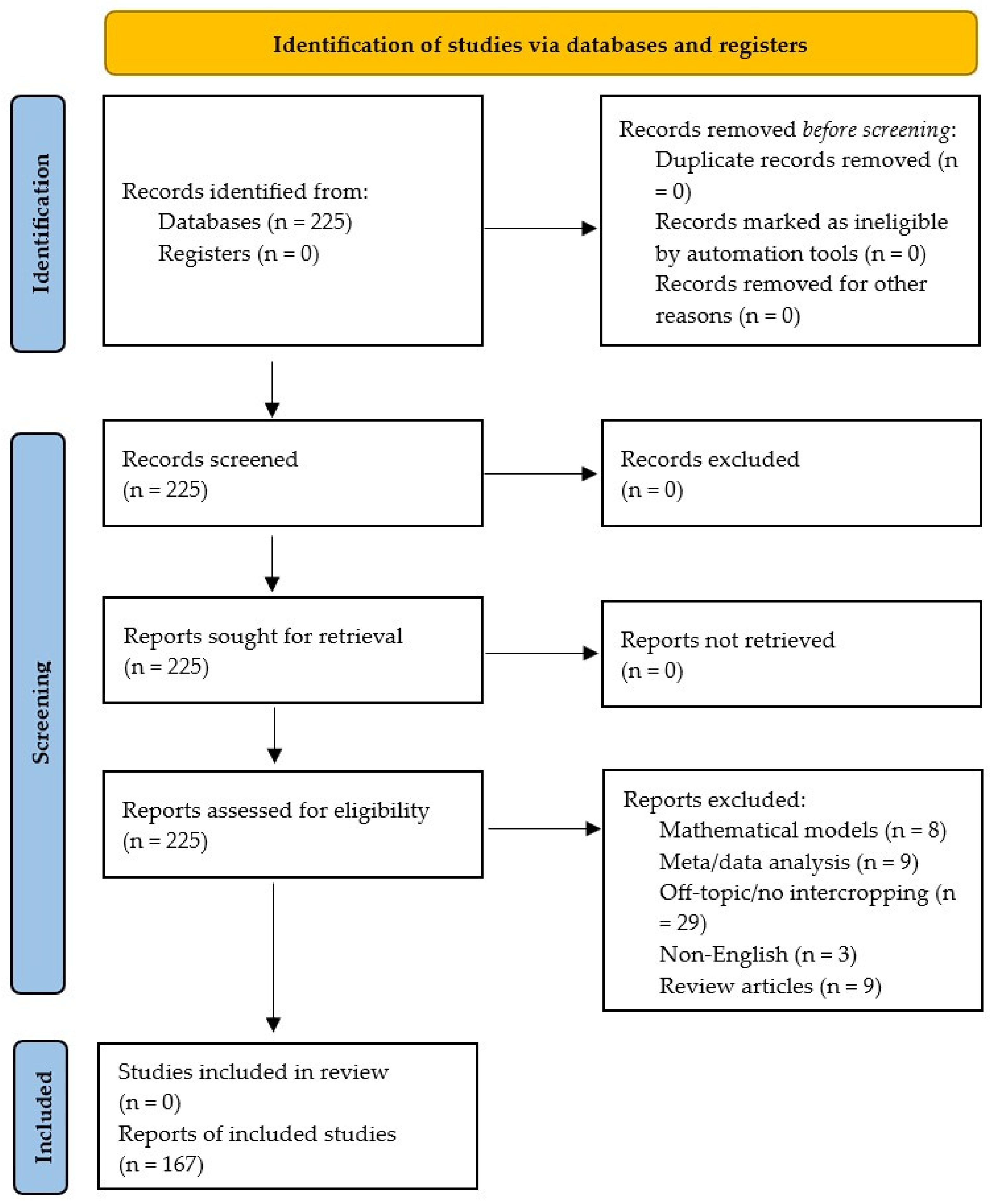
In our study, the PRISMA (Preferred Reporting Items for Systematic review and Meta-Analyses) protocol [55] was used to identify and analyze scientific publications from the past 39 years (1986–2025) on the global intercropping of legumes and non-legumes, with a specific focus on atmospheric nitrogen fixation and soil carbon sequestration (Figure 1). This time span was deliberately selected to ensure a sufficiently extended temporal framework for a robust analysis of publication trends, thematic development, and structural research patterns worldwide. The SCOPUS database was used to retrieve relevant articles. The screening process was carried out by three authors working independently. On 9 June 2025, a search using a specific query yielded 225 publications for the specified period. These were selected and downloaded in .csv format for subsequent analysis. The advanced search query used was: TITLE-ABS-KEY ((“intercrop*”) AND (“legume*”) AND (“carbon” OR “SOC*”) AND (“nitrogen” OR “BNF”)) AND (LIMIT-TO (SRCTYPE, “j”)) AND (LIMIT-TO (DOCTYPE, “ar”)) AND (LIMIT-TO (LANGUAGE, “English”). This query was formulated to select English-language articles that included the terms “intercrop”, “SOC”, and “BNF” in their title, abstract, or keywords, while excluding conference proceedings, review articles, and meeting abstracts. The keywords carbon/SOC were selected based on evidence reported by Wang et al. (2025) [56], who demonstrated that intercropping significantly enhances soil organic carbon conservation and stability. Similarly, the keywords nitrogen/BNF were included following the findings of Villwock et al. (2025) [57], which indicate that legumes within intercropping systems improve and increase soil nitrate levels and biologically fixed nitrogen inputs. Subsequently, the free software VOSviewer (v 1.6.19, Centre for Science and Technology Studies, Leiden, Netherlands) [58] was used to create and analyze the bibliometric maps from the loaded metadata.
For bibliometric analysis, two main approaches are commonly employed: performance analysis and scientific mapping. Performance analysis aims to evaluate the impact of researchers, institutions, and countries through quantitative and qualitative indicators such as total number of publications, number of documents per year, author, authors’ institutional affiliation, country, disciplinary area, journal name, keywords, and number of citations [51]. Scientific mapping, on the other hand, examines the structure and dynamics of scientific research by analyzing relationships among publications, topics, and authors [51,59]. The techniques employed include citation analysis, which identifies the most influential publications based on the number of citations received; co-citation analysis, which detects foundational themes by examining works frequently cited together and is useful for mapping the intellectual structure of a field; co-authorship analysis, used to study collaboration networks among researchers and institutions; keyword co-occurrence analysis and bibliographic coupling, which reveals connections between documents and highlights emerging research trends [51]. The visualization of bibliometric maps was performed using the VOSviewer software. This visualization tool represents elements such as articles, authors, countries, institutions, keywords, or journals through nodes, whose size reflects their weight or frequency. The larger the node is, the greater the importance of the element is. Node colors indicate thematic clusters in the network visualization, while lines connecting the nodes represent relationships among elements, such as co-occurrences, co-citations, or collaborations. Similarly, the thicker the line is, the stronger the relationship between nodes is.

3. Results and Discussion

3.1. Evolution of Scientific Production in Years

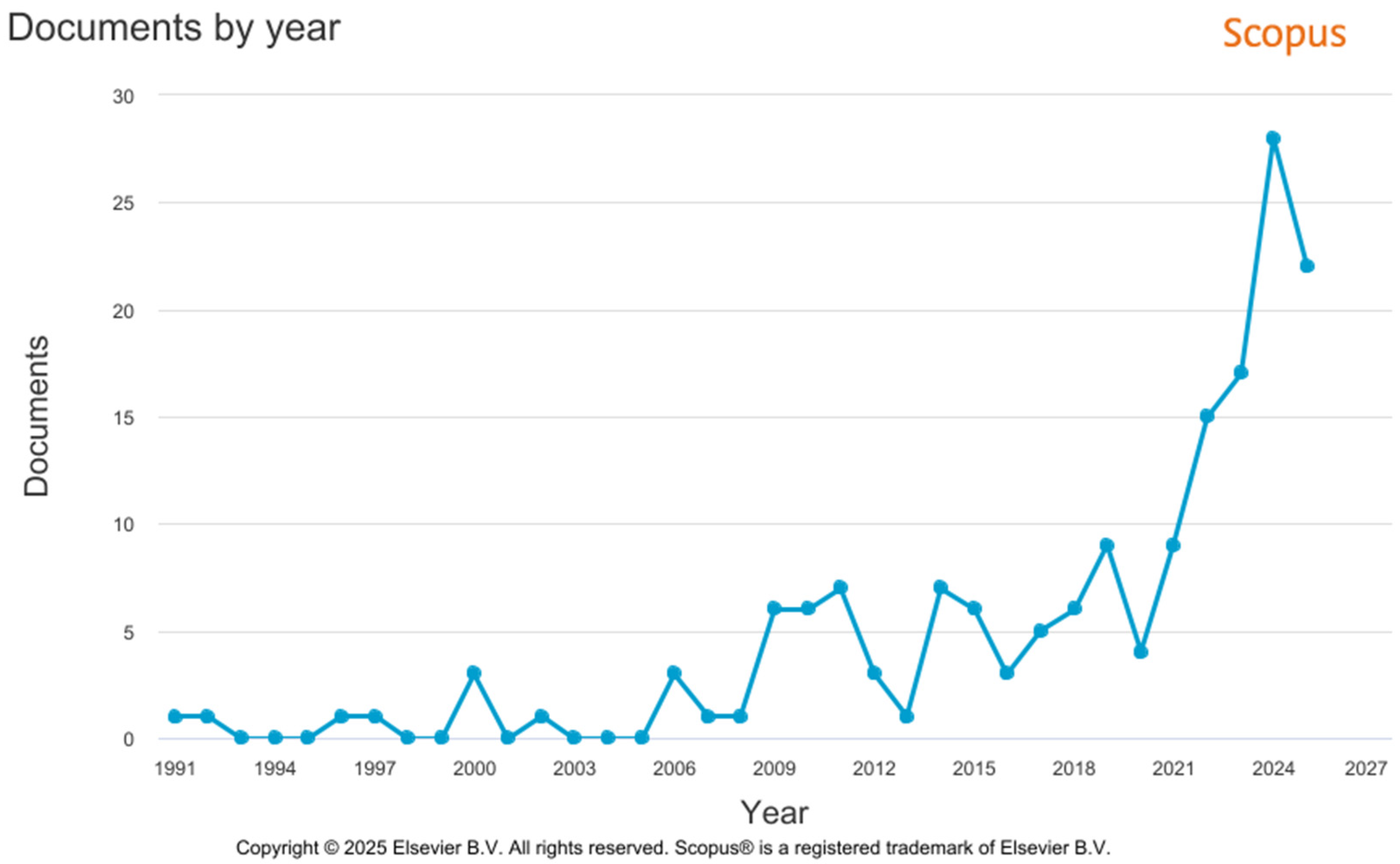
During the document screening process, 58 publications were excluded as they were considered off-topic, review articles, meta-analyses, or works lacking experimental activity and based solely on secondary data. This resulted in a total of 167 articles being used in our analysis. Chronologically, the first and only work indexed by Scopus was an experimental study conducted in Nigeria in 1986 and published in 1991 in Springer Nature, titled “Residual effects of natural bush, Cajanus cajan and Tephrosia candida on the productivity of an acid soil in southeastern Nigeria” [60]. From 1992 to 2008, the number of published documents was particularly low, with only 13 articles in total and never exceeding three per year (which occurred only in 2000 and 2006). No publications were recorded for the years 1993, 1994, 1995, 1998, 1999, 2001, 2003, 2004, and 2005. Between 2009 and 2020, the number of published articles was 63 (approximately 38% of the total), while in recent years (2021–2025), this number increased to 91 (46% of the total), indicating a clear upward trend. It is in this latter period that a significant increase in editorial output is observed, with more than 10 publications per year. The peak occurred in 2024, with 28 articles, while 22 publications have been registered in 2025 (Figure 2). This trend suggests that intercropping (particularly legume-based) is transitioning from a subject of occasional interest to a consolidated and rapidly expanding line of research. This shift is likely driven by the perception that intercropping is one of the most promising levers for simultaneously addressing productivity, yield stability, resource-use efficiency, and the reduction in external inputs.

3.2. Evolution of Scientific Production by Countries

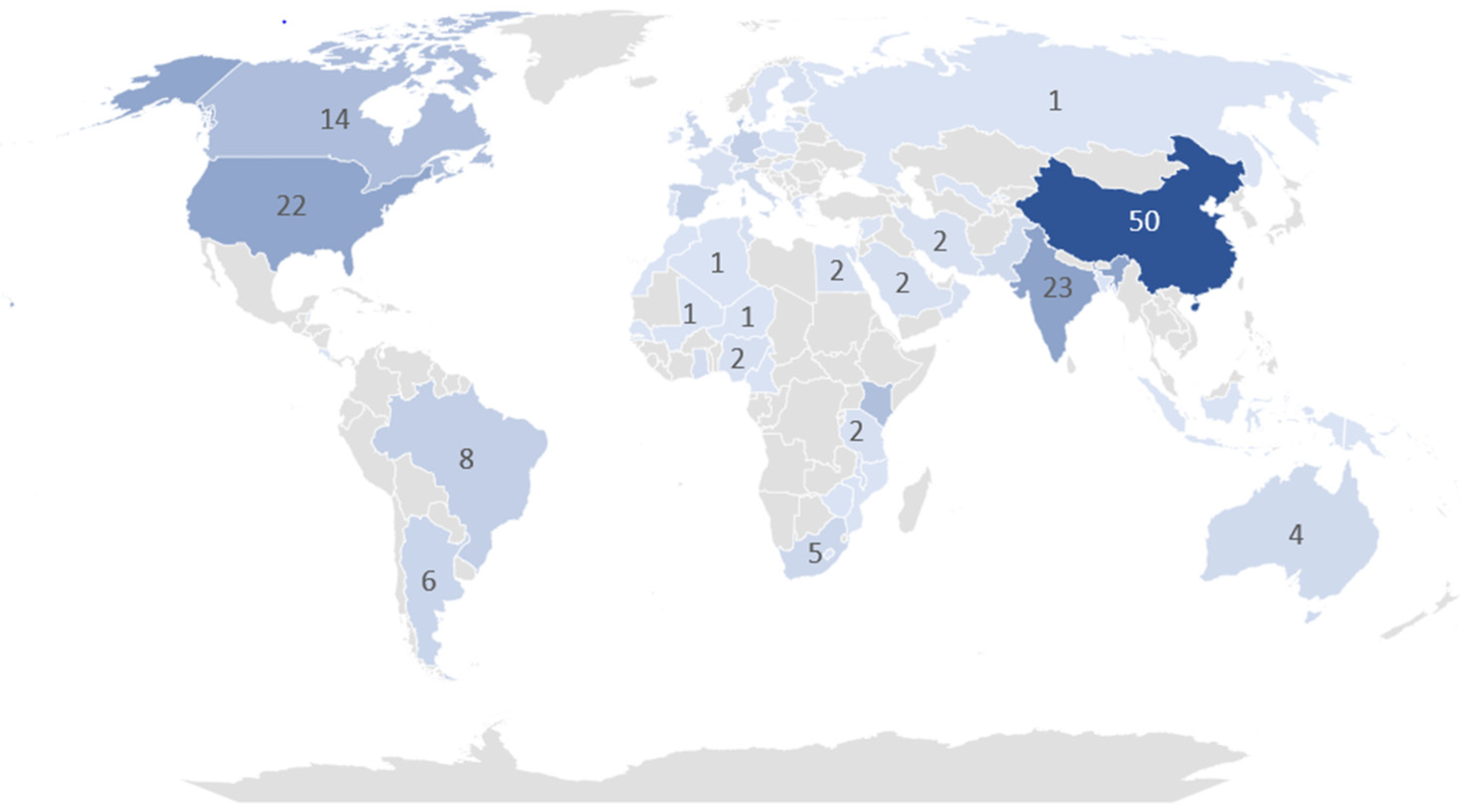
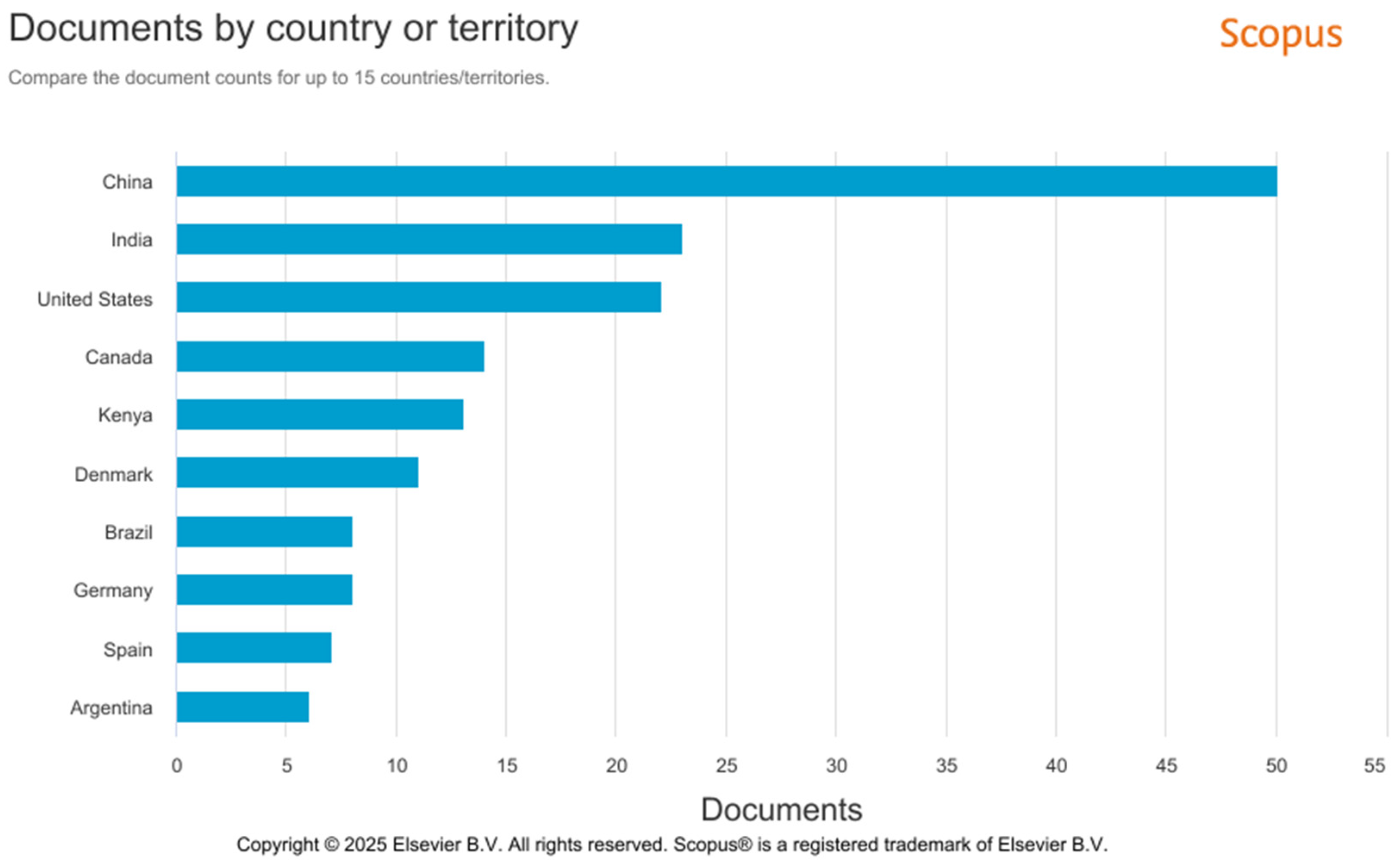
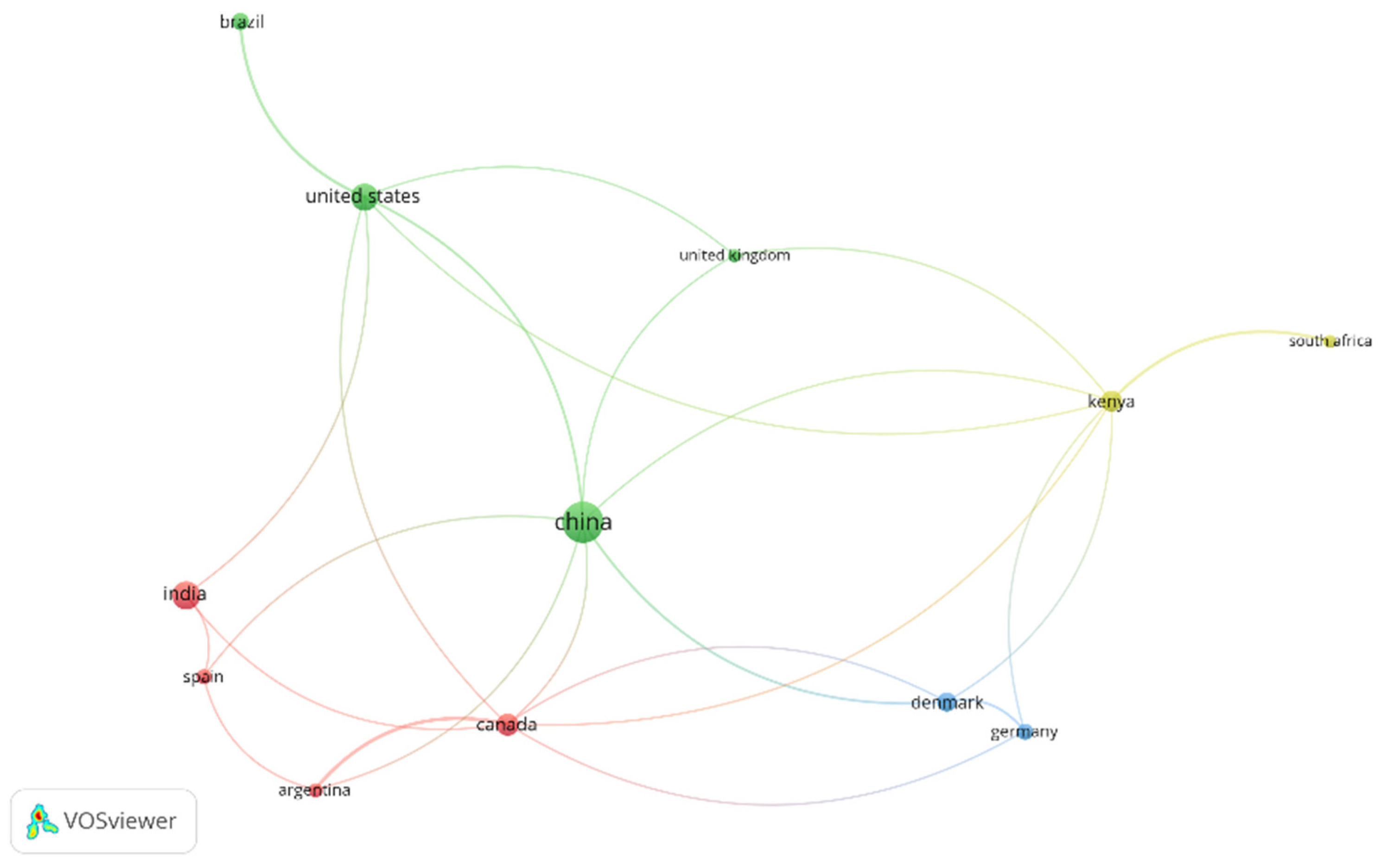
Figure 3 shows the spatial distribution of documents published between 1991 and 2025. Among the 56 countries that contributed to the research, the most productive are found in Asia (China and India), North America (United States and Canada), South America (Brazil and Argentina), and Europe (Denmark, Germany, and Spain). Figure 4 provides a more precise look at the top 10 countries with the highest scientific contribution. China and India are the most productive nations, with 50 and 23 documents, respectively. They are followed by the United States with 23 articles and Canada with 14. In Europe, the main contributing countries are Denmark, Germany, and Spain, with 11, eight, and seven documents, respectively. Overall, a clear overlap emerges between the countries leading scientific output and those that rank among the major legume producers, suggesting a potential linkage between production relevance and research priorities. Through the co-authorship network (Figure 5), it is possible to visualize and analyze collaborations between authors from different countries and, consequently, the scientific collaboration network. By setting a minimum of five documents per country in VOSviewer, the number of nodes identified was 12, while the number of clusters and links was four and 24, respectively. China, India, and the United States represent the largest nodes, with the highest number of publications. Analyzing the clusters on the map, the first and second clusters each contain four countries. The first cluster (red) includes Argentina, Canada, India, and Spain, while the second (green) contains Brazil, China, the United Kingdom, and the United States. The third (blue) and fourth (yellow) clusters contain only two nations each: Denmark and Germany in the third, and Kenya and South Africa in the fourth. The software clearly visualizes not only the links between individual countries but also among the clusters, facilitating the analysis of international collaboration networks. The co-authorship network indicates that international collaboration is structured around a few highly productive hub countries (most notably China, India, and the United States) while the remaining contributors are organized into smaller, more bounded communities. The coexistence of multi-country, cross-continental clusters alongside two-country clusters suggests a partially integrated global research landscape, with scope to broaden and diversify collaborations to improve representativeness across agroclimatic contexts.

3.3. Evolution of Scientific Production and Distribution by Institutions and Authors

The productivity of publication is summarized in Table 1, which lists the 15 institutions with the highest contributions. Chinese institutions, such as the Chinese Academy of Sciences and the University of Chinese Academy of Sciences, are particularly prominent, with the former having 13 publications and the latter 11. In fact, seven of the 15 institutions are from China, further confirming the country’s position as the most productive globally. Following China are Argentina and Spain with two institutions each, and finally Denmark, Canada, Kenya, and Brazil with one institution each. Furthermore, eight of the 15 institutions in the table are universities, while the rest are research centers or non-academic institutes. These results highlight a strong institutional concentration of research output, with China clearly dominating with the Chinese Academy of Sciences and the University of Chinese Academy of Sciences emerging as the leading contributors, suggesting a well-established national research ecosystem on legume-based intercropping. The prevalence of universities alongside research centers indicates that the field is driven primarily by academic research, while contributions from Argentina, Spain, and a small set of other countries appear more dispersed and centered on a limited number of key hubs. Table 2 presents the top ten authors who have contributed most to this research. Among the 167 documents analyzed, there were 160 unique authors. The most prolific include two researchers from the Xi’an University of Technology in China, Shi W. and Jing B., and two Canadian researchers, Oelbermann M. from the University of Waterloo and Chapagain T., affiliated with the Ministry of Agriculture, Food and Rural Affairs. Oelbermann M. stands out as the most prolific author on the central theme of this analysis, with a total of 75 documents, five of which were selected for this bibliometric study. Following is Echarte L., with a total of 46 publications, four of which were selected.
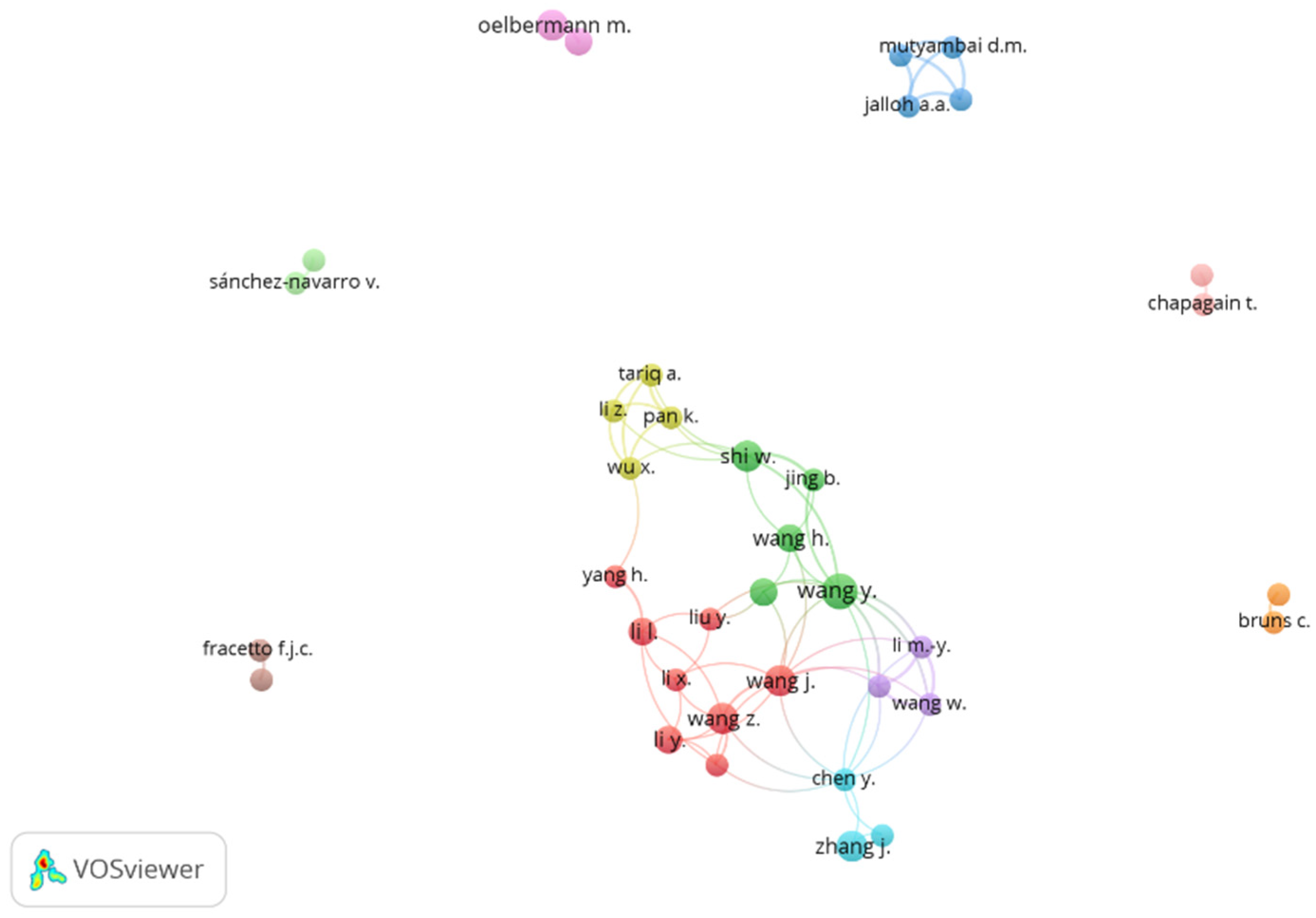
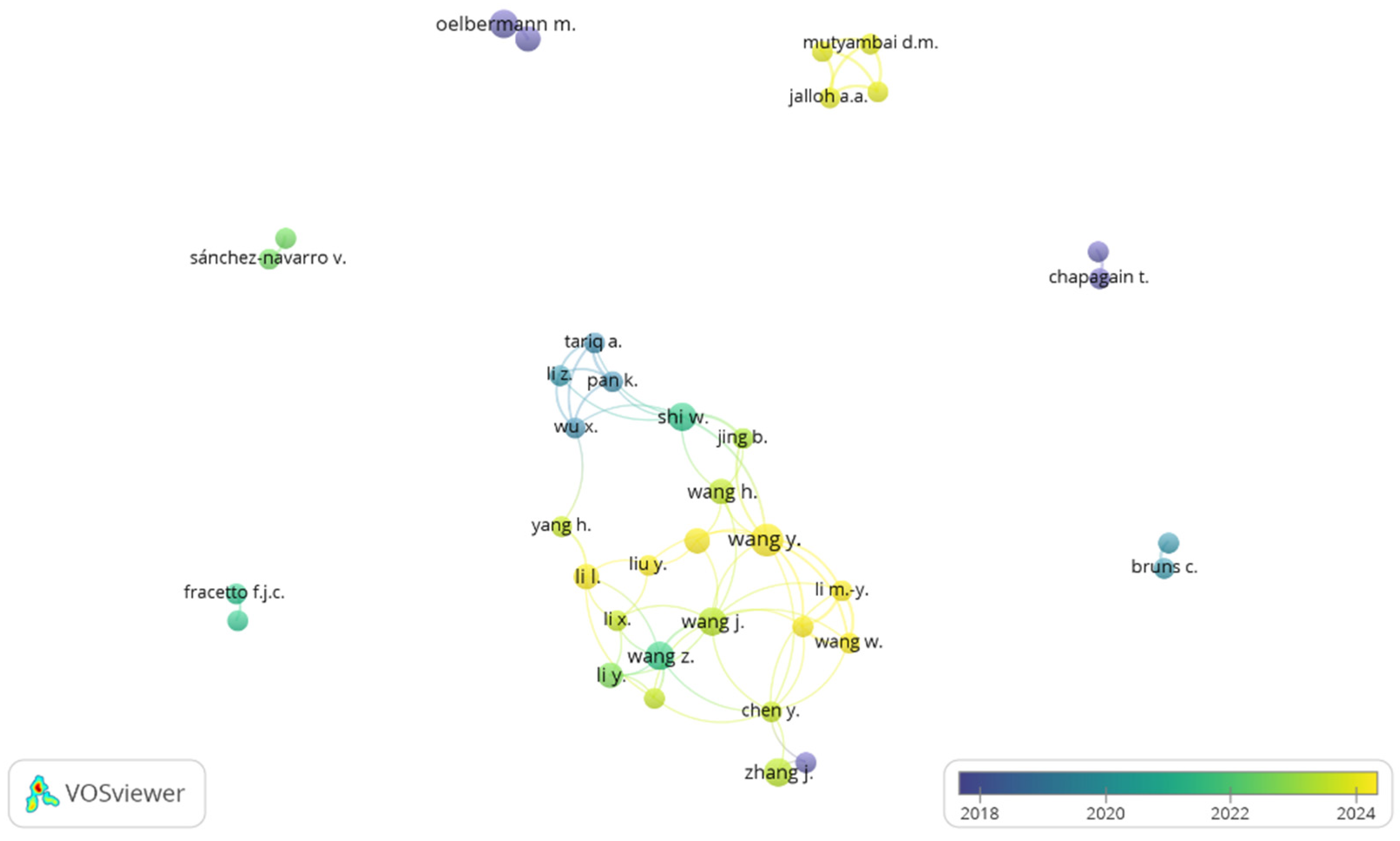
Figure 6 shows the collaboration map, highlighting the relational structure among authors who contributed to the analyzed corpus. It reveals both the density of scientific interactions and the presence of established research groups. Authors such as Shi W. and Wang Y. appear as central nodes, confirming their crucial role within the collaboration network. After setting the minimum threshold to three documents per author, the map generated by the software found connections for 37 authors, but only 23 of these (the central block of Figure 6) form the main collaborative core, representing the largest and most densely connected group within the network. The map is thus composed of 37 nodes, 11 clusters, and 69 links. Among the clusters on the map, the first six are distinguished by a greater number of links and authors involved. The first and second clusters (red and green) include eight and five authors, respectively, all from China, such as Li l., Li X., Wang J., or Wang Y. Cluster 3 (blue) comprises four African researchers: three from Kenya (Jalloh A.A., Mutyambai S., Subramanian S.) and one from South Africa (Yusuf A.A.). Cluster 4 (yellow) also includes four researchers from China: Li Z., Pan K., Tariq A., and Wu X. Clusters 5 and 6 (purple and light blue) each contain three authors. Cluster 5 is composed of three authors from China: Li M., Wang W., and Xiong Y., while cluster 6 includes two Chinese researchers (Chen Y. and Zhang J.) and one Danish researcher (Olesen J.E.). Figure 7 shows the evolution of author relationships over time, specifically in the period from 2018 to 2024. Additionally, a color scale at the bottom of the figure indicates that older relationships (2018–2020) are represented by cool colors, while more recent ones are shown in warmer, brighter colors. Specifically, clusters 1 and 2 feature more recent collaborations, while clusters 9 and 10 show older ones. This map highlights, on one hand, the emergence of new authors and research groups and, on the other, the consolidation of central scholars and figures who maintain an influential role over time. Through this “visual narrative,” it is possible to follow the evolution of research and collaboration networks. The observed network configuration suggests that the research field is characterized by a partial concentration of collaborations within a relatively cohesive core group. This means that scientific production is driven by a limited number of highly interconnected scholars, while a peripheral component remains less structurally integrated. The presence of clearly identifiable central actors indicates the existence of leadership dynamics within the field. This implies that certain scholars not only contribute significantly in terms of productivity but also play a strategic role in shaping collaboration patterns and influencing research directions. The temporal evolution further implies that the field is undergoing a process of consolidation alongside gradual renewal. This means that established research groups maintain their influence over time, while new collaborations emerge and progressively reshape the network structure. Overall, these findings suggest a growing but still partially fragmented research domain, where stronger cross-cluster and international collaborations could enhance knowledge circulation and scientific impact.

3.4. Thematic Areas of Research and Scientific Sources

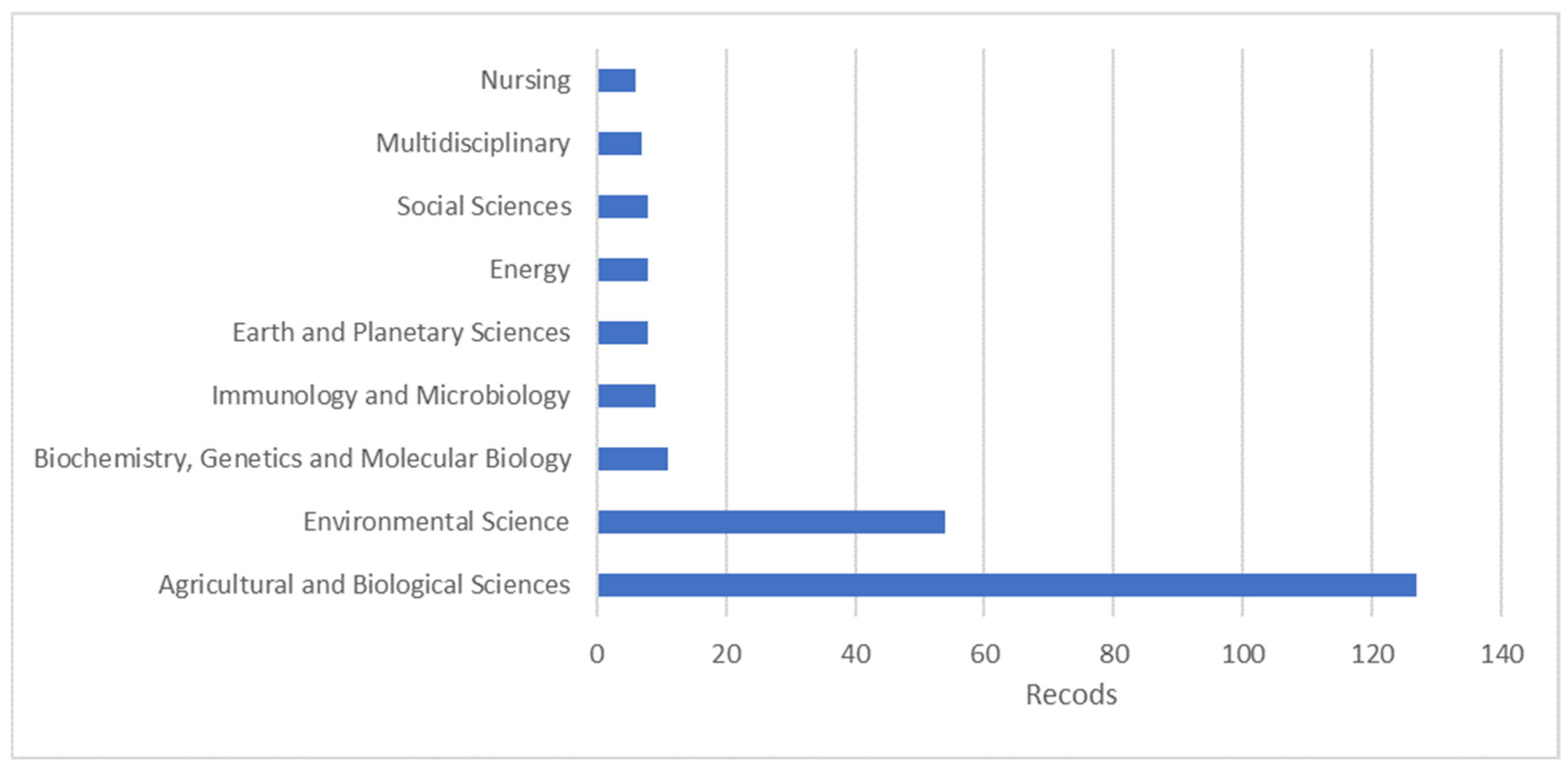
Based on our Scopus search results, a total of 16 subject areas were identified. Of these, only nine contained more than five publications (Figure 8). The two primary subject areas with the highest number of publications are agricultural and biological sciences (127 articles) and environmental science (54 articles). These two fields collectively account for over 70% of the documents analyzed in this study, with agricultural and biological sciences alone representing 49.8% of the total. This is followed by biochemistry, genetics and molecular biology with 11 articles; immunology and microbiology with nine articles; earth and planetary sciences, energy, and social sciences with eight articles each; multidisciplinary with seven articles; and finally nursing with six articles. It should be noted that, in many cases, the analyzed articles belong to multiple thematic categories rather than one. The distribution of publications across subject areas indicates a marked disciplinary concentration within agricultural and environmental sciences. This pattern highlights how the research topic is predominantly conceptualized within biological and ecological frameworks, emphasizing its strong connection to production systems and environmental dynamics. The inclusion of contributions from fields such as biochemistry, genetics, microbiology, and earth sciences further underscores the scientific complexity of the topic. Such diversification suggests that the phenomenon is investigated not only at a systems level but also through molecular and ecological perspectives, reinforcing its inherently multidimensional character. Moreover, the overlap among subject categories confirms the cross-cutting nature of the field. This interdisciplinary distribution supports the view that integrated analytical approaches are essential to fully capture the systemic implications and broader sustainability relevance of the topic.
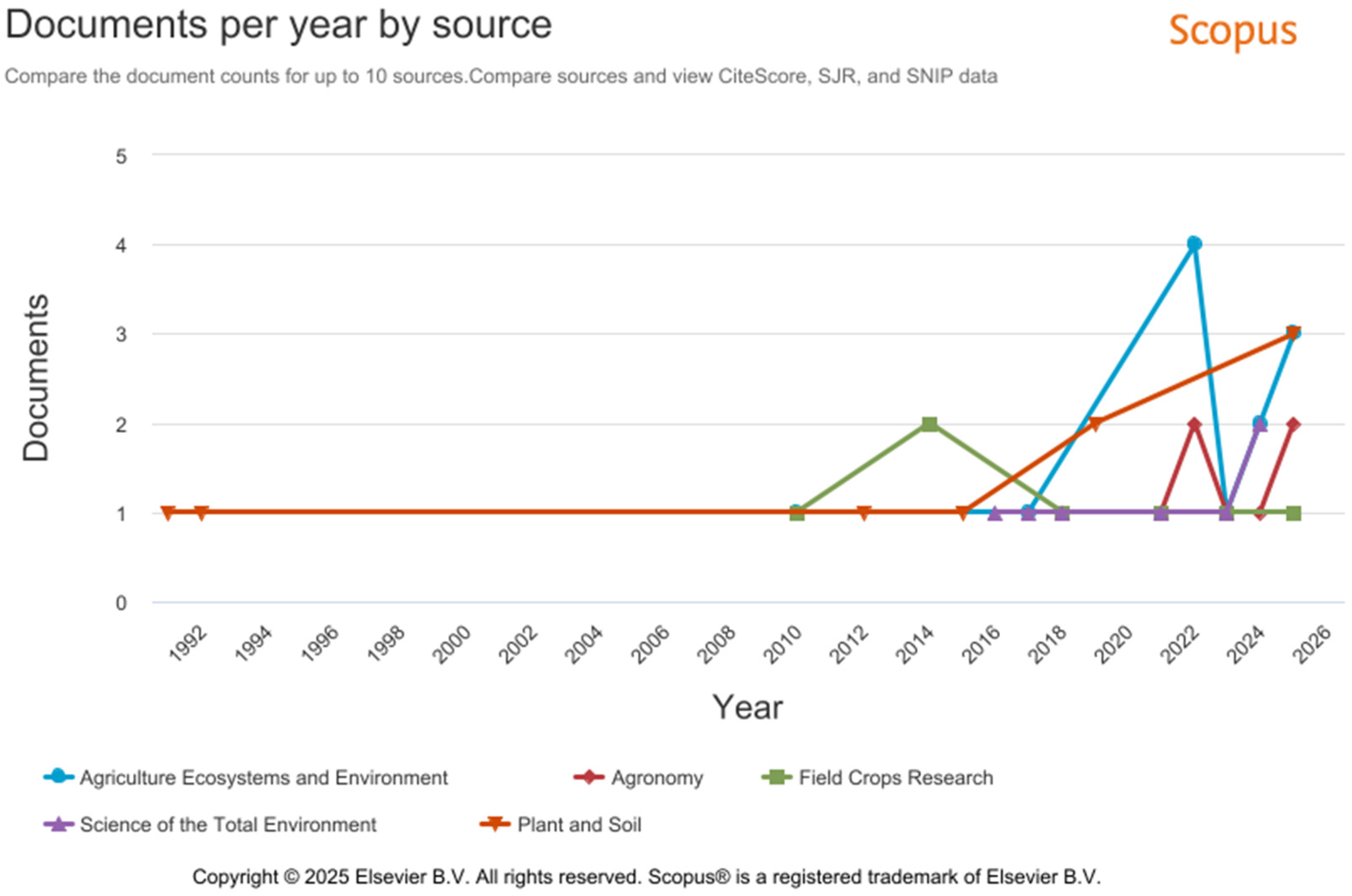
Figure 9 illustrates the scientific productivity over time of the top five journals, all of which have a high percentile ranking, placing them in the first quartile (Q1). Among these, Agriculture, Ecosystems & Environment is the most productive, contributing 12 documents. The first relevant article was published in 2010, and its peak was reached in 2022 with four articles. The journal’s primary themes concern agro-ecosystems, ecology, and the sustainability of agricultural systems, with a focus on the impacts of climate change and intensive agricultural practices. According to the 2024 Journal Citation Reports [61], Agriculture, Ecosystems & Environment has one of the highest percentiles, with a 2024 Journal Impact Factor (JIF) of 6.4. The JIF, first proposed in 1955 by Eugene Garfield, is calculated by dividing the number of citations received in the current year for articles published in the two preceding years by the total number of articles published in the journal during the same period [62]. According to data from the Scimago Journal & Country Rank [63] web platform, the journal has an h-index of 224, calculated across all publications in the database from 1983 to 2025. Plant and Soil, which ranks second with nine total documents, reached its productive peak in 2025 with three publications. Additionally, with an article dating back to 1991, it is the journal with the oldest publication in this field. The journal publishes both original and review articles with the goal of exploring the mechanisms of plant–soil interactions from a strong mechanistic approach. Based on documents published between 1948 and 2025, Scimago calculates an h-index of 237. The journal’s 2022–2023 JIF was 4.1, based on 4851 citations received and 1174 indexed articles. Agronomy follows closely with a total of seven articles. Its first relevant document was published in 2021, and 2022 and 2025 were its most productive years, with two documents each. Agronomy is an international, multidisciplinary journal covering topics in agronomy and agroecology, including crop breeding, sustainability, soil and water management, biotechnology, and agricultural systems. According to Scimago data (with coverage from 2011 to 2025), the journal’s h-index is 114. Its 2024 JIF is 3.4, calculated from 20,991 citations received and 6217 documents indexed in the two preceding years. Scopus registers the first relevant article in the journal Field Crops Research in 2010, with a peak of two documents in 2014. The total number of articles for this journal is seven. The journal publishes experimental and modeling studies on temperate and tropical crops, focusing on plant ecology, physiology, agronomy, and genetics. Analysis of the aforementioned websites shows that Field Crops Research has an h-index of 202 (for articles indexed between 1978 and 2025). Its 2024 JIF is 6.4, derived from 3829 total citations received for 601 documents published in the two preceding years. Similarly, Science of the Total Environment also contributed a total of seven articles, with the first dating back to 2016 and a peak in 2024. This international, multidisciplinary natural sciences journal is dedicated to publishing original, innovative, and high-impact research on the environment, with a particular focus on the atmosphere, hydrosphere, biosphere, lithosphere, and anthroposphere. Science of the Total Environment has a calculated h-index of 399, based on articles published between 1972 and 2025. Its 2024 JIF is 8.0, derived from 133,916 total citations for 16,697 articles. The temporal distribution of publications across the top journals suggests that the research topic has progressively consolidated within high-impact, first-quartile outlets. This indicates not only growing scientific maturity but also increasing recognition of the topic’s relevance within the broader agricultural and environmental research communities. The presence of historically established journals alongside more recently active ones points to both continuity and renewal in publication dynamics. On one hand, long-standing journals with high h-index values suggest a stable and cumulative scientific foundation. On the other hand, the more recent peaks in productivity indicate a phase of intensified scholarly attention, likely driven by emerging global challenges such as climate change, sustainability transitions, and agricultural resilience.

3.5. Keywords Analysis and Co-Occurrence Network

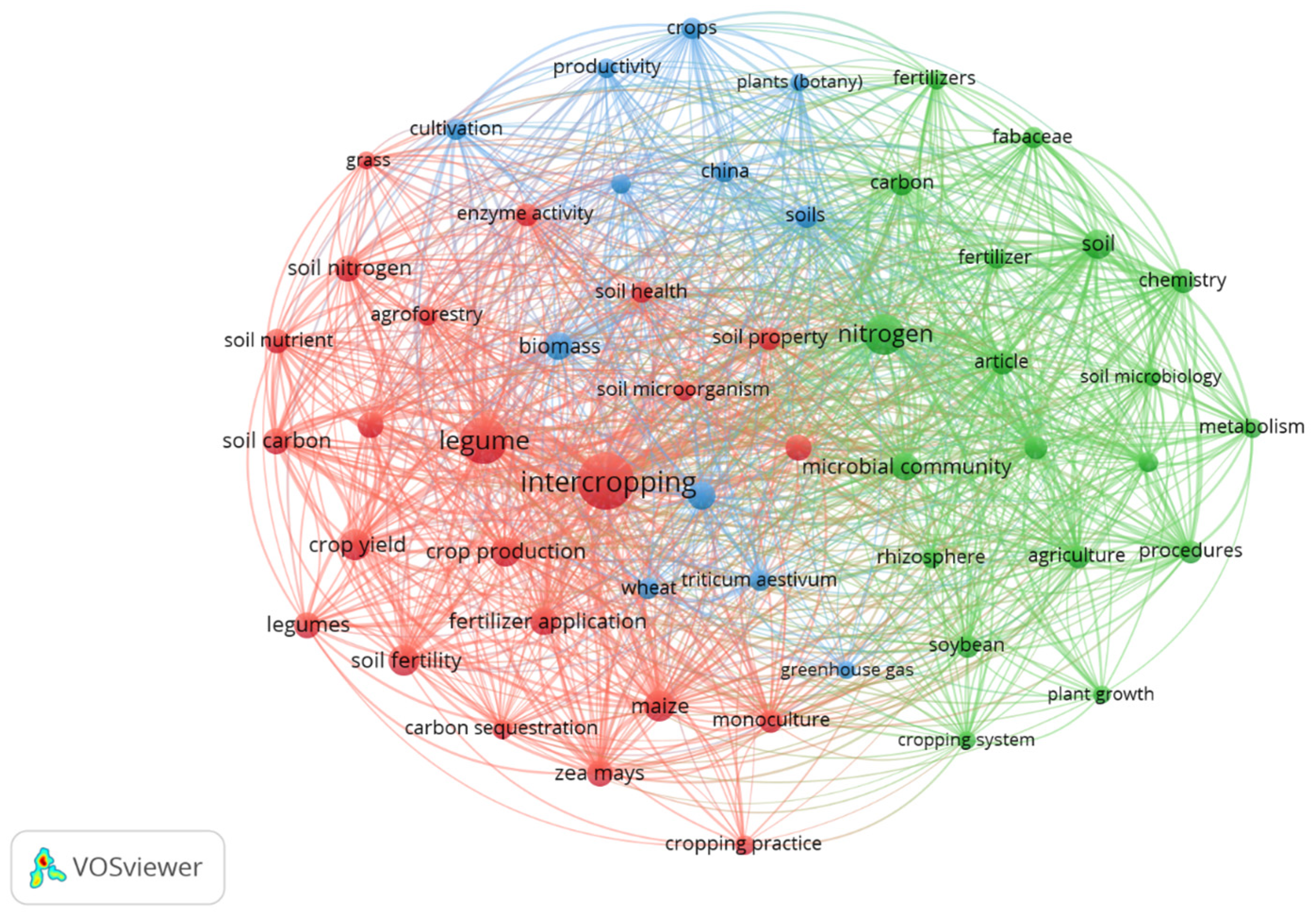
From the analysis of keywords in the examined literature, it is evident that the recurring themes revolve around sustainable agronomic practices. In particular, Table 3, which reports the ten most frequent keywords obtained from a co-occurrence analysis using VOSviewer, shows that “intercropping” (98 occurrences, 698 total link strength), “legume” (68 occurrences, 526 total link strength), and “nitrogen” (51 occurrences, 466 total link strength) are highly represented and strongly interconnected across the analyzed articles, indicating a significant interest in strategies to improve soil fertility and production efficiency. Keywords like “maize,” “crop yield,” and “biomass” indicate a scientific focus on specific crops and measurable agronomic outcomes. The presence of “microbial community,” though less frequent (23 occurrences), points to a growing interest in the microbiological aspects of the soil, which are potentially linked to the sustainability and resilience of agro-ecosystems. For the visual network creation, VOSviewer was set to display keywords with at least 10 occurrences (Figure 10). The resulting map confirms these findings by visually representing the relationships between keywords. The central node, “intercropping,” is clearly visible due to its larger size and higher number of links (53). This keyword, belonging to the first cluster, is interconnected with all the words listed in Table 3, underscoring its central role in the topic. The software’s cluster analysis suggests that the keywords are distributed into three main groups. The red cluster (23 elements) contains keywords such as “intercropping,” “legume,” “crop yield,” “crop production,” “soil fertility,” “soil carbon,” “soil nutrient,” “soil nitrogen,” “soil organic matter,” and “fertilizer application.” This group shows that research is focused on the regeneration of agricultural soils through the use of nitrogen-fixing crops like legumes and intelligent soil management techniques like intercropping. The recurring presence of terms such as “soil fertility,” “soil organic matter,” “legume,” and “nitrogen” indicates a consistent focus on agricultural practices that aim not only for high yields but also for the ecological improvement of the agro-ecosystem, in line with regenerative agriculture principles. The green cluster (19 elements) is oriented toward microbiological and chemical aspects of the soil, containing keywords like “nitrogen,” “microbial community,” “soil microbiology,” “rhizosphere,” and “soil chemistry.” The strong interconnections within this cluster point to intense scientific activity centered on the soil’s biological composition, the carbon cycle, and the role of microorganisms in nutrient transformation and ecosystem regeneration. The focus is on understanding the ecological dynamics that govern soil life, with a particular emphasis on the role of microbial communities in transforming organic matter and cycling carbon. The blue cluster (12 keywords) includes terms such as “biomass,” “productivity,” “cultivation,” “organic carbon,” “microbial biomass,” and “greenhouse gas.” This delineates a research area focused on agronomic efficiency and the environmental impact of agricultural practices. These keywords are important indicators of the interest in farming methods capable of enhancing yield, improving soil health, and simultaneously reducing environmental impact. Finally, keywords such as “Triticum aestivum” or “wheat” suggest that wheat is frequently used as the main crop in intercropping systems, highlighting its strategic role. The presence of “China” as a keyword also delineates the prevalent geographical context of the literature, indicating that a significant portion of the research on legume intercropping is conducted or published within the Asian context.

3.6. Bibliographic Coupling

3.6.1. Bibliographic Coupling of Countries

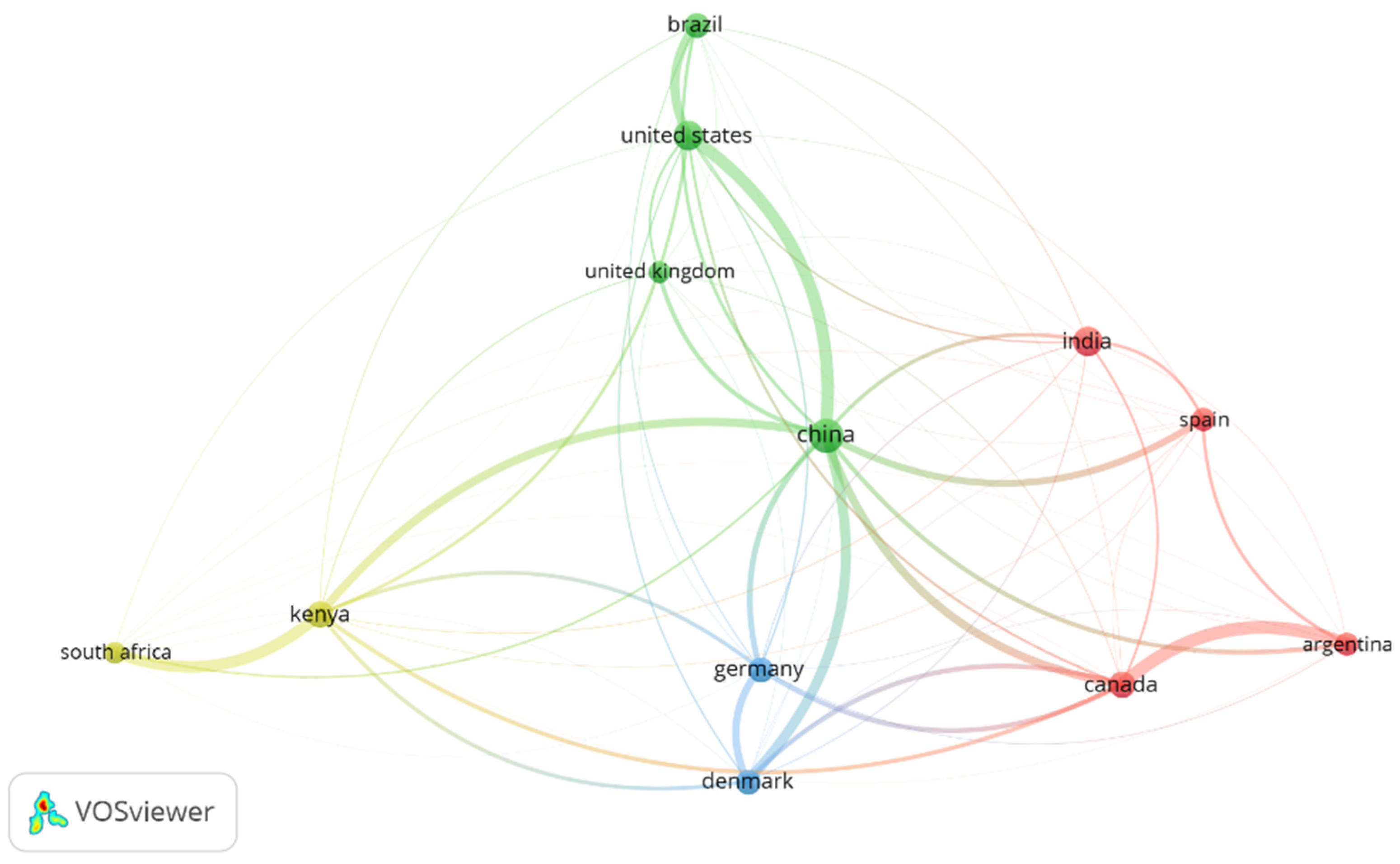
Bibliographic coupling is a scientific mapping technique based on the assumption that two publications sharing common references are also similar in content. This method helps to form recent research clusters and highlight niche studies, thereby providing an up-to-date representation of the current state of a scientific field [51]. In our study, we analyzed bibliographic couplings related to countries, journals, and scientific articles using VOSviewer. By setting the minimum number of articles to 5, the software generated a visual map (Figure 11) containing 12 countries, which were subdivided into four interconnected clusters with 66 links. The first cluster (red) contains four elements: Argentina, Canada, India, and Spain. From the map, India, with 23 documents, represents the largest and most relevant node in terms of scientific output. The link between Argentina and Canada is the most pronounced in terms of intensity, suggesting a strong thematic convergence between publications from these two countries. The second cluster (green) contains four elements: the USA, China, the UK, and Brazil. China is the primary node with a total of 50 documents and strong links to the USA. It is also important to note the robust links to countries in other clusters, particularly Denmark and Kenya, which belong to the third and fourth clusters, respectively. Similarly, the USA, with 22 documents and a strong link to Brazil, also shows a close thematic affinity between their publications, suggesting similar research orientations and potential collaborative pathways. The third cluster (blue) contains only two European countries, Germany and Denmark, with eight and 11 documents respectively, and a strong interconnection. Finally, the fourth cluster (yellow) includes two African countries, Kenya with 13 documents and South Africa with five. Both show a notable link strength, indicating that researchers from both countries frequently cite the same sources. The bibliographic coupling analysis at the country level reveals a geographically differentiated interconnected intellectual structure. The emergence of four clusters suggests that national research systems tend to develop around shared citation patterns, reflecting common thematic orientations or policy priorities. Overall, the country-level coupling structure suggests a field characterized by both regional specialization and cross-regional intellectual exchange. While leading countries act as bridging hubs within the global knowledge system, the persistence of distinct clusters indicates that the research landscape retains identifiable geographic and thematic cores.

3.6.2. Bibliografic Coupling of Journals

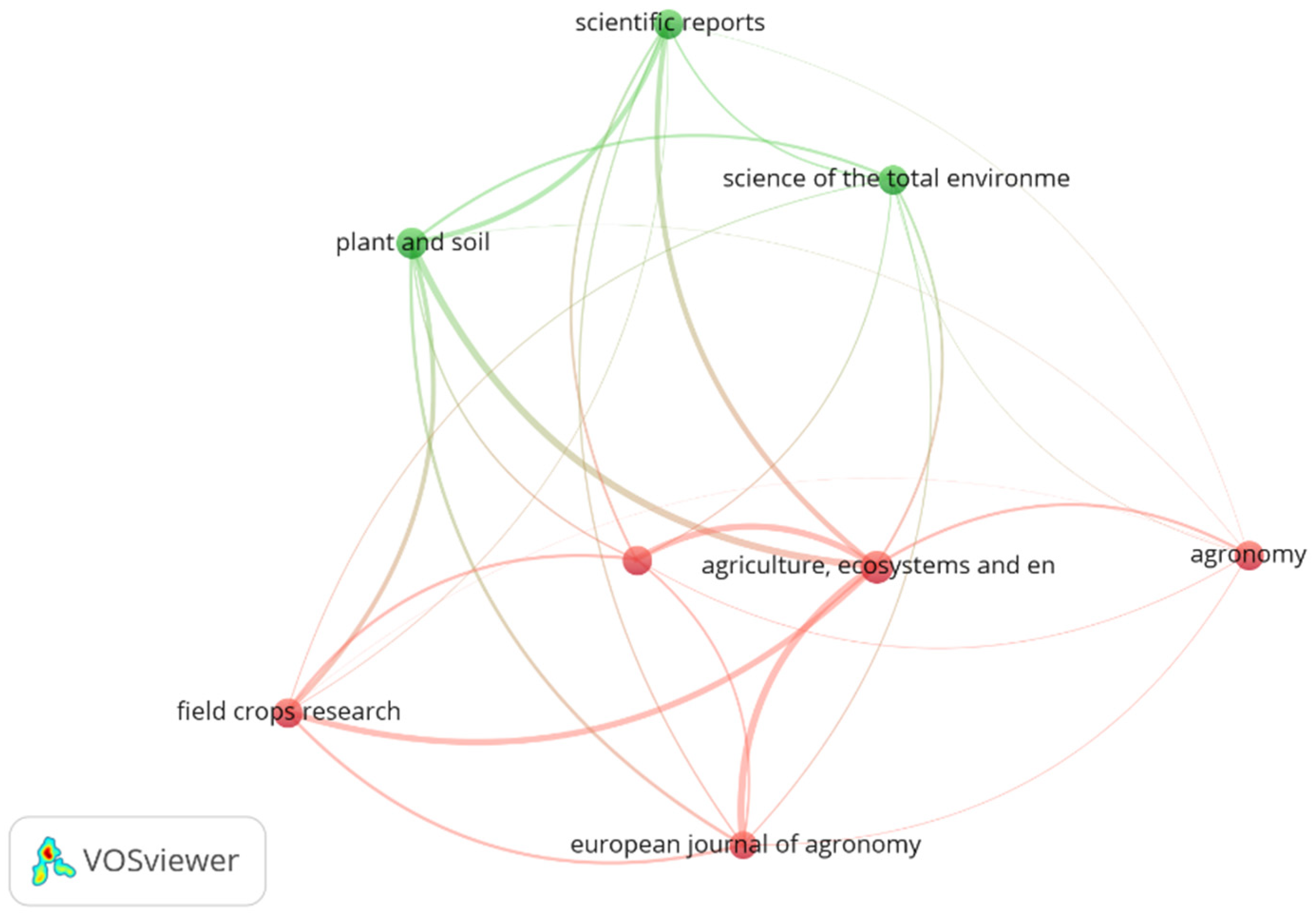
Turning to journal coupling, the minimum number of articles was again set to five, and the software mapped the eight journals meeting this criterion, grouping them into two clusters (Figure 12 and Table 4), suggesting that the research field is structured around two main publication arenas. The first cluster (red) consists of five journals: Agriculture, Ecosystems & Environment, European Journal of Agronomy, Field Crops Research, and Journal of the Science of Food and Agriculture. A robust link between Agriculture, Ecosystems & Environment (12 documents) and European Journal of Agronomy (five documents) shows that both journals are strongly interconnected bibliographically, sharing numerous common citations and addressing similar topics. The strong bibliographic interconnection among these journals suggests a consolidated research stream grounded in crop science, agricultural systems, and applied agronomy. The particularly robust linkage between leading journals within this cluster indicates that they rely on a common theoretical and methodological foundation, reinforcing their role as central platforms for knowledge production and dissemination in the field. The second cluster (green) contains only three elements. The main node in this cluster is the journal Plant and Soil with 10 documents, followed by Science of the Total Environment and Scientific Reports, with seven and six articles respectively. The second cluster, centered around Plant and Soil, reflects a more soil- and environment-focused orientation, with connections extending toward broader environmental and multidisciplinary outlets. This suggests a complementary but partially distinct knowledge base, likely characterized by a stronger emphasis on soil processes, biogeochemical cycles, and environmental impacts. Table 4, which ranks the aforementioned journals by the number of articles, shows that Agriculture, Ecosystems & Environment is in first place with the highest number of documents (12) and citations (416) and the highest link strength (268), indicating that it is the most influential and centrally connected journal in this field of study. Plant and Soil and Field Crops Research follow, with a slightly lower number of documents but a high number of citations. It is interesting to note that total link strength is not always directly proportional to the number of documents or citations. For example, the Journal of the Science of Food and Agriculture and the European Journal of Agronomy have a relatively high link strength (135 and 146, respectively) compared to their number of published documents (six and five), suggesting a strong interconnection with other publications despite a smaller volume of output. Overall, the journal coupling network indicates a research domain structured around interconnected yet thematically distinct publication hubs, suggesting a balance between specialization and intellectual cohesion.

3.6.3. Bibliographic Coupling of Documents

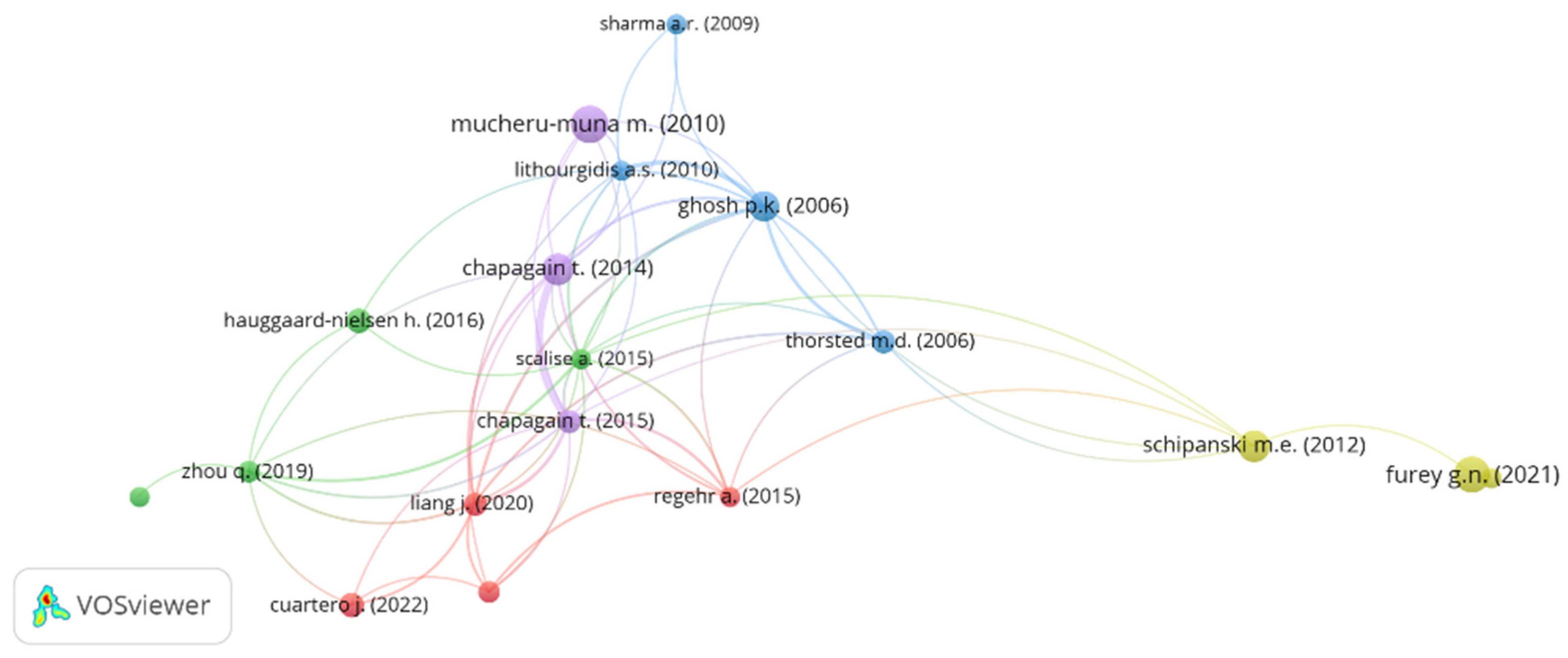
Within the bibliographic coupling analysis of the 167 articles examined, the software generated a network containing 20 documents, which were selected based on a minimum threshold of 50 citations per article. Only 18 were interconnected and are present on the map (Figure 13).
The distribution of the analyzed documents across the five identified clusters is as follows. The first cluster (red) comprises four studies [64,65,66,67], while the second (green) and third (blue) clusters also contain four articles each: [68,69,70,71] and [72,73,74,75], respectively. The fourth cluster (yellow) is represented by three publications [76,77,78] focused on ecological restoration. Similarly, the fifth cluster (purple) includes three works, specifically two by Chapagain and Riseman [79,80] and one by Mucheru-Muna et al. [81]. The configuration of the five clusters reveals distinct yet partially overlapping research streams. The red, green, blue and purple clusters appear relatively compact and internally cohesive, suggesting that the studies within each group draw on similar theoretical foundations and methodological approaches. Their proximity and the density of links among them indicate conceptual affinity and a shared bibliographic backbone. The yellow cluster, visually positioned more peripherally and characterized by fewer connections, reflects a more specialized thematic orientation. Its relative separation from the central clusters suggests that, while related to the broader research domain, it relies on a somewhat distinct body of literature and may engage with different disciplinary traditions.

3.7. Thematic Cluster Analysis and Species Categorization

The analyzed documents share a common objective. They evaluate the agroecological benefits provided by legumes in intercropping systems. This section examines the clusters identified through the bibliometric coupling of documents. Species are categorized based on their potential end-use, such as human food, livestock feed, industrial crop or ecological functions. This classification is applied even in cases where the specific purpose was not explicitly stated in the original articles.

3.7.1. Cluster 1

The first cluster (Figure 13) (red) examines intercropping systems involving species of significant food and industrial interest. Liang et al. (2020) [64] analyzed cotton–mung bean intercropping in the arid conditions of Northwestern China. Their study demonstrated that this system significantly improves agricultural productivity, water-use efficiency (WUE), and nitrogen-use efficiency (NUE). It also enhances overall economic benefits. The researchers identified 390 kg ha−1 as the optimal nitrogen fertilizer rate. In this context, cotton serves as an industrial crop. Mung bean plays a primary role in human nutrition as a protein source. Regehr et al. (2015) [65] investigated soil nitrogen mineralization and immobilization dynamics in maize–soybean intercropping systems in the Argentine Pampas. The results indicated that the presence of the legume promotes nitrogen storage and stimulates microbial activity. Nutrient-use efficiency was also improved compared to monocultures. Both species are primarily used for human food and animal feed. Wang et al. (2021) [66] demonstrated that sweet maize–soybean intercropping, combined with 300 kg N ha−1 fertilization, enhances productivity. This practice reduces net greenhouse gas emissions and carbon footprint. In this case, both species are mainly intended for direct human consumption. However, soybean has a dual purpose. Due to its high protein content, it is suitable for both food and feed. Finally, Cuartero et al. (2022) [67] evaluated melon–cowpea intercropping under organic management with a 30% reduction in fertilization. The results showed improvements in melon yield, total nitrogen availability, available phosphorus, and soil organic carbon. Additionally, the microbial community underwent positive modifications. Both species are primarily produced for human consumption.

3.7.2. Cluster 2

The second cluster (Figure 13) (green) examines intercropping systems ranging from Mediterranean cereal farming to fodder and agroforestry systems. Scalise et al. (2015) [68] analyzed the effects of legume–barley intercropping followed by durum wheat in rotation under Mediterranean rainfed conditions. The results showed that intercropping improves soil nitrogen availability. It also increases the yield of subsequent durum wheat to levels comparable with chemical fertilization. Furthermore, the system stimulates microbial community activity. In this system, durum wheat is primarily intended for human consumption. Conversely, barley, field pea, and faba bean are used as fodder crops. The legumes also perform a key role in soil nitrogen enrichment. The study by Zhou et al. [69] examined the effects of rape–Chinese milk vetch intercropping on the rhizosphere microbial community. Their findings highlighted that this system reduces microbial biomass and alters its structural and functional composition. Rape is used for both edible and industrial oil production. Chinese milk vetch is employed as green manure. Hauggaard-Nielsen et al. (2016) [70] evaluated the effects of different intercropping strategies between perennial forage grasses and forage legumes under two nitrogen fertilization levels. Life Cycle Assessment (LCA) revealed that low-input systems reduce the carbon footprint by 40–50% per ton of biomass. All species involved (ryegrass, cocksfoot, fescue, white clover, red clover, and alfalfa) are intended exclusively for fodder. Barley and wheat are used respectively as a cover crop and a subsequent food crop. Finally, Kremer and Kussman (2011) [71] analyzed an alley-cropping agroforestry system with pecan trees and kura clover in the U.S. Midwest. They demonstrated that this intercropping improves soil quality through organic and nitrogen enrichment. It also significantly increases microbial enzymatic activity. In this case, pecan nuts are destined for human consumption, while kura clover serves a fodder function.

3.7.3. Cluster 3

The third cluster (Figure 13) (blue) examines intercropping systems primarily oriented toward cereal and legume production for food and fodder. Ghosh et al. (2006) [72] analyzed a soybean–sorghum intercropping system in Central India over a five-year period. They evaluated the influence of various organic and chemical fertilization strategies on inter-specific competition and nutrient-use efficiency. The results showed that sorghum dominated the intercropping, while soybean productivity was reduced. However, the system improved soil microbial activity, water-use efficiency, and nitrogen-use efficiency. It also enhanced the Land Equivalent Ratio (LER) and the Relative Crowding Coefficient (RCC). Soybean is used for human consumption and oil production. Grain sorghum is primarily employed in livestock feed. Lithourgidis and Dordas (2010) [73] compared faba bean–winter cereal (wheat, barley, rye) intercropping at different seeding densities. Their study highlighted that rye, both in monoculture and intercropped with faba bean, produced higher forage yields. All species involved in this study are explicitly intended for animal fodder. Thorsted et al. (2006) [74] analyzed the competition between wheat and white clover. They demonstrated that root competition for nitrogen affects biomass production more than competition for light. The system proved advantageous in low-input agriculture, provided that root competition is adequately managed. In this case, wheat is intended for human consumption, while white clover serves a forage function. Finally, Sharma and Behera (2009) [75] evaluated the effects of maize–legume intercropping in Northwest India, followed by the incorporation of crop residues before wheat sowing. The results showed an increase in overall system productivity and a nitrogen fertilizer saving of up to 56 kg ha−1. This led to improved soil fertility and a positive nitrogen balance. The legume species involved (mung bean, cowpea, peanut, soybean, and black bean) are mainly intended for human consumption. Peanut and soybean also serve a role in animal feed. Maize and wheat, which also have a dual-purpose nature, complete a sustainable production system that is more profitable than monoculture.

3.7.4. Cluster 4

The fourth cluster (Figure 13) (yellow) focuses on intercropping systems with a strong emphasis on ecological functions and soil fertility restoration. Schipanski and Drinkwater (2012) [76] compared biological nitrogen fixation in legume–grass intercropping systems across 15 farms in New York State, covering various soil fertility gradients. The results showed that red clover intercropped with orchardgrass produces more biomass and fixes more nitrogen than pea intercropped with oats. Inter-specific competition was found to indirectly influence fixation in more fertile sites. All species are used exclusively as cover crops. Furey and Tilman (2021) [77] conducted a long-term, 23-year experiment on poor, unfertilized soils. They compared monocultures with high-biodiversity systems comprising up to 16 perennial herbaceous species. These included legumes such as perennial lupine, lespedeza, and prairie clover. The results revealed significantly higher levels of soil nutrients (nitrogen, potassium, calcium, magnesium, cation exchange capacity, and carbon) in systems with higher functional diversity. This suggests that such intercropping systems are highly effective for restoring degraded soils. While these species primarily serve ecological purposes, they can also function as grazing land. Finally, Liao et al. (2019) [78] analyzed the influence of biochar on the soil bacterial community in a faba bean–maize intercropping system. They demonstrated that this soil amendment stimulates bacteria belonging to the Firmicutes and Bacteroidetes phyla. These bacteria are involved in nitrogen fixation and phosphorus solubilization, thereby improving nutrient cycling in the rhizosphere. Although the specific purpose of the species is not explicitly stated in the article, faba bean and maize are traditionally cultivated for both human food and animal feed.

3.7.5. Cluster 5

The fifth cluster (Figure 13) (purple) examines intercropping systems primarily oriented toward human food production. These studies focus on resource-use efficiency and sustainability within low-input systems. Chapagain and Riseman (2014) [79] demonstrated that barley–pea intercropping, even without fertilizers, increases soil productivity compared to monocultures. This system also improves nitrogen and carbon content. A 2:1 ratio proved most efficient for grain quality, biological nitrogen fixation and transfer, and atmospheric carbon sequestration. In this system, barley is intended for malting (human food use), while pea is primarily employed as animal fodder. Subsequent research by the same authors (2015) [80] confirmed these findings by extending the analysis to wheat–faba bean and wheat–common bean intercropping. Using stable isotopes (15N and 13C), they quantified biological nitrogen fixation, its transfer to wheat, and carbon accumulation in biomass. Wheat is intended for bread-making and common bean for human consumption. Small-seeded faba bean serves mainly as a cover crop, though it can provide high-quality forage residues. Finally, Mucheru-Muna et al. (2010) [81] compared conventional maize–legume intercropping with the innovative MBILI (Managing Beneficial Interactions in Legume Intercrops) system in Kenya over seven consecutive seasons. The results showed increases in yield as well as light- and nutrient-use efficiency. Cowpea was the only species capable of maintaining a neutral nitrogen balance. Maize, common bean, cowpea, and peanut are all destined for human consumption. Additionally, maize stover is used as livestock fodder, and legume residues are incorporated into the soil to enrich fertility.

3.7.6. Functional Classification and End-Use Patterns

Analysis of the species within the various clusters underscores the pronounced multifunctionality of the examined legume–non-legume intercropping systems. Both human consumption and fodder use are equally represented, each occurring in 14 of the 18 analyzed articles; this confirms the cross-cutting nature of these practices across different production chains. Such overlap is not coincidental, as several of the species involved (notably maize, soybean, and peanut) possess a dual-purpose nature, being suitable for either human consumption or livestock feed depending on the specific production and geographic context. The function of cover cropping or ecological soil restoration characterizes five articles, where primary production goals yield to long-term objectives focused on fertility regeneration and biodiversity. Industrial applications, limited to two articles, specifically concern cotton and rapeseed. However, it is noteworthy that while soybean also has significant industrial applications (e.g., oil and biofuel production), it was classified within the food and feed categories in the analyzed studies. Overall, the data confirm that legume–non-legume intercropping represents an agronomic strategy capable of simultaneously addressing multiple requirements and adapting to highly diverse geographic, climatic, and cropping contexts, ranging from the Mediterranean to the Argentine plains, and from Sub-Saharan Africa to South.

3.8. Citation Analysis

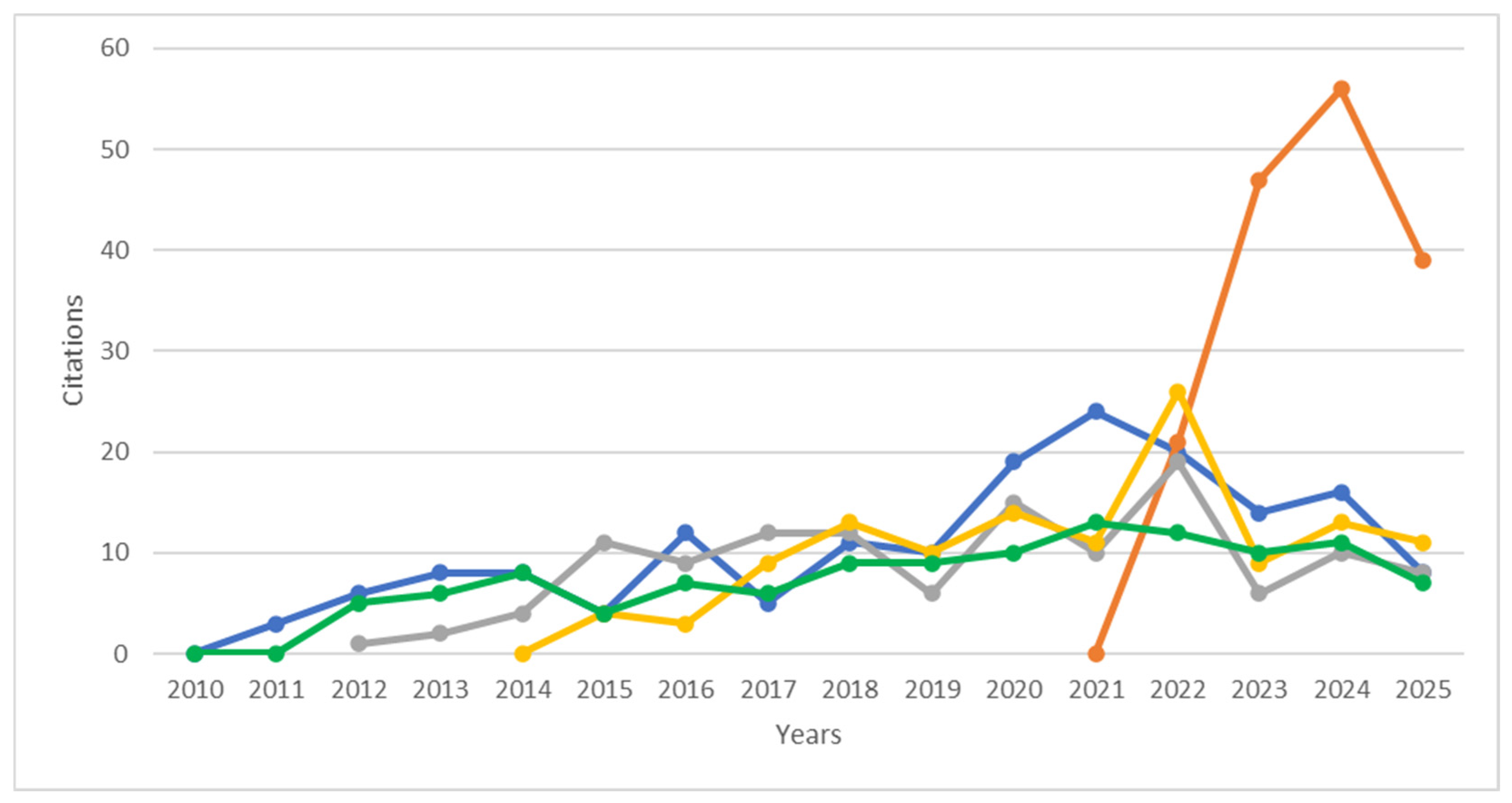
Citation analysis evaluates a scientific work’s impact based on the number of citations it receives, helping to identify the most influential works and understand a research field’s dynamics [51]. Table S1 presents the top ten most cited articles from the 167 documents analyzed. Figure 14 illustrates the year-by-year citation trend for the top five articles. Beginning in 2019, a simultaneous increase in citations is observed across all five publications. This trend suggests that the topics addressed in these works have become particularly central to the recent scientific literature, likely in response to a renewed interest in sustainable agricultural practices, climate change adaptation, and the exploration of ecological dynamics between biodiversity and soil fertility. With 168 total citations, the article “A staggered maize-legume intercrop arrangement robustly increases crop yields and economic returns in the highlands of Central Kenya” by Mucheru-Muna et al. (2010) [81], published in Field Crops Research, is the most cited publication among those analyzed. Its peak in annual citations occurred in 2024, with a total of 24. As previously described, the article discusses a non-traditional intercropping technique called MBILI, where maize and legumes are grown in a two-by-two staggered row arrangement to boost yield and efficiency compared to conventional systems. The second most-cited article is “Plant biodiversity and the regeneration of soil fertility” by Furey and Tilman (2021) [77], published in the Proceedings of the National Academy of Sciences of the United States of America (PNAS). In a relatively short period, the publication has accumulated 163 total citations, with its highest annual count of 56 recorded in 2024. This demonstrates its significant impact within the scientific community. Furthermore, its normalized citation score (TCY = 40.75) further attests to its relevance in the international academic literature. The third article, “Nitrogen fixation in annual and perennial legume-grass mixtures across a fertility gradient” by Schipanski and Drinkwater (2012) [76], published in Plant and Soil, has accumulated a total of 125 citations and a TCY of 9.62. This moderately high TCY for a study published more than 10 years ago indicates a consistent number of citations over time, suggesting stable scientific relevance and a lasting contribution to the literature. The year 2022 had the highest number of citations at 19, confirming it as the period of maximum visibility for the publication. For the study by Chapagain and Riseman [79], published in 2014 in Field Crops Research and titled “Barley-pea intercropping: Effects on land productivity, carbon and nitrogen transformations”, 2022 was also the year with the highest number of citations (26). Since its publication, the study has accumulated a total of 123 citations with a TCY of 11.18. With 117 total citations and a TCY of 7.8, the article “Impact of Gliricidia sepium intercropping on soil organic matter fractions in a maize-based cropping system” by Beedy et al. [82], published in 2010 in Agriculture, Ecosystems & Environment, ranks fifth among the most cited studies. The study analyzes the effects of intercropping maize with Gliricidia sepium on improving soil fertility, particularly concerning labile organic fractions, nutrient availability, and long-term agricultural productivity. As highlighted in Figure 14, the trend in annual citations mirrors that observed in the previously analyzed studies (e.g., Mucheru-Muna et al., 2010 [81]; Schipanski and Drinkwater, 2012 [76]), with an initial growth phase and a peak in 2021 with 13 citations, followed by a recent decline.

3.9. Limitations and Future Research

Despite the adopted approach providing a coherent overview of the literature on legume-based intercropping, several methodological limitations should be acknowledged. First, the bibliographic search was conducted exclusively in Scopus; although this is a comprehensive and well-established database, relying on a single source may have resulted in the omission of relevant contributions indexed elsewhere. In particular, integrating Web of Science could enable the identification of a larger number of authors, journals, and conference proceedings, thereby expanding disciplinary and geographical coverage and reducing the risk of a partial mapping of the field. In this respect, a multi-database strategy represents a natural step to further strengthen the completeness and robustness of the review. Second, restricting eligibility to English-language documents may have introduced language bias by excluding studies published in other languages (e.g., Italian, French, Spanish, or German) that may be especially pertinent to specific European agronomic contexts. In addition, the synthesis may be affected by potential citation bias, as highly cited studies tend to be more visible and therefore more likely to be identified and discussed, whereas recent, regional, or less-indexed works may be underrepresented regardless of their quality or applied relevance. Finally, as is common in query-based literature reviews, outcomes also depend on operational choices (such as search strings, keywords, inclusion/exclusion criteria, and study classification) which can influence the final boundaries of the analyzed corpus. To mitigate these limitations, future work could (i) adopt a multi-database design (Scopus plus Web of Science, and potentially additional sources), (ii) implement a broader language strategy (or at least targeted checks for key geographic areas), and (iii) apply screening procedures that reduce reliance on citation visibility (e.g., systematic screening by time period, region, or document type), thereby improving the overall representativeness of the evidence base.

4. Conclusions

Our analysis shows a rapidly increasing interest in legume–non-legume intercropping as a key strategy for improving soil fertility and supporting regenerative agriculture, with a marked acceleration in publications in recent years. Scientific output is globally distributed but dominated by China and India, followed by the United States and Canada, with leading European contributions from Denmark, Germany, and Spain. The core literature is concentrated in high-impact journals (most notably Agriculture, Ecosystems & Environment) and keyword patterns highlight strong links between intercropping, legumes, nitrogen dynamics, and soil-related outcomes. Overall, the available evidence indicates that legume-based intercropping can enhance crop productivity and yield stability, improve resource-use efficiency, reduce reliance on synthetic fertilizers, and strengthen agro-ecosystem resilience. However, its adoption remains uneven and, in many European contexts, is still limited, highlighting a substantial gap between agronomic potential and practical implementation. To bridge this gap, future research should prioritize long-term, multi-site field experiments capable of robustly quantifying the effects of intercropping on soil organic carbon (SOC), nitrogen dynamics, and crop performance under variable climatic conditions. It is also essential to develop standardized protocols for measuring agro-environmental indicators, including isotopic methods and comparable metrics across diverse cropping systems. At the applied level, particular attention should be given to site-specific optimization of intercropping systems, including cultivar selection, plant density, spatial arrangements, sowing windows, and crop residue management. Concurrently, integrated biophysical and economic analyses (such as Life Cycle Assessment (LCA) and whole-farm approaches) are needed to explicitly quantify the benefits, costs, and potential trade-offs associated with these systems. Finally, socio-economic and innovation studies are crucial to identify and overcome key operational and market barriers, including mechanization limitations, weed management challenges, legume product valorization, and farmers’ risk perception, with the ultimate aim of translating scientific insights into practically transferable solutions for real-world farming systems. At the level of agricultural policy, it becomes a priority to formally recognize intercropping within agroclimatic–environmental schemes, ensuring its inclusion among the practices incentivized at both the national and EU levels. To this end, it is necessary to support structured transition pathways through de-risking measures, specialized technical advisory services, and demonstration networks capable of disseminating best practices within the farming community. Another strategic element concerns the strengthening of value chains and market demand for legume crops, a prerequisite for making crop diversification economically attractive and promoting the broader adoption of intercropping. In this context, policy instruments should reward not only the formal adoption of the practice but also (where technically verifiable) the achievement of measurable outcomes in terms of reduced nitrogen inputs and improved soil health. Finally, the consolidation and advancement of the sector require coordinated international efforts based on the sharing of data, experimental protocols, and knowledge among research institutions and countries. Such cooperation represents a necessary condition to accelerate innovation, harmonize evaluation methodologies, and establish intercropping as a concrete, scalable, and scientifically grounded option for the sustainable management of agricultural soils in the face of increasing climate and food security challenges.

Supplementary Materials

The following supporting information can be downloaded at https://www.mdpi.com/article/10.3390/crops6020034/s1, Table S1: Most cited documents.

Author Contributions

C.M.: data curation, data analysis, data visualization, writing—original draft. N.T.: data curation, data collection, writing—original draft. S.A.: data collection. A.G.: data collection. T.T.: supervision, writing—review and editing. N.I.: conceptualization, methodology, data investigation, writing—review and editing, funding. All authors have read and agreed to the published version of the manuscript.

Funding

This work was funded by University of Palermo Funds—EUROSTART 2025 Call—research project: AI-Driven Nature-Based Water Solutions for Mediterranean Agro-ecosystems (WISEMED), PRJ-2196.

Data Availability Statement

The original contributions presented in this study are included in the article and Supplementary Material. Further inquiries can be directed to the corresponding author.

Conflicts of Interest

The authors declare no conflicts of interest.

References

  1. Hughes, C.; Ringelberg, J.J.; Bruneau, A. Legumes. Curr. Biol. 2025, 35, R323–R328. [Google Scholar] [CrossRef] [PubMed]
  2. FAOSTAT. Available online: https://www.fao.org/faostat/en/#data/QCL (accessed on 17 July 2025).
  3. Singh Sachan, D.; Siddiqui, M.; Singh, S. Global Perspective of Grain Legume Production, Trade and Policy Imperatives; NIPA: New Delhi, India, 2025; pp. 141–153. [Google Scholar]
  4. Nigam, S.N.; Chaudhari, S.; Deevi, K.C.; Saxena, K.B.; Janila, P. Trends in Legume Production and Future Outlook. In Genetic Enhancement in Major Food Legumes: Advances in Major Food Legumes; Springer: Berlin/Heidelberg, Germany, 2021; pp. 7–48. [Google Scholar]
  5. Mahieu, S. Assessment of the Below Ground Contribution of Field Grown Pea (Pisum sativum L.) to the Soil N Pool. Ph.D. Thesis, Université d’Angers, Angers, France, 2008. [Google Scholar]
  6. Gou, X.; Reich, P.B.; Qiu, L.; Shao, M.; Wei, G.; Wang, J.; Wei, X. Leguminous Plants Significantly Increase Soil Nitrogen Cycling across Global Climates and Ecosystem Types. Glob. Change Biol. 2023, 29, 4028–4043. [Google Scholar]
  7. Tang, X.; Bernard, L.; Brauman, A.; Daufresne, T.; Deleporte, P.; Desclaux, D.; Souche, G.; Placella, S.A.; Hinsinger, P. Increase in Microbial Biomass and Phosphorus Availability in the Rhizosphere of Intercropped Cereal and Legumes under Field Conditions. Soil Biol. Biochem. 2014, 75, 86–93. [Google Scholar] [CrossRef]
  8. Lassaletta, L.; Billen, G.; Grizzetti, B.; Anglade, J.; Garnier, J. 50 Year Trends in Nitrogen Use Efficiency of World Cropping Systems: The Relationship between Yield and Nitrogen Input to Cropland. Environ. Res. Lett. 2014, 9, 105011. [Google Scholar] [CrossRef]
  9. Beebe, S.E.; Rao, I.M.; Blair, M.W.; Acosta-Gallegos, J.A. Phenotyping Common Beans for Adaptation to Drought. Front. Physiol. 2013, 4, 35. [Google Scholar] [CrossRef]
  10. Chavas, J.-P.; Di Falco, S.; Adinolfi, F.; Capitanio, F. Weather Effects and Their Long-Term Impact on the Distribution of Agricultural Yields: Evidence from Italy. Eur. Rev. Agric. Econ. 2019, 46, 29–51. [Google Scholar] [CrossRef]
  11. Shah, A.; Nazari, M.; Antar, M.; Msimbira, L.A.; Naamala, J.; Lyu, D.; Rabileh, M.; Zajonc, J.; Smith, D.L. PGPR in Agriculture: A Sustainable Approach to Increasing Climate Change Resilience. Front. Sustain. Food Syst. 2021, 5, 667546. [Google Scholar] [CrossRef]
  12. Westhoek, A.; Clark, L.J.; Culbert, M.; Dalchau, N.; Griffiths, M.; Jorrin, B.; Karunakaran, R.; Ledermann, R.; Tkacz, A.; Webb, I. Conditional Sanctioning in a Legume–Rhizobium Mutualism. Proc. Natl. Acad. Sci. USA 2021, 118, e2025760118. [Google Scholar] [CrossRef]
  13. Sulieman, S.; Tran, L. Legume Nitrogen Fixation in a Changing Environment; Springer: Berlin/Heidelberg, Germany, 2016. [Google Scholar]
  14. Santachiara, G.; Salvagiotti, F.; Rotundo, J.L. Nutritional and Environmental Effects on Biological Nitrogen Fixation in Soybean: A Meta-Analysis. Field Crops Res. 2019, 240, 106–115. [Google Scholar] [CrossRef]
  15. Anglade, J.; Billen, G.; Garnier, J. Relationships for Estimating N2 Fixation in Legumes: Incidence for N Balance of Legume-based Cropping Systems in Europe. Ecosphere 2015, 6, 1–24. [Google Scholar] [CrossRef]
  16. Büchi, L.; Gebhard, C.-A.; Liebisch, F.; Sinaj, S.; Ramseier, H.; Charles, R. Accumulation of Biologically Fixed Nitrogen by Legumes Cultivated as Cover Crops in Switzerland. Plant Soil 2015, 393, 163–175. [Google Scholar] [CrossRef]
  17. Food and Agriculture Organization of the United Nations. Available online: https://www.fao.org/home/en (accessed on 14 July 2025).
  18. Clemente, A.; Olias, R. Beneficial Effects of Legumes in Gut Health. Curr. Opin. Food Sci. 2017, 14, 32–36. [Google Scholar] [CrossRef]
  19. Magalhães, S.C.Q.; Taveira, M.; Cabrita, A.R.J.; Fonseca, A.J.M.; Valentão, P.; Andrade, P.B. European Marketable Grain Legume Seeds: Further Insight into Phenolic Compounds Profiles. Food Chem. 2017, 215, 177–184. [Google Scholar] [CrossRef]
  20. Voisin, A.-S.; Guéguen, J.; Huyghe, C.; Jeuffroy, M.-H.; Magrini, M.-B.; Meynard, J.-M.; Mougel, C.; Pellerin, S.; Pelzer, E. Legumes for Feed, Food, Biomaterials and Bioenergy in Europe: A Review. Agron. Sustain. Dev. 2014, 34, 361–380. [Google Scholar] [CrossRef]
  21. Aguilera, Y.; Estrella, I.; Benitez, V.; Esteban, R.M.; Martín-Cabrejas, M.A. Bioactive Phenolic Compounds and Functional Properties of Dehydrated Bean Flours. Food Res. Int. 2011, 44, 774–780. [Google Scholar] [CrossRef]
  22. Poore, J.; Nemecek, T. Reducing Food’s Environmental Impacts through Producers and Consumers. Science 2018, 360, 987–992. [Google Scholar] [CrossRef] [PubMed]
  23. Calvin, K.; Dasgupta, D.; Krinner, G.; Mukherji, A.; Thorne, P.W.; Trisos, C.; Romero, J.; Aldunce, P.; Barret, K.; Blanco, G.; et al. IPCC, 2023: Climate Change 2023: Synthesis Report. Contribution of Working Groups I, II and III to the Sixth Assessment Report of the Intergovernmental Panel on Climate Change; Core Writing Team, Lee, H., Romero, J., Eds.; IPCC: Geneva, Switzerland, 2023; pp. 1–34. [Google Scholar]
  24. Santosh, D.T.; Debnath, S.; Maitra, S.; Sairam, M.; Sagar, L.L.; Hossain, A.; Moulick, D. Alleviation of Climate Catastrophe in Agriculture Through Adoption of Climate-Smart Technologies. In Climate Crisis: Adaptive Approaches and Sustainability; Chatterjee, U., Shaw, R., Kumar, S., Raj, A.D., Das, S., Eds.; Springer Nature: Cham, Switzerland, 2023; pp. 307–332. [Google Scholar]
  25. Nazir, M.J.; Li, G.; Nazir, M.M.; Zulfiqar, F.; Siddique, K.H.M.; Iqbal, B.; Du, D. Harnessing Soil Carbon Sequestration to Address Climate Change Challenges in Agriculture. Soil Tillage Res. 2024, 237, 105959. [Google Scholar] [CrossRef]
  26. Kabato, W.; Getnet, G.T.; Sinore, T.; Nemeth, A.; Molnár, Z. Towards Climate-Smart Agriculture: Strategies for Sustainable Agricultural Production, Food Security, and Greenhouse Gas Reduction. Agronomy 2025, 15, 565. [Google Scholar] [CrossRef]
  27. Kastner, R. Hope for the Future: How Farmers Can Reverse Climate Change. Soc. Democr. 2016, 30, 154–170. [Google Scholar] [CrossRef]
  28. Rhodes, C.J. The Imperative for Regenerative Agriculture. Sci. Prog. 2017, 100, 80–129. [Google Scholar] [CrossRef]
  29. Newton, P.; Civita, N.; Frankel-Goldwater, L.; Bartel, K.; Johns, C. What Is Regenerative Agriculture? A Review of Scholar and Practitioner Definitions Based on Processes and Outcomes. Front. Sustain. Food Syst. 2020, 4, 577723. [Google Scholar] [CrossRef]
  30. Cappelli, S.L.; Domeignoz-Horta, L.A.; Loaiza, V.; Laine, A.-L. Plant Biodiversity Promotes Sustainable Agriculture Directly and via Belowground Effects. Trends Plant Sci. 2022, 27, 674–687. [Google Scholar] [CrossRef]
  31. Hassen, A.; Talore, D.G.; Tesfamariam, E.H.; Friend, M.A.; Mpanza, T.D.E. Potential Use of Forage-Legume Intercropping Technologies to Adapt to Climate-Change Impacts on Mixed Crop-Livestock Systems in Africa: A Review. Reg. Environ. Change 2017, 17, 1713–1724. [Google Scholar] [CrossRef]
  32. Lessmann, M.; Ros, G.H.; Young, M.D.; de Vries, W. Global Variation in Soil Carbon Sequestration Potential through Improved Cropland Management. Glob. Change Biol. 2022, 28, 1162–1177. [Google Scholar] [CrossRef]
  33. Cotrufo, M.F.; Wallenstein, M.D.; Boot, C.M.; Denef, K.; Paul, E. The M Icrobial E fficiency-M Atrix S Tabilization (MEMS) Framework Integrates Plant Litter Decomposition with Soil Organic Matter Stabilization: Do Labile Plant Inputs Form Stable Soil Organic Matter? Glob. Change Biol. 2013, 19, 988–995. [Google Scholar] [CrossRef]
  34. Cuellar-Ortiz, S.M.; De La Paz Arrieta-Montiel, M.; Acosta-Gallegos, J.; Covarrubias, A.A. Relationship between Carbohydrate Partitioning and Drought Resistance in Common Bean. Plant Cell Environ. 2008, 31, 1399–1409. [Google Scholar] [CrossRef]
  35. Heckman, K.; Hicks Pries, C.E.; Lawrence, C.R.; Rasmussen, C.; Crow, S.E.; Hoyt, A.M.; von Fromm, S.F.; Shi, Z.; Stoner, S.; McGrath, C. Beyond Bulk: Density Fractions Explain Heterogeneity in Global Soil Carbon Abundance and Persistence. Glob. Change Biol. 2022, 28, 1178–1196. [Google Scholar] [CrossRef]
  36. Li, Y.; Li, Z.; Cui, S.; Liang, G.; Zhang, Q. Microbial-Derived Carbon Components Are Critical for Enhancing Soil Organic Carbon in No-Tillage Croplands: A Global Perspective. Soil Tillage Res. 2021, 205, 104758. [Google Scholar]
  37. Murphy-Bokern, D.; Peeters, A.; Westhoek, H. The Role of Legumes in Bringing Protein to the Table. In Legumes in Cropping Systems; CABI: Wallingford, UK, 2017; pp. 18–36. [Google Scholar]
  38. Scherr, S.J.; McNeely, J.A. Biodiversity Conservation and Agricultural Sustainability: Towards a New Paradigm of ‘Ecoagriculture’ Landscapes. Philos. Trans. R. Soc. B 2008, 363, 477–494. [Google Scholar] [CrossRef]
  39. Yu, Y.; Stomph, T.-J.; Makowski, D.; van Der Werf, W. Temporal Niche Differentiation Increases the Land Equivalent Ratio of Annual Intercrops: A Meta-Analysis. Field Crops Res. 2015, 184, 133–144. [Google Scholar] [CrossRef]
  40. Maitra, S.; Sahoo, U.; Sairam, M.; Gitari, H.I.; Rezaei-Chiyaneh, E.; Battaglia, M.L.; Hossain5, A. Cultivating Sustainability: A Comprehensive Review on Intercropping in a Changing Climate. Res. Crop 2023, 24, 702–715. [Google Scholar] [CrossRef]
  41. Palai, J.B.; Jena, J.; Maitra, S. Prospects of Underutilized Food Legumes in Sustaining Pulse Needs in India—A Review. Crop Res. 2019, 54, 82–88. [Google Scholar]
  42. Islam, M.A.; Sarkar, D.; Alam, M.R.; Jahangir, M.M.R.; Ali, M.O.; Sarker, D.; Hossain, M.F.; Sarker, A.; Gaber, A.; Maitra, S. Legumes in Conservation Agriculture: A Sustainable Approach in Rice-Based Ecology of the Eastern Indo-Gangetic Plain of South Asia—An Overview. Technol. Agron. 2023, 3, 3. [Google Scholar]
  43. Duchene, O.; Vian, J.-F.; Celette, F. Intercropping with Legume for Agroecological Cropping Systems: Complementarity and Facilitation Processes and the Importance of Soil Microorganisms. A Review. Agric. Ecosyst. Environ. 2017, 240, 148–161. [Google Scholar] [CrossRef]
  44. Hu, A.; Huang, D.; Duan, Q.; Zhou, Y.; Liu, G.; Huan, H. Cover Legumes Promote the Growth of Young Rubber Trees by Increasing Organic Carbon and Organic Nitrogen Content in the Soil. Ind. Crops Prod. 2023, 197, 116640. [Google Scholar] [CrossRef]
  45. Duan, C.; Yu, C.; Shi, P.; Huangqing, D.; Zhang, X.; Dai, E. Assessing Trade-Offs among Productive, Economic, and Environmental Indicators of Forage Systems in Southern Tibetan Crop-Livestock Integration. Sci. Total Environ. 2023, 876, 162641. [Google Scholar] [CrossRef]
  46. Passas, I. Bibliometric Analysis: The Main Steps. Encyclopedia 2024, 4, 1014–1025. [Google Scholar] [CrossRef]
  47. Fahimnia, B.; Sarkis, J.; Davarzani, H. Green Supply Chain Management: A Review and Bibliometric Analysis. Int. J. Prod. Econ. 2015, 162, 101–114. [Google Scholar] [CrossRef]
  48. Chen, K.; Zhai, X.; Wang, S.; Li, X.; Lu, Z.; Xia, D.; Li, M. Emerging Trends and Research Foci of Deep Learning in Spine: Bibliometric and Visualization Study. Neurosurg. Rev. 2023, 46, 81. [Google Scholar] [CrossRef]
  49. Rousseau, R. Forgotten Founder of Bibliometrics. Nature 2014, 510, 218. [Google Scholar] [CrossRef]
  50. Pritchard, A. Statistical Bibliography or Bibliometrics. J. Doc. 1969, 25, 348. [Google Scholar]
  51. Donthu, N.; Kumar, S.; Mukherjee, D.; Pandey, N.; Lim, W.M. How to Conduct a Bibliometric Analysis: An Overview and Guidelines. J. Bus. Res. 2021, 133, 285–296. [Google Scholar] [CrossRef]
  52. Kraus, S.; Breier, M.; Lim, W.M.; Dabić, M.; Kumar, S.; Kanbach, D.; Mukherjee, D.; Corvello, V.; Piñeiro-Chousa, J.; Liguori, E. Literature Reviews as Independent Studies: Guidelines for Academic Practice. Rev. Manag. Sci. 2022, 16, 2577–2595. [Google Scholar] [CrossRef]
  53. Rivera, M.A.; Pizam, A. Advances in Hospitality Research: “From Rodney Dangerfield to Aretha Franklin”. Int. J. Contemp. Hosp. Manag. 2015, 27, 362–378. [Google Scholar] [CrossRef]
  54. Durieux, V.; Gevenois, P.A. Bibliometric Indicators: Quality Measurements of Scientific Publication. Radiology 2010, 255, 342–351. [Google Scholar] [CrossRef] [PubMed]
  55. Page, M.J.; McKenzie, J.E.; Bossuyt, P.M.; Boutron, I.; Hoffmann, T.C.; Mulrow, C.D.; Shamseer, L.; Tetzlaff, J.M.; Akl, E.A.; Brennan, S.E.; et al. The PRISMA 2020 Statement: An Updated Guideline for Reporting Systematic Reviews. BMJ 2021, 372, n71. [Google Scholar] [CrossRef]
  56. Wang, W.; Li, M.-Y.; Wang, Y.; Li, J.-M.; Zhang, W.; Wen, Q.-H.; Huang, S.-J.; Chen, G.-R.; Zhu, S.-G.; Wang, J.; et al. Legume Intercropping Improves Soil Organic Carbon Stability in Drylands: A 7-Year Experimental Validation. Agric. Ecosyst. Environ. 2025, 381, 109456. [Google Scholar] [CrossRef]
  57. Villwock, D.; Hartung, J.; Weinläder, H.; Müller-Lindenlauf, M. Maize–Bean Intercropping: N Fertilization Effects on Yield, Nitrate Leaching and N Fixation. Agrosyst. Geosci. Environ. 2025, 8, e70071. [Google Scholar] [CrossRef]
  58. Van Eck, N.J.; Waltman, L. Software Survey: VOSviewer, a Computer Program for Bibliometric Mapping. Scientometrics 2010, 84, 523–538. [Google Scholar] [CrossRef]
  59. Van Raan, A.F. Advances in Bibliometric Analysis: Research Performance Assessment and Science Mapping. In Bibliometrics Use and Abuse in the Review of Research Performance; Portlan Press: London, UK, 2014; Volume 87, pp. 17–28. [Google Scholar]
  60. Gichuru, M.P. Residual Effects of Natural Bush, Cajanus cajan and Tephrosia candida on the Productivity of an Acid Soil in Southeastern Nigeria. Plant Soil 1991, 134, 31–36. [Google Scholar] [CrossRef]
  61. Journal Citation Reports—Home. Available online: https://jcr.clarivate.com/jcr/home (accessed on 5 August 2025).
  62. Garfield, E. The History and Meaning of the Journal Impact Factor. JAMA 2006, 295, 90. [Google Scholar] [CrossRef]
  63. Scimago Journal & Country Rank. Available online: https://www.scimagojr.com/ (accessed on 5 August 2025).
  64. Liang, J.; He, Z.; Shi, W. Cotton/Mung Bean Intercropping Improves Crop Productivity, Water Use Efficiency, Nitrogen Uptake, and Economic Benefits in the Arid Area of Northwest China. Agric. Water Manag. 2020, 240, 106277. [Google Scholar] [CrossRef]
  65. Regehr, A.; Oelbermann, M.; Videla, C.; Echarte, L. Gross Nitrogen Mineralization and Immobilization in Temperate Maize-Soybean Intercrops. Plant Soil 2015, 391, 353–365. [Google Scholar] [CrossRef]
  66. Wang, X.; Chen, Y.; Yang, K.; Duan, F.; Liu, P.; Wang, Z.; Wang, J. Effects of Legume Intercropping and Nitrogen Input on Net Greenhouse Gas Balances, Intensity, Carbon Footprint and Crop Productivity in Sweet Maize Cropland in South China. J. Clean. Prod. 2021, 314, 127997. [Google Scholar] [CrossRef]
  67. Cuartero, J.; Pascual, J.A.; Vivo, J.-M.; Özbolat, O.; Sánchez-Navarro, V.; Egea-Cortines, M.; Zornoza, R.; Mena, M.M.; Garcia, E.; Ros, M. A First-Year Melon/Cowpea Intercropping System Improves Soil Nutrients and Changes the Soil Microbial Community. Agric. Ecosyst. Environ. 2022, 328, 107856. [Google Scholar] [CrossRef]
  68. Scalise, A.; Tortorella, D.; Pristeri, A.; Petrovičová, B.; Gelsomino, A.; Lindström, K.; Monti, M. Legume-Barley Intercropping Stimulates Soil N Supply and Crop Yield in the Succeeding Durum Wheat in a Rotation under Rainfed Conditions. Soil Biol. Biochem. 2015, 89, 150–161. [Google Scholar] [CrossRef]
  69. Zhou, Q.; Chen, J.; Xing, Y.; Xie, X.; Wang, L. Influence of Intercropping Chinese Milk Vetch on the Soil Microbial Community in Rhizosphere of Rape. Plant Soil 2019, 440, 85–96. [Google Scholar] [CrossRef]
  70. Hauggaard-Nielsen, H.; Lachouani, P.; Knudsen, M.T.; Ambus, P.; Boelt, B.; Gislum, R. Productivity and Carbon Footprint of Perennial Grass-Forage Legume Intercropping Strategies with High or Low Nitrogen Fertilizer Input. Sci. Total Environ. 2016, 541, 1339–1347. [Google Scholar] [CrossRef]
  71. Kremer, R.J.; Kussman, R.D. Soil Quality in a Pecan-Kura Clover Alley Cropping System in the Midwestern USA. Agrofor. Syst. 2011, 83, 213–223. [Google Scholar] [CrossRef]
  72. Ghosh, P.K.; Manna, M.C.; Bandyopadhyay, K.K.; Tripathi, A.K.; Wanjari, R.H.; Hati, K.M.; Misra, A.K.; Acharya, C.L.; Subba Rao, A. Interspecific Interaction and Nutrient Use in Soybean/Sorghum Intercropping System. Agron. J. 2006, 98, 1097–1108. [Google Scholar] [CrossRef]
  73. Lithourgidis, A.S.; Dordas, C.A. Forage Yield, Growth Rate, and Nitrogen Uptake of Faba Bean Intercrops with Wheat, Barley, and Rye in Three Seeding Ratios. Crop Sci. 2010, 50, 2148–2158. [Google Scholar] [CrossRef]
  74. Thorsted, M.D.; Weiner, J.; Olesen, J.E. Above- and below-Ground Competition between Intercropped Winter Wheat Triticum aestivum and White Clover Trifolium repens. J. Appl. Ecol. 2006, 43, 237–245. [Google Scholar] [CrossRef]
  75. Sharma, A.R.; Behera, U.K. Recycling of Legume Residues for Nitrogen Economy and Higher Productivity in Maize (Zea mays)-Wheat (Triticum aestivum) Cropping System. Nutr. Cycl. Agroecosyst. 2009, 83, 197–210. [Google Scholar] [CrossRef]
  76. Schipanski, M.E.; Drinkwater, L.E. Nitrogen Fixation in Annual and Perennial Legume-Grass Mixtures across a Fertility Gradient. Plant Soil 2012, 357, 147–159. [Google Scholar] [CrossRef]
  77. Furey, G.N.; Tilman, D. Plant Biodiversity and the Regeneration of Soil Fertility. Proc. Natl. Acad. Sci. USA 2021, 118, e2111321118. [Google Scholar] [CrossRef]
  78. Liao, H.; Li, Y.; Yao, H. Biochar Amendment Stimulates Utilization of Plant-Derived Carbon by Soil Bacteria in an Intercropping System. Front. Microbiol. 2019, 10, 1361. [Google Scholar] [CrossRef] [PubMed]
  79. Chapagain, T.; Riseman, A. Barley-Pea Intercropping: Effects on Land Productivity, Carbon and Nitrogen Transformations. Field Crops Res. 2014, 166, 18–25. [Google Scholar] [CrossRef]
  80. Chapagain, T.; Riseman, A. Nitrogen and Carbon Transformations, Water Use Efficiency and Ecosystem Productivity in Monocultures and Wheat-Bean Intercropping Systems. Nutr. Cycl. Agroecosyst. 2015, 101, 107–121. [Google Scholar] [CrossRef]
  81. Mucheru-Muna, M.; Pypers, P.; Mugendi, D.; Kung’u, J.; Mugwe, J.; Merckx, R.; Vanlauwe, B. A Staggered Maize-Legume Intercrop Arrangement Robustly Increases Crop Yields and Economic Returns in the Highlands of Central Kenya. Field Crops Res. 2010, 115, 132–139. [Google Scholar] [CrossRef]
  82. Beedy, T.L.; Snapp, S.S.; Akinnifesi, F.K.; Sileshi, G.W. Impact of Gliricidia Sepium Intercropping on Soil Organic Matter Fractions in a Maize-Based Cropping System. Agric. Ecosyst. Environ. 2010, 138, 139–146. [Google Scholar] [CrossRef]
Figure 1. PRISMA flow diagram of the literature screening and inclusion process for studies on legume–non-legume intercropping (1986–2025).
Crops 06 00034 g001
Figure 2. Annual trend in publications on legume–non-legume intercropping (1991–2025).
Crops 06 00034 g002
Figure 3. Spatial distribution map of scientific production on legume and non-legume intercropping 1991 to 2025.
Crops 06 00034 g003
Figure 4. Top ten countries with the highest scientific production.
Crops 06 00034 g004
Figure 5. Co-authorship networks of countries (≥5 documents; 12 countries; 4 clusters; 24 links): 1st cluster: red; 2nd cluster: green; 3rd cluster: blue; 4th cluster: yellow.
Crops 06 00034 g005
Figure 6. Author co-authorship network visualization map (threshold: ≥3 documents; 37 authors identified): 1st cluster: red; 2nd cluster: green; 3rd cluster: blue; 4th cluster: yellow; 5th cluster: purple; 6th cluster: light blue; 7th cluster: orange; 8th cluster: brown; 9th cluster: pink; 10th cluster: salmon pink; 11th cluster: light green.
Crops 06 00034 g006
Figure 7. Author collaboration network over time (2018–2024), with colors ranging from earlier (cool; 2018–2020) to more recent collaborations (warm; 2021–2024).
Crops 06 00034 g007
Figure 8. Scopus subject area distribution of publications on legume–non-legume intercropping (9 of 16 areas shown; >5 publications).
Crops 06 00034 g008
Figure 9. Annual publication trend of the top five journals in the dataset (1991–2025).
Crops 06 00034 g009
Figure 10. Trend analysis and co-occurrence network of keywords in the analyzed literature, including terms with ≥10 occurrences: 1st cluster: red; 2nd cluster: green; 3rd cluster: blue.
Crops 06 00034 g010
Figure 11. Bibliographic coupling map of the selected countries (threshold: ≥5 articles; 12 selected): 1st cluster: red; 2nd cluster: green; 3rd cluster: blue; 4th cluster: yellow.
Crops 06 00034 g011
Figure 12. Bibliographic coupling map of the selected journals (threshold: ≥5 articles; 8 selected): 1st cluster: red; 2nd cluster: green.
Crops 06 00034 g012
Figure 13. Bibliographic coupling map of the 18 interconnected high-citation documents (threshold: ≥50 citations; 20 selected): 1st cluster: red [64,65,66,67]; 2nd cluster: green [68,69,70,71]; 3rd cluster: blue [72,73,74,75]; 4th cluster: yellow [76,77,78]; 5th cluster: purple [79,80,81].
Crops 06 00034 g013
Figure 14. Annual citation trend of the five most-cited articles in the dataset (2010–2025): blue: Mucheru-Muna et al. (2010) [81]; orange: Furey and Tilman (2021) [77]; gray: Schipanski and Drinkwater (2012) [76]; yellow: Chapagain and Riseman (2014) [79]; green: Beedy et al. (2010) [82].
Crops 06 00034 g014
Table 1. Main universities/research institutes and their editorial production.
AffiliationCountryRecords
Chinese Academy of SciencesChina13
University of Chinese Academy of SciencesChina11
Ministry of Agriculture of the People’s Republic of ChinaChina10
Aarhus UniversitetDenmark7
Chinese Academy of Agricultural SciencesChina6
University of WaterlooCanada5
Lanzhou UniversityChina5
Consejo Nacional de Investigaciones Científicas y TécnicasArgentina4
Instituto Nacional de Tecnología Agropecuaria Buenos AiresArgentina4
China Agricultural UniversityChina4
Xi’an University of TechnologyChina4
Kenyatta UniversityKenya4
Universidade Federal Rural de PernambucoBrasil3
CSIC–Centro de Edafología y Biología Aplicada del Segura CEBASSpain3
Consejo Superior de Investigaciones CientíficasSpain3
Table 2. Number of publications and citation metrics of the most influential authors. The affiliation of author was retrieved from Scopus database through “author search”.
Authorsh-Indexg-Indexm-IndexTCNPIAPeriodAffiliationCountry
Oelbermann M.22360.8514797552000–2025University of WaterlooCanada
Echarte L.25460.9625074642000–2025Instituto Nacional de Tecnología Agropecuaria Buenos AiresArgentina
Shi W.14310.5410726442000–2025Xi’an University of TechnologyChina
Bruns C.17220.778532232004–2025Universität KasselGermany
Chapagain T.13160.818601632010–2025Ministry of Agriculture, Food and Rural AffairsCanada
Fracetto F.J.C.13190.814354532010–2025Universidade Federal Rural de PernambucoBrasil
Fracetto G.G.M.15211.075464632012–2025Universidade Federal Rural de PernambucoBrasil
Jalloh A.A.672.0066932022–2024International Centre of Insect Physiology and Ecology NairobiKenya
Jing B.581791932020–2025Xi’an University of TechnologyChina
Joergensen R.G.611302.0319,10330431996–2025Universität KasselGermany
TC: total citation; NP: number of publications; IA: included in the analysis.
Table 3. Ten most frequent author keywords derived from the keyword co-occurrence analysis of the Scopus-based corpus.
KeywordsOccurrences (n)Total Link Strength
intercropping98698
legume68526
nitrogen51466
maize29278
soil fertility29187
crop yield28210
soil27307
crop production26232
biomass24191
microbial community23234
Table 4. Journal ranking based on bibliographic coupling, citations, and total link strength.
JournalDocumentsCitationsTotal Link Strength
Agriculture, Ecosystems and Environment12416268
Plant and Soil10316183
Field Crops Research7395141
Science of the Total Environment714091
Agronomy73451
Scientific Reports680131
Journal of the Science of Food and Agriculture648135
European Journal of Agronomy577146
Disclaimer/Publisher’s Note: The statements, opinions and data contained in all publications are solely those of the individual author(s) and contributor(s) and not of MDPI and/or the editor(s). MDPI and/or the editor(s) disclaim responsibility for any injury to people or property resulting from any ideas, methods, instructions or products referred to in the content.