Article

Impact of Rainfall on Driving Speed: Combining Radar-Based Measurements and Floating Car Data

1
Institute of Meteorology, Freie Universität Berlin, Carl-Heinrich-Becker-Weg 6-10, 12165 Berlin, Germany
2
Hans-Ertel-Centre for Weather Research, 12165 Berlin, Germany
*
Author to whom correspondence should be addressed.
Future Transp. 2026, 6(1), 38; https://doi.org/10.3390/futuretransp6010038
Submission received: 2 December 2025 / Revised: 28 January 2026 / Accepted: 1 February 2026 / Published: 3 February 2026

Abstract

It is known that rainfall leads to a reduction in driving speed. However, the results of various studies are inconsistent regarding the amount of speed reduction. In this study, we combine high-resolution radar-based rainfall estimates for three days with heavy rainfall with driving speeds derived from floating car data on 1.5 million road sections in Germany. Using linear regression models, we investigate the functional relationship between rainfall and driving speeds depending on road section characteristics like speed limit and number of lanes. We find that the speed reduction due to rainfall is higher at road section with higher speed limits and on multi-lane roads. On highway road section with speed limits of 130 km/h, for example, heavy rainfall of more than 8 L/m2 in five minutes leads to an average speed reduction of more than 30%, although estimates at very high rainfall intensities are subject to increased uncertainty due to data sparsity. Cross-validation shows that including rainfall as a predictor for driving speed reduces mean squared errors by up 14% in general and up to 50% in heavy rainfall conditions. Furthermore, rainfall as a continuous variable should be preferred over categorical variables for a parsimonious model. Our results demonstrate that parsimonious, interpretable models combining radar rainfall data with floating car data can capture systematic rainfall-related speed reductions across a wide range of road types. However, the analysis should be interpreted strictly as a descriptive, event-specific study. It does not support generalizable inference across time, seasons, or broader traffic conditions. To make this approach suitable for operational applications such as real-time speed prediction, route planning, and traffic management, larger multi-event datasets and the consideration of effects like weekday structure and diurnal demand patterns are required to better constrain effects under heavy rainfall conditions.

1. Introduction

Road traffic is an essential part of the transport system and despite all efforts to move towards more sustainable solutions, the number of private and commercial vehicles continues to increase. In Germany, for example, a record high of 580 cars per 1000 inhabitants was reached in 2022 [1]. Enhanced efforts to build up an intelligent transport system (ITS) could help handling the increasing demands on the road network [2]. An ITS with interconnected infrastructure, vehicles and users can be useful to manage and control traffic, helping to direct traffic flow and prevent congestion and road accidents. Furthermore, sensor networks formed by connected vehicles can deliver data to understand influencing factors on driving behavior and help in making informed decisions regarding traffic management. One particularly important factor is weather, which can significantly influence how drivers behave on the road.
Precipitation, including different forms like rain, hail, sleet or snow, is one of the most influential weather phenomena affecting road traffic, consistently leading to reductions in driving speed. Stamos et al. [3] summarized the effects of rainfall on driving speed in a review of 24 studies. The majority of these studies showed that rainfall leads to a reduction of driving speed, with the reduction being larger at higher rainfall intensities. However, there is large variability between the amounts of reduction. While most studies indicate reductions of between 0 and 10%, others show reductions of up to 35% in the case of extreme rainfall [4]. A logarithmic regression function was found to be most suitable to describe the relationship between rainfall and driving speed [5].
Previous research has often focused on studying rainfall effects on driving speed at selected locations or road sections, where long-term station-based speed measurements are available [6,7,8,9,10,11]. A common station-based approach to measure driving speed is using inductive loops [12]. This allows assessment of the local driving characteristics for all vehicles passing a certain location. The identification and tracking of vehicles by camera-based traffic information systems allows for computation of average driving speeds for specific road sections [13]. Such long-term measurements allow for robust statistics for the selected road sections. However, it often remains unclear to what extent the results are transferable to other road sections with different characteristics.
In recent years, novel data sources have become available, which open up new opportunities for analyses of driving speed. Navigation systems are now available in many vehicles, either as on-board devices or via smartphone apps. High-resolution information about the location of vehicles, obtained through global navigation satellite systems (GNSS), can be converted into driving speeds. This makes it possible to obtain speed information independently of station-based observations. Such information, also referred to as floating car data, has been successfully used to study the effect of rainfall on driving speeds [3,14,15]. Although the driving speeds estimated from floating car data are only based on a subsample of all vehicles, it does allow for an assessment of driving speeds on various roads throughout the study area.
Linking rainfall to speed data at a high spatial and temporal resolution within a large area requires appropriate rainfall measurements. Many studies use rain gauge measurements [10,16,17]. Rain gauges measure the amount of rainfall at a specific location with a high accuracy, but they are sparsely distributed in space, and measurements may not be representative for a larger area. In particular, in case of heavy rainfall, the spatial distribution of rainfall is very heterogeneous, and extreme rainfall is often not captured by rain gauges [18]. Therefore, the traffic observations and weather station need to be close enough to ensure representative measurement of rainfall [8]. Other studies use qualitative information on road surface conditions, indicating dry or wet conditions [6], or infer rainfall from wiper settings [19]. Such information is not always readily available and provides only rough estimates of rainfall intensity.
Precipitation radar, on the other hand, has the advantage of large coverage with high spatial resolution. Using radar data to estimate the effect of rainfall on driving speed has been applied by a few studies only [13,20,21,22]. While radar data has the benefit of a large spatial coverage, it has a lower accuracy of rainfall amount compared to gauge data. Some studies use data products based on an atmospheric model with assimilated radar information to assess the impact of rainfall on driving speeds [23,24]. However, such data is often only available at hourly resolution, limiting their suitability for short-term traffic analyses.
For Germany, a calibrated precipitation dataset is available that combines radar and station observations to provide precipitation estimates at a spatial resolution of 1 km and a temporal resolution of 5 min [25]. This dataset offers a unique opportunity to investigate rainfall–speed relationships at high resolution across a large and heterogeneous road network. However, it should be noted that this dataset does not allow for a direct distinction between different types of precipitation.
The aim of this paper is to combine GNSS-based floating car data with such calibrated radar-based measurements for three individual summer days with heavy rainfall to estimate the effect of rainfall on driving speed for the area of Germany. Using regression models allows us to compare the functional relationship between rainfall and driving speed for road sections with different characteristics like speed limits or the number of lanes. Cross-validation is employed to assess predictive performance and to compare models using categorical versus continuous representations of rainfall. This study seeks to provide a first step toward country-scale, rainfall-aware speed modeling that can inform future developments in traffic prediction and management. However, in the presented form, the analysis should be interpreted strictly as a descriptive, event-specific study. To support generalizable inference across time, seasons, or broader traffic conditions, larger multi-event datasets and the consideration of effects like weekday structure and diurnal demand patterns are required.

2. Materials and Methods

2.1. Driving Speed

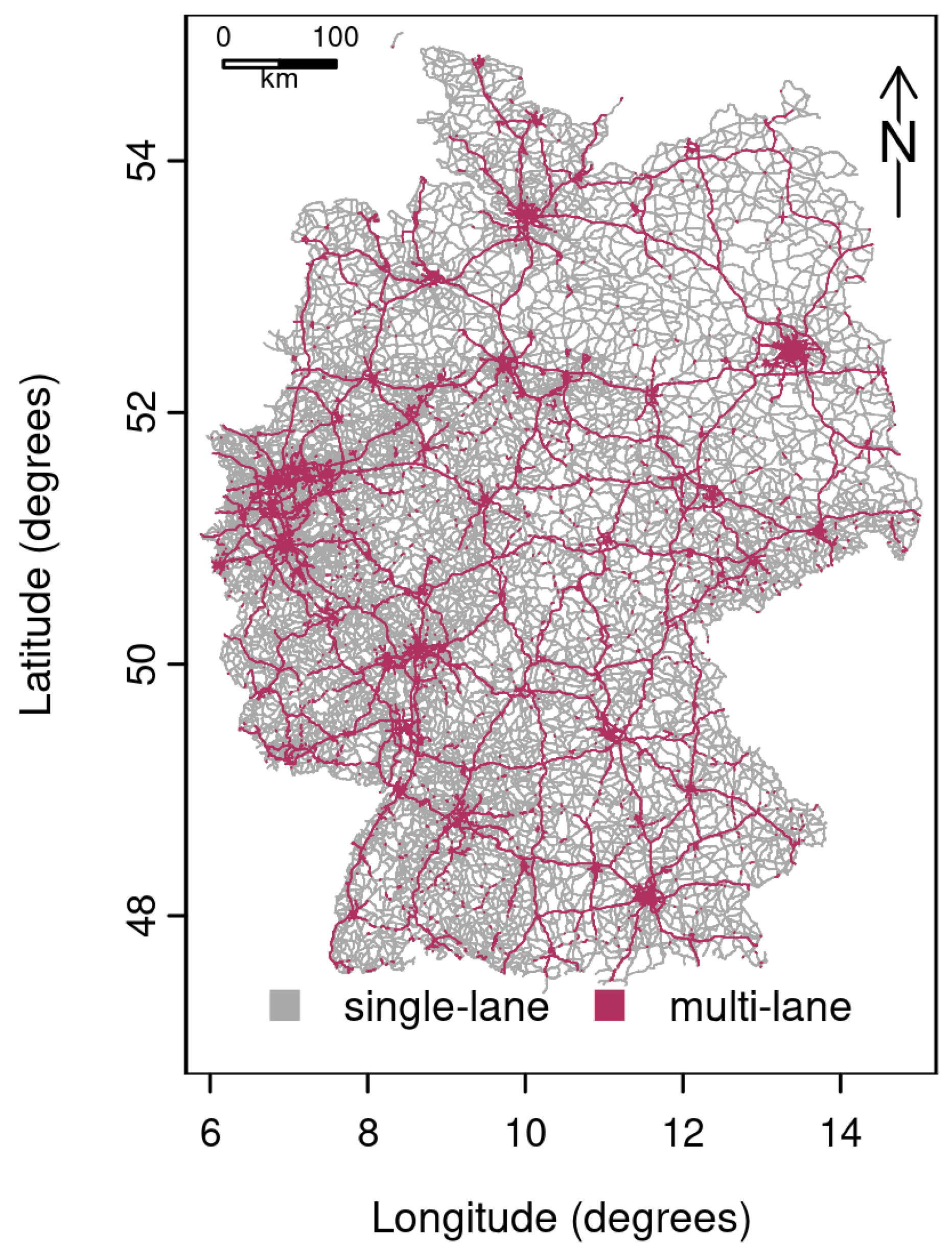
For the analysis, speed data based on GNSS probe data was provided by HERE Europe B.V. The data contains 5 min average driving speed v at about 1.5 mio road sections in Germany (Figure 1). The average speed is computed based on all vehicles contributing a measurement within a 5 min interval. The road sections in the dataset include primary, secondary and tertiary roads. Different road section characteristics are available, including the local speed limit, free-flow velocity, number of lanes, and an indicator for an urban road environment. Speed data is analyzed for three days with strong rainfall (Mon 20 May, Mon 3 June and Wed 12 June 2019). There were also periods and regions without rainfall present on each of the days.

2.2. Radar Data

The radar-based precipitation product RADKLIM (Radarbasierte Niederschlagsklimatologie) [25,26] is used to assign rainfall amounts to the driving speed observations of each road section. RADKLIM provides 5 min precipitation sums on a grid with a spatial resolution of 1 × 1 km for the area of Germany. RADKLIM combines radar reflectivities, measured by the 16 C-band Doppler radars of the German weather radar network, and ground-based gauge measurements. Since the exact amount of precipitation on the ground cannot be directly inferred from radar reflectivity, observations from rain gauges are used to calibrate the amounts of precipitation estimated from radar reflectivity. Furthermore, a statistical clutter filtering is applied, and shadowing effects are corrected. The RADKLIM dataset thus combines the benefits of high spatial resolution of the radar network and the accuracy of gauge-based measurements.
The RADKLIM product does not distinguish between different types of precipitation. However, the analyzed events occurred during the summer season and are therefore dominated by rainfall. Therefore, we use the term rainfall for the following analyses, although it should be noted that the radar-based precipitation estimates may, in a limited area, also include contributions from other precipitation types such as hail.

2.3. Data Preparation

For the analysis, we distinguish three different road section characteristics: the speed limit (50, 70, 100 and 130 km/h), the lane category (single- and multi-lane roads), and the road environment (urban and non-urban). Of these road sections, we exclude those containing tunnels, ramps and intersections. Additionally, road section with signs for persistent traffic congestion are excluded. Since no direct measurements of traffic congestion are available, we classify a road section as congested if, in more than 10% of the observed time steps, the driving speed falls below 50% of the local speed limit (see Appendix A for a sensitivity analysis of these thresholds). Furthermore, some road sections show unusually high observed speeds (more than twice the local speed limit). These sections are also excluded, because it is possible that the speed limit information is not valid.
With an average length of around 100 m, the large majority of road sections is significantly shorter than the 1 km grid size of the RADKLIM data. Each road section is assigned the 1 km RADKLIM grid cell in which it is located. Then, the 5 min rainfall amounts are assigned to the corresponding driving speed observations. This implicitly assumes a uniform distribution of rainfall within each grid cell.
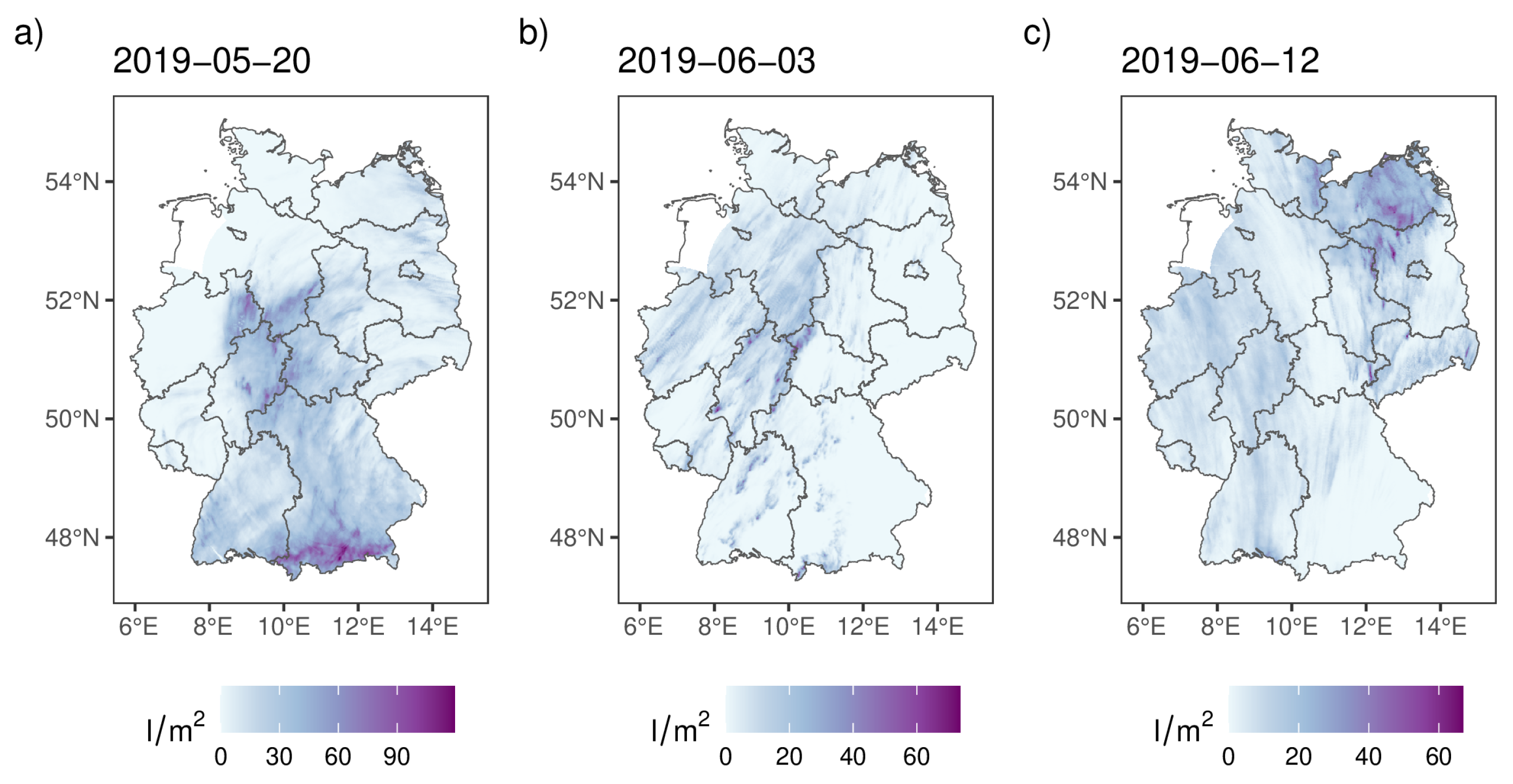
To asses the impact of 5 min rainfall amounts on driving speed, three days with heavy rainfall in different parts of Germany were selected. Maps of the 24 h rainfall amounts show that rainfall occurred in different parts of Germany on the three selected days (Figure 2). The event with the highest rainfall amounts (20 May 2019) lead to 24 h rainfall amounts of more than 30 L/m2 in 15% of the area, affecting large parts of Central and Southern Germany. The 24 h rainfall amount of the two other cases stayed below 30 L/m2. On all three days, more than 3% (18,000) of the RADKLIM grid cells contained time steps with heavy short-term rainfall, during which the 5 min rainfall exceeded 5 L/m2 in different parts of the country).

2.4. Regression Models

Regression models are developed to describe the effect of rainfall on the average driving speed v, which is the average driving speed of all vehicles contributing a measurement within a 5 min interval at a particular road section.
For v, three different linear regression models are developed, respectively. We describe v as a Gaussian random variable with expectation μ and variance σ 2 : V N ( μ , σ 2 ) . First, a NULL model μ = β 0 is developed with an intercept only, predicting simply the average driving speed and serving as a reference model; second, a categorical model CAT with μ = β 0 + k = 2 K β k δ k , where the expectation μ depends on rainfall as a categorical variable, K is the number of rainfall categories, and δ k is 1 if the rainfall is in category k and 0 otherwise; third, a model LOG with μ = β 0 + β 1 ln ( 1 + R ) , where rainfall R is included as a continuous variable transformed with the natural logarithm. R is taken from the RADKLIM grid point closest to the center of the particular road section.
The NULL model is fitted to all time steps, including time steps with and without rainfall. Thus, the NULL model represents a reference condition, where no weather information is available. CAT and LOG models are only fitted to time steps with rainfall larger than 0 L/m2.
The relative speed difference Δ v r e l = ( v v 0 ¯ ) / v 0 , where v 0 ¯ denotes the average driving speed across all 5 min time steps without rainfall, is used to normalize speed changes across different types of road sections. This relative measure facilitates comparisons of rainfall impacts across roads with different speed limits and typical operating speeds. At the same time, it should be noted that similar relative speed reductions may correspond to substantially different absolute speed changes depending on the road context. For example, a given relative reduction on a high-speed motorway translates into a larger absolute decrease in speed than the same relative reduction on an urban road, potentially implying different traffic and safety-relevant conditions. Accordingly, the use of Δ v rel is intended to support comparability across road types, while absolute speed levels remain important for the interpretation of the results.
Regression models were estimated by ordinary least squares. Conventional standard errors assume independent and homoskedastic disturbances, an assumption that may be violated when multiple observations belong to the same road section. To account for potential within-section correlation, we additionally report standard errors clustered at the road-section level [27]. This approach allows for arbitrary dependence of errors within road sections while preserving independence across sections, providing more reliable inference for grouped data.

2.5. Assessing Model Performance

The mean squared error
MSE = 1 n i = 1 n ( f i o i ) 2 ,
is a common metric to evaluate model performance by comparing the values predicted by the model f i to the observed values o i . The squared difference leads to a strong penalization of predictions with larger errors.
A skill score is a relative measure of how a model performs compared to a reference model [28]. The mean squared error skill score
MSESS = 1 MSE f MSE r ,
compares the score of the model under evaluation, MSE f to the score of the reference model MSE r . Positive values of the MSESS indicate an improvement compared to the reference model. Here, we use the NULL model as the reference. Thus, the MSESS for CAT and LOG quantifies the benefit of having rainfall as a categorical and continuous predictor, respectively.
Overfitting is an undesirable behavior in statistical modeling that occurs when the model provides accurate predictions for training data, but not for new data it has not seen during the training. This may occur, for example, if the model’s number of degrees of freedom is large compared to the number of available data points in the training data set. To detect potential overfitting in our models, cross-validation is applied by estimating model coefficients using a training data set and evaluate the performance (computing scores) on an independent testing data set. Here, we split the data based on the three available days: Parameters are estimated using data of two days and the score is calculated for the remaining day. This is repeated three times such that for each set of days, the resulting score is computed. These scores are then averaged and used for model comparison. By comparing the scores computed with and without cross-validation, we can estimate the effect of potential overfitting. The comparison of models fitted to individual days also indicates the uncertainty that arises from building the models based on a limited amount of days only, instead of using long continuous time series.

3. Results

3.1. Detailed Analysis of Highway Sections

In this section, we present a detailed analysis of a specific type of road section with multiple lanes with a speed limit of 130 km/h in a non-urban environment. For simplicity, we refer to these road sections as highways. In the following section, we compare the results of different types of road sections.
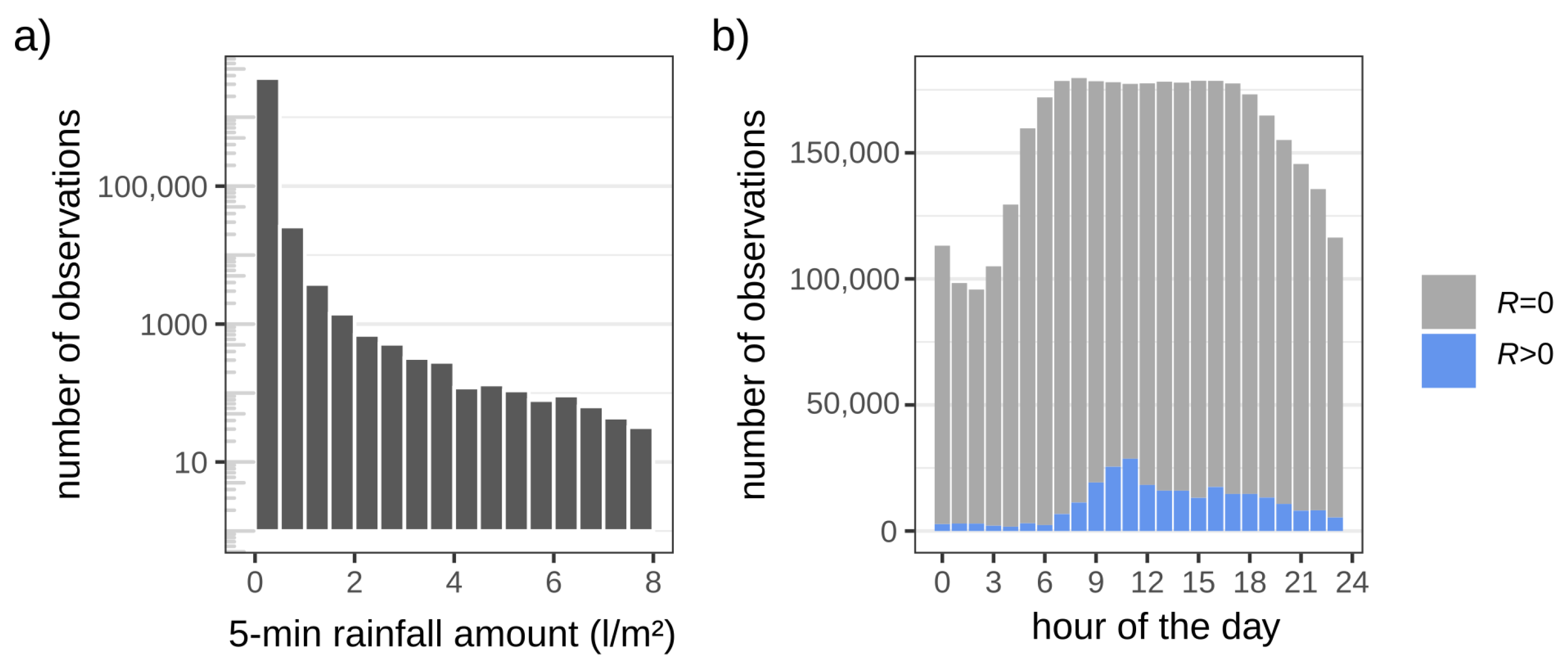
In total 3,732,957 speed observations are available on highways. Rainfall was measured during 265,040 (7.1%) of those 5 min speed observations. As high rainfall amounts occur less frequently than moderate ones, the number of available speed observations for these cases is smaller (Figure 3a). Rainfall amounts of more than 1 L/m2 during a 5 min interval occur only 7828 times (0.2%). While this is a small fraction of all observations, it still represents a non-negligible absolute number of measurements when aggregated across the network. For context, at the Berlin-Dahlem weather station, five-minute rainfall amounts above 1 L/m2 occurred only 36 times in the entire year 2024.
It should be kept in mind that the number of available driving speed observations also depends on peoples’ travel behavior. In general, there are fewer vehicles on the road at night than during the day. In case of highways, the number of available speed observation on the three days selected for the analysis ranges between 175,000 at daytime and below 100,000 at night (Figure 3b). On road sections with lower speed limits, the night-time drop in speed observations is even more pronounced and two maxima during the morning and afternoon rush hours.
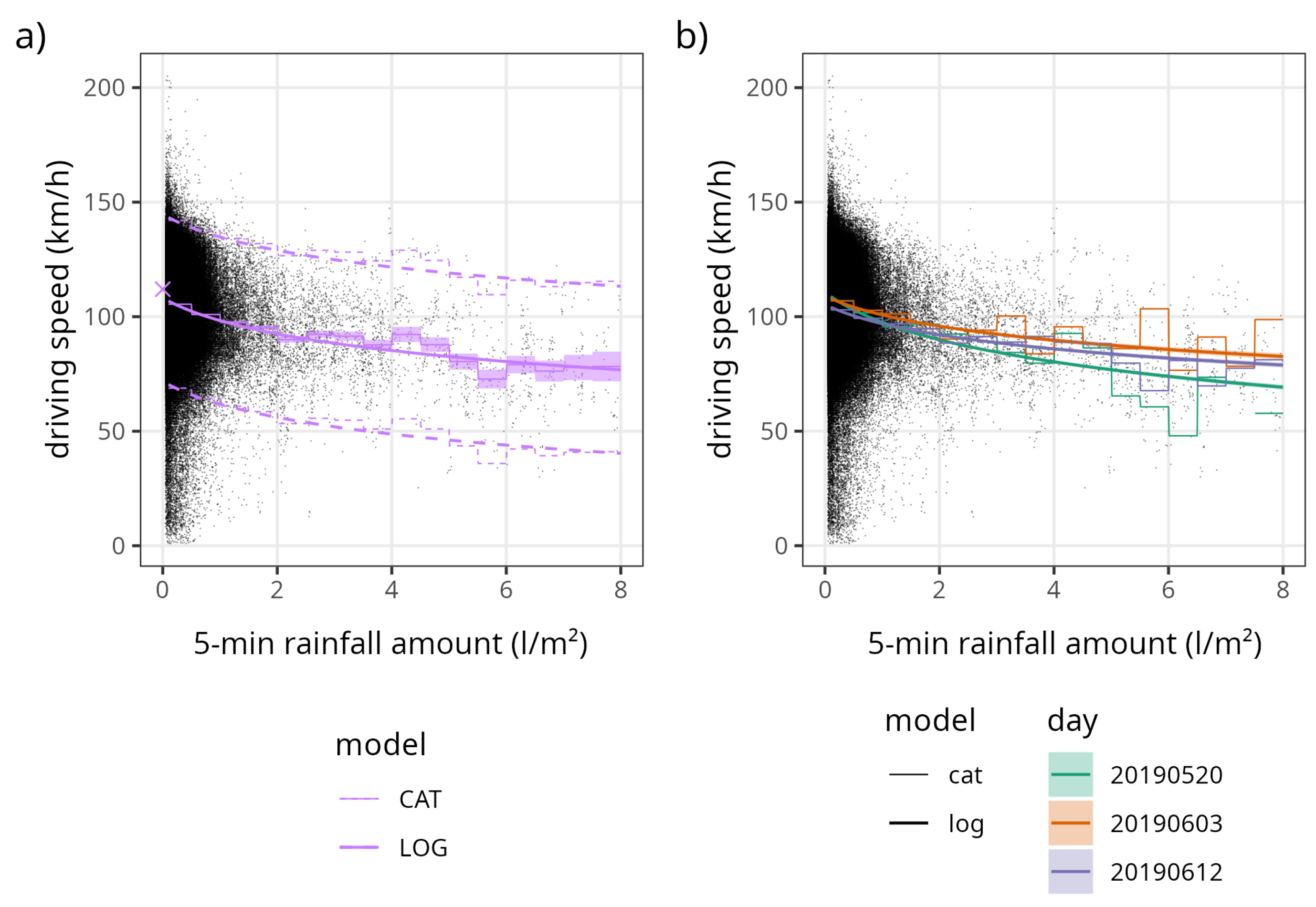
The observed and modeled 5-min average driving speed v on highways is plotted against the 5-min rainfall amount (Figure 4a). The average driving speed during time steps without rainfall is 112 km/h on the selected road section type (magenta x in Figure 4a). The CAT model with rainfall as a categorical predictor shows that driving speed decreases with increasing rainfall categories. The decreasing trend is consistent in rainfall categories below 2 L/m2. In categories above 2 L/m2, the decrease in driving speed becomes more irregular and confidence intervals become wider. These fluctuations can be attributed to overfitting of the categorical model in rainfall categories in which only few observations are available. The LOG model shows that a logarithmic transformation of rainfall leads to a reasonable representation of the functional relationship between rainfall and driving speed, without the overfitting effect observed for the CAT model.
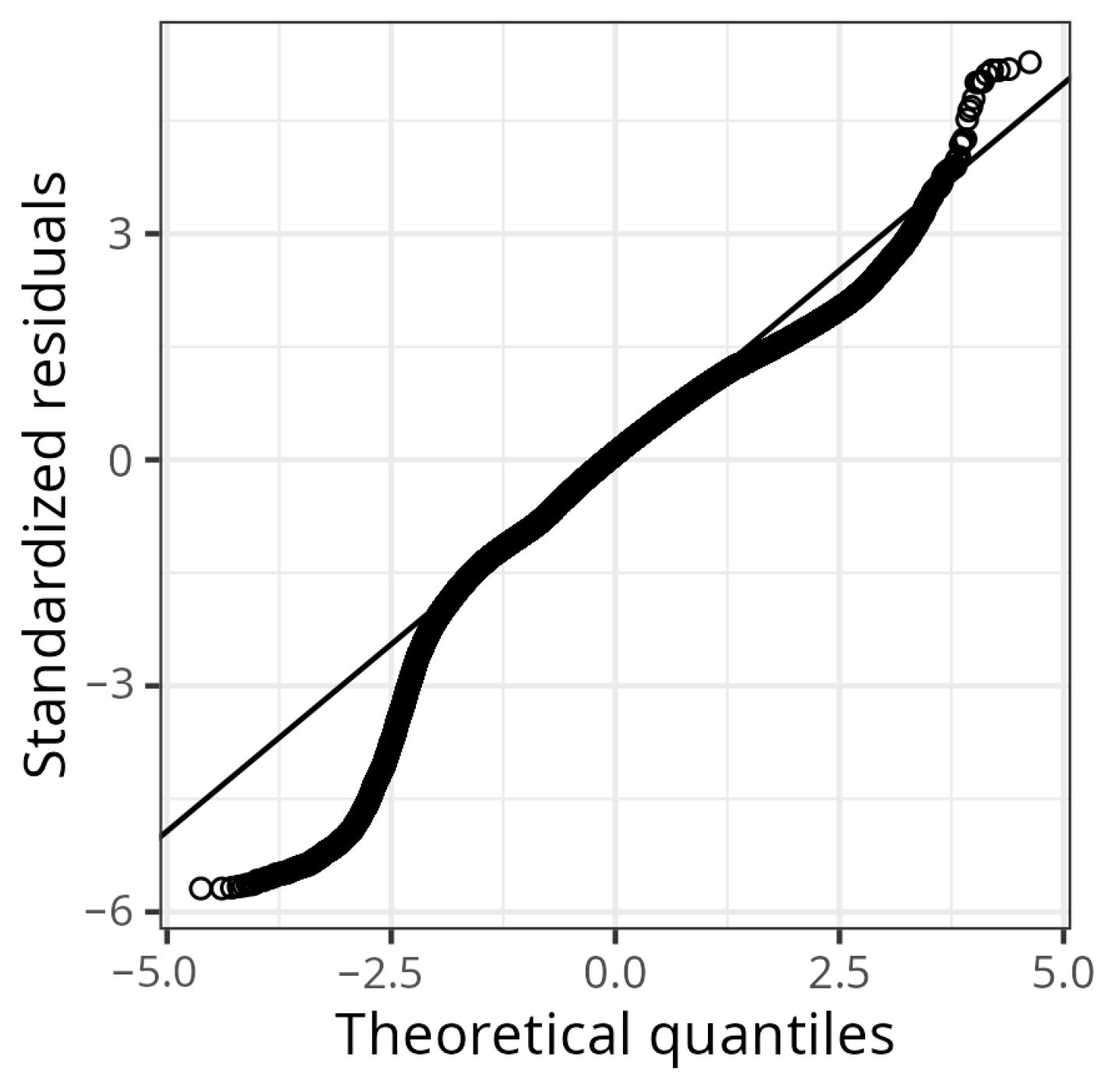
A quantile–quantile (q-q) plot compares the quantiles of the standardized residuals to those of a normal distribution. The q-q plot for the LOG model for driving speed v shows that the requirement for normally distributed residual is sufficiently fulfilled for large parts of the data (Figure 5). Only for the lower tail of the distribution (at theoretical quantiles less than 2 ) are the standardized residuals lower than expected from a normal distribution. This is also visible in the speed observations, indicating a higher than expected number of speed observations below 50 km/h (Figure 4a). We speculate that these observations with relatively low driving speed are due to short-term traffic jams on road sections, which are not removed by the approach described in the methods section. This should be kept in mind when interpreting standard errors and confidence intervals.
On highways, the mean squared errors of the model for v shown in Figure 4a are M S E C A T = 349 km2/h2 and M S E L O G = 346 km2/h2, if no cross-validation is applied. This results in mean squared error skill scores of M S E S S C A T = 0.131 and M S E S S L O G = 0.139 , with NULL as the reference model ( M S E N U L L = 402 km2/h2). If cross-validation is applied, the skill scores are M S E S S C A T = 0.127 and M S E S S L O G = 0.135 . This indicates that: including rainfall as a predictor improves the prediction of driving speed; the LOG model performs slightly better than CAT; both models show some amount of overfitting. It should be noted that all scores are computed using time steps with rainfall only. If metrics are computed using only time steps with rainfall more than 1 L/m2, the skill scores are M S E S S C A T = 0.474 and M S E S S L O G = 0.500 . Obviously, the impact of rainfall as a predictor on the model performance is particularly pronounced in situations with heavy rainfall.
The models presented above are based on data of three individual working days. To analyze the sensitivity of the results to the selection of a specific day, the models CAT and LOG for v are fitted to each of the three days individually (Figure 4b). CAT shows substantial differences, in particular for rainfall categories larger than 1.5 L/m2. The modeled values for v differ by up to 40 km/h. Some categories cannot be estimated, because no rainfall of these categories occurred on the specific days. The LOG model is more consistent due to the use of rainfall as a continuous variable. However, estimates at high rainfall intensities are still subject to increased uncertainty due to data sparsity.

3.2. Comparison of Different Types of Road Sections

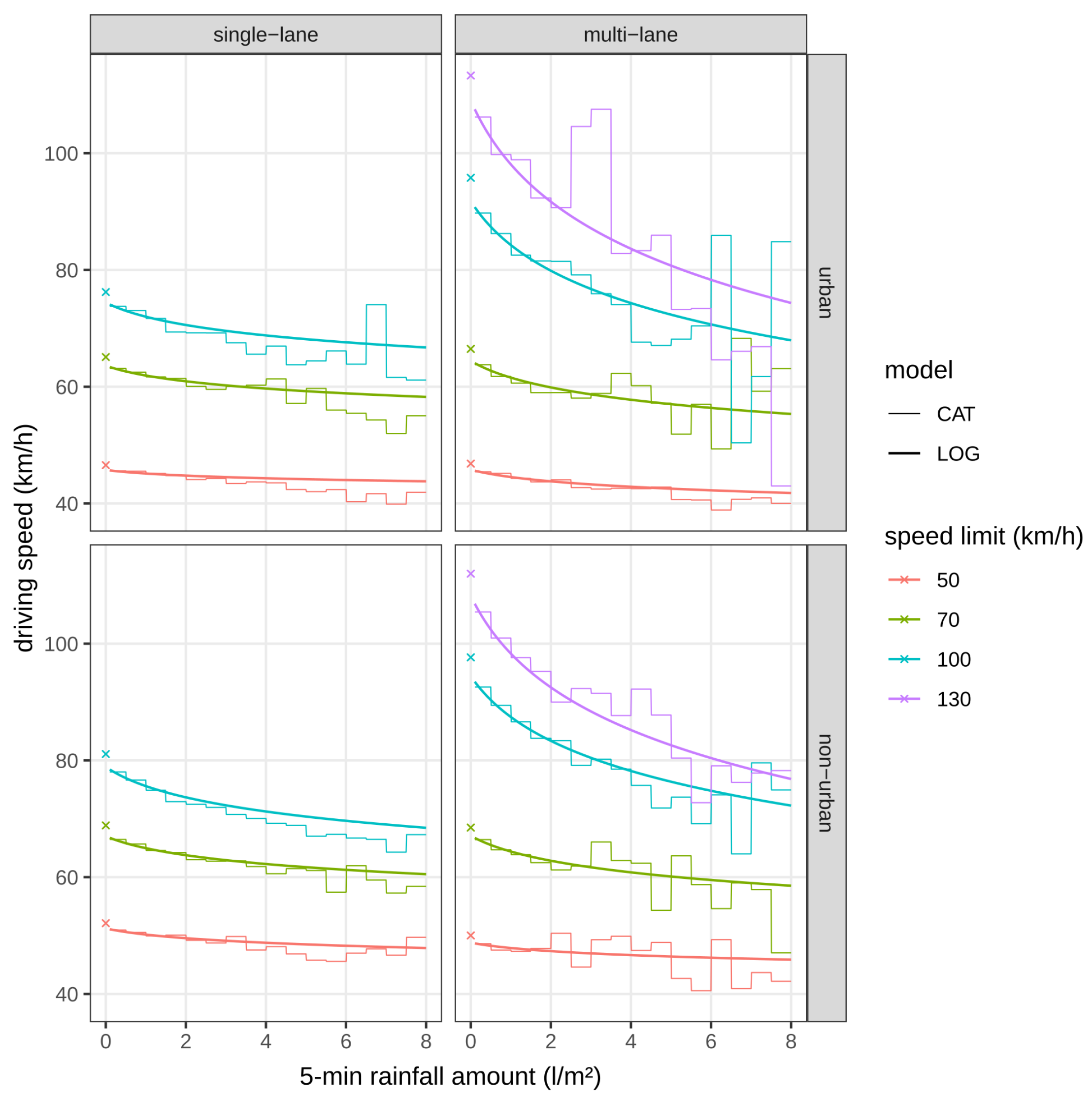
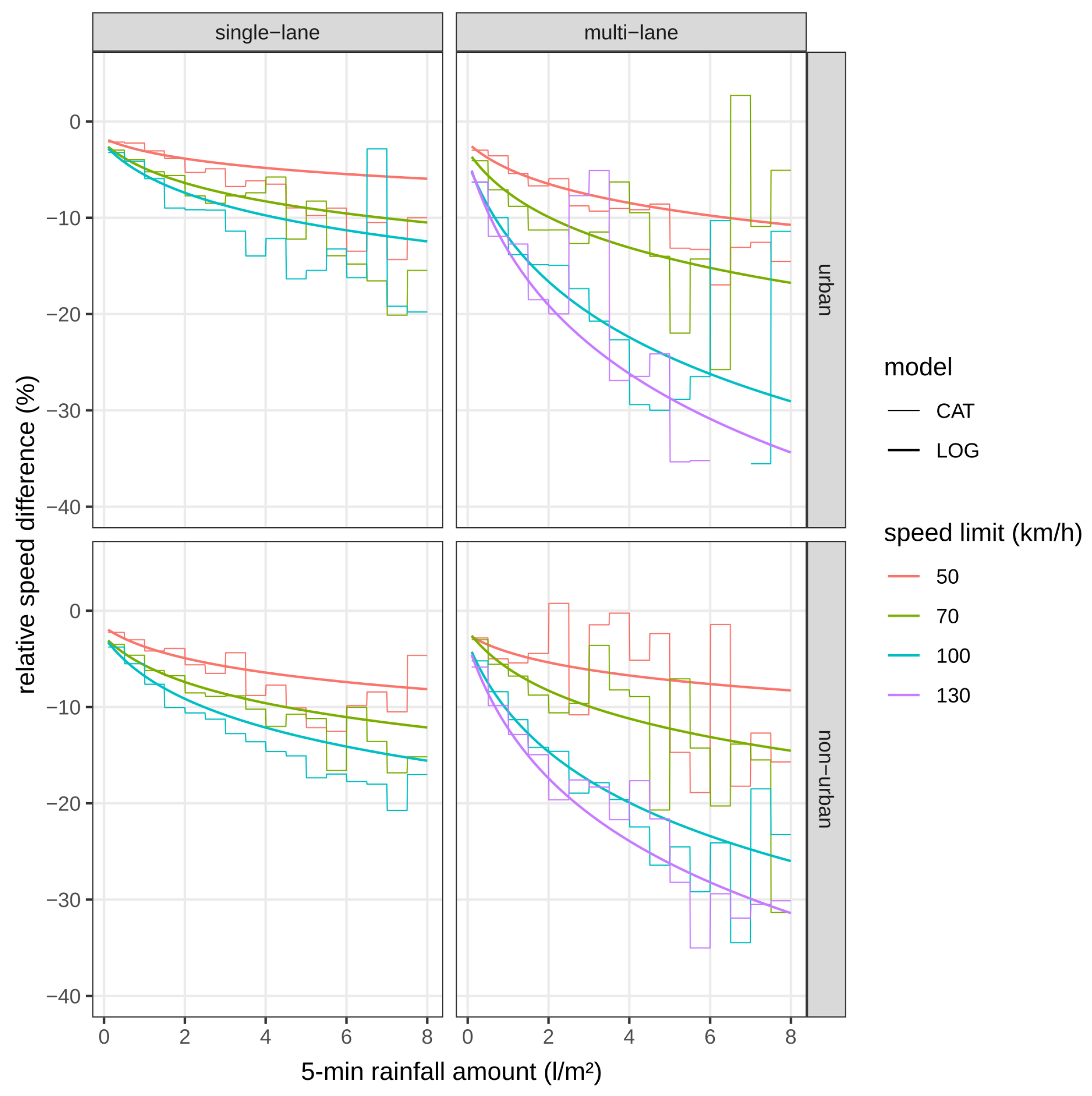
The modeling approach described above for non-urban multi-lane road sections with a speed limit of 130 km/h is now applied to road sections with different speed limits, to single- and multi-lane roads, as well as to road sections in urban and non-urban environments. We analyse the impact of rainfall on driving speed v (Figure 6) and relative speed difference Δ v r e l (Figure 7). Results are shown for the CAT and LOG models (see Table 1 for LOG model coefficients, standard errors and clustered standard errors).
Let us first compare the driving speed v without rainfall (marked with an “x” in Figure 6). The differences between urban and non-urban environments on road sections with the same speed limit are relatively small; for example, on multi-lane roads with speed limits of 100 km/h, v = 95 km/h and v = 98 km/h in urban and non-urban environments, respectively. On the other hand, the differences between single- and multi-lane road sections is relatively large; for example, at speed limits of 100 km/h in a non-urban environment and v = 81 km/h and v = 98 km/h on single- and multi-lane roads, respectively.
Let us now compare the impact of rainfall on v. In general, the impact of rainfall on driving speed is larger on road sections with higher speed limits; for example, on multi-lane roads in a non-urban environment, in case of heavy rainfall of 8 L/m2 Δ v r e l changes from 8 % at speed limits of 50 km/h to –31% at 130 km/h (Figure 7). But, the impact of rainfall differs particularly between single- and multi-lane roads. With increasing rainfall amount, the driving speed v on multi-lane roads drops at a much higher rate than on single-lane roads. This is also indicated by the relative speed differences Δ v r e l (Figure 7); for example, at speed limits of 100 km/h in a non-urban environment, on single- and multi-lane roads Δ v r e l = 15 % and Δ v r e l = 26 %, respectively, if the rainfall amount is 8 L/m2 in 5 min. The reason is that on single-lane roads, the average driving speed is already relatively low in case of no rainfall. Therefore, the room for speed reduction in case of rainfall is restricted.
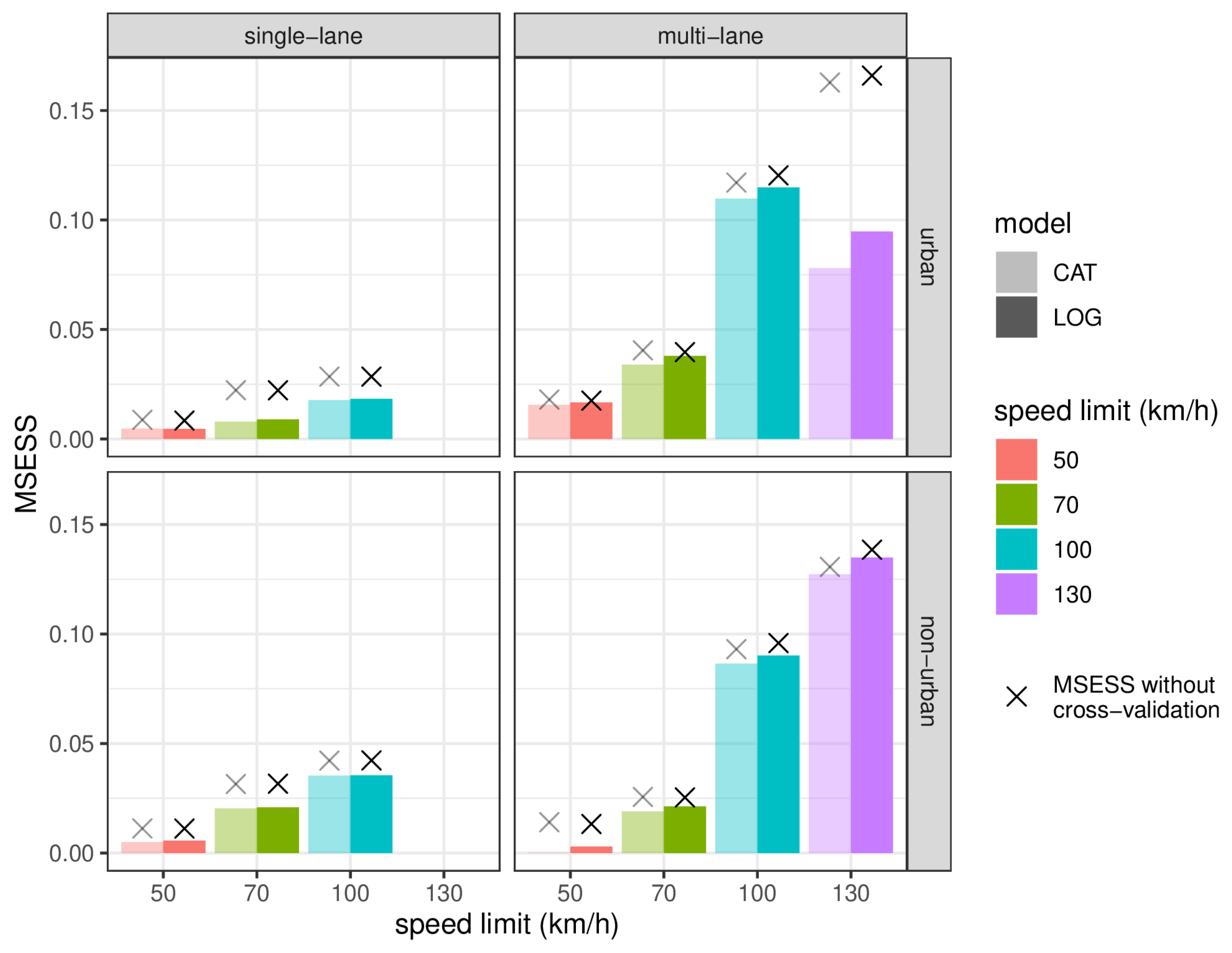
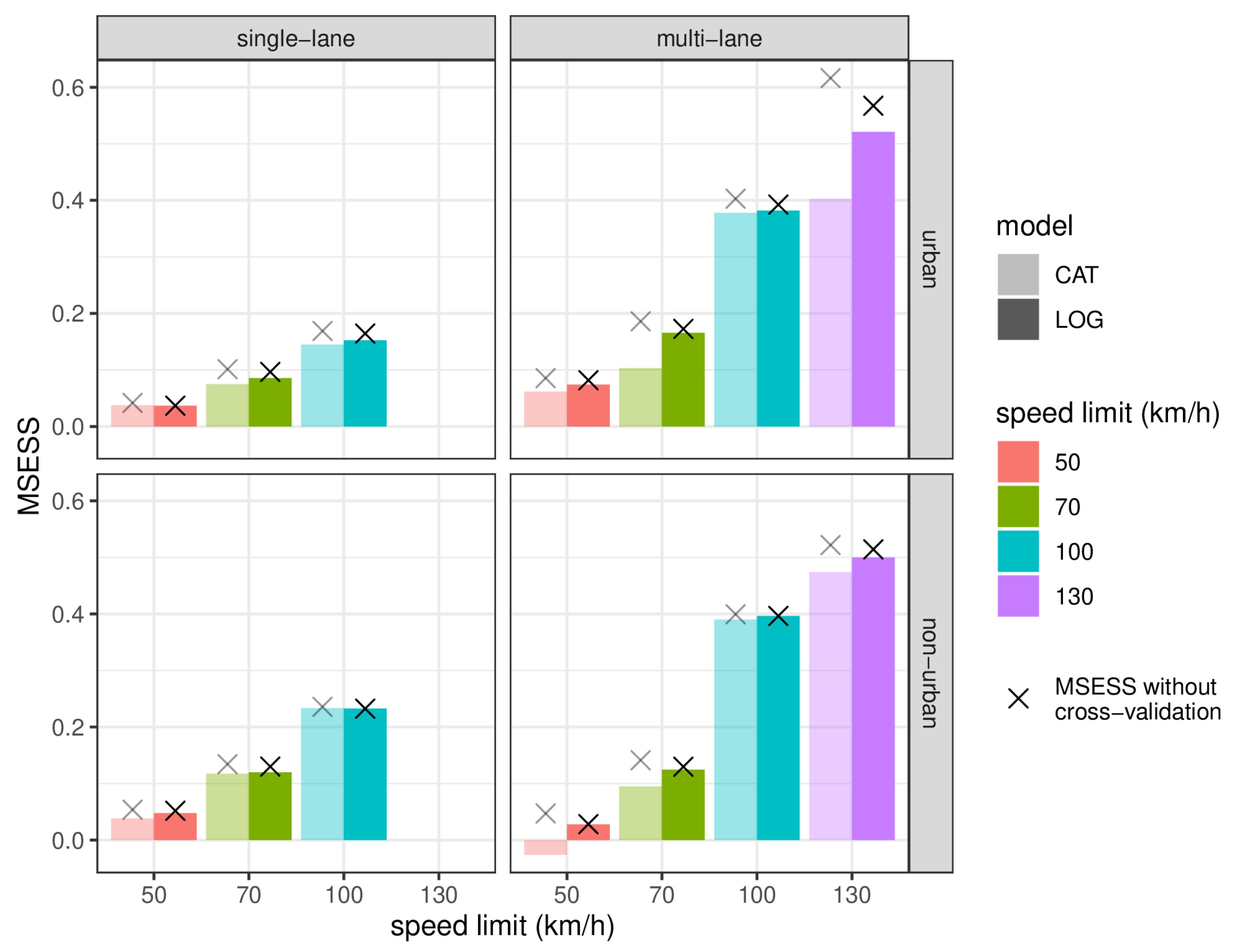
For each type of road section, the MSESS of the CAT and LOG models for driving speed v is computed to assess the benefit of including rainfall as a predictor in comparison to the NULL model (Figure 8). As expected, the MSESS is high on those road sections, where a large impact of rainfall on driving speed was observed. The MSESS is larger on multi-lane roads than on single-lane roads and increases with increasing speed limits. An exception is multi-lane urban road sections with a 130 km/h speed limit, where the MSESS shows a large difference with and without cross-validation. The reason is that this type of road section is relatively rare ( n = 17 , 440 , see Table 1), leading to large uncertainties is the estimated model parameters. On most types of road sections, MSESS of the LOG model is slightly larger compared to the CAT model. The largest MSESS of 0.135 is achieved on multi-lane non-urban roads with 130 km/h speed limit, indicating that the MSE is reduced by 13.5% by using rainfall as a predictor variable. The benefit is even higher if only time steps with rainfall larger than 1 L/m2 are used for computing the scores (Figure 9). In this case, the maximum MSESS values reach up to 0.521, indicating that the MSE is reduced by 52.1%.

4. Discussion

In this study, we analyzed the short-term relationship between rainfall amount and driving speed using 5 min GNSS-based probe vehicle data for approximately 1.5 million road sections across Germany. The combination of floating car data with high-resolution radar-based rainfall estimates enables an assessment of rainfall-related speed reductions at a high spatial and temporal resolution. Focusing on three days with widespread heavy rainfall allowed us to capture a broad range of rainfall intensities and road characteristics. Since the results are based on three individual days, findings should be interpreted as event-based estimates rather than long-term averages.
The results indicate a non-linear, approximately logarithmic decrease in driving speed with increasing rainfall amount, which is consistent with earlier studies [5]. Speed reductions are more pronounced on road sections with higher speed limits and on multi-lane roads, while differences between urban and non-urban roads with the same speed limit are comparatively small.
The estimated magnitudes of rainfall-related speed reductions range from approximately 2–10% under light rainfall or at low driving speeds to more than 20% under heavy rainfall and high driving speeds. These values are broadly consistent with the ranges reported in an extensive literature review by Stamos et al. [3]. Direct numerical comparisons across studies are, however, difficult, as reported effects depend strongly on factors such as the spatio-temporal resolution of the data, the road types considered, and the way rainfall is represented in the analysis. For example, Hooper et al. [13], who analyse precipitation effects on driving speed using radar data but distinguish only between conditions with and without precipitation, report a speed reduction of approximately 2 km/h at a mean driving speed of 80 km/h. Salvi et al. [23] find that speed reductions during rainfall strongly depend on baseline driving speed but observe no substantial effect of rainfall amount when comparing four rainfall intensity classes. This contrasts with the results reported here and may be partly attributable to the relatively coarse spatial resolution of their radar-based rainfall data (0.125°, approximately 13 km). By contrast, Sakhare et al. [24], using rainfall data at 3 km spatial resolution— closer to that employed in this study—find a pronounced dependence of driving speed on rainfall intensity, with reductions of 8.4% under heavy rainfall exceeding 8 mm/h.
Incorporating rainfall as a predictor improves speed prediction, reducing cross-validated mean squared error by up to 14% on average, with substantially larger improvements under heavy rainfall conditions. This finding is consistent with previous studies employing more complex machine learning approaches, such as gradient boosting and neural network models, which also report gains in predictive performance when weather information is included. However, the magnitude of these improvements varies widely across studies. For instance, Prokhorchuk et al. [22] report an average reduction in mean absolute percentage error of 4.5% when radar-based rainfall data are incorporated. Their review of related work further indicates a broad range of reported improvements, spanning from approximately 1.5% to 25%. Again, these differences likely reflect variations in data characteristics, model structures, spatial and temporal resolution, and traffic conditions across studies. Previous studies have also shown that more complex machine learning methods often outperform traditional linear regression approaches [22]. This suggests that evaluating additional modeling approaches for Germany would be valuable. However, doing so would require the availability of larger and more diverse datasets.
Treating rainfall as a continuous variable yields more stable results than categorical approaches, which tend to overfit in regimes with sparse observations. However, due to the scarcity of heavy rainfall observations, estimates of rainfall effects at higher intensities remain uncertain, as reflected by differences in the estimated functional relationships across individual days in the cross-validation analysis.
Several aspects of the analysis point to promising directions for future research. First, traffic volume and congestion are known to be key determinants of driving speed. While direct traffic volume data were not available at the required spatial and temporal resolution, we applied a simple filtering strategy to remove road sections affected by prolonged congestion. Short-term congestion effects are likely still present, and future studies would benefit from integrating traffic volume or occupancy data to better disentangle rainfall-related speed reductions from demand-driven congestion dynamics.
Related to this, the modeling approach was intentionally kept relatively simple to ensure interpretability and robustness across a very large and heterogeneous dataset. More complex statistical frameworks, such as mixed-effects models or models with explicit temporal correlation structures, could in principle better account for repeated observations, unobserved heterogeneity, and autocorrelation. However, the available data do not consistently provide complete time series for all road sections across all analysed days, limiting the feasibility and stability of such approaches. As a result, some degree of residual clustering and temporal dependence remains in the model errors, which can lead to underestimated standard errors. Consequently, reported confidence intervals should be interpreted conservatively. As more continuous and longer-term probe vehicle datasets become available, these modeling extensions represent a natural next step to improve inference and uncertainty quantification.
Another perspective concerns the spatial resolution of rainfall data. Rainfall amounts are assumed to be homogeneous within each 1 km radar grid cell. During convective events, however, sub-grid variability may still be substantial, potentially leading to exposure misclassification at the level of individual road sections. Such measurement error would be expected to attenuate estimated rainfall effects, suggesting that the reported speed reductions may represent conservative estimates.
In this study, only the instantaneous effect of rainfall is analyzed. Lagged effects of rainfall like driving on wet roads after a rainfall event are not considered. Furthermore, distinction of between different types of precipitation apart from rainfall, like hail, sleet or snowfall, is not possible with the RADKLIM data. Future research could address this by including novel radar-based hydrometeor classification, e.g., based on the novel Hymec product used at the German Weather Service [29].
The GNSS-based probe data also open avenues for further refinement. While the large sample size improves representativeness at the network level, information on vehicle types is not available. Differentiating between passenger cars, trucks, and other vehicle classes could provide additional insight. Similarly, probe vehicle penetration rates may vary spatially and temporally, which should be considered when interpreting results.
While this study focuses on rainfall-induced changes in driving speed, it does not assess traffic safety outcomes such as crash occurrence, injury risk, or traffic mortality. Importantly, reductions in driving speed should not be interpreted as evidence of improved road safety. Although a speed reduction might lower crash severity compared to an unaltered driving speed, a substantial body of literature shows that rainfall in general increases crash risk and traffic casualties, reflecting complex and sometimes countervailing mechanisms such as reduced visibility, adverse road surface conditions, and altered traffic flow dynamics [30,31,32,33]. Behavioural adaptations such as speed reduction may therefore coexist with elevated accident risk. Accordingly, the results presented here describe traffic flow responses to rainfall but do not support inferences about safety impacts, which requires dedicated analyses linking weather conditions to crash and injury data.
Finally, the analysis is based on three days with heavy rainfall, which limits the ability to capture seasonal effects, weekday variability, and a robust representation of a diurnal cycle of traffic volume. Differences in model estimates across individual days, especially at high rainfall intensities, highlight the importance of larger multi-event datasets. Other studies have analysed samples comprising 12 days [34], 42 days [24], or 43 days [21], as well as longer continuous observation periods spanning months [11,22] or years [9]. Extending the analysis to longer time periods would reduce sampling uncertainty and allow for more robust estimation of effects under extreme conditions, albeit at the cost of increased computational complexity and the potential need to focus on selected regions.
Taken together, these perspectives indicate that the present study represents only a first step toward country-scale rainfall-aware speed models for Germany. While further data and methodological advances are required for fully operational implementations, the results demonstrate the feasibility and value of combining radar-based rainfall observations with GNSS probe vehicle data to improve our understanding of weather-related driving behavior.

5. Conclusions

Previous research has shown that rainfall reduces driving speed. Road users adapt their driving behavior due to reduced visibility and lower skid resistance, for example. Most existing studies are based on speed measurements at individual sites or at a limited number of road sections combined with station-based rainfall observations. While such approaches yield accurate local estimates, their transferability to other road types and regions is often unclear.
The aim of this paper was to combine high-resolution calibrated radar-based rainfall amounts with GNSS-derived driving speeds derived from GNSS probe data. This allowed for a more generalized estimation of the rainfall–speed relationship at a high spatial and temporal resolution. Despite some disadvantages of using GNSS probe data, which have been discussed in the previous section, the analysis has lead to promising results, which would have been difficult to obtain with traditional station-based approaches.
Using data from approximately 1.5 million road sections, we show that average rainfall-related speed reductions depend systematically on road characteristics. Relative speed reductions increase with rainfall intensity and are substantially larger on road sections with higher speed limits and on multi-lane roads. For example, in case of intense rainfall, the average speed reductions is 8 % at speed limits of 50 km/h and 31 % at 130 km/h. Importantly, treating rainfall as a continuous predictor allows the logarithmic functional form of the rainfall–speed relationship to be captured more parsimoniously than categorical approaches. However, estimates at very high rainfall intensities are subject to increased uncertainty due to data sparsity.
Beyond descriptive effects, we demonstrate that incorporating rainfall information yields measurable predictive benefits. Cross-validation shows that including rainfall as a predictor reduces mean squared error by approximately 14% on average, and by up to 50% during heavy rainfall conditions. This highlights the relevance of rainfall not only as an explanatory variable but also as a key input for short-term speed prediction models.
The results of this study demonstrate the potential of combining radar-based rainfall data with GNSS-derived driving speeds to characterize rainfall-related speed reductions across heterogeneous road types. However, the analysis is based on a limited number of rainfall events and does not explicitly account for traffic volume or congestion dynamics. Consequently, the models presented here should be understood only as a first step toward country-scale rainfall-aware speed prediction rather than as directly operational tools. Extending the analysis to a larger set of rainfall events, incorporating traffic volume information, and further addressing temporal dependencies will be essential to improve robustness, generalizability, and practical applicability in future work.


Author Contributions

Conceptualization, N.B. and H.W.R.; methodology, N.B.; software, N.B.; validation, N.B.; formal analysis, N.B.; investigation, N.B.; resources, H.W.R.; data curation, N.B.; writing—original draft preparation, N.B.; writing—review and editing, N.B., U.U. and H.W.R.; visualization, N.B.; supervision, U.U. and H.W.R.; project administration, H.W.R.; funding acquisition, N.B. and H.W.R. All authors have read and agreed to the published version of the manuscript.

Funding

This research was funded by the Bundesministerium für Verkehr und Digitale Infrastruktur grant number 4818DWDP3A.

Institutional Review Board Statement

Not applicable.

Informed Consent Statement

Not applicable.

Data Availability Statement

The floating car data used in this article are not readily available. Requests to access the datasets should be directed to HERE Europe B.V. Precipitation data used in this article is available at https://opendata.dwd.de/climate_environment/CDC/help/landing_pages/doi_landingpage_RADKLIM_YW_V2017.002-en.html (accessed on 31 January 2026).

Acknowledgments

This research was carried out within the framework of the Hans-Ertel-Centre for Weather Research. This research network of universities, research institutes and the Deutscher Wetterdienst is funded by the Bundesministerium für Verkehr und Digitale Infrastruktur. We kindly thank HERE Europe B.V. for providing the floating car data and supporting this research. The publication of this article was supported by the Open Access funds of Freie Universität Berlin.

Conflicts of Interest

The authors declare no conflicts of interest.

Abbreviations

The following abbreviations are used in this manuscript:
GNSSGlobal Navigation Satellite System
ITSIntelligent Transportation System
MSEMean Squared Error
MSESSMean Squared Error Skill Score
RADKLIMRadar-based precipitation climatology

Appendix A. Sensitivity Analysis

Road sections subject to persistent traffic congestion are intended to be excluded from the analysis. Because no direct measurements of congestion are available, a road section is classified as congested if, in more than 10% of the observed time steps, the observed driving speed falls below 50% of the local speed limit.
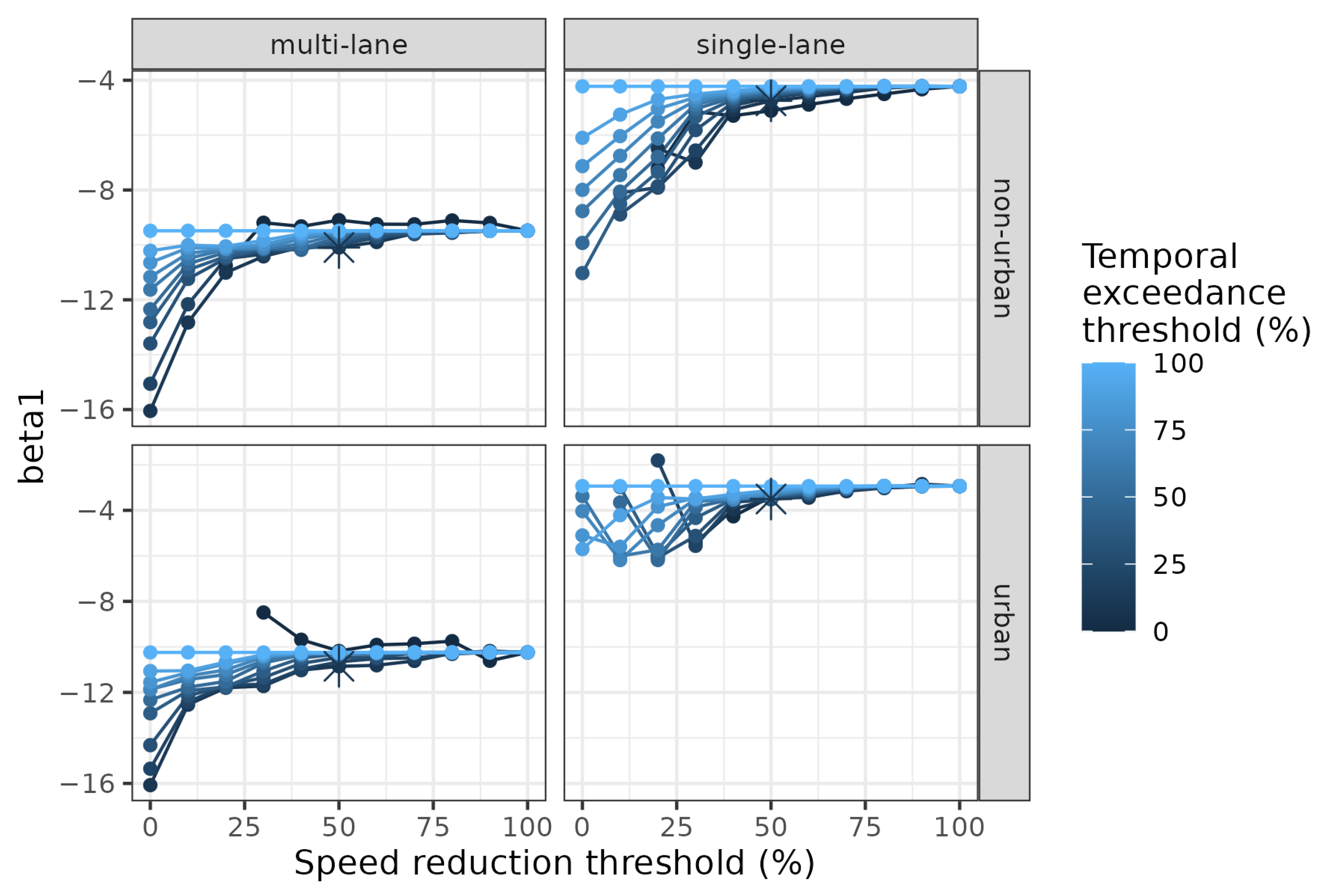
To assess the sensitivity of the results to this classification, we perform a systematic sensitivity analysis by varying the two parameters. First, the percentage reduction in driving speed relative to the local speed limit, denoted as speed_thresh, is varied from 0% to 100% in steps of 10%. Second, the proportion of observed time steps for which driving speeds must fall below speed_thresh, denoted as time_thresh, is also varied from 0% to 100% in steps of 10%. We refer to speed_thresh as the speed reduction threshold and time_thresh as the temporal exceedance threshold.
It should be noted that speed_thresh and time_thresh are varied over their full admissible ranges in order to capture the complete spectrum of potential effects. This necessarily includes threshold combinations that would be implausible in practical applications.
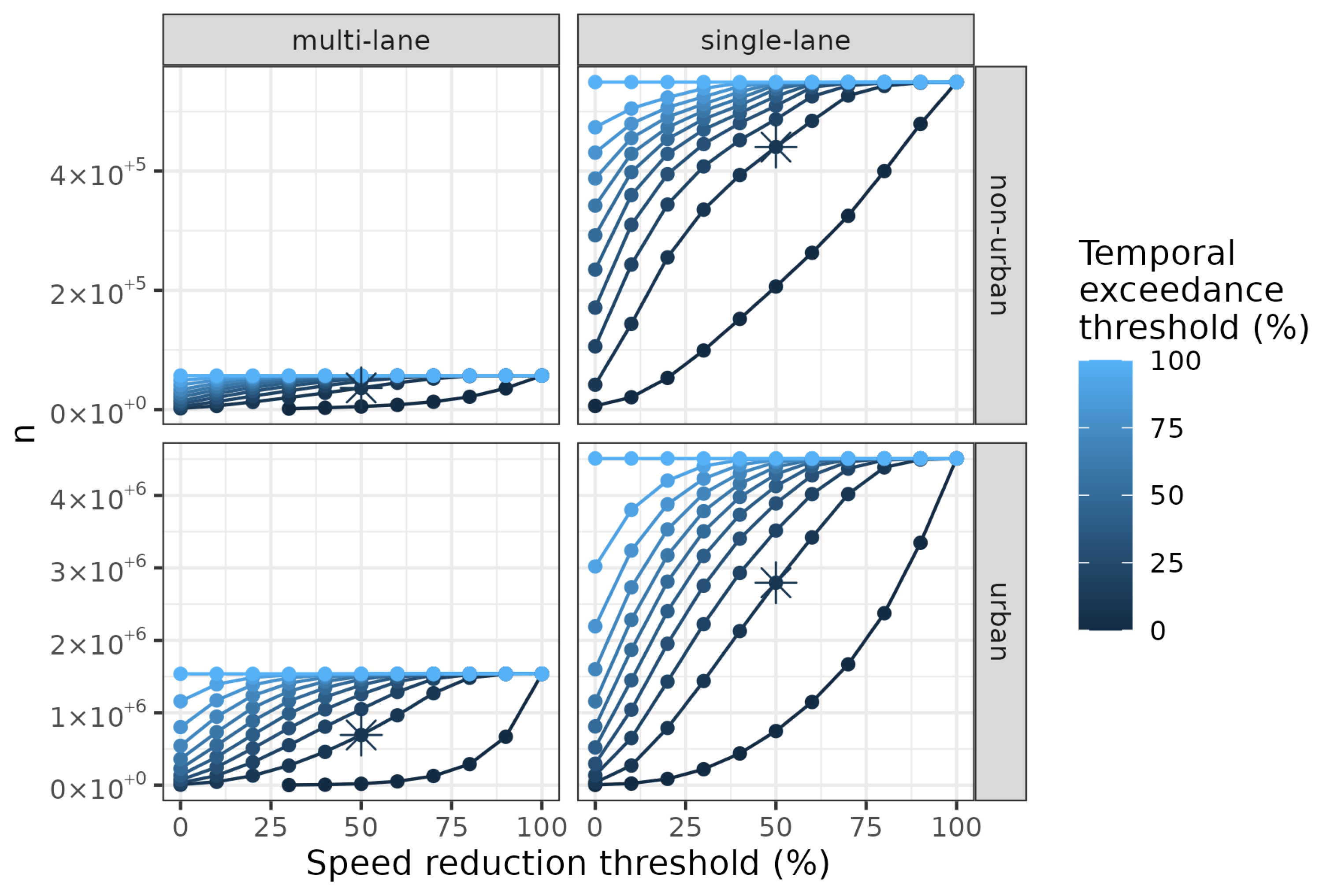
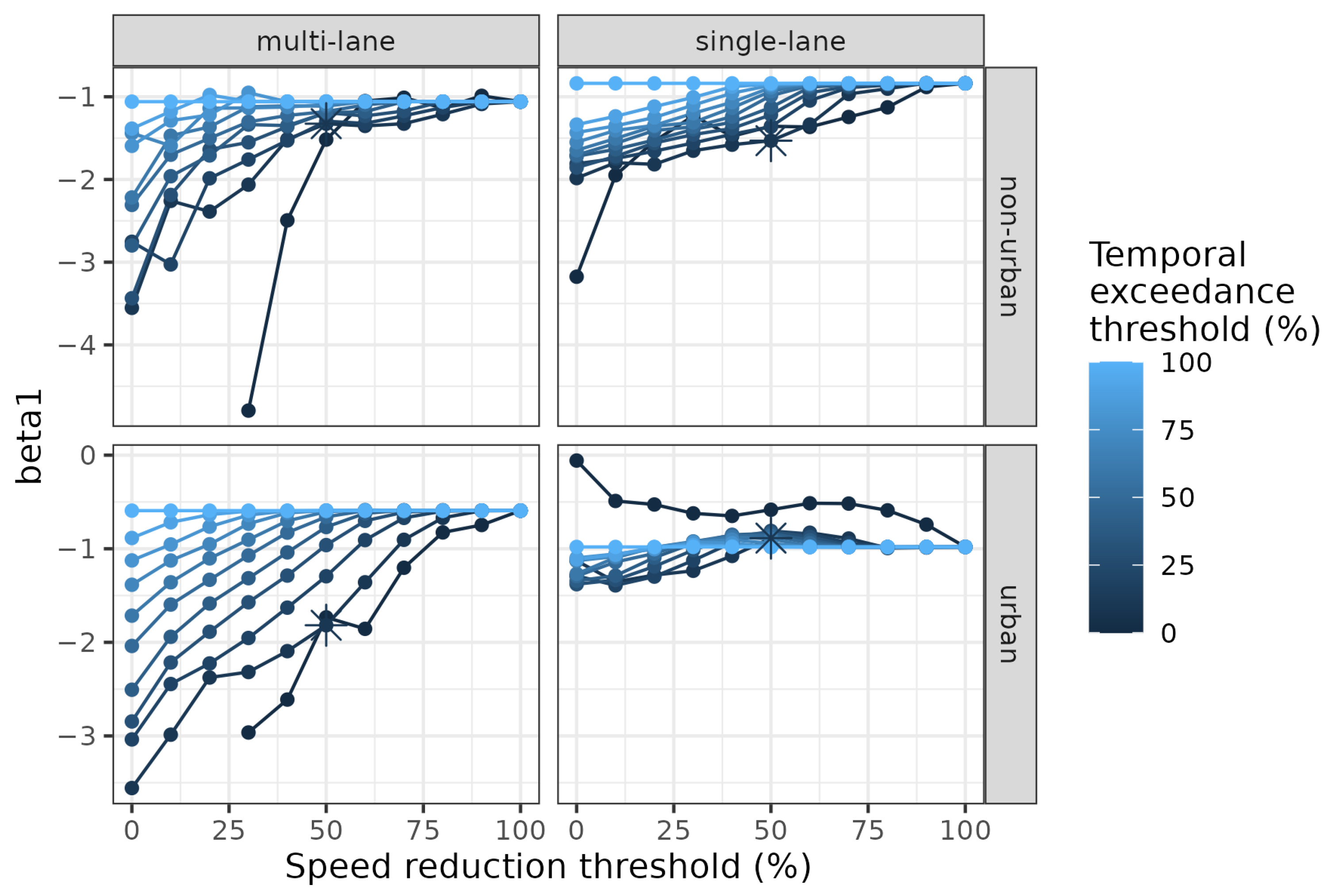
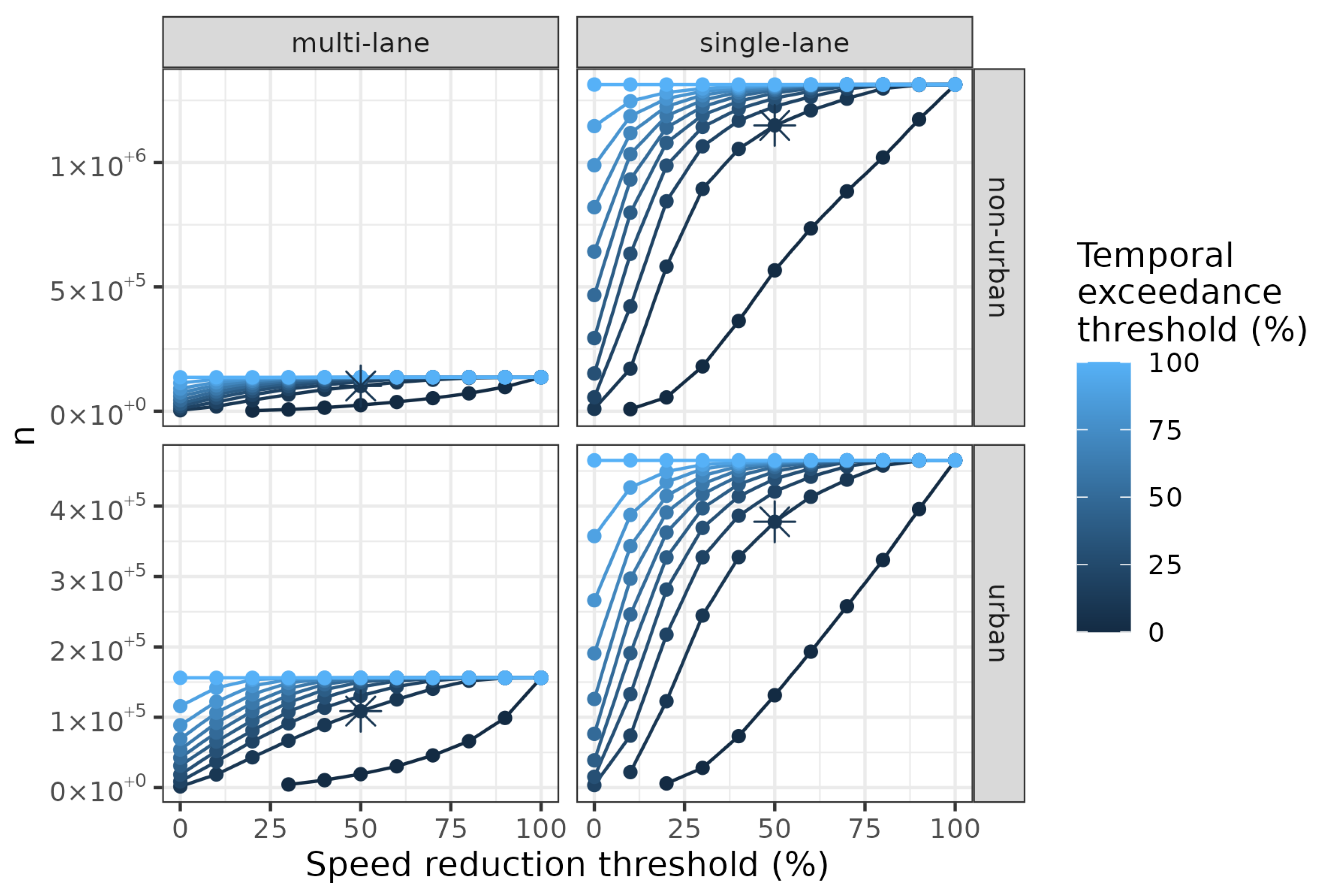
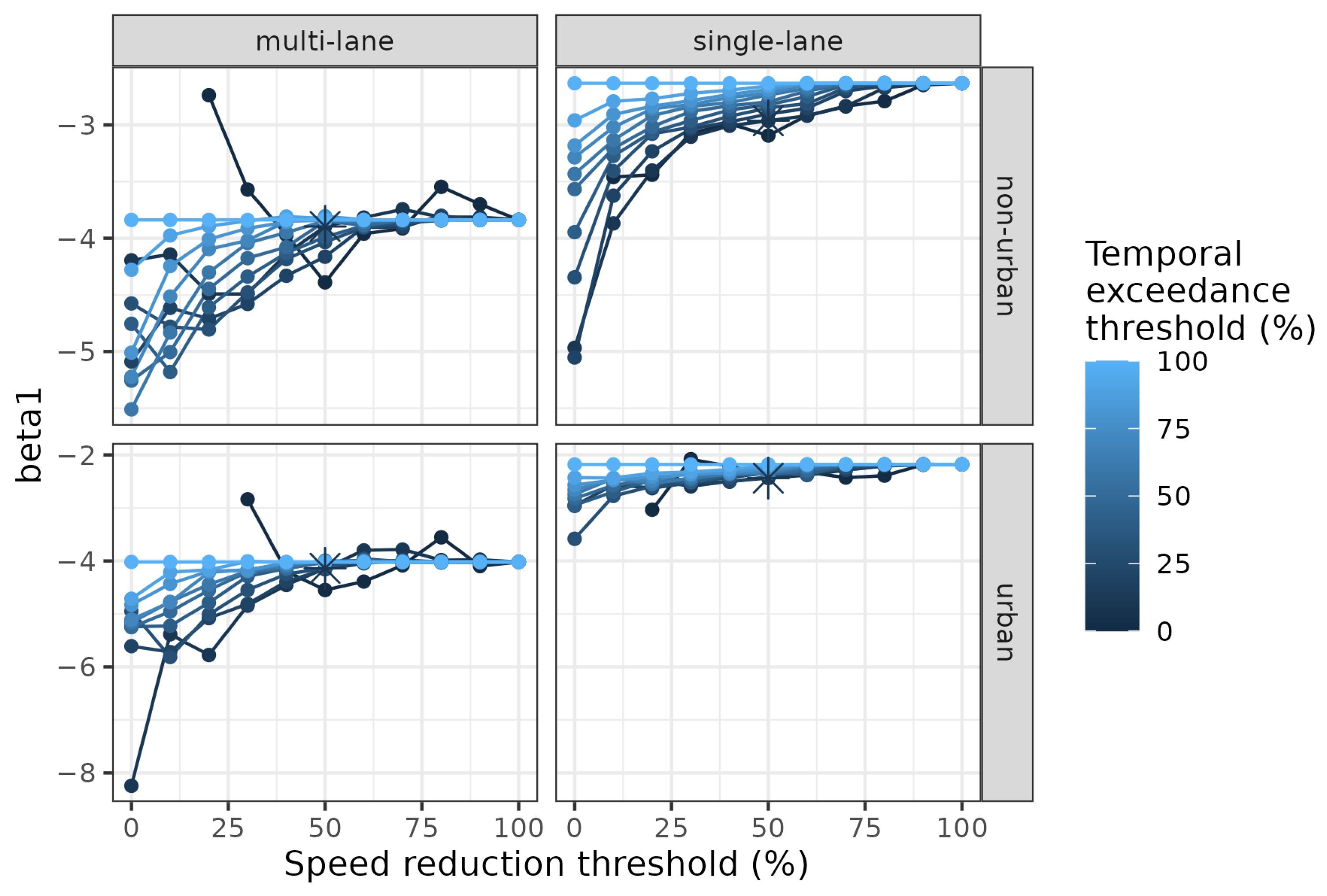
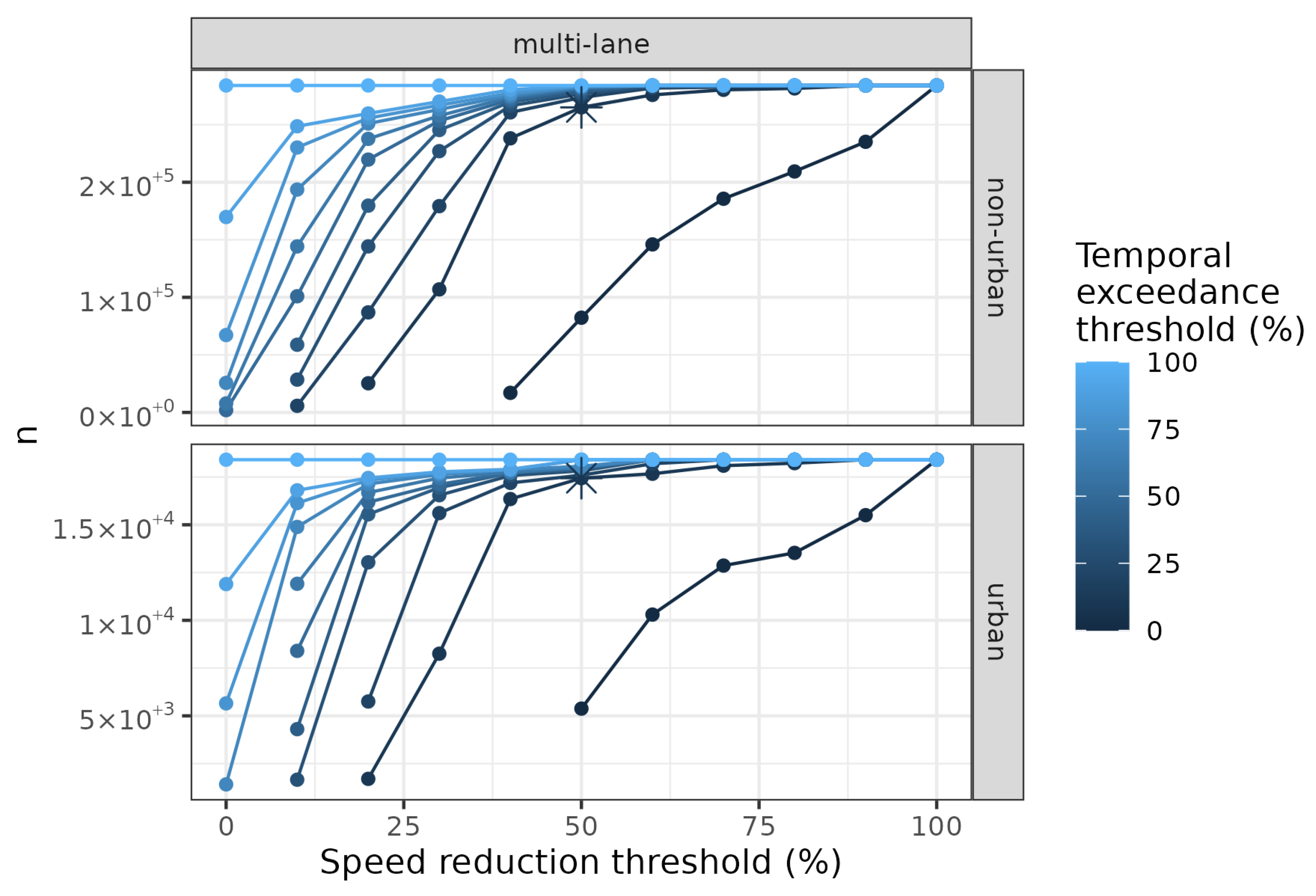
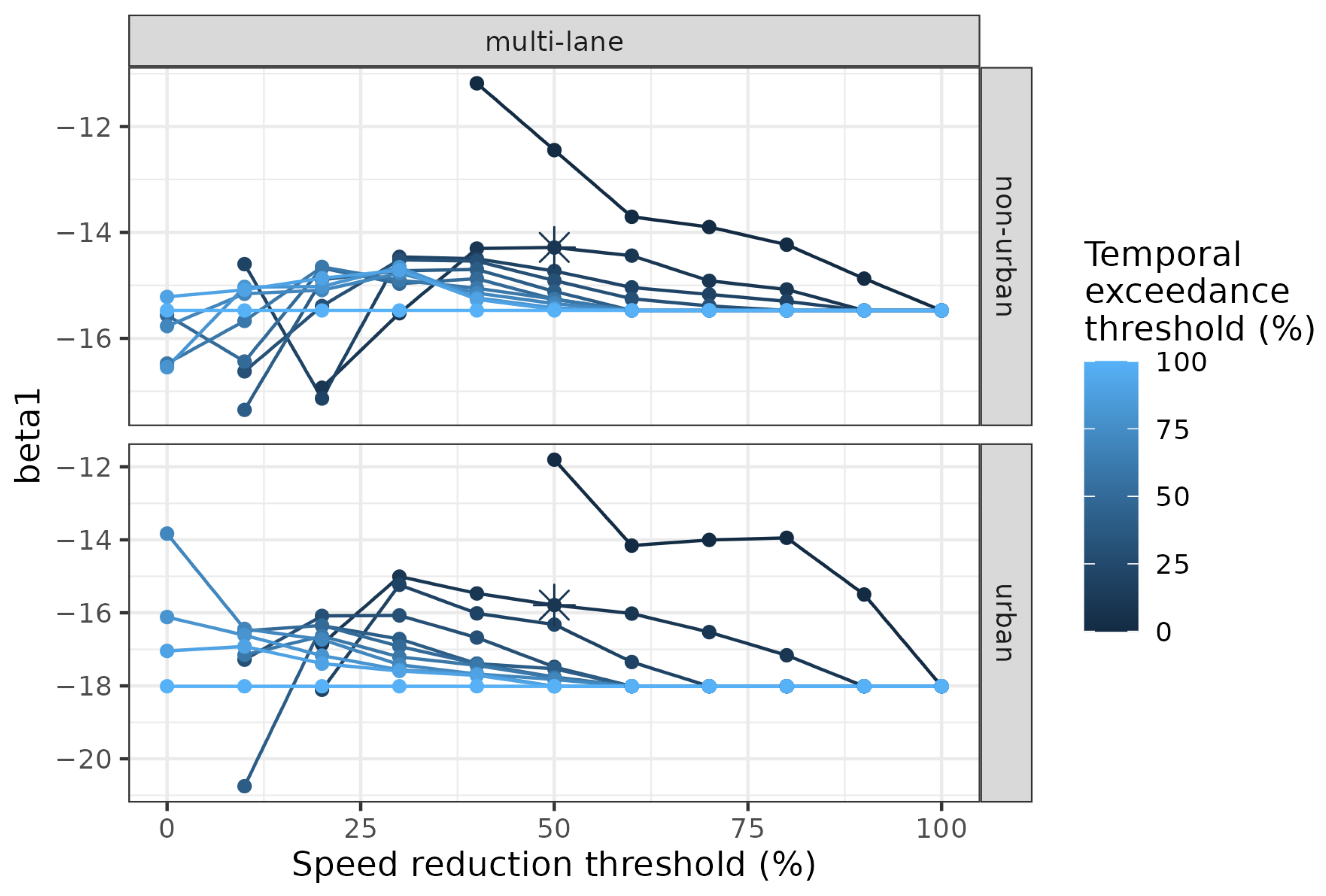
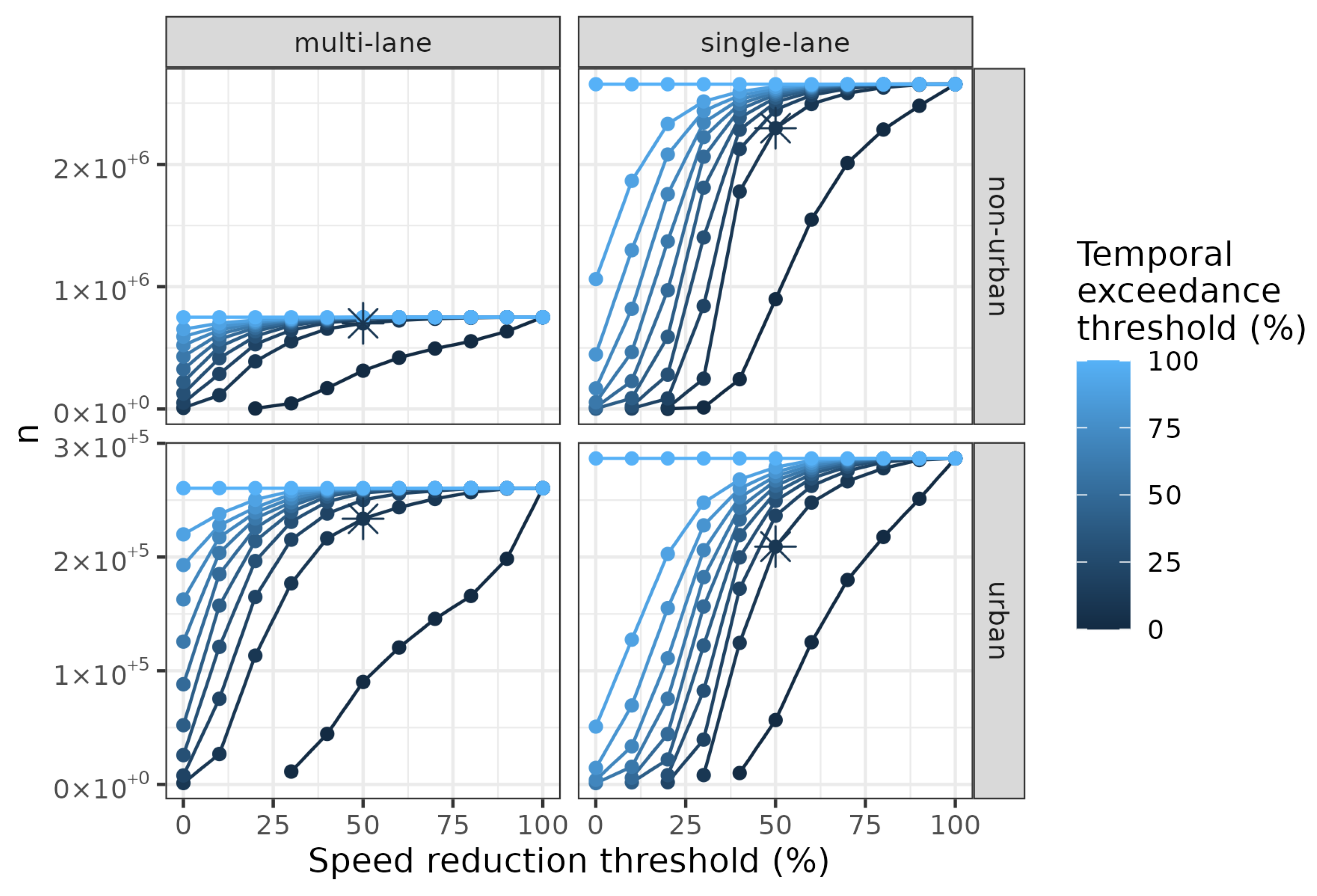
We examine the effects of speed_thresh and time_thresh on (i) the number of remaining observations n after filtering, and (ii) the estimated coefficient β 1 of the LOG model, which captures the effect of rainfall on driving speed. Figure A1, Figure A3, Figure A5 and Figure A7 illustrate the sensitivity of n for road sections with speed limits of 50, 70, 100, and 130 km/h, respectively. Figure A2, Figure A4, Figure A6 and Figure A8 show the corresponding sensitivity of β 1 .
Overall, the sensitivity analysis shows that decreasing speed_thresh and time_thresh leads to a reduction in n, indicating that increasingly strict congestion criteria result in the exclusion of more road sections. The influence of time_thresh on n is non-linear and depends on the chosen speed_thresh. The effect of time_thresh becomes more pronounced at lower values of speed_thresh. For most types of road sections, n is relatively stable at speed_thresh of 50 % and more, but it drops strongly if speed_thresh falls below 50%.
For most types of road sections, stricter filtering (i.e., lower values of speed_thresh and time_thresh) leads to increasingly negative estimates of β 1 , suggesting a stronger estimated impact of rainfall on driving speed reduction. This pattern is plausible, as stricter filtering increasingly restricts the sample to road sections operating predominantly under free-flow conditions, where weather-related effects on driving behavior are expected to be more pronounced. An exception is observed for road sections with a speed limit of 130 km/h, where β 1 becomes less negative under stricter filtering, indicating a weaker estimated rainfall effect.
Importantly, for a speed_thresh of 50%—the value used in the main analysis—the estimate of β 1 is relatively stable across a wide range of time_thresh values, supporting the robustness of the main results with respect to the congestion-filtering criteria. Varying the thresholds affects the magnitude of the estimated rainfall effect, but not its sign.
Figure A1. Sensitivity analysis for road sections with speed limits of 50 km/h, showing the effect of the speed reduction threshold speed_thresh and the temporal selection threshold time_thresh on the number of observations n, which remains after applying the filtering. A star marks the thresholds applied in the main analysis.
Futuretransp 06 00038 g0a1
Figure A2. Sensitivity analysis for roads sections with speed limits of 50 km/h, showing the effect of the speed reduction threshold speed_thresh and the temporal selection threshold time_thresh on the coefficient β 1 of the LOG model, which describes rainfall effect on driving speed. A star marks the thresholds applied in the main analysis.
Futuretransp 06 00038 g0a2
Figure A3. Sensitivity analysis for roads sections with speed limits of 70 km/h, showing the effect of the speed reduction threshold speed_thresh and the temporal selection threshold time_thresh on the number of observations n, which remains after applying the filtering. A star marks the thresholds applied in the main analysis.
Futuretransp 06 00038 g0a3
Figure A4. Sensitivity analysis for roads sections with speed limits of 70 km/h, showing the effect of the speed reduction threshold speed_thresh and the temporal selection threshold time_thresh on the coefficient β 1 of the LOG model, which describes rainfall effect on driving speed. A star marks the thresholds applied in the main analysis.
Futuretransp 06 00038 g0a4
Figure A5. Sensitivity analysis for roads sections with speed limits of 100 km/h, showing the effect of the speed reduction threshold speed_thresh and the temporal selection threshold time_thresh on the number of observations n, which remains after applying the filtering. A star marks the thresholds applied in the main analysis.
Futuretransp 06 00038 g0a5
Figure A6. Sensitivity analysis for roads sections with speed limits of 100 km/h, showing the effect of the speed reduction threshold speed_thresh and the temporal selection threshold time_thresh on the coefficient β 1 of the LOG model, which describes rainfall effect on driving speed. A star marks the thresholds applied in the main analysis.
Futuretransp 06 00038 g0a6
Figure A7. Sensitivity analysis for roads sections with speed limits of 130 km/h, showing the effect of the speed reduction threshold speed_thresh and the temporal selection threshold time_thresh on the number of observations n, which remains after applying the filtering. A star marks the thresholds applied in the main analysis.
Futuretransp 06 00038 g0a7
Figure A8. Sensitivity analysis for road sections with speed limits of 130 km/h, showing the effect of the speed reduction threshold speed_thresh and the temporal selection threshold time_thresh on the coefficient β 1 of the LOG model, which describes rainfall effect on driving speed. A star marks the thresholds applied in the main analysis.
Futuretransp 06 00038 g0a8

References

  1. Statistisches Bundesamt. Pkw-Dichte im Jahr 2021 auf Rekordhoch; Statistisches Bundesamt: Wiesbaden, Germany, 2022.
  2. Dimitrakopoulos, G.; Demestichas, P. Intelligent Transportation Systems. IEEE Veh. Technol. Mag. 2010, 5, 77–84. [Google Scholar] [CrossRef]
  3. Stamos, I.; Grau, J.M.S.; Mitsakis, E.; Aifadopoulou, G. Modeling Effects of Precipitation on Vehicle Speed: Floating Car Data Approach. Transp. Res. Rec. J. Transp. Res. Board 2016, 2551, 100–110. [Google Scholar] [CrossRef]
  4. Mitsakis, E.; Stamos, I.; Diakakis, M.; Salanova Grau, J. Impacts of high-intensity storms on urban transportation: Applying traffic flow control methodologies for quantifying the effects. Int. J. Environ. Sci. Technol. 2014, 11, 2145–2154. [Google Scholar] [CrossRef]
  5. Zhang, J.; Song, G.; Gong, D.; Gao, Y.; Yu, L.; Guo, J. Analysis of rainfall effects on road travel speed in Beijing, China. IET Intell. Transp. Syst. 2018, 12, 93–102. [Google Scholar] [CrossRef]
  6. Brilon, W.; Ponzlet, M. Variability of speed-flow relationships on German autobahns. Transp. Res. Rec. 1996, 1555, 91–98. [Google Scholar] [CrossRef]
  7. Unrau, D.; Andrey, J. Driver response to rainfall on urban expressways. Transp. Res. Rec. 2006, 1980, 24–30. [Google Scholar] [CrossRef]
  8. Camacho, F.J.; García, A.; Belda, E. Analysis of Impact of Adverse Weather on Freeway Free-Flow Speed in Spain. Transp. Res. Rec. J. Transp. Res. Board 2010, 2169, 150–159. [Google Scholar] [CrossRef]
  9. Vidas, M.; Tubić, V.; Ivanović, I.; Subotić, M. One Approach to Quantifying Rainfall Impact on the Traffic Flow of a Specific Freeway Segment. Sustainability 2022, 14, 4985. [Google Scholar] [CrossRef]
  10. Wang, C.; Huang, S.; Zhang, C. Short-Term Traffic Flow Prediction Considering Weather Factors Based on Optimized Deep Learning Neural Networks: Bo-GRA-CNN-BiLSTM. Sustainability 2025, 17, 2576. [Google Scholar] [CrossRef]
  11. Liu, Y.; Chen, H.; Yin, C.; Michalaki, V.; Proctor, P.; Rowley, G.; Wang, X.; Wei, H. A Flow-Speed Model for Motorways in England: Analysis Under Various Weather Conditions. Atmosphere 2025, 16, 117. [Google Scholar] [CrossRef]
  12. Ibrahim, A.T.; Hall, F.L. Effect of Adverse Weather Conditions on Speed-Flow-Occupancy Relationships; Transportation Research Record; Transportation Research Board (TRB): Washington, DC, USA, 1994; pp. 184–191. [Google Scholar]
  13. Hooper, E.; Chapman, L.; Quinn, A. The impact of precipitation on speed–flow relationships along a UK motorway corridor. Theor. Appl. Climatol. 2014, 117, 303–316. [Google Scholar] [CrossRef]
  14. Zhu, D.; Shen, G.; Liu, D.; Chen, J.; Zhang, Y. FCG-ASpredictor: An Approach for the Prediction of Average Speed of Road Segments with Floating Car GPS Data. Sensors 2019, 19, 4967. [Google Scholar] [CrossRef] [PubMed]
  15. Walch, M.; Neubauer, M.; Schildorfer, W. Floating Car Data–Based Short-Term Travel Time Forecasting with Deep Recurrent Neural Networks Incorporating Weather Data. J. Transp. Eng. Part Syst. 2023, 149, 04023035. [Google Scholar] [CrossRef]
  16. Kyte, M.; Khatib, Z.; Shannon, P.; Kitchener, F. Effect of environmental factors on free-flow speed. In Proceedings of the Fourth International Symposium on Highway Capacity, Maui, HI, USA, 27 June–1 July 2000; pp. 108–119. [Google Scholar]
  17. Wang, P.; Zhang, Y.; Wang, S.; Li, L.; Li, X. Forecasting Travel Speed in the Rainfall Days to Develop Suitable Variable Speed Limits Control Strategy for Less Driving Risk. J. Adv. Transp. 2021, 2021, 1–13. [Google Scholar] [CrossRef]
  18. Lengfeld, K.; Kirstetter, P.E.; Fowler, H.J.; Yu, J.; Becker, A.; Flamig, Z.; Gourley, J. Use of radar data for characterizing extreme precipitation at fine scales and short durations. Environ. Res. Lett. 2020, 15, 085003. [Google Scholar] [CrossRef]
  19. Ahmed, M.M.; Ghasemzadeh, A. The impacts of heavy rain on speed and headway Behaviors: An investigation using the SHRP2 naturalistic driving study data. Transp. Res. Part Emerg. Technol. 2018, 91, 371–384. [Google Scholar] [CrossRef]
  20. Leong, L.W.; Lee, K.; Swapnil, K.; Li, X.; Victor, H.Y.T.; Mitrovic, N.; Asif, M.T.; Dauwels, J.; Jaillet, P. Improving traffic prediction by including rainfall data. In Proceedings of the ITS Asia-Pacific Forum, Nanjing, China, 27–29 April 2015; Volume 14. [Google Scholar] [CrossRef]
  21. Attallah, M.; Kianfar, J.; Wang, Y. Impact of High Resolution Radar-Obtained Weather Data on Spatio-Temporal Prediction of Freeway Speed. Sustainability 2022, 14, 14932. [Google Scholar] [CrossRef]
  22. Prokhorchuk, A.; Mitrovic, N.; Muhammad, U.; Stevanovic, A.; Asif, M.T.; Dauwels, J.; Jaillet, P. Estimating the Impact of High-Fidelity Rainfall Data on Traffic Conditions and Traffic Prediction. Transp. Res. Rec. J. Transp. Res. Board 2021, 2675, 1285–1300. [Google Scholar] [CrossRef]
  23. Salvi, K.A.; Kumar, M.; Hainen, A.M. Sensitivity of Traffic Speed to Rainfall. Weather. Clim. Soc. 2022, 14, 1165–1175. [Google Scholar] [CrossRef]
  24. Sakhare, R.S.; Zhang, Y.; Li, H.; Bullock, D.M. Impact of Rain Intensity on Interstate Traffic Speeds Using Connected Vehicle Data. Vehicles 2023, 5, 133–155. [Google Scholar] [CrossRef]
  25. Winterrath, T.; Brendel, C.; Hafer, M.; Junghänel, T.; Klameth, A.; Walawender, E.; Weigl, E.; Becker, A. Erstellung Einer Radargestützten Niederschlagsklimatologie; Berichte des Deutschen Wetterdienstes 251; Deutscher Wetterdienst: Offenbach am Main, Germany, 2017.
  26. Winterrath, T.; Brendel, C.; Hafer, M.; Junghänel, T.; Klameth, A.; Lengfeld, K.; Walawender, E.; Weigl, E.; Becker, A. RADKLIM Version 2017.002: Reprocessed Quasi Gauge-Adjusted Radar data, 5-Minute Precipitation Sums (YW), Extension 3: 2020/01–2020/12. 2018. Available online: https://opendata.dwd.de/climate_environment/CDC/help/landing_pages/doi_landingpage_RADKLIM_YW_V2017.002-en.html (accessed on 31 January 2026).
  27. Cameron, A.C.; Gelbach, J.B.; Miller, D.L. Robust Inference With Multiway Clustering. J. Bus. Econ. Stat. 2011, 29, 238–249. [Google Scholar] [CrossRef]
  28. Wilks, D.S. Statistical Methods in the Atmospheric Sciences, 3rd ed.; Elsevier: Amsterdam, The Netherlands, 2011. [Google Scholar]
  29. Steinert, J.; Tracksdorf, P.; Heizenreder, D. Hymec: Surface precipitation type estimation at the German Weather Service. Weather Forecast. 2021, 36, 1611–1627. [Google Scholar] [CrossRef]
  30. Eisenberg, D. The mixed effects of precipitation on traffic crashes. Accid. Anal. Prev. 2004, 36, 637–647. [Google Scholar] [CrossRef] [PubMed]
  31. Keay, K.; Simmonds, I. Road accidents and rainfall in a large Australian city. Accid. Anal. Prev. 2006, 38, 445–454. [Google Scholar] [CrossRef] [PubMed]
  32. Zhan, Z.Y.; Yu, Y.M.; Chen, T.T.; Xu, L.J.; Ou, C.Q. Effects of hourly precipitation and temperature on road traffic casualties in Shenzhen, China (2010–2016): A time-stratified case-crossover study. Sci. Total Environ. 2020, 720, 137482. [Google Scholar] [CrossRef]
  33. Hsu, C.K. Reconsidering Seasonality, Weather, and Road Safety in Non-temperate Areas: The Case of Kaohsiung, Taiwan. Travel Behav. Soc. 2024, 34, 100710. [Google Scholar] [CrossRef]
  34. Qi, Y.; Zheng, Z.; Jia, D. Exploring the Spatial-Temporal Relationship between Rainfall and Traffic Flow: A Case Study of Brisbane, Australia. Sustainability 2020, 12, 5596. [Google Scholar] [CrossRef]
Figure 1. Road sections used for modeling the effect of rainfall on 5 min average driving speeds derived from GPS probe data. Colors indicate road sections with single (gray) and multiple (red) lanes.
Futuretransp 06 00038 g001
Figure 2. 24 h rainfall amount on the three days selected for the analysis. Rainfall amounts are derived from the RADKLIM data set and plotted on a 1 × 1 km grid.
Futuretransp 06 00038 g002
Figure 3. (a) Histogram of the number of available driving speed observations on highway sections across different rainfall bins. The x-axis represents 5 min rainfall amounts (L/m2), and the y-axis represents the number of available driving speed measurements. (b) Histogram of the number of available driving speed observations on highway sections across the hour of the day, separately for time steps with and without rainfall.
Futuretransp 06 00038 g003
Figure 4. Observations (black points) and models (solid lines) of 5 min average driving speed on highway road sections. Highway road section refers to multi-lane non-urban road sections with speed limits of 130 km/h. Models CAT (thin lines) and LOG (thick lines) are based on a categorical and continuous predictor variable for 5 min rainfall, respectively. (a) Models fitted using the full dataset and (b) fitted to individual days.
Futuretransp 06 00038 g004
Figure 5. Quantile–quantile (q-q) plot showing the quantiles of the standardized residuals of the LOG model for driving speed v compared to the quantiles of a normal distribution.
Futuretransp 06 00038 g005
Figure 6. Models for 5 min average driving speed v as a function of 5 min rainfall for single- and multi-lane road sections, in urban and non-urban environments, and with different speed limits. Xs indicate the average driving speed without rainfall, and lines indicate the modeled speed at time steps with rainfall.
Futuretransp 06 00038 g006
Figure 7. Relative speed difference Δ v r e l as a function of 5 min rainfall for single- and multi-lane road sections, in urban and non-urban environments, and with different speed limits. Δ v r e l indicates the relative difference in driving speed at time steps with rainfall compared to the average driving speed without rainfall.
Futuretransp 06 00038 g007
Figure 8. Mean squared error skill scores (MSESS) of models for driving speed v with rainfall as a categorical (CAT, light colors) and continuous logarithmic predictor (LOG, dark colors) for different types of road sections. The MSESS indicates the improvement of the means squared error compared to a NULL model with an intercept only. The MSESS computed with and without cross-validation is shown as bars and crosses, respectively.
Futuretransp 06 00038 g008
Figure 9. Same as Figure 8, but here, the MSESS is computed only for time steps with rainfall more then 1 L/m2.
Futuretransp 06 00038 g009
Table 1. Estimated model parameters, as well as standard errors and clustered standard errors (in brackets) of the LOG model for for driving speed v for different road characteristics. n is the number of observations used for fitting the models.
Speed Limit (km/h)LanesRoad Environmentn β 0 β 1
50singleurban2,794,80645.75 (0.01; 0.01)−0.89 (0.03; 0.03)
50singlenon-urban440,48151.23 (0.03; 0.04)−1.53 (0.07; 0.08)
50multiurban692,28145.79 (0.02; 0.04)−1.82 (0.05; 0.06)
50multinon-urban36,16248.79 (0.10; 0.21)−1.33 (0.30; 0.36)
70singleurban377,85363.61 (0.03; 0.05)−2.44 (0.10; 0.11)
70singlenon-urban1,149,52867.02 (0.02; 0.03)−2.96 (0.06; 0.07)
70multiurban108,63464.44 (0.06; 0.16)−4.14 (0.18; 0.25)
70multinon-urban101,10367.10 (0.07; 0.17)−3.90 (0.19; 0.25)
100singleurban209,15574.43 (0.05; 0.09)−3.50 (0.15; 0.17)
100singlenon-urban2,296,03778.90 (0.02; 0.03)−4.75 (0.05; 0.05)
100multiurban233,65291.80 (0.06; 0.17)−10.85 (0.17; 0.28)
100multinon-urban700,91894.44 (0.03; 0.10)−10.09 (0.09; 0.15)
130multiurban17,440109.04 (0.21; 0.62)−15.79 (0.65; 0.80)
130multinon-urban265,040108.20 (0.06; 0.17)−14.28 (0.17; 0.25)
Disclaimer/Publisher’s Note: The statements, opinions and data contained in all publications are solely those of the individual author(s) and contributor(s) and not of MDPI and/or the editor(s). MDPI and/or the editor(s) disclaim responsibility for any injury to people or property resulting from any ideas, methods, instructions or products referred to in the content.