
Decarbonizing Freight Through Intermodal Transport: An Operations Research Perspective—Part II: Modal Configurations and Sustainability Pathways


Abstract
1. Introduction
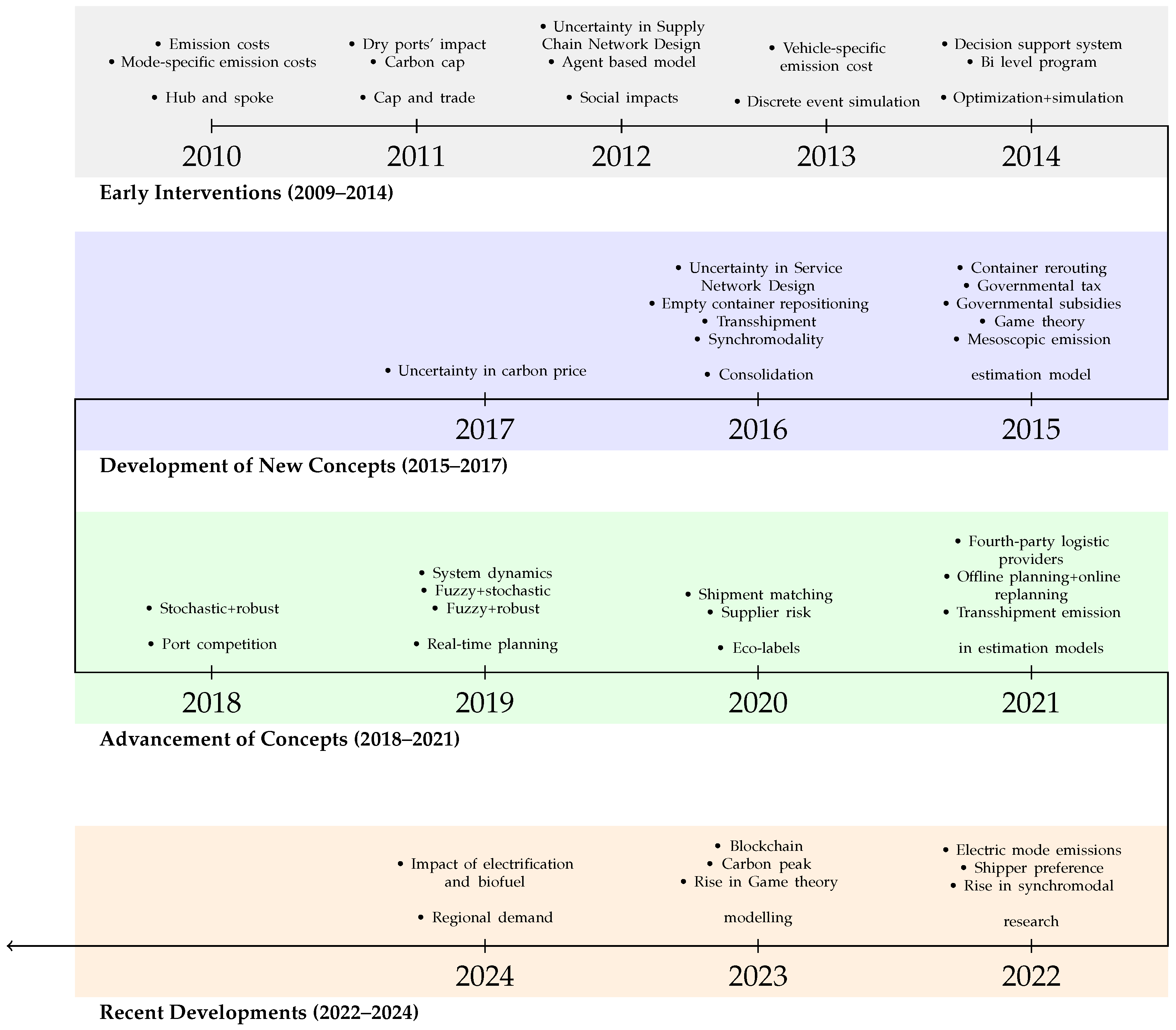
2. Chronological and Thematic Evolution of the Literature
2.1. Early Interventions (2009–2014)
2.2. Development of New Concepts (2015–2017)
2.3. Advancement of Concepts (2018–2021)
2.4. Recent Developments (2022–2024)
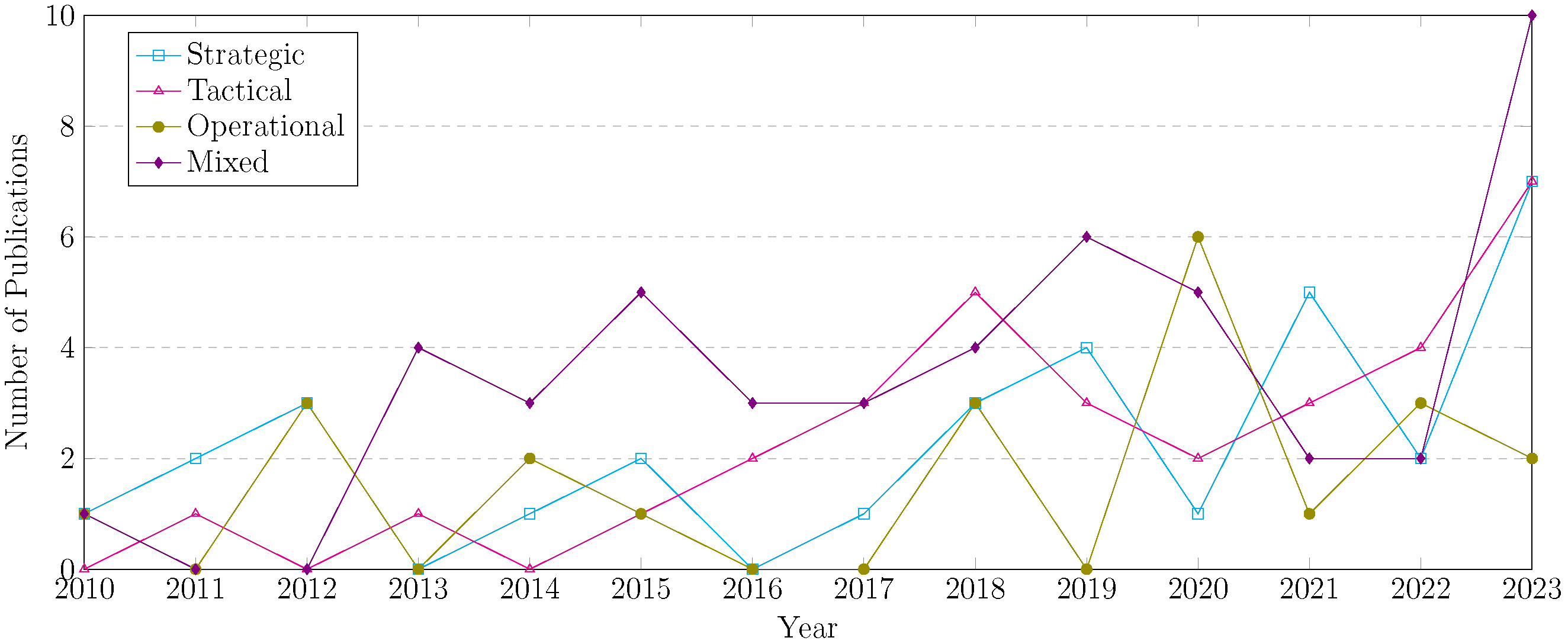
3. Integrated Analysis of Literature
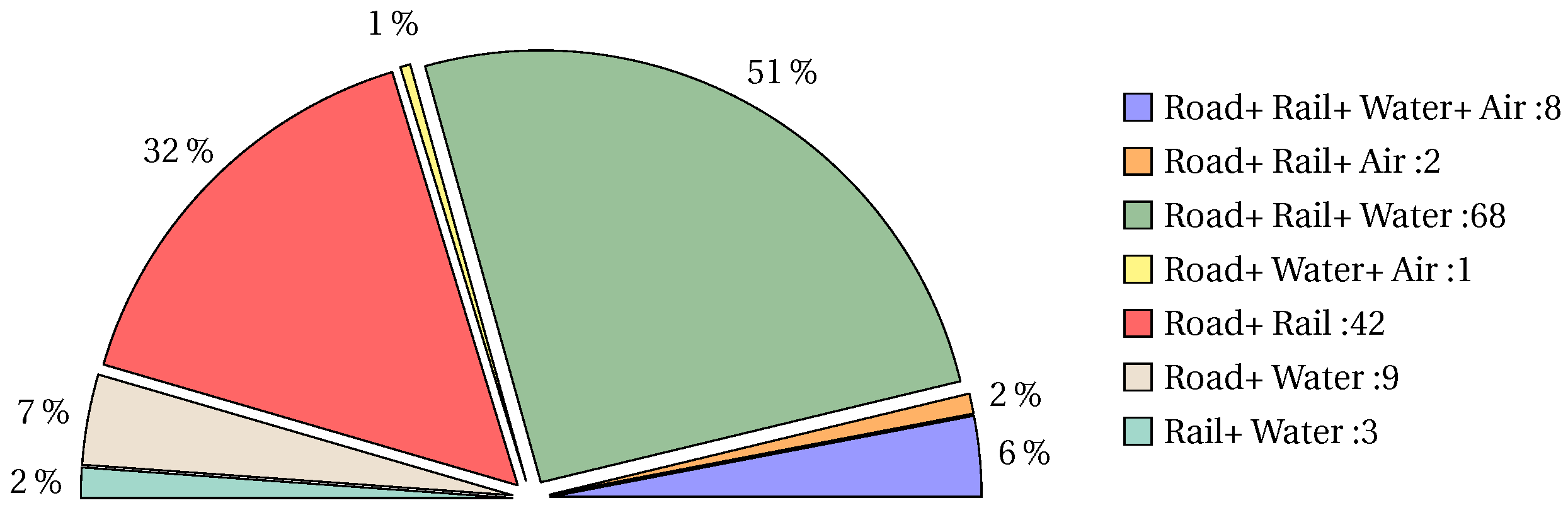
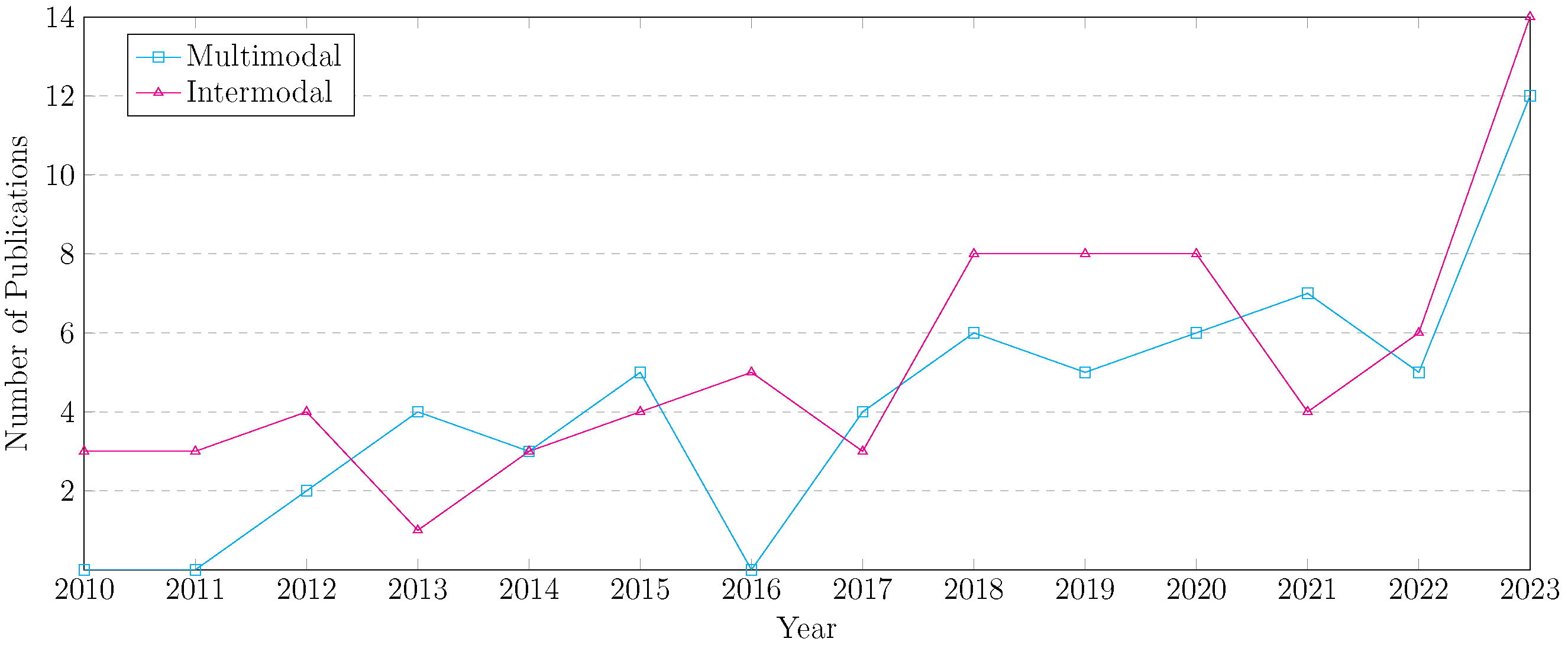
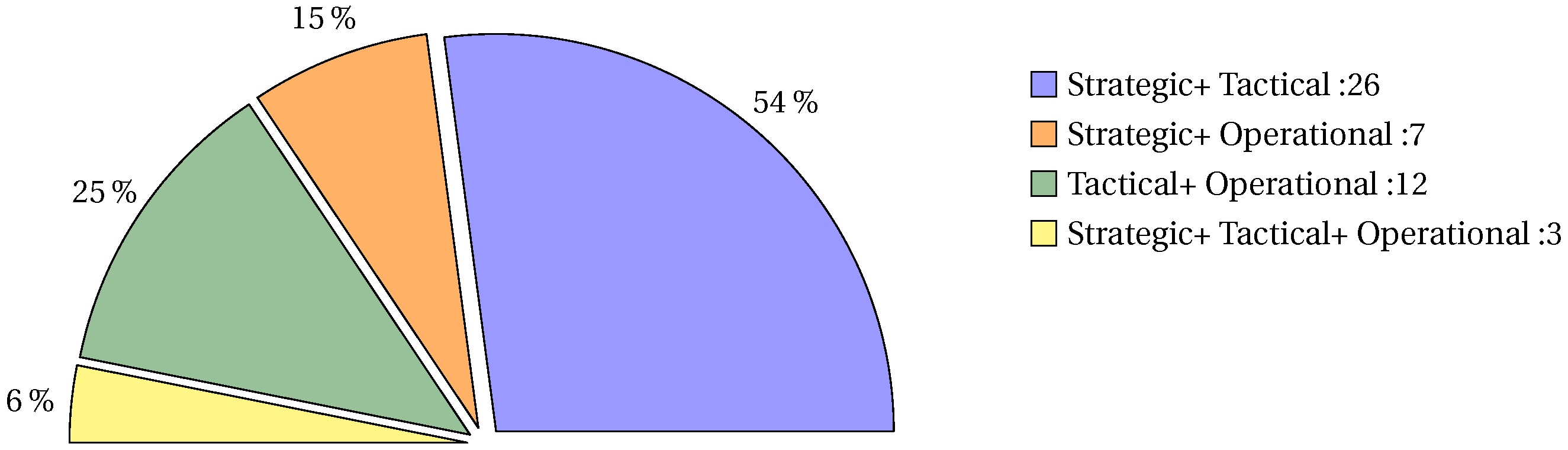
3.1. Modality Analysis
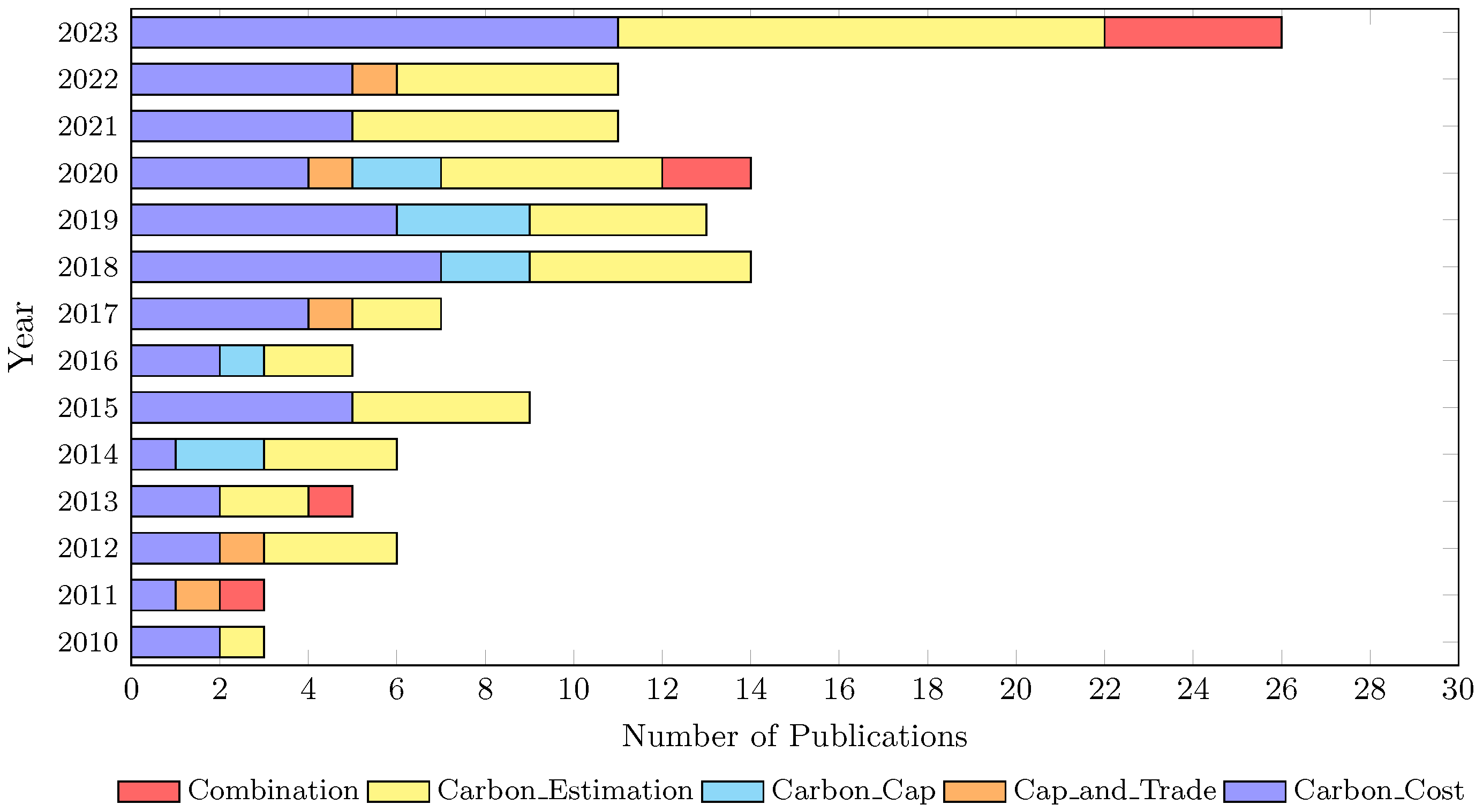
3.2. Sustainability Analysis
- Carbon estimation: Using emission estimations or factors that are minimized within OR models.
- Carbon cap: An emissions limit, often regulated by authorities.
- Carbon cost: Assigning a monetary value charged per unit of emissions (e.g., taxes).
- Cap-and-trade: Carbon credits that can be bought or sold in a market regulated by a third party.
- Combination: Any mix of the above methods.
4. Future Research Directions and Identified Gaps
5. Conclusions
Author Contributions
Funding
Institutional Review Board Statement
Informed Consent Statement
Data Availability Statement
Acknowledgments
Conflicts of Interest
Abbreviations
| AI | Artificial Intelligence |
| BOM | Bill of Materials |
| CO2 | Carbon dioxide |
| ECR | Empty Container Repositioning |
| EU | European Union |
| FT | Freight Transportation |
| GA | Genetic Algorithm |
| GHG | Greenhouse Gas |
| GT | Game Theory |
| IMT | Intermodal Transport |
| LCA | Life Cycle Assessment |
| LSP | Logistics Service Provider |
| MMT | Multimodal Transport |
| ND | Network Design |
| OR | Operations Research |
| SC | Supply Chain |
| SCND | Supply Chain Network Design |
| SD | System Dynamics |
| SMT | Synchromodal Transport |
| SND | Service Network Design |
| UAV | Unmanned Aerial Vehicle |
| UN | United Nations |
| US | United States |
Appendix A. Supplementary Table for Figure 1

| Year | Key Theme (References) |
|---|---|
| 2010 | Emission costs [16]; Mode-specific emission costs [17]; Hub and spoke [15] |
| 2011 | Dry ports’ impact [21]; Carbon cap [18]; Cap and trade [24] |
| 2012 | Uncertainty in Supply Chain Network Design [26,27]; Agent based model [27]; Social impacts [34] |
| 2013 | Vehicle-specific emission cost [19]; Discrete event simulation [22] |
| 2014 | Decision support system [36]; Bi level program [40]; Optimization+simulation [161] |
| 2015 | Container rerouting [41]; Governmental tax [44]; Governmental subsidies [46]; Game theory [45]; Mesoscopic emission estimation model [87] |
| 2016 | Uncertainty in Service Network Design [67]; Empty container repositioning [83]; Transshipment [62]; Synchromodality [162]; Consolidation [63] |
| 2017 | Uncertainty in carbon price [31] |
| 2018 | Stochastic+robust [51]; Port competition [74] |
| 2019 | System dynamics [53]; Fuzzy+stochastic [71]; Fuzzy+robust [73]; Real-time planning [99] |
| 2020 | Shipment matching [100]; Supplier risk [104]; Eco-labels [109] |
| 2021 | Fourth-party logistic providers [114]; Offline planning+online replanning [101]; Transshipment emission in estimation models [90] |
| 2022 | Electric mode emissions [91]; Shipper preference [123]; Rise in synchromodal research [121,123,125] |
| 2023 | Blockchain [126]; Carbon peak [134]; Rise in Game theory modelling [127,128,129] |
| 2024 | Impact of electrification and biofuel [154]; Regional demand [155] |
References
- Greene, S. Freight Transportation. MIT Climate Portal. 2023. Available online: https://climate.mit.edu/explainers/freight-transportation (accessed on 28 January 2026).
- International Transport Forum (ITF). Low-Carbon Road Freight. OECD. 2023. Available online: https://www.itf-oecd.org/low-carbon-road-freight (accessed on 28 January 2026).
- European Commission. Roadmap to a Single European Transport Area-Towards a Competitive and Resource Efficient Transport System; White Paper, Communication; European Commission: Brussels, Belgium, 2011; p. 144. [Google Scholar]
- ARPA-E. Intermodal Freight Transportation System. 2023. Available online: https://arpa-e.energy.gov/news-and-events/news-and-insights/us-department-energy-announces-9-million-projects-modeling-optimal-deployment-low-carbon-intermodal-freight-transportation-system (accessed on 29 April 2024).
- Macharis, C.; Bontekoning, Y.M. Opportunities for OR in intermodal freight transport research: A review. Eur. J. Oper. Res. 2004, 153, 400–416. [Google Scholar] [CrossRef]
- Merrina, A.; Sparavigna, A.; Wolf, R. The intermodal networks: A survey on intermodalism. World Rev. Intermodal Transp. Res. 2007, 1, 286–299. [Google Scholar] [CrossRef]
- Crainic, T.G.; Perboli, G.; Rosano, M. Simulation of intermodal freight transportation systems: A taxonomy. Eur. J. Oper. Res. 2018, 270, 401–418. [Google Scholar] [CrossRef]
- Archetti, C.; Peirano, L.; Speranza, M.G. Optimization in multimodal freight transportation problems: A Survey. Eur. J. Oper. Res. 2022, 299, 1–20. [Google Scholar] [CrossRef]
- Emodi, N.V.; Okereke, C.; Abam, F.I.; Diemuodeke, O.E.; Owebor, K.; Nnamani, U.A. Transport sector decarbonisation in the Global South: A systematic literature review. Energy Strategy Rev. 2022, 43, 100925. [Google Scholar]
- Aminzadegan, S.; Shahriari, M.; Mehranfar, F.; Abramović, B. Factors affecting the emission of pollutants in different types of transportation: A literature review. Energy Rep. 2022, 8, 2508–2529. [Google Scholar] [CrossRef]
- Forkenbrock, D.J. Comparison of external costs of rail and truck freight transportation. Transp. Res. Part A Policy Pract. 2001, 35, 321–337. [Google Scholar] [CrossRef]
- Kim, N.S.; Janic, M.; Van Wee, B. Trade-off between carbon dioxide emissions and logistics costs based on multiobjective optimization. Transp. Res. Rec. 2009, 2139, 107–116. [Google Scholar] [CrossRef]
- Kim, N.S.; Van Wee, B. Assessment of CO2 emissions for truck-only and rail-based intermodal freight systems in Europe. Transp. Plan. Technol. 2009, 32, 313–333. [Google Scholar]
- Kim, N.S.; Van Wee, B. Assessment of CO2 emissions for intermodal freight transport systems and truck-only system: Case study of Western–Eastern Europe corridor. In Proceedings of the 88th Annual Meeting of the Transportation Research Board, Washington, DC, USA, 11–15 January 2009; pp. 1–18. [Google Scholar]
- Comer, B.; Corbett, J.J.; Hawker, J.S.; Korfmacher, K.; Lee, E.E.; Prokop, C.; Winebrake, J.J. Marine vessels as substitutes for heavy-duty trucks in Great Lakes freight transportation. J. Air Waste Manag. Assoc. 2010, 60, 884–890. [Google Scholar] [CrossRef]
- Bauer, J.; Bektaş, T.; Crainic, T.G. Minimizing greenhouse gas emissions in intermodal freight transport: An application to rail service design. J. Oper. Res. Soc. 2010, 61, 530–542. [Google Scholar] [CrossRef]
- Chang, Y.T.; Lee, P.T.W.; Kim, H.J.; Shin, S.H. Optimization model for transportation of container cargoes considering short sea shipping and external cost: South Korean case. Transp. Res. Rec. 2010, 2166, 99–108. [Google Scholar]
- Zhang, J.; Ding, H.W.; Wang, X.Q.; Yin, W.J.; Zhao, T.Z.; Dong, J. Mode choice for the intermodal transportation considering carbon emissions. In Proceedings of the 2011 IEEE International Conference on Service Operations, Logistics and Informatics, Beijing, China, 10–12 July 2011; pp. 297–301. [Google Scholar]
- Le, T.P.N.; Lee, T.R. Model selection with considering the CO2 emission alone the global supply chain. J. Intell. Manuf. 2013, 24, 653–672. [Google Scholar]
- Roso, V. Evaluation of the dry port concept from an environmental perspective: A note. Transp. Res. Part D Transp. Environ. 2007, 12, 523–527. [Google Scholar]
- Henttu, V.; Hilmola, O.P. Financial and environmental impacts of hypothetical Finnish dry port structure. Res. Transp. Econ. 2011, 33, 35–41. [Google Scholar] [CrossRef]
- Lättilä, L.; Henttu, V.; Hilmola, O.P. Hinterland operations of sea ports do matter: Dry port usage effects on transportation costs and CO2 emissions. Transp. Res. Part E Logist. Transp. Rev. 2013, 55, 23–42. [Google Scholar] [CrossRef]
- Iannone, F. The private and social cost efficiency of port hinterland container distribution through a regional logistics system. Transp. Res. Part A Policy Pract. 2012, 46, 1424–1448. [Google Scholar] [CrossRef]
- Chaabane, A.; Ramudhin, A.; Paquet, M. Designing supply chains with sustainability considerations. Prod. Plan. Control 2011, 22, 727–741. [Google Scholar]
- Chaabane, A.; Ramudhin, A.; Paquet, M. Design of sustainable supply chains under the emission trading scheme. Int. J. Prod. Econ. 2012, 135, 37–49. [Google Scholar] [CrossRef]
- Pishvaee, M.S.; Torabi, S.A.; Razmi, J. Credibility-based fuzzy mathematical programming model for green logistics design under uncertainty. Comput. Ind. Eng. 2012, 62, 624–632. [Google Scholar] [CrossRef]
- Holmgren, J.; Davidsson, P.; Persson, J.A.; Ramstedt, L. TAPAS: A multi-agent-based model for simulation of transport chains. Simul. Model. Pract. Theory 2012, 23, 1–18. [Google Scholar]
- Fahimnia, B.; Sarkis, J.; Dehghanian, F.; Banihashemi, N.; Rahman, S. The impact of carbon pricing on a closed-loop supply chain: An Australian case study. J. Clean. Prod. 2013, 59, 210–225. [Google Scholar] [CrossRef]
- Zhang, M.; Wiegmans, B.; Tavasszy, L. Optimization of multimodal networks including environmental costs: A model and findings for transport policy. Comput. Ind. 2013, 64, 136–145. [Google Scholar] [CrossRef]
- Hoen, K.M.; Tan, T.; Fransoo, J.C.; van Houtum, G.J. Switching transport modes to meet voluntary carbon emission targets. Transp. Sci. 2014, 48, 592–608. [Google Scholar] [CrossRef]
- Rezaee, A.; Dehghanian, F.; Fahimnia, B.; Beamon, B. Green supply chain network design with stochastic demand and carbon price. Ann. Oper. Res. 2017, 250, 463–485. [Google Scholar]
- Fahimnia, B.; Sarkis, J.; Choudhary, A.; Eshragh, A. Tactical supply chain planning under a carbon tax policy scheme: A case study. Int. J. Prod. Econ. 2015, 164, 206–215. [Google Scholar] [CrossRef]
- Zhang, D.; He, R.; Li, S.; Wang, Z. A multimodal logistics service network design with time windows and environmental concerns. PLoS ONE 2017, 12, e0185001. [Google Scholar] [CrossRef]
- Sawadogo, M.; Anciaux, D.; Daniel, R. Reducing intermodal transportation impacts on society and environment by path selection: A multiobjective shortest path approach. IFAC Proc. Vol. 2012, 45, 505–513. [Google Scholar] [CrossRef]
- Kim, S.; Park, M.; Lee, C. Multimodal freight transportation network design problem for reduction of greenhouse gas emissions. Transp. Res. Rec. 2013, 2340, 74–83. [Google Scholar] [CrossRef]
- Kengpol, A.; Tuammee, S.; Tuominen, M. The development of a framework for route selection in multimodal transportation. Int. J. Logist. Manag. 2014, 25, 581–610. [Google Scholar] [CrossRef]
- Soysal, M.; Bloemhof-Ruwaard, J.M.; Van Der Vorst, J.G. Modelling food logistics networks with emission considerations: The case of an international beef supply chain. Int. J. Prod. Econ. 2014, 152, 57–70. [Google Scholar] [CrossRef]
- Pan, Y.; Li, X.; Zhang, M.; Zhou, M.; Duan, Y. Multimodal transportation network optimization with environmental and economic performance considered: An ongoing research. In Proceedings of the 2017 International Conference on Service Systems and Service Management, Dalian, China, 16–18 June 2017; pp. 1–6. [Google Scholar]
- Rodrigues, V.S.; Beresford, A.; Pettit, S.; Bhattacharya, S.; Harris, I. Assessing the cost and CO2e impacts of rerouteing UK import containers. Transp. Res. Part A Policy Pract. 2014, 61, 53–67. [Google Scholar]
- Chen, K.; Yang, Z.; Notteboom, T. The design of coastal shipping services subject to carbon emission reduction targets and state subsidy levels. Transp. Res. Part E Logist. Transp. Rev. 2014, 61, 192–211. [Google Scholar]
- Rodrigues, V.S.; Pettit, S.; Harris, I.; Beresford, A.; Piecyk, M.; Yang, Z.; Ng, A. UK supply chain carbon mitigation strategies using alternative ports and multimodal freight transport operations. Transp. Res. Part E Logist. Transp. Rev. 2015, 78, 40–56. [Google Scholar] [CrossRef]
- Liotta, G.; Stecca, G.; Kaihara, T. Optimisation of freight flows and sourcing in sustainable production and transportation networks. Int. J. Prod. Econ. 2015, 164, 351–365. [Google Scholar] [CrossRef]
- Chasek, P.S.; Wagner, L.M.; Leone, F.; Lebada, A.M.; Risse, N. Getting to 2030: Negotiating the post-2015 sustainable development agenda. Rev. Eur. Comp. Int. Environ. Law 2016, 25, 5–14. [Google Scholar]
- Duan, X.; Heragu, S. Carbon emission tax policy in an intermodal transportation network. In Proceedings of the IIE Annual Conference, Nashville, TN, USA, 30 May–2 June 2015; Institute of Industrial and Systems Engineers (IISE): Norcross, GA, USA, 2015; Volume 30, pp. 566–574. [Google Scholar]
- Wang, M.; Liu, K.; Choi, T.M.; Yue, X. Effects of carbon emission taxes on transportation mode selections and social welfare. IEEE Trans. Syst. Man Cybern. Syst. 2015, 45, 1413–1423. [Google Scholar] [CrossRef]
- Bouchery, Y.; Fransoo, J. Cost, carbon emissions and modal shift in intermodal network design decisions. Int. J. Prod. Econ. 2015, 164, 388–399. [Google Scholar] [CrossRef]
- Zhang, M.; Janic, M.; Tavasszy, L.A. A freight transport optimization model for integrated network, service, and policy design. Transp. Res. Part E Logist. Transp. Rev. 2015, 77, 61–76. [Google Scholar]
- Lin, B.; Liu, C.; Wang, H.; Lin, R. Modeling the railway network design problem: A novel approach to considering carbon emissions reduction. Transp. Res. Part D Transp. Environ. 2017, 56, 95–109. [Google Scholar] [CrossRef]
- Mostert, M.; Caris, A.; Limbourg, S. Road and intermodal transport performance: The impact of operational costs and air pollution external costs. Res. Transp. Bus. Manag. 2017, 23, 75–85. [Google Scholar] [CrossRef]
- Mostert, M.; Caris, A.; Limbourg, S. Intermodal network design: A three-mode bi-objective model applied to the case of Belgium. Flex. Serv. Manuf. J. 2018, 30, 397–420. [Google Scholar] [CrossRef]
- Haddadsisakht, A.; Ryan, S.M. Closed-loop supply chain network design with multiple transportation modes under stochastic demand and uncertain carbon tax. Int. J. Prod. Econ. 2018, 195, 118–131. [Google Scholar] [CrossRef]
- Zhang, D.; Zhan, Q.; Chen, Y.; Li, S. Joint optimization of logistics infrastructure investments and subsidies in a regional logistics network with CO2 emission reduction targets. Transp. Res. Part D Transp. Environ. 2018, 60, 174–190. [Google Scholar] [CrossRef]
- Choi, B.; Park, S.i.; Lee, K.D. A system dynamics model of the modal shift from road to rail: Containerization and imposition of taxes. J. Adv. Transp. 2019, 2019, 7232710. [Google Scholar] [CrossRef]
- Jiang, J.; Zhang, D.; Meng, Q.; Liu, Y. Regional multimodal logistics network design considering demand uncertainty and CO2 emission reduction target: A system-optimization approach. J. Clean. Prod. 2020, 248, 119304. [Google Scholar] [CrossRef]
- Li, L.; Zhang, X. Integrated optimization of railway freight operation planning and pricing based on carbon emission reduction policies. J. Clean. Prod. 2020, 263, 121316. [Google Scholar] [CrossRef]
- Yang, Z.; Xin, X.; Chen, K.; Yang, A. Coastal container multimodal transportation system shipping network design—toll policy joint optimization model. J. Clean. Prod. 2021, 279, 123340. [Google Scholar] [CrossRef]
- Qian, Q.; Li, D.; Gan, M.; Yao, Z. Decision analysis of the optimal freight structure at provincial level in China. Environ. Sci. Pollut. Res. 2021, 28, 54972–54985. [Google Scholar] [CrossRef] [PubMed]
- Gallardo, P.; Murray, R.; Krumdieck, S. A sequential optimization-simulation approach for planning the transition to the low carbon freight system with case study in the North Island of New Zealand. Energies 2021, 14, 3339. [Google Scholar] [CrossRef]
- Pedinotti-Castelle, M.; Pineau, P.O.; Vaillancourt, K.; Amor, B. Freight transport modal shifts in a TIMES energy model: Impacts of endogenous and exogenous modeling choice. Appl. Energy 2022, 324, 119724. [Google Scholar] [CrossRef]
- Halim, R.A. Boosting intermodal rail for decarbonizing freight transport on Java, Indonesia: A model-based policy impact assessment. Res. Transp. Bus. Manag. 2023, 48, 100909. [Google Scholar] [CrossRef]
- Qu, Y.; Bektaş, T.; Bennell, J. Sustainability SI: Multimode multicommodity network design model for intermodal freight transportation with transfer and emission costs. Networks Spat. Econ. 2016, 16, 303–329. [Google Scholar] [CrossRef]
- Rudi, A.; Fröhling, M.; Zimmer, K.; Schultmann, F. Freight transportation planning considering carbon emissions and in-transit holding costs: A capacitated multi-commodity network flow model. EURO J. Transp. Logist. 2016, 5, 123–160. [Google Scholar] [CrossRef]
- Baykasoğlu, A.; Subulan, K. A multi-objective sustainable load planning model for intermodal transportation networks with a real-life application. Transp. Res. Part E Logist. Transp. Rev. 2016, 95, 207–247. [Google Scholar] [CrossRef]
- Ji, S.f.; Luo, R.j. A hybrid estimation of distribution algorithm for multi-objective multi-sourcing intermodal transportation network design problem considering carbon emissions. Sustainability 2017, 9, 1133. [Google Scholar] [CrossRef]
- Zhou, M.; Duan, Y.; Yang, W.; Pan, Y.; Zhou, M. Capacitated multi-modal network flow models for minimizing total operational cost and CO2e emission. Comput. Ind. Eng. 2018, 126, 361–377. [Google Scholar] [CrossRef]
- Sun, Y.; Li, X.; Liang, X.; Zhang, C. A bi-objective fuzzy credibilistic chance-constrained programming approach for the hazardous materials road-rail multimodal routing problem under uncertainty and sustainability. Sustainability 2019, 11, 2577. [Google Scholar] [CrossRef]
- Demir, E.; Burgholzer, W.; Hrušovskỳ, M.; Arıkan, E.; Jammernegg, W.; Van Woensel, T. A green intermodal service network design problem with travel time uncertainty. Transp. Res. Part B Methodol. 2016, 93, 789–807. [Google Scholar] [CrossRef]
- Hrušovskỳ, M.; Demir, E.; Jammernegg, W.; Van Woensel, T. Hybrid simulation and optimization approach for green intermodal transportation problem with travel time uncertainty. Flex. Serv. Manuf. J. 2018, 30, 486–516. [Google Scholar] [CrossRef]
- Layeb, S.B.; Jaoua, A.; Jbira, A.; Makhlouf, Y. A simulation-optimization approach for scheduling in stochastic freight transportation. Comput. Ind. Eng. 2018, 126, 99–110. [Google Scholar] [CrossRef]
- Sun, Y.; Hrušovskỳ, M.; Zhang, C.; Lang, M. A time-dependent fuzzy programming approach for the green multimodal routing problem with rail service capacity uncertainty and road traffic congestion. Complexity 2018, 2018, 8645793. [Google Scholar] [CrossRef]
- Baykasoğlu, A.; Subulan, K. A fuzzy-stochastic optimization model for the intermodal fleet management problem of an international transportation company. Transp. Plan. Technol. 2019, 42, 777–824. [Google Scholar] [CrossRef]
- Tran, N.K.; Haasis, H.D.; Buer, T. Container shipping route design incorporating the costs of shipping, inland/feeder transport, inventory and CO2 emission. Marit. Econ. Logist. 2017, 19, 667–694. [Google Scholar] [CrossRef]
- Tsao, Y.C.; Linh, V.T. Seaport-dry port network design considering multimodal transport and carbon emissions. J. Clean. Prod. 2018, 199, 481–492. [Google Scholar] [CrossRef]
- Xu, X.; Zhang, Q.; Wang, W.; Peng, Y.; Song, X.; Jiang, Y. Modelling port competition for intermodal network design with environmental concerns. J. Clean. Prod. 2018, 202, 720–735. [Google Scholar] [CrossRef]
- Liu, P.; Liu, C.; Du, J.; Mu, D. A system dynamics model for emissions projection of hinterland transportation. J. Clean. Prod. 2019, 218, 591–600. [Google Scholar] [CrossRef]
- Tsao, Y.C.; Thanh, V.V. A multi-objective mixed robust possibilistic flexible programming approach for sustainable seaport-dry port network design under an uncertain environment. Transp. Res. Part E Logist. Transp. Rev. 2019, 124, 13–39. [Google Scholar] [CrossRef]
- Wei, H.; Dong, M. Import-export freight organization and optimization in the dry-port-based cross-border logistics network under the Belt and Road Initiative. Comput. Ind. Eng. 2019, 130, 472–484. [Google Scholar] [CrossRef]
- Li, X.; Kuang, H.; Hu, Y. Carbon mitigation strategies of port selection and multimodal transport operations—A case study of northeast China. Sustainability 2019, 11, 4877. [Google Scholar] [CrossRef]
- Wang, W.; Xu, X.; Jiang, Y.; Xu, Y.; Cao, Z.; Liu, S. Integrated scheduling of intermodal transportation with seaborne arrival uncertainty and carbon emission. Transp. Res. Part D Transp. Environ. 2020, 88, 102571. [Google Scholar] [CrossRef]
- Dai, Q.; Yang, J. A distributionally robust chance-constrained approach for modeling demand uncertainty in green port-hinterland transportation network optimization. Symmetry 2020, 12, 1492. [Google Scholar]
- Abu Aisha, T.; Ouhimmou, M.; Paquet, M. Optimization of container terminal layouts in the seaport—Case of port of Montreal. Sustainability 2020, 12, 1165. [Google Scholar] [CrossRef]
- Yin, C.; Ke, Y.; Chen, J.; Liu, M. Interrelations between sea hub ports and inland hinterlands: Perspectives of multimodal freight transport organization and low carbon emissions. Ocean Coast. Manag. 2021, 214, 105919. [Google Scholar] [CrossRef]
- Lam, J.S.L.; Gu, Y. A market-oriented approach for intermodal network optimisation meeting cost, time and environmental requirements. Int. J. Prod. Econ. 2016, 171, 266–274. [Google Scholar] [CrossRef]
- Zhao, Y.; Xue, Q.; Zhang, X. Stochastic empty container repositioning problem with CO2 emission considerations for an intermodal transportation system. Sustainability 2018, 10, 4211. [Google Scholar] [CrossRef]
- Castrellon, J.P.; Sanchez-Diaz, I.; Roso, V.; Altuntas-Vural, C.; Rogerson, S.; Santén, V.; Kalahasthi, L.K. Assessing the eco-efficiency benefits of empty container repositioning strategies via dry ports. Transp. Res. Part D Transp. Environ. 2023, 120, 103778. [Google Scholar]
- Demir, E.; Bektaş, T.; Laporte, G. A review of recent research on green road freight transportation. Eur. J. Oper. Res. 2014, 237, 775–793. [Google Scholar] [CrossRef]
- Kirschstein, T.; Meisel, F. GHG-emission models for assessing the eco-friendliness of road and rail freight transports. Transp. Res. Part B Methodol. 2015, 73, 13–33. [Google Scholar] [CrossRef]
- Heinold, A.; Meisel, F. Emission rates of intermodal rail/road and road-only transportation in Europe: A comprehensive simulation study. Transp. Res. Part D Transp. Environ. 2018, 65, 421–437. [Google Scholar] [CrossRef]
- Pizzol, M. Deterministic and stochastic carbon footprint of intermodal ferry and truck freight transport across Scandinavian routes. J. Clean. Prod. 2019, 224, 626–636. [Google Scholar] [CrossRef]
- Tao, X.; Wu, Q. Energy consumption and CO2 emissions in hinterland container transport. J. Clean. Prod. 2021, 279, 123394. [Google Scholar] [CrossRef]
- Guo, X.; He, J.; Lan, M.; Yu, H.; Yan, W. Modeling carbon emission estimation for hinterland-based container intermodal network. J. Clean. Prod. 2022, 378, 134593. [Google Scholar] [CrossRef]
- Harris, I.; Rodrigues, V.S.; Pettit, S.; Beresford, A.; Liashko, R. The impact of alternative routeing and packaging scenarios on carbon and sulphate emissions in international wine distribution. Transp. Res. Part D Transp. Environ. 2018, 58, 261–279. [Google Scholar] [CrossRef]
- Ma, Q.; Wang, W.; Peng, Y.; Song, X. An optimization approach to the intermodal transportation network in fruit cold chain, considering cost, quality degradation and carbon dioxide footprint. Pol. Marit. Res. 2018, 25, 61–69. [Google Scholar] [CrossRef]
- Maiyar, L.M.; Thakkar, J.J. Modelling and analysis of intermodal food grain transportation under hub disruption towards sustainability. Int. J. Prod. Econ. 2019, 217, 281–297. [Google Scholar] [CrossRef]
- Demir, E.; Hrušovskỳ, M.; Jammernegg, W.; Van Woensel, T. Green intermodal freight transportation: Bi-objective modelling and analysis. Int. J. Prod. Res. 2019, 57, 6162–6180. [Google Scholar] [CrossRef]
- Laurent, A.B.; Vallerand, S.; Van der Meer, Y.; D’Amours, S. CarbonRoadMap: A multicriteria decision tool for multimodal transportation. Int. J. Sustain. Transp. 2020, 14, 205–214. [Google Scholar]
- Giusti, R.; Manerba, D.; Bruno, G.; Tadei, R. Synchromodal logistics: An overview of critical success factors, enabling technologies, and open research issues. Transp. Res. Part E Logist. Transp. Rev. 2019, 129, 92–110. [Google Scholar]
- Farahani, N.Z.; Noble, J.S.; Klein, C.M.; Enayati, M. A decision support tool for energy efficient synchromodal supply chains. J. Clean. Prod. 2018, 186, 682–702. [Google Scholar] [CrossRef]
- Resat, H.G.; Turkay, M. A discrete-continuous optimization approach for the design and operation of synchromodal transportation networks. Comput. Ind. Eng. 2019, 130, 512–525. [Google Scholar] [CrossRef]
- Guo, W.; Atasoy, B.; van Blokland, W.B.; Negenborn, R.R. A dynamic shipment matching problem in hinterland synchromodal transportation. Decis. Support Syst. 2020, 134, 113289. [Google Scholar] [CrossRef]
- Hrušovskỳ, M.; Demir, E.; Jammernegg, W.; Van Woensel, T. Real-time disruption management approach for intermodal freight transportation. J. Clean. Prod. 2021, 280, 124826. [Google Scholar] [CrossRef]
- Sun, Y. Green and Reliable Freight Routing Problem in the Road-Rail Intermodal Transportation Network with Uncertain Parameters: A Fuzzy Goal Programming Approach. J. Adv. Transp. 2020, 2020, 7570686. [Google Scholar] [CrossRef]
- Wang, C.N.; Dang, T.T.; Le, T.Q.; Kewcharoenwong, P. Transportation optimization models for intermodal networks with fuzzy node capacity, detour factor, and vehicle utilization constraints. Mathematics 2020, 8, 2109. [Google Scholar] [CrossRef]
- Kabadurmus, O.; Erdogan, M.S. Sustainable, multimodal and reliable supply chain design. Ann. Oper. Res. 2020, 292, 47–70. [Google Scholar] [CrossRef]
- Mousavi Ahranjani, P.; Ghaderi, S.F.; Azadeh, A.; Babazadeh, R. Robust design of a sustainable and resilient bioethanol supply chain under operational and disruption risks. Clean Technol. Environ. Policy 2020, 22, 119–151. [Google Scholar]
- Sun, Y.; Lang, M. Modeling the Multicommodity Multimodal Routing Problem with Schedule-Based Services and Carbon Dioxide Emission Costs. Math. Probl. Eng. 2015, 2015, 406218. [Google Scholar] [CrossRef]
- Maneengam, A. A bi-objective programming model for multimodal transportation routing problem of bulk cargo transportation. In Proceedings of the 2020 IEEE 7th International Conference on Industrial Engineering and Applications (ICIEA), Bangkok, Thailand, 16–21 April 2020; pp. 890–894. [Google Scholar]
- Wang, Q.Z.; Chen, J.M.; Tseng, M.L.; Luan, H.M.; Ali, M.H. Modelling green multimodal transport route performance with witness simulation software. J. Clean. Prod. 2020, 248, 119245. [Google Scholar] [CrossRef]
- Heinold, A.; Meisel, F. Emission limits and emission allocation schemes in intermodal freight transportation. Transp. Res. Part E Logist. Transp. Rev. 2020, 141, 101963. [Google Scholar] [CrossRef]
- Fulzele, V.; Shankar, R.; Choudhary, D. A model for the selection of transportation modes in the context of sustainable freight transportation. Ind. Manag. Data Syst. 2019, 119, 1764–1784. [Google Scholar] [CrossRef]
- Wang, D.; Zhou, L.; Zhang, H.; Liang, X. A bi-level model for green freight transportation pricing strategy considering enterprise profit and carbon emissions. Sustainability 2021, 13, 6514. [Google Scholar] [CrossRef]
- Zhang, X.; Jin, F.Y.; Yuan, X.M.; Zhang, H.Y. Low-carbon multimodal transportation path optimization under dual uncertainty of demand and time. Sustainability 2021, 13, 8180. [Google Scholar] [CrossRef]
- Tiwari, S.; Wee, H.M.; Zhou, Y.; Tjoeng, L. Freight consolidation and containerization strategy under business as usual scenario & carbon tax regulation. J. Clean. Prod. 2021, 279, 123270. [Google Scholar] [CrossRef]
- Wu, J.; Wang, Y.; Li, W.; Wu, H. Research on Green Transport Mode of Chinese Bulk Cargo Based on Fourth-Party Logistics. J. Adv. Transp. 2021, 2021, 6142226. [Google Scholar] [CrossRef]
- Li, M.; Sun, X. Path optimization of low-carbon container multimodal transport under uncertain conditions. Sustainability 2022, 14, 14098. [Google Scholar] [CrossRef]
- Lu, Y.; Lang, M.; Yu, X.; Li, S. A sustainable multimodal transport system: The two-echelon location-routing problem with consolidation in the euro–China expressway. Sustainability 2019, 11, 5486. [Google Scholar] [CrossRef]
- Liang, X.; Liu, X.; Mei, L.; Zhang, D. Multi-objective green multimodal transport path optimization with the participation of high-speed railway. In Proceedings of the 2021 6th International Conference on Transportation Information and Safety (ICTIS) (ICTIS), Wuhan, China, 22–24 October 2021; pp. 1072–1077. [Google Scholar]
- Qi, Y.; Harrod, S.; Psaraftis, H.N.; Lang, M. Transport service selection and routing with carbon emissions and inventory costs consideration in the context of the Belt and Road Initiative. Transp. Res. Part E Logist. Transp. Rev. 2022, 159, 102630. [Google Scholar] [CrossRef]
- Xie, F.J.; Feng, R.C.; Zhou, X.Y. Research on the Optimization of Cross-Border Logistics Paths of the “Belt and Road” in the Inland Regions. J. Adv. Transp. 2022, 2022, 5776334. [Google Scholar] [CrossRef]
- Sun, Y.; Yu, N.; Huang, B. Green road–rail intermodal routing problem with improved pickup and delivery services integrating truck departure time planning under uncertainty: An interactive fuzzy programming approach. Complex Intell. Syst. 2022, 8, 1459–1486. [Google Scholar] [CrossRef]
- Zhang, Y.; Heinold, A.; Meisel, F.; Negenborn, R.R.; Atasoy, B. Collaborative planning for intermodal transport with eco-label preferences. Transp. Res. Part D Transp. Environ. 2022, 112, 103470. [Google Scholar]
- Heinold, A.; Meisel, F.; Ulmer, M.W. Primal-dual value function approximation for stochastic dynamic intermodal transportation with eco-labels. Transp. Sci. 2023, 57, 1452–1472. [Google Scholar] [CrossRef]
- Zhang, Y.; Atasoy, B.; Negenborn, R.R. Preference-based multi-objective optimization for synchromodal transport using adaptive large neighborhood search. Transp. Res. Rec. 2022, 2676, 71–87. [Google Scholar]
- Zhang, Y.; Li, X.; van Hassel, E.; Negenborn, R.R.; Atasoy, B. Synchromodal transport planning considering heterogeneous and vague preferences of shippers. Transp. Res. Part E Logist. Transp. Rev. 2022, 164, 102827. [Google Scholar] [CrossRef]
- Zhang, Y.; Guo, W.; Negenborn, R.R.; Atasoy, B. Synchromodal transport planning with flexible services: Mathematical model and heuristic algorithm. Transp. Res. Part C Emerg. Technol. 2022, 140, 103711. [Google Scholar] [CrossRef]
- Oudani, M. A combined multi-objective multi criteria approach for blockchain-based synchromodal transportation. Comput. Ind. Eng. 2023, 176, 108996. [Google Scholar] [CrossRef]
- Shams, H.R.; Tamannaei, M.; Zarei, H. A game-theoretic approach to designing carbon regulations in a duopoly freight transportation market: Road and multimodal road-rail competitive systems. Environ. Sci. Pollut. Res. 2023, 30, 111284–111308. [Google Scholar] [CrossRef]
- Wu, Y.; Zhang, R. Game-theoretical method toward dry port multilevel location considering capacity constraints and shippers’ choice behavior. Transp. Res. Rec. 2023, 2677, 64–82. [Google Scholar] [CrossRef]
- Rahiminia, S.; Mehrabi, A.; Pourseyed Aghaee, M.; Jamili, A. Adopting a Bi-level Optimization Method for the Freight Transportation Problem: A Multi-objective Programming Approach. Transp. Res. Rec. 2023, 2677, 490–504. [Google Scholar]
- Chen, Z.; Zhang, Z.; Bian, Z.; Dai, L.; Hu, H. Subsidy policy optimization of multimodal transport on emission reduction considering carrier pricing game and shipping resilience: A case study of Shanghai port. Ocean Coast. Manag. 2023, 243, 106760. [Google Scholar] [CrossRef]
- Zhong, H.; Chen, W.; Gu, Y. A system dynamics model of port hinterland intermodal transport: A case study of Guangdong-Hong Kong-Macao Greater Bay Area under different carbon taxation policies. Res. Transp. Bus. Manag. 2023, 49, 100987. [Google Scholar] [CrossRef]
- Nassar, R.F.; Ghisolfi, V.; Annema, J.A.; van Binsbergen, A.; Tavasszy, L.A. A system dynamics model for analyzing modal shift policies towards decarbonization in freight transportation. Res. Transp. Bus. & Manag. 2023, 48, 100966. [Google Scholar]
- Guo, T.; Liu, P.; Wang, C.; Xie, J.; Du, J.; Lim, M.K. Toward sustainable port-hinterland transportation: A holistic approach to design modal shift policy mixes. Transp. Res. Part A Policy Pract. 2023, 174, 103746. [Google Scholar] [CrossRef]
- Zuo, D.; Liang, Q.; Zhan, S.; Huang, W.; Yang, S.; Wang, M. Using energy consumption constraints to control the freight transportation structure in China (2021–2030). Energy 2023, 262, 125512. [Google Scholar] [CrossRef]
- Yu, S.; Zheng, S.; Li, X. The achievement of the carbon emissions peak in China: The role of energy consumption structure optimization. Energy Econ. 2018, 74, 693–707. [Google Scholar] [CrossRef]
- Guo, X.; He, J.; Yu, H.; Liu, M. Carbon peak simulation and peak pathway analysis for hub-and-spoke container intermodal network. Transp. Res. Part E Logist. Transp. Rev. 2023, 180, 103332. [Google Scholar] [CrossRef]
- Ke, H.; Xu, G.; Li, C.; Gao, J.; Xiao, X.; Wu, X.; Yan, Q. Optimization of China’s freight transportation structure based on adaptive genetic algorithm under the background of carbon peak. Environ. Sci. Pollut. Res. 2023, 30, 85087–85101. [Google Scholar] [CrossRef]
- Zhang, T.; Chen, N. Research on Multimodal Transportation Path Optimization Based on Improved Genetic Algorithm. In Proceedings of the 2023 7th International Conference on Transportation Information and Safety (ICTIS), Xi’an, China, 4–6 August 2023; pp. 2034–2043. [Google Scholar]
- Yang, L.; Zhang, C.; Wu, X. Multi-Objective Path Optimization of Highway-Railway Multimodal Transport Considering Carbon Emissions. Appl. Sci. 2023, 13, 4731. [Google Scholar] [CrossRef]
- Li, H.; Wang, Y. Hierarchical multimodal hub location problem with carbon emissions. Sustainability 2023, 15, 1945. [Google Scholar] [CrossRef]
- Shoukat, R.; Xiaoqiang, Z. Sustainable logistics network optimization from dry ports to seaport: A case study from Pakistan. Transp. Res. Rec. 2023, 2677, 302–318. [Google Scholar] [CrossRef]
- Sun, Y.; Sun, G.; Huang, B.; Ge, J. Modeling a Carbon-Efficient Road–Rail Intermodal Routing Problem with Soft Time Windows in a Time-Dependent and Fuzzy Environment by Chance-Constrained Programming. Systems 2023, 11, 403. [Google Scholar] [CrossRef]
- Li, L.; Zhang, Q.; Zhang, T.; Zou, Y.; Zhao, X. Optimum Route and Transport Mode Selection of Multimodal Transport with Time Window under Uncertain Conditions. Mathematics 2023, 11, 3244. [Google Scholar] [CrossRef]
- Liu, S. Multimodal transportation route optimization of cold chain container in time-varying network considering carbon emissions. Sustainability 2023, 15, 4435. [Google Scholar] [CrossRef]
- Kurtuluş, E. Green Container Shipping Schedule Design Considering Collaboration and Disruption Recovery. IEEE Access 2023, 11, 90477–90497. [Google Scholar] [CrossRef]
- Sun, Y.; Lu, Z.; Lian, F.; Yang, Z. Study of channel upgrades and ship choices of river-shipping of port access-transportation. Transp. Res. Part D Transp. Environ. 2023, 119, 103733. [Google Scholar]
- Wu, Y.; Zhang, R. Evaluation Model for a Port Hinterland Intermodal Freight Network Considering Environmental Impacts and Capacity Constraints. Transp. Res. Rec. 2023, 2677, 462–478. [Google Scholar]
- Guo, L.; Du, J.; Zheng, J.; He, N. Integrated Planning of Feeder Route Selection, Schedule Design, and Fleet Allocation with Multimodal Transport Path Selection Considered. J. Mar. Sci. Eng. 2023, 11, 1445. [Google Scholar] [CrossRef]
- Ko, S.; Choi, K.; Yu, S.; Lee, J. A stochastic optimization model for sustainable multimodal transportation for bioenergy production. Sustainability 2022, 14, 1889. [Google Scholar] [CrossRef]
- de Almeida Rodrigues, T.; de Miranda Mota, C.M.; Ojiako, U.; Chipulu, M.; Marshall, A.; Dweiri, F. A flexible cost model for seaport-hinterland decisions in container shipping. Res. Transp. Bus. Manag. 2023, 49, 101016. [Google Scholar] [CrossRef]
- Feng, X.; Song, R.; Yin, W.; Yin, X.; Zhang, R. Multimodal transportation network with cargo containerization technology: Advantages and challenges. Transp. Policy 2023, 132, 128–143. [Google Scholar] [CrossRef]
- Yin, C.; Zhang, Z.A.; Fu, X.; Ge, Y.E. A low-carbon transportation network: Collaborative effects of a rail freight subsidy and carbon trading mechanism. Transp. Res. Part A Policy Pract. 2024, 184, 104066. [Google Scholar]
- Zhang, H.; Huang, Q.; Ma, L.; Zhang, Z. Sparrow search algorithm with adaptive t distribution for multi-objective low-carbon multimodal transportation planning problem with fuzzy demand and fuzzy time. Expert Syst. Appl. 2024, 238, 122042. [Google Scholar]
- Ghisolfi, V.; Tavasszy, L.A.; Correia, G.H.d.A.R.; Chaves, G.d.L.D.; Ribeiro, G.M. Dynamics of freight transport decarbonization: A simulation study for Brazil. Transp. Res. Part D Transp. Environ. 2024, 127, 104020. [Google Scholar]
- Derpich, I.; Duran, C.; Carrasco, R.; Moreno, F.; Fernandez-Campusano, C.; Espinosa-Leal, L. Pursuing Optimization Using Multimodal Transportation System: A Strategic Approach to Minimizing Costs and CO2 Emissions. J. Mar. Sci. Eng. 2024, 12, 976. [Google Scholar] [CrossRef]
- Crainic, T.G.; Laporte, G. Planning models for freight transportation. Eur. J. Oper. Res. 1997, 97, 409–438. [Google Scholar] [CrossRef]
- Green, J.F. Private standards in the climate regime: The greenhouse gas protocol. Bus. Politics 2010, 12, 1–37. [Google Scholar]
- Metcalf, G.E. Carbon taxes in theory and practice. Annu. Rev. Resour. Econ. 2021, 13, 245–265. [Google Scholar] [CrossRef]
- Lessmann, C.; Kramer, N. The effect of cap-and-trade on sectoral emissions: Evidence from California. Energy Policy 2024, 188, 114066. [Google Scholar]
- Luo, T.; Gao, L.; Akçay, Y. Revenue management for intermodal transportation: The role of dynamic forecasting. Prod. Oper. Manag. 2016, 25, 1658–1672. [Google Scholar] [CrossRef]
- Liotta, G.; Kaihara, T.; Stecca, G. Optimization and simulation of collaborative networks for sustainable production and transportation. IEEE Trans. Ind. Inform. 2014, 12, 417–424. [Google Scholar]
- Zhang, M.; Pel, A. Synchromodal hinterland freight transport: Model study for the port of Rotterdam. J. Transp. Geogr. 2016, 52, 1–10. [Google Scholar] [CrossRef]


Disclaimer/Publisher’s Note: The statements, opinions and data contained in all publications are solely those of the individual author(s) and contributor(s) and not of MDPI and/or the editor(s). MDPI and/or the editor(s) disclaim responsibility for any injury to people or property resulting from any ideas, methods, instructions or products referred to in the content. |
© 2026 by the authors. Licensee MDPI, Basel, Switzerland. This article is an open access article distributed under the terms and conditions of the Creative Commons Attribution (CC BY) license.
Share and Cite
Sharmin, A.; Martinez-Ferguson, M.; Camur, M.C.; Li, X. Decarbonizing Freight Through Intermodal Transport: An Operations Research Perspective—Part II: Modal Configurations and Sustainability Pathways. Future Transp. 2026, 6, 37. https://doi.org/10.3390/futuretransp6010037
Sharmin A, Martinez-Ferguson M, Camur MC, Li X. Decarbonizing Freight Through Intermodal Transport: An Operations Research Perspective—Part II: Modal Configurations and Sustainability Pathways. Future Transportation. 2026; 6(1):37. https://doi.org/10.3390/futuretransp6010037
Chicago/Turabian StyleSharmin, Aliza, Madelaine Martinez-Ferguson, Mustafa Can Camur, and Xueping Li. 2026. "Decarbonizing Freight Through Intermodal Transport: An Operations Research Perspective—Part II: Modal Configurations and Sustainability Pathways" Future Transportation 6, no. 1: 37. https://doi.org/10.3390/futuretransp6010037
APA StyleSharmin, A., Martinez-Ferguson, M., Camur, M. C., & Li, X. (2026). Decarbonizing Freight Through Intermodal Transport: An Operations Research Perspective—Part II: Modal Configurations and Sustainability Pathways. Future Transportation, 6(1), 37. https://doi.org/10.3390/futuretransp6010037