1. Background
Central nervous system (CNS) tumors are a heterogeneous group of diseases and remain the leading cause of cancer-related mortality in children and adolescents. For decades, their classification was based primarily on histopathologic assessment. Although microscopic evaluation is essential, it is often insufficient on its own. Tumors with similar histologic appearances may behave very differently, while others with distinct morphology can share common underlying biology. These limitations are particularly evident in pediatric neuro-oncology, where small biopsy samples, treatment-naïve tissue, and unusual differentiation patterns are common [
1,
2,
3].
The 2021 World Health Organization (WHO) Classification of Tumors of the CNS reflects this reality by placing increasing emphasis on integrated diagnosis. Molecular features are now central to tumor classification, and for several pediatric entities, DNA methylation profiling is considered desirable or essential [
3,
4]. This shift is especially relevant in children, as pediatric CNS tumors typically carry a lower burden of somatic mutations than adult tumors but often show profound epigenetic alterations that drive tumor behavior [
4,
5].
DNA methylation is an epigenetic modification involving the addition of a methyl group to cytosine residues, most commonly within CpG dinucleotides. These patterns play a key role in regulating gene expression and maintaining cellular identity [
4]. From a diagnostic perspective, methylation profiling exploits two biologic properties: the retention of lineage-specific methylation patterns from the cell of origin and the acquisition of tumor-specific epigenetic changes during oncogenesis [
3,
4]. The resulting methylation signatures are remarkably stable and reproducible and are preserved in formalin-fixed paraffin-embedded tissue, making them suitable for routine clinical use [
2,
4]. In addition, methylation data capture signals from non-neoplastic components within the tumor microenvironment and may provide complementary biological information when interpreted in context [
6].
In clinical practice, genome-wide methylation profiling is usually performed using microarray-based platforms followed by computational classification. The most widely used approach is the classifier developed by the German Cancer Research Center (DKFZ), which applies machine-learning algorithms to compare an individual tumor’s methylation profile with a large reference cohort spanning multiple CNS tumor entities [
2,
4]. The output includes a calibrated score between 0 and 1, reflecting the likelihood that a tumor belongs to a specific class. High scores generally support confident classification, while intermediate scores are common and require integration with histopathology, imaging, and clinical findings [
3,
4]. Conversely, tumors that fail to match any reference class may be reported as “not elsewhere classified” (NEC), which can reflect low tumor purity, technical limitations, or the presence of rare or emerging entities not yet represented in reference datasets [
6].
The clinical value of DNA methylation profiling has been particularly evident in pediatric CNS tumors. Population-based and real-world studies have shown that methylation profiling refines or revises diagnoses more frequently in children than in adults and can meaningfully influence clinical decision-making [
5,
7]. It is now routinely used to define biologically distinct subgroups within histologic entities and to support risk stratification and treatment selection [
3,
4]. In diagnostically ambiguous tumors, methylation profiling often provides clarity beyond that achievable by morphology and immunohistochemistry alone [
2,
8]. In addition to classification, methylation arrays allow derivation of genome-wide copy number profiles, which can reveal diagnostically and prognostically relevant alterations and further support integrated diagnosis [
4].
Importantly, the integration of methylation profiling into diagnostic workflows has demonstrated tangible clinical impact. In diagnostically challenging CNS tumor cohorts, methylation profiling has been shown to alter or refine diagnoses in a substantial proportion of cases and to affect therapeutic management in a meaningful subset of pediatric patients [
3,
5,
8,
9,
10]. At the same time, limitations remain, particularly in high-grade gliomas and NEC cases, where methylation profiling may not yield a definitive classification and diagnostic uncertainty persists [
6]. These challenges highlight the need for continued refinement of classifiers and expansion of reference datasets through international collaboration.
Taken together, DNA methylation profiling has become a core component of modern pediatric neuro-oncology diagnostics. When interpreted within an integrated clinicopathologic framework, it reduces diagnostic uncertainty, supports more precise risk stratification, and helps guide appropriate treatment decisions for children with CNS tumors.
In this context, we describe several pediatric CNS tumor cases reflecting our institutional experience with the clinical use of DNA methylation profiling. These cases illustrate how methylation-based classification can support integrated diagnosis in routine practice and highlight practical considerations that arise when interpreting molecular results in real-life clinical settings.
2. Methods
We retrospectively reviewed four pediatric patients with brain tumors who underwent diagnostic evaluation and treatment at our institution. All cases were initially assessed using routine histopathologic examination of formalin-fixed, paraffin-embedded (FFPE) tumor tissue, complemented by immunohistochemistry according to institutional neuropathology protocols. Final integrated diagnoses were rendered in accordance with the 2021 World Health Organization (WHO) Classification of Tumors of the Central Nervous System.
Targeted next-generation sequencing (NGS) was performed on FFPE-derived tumor nucleic acids using clinically validated Thermo Fisher Oncomine assays (Thermo Fisher Scientific, Waltham, MA, USA) [
11,
12]. RNA sequencing was performed using the Oncomine Childhood Cancer Research Assay (RNA module) (Thermo Fisher Scientific, Waltham, MA, USA) to evaluate fusion/translocation events and RNA-based targets. DNA sequencing was performed using the Oncomine Comprehensive Assay Plus (DNA module) to assess clinically relevant sequence variants and to evaluate genomic signatures including tumor mutational burden (TMB) and microsatellite instability (MSI), where applicable [
11,
12]. NGS results were interpreted in conjunction with histopathologic and clinical findings.
Genome-wide DNA methylation profiling was performed on FFPE tumor samples using microarray-based platforms and analyzed using the German Cancer Research Center (DKFZ)/Heidelberg brain tumor methylation classifier (version 12.8) [
2,
3,
4,
9,
10]. Methylation-based classification results were reviewed alongside histopathology and clinical/radiologic features, and calibrated classifier scores were interpreted as part of an integrated diagnostic framework rather than as standalone findings [
3,
4]. In one case with suspected non-CNS lineage, additional analysis was performed using the DKFZ sarcoma methylation classifier (version 13.2) to support diagnostic clarification [
4,
13].
Copy number variation (CNV) profiles were derived from methylation array data and reviewed for diagnostically and prognostically relevant chromosomal alterations, when applicable [
4]. All molecular results were discussed in a multidisciplinary setting and integrated with histopathologic, radiologic, and clinical information to inform diagnosis and treatment decisions.
3. Results
3.1. Case 1: Discordant Methylation Classification Without Change in Final Diagnosis
A 13-year-old male was diagnosed with a posterior fossa ependymoma, WHO grade 2 based on histopathology. Fluorescence in situ hybridization (FISH) did not demonstrate chromosome 1q gain or 6p loss. Targeted NGS did not detect pathogenic mutations, gene fusions, or clinically significant copy number alterations, and the tumor mutational burden (TMB) was 4.7 mutations/Mb.
DNA methylation profiling (DKFZ Brain Tumor Classifier v12.8) assigned the tumor to the papillary tumor of the pineal region (PTPR) class with high confidence (superfamily: Pineal tumours, calibrated score 0.9993; subclass: PTPR subtype B, calibrated score 0.9989). Given the tumor location and histopathologic findings consistent with posterior fossa ependymoma, the methylation result was interpreted as discordant and was not adopted as the final diagnosis. The patient underwent gross total resection followed by proton radiotherapy and remains in complete remission at 16 months from diagnosis.
Key distinguishing feature: High-confidence methylation assignment discordant with a clinicopathologically typical posterior fossa ependymoma.
3.2. Case 2: Methylation Profiling Supported Tumor Lineage in an Indeterminate Intraventricular Neoplasm
A 15-year-old female presented with a right intraventricular parietotemporal mass and visual impairment attributed to papilledema. She underwent neurosurgical gross total resection. Histopathology was inconclusive. The tumor consisted of sheets of markedly lipidized/vacuolated cells with eosinophilic cytoplasm and focal merging with choroid plexus tissue. Numerous hyaline globules and eosinophilic proteinaceous deposits were observed. Nuclear atypia was mild-to-moderate, with no necrosis and no mitoses identified. Immunohistochemistry demonstrated positivity keratin cocktail, keratin 8/18, keratin 20 and Glut1; negative for synaptophysin, CD56, EMA, keratin 7, keratin 5/6, S100, GFAP, Olig 2, SSTR2, SF1, PAX8, inhibin, D2-40, SALL4, GATA3, ERG. Ki67 is positive in 5% of cells. The differential diagnosis included a highly lipidized meningioma, hemangioblastoma, lipomatous neurocytoma, and glioma with fatty differentiation, though immunoprofile excluded these entities. The lesion was initially reported as a neoplasm of uncertain origin.
Targeted NGS did not identify pathogenic mutations, fusions, or copy number alterations; TMB was 7.5 mutations/Mb. DNA methylation profiling (DKFZ Brain Tumor Classifier v12.8) classified the tumor within choroid plexus tumors, with a highest match to choroid plexus carcinoma (calibrated score 0.9307; pediatric subtype [novel], 0.9301).
External pathology review described an epithelioid neoplasm with cytoplasmic clearing and frequent hyaline droplets, with rare mitoses (<1 per 10 HPF) and low proliferative activity. Methylation-based classification performed externally (NIH) did not match a defined choroid plexus tumor class with high confidence. The final integrated interpretation favored a choroid plexus neoplasm, not elsewhere classified (NEC), with unusual morphologic and epigenetic features, and close surveillance was recommended. Postoperatively, the clinical decision was observation with close follow-up. The patient remains in complete remission at 16 months from diagnosis.
Key distinguishing feature: Unusual intraventricular epithelial tumor with non-diagnostic morphology and immunophenotype.
3.3. Case 3: Diagnostic Revision from ATRT to CNS Ewing Sarcoma with Major Therapeutic Implications
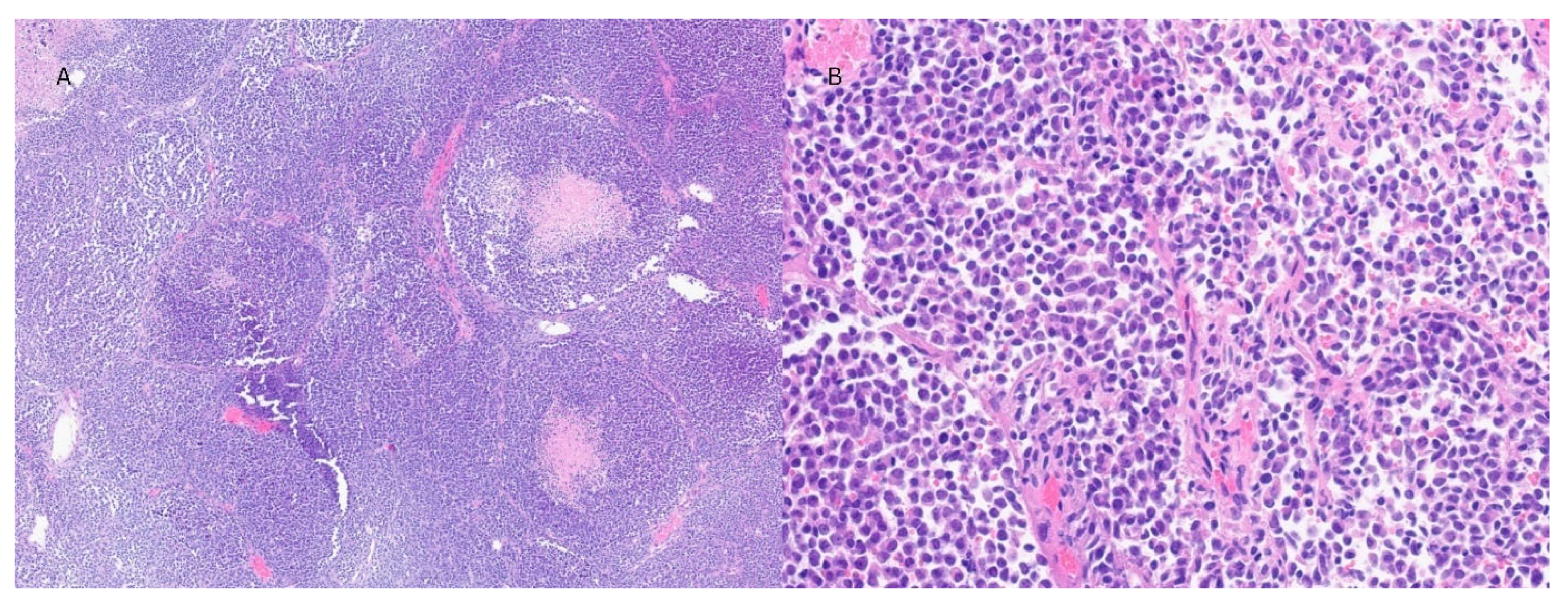
A 2-year-old female presented with a temporal lobe tumor; imaging differential diagnosis included atypical teratoid/rhabdoid tumor (ATRT), pleomorphic xanthoastrocytoma, or ependymoma. She underwent emergency surgery with gross total resection. Histopathology (
Figure 1) revealed a highly cellular tumor composed of small atypical cells with vesicular nuclei and focal rhabdoid morphology. INI-1 immunostaining was interpreted as patchy loss. Additionally, the tumor was focally positive for actin, pankeratin, and synaptophysin, and negative for desmin, GFAP, and Olig2. These findings were considered consistent with ATRT, and therapy was initiated according to COG ACNS0333 while awaiting molecular studies.
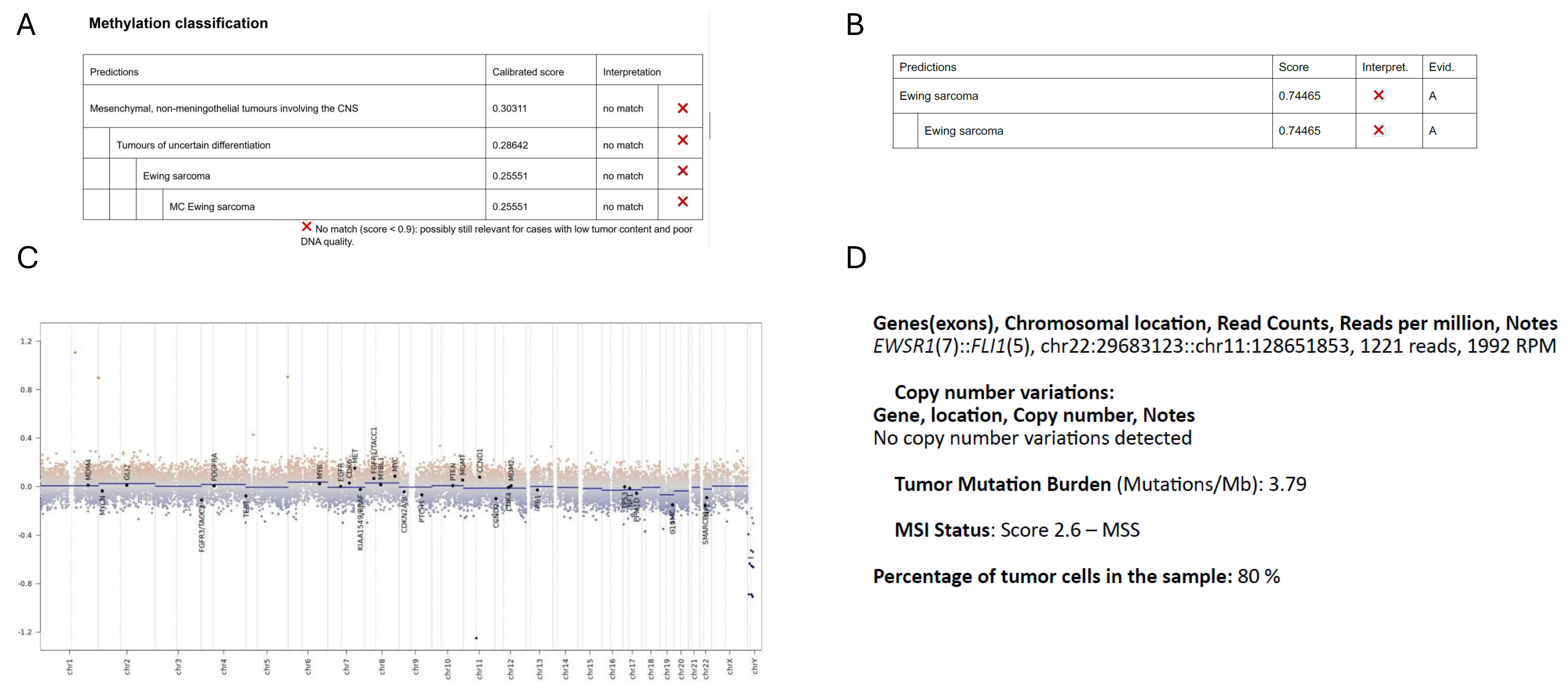
DNA methylation profiling (
Figure 2) (DKFZ Brain Tumor Classifier v12.8) yielded a low-confidence classification, with the highest match within Ewing sarcoma (class score 0.2555). Given the low calibrated score and the unexpected result, the sample was reanalyzed using the DKFZ sarcoma classifier v13.2, which classified the tumor as Ewing sarcoma with improved confidence (class score 0.7446). To confirm these results, additional immunohistochemical stains were performed and showed diffuse strong membranous staining for CD99 and positive nuclear staining for NKX2.2 and FLI1 in most tumor cells. INI1 stain was repeated and showed retained staining, with the earlier loss attributed to technical factors.
In parallel, targeted RNA NGS identified an EWSR1::FLI1 fusion, confirming the diagnosis of CNS Ewing sarcoma. In DNA sequencing, no pathogenic sequence variants were identified; one variant of uncertain significance was detected: CREBBP (NM_004380.3): c.5827C>T, p.Pro1943Ser with an allelic frequency of 30%. TMB was 3.79 mutations/Mb.
The diagnosis was revised from ATRT to CNS Ewing sarcoma, leading to a change in treatment strategy. The patient received one course of ICE chemotherapy during diagnostic revision and subsequently transitioned to Ewing-based therapy as per AEWS0031 compressed interval VDC/IE. Given the young age and concern for minimal residual disease, high-dose chemotherapy with stem cell rescue was planned to minimize or avoid radiotherapy.
Key distinguishing feature: Methylation profiling triggered reconsideration of an apparently classic ATRT diagnosis.
3.4. Case 4: Reclassification of Presumed High-Grade Glioma to BCOR-ITD Tumor with Change in Prognosis and Management
A 3.5-year-old male presented with a fourth ventricular tumor and severe hydrocephalus, without metastasis. He underwent complete tumor resection. Histopathologic evaluation showed a cellular glial tumor with atypia and mitoses, positive for Olig2 and GFAP, negative for synaptophysin, NeuN, EMA, BCOR, IDH1, INI1, and H3K27M, with wild-type p53 expression and preserved ATRX. Ki-67 was approximately 30%, and calcifications and focal necrosis were present. The initial diagnosis was high-grade astrocytoma/glioblastoma (WHO grade 4). Based on this diagnosis, the family was counseled regarding the expected poor prognosis, and radiotherapy was planned to begin 4–5 weeks after surgery.
NGS failed due to technical reasons. DNA methylation profiling (DKFZ Brain Tumor Classifier v12.8) classified the tumor as a CNS tumor with BCOR internal tandem duplication (BCOR-ITD) with high confidence (class score 0.9957). Retrospective integrated assessment supported this diagnosis, and the grade was not assigned. The clinical approach was changed accordingly: the patient received ICE chemotherapy (6 cycles) followed by focal proton radiotherapy. He is currently in complete remission, 3 months after completion of therapy.
Key distinguishing feature: Histology suggestive of glioblastoma but methylation consistent with a distinct embryonal entity.
Key distinguishing clinicopathologic and molecular features of all cases are summarized in
Table 1.
4. Discussion
In this four-case series, we describe our real-world experience incorporating DNA methylation profiling into the diagnostic workflow of pediatric CNS tumors and illustrate the spectrum of clinical impact that methylome analysis can deliver. Across cases, methylation profiling provided information beyond conventional histopathology and immunohistochemistry, ranging from contextual diagnostic support in ambiguous lesions to major diagnostic revision with direct therapeutic consequences. This range aligns with population-based and real-world cohorts showing that methylation profiling frequently refines pediatric CNS tumor diagnosis and can influence clinical management in a meaningful subset of patients [
2,
5,
14,
15,
16].
A central message emerging from our cases is that methylation profiling is most valuable when interpreted within an integrated clinicopathologic framework rather than as a standalone diagnostic label. In Case 1, the classifier output suggested papillary tumor of the pineal region with very high confidence, yet the clinicopathologic context supported posterior fossa ependymoma. Although methylation-based classification is a major advance in CNS tumor diagnostics, discordant results can occur and require careful integration of anatomic location, morphology, immunophenotype, and orthogonal molecular findings [
3,
4,
9,
17]. Several biological and technical factors may contribute to such discrepancies, including low tumor purity, sampling variability, limitations of the current reference cohort, or partial epigenetic overlap between biologically related entities. These situations underscore that calibrated scores, even when high, should not be interpreted in isolation. Rather, methylation results must be integrated with tumor location, morphology, immunophenotype, and orthogonal molecular findings within a multidisciplinary framework [
17]. This point is strongly emphasized in cIMPACT-NOW recommendations, which highlight that classifier scores exist on a continuum and that unexpected classifications should prompt review of tumor purity, technical factors, and alternative diagnostic possibilities within multidisciplinary discussion [
17].
Case 2 represents another common diagnostic challenge: a tumor with unusual morphology and an immunoprofile that does not fit established entities. Here, methylation profiling supported choroid plexus tumor lineage, while low proliferative activity and lack of defining oncogenic alterations supported a conservative approach with close surveillance rather than escalation of therapy. This case illustrates how methylation profiling can narrow differential diagnosis and provide biologic context even when a tumor remains best categorized as “not elsewhere classified” NEC [
2,
7,
8,
17]. Even comprehensive methylation analysis may fail to assign a high-confidence class in a subset of tumors with unusual biology or limited representation in current reference cohorts. In larger clinical series, the NEC category remains a non-trivial proportion of cases and may complicate risk stratification, treatment standardization, and clinical trial eligibility. From a clinical trials perspective, NEC assignments can create uncertainty regarding appropriate protocol enrollment or arm allocation, particularly in studies that rely on molecular subgrouping. Continued expansion of reference datasets, iterative classifier refinement, and integration with complementary genomic and clinicopathologic data will be essential to reduce the NEC fraction and improve the utility of methylation profiling in prospective clinical workflows [
2,
8]. Importantly, such cases also reflect current limitations of reference datasets and underscore that methylation output should be used to guide integration rather than to override clinicopathologic judgment [
3,
16,
18].
The clearest clinical impact in our series occurred in Cases 3 and 4, where methylation profiling contributed to major diagnostic revision and directly changed management. In Case 3, a tumor initially treated as ATRT was reclassified as CNS Ewing sarcoma after methylation profiling raised suspicion for mesenchymal lineage, prompting reanalysis with a sarcoma classifier and confirmatory testing. The diagnosis was supported by immunophenotype and by identification of an EWSR1–FLI1 fusion on targeted sequencing [
4,
11,
12,
13]. This diagnostic trajectory mirrors real-life implementation described in multiple cohorts, in which methylation profiling functions as an early diagnostic “alert” that redirects additional testing and helps prevent prolonged exposure to inappropriate, highly intensive CNS-directed protocols [
2,
14,
15,
16,
19].
In Case 4, methylation profiling reclassified a tumor initially interpreted as glioblastoma to a CNS tumor with BCOR internal tandem duplication, shifting both prognostic framing and treatment intent. This entity may mimic high-grade glioma histologically and has been highlighted in routine-practice methylation series as a clinically meaningful example of how epigenomic classification can prevent premature nihilism and support biology-aligned therapy [
6,
7,
8,
17,
20]. In our case, methylation-based reclassification supported a curative-intent approach with intensive chemotherapy and focal radiotherapy, emphasizing the prognostic relevance of correct molecular classification in early childhood tumors. From a diagnostic test perspective, methylation profiling in pediatric CNS tumors functions best as a high-performance adjunct rather than a standalone assay. Its effective positive and negative predictive values in routine practice are strongly influenced by pre-test probability, tumor purity, and concordance with histologic and clinical features. Accordingly, the current best practice is to interpret methylation results within an integrated multidisciplinary framework that incorporates morphology, immunophenotype, genomic findings, and clinical context. This layered strategy helps maximize diagnostic accuracy while mitigating the risks of both false reassurance and overcalling based on classifier output alone. Consistent with recent cIMPACT-NOW guidance [
17], calibrated scores should be interpreted along a continuum and weighed against clinicopathologic context rather than used as isolated determinants of diagnosis.
From an implementation perspective, our experience highlights two practical considerations. First, turnaround time is clinically meaningful. In Case 3, methylation results arrived several weeks into treatment, after protocol therapy had already started. Recent innovations such as Rapid-CNS demonstrate that methylation-based classification and CNV profiling can potentially be generated within intraoperative or early post-operative timeframes, supporting a future model in which integrated molecular diagnosis informs therapy much earlier in the treatment course [
21]. Second, limitations remain. Discordant classifications, intermediate calibrated scores, and NEC assignments require careful review, and methylation profiling may be less informative in specific settings such as subsets of high-grade gliomas, supporting cautious interpretation and continued refinement of classifiers and reference datasets [
6,
8,
17,
22]. An important limitation of this study is its retrospective, case-based design. Because methylation profiling in our institution is most frequently pursued in diagnostically challenging or ambiguous tumors, this series may overrepresent scenarios in which the technology demonstrates high clinical impact. Consequently, the observed rate of diagnostic refinement or reclassification should not be interpreted as representative of an unselected pediatric CNS tumor population. Nevertheless, our intent was not to estimate population-level performance, but rather to illustrate real-world clinical scenarios in which methylation profiling meaningfully informs decision making. Prospective and population-based studies will be essential to more precisely define the overall diagnostic yield and clinical utility of this approach. In our series, CNV plots derived from methylation data were variably informative across cases, reflecting differences in tumor purity and signal quality in real-world specimens.
In summary, these four cases demonstrate that methylation profiling can meaningfully shape pediatric CNS tumor care in real-world practice. Its contribution may be confirmatory, clarifying, or decisively practice-changing—particularly when methylation results trigger diagnostic revision supported by orthogonal molecular validation. Continued incorporation of methylome analysis into routine pediatric CNS tumor diagnostics, coupled with timely testing and multidisciplinary interpretation, is likely to reduce diagnostic uncertainty and improve alignment between tumor biology and clinical management [
2,
5,
9,
15,
16,
17,
22].