Big Data, Crowdsourcing, and Volunteered Geographic Information Challenge Core Conceptual Neighborhood Graph Assumptions




Abstract
1. Introduction
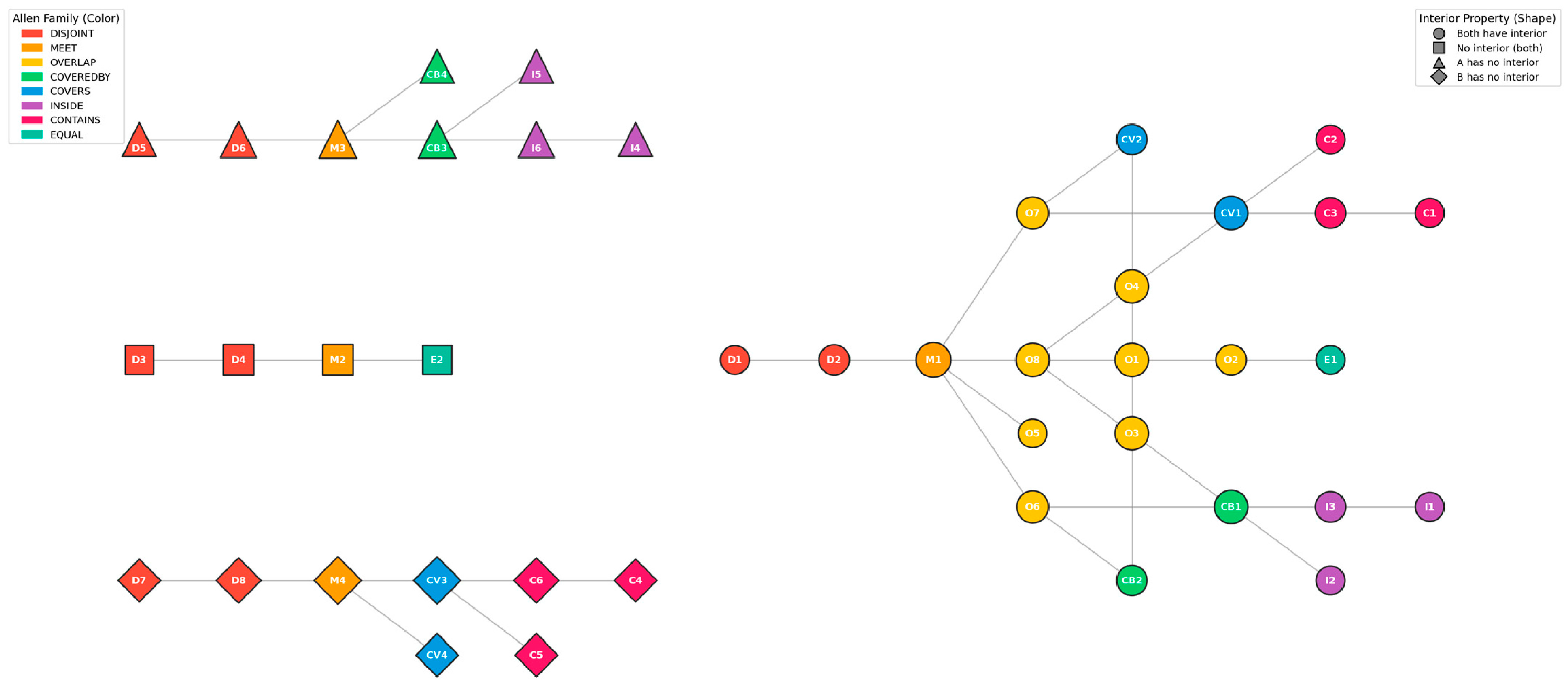
- The most obvious one is the difference between vectorized objects (such as the shapefile architecture) and discretized objects (such as those originating from a raster). When using the same formalism on the same type of object but switching the embedding space from a vectorized to discretized embedding, we see fundamental shifts in relational diversity, and this can impact reasoning power and data consistency. For example, both RCC-8 and the 9-intersection identify eight planar polygonal relations between objects [21,22]; however, in discretized embeddings, this can stay the same by using the standard digital topology endowed by the hyperraster [28,29] or it can be expanded greatly to 16/19 [30] or 62/70 [31] by considering bounding mechanisms such as the digital Jordan curve [32] or the frontier-as-boundary approach [31]. The same is true for temporal intervals: 13 temporal intervals exist in continuous time [33], while for discretized time, that total is 74 [34]. The standard rule is that discretized embeddings have more distinctive symbolic representations than continuous embeddings do, predominantly because of the boundary and its thickness in the discretized embedding space.
- The next area of difficulty comes from the cartographic generalization of objects to a higher co-dimension with their embedding space, commonly called collapsing [35]. The opposite of this is called expanding. An easy example to conceive of the challenges borne by these types of changes is the modeling of highways or rivers as lines or cities or towns as points, communicating their fundamental purpose in the representation itself. While applications such as Google Maps seamlessly undergo geometric collapse (and expansion) as one dynamically zooms in or out [36,37], when static representations are involved, there is no opportunity to expand; similarly, to collapse would involve the potential of having to encode the static vector image on the fly. In vectorized embeddings, there are numerous relation sets that have been constructed to represent relations between types of objects [21,38,39,40,41,42]. In discretized embeddings, this conceptual space is not fully realized [30,31,34,43]. Furthermore, changing between co-dimensions of objects involves a reformulation of how the topological structure of the space is conceptually utilized, switching from a point-set topological architecture [44] to an algebraic topological architecture [38].
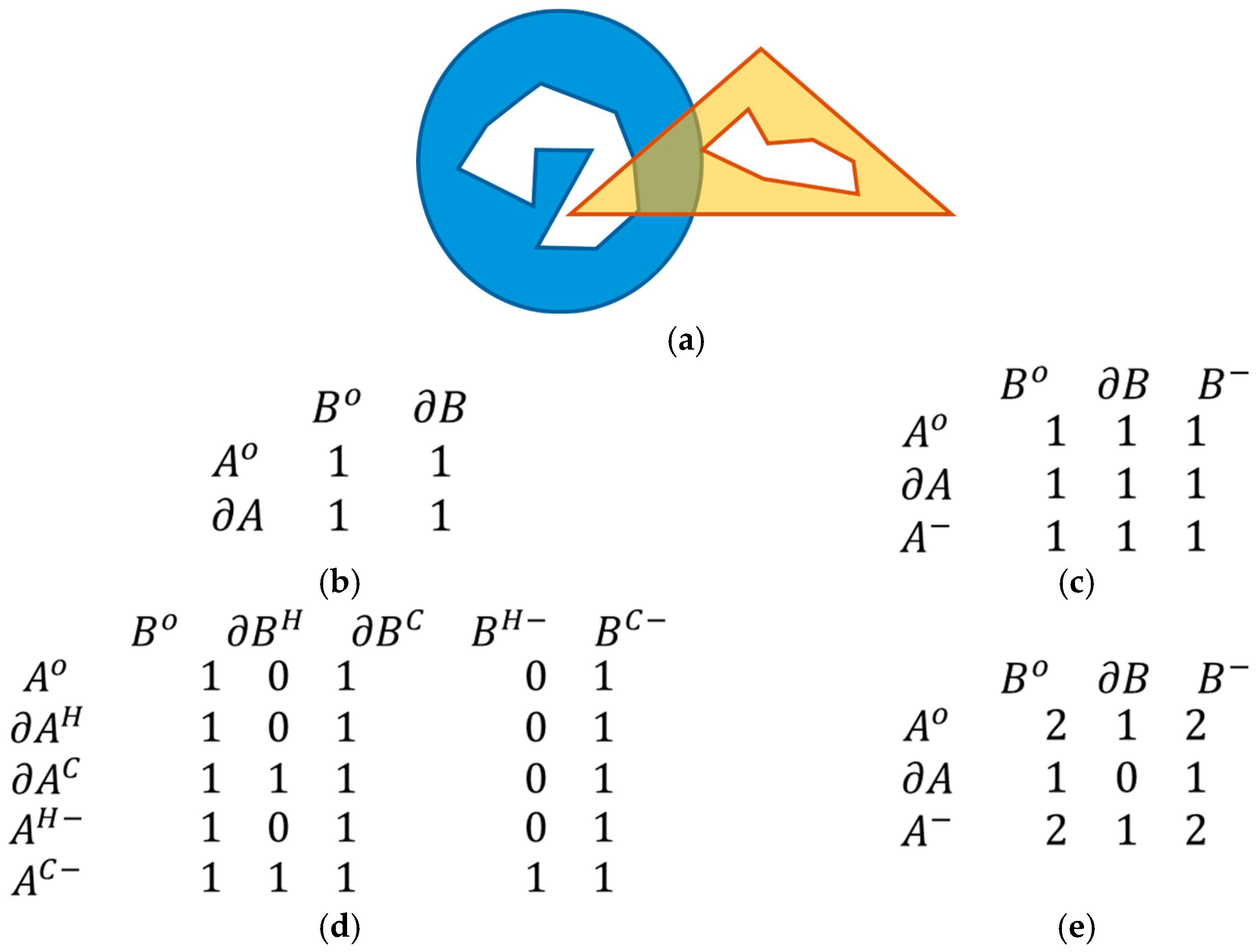
- Another cartographic generalization challenge through the concept of simplification is the consideration of holes and separations within compound objects [45,46]. It is quite common for geographic objects with exclaves or enclaves to undergo hole-filling or separation-cleansing procedures [47,48]. Relation sets have been considered for such types of objects and their transformations in this regard [41,42,49,50].
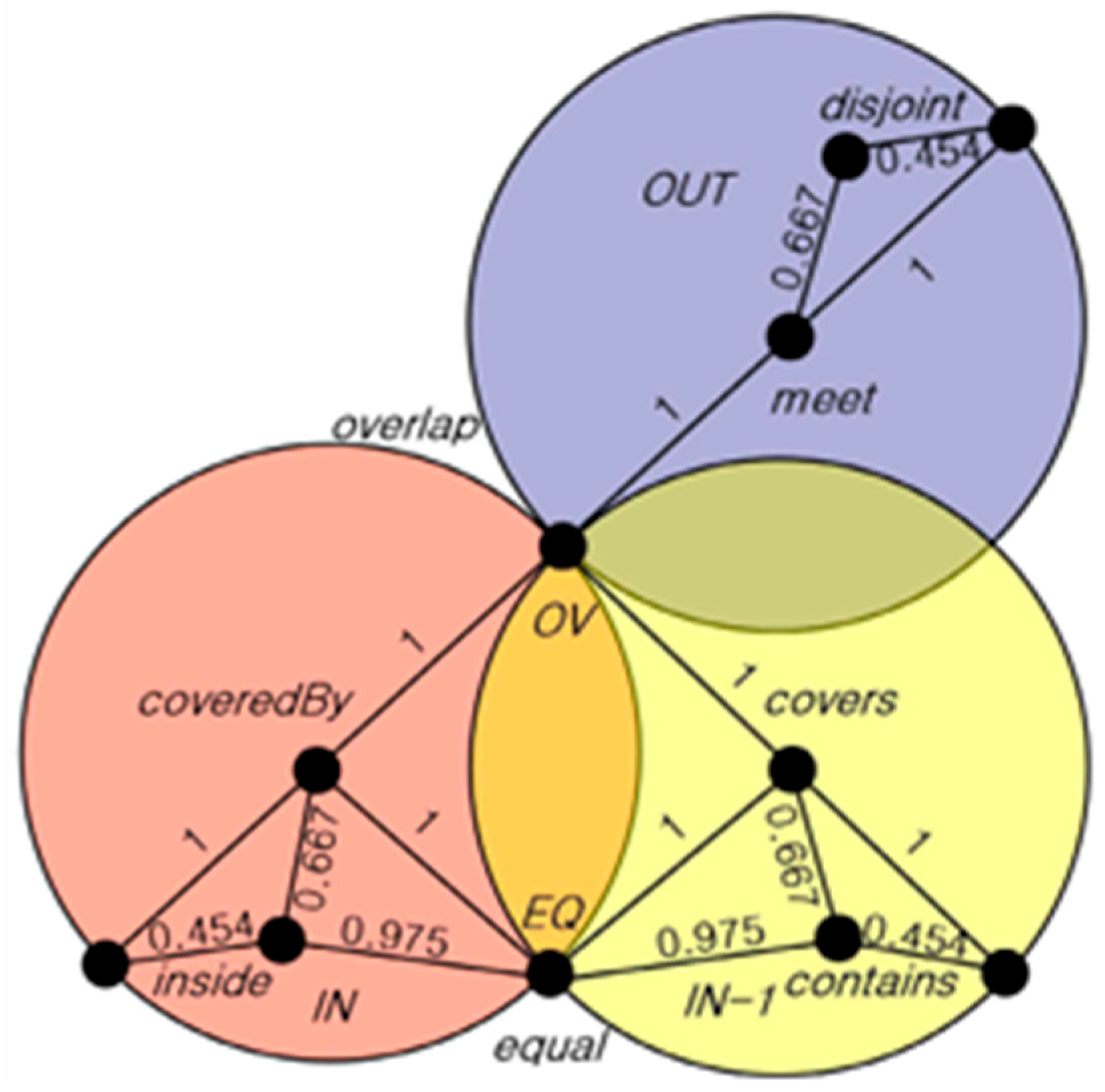
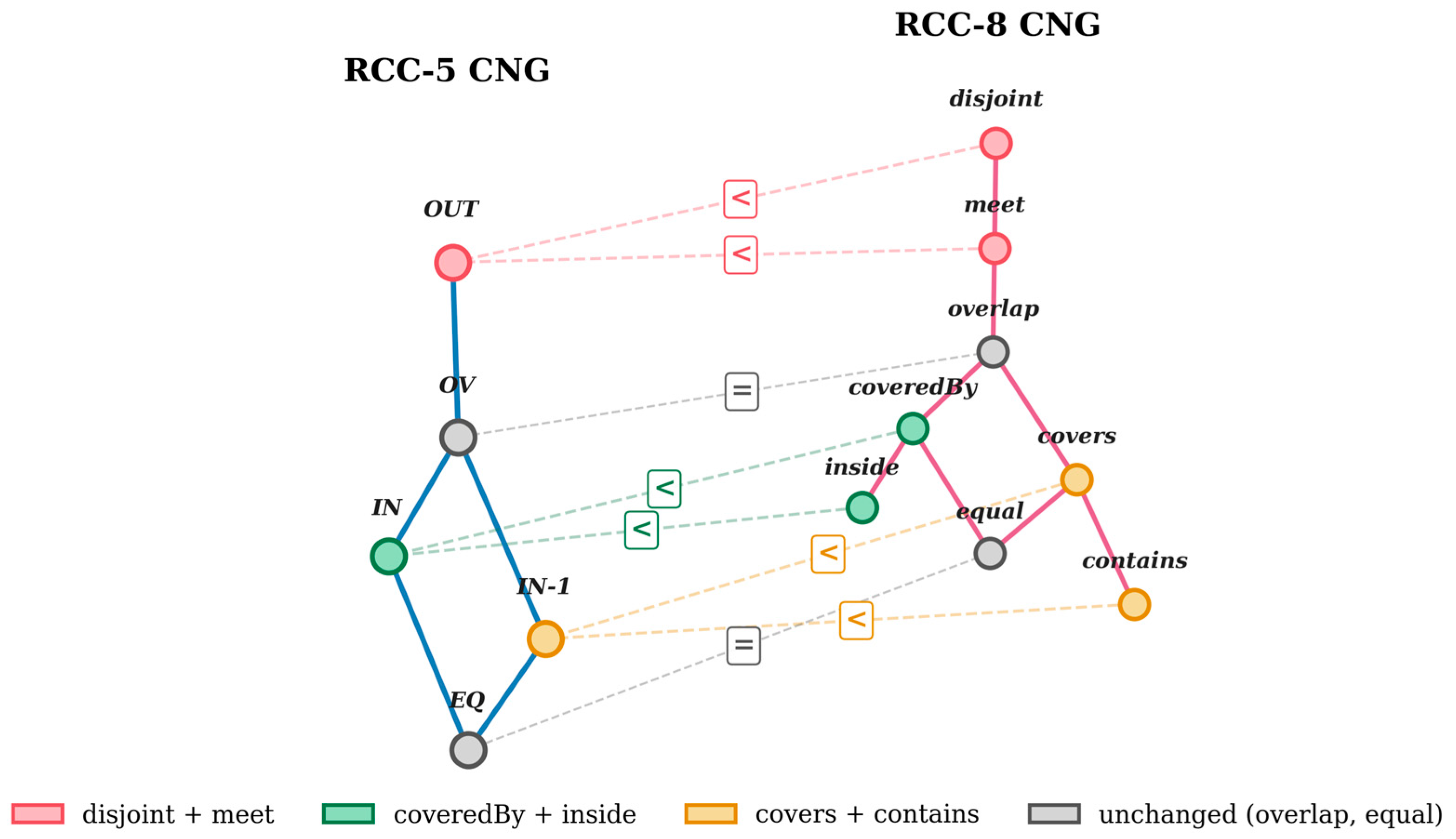
- Apart from discretization and generalization concepts, it is also a common practice for topological relations themselves to be simplified on a linguistic level. The most common example of this is between RCC-8 [22] and RCC-5 [51]. The difference between these relation spaces is that the boundary component is in effect neglected. We see similar legacies of this with the various versions of within from the Clementini operators in modern GIS [17].
2. Qualitative Spatial Relation Formalisms and Sets
2.1. Topological Formalisms
- (a)
- The empty set and the set X are open sets;
- (b)
- The union of an arbitrary collection of open sets is also an open set;
- (c)
- The intersection of a finite number of open sets is open.
2.2. Mereotopological Formalisms
- RCC-5, categorizing relations in the plane where the boundary is not crucial [51];
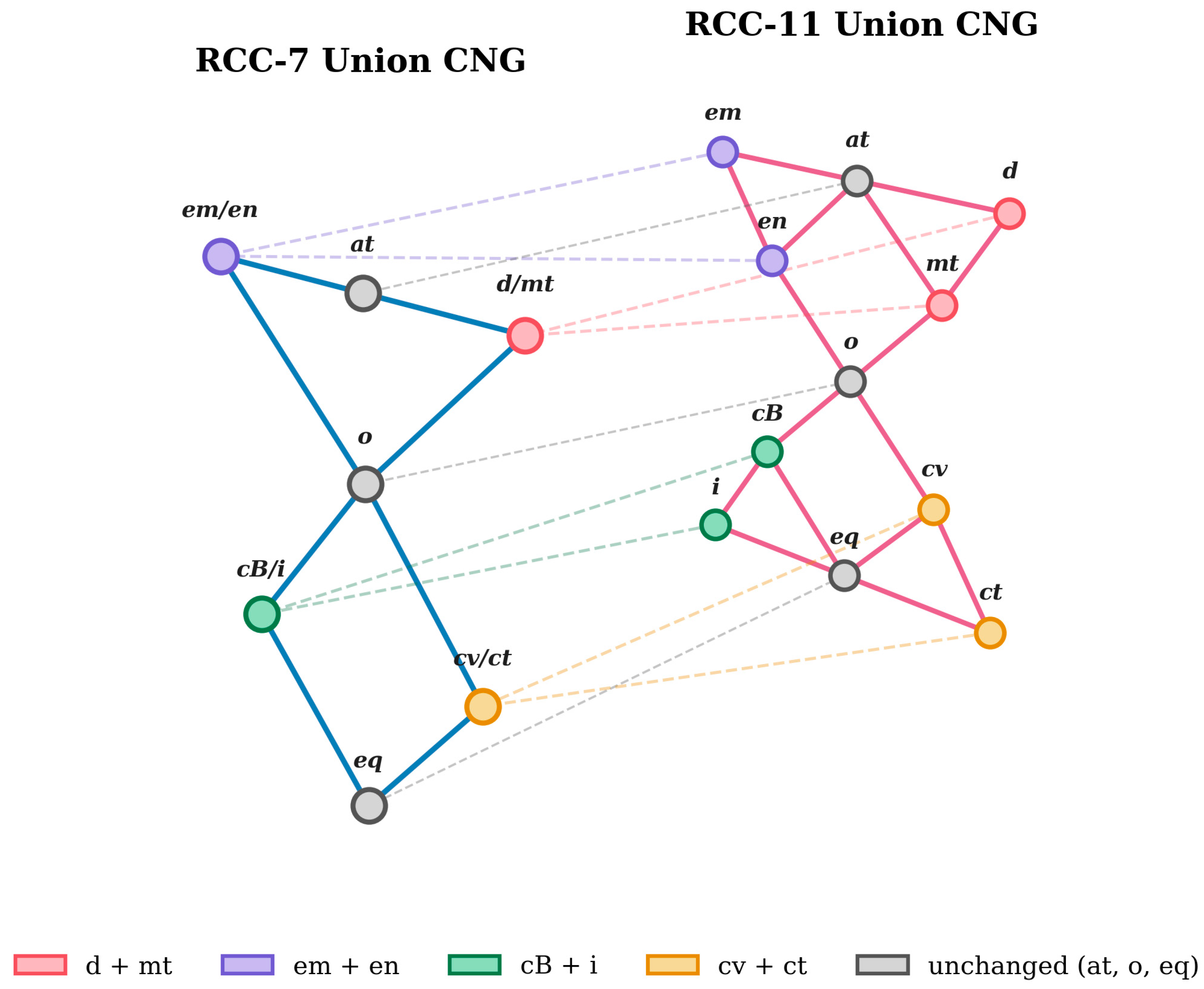
- RCC-7, categorizing relations on the sphere where the boundary is not crucial [68];
- RCC-8, categorizing relations in the plane [22];
- RCC-11, categorizing relations on the sphere [60];
- RCC-23, categorizing relations in 3D space [72].
2.3. Partition-Mapping Formalisms
3. Conceptual Neighborhood Graphs
- Translation, isotropic scaling, and anisotropic scaling in continuous temporal intervals [52];
- Matrix differences for continuous line–region, and conversely, region–line relations [39];
- Matrix differences for continuous line–line relations [81];
- Matrix differences for arbitrary relation sets [53];
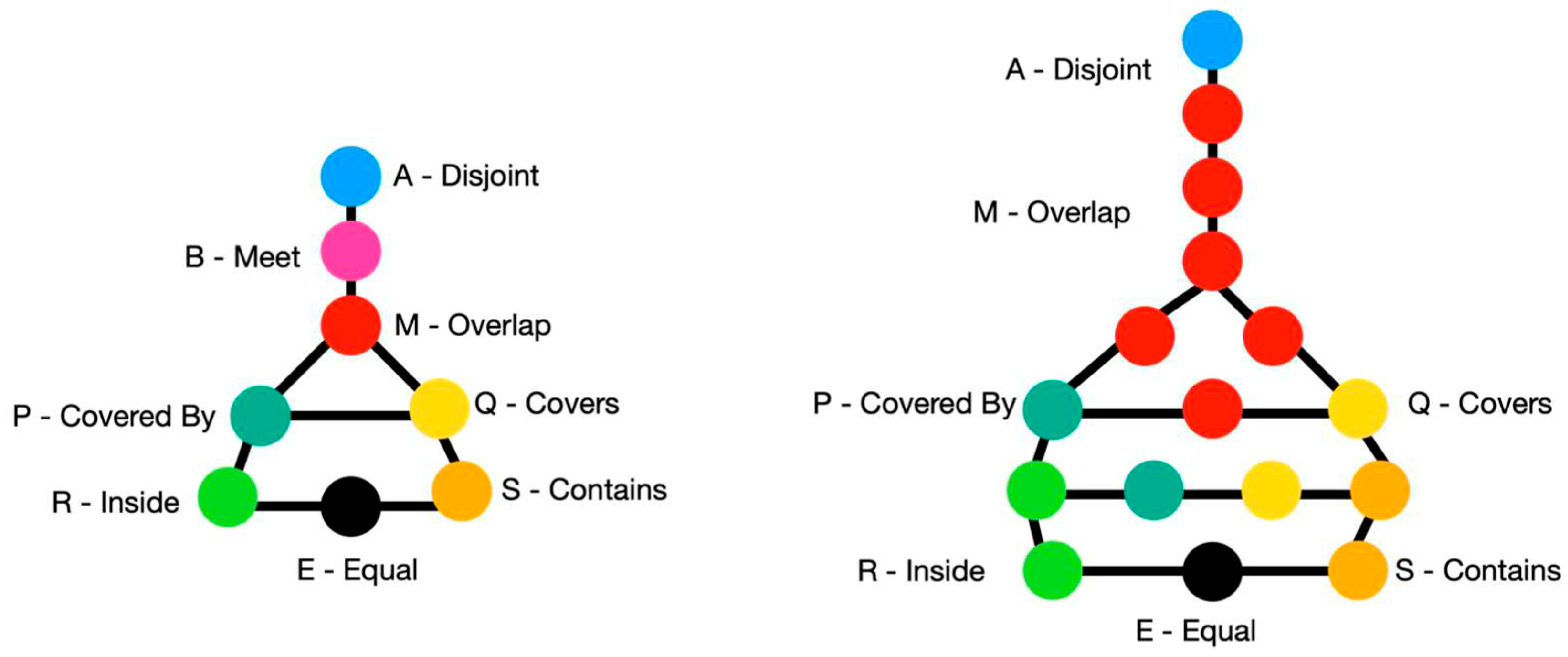
- Integration of RCC-5 and RCC-8 conceptual neighborhood graphs [54];
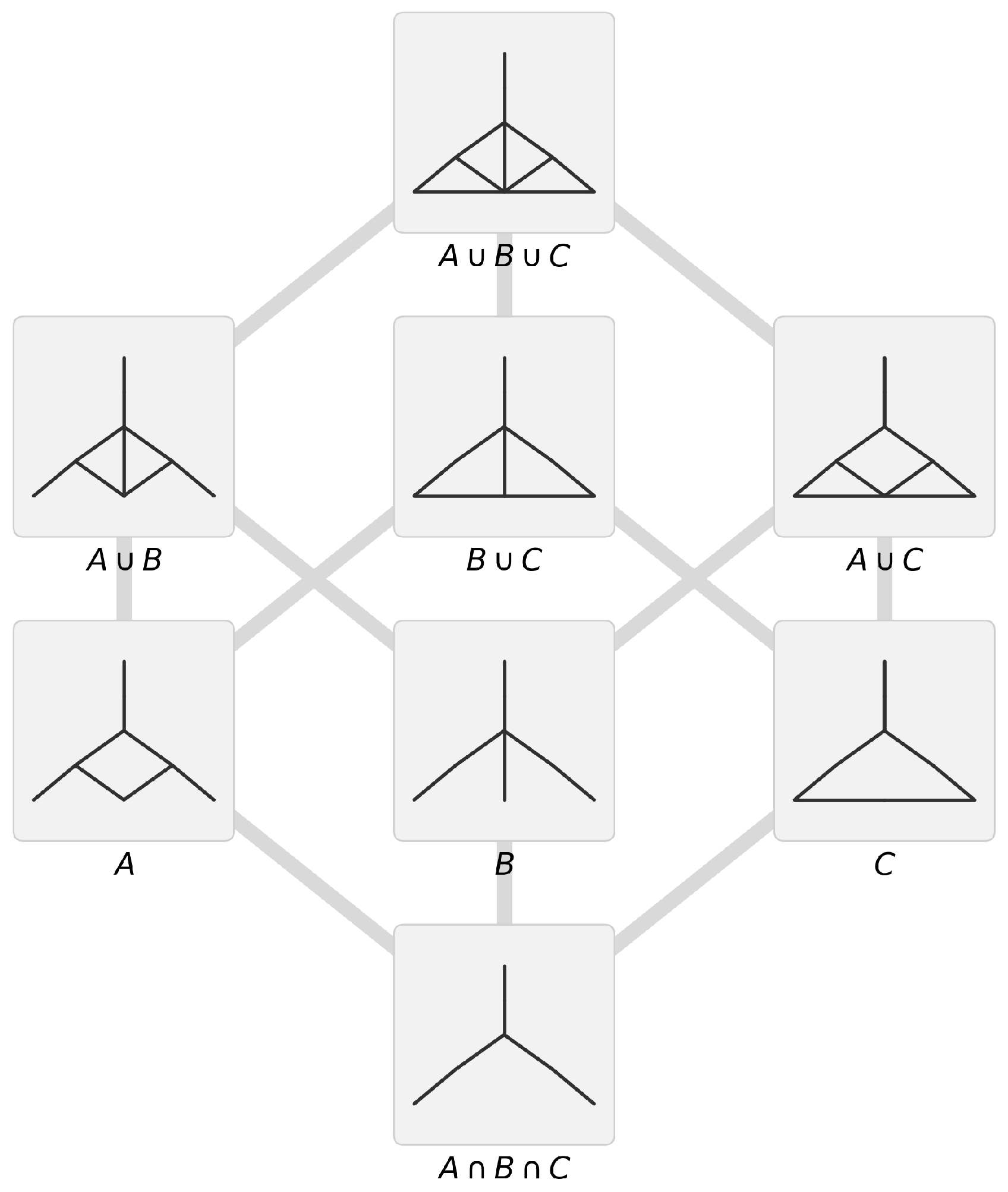
- Unions and intersections of conceptual neighborhood graphs [82];
- Hole and separation changes to region–region relations [50];
- Translation, isotropic scaling, and anisotropic scaling in discretized temporal intervals [80];
- Translation, isotropic scaling, and anisotropic scaling in discretized lines in a linear embedding [80].
- Ranking configurations to their suitability for a desired phenomenon by a user. For example, humans often speak in prototype configurations for a phenomenon, when in reality, near conceptual neighbors to that prototype are just as problematic. An example of this might be the relation between a tree on one’s property and its relationship to the neighbor’s property. The relation overlap is the most concerning, but the relation coveredBy (a conceptual neighbor) is also noteworthy.
- Detecting temporal events within spatial data. Many events are not limited to one timestamp; they require a duration to be seen. From a cognitive perspective, it is often more important to observe changes in relationships rather than the static relationship itself. For example, a human might not care that two objects are disjoint in a representation, but they might care that the object has transitioned from overlap to meet to disjoint, communicating a potential event.
- Tracking the spatial completeness of a temporal dataset. Because we are often looking at configurations in snapshots of time, it is fully plausible that a configuration between objects did exist, but we do not possess an artifact of that occurrence. Because objects should have some sense of permanence (in most instances) and have a typical expectation of being homeomorphically deformed, a disjoint configuration in one timestamp and then an overlap configuration in the next recorded timestamp directly implies the objects had a meet configuration at one point between these two timestamps.
- Adjusting to the usage of non-topologically explicit spatial prepositions in human language. A term such as along has several different topological relations that have instances that could satisfy it. Coincidentally, these relations happen to be neighbors in their conceptual neighborhood graph [14].
4. Attempts at Combining Conceptual Neighborhood Graphs
5. An Integrated Approach to Conceptual Neighborhood Graphs
5.1. Example Discretization Neighborhood: Simple Region–Region Relations to Discretized Region–Region Relations
5.1.1. Hyperraster and Frontier-as-Boundary Relations
5.1.2. Functional Linguistic Mapping Between These Sets
5.2. Example Linguistic Simplification Neighborhood: RCC-7 and RCC-11
5.3. Example Cartographic Generalization Neighborhood: Region–Region to Region–Point Relations in the Cartesian Plane
6. Discussion
Author Contributions
Funding
Data Availability Statement
Conflicts of Interest
References
- Abawajy, J. Comprehensive analysis of big data variety landscape. Int. J. Parallel Emergent Distrib. Syst. 2015, 30, 5–14. [Google Scholar] [CrossRef] [Scilit]
- Goodchild, M. Citizens as sensors: The world of volunteered geography. GeoJournal 2007, 69, 211–221. [Google Scholar] [CrossRef] [Scilit]
- Van Exel, M.; Dias, E.; Fruijtier, S. The impact of crowdsourcing on spatial data quality indicators. In Proceedings of the GIScience 2010 Doctoral Colloquium; Springer: Berlin, Germany, 2010; pp. 14–17. [Google Scholar]
- Chen, L.; Shahabi, C. Spatial crowdsourcing: Challenges and opportunities. IEEE Data Eng. Bull. 2016, 39, 14–25. [Google Scholar]
- Meier, P. Digital Humanitarians: How Big Data is Changing the Face of Humanitarian Response; CRC Press: Boca Raton, FL, USA, 2015. [Google Scholar]
- Calvo, D. Everybody’s crisis? Critiques and limitations of humanitarian mapping during COVID-19. Continuum 2025, 39, 292–304. [Google Scholar] [CrossRef] [Scilit]
- Shneiderman, B.; Plaisant, C. Sharpening analytic focus to cope with big data volume and variety. IEEE Comput. Graph. Appl. 2015, 35, 10–14. [Google Scholar] [CrossRef] [Scilit]
- Mao, R.; Xu, H.; Wu, W.; Li, J.; Li, Y.; Lu, M. Overcoming the challenge of variety: Big data abstraction, the next evolution of data management for AAL communication systems. IEEE Commun. Mag. 2015, 53, 42–47. [Google Scholar] [CrossRef] [Scilit]
- Kuipers, B. Modelling spatial knowledge. Cogn. Sci. 1978, 2, 129–153. [Google Scholar] [CrossRef] [Scilit]
- Egenhofer, M.J.; Mark, D.M. Naïve geography. In International Conference on Spatial Information Theory; Frank, A.U., Kuhn, W., Eds.; Springer: Berlin, Germany, 1995; pp. 1–15. [Google Scholar]
- Landau, B.; Jackendoff, R. Whence and whither in spatial language and spatial cognition? Behav. Brain Sci. 1993, 16, 255–265. [Google Scholar] [CrossRef] [Scilit]
- Majid, A.; Bowerman, M.; Kita, S.; Haun, D.B.; Levinson, S.C. Can language restructure cognition? The case for space. Trends Cogn. Sci. 2004, 8, 108–114. [Google Scholar] [CrossRef] [Scilit]
- Boroditsky, L.; Fuhrman, O.; McCormick, K. Do English and Mandarin speakers think about time differently? Cognition 2011, 118, 123–129. [Google Scholar] [CrossRef] [Scilit]
- Dube, M.; Egenhofer, M. An ordering of convex topological relations. In Geographic Information Science: 7th International Conference; Xiao, N., Kwan, M., Goodchild, M., Shekhar, S., Eds.; Springer: Berlin, Germany, 2012; pp. 72–86. [Google Scholar]
- Klippel, A.; Li, R.; Yang, J.; Hardisty, F.; Xu, S. Cognitive and Linguistic Aspects of Geographic Space; Raubal, M., Mark, D.M., Frank, A.U., Eds.; Springer: Berlin, Germany, 2013; pp. 195–215. [Google Scholar]
- Lupyan, G.; Bergen, B. How language programs the mind. Top. Cogn. Sci. 2016, 8, 408–424. [Google Scholar] [CrossRef] [Scilit]
- Clementini, E.; Sharma, J.; Egenhofer, M.J. Modelling topological spatial relations: Strategies for query processing. Comput. Graph. 1994, 18, 815–822. [Google Scholar] [CrossRef] [Scilit]
- Egenhofer, M. Query processing in spatial-query-by-sketch. J. Vis. Lang. Comput. 1997, 8, 403–424. [Google Scholar] [CrossRef] [Scilit]
- DiSciascio, E.; Donini, F.M.; Mongiello, M. Spatial layout representation for query-by-sketch content-based image retrieval. Pattern Recognit. Lett. 2002, 23, 1499–1612. [Google Scholar]
- Tang, M.; Falomir, Z.; Freksa, C.; Sheng, Y.; Lyu, H. Towards place query-by-sketch. Trans. GIS 2020, 24, 903–943. [Google Scholar] [CrossRef] [Scilit]
- Egenhofer, M.J.; Herring, J.R. Categorizing Binary Topological Relations Between Regions, Lines, and Points in Geographic Databases; NCGIA Technical Report; NCGIA: Santa Barbara, CA, USA, 1990. [Google Scholar]
- Randell, D.A.; Cui, Z.; Cohn, A.G. A spatial logic based on regions and connection. In Principles of Knowledge Representation and Reasoning; Nebel, B., Rich, C., Swartout, W.R., Eds.; Morgan Kaufmann Publishers: San Francisco, CA, USA, 1992; pp. 165–176. [Google Scholar]
- Barkowsky, T.; Latecki, L.J.; Richter, K.F. Schematizing maps: Simplification of geographic shape by discrete curve evolution. In Spatial Cognition II: Integrating Abstract Theories, Empirical Studies, Formal Methods, and Practical Applications; Springer: Berlin, Germany, 2000; pp. 41–53. [Google Scholar]
- Wasserman, L. Topological data analysis. Annu. Rev. Stat. Its Appl. 2018, 5, 501–532. [Google Scholar] [CrossRef] [Scilit]
- Tudoreanu, M.E. Exploring the use of topological data analysis to automatically detect data quality faults. Front. Big Data 2022, 5, 931398. [Google Scholar] [CrossRef] [Scilit]
- Shi, S. Automatics seamless matching of area boundaries. Earth Sci. Inform. 2019, 12, 253–256. [Google Scholar] [CrossRef] [Scilit]
- Huang, K.; Wang, C.; Liu, R.; Chen, G. A fast and accurate spatial target snapping method for 3D modeling and mapping in mobile augmented reality. Int. J. Geoinf. 2022, 11, 69. [Google Scholar] [CrossRef] [Scilit]
- Rosenfeld, A. Digital topology. Am. Math. Mon. 1979, 86, 621–630. [Google Scholar] [CrossRef] [Scilit]
- Winter, S. Topological relations between discrete regions. In International Symposium on Spatial Databases; Egenhofer, M.J., Herring, J.R., Eds.; Springer: Berlin, Germany, 1995; pp. 310–327. [Google Scholar]
- Egenhofer, M.J.; Sharma, J. Topological relations between in regions in and . In International Symposium on Spatial Databases; Abel, D.J., Ooi, B.C., Eds.; Springer: Berlin, Germany, 1993; pp. 316–336. [Google Scholar]
- Dube, M.P.; Egenhofer, M.J.; Barrett, J.V.; Simpson, N.J. Beyond the digital Jordan curve: Unconstrained simple pixel-based raster relations. J. Comput. Lang. 2019, 54, 100906. [Google Scholar] [CrossRef] [Scilit]
- Vince, A.; Little, C.H. Discrete Jordan curve theorems. J. Comb. Theory Ser. B 1989, 47, 251–261. [Google Scholar] [CrossRef] [Scilit]
- Allen, J.F. Maintaining knowledge about temporal intervals. Commun. ACM 1983, 26, 832–843. [Google Scholar] [CrossRef] [Scilit]
- Dube, M.P. Digital relations in : Discretized time and rasterized lines. Int. J. Geo-Inf. 2025, 14, 327. [Google Scholar] [CrossRef] [Scilit]
- Haunert, J.H.; Sester, M. Area collapse and road centerlines based on straight skeletons. Geoinformatica 2008, 12, 169–191. [Google Scholar] [CrossRef] [Scilit]
- Dumont, M.; Touya, G.; Duchene, C. Designing multi-scale maps: Lessons learned from existing practices. Int. J. Cartogr. 2020, 6, 121–151. [Google Scholar] [CrossRef] [Scilit]
- Timpf, S. Cartographic objects in a multiscale data structure. In Geographic Information Research; CRC Press: Boca Raton, FL, USA, 2020; pp. 224–234. [Google Scholar]
- Egenhofer, M. Definitions of line-line relations for geographic databases. IEEE Data Eng. Bull. 1993, 16, 40–45. [Google Scholar]
- Mark, D.M.; Egenhofer, M.J. Modeling spatial relations between lines: Combining formal mathematics and human subjects testing. Cartogr. Geogr. Inf. Syst. 1994, 21, 195–212. [Google Scholar]
- Egenhofer, M.J. Spherical topological relations. J. Data Semant. III 2005, 1, 25–49. [Google Scholar]
- Li, S. A complete classification of topological relations using the 9-intersection method. Int. J. Geogr. Inf. Sci. 2006, 20, 589–610. [Google Scholar] [CrossRef] [Scilit]
- Schneider, M.; Behr, T. Topological relationships between complex spatial objects. ACM Trans. Database Syst. 2006, 31, 39–81. [Google Scholar] [CrossRef] [Scilit]
- Dube, M.P.; Egenhofer, M.J. Binary topological relations on the digital sphere. Int. J. Approx. Reason. 2020, 116, 62–84. [Google Scholar] [CrossRef] [Scilit]
- Egenhofer, M.J.; Franzosa, R.D. Point-set topological spatial relations. Int. J. Geogr. Inf. Syst. 1991, 5, 161–174. [Google Scholar] [CrossRef] [Scilit]
- Egenhofer, M. A reference system for topological relations between compound spatial objects. In International Conference on Conceptual Modeling; Springer: Berlin, Germany, 2009; pp. 307–316. [Google Scholar]
- Dube, M.P.; Egenhofer, M.J.; Lewis, J.A.; Stephen, S.; Plummer, M. Swiss canton regions: A model for complex objects in geographic partitions. In International Conference on Spatial Information Theory; Springer: Berlin, Germany, 2015; pp. 309–330. [Google Scholar]
- Wang, X. Identification of enclaves and exclaves by computation based on point-set topology. Int. J. Geogr. Inf. Sci. 2023, 37, 307–338. [Google Scholar] [CrossRef] [Scilit]
- Dinkler, B.; Dotsch, L.; Hruby, F.; Korfmacher, S.; Kriese, B.; Royar, N.; Triassi, J. Enclaves and exclaves in tile maps. Abstr. ICA 2024, 7, 31. [Google Scholar]
- Egenhofer, M.J.; Vasardani, M. Spatial reasoning with a hole. In International Conference on Spatial Information Theory; Springer: Berlin, Germany, 2007; pp. 303–320. [Google Scholar]
- Dube, M. Beyond homeomorphic deformations: Neighborhoods of topological changes. In Advancing Geographic Information Science: The Past and Next Twenty Years; Onsrud, H., Kuhn, W., Eds.; GSDI Press: Needham, MA, USA, 2016; pp. 137–151. [Google Scholar]
- Bennett, B. Spatial reasoning with propositional logics. In Principles of Knowledge Representation and Reasoning; Morgan Kaufmann: San Francisco, CA, USA, 1994; pp. 51–62. [Google Scholar]
- Freksa, C. Temporal reasoning based on semi-intervals. Artif. Intell. 1992, 54, 199–227. [Google Scholar] [CrossRef] [Scilit]
- Dube, M. An Embedding Graph for 9-Intersection Topological Spatial Relations. Master’s Thesis, University of Maine, Orono, ME, USA, 2009. [Google Scholar]
- Dube, M.P.; Egenhofer, M.J. Establishing similarity across multi-granular topological-relation ontologies. In Quality of Context; Rothermel, K., Fritsch, D., Blochinger, W., Durr, F., Eds.; Springer: Berlin, Germany, 2009; pp. 98–108. [Google Scholar]
- Dube, M.P.; Hall, B.P. Conceptual neighborhood graphs: Event detectors, data relevancy, and language translation. In Geography According to Foundation Models; Janowicz, K., Zhu, R., Mai, G., Gao, S., Hu, Y., Wang, Z., Cai, L., Bennett, L., Eds.; IOS Press: Amsterdam, The Netherlands, 2026; pp. 12–27. [Google Scholar]
- Kurata, Y. The 9+-intersection: A universal framework for modeling topological relations. In International Conference on Geographic Information Science; Cova, T.J., Miller, H.J., Beard, M.K., Frank, A.U., Goodchild, M.F., Eds.; Springer: Berlin, Germany, 2008; pp. 181–198. [Google Scholar]
- Clementini, E.; DiFelice, P. A comparison of methods for representing topological relationships. Inf. Sci. Appl. 1995, 3, 149–178. [Google Scholar] [CrossRef] [Scilit]
- Balbiani, P.; Osmani, A. A model for reasoning about topological relations between cyclic intervals. In Principles of Knowledge Representation and Reasoning; Cohn, A.G., Giunchiglia, F., Selman, B., Eds.; Morgan Kaufmann Publishers: San Francisco, CA, USA, 2000; pp. 378–385. [Google Scholar]
- Clarke, B. A calculus of individuals based on “connection”. Notre Dame J. Form. Log. 1981, 22, 204–218. [Google Scholar] [CrossRef] [Scilit]
- Li, S.; Li, Y. On the complemented disk algebra. J. Log. Algebr. Program. 2006, 66, 195–211. [Google Scholar] [CrossRef] [Scilit]
- Dimov, G.; Vakarelov, D. Contact algebras and region-based theory of space: A proximity approach. Fundam. Inform. 2006, 74, 209–249. [Google Scholar] [CrossRef] [Scilit]
- Duntsch, I.; Winter, M. A representation theorem for Boolean contact algebras. Theor. Comput. Sci. 2005, 347, 498–512. [Google Scholar] [CrossRef] [Scilit]
- DeVries, H. Compact Spaces and Compactifications: An Algebraic Approach. Doctoral Dissertation, Universiteit van Amsterdam, Amsterdam, The Netherlands, 1962. [Google Scholar]
- Fedorcuk, V.V. Infinite-dimensional compact Hausdorff spaces. Math. USSR-Izv. 1979, 13, 445–460. [Google Scholar] [CrossRef] [Scilit]
- Roeper, P. Region-based topology. J. Philos. Log. 1997, 26, 251–309. [Google Scholar] [CrossRef] [Scilit]
- Vakarelov, D.; Dimov, G.; Duntsch, I.; Bennett, B. A proximity approach to some region-based theories of space. J. Appl. Non-Class. Log. 2002, 12, 527–559. [Google Scholar] [CrossRef] [Scilit]
- Stell, J.G. Boolean connection algebras: A new approach to the region-connection calculus. Artif. Intell. 2000, 122, 111–136. [Google Scholar] [CrossRef] [Scilit]
- Duntsch, I.; Wang, H.; McCloskey, S. A relation-algebraic approach to the region-connection calculus. Theor. Comput. Sci. 2001, 255, 63–83. [Google Scholar] [CrossRef] [Scilit]
- Clementini, E.; Cohn, A.G. RCC*-9 and CBM. In International Conference on Geographic Informaiton Science; Springer: Berlin, Germany, 2014; pp. 349–365. [Google Scholar]
- Izadi, A.; Hahmann, T.; Guesgen, H.; Stock, K. A modification of RCC*-9. In GeoComputation; University of Auckland: Auckland, New Zealand, 2019; p. 420. [Google Scholar]
- Clementini, E.; Cohn, A.G. Extension of RCC*-9 to complex and three-dimensional features and its reasoning system. Int. J. Geoinf. 2024, 13, 25. [Google Scholar] [CrossRef] [Scilit]
- Albath, J.; Leopold, J.L.; Sabharwal, C.L.; Maglia, A.M. RCC-3D: Qualitative spatial reasoning in 3D. In 23rd International Conference on Computer Applications in Industry and Engineering; ISCA Publishing: Winona, MN, USA, 2010; pp. 74–79. [Google Scholar]
- Izadi, A.; Stock, K.M.; Guesgen, H.W. Multidimensional region connection calculus. In Proceedings of the 30th International Workshop on Qualitative Reasoning; AAAI Press: Washington, DC, USA, 2017; pp. 1–7. [Google Scholar]
- Dube, M.P.; Egenhofer, M.J. Surrounds in partitions. In Proceedings of the 22nd ACM SIGSPATIAL International Conference on Advances in Geographic Information Systems; ACM Press: Washington, DC, USA, 2014; pp. 233–242. [Google Scholar]
- Worboys, M.F. Using maptrees to characterize topological change. In International Conference on Spatial Information Theory; Springer: Berlin, Germany, 2013; pp. 74–90. [Google Scholar]
- Sindoni, G.; Stell, J.G. The logic of discrete qualitative relations. In International Conference on Spatial Information Theory; Dagstuhl Publishing: Saarbrucken, Germany, 2017. [Google Scholar]
- Egenhofer, M.; Al-Taha, K. Reasoning about gradual changes of topological relationships. In Theories and Methods of Spatio-Temporal Reasoning in Geographic Space: International Conference GIS—From Space to Territory; Frank, A., Campari, I., Formentini, U., Eds.; Springer: Berlin, Germany, 1992; pp. 196–219. [Google Scholar]
- Hall, B. Identification of Conceptual Neighborhoods and Topological Relations in . Master’s Thesis, University of Maine, Orono, ME, USA, 2024. [Google Scholar]
- Hall, B.P.; Dube, M.P. Conceptual neighborhood graphs of topological relations in . Int. J. Geo-Inf. 2025, 14, 150. [Google Scholar] [CrossRef] [Scilit]
- Dube, M.P.; Hall, B.P. Conceptual neighborhood graphs of discrete time intervals. Int. J. Geo-Inf. 2026, 15, 39. [Google Scholar] [CrossRef] [Scilit]
- Reis, R.M.P.; Egenhofer, M.J.; Matos, J.L. Conceptual neighborhoods of topological relations between lines. In Headway in Spatial Data Handling; Ruas, A., Gold, C., Eds.; Springer: Berlin, Germany, 2008; pp. 557–574. [Google Scholar]
- Egenhofer, M.J. The family of conceptual neighborhood graphs for region-region relations. In International Conference on Geographic Information Science; Fabrikant, S.I., Reichenbacher, T., van Kreveld, M.J., Schlieder, C., Eds.; Springer: Berlin, Germany, 2010; pp. 42–55. [Google Scholar]
- Dube, M.P.; Barrett, J.V.; Egenhofer, M.J. From metric to topology: Determining relations in discrete space. In International Conference on Spatial Information Theory; Springer: Berlin, Germany, 2015; pp. 151–171. [Google Scholar]
- Duntsch, I.; Orlowska, E. Discrete dualities for some algebras with relations. J. Log. Algebr. Methods Program. 2014, 83, 169–179. [Google Scholar] [CrossRef] [Scilit]
- Winter, S. Ontology: Buzzword or paradigm shift in GIScience? Int. J. Geogr. Inf. Sci. 2001, 15, 587–590. [Google Scholar] [CrossRef] [Scilit]
- Bateman, J.; Tenbrink, T.; Farrar, S. The role of conceptual and linguistic ontologies in interpreting spatial discourse. Discourse Process. 2007, 44, 175–212. [Google Scholar] [CrossRef] [Scilit]
- Bateman, J. Situating spatial language and the role of ontology: Issues and outlook. Lang. Linguist. Compass 2010, 4, 639–664. [Google Scholar] [CrossRef] [Scilit]
- Hahmann, T.; Gruninger, M. A naïve theory of dimension for qualitative spatial relations. In AAAI 2011 Spring Symposium on Logical Formalizations of Commonsense Reasoning; AAAI Press: Washington, DC, USA, 2011; pp. 42–48. [Google Scholar]
- Hahmann, T. CODI: A multidimensional theory of mereotopology with closure operations. Appl. Ontol. 2020, 15, 251–311. [Google Scholar] [CrossRef] [Scilit]
- Claramunt, C.; Dube, M.P. A brief review of the evolution of GIScience since the NCGIA research agenda initiatives. J. Spat. Inf. Sci. 2023, 26, 137–150. [Google Scholar] [CrossRef] [Scilit]
- Shariff, R.B.M.; Egenhofer, M.J.; Mark, D.M. Natural-language spatial relations between linear and areal objects: The topology and metric of English-language terms. Int. J. Geogr. Inf. Sci. 1998, 12, 215–245. [Google Scholar]
- Ying, S.; Li, L. Knowledge Representation of Cartographic Generalization. In Proceedings of International Symposium on Spatio-temporal Modeling, Spatial Reasoning, Analysis, Data Mining and Data Fusion; Tang, X., Liu, Y., Zhang, J., Kainz, W., Eds.; ISPRS: Hannover, Germany, 2005. [Google Scholar]
- Wildermeesch, S.; Godernaux, P.; Orban, P.; Brouyere, S.; Dassargues, A. Assessing the effects of spatial discretization on large-scale flow model performance and prediction uncertainty. J. Hydrol. 2014, 510, 10–25. [Google Scholar] [CrossRef] [Scilit]
- Hu, Y.; Gao, S.; Janowicz, K.; Yu, B.; Li, W.; Prasad, S. Extracting and understanding urban areas of interest using geotagged photos. Comput. Environ. Urban Syst. 2015, 54, 240–254. [Google Scholar] [CrossRef] [Scilit]
- Hu, Y.; Adams, B. Harvesting big geospatial data from natural language texts. In Handbook of Big Geospatial Data; Springer: Berlin, Germany, 2020; pp. 487–507. [Google Scholar]
- Westerholt, R.; Mocnik, F.B.; Comber, A. A place for place: Modelling and analysing palatial representations. Trans. GIS 2020, 24, 811–818. [Google Scholar] [CrossRef] [Scilit]
- Mocnik, F.B. On the representation of places. GeoJournal 2023, 88, 4109–4126. [Google Scholar] [CrossRef] [Scilit]
- Goddard, C. Natural Semantic Metalanguage: The state of the art. In Cross-Linguistic Semantics; John Benjamins Publishing Company: Amsterdam, The Netherlands, 2008; pp. 1–34. [Google Scholar]





| Region–Region in [21,29,40] | Region–Region in [30,31,43] |
|---|---|
 disjoint |  |
 meet |  |
 overlap |  |
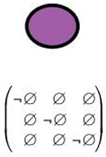 equal |  |
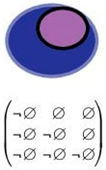 coveredBy | 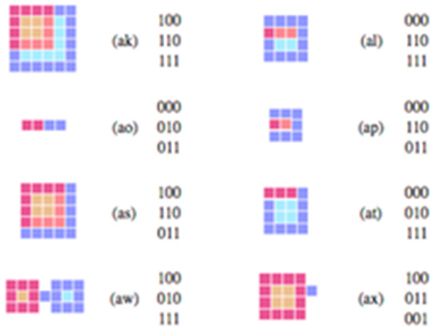 |
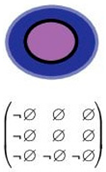 inside |  |
 covers |  |
 contains |  |
| Region–Region in [21,29,40] | Region–Region in [30,31,43] |
|---|---|
 disjoint |  |
 meet |  |
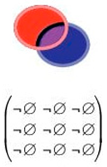 overlap |  |
 equal |  |
 coveredBy | 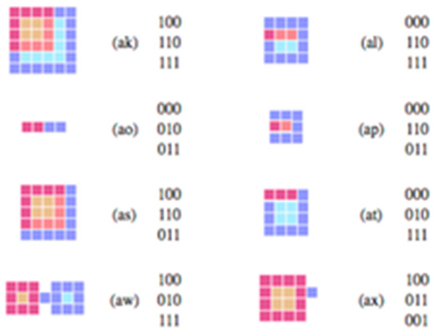 |
 inside |  |
 covers |  |
 contains |  |
| Region–Region Relation | Region–Point Relation |
|---|---|
| disjoint | outside |
| meet | on the boundary, outside |
| overlap | inside, on the boundary, outside |
| equal | inside, on the boundary |
| coveredBy | inside, on the boundary |
| inside | inside |
| covers | inside, on the boundary, outside |
| contains | inside, on the boundary, outside |
| Object Class | Continuous 1D | Continuous 2D | Discrete 1D | Discrete 2D | Linguistic Simplification |
|---|---|---|---|---|---|
| R to R | N/A | Relation set [21,40], CNG [77] | N/A | Relation set [30,31,43], CNG [79] | [51,60] |
| R to L | N/A | Relation set [39], CNG [39] | N/A | [91] | |
| R to P | N/A | Relation set [42] | N/A | Relation set [31], CNG [79] | |
| L to L | Relation set [33], CNG [52] | Relation set [38], CNG [81] | Relation set [34], CNG [80] | ||
| L to P | Relation set [42] | Relation set [42] | Relation set [34], CNG [80] | ||
| P to P | Relation set [42] | Relation set [42] | Relation set [34], CNG [80] | Relation set [31], CNG [79] |
Disclaimer/Publisher’s Note: The statements, opinions and data contained in all publications are solely those of the individual author(s) and contributor(s) and not of MDPI and/or the editor(s). MDPI and/or the editor(s) disclaim responsibility for any injury to people or property resulting from any ideas, methods, instructions or products referred to in the content. |
© 2026 by the authors. Licensee MDPI, Basel, Switzerland. This article is an open access article distributed under the terms and conditions of the Creative Commons Attribution (CC BY) license.
Share and Cite
Dube, M.P.; Hall, B.P.; Thibeau, T. Big Data, Crowdsourcing, and Volunteered Geographic Information Challenge Core Conceptual Neighborhood Graph Assumptions. Geomatics 2026, 6, 64. https://doi.org/10.3390/geomatics6030064
Dube MP, Hall BP, Thibeau T. Big Data, Crowdsourcing, and Volunteered Geographic Information Challenge Core Conceptual Neighborhood Graph Assumptions. Geomatics. 2026; 6(3):64. https://doi.org/10.3390/geomatics6030064
Chicago/Turabian StyleDube, Matthew P., Brendan P. Hall, and Tyler Thibeau. 2026. "Big Data, Crowdsourcing, and Volunteered Geographic Information Challenge Core Conceptual Neighborhood Graph Assumptions" Geomatics 6, no. 3: 64. https://doi.org/10.3390/geomatics6030064
APA StyleDube, M. P., Hall, B. P., & Thibeau, T. (2026). Big Data, Crowdsourcing, and Volunteered Geographic Information Challenge Core Conceptual Neighborhood Graph Assumptions. Geomatics, 6(3), 64. https://doi.org/10.3390/geomatics6030064