Global Assessment of Time-Varying Periodic Signals in GNSS Vertical Displacements Using SSA Versus Parameterized Models Considering Environmental Loading Effects

 ,
,
Highlights
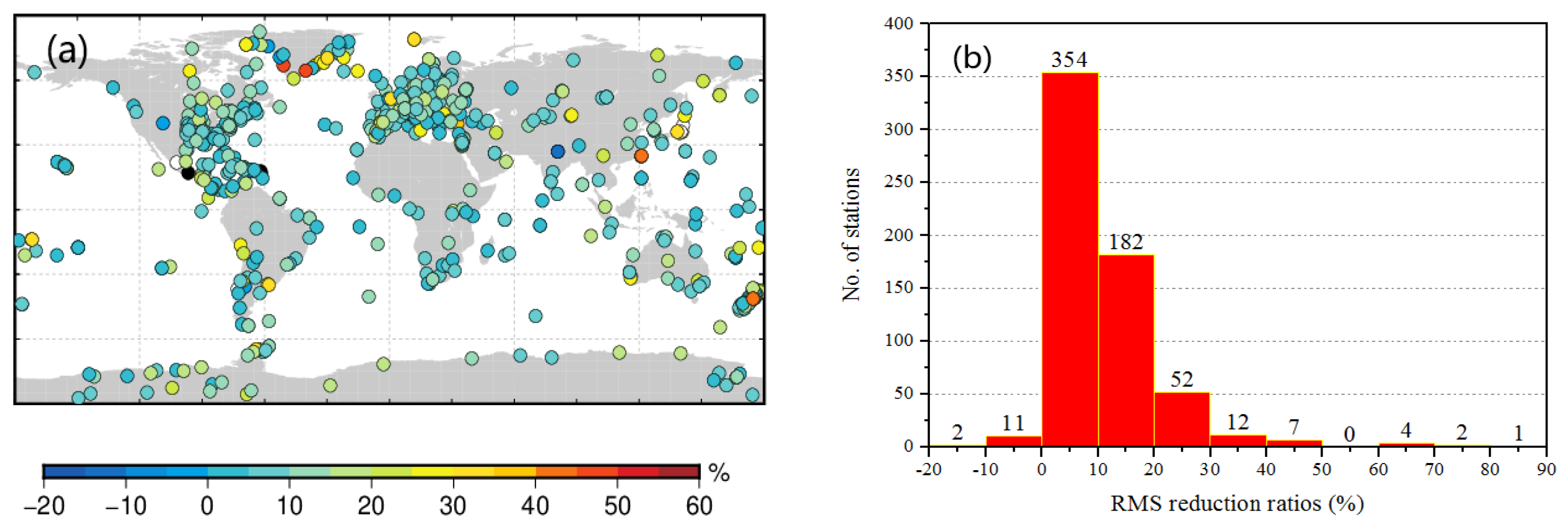
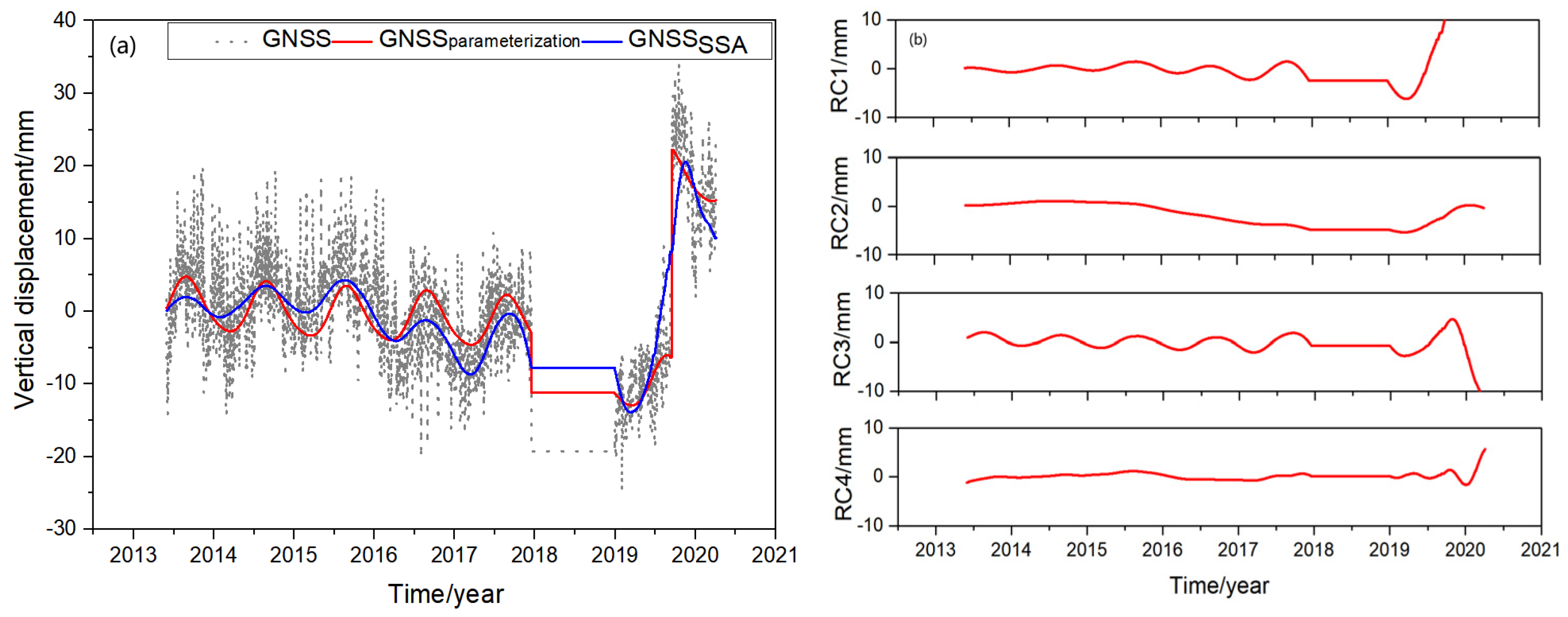
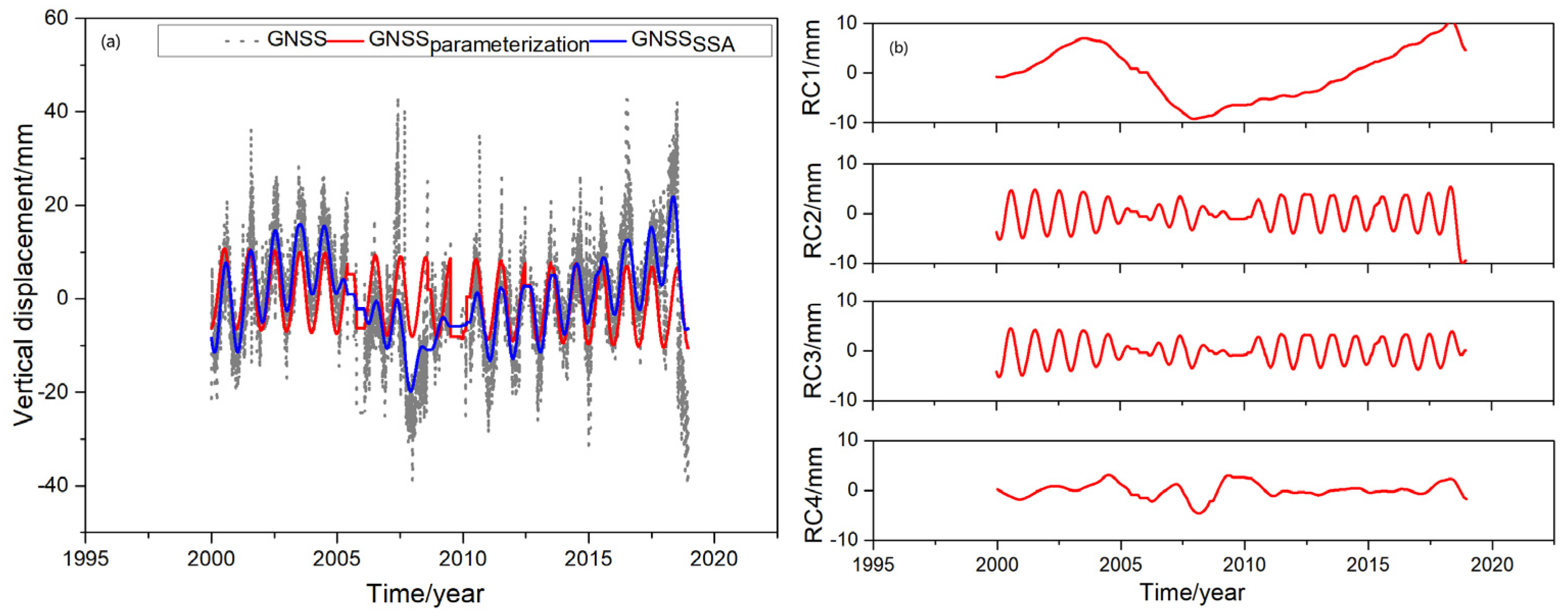
- The SSA method effectively extracts time-varying periodic signals from global GNSS station coordinate time series. Quantitative comparison with conventional parameterization methods demonstrates its superior performance: 97.46% of the global stations show a positive reduction in root mean square (RMS) error after applying SSA.
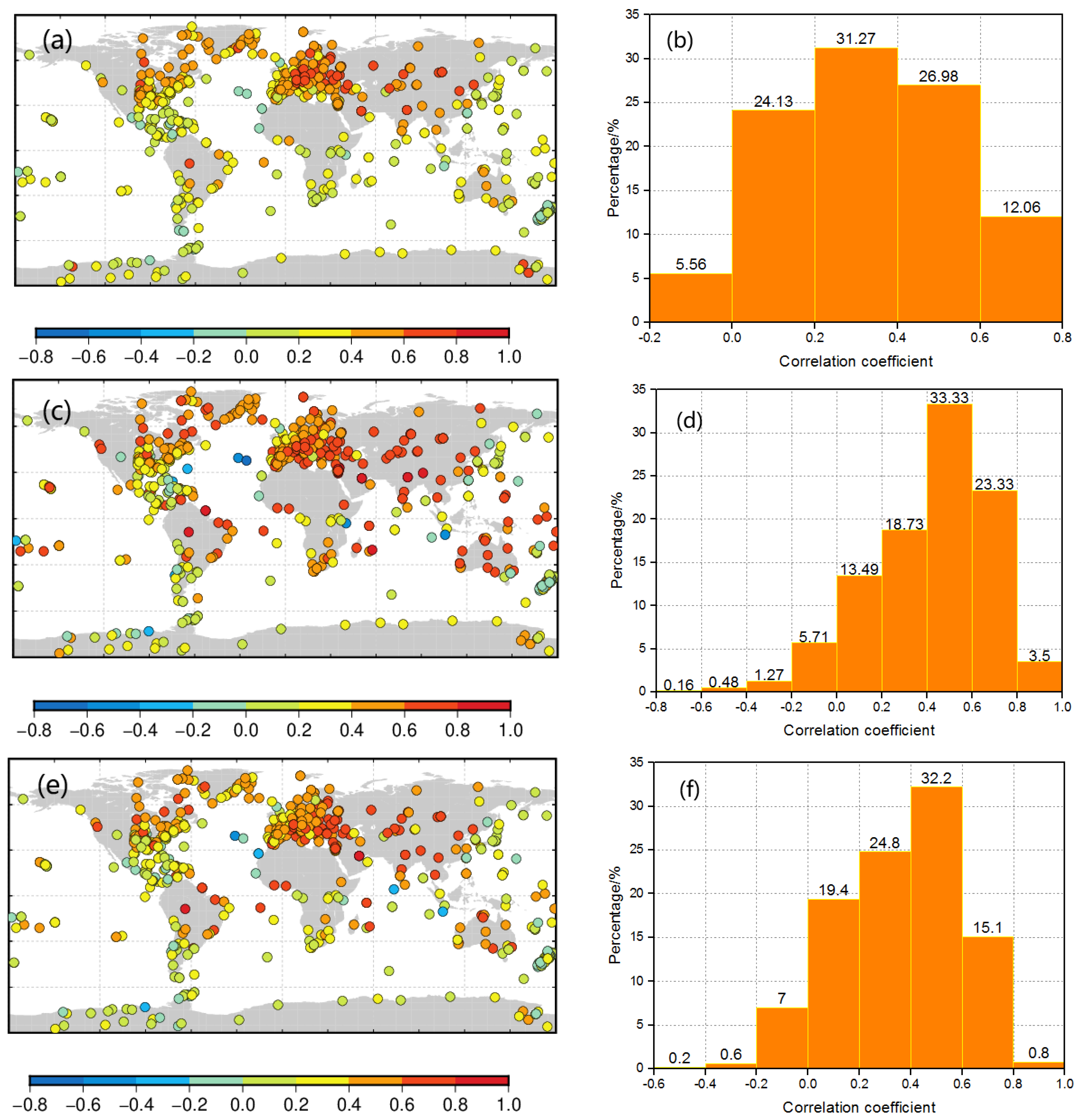
- The correlation between extracted periodic signals and environmental loading is significantly enhanced using the SSA method. Specifically, the analysis shows that 66.98% of global GNSS stations exhibit an improved correlation with environmental loading after applying the SSA method, whereas the traditional parameterization methods achieve improvement in only 56.67% of stations.
- This study indicates that the SSA method can accurately reconstruct time-varying periodic signals in GNSS coordinate time series, which is crucial for the refined characterization of GNSS station motion features.
- Studying the correlation between environmental loading and GNSS time-varying periodic signals can enrich and improve the geophysical interpretation of nonlinear deformation in global GNSS stations, which is of great significance for correctly understanding non-tectonic deformation and establishing high-precision reference frameworks.
Abstract
1. Introduction
2. Data and Methodology
2.1. GNSS Vertical Coordinate Time Series
2.2. Environmental Loading Model
2.3. GNSS Coordinate Time-Series Analysis Method
2.4. Periodic Signal Acquisition Method
2.5. Evaluation Indicators
3. Results
3.1. Comparison of SSA and Parameterization Methods
3.2. Consistent Comparison of ELC Effects
4. Discussion
5. Conclusions
- (1)
- The SSA method can indeed accurately extract time-varying periodic signals from GNSS station coordinate time series worldwide, and compared with conventional parameterization methods, 97.46% of the stations have a positive RMS reduction ratio. The SSA method is indeed helpful in analyzing the nonlinear deformation of GNSS coordinate time series in the process of extracting GNSS periodic signals compared to conventional parameterization methods.
- (2)
- By comparing the correlation coefficients between the time-varying periodic signal sequence obtained by the SSA method and the environmental loading sequence, the correlation coefficients between the periodic sequence obtained by the parameterization method and the environmental loading sequence, and the correlation coefficients between the GNSS original coordinate time series and the environmental loading sequence, we can further analyze the characteristics of the periodic changes in environmental loadings on a global scale. The results show that 66.98% and 56.67% of the stations, respectively, have improved their correlation with the original GNSS sequence and environmental loading sequence after obtaining periodic signals through SSA and parameterization methods. The time-varying periodic signals obtained by the SSA method can more accurately reflect the influence of environmental loading on the nonlinear variation in GNSS vertical coordinate time series compared with the periodic signals obtained by the parameterization method.
- (3)
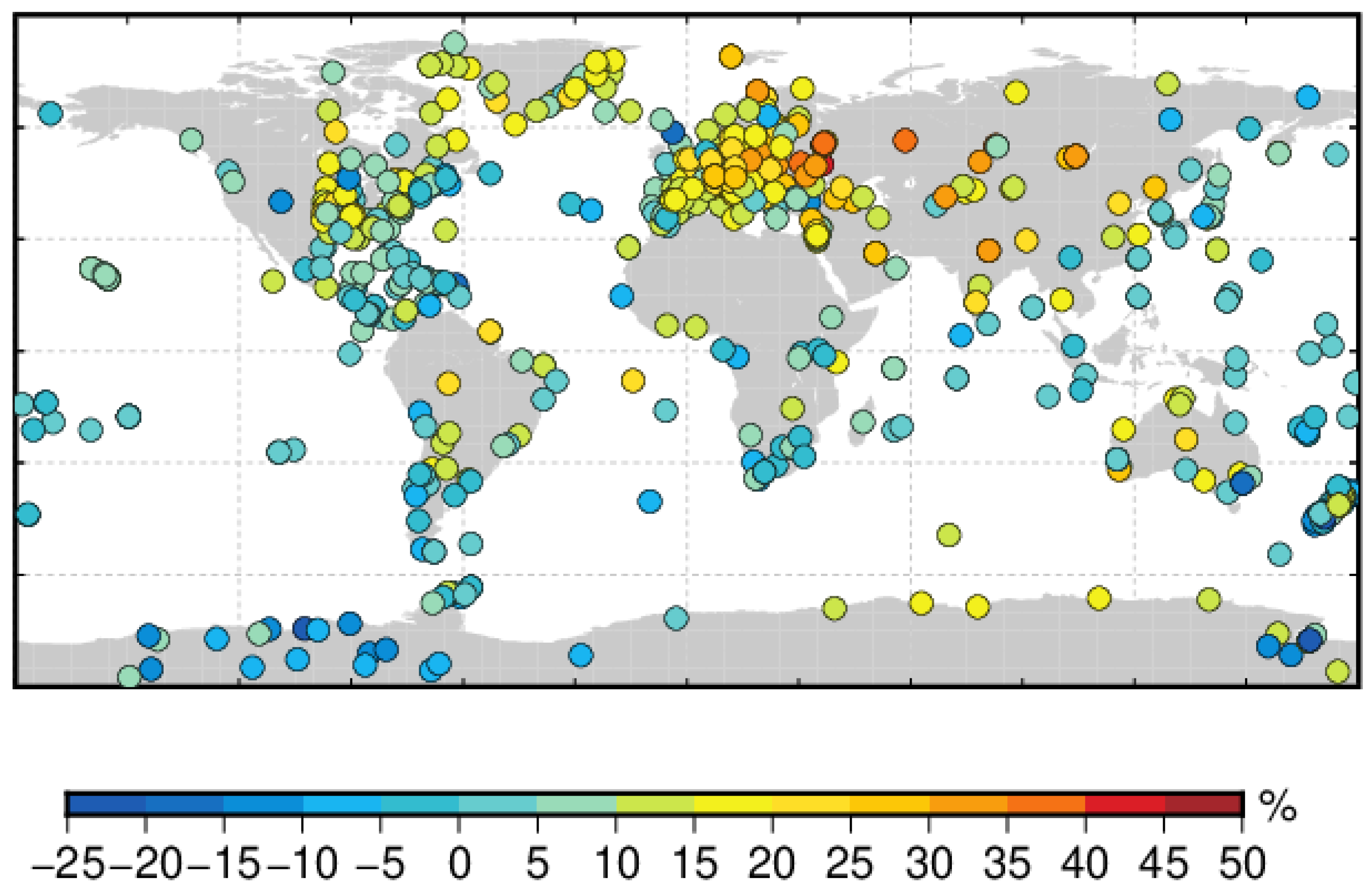
- The time-varying periodic signal obtained by the SSA method has a maximum RMS reduction ratio of 42.37% before and after ELCs. For the selected global IGS stations, 79.52% of the stations have reduced nonlinear amplitude after ELCs.
Author Contributions
Funding
Data Availability Statement
Acknowledgments
Conflicts of Interest
Abbreviations
| GNSS | Global Navigation Satellite System |
| SSA | Singular Spectrum Analysis |
| ELCs | Environmental Loading Corrections |
| MLE | Maximum Likelihood Estimation |
| WD | Wavelet Decomposition |
| KF | Kalman Filter |
| EMD | Empirical Mode Decomposition |
| BJFS | Beijing Fangshan |
| SOPAC | Scripps Orbit and Permanent Array Center |
| IGS | International GNSS Service |
| GFZ | The German Research Center for Geosciences |
| EOST | The School and Observatory of Earth Sciences |
| IMLS | The International Mass Loading Service |
| ECMWF | The European Centre for Medium-Range Weather Forecasts |
| MPIOM | The Max-Planck Institute Ocean Model |
| LSDM | The Land Surface Discharge Model |
| GLDAS | Global Land Data Assistance System |
| MERRA2 | Modern-Era Retrospective Analysis for Research and Applications, Version 2 |
| ECCO | Estimating the Circulation and Climate of the Ocean |
| GLORYS2v3 | Global Ocean Reanalyses and Simulations |
| TPC | Time Principal Component |
| RMS | Root Mean Square |
| WN + PL | White Noise and Flicker Noise |
References
- Blewitt, G.; Lavallee, D.; Clarke, P.; Nurutdinov, K. A new global mode of Earth deformation: Seasonal cycle detected. Science 2001, 294, 2342–2345. [Google Scholar] [CrossRef]
- Wu, S.; Li, Z.; Li, H.; Bian, S.; Ouyang, H.; Yao, Y.; Peng, P.; He, Y. Detection of Time-varying Periodic Signals from CMONOC Stations in China by Singular Spectrum Analysis. IEEE Trans. Geosci. Remote Sens. 2023, 61, 5802812. [Google Scholar] [CrossRef]
- Klos, A.; Bos, M.S.; Bogusz, J. Detecting time-varying seasonal signal in gps position time series with different noise levels. GPS Solut. 2018, 22, 21. [Google Scholar] [CrossRef]
- Klos, A.; Olivares, G.; Teferle, F.N.; Hunegnaw, A.; Bogusz, J. On the combined effect of periodic signals and colored noise on velocity uncertainties. GPS Solut. 2018, 22, 1. [Google Scholar] [CrossRef]
- Niu, Y.; Li, M.; Zhan, W.; Li, J.; Li, L.; Wu, Y. Orgin analysis and modelling of spatially correlated noise in GNSS station coordinates. Chin. J. Geophys. 2026, 69, 559–572. [Google Scholar] [CrossRef]
- Jiao, J.; Wang, H.; Dang, Y.; Ren, Y.; Yue, C.; Wu, X.; Cui, H.; Wang, X. Noise-resilient GNSS coordinate time series prediction using AVMD-sLSTM-transformer hybrid model. Adv. Space Res. 2025, 76, 6863–6881. [Google Scholar] [CrossRef]
- Altamimi, Z.; Rebischung, P.; Collilieux, X.; Métivier, L.; Chanard, K. ITRF2020: An augmented reference frame refining the modeling of nonlinear station motions. J. Geod. 2023, 97, 47. [Google Scholar] [CrossRef]
- Li, Z.; Jiang, W.; Dam, V.T.; Zou, X.; Chen, Q.; Chen, H. A Review on Modeling Environmental Loading Effects and Their Contributions to Nonlinear Variations of Global Navigation Satellite System Coordinate Time Series. Engineering 2025, 47, 26–37. [Google Scholar] [CrossRef]
- Ma, Y.; Yang, Y.; Zhou, X.; Hu, L.; Liu, W. Stochastic properties of GNSS height time series caused by aperiodic part of environmental loading deformations: Case study in Beijing and its surrounding areas. Adv. Space Res. 2025, 76, 734–749. [Google Scholar] [CrossRef]
- Gu, Y.; Yuan, L.; Fan, D.; You, W.; Su, Y. Seasonal crustal vertical deformation induced by environmental mass loading in mainland China derived from GPS, GRACE and surface loading models. Adv. Space Res. 2017, 59, 88–102. [Google Scholar] [CrossRef]
- Chanard, K.; Fleitout, L.; Calais, E.; Rebischung, P.; Avouac, J. Toward a global horizontal and vertical elastic load deformation model derived from GRACE and GNSS station position time series. J. Geophys. Res. Solid Earth 2018, 123, 3225–3237. [Google Scholar] [CrossRef]
- Yuan, P.; Li, Z.; Jiang, W.; Ma, Y.; Chen, W.; Sneeuw, N. Influences of Environmental Loading Corrections on the Nonlinear Variations and Velocity Uncertainties for the Reprocessed Global Positioning System Height Time Series of the Crustal Movement Observation Network of China. Remote Sens. 2018, 10, 958. [Google Scholar] [CrossRef]
- Klos, A.; Gruszczynska, M.; Bos, M.; Boy, J.; Bogusz, J. Estimates of vertical velocity errors for IGS ITRF2014 stations by applying the improved singular spectrum analysis method and environmental loading models. Pure Appl. Geophys. 2018, 175, 1823–1840. [Google Scholar] [CrossRef]
- Niu, Y.; Wei, N.; Li, M.; Rebischung, P.; Shi, C.; Chen, G. Quantifying discrepancies in the three-dimensional seasonal variations between IGS station positions and load models. J. Geod. 2022, 96, 31. [Google Scholar] [CrossRef]
- Jiang, W.; Li, Z.; Liu, H.; Zhao, Q. Cause analysis of the non-linear variation of the IGS reference station coordinate time series inside China. Chin. J. Geophys. 2013, 56, 2228–2237. [Google Scholar] [CrossRef]
- Bevis, M.; Brown, A. Trajectory models and reference frames for crustal motion geodesy. J. Geod. 2014, 88, 283–311. [Google Scholar] [CrossRef]
- He, X.; Montillet, J.P.; Fernandes, R.; Bos, M.; Yu, K.; Hua, X.; Jiang, W. Review of current GPS methodologies for producing accurate time series and their error sources. J. Geod. 2017, 106, 12–29. [Google Scholar] [CrossRef]
- Su, G.; Zhan, W. Seasonal and long-term vertical land motion in Southwest China determined using GPS, GRACE, and surface loading model. Earth Planets Space 2021, 73, 131. [Google Scholar] [CrossRef]
- Dai, H.; Sun, F.; Jiang, W.; Xiao, K.; Zhu, X.; Liu, Q. Application of Wavelet Decomposition and Singular Spectrum Analysis to GNSS Station Coordinate Time Series. Geomat. Inf. Sci. Wuhan Univ. 2021, 46, 371–380. (In Chinese) [Google Scholar]
- Ma, J.; Cao, C.; Jiang, W.; Zhou, L. Elimination of Colored Noise in GNSS Station Coordinate Time Series by Using Wavelet Packet Coefficient Information Entropy. Geomat. Inf. Sci. Wuhan Univ. 2021, 46, 1309–1317. (In Chinese) [Google Scholar]
- Jia, R.; Zhao, T.; Sun, H.; Yan, X. Microseismic signal denoising method based on empirical mode decomposition and independent component analysis. Chin. J. Geophys. 2015, 58, 1013–1023. (In Chinese) [Google Scholar]
- Xu, J.; Zhu, Q.; Shi, N. The singular spectral analysis of periodic oscillation in long-term variation of east-asian monsoon in recent century. Acta Meteorol. Sin. 1997, 5, 109–116. [Google Scholar]
- Dong, A.; Qu, Z.; Yin, X.; Zhou, L. The Singular Spectrum Analysis of Snow Damage in Eastern Qinghai-Xizang Plateau. Plateau Meteorol. 2001, 2, 214–219. [Google Scholar]
- Li, Y.; Liu, D.; Zhu, Y.; Gao, Y.; Mao, W. Singular Spectrum Analysis of Surface Air Temperature and Precipitation Series in Chongqing. Plateau Meteorol. 2005, 5, 798–804. [Google Scholar]
- Jevrejeva, S.; Grinsted, A.; Moore, J.C.; Holgate, S. Nonlinear trends and multiyear cycles in sea level records. J. Geophys. Res. Ocean. 2006, 111, 3229. [Google Scholar] [CrossRef]
- Xu, K.; Cheng, P.; Wen, H. Singular spectrum analysis and wavelet analysis on time series of Sunspot. Sci. Surv. Mapp. 2007, 6, 35–38+205. [Google Scholar]
- Chen, Q.; van Dam, T.; Sneeuw, N.; Collilieux, X.; Weigelt, M.; Rebischung, P. Singular spectrum analysis for modeling seasonal signals from GPS time series. J. Geodyn. 2013, 72, 25–35. [Google Scholar] [CrossRef]
- Wang, J.; Lian, L.; Shen, Y. Application of Singular Spectral Analysis to GPS Station Coordinate Monitoring Series. J. Tongji Univ. (Nat. Sci.) 2013, 41, 282–288. [Google Scholar]
- Luo, Y.; Kuang, C.; Lu, C.; Zeng, F. GPS Coordinate Series Denoising and Seasonal Signal Extraction Based on SSA. J. Geod. Geodyn. 2015, 35, 391–395. [Google Scholar] [CrossRef]
- Jiang, Z.; Zhang, P.; Mi, J.; Liu, L. Velocity Estimation on the Colored Noise Properties of CORS Network in China Based on the CGCS2000 Frame. Acta Geod. Cartogr. Sin. 2010, 39, 355–363. [Google Scholar]
- Li, C.; Huang, S.; Chen, Q.; van Dam, T.; Fok, H.S.; Zhao, Q.; Wu, W.; Wang, X. Quantitative Evaluation of Environmental Loading Induced Displacement Products for Correcting GNSS Time Series in CMONOC. Remote Sens. 2020, 12, 594. [Google Scholar] [CrossRef]
- He, Y.; Nie, G.; Wu, S.; Li, H. Comparative analysis of the correction effect of different environmental loading products on global GNSS coordinate time series. Adv. Space Res. 2022, 70, 3594–3613. [Google Scholar] [CrossRef]
- Jiang, W.; Deng, L.; Li, Z.; Zhou, X.; Liu, H. Effects on noise properties of GPS time series caused by higher-order ionospheric corrections. Adv. Space Res. 2014, 53, 1035–1046. [Google Scholar] [CrossRef]
- Wu, S.; Nie, G.; Meng, X.; Liu, J.; He, Y.; Xue, C.; Li, H. Comparative Analysis of the Effect of the Loading Series from GFZ and EOST on Long-Term GPS Height Time Series. Remote Sens. 2020, 12, 2822. [Google Scholar] [CrossRef]
- Dill, R.; Dobslaw, H. Numerical simulations of global scale high-resolution hydrological crustal deformations. J. Geophys. Res. Solid Earth 2013, 118, 5008–5017. [Google Scholar] [CrossRef]
- Mémin, A.; Boy, J.; Santamaría-Gómez, A. Correcting GPS measurements for non-tidal loading. GPS Solut. 2020, 24, 45. [Google Scholar] [CrossRef]
- Marsland, S.; Haak, H.; Jungclaus, J.; Latif, M.; Roske, F. The Max-Planck-Institute global ocean/sea-ice model with orthogonal curvilinear coordinates. Ocean Model. 2003, 5, 91–127. [Google Scholar] [CrossRef]
- Dill, R. Hydrological Model LSDM for Operational Earth Rotation and Gravity Field Variations; Deutsches GeoForschungsZentrum GFZ: Potsdam, Germany, 2008. [Google Scholar] [CrossRef]
- Petrov, L.; Boy, J.P. Study of the atmospheric pressure loading signal in VLBI observations. J. Geophys. Res. Atmos. 2004, 109, B03405. [Google Scholar] [CrossRef]
- Liu, R.; Zou, R.; Li, J.; Zhang, C.; Zhao, B.; Zhang, Y. Vertical Displacements Driven by Groundwater Storage Changes in the North China Plain Detected by GPS Observations. Remote Sens. 2018, 10, 259. [Google Scholar] [CrossRef]
- Zhang, J.; Bock, Y.; Johnson, H.; Fang, P.; Williams, S.D.P.; Genrich, J.; Wdowinski, S.; Behr, J. Southern California permanent GPS geodetic array: Error analysis of daily position estimates and site velocities. J. Geophys. Res. Solid Earth 1997, 102, 18035–18055. [Google Scholar] [CrossRef]
- Bos, M.; Fernandes, R.; Williams, S.; Bastos, L. Fast error analysis of continuous GNSS observations with missing data. J. Geod. 2013, 87, 351–360. [Google Scholar] [CrossRef]
- Bos, M. Hector User Manual Version 2.0. 2021. Available online: https://teromovigo.com/wp-content/uploads/hector/hector_manual_2.0.pdf (accessed on 25 January 2026).
- Jia, Y.; Zhu, X.; Sun, F.; Xiao, K.; Ke, N. Time-varying characteristics and cause analysis of annual amplitudes of GNSS vertical coordinate time series. Chin. J. Geophys. 2023, 66, 162–172. (In Chinese) [Google Scholar]



| Institution | Loading Model | Model | Spatial Resolution | Time Resolution | Time Span |
|---|---|---|---|---|---|
| EOST | ATML | ECMWF(IB) | 0.5° × 0.5° | 3 h | 2000–present |
| ECMWF | 0.5° × 0.5° | 3 h | 2002–2017 | ||
| ERA interim | 0.5° × 0.625° | 6 h | 1979–present | ||
| HYDL | GLDAS1 | 0.5° × 0.5° | 3 h | 2000–2016 | |
| GLDAS2 | 0.5° × 0.5° | 3 h | 1980–present | ||
| MERRA2 | 0.5° × 0.625° | 1 h | 1980–2019 | ||
| MERRA-land | 0.5° × 0.67° | 1 h | 1980–2016 | ||
| NTOL | ECCO1 | 1° × 1° | 12 h | 1993–present | |
| ECCO2 | 0.5° × 0.5° | 24 h | 1992–present | ||
| GLORYS2v3 | 0.5° × 0.5° | 24 h | 1992–2013 |
| Corr(GNSSSSA, ELS)-Corr(GNSS, ELS) | Number of Sites | Percentage (%) |
|---|---|---|
| (−0.6, −0.4) | 3 | 0.48 |
| (−0.4, −0.2) | 11 | 1.75 |
| (−0.2, 0) | 194 | 30.79 |
| (0, 0.2) | 279 | 44.28 |
| (0.2, 0.4) | 117 | 18.57 |
| (0.4, 0.6) | 26 | 4.13 |
| Corr(GNSSparameterization, ELS)-Corr(GNSS, ELS) | Number of Sites | Percentage (%) |
|---|---|---|
| (−0.4, −0.2) | 14 | 2.22 |
| (−0.2, 0) | 259 | 41.11 |
| (0, 0.2) | 304 | 48.25 |
| (0.2, 0.4) | 51 | 8.1 |
| (0.4, 0.6) | 2 | 0.32 |
Disclaimer/Publisher’s Note: The statements, opinions and data contained in all publications are solely those of the individual author(s) and contributor(s) and not of MDPI and/or the editor(s). MDPI and/or the editor(s) disclaim responsibility for any injury to people or property resulting from any ideas, methods, instructions or products referred to in the content. |
© 2026 by the authors. Licensee MDPI, Basel, Switzerland. This article is an open access article distributed under the terms and conditions of the Creative Commons Attribution (CC BY) license.
Share and Cite
He, Y.; Wang, Y.; Su, X.; Li, Y.; Wu, S.; Nie, G. Global Assessment of Time-Varying Periodic Signals in GNSS Vertical Displacements Using SSA Versus Parameterized Models Considering Environmental Loading Effects. Geomatics 2026, 6, 60. https://doi.org/10.3390/geomatics6030060
He Y, Wang Y, Su X, Li Y, Wu S, Nie G. Global Assessment of Time-Varying Periodic Signals in GNSS Vertical Displacements Using SSA Versus Parameterized Models Considering Environmental Loading Effects. Geomatics. 2026; 6(3):60. https://doi.org/10.3390/geomatics6030060
Chicago/Turabian StyleHe, Yuefan, Yanxin Wang, Xiaoning Su, Yuzhao Li, Shuguang Wu, and Guigen Nie. 2026. "Global Assessment of Time-Varying Periodic Signals in GNSS Vertical Displacements Using SSA Versus Parameterized Models Considering Environmental Loading Effects" Geomatics 6, no. 3: 60. https://doi.org/10.3390/geomatics6030060
APA StyleHe, Y., Wang, Y., Su, X., Li, Y., Wu, S., & Nie, G. (2026). Global Assessment of Time-Varying Periodic Signals in GNSS Vertical Displacements Using SSA Versus Parameterized Models Considering Environmental Loading Effects. Geomatics, 6(3), 60. https://doi.org/10.3390/geomatics6030060