1. Introduction
Vulnerable Road Users (VRUs) are defined as road participants who lack external protection (including pedestrians, cyclists, motorcyclists, and individuals with reduced mobility), making them exceptionally susceptible to severe or fatal injuries within complex and dynamic traffic environments. VRUs are extremely relevant in the field of transport systems and road safety due to their high exposure to serious or fatal injuries in the event of a crash [
1]. It is estimated that out of approximately 1.2 million road traffic fatalities each year, more than half are VRUs [
2]. In addition to their vulnerability, VRUs, as pedestrians, cyclists and users of personal mobility vehicles, are major participants in the traffic of urban environments. Their presence in these dynamic and complex environments is a significant challenge for autonomous vehicles (AVs) and advanced driver assistance systems (ADAS) [
3,
4].
The detection of VRUs represents a challenge for perception systems in urban environments due to their dynamic behavior, small size and lack of on-board localization devices [
5,
6]. Limitations of sensors installed in AV, such as the presence of occlusions, adverse environmental conditions, low resolution for small objects and blind spots [
7,
8,
9,
10], hinder their reliable detection, especially in crossing areas or high pedestrian density [
11]. In addition, data collection from VRUs is limited and raises ethical challenges related to privacy [
12].
Light Detection and Ranging (LiDAR) has emerged as a technology in 3D mapping for intelligent transportation systems, offering high-resolution spatial and temporal data that enable accurate representation of complex urban environments [
13]. By emitting laser pulses and measuring their reflections, LiDAR generates dense point clouds that capture precise geometric details of objects and road infrastructure, regardless of lighting conditions [
14]. Unlike conventional cameras, LiDAR is robust to variations in illumination and weather, ensuring reliable depth perception and consistent performance day and night. These capabilities make LiDAR technology particularly suitable for detecting and characterizing VRUs, whose unpredictable trajectories and frequent presence in occluded or congested areas require accurate localization and tracking [
15,
16,
17].
The objective of this work is to analyze LiDAR-based solutions to avoid and minimize VRU-related accidents. Current research focuses on strategies such as collaborative sensors in infrastructure and connected vehicles, multi-sensor fusion, and the use of advanced Deep Learning algorithms to improve trajectory detection, tracking and prediction. However, the rapid growth and fragmentation of these approaches across disciplines highlights the need for a scoping review to synthesize current methodologies, identify research gaps, and guide future developments in VRU detection and urban safety applications. This review will provide answers to the following Research Questions (RQ):
How accurate are LiDAR point clouds in detecting pedestrians and cyclists in complex urban scenarios?
Which methods or algorithms applied to LiDAR data provide the most reliable characterization and tracking of VRU?
Do effective solutions for VRU detection rely more on on-board, infrastructure-based, or wearable systems?
What existing project interventions demonstrate the practicality and effectiveness of continuous LiDAR monitoring and VRU path design?
What recommendations derived from 3D spatial data can improve the design and visibility of pedestrian crossings and intersections?
The remainder of this paper is structured as follows.
Section 2 compiles previous literature reviews on LiDAR and VRUs.
Section 3 describes the search methodology to ensure reproducibility.
Section 4 answers the Research Questions.
Section 5 is dedicated to identifying current trends and future challenges.
Section 6 concludes this work.
2. Related Work
Reviews of VRU safety have been approached from multiple perspectives in recent years. The taxonomy of VRUs is presented in Holländer et al. [
18], where the authors are defined VRU as non-motorized road users, such as pedestrians and cyclists, as well as motorcyclists and individuals with disabilities or reduced mobility and orientation. More broadly, VRUs are all road users who lack external protection too.
Most existing reviews focus on autonomous driving, addressing a wide range of complementary aspects essential for the development of safe and intelligent transportation systems. For instance, Muslim and Antona-Makoshi [
19] focus on VRU-related collisions on limited-access highways, while Reyes-Muñoz and Guerrero-Ibáñez [
20] examine human–machine interaction dynamics in automated driving environments. Sankeerthana and Raghuram Kadali [
21] investigates risk perception among different categories of road users, and Zoghlami et al. [
22] explore the role of 5G-enabled V2X communication in enhancing situational awareness. More recent studies by Ferdiansyah et al. [
23] concentrate on advances in object detection techniques, whereas Adnan Yusuf et al. [
24] provide a broader synthesis of communication, sensor, and artificial intelligence technologies supporting VRU safety.
Beyond autonomous driving, several authors have addressed additional aspects of VRU safety. For example, Lv et al. [
25] review improvements on vehicle design to ensure the VRU’s safety; Madsen et al. [
26] analyze methodologies and sensors for accident reduction; and Zhang et al. [
27] provide an extensive review of methods, sensor fusion approaches, trajectory prediction, and risk analysis frameworks based on roadside units. Similarly, Altaf and Kaul [
28] examine vehicle ad hoc communication systems through mesh-networking. Other works concentrate on specific user groups, such as cyclists [
29] or the interaction of trucks with VRUs [
30]. Finally, some reviews are organized around specific technologies, such as Head-Mounted Displays for Augmented Reality [
31] or Extended Reality [
32].
A significant recent contribution to the field is the work from Zhang et al. [
27], who provide an extensive review of methods, sensor fusion approaches, and risk analysis frameworks specifically for roadside-based protection systems. While the current work shares the goal of enhancing VRU safety, it extends the existing literature by narrowing the technical focus to LiDAR-centric solutions while broadening the operational scope to include on-board and wearable platforms. Furthermore, whereas [
27] emphasizes the computational and communication aspects of intelligent infrastructure, our review specifically addresses the geospatial precision of 3D mapping to derive practical interventions for visibility analysis and road geometry design.
To the best of the authors’ knowledge, despite LiDAR being one of the main sensors employed in autonomous driving, no recent review has specifically addressed the topic proposed in this work. Furthermore, there is a lack of comprehensive studies that extend the analysis to other 3D mapping sensors fusion with LiDAR and across different system configurations, including vehicle-mounted, roadside, and wearable solutions.
3. Methodology
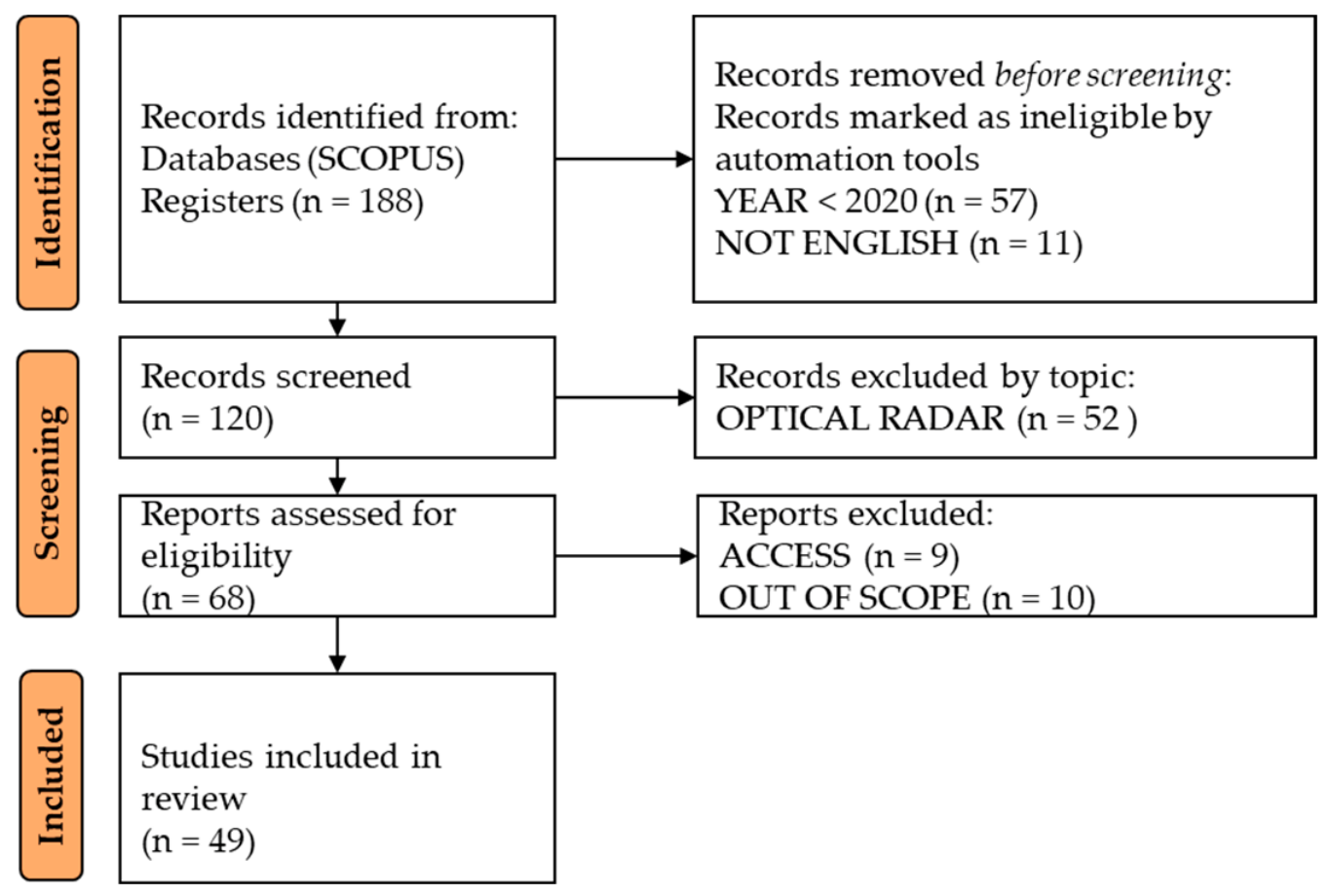
To ensure reproducibility, transparency, and methodological rigor, this review follows the PRISMA-ScR (Scoping Reviews) guidelines [
33]. The workflow outlining the study selection process, from initial identification in databases to final inclusion, is illustrated in
Figure 1.
3.1. Search Criteria
The literature review was carried out using SCOPUS as the main bibliographic source, selected for its broad content coverage and strict indexing criteria across scholarly journals, conference papers, and book chapters. SCOPUS was selected as the primary database due to its broad multidisciplinary coverage and the high overlap of indexed records with databases such as Web of Science and IEEE Xplore, which minimizes redundancy while ensuring comprehensive literature retrieval.
The keywords used in this review were organized into three thematic categories: the first group relates to the terminology associated with VRUs, the second focuses on LiDAR and 3D sensing technologies, and the third encompasses concepts linked to road safety. The search performed was “(pedestrian OR bike OR vulnerable-road-user OR VRU) AND (point-cloud OR 3D-scanning OR LiDAR OR laser-scanning OR mobile-mapping) AND (road-safety OR traffic-safety OR urban-safety OR intersection OR crosswalk OR road-geometry OR accident)”. The search was conducted in title, abstract, and keywords. Although the search criteria and keywords are specifically designed to retrieve LiDAR-based research, this review acknowledges that contemporary VRU safety solutions rarely rely on single sensor modality. Consequently, while the analysis remains anchored in the processing and application of 3D point clouds, it intentionally includes systems that employ multi-sensor fusion (e.g., LiDAR-Camera or LiDAR-GNSS).
Figure 1.
PRISMA workflow.
Figure 1.
PRISMA workflow.
3.2. Screening, Eligibility, and Appraisal Criteria
The selection of articles followed a sequential filtering process, beginning with the database search parameters. Only articles published in English from 2020 onwards were considered for inclusion. The year 2020 was established as a methodological threshold to account for the rapid technological evolution of LiDAR hardware and advanced perception algorithms observed in recent years. This temporal constraint ensures that the synthesis focuses exclusively on the current state-of-the-art and practically applicable solutions, deliberately excluding earlier studies based on preliminary prototypes or obsolete sensing technologies that no longer align with modern safety standards.
Articles focusing exclusively on optical radar were excluded from the review as part of a deliberate domain-definition choice to center the analysis on LiDAR technology and high-resolution 3D spatial data. This exclusion represents a methodological necessity to ensure the scope remains coherent and focused on the processing of dense point clouds, thereby avoiding the potential redundancy that arises from including multimodal systems where LiDAR’s geometric precision is not the primary focus. While the role of radar-LiDAR fusion is acknowledged as a significant topic in broader literature, this review prioritizes the technical paradigms and urban design recommendations derived from the dense geometric details provided by laser-scanning sensors.
The final filtering step was conducted manually, where publications were reviewed and excluded based on text accessibility and overall quality of the work. A four-point Quality Assessment (QA) framework was introduced to enhance the methodological rigor and technical reliability of the synthesis: (QA1) all included publications were required to have undergone peer-review validation; (QA2) the corpus had to demonstrate methodological transparency by providing clear descriptions; (QA3) the studies have to evidence strength, specifically reporting validated performance metrics, or standardized safety measures; (QA4) contextual relevance into urban VRU safety, such as identifying risks in occluded intersections or proposing data-driven geometry and visibility design interventions. Literature reviews were also excluded but mentioned in
Section 2. In the end, 49 publications were selected, comprising 28 journal articles and 21 conference proceedings.
3.3. Bibliometric Analysis
The first appearance of the term Vulnerable Road User (VRU) in the scientific literature dates to 1987 in Finland [
34]. However, the relation with LiDAR sensors did not emerge until 2016 [
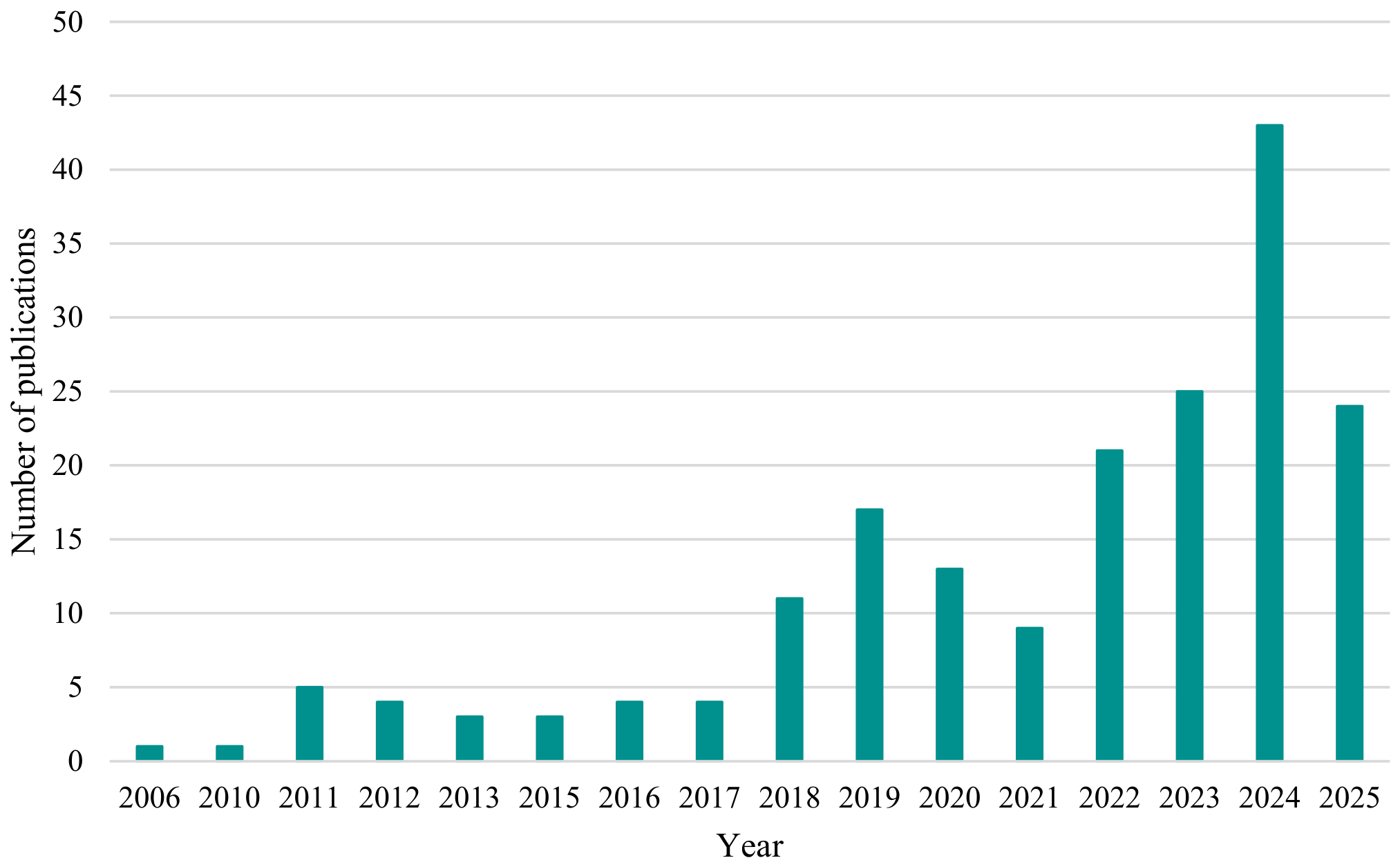
35], with a focus on pedestrian detection using on-vehicle LiDAR. Since then, the analysis of VRU safety through 3D technologies has steadily gained attention, maintaining research interest over the years (
Figure 2).
To complement the systematic review, a textual analysis of the selected literature was conducted using VOSviewer v1.6 [
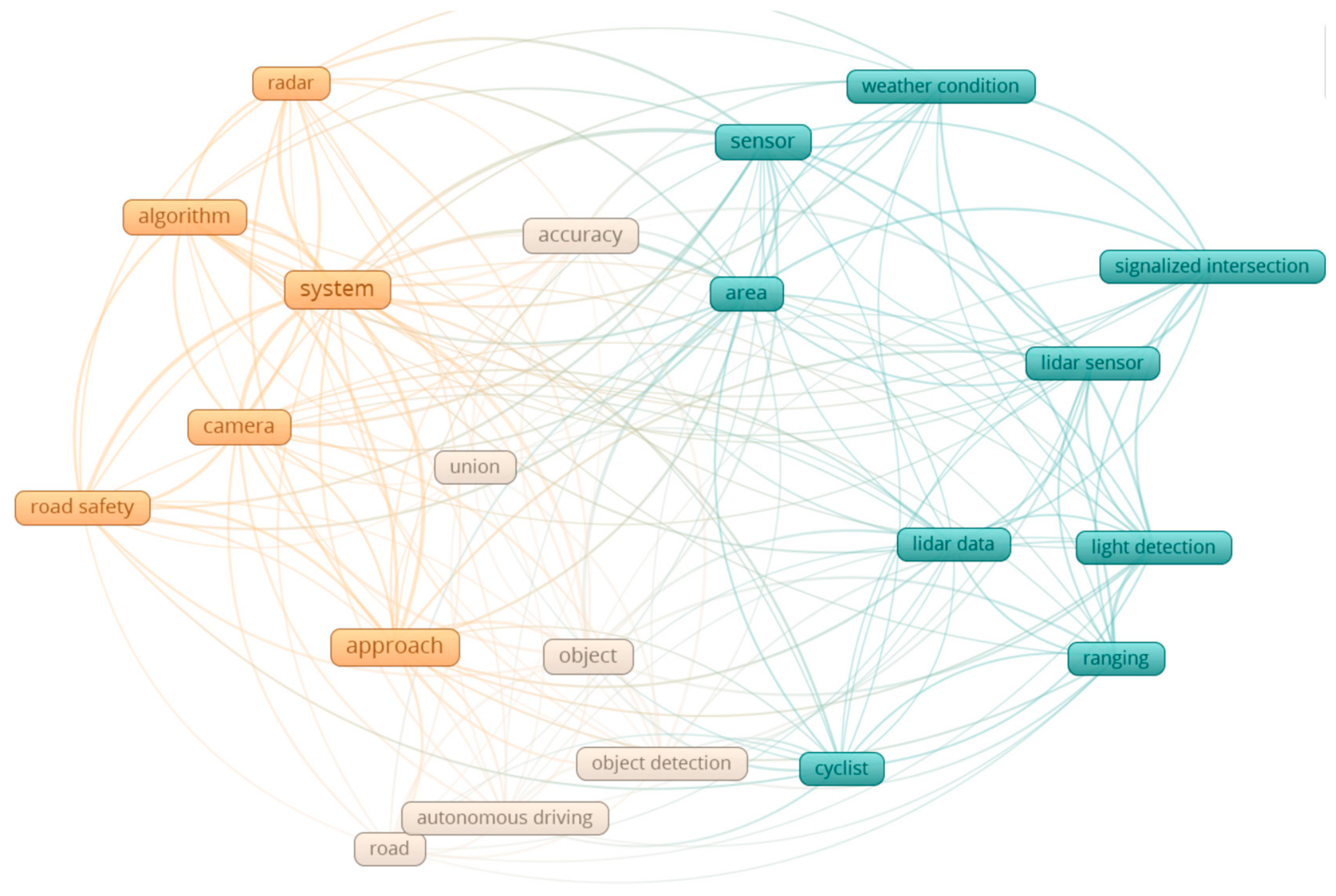
36], a software tool widely employed in bibliometric studies for constructing and visualizing scientific landscapes. VOSviewer is particularly suitable for mapping co-occurrence networks of terms, allowing the identification of thematic clusters and research trends within a corpus. Its use enables a more structured understanding of the conceptual development of the field, highlighting the most frequent keywords, their interrelations, and the emergence of new topics. In this study, VOSviewer was applied to capture the VRU-related research in connection with 3D sensing technologies, within title and abstract information of the screened publications. VOSviewer identified terms with more than seven occurrences and grouped them into three clusters. As shown in
Figure 3, the left cluster is associated with camera-based systems and road safety; the central cluster focuses on autonomous driving, particularly on one of its key objectives (object detection) which incorporates performance metrics such as accuracy and union (Intersection over Union); finally, the right cluster is centered in LiDAR technology terms.
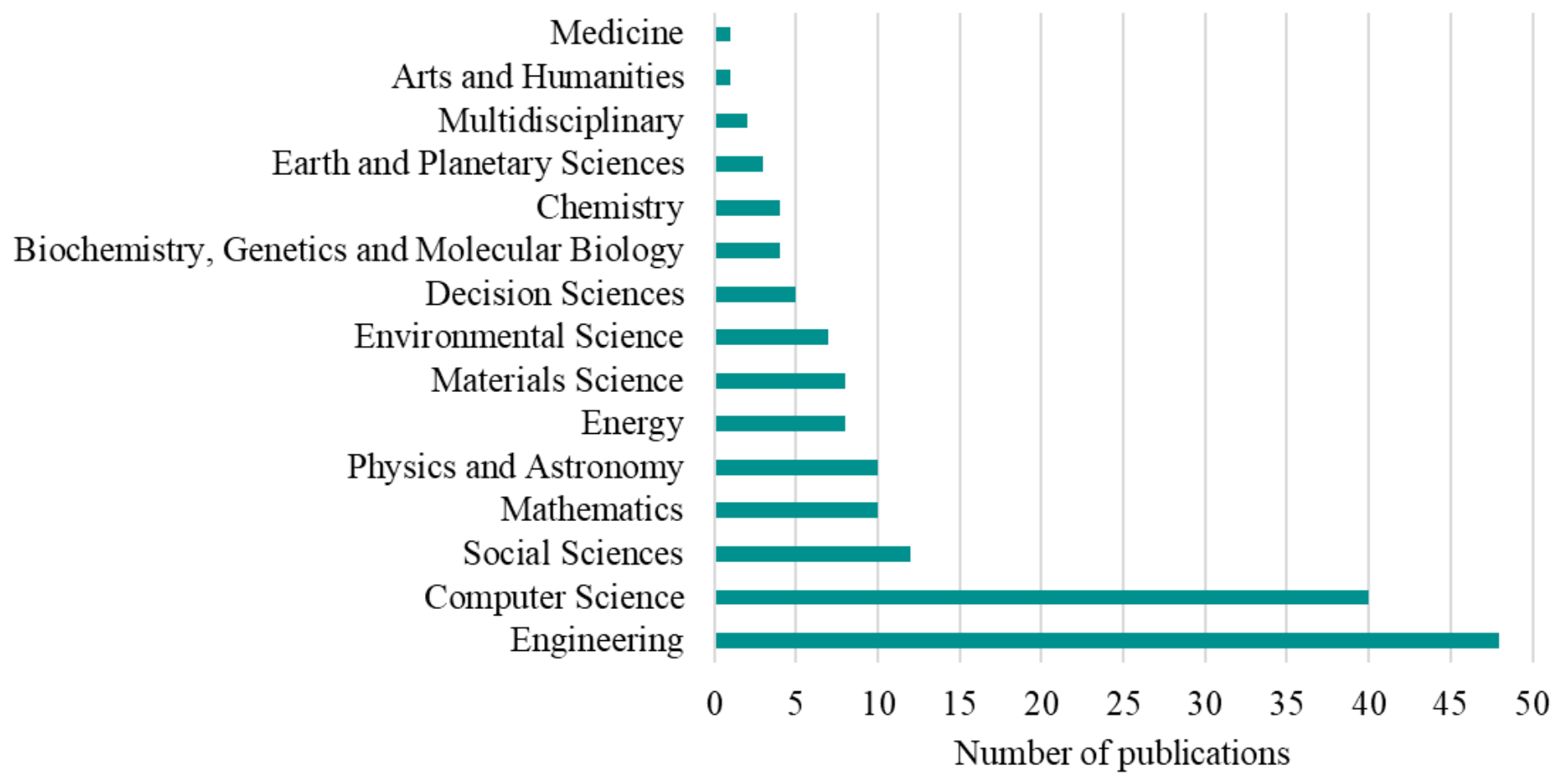
The bibliometric and subject area analyses were performed on the reports assessed for eligibility to provide a broader mapping of the conceptual landscape prior to the final manual exclusion of 19 publications based on quality constraints.
Figure 4 shows the number of publications by subject area. The number of publications shows a clear concentration in Engineering (48) and Computer Science (40), reflecting the emphasis on sensor development, perception algorithms, and intelligent transportation systems. The presence of Social Sciences (12) indicates a growing interest in understanding road user behaviors and human factors contributing to traffic safety. Other fields, such as Mathematics (10) and Physics (10), provide the foundations for modeling and simulating complex scenarios, while disciplines like Environmental Science (7) and Energy (8) suggest explorations in sustainability and infrastructure efficiency. This multidisciplinary landscape highlights that integrating LiDAR technology to protect VRUs requires an approach that combines technical innovation with social and environmental understanding.
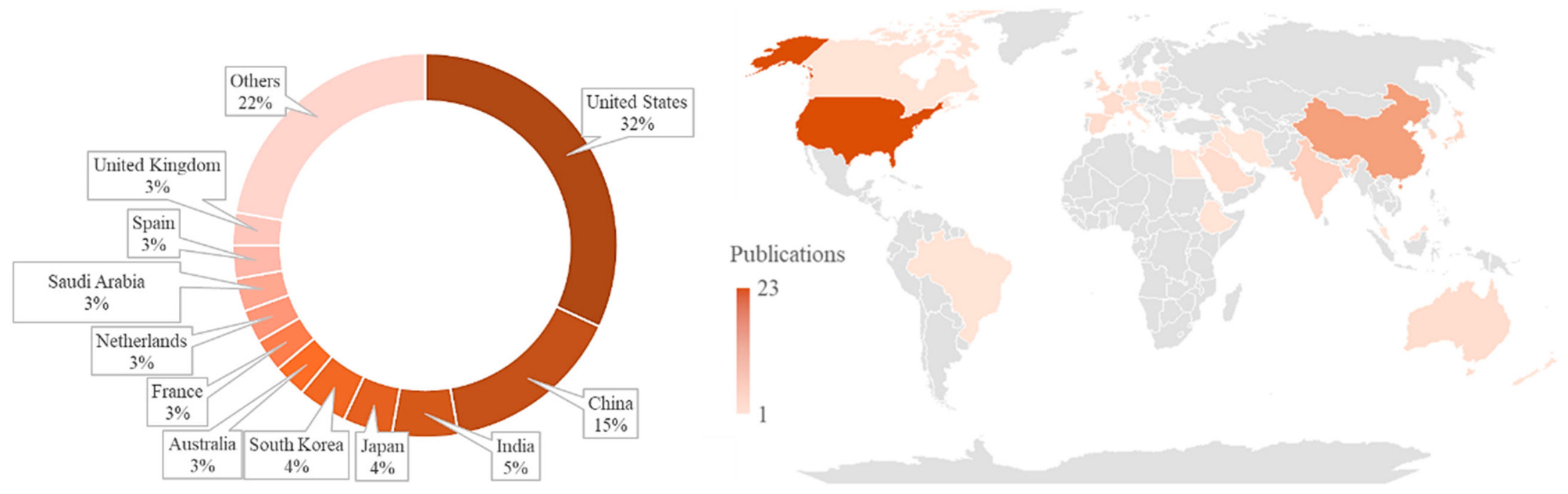
The distribution of publications by country is presented in
Figure 5. The United States leads with 23 publications, followed by China with 11 and India with 4. Consistent with this distribution, the institutions with the highest number of contributions are also based in the United States: University of Nevada (5 publications), Morgan State University (4 publications), and Purdue University (3 publications).
3.4. Research Constraints Overview
This literature review was primarily conducted using the SCOPUS database, which ensures a focus on multidisciplinary, peer-reviewed research but may limit the scope by omitting relevant technical publications exclusively indexed in specialized engineering databases such as IEEE Xplore or Web of Science. While there is a significant overlap between these databases [
37], the analysis remains constrained to academic literature, intentionally excluding proprietary developments, industry reports, or non-peer-reviewed sources from private companies. Furthermore, the implementation of a concise search string, while effective for broad retrieval across disciplines, might have inadvertently bypassed works employing alternative terminology or focusing on niche applications, which should be considered when evaluating the representativeness and completeness of the findings.
As a scoping review, this study acknowledges specific methodological constraints that distinguish it from a full systematic review. Notably, the protocol does not include a formal quality appraisal or a risk-of-bias assessment for each of the 49 included studies, meaning findings are synthesized regardless of the individual methodological strength of the source papers. Additionally, the screening and eligibility process was conducted by a single reviewer without reported inter-rater reliability measures, and the study protocol was not prospectively registered in international platforms such as PROSPERO. These factors are explicitly disclosed to ensure methodological transparency and to assist readers in calibrating their confidence in the types of claims and syntheses presented throughout this work.
4. Findings
4.1. How Accurate Are LiDAR Point Clouds in Detecting Pedestrians and Cyclists in Complex Urban Scenarios?
LiDAR technology offers high accuracy and robust performance, especially when complemented by other sensor modalities, acting as a primary source of geometric truth in urban perception. These sensors provide high-resolution spatial and temporal data by emitting laser pulses to generate dense 3D point clouds, enabling the accurate tracking of virtually all objects, including pedestrians and cyclists, at high sampling rates typically reaching ten frames per second (0.1 s) [
38]. Specific hardware, such as the Ouster OS1-128, exemplifies these capabilities by featuring 128 layers and a 45° vertical field of view to achieve a 0.3 cm resolution, detecting objects as close as 0.3 m, and offering a ranging accuracy of ±3 cm [
39]. Beyond precision, these systems are engineered for environmental resilience, possessing IP68 and IP69K ratings and operating effectively in temperatures ranging from −53 °C to 60 °C, ensuring reliability during adverse weather conditions like heavy fog or snow where optical sensors may fail.
Recent advances in LiDAR technology have also introduced important differences in scanning patterns that influence VRU detection performance. Traditional mechanical LiDAR sensors commonly operate using repetitive scanning patterns, where laser beams follow a fixed and periodic trajectory. These systems provide stable and predictable spatial sampling, which is advantageous for object localization and temporal consistency in tracking applications. However, repetitive patterns may generate sparsity artifacts or blind regions at longer distances and under dynamic occlusions, limiting the representation of small and fast-moving VRUs such as pedestrians or cyclists. In contrast, emerging non-repetitive scanning LiDARs employ irregular or pseudo-random beam distributions that progressively densify the observed scene over time [
40]. This strategy improves spatial coverage and increases the probability of detecting partially occluded or distant objects, especially in complex urban scenarios with heterogeneous traffic dynamics [
41]. Although non-repetitive scanning patterns can enhance perception robustness and scene completeness, they also introduce additional challenges for point cloud registration, temporal synchronization, and real-time processing due to their non-uniform spatial distribution [
42].
The accuracy of LiDAR-derived data has been validated through rigorous field studies, such as the Baltimore jaywalking analysis, which showed a 99.4% accuracy rate for real-time detection and trajectory mapping per second when compared to manual counting from Closed-circuit Television Cameras (CCTV) [
43]. For pedestrian detection specifically, models utilizing LiDAR point clouds, such as the Point Voxel-Region-based Convolutional Neural Network (PV-RCNN), achieve an F1-Score of 82.91% by synergizing voxel-based feature encoding with point-based set abstraction. This technical robustness is further extended by specialized models like PointNet, which classify pedestrian activities (distinguishing “Normal” behavior from “Abnormal” states such as falling or dizzy walking) with an overall accuracy of 83.92%. Furthermore, large-scale deployments in Utah have demonstrated the technology’s capacity to analyze over 170,000 pedestrian waypoints in a single 24 h period, allowing agencies to establish evidence-based metrics like the 15th percentile walking speed (3.9 ft/s) to calibrate signal clearance intervals according to local demographic reality [
38].
LiDAR systems consistently maintain their sensing performance regardless of the time of day and are less affected by external illumination conditions [
10,
44], where traditional CCTV cameras may struggle, providing reliable depth information and maintaining performance [
45,
46,
47]. In challenging conditions like nighttime and rain, camera-LiDAR fusion can still achieve 43% to 60% Intersection over Union (IoU) for pedestrian segmentation [
48].
An additional challenge in LiDAR-based VRU perception lies in the need for more granular distinctions among different categories of VRUs. Pedestrians and cyclists exhibit substantially different motion dynamics, spatial occupancy patterns, and geometric signatures, which directly affect detection and tracking performance. Pedestrians generally represent relatively slow-moving targets but possess highly articulated and geometrically complex structures due to limb movements and posture variability. In contrast, cyclists typically move at higher speeds and across larger distance ranges, requiring denser point cloud sampling and higher temporal refresh rates to maintain reliable trajectory estimation and object association [
49,
50]. Consequently, the suitability of a LiDAR sensor strongly depends on its technical specifications, including angular resolution, frequency, field of view, and range. High-channel LiDAR systems with dense vertical resolution may better capture fine-grained pedestrian geometry, whereas long-range and high-frequency sensors are more appropriate for fast-moving cyclists.
4.2. Which Methods or Algorithms Applied to LiDAR Data Provide the Most Reliable Characterization and Tracking of VRU?
Today, methods for point cloud processing can be categorized into foundational heuristic pipelines and specialized Deep Learning (DL) architectures. While heuristic steps remain essential for initial data refinement, the field has evolved toward a diverse architectural taxonomy that balances detection precision with computational efficiency.
4.2.1. Differentiated Synthesis of Detection and Tracking Performance Metrics
To facilitate a cross-study comparison, the quantitative performance of the main algorithms and fusion methods identified for VRU detection and tracking in this review is summarized in
Table 1 and
Table 2. The comparison confirms that the current body of research remains predominantly detection-oriented, with a primary focus on the spatial localization and classification of road users. Most of the reviewed works prioritize detection tasks and evaluate performance using standardized metrics such as Average Precision (AP), F1-score, Accuracy, or Intersection over Union (IoU). This imbalance reflects prevailing evaluation practices in LiDAR-based VRU research, where detection performance is commonly prioritized as the foundational step for safety systems, while tracking capabilities are frequently described qualitatively or integrated within broader system descriptions rather than assessed through standardized quantitative metrics.
In contrast, only a limited number of studies report explicit metrics associated with tracking performance, typically expressed as positional accuracy, trajectory-related measures, or temporal prediction errors. To address the heterogeneity of these findings,
Table 3 provides a dedicated synthesis of tracking evidence, categorizing studies by system and metric type (spatial or temporal), and context. While detection metrics show high consistency across datasets, tracking evidence remains fragmented, ranging from high-precision wearable trajectory prediction with errors under 3.2 cm to infrastructure-based tracking where occlusions can increase positional error to over 2 m. This variability reflects the broader transition in the literature from simple object identification toward high-fidelity trajectory analysis and future state prediction, where the focus shifts from determining whether an object is present to ensuring spatiotemporal accuracy for collision avoidance and real-time infrastructure management.
Recent approaches emphasize the integration of multiple sensing sources to maintain robust tracking under complex conditions. A key trend is the fusion of infrastructure-based LiDAR with wearable or mobile sensors such as GPS, IMU, and UWB, allowing systems to preserve continuous tracking during severe occlusions in environments like parking lots or dense urban intersections. The fusion of GNSS and IMU data enhances the robustness and accuracy of LiDAR-based VRU detection systems. While GNSS provides global positioning information, its accuracy is often degraded in dense urban canyons due to multipath propagation and Non-Line-of-Sight (NLOS) effects, where satellite signals are reflected or obstructed by surrounding infrastructure, introducing significant positional errors [
53]. IMU data, on the other hand, offers high-frequency inertial measurements that are immune to external signal occlusions but suffer from drift over time when used independently. The integration of these complementary sensors through sensor fusion techniques, such as Extended Kalman Filters, has been shown to recover position accuracy by up to 36.2% when pedestrians reappear from blind spots [
54]. It enables continuous, drift-compensated state estimation, thereby improving LiDAR point cloud georeferencing and the reliability of VRU localization and tracking. At the algorithmic level, computationally efficient approaches such as the AMT algorithm enable real-time trajectory prediction within a 5 s window in as little as 1.26 ms on standard hardware and around 5.5 ms on low-cost embedded devices such as Raspberry Pi [
6]. To mitigate multipath and NLOS-induced errors, advanced approaches include signal quality assessment metrics, 3D building-aided GNSS modeling, and machine learning-based NLOS detection and exclusion [
55], all of which contribute to more resilient positioning performance in complex urban scenarios.
Table 2.
Performance comparison of LiDAR-based algorithms and sensor fusion for VRU spatial/temporal tracking.
Table 2.
Performance comparison of LiDAR-based algorithms and sensor fusion for VRU spatial/temporal tracking.
| Algorithm/Method | Sensor Platform | Key Metric | Reported Performance | Context |
|---|
| Extended Kalman Filter [54] | Infrastructure/Wearable | Position Accuracy (spatial) | 1.033 m
2.317 m (from occlusion) | Pedestrian tracking |
| Alternating Model Tree (AMT) [6] | Wearable | Position Accuracy (spatial) | <3.2 cm | Trajectory prediction for VRU |
| Gated Recurrent Units (GRU) [56] | On-board | Mean Absolute Error (MAE) (temporal) | <0.458 s | Predicting vehicle-pedestrian encounters |
4.2.2. Heuristic and Pre-Processing Pipelines
Heuristic methodologies consist of knowledge-sequential steps focused on isolating target elements. These steps are often integrated into modern AI-based methods for data simplification:
Ground filtering: An initial step to extract non-ground point clouds, simplifying the data for accurate object clustering and detection [
11,
54,
57].
Clustering methods: Techniques like DBSCAN (Density-Based Spatial Clustering of Applications with Noise), Euclidean clustering, and human feature filters are widely used to group LiDAR points belonging to the same objects, effectively identifying pedestrians in 3D space [
2,
11,
52,
58].
Filtering and Estimation: PassThrough filtering is used as a pre-processing step to reduce complexity [
59], while the Kalman filter allows for trajectory estimation during occlusions and the fusion of unreliable data sources like GPS/IMU with LiDAR [
54].
Research has also focused on LiDAR-Inertial Odometry (LIO) frameworks capable of identifying and filtering pedestrians, vehicles, and other dynamic objects from point cloud data to improve localization and mapping robustness in urban environments. Dynamic-aware approaches [
60,
61,
62,
63] integrate temporal consistency analysis, occupancy-based filtering, trajectory estimation, and sliding-window optimization to suppress movable objects before scan matching and map generation. These methods reduce drift and improve pose estimation accuracy in highly dynamic urban scenarios where pedestrians and VRUs frequently introduce inconsistencies in static map assumptions.
4.2.3. Taxonomy of Deep Learning Architectures
To address the limitations of binary classifications, this review organizes DL-based methods into a structured taxonomy based on their spatial representation strategies:
Point-based Neural Networks: These architectures process 3D point cloud data directly, maintaining geometric consistency despite transformations. PointNet is utilized for high-precision pedestrian activity classification [
43]. These methods preserve high spatial fidelity but face increased computational burden when handling large-scale urban datasets.
Voxel and Grid-based Architectures: These approaches transform raw LiDAR point clouds into a 3D structured image (voxels) or 2D grids to facilitate efficient feature extraction. YOLO, when applied to intersection data and fused with clustering, shows high accuracy (mostly >0.90) for pedestrian detection [
47]. Similarly, CetrRoad is a specialized roadside 3D object detector for turning and occluded objects, achieving results comparable to multi-modal fusion [
52]. These paradigms are highly suitable for real-time infrastructure deployment due to their lower latency.
Hybrid (Point-Voxel) Frameworks: Hybrid models aim to blend the detailed spatial features of point-based methods with the computational efficiency of voxel-based discretization. PV-RCNN (Point Voxel-Region-based Convolutional Neural Network) demonstrates superior performance in pedestrian detection, achieving an F1-Score of 82.91% [
43]. While offering high precision for detailed safety analysis and post-processing, they require significant hardware resources.
4.2.4. Efficiency-Focused Machine Learning
For scenarios with limited data or edge-computing constraints, traditional Machine Learning (ML) algorithms such as Random Forest or Support Vector Machines (SVM) remain highly valued. These algorithms are appreciated for their efficiency, low number of training samples required, and robust performance in human-vehicle classification [
39,
43,
54].
4.2.5. Data Fusion Approaches
A very common option is to merge different types of data to counteract the limitations of each sensor and thus improve the performance of the methods:
LiDAR-Camera Fusion: Cameras provide texture and color, while LiDAR provides accurate distance and 3D geometry. This fusion helps overcome limitations in poor lighting, adverse weather where cameras struggle, and occlusion by compensating for missed detections. For pedestrian segmentation, camera-LiDAR fusion can achieve 43% to 60% Intersection over Union (IoU) in challenging nighttime and rainy conditions [
48].
LiDAR-UWB (Ultra-WideBand) Fusion: UWB, known for its high ranging accuracy and robustness in challenging environments, can improve VRU detection and tracking, especially in non-line-of-sight conditions. The average magnitude of distance error between LiDAR and UWB was found to be 0.1983 m [
4].
LiDAR-Smartphone Fusion: PAIDS approach combines LiDAR with smartphone Global Navigation Satellite System (GNSS) and IMU data to acquire high-precision position and attribute information of pedestrians [
11]. While smartphone GNSS can be inaccurate, LiDAR provides high accuracy for position, and their fusion improves overall reliability, even allowing trajectory estimation during occlusions.
Cooperative Perception: Systems leveraging LiDAR point clouds from multiple Connected Autonomous Vehicles (CAVs) or roadside units significantly improve pedestrian detection accuracy by compensating for blind spots, low resolution, and object occlusion. The S-AdaFusion model, for instance, showed a 7.2% Average Precision improvement for pedestrian detection [
11]. Roadside sensors offer a larger field of view and reduced sensitivity to occlusion compared to onboard sensors.
4.3. Do Effective Solutions for VRU Detection Rely More on On-Board, Infrastructure-Based, or Wearable Systems?
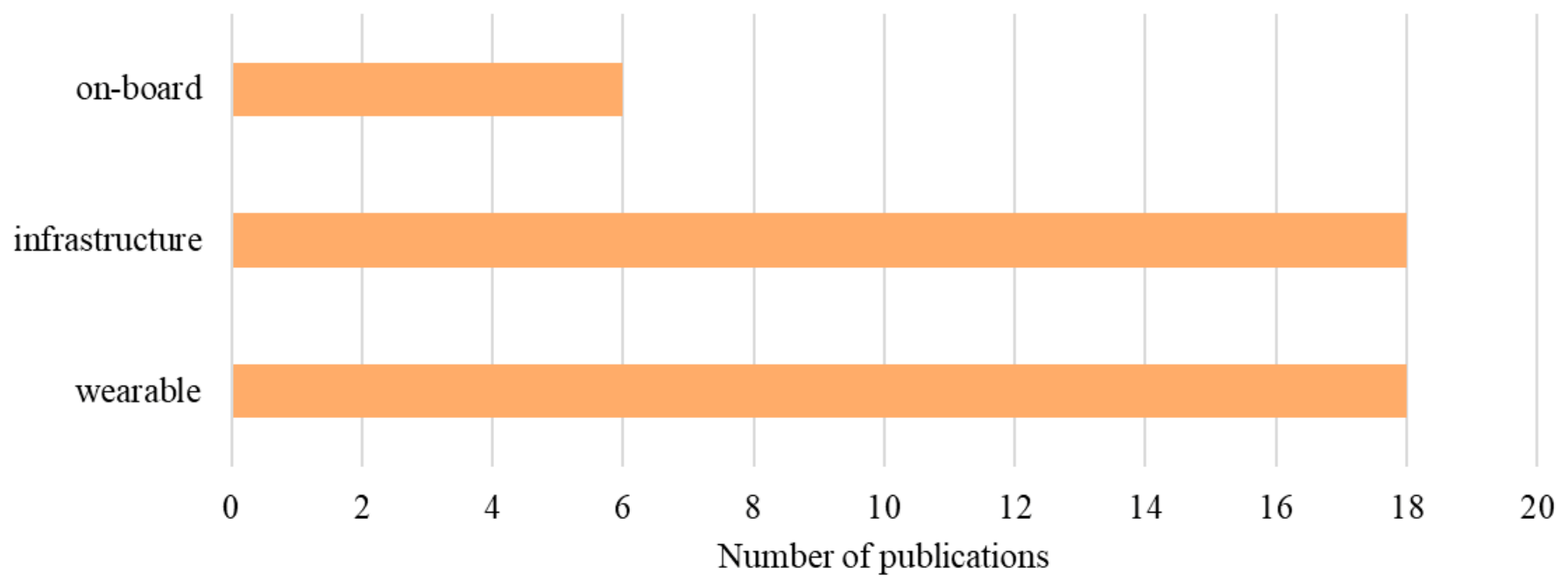
There are multiple platforms where sensors can be installed, and each one conditions VRU data collection. On-board systems refer to sensing and detection technologies directly integrated into vehicles and perceive the surrounding environment from the perspective of the vehicles. Infrastructure-based systems are fixed sensing installations designed to monitor urban spaces. By covering wider fields of view and reducing blind spots, they complement vehicle-based systems and provide continuous traffic monitoring for VRU safety. Wearable systems involve devices carried or worn by VRUs, such as smartphones, smartwatches, or dedicated sensors; and they provide location and communication capabilities (e.g., Vehicle-to-Pedestrian, V2P), enabling cooperative safety applications between VRUs and vehicles or infrastructure.
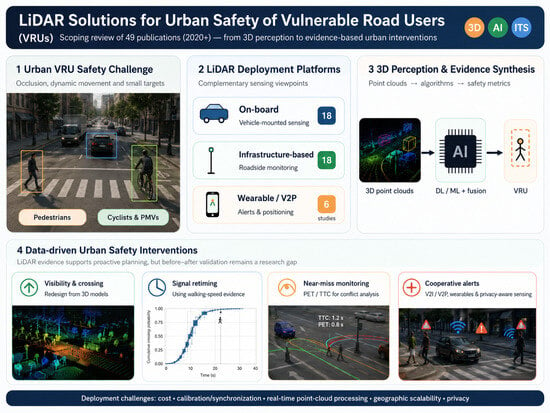
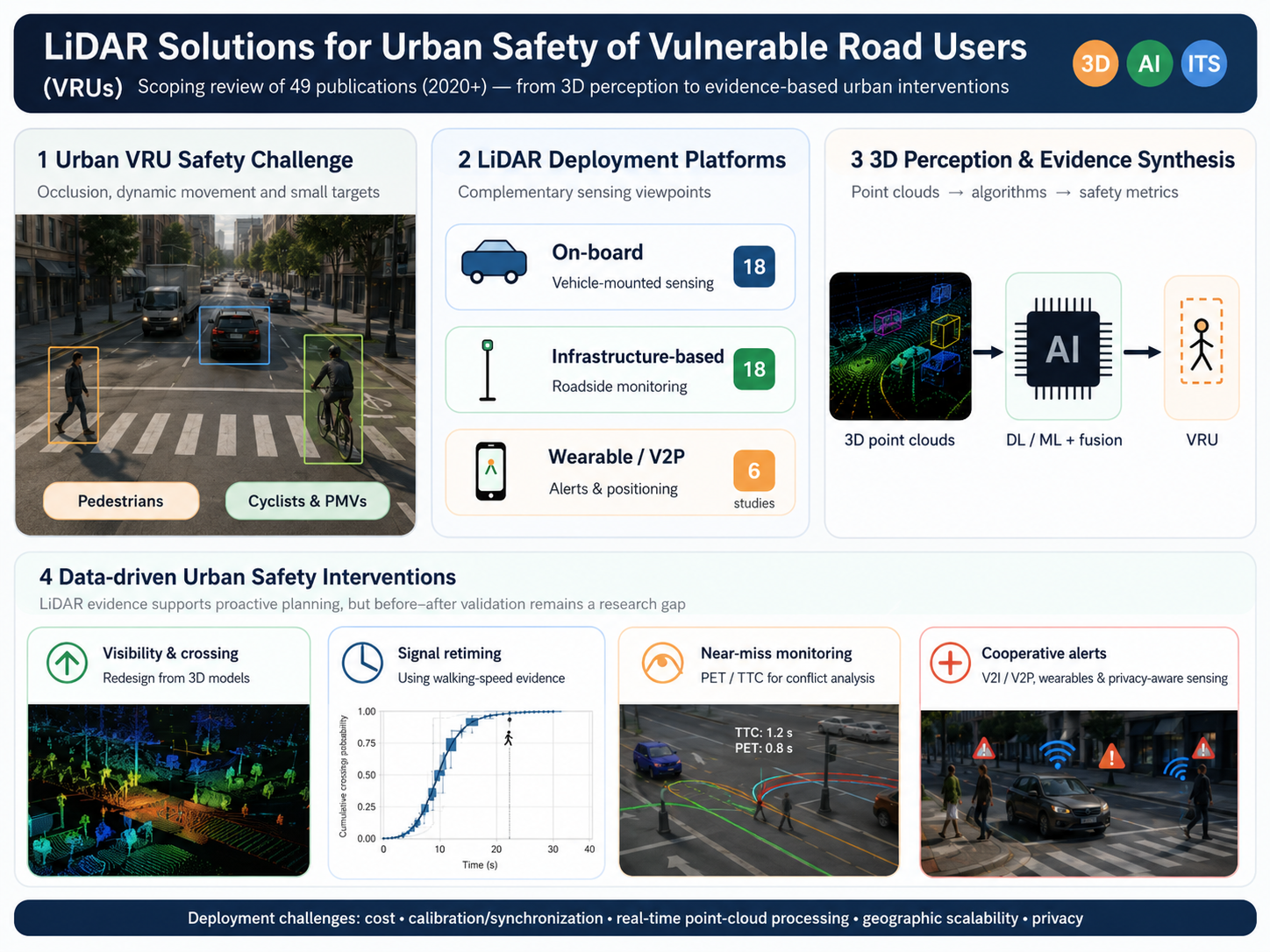
From the literature review, 42 articles make specific reference to the installation of sensors. The most common options are installation in infrastructure or vehicles (on-board), with 18 publications each, while only 6 publications examine wearable devices (
Figure 6).
4.3.1. On-Board Systems
On-board sensor systems for detecting VRUs have specific advantages and limitations compared to those integrated into infrastructure. The main advantages of on-board sensor systems are:
3D awareness and distance measurement: LiDAR sensors excel at providing accurate distance measurements and rich 3D geometric information about the environment [
48]. LiDAR capabilities are crucial for modeling accurate environmental networks and detecting obstacles, facilitating obstacle avoidance and route planning [
59].
Multipurpose object identification: On-board systems can identify in real time critical road elements, such as other vehicles, pedestrians, traffic signs, and lane boundaries [
64].
Limitations of on-board sensor systems:
Blind spots and limited Field of View (FoV): A fundamental limitation is the installation height of on-board sensors, which can impede the effective identification of occluded objects from the vehicle’s perspective [
52]. Large vehicles, such as buses, may have significant blind spots. A single sensor may have a limited field of view or blind spots, delaying the detection of approaching road users [
4].
Occlusion: Occlusion, caused by objects blocking the sensor’s detection field (such as parked vehicles, buildings, or trees), poses a real challenge for on-board perception systems, limiting the vehicle’s ability to detect VRUs [
2]. Pedestrians appearing suddenly from behind obstacles are difficult to detect in real time.
Detection range and short-distance detection: LiDAR, as currently used, may be insufficient for accident prevention, as it is primarily designed to recognize distant obstacles, making it difficult to detect pedestrians at short distances (near-field zone or blind spots immediately surrounding the sensor) [
65]. The effectiveness of camera systems in detecting pedestrians at short distances is inadequate for accident prevention when a pedestrian suddenly appears from behind an obstacle.
On-board LiDAR integration has emerged as the dominant strategy within the assisted and autonomous driving industry due to its direct role in real-time perception, collision avoidance, and trajectory prediction. Major automotive manufacturers and autonomous driving companies increasingly rely on LiDAR-based sensor fusion architectures combining cameras, radar, GNSS, and inertial systems to improve the robustness of VRU detection [
66]. Recent studies demonstrate that high-resolution automotive LiDAR substantially enhances the detection and tracking of pedestrians and cyclists by providing accurate 3D spatial information and reliable depth estimation [
67]. Furthermore, industrial advances in solid-state and high-channel-count LiDAR technologies have accelerated the deployment of Level 2+ and Level 3 ADAS platforms in commercial vehicles, with companies such as Waymo, Cruise, Baidu Apollo, Huawei ADS, Hesai, and Luminar adopting increasingly sophisticated LiDAR perception pipelines [
68]. Current research also highlights that LiDAR-based perception improves redundancy and safety validation compared with camera-only systems, particularly for VRU recognition at long distances and under nighttime conditions [
69].
4.3.2. Infrastructure-Based Systems
Infrastructure-based detection systems offer significant advantages in enhancing VRU safety by overcoming some of the inherent limitations of onboard vehicle sensors. Infrastructure-based detection systems, being installed in carefully selected fixed positions, allow for more consistent 3D data with better visibility:
Expanded FoV and reduced blind spots: Sensors mounted on traffic poles or other infrastructure elements can provide a much wider FoV and better detect objects that are occluded from a vehicle’s perspective, such as pedestrians hidden by parked cars or buildings [
10]. Reduced blind spots is crucial for early detection of sudden appearances of VRUs [
2].
Enhanced occlusion robustness: Unlike onboard sensors, which struggle with occluded VRUs, LiDAR infrastructure-based sensors are less sensitive to occlusion by other vehicles or environmental structures, providing more comprehensive awareness of the road environment [
2].
Superior 3D spatial data (LiDAR): Roadside LiDAR sensors excel at providing accurate distance measurements and rich 3D geometric information of the surroundings [
47]. This detailed 3D data is crucial for precise object localization, tracking, and understanding complex traffic situations [
70].
Improved detection accuracy for VRUs: Cooperative perception using roadside LiDAR has been shown to improve the accuracy of pedestrian detection compared to conventional single-vehicle perception [
10]. Integrating LiDAR with vision can also improve detection in challenging scenarios like vehicle occlusion [
46].
Real-time data collection and massive data analysis: Roadside LiDAR enables real-time traffic data collection and processing, which is vital for optimizing traffic management methods, alleviating congestion, and improving intersection safety [
39]. These systems can have greater computing dedicated power than those installed in mobile systems.
At the same time, limitations of infrastructure-based detection systems are related to on-board systems:
Occlusion remains a challenge: Although generally better than onboard sensors, roadside systems can still face occlusion issues from complex urban elements like buildings or dense traffic, making it difficult to detect suddenly appearing VRUs [
2,
54].
High-cost installation and calibration challenges: High-precision LiDAR for a VRU specific environment and application can be expensive [
58]. Accurate sensor calibration and synchronization across multiple roadside units are essential for effective data fusion and cohesive scene understanding, which can be complex to achieve and maintain [
45,
71,
72]. Unlike on-board systems, which typically operate as self-contained units, effective roadside monitoring at complex intersections often requires the precise synchronization and spatial calibration of multiple units to eliminate blind spots and handle frequent occlusions of small targets like pedestrians. This multi-sensor coordination introduces a layer of complexity in ‘cohesive scene understanding’ that is not present in single-sensor setups.
Practical implementation vs. simulation: While simulations show promising results for infrastructure-based systems, their real-world implementation faces challenges related to environmental variability, communication reliability, and the need for robust edge computing capabilities [
47,
73].
4.3.3. Wearable Devices
Wearable devices offer capabilities that complement or overcome limitations of traditional vehicle-mounted sensors. The main contributions of wearable devices to VRU detection and tracking are:
Enabling Vehicle-to-VRU (V2P) Communication: Wearable devices, particularly smartphones, are instrumental in facilitating V2P communication. Thus, vehicles can receive information about nearby VRUs even when onboard perception sensors cannot detect them due to partial or complete occlusion or adverse weather conditions [
5].
Precise localization and trajectory prediction: Smartphones equipped with active geolocation capabilities (GNSS and IMU) or UWB can transmit location information, user identifiers, and attribute data. This data enables the prediction of VRU trajectories and estimation of collision risk [
4,
5]. For instance, the Alternating Model Tree (AMT) algorithm can predict future VRU positions with an error of less than 3.2 cm, extending up to 1 m for the next 5 positions over a 1 s period. A 5 s prediction window can be processed within 1.25 milliseconds [
6].
Real-time alerts and enhanced situational awareness: Smartphone applications can receive real-time alerts regarding potential VRU-vehicle conflicts, enabling prompt control commands and improving safety. Moreover, wearable Augmented Reality (AR) systems can provide spatially located warnings in real-time by overlaying digital elements onto the user’s view, making hidden objects visible without diverting attention to a phone screen [
44].
Acquisition of VRU Attribute Information: Systems like PAIDS, which integrate LiDAR data and previously smartphone-user-registered data, can extract high-precision position alongside detailed pedestrian attribute information: age-related data allows the system to anticipate various behavioral patterns, by recognizing that elderly or physically disabled pedestrians often require longer crossing times, the system can proactively adjust its trajectory or even shut off the engine to conserve energy while waiting; health status attributes, such as visual impairments, are critical for determining the most effective safety communication methods (e.g., audible rather than visual alerts), while native language information ensures that foreign pedestrians correctly receive and interpret voice instructions in real time [
11].
Wearable devices also present the following limitations:
Scalability and user inconvenience: Some technologies necessitate attaching specific hardware devices to workers, which can be inconvenient for daily use and cause discomfort to the user. Current experimental setups, often involving VRUs, are not immediately practical for large-scale deployment. For example, future integration of UWB into mass-market consumer devices is promising, widespread adoption still faces significant hurdles [
4].
Accuracy limitations: The positioning accuracy of smartphone GNSS sensors can be unsatisfactory, especially in urban canyons. Although Kalman filters can help smooth irregular GNSS deviations, significant variations in a pedestrian’s actual height from a reference can introduce inaccuracies in distance calculations. The typically low refresh rate (1 Hz) of standard GPS sensors also poses a challenge for real-time tracking [
5].
Communication band congestion and delays: Managing large groups of VRUs can substantially increase the processing load on the system and potentially cause congestion within the Bluetooth or other communication bands [
5].
Privacy concerns: The use of certain sensors or the collection of sensitive data by wearable sensors can raise privacy concerns [
9,
74,
75].
4.4. What Existing Project Interventions Demonstrate the Practicality and Effectiveness of Continuous LiDAR Monitoring and VRU Path Design?
The implementation of LiDAR-based digitization is a specialized application used to create high-resolution 3D models of segregated walking and cycling facilities, enabling a flexible assessment of road geometries and surface features [
76]. Rather than a general mapping exercise, these digitized environments serve as the technical foundation for evaluating how specific design elements (such as protected bike lanes and pedestrian refuges) influence visibility and behavioral patterns among VRUs. By transforming raw point clouds into actionable Digital Twins, planners can simulate conflict zones and implement evidence-based traffic calming strategies that directly reduce the frequency of ‘near-miss’ events [
71,
77].
LiDAR-supported analysis of VRU-vehicle conflict zones allows planners to implement evidence-based traffic calming strategies, such as speed reduction zones, which lower the frequency and severity of accidents [
71]. Green infrastructure informed by MMS and GPR optimizes safety by mitigating sun glare to improve visibility at conflict zones while enhancing thermal comfort to encourage pedestrian compliance with designated safe paths [
78]. While no publications mentioned direct collision reductions, such interventions improve the quality and appeal of VRU paths, encouraging higher usage and greater compliance with designated paths.
The reviewed publications focused primarily on the observation and understanding of collisions. While pilot studies in locations such as Sofia, Madrid, and Baltimore have successfully demonstrated the practicality of using infrastructure-based and portable LiDAR for real-time traffic monitoring, they primarily emphasize the identification and understanding of safety risks rather than the longitudinal impact of specific implemented solutions. For instance, the Madrid study illustrates how LiDAR-derived 3D models can precisely quantify visibility obstructions caused by street furniture and vegetation, providing a flexible framework for evaluating the relocation of these elements to improve sight distances for pedestrians and riders. Similarly, research in Utah highlights the effectiveness of LiDAR in directly measuring 15th-percentile pedestrian walking speeds (3.9 ft/s), which provides a data-driven justification for modifying signal timing policies that currently rely on more conservative national guidelines. Furthermore, the deployments in Reno & Sparks and Trois-Rivières demonstrate LiDAR’s superior capability to capture high-frequency near-miss events that remain undetected in official crash reports, thereby validating the need for proactive interventions such as evidence-based traffic calming and speed reduction zones. However, the transition from observation to validation requires more robust comparative analyses, measuring “before and after” scenarios of interventions, to provide the practical engineering experience necessary for large-scale adoption and the direct reduction of VRU-vehicle collisions. A summary of the identified pilot studies is presented in
Table 3.
Table 3.
LiDAR-based Pilot Studies for VRU Safety Analysis.
Table 3.
LiDAR-based Pilot Studies for VRU Safety Analysis.
| Reference | Location | Objective | Duration | VRU | LiDAR |
|---|
| Wibisana et al. [39] | Sofia,
Bulgaria | Traffic monitoring—simulation | 6 min. | Pedestrians, Cyclists | Infrastructure-based |
| González-Gómez et al. [79] | Madrid,
Spain | Conflict evaluation based on intersection visibility | 30 min. | Pedestrians, Cyclists | On-board |
| Ansariyar et al. [71] | Baltimore,
USA | Conflict analysis of jaywalking events | 6 mo. | Pedestrians | Infrastructure-based |
| Ansariyar and Jeihani [80] | Trois-Rivières,
Canada | Detection of V2V and V2P conflicts | 18 mo. | Pedestrians | Infrastructure-based |
| Kelley et al. [58] | Reno & Sparks,
USA | Mapping of near-miss conflict events | 6 days | Pedestrians, Cyclists | Infrastructure-based |
| Saldivar-Carranza et al. [38] | Utah,
USA | Measurement of traffic signal performance | 1 day | Pedestrians | Infrastructure-based |
4.5. What Recommendations from 3D Spatial Data Can Improve the Design and Visibility of Pedestrian Crossings and Intersections?
3D spatial data, particularly that acquired through LiDAR with a high Level of Detail enables the creation of comprehensive holographic scenes of traffic conditions and accurate representations of the road environment [
81], through 3D visibility analyses and assessing sight distances for all road users, including pedestrians and riders [
79], where lack of visibility is a significant factor in accidents. 3D models also allow for quantifying the impact of common obstructions such as vegetation growth, street furniture, and traffic elements [
82]; and subsequent evaluation of relocating or re-dimensioning urban furniture elements or road assets. For instance, it provides a framework to potentially evaluate which element caused an obstruction and quantify the effects of its replacement or correction on visibility.
LiDAR sensors accurately track the movement of pedestrians within intersection areas, recording positions and velocities for trajectory analysis. These insights offer a basis for agencies to consider corroborating existing design guidelines, like Manual on Uniform Traffic Control Devices (MUTCD) speeds, or consider alternative crossing times that better serve local demographics [
38]. LiDAR-derived metrics, such as Post-Encroachment Time (PET) and Time-to-Collision (TTC), provide essential data for the assessment of pedestrian-vehicle conflicts [
71], for identifying “near-miss” events that are far more frequent than actual crashes and are critical for proactive safety planning [
58].
In signal optimization, LiDAR data allows dynamic adjustments to signal timings based on current traffic volume [
80] with estimation of traffic signal performance for both vehicles and pedestrians, such as wait times and the proportion of people traversing multiple crosswalks. These measures represent a valuable input for Digital Twin models to explore whether operational changes or signal retiming are required [
38].
Table 4 presents a structured mapping of the LiDAR-to-design pipeline, illustrating the interconnections between LiDAR-derived data, associated safety metrics, urban interventions, and the strength of the underpinning evidence.
5. Discussion: Current Trends and Future Challenges
5.1. LiDAR and Data Processing
The effectiveness of VRU detection is primarily dictated by LiDAR-specific constraints, specifically the inherent trade-off between point cloud density and real-time processing speeds. While multi-unit configurations can mitigate occlusions, they introduce significant complexities in spatial point cloud registration and temporal synchronization across the network. As mentioned above, limited FoV and occlusion represent persistent challenges, as pedestrians and cyclists can easily be hidden by vehicles, roadside objects, or environmental features [
2]. While integrating multiple LiDAR units or complementing them with cameras and mmWave radar improves coverage, these solutions introduce higher costs, maintenance demands, and additional sources of uncertainty [
70,
75]. Camera-based perception struggles under low-light conditions or glare, whereas radar systems often lack shape information and have reduced sensitivity to non-metallic objects [
46]. Moreover, 3D object detection tasks suffer from difficulties in boundary definition and spatial reasoning, particularly when handling dense and complex datasets [
83]. These factors highlight the need for more robust and cost-effective sensor fusion strategies that can balance complementary strengths without overburdening computational or hardware requirements.
Beyond the sensors themselves, the quality, quantity, and real-time processing of data remain pressing issues. Training DL models requires extensive annotated LiDAR datasets, yet manual labeling is prohibitively expensive, and the scarcity of raw point clouds further limits generalization [
3]. Incomplete trajectories, heterogeneous formats, and preprocessing requirements add layers of complexity, slowing down pipeline efficiency [
39]. Real-time constraints are particularly challenging, as the computational burden of processing large-scale point clouds or generating heatmaps can hinder timely decision-making [
75]. Moreover, multi-task networks designed for panoramic perception often underperform, struggling to achieve both accuracy and efficiency with limited resources [
59]. These limitations underscore the need for novel data-efficient learning strategies, standardized preprocessing pipelines, and lightweight architectures that enable reliable VRU detection under real-world constraints. In addition, challenges remain in addressing occlusion with more than three individuals in IoU loss functions [
83], as well as enhancing the prediction of forklift and pedestrian speed and direction while accounting for aspect-ratio variations in distance estimation [
84].
Several public datasets have contributed significantly to the development and benchmarking of LiDAR-based VRU detection and tracking algorithms. Widely used datasets such as Complex Urban Dataset [
85], SynPeDS [
86], SynthmanticLiDAR [
87], HeLiPR [
88], NCLT [
89], UrbanNav [
90], SUD [
91], AevaScenes [
92], and SemanticKITTI [
93] include annotated pedestrians, cyclists, or other VRUs under diverse urban traffic conditions.
5.2. Scalability for Geographic Coverage
Scaling up the deployment of advanced detection systems for VRU safety faces several practical and economic barriers. High initial investment costs, coupled with the complexity of installing, configuring, and maintaining multi-sensor or high-end LiDAR solutions, limit their feasibility for large-scale urban applications [
84]. Achieving real-world scalability requires the development of embedded, low-power hardware capable of supporting DL processes [
47]. Surveillance systems and roadside units (RSUs) demand frequent maintenance, such as lens cleaning and calibration [
9]. These constraints hinder the possibility of achieving city-wide coverage without substantial financial and technical investment. Future scalability depends on the development of solid-state LiDAR and edge-computing architectures capable of handling the high-bandwidth throughput of raw 3D spatial data without relying on expensive central servers.
Despite the high technical specifications often reported for LiDAR hardware, such as sub-centimeter resolution and high ranging accuracy, it is critical to distinguish these theoretical capabilities from their real-world engineering readiness. The evidence synthesized in this review reveals that many high-performance results are derived from simulation platforms or short-term, small-scale field tests that do not fully account for the complexities of urban environments. Factors that severely degrade performance (including adverse weather (rain, fog, snow), lighting fluctuations (glare), traffic density, and calibration drift) remain persistent challenges for consistent operational reliability.
Recent technological advances in LiDAR sensing have substantially improved the feasibility of large-scale deployment of high-resolution perception systems in intelligent transportation applications. Over the last decade, LiDAR sensors have experienced rapid improvements in spatial resolution, ranging capability, scanning frequency, and robustness under adverse environmental conditions, while mass production has significantly reduced hardware costs and accelerated industrial adoption [
94]. New-generation automotive LiDAR systems are beginning to achieve image-like perception densities that were previously unattainable in commercial platforms. For example, Huawei recently introduced an 896-line dual-optical-path LiDAR system, currently among the highest-resolution mass-produced automotive LiDAR sensors available, capable of detecting small low-reflectivity obstacles at distances exceeding 120 m with substantially increased point cloud density and perception stability. Such developments represent an important step toward high-definition environmental modeling and more reliable detection of VRUs.
Beyond technical and financial issues, large-scale implementation also raises structural and societal challenges. Comprehensive urban coverage would require a dense distribution of sensors, which is costly and may trigger public concerns regarding surveillance and trust [
58]. Moreover, existing infrastructure is often tailored to specific areas, restricting its applicability across broader urban networks, such as complex intersections or extensive cycling routes [
47]. The lack of unified standards and interoperable platforms, particularly for the safe design of cyclist infrastructure, slows progress toward fully integrated intelligent transportation systems too [
95]. Bridging these gaps will require continued research on cooperative perception frameworks, harmonized technical standards, and robust, cost-effective deployment strategies.
5.3. Data Privacy
Privacy concerns represent a major challenge in the deployment of sensor-based systems for VRU safety. Street-level imagery often contains personally identifiable information, such as faces, license plates, clothing, body shape, or even geographic location [
96]. The use of video surveillance in public spaces intensifies debates around data protection, restricting the collection and analysis of sensitive attributes like age, gender, or demographic behavior [
71]. In many cases, datasets cannot be publicly released due to corporate security policies or the absence of participant consent [
72]. Public trust also emerges as a critical factor, as widespread sensor networks in the built environment raise concerns about surveillance, while the collection of sensitive user attributes, such as language or health status, further amplifies privacy risks [
11].
To address these challenges, several privacy-preserving strategies have been proposed. Anonymization and obfuscation techniques, including face and license plate blurring, remain common, though limited in scope [
96]. Emerging approaches leverage semantic segmentation and inpainting to automatically remove sensitive objects from images while maintaining visual integrity. Unlike camera-based systems that capture sensitive biometric data, LiDAR offers a ‘privacy-by-design’ advantage by representing VRUs as anonymized 3D geometric coordinates [
43]. Informed consent, user engagement in sensor deployment decisions, and the explicit preprocessing of raw data (audio, video, LiDAR) are emphasized as ethical safeguards [
58]. However, these approaches introduce trade-offs: post-processing adds cost [
9], crowd occlusion complicates individual identification [
11], and the drive for more accurate and widely adopted systems risks undermining privacy protections if not carefully balanced.
Although the reviewed publications do not report on the use of LiDAR for biometric recognition, it is a current field of research. Instead of relying on facial features, most LiDAR-based identification approaches focus on behavioral biometrics, especially gait patterns, extracted from temporal sequences of point clouds or distance measurements [
97]. Recent studies demonstrate that individuals can be identified with relatively high accuracy (98%) using both 2D and 3D LiDAR data combined with deep learning techniques such as convolutional and recurrent neural networks [
98,
99]. These methods leverage spatial–temporal representations of human motion, including leg trajectories and body dynamics, rather than fine-grained physiological details. Its reliance on gait introduces sensitivity to changes in movement patterns, clothing, or carried objects.
5.4. The LiDAR-to-Design Pipeline
The synthesis of the reviewed literature reveals a clear, although still emerging, pipeline that translates LiDAR’s geospatial precision into urban design interventions. This pipeline is currently strongest in the Data-to-Metric phase, where the high resolution of 3D point clouds (up to 0.3 cm) [
39] allows for the precise quantification of visibility obstructions and pedestrian behavioral patterns that traditional sensors fail to capture. However, the Intervention-to-Validation link remains the most significant research gap, with evidence strength varying considerably across deployment platforms.
The evidence base is currently most robust for infrastructure-based observational studies. Research in Madrid [
79] and Utah [
38] has successfully demonstrated that LiDAR-derived 3D models can precisely quantify visibility obstructions caused by street furniture and vegetation. These studies provide strong evidence for the Data-to-Design transition, as they offer a flexible framework for evaluating the relocation of these elements to improve sight distances for pedestrians and riders. Similarly, the technology’s ability to measure 15th-percentile walking speeds (e.g., 3.9 ft/s in the Utah deployment) provides a data-driven justification for modifying signal timing policies that currently rely on conservative national guidelines. This represents a strong evidence base for measurement, though the subsequent safety outcomes of these interventions still lack longitudinal confirmation.
In contrast, the evidence for on-board ADAS and cooperative perception (CAV/V2X) pathways remains primarily modeling-based or simulation-only. While architectures like S-AdaFusion and PV-RCNN show high theoretical accuracy in compensating for blind spots and occlusions, their performance metrics are largely derived from simulated environments (e.g., CARLA or Blender) rather than real-world accident reduction. Similarly, near-miss frequency mapping in Reno, Sparks, [
58] and Baltimore [
71] remains purely observational. While these studies validate that LiDAR captures far more hazardous events than official crash reports, such as the 251 near-misses recorded in Reno versus only 26 historical crashes, they have yet to prove that traffic calming measures informed by this data lead to a statistical reduction in collisions over time.
Future research must prioritize longitudinal studies to bridge the validation gap. The urgency for these studies is differentiated as follows. High urgency for infrastructure interventions where validation is most critically needed for physical design changes, such as street furniture relocation or lane reconfiguration. Because these involve permanent capital investments, empirical “before-and-after” evidence is required to confirm they result in a statistically significant decrease in VRU-vehicle crashes. Medium urgency for signal optimization where the measurement of wait times and walking speeds is highly accurate, but the safety impact of implementing “demographic-aware” crossing times requires longitudinal validation to ensure they do not introduce new risks to traffic flow or vehicle compliance. And foundational urgency for wearable and cooperative alerts, because in AR and V2X systems, the primary need is not yet longitudinal safety validation but rather real-world scalability and latency testing. These systems must first achieve stable operation in dense urban “canyons” where communication band congestion is a risk before their long-term collision reduction can be evaluated.
6. Conclusions
Through a systematic search and scoping review framework, this review examined the evolution of research on sensing technologies aimed at improving the safety of Vulnerable Road Users (VRUs). The literature indicates that LiDAR has become one of the most influential sensing technologies for VRU detection due to its capacity to generate accurate 3D spatial representations of dynamic urban environments. Compared with purely vision-based systems, LiDAR offers advantages in depth perception, geometric accuracy, and reduced exposure to personally identifiable visual information. These characteristics position LiDAR as a valuable component within emerging perception frameworks for both autonomous vehicles and intelligent roadside infrastructures.
At the same time, the reviewed studies demonstrate that no single sensing modality provides a complete solution for VRU monitoring in complex urban scenarios. On-board sensors, infrastructure-based systems, and wearable devices each address different aspects of the perception problem, from localized vehicle awareness to broader environmental monitoring and user-centered safety applications. Consequently, recent research increasingly converges toward hybrid and cooperative perception architectures in which multiple sensing platforms interact to improve situational awareness and system robustness.
Beyond technological development, the literature also highlights the growing importance of integrating sensing systems within broader urban mobility ecosystems. Advances in sensing technologies are progressively linked with intelligent transportation systems, traffic management platforms, and urban safety policies. This integration underscores the transition from isolated experimental prototypes toward more comprehensive data-driven mobility infrastructures capable of supporting safer interactions between vehicles and VRUs.
Although substantial progress has been achieved, several research avenues remain for advancing the practical deployment of VRU detection systems. Future work should focus on improving the efficiency and generalization of Deep Learning models for LiDAR-based perception through data-efficient training strategies and lightweight architectures suitable for edge and embedded computing environments. Additional efforts are needed to develop robust sensor fusion frameworks capable of mitigating occlusion in dense urban settings. From an infrastructural perspective, research should also explore scalable sensing architectures, interoperable standards, and cost-effective deployment strategies that enable broader urban coverage. Addressing these challenges will require interdisciplinary collaboration across engineering, urban planning, transportation policy, and data governance to ensure that sensing technologies effectively contribute to safer and more sustainable urban mobility systems.
Author Contributions
Conceptualization, J.B. and M.S.; methodology, J.B. and J.C.; validation, J.B., M.S. and N.C.; formal analysis, J.C.; investigation, N.C.; resources, J.B.; writing—original draft preparation, J.C. and J.B.; writing—review and editing, M.S.; supervision, J.B.; project administration, J.B.; funding acquisition, J.B. All authors have read and agreed to the published version of the manuscript.
Funding
Jesús Balado would like to thank the funding from Government of Spain through RYC2022-038100-I by MCIN/AEI/10.13039/501100011033 and FSE+; and from Xunta de Galicia—GAIN [EDC431C 2024/30, ED431F 2024/06]. Mario Soilán would like to thank the funding Spanish Ministry of Science, Innovation and Universities through Grant RYC2021-033560-I funded by MCIN/AEI/10.13039/501100011033 and by European Union NextGenerationEU/PRTR, and by grant ED431F 2024/02 funded by Xunta de Galicia, Spain-GAIN.
Institutional Review Board Statement
Not applicable.
Informed Consent Statement
Not applicable.
Data Availability Statement
No new data were created or analyzed in this study. Data sharing is not applicable to this article.
Acknowledgments
During the preparation of this work the authors used ChatGPT v5.5 to improve language and readability and NotebookLM to support information extraction. After using this tool/service, the authors reviewed and edited the content as needed and took full responsibility for the content of the publication.
Conflicts of Interest
The authors declare no conflicts of interest.
References
- Morris, A.P.; Haworth, N.; Filtness, A.; Nguatem, D.-P.A.; Brown, L.; Rakotonirainy, A.; Glaser, S. Autonomous Vehicles and Vulnerable Road-Users—Important Considerations and Requirements Based on Crash Data from Two Countries. Behav. Sci. 2021, 11, 101. [Google Scholar] [CrossRef]
- de Borba, T.; Vaculín, O.; Marzbani, H.; Jazar, R.N. Increasing Safety of Vulnerable Road Users in Scenarios With Occlusion: A Collaborative Approach for Smart Infrastructures and Automated Vehicles. IEEE Access 2025, 13, 8851–8885. [Google Scholar] [CrossRef]
- de Araujo, J.N.; Palade, V.; Sedighi, T.; Daneshkhah, A. Improving the Pedestrian Detection Performance in the Absence of Rich Training Datasets: A UK Case Study. Adv. Artif. Intell. Mach. Learn. 2022, 2, 315–337. [Google Scholar] [CrossRef]
- Huang, J.; Gautam, A.; Choi, J.; Saripalli, S. Assessing Ultra-Wideband Technology for Improved Detection of Vulnerable Road Users in Urban Settings. In Proceedings of the 2024 IEEE International Symposium on Safety Security Rescue Robotics (SSRR), New York, NY, USA, 12–14 November 2024; pp. 261–266. [Google Scholar]
- Gelbal, S.Y.; Aksun-Guvenc, B.; Guvenc, L. Vulnerable Road User Safety Using Mobile Phones with Vehicle-to-VRU Communication. Electronics 2024, 13, 331. [Google Scholar] [CrossRef]
- Parada, R.; Aguilar, A.; Alonso-Zarate, J.; Vázquez-Gallego, F. Machine Learning-Based Trajectory Prediction for VRU Collision Avoidance in V2X Environments. In Proceedings of the 2021 IEEE Global Communications Conference (GLOBECOM), Madrid, Spain, 7–11 December 2021; pp. 1–6. [Google Scholar]
- Ayala, R.; Mohd, T.K. Sensors in Autonomous Vehicles: A Survey. J. Auton. Veh. Syst. 2021, 1, 1–16. [Google Scholar] [CrossRef]
- Matos, F.; Bernardino, J.; Durães, J.; Cunha, J. A Survey on Sensor Failures in Autonomous Vehicles: Challenges and Solutions. Sensors 2024, 24, 5108. [Google Scholar] [CrossRef]
- Nimac, P.; Krpič, A.; Batagelj, B.; Gams, A. Pedestrian Traffic Light Control with Crosswalk FMCW Radar and Group Tracking Algorithm. Sensors 2022, 22, 1754. [Google Scholar] [CrossRef] [PubMed]
- Qiao, D.; Zulkernine, F. Adaptive Feature Fusion for Cooperative Perception Using LiDAR Point Clouds. In Proceedings of the 2023 IEEE/CVF Winter Conference on Applications of Computer Vision (WACV), Waikoloa, HI, USA, 2–7 January 2023; pp. 1186–1195. [Google Scholar]
- Zhou, Z.; Kitamura, S.; Watanabe, Y.; Yamada, S.; Takada, H. PAIDS: Toward Pedestrian High-Precision Position and Attribute Information Detection. Int. J. Mechatron. Autom. 2021, 8, 187. [Google Scholar] [CrossRef]
- Yoshizawa, T.; Preneel, B. Open Questions in VRU Standards from Security and Privacy Perspectives. In Proceedings of the 2023 IEEE Conference on Standards for Communications and Networking (CSCN), Munich, Germany, 6–8 November 2023; pp. 284–289. [Google Scholar]
- Anand, B.; Barsaiyan, V.; Senapati, M.; Rajalakshmi, P. Real Time LiDAR Point Cloud Compression and Transmission for Intelligent Transportation System. In Proceedings of the 2019 IEEE 89th Vehicular Technology Conference (VTC2019-Spring), Kuala Lumpur, Malaysia, 28 April–1 May 2019; pp. 1–5. [Google Scholar]
- Sakib, S. LiDAR Technology-An Overview. IUP J. Electr. Electron. Eng. 2022, 15, 36. [Google Scholar]
- Miekkala, T.; Pyykönen, P.; Kutila, M.; Kyytinen, A. LiDAR System Benchmarking for VRU Detection in Heavy Goods Vehicle Blind Spots. In Proceedings of the 2021 IEEE 17th International Conference on Intelligent Computer Communication and Processing (ICCP), Cluj-Napoca, Romania, 28–30 October 2021; pp. 299–303. [Google Scholar]
- Rath, P.; Wishart, J. Evaluating Safety Metrics for VRUs at Urban Traffic Intersections Using Infrastructure LIDAR. 2024. Available online: https://saemobilus.sae.org/papers/evaluating-safety-metrics-vulnerable-road-users-urban-traffic-intersections-using-high-density-infrastructure-lidar-system-2024-01-2641 (accessed on 8 April 2026).
- Vogt, J.; Ilic, M.; Bogenberger, K. A Mobile Mapping Solution for VRU Infrastructure Monitoring via Low-Cost LiDAR-Sensors. J. Locat. Based Serv. 2023, 17, 389–411. [Google Scholar] [CrossRef]
- Holländer, K.; Colley, M.; Rukzio, E.; Butz, A. A Taxonomy of Vulnerable Road Users for HCI Based On A Systematic Literature Review. In Proceedings of the 2021 CHI Conference on Human Factors in Computing Systems; Association for Computing Machinery: New York, NY, USA, 2021. [Google Scholar]
- Muslim, H.; Antona-Makoshi, J. A Review of Vehicle-to-Vulnerable Road User Collisions on Limited-Access Highways to Support the Development of Automated Vehicle Safety Assessments. Safety 2022, 8, 26. [Google Scholar] [CrossRef]
- Reyes-Muñoz, A.; Guerrero-Ibáñez, J. Vulnerable Road Users and Connected Autonomous Vehicles Interaction: A Survey. Sensors 2022, 22, 4614. [Google Scholar] [CrossRef] [PubMed]
- Sankeerthana, G.; Raghuram Kadali, B. A Strategic Review Approach on Adoption of Autonomous Vehicles and Its Risk Perception by Road Users. Innov. Infrastruct. Solut. 2022, 7, 351. [Google Scholar] [CrossRef]
- Zoghlami, C.; Kacimi, R.; Dhaou, R. 5G-Enabled V2X Communications for Vulnerable Road Users Safety Applications: A Review. Wirel. Netw. 2023, 29, 1237–1267. [Google Scholar] [CrossRef]
- Ferdiansyah, A.; Lakshamana, I.P.; Rafli, A.M.; Pangestu, G. Comparison of Object Detection Models For Autonomous Vehicle Based on Accurracies: A Study Literature Review. Procedia Comput. Sci. 2024, 245, 555–564. [Google Scholar] [CrossRef]
- Adnan Yusuf, S.; Khan, A.; Souissi, R. Vehicle-to-Everything (V2X) in the Autonomous Vehicles Domain—A Technical Review of Communication, Sensor, and AI Technologies for Road User Safety. Transp. Res. Interdiscip. Perspect. 2024, 23, 100980. [Google Scholar] [CrossRef]
- Lv, X.; Xiao, Z.; Fang, J.; Li, Q.; Lei, F.; Sun, G. On Safety Design of Vehicle for Protection of Vulnerable Road Users: A Review. Thin-Walled Struct. 2023, 182, 109990. [Google Scholar] [CrossRef]
- Madsen, T.; Andersen, C.; Kamaluddin, N.; Varhelyi, A.; Lahrmann, H. Review of Current Study Methods for VRU Safety; Warsaw University of Technology: Warsaw, Poland, 2016. [Google Scholar]
- Zhang, T.; Cheng, L.; Bang, T.; Guo, L.; Hajij, M.; Cao, S.; Harris, A.; Sartipi, M. Roadside Sensor Systems for Vulnerable Road User Protection: A Review of Methods and Applications. IEEE Access 2025, 13, 62717–62738. [Google Scholar] [CrossRef]
- Altaf, I.; Kaul, A. Vulnerable Road User Safety: A Systematic Review and Mesh-Networking Based Vehicle Ad Hoc System Using Hybrid of Neuro-Fuzzy and Genetic Algorithms. Int. J. Commun. Syst. 2021, 34, e4907. [Google Scholar] [CrossRef]
- Kapousizis, G.; Ulak, M.B.; Geurs, K.; Havinga, P.J.M. A Review of State-of-the-Art Bicycle Technologies Affecting Cycling Safety: Level of Smartness and Technology Readiness. Transp. Rev. 2023, 43, 430–452. [Google Scholar] [CrossRef]
- Galal, A.; Ghizzawi, F.; Donmez, B.; Roorda, M.J. Human Factors Affecting Truck—Vulnerable Road User Safety: A Scoping Review. Transp. Rev. 2024, 44, 1209–1234. [Google Scholar] [CrossRef]
- Stefanidi, H.; Tatzgern, M.; Meschtscherjakov, A. Augmented Reality on the Move: A Systematic Literature Review for Vulnerable Road Users. Proc. ACM Hum.-Comput. Interact. 2024, 8, 1–30. [Google Scholar] [CrossRef]
- Sudhakaran, G.; Prabhakaran, A.; Booth, C.; Abbey, S.; Mahamadu, A.-M.; Georgakis, P.; Pohle, M. Stepping into Safety: A Systematic Review of Extended Reality Technology Applications in Enhancing Vulnerable Road User Safety. Smart Sustain. Built Environ. 2024, 14, 1664–1700. [Google Scholar] [CrossRef]
- Page, M.; Mckenzie, J.; Bossuyt, P.; Boutron, I.; Hoffmann, T.; Mulrow, C.; Shamseer, L.; Tetzlaff, J.; Akl, E.; Brennan, S.; et al. The PRISMA 2020 Statement: An Updated Guideline for Reporting Systematic Reviews. BMJ 2021, 372, n71. [Google Scholar] [CrossRef]
- Dunbar, J.A.; Penttila, A.; Pikkarainen, J. Drinking and Driving: Success of Random Breath Testing in Finland. Br. Med. J. (Clin. Res. Ed.) 1987, 295, 101–103. [Google Scholar] [CrossRef]
- Takagi, K.; Ando, S.; Hashimoto, M. Pedestrian Recognition Using On-Vehicle LIDAR. 2006. Available online: https://jglobal.jst.go.jp/en/detail?JGLOBAL_ID=200902261863157757 (accessed on 8 April 2026).
- van Eck, N.J.; Waltman, L. Software Survey: VOSviewer, a Computer Program for Bibliometric Mapping. Scientometrics 2010, 84, 523–538. [Google Scholar] [CrossRef]
- Mongeon, P.; Paul-Hus, A. The Journal Coverage of Web of Science and Scopus: A Comparative Analysis. Scientometrics 2016, 106, 213–228. [Google Scholar] [CrossRef]
- Saldivar-Carranza, E.D.; Desai, J.; Thompson, A.; Taylor, M.; Sturdevant, J.; Bullock, D.M. Vehicle and Pedestrian Traffic Signal Performance Measures Using LiDAR-Derived Trajectory Data. Sensors 2024, 24, 6410. [Google Scholar] [CrossRef]
- Wibisana, M.I.; Koeva, M.; Nourian, P.; Petrova-Antonova, D.; Karamitov, K. A LiDAR-Based Digital Twinning Workflow for Traffic Monitoring and Simulation. ISPRS Ann. Photogramm. Remote Sens. Spat. Inf. Sci. 2024, X-4–2024, 411–418. [Google Scholar] [CrossRef]
- Xie, A.; Qian, Y.; Yan, W.; Wang, C.; Yang, M. Non-Repetitive: A Promising LiDAR Scanning Pattern. In Proceedings of the 2024 IEEE/RSJ International Conference on Intelligent Robots and Systems (IROS), Abu Dhabi, United Arab Emirates, 14–18 October 2024; pp. 2653–2659. [Google Scholar]
- Qi, Z.; Zhao, R.; Zhuang, H.; Wang, C.; Yang, M. Which LiDAR Scanning Pattern Is Better for Roadside Perception: Repetitive or Non-Repetitive? Available online: https://arxiv.org/abs/2511.00060v1 (accessed on 7 May 2026).
- Aijazi, A.K.; Checchin, P. Non-Repetitive Scanning LiDAR Sensor for Robust 3D Point Cloud Registration in Localization and Mapping Applications. Sensors 2024, 24, 378. [Google Scholar] [CrossRef]
- Guefrachi, N.; Shi, J.; Ghazzai, H.; Alsharoa, A. Leveraging 3D LiDAR Sensors to Enable Enhanced Urban Safety and Public Health: Pedestrian Monitoring and Abnormal Activity Detection. In Proceedings of the 2024 46th Annual International Conference of the IEEE Engineering in Medicine and Biology Society (EMBC), Orlando, FL, USA, 15–19 July 2024; pp. 1–5. [Google Scholar]
- Lin, A.; Xu, H.; Chen, Z. Wearable AR System for Real-Time Pedestrian Conflict Alerts Using Live Roadside Data. Electronics 2024, 14, 99. [Google Scholar] [CrossRef]
- Ansariyar, A.; Taherpour, A.; Yang, D.; Jeihani, M. Comparative Analysis of LiDAR and CCTV Sensor Accuracy at Signalized Intersections Under Varied Weather Conditions. Int. J. Transp. Dev. Integr. 2024, 8, 237–249. [Google Scholar] [CrossRef]
- Kim, T.-L.; Jang, B.J.; Yeon, J.Y.; Kim, T.-H.; Park, T.-H. Camera-LiDAR Jaywalking Detection in Traffic Surveillance System. In Proceedings of the 2025 IEEE/SICE International Symposium on System Integration (SII), Munich, Germany, 21–24 January 2025; pp. 1004–1009. [Google Scholar]
- Park, S.-Y.; Kee, S.-C. Optimized Right-Turn Pedestrian Collision Avoidance System Using Intersection LiDAR. World Electr. Veh. J. 2024, 15, 452. [Google Scholar] [CrossRef]
- Gu, J.; Bellone, M.; Lind, A. Camera-LiDAR Fusion Based Object Segmentation in Adverse Weather Conditions for Autonomous Driving. In Proceedings of the 2024 19th Biennial Baltic Electronics Conference (BEC), Tallinn, Estonia, 2–4 October 2024; pp. 1–5. [Google Scholar]
- Chang, H.; Gu, Y.; Goncharenko, I.; Hsu, L.-T.; Premachandra, C. Cyclist Orientation Estimation Using LiDAR Data. Sensors 2023, 23, 3096. [Google Scholar] [CrossRef]
- Bhatia, T.; Goel, S.; Medury, A. Low-Cost LiDAR Mapping on Bicycles for Urban Road and Sidewalk Detection. Int. Arch. Photogramm. Remote Sens. Spat. Inf. Sci. 2025, XLVIII-G-2025, 197–204. [Google Scholar] [CrossRef]
- Ansariyar, A.; Jeihani, M. Statistical Analysis of Jaywalking Conflicts by a LiDAR Sensor. Sci. J. Silesian Univ. Technol. Ser. Transp. 2023, 120, 17–36. [Google Scholar] [CrossRef]
- Shi, H.; Hou, D.; Li, X. Center-Aware 3D Object Detection with Attention Mechanism Based on Roadside LiDAR. Sustainability 2023, 15, 2628. [Google Scholar] [CrossRef]
- Zhang, X.; Chen, L.; Feng, M.; Jiang, T. Toward Reliable Non-Line-of-Sight Localization Using Multipath Reflections. Proc. ACM Interact. Mob. Wearable Ubiquitous Technol. 2022, 6, 1–25. [Google Scholar] [CrossRef]
- Zhou, Z.; Yamada, S.; Watanabe, Y.; Takada, H. Tracking Pedestrians Under Occlusion in Parking Space. Comput. Syst. Sci. Eng. 2023, 44, 2109–2127. [Google Scholar] [CrossRef]
- Wen, W.W.; Hsu, L.-T. 3D LiDAR Aided GNSS NLOS Mitigation in Urban Canyons. IEEE Trans. Intell. Transp. Syst. 2022, 23, 18224–18236. [Google Scholar] [CrossRef]
- Miani, M.; Dunnhofer, M.; Micheloni, C.; Marini, A.; Baldo, N. Young Drivers’ Pedestrian Anti-Collision Braking Operation Data Modelling for ADAS Development. Transp. Res. Procedia 2022, 60, 432–439. [Google Scholar] [CrossRef]
- Mounsey, A.; Khan, A.; Sharma, S. Deep and Transfer Learning Approaches for Pedestrian Identification and Classification in Autonomous Vehicles. Electronics 2021, 10, 3159. [Google Scholar] [CrossRef]
- Kelley, S.; Peiffer, C.; Guan, F.; Xu, H.; Okorocha, J.; Dunn, K.; Cardillo, C. Mapping and Quantifying Near-Miss Events Involving Vehicles and Vulnerable Road Users in Reno and Sparks, Nevada. Transp. Res. Interdiscip. Perspect. 2025, 32, 101514. [Google Scholar] [CrossRef]
- Wu, W.; Liu, C.; Zheng, H. A Panoramic Driving Perception Fusion Algorithm Based on Multi-Task Learning. PLoS ONE 2024, 19, e0304691. [Google Scholar] [CrossRef]
- Zhang, Q.; Duberg, D.; Geng, R.; Jia, M.; Wang, L.; Jensfelt, P. A Dynamic Points Removal Benchmark in Point Cloud Maps. In Proceedings of the 2023 IEEE 26th International Conference on Intelligent Transportation Systems (ITSC), Bilbao, Spain, 24–28 September 2023; pp. 608–614. [Google Scholar]
- Duberg, D.; Zhang, Q.; Jia, M.; Jensfelt, P. DUFOMap: Efficient Dynamic Awareness Mapping. IEEE Robot. Autom. Lett. 2024, 9, 5038–5045. [Google Scholar] [CrossRef]
- Chen, Z.; Le Gentil, C.; Lin, F.; Lu, M.; Qiao, Q.; Xu, B.; Qi, Y.; Lu, P. Breaking the Static Assumption: A Dynamic-Aware LIO Framework via Spatio-Temporal Normal Analysis. IEEE Robot. Autom. Lett. 2025, 10, 12636–12643. [Google Scholar] [CrossRef]
- Wang, D.; Herraez, D.C.; May, S.; Nüchter, A. Dynamic-ICP: Doppler-Aware Iterative Closest Point Registration for Dynamic Scenes. IEEE Robot. Autom. Lett. 2026, 11, 5174–5181. [Google Scholar] [CrossRef]
- Kanagamalliga, S.; Latha, R.; Sugitha, N.; Iraianbu, E.; Guru, S.; Renugadevi, R. Real-Time Detection of Road Objects and Lane Markings for Autonomous Vehicles. In Proceedings of the 2025 5th International Conference on Trends in Material Science and Inventive Materials (ICTMIM), Kanyakumari, India, 7–9 April 2025; pp. 507–511. [Google Scholar]
- Heuijee, Y.; Park, D. Deep Learning Based Human Detection Using Thermal-RGB Data Fusion for Safe Automotive Guided-Driving. In Proceedings of the 2024 IEEE International Conference on Pervasive Computing and Communications Workshops and other Affiliated Events (PerCom Workshops), Biarritz, France, 11–15 March 2024; pp. 593–598. [Google Scholar]
- Roriz, R.; Cabral, J.; Gomes, T. Automotive LiDAR Technology: A Survey. IEEE Trans. Intell. Transp. Syst. 2022, 23, 6282–6297. [Google Scholar] [CrossRef]
- Feng, W.; Li, Y.; Wei, J. Impact of LiDAR Beam Loss on 3D Object Detection: A Systematic Analysis of Vulnerable Road User Safety. Pattern Recognit. Lett. 2026, 205, 155–161. [Google Scholar] [CrossRef]
- Li, Y.; Ibanez-Guzman, J. Lidar for Autonomous Driving: The Principles, Challenges, and Trends for Automotive Lidar and Perception Systems. IEEE Signal Process. Mag. 2020, 37, 50–61. [Google Scholar] [CrossRef]
- Chen, H.; Bandaru, V.K.; Wang, Y.; Romero, M.A.; Tarko, A.; Feng, Y. Cooperative Perception System for Aiding Connected and Automated Vehicle Navigation and Improving Safety. Transp. Res. Rec. 2024, 2678, 1498–1510. [Google Scholar] [CrossRef]
- Saldivar-Carranza, E.D.; Bullock, D.M. Deriving Verified Vehicle Trajectories from LiDAR Sensor Data to Evaluate Traffic Signal Performance. Future Transp. 2024, 4, 765–779. [Google Scholar] [CrossRef]
- Ansariyar, A.; Taherpour, A.; Yang, D.; Jeihani, M. Enhancing Pedestrian Safety by Providing a LiDAR-Based Analysis of Jaywalking Conflicts at Signalized Intersections. ASPAL 2024, 23, 167–194. [Google Scholar] [CrossRef]
- Piadyk, Y.; Rulff, J.; Brewer, E.; Hosseini, M.; Ozbay, K.; Sankaradas, M.; Chakradhar, S.; Silva, C. StreetAware: A High-Resolution Synchronized Multimodal Urban Scene Dataset. Sensors 2023, 23, 3710. [Google Scholar] [CrossRef]
- Adachi, M.; Honda, K.; Xue, J.; Sudo, H.; Ueda, Y.; Yuda, Y.; Wada, M.; Miyamoto, R. Practical Implementation of Visual Navigation Based on Semantic Segmentation for Human-Centric Environments. J. Robot. Mechatron. 2023, 35, 1419–1434. [Google Scholar] [CrossRef]
- Dang, X.; Ke, W.; Hao, Z.; Jin, P.; Deng, H.; Sheng, Y. Mm-TPG: Traffic Policemen Gesture Recognition Based on Millimeter Wave Radar Point Cloud. Sensors 2023, 23, 6816. [Google Scholar] [CrossRef]
- Gu, Z.; Regmi, H.; Sur, S. mmBox: Harnessing Millimeter-Wave Signals for Reliable Vehicle and Pedestrians Detection. ACM Trans. Internet Things 2024, 5, 1–30. [Google Scholar] [CrossRef]
- Suleymanoglu, B.; Gurturk, M.; Yilmaz, Y.; Soycan, A.; Soycan, M. Comparison of Unmanned Aerial Vehicle-LiDAR and Image-Based Mobile Mapping System for Assessing Road Geometry Parameters via Digital Terrain Models. Transp. Res. Rec. 2023, 2677, 617–632. [Google Scholar] [CrossRef]
- Joo, Y.; Kim, S.-N.; Kim, B.-C.; Cho, G.-H.; Kim, J. Autonomous Vehicles and Street Design: Exploring the Role of Medians in Enhancing Pedestrian Street Crossing Safety Using a Virtual Reality Experiment. Accid. Anal. Prev. 2023, 188, 107092. [Google Scholar] [CrossRef]
- González-Collazo, S.M.; Solla, M.; González, E.; Rodríguez-Somoza, J.L.; Balado, J. Optimizing Bus Stop Environments: Analysis of Sun Glare Reduction with Green Elements in MLS and GPR Data. ISPRS Ann. Photogramm. Remote Sens. Spat. Inf. Sci. 2024, X-4/W5-2024, 187–194. [Google Scholar] [CrossRef]
- González-Gómez, K.; López-Cuervo Medina, S.; Castro, M. Assessment of Intersection Conflicts between Riders and Pedestrians Using a GIS-Based Framework and Portable LiDAR. GIScience Remote Sens. 2021, 58, 587–602. [Google Scholar] [CrossRef]
- Ansariyar, A.; Jeihani, M. Investigating LiDAR Sensor Accuracy for V2V and V2P Conflict Detection at Signalized Intersections. Future Transp. 2024, 4, 834–855. [Google Scholar] [CrossRef]
- González-Collazo, S.M.; Schwab, B.; Beil, C.; Kolbe, T.H.; González, E.; Balado, J. Curbside Management from MLS and HMLS Point Clouds to CityGML 3.0. Geo-Spat. Inf. Sci. 2025, 28, 3110–3132. [Google Scholar] [CrossRef]
- Barros-Ribademar, J.; Balado, J.; Arias, P.; González-Collazo, S.M. Visibility Analysis for the Occlusion Detection and Characterisation in Street Point Clouds Acquired with Mobile Laser Scanning. Geocarto Int. 2022, 37, 10152–10169. [Google Scholar] [CrossRef]
- Mohammed, S.A.K.; Razak, M.Z.A.; Rahman, A.H.A.; Bakar, M.A. An Efficient Intersection Over Union Algorithm for 3D Object Detection. IEEE Access 2024, 12, 169768–169786. [Google Scholar] [CrossRef]
- Kang, H.-C.; Lim, S.-K.; Lee, Y.; Kim, M.-G.; Son, J.-Y. Cost-Effective AIoT-Based Hazard Detection Using 2D Camera in Manufacturing Environments. Int. J. Adv. Manuf. Technol. 2024, 135, 4595–4608. [Google Scholar] [CrossRef]
- Jeong, J.; Cho, Y.; Shin, Y.-S.; Roh, H.; Kim, A. Complex Urban Dataset with Multi-Level Sensors from Highly Diverse Urban Environments. Int. J. Robot. Res. 2019, 38, 642–657. [Google Scholar] [CrossRef]
- Stauner, T.; Blank, F.; Fürst, M.; Günther, J.; Hagn, K.; Heidenreich, P.; Huber, M.; Knerr, B.; Schulik, T.; Leiß, K.-F. SynPeDS: A Synthetic Dataset for Pedestrian Detection in Urban Traffic Scenes. In Proceedings of the 6th ACM Computer Science in Cars Symposium; Association for Computing Machinery: New York, NY, USA, 2022; pp. 1–10. [Google Scholar]
- Montalvo, J.; Carballeira, P.; García-Martín, Á. Synthmanticlidar: A Synthetic Dataset For Semantic Segmentation On Lidar Imaging. In Proceedings of the 2024 IEEE International Conference on Image Processing (ICIP), Abu Dhabi, United Arab Emirates, 27–30 October 2024; pp. 137–143. [Google Scholar]
- Jung, M.; Yang, W.; Lee, D.; Gil, H.; Kim, G.; Kim, A. HeLiPR: Heterogeneous LiDAR Dataset for Inter-LiDAR Place Recognition under Spatiotemporal Variations. Int. J. Robot. Res. 2024, 43, 1867–1883. [Google Scholar] [CrossRef]
- Carlevaris-Bianco, N.; Ushani, A.K.; Eustice, R.M. University of Michigan North Campus Long-Term Vision and Lidar Dataset. Int. J. Robot. Res. 2015, 35, 1023–1035. [Google Scholar] [CrossRef]
- Li, T.; Pei, L.; Xiang, Y.; Wu, Q.; Xia, S.; Tao, L.; Guan, X.; Yu, W. P3-LOAM: PPP/LiDAR Loosely Coupled SLAM With Accurate Covariance Estimation and Robust RAIM in Urban Canyon Environment. IEEE Sens. J. 2021, 21, 6660–6671. [Google Scholar] [CrossRef]
- González-Collazo, S.M.; Balado, J.; Garrido, I.; Grandío, J.; Rashdi, R.; Tsiranidou, E.; del Río-Barral, P.; Rúa, E.; Puente, I.; Lorenzo, H. Santiago Urban Dataset SUD: Combination of Handheld and Mobile Laser Scanning Point Clouds. Expert Syst. Appl. 2024, 238, 121842. [Google Scholar] [CrossRef]
- Narasimhan, G.N.; Vhavle, H.; Vishvanatha, K.B.; Reuther, J. AevaScenes: A Dataset and Benchmark for FMCW LiDAR Perception 2025. Available online: https://scenes.aeva.com/dataset (accessed on 8 April 2026).
- Behley, J.; Garbade, M.; Milioto, A.; Quenzel, J.; Behnke, S.; Stachniss, C.; Gall, J. SemanticKITTI: A Dataset for Semantic Scene Understanding of LiDAR Sequences. In Proceedings of the IEEE/CVF International Conference on Computer Vision (ICCV), Seoul, Republic of Korea, 27 October–2 November 2019. [Google Scholar]
- Balado, J.; Garozzo, R.; Winiwarter, L.; Tilon, S. A Systematic Literature Review of Low-Cost 3D Mapping Solutions. Inf. Fusion 2025, 114, 102656. [Google Scholar] [CrossRef]
- Majer, J.; Adamiec, J.; Obst, M.; Kurpisz, D. System for Monitoring the Safety and Movement Mechanics of Users of Bicycles and Electric Scooters in Real Conditions in the Context of Social Sustainability. Sustainability 2024, 16, 1684. [Google Scholar] [CrossRef]
- Khourishandiz, M.; Amirkhani, A. Enhancing Privacy by Large Mask Inpainting and Fusion-Based Segmentation in Street View Imagery. IJEEE 2025, 21, 1. [Google Scholar] [CrossRef]
- Duong, H.T.; Suh, Y.S. Human Gait Estimation Using Multiple 2D LiDARs. IEEE Access 2021, 9, 56881–56892. [Google Scholar] [CrossRef]
- Hasan, M.; Uddin, M.K.; Suzuki, R.; Kuno, Y.; Kobayashi, Y. PerFication: A Person Identifying Technique by Evaluating Gait with 2D LiDAR Data. Electronics 2024, 13, 3137. [Google Scholar] [CrossRef]
- Yamada, H.; Ahn, J.; Mozos, O.M.; Iwashita, Y.; Kurazume, R. Gait-Based Person Identification Using 3D LiDAR and Long Short-Term Memory Deep Networks. Adv. Robot. 2020, 34, 1201–1211. [Google Scholar] [CrossRef]
| Disclaimer/Publisher’s Note: The statements, opinions and data contained in all publications are solely those of the individual author(s) and contributor(s) and not of MDPI and/or the editor(s). MDPI and/or the editor(s) disclaim responsibility for any injury to people or property resulting from any ideas, methods, instructions or products referred to in the content. |