Article

Global Assessment of Time-Varying Periodic Signals in GNSS Vertical Displacements Using SSA Versus Parameterized Models Considering Environmental Loading Effects


1
Faculty of Geomatics, Lanzhou Jiaotong University, Lanzhou 730070, China
2
National-Local Joint Engineering Research Center of Technologies and Applications for National Geographic State Monitoring, Lanzhou 730070, China
3
Key Laboratory of Science and Technology in Surveying & Mapping Gansu Province, Lanzhou 730070, China
4
School of Electrical Engineering, Naval University of Engineering, Wuhan 430034, China
5
GNSS Research Center, Wuhan University, Wuhan 430079, China
*
Author to whom correspondence should be addressed.
Geomatics 2026, 6(3), 60; https://doi.org/10.3390/geomatics6030060
Submission received: 17 April 2026 / Revised: 25 May 2026 / Accepted: 29 May 2026 / Published: 1 June 2026

Highlights

This study presents, for the first time, a systematic global-scale comparison between the Singular Spectrum Analysis (SSA) method and parametric methods in extracting time-varying periodic signals from the Global Navigation Satellite System (GNSS) vertical coordinate time series. The results reveal that the SSA method outperforms traditional parametric methods in interpreting the periodic variations within GNSS coordinate time series. This study quantitatively analyzes the contribution of environmental loading corrections to the nonlinear variations in GNSS coordinate time series. It confirms that the time-varying signals extracted by the SSA method can more accurately reflect the impact of environmental loading on the nonlinear changes in GNSS coordinate time series. This research provides superior methodological support for the refinement of the International Terrestrial Reference Frame (ITRF) and the analysis of geophysical factor influences.
What are the main findings?
  • The SSA method effectively extracts time-varying periodic signals from global GNSS station coordinate time series. Quantitative comparison with conventional parameterization methods demonstrates its superior performance: 97.46% of the global stations show a positive reduction in root mean square (RMS) error after applying SSA.
  • The correlation between extracted periodic signals and environmental loading is significantly enhanced using the SSA method. Specifically, the analysis shows that 66.98% of global GNSS stations exhibit an improved correlation with environmental loading after applying the SSA method, whereas the traditional parameterization methods achieve improvement in only 56.67% of stations.
What are the implications of the main findings?
  • This study indicates that the SSA method can accurately reconstruct time-varying periodic signals in GNSS coordinate time series, which is crucial for the refined characterization of GNSS station motion features.
  • Studying the correlation between environmental loading and GNSS time-varying periodic signals can enrich and improve the geophysical interpretation of nonlinear deformation in global GNSS stations, which is of great significance for correctly understanding non-tectonic deformation and establishing high-precision reference frameworks.

Abstract

Environmental loading affects periodic variation in the Global Navigation Satellite System (GNSS) vertical coordinate time series. This study extracted periodic signals from the global GNSS vertical coordinate time series using Singular Spectrum Analysis (SSA) and parameterization methods. Then, the accuracy of the GNSS time-varying periodic signal obtained by the SSA method compared to the GNSS periodic signal fitted by the parameterization method was statistically analyzed. The results show that the stations with a positive RMS reduction ratio account for 97.46% of the total 630 stations worldwide. Subsequently, this article conducted a comparative study on the correlation between time-varying periodic signals obtained by the SSA method, periodic signals fitted by the parameterization method, and the GNSS original coordinate time series with environmental loading displacement. The results indicate that the correlation between the time-varying periodic signal obtained by the SSA method and the environmental loading is highly consistent with the correlation between the original GNSS coordinate time series and the environmental loading. The time-varying periodic sequence obtained using the SSA method is used to analyze the impact of environmental loading corrections (ELCs) on the global GNSS vertical coordinate time-series periodic signal. Research has shown that 79.52% of global stations have reduced time-varying periodic signals and the nonlinear amplitude of the GNSS coordinate time series is weakened after ELCs.

1. Introduction

In the past 20 years, many scholars have carried out geophysical research of various aspects by using Global Navigation Satellite System (GNSS) coordinate time series, mainly including periodic signal analysis in GNSS coordinate time series [1,2,3,4], stochastic model studies [5,6,7], and environmental loading models [8,9,10,11,12,13,14].
GNSS coordinate time series contain distinct seasonal signals, and the current common practice for seasonal signals contained in GNSS coordinate time series is to consider them as a combination of annual periodic signals and their integer-order harmonic components [15,16,17,18]. This method of parameterizing seasonal signals into fixed amplitudes and phases for annual/semi-annual signals is suitable for stationary GNSS coordinate time series. For non-stationary seasonal signals from stations, there are differences in signal characteristics between years. The fixed amplitude and phase obtained through parameterization are no longer suitable for describing the seasonal signal characteristics of stations. Therefore, it is necessary to treat seasonal signals as time-varying.
The methods for extracting periodic signals from GNSS stations can mainly be divided into parameterized methods, non-parametric methods, and semi-parametric methods. Among them, parameterization methods include Least Squares Estimation, Maximum Likelihood Estimation (MLE), etc. The advantages of these methods are rigorous mathematical derivation and simple methods. The disadvantage is that they are only suitable for stations with stable annual changes and cannot extract time-varying periodic signals. Non-parametric methods include Singular Spectrum Analysis (SSA), Wavelet Decomposition (WD), Empirical Mode Decomposition (EMD), etc. Research has shown that the effectiveness of the WD method in decomposing periodic signals is greatly influenced by wavelet bases and decomposition levels, and the results are prone to bias [19,20]. The EMD method is prone to mode aliasing when decomposing GNSS periodic signals, resulting in ineffective differentiation between reconstructed sub-signals [21]. Therefore, this article adopts the SSA method for extracting GNSS periodic signals.
Numerous studies have used the SSA method to investigate the East Asian monsoon [22], plateau snowstorms [23], temperature and precipitation [24], sea level changes [25], sunspot numbers [26], and other aspects. In the past decade, a large number of scholars have conducted extensive research on the SSA method for GNSS coordinate time-series analysis. Chen et al. [27] evaluated the effectiveness of the SSA method in extracting time-varying seasonal signals from GPS coordinate time series and then compared the results of the SSA with the seasonal signal results obtained using Least Squares Fit and KF. The results showed that the SSA method was indeed effective in extracting time-varying seasonal signals from GPS coordinate time series [27]. Wang et al. [28] applied the SSA method to the coordinate time-series analysis of Beijing Fangshan (BJFS) Station. The results demonstrated that the SSA method effectively recognized and extracted periodic signals in GNSS coordinate time series. Additionally, it was utilized to reconstruct and denoise the original sequence, achieving a notable smoothing effect [28]. Subsequently, Luo et al. [29] compared the denoising and seasonal signal analysis effects of BJFS station coordinate time series using SSA, EMD, and WD methods. The results show that all three methods have shown good denoising performance but, relatively speaking, the SSA method has better denoising performance and compared to other methods it can more effectively extract periodic signals from GPS coordinate time series [29]. Klos et al. [3] compared the ability of SSA, WD, KF, and other methods to capture time-varying periodic signals by representing the amplitude of seasonal signals as a time function of Chebyshev polynomials. The results showed that SSA and KF obtained time-varying seasonal signals with high accuracy [3]. Wu et al. used the SSA method to explore the periodic signals of the Crustal Movement Observation Network of China and found that the SSA method can effectively extract the time-varying periodic signals of GNSS stations [2]. The use of the SSA method to extract time-varying periodic signals from GNSS coordinate time series is of great significance for correctly interpreting the geophysical sources that cause nonlinear changes in GNSS coordinate time series and also has important value for optimizing the reference framework in the later stage.
GNSS coordinate time series are influenced by surface elastic deformation caused by environmental loading factors such as atmospheric loading, non-tidal ocean loading, and hydrological loading. These geophysical influencing factors are the main reasons for the nonlinear changes in GNSS vertical coordinate time series [30,31,32]. In addition, the GNSS coordinate time series also includes coordinate offsets and post-seismic deformations caused by factors such as earthquakes, volcanic activity, and instrument replacement. By establishing a Surface Loading Model and calculating the coordinate time series of GNSS station locations, the geophysical impact mechanism at the station location can be effectively studied. At the same time, comparing and analyzing the characteristic changes in nonlinear deformation in GNSS coordinate time series before and after surface loading correction, and detecting the impact of various surface loadings on GNSS coordinate time series, is crucial for correctly understanding the geophysical effects of nonlinear changes in GNSS coordinate time series.
From the above results, it can be seen that the SSA method can effectively extract periodic signals from GNSS coordinate time series. However, previous studies have not used SSA methods to effectively detect time-varying periodic signals in the global GNSS vertical coordinate time series, nor have they analyzed the impact of time-varying periodic signals before and after environmental loading corrections (ELCs). Therefore, this article mainly uses the SSA method to extract time-varying periodic signals from the vertical coordinate time series of global IGS stations and then compares and analyzes them with the periodic signals obtained by traditional parameterization methods to further prove the superiority of the SSA method. Next, the time-varying periodic sequence obtained by the SSA method, the periodic sequence obtained by the parameterization method, and the original GNSS coordinate time series will be compared and analyzed for correlation with the environmental loading sequence, in order to more accurately reflect the nonlinear variation characteristics of GNSS vertical coordinate time series worldwide. Finally, it has been confirmed that the time-varying periodic signals obtained by the SSA method can accurately and effectively reflect the nonlinear changes in the global GNSS vertical coordinate time series. So, the environmental loading was added to analyze the impact of ELCs on the time-varying periodic signal of SSA, which is of great significance for accurately and effectively reflecting the impact of environmental loading changes on the nonlinear deformation of GNSS coordinate time series.

2. Data and Methodology

The data used in this article includes GNSS vertical coordinate time-series data and environmental loading displacement data. The following will provide a specific introduction to the acquisition methods and selection criteria of these two types of data.

2.1. GNSS Vertical Coordinate Time Series

The GNSS vertical coordinate time-series data used in this article was published by the Scripps Orbit and Permanent Array Center (SOPAC) [33], a data analysis center that participates in the International GNSS Service (IGS) [34]. This organization not only publishes raw GNSS coordinate time series, but also publishes clean GNSS time-series products after removing singular values. This article mainly adopts the detrended mean GNSS coordinate time series (CleanDetrend) after removing offsets (caused by coseismic or noncoseismic reasons) and outliers. This GNSS coordinate time series used not only contains stable periodic signals, but also unstable periodic signals, and it has not been corrected for environmental loadings (including atmospheric loading, hydrological loading, non-tidal ocean loading, etc.). The retained periodic signals are mainly used to analyze the impact of surface environmental loadings on them. The coordinate reference framework used for its GNSS data is ITRF2014. The data were downloaded from https://garner.ucsd.edu/pub/timeseries/measures/ats/ (accessed on 17 March 2025). The detailed descriptions of GNSS data processing refer to http://sopac-csrc.ucsd.edu/index.php/gambit-globk/ (accessed on 28 March 2025).
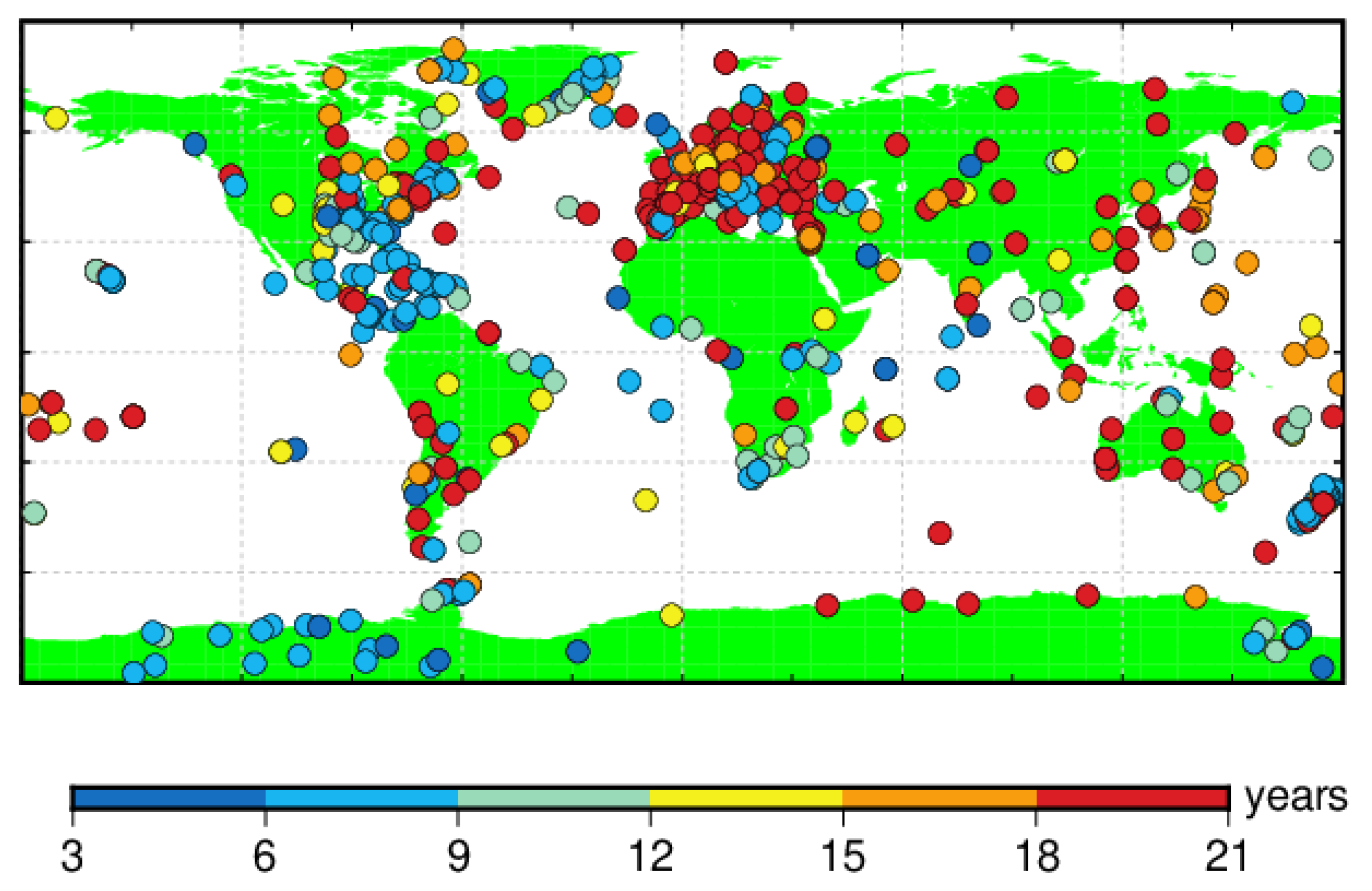
In order to improve data quality and reliability, we screened GNSS coordinate time-series data from 2000 to 2021 before conducting data analysis. We selected GNSS coordinate time-series data with a time span exceeding three years to ensure the integrity of GNSS coordinate time data. Finally, 630 IGS stations were selected for analysis. The distribution of GNSS stations is shown in Figure 1, where dots of different colors are used to represent the length of the selected GNSS coordinate time series.

2.2. Environmental Loading Model

Currently, multiple institutions offer environmental loading products, including the German Research Center for Geosciences (GFZ, https://rz-vm480.gfz.de/) [35], the School and Observatory of Earth Sciences (EOST, http://loading.u-strasbg.fr/, accessed on 16 April 2026) in Strasbourg, France [36], the International Mass Loading Service (IMLS, http://massloading.net/) in the United States, etc. Among them, GFZ uses surface pressure data provided by the European Centre for Medium-Range Weather Forecasts (ECMWF), the Max-Planck Institute Ocean Model [37], and the Land Surface Discharge Model [38]. Then, based on these loading deformation grid data, the double cubic interpolation method is used to obtain the surface environmental loading displacement values at the specified location. IMLS provides the coordinates of the required stations online and then uses the B-spline difference method to calculate the displacement values of atmospheric, non-tidal ocean, and hydrological loadings at specific locations. Only EOST directly provides models of three-dimensional surface displacement, Earth gravity, and tilt changes calculated from the general circulation models of atmosphere, ocean, and hydrology at approximately 7500 IGS stations worldwide [39]. If IGS stations are selected for research, the data provided by EOST is more accurate and easier to obtain [30]. EOST can provide three atmospheric loading models, namely ECMWF (IB) (European Centre for Medium-Range Weather Forecasts), ECMWF, and ERA interim, four hydrological loading models, namely GLDAS1 (Global Land Data Assistance System), GLDAS2, MERRA2 (Modern Era Retrospective analysis for Research and Applications, version 2), and MERRA land, and three non-tidal ocean loading models, namely ECCO1 (Estimating the Circulation and Climate of the Ocean), ECCO2 (Follow-on ECCO), and GLORYS2v3 (GLobal Ocean Reanalyses and Simulations). Their spatiotemporal resolutions and time spans are shown in Table 1. This article selects the atmospheric loading model ECMWF (IB), hydrological loading model MERRA2, and non-tidal ocean loading model ECCO1 as the combination of environmental loading models to be discussed based on their spatiotemporal resolution and time span, which are relatively optimal. Then, before and after adding the environmental loading model correction, we analyze its nonlinear impact on the global GNSS vertical coordinate time series obtained by SSA and parameterization methods.
Next, we will introduce the Methods Section, which mainly includes the analysis methods of GNSS coordinate time series, the acquisition methods of periodic signals in GNSS coordinate time series, and the evaluation indicators of periodic signal acquisition methods.

2.3. GNSS Coordinate Time-Series Analysis Method

The functional model of GNSS coordinate time series is expressed as follows [16]:
x ( t ) = i = 0 n p p i ( t t R ) i + j = 1 n b b j H ( t t j ) + k = 1 n A A k sin ( ω k t + φ k ) + l = 1 n L a l log ( 1 + t t l T l ) + m = 1 n M a m ( 1 e t t m T m ) + ε
Among them, the first term on the right side of the equation is a polynomial, and p i and i are the coefficients and the order of the polynomial, respectively. The second term denotes offsets, and b j and t j denote the magnitude and moment of each offset, respectively. The third term includes the periodic signals to be studied in this paper. A k , ω k , and φ k denote the amplitude, angular frequency, and initial phase of the kth periodic signal, respectively. n A refers to the number of periodic signals. The fourth and fifth terms are used to represent the post-earthquake deformation displacement of the stations. al, Tl, and tl denote the amplitude, relaxation time, and post-earthquake deformation onset moment of the logarithmic function, respectively. am, Tm, and tm denote the amplitude, relaxation time, and post-earthquake deformation onset moment of the exponential function, respectively. ε refers to fitting residuals.
During the data preprocessing process of the selected IGS station, stations with obvious offset signals and post-earthquake deformation have been removed. Therefore, the effects of the second, fourth, and fifth terms in Equation (1) can be ignored. In conventional processing, the order of the polynomial often uses the first-order term, and among the various types of periodic signals, the annual and semi-annual signals are most significant. Thus, the above equation can be simplified as
x 1 ( t ) = a + b t + k = 1 2 A k sin ( ω k t + φ k ) +   ε
Among them, a is the intercept of the linear term, and b represents the linear velocity. Equation (2) has a simple form and the parameterized representation of periodic signals helps to quickly determine the amplitude of seasonal signals in GNSS coordinate time series. However, the parameterized coefficients cannot accurately reflect the characteristics of seasonal signals at the station over time. For example, when analyzing drought events caused by hydrological and other factors in GNSS coordinate time series, if the seasonal changes caused by these events are considered fixed and invariant, the time-varying signals caused by them will be ignored [12,40].

2.4. Periodic Signal Acquisition Method

This article mainly uses two methods to obtain GNSS coordinate time-series periodic signals. One is to use the SSA method to obtain GNSS time-varying periodic signals, and the other is to use MLE parameterization method to fit GNSS periodic signals. This article mainly explains the steps of obtaining time-varying periodic signals using the SSA method.
The Singular Spectrum Analysis (SSA) method used in this article is based on the classic Caterpillar algorithm framework and decomposes the GNSS coordinate time series through three core steps: trajectory matrix construction, decomposition, and reconstruction. In practical implementation, this method does not require assumptions about parameter models or stationary conditions and has strong adaptability. For the research scenario of this article, the ssa.m standard library in MATLAB R2024b was used for implementation, and proprietary processing was carried out for missing data, window length selection, etc. The main steps are as follows:
(1) Trajectory matrix construction
For a one-dimensional zero-mean time series x 1 , x 2 , , x N , N represents the sequence length. Firstly, it is necessary to select an appropriate window length L and use it to convert the original time series of length N into a trajectory matrix, where K = N − L + 1.
X = x 1 x 2 x N L + 1 x 2 x 3 x N L + 2 x L x L + 1 x N = x 1 x 2 x K x 2 x 3 x K + 1 x L x L + 1 x N   L × K
(2) Trajectory matrix decomposition
This is performed using singular value decomposition (SVD) on the trajectory matrix X, as shown below.
X = U Σ V T
Among them, Σ is a diagonal matrix composed of singular values. U and V are unit orthogonal matrices, also known as unitary matrices, where U U T = U T U = V V T = V T V = I . U and V are determined by the following equations.
X X T = U Σ V T ( U Σ V T ) T = U Σ V T V Σ T U T = U Σ Σ T U T
X T X = ( U Σ V T ) T U Σ V T = V Σ T U T U Σ V T = V Σ T Σ V T
In Formulas (5) and (6), X X T and X T X are both real symmetric matrices, so they can be decomposed using eigenvalues to calculate the eigenvalues U and V , U = U 1 , U 2 , , U L , V = V 1 , V 2 , , V L . The square root of the eigenvalues in a diagonal matrix Σ Σ T or Σ T Σ yields all singular values λ 1 , λ 2 , , λ L   λ i 0 . The feature vector Ui corresponding to λ i is called the Time Empirical Orthogonal Function (TEOF).
The trajectory matrix X can be represented as
X = i = 1 L λ i U i V i T
In the process of singular value decomposition, the values are arranged in descending order, where the larger singular values represent the main signal features in the original time series, while the smaller singular values represent observation noise. By intercepting the first few larger eigenvalues, the original time series can be reconstructed using Equations (8)–(10).
(3) Trajectory matrix reconstruction
The projection of the i-th column X i of the trajectory matrix X onto U m can be expressed as
X i m = X i U m = j = 1 L x i + j U m , j ,   0 i K 1
X i m is the magnitude of the projection component of the column vector X i on U m , called the Time Principal Component (TPC). Next, TEOF and TPC are used for reconstruction, and the specific reconstruction process is represented as follows:
x i k = 1 i j = 1 i a i j k U k , j , 1 i L 1 1 L j = 1 L a i j k U k , j , L i N + L 1 1 N i + 1 j = i N + L L a i j k U k , j ,   N L + 2 i N
Among them, “a” refers to the weighting coefficient. The sum of all reconstructed sequences is the original sequence, i.e.,
X = k = 1 L x i k   i = 1 ,   2 ,   ,   N
X is the time-varying periodic sequence obtained using the SSA method in this article.

2.5. Evaluation Indicators

In this article, we use the root mean square (RMS) reduction ratio to represent the accuracy of the SSA method in extracting time-varying periodic signals relative to the parameterization method in fitting periodic signals.
R M S r e d u c t i o n = R M S ( ε ) R M S ( k = M + 1 L x i k ) R M S ( ε ) × 100 %
In Formula (11), RMSreducation represents the RMS reduction ratio, R M S ( ε ) represents the RMS value of the GNSS coordinate residual sequence considering only the annual and semi-annual signals using traditional parameterization methods, and ε is the residual in Equation (1). R M S ( k = M + 1 L x i k ) represents the RMS value of the reconstructed sequence from the M + 1 principal component to the last principal component using the SSA method. When the RMS reduction ratio is positive, it indicates that the SSA method has higher accuracy in fitting GNSS coordinate time-series periodic signals compared to the parameterization method. When the RMS reduction ratio is negative, it indicates that the parameterization method has higher accuracy in fitting GNSS coordinate time-series periodic signals compared to the SSA method.

3. Results

We used Hector 2.0 software, which utilized the MLE method to estimate the annual/semi-annual amplitude and phase of 630 selected global GNSS vertical coordinate time series, in order to obtain periodic signals in the GNSS vertical coordinate time series [41,42,43]. The specific process can refer to https://teromovigo.com/product/hector/ (accessed on 16 April 2026). The selected GNSS coordinate time-series noise model was a combination model of white noise and flicker noise (WN + PL) for analysis. The seasonal signals in the GNSS station vertical coordinate time series were represented as the superposition of annual and semi-annual signals, and the amplitude and phase of the seasonal signals were parameterized using the MLE principle. Then, following the SSA method and steps in Section 2.4 above, first construct the trajectory matrix X for the GNSS vertical coordinate time series, with a window length L of 730 selected. Here, 730 is an empirical value that needs to be determined comprehensively based on the length of the data, the included period characteristics, etc. It is best to take an integer multiple of the period, which corresponds to twice the annual period. This can effectively capture annual and semi-annual period signals. Next, the trajectory matrix X was subjected to singular value decomposition, sorted according to the size of the eigenvalues, and the first four principal components were selected for signal reconstruction, ultimately extracting the time-varying periodic signal. Among them, the first two principal components represent trend terms, corresponding to long-term linear movements of crustal deformation, while the third and fourth principal components represent annual and semi-annual signals. Research has shown that the main periods of GNSS vertical coordinate time series are annual and semi-annual periods [44]. In this article, for the selected GNSS station coordinate time series, the first four principal components are selected for reconstruction, and their cumulative contribution rates can all reach over 90%. Firstly, a comparative analysis was conducted on the accuracy of obtaining periodic signals using the parameterization method compared to the time-varying periodic signals obtained using the SSA method. Then, the consistency between the periodic sequence obtained by these two methods and the environmental loading sequence was studied. Finally, the impact of adding environmental loading correction on the periodic signal of GNSS coordinate time series was analyzed.

3.1. Comparison of SSA and Parameterization Methods

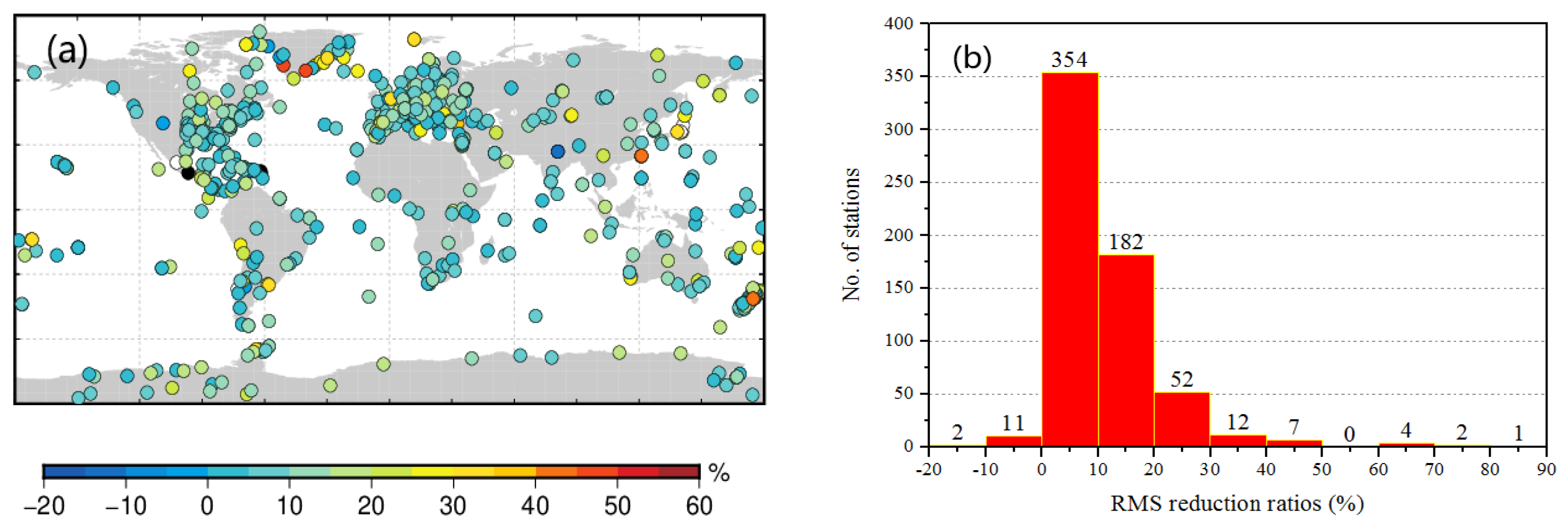
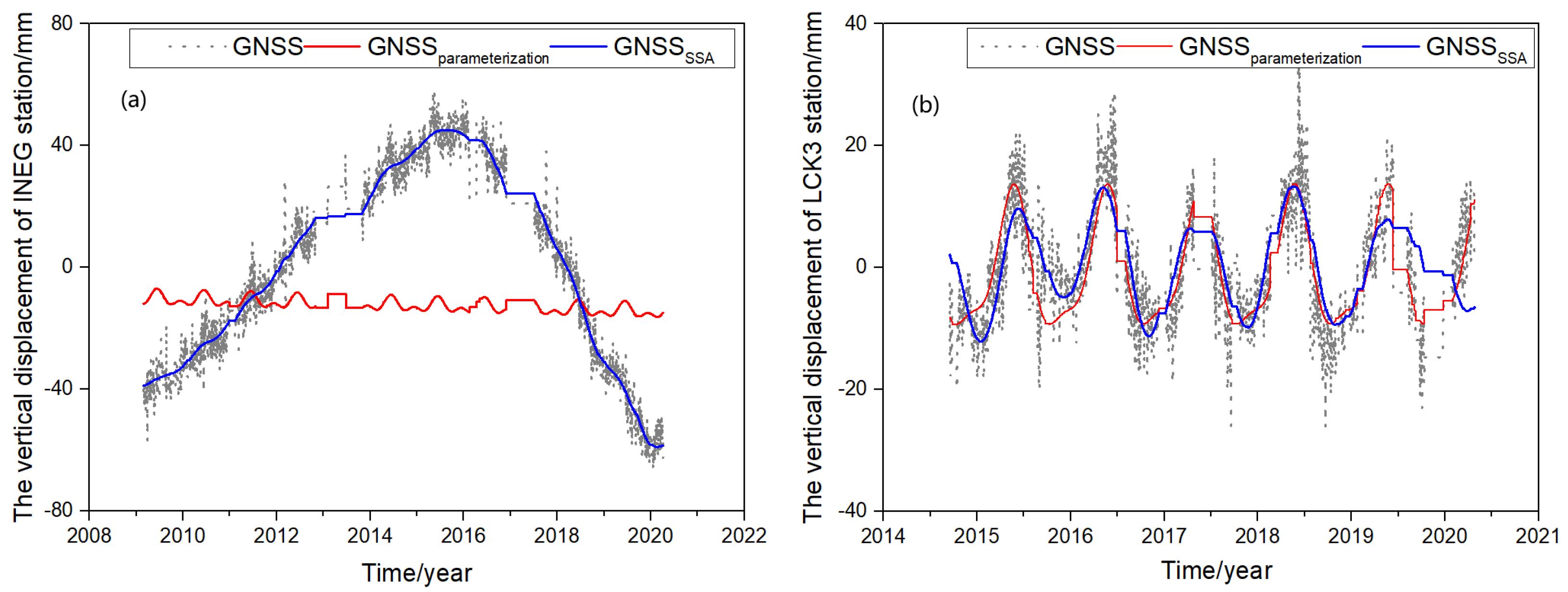
Using Equation (11), this article first conducted a statistical analysis of the residual RMS reduction ratio of the time-varying periodic signals obtained by the SSA method from 630 selected stations worldwide compared to the periodic signals obtained by conventional parameterization methods during the process of weakening the nonlinear deformation of GNSS coordinate time series. The distribution diagram is shown in Figure 2a. Also, the distribution range of the RMS reduction ratio and the corresponding number of sites are illustrated in Figure 2b. It can be seen that for the 630 IGS stations discussed in this article, 614 of them have a positive RMS reduction ratio, accounting for 97.46% of the total. This indicates that, globally, for the vast majority of stations, the SSA method, compared to the traditional parameterization method, helps to accurately extract the GNSS coordinate time-series periodic signals. The reason why the SSA method is superior to traditional parameterization methods is that it does not assume that geophysical signals are stationary and time-invariant. On the contrary, it adaptively decomposes the displacement of the measuring station into a series of components with clear physical meanings (trend, annual cycle, semi-annual cycle, etc.) through data-driven methods. The periodic signals of these components can change over time, thus more accurately reflecting the time-varying displacement process influenced by geophysical factors. However, traditional methods that use a fixed model to fit time-varying processes are equivalent to forcing fixed parameters to describe time-varying signals, which inevitably leads to accurate physical information being discarded as residuals. The station with the largest RMS reduction ratio is INEG (INEGI: 21.86° N, 257.72° E) located in the North American region, and its RMS reduction ratio can reach 85.88%. As shown in Figure 3a, where the GNSS time-varying periodic signals extracted by the SSA method are denoted as GNSSSSA, and the GNSS periodic signals extracted by the parameterization method are denoted as GNSSparameterization. The original GNSS coordinate time series are denoted as GNSS. The reason why the RMS reduction ratio of INEG station is the highest is that due to groundwater withdrawal the deformation rate of this station has undergone significant changes from 2008 to 2020. However, this change cannot be captured in a timely manner using the parameterization method, but the SSA method can accurately and timely reconstruct the changes caused by large and sudden deformations. The minimum RMS reduction ratio is LCK3 (26.91° N, 80.96° E) located in the Asian region, with a value of −19.10%, as shown in Figure 3b. This is the reason why there were many missing data points on this site from 2020 to 2021, resulting in a large difference between the reconstructed sequence and the original sequence in the smooth sequence. Therefore, before using SSA, fitting the missing data first and then extracting time-varying signals using the SSA method can effectively avoid the phenomenon of significant differences between the reconstructed sequence of SSA and the original signal near the missing data. Among them, there are 78 stations with a RMS reduction ratio greater than 20%. The mean and median RMS reduction ratios for all stations are 10.76% and 8.60%, respectively. It can be seen that for the selected global IGS stations, the SSA method for obtaining time-varying periodic signals reduces the RMS value of residual sequences compared to traditional parameterization methods for fitting periodic signals, improves the accuracy of describing nonlinear deformation of the stations, and helps to further explore the geophysical factors that affect station displacement. Next, this article mainly discusses and analyzes the impact of environmental loading in geophysical factors on the periodic signals of selected stations, including hydrological loading, non-tidal ocean loading, and atmospheric loading.
In order to compare the periodic signals obtained by the parameterization method with the time-varying periodic signals obtained by the SSA method in more detail, this article first selects three representative sites worldwide for further analysis and explanation. These three representative sites are MIK2 (68.14° N, 328.55° E) located in the Greenland region, CEBR (40.45° N, 355.63° E) in the European region, and URUM (43.81° N, 87.60° E) in the Asian region.
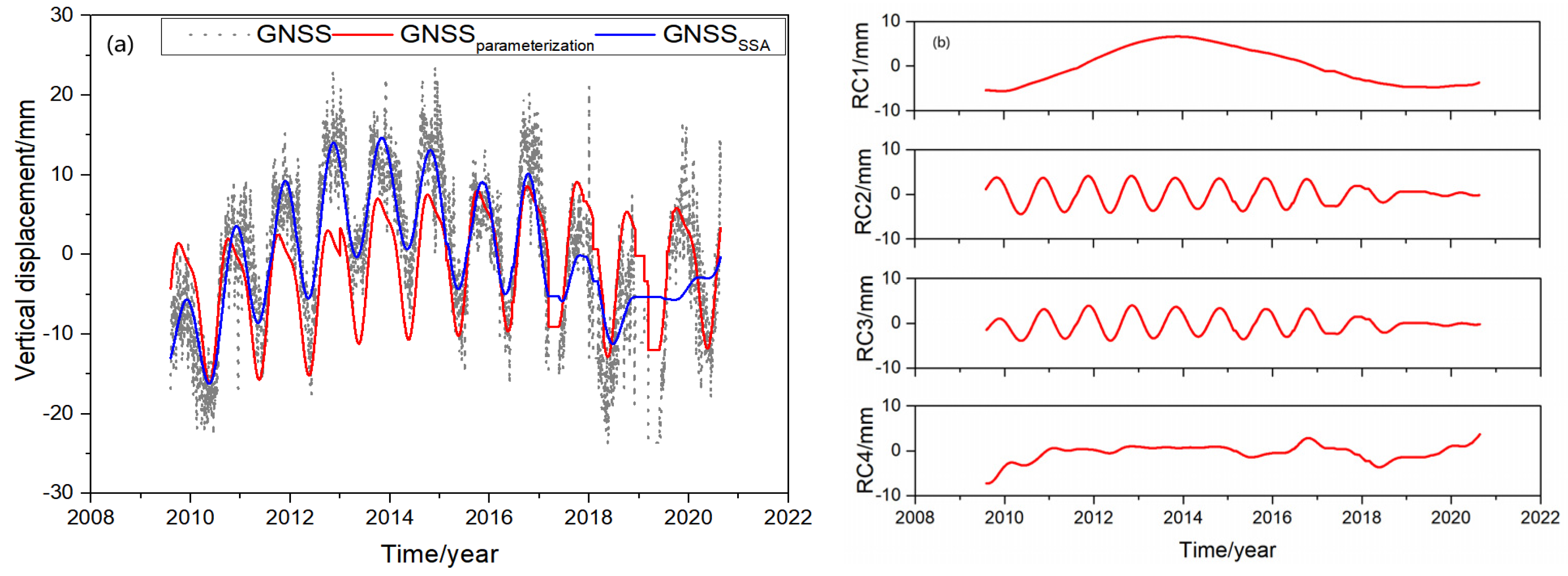
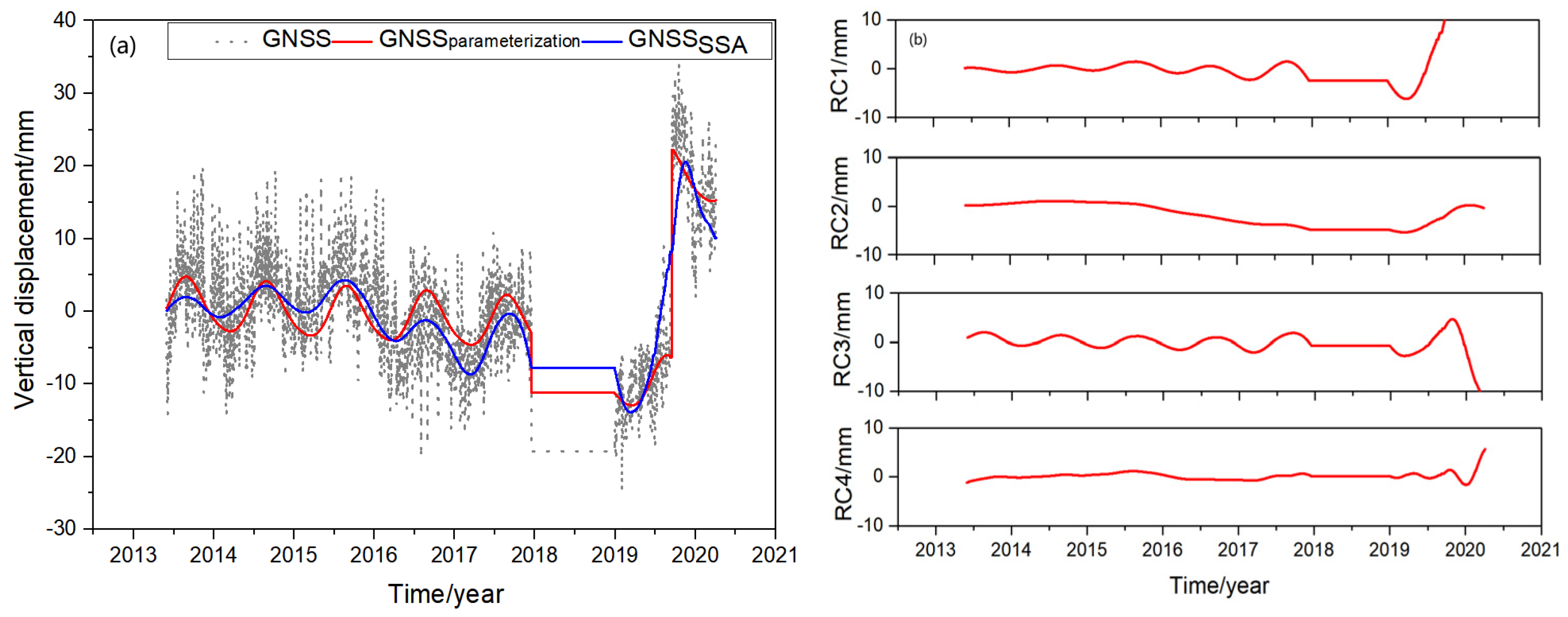
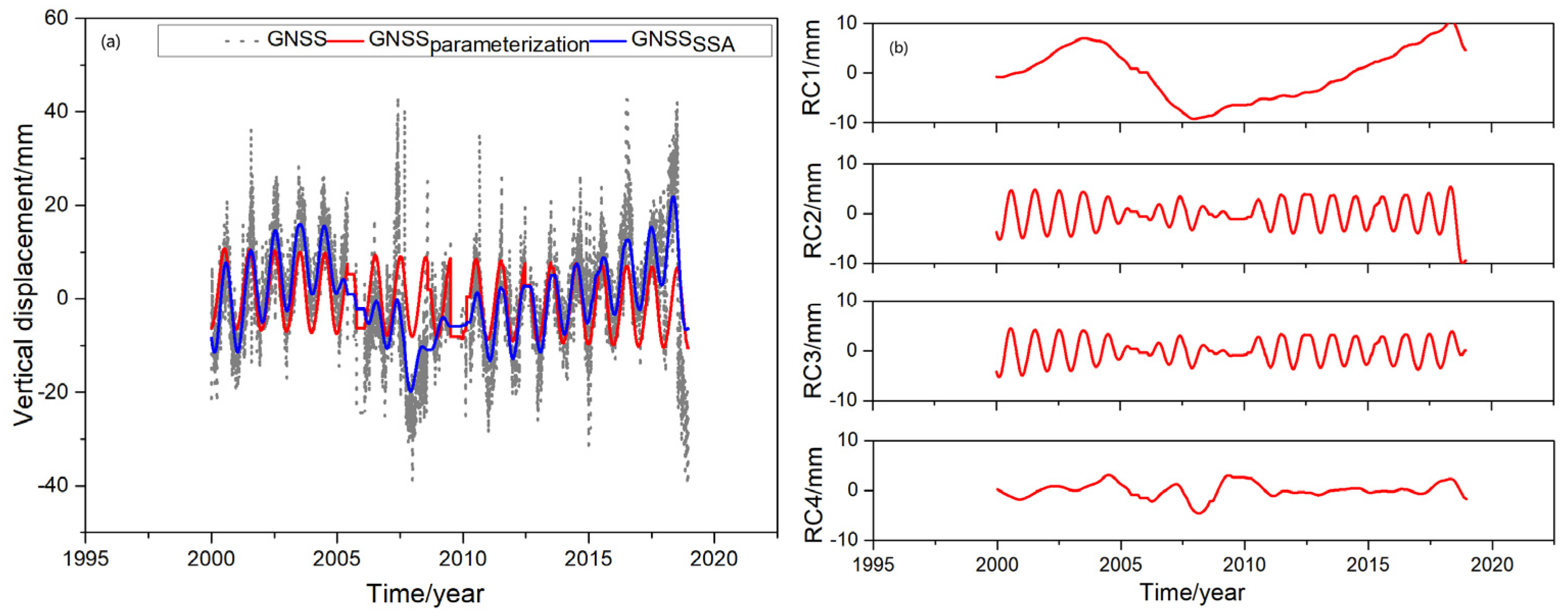
For the MIK2 site in Greenland, as shown in Figure 4a, the original GNSS coordinate time series exhibits periodic signal changes during long-term deformation. However, this change cannot be reflected in a timely manner using the parameterization method, while the time-varying periodic signal obtained using the SSA method can effectively simulate the occurrence of this deformation. Figure 4b presents the principal component distribution of the time-varying periodic signal reconstructed using the SSA method. The first three terms model its periodically varying signal and the fourth term represents the partial noise in the GNSS coordinate time series. The RMS reduction ratio can reach 27.49%, which means that the accuracy of using the SSA method to extract time-varying periodic signals compared to using the parameterization method to fit periodic signals can reach 27.49%.
For the CEBR sites in Europe, as shown in Figure 5a, before 2016, the deformation of the original GNSS coordinate time series was relatively stable, so both the periodic sequence obtained by the parameterization method and the time-varying periodic sequence obtained by the SSA method could accurately simulate their periodic change characteristics. However, after 2016, this original GNSS coordinate time series showed a sinking change, and during the epoch period from 2018 to 2020.5, there were not only a large number of missing data but also obvious offsets in the original GNSS coordinate time series. For such abnormal changes, when using parameterization methods to obtain periodic sequences, it is necessary to specially calibrate the time and displacement of their offsets, so as to accurately fit their offset signals. By using the SSA method, the occurrence of this offset can be directly reconstructed without special calibration. Figure 5b shows the principal component distribution of the time-varying periodic signal reconstructed using the SSA method. For CEBR sites, the RMS reduction ratio can reach −0.78%, indicating that the use of parameterization methods can fit their periodic signals slightly better, and the accuracy of extracting time-varying periodic signals relative to SSA methods can reach 0.78%.
For the URUM site in Asia, as shown in Figure 6a, between the epochs of 2006 and 2010, the original GNSS coordinate time series experienced a downward movement in the early stages and a subsequent upward change. Similarly, the periodic sequence obtained by parameterization method cannot be accurately identified, while the time-varying periodic signal obtained by SSA method can accurately capture this change. The RMS reduction ratio can reach 28.12%, which means that the accuracy of using the SSA method to extract time-varying periodic signals compared to using the parameterization method to fit periodic signals can reach 28.12%. Figure 6b shows the principal component distribution of the time-varying periodic signal reconstructed using the SSA method.

3.2. Consistent Comparison of ELC Effects

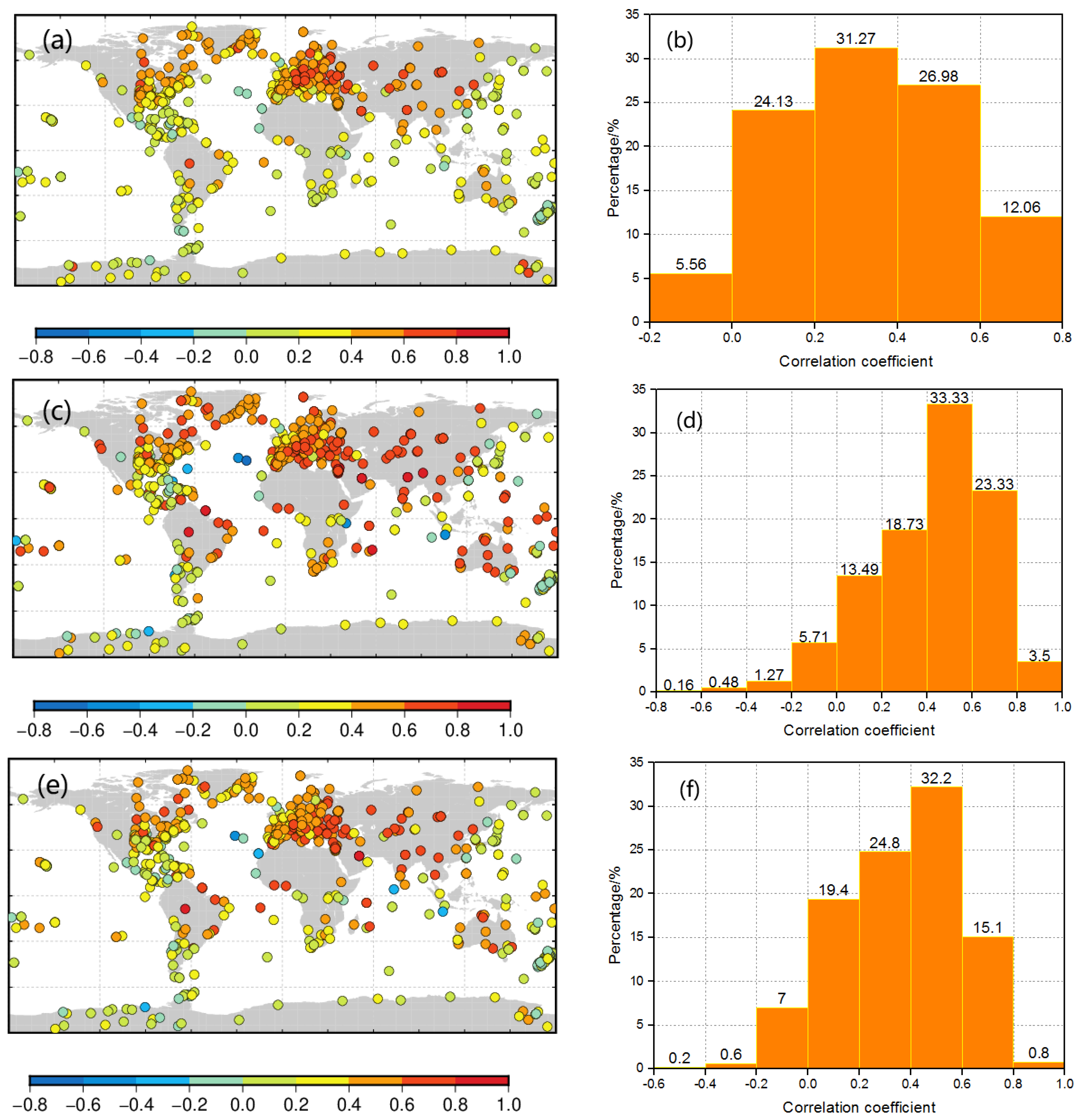
As mentioned above, this article selects the combined model of the atmospheric loading model ECMWF (IB), hydrological loading model MERRA2, and non-tidal ocean loading model ECCO1 provided by EOST as the environmental loading model and then conducts correlation analysis with the time-varying periodic series reconstructed by SSA method and the periodic series fitted by parameterization method. Among them, the environmental loading sequence is represented as ELS. Figure 7a and Figure 7b show the distribution of the correlation coefficients (corr (GNSS, ELS)) and their distribution histograms between the GNSS original coordinate time series and the environmental loading series, respectively. From these two figures, it can be seen that there are 595 stations with a positive correlation between their environmental loading series and the GNSS original coordinate time series, accounting for 94.44% of the global stations. There are 163 stations with a correlation coefficient greater than 0.5, accounting for 25.87%, mainly distributed in mid-to-high-latitude regions. Especially in the European and Asian regions, it is evident that there are many stations with high consistency between the GNSS original coordinate time series and the environmental loading series. Therefore, it is worth affirming that environmental loading do have an undeniable impact on the GNSS vertical periodic signal.
Next, we present the distribution of the correlation coefficients (corr (GNSSSSA, ELS)) between the time-varying periodic signal of GNSS coordinate time series obtained using the SSA method and the environmental loading sequence, as shown in Figure 7c, with Figure 7d as its distribution histogram. After extracting the time-varying periodic signal from the GNSS coordinate time series using the SSA method, the correlation coefficient between the GNSS time-varying periodic signal sequence and the environmental loading sequence was calculated. It can be seen that compared to the original GNSS coordinate time series, there is a stronger correlation between environmental loading and GNSS time-varying periodic signals on a global scale. Among them, the correlation coefficient of 295 stations is greater than 0.5, accounting for 46.83% of the global total. That is to say, globally, 46.83% of the stations have a strong correlation between the time-varying periodic signals of GNSS coordinate time series obtained using SSA method and their corresponding environmental loading displacement. Moreover, it can be seen from Figure 7c that the correlation coefficient is larger in the land region compared to the coastal region. and the GNSS coordinate time series period signals are strongly influenced by the environmental loading, and its periodic displacement rises as the environmental loading increases. Some sites exhibit strong negative correlation between their time-varying periodic sequences and environmental loading sequences, such as PDEL (334.34°E, 37.75°N) stations, with a correlation coefficient of −0.60. That is to say, for some stations, the environmental loading not only does not weaken the amplitude of periodic changes in GNSS stations, but also increases their periodic amplitude changes.
Finally, the distribution of correlation coefficients (corr(GNSSparameterization, ELS)) between the environmental loading sequences and the GNSS periodic signals extracted using the parameterization method is plotted, as shown in Figure 7e, and its distribution histogram is shown in Figure 7f. Its distribution characteristics are that in the mid-to-high-latitude regions, especially in North America, Europe, and Asia, there is a high consistency in the correlation coefficient distribution between the original GNSS coordinate time series and the environmental loading series. In low-latitude regions, the correlation coefficient distribution between the GNSS periodic signals obtained by parameterization methods and the environmental loadings maintains a high consistency with the correlation coefficient between the time-varying periodic signals and the environmental loadings extracted by SSA methods. For all stations, the correlation coefficient of 242 stations is greater than 0.5, accounting for 38.41%. That is to say, globally, 38.41% of stations show strong correlation between the periodic series obtained using the parameterization method and the environmental loading series.
Therefore, overall, the time-varying periodic signals obtained by the SSA method can more accurately represent the periodic changes in the GNSS coordinate time series, indicating that the periodic signals extracted by this method can more accurately reflect the impact of environmental loadings on the nonlinear changes in GNSS coordinate time series. It is of great significance and value to analyze the impact of environmental loading on the periodic changes in GNSS coordinate time series.
In order to further compare the consistency between the periodic signals fitted by the parameterization method, the time-varying periodic signals extracted by the SSA method, and the original GNSS coordinate time series with the environmental loading, we compare their correlation coefficients separately. Table 2 shows the difference between the correlation coefficients of the SSA time-varying periodic signals and environmental loading, as well as the correlation coefficients of the GNSS original sequences and environmental loading. When the difference between them is positive, it indicates that the consistency between the periodic signal extracted by the SSA method and the environmental loading is significantly improved compared to the consistency between the GNSS original coordinate time series and the environmental loading. It also indicates that the periodic signal extracted by this method can more accurately reflect the impact of environmental loading on the nonlinear changes in the GNSS coordinate time series. In Table 2, it can be seen that 66.98% of the stations have improved the correlation between the time-varying periodic signals extracted by SSA method and the environmental loading sequence. Similarly, Table 3 shows the difference in correlation coefficients between the GNSS coordinate time-series periodic signals extracted by the parameterization method and the original GNSS coordinate time series with environmental loadings. It can be seen that 56.67% of the stations have improved the consistency between the periodic signals extracted by the parameterization method and the environmental loading compared to the GNSS original coordinate time series. This further indicates that, globally, compared to the parameterization method, the SSA method can more accurately obtain the periodic signals of the GNSS coordinate time series and more accurately reflect the impact of environmental loading on the nonlinear changes in the GNSS coordinate time series.

4. Discussion

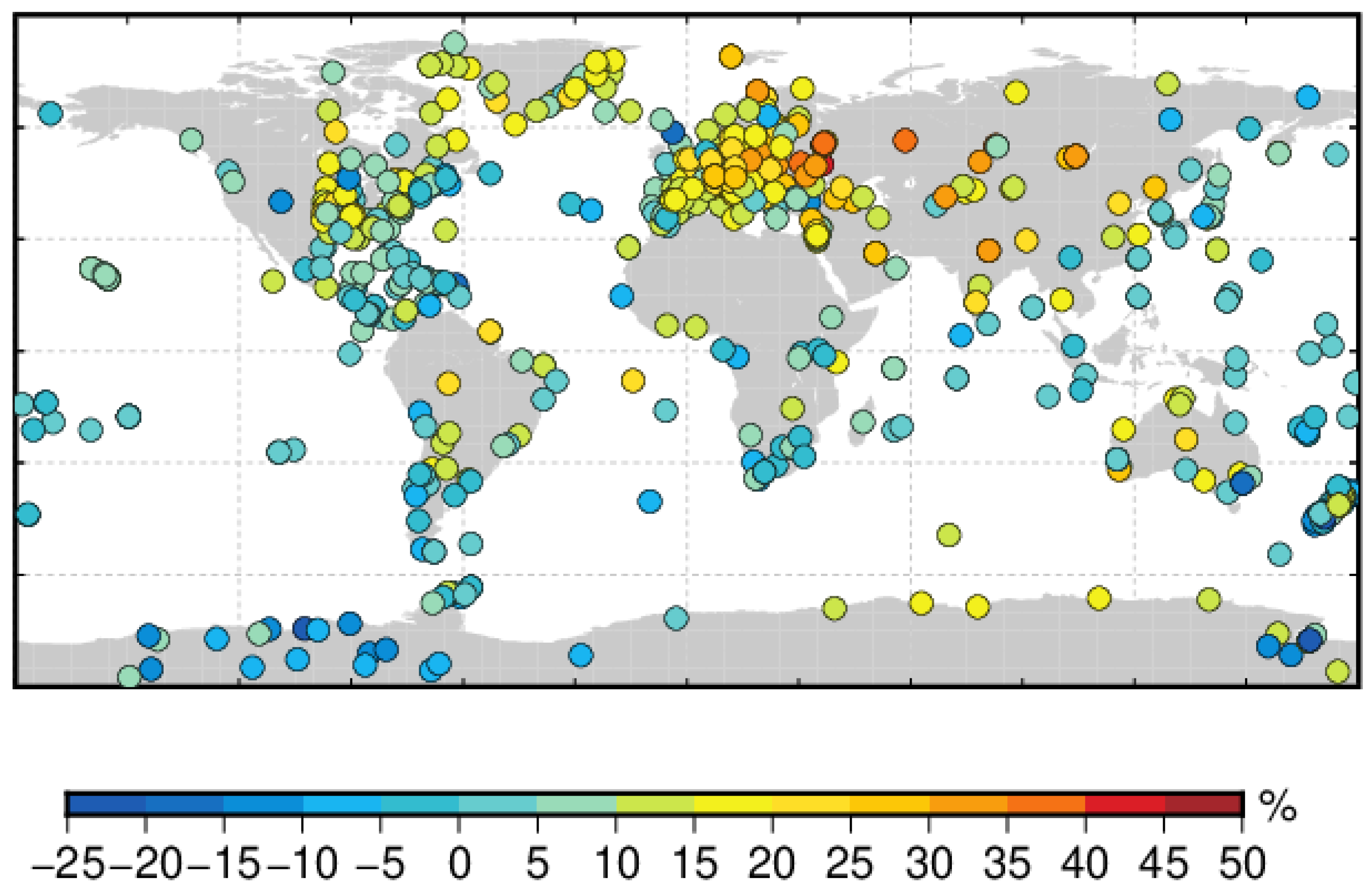
From the above analysis, it can be concluded that the time-varying periodic signal obtained by the SSA method can more accurately and comprehensively represent the changes in the GNSS coordinate time-series periodic signal and also more accurately reflect the impact of environmental loading on the nonlinear changes in the GNSS coordinate time series. Therefore, this article next uses the SSA method to obtain the time-varying periodic signals of the GNSS coordinate time series, and adds ELCs to further analyze the impact of environmental loading on the nonlinear changes in GNSS coordinate time series. In this article, the RMS reduction ratio is mainly used to analyze the impact of environmental loading on the time-varying periodic sequences obtained by SSA. As shown in Figure 8, it can be seen that for IGS stations distributed globally the SSA method can obtain time-varying periodic sequences with a maximum RMS reduction ratio of 42.37% before and after ELCs. The sites with a positive RMS reduction ratio account for 79.52% of all sites, which means that for the vast majority of sites, after ELCs, the RMS value decreases and the nonlinear amplitude weakens. In Figure 8, it can still be seen that environmental loading has a significant impact on sites in mid-to-high-latitude regions, especially in Eurasia where the RMS reduction ratio is significant. However, in coastal areas and low-latitude regions, the impact of environmental loading on the GNSS coordinate time series is relatively small, and the RMS reduction ratio is even negative. Because the impact of atmospheric loading is relatively small in low-latitude regions, the correction effect of environmental loading in low-latitude regions is lower than that in mid- and high-latitude regions. Moreover, in coastal areas, due to incomplete modeling of non-tidal ocean loading models, the nonlinear signal after environmental loading correction not only decreases, but also shows an upward trend. This indicates that in these regions, adding ELCs not only does not weaken the nonlinear amplitude in GNSS coordinate time series, but also increases its nonlinear amplitude.

5. Conclusions

SSA and parameterization methods can effectively extract periodic signals of GNSS vertical coordinate time series. In this article, the GNSS coordinate time series of 630 stations worldwide were selected to compare and analyze the accuracy of the periodic signals extracted by the parameterization method and the time-varying periodic signals extracted by the SSA method, as well as the consistency with the corresponding environmental loading displacement. The following conclusions were drawn.
(1)
The SSA method can indeed accurately extract time-varying periodic signals from GNSS station coordinate time series worldwide, and compared with conventional parameterization methods, 97.46% of the stations have a positive RMS reduction ratio. The SSA method is indeed helpful in analyzing the nonlinear deformation of GNSS coordinate time series in the process of extracting GNSS periodic signals compared to conventional parameterization methods.
(2)
By comparing the correlation coefficients between the time-varying periodic signal sequence obtained by the SSA method and the environmental loading sequence, the correlation coefficients between the periodic sequence obtained by the parameterization method and the environmental loading sequence, and the correlation coefficients between the GNSS original coordinate time series and the environmental loading sequence, we can further analyze the characteristics of the periodic changes in environmental loadings on a global scale. The results show that 66.98% and 56.67% of the stations, respectively, have improved their correlation with the original GNSS sequence and environmental loading sequence after obtaining periodic signals through SSA and parameterization methods. The time-varying periodic signals obtained by the SSA method can more accurately reflect the influence of environmental loading on the nonlinear variation in GNSS vertical coordinate time series compared with the periodic signals obtained by the parameterization method.
(3)
The time-varying periodic signal obtained by the SSA method has a maximum RMS reduction ratio of 42.37% before and after ELCs. For the selected global IGS stations, 79.52% of the stations have reduced nonlinear amplitude after ELCs.

Author Contributions

Conceptualization, Y.H. and S.W.; methodology, Y.H.; validation, X.S. and Y.W.; formal analysis, Y.H.; investigation, G.N. and Y.W.; resources, Y.L.; data curation, Y.H.; writing—original draft preparation, Y.H.; writing—review and editing, Y.H. and S.W.; visualization, Y.L.; supervision, X.S.; funding acquisition, Y.H. and Y.L. All authors have read and agreed to the published version of the manuscript.

Funding

This research was funded by the National Natural Science Foundation of China (No. 42404017; No. 42561069), the Youth Science Foundation of Lanzhou Jiaotong University (No. 2024004), and the Joint Innovation Fund Project of Lanzhou Jiaotong University and Tianjin University (No. LH2025001).

Data Availability Statement

The original contributions presented in this study are included in the article. Further inquiries can be directed to the corresponding author.

Acknowledgments

The GNSS coordinate time-series data and environmental loading data can be publicly obtained through the Scripps Orbit and Permanent Array Center (SOPAC, https://garner.ucsd.edu/pub/timeseries/measures/ats/) and the School and Observatory of Earth Sciences (EOST, http://loading.u-strasbg.fr/) mechanisms, respectively. The Hector software (https://teromovigo.com/product/hector/) was used to calculate and analyze the GNSS long-term coordinate series. We used GMT 5 software and Origin 9.1 software to plot the calculation results. We express our heartfelt thanks to these organizations and software providers. The authors have reviewed and edited the output and take full responsibility for the content of this publication.

Conflicts of Interest

The authors declare no conflicts of interest.

Abbreviations

The following abbreviations are used in this manuscript:
GNSSGlobal Navigation Satellite System
SSASingular Spectrum Analysis
ELCsEnvironmental Loading Corrections
MLEMaximum Likelihood Estimation
WDWavelet Decomposition
KFKalman Filter
EMDEmpirical Mode Decomposition
BJFSBeijing Fangshan
SOPACScripps Orbit and Permanent Array Center
IGSInternational GNSS Service
GFZThe German Research Center for Geosciences
EOSTThe School and Observatory of Earth Sciences
IMLSThe International Mass Loading Service
ECMWFThe European Centre for Medium-Range Weather Forecasts
MPIOMThe Max-Planck Institute Ocean Model
LSDMThe Land Surface Discharge Model
GLDASGlobal Land Data Assistance System
MERRA2Modern-Era Retrospective Analysis for Research and Applications, Version 2
ECCOEstimating the Circulation and Climate of the Ocean
GLORYS2v3Global Ocean Reanalyses and Simulations
TPCTime Principal Component
RMSRoot Mean Square
WN + PLWhite Noise and Flicker Noise

References

  1. Blewitt, G.; Lavallee, D.; Clarke, P.; Nurutdinov, K. A new global mode of Earth deformation: Seasonal cycle detected. Science 2001, 294, 2342–2345. [Google Scholar] [CrossRef]
  2. Wu, S.; Li, Z.; Li, H.; Bian, S.; Ouyang, H.; Yao, Y.; Peng, P.; He, Y. Detection of Time-varying Periodic Signals from CMONOC Stations in China by Singular Spectrum Analysis. IEEE Trans. Geosci. Remote Sens. 2023, 61, 5802812. [Google Scholar] [CrossRef]
  3. Klos, A.; Bos, M.S.; Bogusz, J. Detecting time-varying seasonal signal in gps position time series with different noise levels. GPS Solut. 2018, 22, 21. [Google Scholar] [CrossRef]
  4. Klos, A.; Olivares, G.; Teferle, F.N.; Hunegnaw, A.; Bogusz, J. On the combined effect of periodic signals and colored noise on velocity uncertainties. GPS Solut. 2018, 22, 1. [Google Scholar] [CrossRef]
  5. Niu, Y.; Li, M.; Zhan, W.; Li, J.; Li, L.; Wu, Y. Orgin analysis and modelling of spatially correlated noise in GNSS station coordinates. Chin. J. Geophys. 2026, 69, 559–572. [Google Scholar] [CrossRef]
  6. Jiao, J.; Wang, H.; Dang, Y.; Ren, Y.; Yue, C.; Wu, X.; Cui, H.; Wang, X. Noise-resilient GNSS coordinate time series prediction using AVMD-sLSTM-transformer hybrid model. Adv. Space Res. 2025, 76, 6863–6881. [Google Scholar] [CrossRef]
  7. Altamimi, Z.; Rebischung, P.; Collilieux, X.; Métivier, L.; Chanard, K. ITRF2020: An augmented reference frame refining the modeling of nonlinear station motions. J. Geod. 2023, 97, 47. [Google Scholar] [CrossRef]
  8. Li, Z.; Jiang, W.; Dam, V.T.; Zou, X.; Chen, Q.; Chen, H. A Review on Modeling Environmental Loading Effects and Their Contributions to Nonlinear Variations of Global Navigation Satellite System Coordinate Time Series. Engineering 2025, 47, 26–37. [Google Scholar] [CrossRef]
  9. Ma, Y.; Yang, Y.; Zhou, X.; Hu, L.; Liu, W. Stochastic properties of GNSS height time series caused by aperiodic part of environmental loading deformations: Case study in Beijing and its surrounding areas. Adv. Space Res. 2025, 76, 734–749. [Google Scholar] [CrossRef]
  10. Gu, Y.; Yuan, L.; Fan, D.; You, W.; Su, Y. Seasonal crustal vertical deformation induced by environmental mass loading in mainland China derived from GPS, GRACE and surface loading models. Adv. Space Res. 2017, 59, 88–102. [Google Scholar] [CrossRef]
  11. Chanard, K.; Fleitout, L.; Calais, E.; Rebischung, P.; Avouac, J. Toward a global horizontal and vertical elastic load deformation model derived from GRACE and GNSS station position time series. J. Geophys. Res. Solid Earth 2018, 123, 3225–3237. [Google Scholar] [CrossRef]
  12. Yuan, P.; Li, Z.; Jiang, W.; Ma, Y.; Chen, W.; Sneeuw, N. Influences of Environmental Loading Corrections on the Nonlinear Variations and Velocity Uncertainties for the Reprocessed Global Positioning System Height Time Series of the Crustal Movement Observation Network of China. Remote Sens. 2018, 10, 958. [Google Scholar] [CrossRef]
  13. Klos, A.; Gruszczynska, M.; Bos, M.; Boy, J.; Bogusz, J. Estimates of vertical velocity errors for IGS ITRF2014 stations by applying the improved singular spectrum analysis method and environmental loading models. Pure Appl. Geophys. 2018, 175, 1823–1840. [Google Scholar] [CrossRef]
  14. Niu, Y.; Wei, N.; Li, M.; Rebischung, P.; Shi, C.; Chen, G. Quantifying discrepancies in the three-dimensional seasonal variations between IGS station positions and load models. J. Geod. 2022, 96, 31. [Google Scholar] [CrossRef]
  15. Jiang, W.; Li, Z.; Liu, H.; Zhao, Q. Cause analysis of the non-linear variation of the IGS reference station coordinate time series inside China. Chin. J. Geophys. 2013, 56, 2228–2237. [Google Scholar] [CrossRef]
  16. Bevis, M.; Brown, A. Trajectory models and reference frames for crustal motion geodesy. J. Geod. 2014, 88, 283–311. [Google Scholar] [CrossRef]
  17. He, X.; Montillet, J.P.; Fernandes, R.; Bos, M.; Yu, K.; Hua, X.; Jiang, W. Review of current GPS methodologies for producing accurate time series and their error sources. J. Geod. 2017, 106, 12–29. [Google Scholar] [CrossRef]
  18. Su, G.; Zhan, W. Seasonal and long-term vertical land motion in Southwest China determined using GPS, GRACE, and surface loading model. Earth Planets Space 2021, 73, 131. [Google Scholar] [CrossRef]
  19. Dai, H.; Sun, F.; Jiang, W.; Xiao, K.; Zhu, X.; Liu, Q. Application of Wavelet Decomposition and Singular Spectrum Analysis to GNSS Station Coordinate Time Series. Geomat. Inf. Sci. Wuhan Univ. 2021, 46, 371–380. (In Chinese) [Google Scholar]
  20. Ma, J.; Cao, C.; Jiang, W.; Zhou, L. Elimination of Colored Noise in GNSS Station Coordinate Time Series by Using Wavelet Packet Coefficient Information Entropy. Geomat. Inf. Sci. Wuhan Univ. 2021, 46, 1309–1317. (In Chinese) [Google Scholar]
  21. Jia, R.; Zhao, T.; Sun, H.; Yan, X. Microseismic signal denoising method based on empirical mode decomposition and independent component analysis. Chin. J. Geophys. 2015, 58, 1013–1023. (In Chinese) [Google Scholar]
  22. Xu, J.; Zhu, Q.; Shi, N. The singular spectral analysis of periodic oscillation in long-term variation of east-asian monsoon in recent century. Acta Meteorol. Sin. 1997, 5, 109–116. [Google Scholar]
  23. Dong, A.; Qu, Z.; Yin, X.; Zhou, L. The Singular Spectrum Analysis of Snow Damage in Eastern Qinghai-Xizang Plateau. Plateau Meteorol. 2001, 2, 214–219. [Google Scholar]
  24. Li, Y.; Liu, D.; Zhu, Y.; Gao, Y.; Mao, W. Singular Spectrum Analysis of Surface Air Temperature and Precipitation Series in Chongqing. Plateau Meteorol. 2005, 5, 798–804. [Google Scholar]
  25. Jevrejeva, S.; Grinsted, A.; Moore, J.C.; Holgate, S. Nonlinear trends and multiyear cycles in sea level records. J. Geophys. Res. Ocean. 2006, 111, 3229. [Google Scholar] [CrossRef]
  26. Xu, K.; Cheng, P.; Wen, H. Singular spectrum analysis and wavelet analysis on time series of Sunspot. Sci. Surv. Mapp. 2007, 6, 35–38+205. [Google Scholar]
  27. Chen, Q.; van Dam, T.; Sneeuw, N.; Collilieux, X.; Weigelt, M.; Rebischung, P. Singular spectrum analysis for modeling seasonal signals from GPS time series. J. Geodyn. 2013, 72, 25–35. [Google Scholar] [CrossRef]
  28. Wang, J.; Lian, L.; Shen, Y. Application of Singular Spectral Analysis to GPS Station Coordinate Monitoring Series. J. Tongji Univ. (Nat. Sci.) 2013, 41, 282–288. [Google Scholar]
  29. Luo, Y.; Kuang, C.; Lu, C.; Zeng, F. GPS Coordinate Series Denoising and Seasonal Signal Extraction Based on SSA. J. Geod. Geodyn. 2015, 35, 391–395. [Google Scholar] [CrossRef]
  30. Jiang, Z.; Zhang, P.; Mi, J.; Liu, L. Velocity Estimation on the Colored Noise Properties of CORS Network in China Based on the CGCS2000 Frame. Acta Geod. Cartogr. Sin. 2010, 39, 355–363. [Google Scholar]
  31. Li, C.; Huang, S.; Chen, Q.; van Dam, T.; Fok, H.S.; Zhao, Q.; Wu, W.; Wang, X. Quantitative Evaluation of Environmental Loading Induced Displacement Products for Correcting GNSS Time Series in CMONOC. Remote Sens. 2020, 12, 594. [Google Scholar] [CrossRef]
  32. He, Y.; Nie, G.; Wu, S.; Li, H. Comparative analysis of the correction effect of different environmental loading products on global GNSS coordinate time series. Adv. Space Res. 2022, 70, 3594–3613. [Google Scholar] [CrossRef]
  33. Jiang, W.; Deng, L.; Li, Z.; Zhou, X.; Liu, H. Effects on noise properties of GPS time series caused by higher-order ionospheric corrections. Adv. Space Res. 2014, 53, 1035–1046. [Google Scholar] [CrossRef]
  34. Wu, S.; Nie, G.; Meng, X.; Liu, J.; He, Y.; Xue, C.; Li, H. Comparative Analysis of the Effect of the Loading Series from GFZ and EOST on Long-Term GPS Height Time Series. Remote Sens. 2020, 12, 2822. [Google Scholar] [CrossRef]
  35. Dill, R.; Dobslaw, H. Numerical simulations of global scale high-resolution hydrological crustal deformations. J. Geophys. Res. Solid Earth 2013, 118, 5008–5017. [Google Scholar] [CrossRef]
  36. Mémin, A.; Boy, J.; Santamaría-Gómez, A. Correcting GPS measurements for non-tidal loading. GPS Solut. 2020, 24, 45. [Google Scholar] [CrossRef]
  37. Marsland, S.; Haak, H.; Jungclaus, J.; Latif, M.; Roske, F. The Max-Planck-Institute global ocean/sea-ice model with orthogonal curvilinear coordinates. Ocean Model. 2003, 5, 91–127. [Google Scholar] [CrossRef]
  38. Dill, R. Hydrological Model LSDM for Operational Earth Rotation and Gravity Field Variations; Deutsches GeoForschungsZentrum GFZ: Potsdam, Germany, 2008. [Google Scholar] [CrossRef]
  39. Petrov, L.; Boy, J.P. Study of the atmospheric pressure loading signal in VLBI observations. J. Geophys. Res. Atmos. 2004, 109, B03405. [Google Scholar] [CrossRef]
  40. Liu, R.; Zou, R.; Li, J.; Zhang, C.; Zhao, B.; Zhang, Y. Vertical Displacements Driven by Groundwater Storage Changes in the North China Plain Detected by GPS Observations. Remote Sens. 2018, 10, 259. [Google Scholar] [CrossRef]
  41. Zhang, J.; Bock, Y.; Johnson, H.; Fang, P.; Williams, S.D.P.; Genrich, J.; Wdowinski, S.; Behr, J. Southern California permanent GPS geodetic array: Error analysis of daily position estimates and site velocities. J. Geophys. Res. Solid Earth 1997, 102, 18035–18055. [Google Scholar] [CrossRef]
  42. Bos, M.; Fernandes, R.; Williams, S.; Bastos, L. Fast error analysis of continuous GNSS observations with missing data. J. Geod. 2013, 87, 351–360. [Google Scholar] [CrossRef]
  43. Bos, M. Hector User Manual Version 2.0. 2021. Available online: https://teromovigo.com/wp-content/uploads/hector/hector_manual_2.0.pdf (accessed on 25 January 2026).
  44. Jia, Y.; Zhu, X.; Sun, F.; Xiao, K.; Ke, N. Time-varying characteristics and cause analysis of annual amplitudes of GNSS vertical coordinate time series. Chin. J. Geophys. 2023, 66, 162–172. (In Chinese) [Google Scholar]
Figure 1. The selected global 630 GNSS coordinate time series and their effective time length distribution.
Geomatics 06 00060 g001
Figure 2. Spatial distribution (a) and statistical histogram (b) of residual RMS reduction ratios of SSA time-varying periodic signal relative to parameterized periodic signal.
Geomatics 06 00060 g002
Figure 3. GNSS original coordinate time series, parameterized periodic sequences, and SSA time-varying periodic sequences for INEG (a) and LCK3 (b) stations.
Geomatics 06 00060 g003
Figure 4. GNSS original coordinate time series, parameterized periodic sequences, SSA time-varying periodic sequences, and principal component distributions obtained by the SSA method for the MIK2 site.
Geomatics 06 00060 g004
Figure 5. GNSS original coordinate time series, parameterized periodic sequences, SSA time-varying periodic sequences, and principal component distributions obtained by the SSA method for the CEBR site.
Geomatics 06 00060 g005
Figure 6. GNSS original coordinate time series, parameterized periodic sequences, SSA time-varying periodic sequences, and principal component distributions obtained by the SSA method for URUM site.
Geomatics 06 00060 g006
Figure 7. The correlation coefficient distribution and histogram between the GNSS original coordinate time series, SSA time-varying periodic series, and the parameterized periodic series and environmental loading, respectively.
Geomatics 06 00060 g007
Figure 8. Distribution of RMS reduction ratio before and after ELCs for time-varying periodic sequences obtained by SSA method.
Geomatics 06 00060 g008
Table 1. Statistical table of spatiotemporal resolution and time span of environmental loading provided by EOST institution.
InstitutionLoading ModelModelSpatial
Resolution
Time
Resolution
Time Span
EOSTATMLECMWF(IB)0.5° × 0.5°3 h2000–present
ECMWF0.5° × 0.5°3 h2002–2017
ERA interim0.5° × 0.625°6 h1979–present
HYDLGLDAS10.5° × 0.5°3 h2000–2016
GLDAS20.5° × 0.5°3 h1980–present
MERRA20.5° × 0.625°1 h1980–2019
MERRA-land0.5° × 0.67°1 h1980–2016
NTOLECCO11° × 1°12 h1993–present
ECCO20.5° × 0.5°24 h1992–present
GLORYS2v30.5° × 0.5°24 h1992–2013
Table 2. Statistical table for the difference in correlation coefficients between the SSA time-varying periodic signals and the environmental loading sequences, as well as the correlation coefficients between the GNSS original time series and the environmental loading sequences.
Corr(GNSSSSA, ELS)-Corr(GNSS, ELS)Number of SitesPercentage (%)
(−0.6, −0.4)30.48
(−0.4, −0.2)111.75
(−0.2, 0)19430.79
(0, 0.2)27944.28
(0.2, 0.4)11718.57
(0.4, 0.6)264.13
Table 3. Statistical table for the difference in correlation coefficients between the parameterized periodic sequence and environmental loading sequence, as well as the correlation coefficients between the GNSS original time series and environmental loading sequence.
Corr(GNSSparameterization, ELS)-Corr(GNSS, ELS)Number of SitesPercentage (%)
(−0.4, −0.2)142.22
(−0.2, 0)25941.11
(0, 0.2)30448.25
(0.2, 0.4)518.1
(0.4, 0.6)20.32
Disclaimer/Publisher’s Note: The statements, opinions and data contained in all publications are solely those of the individual author(s) and contributor(s) and not of MDPI and/or the editor(s). MDPI and/or the editor(s) disclaim responsibility for any injury to people or property resulting from any ideas, methods, instructions or products referred to in the content.