A Multispectral Satellite-Based Integrated System for Monitoring Fire Disturbance and Recovery Dynamics in Forest Ecosystems



Abstract
1. Introduction
2. Materials and Methods
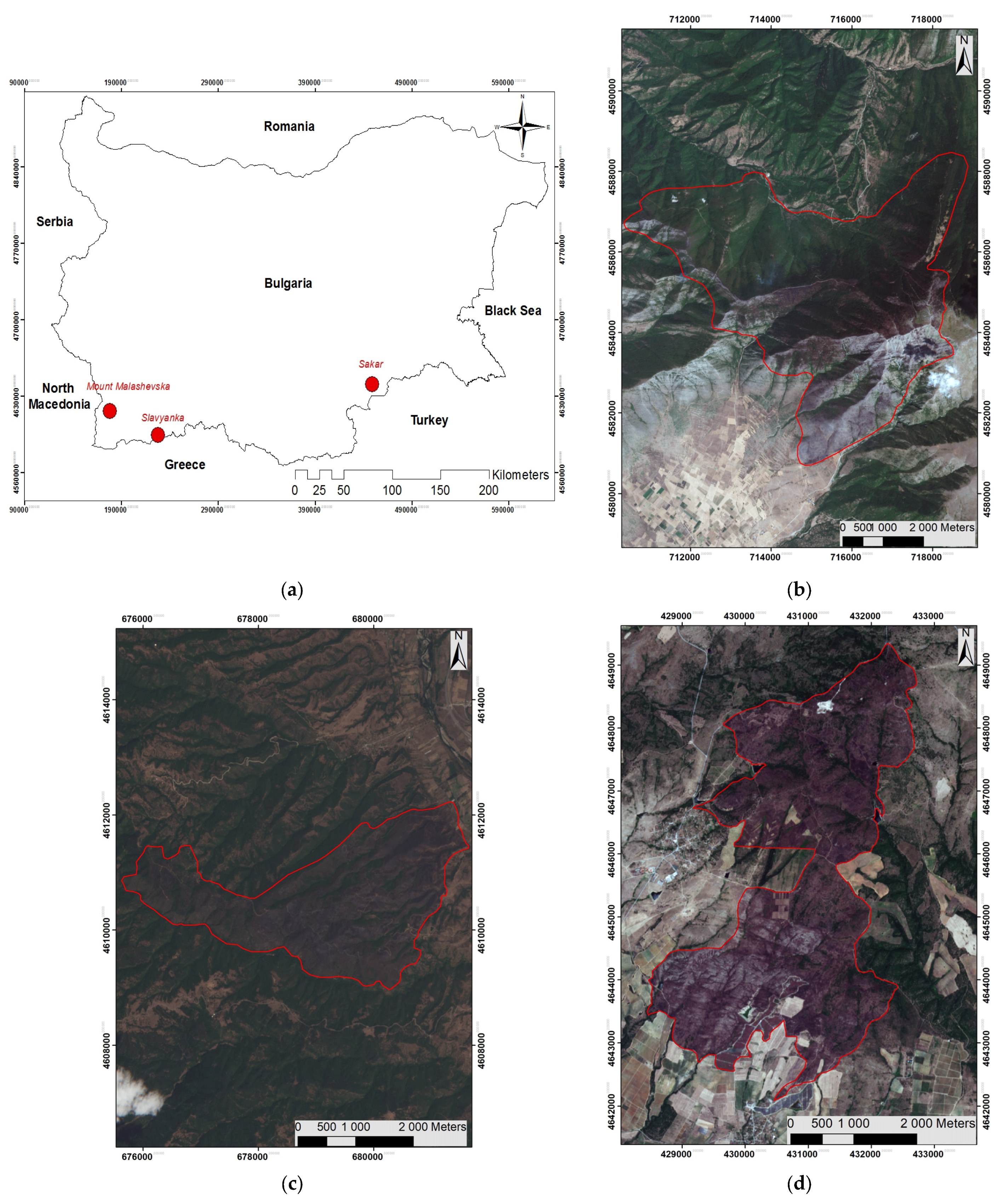
2.1. Study Area
2.1.1. Slavyanka Mountain
2.1.2. Maleshevska Mountain
2.1.3. Sakar Mountain
2.2. Data Used
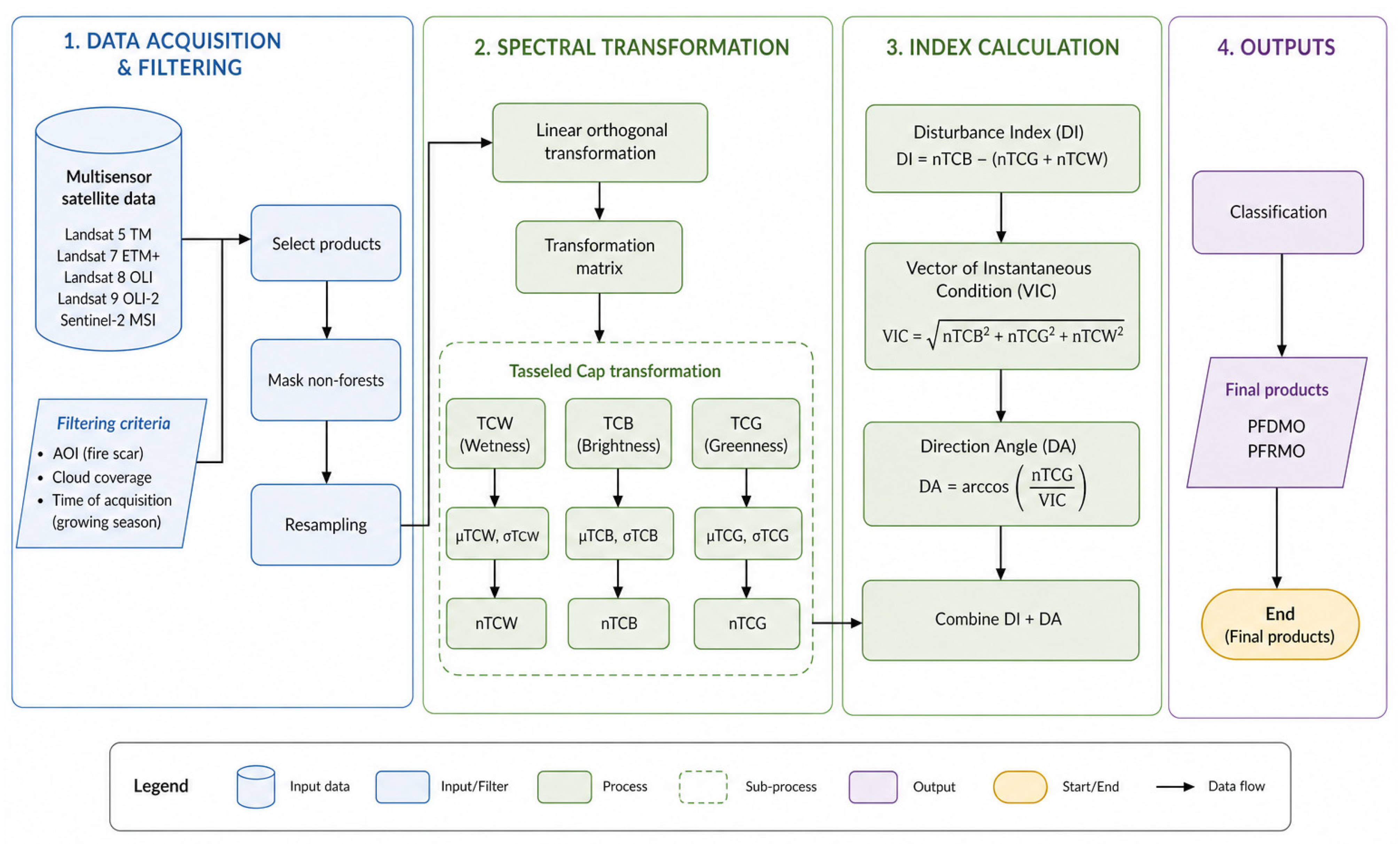
2.3. Methodology
2.3.1. Satellite Data Selection and Filtering
- Acquisition within the forest growing season, typically defined between 1 July and 30 August;
- Minimal atmospheric interference, ensuring the use of cloud-free imagery with negligible cloud shadow effects over the study areas;
- Accurate delineation of the area of interest (AOI), defined by the fire-affected area (fire scar), which is identified through the calculation of spectral indices such as the Normalized Burn Ratio (NBR) or the DI.
2.3.2. Forest Area Delineation and Filtering
2.3.3. Data Resampling and Spatial Harmonization
2.3.4. Input Satellite Data and Spectral Band Configuration
2.3.5. Spectral Transformation Using the Tasseled Cap Approach
2.3.6. Normalization of Tasseled Cap Components
2.3.7. Calculation of DI for Disturbance Assessment
2.3.8. VIC Estimation
2.3.9. DA Calculation
2.3.10. Classification of Post-Fire Disturbance and Recovery Patterns
2.3.11. Workflow Automation and User-Defined Settings
2.4. Validation Background of the Algorithm Implemented in the System
3. Results
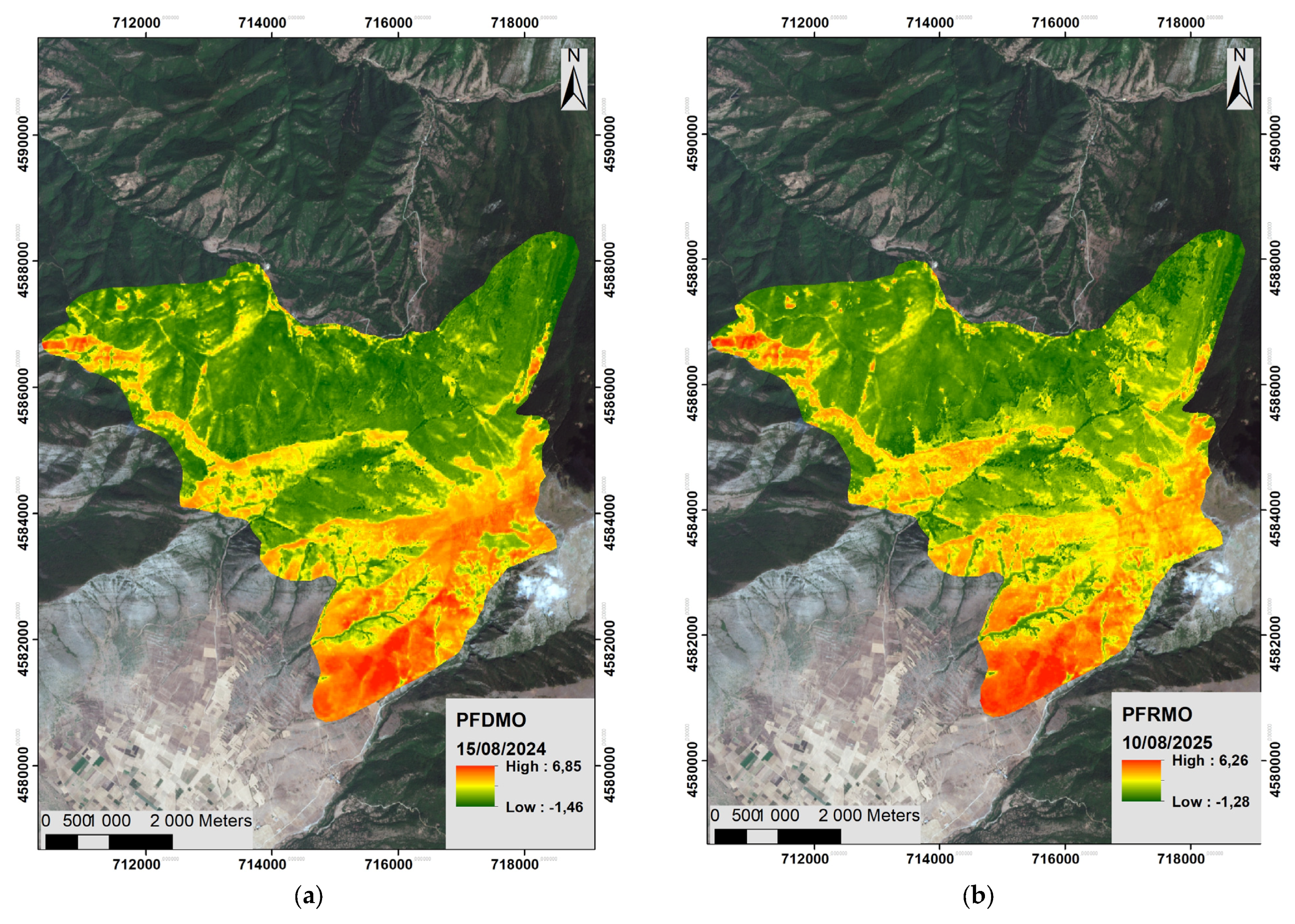
3.1. Post-Fire Disturbance and Recovery Assessment on Slavyanka Mountain
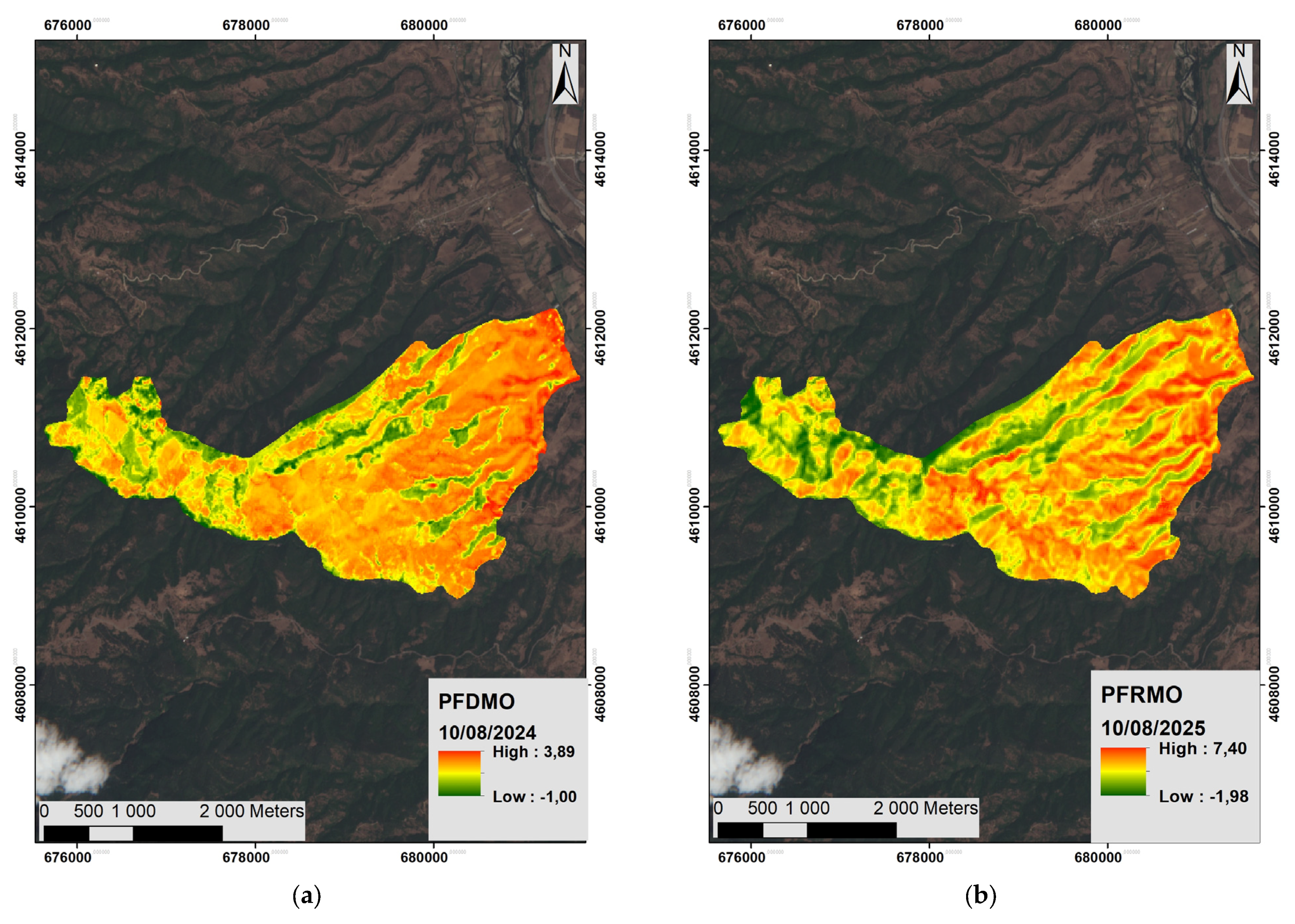
3.2. Post-Fire Disturbance and Recovery Assessment on Maleshevska Mountain
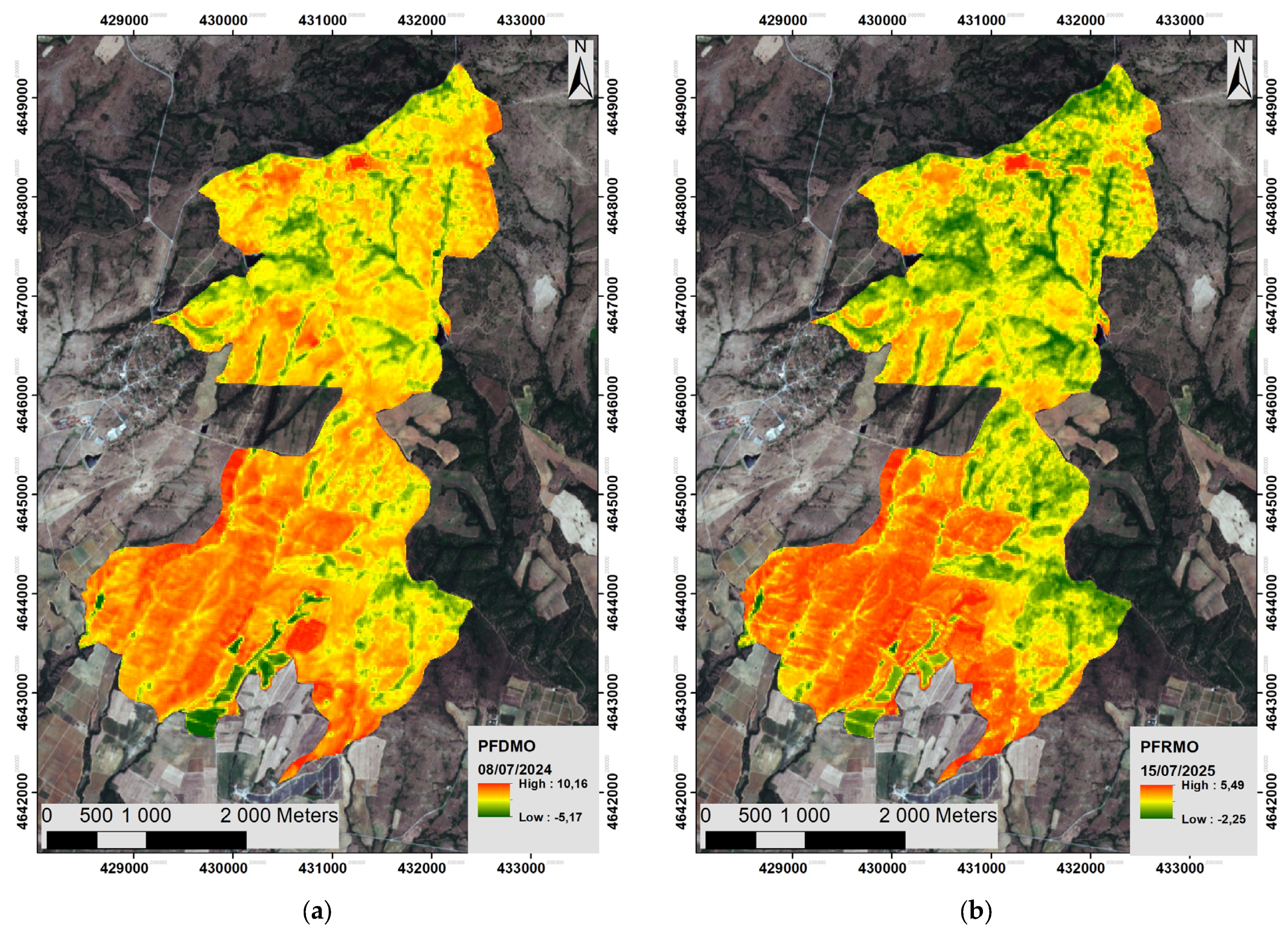
3.3. Post-Fire Disturbance and Recovery Assessment on Sakar Mountain
4. Discussion
5. Conclusions
Author Contributions
Funding
Institutional Review Board Statement
Data Availability Statement
Acknowledgments
Conflicts of Interest
Abbreviations
| TM | Thematic Mapper |
| ETM+ | Enhanced Thematic Mapper Plus |
| OLI | Operational Land Imager |
| MODIS | Moderate Resolution Imaging Spectroradiometer |
| VIIRS | Visible Infrared Imaging Radiometer Suite |
| RdNRB | Relative delta Normalized Burn Ratio |
| DI | Disturbance Index |
| VIC | Vector of Instantaneous Condition |
| DA | Direction Angle |
| MSI | Multispectral Instrument |
| DEM | Digital elevation model |
| RGB | Red, Green, and Blue |
| ESA | European Space Agency |
| SW | Southwest |
| SE | Southeast |
| Ha | Hectare |
| PFDMO | Post-fire Disturbance Module Output |
| PFRMO | Post-fire Recovery Module Output |
| HRL | High Resolution Layers |
| DLT | Dominant Leaf Type |
| AOI | Area of interest |
| TCB | Tasseled cap brightness |
| TCG | Tasseled cap greenness |
| TCW | Tasseled cap wetness |
| St. Dev. | Standard deviation |
| NBR | Normalized Burn Ratio |
| B | Band |
| TCT | Tasseled cap Transformation |
| TC | Tasseled cap |
| nTCB | Normalized Tasseled cap brightness |
| nTCG | Normalized Tasseled cap greenness |
| nTCW | Normalized Tasseled cap wetness |
| dNBR | Differenced Normalized Burn Ratio |
| dNDVI | Differenced Normalized Difference Vegetation Index |
| dDI | Differenced Disturbance Index |
| EFFIS | European Forest Fire Information System |
| MTBS | Monitoring Trends in Burn Severity |
References
- Arrogante-Funes, F.; Aguado, I.; Chuvieco, E. Global assessment and mapping of ecological vulnerability to wildfires. Nat. Hazards Earth Syst. Sci. 2022, 22, 2981–3003. [Google Scholar] [CrossRef]
- Kumar, R.; Pippal, P.S.; Kumar, R.; Singh, A.; Singh, S.; Kumar, P.; Shrestha, S. Forest fire consequences under the influence of changing climate: A systematic review with bibliometric analysis in the context of sustainable development goals. Discov. Sustain. 2025, 6, 541. [Google Scholar] [CrossRef]
- Tezcan, B.; Eren, T. Forest fire management and fire suppression strategies: A systematic literature review. Nat. Hazards 2025, 121, 10485–10515. [Google Scholar] [CrossRef]
- Gajendiran, K.; Kandasamy, S.; Narayanan, M. Influences of wildfire on the forest ecosystem and climate change: A comprehensive study. Environ. Res. 2024, 240, 117537. [Google Scholar] [CrossRef]
- Food and Agriculture Organization of the United Nations. Global Forest Resources Assessment 2020: Main Report; FAO: Rome, Italy, 2020. [Google Scholar]
- Global Forest Watch. Country Profile: Bulgaria. Available online: https://www.globalforestwatch.org/dashboards/country/BGR/ (accessed on 4 April 2026).
- Stankova, N.; Avetisyan, D. Forest fire database on the territory of Bulgaria for the period 2020–2024 based on satellite data. Aerosp. Res. Bulg. 2026, in press. [Google Scholar]
- Velichkova, R.; Gieva, E.; Simova, I. Assessment and analysis of forest fires in Bulgaria. Eng. Proc. 2024, 60, 2. [Google Scholar] [CrossRef]
- European Forest Fire Information System (EFFIS). Estimates for the European Union: Current Year-to-Date Estimates. Available online: https://effis.jrc.ec.europa.eu/apps/effis.statistics/estimates (accessed on 4 April 2026).
- Borisova, B.; Todorova, E.; Ihtimanski, I.; Glushkova, M.; Zhiyanski, M.; Georgieva, M.; Stoyanov, T.; Bozhilova, M.; Atanasova, M.; Dimitrov, S. Wildfire risk assessment and mapping: An approach for Natura 2000 forest sites. Trees For. People 2024, 16, 100532. [Google Scholar] [CrossRef]
- Dimitrova, M.; Ivanova, I.; Zaharinova, M.; Nedkov, R. Application of aerospace methods for monitoring of forest fires and evaluation of burned area in the Haskovo region in the summer of 2011. Aerosp. Res. Bulg. 2013, 25, 194–205. [Google Scholar]
- Misseyanni, A.; Christopoulou, A.; Kougkoulos, I.; Vassilakis, E.; Arianoutsou, M. The impact of forest fires on ecosystem services: The case of Greece. Forests 2025, 16, 533. [Google Scholar] [CrossRef]
- Busari, I.; Sloggy, M.R.; Rouhi Rad, M.; Sahoo, D.; Drury, S.A.; Escobedo, F.J. Modeling wildfire effects on ecosystem services in two disparate California watersheds and communities. Environ. Manag. 2025, 75, 1680–1700. [Google Scholar] [CrossRef]
- Hurteau, M.D.; Bradford, J.B.; Fulé, P.Z.; Taylor, A.H.; Martin, K.L. Climate change, fire management, and ecological services in the southwestern United States. For. Ecol. Manag. 2014, 327, 280–289. [Google Scholar] [CrossRef]
- Chuvieco, E.; Mouillot, F.; van der Werf, G.R.; San Miguel, J.; Tanase, M.; Koutsias, N.; García, M.; Yebra, M.; Padilla, M.; Gitas, I.; et al. Historical background and current developments for mapping burned area from satellite Earth observation. Remote Sens. Environ. 2019, 225, 45–64. [Google Scholar] [CrossRef]
- Coppin, P.; Jonckheere, I.; Nackaerts, K.; Muys, B.; Lambin, E. Digital change detection methods in ecosystem monitoring: A review. Int. J. Remote Sens. 2004, 25, 1565–1596. [Google Scholar] [CrossRef]
- Key, C.H.; Benson, N.C. Landscape assessment: Ground measure of severity, the Composite Burn Index; and remote sensing of severity, the Normalized Burn Ratio. In FIREMON: Fire Effects Monitoring and Inventory System; Lutes, D.C., Ed.; USDA Forest Service: Fort Collins, CO, USA, 2006; pp. LA1–LA51. [Google Scholar]
- Avetisyan, D.; Stankova, N.; Dimitrov, Z. Assessment of spectral vegetation indices performance for post-fire monitoring of different forest environments. Fire 2023, 6, 290. [Google Scholar] [CrossRef]
- Stankova, N. Post-fire recovery monitoring using remote sensing: A review. Aerosp. Res. Bulg. 2023, 35, 192–200. [Google Scholar] [CrossRef]
- Avetisyan, D.; Velizarova, E.; Filchev, L. Post-fire forest vegetation state monitoring through satellite remote sensing and in situ data. Remote Sens. 2022, 14, 6266. [Google Scholar] [CrossRef]
- Dimitrov, P.; Olofsson, P.; Jelev, G.; Kamenova, I. Mapping of forest cover change by post-classification comparison and multitemporal classification of SPOT data—A Bulgarian case study. Aerosp. Res. Bulg. 2018, 30, 42–62. [Google Scholar] [CrossRef]
- Jelev, G.; Chanev, M. Using spectral indexes and spectral channel combinations in different color models for satellite imagery mapping. Ecol. Eng. Environ. Prot. 2023, 3–4, 26–47. [Google Scholar]
- Lyubenova, M.; Georgieva, N.; Lyubenova, V.; Nedkov, R.; Ivanova, I.; Ivanova, E. Ecological space modelling as a pattern of forest vegetation investigation: Example from Belasitsa Mountain, Bulgaria. C. R. Acad. Bulg. Sci. 2012, 65, 483–490. [Google Scholar]
- Kolios, S.; Mandilara, M. Forest density detection using a set of remotely sensed vegetation indices, texture parameters, and spatial clustering metrics. Geomatics 2026, 6, 33. [Google Scholar] [CrossRef]
- Miller, J.D.; Thode, A.E. Quantifying burn severity in a heterogeneous landscape with a relative version of the delta Normalized Burn Ratio (RdNBR). Remote Sens. Environ. 2007, 109, 66–80. [Google Scholar] [CrossRef]
- Pickell, P.D.; Hermosilla, T.; Frazier, R.J.; Coops, N.C.; White, J.C. Monitoring forest recovery following wildfire using Landsat time series. Remote Sens. Environ. 2016, 176, 40–50. [Google Scholar]
- White, J.C.; Hermosilla, T.; Wulder, M.A.; Coops, N.C.; Hobart, G.W. A Best Practices Guide for Generating Forest Disturbance Maps from Time Series of Landsat Data; Canadian Forest Service: Ottawa, ON, Canada, 2016. [Google Scholar]
- Filipponi, F. BAIS2: Burned area index for Sentinel-2. Remote Sens. 2018, 10, 1203. [Google Scholar] [CrossRef]
- Dragozi, E.; Chuvieco, E.; Dennison, P. Burn severity mapping using Sentinel-2 imagery. Remote Sens. 2020, 12, 1571. [Google Scholar]
- Lee, S.-H.; Lee, M.-H.; Kang, T.-H.; Cho, H.-R.; Yun, H.-S.; Lee, S.-J. Comparative analysis of dNBR, dNDVI, SVM kernels, and ISODATA for wildfire-burned area mapping using Sentinel-2 imagery. Remote Sens. 2025, 17, 2196. [Google Scholar] [CrossRef]
- Boschetti, L.; Roy, D.P.; Justice, C.O.; Humber, M.L. MODIS–Landsat fusion for large area burned area mapping. Remote Sens. Environ. 2015, 161, 27–42. [Google Scholar] [CrossRef]
- Mitri, G.H.; Gitas, I.Z. A semi-automated object-oriented model for burned area mapping in the Mediterranean region using Landsat-TM imagery. Int. J. Wildland Fire 2004, 19, 867–878. [Google Scholar] [CrossRef]
- Veraverbeke, S.; Harris, S.; Hook, S. Evaluating spectral indices for burned area discrimination using MODIS/ASTER imagery. Int. J. Appl. Earth Obs. Geoinf. 2011, 13, 678–689. [Google Scholar] [CrossRef]
- Hawbaker, T.J.; Vanderhoof, M.K.; Beal, Y.-J.; Takacs, J.D.; Schmidt, G.L.; Falgout, J.T.; Dwyer, J.L. Mapping burned areas using dense time-series of Landsat data. Remote Sens. Environ. 2017, 198, 504–522. [Google Scholar] [CrossRef]
- Giglio, L.; Boschetti, L.; Roy, D.P.; Humber, M.L.; Justice, C.O. The Collection 6 MODIS burned area mapping algorithm and product. Remote Sens. Environ. 2018, 217, 72–85. [Google Scholar] [CrossRef]
- Chen, Y.; Kou, W.; Yin, X.; Wang, R.; Ye, J.; Wang, Q. Regional forest wildfire mapping through integration of Sentinel-2 and Landsat 8 data in Google Earth Engine with semi-automatic training sample generation. Remote Sens. 2025, 17, 4038. [Google Scholar] [CrossRef]
- Prodromou, M.; Gitas, I.; Mettas, C.; Tzouvaras, M.; Themistocleous, K.; Konstantinidis, A.; Pamboris, A.; Hadjimitsis, D. Remote-sensing-based prioritization of post-fire restoration actions in Mediterranean ecosystems: A case study in Cyprus. Remote Sens. 2025, 17, 1269. [Google Scholar] [CrossRef]
- Cristal, I.; Pons, P.; Palmero-Iniesta, M.; Puigdemasa, E. Post-Fire Environmental Assessment: A Participatory Multi-Criteria Approach for Estimating Soil Erosion Risk and Vegetation Recovery Potential. Available online: https://www.sciencedirect.com/science/article/pii/S2215016125004911 (accessed on 4 April 2026).
- Cubas Sanchez, J.A.; Lisbeth-Ocaña Zúñiga, C.; Gonzáles Pérez, H.; Santos Moreno, A.; Ruiz Ramos, M.; Barboza, E.; Vergara, A.J. Severity and recovery of post-fire vegetation cover using satellite images and burned area indices in Cajamarca (Peru). Fire Ecol. 2026, 22, 12. [Google Scholar] [CrossRef]
- Kaloudis, S.; Raptis, D.; Galanopoulou, S.; Demestichas, K.; Lykoudi, E.; Ntalianis, F.; Zografakis, D.; Sykas, D.; Costopoulou, C. Assessing post-fire rehabilitation: Development and validation of a continuous monitoring index. Int. J. Disaster Risk Reduct. 2026, 133, 105924. [Google Scholar] [CrossRef]
- Yuan, Q. Multi-source remote sensing-based forest fire monitoring. Int. Arch. Photogramm. Remote Sens. Spat. Inf. Sci. 2025, 48, 189–193. [Google Scholar] [CrossRef]
- Ebadati, B.; Attarzadeh, R.; Alikhani, M.; Youssefi, F.; Pirasteh, S. Rapid Post-Wildfire Burned Vegetation Assessment with Google Earth Engine (Case Study: 2023 Canada Wildfires). Int. Arch. Photogramm. Remote Sens. Spat. Inf. Sci. 2024, 48, 45–53. [Google Scholar] [CrossRef]
- Priya, R.S.; Vani, K. Vegetation change detection and recovery assessment based on post-fire satellite imagery using deep learning. Sci. Rep. 2024, 14, 12611. [Google Scholar] [CrossRef]
- Gündüz, H.İ.; Torun, A.T.; Gezgin, C. Post-Fire Burned Area Detection Using Machine Learning and Burn Severity Classification with Spectral Indices in İzmir: A SHAP-Driven XAI Approach. Fire 2025, 8, 121. [Google Scholar] [CrossRef]
- Fernández-García, V.; Calvo, L.; Suárez-Seoane, S.; Marcos, E. Remote Sensing Advances in Fire Science: From Fire Predictors to Post-Fire Monitoring. Remote Sens. 2023, 15, 4930. [Google Scholar] [CrossRef]
- Stankova, N.; Avetisyan, D. Postfire forest regrowth algorithm using tasseled cap–retrieved indices. Remote Sens. 2024, 16, 597. [Google Scholar] [CrossRef]
- Healey, S.; Cohen, W.; Yang, Z.; Krankina, O. Comparison of tasseled cap–based Landsat data structures for use in forest disturbance detection. Remote Sens. Environ. 2005, 97, 301–310. [Google Scholar] [CrossRef]
- Stankova, N.; Nedkov, R. Model for quantitative assessment of disturbance index and vector of instantaneous condition of an ecosystem after fire based on aerospace data. In Proceedings of the Eleventh Scientific Conference with International Participation “Space, Ecology, Safety”, Sofia, Bulgaria, 4–6 November 2015; pp. 292–297. [Google Scholar]
- Stankova, N.; Spasova, T.; Ivanova, I. Monitoring post-fire forest regrowth using differenced disturbance index classification. In Proceedings of the Ninth International Conference on Remote Sensing and Geoinformation of the Environment (RSCy2023), Ayia Napa, Cyprus, 3–5 April 2023; Volume 127861. [Google Scholar] [CrossRef]
- Chen, W.; Moriya, K.; Sakai, T.; Koyama, L.; Cao, C. Monitoring of post-fire forest recovery under different restoration modes based on time series Landsat data. Eur. J. Remote Sens. 2014, 47, 153–168. [Google Scholar] [CrossRef]
- Kauth, R.; Thomas, G. The tasseled cap—A graphic description of the spectral-temporal development of agricultural crops as seen by Landsat. In Proceedings of the Symposium on Machine Processing of Remotely Sensed Data, West Lafayette, IN, USA, 29 June–1 July 1976. [Google Scholar]
- Crist, E.; Cicone, R. A physically based transformation of Thematic Mapper data: The TM tasseled cap. IEEE Trans. Geosci. Remote Sens. 1984, 22, 256–263. [Google Scholar] [CrossRef]
- Wang, S.; Yang, L.; Shi, T.; Chen, J. Harmonized tasseled cap transformation coefficients for Landsat 8 and 9 OLI sensors using surface reflectance. Sci. Remote Sens. 2025, in press. [Google Scholar]
- Stankova, N.; Nedkov, R. Research model of monitoring the recovery of an ecosystem after fire based on satellite and GPS data. Ecol. Eng. Environ. Prot. 2016, 1, 5–11. [Google Scholar]
- Stankova, N.; Avetisyan, D. Modeling post-fire forest regrowth using tasseled cap–derived indicators. In Proceedings of the Earth Resources and Environmental Remote Sensing/GIS Applications XIV, Amsterdam, The Netherlands, 3–6 September 2023; Volume 12734. [Google Scholar] [CrossRef]
- European Environment Agency. Natura 2000—The European Ecological Network (Spatial Dataset); European Environment Agency: Copenhagen, Denmark, 2023. [Google Scholar]
- Sentinel-2: ESA’s Optical High-Resolution Mission for GMES Operational Services. Available online: https://www.sciencedirect.com/science/article/abs/pii/S0034425712000636 (accessed on 4 April 2026).
- Stankova, N.; Avetisyan, D.; Spasova, T.; Ivanova, I.; Dancheva, A.; Stoyanov, A. Assessment of post-fire disturbances based on remotely sensed methods and data. In Proceedings of the Eleventh International Conference on Remote Sensing and Geoinformation of the Environment (RSCy2025), Paphos, Cyprus, 17–19 March 2025; Volume 13816. [Google Scholar]
- European Parliament and Council of the European Union. Directive 2009/147/EC on the conservation of wild birds. Off. J. Eur. Union 2009, L20, 7–25. [Google Scholar]
- Council of the European Communities. Directive 92/43/EEC on the conservation of natural habitats and of wild fauna and flora. Off. J. Eur. Communities 1992, L206, 7–50. [Google Scholar]
- Giglio, L.; Schroeder, W.; Justice, C.O. The Collection 6 MODIS active fire detection algorithm and fire products. Remote Sens. Environ. 2016, 178, 31–41. [Google Scholar] [CrossRef]
- Schroeder, W.; Oliva, P.; Giglio, L.; Csiszar, I.A. The new VIIRS 375 m active fire detection data product: Algorithm description and initial assessment. Remote Sens. Environ. 2014, 143, 85–96. [Google Scholar] [CrossRef]
- European Environment Agency. Copernicus High Resolution Layers (HRL)—Forest Dominant Leaf Type (Raster Dataset); European Environment Agency: Copenhagen, Denmark, 2023. [Google Scholar]
- Huang, C.; Wylie, B.; Homer, C.; Zylstra, G. Derivation of a tasseled cap transformation based on Landsat 7 at-satellite reflectance. Int. J. Remote Sens. 2002, 23, 1741–1748. [Google Scholar] [CrossRef]
- Baig, M.; Zhang, L.; Shuai, T.; Tong, Q. Derivation of a tasseled cap transformation based on Landsat 8 at-satellite reflectance. Remote Sens. Lett. 2014, 5, 423–432. [Google Scholar] [CrossRef]
- Nedkov, R. Orthogonal transformation of segmented images from the satellite Sentinel-2. C. R. Acad. Bulg. Sci. 2017, 70, 687–692. [Google Scholar]
- European Forest Fire Information System (EFFIS). Rapid Damage Assessment. Available online: https://forest-fire.emergency.copernicus.eu/about-effis/technical-background/rapid-damage-assessment (accessed on 1 May 2026).
- Pérez-Cabello, F.; Montorio, R.; Borini Alves, D. Remote sensing techniques to assess post-fire vegetation recovery. Curr. Opin. Environ. Sci. Health 2021, 21, 100251. [Google Scholar] [CrossRef]
- Burn Severity Portal. Post-Fire Mapping Glossary. Available online: https://burnseverity.cr.usgs.gov/glossary (accessed on 1 May 2026).
- Bassett, M.; Leonard, S.W.J.; Chia, E.K.; Clarke, M.F.; Bennett, A.F. Interacting effects of fire severity, time since fire and topography on vegetation structure after wildfire. For. Ecol. Manag. 2017, 396, 26–34. [Google Scholar] [CrossRef]
- Turner, M.G.; Hargrove, W.W.; Gardner, R.H.; Romme, W.H. Effects of fire on landscape heterogeneity in Yellowstone National Park, Wyoming. J. Veg. Sci. 1994, 5, 731–742. [Google Scholar] [CrossRef]
- Dillon, G.K.; Holden, Z.A.; Morgan, P.; Crimmins, M.A.; Heyerdahl, E.K.; Luce, C.H. Both topography and climate affected forest and woodland burn severity in two regions of the western US, 1984–2006. Ecosphere 2011, 2, 130. [Google Scholar] [CrossRef]
- Johnson, J.; Kelly, L.T.; Collins, L.; Stewart, S.; Nitschke, C.R. Drought, topography, and forest management shape wildfire occurrence and severity in montane landscapes. Sci. Total Environ. 2025, 998, 180207. [Google Scholar] [CrossRef]
- Haire, S.L.; McGarigal, K. Changes in fire severity across gradients of climate, fire size, and topography: A landscape ecological perspective. Fire Ecol. 2009, 5, 86–103. [Google Scholar] [CrossRef]
- Lecina-Diaz, J.; Alvarez, A.; Retana, J. Extreme fire severity patterns in Mediterranean pine forests. PLoS ONE 2014, 9, e85127. [Google Scholar] [CrossRef]
- Collins, B.M.; Kelly, M.; van Wagtendonk, J.W.; Stephens, S.L. Spatial patterns of large natural fires in Sierra Nevada wilderness areas. Landsc. Ecol. 2007, 22, 545–557. [Google Scholar] [CrossRef]
- Turner, M.G.; Romme, W.H.; Tinker, D.B. Surprises and lessons from the 1988 Yellowstone fires. Ecosystems 2003, 6, 351–358. [Google Scholar] [CrossRef]
- Johnstone, J.F.; Allen, C.D.; Franklin, J.F.; Frelich, L.E.; Harvey, B.J.; Higuera, P.E.; Mack, M.C.; Meentemeyer, R.K.; Metz, M.R.; Perry, G.L.W.; et al. Changing disturbance regimes, ecological memory, and forest resilience. Front. Ecol. Environ. 2016, 14, 369–378. [Google Scholar] [CrossRef]
- Kane, V.R.; Lutz, J.A.; Cansler, C.A.; Povak, N.A.; Churchill, D.J.; Smith, D.F.; Kane, J.T.; North, M.P. Water balance and topography predict fire and forest structure patterns. For. Ecol. Manag. 2015, 338, 1–13. [Google Scholar] [CrossRef]
- Meng, R.; Dennison, P.E.; D’Antonio, C.M.; Moritz, M.A. Remote sensing analysis of vegetation recovery following short-interval fires in southern California shrublands. Remote Sens. Environ. 2014, 152, 442–452. [Google Scholar] [CrossRef]
- Ireland, G.; Petropoulos, G.P. Exploring the relationships between post-fire vegetation regeneration dynamics, topography, and burn severity: A case study from montane ecosystems of Greece. Appl. Geogr. 2015, 63, 308–320. [Google Scholar] [CrossRef]
- Seidl, R.; Schelhaas, M.-J.; Rammer, W.; Verkerk, P.J. Increasing forest disturbances in Europe and their impact on carbon storage. Nat. Clim. Change 2014, 4, 806–810. [Google Scholar] [CrossRef]
- Viedma, O.; Melia, J.; Segarra, D.; Garcia-Haro, J. Modeling rates of ecosystem recovery after fires using Landsat TM data. Remote Sens. Environ. 2006, 101, 383–392. [Google Scholar] [CrossRef]
- Copernicus Emergency Management Service. Post-Disaster Wildfire Recovery and Monitoring. Available online: https://mapping.emergency.copernicus.eu/about/recovery-mapping-portfolio/post-disaster-wildfire-recovery-and-monitoring/ (accessed on 1 May 2026).
- Liu, C.-L.; Wang, Y.-R.; Liu, W.-Y. Multi-index remote sensing for post-fire damage assessment: Accuracy, carbon loss, and conservation implications. Front. For. Glob. Change 2025, 8, 1577612. [Google Scholar] [CrossRef]



| Study Area | Region | Fire Period | Burned Area | Dominant Vegetation | Topography |
|---|---|---|---|---|---|
| Slavyanka | SW Bulgaria, border with Greece | August 2024 | 2000 ha | Mixed coniferous and broadleaf forests | Mountainous, steep slopes |
| Maleshevska | SW Bulgaria, Blagoevgrad Province | July 2024 | 3000 ha | Drought-tolerant broadleaf species and shrublands | Hilly to pre-mountains |
| Sakar | SE Bulgaria Haskovo Province | July 2024 | 10,000 ha | Oak-dominated formations and shrublands | Low to mid-elevation mountainous |
| Slavyanka | Maleshevska | Sakar | |
|---|---|---|---|
| Sentinel 2 A | 10 July 2024 | 8 July 2024 | |
| Sentinel 2 A | 31 July 2024 | 15 June 2025 | |
| Sentinel 2 B | 16 July 2024 | 26 July 2024 | 23 June 2024 |
| Sentinel 2 B | 15 August 2024 | 10 July 2025 | |
| Sentinel 2 B | 10 August 2025 |
| Study Area | Indicator | Min | Max | Mean | Std. Dev. | Low Level (%) | Moderate Level (%) | High Level (%) |
|---|---|---|---|---|---|---|---|---|
| Slavyanka | PFDMO | −1.46 | 6.85 | 2.31 | 1.74 | 28.4 | 46.7 | 24.9 |
| PFRMO | −1.28 | 6.26 | 2.05 | 1.52 | 35.2 | 44.1 | 20.7 | |
| Maleshevska | PFDMO | −1.00 | 3.89 | 1.87 | 1.02 | 31.6 | 52.3 | 16.1 |
| PFRMO | −1.98 | 7.40 | 2.64 | 1.95 | 29.8 | 40.5 | 29.7 | |
| Sakar | PFDMO | −5.17 | 10.16 | 3.95 | 2.86 | 22.7 | 38.4 | 38.9 |
| PFRMO | −2.25 | 5.49 | 2.18 | 1.63 | 33.5 | 47.2 | 19.3 |
| Study Area | ΔMean (PFRMO–PFDMO) | Recovery Ratio (%) | Interpretation |
|---|---|---|---|
| Slavyanka | −0.26 | 88.7 | Limited recovery |
| Maleshevska | +0.77 | 141.2 | Strong heterogeneous recovery |
| Sakar | −1.77 | 55.2 | Partial recovery with persistent disturbance |
Disclaimer/Publisher’s Note: The statements, opinions and data contained in all publications are solely those of the individual author(s) and contributor(s) and not of MDPI and/or the editor(s). MDPI and/or the editor(s) disclaim responsibility for any injury to people or property resulting from any ideas, methods, instructions or products referred to in the content. |
© 2026 by the authors. Licensee MDPI, Basel, Switzerland. This article is an open access article distributed under the terms and conditions of the Creative Commons Attribution (CC BY) license.
Share and Cite
Stankova, N.; Avetisyan, D. A Multispectral Satellite-Based Integrated System for Monitoring Fire Disturbance and Recovery Dynamics in Forest Ecosystems. Geomatics 2026, 6, 55. https://doi.org/10.3390/geomatics6030055
Stankova N, Avetisyan D. A Multispectral Satellite-Based Integrated System for Monitoring Fire Disturbance and Recovery Dynamics in Forest Ecosystems. Geomatics. 2026; 6(3):55. https://doi.org/10.3390/geomatics6030055
Chicago/Turabian StyleStankova, Nataliya, and Daniela Avetisyan. 2026. "A Multispectral Satellite-Based Integrated System for Monitoring Fire Disturbance and Recovery Dynamics in Forest Ecosystems" Geomatics 6, no. 3: 55. https://doi.org/10.3390/geomatics6030055
APA StyleStankova, N., & Avetisyan, D. (2026). A Multispectral Satellite-Based Integrated System for Monitoring Fire Disturbance and Recovery Dynamics in Forest Ecosystems. Geomatics, 6(3), 55. https://doi.org/10.3390/geomatics6030055