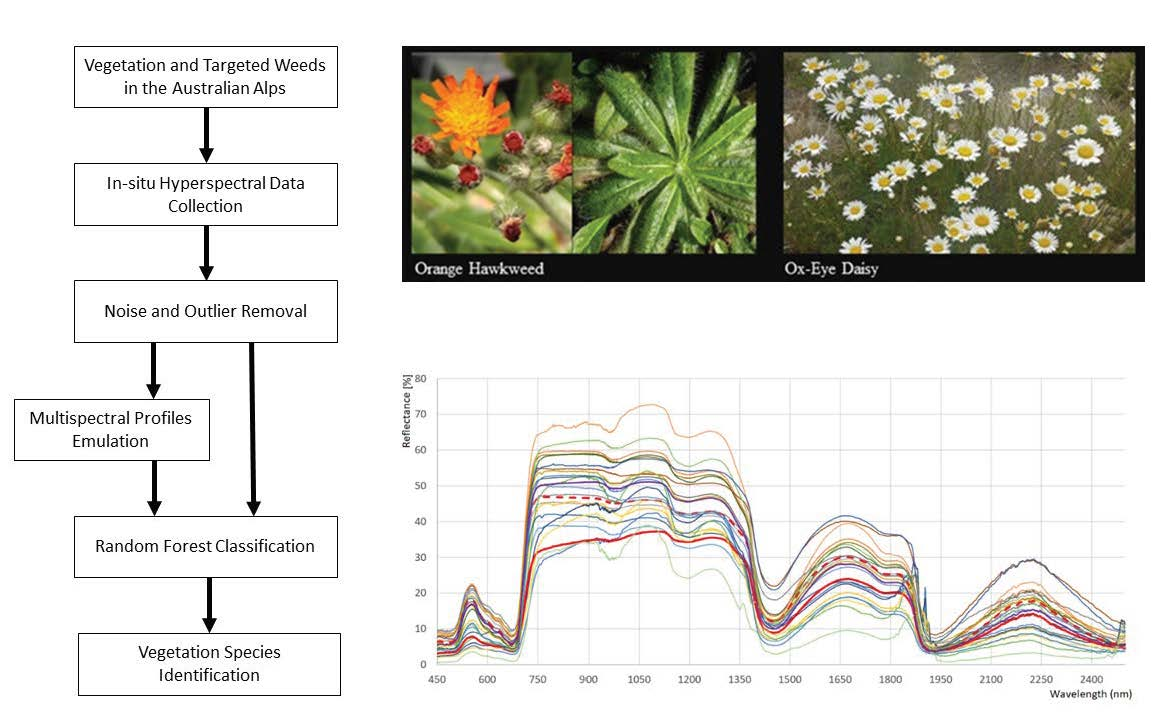
Identifying Invasive Weed Species in Alpine Vegetation Communities Based on Spectral Profiles
 , and
, and Abstract
Share and Cite
Ajamian, C.; Chang, H.-C.; Tomkins, K.; Farebrother, W.; Heim, R.; Rahman, S. Identifying Invasive Weed Species in Alpine Vegetation Communities Based on Spectral Profiles. Geomatics 2021, 1, 177-191. https://doi.org/10.3390/geomatics1020011
Ajamian C, Chang H-C, Tomkins K, Farebrother W, Heim R, Rahman S. Identifying Invasive Weed Species in Alpine Vegetation Communities Based on Spectral Profiles. Geomatics. 2021; 1(2):177-191. https://doi.org/10.3390/geomatics1020011
Chicago/Turabian StyleAjamian, Chad, Hsing-Chung Chang, Kerrie Tomkins, William Farebrother, Rene Heim, and Shahriar Rahman. 2021. "Identifying Invasive Weed Species in Alpine Vegetation Communities Based on Spectral Profiles" Geomatics 1, no. 2: 177-191. https://doi.org/10.3390/geomatics1020011
APA StyleAjamian, C., Chang, H.-C., Tomkins, K., Farebrother, W., Heim, R., & Rahman, S. (2021). Identifying Invasive Weed Species in Alpine Vegetation Communities Based on Spectral Profiles. Geomatics, 1(2), 177-191. https://doi.org/10.3390/geomatics1020011