

Longitudinal Effects of Neuropsychomotor Therapy on Clinical Outcomes in Autism Spectrum Disorder: An 18-Month Multicenter Rehabilitation Study

 , , ,
, , ,  , ,
, ,  , and
, and 
Abstract
1. Introduction
2. Materials and Methods
2.1. Ethical Statement
2.2. Study Design
2.3. Participants
2.4. Outcome Measures
2.5. Materials and Assessment Protocol
- Autism Diagnostic Observation Schedule, 2nd edition—DOS-2 [20]: A semi-structured, standardized observational assessment measuring autism symptoms in social relatedness, communication, play, and restricted or repetitive behaviors. Standardized severity scores can be derived from these domains to compare symptom levels across modules.
- Vineland Adaptive Behavior Scales 2nd edition—VABS II [21]: A parent interview assessing socialization, communication, motor skills, and daily living abilities. The VABS provides age-equivalent and standardized scores across multiple subscales, including expressive and receptive language, social competence, and adaptive behavior.
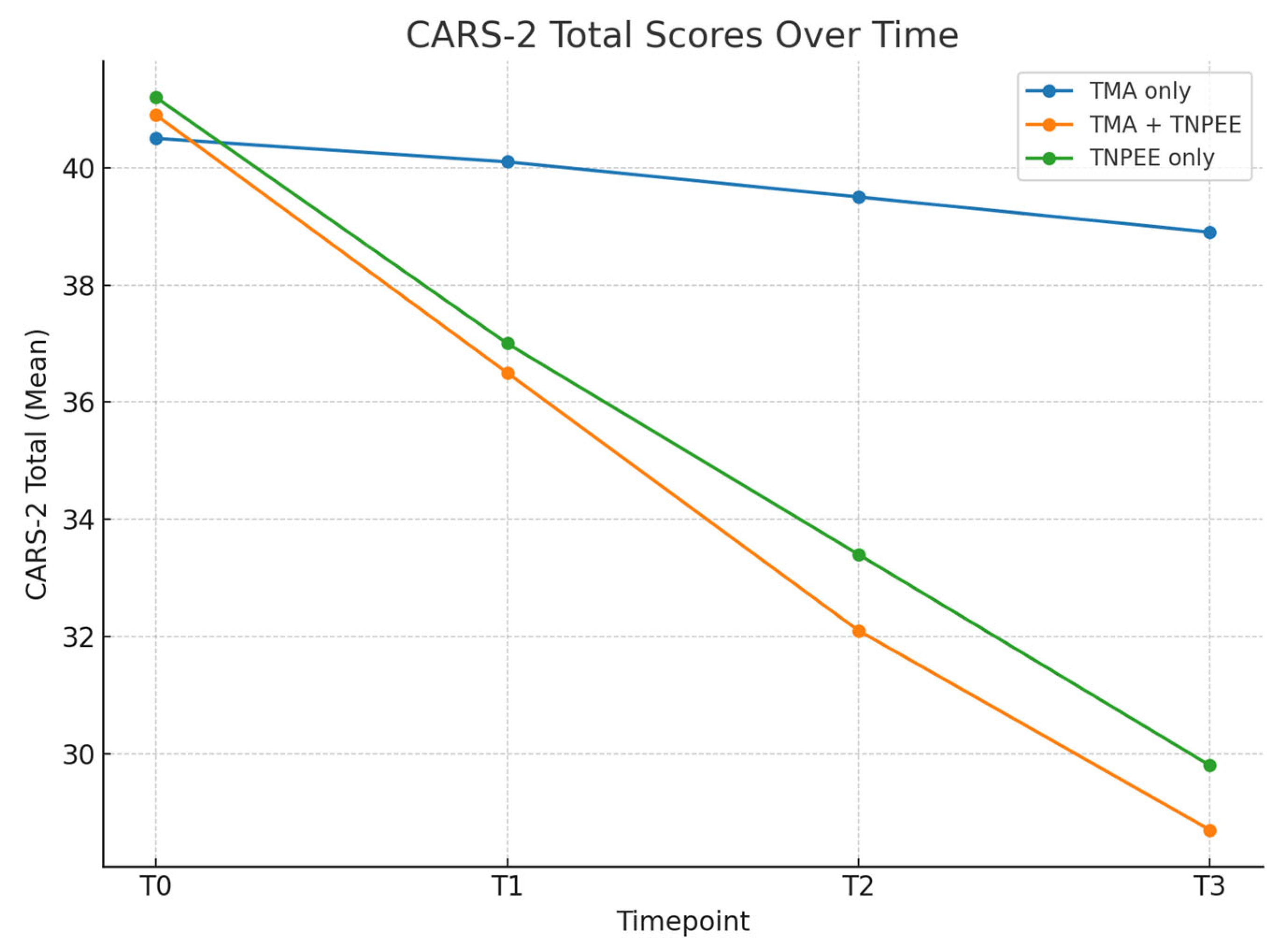
- Childhood Autism Rating Scale, Second Edition CARS-2 [22]: A standardized rating scale used to classify the severity of autism based on direct observation and caregiver information, yielding a total score reflecting overall symptom intensity.
- Sensory Processing Measure—SPM [23]: A parent-report instrument designed to evaluate sensory modulation, integration, and behavioral responses in home and school contexts, providing standardized scores for multiple sensory domains.
- Autism Spectrum Disorder Behavior Inventory—ASDBI [24]: The ASDBI was selected because it captures multiple behavioral and socio-emotional domains relevant to treatment monitoring in ASD, including ritualistic behaviors, sensory responses, excitability, affective regulation, and social functioning. Its multidomain structure makes it suitable for detecting broad behavioral changes over time in rehabilitation settings. We acknowledge, however, that this instrument was not designed as a formal measure of clinically meaningful change and that interpretation of repeated-measures change should therefore remain cautious.
- HAARS—Humphries’ Assessment of Aquatic Readiness [25]: The HAARS is a 17-item observational scale designed to assess children’s aquatic readiness through three skill domains: water orientation, basic motor abilities, and essential water-safety behaviors. It provides a quick, structured evaluation of a child’s preparedness for early swimming instruction.
2.6. Interventions Description
3. Results
3.1. Statistical Analysis
3.2. Participant Characteristics
3.3. Longitudinal Outcomes
4. Discussion
5. Conclusions
Author Contributions
Funding
Institutional Review Board Statement
Informed Consent Statement
Data Availability Statement
Acknowledgments
Conflicts of Interest
Disability Language/Terminology Positionality Statement
References
- American Psychiatric Association. Diagnostic and Statistical Manual of Mental Disorders (DSM-5-TR); American Psychiatric Association: Washington, DC, USA, 2022. [Google Scholar] [CrossRef] [Scilit]
- Costanza, C.; Gallai, B.; Sorrentino, M.; Gnazzo, M.; Pisanò, G.; Parisi, L.; Germanò, E.; Maltese, A.; Esposito, M.; Roccella, M.; et al. The Prevalence and Clinical Significance of Toe Walking in Autism Spectrum Disorder: A Cross-Sectional Study in an Italian Pediatric Sample. Medicina 2025, 61, 1346. [Google Scholar] [CrossRef] [Scilit]
- Chandler, S.; Leno, V.C.; White, P.; Yorke, I.; Hollocks, M.J.; Baird, G.; Pickles, A.; Simonoff, E.; Charman, T. Pathways to adaptive functioning in autism from early childhood to adolescence. Autism Res. 2022, 15, 1883–1893. [Google Scholar] [CrossRef] [Scilit] [PubMed]
- Gilotty, L.; Kenworthy, L.; Sirian, L.; Black, D.O.; Wagner, A.E. Adaptive Skills and Executive Function in Autism Spectrum Disorders. Child Neuropsychol. 2002, 8, 241–248. [Google Scholar] [CrossRef] [Scilit]
- Marco, E.J.; Hinkley, L.B.N.; Hill, S.S.; Nagarajan, S.S. Sensory processing in autism: A review of neurophysiologic findings. Pediatr. Res. 2011, 69, 48–54. [Google Scholar] [CrossRef] [Scilit] [PubMed]
- Posar, A.; Visconti, P. Sensory abnormalities in children with autism spectrum disorder. J. Pediatr. 2018, 94, 342–350. [Google Scholar] [CrossRef] [Scilit]
- Lindor, E.; Sivaratnam, C.; May, T.; Stefanac, N.; Howells, K.; Rinehart, N. Problem behavior in autism spectrum disorder: Considering core symptom severity and accompanying sleep disturbance. Front. Psychiatry 2019, 10, 487. [Google Scholar] [CrossRef] [Scilit]
- Istituto Superiore di Sanità (ISS). Diagnosi e Trattamento di Bambini e Adolescenti con Disturbo dello Spettro Autistico (Linee Guida No. SNLG-ISS); Sistema Nazionale Linee Guida (SNLG); Istituto Superiore di Sanità: Rome, Italy, 2023.
- National Institute for Health and Care Excellence (NICE). Autism Spectrum Disorder in Under 19s: Support and Management (Guideline No. CG170); NICE: Manchester, UK, 2012.
- Caliendo, M.; Lanzara, V.; Vetri, L.; Roccella, M.; Marotta, R.; Carotenuto, M.; Russo, D.; Cerroni, F.; Precenzano, F. Emotional–Behavioral Disorders in Healthy Siblings of Children with Neurodevelopmental Disorders. Medicina 2020, 56, 491. [Google Scholar] [CrossRef] [Scilit]
- Esposito, M.; Gimigliano, F.; Ruberto, M.; Marotta, R.; Gallai, B.; Parisi, L.; Lavano, S.M.; Mazzotta, G.; Roccella, M.; Carotenuto, M. Psychomotor approach in children affected by nonretentive fecal soiling (FNRFS): A new rehabilitative purpose. Neuropsychiatr. Dis. Treat. 2013, 9, 1433–1441. [Google Scholar] [CrossRef] [Scilit] [PubMed]
- Romero Naranjo, F.J.; Andreu, E. Neuromotricity as a New Paradigm. 2023. Available online: https://rua.ua.es/dspace/handle/10045/120025 (accessed on 16 February 2026).
- de Barros, I.M.; Coutinho, D.J.G. The contribution of psychomotricity in the development of autistic children: A literature review. Rev. Ibero-Am. Humanid. Ciênc. Educ. 2023, 9, 230–242. [Google Scholar]
- Frazão, A.; Santos, S.; Lebre, P. Psychomotor Intervention Practices for Children with Autism Spectrum Disorder: A Scoping Review. Rev. J. Autism Dev. Disord. 2021, 10, 319–336. [Google Scholar] [CrossRef] [Scilit]
- Alaniz, M.L.; Rosenberg, S.S.; Beard, N.R.; Rosario, E.R. The Effectiveness of Aquatic Group Therapy for Improving Water Safety and Social Interactions in Children with Autism Spectrum Disorder: A Pilot Program. J. Autism Dev. Disord. 2017, 47, 4006–4017. [Google Scholar] [CrossRef] [Scilit]
- Caputo, G.; Ippolito, G.; Mazzotta, M.; Sentenza, L.; Muzio, M.R.; Salzano, S.; Conson, M. Effectiveness of a Multisystem Aquatic Therapy for Children with Autism Spectrum Disorders. J. Autism Dev. Disord. 2018, 48, 1945–1956. [Google Scholar] [CrossRef] [Scilit] [PubMed]
- Kemp, E.; Nikahd, M.; Howard, M.; Darragh, A.; Crasta, J.E. Improving water competency among children on the autism spectrum: The AquOTic randomized controlled trial. Front. Pediatr. 2024, 12, 1473328. [Google Scholar] [CrossRef] [Scilit]
- Shariat, A.; Najafabadi, M.G.; Dos Santos, I.K.; Anastasio, A.T.; Milajerdi, H.R.; Hassanzadeh, G.; Nouri, E. The Effectiveness of Aquatic Therapy on Motor and Social Skill as Well as Executive Function in Children with Neurodevelopmental Disorder: A Systematic Review and Meta-analysis. Arch. Phys. Med. Rehabil. 2023, 105, 1000–1007. [Google Scholar] [CrossRef] [Scilit]
- Zanobini, M.; Solari, S. Effectiveness of the Program “Acqua Mediatrice di Comunicazione” (Water as a Mediator of Communication) on Social Skills, Autistic Behaviors and Aquatic Skills in ASD Children. J. Autism Dev. Disord. 2019, 49, 4134–4146. [Google Scholar] [CrossRef] [Scilit]
- Lord, C.; Rutter, M.; DiLavore, P.C.; Risi, S.; Gotham, K.; Bishop, S.L. Autism Diagnostic Observation Schedule, (ADOS-2), 2nd ed.; Western Psychological Services: Torrance, CA, USA, 2012. [Google Scholar]
- Sparrow, S.S.; Cicchetti, D.V.; Balla, D.A. Vineland Adaptive Behavior Scales, (Vineland-II), 2nd ed.; Pearson Assessments: London, UK, 2005. [Google Scholar]
- Schopler, E.; Van Bourgondien, M.E.; Wellman, G.J.; Love, S.R. Childhood Autism Rating Scale, (CARS-2), 2nd ed.; Western Psychological Services: Torrance, CA, USA, 2010. [Google Scholar]
- Parham, L.D.; Ecker, C.; Miller-Kuhaneck, H.; Henry, D.; Glennon, T.J. Sensory Processing Measure (SPM); Pearson Assessments: London, UK, 2007. [Google Scholar]
- Aman, M.G.; Lam, K.S.L. Autism Spectrum Disorder Behavior Inventory (ASDBI); Multi-Health Systems: Toronto, ON, Canada, 2007. [Google Scholar]
- Humphries, K.M. ‘Humphries’ Assessment of Aquatic Readiness’. Master’s Thesis, Texas Women’s University, Denton, TX, USA, 2008. [Google Scholar]
- Caliendo, M.; Di Sessa, A.; D’alterio, E.; Frolli, A.; Verde, D.; Iacono, D.; Romano, P.; Vetri, L.; Carotenuto, M. Efficacy of Neuro-Psychomotor Approach in Children Affected by Autism Spectrum Disorders: A Multicenter Study in Italian Pediatric Population. Brain Sci. 2021, 11, 1210. [Google Scholar] [CrossRef] [Scilit]
- ElGarhy, S.; Liu, T. Effects of psychomotor intervention program on students with autism spectrum disorder. Sch. Psychol. Q. 2016, 31, 491–506. [Google Scholar] [CrossRef] [Scilit]
- Giangiacomo, E.; Visaggi, M.C.; Aceti, F.; Giacchetti, N.; Martucci, M.; Giovannone, F.; Valente, D.; Galeoto, G.; Tofani, M.; Sogos, C. Early neuro-psychomotor therapy intervention for theory of mind and emotion recognition in neurodevelopmental disorders: A pilot study. Children 2022, 9, 1142. [Google Scholar] [CrossRef] [Scilit] [PubMed]
- López Gómez, A.; Gallicchio, P. Therapeutic psychomotricity in children: Professional profile and reasons for referral to treatment in Uruguay. Cienc. Psicol. 2025, 19, e-4003. [Google Scholar]
- Faraji, S.; Najafabadi, M.G.; Zandi, H.G.; Shaw, I. Effect of aquatic therapy on motor skill and executive function in children with autism spectrum disorder. S. Afr. J. Res. Sport Phys. Educ. Recreat. 2023, 45, 17–27. [Google Scholar] [CrossRef] [Scilit]
- Ben Hassen, I.; Abid, R.; Ben Waer, F.; Masmoudi, L.; Sahli, S.; Driss, T.; Hammouda, O. Intervention based on psychomotor rehabilitation in children with autism spectrum disorder ASD: Effect on postural control and sensory integration. Children 2023, 10, 1480. [Google Scholar] [CrossRef] [Scilit]
- Frazão, A.; Santos, S.; Rodrigues, A.; Brandão, T.; Simões, C.; Lebre, P. Consensus on the best practice guidelines for psychomotor intervention in preschool children with autism spectrum disorder. Children 2022, 9, 1778. [Google Scholar] [CrossRef] [Scilit] [PubMed]
- Moschos, G.; Pollatou, E.; Kambas, A.; Bekiari, A. The effect of psychomotor intervention program on emotional competence and behaviour problems in children four to five years of age. Body Mov. Dance Psychother. 2023, 18, 187–200. [Google Scholar] [CrossRef] [Scilit]
- Van T Hooft, P.; Moeijes, J.; Hartaman, C.; Van Busschbach, J.; Hartaman, E. Aquatic Interventions to Improve Motor and Social Functioning in Children with ASD: A Systematic Review. Rev. J. Autism Dev. Disord. 2024, 1–21. [Google Scholar] [CrossRef] [Scilit]
- Asta, L.; Ricciardello, A.; Cucinotta, F.; Turriziani, L.; Boncoddo, M.; Bellomo, F.; Angelini, J.; Gnazzo, M.; Scandolo, G.; Pisanò, G.; et al. Clinical, developmental and serotonemia phenotyping of a sample of 70 Italian patients with Phelan-McDermid Syndrome. J. Neurodev. Disord. 2024, 16, 57. [Google Scholar] [CrossRef] [Scilit] [PubMed] [PubMed Central]


| Outcome | TMA Only T0 | TMA Only T3 | TMA + TNPEE T0 | TMA + TNPEE T3 | TNPEE Only T0 | TNPEE Only T3 | p-Value | H2 |
|---|---|---|---|---|---|---|---|---|
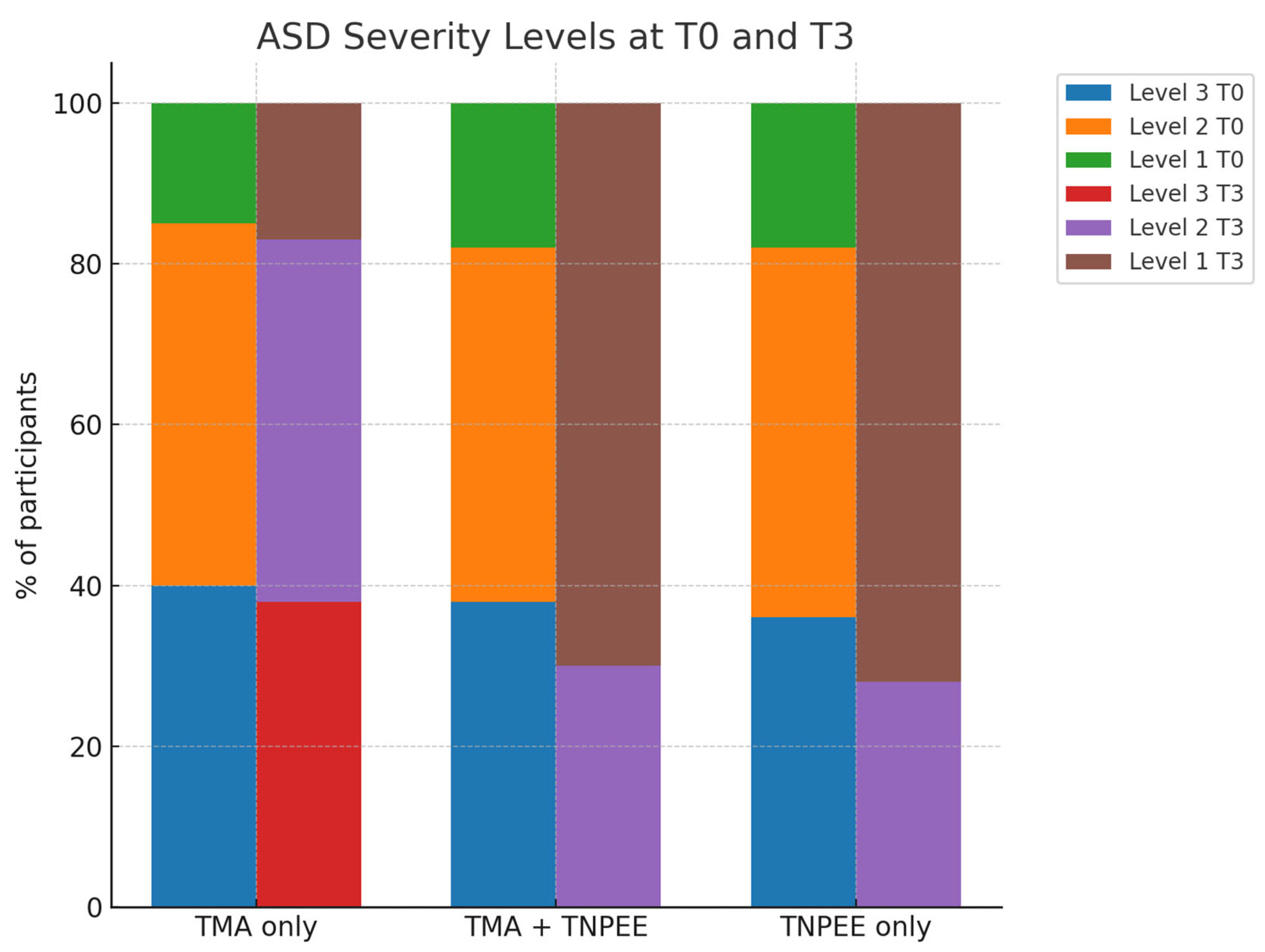
| ADOS-2 Total | 17.48 ± 2.57 | 15.98 ± 2.57 | 17.10 ± 1.91 | 12.10 ± 1.91 | 17.75 ± 1.66 | 13.15 ± 1.66 | <0.001 | 1.000 |
| CARS-2 Total | 41.36 ± 4.06 | 38.36 ± 4.06 | 43.84 ± 3.66 | 32.84 ± 3.66 | 43.80 ± 3.60 | 33.80 ± 3.60 | <0.001 | 1.000 |
| VABS Communication | 47.32 ± 7.74 | 50.63 ± 7.94 | 50.73 ± 7.16 | 63.48 ± 7.37 | 47.15 ± 6.63 | 57.50 ± 6.49 | <0.001 | 0.523 |
| VABS Daily Living | 52.45 ± 5.87 | 55.95 ± 6.46 | 51.71 ± 5.95 | 65.65 ± 6.08 | 52.26 ± 8.39 | 62.51 ± 9.40 | <0.001 | 0.560 |
| VABS Socialization | 50.23 ± 7.93 | 52.79 ± 8.07 | 49.13 ± 5.27 | 62.60 ± 4.99 | 50.68 ± 4.94 | 61.48 ± 5.84 | <0.001 | 0.598 |
| VABS Motor | 60.68 ± 4.86 | 63.84 ± 5.13 | 60.04 ± 4.90 | 72.73 ± 4.87 | 60.14 ± 4.24 | 70.26 ± 4.94 | <0.001 | 0.492 |
| VABS Composite | 52.67 ± 3.68 | 55.80 ± 3.64 | 52.90 ± 2.66 | 66.11 ± 2.94 | 52.56 ± 3.36 | 62.94 ± 3.62 | <0.001 | 0.827 |
| SPM Total | 73.00 ± 6.15 | 68.50 ± 6.15 | 73.68 ± 6.25 | 63.68 ± 6.25 | 73.15 ± 6.78 | 64.65 ± 6.78 | <0.001 | 1.000 |
| ASDBI Ritualistic | 8.54 ± 0.99 | 7.50 ± 0.93 | 8.53 ± 1.36 | 5.03 ± 1.38 | 8.58 ± 1.10 | 5.70 ± 1.18 | <0.001 | 0.755 |
| ASDBI Sensory | 8.35 ± 1.02 | 7.31 ± 1.00 | 8.13 ± 1.20 | 4.65 ± 1.15 | 8.26 ± 1.18 | 5.37 ± 1.20 | <0.001 | 0.773 |
| ASDBI Affective responses | 7.80 ± 1.24 | 6.82 ± 1.38 | 7.42 ± 1.46 | 3.89 ± 1.59 | 7.24 ± 1.58 | 4.29 ± 1.47 | <0.001 | 0.781 |
| ASDBI Excitability | 7.84 ± 1.27 | 6.82 ± 1.33 | 8.20 ± 1.03 | 4.75 ± 1.12 | 7.97 ± 1.17 | 4.90 ± 1.19 | <0.001 | 0.774 |
| ASDBI Relational/Social | 2.59 ± 1.33 | 3.32 ± 1.40 | 3.14 ± 1.05 | 5.96 ± 1.11 | 2.79 ± 0.80 | 5.00 ± 0.87 | <0.001 | 0.698 |
| ASDBI Anxiety/Mentalizing | 3.56 ± 1.13 | 4.29 ± 1.29 | 3.14 ± 1.03 | 5.87 ± 1.09 | 3.29 ± 1.10 | 5.58 ± 1.13 | <0.001 | 0.633 |
| HAARS Rotations | 16.45 ± 7.80 | 83.33 ± 11.50 | 13.77 ± 8.86 | 92.86 ± 8.01 | — | — | <0.001 | 0.198 |
| HAARS Balance | 22.72 ± 9.22 | 88.85 ± 6.48 | 25.72 ± 9.91 | 97.11 ± 5.41 | — | — | 0.003 | 0.090 |
| HAARS Independent movement | 14.17 ± 7.95 | 82.63 ± 11.15 | 13.62 ± 8.66 | 92.63 ± 8.94 | — | — | <0.001 | 0.157 |
Disclaimer/Publisher’s Note: The statements, opinions and data contained in all publications are solely those of the individual author(s) and contributor(s) and not of MDPI and/or the editor(s). MDPI and/or the editor(s) disclaim responsibility for any injury to people or property resulting from any ideas, methods, instructions or products referred to in the content. |
© 2026 by the authors. Licensee MDPI, Basel, Switzerland. This article is an open access article distributed under the terms and conditions of the Creative Commons Attribution (CC BY) license.
Share and Cite
Gnazzo, M.; Bargiacchi, G.; Esposito, M.; Passerini, R.; Varriale, E.; Cerroni, F.; Germanò, E.; Maltese, A.; Parisi, L.; Roccella, M.; et al. Longitudinal Effects of Neuropsychomotor Therapy on Clinical Outcomes in Autism Spectrum Disorder: An 18-Month Multicenter Rehabilitation Study. Disabilities 2026, 6, 46. https://doi.org/10.3390/disabilities6030046
Gnazzo M, Bargiacchi G, Esposito M, Passerini R, Varriale E, Cerroni F, Germanò E, Maltese A, Parisi L, Roccella M, et al. Longitudinal Effects of Neuropsychomotor Therapy on Clinical Outcomes in Autism Spectrum Disorder: An 18-Month Multicenter Rehabilitation Study. Disabilities. 2026; 6(3):46. https://doi.org/10.3390/disabilities6030046
Chicago/Turabian StyleGnazzo, Martina, Giuditta Bargiacchi, Maria Esposito, Rosa Passerini, Emanuela Varriale, Francesco Cerroni, Eva Germanò, Agata Maltese, Lucia Parisi, Michele Roccella, and et al. 2026. "Longitudinal Effects of Neuropsychomotor Therapy on Clinical Outcomes in Autism Spectrum Disorder: An 18-Month Multicenter Rehabilitation Study" Disabilities 6, no. 3: 46. https://doi.org/10.3390/disabilities6030046
APA StyleGnazzo, M., Bargiacchi, G., Esposito, M., Passerini, R., Varriale, E., Cerroni, F., Germanò, E., Maltese, A., Parisi, L., Roccella, M., Spoto, G., Di Rosa, G., Barone, R., Scifo, L., Gallai, B., Terracciano, A. M., & Carotenuto, M. (2026). Longitudinal Effects of Neuropsychomotor Therapy on Clinical Outcomes in Autism Spectrum Disorder: An 18-Month Multicenter Rehabilitation Study. Disabilities, 6(3), 46. https://doi.org/10.3390/disabilities6030046