Skip to Content
DisabilitiesDisabilities
  • Article
  • Open Access

7 May 2026

Longitudinal Effects of Neuropsychomotor Therapy on Clinical Outcomes in Autism Spectrum Disorder: An 18-Month Multicenter Rehabilitation Study


,
,
,
,
,
,
,
,
1
Department of Biomedical, Metabolic and Neural Sciences, University of Modena and Reggio Emilia, 41121 Modena, Italy
2
Clinic of Child and Adolescent Neuropsychiatry, Department of Mental Health, Physical and Preventive Medicine, University of Campania “Luigi Vanvitelli”, 80131 Naples, Italy
3
Centro di Riabilitazione LARS, 84087 Sarno, Italy
4
Child and Adolescent Neuropsychiatry Unit, Department of Human and Evolutionary Pathology “Gaetano Barresi”, University of Messina, 98122 Messina, Italy

Abstract

Background: Autism Spectrum Disorder (ASD) is characterized by social communication deficits, restricted/repetitive behaviors, sensory processing atypicalities, and impaired adaptive functioning. Neuropsychomotor Therapy of Early Development (TNPEE) integrates motor, cognitive, and socio-emotional domains, promoting functional skills, while Therapy in Aquatic Motor Activities (TAMA) targets motor and sensory engagement. This multicenter, 18-month study compared TNPEE, TAMA, and their combination, hypothesizing that TNPEE would drive core symptom and adaptive improvements, with TAMA providing complementary benefits. Methods: Seventy-seven children with Autism Spectrum Disorder (31.6% females) were recruited from four Italian centers (Palermo, Perugia, Sarno, Messina) and allocated to three groups: TAMA only, TNPEE combined with TAMA, and TNPEE only. Assessments included the Autism Diagnostic Observation Schedule, Second Edition (ADOS-2), the Childhood Autism Rating Scale, Second Edition (CARS-2), Vineland Adaptive Behavior Scales, Sensory Processing Measure and HAARS at baseline, 6, 12, and 18 months. Results: By 18 months, children receiving TNPEE, alone or combined with TAMA, exhibited significant reductions in autism severity, significant improvements in adaptive functioning, and enhanced sensory processing. In contrast, the TAMA-only group demonstrated improvements in aquatic competence (HAARS) but no statistically significant changes in ASD severity or adaptive functioning. Conclusions: TNPEE was the intervention most consistently associated with improvements in ASD severity, adaptive functioning, and sensory processing, whereas TAMA alone showed a more limited impact on broader developmental outcomes.

1. Introduction

Autism Spectrum Disorder (ASD) is a complex neurodevelopmental condition characterized by impairments in social communication, restricted and repetitive behaviors, and frequent comorbidities in sensory processing and motor development [1,2]. Functionally, children with Autism Spectrum Disorder often present with deficits in adaptive functioning, including difficulties in daily living skills, socialization, and communication [3,4]. Sensory processing atypicalities are also prominent, with heightened or diminished responses to sensory stimuli [5,6]. Additionally, maladaptive behaviors such as ritualistic actions, sensory-seeking or sensory-avoidant behaviors, excitability, and anxiety-related behaviors may interfere with participation in everyday activities [7]. Collectively, these characteristics delineate a multidimensional profile of functioning in ASD, encompassing social, cognitive, sensory, and adaptive domains, which serves as a foundation for targeted therapeutic interventions. There is consensus that intensive, individualized interventions are crucial to support developmental trajectories and enhance functional outcomes [8,9]. Among the therapeutic approaches implemented in Italy and across Europe, Neuropsychomotor Therapy of Early Development (NTED or TNPEE from Italian acronym of Terapia della Neuro e psicomotricità dell’Età Evolutiva) is widely implemented in clinical practice, with emerging supportive evidence. TNPEE is a widely implemented developmental-relational rehabilitation approach in Italy and other European contexts, with emerging supportive evidence in children with Autism Spectrum Disorder, although further controlled studies are needed to define its efficacy according to formal evidence-based treatment criteria [10,11]. The therapy emphasizes the child as a global system, in which body, mind, and relational context are closely interconnected. It utilizes structured and spontaneous play, motor activities, sensory stimulation, and cognitive exercises to enhance motor coordination, cognitive functioning, emotional regulation, and social skills. Interventions are individualized and often involve caregivers to ensure generalization of acquired skills to everyday contexts [12]. By psychophysical development, we refer to the integrated maturation of sensorimotor, cognitive, emotional, and relational functioning [13,14]. At the same time, particularly in the Italian context, Therapy in Aquatic Motor Activities (TAMA) has attracted clinical interest due to the natural motivation provided by water, which may promote motor coordination, sensory regulation, and engagement in structured activities [15,16,17,18,19]. However, although aquatic environments can provide unique opportunities and facilitators for engagement and participation, the clinical efficacy of TAMA interventions as a stand-alone treatment for children with Autism Spectrum Disorder has not yet been conclusively established. Current evidence is limited, and while preliminary studies suggest potential benefits in motor, social, and adaptive domains, further rigorous, controlled trials are necessary to determine the extent to which TAMA can produce consistent and clinically meaningful outcomes when applied independently.
This study was designed to explore the differential contributions of Neuropsychomotor Therapy of Early Development and Therapy in Aquatic Motor Activities intervention in children with Autism Spectrum Disorder. In this multicenter, 18-month rehabilitation cohort study, we compared outcomes across three therapeutic groups: TAMA only, TNPEE combined with TAMA, and TNPEE alone.
Our primary hypotheses are as follows: (a) TNPEE acts as the main therapeutic driver, producing significant improvements in core ASD symptomatology, including social affect, restricted and repetitive behaviors, and overall autism severity; (b) TNPEE is expected to enhance adaptive functioning, improve socio-emotional and relational skills, and reduce maladaptive behaviors; and (c) TAMA alone, while potentially beneficial for motor and sensory engagement, will not result in substantial changes in core ASD features. Furthermore, (c1) the combination of TNPEE with TAMA may provide additional benefits, particularly in adaptive functioning and sensory integration, beyond those achieved by TNPEE alone. Longitudinal tracking of ASD severity levels (Levels 1–3) is anticipated to capture these therapeutic effects over time.

2. Materials and Methods

2.1. Ethical Statement

Ethical approval was granted by the Institutional Review Board of the University of Campania “Luigi Vanvitelli,” acting as the leading and coordinating center responsible for the overall study governance, as well as for centralized data collection and analysis (protocol no. 217, 4 August 2020). Written informed consent was obtained from the parents or legal guardians of all participants prior to study inclusion.

2.2. Study Design

This study is designed as a multicenter, 18-month longitudinal cohort aimed at evaluating the differential effects of three therapeutic interventions in children with Autism Spectrum Disorder. Participants were not randomly assigned to treatment conditions. Group allocation reflected the rehabilitation program available or already implemented within the participating centers according to routine clinical practice. Following the baseline assessment, all participants underwent their assigned treatment three times per week for a total duration of 18 months. Standardized assessments were conducted at baseline (T0), 6 months (T1), 12 months (T2), and 18 months (T3) by blinded clinicians to allow longitudinal evaluation of core ASD symptomatology, adaptive functioning, and sensory–motor outcomes across the three therapeutic conditions.

2.3. Participants

The sample was recruited from four clinics, located respectively in Naples, Palermo, Perugia, and Sarno. Inclusion criteria are: (a) diagnosis of Autism Spectrum Disorder; (b) age from 2 to 10 years old. The exclusion criteria were as follows: (a) significant sensory impairment was defined as severe visual or hearing impairment likely to interfere with standardized assessment or participation in therapy; (b) significant motor impairment referred to neurological or orthopedic conditions substantially limiting independent participation in psychomotor or aquatic sessions; (c) chronic serious health conditions included uncontrolled epilepsy, major cardiopulmonary disease, severe gastrointestinal disorders requiring frequent medical management, cerebral palsy, and other neurological or systemic diseases judged by the clinical team to interfere with participation or outcome interpretation; (d) use of psychoactive medications. Seventy-seven children with Autism Spectrum Disorder (ASD) (31.2% female; age range 4–10 years, mean age = 8 years) were consecutively enrolled. All participants underwent a comprehensive diagnostic assessment conducted by experienced clinical psychologists. The diagnosis of ASD was confirmed through the administration of the Autism Diagnostic Observation Schedule, Second Edition (ADOS-2) and the Childhood Autism Rating Scale, Second Edition (CARS-2), in accordance with DSM-5 criteria. Group characteristics were as follows: Gr1 had a mean age of 7.62 years (median 7.10; SD = 2.03) and mean ASD level of 2.15 (SD = 0.613); Gr2 had a mean age of 8.22 years (median 7.80; SD = 2.04) and mean ASD level of 2.32 (SD = 0.748); Gr3 had a mean age of 8.23 years (median 8.80; SD = 2.29) and mean ASD level of 2.15 (SD = 0.732). Baseline demographic and clinical characteristics were comparable across groups, ensuring the suitability of the cohort for subsequent longitudinal comparisons. For characteristics of the sample, see Table 1.
Table 1. Main outcomes at baseline (T0) and 18 months (T3) across treatment groups, with statistical results.

2.4. Outcome Measures

The primary outcomes of this study focused on the reduction in core autism symptom severity and the increase in adaptive skills. Core autism symptom severity reflects the overall intensity and pervasiveness of symptoms characteristic of ASD, encompassing impairments in social affect, communication, and the presence of restricted and repetitive behaviors. It represents the central features of ASD that affect daily functioning, social interactions, and learning, and was evaluated to capture both the breadth and depth of symptom expression. Adaptive functioning refers to a child’s practical, everyday skills across key domains (including communication, socialization, motor abilities, and daily living skills) which are critical for independent functioning and successful engagement in social and educational contexts. They are assessed respectively with Autism Diagnostic Observation Schedule, Second Edition (ADOS-2) and Vineland Adaptive Behavior Scales II (VABS II).
As secondary outcomes, sensory processing abilities were assessed to characterize how children detect, interpret, and respond to sensory stimuli in their environment, capturing their capacity for sensory modulation, integration, and regulation in both home and school contexts. Sensory Processing Measure is used to assess this capacity. Socio-emotional and behavioral outcomes encompass a range of affective and behavioral traits, including ritualistic behaviors, sensory-related responses, excitability, affective reactions, relational and social skills, anxiety/mentalizing, and other maladaptive behaviors. We evaluate these dimensions through Autism Spectrum Disorder Behavior Inventory.

2.5. Materials and Assessment Protocol

A comprehensive battery of standardized instruments was administered to assess core autism symptomatology, adaptive functioning, sensory processing, and socio-emotional behavior. The selected measures allowed for a multidimensional evaluation of participants’ functioning and the monitoring of therapeutic effects over time. The assessment protocol included the following instruments:
  • Autism Diagnostic Observation Schedule, 2nd edition—DOS-2 [20]: A semi-structured, standardized observational assessment measuring autism symptoms in social relatedness, communication, play, and restricted or repetitive behaviors. Standardized severity scores can be derived from these domains to compare symptom levels across modules.
  • Vineland Adaptive Behavior Scales 2nd edition—VABS II [21]: A parent interview assessing socialization, communication, motor skills, and daily living abilities. The VABS provides age-equivalent and standardized scores across multiple subscales, including expressive and receptive language, social competence, and adaptive behavior.
  • Childhood Autism Rating Scale, Second Edition CARS-2 [22]: A standardized rating scale used to classify the severity of autism based on direct observation and caregiver information, yielding a total score reflecting overall symptom intensity.
  • Sensory Processing Measure—SPM [23]: A parent-report instrument designed to evaluate sensory modulation, integration, and behavioral responses in home and school contexts, providing standardized scores for multiple sensory domains.
  • Autism Spectrum Disorder Behavior Inventory—ASDBI [24]: The ASDBI was selected because it captures multiple behavioral and socio-emotional domains relevant to treatment monitoring in ASD, including ritualistic behaviors, sensory responses, excitability, affective regulation, and social functioning. Its multidomain structure makes it suitable for detecting broad behavioral changes over time in rehabilitation settings. We acknowledge, however, that this instrument was not designed as a formal measure of clinically meaningful change and that interpretation of repeated-measures change should therefore remain cautious.
  • HAARS—Humphries’ Assessment of Aquatic Readiness [25]: The HAARS is a 17-item observational scale designed to assess children’s aquatic readiness through three skill domains: water orientation, basic motor abilities, and essential water-safety behaviors. It provides a quick, structured evaluation of a child’s preparedness for early swimming instruction.

2.6. Interventions Description

Three distinct therapeutic conditions were implemented in this study, corresponding to the three experimental groups: Neuropsychomotor Therapy of early development (Gr1), Integrated Neuropsychomotor Therapy of early development and Aquatic Therapy (Gr2), and Aquatic Therapy-only (Gr3). All interventions were delivered by trained and certified professionals and followed standardized procedures in terms of frequency, duration, and therapeutic goals.
Neuropsychomotor Therapy (Gr1). Children assigned to Gr1 received Neuropsychomotor Therapy of Early Development (TNPEE), a rehabilitation approach aimed at supporting the development of motor, cognitive, relational, and emotional competencies through structured sensorimotor and play-based activities. TNPEE focuses on enhancing postural control, motor planning, perceptual–motor integration, social interaction, and adaptive behavioral regulation. Therapy sessions were conducted three times per week, each lasting 50 min, within the rehabilitative clinical setting. Interventions were delivered individually by certified neuropsychomotor therapists (TNPEE practitioners), who hold a three-year Italian bachelor’s degree in Rehabilitation Sciences (“Terapista della Neuro e Psicomotricità dell’Età Evolutiva”). These professionals are specifically trained to work with children with neurodevelopmental disorders, including ASD, integrating motor, cognitive, affective, and relational components within a developmental framework.
Integrated Neuropsychomotor and Aquatic Therapy (Gr2). Children in Gr2 received a combined intervention consisting of two weekly sessions of neuropsychomotor therapy and one weekly session of aquatic therapy, each lasting 50 min. Neuropsychomotor sessions were conducted at the psychomotor therapy center by licensed TNPEE practitioners, who implemented individualized therapeutic programs targeting sensorimotor integration, emotional regulation, body scheme awareness, communicative intent, and social reciprocity as in Gr1. Aquatic therapy sessions were conducted in an external pool facility specifically equipped for therapeutic aquatic interventions. The water-based component was delivered by therapists trained in specialized aquatic therapy protocols. This intervention focused on improving motor coordination, balance, proprioception, postural control, sensory modulation, and emotional engagement through warm-water immersion, fluid resistance, and structured aquatic activities.
Aquatic Therapy (Gr3). Children in Gr3 participated exclusively in Aquatic Therapy (TAMA), conducted in an external therapeutic pool setting. Sessions were delivered three times per week, each lasting 50 min, by specialized aquatic therapy practitioners certified in recognized rehabilitation methods. Aquatic therapy targeted motor coordination, core stability, balance, sensory regulation, and emotional–relational engagement through guided water-based activities. The buoyancy and multisensory stimulation provided by water were used to facilitate movement, reduce postural demands, and promote adaptive behavior and engagement.

3. Results

3.1. Statistical Analysis

All analyses were conducted using SPSS 29.0 (IBM Corp., Armonk, NY, USA). Descriptive statistics were computed for demographic and baseline clinical variables. Normality of distributions was verified using the Shapiro–Wilk test.
Between-group comparisons at baseline (T0) were performed using one-way ANOVA for continuous measures (ADOS-2, CARS-2, VABS, SPM, ASDBI subscales, HAARS) and chi-square tests for categorical variables (sex, ASD severity levels, study center).
Longitudinal changes across the four time points (T0, T1, T2, T3) were analyzed with repeated-measures ANOVA, with time as a within-subject factor and treatment group as a between-subject factor. Greenhouse–Geisser corrections were applied when sphericity was violated. Post hoc pairwise comparisons were Bonferroni-adjusted.
For categorical severity levels (ASD Levels 1–3), transitions across timepoints were described using contingency tables and analyzed with McNemar’s test for paired comparisons (T0 vs. T3). Effect sizes were calculated using partial eta-squared (η2) for ANOVA and Cramer’s V for chi-square tests. A significance threshold of p < 0.05 (two-tailed) was adopted.
Post hoc pairwise comparisons were performed where appropriate and are reported in Table 1.

3.2. Participant Characteristics

Seventy-seven children with Autism Spectrum Disorder (69.4% males; mean age 7.1 ± 2.4 years) were recruited from four centers: Naples (n = 29), Palermo (n = 22), Perugia (n = 17), and Sarno (n = 9). No statistically significant differences were observed across centers in age, sex distribution, baseline ADOS-2, CARS-2, VABS-II, SPM, or baseline severity distribution (all p > 0.05).

3.3. Longitudinal Outcomes

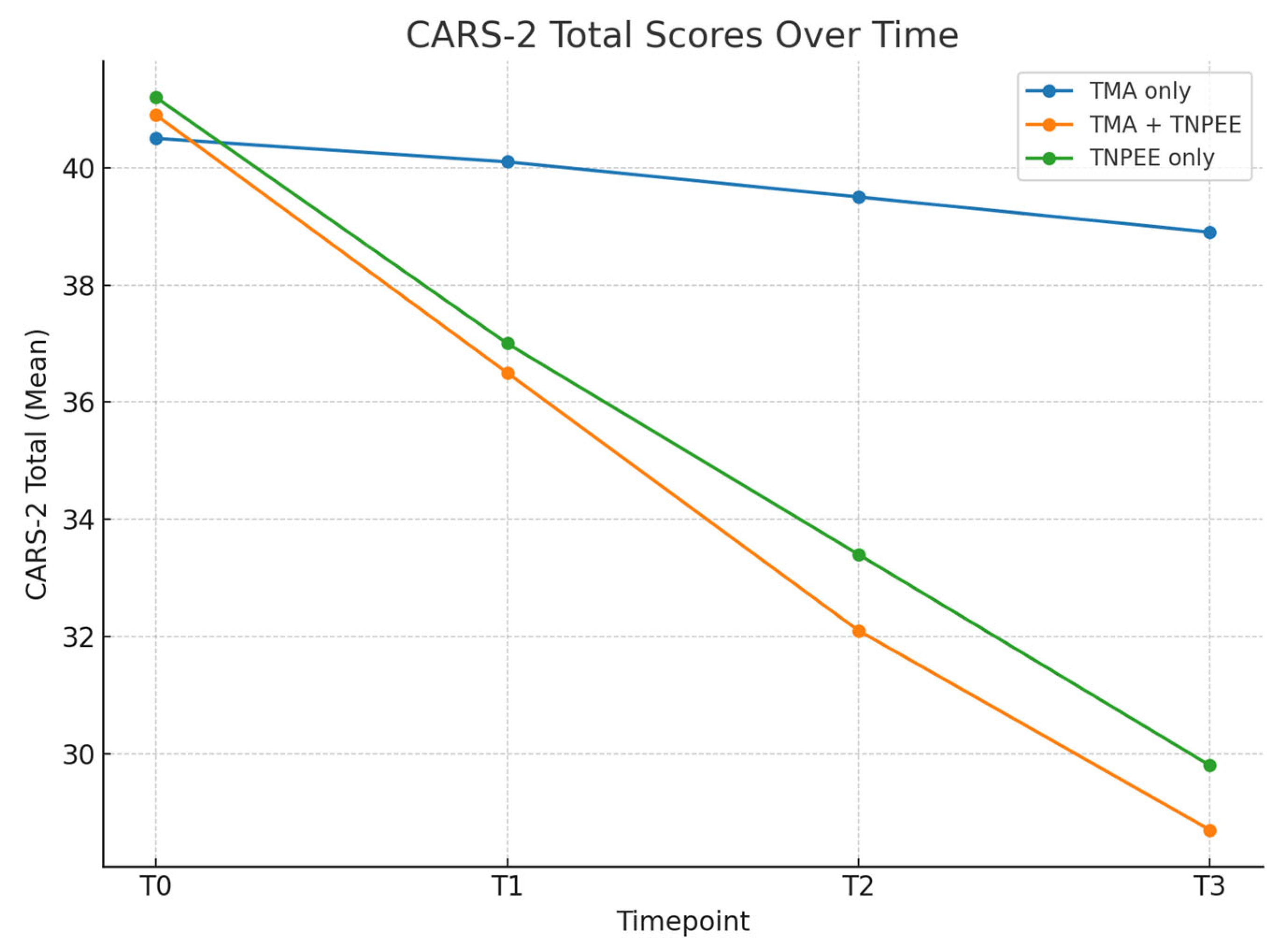
Core Autism Symptoms. At baseline, mean ADOS-2 total scores were comparable across groups (Gr3: 17.3 ± 3.1; Gr2: 17.1 ± 3.4; Gr1: 16.9 ± 3.5). ADOS-2 total scores showed a significant group × time interaction (p < 0.001; see Table 1 for full statistics). A progressive reduction over time was observed in Gr1 and Gr2, whereas minimal change was noted in Gr3. CARS-2 scores showed a significant reduction over time in the TNPEE groups, while only minimal variation was observed in the TAMA-only group.
Adaptive Functioning. Adaptive functioning improved significantly in the TNPEE-only and combined TNPEE + TAMA groups across all VABS domains (all p < 0.001; Table 1), while only marginal changes were observed in the TAMA-only group.
Sensory Processing. Changes in sensory processing were captured using the Sensory Processing Measure (SPM). Total scores decreased over time—reflecting improved sensory integration—in Gr1 (72.3 ± 6.5 → 64.1 ± 6.2) and Gr2 (71.9 ± 6.7 → 63.4 ± 6.0). No significant changes were observed in Gr3 (72.0 ± 6.4 → 70.5 ± 6.2), highlighting the specific contribution of neuropsychomotor therapy to sensory regulation.
The longitudinal trajectories of CARS-2 scores across timepoints are illustrated in Figure 1.
Figure 1. CARS-2 total scores trajectories across timepoints (T0–T3) for the three treatment groups. Only groups receiving TNPEE (alone or in combination with TAMA) show a statistically significant reduction over time, while TAMA alone does not produce substantial improvement.
Behavioral Domains. Behavioral and socio-emotional outcomes were assessed using the Autism Spectrum Disorder Behavior Inventory (ASDBI). At T3, children in Gr1 and Gr2 exhibited significant reductions in ritualistic behaviors (RIT), sensory responses (SENS), excitability (ECCIT), and affective responses (ARECS/C) (p < 0.01). In parallel, relational and social skills (RELSOC) and anxiety/mentalizing regulation (AMLR) improved in these groups (p < 0.01). These results suggest that neuropsychomotor therapy, with or without aquatic integration, promotes socio-emotional and behavioral development beyond motor engagement alone.
Aquatic Skills. Both aquatic therapy groups (Gr2 and Gr3) showed significant improvements across all HAARS domains (p < 0.001).
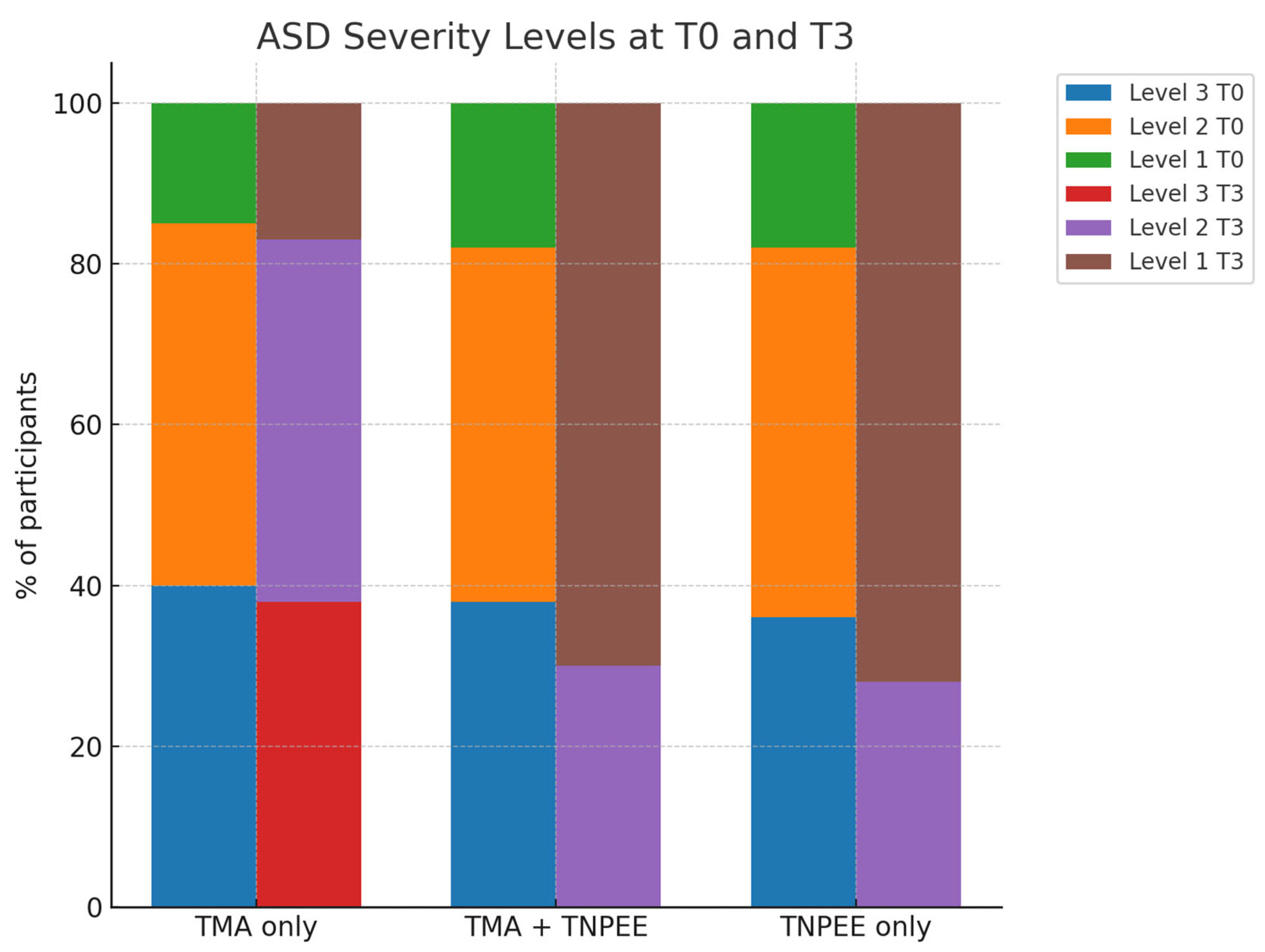
ASD Severity Levels. Baseline severity levels were distributed as follows: Level 3 = 38%, Level 2 = 44%, Level 1 = 18%, with no differences among groups. By T3, children in Gr1 and Gr2 demonstrated meaningful shifts toward lower severity levels: all initial Level 3 participants moved to Level 2, and all Level 2 participants moved to Level 1. In contrast, severity levels in Gr3 remained largely unchanged. McNemar’s test confirmed significant transitions for Gr1 (p < 0.001) and Gr2 (p < 0.001), but not for Gr3 (p = 0.27).
Changes in ASD severity level distribution from T0 to T3 are depicted in Figure 2.
Figure 2. Distribution of ASD severity levels (Levels 1–3) at baseline (T0) and after 18 months (T3) across treatment groups. Shifts towards lower severity levels are evident only in the TNPEE and TMA + TNPEE groups.
All statistical results are fully reported in Table 1.

4. Discussion

The present study examined the longitudinal effects of neuropsychomotor therapy of early development, an integrated program combining neuropsychomotor and aquatic therapy, and aquatic therapy alone on core autism symptoms, adaptive functioning, sensory processing, behavioral domains, and clinical severity in children with Autism Spectrum Disorder. Over 18 months, both the TNPEE-only group and the combined TNPEE + TAMA group showed significant gains in autism severity reduction, adaptive functioning, and behavioral regulation. In contrast, the TAMA-only group did not experience meaningful changes in core ASD symptoms, despite improved aquatic motor skills.
These findings align with previous work demonstrating the benefits of neuro-psychomotor approaches in ASD. For instance, Caliendo et al. (2021) reported significant improvement in autism-related behaviors, including excitability, resistance to change, social relations, and learning/memory, after six months of neuro psychomotor therapy, as measured by the ASDBI scale (p < 0.0001) [26]. Furthermore, both Gr1 and Gr2 demonstrated significant reductions in ADOS-2 and CARS-2 scores over time, indicating meaningful improvements in core autism symptomatology such as communication, social interaction, and behavioral rigidity. In contrast, children receiving only aquatic therapy showed minimal or no reductions across these measures. This pattern suggests that neuropsychomotor therapy may play a relevant role within a multidimensional rehabilitation framework in targeting foundational deficits associated with Autism Spectrum Disorder. As reported in the literature, it may support not only postural and motor abilities in participants with Autism Spectrum Disorder but also social-affective development [27,28,29].
The comparable magnitude of improvement in Gr1 and Gr2 further indicates that while aquatic therapy may provide complementary benefits such as on aquatic motor skills and motor coordination [18,30], it does not replace the structured, developmental framework inherent to neuropsychomotor intervention. Significant improvements in adaptive functioning (VABS-II) were observed exclusively in Gr1 and Gr2. These gains support the role of neuro-psychomotor intervention on communication, socialization, daily living skills, and motor skills, reflecting enhanced autonomy and functional competence in everyday contexts. The limited progression in Gr3 may suggest a specific contribution of neuropsychomotor therapy in promoting the acquisition and generalization of adaptive behaviors, likely due to its emphasis on embodied interaction, environmental exploration, and co-regulated engagement. Across sensory, behavioral, motor, and global developmental outcomes, children in Gr1 and Gr2 consistently demonstrated the most substantial gains, whereas Gr3 showed limited or domain-specific improvements. Sensory processing improved only in Gr1 and Gr2, reflecting the effectiveness of neuropsychomotor therapy in providing structured multisensory experiences that enhance regulation and perceptual organization. Similarly, significant reductions in ritualistic behaviors, sensory reactivity, excitability, and affective dysregulation, alongside gains in relational and regulatory abilities, emerged exclusively in Gr1 and Gr2, highlighting the role of neuropsychomotor principles in promoting self-regulation [31,32,33]. While both aquatic-exposed groups (Gr2 and Gr3) improved in aquatic skills, only Gr2 generalized these benefits to broader developmental domains, indicating that aquatic therapy is most effective when embedded within a neuropsychomotor framework. Together, these findings underscore that neuropsychomotor-based interventions, alone or integrated with aquatic therapy, produce the most robust and generalized developmental progress in children with Autism Spectrum Disorder.
In terms of aquatic interventions, systematic reviews suggest moderate evidence that aquatic therapies can improve motor and social skills and reduce autistic behaviors, although results are heterogeneous [34]. Shariat et al. specifically found that aquatic therapy significantly improves domains such as mental adjustment, rotations, balance, and independent movement when compared to land-based exercises [18]. These findings support our observation: TAMA enhances aquatic competence but does not by itself translate to clinical improvement unless paired with a neuro-psychomotor framework.
Taken together, the data suggest that aquatic activities may serve as facilitators for engagement and motor readiness, yet only TNPEE, grounded in relational and developmental principles, may contribute to broader developmental improvements across domains in ASD. The consistent shifts in severity levels over 18 months in groups receiving TNPEE highlight its modulatory capacity, a pattern not observed in the TAMA-only group.
These findings suggest that neuropsychomotor therapy may represent a promising component within a multidimensional rehabilitation framework.
These findings should be interpreted within the exploratory nature of the study and the absence of randomized allocation; therefore, conclusions regarding causal superiority of interventions remain preliminary.
Limitations and Future Directions. This study presents several limitations that should be acknowledged. First, the observational and non-randomised design restricts the ability to draw causal conclusions regarding the effects of the interventions, and the relatively small sample size within each treatment group further limits statistical power. Nonetheless, the consistency of outcomes across multiple independent centers (Palermo, Perugia, Sarno, Messina) strengthens the external validity of the findings. Additional limitations include the absence of a follow-up assessment, which prevents evaluation of the long-term maintenance of therapeutic gains, and the lack of systematic monitoring of dropout rates, which limits insight into treatment adherence and feasibility.
A further important limitation is the absence of a placebo, wait-list, or usual-care control group. Given the developmental age of the participants and the 18-month observation period, part of the observed improvements may reflect natural maturation rather than treatment-specific effects. Therefore, the findings should not be interpreted as demonstrating causal superiority of one intervention over another.
Effect sizes for some outcomes were large and should be interpreted cautiously given the sample size and observational design.
Future research should incorporate randomized controlled designs with larger samples to confirm these preliminary results and clarify causal relationships. Longitudinal follow-up assessments are essential to determine whether improvements in core symptoms, adaptive functioning, and sensory–behavioral domains persist over time. Moreover, studies should examine moderators such as age, baseline severity, cognitive profile, and co-occurring conditions to identify which children benefit most from each intervention.

5. Conclusions

In this 18-month multicenter longitudinal study, children receiving TNPEE, alone or in combination with TAMA, showed broader improvements in ASD severity, adaptive functioning, and sensory processing compared to children receiving TAMA alone.
Aquatic therapy may enhance engagement and aquatic competence, but in the present cohort it was not associated with comparable improvements in core ASD outcomes when delivered as a stand-alone intervention.
Given the non-randomized design and the absence of a control condition, these findings should be interpreted with caution and require confirmation in future controlled studies.
These results may also be interpreted within a broader neurodevelopmental framework, in which individual variability and biological heterogeneity influence treatment response and functional outcomes across developmental conditions [35].

Author Contributions

Conceptualization, M.G. and M.C.; methodology, M.G., G.B. and M.E.; formal analysis, M.G.; investigation, M.G., G.B., R.P., E.V., F.C., E.G., A.M., L.P., M.R., G.S., G.D.R., R.B., L.S., B.G. and A.M.T.; data curation, M.G. and G.B.; writing—original draft preparation, M.G.; writing—review and editing, M.C., G.B. and M.E.; supervision, M.C.; project administration, M.C. All authors have read and agreed to the published version of the manuscript.

Funding

This research received no external funding. The APC was funded by the authors’ institutional resources.

Institutional Review Board Statement

The study was conducted in accordance with the Declaration of Helsinki and approved by the Institutional Review Board of the University of Campania “Luigi Vanvitelli” (protocol code 217, approved on 4 August 2020).

Data Availability Statement

The data presented in this study are available on reasonable request from the corresponding author. The data are not publicly available due to privacy and ethical restrictions related to pediatric clinical data.

Acknowledgments

The authors would like to thank the participating families and the clinical teams from the centers involved in Naples, Palermo, Perugia, and Sarno for their collaboration and support in data collection.

Conflicts of Interest

R.P. and E.V. are affiliated with Centro di Riabilitazione LARS as healthcare professionals involved in clinical practice and patient care. The study did not receive commercial funding, and no author has financial interests related to the outcomes of the present research.

Disability Language/Terminology Positionality Statement

In this manuscript, person-first language (e.g., “children with Autism Spectrum Disorder”) has been used to maintain consistency with clinical and scientific conventions commonly adopted in medical and rehabilitation literature. This choice reflects a clinical and developmental perspective aimed at emphasizing the individuality of the child while acknowledging the diagnostic framework relevant to the study context.

References

  1. American Psychiatric Association. Diagnostic and Statistical Manual of Mental Disorders (DSM-5-TR); American Psychiatric Association: Washington, DC, USA, 2022. [Google Scholar] [CrossRef] [Scilit]
  2. Costanza, C.; Gallai, B.; Sorrentino, M.; Gnazzo, M.; Pisanò, G.; Parisi, L.; Germanò, E.; Maltese, A.; Esposito, M.; Roccella, M.; et al. The Prevalence and Clinical Significance of Toe Walking in Autism Spectrum Disorder: A Cross-Sectional Study in an Italian Pediatric Sample. Medicina 2025, 61, 1346. [Google Scholar] [CrossRef] [Scilit]
  3. Chandler, S.; Leno, V.C.; White, P.; Yorke, I.; Hollocks, M.J.; Baird, G.; Pickles, A.; Simonoff, E.; Charman, T. Pathways to adaptive functioning in autism from early childhood to adolescence. Autism Res. 2022, 15, 1883–1893. [Google Scholar] [CrossRef] [Scilit] [PubMed]
  4. Gilotty, L.; Kenworthy, L.; Sirian, L.; Black, D.O.; Wagner, A.E. Adaptive Skills and Executive Function in Autism Spectrum Disorders. Child Neuropsychol. 2002, 8, 241–248. [Google Scholar] [CrossRef] [Scilit]
  5. Marco, E.J.; Hinkley, L.B.N.; Hill, S.S.; Nagarajan, S.S. Sensory processing in autism: A review of neurophysiologic findings. Pediatr. Res. 2011, 69, 48–54. [Google Scholar] [CrossRef] [Scilit] [PubMed]
  6. Posar, A.; Visconti, P. Sensory abnormalities in children with autism spectrum disorder. J. Pediatr. 2018, 94, 342–350. [Google Scholar] [CrossRef] [Scilit]
  7. Lindor, E.; Sivaratnam, C.; May, T.; Stefanac, N.; Howells, K.; Rinehart, N. Problem behavior in autism spectrum disorder: Considering core symptom severity and accompanying sleep disturbance. Front. Psychiatry 2019, 10, 487. [Google Scholar] [CrossRef] [Scilit]
  8. Istituto Superiore di Sanità (ISS). Diagnosi e Trattamento di Bambini e Adolescenti con Disturbo dello Spettro Autistico (Linee Guida No. SNLG-ISS); Sistema Nazionale Linee Guida (SNLG); Istituto Superiore di Sanità: Rome, Italy, 2023.
  9. National Institute for Health and Care Excellence (NICE). Autism Spectrum Disorder in Under 19s: Support and Management (Guideline No. CG170); NICE: Manchester, UK, 2012.
  10. Caliendo, M.; Lanzara, V.; Vetri, L.; Roccella, M.; Marotta, R.; Carotenuto, M.; Russo, D.; Cerroni, F.; Precenzano, F. Emotional–Behavioral Disorders in Healthy Siblings of Children with Neurodevelopmental Disorders. Medicina 2020, 56, 491. [Google Scholar] [CrossRef] [Scilit]
  11. Esposito, M.; Gimigliano, F.; Ruberto, M.; Marotta, R.; Gallai, B.; Parisi, L.; Lavano, S.M.; Mazzotta, G.; Roccella, M.; Carotenuto, M. Psychomotor approach in children affected by nonretentive fecal soiling (FNRFS): A new rehabilitative purpose. Neuropsychiatr. Dis. Treat. 2013, 9, 1433–1441. [Google Scholar] [CrossRef] [Scilit] [PubMed]
  12. Romero Naranjo, F.J.; Andreu, E. Neuromotricity as a New Paradigm. 2023. Available online: https://rua.ua.es/dspace/handle/10045/120025 (accessed on 16 February 2026).
  13. de Barros, I.M.; Coutinho, D.J.G. The contribution of psychomotricity in the development of autistic children: A literature review. Rev. Ibero-Am. Humanid. Ciênc. Educ. 2023, 9, 230–242. [Google Scholar]
  14. Frazão, A.; Santos, S.; Lebre, P. Psychomotor Intervention Practices for Children with Autism Spectrum Disorder: A Scoping Review. Rev. J. Autism Dev. Disord. 2021, 10, 319–336. [Google Scholar] [CrossRef] [Scilit]
  15. Alaniz, M.L.; Rosenberg, S.S.; Beard, N.R.; Rosario, E.R. The Effectiveness of Aquatic Group Therapy for Improving Water Safety and Social Interactions in Children with Autism Spectrum Disorder: A Pilot Program. J. Autism Dev. Disord. 2017, 47, 4006–4017. [Google Scholar] [CrossRef] [Scilit]
  16. Caputo, G.; Ippolito, G.; Mazzotta, M.; Sentenza, L.; Muzio, M.R.; Salzano, S.; Conson, M. Effectiveness of a Multisystem Aquatic Therapy for Children with Autism Spectrum Disorders. J. Autism Dev. Disord. 2018, 48, 1945–1956. [Google Scholar] [CrossRef] [Scilit] [PubMed]
  17. Kemp, E.; Nikahd, M.; Howard, M.; Darragh, A.; Crasta, J.E. Improving water competency among children on the autism spectrum: The AquOTic randomized controlled trial. Front. Pediatr. 2024, 12, 1473328. [Google Scholar] [CrossRef] [Scilit]
  18. Shariat, A.; Najafabadi, M.G.; Dos Santos, I.K.; Anastasio, A.T.; Milajerdi, H.R.; Hassanzadeh, G.; Nouri, E. The Effectiveness of Aquatic Therapy on Motor and Social Skill as Well as Executive Function in Children with Neurodevelopmental Disorder: A Systematic Review and Meta-analysis. Arch. Phys. Med. Rehabil. 2023, 105, 1000–1007. [Google Scholar] [CrossRef] [Scilit]
  19. Zanobini, M.; Solari, S. Effectiveness of the Program “Acqua Mediatrice di Comunicazione” (Water as a Mediator of Communication) on Social Skills, Autistic Behaviors and Aquatic Skills in ASD Children. J. Autism Dev. Disord. 2019, 49, 4134–4146. [Google Scholar] [CrossRef] [Scilit]
  20. Lord, C.; Rutter, M.; DiLavore, P.C.; Risi, S.; Gotham, K.; Bishop, S.L. Autism Diagnostic Observation Schedule, (ADOS-2), 2nd ed.; Western Psychological Services: Torrance, CA, USA, 2012. [Google Scholar]
  21. Sparrow, S.S.; Cicchetti, D.V.; Balla, D.A. Vineland Adaptive Behavior Scales, (Vineland-II), 2nd ed.; Pearson Assessments: London, UK, 2005. [Google Scholar]
  22. Schopler, E.; Van Bourgondien, M.E.; Wellman, G.J.; Love, S.R. Childhood Autism Rating Scale, (CARS-2), 2nd ed.; Western Psychological Services: Torrance, CA, USA, 2010. [Google Scholar]
  23. Parham, L.D.; Ecker, C.; Miller-Kuhaneck, H.; Henry, D.; Glennon, T.J. Sensory Processing Measure (SPM); Pearson Assessments: London, UK, 2007. [Google Scholar]
  24. Aman, M.G.; Lam, K.S.L. Autism Spectrum Disorder Behavior Inventory (ASDBI); Multi-Health Systems: Toronto, ON, Canada, 2007. [Google Scholar]
  25. Humphries, K.M. ‘Humphries’ Assessment of Aquatic Readiness’. Master’s Thesis, Texas Women’s University, Denton, TX, USA, 2008. [Google Scholar]
  26. Caliendo, M.; Di Sessa, A.; D’alterio, E.; Frolli, A.; Verde, D.; Iacono, D.; Romano, P.; Vetri, L.; Carotenuto, M. Efficacy of Neuro-Psychomotor Approach in Children Affected by Autism Spectrum Disorders: A Multicenter Study in Italian Pediatric Population. Brain Sci. 2021, 11, 1210. [Google Scholar] [CrossRef] [Scilit]
  27. ElGarhy, S.; Liu, T. Effects of psychomotor intervention program on students with autism spectrum disorder. Sch. Psychol. Q. 2016, 31, 491–506. [Google Scholar] [CrossRef] [Scilit]
  28. Giangiacomo, E.; Visaggi, M.C.; Aceti, F.; Giacchetti, N.; Martucci, M.; Giovannone, F.; Valente, D.; Galeoto, G.; Tofani, M.; Sogos, C. Early neuro-psychomotor therapy intervention for theory of mind and emotion recognition in neurodevelopmental disorders: A pilot study. Children 2022, 9, 1142. [Google Scholar] [CrossRef] [Scilit] [PubMed]
  29. López Gómez, A.; Gallicchio, P. Therapeutic psychomotricity in children: Professional profile and reasons for referral to treatment in Uruguay. Cienc. Psicol. 2025, 19, e-4003. [Google Scholar]
  30. Faraji, S.; Najafabadi, M.G.; Zandi, H.G.; Shaw, I. Effect of aquatic therapy on motor skill and executive function in children with autism spectrum disorder. S. Afr. J. Res. Sport Phys. Educ. Recreat. 2023, 45, 17–27. [Google Scholar] [CrossRef] [Scilit]
  31. Ben Hassen, I.; Abid, R.; Ben Waer, F.; Masmoudi, L.; Sahli, S.; Driss, T.; Hammouda, O. Intervention based on psychomotor rehabilitation in children with autism spectrum disorder ASD: Effect on postural control and sensory integration. Children 2023, 10, 1480. [Google Scholar] [CrossRef] [Scilit]
  32. Frazão, A.; Santos, S.; Rodrigues, A.; Brandão, T.; Simões, C.; Lebre, P. Consensus on the best practice guidelines for psychomotor intervention in preschool children with autism spectrum disorder. Children 2022, 9, 1778. [Google Scholar] [CrossRef] [Scilit] [PubMed]
  33. Moschos, G.; Pollatou, E.; Kambas, A.; Bekiari, A. The effect of psychomotor intervention program on emotional competence and behaviour problems in children four to five years of age. Body Mov. Dance Psychother. 2023, 18, 187–200. [Google Scholar] [CrossRef] [Scilit]
  34. Van T Hooft, P.; Moeijes, J.; Hartaman, C.; Van Busschbach, J.; Hartaman, E. Aquatic Interventions to Improve Motor and Social Functioning in Children with ASD: A Systematic Review. Rev. J. Autism Dev. Disord. 2024, 1–21. [Google Scholar] [CrossRef] [Scilit]
  35. Asta, L.; Ricciardello, A.; Cucinotta, F.; Turriziani, L.; Boncoddo, M.; Bellomo, F.; Angelini, J.; Gnazzo, M.; Scandolo, G.; Pisanò, G.; et al. Clinical, developmental and serotonemia phenotyping of a sample of 70 Italian patients with Phelan-McDermid Syndrome. J. Neurodev. Disord. 2024, 16, 57. [Google Scholar] [CrossRef] [Scilit] [PubMed] [PubMed Central]
Disclaimer/Publisher’s Note: The statements, opinions and data contained in all publications are solely those of the individual author(s) and contributor(s) and not of MDPI and/or the editor(s). MDPI and/or the editor(s) disclaim responsibility for any injury to people or property resulting from any ideas, methods, instructions or products referred to in the content.

Article Metrics

Citations

Article Access Statistics

Multiple requests from the same IP address are counted as one view.