As the fifth year of
Thermo (ISSN 2673-7264; [
1]) is coming to a close, this Editorial assesses how the journal has developed since its creation.
Thermo was launched in June 2021, with the first issue gathering eight contributions. Over the five years that followed, 478 manuscripts were submitted, 227 items were published, and more than 844,000 full-text views were recorded. Coverage has been obtained in Scopus and in the Emerging Sources Citation Index of the Web of Science, and the 2025 Impact Factor of the journal reached 3.9, together with a CiteScore of 4.4 [
2,
3,
4]. An anniversary is above all an opportunity for an honest examination of what has been achieved, of what remains fragile, and of what should be undertaken during the coming years.
This development has depended on many people, whose contribution is gratefully acknowledged: the authors, who entrusted their work to a journal that had no metrics to offer them; the reviewers, of whom those active between 2023 and 2025 alone delivered 341 reports; the Guest Editors; the founding Editorial Board of 2021, the Editorial Board Members and, since this year, the Early Career Editorial Board Members; and the successive Managing Editors and staff of the Editorial Office of MDPI, whose support has been constant throughout these five years.
1. Five Years in Numbers
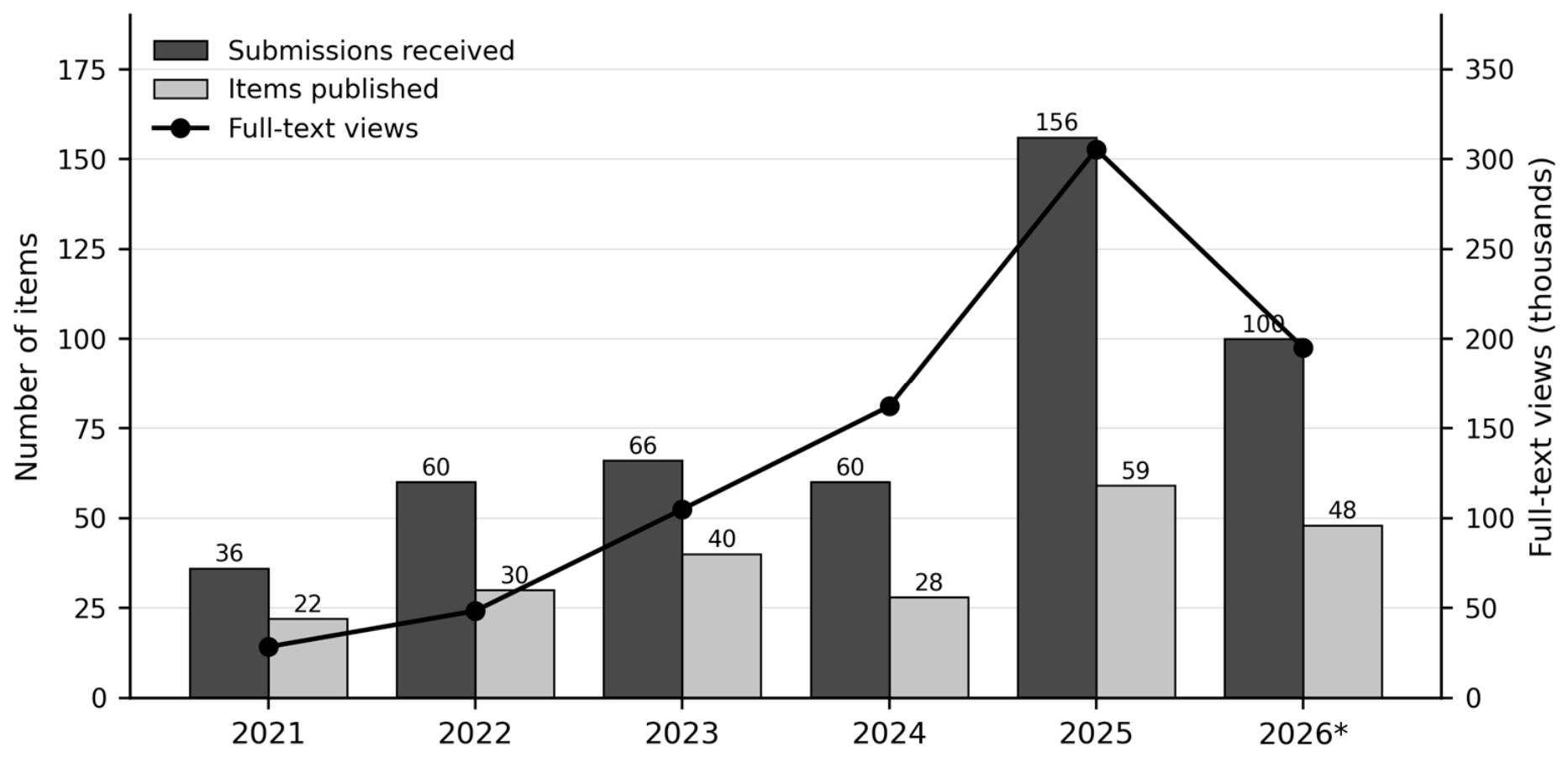
The trajectory of the journal since its creation is summarized in
Table 1 and in
Figure 1. The single year during which the journal contracted is as informative as those during which it grew.
Three observations may be drawn from these data. The first one concerns the irregularity of the growth, which is not a weakness. The number of items published fell from 40 in 2023 to 28 in 2024, while the number of submissions remained close to 60. This contraction did not result from a loss of momentum: it followed from the consolidation of the reviewing policy described in these pages two years ago [
8], whose first effect was a lengthening of the revision cycles and the transfer of several accepted manuscripts to the following volume. Its full effect on the acceptance rate only became visible later, once the much larger 2025 cohort had been processed.
The recovery of 2025 and 2026 is of a different nature. A total of 156 submissions were received in 2025, compared to 60 in 2024, and 100 further submissions had already been received by the end of June 2026 [
5]. The increase in submissions associated with the Scopus indexing therefore became visible only in the second year. This growth in volume was accompanied by a marked growth in selectivity: the rejection rate reached 55% in 2025 and 48% during the first half of 2026 [
5], against the provisional value close to 36% reported for 2024 [
9]. A growing share of these decisions is taken at the editorial screening stage, as described in
Section 3. The readership followed the same trend, the number of full-text views rising from 28,461 in 2021 to 48,416 in 2022, 104,903 in 2023, 162,153 in 2024 and 305,460 in 2025, with 195,218 recorded during the first half of 2026 alone [
5,
8,
9].
The third observation carries the most weight: the citation profile did not deteriorate when the volume increased, which is the outcome that a rapid growth in submissions most often produces. According to the Scopus-derived data compiled by SCImago [
4,
10], the average number of citations per document over a two-year window increased from 1.58 in 2023, to 2.55 in 2024, and up to 4.17 in 2025, while the number of cited documents grew from 34 to 73 over the same period. An h-index of 15 has now been reached [
10], and 32 papers had been cited ten times or more at the end of June 2026 [
2].
2. Indexing and the First Metrics
The first years of a new journal are circular by construction: recognition follows demonstrated quality, and quality is demonstrated through the manuscripts that recognition attracts. Three years were required before this circle could be broken.
The first decisive step was reached in November 2023, when
Thermo was accepted for coverage in Scopus [
11]. The second one followed in May 2024, with the inclusion of the journal in the Emerging Sources Citation Index of the Web of Science [
12]. Metrics were then obtained rather quickly. The first CiteScore, for the 2023 reference year, was 2.1. One year later, the CiteScore for 2024 had risen to 3.9, ranking the journal 87/264 (Q2) in Engineering (miscellaneous), 49/100 (Q2) in Energy (miscellaneous) and 49/91 (Q3) in Chemical Engineering (miscellaneous) [
13]. In June 2025, a first Impact Factor of 2.3 was received for the 2024 reference year, corresponding to the rank 33/79 in the Thermodynamics category. One year later, the 2025 Impact Factor reached 3.9, with a five-year value of 3.2 and a stable second quartile position, while the CiteScore rose to 4.4 and the journal reached the second CiteScore quartile in all three of its Scopus subject categories [
2,
3,
4]. The quartiles derived from the SJR indicator, which weights citations by the standing of the citing source and is therefore computed on a different basis, remain one quartile lower in Energy (miscellaneous) for 2025 [
10].
Some caution is required in reading these numbers. For a journal publishing a few tens of items per year, an increase of this magnitude within a single year reflects the arrival of a small number of highly cited reviews at least as much as a general shift in the citation profile, and it should not be expected to repeat itself annually. One further indicator is worth reporting, because it does not flatter the journal: journal self-citations represented 12 of the 329 citations received in 2025, or 3.6%, against 1.7% during the preceding year [
10]. The citation profile of
Thermo is therefore built almost entirely outside the journal itself. Closest attention is nevertheless owed to the fraction of the papers that are cited at all, because it indicates whether the journal is being read over its whole scope and not only in a few visible areas. This fraction has clearly improved, yet, over the three-year windows used by SCImago, slightly more than one document out of five has still not been cited [
10]. Reducing this fraction is the most meaningful objective for the coming years, and it will be reported in each annual editorial.
3. The Editorial Process
The editorial process announced at the beginning of 2024 [
8] has since been consolidated. Manuscripts that fall outside the scope of the journal, or that do not meet its minimum methodological and presentational requirements, are declined at the editorial screening stage, before any review is requested. Every manuscript sent for external review is then assessed by at least two to three expert referees, pre-selected by the editorial team according to their competence in the specific subfield concerned [
8,
9], and further reports are requested as a matter of course whenever the reports received diverge or whenever a specific point of method has to be settled by a third specialist. A substantial part of the rejections recorded each year is decided at the screening stage, on submissions that never reach a referee. This is why the number of review reports received in a given year corresponds to a fraction of the submissions of that year rather than to their totality, and why that number cannot be converted into a rejection rate.
For the papers published during the first half of 2026, a median time of 24.5 days from submission to first decision and a median time of 3.9 days from acceptance to publication were recorded [
1,
5]. The first value is of the same order as the average of 22 days reported for 2023 [
8], although the two quantities are not strictly comparable, the earlier figure being a mean and the present one a median, and although the annual number of submissions has more than doubled in the meantime. The second value is well below the seven-day target announced for the same year [
8].
The evolution of the reviewer community deserves to be reported in detail, including the year during which it contracted. In 2023, 104 review reports were delivered by 102 reviewers. In 2024, this activity decreased to 70 reports delivered by 66 reviewers, in line with the reduction in the number of items processed during that year. In 2025, 167 reports were received from 161 reviewers [
5], an increase of 139% with respect to 2024 and of 61% with respect to 2023. The number of countries represented rose in parallel, from 33 in 2023 and 25 in 2024 to 41 in 2025.
4. The Editorial Community
Thermo is currently guided by an Editorial Board of 46 members, together with one Advisory Board Member, based in 19 countries, the largest contributions being provided by Italy, China, the United States, Spain and France [
14].
The structural change that will matter most in the long term is the creation of the Early Career Editorial Board. Announced through a call for applications in January 2025 and constituted in January 2026, it gathers 22 researchers based in eight countries, each of them having obtained a PhD within the last ten years, appointed for a renewable term [
15]. All Editorial Board Members are encouraged to involve these colleagues in the handling of manuscripts and in the preparation of future collections.
Two aspects of the community profile of
Thermo remain unsatisfactory, and they are reported here with the whole series rather than with the most favorable comparison. The fraction of the publications resulting from international collaborations, which stood at 31.8% in 2021 and 28.6% in 2022, fell to 12.8% in 2023 and 14.8% in 2024 before recovering to 25.4% in 2025. It has therefore not yet returned to its initial level, and it remains low for a journal whose subject matter is transnational by nature. The fraction of female authors has followed an equally irregular path, from 13.8% in 2021 and 23.7% in 2022 to 33.9% in 2023, 12.7% in 2024 and 27.4% in 2025, and it remains below the level that the thermal sciences community should reach [
10]. Neither series will stabilize unless the invitations, the Guest Editor appointments and the review requests change with them.
5. Publication Profile and Evolution of the Field
Since 2021, 51 Feature Papers have been published, defined as substantial contributions invited or recommended by the scientific editors, together with 15 Special Issues, five of which were still open at the end of August 2026, one Topical Collection devoted to thermodynamics education, and four cross-journal Topics [
5,
6]. Taken as a whole, this corpus provides a rather faithful map of how thermal science has moved during these five years.
The first years were dominated by high-temperature and nuclear thermodynamics, with the assessment of molten salt and fuel systems, corium thermochemistry, accident-tolerant claddings, and the modeling frameworks supporting them. This thematic core, inherited from the very first Special Issue of the journal, remains a distinctive strength and continues to attract submissions of a consistently high methodological standard.
From 2022 onwards, a second center of gravity appeared around energy systems and the built environment, with thermal energy storage in its compressed-air, pumped-thermal and latent forms, insulation materials in different climate zones, heat pumps, anaerobic digestion, and industrial decarbonization including CO2 reduction applied to glass furnaces. The most cited, most viewed and most downloaded paper of the journal, the review of compressed air energy storage technologies published by Rabi’, Radulovic and Buick in volume 3 (2023), belongs to this family, as does the review by Villano, Mauro and Pedace on machine and deep learning techniques applied to building energy simulation, optimization and management, published in volume 4 (2024).
Since 2024, the map has changed again. Data-driven methods, from neural networks to surrogate models and optimization under uncertainty, are now employed as an ordinary working practice, in ejector design, in pyrolysis kinetics and in building energy management. Thermal management has moved toward electrification, with battery packs, power electronics, fuel cells for unmanned aerial vehicles, and textile and knitted heaters. The fundamentals, together with their teaching, have returned in force, with the revisitation of the Clausius/Clapeyron equation and of the cause of its linearity proposed by Thompson and Paluch in volume 3 (2023), contributions on the second law and on nonlocality in continuum physics, critical papers on the misinterpretation of thermodynamic parameters extracted from thermal analysis experiments, and the coupling of project-based learning with a heat exchanger test bench described by Hernández, Zeoli and Gendebien in volume 6 (2026).
Full bibliographic records for the works mentioned in this section are accessible from the volume pages of the journal [
1] and, for those included in the first Editor’s Choice selection, from the corresponding list [
16].
6. A New Structure in Four Sections
The most concrete consequence of the growth described above is a decision taken in June 2026. Thermo is being organized into four scientific sections, namely Advanced Thermodynamics, Thermal Data Sciences and Molecular Modeling; Thermal Transport, Thermo-Fluids and Multiphysics Systems; Thermal Energy Systems and Decarbonization Processes; and Thermal Materials, Circular Processes and Sustainable Thermal Technologies.
This structure was preferred to a finer subdivision for three reasons: it minimizes the overlap between sections; it keeps thermodynamics and thermal science as the common denominator of all four of them, so that the journal does not drift toward generic energy, materials or simulation content; and it distributes the editorial responsibility at a scale that the present volume can genuinely sustain. Further sections may be created at a later stage, once the publication volume, the visibility and the size of the Editorial Board justify them. A dedicated webpage will be opened for each of the four sections, and every submission received after these pages have been opened will be assigned to one of them. The Special Issues and Topical Collections currently open will be attached to the section closest to their subject and will continue under the responsibility of their present Guest Editors.
Each section will be led by a Section Editor-in-Chief, supported at the level of the journal by an Associate Editor. The corresponding nominations are currently being finalized and will be announced separately, so that the colleagues concerned may be presented to the community once their appointment has been formally confirmed. In parallel, an enlargement of the Editorial Board is ongoing. Priority is given to the subfields in which submissions are now received without the corresponding editorial expertise being available on the Board, and to the geographical areas that are currently absent from it, several major thermodynamics and thermo-fluid communities in Europe being among them.
7. Strategic Priorities for the Coming Years
Five priorities are placed before the community for the coming years:
- (1)
Research integrity and methodological transparency. Screening procedures against paper mills and against image or data manipulation will continue to be applied to every submission. The disclosure of any use of generative artificial intelligence remains mandatory for authors, and reviewers are reminded that manuscripts under evaluation must not be uploaded to generative artificial intelligence tools, any other use having to be disclosed to the editorial team. A Data Availability Statement is required from every submission, and the deposition of datasets and of analysis code in a public repository is strongly encouraged. Contributions reporting reproducibility studies, benchmark datasets, validation protocols and uncertainty quantification are explicitly welcome.
- (2)
Reduction of the uncited fraction of the papers published, through better-targeted Special Issues and through a more active promotion of the work published in the less densely cited areas of the scope.
- (3)
Internationalization and diversification of the communities of authors, reviewers and editors, measured and reported openly, as in
Section 4 above.
- (4)
Implementation of the new section structure in practice, so that faster and better-informed decisions are provided to the authors, without adding an administrative layer.
- (5)
Coverage in the Science Citation Index Expanded, which would be the natural consequence of the four priorities above rather than an objective pursued for itself, since it depends far less on publication volume than on the consistency of the citation profile.
8. A Call to the Community
None of these objectives can be reached from an Editorial Office alone, and three concrete forms of involvement are proposed here.
Editor’s Choice Articles. A first selection of 38 articles, close to 17% of the 227 items published between the creation of the journal and June 2026, has been prepared and is being released through a series of three announcements [
16]. From now on, this selection will be established annually and collectively by a dedicated committee. A list of candidate papers will be prepared each year under the responsibility of the Section Editors-in-Chief, once they have taken office, covering the whole scope of each section, and the Editorial Office will provide the committee with the corresponding bibliometric and readership records for information only. Selection will be based on the scientific content of the papers, and the committee will be explicitly invited to consider contributions that have attracted little attention so far, so that the selection does not simply reproduce the existing citation distribution. The committee will be constituted each year from volunteers among the Editorial Board Members and the Early Career Editorial Board Members, with a target size of eight to ten members and a balance across the four sections. Colleagues who wish to take part are invited to contact the Editorial Office, and this call will also be relayed during the forthcoming Editorial Board meeting.
Scientific program. Proposals for Special Issues and Topical Collections are welcome at any time. They are particularly encouraged in the areas that have been comparatively neglected so far, including thermal metrology and data quality, reproducibility and validation practices, uncertainty quantification, and teaching-oriented contributions in the thermal sciences.
Reviewing. Rapidity and rigor are sometimes presented as being in opposition. The experience gathered at Thermo over these five years suggests that the two are compatible, provided that the reviewer base is large enough and that the editorial process is properly organized. This is precisely why every invitation to review that is accepted by a colleague has a direct effect on what is finally published. Reviewers of Thermo receive a certificate for each completed report, may record their activity in the Web of Science reviewer recognition service, and are acknowledged collectively in an annual announcement of the journal.
One commitment made in the previous editorial can also be reported here. A target of 48 items was announced for 2025 [
9]; 59 were published. The distribution over the year was uneven, 23 of these items appearing in the fourth quarter, as the manuscripts of the enlarged 2025 cohort reached the end of their review cycle at the same time. Smoothing this distribution is one of the objectives of the new section structure. The other commitment made on that occasion, namely the launch of one to two new Special Issues per quarter, has been followed less regularly, and the balance of the collections across the whole scope of the journal remains to be improved.
After five years, the foundations of the journal are solid.
Thermo was created as an open access forum for the whole thermal science community, from fundamental thermodynamics to sustainable applications, and its value will always be measured by what this community decides to publish in it. Following the previous editorials [
8,
9], the authors, reviewers, Guest Editors, Editorial Board Members and readers of
Thermo are thanked once again for their trust and for their commitment to the thermal sciences. All members of this community are warmly invited to take part in the next stage of the journey of the journal.