
Kinetics of Complex Double Salts [Co(A)3][Fe(C2O4)3]∙xH2O (A=2NH3, En (Ethylenediamine))


Abstract
1. Introduction
2. Materials and Methods
2.1. Synthesis
2.2. Equipment
2.3. Simultaneous Thermal Analysis (STA)
2.3.1. STA Measurements for Kinetics Research
2.3.2. Kinetic Analysis
2.3.3. Synchronous Thermal Analysis + IR
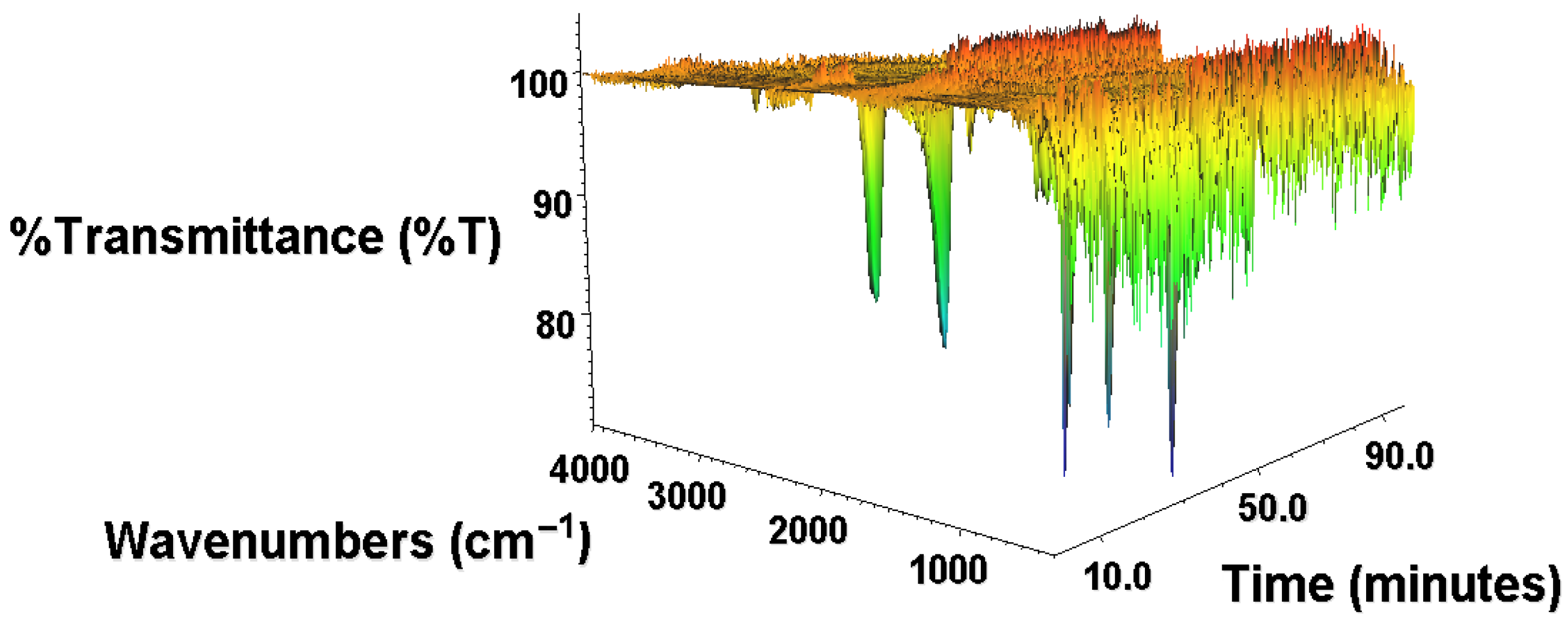
- By operating a synchronous thermal analysis device with IR analysis of the gas phase, thermogravimetric data and an array of IR spectrometric data in .srs format were obtained (see Figure 1). The data array is obtained in the form of a three-dimensional diagram. Coordinates of diagram: time, transmittance, and wavenumber (λ).
- Thermal analysis data helped determine the temperature in the thermogravimetric curve that corresponds to maximum mass loss. A general IR spectrum is observed at this time in the wavelength range of 400–4000 cm−1.
- We apply the “automatic search by integrated libraries” feature of the Omnic program to this IR spectrum. We configure the autosearch for 50 hypothetical gas products. In our experience, more than this number is often not necessary.
- We manually select gas products based on the following criteria: (1) matching chemical nature (chemical elements that were not part of the original uncalcined compound cannot be released); and (2) experience from literary sources.
- Thus, ~10 of the most likely actually released ones are selected from 50 hypothetical gas products.
- We search libraries for the spectra of these 10 compounds in the gaseous state. It is critical that the compounds be in the gaseous, not condensed, state.
- We select the wavelength values λ with the highest intensity in each of the 10 library spectra. For example, we considered 4 wavelengths (647, 675, 2360, and 3595 cm−1) in the case of CO2.
- We cut out the spectrum in the “time-transmission” coordinates for each of the selected wavelengths in the .srs data array.
- Plot all the obtained spectra on a single graph. The number of spectra on the graph should correspond to the number of wavelengths chosen as characteristic wavelengths. If necessary, the spectra are enlarged; therefore, that they have the same intensity. Here, a multiplication factor is introduced, which is given in a separate table (for example, in this work it is in Table 1). If the curves match, the gaseous product is considered present in the exhaust gases. If they do not match, the product is considered absent.
- If a gaseous product, according to points 1–9, is present in the gas mixture, then one spectrum with the highest intensity is selected for identification. For example, we considered 2360 cm−1 in the case of CO2. However, it is necessary to analyze all spectra for all products simultaneously. Since if there is an overlap for any characteristic frequencies (for example, a product with a high intensity at closely spaced wavelengths may obscure a product with a lower intensity), these spectra cannot be considered for identification and further processing. For example, if 10 gas products are detected and 4 characteristic wavelengths are selected for each product, then 40 spectra must be considered for overlap simultaneously.
- The most intense spectra for the identified gaseous products (one product is one spectrum) are subjected to mathematical processing and reconstructed into one common summary graph with “temperature–transmission” axes.
2.3.4. Static Thermal Analysis
3. Results and Discussion
3.1. Kinetics
3.2. Analysis of Gaseous Products of Thermal Decomposition
3.3. Analysis of Solid Products of Thermal Decomposition
4. Conclusions
Supplementary Materials
Author Contributions
Funding
Data Availability Statement
Conflicts of Interest
Abbreviations
| DCS | double complex salt |
| STA | synchronous thermal analysis |
| TG | thermogravimetry |
| DSC | differential scanning calorimetry |
| STA+IR | synchronous thermal analysis with IR-spectroscopic analysis of exhaust gases |
| GTDP | gaseous thermal decomposition products |
| XRD | X-ray diffraction |
| SEM | scanning electron microscopy |
| en | ethylenediamine |
| tn | 1,3-diaminopropan |
References
- Rudneva, Y.V.; Korenev, S.V. Dispersed Metal Alloys: Synthesis Methods and Catalytic Properties (Review). Žurnal Neorganičeskoj Himii 2024, 69, 1181–1200. (In Russian) [Google Scholar] [CrossRef]
- Wessells, C.D.; Peddada, S.V.; Huggins, R.A.; Cui, Y. Nickel Hexacyanoferrate Nanoparticle Electrodes For Aqueous Sodium and Potassium Ion Batteries. Nano Lett. 2011, 11, 5421–5425. [Google Scholar] [CrossRef] [PubMed]
- Mezentsev, K.V.; Cherkasova, T.G. Reversible Chrome Thermoindicator. RU Patent No. 2187081 C1, 2002. Available online: https://patents.google.com/patent/RU2187081C1/en (accessed on 10 October 2025).
- Cherkasova, T.G.; Tatarinova, E.S.; Kuznetsova, O.A.; Trjasunov, B.G. Reversible Thermochromic Materials. RU Patent No. 2097714 C1, 1997. Available online: https://patents.google.com/patent/RU2097714C1/en (accessed on 10 October 2025).
- Scherzer, J.; Fort, D. Zeolite-supported metal catalysts for Fischer-Tropsch reactions: I. A new preparation method. J. Catal. 1981, 71, 111–118. [Google Scholar] [CrossRef]
- Khan, R.; Arshad, J.; Khan, S.; Mansoor, M.A.; Ali, S.; Nisar, T.; Wagner, V.; Asghar, M.A.; Haider, A. Surfactant-assisted fabrication of prussian blue analogs as bifunctionalelectrocatalysts for water and hydrazine oxidation. Mol. Catal. 2023, 548, 113415. [Google Scholar] [CrossRef]
- Lin, Y.; Ren, H.; Zhang, S.; Liu, S.; Zhao, T.; Jiang, W.J.; Zhou, W.; Hu, J.S.; Li, Z. Enhancing Interfacial Dynamic Stability Through Accelerated Reconstruction to Inhibit Iron—Loss During Initial Electrochemical Activation. Adv. Energy Mater. 2024, 14, 2302403. [Google Scholar] [CrossRef]
- Liang, C.; Liu, P.; Xu, J.; Wang, H.; Wang, W.; Fang, J.; Wang, Q.; Shen, W.; Zhao, J. A simple method for the synthesis of Fe-Co Prussian Blue analogue with novel morphologies, different structures, and dielectric properties. Synth. React. Inorg. Met-Org. Nano-Met. Chem. 2011, 41, 1108–1113. [Google Scholar] [CrossRef]
- Domonov, D.P.; Pechenyuk, S.I.; Semushina, Y.P.; Yusenko, K.V. Solid-state transformations in inner coordination sphere of [Co(NH3)6][Fe(C2O4)3]∙ 3H2O as a route to access catalytically active Co-Fe materials. Materials 2019, 12, 221. [Google Scholar] [CrossRef]
- Vyazovkin, S.; Burnham, A.K.; Criado, J.M.; Pérez-Maqueda, L.A.; Popescu, C.; Sbirrazzuoli, N. ICTAC Kinetics Committee recommendations for performing kinetic computations on thermal analysis data. Thermochim. Acta 2011, 520, 1–19. [Google Scholar] [CrossRef]
- Mahmood, H.; Moniruzzaman, M.; Yusup, S.; Khan, M.I.; Khan, M.J. Kinetic modeling and optimization of biomass pyrolysis for bio-oil production. Energy Sour. A 2016, 38, 2065–2071. [Google Scholar] [CrossRef]
- Chen, X.; Liu, L.; Zhang, L.; Zhao, Y.; Zhang, Z.; Xie, X.; Qiu, P.; Chen, G.; Pei, J. Thermogravimetric analysis and kinetics of the co-pyrolysis of coal blends with corn stalks. Thermochim. Acta 2018, 659, 59–65. [Google Scholar] [CrossRef]
- Toda, T.A.; Visioli, P.D.C.F.; de Oliveira, A.L.; da Costa Rodrigues, C.E. Conventional and pressurized ethanolic extraction of oil from spent coffee grounds: Kinetics study and evaluation of lipid and defatted solid fractions. J. Supercr. Fluids 2021, 177, 105332. [Google Scholar] [CrossRef]
- Sarkar, R.; Li, Z. Isothermal and non-isothermal crystallization kinetics of mold fluxes used in continuous casting of steel: A review. Metall. Mater. Trans. B 2021, 52, 1357–1378. [Google Scholar] [CrossRef]
- Jelić, D.; Papović, S.; Vraneš, M.; Gadžurić, S.; Berto, S.; Alladio, E.; Gajić, D.; Janković, B. Thermo-analytical and compatibility study with mechanistic explanation of degradation kinetics of ambroxol hydrochloride tablets under non-isothermal conditions. Pharmaceutics 2021, 13, 1910. [Google Scholar] [CrossRef]
- Vorobyeva, S.N.; Rudzis, Z.V.; Sukhikh, T.S.; Filatov, E.Y.; Plusnin, P.E.; Nadolinny, V.A.; Bogomyakov, A.S.; Korenev, S.V. Double complex salts based on tetraamminplatinum (II) and vanadyl (IV) bisoxalate for the preparation of bimetallic Pt–Valloys. N. J. Chem. 2024, 48, 15894–15903. [Google Scholar] [CrossRef]
- Pechenyuk, S.I.; Domonov, D.P.; Shimkin, A.A.; Semushina, Y.P.; Ivanov, Y.V. Thermal behavior of binary complex compoundscontaining the hexacyanoferrate anion. Russ. J. Gen. Chem. 2017, 87, 2212–2223. [Google Scholar] [CrossRef]
- Gosteva, A.N.; Kulikova, M.V.; Ivantsov, M.I.; Grabchak, A.A.; Semushina, Y.P.; Lapuk, S.E.; Gerasimov, A.V.; Tsvetov, N.S. CO2 Hydrogenation over Fe-Co Bimetallic Catalyst Derived from the Thermolysis of [Co(NH3)6][Fe(CN)6]. Catalysts 2023, 13, 1475. [Google Scholar] [CrossRef]
- Gosteva, A.N.; Kulikova, M.V.; Svidersky, S.A.; Grabchak, A.A.; Lapuk, S.E.; Gerasimov, A.V. CO2 hydrogenation reaction on catalysts based on double complex Fe-Co salts. Mendeleev Commun. 2025, in press.
- Filatov, E.Y.; Semushina, Y.P.; Gosteva, A.N. Obtaining and catalytic properties investigation of the products of double-complex salts [Cr(ur)6][M(L)6] thermal oxidation (M= Co, Fe; L= CN−, 1/2C2O42−). J. Therm. Anal. Calorim. 2018, 134, 355–361. [Google Scholar] [CrossRef]
- Garkul, I.A.; Zadesenets, A.V.; Filatov, E.Y.; Baidina, I.A.; Plyusnin, P.E.; Urlukov, A.S.; Potemkin, D.I.; Korenev, S.V. Double oxalates of Rh(III) with Cu(II) and Zn(II)—Effective precursors of nanoalloys for hydrogen production by steam reforming of propane. Int. J. Hydrogen Energy 2024, 82, 611–623. [Google Scholar] [CrossRef]
- Smirnov, P.; Filatov, E.; Kuratieva, N.; Plyusnin, P.; Korenev, S. Crystal Structure and Thermal Properties of Double-Complex Salts [M1(NH3)6][M2(C2O4)3] (M1, M2 = Co, Rh) and K3[Rh(NH3)6][Rh(C2O4)3]2∙6H2O. Int. J. Mol. Sci. 2023, 24, 12279. [Google Scholar] [CrossRef]
- Pechenyuk, S.I.; Semushina, Y.P.; Mikhailova, N.L.; Ivanov, Y.V. Binary complexes [Co(A)6][M(C2O4)3] (A = NH3, 1/2C2H8N2, M = Fe, Cr): Synthesis, properties, and thermal decomposition. Russ. J. Coord. Chem. 2015, 41, 175–181. [Google Scholar] [CrossRef]
- Yusenko, K.V.; Pechenyuk, S.I.; Vikulova, E.S.; Semushina, Y.P.; Baidina, I.A.; Filatov, E.Y. Isostructurality and Thermal Properties in the Series of Double Complex Salts [M1(NH3)6][M2(C2O4)3]·3H2O (M1 = Co, Ir, M2 = Fe, Cr). J. Struct. Chem. 2019, 60, 1062–1071. [Google Scholar] [CrossRef]
- Domonov, D.P.; Pechenyuk, S.I.; Semushina, Y.P.; Kadyrova, G.I. Solid-state transformations by thermal decomposition of [Co(en)3][Fe(C2O4)3] in an inert atmosphere. Thermochim. Acta 2020, 687, 178578. [Google Scholar] [CrossRef]
- Brauer, G. Handbook of Preparative Inorganic Chemistry; Academic Press: New York, NY, USA, 1985; Volume 5, pp. 1744–1762. [Google Scholar]
- Novakovskii, M.S. Laboratory Work on the Chemistry of Complex Compounds; Kommunist: Khar‘kov, Northeastern Ukraine, 1972; p. 66. [Google Scholar]
- Vyazovkin, S.; Burnham, A.K.; Favergeon, L.; Koga, N.; Moukhina, E.; Pérez-Maqueda, L.A.; Sbirrazzuoli, N. ICTAC Kinetics Committee recommendations for analysis of multi-step kinetics. Thermochim. Acta 2020, 689, 178597. [Google Scholar] [CrossRef]
- Charkin, D.O.; Gosteva, A.N.; Kireev, V.A.; Banaru, A.M.; Dmitriev, D.N.; Deyneko, D.V.; Tsvetov, N.S.; Tananaev, I.G.; Aksenov, S.M. Double sulfates with 1-methylpiperazinediium and divalent cations: Synthesis, structures, spectroscopic characterization, thermal stability, and topological features of (C5H14N2)[M(H2O)6](SO4)2∙H2O (M = Mg, Mn, Fe, Co, Ni, Zn, and Cd) and (C5H14N2)(SO4)∙H2O. Polyhedron 2025, 117763. [Google Scholar] [CrossRef]
- Pechenyuk, S.I.; Domonov, D.P.; Semushina, Y.P.; Tsvetov, N.S.; Kadyrova, G.I.; Belyaevskii, A.T. Metal-carbon compositions as thermolysis products of complex compounds [Co(A)6]x[Fe(CN)6]y·nH2O (A = NH3, en/2). Thermochim. Acta 2021, 703, 179009. [Google Scholar] [CrossRef]



| Product | Wavelength, cm−1 | Multiplication Factor | |
|---|---|---|---|
| DCS I | DCS II | ||
| H2O | 1696 | 10 | 10 |
| CO | 2114 | 10 | 10 |
| CO2 | 2360 | 1 | 1 |
| NH3 | 966 | 1 | 5 |
| en | 2927 | - | 10 |
| N2O | 2236 | 10 | - |
| DCS | Isoconversion Approach | Stage 1 | Stage 2 | Stage 3 | Stage 4 | ||||
|---|---|---|---|---|---|---|---|---|---|
| Step 1 | Step 1 | Step 2 | Step 1 | Step 2 | Step 1 | Step 2 | |||
| (I) | Friedman’s Analysis | Activation Energy E, kJ/mol | 65 | 130 | 220 | 150 | |||
| The pre-exponential factor logA (A, 1/s) | 7 | 11.5 | 18 | 9 | |||||
| KAS method | Activation Energy E, kJ/mol | 70 | 130 | 200 | 120 | ||||
| The pre-exponential factor logA (A, 1/s) | 7.5 | 11.6 | 16 | 7 | |||||
| (II) | Friedman’s Analysis | Activation Energy E, kJ/mol | 188 | 300 | 330 | 340 | 160 | – | |
| The pre-exponential factor logA (A, 1/s) | 15 | 18 | 25 | 23 | 9 | – | |||
| KAS method | Activation Energy E, kJ/mol | 199 | 260 | 320 | 340 | 190 | – | ||
| The pre-exponential factor logA (A, 1/s) | 16 | 20 | 24 | 23 | 12 | – | |||
| Stage 1 | Stage 2 | Stage 3 | Stage 4 | ||||
|---|---|---|---|---|---|---|---|
| Kinetic parameters | R2 | Kinetic parameters | R2 | Kinetic parameters | R2 | Kinetic parameters | R2 |
| Cnm | 0.99978 | Cnm | 0.99993 | Cnm | 0.99552 | Cnm | 0.98990 |
| E = 67.2 kJ/mol, Log(A) = 7.2 (A, 1/s), React Order n = 1.4, Log(Autocat PreExp) 0.38, Autocat Power m = 1.7 | E = 130.3 kJ/mol, Log(A) = 11.5 (A, 1/s), React Order n = 2.0, Log(Autocat PreExp) 0.49, Autocat Power m = 1.00 | E = 216.2 kJ/mol, Log(A) = 17.7 (A, 1/s), React Order n = 4.3, Log(Autocat Pre Exp) 1.00, Autocat Power m = 2.99 | E = 122.2 kJ/mol, Log(A) = 6.6 (A, 1/s), React Order n = 2.0, Log(Autocat PreExp) 1.15, Autocat Power m = 1.18 | ||||
| Step | Stage 1 | Stage 2 | Stage 3 | |||
|---|---|---|---|---|---|---|
| Step 1 | Kinetic parameters | R2 | Kinetic parameters | R2 | Kinetic parameters | R2 |
| Cnm | 0.99980 | Sb | 0.99912 | Cnm | 0.99980 | |
| E = 201.3 kJ/mol, Log(A) = 13.3 (A, 1/s), React Order n = 1.5 Log(Autocat PreExp) 3.43, Autocat Power m = 0.42 | E = 217.9 kJ/mol, Log(A) = 17.3 (A, 1/s), React Order n = 0.67 Autocat Order 0.01 Log Order q = 0.01 | E = 315.6 kJ/mol, Log(A) = 22.2 (A, 1/s), React Order n = 5.53 Log(Autocat PreExp) 0.81, Autocat Power m = 3.53 | ||||
| Step 2 | Cnm | Cnm | ||||
| E = 283.2 kJ/mol, Log(A) = 22.3 (A, 1/s), React Order n = 4.30 Log(Autocat PreExp) 1.62 Autocat Power m = 10.0 | E = 120.6 kJ/mol, Log(A) = 5.5 (A, 1/s), React Order n = 1.95, Log(Autocat PreExp) 1.14, Autocat Power m = 0.89 | |||||
| Type of Analysis | I-950 | II-950 | ||
|---|---|---|---|---|
| Residue of thermolysis, mass % | 23.8 | 22.6 | ||
| XRD (number card in PDF-2) | CoFe2O4 (01-074-6402) | Co7Fe3 (00-050-0795) | α-Co (01-071-4651) | wairauite CoFe (01-071-5029) |
| Content, % | 43.3 | 48.4 | 8.3 | 100 |
| CSR, Å | 1108 | 2024 | 734 | 916 |
| C, wt.% | 0.2 | 19.1 | ||
| Specific surface area, m2/g | 8.3 | 71.2 | ||
| Average pore size, nm | 11.3 | 5.2 | ||
Disclaimer/Publisher’s Note: The statements, opinions and data contained in all publications are solely those of the individual author(s) and contributor(s) and not of MDPI and/or the editor(s). MDPI and/or the editor(s) disclaim responsibility for any injury to people or property resulting from any ideas, methods, instructions or products referred to in the content. |
© 2025 by the authors. Licensee MDPI, Basel, Switzerland. This article is an open access article distributed under the terms and conditions of the Creative Commons Attribution (CC BY) license (https://creativecommons.org/licenses/by/4.0/).
Share and Cite
Gosteva, A.; Lapuk, S.; Gerasimov, A. Kinetics of Complex Double Salts [Co(A)3][Fe(C2O4)3]∙xH2O (A=2NH3, En (Ethylenediamine)). Thermo 2025, 5, 50. https://doi.org/10.3390/thermo5040050
Gosteva A, Lapuk S, Gerasimov A. Kinetics of Complex Double Salts [Co(A)3][Fe(C2O4)3]∙xH2O (A=2NH3, En (Ethylenediamine)). Thermo. 2025; 5(4):50. https://doi.org/10.3390/thermo5040050
Chicago/Turabian StyleGosteva, Alevtina, Semen Lapuk, and Alexander Gerasimov. 2025. "Kinetics of Complex Double Salts [Co(A)3][Fe(C2O4)3]∙xH2O (A=2NH3, En (Ethylenediamine))" Thermo 5, no. 4: 50. https://doi.org/10.3390/thermo5040050
APA StyleGosteva, A., Lapuk, S., & Gerasimov, A. (2025). Kinetics of Complex Double Salts [Co(A)3][Fe(C2O4)3]∙xH2O (A=2NH3, En (Ethylenediamine)). Thermo, 5(4), 50. https://doi.org/10.3390/thermo5040050