1. Introduction
The rapid urbanization process has driven an increasing demand for construction materials in both developed and developing countries, generating negative impacts on urban sustainability, the economy, and the environment [
1,
2]. This phenomenon is exacerbated by the constant growth of the global population, which intensifies both concrete production and the generation of textile waste, which is currently identified as one of the major environmental problems [
3]. It is estimated that 40% of global waste is deposited in landfills, highlighting the need for effective management and recycling strategies [
4].
In the textile industry, global consumption of clothing and the “fast fashion” model have significantly increased waste disposal. In Australia, for example, around 501 million kilograms of textiles are discarded annually, while globally, nearly 87% of textile waste ends up in landfills or is incinerated. Despite this, over 90% of these wastes are recyclable, as textiles are almost 100% reusable. However, the recovery rate remains low: in the United States, although 38 kg of fiber is consumed per capita annually, more than 18 kg is discarded, and only 30% of textile waste is diverted to recycling [
5,
6].
In parallel, in the construction industry, concrete remains one of the most commonly used materials, although it has limitations such as fragility and low tensile strength [
7]. In this regard, fiber reinforcement has emerged as an efficient option to optimize its mechanical properties. While synthetic fibers often provide better characteristics, natural fibers represent an attractive option due to their low cost, abundance, low density, renewable nature, and biodegradability. Additionally, these fibers exhibit intrinsic properties such as high strength and specific stiffness [
8,
9,
10,
11].
Several studies have reported significant improvements in natural fiber-reinforced concrete. It has been demonstrated that the incorporation of gamma-irradiated natural fibers enhances compressive strength by up to 40%. Similarly, investigations involving cellulose fibers have shown crack reductions of up to 85% compared to conventional concrete, as well as improved resistance to freeze–thaw cycles, attributed to their high water absorption capacity, which promotes internal curing. Other studies have also reported that natural fiber-reinforced polymer confinement improves the compressive behavior of concrete elements [
12,
13,
14,
15,
16].
Experimental studies on reinforced and textile- or carbon-reinforced concrete have shown that transverse tensile stresses, cracking, and internal planes of weakness can lead to measurable reductions in compressive capacity, even when compressive strength is obtained from standard cylinder tests [
17,
18]. Large experimental databases, including more than 400 reinforced concrete column tests, have demonstrated the importance of considering material brittleness and stress redistribution when extrapolating material-level compressive strength to structural behavior [
19,
20].
In fiber-reinforced concrete, fibers mainly influence crack control and post-cracking response, while their contribution to compressive strength is generally limited [
21].
Cotton fibers, primarily composed of cellulose, exhibit a strongly hydrophilic nature and high water absorption capacity [
22]. When incorporated into cementitious composites, these characteristics can significantly influence hydration, workability, and mechanical performance [
23,
24]. On one hand, water absorbed within the fibers may act as an internal curing reservoir, gradually releasing moisture during hydration and contributing to crack control and microstructural refinement [
25]. On the other hand, excessive water absorption can locally increase the effective water-to-cement ratio, leading to higher porosity and reduced mechanical performance if fiber dosage and mixing procedures are not adequately controlled [
26].
In addition to water absorption effects, cotton fibers are susceptible to degradation in the highly alkaline environment of cement-based materials [
27,
28]. The alkaline pore solution may progressively affect the cellulose structure, leading to fiber weakening and a reduction in long-term reinforcement efficiency [
29,
30]. Previous studies have shown that inadequate fiber dispersion, lack of treatment, or excessive fiber content can accelerate degradation processes, resulting in inconsistent mechanical behavior and premature strength loss [
31]. These mechanisms partly explain the variability reported in the literature regarding the performance of natural fiber-reinforced concretes [
32,
33].
Despite the promising results, several investigations have identified limitations related to fiber dosage, dispersion, and mixing procedures, which can negatively affect compressive strength and mechanical stability. Consequently, the effective use of cotton fibers in cementitious composites requires careful control of fiber content and an optimized mixing methodology to balance the beneficial effects of internal curing and crack control against the potential drawbacks associated with water absorption and fiber degradation [
34,
35,
36,
37].
In this context, the present study proposes the optimization of a concrete mix incorporating waste cotton textile fibers from discarded clothing at proportions of 0.5%, 1.0%, and 5.0%. The objective is to evaluate whether the incorporation of recycled cotton fibers, within the investigated dosage range, allows the concrete to retain its axial compressive strength without negatively affecting its workability, under simple axial compression conditions and for non-structural applications.
The potential contributions of this manuscript are briefly outlined below:
A methodology is established for designing concrete with discarded cotton fibers.
A fiber dosage of 0.5% is identified as an optimal threshold that preserves the compressive strength of conventional concrete without compromising workability.
The results suggest that textile waste can be incorporated as a complementary addition in non-structural conventional concrete, maintaining comparable mechanical performance without deteriorating compressive strength.
Finally, the manuscript is organized as follows: the
Materials and Methods Section 2 describes the processes employed, fiber preparation, and the mixing procedure, as well as the tests performed. The
Results and
Discussion Section 3 presents the obtained compressive strength values, discussing the results as a function of fiber percentage. Lastly, the
Conclusions Section 4 highlights the most relevant findings and the implications of using recycled cotton textile fibers in concrete mixtures.
2. Materials and Methods
Three fiber addition proportions (0.5%, 1.0%, and 5.0% by weight relative to dry concrete) were studied, which were compared to a reference concrete made without fibers.
A total of 36 cylindrical concrete specimens were made, 27 of which corresponded to mixes with fibers in the three mentioned proportions, while 9 were used as the control group without fibers.
The characterization and preparation of the aggregates, as well as the tests applied to the concrete mixes and specimens, were carried out in accordance with the relevant ASTM standards, which are specified in the subsections describing each test.
2.1. Aggregates Materials
The aggregates used for concrete production (fine, coarse, and cement) were sourced from a material bank in the state of Querétaro, Mexico.
The sampling was conducted according to the standards ASTM D75/D75M-19 [
38], in order to obtain representative samples of aggregate materials.
For the case of gravel or coarse aggregate, which was stored in piles, the recombining procedure recommended by the standard was applied, forming a mound that was then divided into four quadrants, from which equal amounts of material were taken. The total amount of coarse aggregate collected was 150 kg.
For the fine aggregate, five random locations were selected within the material bank, taking into account that this material tends to segregate during storage. Once collected, the samples were placed in clean, dry sacks, ensuring that contamination by residues or other foreign materials was avoided at all times. Finally, the sacks were properly sealed to prevent loss or alteration. The total amount of fine aggregate collected was 100 kg.
2.1.1. Particle Size Distribution of the Aggregate Materials
The particle size analysis was determined in accordance with standardized norms ASTM D422 [
39] and ASTM D6913-04 [
40]. For the coarse aggregates (mainly sandy fractions), dry sieving was employed using a series of standard sieves with openings ranging from 4.75 mm to 0.075 mm.
Prior to testing, the samples were oven-dried at 110 °C for 24 h to ensure the removal of surface moisture. Subsequently, the weight of each portion retained on the various sieves was recorded; using this data, the corresponding particle size distribution curve was constructed, representing the percent passing as a function of particle size.
2.1.2. Fine Particle Content
To determine the amount of material passing through the No. 200 sieve, the ASTM C117-23 standard [
41] was used. Following the standard, the samples were homogenized, oven-dried at 110 ± 5 °C, and subsequently washed and sieved through sieves No. 100 and No. 200 until the wash water ran clear. The retained material was dried again to constant mass to obtain the percentage of fines.
2.1.3. Bulk Density of Aggregates Materials
The bulk density of gravel and sand was determined using the ASTM D2726/D2726M-21 standard [
42], applicable to particles up to 101 mm (4 in). Samples were obtained by quartering, then homogenized and oven-dried at 110 ± 5 °C until reaching a constant mass.
The bulk density test was conducted using the rodding method, placing the material inside the container in three layers; each layer was compacted with 25 uniformly distributed strokes, and the surface was struck off at the end. Subsequently, the container with the material was weighed, and the bulk density of the coarse and fine aggregates was calculated by determining the difference with the mass of the empty container.
2.1.4. Resistance to Degradation of Coarse Aggregate
For the coarse aggregate, resistance to degradation was determined using the machine specified in ASTM C131/C131M-20 [
43]. To this end, a representative sample was placed, along with steel spheres, into the rotating drum, which was operated for 500 revolutions at 33 rpm. Subsequently, the aggregate was sieved through a No. 12 (1.70 mm) sieve, discarding the fraction that passed through it. The resulting loss allowed for the calculation of the aggregate’s abrasion resistance.
2.1.5. Absorption and Density of Aggregates
To determine the absorption capacity and the real density of the aggregates, the ASTM-C128-15 [
44] standard was used for fine aggregates, and the ASTM-C127-15 [
45] standard was used for coarse aggregates.
The density of fine aggregates was determined using water displacement, whereas that of coarse aggregates was calculated by weighing the sample both in air and in a submerged state. Absorption was calculated based on the percentage of water retained by the aggregate in a Saturated Surface-Dry (SSD) condition relative to its dry weight.
2.1.6. Moisture Content of Aggregates
The moisture content was evaluated following the ASTM-C566-19 [
46] standard. The procedure begins with the weighing of a representative sample of the aggregates in their wet state. Subsequently, the sample is oven-dried at 110 ± 5 °C until a constant mass is reached, ensuring the removal of all present moisture. After drying, the sample is weighed again to determine the mass of dry solids.
2.2. Preparation and Evaluation of Natural Cotton Textile Fibers
To obtain recycled cotton fibers, waste materials from the textile industry in Querétaro, Mexico, were collected. These wastes consisted of garments labeled as “100% cotton” that did not meet the quality standards required for commercialization. Only materials free of prints, dyes, nits, zippers, elastic bands, buttons, insects, dirt residues, or any other visible contaminants were selected to avoid undesirable interactions with the cementitious matrix.
An initial visual inspection was performed to ensure that the selected textile waste did not present stains, residues, or foreign materials. Subsequently, non-cotton components were manually removed prior to processing [
35,
36].
The transformation of the garments into fibers was carried out through a mechanical fiberization process similar to that used in the production of textile tow. First, the textile waste was cut into uniform square pieces using two rotary cutters arranged at 90°, producing fragments with approximate dimensions of 10 mm × 10 mm. The cutting unit was equipped with a 5.5 kW electric motor, operating at a voltage of 380 V and a frequency of 50 Hz. The system allows adjustable cutting lengths ranging from 3 to 75 mm, enabling control over the initial size of the textile fragments. This pre-cutting stage ensured consistent feeding into the fiberizing equipment and reduced variability in the resulting fiber length.
The pre-cut material was then fed into a fabric fiberizer, where mechanical action was applied to separate the textile structure into individual fibers. The fiberizer operates through a set of rotating drums equipped with tearing and opening elements, which progressively open the fabric structure without the use of chemical treatments. The rotating drums had a diameter of approximately 250 mm and operated at a rotational speed of about 2000 rpm, driven by a 5.5 kW electric motor. After fiberization, the material was transported evenly through a pneumatic conveying system to a modular carding machine composed of six sequential sections. Inside the carding unit, the fibers were processed by a large-diameter rotating cylinder covered with fine steel tips. This carding cylinder operated under the same mechanical characteristics as the fiberizer drums, enabling the tearing, disentangling, alignment, and separation of the fibers, resulting in a loose and relatively homogeneous fibrous material.
After fiberization, the geometric characterization of the recycled cotton fibers was conducted. Fiber length was determined by randomly selecting representative fibers from the processed batch. A minimum of 100 fibers was measured and the average length was reported. The measured values confirmed a mean fiber length of approximately 10 mm, which is consistent with the initial cutting dimensions and the mechanical processing stages.
In addition to the processing procedure, the recycled cotton fibers used in this study were characterized using typical physical, mechanical, and chemical properties reported in the literature for textile cotton fibers obtained from discarded garments and post-consumer clothing waste, produced through mechanical recycling processes comparable to those applied in this work [
22,
25,
47,
48,
49,
50,
51,
52,
53]. These studies focus on textile-grade cotton fibers with similar origin, morphology, and processing history, making them representative of the fibers employed in this research. According to the literature, recycled textile cotton fibers present a nominal diameter of approximately 12–15 µm and density values ranging 1.6 g/cm
3. From a mechanical standpoint, reported Young’s modulus values range up to 12.6 GPa, tensile strength values reach up to 800 MPa, and elongation at break ranges from 3% to 10%. Chemically, these fibers are composed primarily of cellulose (80–95%), which explains their strongly hydrophilic behavior. Under ambient conditions, their natural moisture content is negligible; however, reported water absorption after 24 h ranges from 25% to 50%.
It is important to note that recycled cotton fibers may contain traces of invisible chemical residues from previous textile treatments or show signs of organic degradation, which could influence their interaction with the cement matrix. However, among their intrinsic properties, water absorption capacity is considered the most relevant parameter affecting the behavior of cotton fiber-reinforced concrete, as it directly influences workability, internal curing, and fiber–matrix bonding [
37].
Figure 1 illustrates the preparation process used for the production of cotton fibers.
2.3. Concrete Mixes with Fibers
The concrete mix was prepared for a total of 36 specimens, organized into four groups: 9 cylindrical specimens with 0.5% cotton fibers, 9 with 1.0%, 9 with 5.0%, and finally, 9 conventional concrete specimens without fibers. The design established a simple axial compressive strength of 20.594 MPa and a maximum slump of 10 cm, ensuring adequate workability for handling and pouring into the molds. All cylinders followed the same material proportion and mixing procedure, ensuring the comparability of the results, and will be evaluated through compression tests at 7, 14, and 28 days of curing, as shown in
Table 1.
The fiber percentages used in the experiments were selected based on studies [
34,
35,
36,
37] that indicate the possible fiber contents that allow for the evaluation of mechanical improvements without significantly affecting the workability of the concrete. The number of cylindrical specimens was determined according to ACI 318-19 [
54], ensuring that the obtained results were representative and reliable.
2.3.1. Methodology for Designing a Concrete Mix Modified with Cotton Fibers
The modified concrete mix was designed based on the research studies [
12,
13,
14,
15,
16,
34,
35,
36,
37], the ACI PRC-211.1-22 standard [
55], and the ASTM C94/C94M-22a standard [
56]. Starting with the target strength, the expected slump, and based on the gradation of the materials, the quantities of cement, water, water/cement ratio, as well as the proportions of gravel and sand needed, were determined. Subsequently, the weight for the percentage of cotton fibers to be added per m
3 of concrete was calculated by multiplying this percentage by the total weight of the materials.
The concrete mix was prepared using a mechanical concrete mixer following a controlled sequence. The mixer operated at 120 V and 60 Hz, with a power rating of 500 W and a rotational speed of approximately 1680 rpm. Prior to mixing, the recycled cotton fibers were pre-saturated in water for 24 h to achieve a Saturated Surface Dry (SSD) condition. This procedure was implemented to prevent additional water absorption during mixing and to preserve the designed water-to-cement ratio. Subsequently, the SSD fibers were immersed in 20% of the total mixing water for 15 min to form a homogeneous fiber suspension. This water was fully accounted for as part of the total mixing water and was used exclusively to improve fiber dispersion and uniformity within the mixture, without altering the effective water/cement ratio.
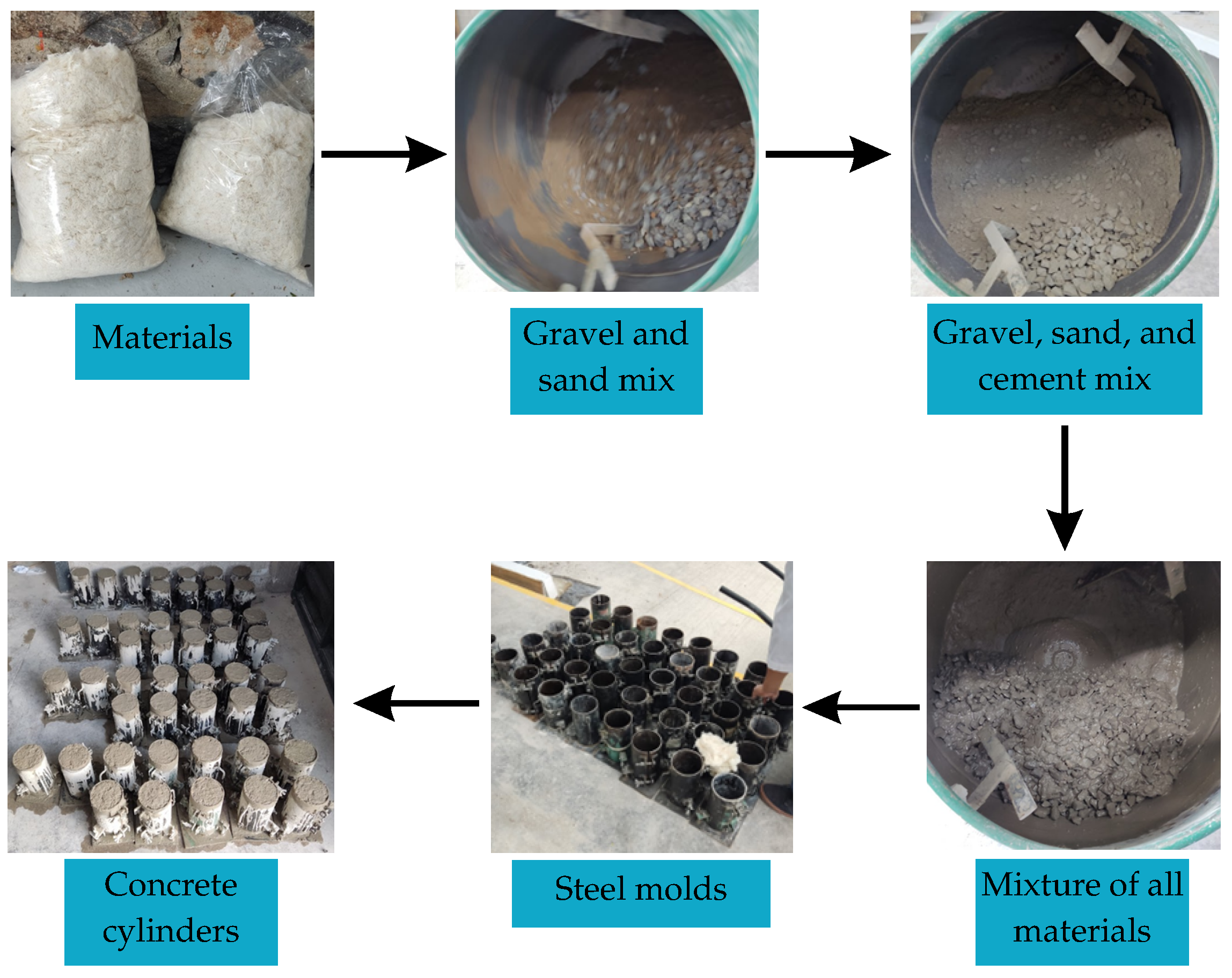
Once the fiber suspension was prepared, 50% of the total gravel and 50% of the sand were introduced into the mixer and blended for 120 s. Then, 50% of the cement was added and mixed for an additional 30 s. The fiber suspension was incorporated together with the remaining aggregates and cement, and the mixture was blended for 2 min. Subsequently, the remaining 80% of the mixing water was added, followed by 3 min of mixing, a 2-min rest period, and a final 2-min mixing stage to ensure adequate homogeneity of the concrete.
Subsequently, the mix was placed into cylindrical molds with a height of 20 cm and a diameter of 10 cm, following the ASTM C172-08 and ASTM C192/C192M standards [
57,
58]. Each mold was filled in two layers of approximately equal volume. Each layer was compacted with 25 uniformly distributed strokes using a tamping rod, ensuring that the rod penetrated approximately 25 mm (1 in.) into the underlying layer for the second lift. Finally, the excess material was removed, and the top surface was leveled to ensure a smooth finish.
After casting, the containers were covered with plastic and left at a temperature of 24 °C for 24 h. Then, the molds were removed, and the specimens were transferred to a curing chamber at 23 ± 2 °C and 95% relative humidity for 28 days, in accordance with the ASTM-C39/C39M-21 standard [
59].
This process was used to prepare mixtures with cotton fibers at 0.5%, 1.0 and 5.0%, as well as conventional mixtures without fibers, using the same procedures, proportions, and curing conditions to ensure the comparability of the values obtained in the subsequent tests.
Figure 2 shows the preparation process used to obtain the cylindrical concrete specimens.
2.3.2. Slump of Fresh Concrete
The consistency of the mixture was evaluated using the slump test, following the guidelines of ASTM-C143/C143M-20 [
60]. The process involved filling a standardized truncated cone mold in three layers, each compacted with 25 rod impacts. Once the mold was filled, it was removed vertically and continuously, allowing the concrete to settle. Finally, the decrease in the height of the specimen, relative to the initial height of the mold, was recorded, thereby obtaining the slump value, expressed in centimeters.
2.3.3. Tests for Simple Axial Compression Strength
The test was performed according to the ASTM-C39/C39M-21 [
59], using standard cylindrical specimens with a height-to-diameter ratio of 2:1 and compressive strengths below 49.033 MPa. Furthermore, the tests were conducted under axial loading conditions, without considering confinement, multiaxial stress states, or structural-scale effects.
Compressive strength tests were performed under load-controlled conditions using a universal testing machine. Before testing, the diameter and height of each specimen were measured to ensure geometric compliance. Subsequently, the specimens were carefully centered on the loading plates to minimize eccentricity. During the initial loading phase, up to approximately 50% of the anticipated failure load, a higher loading rate was permitted to expedite the process. However, the exact loading protocol was strictly transition to a constant stress rate of MPa/s during the latter half of the anticipated loading phase. This designated rate was maintained continuously and without impact until the ultimate failure of the specimen occurred. The maximum load reached was recorded to calculate the compressive strength (), and the fracture pattern was identified.
The axial compressive strength (R, MPa) was determined from the maximum load recorded during the test (P, kN) and the average cross-sectional area of the cylindrical specimen (A, cm2). The strength value was obtained by dividing P by A and applying the appropriate unit conversion to express the result in megapascals (MPa), following standard axial compression testing procedures.
Figure 3 shows a concrete specimen in the hydraulic press.
For clarity and ease of reference,
Table 2 summarizes all ASTM and ACI standards applied throughout this study.
3. Results and Discussion
This section presents the results obtained from tests conducted on both the aggregates and the mixtures with and without cotton textile fibers. The analyses include granulometry, aggregate properties (absorption, density, bulk weight, and moisture), as well as their resistance to degradation. Subsequently, the results of the mix design, the slump of fresh concrete, and finally, the compression strength at different curing days are presented.
3.1. Granulometry of the Aggregates
In the gravel, it was observed that the highest percentage retained corresponds to the 12.5 mm sieve, with 41.26%, while the coarser fractions (37.5 mm, 50 mm, and 75 mm) showed no material retained. This indicates that the gravel used has a nominal maximum size of 25 mm, with a continuous distribution in the intermediate fractions.
In the case of the sand, the highest retention percentage was observed in the 0.300 mm sieve, with 23.76%, followed by the 1.18mm sieve, with 22.51%. The percentage passing through the 0.075 mm opening was 0%, confirming that the fine fraction is limited. The granulometric curve constructed from these results showed that the sand used is classified as well-graded sand, suitable for use in concrete mixtures.
Table 3 and
Table 4 summarize the granulometric test values for gravel and sand.
3.2. Fine Particle Content
A sample with an initial weight of 2000 g was used, and a final weight of 89.57 g was obtained after the washing process.
Based on these values, the fine particle content was calculated to be 4.47%, which falls within the range specified by the standard, from 0 to 10% [
41], for aggregates intended for the production of hydraulic concrete.
3.3. Bulk Density of the Stone Aggregates
Table 5 shows the obtained values. It can be observed that the bulk density of the coarse aggregate was 1554.18 kg/m
3, and for the fine aggregate, it was 1039.64 kg/m
3.
The bulk density obtained for the coarse aggregate (1554.18 kg/m3) falls within the typical range for natural stone aggregates (1400 to 1700 kg/m3), indicating proper compaction and granulometric distribution.
Meanwhile, the fine aggregate exhibited a bulk density of 1039.64 kg/m3, a value that falls within the expected range for natural sands (1000 to 1200 kg/m3). This result reflects a granulometry suitable for the workability of the mix and confirms that the material does not exhibit excessive porosity or voids.
3.4. Resistance to Degradation of the Coarse Aggregate
The resistance to degradation was evaluated according to the ASTM-C131/C131M-20 standard [
43]. The results show an initial mass of 5000 g, and after the test, 4350 g remained, which represents a wear percentage of 13%. This value is within the range specified by the standard, which recommends values below 40% for aggregates intended for general-use hydraulic concretes.
This result suggests that the coarse aggregate used has high resistance to both wear and abrasion, desirable characteristics to ensure the durability of the concrete. A low wear percentage, such as the one obtained, ensures better performance of the concrete during internal crushing processes during mixing, transportation, and placement, reducing the generation of unwanted fine particles and helping to maintain the mechanical strength intended for the mix design.
3.5. Absorption and Density of the Aggregates
The tests were conducted according to the ASTM-C128-15 [
44] standard for fine aggregate and the ASTM-C127-15 [
45] standard for coarse aggregate.
Table 6 and
Table 7 present the obtained results, corresponding to the sand and gravel, respectively.
The obtained true density values were 2.67 g/cm3 for the fine aggregate (sand) and 2.69 g/cm3 for the coarse aggregate (gravel), which fall within the typical values reported for natural siliceous and calcareous aggregates, ranging from 2.55 to 2.75 g/cm3.
These results confirm that both the sand and gravel used have an appropriate and stable mineralogical composition, with no significant presence of lightweight or contaminant materials that could alter the density.
The similarity in the true density of the coarse and fine aggregates ensures consistency in the behavior of the concrete, favoring volumetric control in the mix design and reducing the risks of segregation.
The absorption capacity of the materials allowed for determining the amount of water each material can retain in its pores. The values obtained for the fine and coarse aggregates are shown in
Table 8 and
Table 9.
The sand showed an absorption capacity of 3.71%, while the gravel recorded a value of 2.80%. Both values fall within the common ranges reported [
7,
8,
9]: between 2% and 4% for sands and between 0.5% and 3% for natural gravels.
The relatively high value of the sand indicates greater porosity of the fine aggregate, which could increase the amount of water in the mix. In contrast, the gravel showed a moderate absorption level, which is suitable for structural concrete.
3.6. Moisture Content of the Aggregates
The moisture content of the aggregates was evaluated according to the ASTM-C566-19 standard [
46], with the values obtained shown in
Table 10 and
Table 11.
A significantly high moisture content is observed in the sand (20.45%) compared to the gravel (1.493%). This elevated value in the fine aggregate may be due to its higher porosity and specific surface area, which facilitates water retention. In contrast, the gravel, having a lower exposed surface area and absorption capacity, showed a lower and more stable moisture content.
3.7. Concrete Mix Design Modified with Cotton Fibers
For the preparation of the concrete with cotton fiber inclusion, the technical parameters of the materials used were considered, as shown in
Table 12.
The expected strength was defined as 20.594 MPa, using Portland cement type CPC 30R RS, with a design slump or consistency of 10.00 cm. An experimental value of 10.50 cm was obtained, indicating adequate workability of the mix.
Table 13 presents the quantities of material per m
3 of concrete under theoretical conditions, without considering corrections for moisture and absorption. The water-to-cement ratio is 0.68.
The following correction for absorption and moisture was made accordingly. In the base mix, 284 kg of cement, 823 kg of sand, 1026 kg of gravel, and 193 kg of water were used, totaling 2326 kg. The moisture correction was applied to the sand and gravel, adjusting the quantities of these materials to reflect the water content they contain.
For the sand, the moisture content is 20.45%, which corresponds to 168.30 kg of water. The absorption of the sand is 3.7%, adding 30.53 kg more, resulting in a total of 960.77 kg of sand. On the other hand, the gravel has a moisture content of 1.49%, which implies 15.28 kg of water, and its absorption is 2.80%, adding 28.72 kg, giving a total of 1012.55 kg of gravel. Finally, the water is adjusted to 183.59 kg due to the moisture correction, resulting in an actual amount of 68.67 kg of water. After applying these corrections, the total amount of materials was 2326 kg.
To calculate the amount of concrete required for 36 cylinders with a total volume of 0.05654844 m3, a specific amount of concrete is needed. Given that 1 m3 of concrete weighs 2326 kg, the concrete required to fill the 36 cylinders is calculated by multiplying the weight by the volume of the cylinders. This gives approximately 131.12 kg of concrete.
The amount of material per cylinder is shown in
Table 14, ensuring homogeneity and representativeness in the molding process.
Finally,
Table 15 shows the dosing of cotton as a reinforcing fber, which was incorporated in different proportions: 0%, 0.5%, 1.0%, and 5.0% by weight relative to the concrete per cylinder. Each percentage was applied to 9 specimens. The total weight of cotton used was approximately 2.14 kg, with the highest contribution in the specimens with 5% reinforcement.
3.8. Simple Axial Compression Strength
The concrete strength was measured at 7, 14, and 28 days of curing, using cylindrical samples in accordance with the applicable ASTM standards. For each group, tests were conducted on three cylinders to obtain a distinct average, considering four cotton fiber proportions: 0%, 0.5%, 1.0%, and 5.0%.
The values obtained are presented in
Table 16,
Table 17 and
Table 18 for each curing age. At 7 days (
Table 16), the concrete without fibers reached strengths between 12.15 and 13.18 MPa, while with 0.5% cotton, slightly lower values were recorded (11.57 to 11.66 MPa).
In contrast, the mixes with 1% and 5% cotton showed significant reductions, with values ranging from 3.39 MPa to 5.93 MPa, respectively.
At 14 days (
Table 17), the reference concrete without fibers reached values between 17.92 and 18.33 MPa, while the mix with 0.5% fibers demonstrated comparable performance (16.86 to 17.48 MPa). However, the specimens with 1% and 5% cotton achieved an average of 9.68 MPa and 5.88 MPa, showing a reduction of over 45% compared to the control concrete.
Finally, at 28 days (
Table 18), the reference concrete mix showed its highest strength, ranging from 20.41 to 21.38 MPa, in line with the expected design compressive strength (20.59 MPa). The addition of 0.5% cotton did not affect performance, achieving values of 20.85 to 21.71 MPa. In contrast, with 1% fibers, an average strength of 12.49 MPa was observed, and with 5% fibers, an even lower value (8.27 MPa), confirming the negative impact of excessive reinforcement with cotton fibers on the cementitious matrix.
The results indicate that the controlled addition of 0.5% cotton fibers can maintain the compressive strength of concrete without compromising its mechanical performance. The 0.5% fiber dosage showed similar behavior to the reference concrete at all ages, with slight increases at 28 days that fall within the expected experimental range for concrete tests. This behavior suggests that this fiber proportion allows for adequate integration into the cementitious matrix without negatively affecting load-bearing capacity.
Conversely, fiber contents of 1.0% and 5.0% resulted in significant reductions in compressive strength. These decreases indicate that excessive fiber incorporation introduces discontinuities in the cementitious matrix, increases the effective water-cement ratio, and hinders proper compaction, resulting in reduced homogeneity and mechanical performance similar to that observed in other studies [
61,
62,
63,
64].
From a practical standpoint, a moderate fiber dosage of 0.5% appears viable, while higher proportions significantly compromise the structural integrity of the material.
After 28 days of curing, concrete samples containing 0.5% recycled cotton fibers showed compressive strength values approximately 1.48% higher than those of the reference concrete. However, this variation should be interpreted with caution, as it falls within the normal variability associated with compressive strength tests. In contrast, samples with 1.0% and 5.0% fibers showed substantial reductions of approximately 40.09% and 60.33%, respectively, clearly demonstrating the detrimental effect of excessive fiber content.
The standard deviation of compressive strength values ranged from approximately 0.02 to 0.65 MPa, depending on fiber content and curing age. For the reference concrete and mixtures with 0.5% cotton fibers, standard deviation values at 28 days were below 0.50 MPa, indicating good repeatability of the test results. Higher dispersion was observed for mixtures containing 1.0% and 5.0% fibers, which may be associated with reduced workability and increased heterogeneity of the fiber distribution within the concrete matrix. The observed variability is considered acceptable for an exploratory experimental program conducted in accordance with ACI 318 provisions based on the average of three specimens.
Figure 4 is presented to illustrate the comparative evolution of the average compressive strength for different cotton fiber contents as a function of curing age. These figures do not represent full stress–strain behavior or load–displacement responses and should therefore not be interpreted as a complete description of the material’s mechanical behavior.
The reduction in strength as the percentage of recycled cotton fibers increases at 7, 14, and 28 days of curing, for the 1.0% and 5.0% fiber percentages, is possibly due to the increased fiber content and the reduced workability when adding an additional aggregate to the mix. However, it can be observed that the extent of the reduction narrows as the curing time progresses, which may be explained by the fact that cotton fibers act as a water reservoir, promoting internal curing of the concrete. For a fiber content of 0.5%, the 28-day compressive strength values remained comparable to those of conventional concrete, which can be attributed to better fiber dispersion and adequate workability at this dosage. These results indicate that the incorporation of 0.5% cotton fibers does not negatively affect the properties of fresh or hardened concrete.
The findings also highlight that fiber dosage plays a fundamental role in determining mechanical performance. While low fiber content can be incorporated without compromising strength, higher content negatively affects workability, porosity, and strength. Therefore, this fiber percentage could represent an option for maintaining the compressive mechanical properties of concrete. Furthermore, since the fibers are recycled cotton, their use helps reduce waste and environmental impact.
3.9. Types of Failures in Concrete Cylindrical Specimens
For the specimens without fibers (0%), the observed failure corresponded to the typical brittle behavior reported for unreinforced concrete under axial compression, characterized by the formation of an X-shaped cracking pattern as a result of a properly applied compressive load on well-prepared specimens, as shown in
Figure 5. This failure mode is consistent with those widely described in the literature for conventional concrete subjected to uniaxial compressive loading [
59,
65,
66,
67,
68].
In the cylindrical specimens containing 5.0% fibers, an average height reduction of approximately 6.75% was observed relative to the original specimen height (20 cm), suggesting a redistribution of strains within the concrete matrix under axial compression. In contrast, specimens incorporating 0.5% and 1.0% fiber contents did not exhibit a significant reduction in height and showed failure modes similar to those of the reference concrete, characterized by axial cracking typical of uniaxial compression. Nevertheless, in all fiber-containing specimens, the presence of cotton fibers appeared to reduce the tendency toward sudden disintegration after peak load, as the samples retained greater macroscopic integrity following failure. These observations are qualitative in nature and should not be interpreted as definitive evidence of crack arrest or enhanced compressive performance, but rather as indicative of a modified post-failure response associated with the incorporation of recycled cotton fibers, consistent with behaviors reported in previous studies on fiber-modified concrete when appropriate fiber contents are used without adversely affecting workability [
67,
69,
70].
Furthermore, previous research that has included microscopic analyses of fiber-reinforced cementitious composites has reported modifications in the Interfacial Transition Zone (ITZ), changes in fiber–matrix adhesion behavior and fiber interactions, as well as the development of microcracking that may influence the macroscopic mechanical response [
67,
70,
71,
72]. Documented mechanisms such as fiber pull-out, microcrack bridging, and localized stress redistribution within the cementitious matrix have been associated with altered post-failure behavior in fiber-modified concretes [
73,
74,
75,
76]. Although microstructural characterization was not performed in the present study, the qualitative observations reported herein are consistent with trends described in the literature.
This study presents notable strengths, such as the use of standardized methodologies (ASTM and ACI), which adds reliability to the results, as well as the proposal to incorporate discarded cotton fibers into concrete. The experimental design allowed for the observation of the effect of different fiber percentages and the analysis of both fresh and hardened concrete properties.
Furthermore, the experimental results were analyzed and discussed in conjunction with the corresponding ASTM standards, allowing for a comparison of the behavior of the aggregates and concrete mixtures with the expected and ideal values established in the regulations. Although previous studies on concrete with natural fibers have been developed, the methodology proposed in this work differs in the treatment, dosing, and incorporation of discarded cotton fibers, offering an alternative approach applicable to the development of sustainable materials for construction.
However, this study has some limitations. The experimental program was conducted under controlled laboratory conditions and was limited to the evaluation of axial compressive strength. Accordingly, the results should be interpreted as an assessment of the effect of fiber incorporation on compressive performance, rather than as evidence of structural reinforcement or enhanced mechanical behavior. Furthermore, a limited number of specimens were tested, and a high fiber content (5%) was observed to negatively affect both workability and compressive strength. Additionally, only one type of recycled cotton fiber was evaluated, and the curing period was limited to 28 days. Although the mechanisms of water absorption and alkaline degradation of the fibers were discussed based on existing literature, these phenomena were not directly quantified experimentally. Therefore, the findings primarily reflect the short-term mechanical behavior of cotton fiber-modified concrete, while long-term durability aspects remain an important subject for future research.
Another limitation of this study is that the physical and mechanical properties of the recycled cotton fibers, such as tensile strength, elastic modulus, density, and water absorption capacity, were not experimentally measured for each fiber batch used. Instead, these properties were described based on representative values reported in the literature for recycled and natural cotton fibers with similar origin and processing conditions. Although this approach allows for a reasonable interpretation of fiber–matrix interactions, variations associated with fiber source, prior textile treatments, and mechanical fiberization processes may influence the actual behavior of the fibers in the cementitious matrix.
Another limitation of this study is that it focused exclusively on the evaluation of the axial compressive strength of concrete. Although compressive strength is a fundamental parameter for assessing the performance of conventional concrete [
77,
78,
79,
80,
81,
82,
83,
84], other relevant mechanical properties commonly associated with fiber-reinforced concretes, such as tensile strength, flexural behavior, post-cracking response, and ductility, were not evaluated. Therefore, the results presented herein should be interpreted as an initial assessment of the feasibility of incorporating recycled cotton fibers into concrete mixtures, rather than a complete mechanical characterization of fiber-reinforced concrete systems.
A limitation of this study is that the analysis of failure modes was primarily based on visual observation and geometric changes of the specimens after axial compression testing. Although the observed cracking patterns and height reduction provide qualitative insight into the influence of recycled cotton fibers on damage development and crack restraint, a quantitative evaluation of post-peak behavior, toughness, and energy absorption was not included. Consequently, the interpretation of the fiber contribution to post-peak performance is limited to macroscopic observations rather than stress–strain-based parameters.
A limitation of this study is that microstructural characterization techniques, such as scanning electron microscopy (SEM), were not employed to directly analyze the Interfacial Transition Zone (ITZ) and fiber–matrix bonding mechanisms. Consequently, the interpretation of fiber contribution is based on macroscopic mechanical behavior and visual failure observations, supported by consistency with previously reported mechanisms in natural fiber-reinforced cementitious composites.
Possible sources of error include the uneven distribution of fibers, slight variations in curing and moisture content of the aggregates, as well as minor inaccuracies in the measurements.
Despite these limitations, the experimental methodology is considered appropriate for the scope of this study, and the results indicate that low additions of recycled cotton fibers can be incorporated without adversely affecting axial compressive performance. This suggests potential for their use as a complementary addition in sustainable, non-structural concrete applications.
Finally, it would be useful to compare cotton fibers with other synthetic and natural fibers in order to broaden the practical applicability of the methodology adopted for producing modified concrete mixes in this study. Additionally, investigating fiber surface treatments to improve fiber–matrix adhesion, conducting full-scale tests, and performing sensitivity analyses to assess the relative influence of parameters such as fiber content, aggregate type, water-to-cement ratio, and curing time on the mechanical and physical properties of concrete would be beneficial.
These efforts could help consolidate the use of waste fibers in concrete for practical and environmentally responsible applications.
4. Conclusions
The results demonstrate that incorporating small amounts of recycled cotton fibers, particularly at 0.5%, does not compromise the compressive strength of the concrete and offers performance comparable to that of conventional mixes. While a slight increase of 1.48% in compressive strength was observed at 28 days, this variation falls within the typical experimental range for concrete tests and should not be interpreted as a statistically significant improvement. Nevertheless, the fibers contributed to improved crack control and deformation behavior.
From an environmental perspective, reusing discarded cotton fibers contributes to waste valorization by redirecting textile waste toward construction applications. However, this study focuses primarily on compressive mechanical behavior, and the environmental benefits are considered complementary.
However, the use of recycled cotton fibers also presents limitations. Notably, their hydrophilic nature can increase water absorption and alter the workability of the concrete, as well as the variability in the cleanliness and quality of the fibers, which directly affects mechanical performance. Additionally, it was found that high doses (≥1%) reduce strength and cause issues with the homogeneity of the mix. These aspects must be carefully controlled through proper dosing and an adequate mixing and curing process.
Finally, although the results obtained are encouraging, further research is needed to optimize the proportion, size, and distribution of recycled cotton textile fibers, as well as to extend the mechanical characterization beyond compressive strength in more concrete samples. Future studies should include the acquisition of stress–strain curves under axial compression to quantitatively evaluate post-peak behavior, toughness, energy absorption, and ductility, together with the assessment of flexural and tensile behavior, fracture response, and post-cracking performance. In addition, microstructural analyses such as scanning electron microscopy (SEM) should be conducted to directly investigate the fiber–matrix interface, Interfacial Transition Zone (ITZ) morphology, and bonding mechanisms, enabling a deeper understanding of load transfer, crack control, and fiber contribution at the microscale. Future research should also incorporate direct experimental characterization of the physical and mechanical properties of recycled cotton fibers, including tensile strength, elastic modulus, density, and water absorption capacity for each fiber batch used, in order to reduce uncertainties associated with variability in fiber origin, prior textile treatments, and mechanical recycling processes. Moreover, long-term performance aspects such as durability, shrinkage, creep, and the effects of fiber degradation within the cementitious matrix over time should be investigated under real-use conditions.
These research directions will contribute to a more comprehensive understanding of the structural potential of cotton fiber-reinforced concrete and support the development of safer, more durable, and more sustainable construction materials aligned with circular economy principles.




 ,
,