Article

Effect of Bioeconomy Integration on the Transition from Traditional Livestock Farming to Circular Farming Models in Greece

by
Stavros Kalogiannidis
1,*,
Konstantinos Spinthiropoulos
2,
Fotios Chatzitheodoridis
2,
Dimitrios Parris
2,* and
Angel Valsamopoulos
2
1
Department of Business Administration, University of Western Macedonia, 50100 Grevena, Greece
2
Department of Management Science and Technology, University of Western Macedonia, 50150 Kozani, Greece
*
Authors to whom correspondence should be addressed.
Conservation 2026, 6(2), 74; https://doi.org/10.3390/conservation6020074 (registering DOI)
Submission received: 29 April 2026 / Revised: 7 June 2026 / Accepted: 10 June 2026 / Published: 15 June 2026

Abstract

This study investigates the integration of bioeconomy principles in the Greek livestock sector, framing the transition from conventional farming toward a circular bioeconomy as a strategy for resource conservation and reduced environmental pressure. It assesses farmers’ awareness of bioeconomy principles, the adoption of circular practices, and the associated economic and conservation-related performance. Data were collected through a structured questionnaire administered to 383 livestock farmers across the main livestock-producing regions of Greece and analyzed using descriptive statistics and multiple regression. Although respondents show substantial awareness, adoption remains incomplete, mainly because of high initial capital costs and insufficient financial incentives. Farmers implementing circular strategies reported gains in resource-use efficiency, waste minimization, and the conservation of soil, water, and biodiversity, particularly reduced greenhouse-gas emissions, while public subsidies and fiscal incentives emerged as the principal drivers of adoption. In applied terms, support should be prioritized for capital-intensive investments such as anaerobic digestion, manure and nutrient recovery, and water reuse, and the awareness–adoption gap is best closed through targeted subsidies and training. The findings offer concrete guidance for conservation-oriented agri-environmental policy supporting the green transition of livestock farming in Greece.

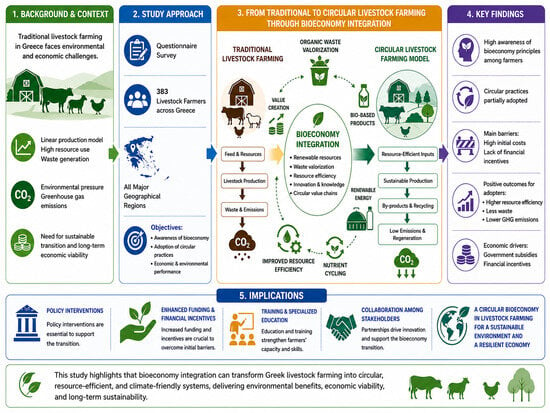
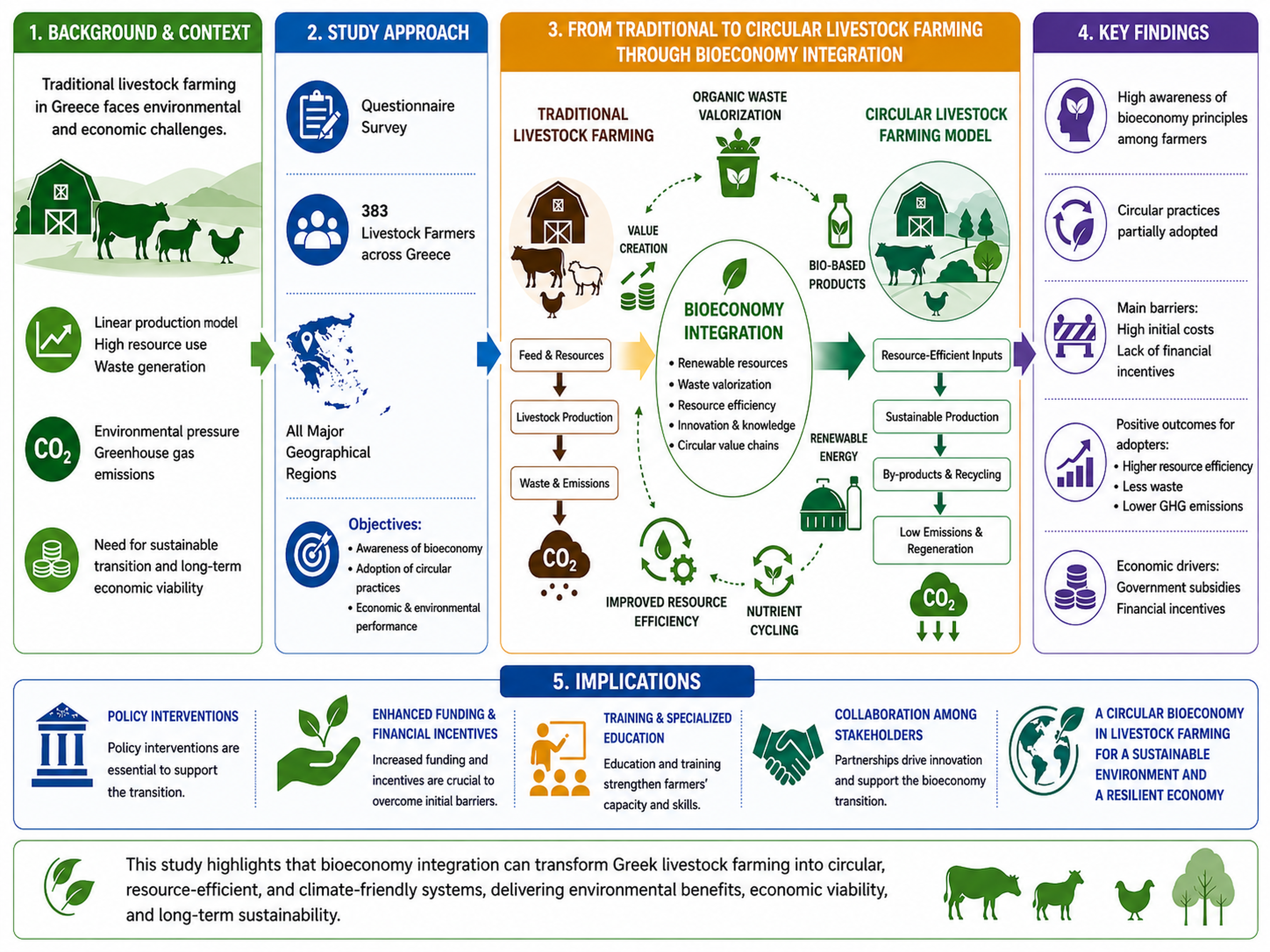
Graphical Abstract

1. Introduction

Bioeconomy has become a global phenomenon, which proposes solutions to modern issues, such as environmental sustainability, resource scarcity, and climate change [1,2]. The bioeconomy at the global level can be defined as sustainable utilization of renewable biological resources, including crops, forests, fish, animals and microorganisms, in combination with technological innovations to generate food, feed, energy and other bio-based products. In this respect, the bioeconomy is closely tied to conservation: by keeping biological resources within the production cycle and curbing the extraction of raw inputs, it directly supports the conservation of soil, water, and biodiversity and helps protect the ecosystems on which agriculture depends.
A circular bioeconomy is an attractive concept for a number of reasons. The first is that it acknowledges that production waste, which usually does not employ inputs economically and technically efficiently, is a major cause of pollution and environmental deterioration [3].
Second, it highlights how crucial it is to cut waste production at its source, recycle and reuse garbage, and turn waste into finished goods that will satisfy customer demand. Third, it highlights the potential of biological resources to replace fossil fuels and slow down climate change. Finally, an operational and technologically focused route to environmental sustainability is offered by a circular bioeconomy [4]. States across the globe and in Europe, in particular, are realizing the potential of the bioeconomy to alleviate the global environmental challenges and their economical demands [2,5].
The European Union (EU) has already incorporated the tenets of the bioeconomy in their long-term sustainability strategies, the major changes being to convert to a circular bioeconomy based on the regeneration of the resources [6]. The models of the circular bioeconomy in agriculture practice, i.e., livestock farming, including the development of technology coupled with the control of resources, have become possible thanks to the adaptive policies of the EU [7,8].
The use of the bioeconomy in livestock farming continues to increase in developed countries as one of the ways to minimize the environmental impact, secure the distribution of resources, and increase sustainability [1,9]. On the one hand, the reduction in harm by a partial contribution of circular farming to the environmental footprint of livestock farming has been explored in Sweden and Germany with the recycling of nutrients and waste treatment [10].
The EU economy depends heavily on agriculture, which produces the food, feed, and bioresources that keep civilization going. The issues of population expansion, food security, climate change, and resource scarcity are particularly focused on this industry [8,11]. Agriculture has become increasingly resource-intensive during the past 50 years, mostly depending on the availability of fossil inputs such as fossil fuels, oil-derived agrochemicals, and synthetic fertilizers that include nitrogen and phosphorus [4,12,13]. The concepts of the “circular economy” might present several chances for livestock production in particular, and agriculture in general, to become more resource-efficient.
Agriculture and livestock production are mostly linear processes that need a lot of inputs, most of which are not transformed into edible goods but instead produce inefficient and harmful outcomes for the environment. Inefficiencies in the global food industry are estimated by the UN FAO to cost between $1 and $2 trillion annually [14,15]. In the end, up to one-third of the food produced for human consumption is wasted when the full agri-food cycle is examined. Both lost revenue and the resources used in its creation are equivalent to this waste.
Closing nutrient loops, producing agricultural commodities with the least amount of outside inputs, and minimizing adverse environmental discharges (such as trash and emissions) are the main goals of the “circular economy” in agriculture. Opportunities may be found at every level of the agri-food system when seen from the “circular economy” viewpoint, from recycling and utilizing agricultural waste to primary production with precision agriculture techniques [16].
Greece is in a critical phase as it moves towards the circular bioeconomy in the livestock industry. Greece is an agricultural nation with a history of livestock production that has numerous environmental and economic concerns that are connected with the use and disposal of resources, and with climate change [17,18]. It believes that these problems can be solved through the introduction of bioeconomy principles to the Greek farming system and contribute to the increased sustainability of this sector.
The concept of circular farming has become of growing governmental and business interest, with subsidies and incentives assigned to farmers to implement less wasteful and low carbon-emitting practices [19,20]. Nevertheless, glaring gaps can still be identified regarding the overall implications of bioeconomy implementation in Greece, assuming it refers to how the farmers understand the matter, as well as their readiness to invest in a circular agricultural system. It has been established that although the bioeconomy may have its benefits, including the more efficient use of current resources and economic sustainability over the long term, most farmers are still reluctant to resort to circular practices because it is expensive and does not provide monetary stimuli [21,22]. The bioeconomy is also being promoted in Greece, particularly in the Western Macedonia region. Through its participation in the European projects BIOMODEL4REGIONS and CEE2ACT, the Cluster of Bioeconomy and Environment of Western Macedonia (CluBE) is attempting to develop a bioeconomy plan at both the regional and national levels. But when it comes to creating a bioeconomy policy, Greece is lagging behind other European nations.
Even though there are a lot of stakeholders, they do not have the knowledge they need and seem reluctant or even unwilling to attend bioeconomy seminars, workshops, and hubs [23]. CluBE has taken on the responsibility of involving and educating pertinent parties at the local and national levels in order to solve this issue. In Western Macedonia, an area going through change, the agricultural sector, especially through the agri-food partnership, is set to have a major influence. Training and capacity-building initiatives in the larger agri-food industry are required to enable a smooth and fair transition.
Training for farmers, agricultural guidance, the development of educational resources, the establishment of demonstration fields, and skill-building exercises like study tours and exchanges are all crucial elements [24]. It could be useful to break farmers into groups according to their different viewpoints, concerns, and opinions in order to develop strategies that are specific to each group’s traits. Farmers can be categorized into exclusive groups using cluster analysis [25].
Even though there is some knowledge about the bioeconomy in the developed world, there is not much research on how to use the bioeconomy in the Greek livestock farming industry. People have mostly looked at the benefits of the bioeconomy in terms of how well it uses resources and how well it protects the environment. But the economic elements, especially the role of government subsidies and start-up expenses in putting bioeconomy methods into action on Greek cattle farms, have not been properly looked into.
Also, studies in Greece are not as good as studies in other areas where the long-term financial viability of bioeconomy practices is well-known [17]. This study’s goal is to fill in these gaps by examining how the principles of the bioeconomy can be applied to the livestock farming business in Greece.
The study also evaluated the knowledge of bioeconomy principles and circular farming practices in Greece among farmers, and assessed the effectiveness of embracing a circular bioeconomy in resource efficiency and environmental sustainability in Greek livestock farming. It also assessed how economic factors, such as initial investment and availability of government incentives, can affect the decision by farmers to engage in circular bioeconomy practices and examined the financial sustainability results of implementing bioeconomy concepts into livestock production in Greece in the long term. By treating the circular bioeconomy as a vehicle for conserving natural resources and reducing the environmental footprint of livestock farming, the study contributes to the wider conservation agenda, linking farm-level practice to the protection of soil, water, and biodiversity and to the sustainable management of renewable resources.

2. Literature Review

2.1. Awareness Towards Adoption of Circular Bioeconomy Practices

Research indicates that because educated and trained farmers are critical to the sector’s growth and performance, bioeconomy strategies encourage farmer training [26]. In order to guarantee that farmers are prepared to fulfill the needs of the growing bioeconomy, it is imperative that they get training and education.
Farmers play a crucial role in the production of bio-based goods and the adoption of sustainable agriculture techniques. Farmers must receive education on the concepts and methods involved in the sustainable and effective use of biological resources for the production of a range of goods, including materials, food, and energy, in order to be trained in the bioeconomy.
This involves educating them on the most recent developments in regenerative farming, precision agriculture, agroforestry, and biotechnology. They should also get training on the commercial and economic facets of the bioeconomy, such as product creation, branding, and marketing. Natural resources, productivity parameters, and their potential are all significantly impacted by the bioeconomy in agriculture [9]. With the help of both internal and external factors, production factors aim to provide an atmosphere that is conducive to farms’ expansion and development. A farm’s productive capacity is determined by its resources and land, which is the main production element in agriculture.
Rekleitis et al. (2020) noted that by connecting land efficiency to the agricultural methods employed, bioeconomics disproves the antiquated notion that land efficiency is correlated with farm size [21]. Production costs, regional comparative advantages, regional structure, and agricultural competitiveness are all impacted by land quality. The agricultural sector’s bioeconomy produces income on par with other economic sectors, supplies the funds required for modernization, encourages food self-sufficiency, protects the soil’s potential for production, makes efficient use of agricultural land, lowers environmental risks, and helps produce raw materials that meet desired quality standards [2]. Sustainable agriculture guarantees that natural resources will be available to future generations while adhering to the bioeconomy’s tenets.
Chances are given to farmers and the area, quality of life is improved, variety is preserved, high-quality jobs are offered, innovation and education are prioritized, and social cohesion is promoted via equitable opportunity. The best way to address the issues affecting the agriculture industry is through sustainable agriculture.
Natural resource usage has to be controlled so that renewable resources are used without diminishing or lowering their value [15,27]. Based on the above review, hypothesis one was developed which states that:
H1. 
Higher awareness of bioeconomy principles among farmers is positively associated with greater implementation of circular farming practices.

2.2. Circular Economy, Agricultural Resource Use and Environmental Strain

With its heavy reliance on land, water, energy, and mineral inputs, agriculture is by its very nature resource-intensive. However, because of deforestation, overcultivation, and other unsustainable practices that deteriorate soils and lower long-term productivity, the amount of land accessible for additional agricultural growth is gradually decreasing [28]. The decline in soil fertility is especially concerning [20].
Smallholder farmers, who frequently work marginal areas with little access to soil restoration technology and extension services, are particularly vulnerable to these pressures. Their income and yields fall in the absence of sufficient assistance, which exacerbates cycles of food insecurity and poverty. These issues are made worse by climate change. However, limited mineral resources are necessary for these inputs [29]. Smallholders that lack the funds to absorb growing input prices face more and more obstacles to productivity as global reserves diminish and extraction costs rise. One of the biggest obstacles to agricultural productivity is still water shortages. Nearly 70% of the world’s freshwater resources are used for farming [30], but small-scale farmers in semi-arid areas of South Asia and sub-Saharan Africa are particularly hard hit. Farmers in these regions are forced to depend on erratic rainfall due to insufficient irrigation infrastructure. In sub-Saharan Africa, for instance, 98% of agriculture is rain-fed and requires few technology inputs.
Although the majority of field activities, irrigation systems, and transportation still rely on fossil fuels, energy is another important input in agriculture [6]. In addition to increasing production costs, fuel price volatility increases agriculture’s carbon impact. Due to their lack of mechanization and consistent grid energy, smallholders are more susceptible to climatic and market shocks. Although they are becoming more popular, circular energy solutions like solar micro grids and on-farm methane digesters are still not widely used.
Notwithstanding these difficulties, agriculture continues to employ a significant portion of the world’s workforce—roughly 28%—with smallholders accounting for the majority in several low- and middle-income nations [15]. Therefore, balancing the lives that modern farming supports with its environmental restrictions is a crucial policy and scientific goal. Based on this review, hypothesis two was developed:
H2. 
Greater adoption of circular bioeconomy practices is positively associated with farmers’ perceived improvements in resource efficiency and reductions in environmental impact.
Due to its enormous demand for land, fertilizers, and water, agriculture puts tremendous strain on natural systems, contributing to resource depletion, biodiversity loss, and more than 25% of global greenhouse gas emissions [31]. Waste products in the industry include pesticide runoff, crop leftovers, and manure. If handled appropriately, these byproducts may be useful resources. For smallholder farmers, who frequently lack access to infrastructure for waste treatment or recovery, this re-framing is especially critical [32,33].
For example, more than 5 billion tons of crop residue are produced annually worldwide. Many smallholders handle this trash by burning it, which kills helpful soil microorganisms, increases soil temperatures, and speeds up erosion in areas with little infrastructure and few support services [34]. These sorts of actions miss out on the financial potential while raising environmental dangers.
The body of existing literature continuously shows how uncontrolled agricultural waste releases greenhouse gases like methane and ammonia, pollutes the air, and contaminates water bodies [27,29,35].
In addition to reducing the amount of agricultural waste produced, the main goal from a CE standpoint is to make sure that any residues that cannot be avoided are viewed and used as useful resources rather than as liabilities.
Research on the recovery of phosphorus from wastewater and biogas leftovers, for instance, shows both economic and ecological feasibility [36], yet smallholder systems seldom ever adopt such improvements. Similarly, one of the most lucrative ways to valorize biowaste is to raise insects, especially the larvae of Hermetia illucens, also referred to as the black army fly [37].
However, smallholder farming methods are still mostly unable to utilize these advances, despite their advantages. To close this gap, decentralized, low-cost models that are suited to resource-constrained farmers—especially those in the Global South—must incorporate techniques for nutrient recovery, waste valorization, and emission reduction [38,39,40].

2.3. Economic Factors and the Circular Bioeconomy

The circular economy’s core components, resource productivity and efficiency, are frequently examined in the literature as crucial aspects in the shift to sustainable economic models. In order to promote circular behaviors and deter overexploitation of natural resources, studies by Fava et al. (2021), Venkatesh (2022), and Ruckli et al. (2022) have emphasized the significance of fiscal measures like taxing primary resources and providing subsidies for recycled materials [11,33,41].
According to additional study, material productivity and the adoption of the circular economy are significantly influenced by environmental regulation strictness and economic globalization. Simultaneously, these policies foster an economic climate that attracts private investment, which is crucial for advancing advanced recycling technologies and growing the infrastructure required for reuse, according to recent specialized studies [20,42]. The research highlights how important private investment is to implementing and growing circular processes. According to recent polls [22,24], private capital participation is crucial for the construction of the required recycling infrastructure and the use of cutting-edge technical solutions. The adoption of sustainable business models that put an emphasis on waste reduction and the utilization of recyclable materials is also made easier by these investments.
According to Nguyen et al. (2025), private investment is crucial in advancing creative projects like sustainable product design and improved recycling [43]. The relationship between private funding and the adoption of circular technology was examined by Gkountani and Tsoulfas (2022), who emphasized the need for public–private collaborations in growing circular solutions [44].
The authors demonstrated how funding infrastructure for recycling and reuse lays a strong basis for expanding the usage of circular materials. Additionally, Gatto and Re (2021) highlighted that financial accessibility is a crucial component of circularity adoption, particularly in sectors with significant environmental effect [8].
Another important factor propelling the shift to the circular economy is rising resource productivity. Because of the savings and lower environmental effect, Kusmayadi et al. (2021) contend that high-productivity economies are better suited to include circular materials into their production chains [45]. Donner and de Vries (2021) assert that higher productivity maximizes the economic worth of recycled materials by enabling their effective usage [46]. Chodkowska-Miszczuk et al. (2021) further stress that resource efficiency contributes to lower costs for raw material extraction and processing, which raises the competitiveness of circular materials [3].
According to research by Loizou et al. (2019), economies that place a higher priority on boosting resource productivity and cutting waste are better positioned to embrace and grow the use of circular materials, which will promote a sustainable economy [13]. The literature has extensively demonstrated the importance that resource productivity and private investment play in advancing the circular economy.
Resource productivity encourages the use of circular materials and lessens reliance on primary resources, while private investment makes it easier to implement technical advancements and build the required infrastructure. These observations highlight the significance of a comprehensive strategy to fully realize the circular economy’s potential in the shift to a sustainable economic model [28].
One important factor in encouraging circularity is the provision of financial incentives. Successful transitions have been found to be significantly influenced by increases in resource productivity and private investment in circular industries [29]. Furthermore, the impact of trade liberalization and economic globalization on material flows is coming into focus.
According to current research, interconnected markets help embrace circular practices by lowering financial and technological obstacles. According to empirical research, fiscal incentives like tax breaks for investments in the circular economy and financial aid for the adoption of green technologies are essential for promoting circularity in high-industrial-output economies [47]. Based on this review the following hypothesis was developed:
H3. 
Economic variables including initial investment costs and government incentives play a major role in determining whether farmers adopt circular bioeconomy practices.

2.4. Economic Perspectives of the Circular Bioeconomy in the Agricultural Sector

Ghisellini et al. (2023) claim that since the middle of the 20th century, the world’s food output has quadrupled, outpacing both the population and the amount of land used for agriculture [7]. This intensification of agriculture has been fueled by technological advancements, mostly brought about by the need to increase productivity and profitability.
However, a significant amount of inputs used for crop production—such as fertilizer, irrigation water, and herbicides—are not absorbed by the crop; this low-input-utilization efficiency leads to runoff that deteriorates the quality of the soil and water, and pollution of the environment. Furthermore, when agricultural processing companies transform agricultural commodities into consumer items, they discharge more nutrients into wastewater streams [44].
With these inputs, a large portion of the agricultural biomass is squandered. Losses throughout the pre-harvest, post-harvest, and post-consumer phases contribute to organic waste from the consumable biomass [48]. Both industrialized and developing economies struggle to manage agricultural waste because it is frequently burned or landfilled, which increases greenhouse gas emissions and air pollution [2,11].
The primary cause of soil health loss, hypoxic zones, biodiversity loss, and deterioration in surface and groundwater quality is agricultural pollution. In 2019, land use, forestry, and agriculture accounted for 75% of deforestation, 30% of energy use, 70% of groundwater extraction, and 22% of world emissions. Because it uses a one-way process of extracting inputs, creating outputs, and generating residues that turn into polluting wastes, the current agri-food production system is known as linear.
A paradigm shift toward a circular bioeconomy has been called for as a result of the realization of the constraints of depending only on this strategy to satisfy the rising demand for agri-food products. While different studies have different definitions of what a circular bioeconomy is, they all emphasize reducing the use of natural resources, recycling and reusing materials, restoring and regenerating natural systems, and turning waste and other biological resources into bioenergy or bioproducts to replace fossil fuels [49].
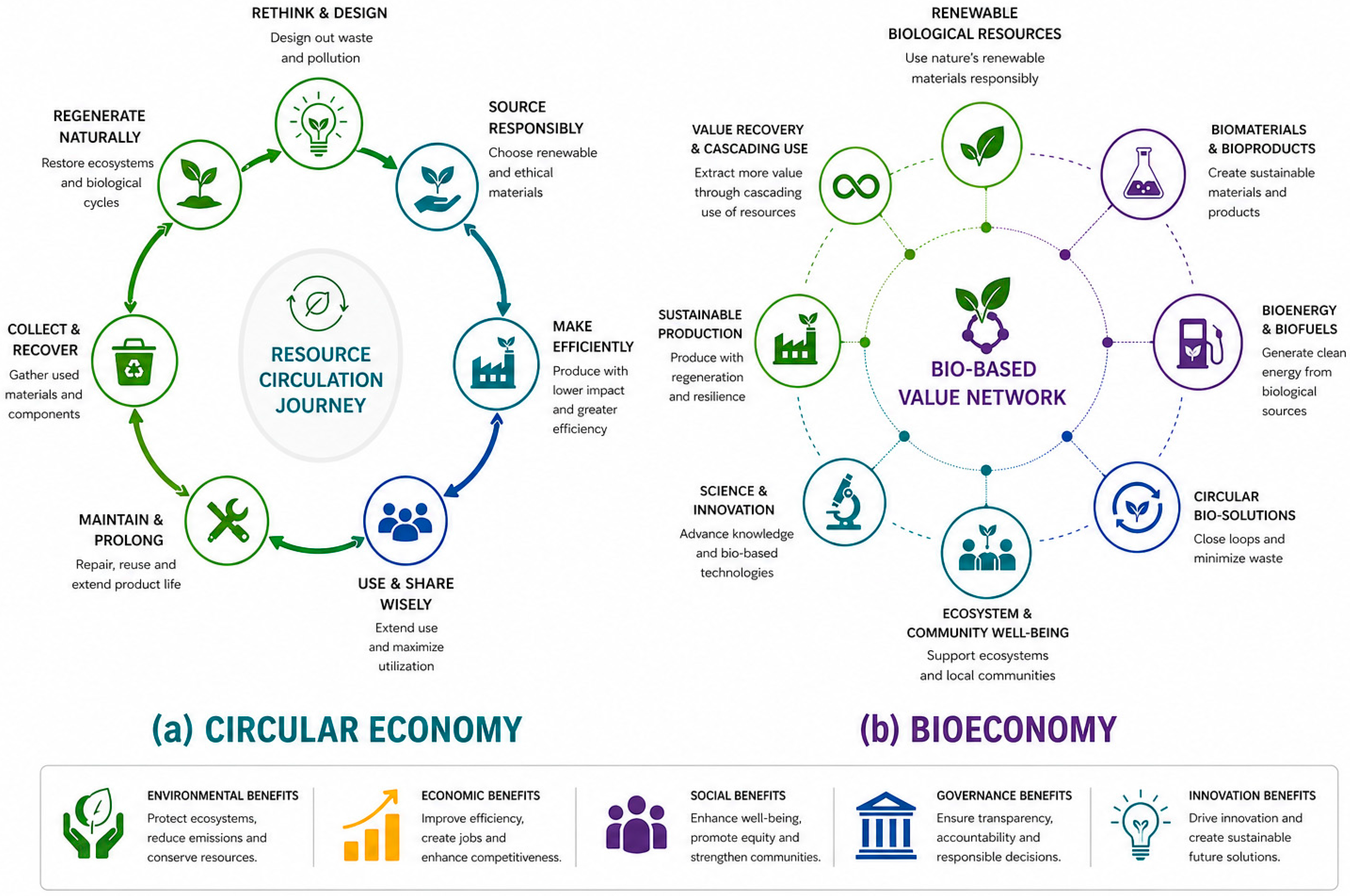
For each product supply chain, and throughout the wide range of goods in an economy, there are a number of current and developing technical routes that might facilitate the agri-food sector’s transition to circularity (Figure 1a). These include scientific advancements in crop management technology such as artificial intelligence and digital precision farming, which can minimize fertilizer loss on the field and improve nutrient recovery and recycling at the field’s edge.
Similar to this, Ingrao et al. (2018) describe how synthetic biology, gene editing, biotechnology, and precision fermentation can be used in a variety of ways to upcycle and convert agricultural waste and perennial energy crops into plant-based proteins, bioproducts, and bioenergy that can replace products based on chemicals and fossil fuels (Figure 1b) [28].
Other examples include changing landscapes to incorporate pasture for grass-fed animals; leguminous crops that require fewer chemical treatments; and organic waste generated at all stages, from food scraps to crop residues, that can be converted into renewable natural gas or compost and biochar for nutrient-rich soil amendments. These changes can improve soil health and crop productivity while lowering the need for fossil fuels [2,11].
H4. 
Greater integration of bioeconomy principles in livestock farming is positively associated with farmers’ perceived long-term financial sustainability.

3. Materials and Methods

3.1. Research Design and Study Area

This study employed a cross-sectional, descriptive survey design, in which data were collected from each respondent at a single point in time. The design helped to estimate the association between variables, including the relationship between awareness of bioeconomy principles and the implementation of circular farming practices by farmers. It also looks at how economic factors influence the process of adoption such as initial investment costs and government subsidies. A cross-sectional design is appropriate for the study’s aim of measuring, at the current stage of the transition, the associations among awareness, adoption, economic factors, and perceived outcomes across a large and geographically dispersed sample of farmers, and is suited to testing the stated hypotheses, which are formulated as associational rather than temporal–causal claims. In this study, “traditional (conventional) livestock farming” is defined as a predominantly linear production model following a take–make–dispose logic: reliance on external, largely fossil-based inputs (synthetic fertilizers, purchased feed, fossil energy), open nutrient loops, and the disposal of byproducts (manure, crop and processing residues) as waste rather than their reintegration into the production cycle. Correspondingly, “transformation” (transition to circular bioeconomy farming) is defined as the operational shift from this linear model towards the closing of nutrient and material loops at the farm level through the adoption of one or more circular practices such as anaerobic digestion/biogas, on-farm composting, manure and nutrient recovery, waste valorization, water reuse, and renewable energy integration; in operational terms, a farmer is considered to have undergone transformation when at least one such circular practice has been implemented on the farm.
Moreover, it looks at long-term financial sustainability post-implementation of bioeconomy principles in Greek livestock farming. By employing quantitative and qualitative methodologies, the study will aim to provide a comprehensive picture of the traditional-to-circular farming model transformation.
The study was conducted in Greece, where the agricultural industry is substantial, particularly within livestock rearing. In Greece, especially in the rural areas, agriculture is a very conservative culture. The transition to circular agriculture production is a new issue, as it assumes a significant shift in the conduct of farming and the application of new technologies.
The survey includes various regions of Greece, although primarily areas where livestock farming is a major activity in agriculture like in parts of Northern Greece and the Peloponnese.
The graphical layout of Figure 1 (presented in the Section 2) was produced using ChatGPT-5.5 Thinking (OpenAI, San Francisco, CA, USA; https://chat.openai.com, accessed on 2 April 2026. The authors supplied the underlying data, defined their classification and ordering, and specified the visual format (segmented circles with icons and descriptive labels); the tool was used solely to render this layout. No data, results, or interpretations were generated by the tool.

3.2. Target Population and Sample Size

This study targeted livestock farmers in Greece who had undergone the transformation from traditional farming to circular bioeconomy farming. The sample was selected from various regions of Greece and locations where livestock farming is a large industry. A simple random sampling method was used to ensure that the sample was representative of the farming community, and would cut across a broad cross-section of small- and big-scale farmers.
The study aimed to gather diverse responses to the adoption of circular farming, including the responses of farmers who were more or less practicing the principles of the bioeconomy. To get the required sample size, we took the formula of finite populations formulated by Yamane (1973) [52]. The population of 130.640 livestock farmers was estimated using available data on the number of livestock farmers in Greece [53]. A margin of error of 5.1 and a confidence interval of 95 were used to compute the sample size:
n = N 1 + N e 2
where:
n = sample size;
N = population size (130,640);
e = level of significance (0.05099).
n = ( 130,640 ) 1 + ( 130,640 ) ( 0.05099 ) 2
n = 383.36
n = 383

3.3. Data Collection

Data collection was conducted using a structured questionnaire with the aim of establishing the extent of awareness, adoption and influence of the application of circular farming practices within Greek livestock farming. The scale was based on the Likert scale as the researcher had to consider the perceptions and attitudes of the farmers to the bioeconomy principles and application of circular farming practices.
The questionnaire was designed and administered using Google Forms (Google LLC, Mountain View, CA, USA; https://www.google.com/forms/about/, accessed on 24 February 2025).
The Likert scale was between strongly disagree and strongly agree, which provided the participants with a chance to express their viewpoint regarding various statements about bioeconomy awareness, economic barriers, and sustainability outcomes. The questionnaire was administered electronically, by email and online survey, to make the questionnaire accessible to the rural and semi-rural dwellers.
The process of data collection lasted three months and a broad range of respondents were involved. There were ethical considerations in this study. This was all done with informed consent, and they were fully informed about the purpose of the study, their involvement in the research and their right to confidentiality. Several steps were taken to limit bias and measurement error: the instrument used structured items with response categories adapted from previously published bioeconomy and circular economy studies to support content validity; it was administered through multiple channels (electronic, email, and online survey) to broaden reach across rural and semi-rural respondents and reduce coverage bias; and respondents were assured of anonymity and confidentiality to mitigate social-desirability bias. All outcome constructs (resource efficiency, environmental impact, financial sustainability) are self-reported farmer perceptions; the study therefore measures perceived rather than directly observed biophysical outcomes, and the hypotheses are correspondingly framed and tested as associations among measured perception constructs.

3.4. Data Analysis

The collected data were subjected to descriptive and inferential statistical analysis. The descriptive statistics (frequency, percentages, means, and standard deviations) summarized the responses to provide the general picture of awareness and adoption of bioeconomy principles.
A correlation analysis was conducted to ascertain the relationship between bioeconomy awareness and the uptake of the circular practice of farming among farmers. Regression analysis was then used to determine the impact of economic factors such as cost of investment and government incentives on the adoption process.
Statistical analyses were performed using IBM SPSS Statistics, version 28 (IBM Corp., Armonk, NY, USA).
The regression model was also used to determine the long-term financial sustainability outcomes of the implementation of bioeconomy principles in livestock farming. The correlation between the level of awareness of farmers about the principles of the bioeconomy, the approaches to the management of the circles of the economy, and the presence of the long-term results of financial sustainability in the sphere of Greek livestock farming were explored with the help of multiple regression analysis. The regression analysis was to determine the influence of awareness, economic factors, and adoption of circular farming practices on the long-term sustainability of the farms. The regression model was built as follows:
S = β 0 + β 1 A B + β 2 C F + β 3 E F + β 4 L F + ϵ
where:
S = circular bioeconomy transition outcome (the dependent variable, i.e., the overall degree of sustainable transformation of the farm);
AB = awareness of bioeconomy principles;
CF = circular farming practices (extent of circular practices implemented, an independent variable);
EF = economic factors;
LF = long-term financial sustainability.
Then β 0 is the intercept, β 1 , β 2 , β 3 , and β 4 are the coefficients that represent the impact of each independent variable on the dependent variable (the circular bioeconomy transition outcome, S), and ϵ is the error term. The overall fit of the regression model was tested with the help of analysis of variance (ANOVA), and it aided to evaluate whether the regression model is statistically significant and whether the independent variables capture a significant percentage of the variation in the circular bioeconomy transition outcome (S).

4. Results

4.1. Demographic Characteristics of Respondents

The different demographic characteristics of the livestock farmers in Greece that participated in this study are presented in Table 1 below.
The results in Table 1 show that the sample was fairly balanced in terms of gender with 55.1% of the respondent population female, and 44.9 percent male. The age distribution is wide with the highest proportion (40.4%) made up of people aged 46 and above.
This is then followed by the 36–45 age group (27.7%) and the younger age groups constitute a lower percentage of the sample, with 19.6% in the 26–35 age category and 12.3% in the 18–25 age category. With respect to the level of education, most of the respondents are highly educated. Among the sample, 36.1% are postgraduates, 34.7% are graduates and 23.5% are undergraduates. In terms of the number of years of experience in livestock farming, most farmers had good experience in livestock farming.
There are a significant number (31.6%) with between 6 and 10 years’ experience and a significant number (28.5) with 11–15 years’ experience. Moreover, 24.0% have greater than 16 years of experience and 15.9% have 0–5 years of experience. This variety of experience provided a complete picture of how bioeconomy principles can be adopted and integrated into different phases of a farming career.
A comparison of the sample with the broader population of Greek livestock farmers, using national statistics from ELSTAT (Hellenic Statistical Authority) and Eurostat farm-structure data, indicates that the sample is broadly diverse in gender, age, and experience but is, on balance, somewhat younger and more highly educated than the national livestock farming population, in which older operators and lower formal-education levels predominate. This pattern is an expected consequence of the study’s focus on farmers who have already engaged with the circular bioeconomy transition, who tend to be earlier adopters. Accordingly, the findings are most directly representative of transition-oriented farms, and generalization to the wider, more conservative farming population should be made with appropriate caution; this point is revisited in the limitations.

4.2. Descriptive Results

The results presented in Table 2 show the extent of farmers’ awareness of bioeconomy principles and how this correlates with their practices.
Table 2’s results offer an understanding of how the awareness of bioeconomy principles in farmers relates to the use of circular practices in farming.
A considerable majority (48.2%) of respondents strongly agree that they know bioeconomy principles, whereas 38.8% agree with this question, which demonstrates a high degree of awareness among the farmers. This points to the fact that the principles of the bioeconomy are familiar to the farming community, a key prerequisite of the future implementation of the circular farming practice. The table further demonstrates that 42.4% of the respondents have knowledge of circular farming and its positive environmental impact, and 39.3% of them practice circular farming on their livestock farms. It indicates that the level of awareness is high though the complete adoption of circular farming practices is still in its early stages because only 33.4% strongly agree with the statement that they have adopted the practices.
In addition, 41.8 percent of farmers indicate that their knowledge about the bioeconomy has had a direct impact on their farm activities. The use of awareness and practice implies that education and awareness campaign programs can be useful in encouraging farmers to convert to more sustainable practices. In general, the findings reveal that, even though we can say that there is a broad awareness of bioeconomy principles, the gap between this awareness and the actual practice of circular agricultural approaches is evident.
Table 3 shows the results on the effect of circular farming practices on resource efficiency and environmental sustainability.
Table 3’s results show that a significant proportion of farmers consider circular farming as a sustainable strategy of maximizing the use of resources that can be used to achieve more sustainable farming. On waste management, 41.4% of the respondents strongly agree and 40.2% agree that they have reduced waste and improved recycling on their farms. This demonstrates that circular farming positively affects waste management and recycling as essential aspects of environmental sustainability in the agricultural sector.
Similarly, 34.8% of farmers are strongly convinced that circular farming has decreased the environmental footprint of their farm, and 39.4% of respondents agree that circular farming can decrease adverse environmental impacts, such as soil degradation or pollution. The effect of circular farming on water usage is also seen to have been positive with 36.6% strongly agreeing with the question and 41.1% replying that, since they have started using circular practices, water usage has decreased.
This means that circular farming practices, such as effective irrigation systems or water reuse in agricultural processes, are helping to conserve water resources. Finally, 35.3% and 38.5% of the farmers strongly agree and agree, respectively, that there has been a reduction in greenhouse gas emissions on their farms. This implies that circular agriculture is also contributing to the mitigation of climate change by countering the emission of greenhouse gases.
The results concerning the role of economic factors in circular bioeconomy practice adoption are presented in Table 4 below.
The results from Table 4 offer valuable insights into the role of economic factors in the adoption of circular bioeconomy practices in Greek livestock farming. One of the key findings is that a significant number of farmers (35.2%) strongly agree that the initial investment required for circular farming practices is too high, with 33.6% agreeing. This suggests that the upfront costs associated with adopting circular farming practices are a barrier for many farmers, reinforcing the importance of addressing financial constraints in facilitating the transition to more sustainable practices.
However, government subsidies or incentives appear to play a significant role in encouraging adoption, with 35.0% of respondents strongly agreeing and 42.3% agreeing that these financial supports influence their decision to adopt circular farming practices.
This highlights the importance of financial assistance and policy support in making circular farming more accessible and appealing to farmers, particularly those hesitant due to high initial investment costs.
Additionally, 36.8% of farmers strongly agree, and 44.5% agree, that circular farming is economically viable in the long term. This indicates that while the initial investment may be a concern, many farmers recognize the long-term economic benefits of circular practices, such as increased resource efficiency, reduced waste, and potential savings on input costs.
Furthermore, 33.5% of respondents strongly agree and 41.9% agree that the cost of implementing circular farming practices is justified by long-term savings. This suggests that farmers who are able to adopt these practices perceive the economic trade-off as worthwhile, as they expect significant savings over time. Finally, economic barriers have prevented adoption for 32.3% of farmers, further emphasizing the need for supportive policies and financial assistance to overcome these challenges.
The results concerning the long-term financial sustainability of circular farming practices are presented in Table 5 below.
Table 5’s results explain the financial sustainability of the long-term implementation of the circular farming concepts in Greek livestock farming. Most farmers (38.1%) strongly agree and 38.2% agree that circular farming will cause financial long-term sustainability. This shows that most farmers are convinced that the short-term economic advantages of circular farming would include minimized operation costs and maximized resource use, which would enhance farm sustainability.
Regarding profitability, 30.7 percent of respondents strongly agree, and 40.7 percent agree, that circular farming has made their farm more profitable. This implies that circular agricultural methods have positively influenced the financial performance of farmers, probably due to increased efficiency and minimized waste, and possibly due to the improved quality of products or services leading to better profitability.
Moreover, 32.7% of farmers strongly agree, and 41.2% agree, that they have earned a payoff on their investment in going circular with farming. This solidifies the financial sustainability of circular practices, with farmers investing in such sustainable methods starting to see financial gains, justifying the financial outlay on circular farming over the long term. It has also had a positive effect on the resilience of farms to market changes with 35.0% of the respondents strongly agreeing that circular farming has helped their farm to become more resilient to economic shocks and 39.2% agreeing. It is implied that circular farming, which aims to minimize waste, enhance resource use, and improve farm management, would enable farmers to better resist market volatility.
Finally, 33.5% of farmers strongly agree and 41.5% agree that circular farming increases the economic stability of their farms. This means that embracing the principles of the bioeconomy helps to make the financial environment of farmers more stable and less susceptible to external economic forces.

4.3. Regression Analysis

The regression analysis was conducted to evaluate the relationships between four key factors—farmers’ awareness of bioeconomy principles, the adoption of circular bioeconomy practices, economic factors, and long-term financial sustainability. The overall fit of the model is summarized in Table 6, while the individual regression coefficients are reported in Table 7.
Predictors: (Constant), awareness of the bioeconomy, circular farming practices, economic factors, long-term financial sustainability. Source: primary data (2025).
The model summary shows that the predictors (awareness of the bioeconomy, adoption of circular farming practices, economic factors, and long-term financial sustainability) collectively approximately 76.8% of the variation in the circular bioeconomy transition outcome (S) (R2 = 0.768).
The adjusted R2 value of 0.759 further confirms the robustness of the model, suggesting that these factors are strong predictors of the adoption of circular bioeconomy practices in Greek livestock farming.

Regression Coefficients

Dependent Variable: Circular Bioeconomy Transition Outcome (S).
In the coefficient estimates reported below, the dependent variable is the circular bioeconomy transition outcome (S); each coefficient therefore expresses the relationship between the respective predictor and this overall outcome.
The coefficient for awareness of the bioeconomy (β = 0.216, p < 0.05) indicates a statistically significant positive relationship with the adoption of circular farming practices. This suggests that as farmers’ awareness of bioeconomy principles increases, they are more likely to adopt circular farming practices.
The coefficient of 0.152 means that for every unit increase in awareness, the likelihood of adopting circular practices increases by 0.152 units. This finding supports H1: there is a significant positive relationship between farmers’ awareness of bioeconomy principles and their adoption of circular farming practices. The circular farming practices have a highly significant positive relationship with the model’s outcome (β = 0.392, p < 0.01), suggesting that as farmers adopt more circular practices, the outcomes, such as resource efficiency and environmental sustainability, improve.
The positive coefficient of 0.432 indicates that every unit increase in the adoption of circular practices leads to a 0.432-unit increase in the overall sustainability outcomes, supporting H2: the adoption of circular bioeconomy practices results in improved resource efficiency and reduced environmental impact. Economic factors, including initial investment costs and access to government incentives, have a significant impact on the adoption of circular farming practices (β = 0.328, p < 0.01). The coefficient of 0.321 suggests that for each unit increase in economic support, the likelihood of adopting circular practices increases by 0.321 units.
This confirms H3: economic factors such as initial investment costs and government incentives significantly influence farmers’ decisions to adopt circular bioeconomy practices. The coefficient for long-term financial sustainability (0.251) suggests a positive relationship between the integration of bioeconomy principles and long-term financial stability in farming (β = 0.238, p < 0.01).
As farmers integrate bioeconomy practices into their livestock operations, they experience better financial outcomes, which supports H4: the integration of bioeconomy principles into livestock farming leads to long-term financial sustainability for farmers.


5. Discussion

This study explored the role of circular bioeconomy ideas in the Greek livestock industry. The positive relationship between the knowledge of bioeconomy principles and the application of circular farming practices by farmers is confirmed by the analysis, which is consistent with other studies conducted by Papadopoulou et al. (2023) and Ghisellini et al. (2023) [7,17]. Knowledge alone will not be converted to adoption as Gatto and Re (2021) observed [8].
The paper subscribes to the views of Pettersson et al. (2024) and Firoiu et al. (2023), who opine that augmentation of acceptance depends on technical training and monetary stimuli [10,54]. Actually, sustainable agricultural practices can only be adopted in an enabling environment with the right policy tools applied in the form of subsidies and training programs as reported by Petropoulos et al. (2025) [34].
In addition, Papadopoulou et al. (2025) and Gkountani and Tsoulfas (2022) have emphasized that although the awareness regarding the bioeconomy is generally high, there is a discrepancy between awareness and actual practice [22,44]. This gap can be partially explained by the lack of knowledge, as Dallendorfer et al. (2022) state that even though there is an overall consensus on the bioeconomy, most farmers are not aware of its practical applications [55]. These findings correspond to the findings of Fritsche et al. (2020), who highlighted the significance of increased openness and education as the correct method to seal this gap [6].
Greek livestock farming practices have been transformed into circular bioeconomy practices that have demonstrated significant progress in resource efficiency and environmental sustainability.
The findings are consistent with the results of Awasthi et al. (2019) who highlighted the advantages of the circular system in waste reduction and furthering sustainability [49]. Hereby, as illustrated by Rekleitis et al. (2020), the anaerobic digestion technique has been applied to rural farms to enhance waste management and reduce external inputs, which is in line with the environmental ambitions of the circular bioeconomy [21].
Furthermore, the findings are justified by Melas et al. (2023), who have published the environmental benefits of circularity in the Greek pig industry [18]. This study highlights the resulting drop in the carbon footprint and increased sustainability advantages, as Ghisellini et al. (2023) did, indicating that circular bioeconomy practices decrease climate change by reducing greenhouse gas emissions in agricultural production [7].
This negative effect on the environment is aligned with the findings of Ingrao et al. (2018) who emphasized the relevance of the bioeconomy in building a climate-neutral society [28]. The farm-to-fork concept, which Ghisellini et al. (2023) referred to, is the primary focus in the importance of observing sustainability in both farm production and among consumers, which is why the whole process can be taken as a unit [7].
Among the reasons why farmers were encouraged to switch to circular bioeconomy practices, economic factors were identified as of great importance. This validates the study conducted by Rampasso et al. (2021), who pointed out that one of the significant barriers was seen to be the high cost of initial investment and financial constraints overall [56].
This study is consistent with Kang et al. (2020) who found that government-provided funds to programs, and access to affordable credit, would extensively help with the implementation of bioeconomy practices [4].
However, as Firoiu et al. (2023) observed, the economic advantages of a circular bioeconomy, such as reduced input prices and improved rates of resource efficiency, can only be realized after a significant adoption time, hence the reason why in the short run, economic challenges are one of the biggest issues among farmers [54].
Also, policies and financial incentives of government, according to Pettersson et al. (2024), are also significant contributors to the success of circular bioeconomy practices [10]. These incentives, according to Fritsche et al. (2020) and Petropoulos et al. (2025), worked especially well when specific needs of different agriculture industries were considered [6,34].
Additionally, Gkountani and Tsoulfas (2022) noted that as farmers are better able to access the markets to market their sustainable products, the circular practices can be more lucrative [44].
From an environmental perspective, the circular bioeconomy (CBE) lowers carbon emissions, encourages resource efficiency, and regenerates natural wealth. However, there has not been enough research done on how it affects risk factors and more general environmental performance indicators at the corporate and national levels [7,24].
Specifically, the decrease in greenhouse gas emissions at various food system stages is still not defined, and the ecological risks resulting from this economy—such as those related to biomass production, wastewater treatment, and compost processing—have not been clarified [34,44].
Lastly, successful cooperation between enterprises and stakeholders, as well as between firms within comprehensive supply chains and networks, is essential to the CBE’s success [10].
However, how various internal and external stakeholders might be handled successfully to assist SFS growth is not adequately examined in the published literature.
In the CBE, the dynamics of stakeholder participation and government–business relations are still mostly ignored. This research offers a number of policy recommendations based on the findings.
To enhance the adoption of circular bioeconomy practices, the initial step is to enhance education and awareness campaigns. The campaigns must emphasize the environmental as well as the economic advantages, despite the economics, as Ghisellini et al. (2023) indicate [7].
Also, financial incentives and subsidies should also be sustained by the government to cover the upfront costs of transitioning to circular farming. It can include financial support to invest in green technologies, renewable energy sources, and waste management technologies.

Limitations and Future Research

Several limitations should be acknowledged. First, the study uses a cross-sectional design, which captures associations at a single point in time and does not establish temporal or causal ordering among the constructs; longitudinal designs would be required to confirm causal pathways. Second, all outcome measures—resource efficiency, environmental impact, and financial sustainability—are based on farmers’ self-reported perceptions and may therefore be subject to self-report and common-method bias; they do not substitute for direct biophysical measurement (for example, metered water use or measured greenhouse gas fluxes). Third, the sample is drawn from transition-oriented farmers in the principal livestock-producing regions of Northern Greece and the Peloponnese and is somewhat younger and more highly educated than the national population, so generalization to the broader, more conservative farming community should be made with caution. Future research should triangulate perceived outcomes with objective farm-level environmental and financial data, employ longitudinal or quasi-experimental designs to strengthen causal inference, and extend the sampling frame to a wider range of regions and farm types.

6. Conclusions

This study has explained how the traditional systems of farming can be substituted with the circular bioeconomy systems, particularly the application of the circular livestock system in the Greek livestock system.
The findings indicate that knowledge about the principles of the bioeconomy among farmers is adequate, yet the transfer of these practices into the operations of the farms is underway. Despite being aware of the advantage of the bioeconomy in the long term, the majority of farmers are unable to overcome the initial obstacles, which comprise the high cost of investment and lack of financial assistance.
Those farmers who have accepted the idea of circular farming also state that their resources and waste management are more efficient and the environment is more sustainable. The results are aligned with the general shift toward circular economy models occurring in the global spectrum, where resource reuse, waste minimization, and the introduction of environmentally friendly practices are prioritized.
Positive impacts include resource efficiency, reduced environmental footprint, and reduced greenhouse gas emissions, and this demonstrates how circular practices can contribute to solving key environmental challenges in the agricultural sector. However, the study showed that economic factors, particularly the upfront price of transitioning to circular farming, play a critical role in the behavior change process.
Subsidies and other government-supported measures are valuable but additional funding is needed to encourage more individuals to adopt circular farming. It has also been demonstrated that circular farming is a long-term, financially viable approach, as farmers have reported higher profitability and strength in addressing market problems after implementing circular practices.
The study shows that the circular bioeconomy’s technology-centric approach ignores the necessity of demand-side conservation initiatives as an additional strategy for environmental sustainability. Overconsumption of polluting items occurs because the cost of these products does not account for their pollution impact.
Policymakers, governmental and non-governmental organizations, and national and international development agencies must adopt a normative, nuanced, and systems-level view of the circular economy in order to design a sustainable circular bioeconomy. They must also adopt an approach to determining the sustainable level of circularity, which takes into account the mutual benefits and trade-offs between the costs and benefits of a circular bioeconomy, as well as the value of the environmental benefits obtained and their incidence throughout society. These organizations usually use environmental impact and cost–benefit analyses to determine if a project or policy is environmentally and financially sound. Ultimately, the transition to a circular bioeconomy in Greek livestock farming should be understood as a conservation strategy in its own right: by closing nutrient and material loops, reusing water, and recovering energy from waste, it relieves pressure on soil, water, and biodiversity and advances the sustainable management of renewable resources. Embedding such conservation objectives in agri-environmental policy is therefore essential, so that the green transition delivers not only economic resilience for farmers but also tangible benefits for the natural systems on which the sector ultimately depends.

Author Contributions

Conceptualization, S.K. and K.S.; methodology, S.K. and F.C.; software, K.S. and D.P.; validation, S.K., K.S., F.C. and D.P.; formal analysis, S.K. and D.P.; investigation, S.K., K.S. and F.C.; resources, S.K., K.S., F.C. and D.P.; data curation, F.C., D.P. and A.V.; writing—original draft preparation, S.K., K.S., F.C. and D.P.; writing—review and editing, D.P. and A.V.; visualization, F.C., D.P. and A.V.; supervision, S.K. and K.S.; project administration, S.K., K.S. and F.C.; funding acquisition, S.K., K.S., F.C., D.P. and A.V. All authors have read and agreed to the published version of the manuscript.

Funding

This research received no external funding.

Institutional Review Board Statement

The study was conducted in accordance with the Declaration of Helsinki, and approved by the Research Ethics and Deontology Committee of the University of Western Macedonia (protocol code: 112/2024, date of approval: 12 December 2024).

Informed Consent Statement

Informed consent was obtained from all subjects involved in the study.

Data Availability Statement

The data supporting the findings of this study are available from the corresponding author upon reasonable request. Public availability of the questionnaire dataset is currently restricted, as it forms part of an ongoing research project, with broader release planned upon completion of the wider study.

Acknowledgments

The authors would like to thank the editor and the anonymous reviewers for their feedback and insightful comments on the original submission. All errors and omissions remain the responsibility of the authors.ring the preparation of this manuscript, the authors used ChatGPT (OpenAI, San Francisco, CA, USA; version ChatGPT-5.5 Thinking for the purpose of generating the graphical layout of Figure 1. The authors have reviewed and edited the output and take full responsibility for the content of this publication.

Conflicts of Interest

The authors declare no conflicts of interest.

Abbreviations

The following abbreviations are used in this manuscript:
EUEuropean Union
UN FAOFood and Agriculture Organization of the United Nations
OECDOrganisation for Economic Co-operation and Development
CEECentral and Eastern Europe
CluBECluster of Bioeconomy and Environment of Western Macedonia
CBECircular Bioeconomy
ANOVAAnalysis of Variance

References

  1. Andretta, I.; Hickmann, F.M.W.; Remus, A.; Franceschi, C.H.; Mariani, A.B.; Orso, C.; Kipper, M.; Létourneau-Montminy, M.-P.; Pomar, C. Environmental Impacts of Pig and Poultry Production: Insights From a Systematic Review. Front. Vet. Sci. 2021, 8, 750733. [Google Scholar] [CrossRef]
  2. Achillas, C.; Bochtis, D. Toward a Green, Closed-Loop, Circular Bioeconomy: Boosting the Performance Efficiency of Circular Business Models. Sustainability 2020, 12, 10142. [Google Scholar] [CrossRef]
  3. Chodkowska-Miszczuk, J.; Martinát, S.; Van Der Horst, D. Changes in Feedstocks of Rural Anaerobic Digestion Plants: External Drivers towards a Circular Bioeconomy. Renew. Sustain. Energy Rev. 2021, 148, 111344. [Google Scholar] [CrossRef]
  4. Kang, Y.; Yang, Q.; Bartocci, P.; Wei, H.; Liu, S.S.; Wu, Z.; Zhou, H.; Yang, H.; Fantozzi, F.; Chen, H. Bioenergy in China: Evaluation of Domestic Biomass Resources and the Associated Greenhouse Gas Mitigation Potentials. Renew. Sustain. Energy Rev. 2020, 127, 109842. [Google Scholar] [CrossRef] [PubMed]
  5. Angenendt, E.; Poganietz, W.-R.; Bos, U.; Wagner, S.; Schippl, J. Modelling and Tools Supporting the Transition to a Bioeconomy. In Bioeconomy; Lewandowski, I., Ed.; Springer International Publishing: Cham, Switzerland, 2018; pp. 289–316. [Google Scholar]
  6. Fritsche, U.; Brunori, G.; Chiaramonti, D.; Galanakis, C.; Hellweg, S.; Matthews, R.; Panoutsou, C. Future Transitions for the Bioeconomy Towards Sustainable Development and a Climate-Neutral Economy: Knowledge Synthesis: Final Report; Publications Office of the European Union: Luxembourg, 2020. [Google Scholar]
  7. Ghisellini, P.; Ncube, A.; Rotolo, G.; Vassillo, C.; Kaiser, S.; Passaro, R.; Ulgiati, S. Evaluating Environmental and Energy Performance Indicators of Food Systems, within Circular Economy and “Farm to Fork” Frameworks. Energies 2023, 16, 1671. [Google Scholar] [CrossRef]
  8. Gatto, F.; Re, I. Circular Bioeconomy Business Models to Overcome the Valley of Death. A Systematic Statistical Analysis of Studies and Projects in Emerging Bio-Based Technologies and Trends Linked to the SME Instrument Support. Sustainability 2021, 13, 1899. [Google Scholar] [CrossRef]
  9. Stegmann, P.; Londo, M.; Junginger, M. The Circular Bioeconomy: Its Elements and Role in European Bioeconomy Clusters. Resour. Conserv. Recycl. X 2020, 6, 100029. [Google Scholar] [CrossRef]
  10. Pettersson, S.; Asplund, T.; Ostwald, M. Circumstantial Factors and Local Collaboration Determine Farmers’ Perceptions and Practices on Circular Bioeconomy—Examples from Southern Sweden. Clean. Circ. Bioeconomy 2024, 9, 100114. [Google Scholar] [CrossRef]
  11. Fava, F.; Gardossi, L.; Brigidi, P.; Morone, P.; Carosi, D.A.R.; Lenzi, A. The Bioeconomy in Italy and the New National Strategy for a More Competitive and Sustainable Country. New Biotechnol. 2021, 61, 124–136. [Google Scholar] [CrossRef] [PubMed]
  12. Ranjbari, M.; Shams Esfandabadi, Z.; Quatraro, F.; Vatanparast, H.; Lam, S.S.; Aghbashlo, M.; Tabatabaei, M. Biomass and Organic Waste Potentials towards Implementing Circular Bioeconomy Platforms: A Systematic Bibliometric Analysis. Fuel 2022, 318, 123585. [Google Scholar] [CrossRef]
  13. Loizou, E.; Karelakis, C.; Galanopoulos, K.; Mattas, K. The Role of Agriculture as a Development Tool for a Regional Economy. Agric. Syst. 2019, 173, 482–490. [Google Scholar] [CrossRef]
  14. FAO. Hidden Costs of Global Agrifood Systems Worth at Least $10 Trillion 154-Country Study Makes Case for True Cost Accounting to Guide Policy; Food and Agriculture Organization of the United Nations: Rome, Italy, 2023. [Google Scholar]
  15. OECD. FINAL AGENDA “Supporting Green Transition in the Western Balkans” Project Regional Peer Dialogue: Circular Bioeconomy; OECD: Caserta, Italy, 2025. [Google Scholar]
  16. Rótolo, G.C.; Vassillo, C.; Rodriguez, A.A.; Magnano, L.; Milo Vaccaro, M.; Civit, B.M.; Covacevich, M.S.; Arena, A.P.; Ulgiati, S. Perception and Awareness of Circular Economy Options within Sectors Related to Agriculture in Argentina. J. Clean. Prod. 2022, 373, 133805. [Google Scholar] [CrossRef]
  17. Papadopoulou, C.-I.; Loizou, E.; Chatzitheodoridis, F.; Michailidis, A.; Karelakis, C.; Fallas, Y.; Paltaki, A. What Makes Farmers Aware in Adopting Circular Bioeconomy Practices? Evidence from a Greek Rural Region. Land 2023, 12, 809. [Google Scholar] [CrossRef]
  18. Melas, L.; Batsioula, M.; Malamakis, A.; Patsios, S.I.; Geroliolios, D.; Alexandropoulos, E.; Skoutida, S.; Karkanias, C.; Dedousi, A.; Kritsa, M.-Z.; et al. Circular Bioeconomy Practices in the Greek Pig Sector: The Environmental Performance of Bakery Meal as Pig Feed Ingredient. Sustainability 2023, 15, 11688. [Google Scholar] [CrossRef]
  19. Papadopoulou, C.-I.; Loizou, E.; Chatzitheodoridis, F.; Karelakis, C. Agricultural Resources and Practices in the Circular Bioeconomy Adoption: Evidence from a Rural Region of Greece. J. Agribus. Dev. Emerg. Econ. 2025, 15, 333–350. [Google Scholar] [CrossRef]
  20. Kleftodimos, G.; Kyrgiakos, L.S.; Kleisiari, C.; Tagarakis, A.C.; Bochtis, D. Examining Farmers’ Adoption Decisions towards Precision-Agricultural Practices in Greek Dairy Cattle Farms. Sustainability 2021, 14, 411. [Google Scholar] [CrossRef]
  21. Rekleitis, G.; Haralambous, K.-J.; Loizidou, M.; Aravossis, K. Utilization of Agricultural and Livestock Waste in Anaerobic Digestion (A.D): Applying the Biorefinery Concept in a Circular Economy. Energies 2020, 13, 4428. [Google Scholar] [CrossRef]
  22. Papadopoulou, C.-I.; Foutri, A.; Martinidis, G.; Kalea, T.; Fallas, Y. Developing Blueprints for Robust Regional Bioeconomy Strategies: The Case of Western Macedonia. Land 2025, 14, 418. [Google Scholar] [CrossRef]
  23. Cidón, C.F. Bioeconomy for Sustainable Organic Farming. In Bioeconomy for Sustainability; Garg, V.K., Kataria, N., Eds.; Springer Nature: Singapore, 2024; pp. 189–204. [Google Scholar]
  24. Dedehayir, O.; Ortt, R.J.; Riverola, C.; Miralles, F. Innovators and Early Adopters in the Diffusion of Innovations: A Literature Review. Int. J. Innov. Mgt. 2017, 21, 1740010. [Google Scholar] [CrossRef]
  25. Paltaki, A.; Michailidis, A.; Chatzitheodoridis, F.; Zaralis, K.; Loizou, E. Bioeconomy and Livestock Production Nexus: A Bibliometric Network Analysis. Sustainability 2021, 13, 12350. [Google Scholar] [CrossRef]
  26. Sejian, V.; Bhatta, R.; Malik, P.K.; Madiajagan, B.; Al-Hosni, Y.A.S.; Sullivan, M.; Gaughan, J.B. Livestock as Sources of Greenhouse Gases and Its Significance to Climate Change. In Greenhouse Gases; Moya, B.L., Pous, J., Eds.; InTech: Rijeka, Croatia, 2016. [Google Scholar]
  27. Wang, Q.; Wang, X.; Li, R. Energy Transition and Environmental Sustainability: The Interplay with Natural Resource Rents and Trade Openness. Humanit. Soc. Sci. Commun. 2025, 12, 1152. [Google Scholar] [CrossRef]
  28. Ingrao, C.; Bacenetti, J.; Bezama, A.; Blok, V.; Goglio, P.; Koukios, E.G.; Lindner, M.; Nemecek, T.; Siracusa, V.; Zabaniotou, A.; et al. The Potential Roles of Bio-Economy in the Transition to Equitable, Sustainable, Post Fossil-Carbon Societies: Findings from This Virtual Special Issue. J. Clean. Prod. 2018, 204, 471–488. [Google Scholar] [CrossRef]
  29. Jurga, P.; Loizou, E.; Rozakis, S. Comparing Bioeconomy Potential at National vs. Regional Level Employing Input-Output Modeling. Energies 2021, 14, 1714. [Google Scholar] [CrossRef]
  30. Tabler, T.; Chibanga, J. Water Scarcity in Agriculture: The Greatest Threat to Global Food Security; Institute of Agriculture—The University of Tennessee: Knoxville, TN, USA, 2024. [Google Scholar]
  31. Sossidou, E.N.; Banias, G.F.; Batsioula, M.; Termatzidou, S.-A.; Simitzis, P.; Patsios, S.I.; Broom, D.M. Modern Pig Production: Aspects of Animal Welfare, Sustainability and Circular Bioeconomy. Sustainability 2025, 17, 5184. [Google Scholar] [CrossRef]
  32. Többen, J.; Stöver, B.; Reuschel, S.; Distelkamp, M.; Lutz, C. Sustainability Implications of the EU’s Bioeconomy Transition along Global Supply Chains. J. Clean. Prod. 2024, 461, 142565. [Google Scholar] [CrossRef]
  33. Venkatesh, G. Circular Bio-Economy—Paradigm for the Future: Systematic Review of Scientific Journal Publications from 2015 to 2021. Circ. Econ. Sust. 2022, 2, 231–279. [Google Scholar] [CrossRef]
  34. Petropoulos, D.; Deirmentzoglou, G.A.; Apostolopoulos, N.; Paris, B.; Michas, D.; Balafoutis, A.T.; Athanasopoulou, E.; Nibbi, L.; Li, H.; Carvalho, L.; et al. Digital and Entrepreneurial Competencies for the Bioeconomy: Perceptions and Training Needs of Agricultural Professionals in Greece, Italy, Portugal, and Sweden. Agriculture 2025, 15, 1106. [Google Scholar] [CrossRef]
  35. Moustakis, D. Unlocking Greece’s Potential: Transitioning to a Circular Economy for Sustainability and Competitiveness; BBioNets: Tralee, Ireland, 2025. [Google Scholar]
  36. Trigkas, M.; Karagouni, G. State/Academia Key Stakeholders’ Perceptions Regarding Bioeconomy: Evidence from Greece. Sustainability 2023, 15, 9976. [Google Scholar] [CrossRef]
  37. Woźniak, E.; Tyczewska, A.; Twardowski, T. Bioeconomy Development Factors in the European Union and Poland. New Biotechnol. 2021, 60, 2–8. [Google Scholar] [CrossRef]
  38. Loizou, E.; Spinthiropoulos, K.; Kalogiannidis, S.; Chatzitheodoridis, F.; Kalfas, D.; Tzilantonis, G. Enhancing Climate Resilience and Food Security in Greece Through Agricultural Biodiversity. Land 2025, 14, 838. [Google Scholar] [CrossRef]
  39. Kalogiannidis, S.; Syndoukas, D. The Impact of Agricultural Extension Services on Farm Output: A Worldwide Viewpoint. Res. World Agric. Econ. 2024, 5, 96–114. [Google Scholar] [CrossRef]
  40. Kalfas, D.; Kalogiannidis, S.; Papadopoulou, C.-I.; Chatzitheodoridis, F. Chapter 14—The Value of Periurban Forests and Their Multifunctional Role: A Scoping Review of the Context of and Relevant Recurring Problems. In Modern Cartography Series; Sahana, M., Ed.; Academic Press: Cambridge, MA, USA, 2024; Volume 11, pp. 329–345. [Google Scholar]
  41. Ruckli, A.K.; Hörtenhuber, S.J.; Ferrari, P.; Guy, J.; Helmerichs, J.; Hoste, R.; Hubbard, C.; Kasperczyk, N.; Leeb, C.; Malak-Rawlikowska, A.; et al. Integrative Sustainability Analysis of European Pig Farms: Development of a Multi-Criteria Assessment Tool. Sustainability 2022, 14, 5988. [Google Scholar] [CrossRef]
  42. Giakoumatos, S.D.V.; Tsoulfas, G.T. Towards Shaping Integrated Circular Economy Approaches in Animal Breeding Supply Chains by Mainstreaming Microalgae Utilization. Circ. Econ. Sust. 2025, 5, 6351–6390. [Google Scholar] [CrossRef]
  43. Nguyen, T.H.; Wang, X.; Utomo, D.; Gage, E.; Xu, B. Circular Bioeconomy and Sustainable Food Systems: What Are the Possible Mechanisms? Clean. Circ. Bioeconomy 2025, 11, 100145. [Google Scholar] [CrossRef]
  44. Gkountani, V.A.; Tsoulfas, G.T. Circular Bioeconomy: A Review on the Current State and Future Opportunities. In Digital Economy and the Green Revolution; Busu, M., Ed.; Springer Proceedings in Business and Economics; Springer Nature: Cham, Switzerland, 2023; pp. 277–286. [Google Scholar]
  45. Kusmayadi, A.; Leong, Y.K.; Yen, H.-W.; Huang, C.-Y.; Chang, J.-S. Microalgae as Sustainable Food and Feed Sources for Animals and Humans—Biotechnological and Environmental Aspects. Chemosphere 2021, 271, 129800. [Google Scholar] [CrossRef] [PubMed]
  46. Donner, M.; De Vries, H. How to Innovate Business Models for a Circular Bio-economy? Bus. Strategy Environ. 2021, 30, 1932–1947. [Google Scholar] [CrossRef]
  47. Holland, C.; Shapira, P. Building the Bioeconomy: A Targeted Assessment Approach to Identifying Biobased Technologies, Challenges and Opportunities. Eng. Biol. 2024, 8, 1–15. [Google Scholar] [CrossRef] [PubMed]
  48. Skondras, A.; Nastis, S.A.; Skalidi, I.; Theofilou, A.; Bakousi, A.; Mone, T.; Tsifodimou, Z.E.; Gaffey, J.; Ludgate, R.; O’Connor, T.; et al. Governance Strategies for Sustainable Circular Bioeconomy Development in Europe: Insights and Typologies. Sustainability 2024, 16, 5140. [Google Scholar] [CrossRef]
  49. Awasthi, M.K.; Sarsaiya, S.; Wainaina, S.; Rajendran, K.; Kumar, S.; Quan, W.; Duan, Y.; Awasthi, S.K.; Chen, H.; Pandey, A.; et al. A Critical Review of Organic Manure Biorefinery Models toward Sustainable Circular Bioeconomy: Technological Challenges, Advancements, Innovations, and Future Perspectives. Renew. Sustain. Energy Rev. 2019, 111, 115–131. [Google Scholar] [CrossRef]
  50. Cheng, M.; McCarl, B.; Fei, C. Climate Change and Livestock Production: A Literature Review. Atmosphere 2022, 13, 140. [Google Scholar] [CrossRef]
  51. Asmussen, J.W. Transition to a Circular Bioeconomy Requires Getting Prices Right; Office of the Vice Chancellor for Research and Innovation Institute for Sustainability, Energy, and Environment, University of Illinois Urbana—Campaign: Urbana, IL, USA, 2024. [Google Scholar]
  52. Mburu, J. Yamane Sample Size Calculator & Formula. Available online: https://statstudyhub.com/yamane-formula-calculator/ (accessed on 23 March 2026).
  53. EL.STAT. Agricultural and Livestock Census; Hellenic Statistical Authority: Athens, Greece, 2021.
  54. Firoiu, D.; Ionescu, G.H.; Cojocaru, T.M.; Niculescu, M.; Cimpoeru, M.N.; Călin, O.A. Progress of EU Member States Regarding the Bioeconomy and Biomass Producing and Converting Sectors. Sustainability 2023, 15, 14128. [Google Scholar] [CrossRef]
  55. Dallendörfer, M.; Dieken, S.; Henseleit, M.; Siekmann, F.; Venghaus, S. Investigating Citizens’ Perceptions of the Bioeconomy in Germany—High Support but Little Understanding. Sustain. Prod. Consum. 2022, 30, 16–30. [Google Scholar] [CrossRef]
  56. Rampasso, I.S.; Quelhas, O.L.G.; Anholon, R.; Silva, D.A.L.; Pontes, A.T.; Miranda, J.D.A.; Dias, J.O. The Bioeconomy in Emerging Economies: A Study of the Critical Success Factors Based on Life Cycle Assessment and Delphi and Fuzzy-Delphi Methods. Int. J. Life Cycle Assess. 2021, 26, 1254–1266. [Google Scholar] [CrossRef]
Figure 1. Multiple pathways to a circular bioeconomy. (a) illustrates many approaches to waste reduction, recycling, and reuse in a circular economy; (b) illustrates various approaches to the production of inputs, food, and energy products in a bioeconomy. The two panels together demonstrate the relationships between the methods for trash reduction, recycling, and reuse as well as the conversion of biological resources and inevitable waste into bioproducts that replace fossil fuels. The environmental results and effects of these routes on biodiversity, water quality, GHG emissions, and land use may differ and may be complementary or antagonistic. The prices, efficacy of pollution reduction, effects on productivity, and trade-offs of these technologies might vary [23,50]. The selection of the technologies and the desired level of circularity to be attained with this transition is a crucial aspect in mapping out a route to a circular bioeconomy; this will impact the costs of doing so as well as other socioeconomic implications. Technology accessibility is required, but not enough, to ensure a shift to a circular bioeconomy. Decentralized decisions driven by individual goals are made by consumers and companies across the agri-food supply chain [7]. Economic, behavioral, and societal factors frequently prevent the adoption of even highly deployable technology. In order to guide individual consumer and producer decisions among the different alternative routes, a plan for the transition to a circular bioeconomy must combine the availability of technology with market-driven procedures, laws, and other incentives. Based on this review the following hypothesis was developed; Figure adapted from Asmussen (2024) [51].
Conservation 06 00074 g001
Table 1. Demographic characteristics of respondents.
Demographic CharacteristicCategoryFrequency (f)Percentage (%)
GenderMale17244.9
Female21155.1
Age18–254712.3
26–357519.6
36–4510627.7
46+15540.4
Education LevelHigh School225.7
Undergraduate9023.5
Graduate13334.7
Postgraduate13836.1
Years of Experience0–5 years6115.9
6–10 years12131.6
11–15 years10928.5
16+ years9224.0
Total 383100.0
Table 2. Awareness of bioeconomy principles and adoption of circular farming practices.
StatementStrongly Disagree (%)Disagree (%)Neutral (%)Agree (%)Strongly Agree (%)MeanStd. Dev.
I am aware of bioeconomy principles2.24.36.538.848.24.30.7
I understand circular farming and its environmental benefits3.45.27.042.042.44.10.8
I have adopted circular farming practices in my livestock farm5.47.614.339.333.44.00.8
My awareness of the bioeconomy has influenced my farming practices4.06.710.137.441.84.10.7
I believe my farm has become more sustainable through bioeconomy practices5.38.29.839.537.24.00.8
Table 3. Descriptive results on circular farming practices.
StatementStrongly Disagree (%)Disagree (%)Neutral (%)Agree (%)Strongly Agree (%)MeanStd. Dev.
Circular farming has improved the resource efficiency on my farm5.17.811.539.336.34.00.8
I have reduced waste and improved recycling on my farm4.06.38.140.241.44.10.7
The adoption of circular farming has decreased my farm’s environmental footprint6.57.312.039.434.84.00.8
I believe circular farming has reduced water usage on my farm5.77.29.441.136.64.10.7
I have observed a decrease in greenhouse gas emissions since adopting circular practices6.38.111.838.535.34.00.8
Table 4. Economic factors influencing adoption.
StatementStrongly Disagree (%)Disagree (%)Neutral (%)Agree (%)Strongly Agree (%)MeanStd. Dev.
I find the initial investment for circular farming too high7.410.113.733.635.23.90.9
Government subsidies or incentives influence my decision2.26.514.042.335.04.10.8
I think circular farming is economically viable in the long term3.46.19.244.536.84.10.8
I believe the cost of implementing circular farming practices is justified by the long-term savings5.18.311.241.933.54.00.8
Economic barriers have prevented me from adopting circular farming7.513.215.032.032.33.90.9
Table 5. Long-term financial sustainability.
StatementStrongly Disagree (%)Disagree (%)Neutral (%)Agree (%)Strongly Agree (%)MeanStd. Dev.
I believe circular farming will lead to long-term financial sustainability3.87.412.538.238.14.10.8
Circular farming has increased my farm’s profitability5.29.114.340.730.74.00.9
I have seen a return on investment from adopting circular farming4.08.413.741.232.74.00.8
Circular farming has made my farm more resilient to market fluctuations5.19.311.439.235.04.00.8
I believe circular farming enhances the economic stability of my farm4.88.212.041.533.54.00.8
Table 6. Model summary.
ModelRR SquareAdjusted R SquareStd. Error of the Estimate
10.8760.7680.7590.342
Table 7. Coefficients of regression.
ModelUnstandardized CoefficientsStandardized CoefficientsBetatSig.
BStd. Error
(Constant)1.30 × 10−160.089 7.420.000
Awareness of Bioeconomy0.1520.0760.2162.000.047
Circular Farming Practices0.4320.0890.3924.860.000
Economic Factors0.3210.0700.3284.590.000
Long-Term Financial Sustainability0.2510.0750.2383.350.001
Disclaimer/Publisher’s Note: The statements, opinions and data contained in all publications are solely those of the individual author(s) and contributor(s) and not of MDPI and/or the editor(s). MDPI and/or the editor(s) disclaim responsibility for any injury to people or property resulting from any ideas, methods, instructions or products referred to in the content.