Article

Screening Rice (Oryza sativa L.) Genotypes for Seedling-Stage Drought Tolerance

by
Kajale George Warioba
1,2,3,
Celsa Mondlane Macandza
1,2,* and
Leonel Domingos Moiana
4,5
1
Department of Plant Production, Faculty of Agronomy and Forestry Engineering, Eduardo Mondlane University, P.O. Box 257, Maputo 1100, Mozambique
2
Centre of Excellence in Agri-Food Systems and Nutrition (CE-AFSN), Eduardo Mondlane University, 5th Floor, Rectory Building, 25th June Square, Maputo 1100, Mozambique
3
Department of Research and Innovation, Tanzania Agricultural Research Institute (TARI), Arusha Road, Dodoma P.O. Box 1571, Tanzania
4
Regional Research Centre of Leadership for Rice, Mozambique Agricultural Research Institute (IIAM), National Road No. 1, Namacurra, Zambezia 2400, Mozambique
5
Department of Agriculture and Animal Health, School of Agriculture and Life Sciences, University of South Africa, P.O. Box 392, Roodepoort 0003, South Africa
*
Author to whom correspondence should be addressed.
Stresses 2026, 6(1), 13; https://doi.org/10.3390/stresses6010013
Submission received: 22 January 2026 / Revised: 14 February 2026 / Accepted: 25 February 2026 / Published: 13 March 2026
(This article belongs to the Section Plant and Photoautotrophic Stresses)

Abstract

Drought stress is a major abiotic constraint to rice productivity. Seedling-stage screening of rice genotypes is therefore essential for identifying key adaptive traits and drought-tolerant genotypes. This study evaluated 40 lowland rainfed rice genotypes for seedling-stage drought tolerance under greenhouse conditions using a split-plot randomized complete block design. Progressive drought stress was imposed for 21 days, and root and shoot traits were assessed. Substantial morphological variability was observed among genotypes for most traits. Drought stress significantly reduced root dry weight (52.8%), shoot dry weight (51.6%), seedling biomass (51.5%), number of roots (39.3%), number of roots with at least 5 cm length (37%), and shoot length (21.1%). Root-to-shoot ratio showed significant water × genotype interaction. Correlation analysis, heritability, and genetic advance identified root traits as reliable selection criteria for seedling-stage drought stress screening. Combined Drought Stress Response Index (CDSRI) classified 17.5% of genotypes as tolerant and 12.5% as sensitive. Tolerant genotypes (B1P15, Chupa, Mucabo, Mpulo, Nasoco, Nene, and Mutanzania) represent a valuable resource for rice breeding targeting early-season drought resilience. These findings support breeders in identification of adaptive traits and provide a basis for policy interventions to invest in drought-resilient varieties that benefit farmers in rainfed areas.

1. Introduction

Rice (Oryza sativa L.) is one of the most important food crops in the world, serving as a dietary staple for more than half of the world’s population [1]. Asia accounts for nearly 90% of global rice production, mostly from irrigated systems that supply about 75% of total output [1,2]. However, cultivation in developing regions such as Southeast Asia and sub-Saharan Africa is largely rainfed. In these regions, rising rice consumption has coincided with increased exposure to climate risks, including agricultural droughts manifested through reduced evapotranspiration, soil moisture depletion, and yield decline [3,4]. Rice is more vulnerable to drought stress partly due to its relatively shallow root system, which limits efficient water and nutrient acquisition [5]. As a result, drought has emerged as one of the most significant constraints to global rice production, with projections suggesting future yield reductions of about 13% [6]. Addressing drought requires an integrated approach combining the adoption of drought-tolerant varieties with efficient water management and agronomic practices.
Rice plants are vulnerable to drought stress at different growth stages, with stress-induced alterations evident in plant morphology [7]. At the seedling stage, drought stress affects germination, seedling vigor, and establishment, limiting crop’s growth potential [8]. In response, rice genotypes employ morpho-physiological adaptive mechanisms that may be exploited in breeding programs [9]. Successful screening for these traits relies on multivariate analytical tools to decipher complex genetic diversity and trait associations, as shown in some studies [10]. Genotypes can be systematically classified for drought tolerance using Individual Drought Stress Response Indices (IDSRI) [11]. The IDSRI quantifies the relative performance of individual traits under stress compared with non-stress conditions, thereby capturing trait-specific sensitivity to drought [12]. Individual indices are integrated into the Combined Drought Stress Response Index (CDSRI) to provide a comprehensive, multi-trait evaluation of drought response at the seedling stage and has been proved effective in previous studies [12,13].
In Mozambique, rice is the third most consumed cereal after maize and wheat [14]. It is mostly cultivated in lowland rainfed agroecosystems, which account for about 90% of national production, alongside small areas under rainfed upland and irrigated systems [14,15]. In terms of production quantity, rice ranks second to maize among cereal crops, with smallholder farmers contributing 97% of total output, characterized by low yields [2,14]. Low productivity is driven by abiotic and biotic stress, including recurrent dry periods in rainfed systems [15]. Although national and international breeding initiatives have introduced stress tolerant varieties, progress in variety improvement and adoption has been constrained by limited research funding and insufficient extension services, resulting in continued use of local landraces [15,16]. These landraces represent a rich genetic reservoir, having been cultivated under local agroecological conditions for decades [14]. Yet their effective use in breeding programs is limited by insufficient genotypic and phenotypic characterization. Current breeding efforts focus on climate-resilience and market-aligned high-yielding varieties [16]; however, reliance on imported germplasm necessitates extensive adaptation testing and may overlook locally preferred traits such as aroma and grain quality. Systematic characterization of local germplasm is therefore essential to support targeted breeding for stress tolerance and conservation of genetic resources.
While breeding for drought tolerance has emphasized reproductive stages, increasing rainfall variability under climate change and a global shift towards water-saving practices such as direct seeded rice, have made seedling-stage drought resilience essential [17,18]. Therefore, the present study aimed to assess the genetic diversity of 40 lowland rainfed rice germplasm from Mozambique under seedling-stage drought stress. The specific objectives were to: (i) determine morphological variability for drought tolerance; (ii) estimate coefficients of variation, heritability, and genetic advance; and (iii) classify genotypes into different drought tolerance groups. The findings provide a basis for identifying genetic resources for use in national rice breeding programs to enhance productivity under water-limited conditions.

2. Results and Discussion

The progressive drought model gradually reduced water availability, enabling biologically meaningful assessment of genotypic responses to water deficit [19].

2.1. Performance of Rice Genotypes and Interaction with Drought

2.1.1. Descriptive Statistics of Measured Traits

Overall, all eight measured traits showed reduced mean values under drought compared with the control treatment (Table 1). Minimum and maximum values were generally lower under drought, except for the longest root (LRoot; 22.9 cm) and root-to-shoot ratio (RS; 1), which recorded higher maximum values than under control (20.9 cm and 0.7, respectively). Lower values under drought reflected the inhibitory effect of water deficit on seedling growth [5].
Seedling vigor showed a bimodal distribution, with 53.33% of genotypes recording a score of 3, and 46.67% of 5 (Table 2). According to [20], a seedling vigor score of 3 denotes vigorous plants, whereas a 5 indicates normal vigor, suggesting that all plants were healthy prior to drought imposition. Leaf rolling was not observed in the control treatment, while genotypes under drought exhibited variation in leaf rolling severity (scores 1, 3, or 5). This response reflects loss of cell turgor and limited osmotic adjustment under water deficit, promoting leaf rolling to conserve water [21].

2.1.2. Statistical Analysis of 10 Morphological Traits

  • Analysis of variance (ANOVA) for eight morphological traits
Analysis of variance for eight traits revealed morphological variation among genotypes, indicating that the evaluated germplasm represents a valuable resource for seedling-stage rice improvement programs (Table 3). Significant differences were detected between water treatments for most traits (p < 0.05), except for the longest root. Genotypic effects were significant for all traits (p < 0.05); however, the water × genotype interaction was significant only for root-to-shoot ratio (p < 0.01). This indicated that genotypic responses were largely consistent across environments, aligning with findings by [13], who reported interaction effect limited to a single trait, despite strong main effects of genotype and water treatment. The coefficient of variation (CV) ranged from 10.23% (shoot length) to 37.36% (number of roots ≥ 5 cm). These values are within the range reported for rice seedling traits, and indicate acceptable experimental precision [22,23].
  • Statistical analysis for seedling vigor and leaf rolling scores
Seedling vigor was analyzed using a Generalized Linear Mixed Model with a binomial distribution and a logit link function. Results showed no significant differences in vigor scores between water treatments (z = 1.12, p = 0.264). Maintaining uniform seedling vigor prior to drought imposition is essential for reliable stress evaluation, as it ensures that observed morphological differences are primarily attributed to drought effects rather than pre-existing variation in seedling quality [24]. Although variation in vigor scores reflected inherent genetic differences in growth potential among genotypes, it did not cause bias in treatment comparisons (Table 3).
For leaf rolling, the absence of variation under control conditions precluded the application of standard linear or generalized mixed models. Genotypes were compared within the drought treatment using a non-parametric Kruskal–Wallis rank sum test, which detected no significant differences (χ2 = 39.73, df = 39, p = 0.44). Leaf rolling is an adaptive response to water deficit, triggered by the loss of turgor pressure in bulliform cells, which reduces transpiration by decreasing effective leaf surface area [25]. The lack of significant genotypic differences suggested that leaf rolling represented a generalized drought stress response rather than a genotype-specific adaptive trait, as also observed by [21]. Therefore, leaf rolling should be interpreted in conjunction with other morpho-physiological traits when screening for drought tolerance at seedling-stage (Table 3).

2.1.3. Effect of Drought on Eight Morphological Traits

Drought stress significantly reduced all eight morphological traits, except for the longest root and root-to-shoot ratio, as presented in Table 4.
  • Root-to-shoot ratio
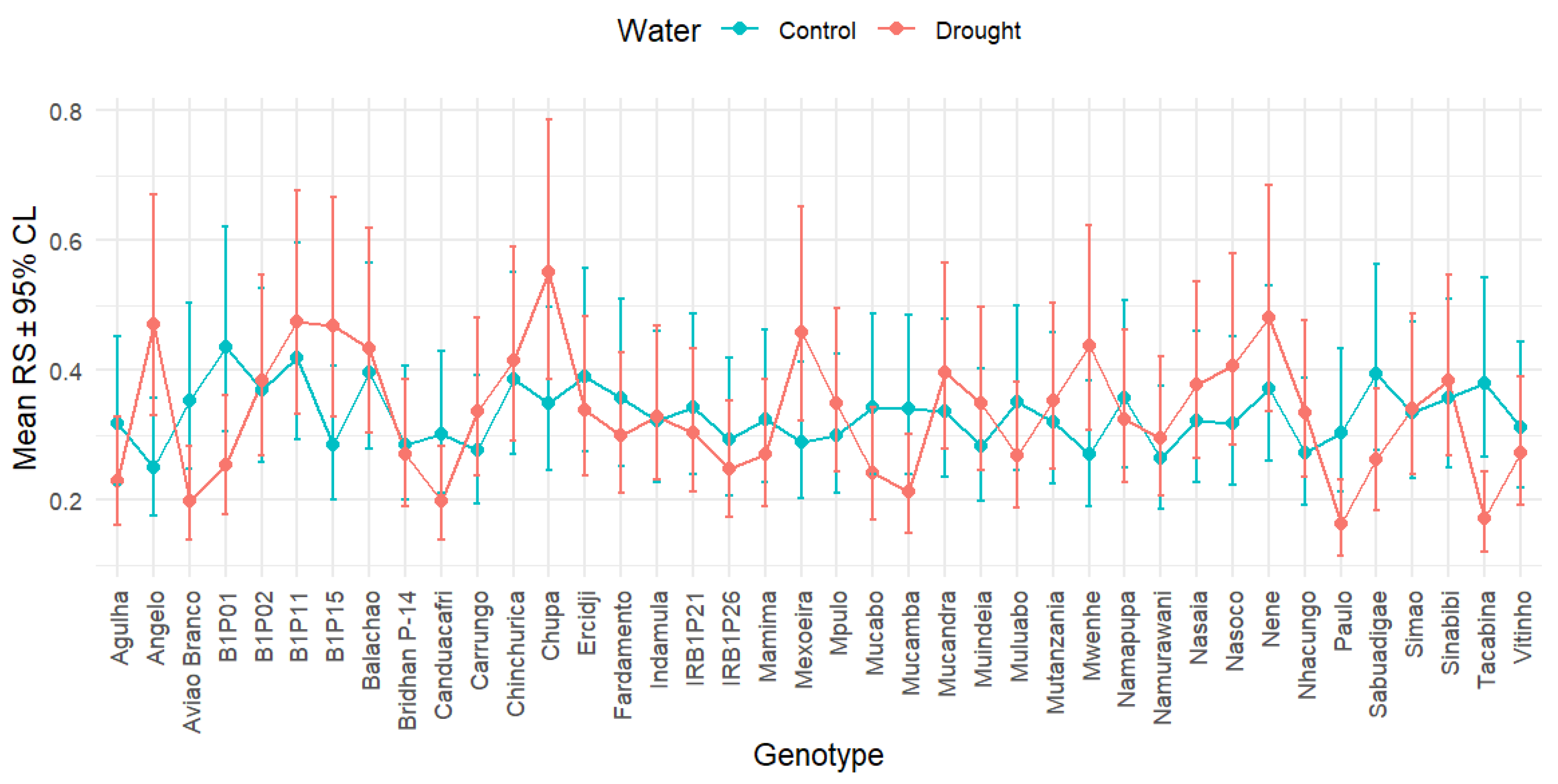
Root-to-shoot ratio (RS) showed a non-significant 3% reduction, with a mean value of 0.32 under drought and 0.33 under control. However, the significant water × genotype interaction indicated genotypic variation in RS ratio plasticity, suggesting that such responses were genotype-specific rather than consistent across genotypes (Figure 1). For instance, genotype Angelo and Mexoeira showed increased RS ratio under drought (0.47 and 0.46) compared with the control (0.25 and 0.29), whereas Paulo and Tacabina exhibited reduced RS ratio under drought (0.16 and 0.17) relative to control (0.30 and 0.38). Similar observations have been reported in rice, where RS ratio remains relatively stable under optimal conditions but varies significantly under water stress, reflecting environmentally driven expression of genetic differences [12]. Genotypes that increase root allocation under drought may enhance soil resource acquisition, resulting in higher RS ratio values and potential adaptive advantage under water-limited conditions [26].
  • Root traits
The most affected root trait was root dry weight which declined by 52.8%, with a mean of 18.7 mg under drought compared to 39.6 mg under control. Number of roots was also significantly reduced by 39.3%, averaging 8.5 roots under drought compared to 14 under control. Reduced soil water availability constrains root growth by lowering water potential in root meristematic tissues, thereby slowing cell division and elongation, while dry soil conditions may further restrict root penetration [7]. Depending on genotype, stress intensity, and duration, drought may elicit contrasting root responses, including maintenance or stimulation of root elongation to enhance water exploration, often accompanied by a reduction in root number and overall root biomass [27]. In the present study root length was not significantly reduced by drought stress; however, the maximum root length under drought (22.9 cm) exceeded that observed under control (20.9 cm). Similar patterns have been reported under PEG-induced stress by [28], whereas [29] observed a significant reduction in root length of 32.6%, underscoring the sensitivity of root elongation responses to stress severity and experimental conditions.
  • Shoot traits
There were significant reductions in all shoot traits under drought compared to control treatment. Shoot dry weight was the most affected, declining by 51.6%, with a mean of 58.3 mg under drought compared to 120.5 mg under control. Shoot length was the least affected, showing a reduction of 21.1%, with a mean of 30.2 cm compared to 38.3 cm under control. Drought stress is known to disrupt cell division and limit cell elongation, resulting in restricted shoot growth [30]. Reductions in shoot traits under seedling-stage drought have been reported in previous studies. For example, Ref. [29] reported a 46% reduction in shoot length, while ref. [13] observed a reduction of 15.7% for shoot length and 18.4% for shoot dry weight, and ref. [28] recorded a 36.3% decrease in total dry weight under PEG-6000-induced stress. Differences in reported values may reflect variation in experimental conditions, plant developmental stage, genotype, and stress intensity. Nonetheless, the overall trend indicates that drought exerts a negative effect on aboveground growth in rice seedlings. Furthermore, reductions in shoot growth may also result from drought-induced limitations on mineral uptake and metabolic activity, altering assimilate partitioning and contributing to biomass reduction [31].

2.1.4. Morphological Performance of Genotypes Under Drought Treatment

Table 5 presents estimated means of 40 rice genotypes under drought and control treatments. Means comparison using Tukey’s HSD (α = 0.05) showed significant differences among genotypes for all traits, except for number of roots and the longest root.
  • Number of roots with at least 5 cm length
Genotype Chupa recorded the highest mean number of longer roots (5.9), whereas Vitinho exhibited the lowest value (0.9). Variation in root number reflects genotypic differences in root growth in response to drought stress and has been used as a selection criterion in rice screening [32]. Roots are the first organs to sense soil water deficit and play an important role in initiating adaptive responses to drought. According to [33], a higher number of roots increases the absorptive surface area for water uptake, while longer roots enable seedlings to access moisture from deeper soil layers as surface water becomes depleted. Root phenotyping remains challenging due to limited low-cost screening techniques, which may explain the scarcity of comparable data for root traits relative to above-ground components [34].
  • Root dry weight
For root dry weight, genotype Chupa had the highest estimated mean (42.2 mg), while the lowest were observed for Ercidji, B1P01, Tacabina, and Agulha (9.5 to10.9 mg). Differences in root dry weight among rice genotypes have been reported in other drought screening studies. Ref. [35] reported root dry weight of 48-day-old seedlings under PEG-6000-induced stress ranging from 510 to 1590 mg, while [23] observed 30 to 2490 mg in 45-day old seedlings grown in PVC pipes. Such variation highlights the influence of experimental conditions and genotypic-specific responses.
  • Root-to-shoot ratio
For root-to-shoot ratio (RS) genotype Chupa exhibited the highest mean value (0.55), whereas Paulo recorded the lowest (0.16). A high RS ratio reflected a prioritized biomass allocation toward the root system, a strategy that enhances soil moisture extraction while minimizing transpiration demand [36]. On the contrary, the low RS ratio suggested greater investment in aboveground biomass, a strategy often favored in resource rich environments; however, this allocation pattern may increase susceptibility under water-limited conditions [8]. Therefore, the observed genotypic variations underscore RS ratio as a selection criterion for drought tolerance screening, consistent with previous findings [37].
  • Shoot length
Genotypes Mucabo, Indamula, and Namapupa had the longest shoots, with mean values ranging from 36.5 to 37.2 cm, while Ercidji and Mexoeira recorded the shortest shoots (22.7 cm and 23.8 cm, respectively). Although drought suppresses shoot elongation, the sustained growth observed in some genotypes suggests high seedling vigor and adaptive growth plasticity. This maintenance of shoot growth under reduced turgor has been associated with osmotic adjustment, which enables continued cell expansion despite water deficit [8]. Conversely, the reduced shoot length may reflect drought sensitivity or a stress-avoidance strategy, where cell elongation is suppressed to conserve internal water status. However, such excessive growth reduction may limit photosynthetic surface area and assimilate accumulation, thereby constraining productivity [38]. Genotypes capable of maintaining shoot growth while concurrently investing in robust root systems represent desirable ideotypes for drought-prone environments, as they balance water acquisition with aboveground growth potential [37].
  • Shoot dry weight
For shoot dry weight, genotypes Aviao Branco, Mutanzania, Nasaia, Simao, Namapupa, Chupa, Nene, Indamula and Paulo recorded the highest means (71.5 to 88.7 mg), whereas Ercidji had the lowest (28.6 mg). The ability of certain genotypes to maintain high shoot biomass under drought stress may reflect an efficient source–sink balance, allowing continued dry matter partitioning to the shoots as soil water availability declines [39]. This maintenance has been associated with greater leaf area retention and chlorophyll stability, which can delay stress-induced senescence and support continued photosynthetic activity [40]. The lower shoot dry weight observed in Ercidji may indicate sensitivity to drought, resulting in constrained shoot growth and reduced dry matter [7]. As shoot dry weight integrates multiple above ground growth organs, the genotypic variations reflect its usefulness as a discriminating trait for drought tolerance screening.
  • Seedling biomass
Seedling biomass varied among genotypes, with B1P02, Mutanzania, Namapupa, Simao, Nasaia, Paulo, Indamula, Nene, and Chupa showing the highest means (96.6 to 120.8 mg), while Ercidji had the lowest (38.5 mg). The reduction in seedling biomass can be attributed to the inhibited growth of shoot-related traits, including leaf number, leaf area, shoot length, and stem diameter, which impair photosynthetic capacity, leading to reduced dry matter accumulation [41]. Seedling dry weights from 0 to 40 mg were reported under PEG-6000-induced stress [42]. Although the absolute values differ, the overarching trend confirms seedling biomass as a useful parameter in drought tolerance screening.

2.2. Correlation of 10 Morphological Traits Under Drought Conditions

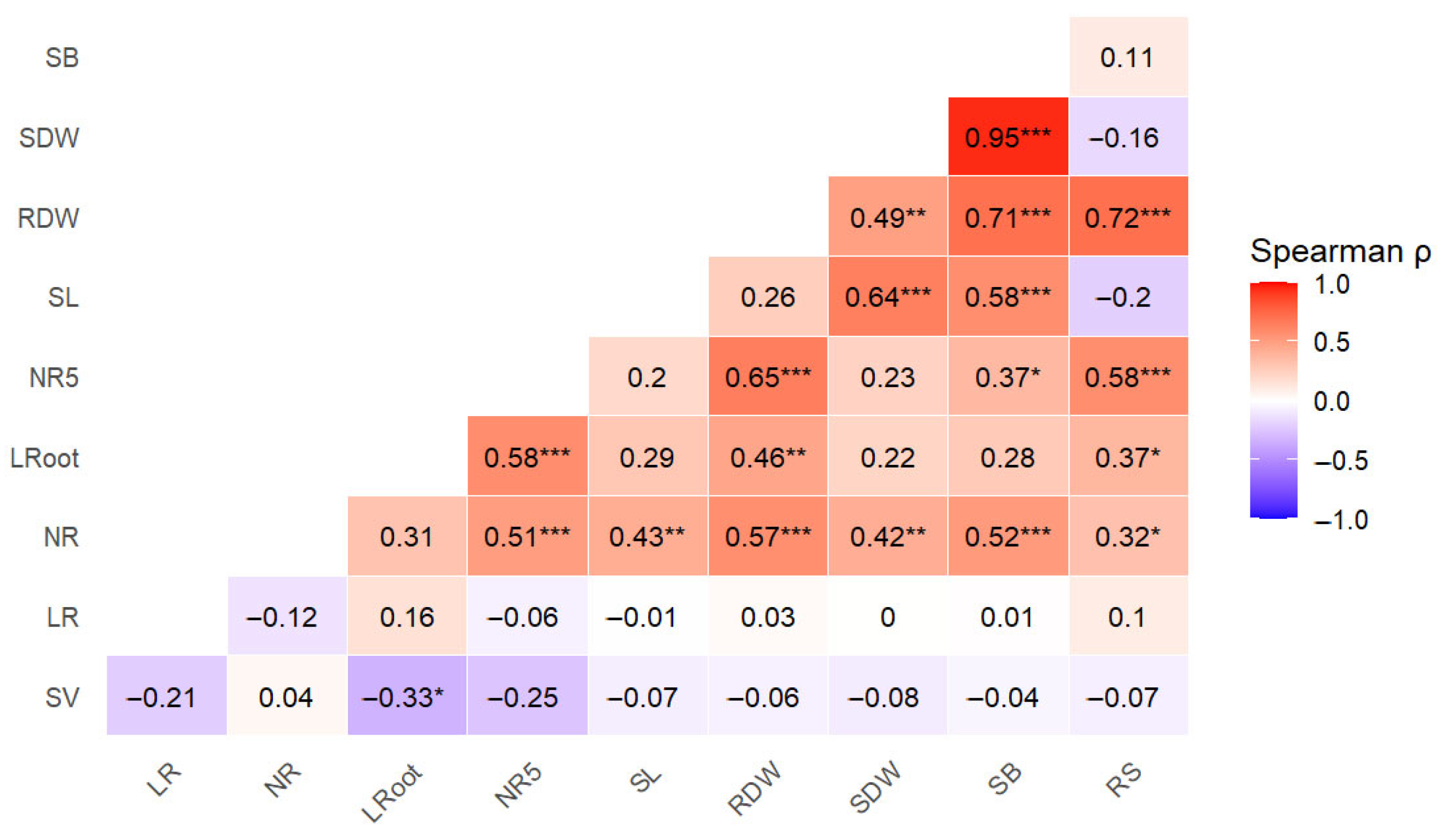
Overall, root traits showed positive associations with shoot traits under drought conditions (Figure 2). Root dry weight exhibited positive and significant association with seedling biomass (ρ = 0.71) and shoot dry weight (ρ = 0.49). Number of roots correlated significantly with shoot length (ρ = 0.43), shoot dry weight (ρ = 0.42) and seedling biomass (ρ = 0.52), while the number of roots with at least 5 cm length showed positive association with seedling biomass (ρ = 0.37). Root-to-shoot ratio (RS) significantly correlated with all root traits, particularly root dry weight (ρ = 0.72) and number of roots with at least 5 cm length (ρ = 0.58). Drought tolerance has been linked to several root system traits, including root number, root length, and root dry weight [26]. Understanding the relationships between these and aboveground growth traits is important for selection, as shoot development and yield-related attributes ultimately influence plant productivity under stress [35]. In this context, correlation analysis is useful for identifying traits whose selection may indirectly enhance plant performance, as significant positive correlations suggest that improvement in one trait may be accompanied by gains in another [43]. Consistent with previous reports [35], the observed positive associations indicate that selection based on root traits and RS ratio may improve seedling growth under drought stress.
However, while selection for a high RS ratio under drought stress may contribute to improved drought adaptation, a balanced investment between root and shoot growth remains important for sustained plant development beyond the seedling stage. An increased RS ratio does not necessarily indicate enhanced root growth, as it may result from reduced shoot biomass rather than enhanced root growth. This phenomenon is particularly evident under mild to moderate water stress, where shoot development may be more restricted than root growth, leading to higher ratios without substantial increases in root development [44].

2.3. Principal Component Analysis and Cluster Analysis Under Drought Treatment

  • Principal component analysis
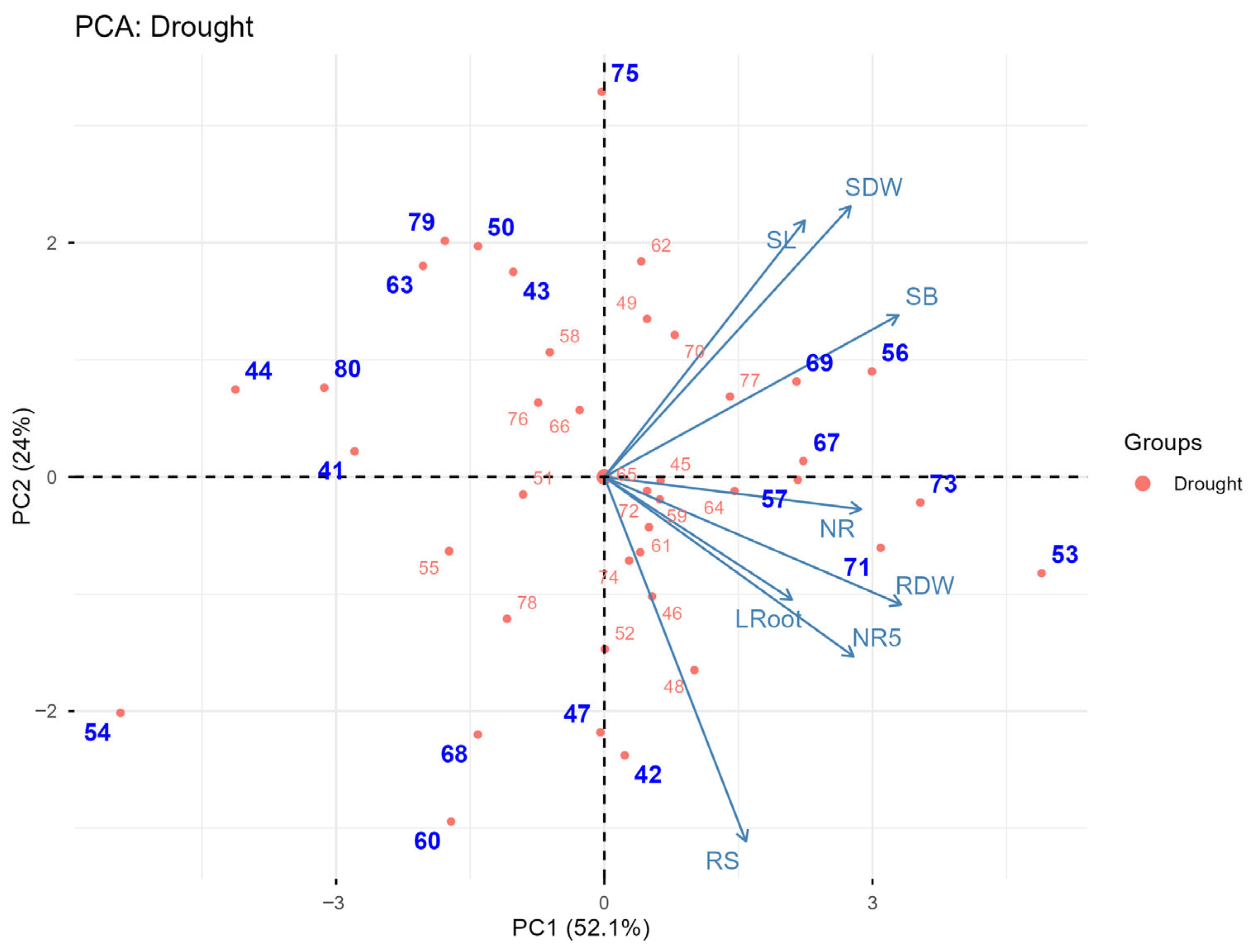
In principal component analysis (PCA), components with eigenvalues greater than 1 were considered for interpretation, as explained by [45]. The dispersion of genotypes across the biplot coordinate space indicated the existence of morphological variation among genotypes (Figure 3). The first two principal components (PCs) explained 76.1% of total variation. The first principal component (PC1) accounted for 52.1% of the observed phenotypic variation and was primarily associated with biomass-related traits including root dry weight and seedling biomass. PC1 represented a seedling vigor dimension, indicating that high-performing genotypes tend to maintain both root and shoot systems growth. For example, genotypes 53 (Chupa) and 56 (Indamula) positioned on the positive side of PC1, reflected superior biomass accumulation under water stress, whereas 54 (Ercidji) and 60 (Mexoeira) located on the negative side of PC1 indicated limited growth.
The second principal component (PC2) explained 24% of total variation and was dominated by root-to-shoot ratio (RS), reflecting biomass allocation strategies among genotypes. PC2 showed association with root traits (NR, NR5, RDW and LRoot), suggesting that genotypes with higher RS allocate a greater proportion of biomass to root development relative to shoots. For instance, genotypes 42 (Angelo) and 47 (B1P15) exhibited relatively high biomass combined with a stronger shift toward root investment, whereas 63 (Mucamba) and 79 (Tacabina) showed low root biomass allocation.
In rice drought tolerance screening, PCA aids in identifying key traits contributing to stress response and in grouping genotypes based on overall performance, supporting its use as part of selection indices in breeding programs [46]. Studies have leveraged this technique to reveal genetic diversity under stress conditions. For example, Ref. [47] reported that principal components with eigenvalues greater than one accounted for about 88% of the total phenotypic variability, with germination rate, seed vigor, and seedling height identified as among the contributors to this variation.
  • Cluster analysis
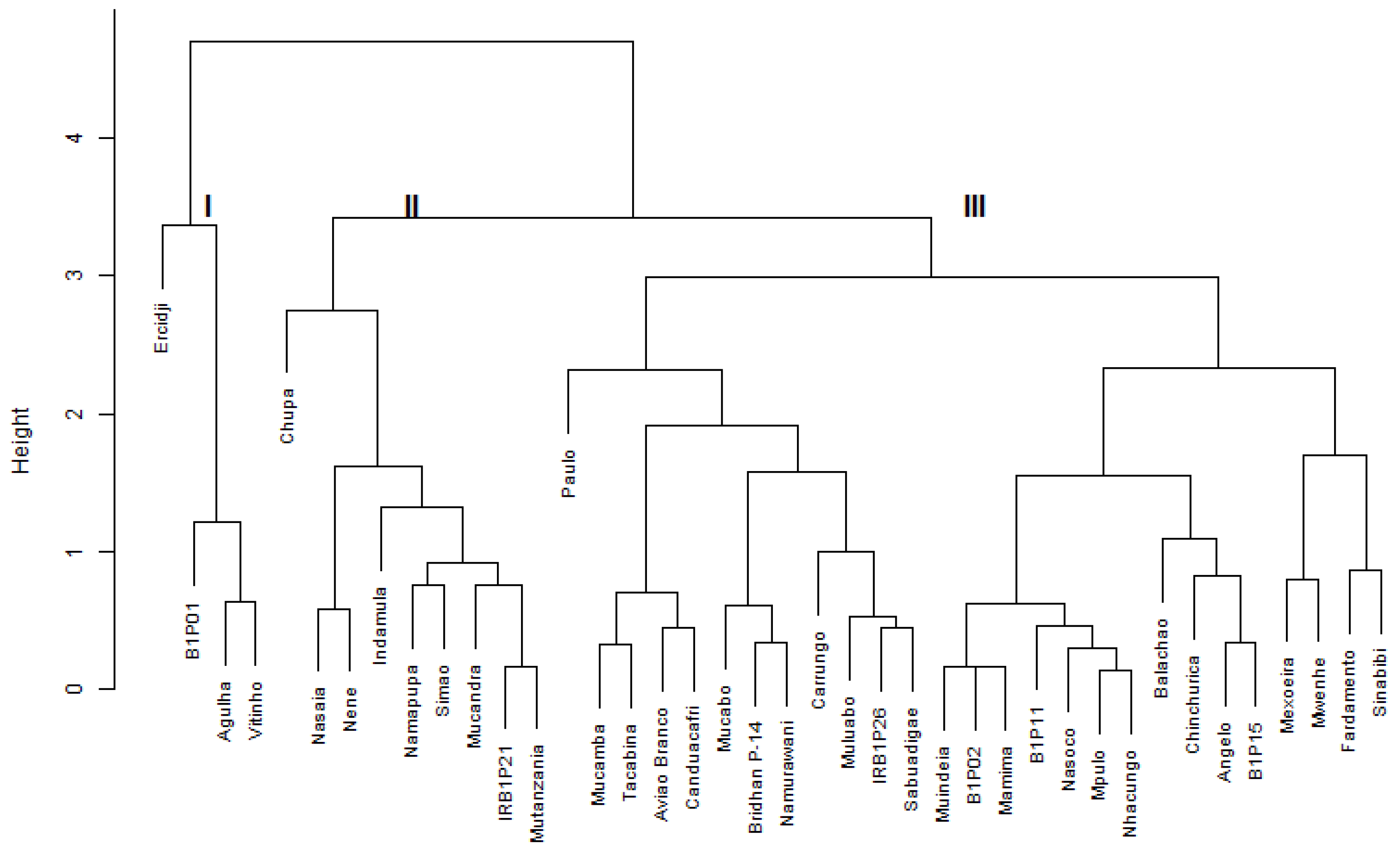
In order to further explore morphological variability among the 40 rice genotypes, a hierarchical cluster analysis was performed using the Unweighted Pair Group Method with Arithmetic Mean (UPGMA) based on phenotypic dissimilarity (Figure 4). Euclidean distances were calculated from the first two principal components. The average Euclidean distance among genotypes was 3.07, ranging from 0.14 between Mpulo and Nhacungo, to 10.37 between Ercidji and Chupa.
The cluster analysis grouped genotypes into three major clusters; Cluster I comprised four genotypes exhibiting low seedling vigor, with an average score of −3.87 for PC1 and −0.07 for PC2. Cluster II contained nine genotypes with high seedling vigor (average scores of 2.66 PC1 and 0.08 PC2), whereas Cluster III consisted of 27 genotypes with intermediate seedling vigor (average score of −0.31 PC1 and −0.02 PC2). This clustering pattern indicated a distinct phenotypic structure within the population based on seedling vigor traits.
Euclidean distance has been applied as a measure of phenotypic divergence, with higher values indicating greater dissimilarity among genotypes [48]. Ref. [49] reported phenotypic diversity among upland rice genotypes and highlighted their potential value for targeted breeding and conservation initiatives. The most dissimilar genotypes may be used in crosses to create variability in breeding programs.

2.4. Coefficient of Variation, Heritability and Expected Genetic Advance

  • Coefficient of variation
Under drought conditions, the phenotypic coefficient of variation (PCV) ranged from 3.76% for shoot length to 22.32% for number of roots with at least 5 cm length, and genotypic coefficient of variation (GCV) was from 3.38% for shoot length, to 15.46% for number of roots (Table 6). PCV values were higher than GCV, indicating a considerable influence of the environmental factors on trait expression, a common characteristic observed in quantitative traits controlled by multiple genes [50]. Nevertheless, the appreciable GCV values indicated the presence of exploitable genetic variability, which is important for genotype selection in breeding programs. Similar patterns have been reported in rice; reference [28] found PCV and GCV values of 30.5% and 21.2% for plant height, 21.1% and 16.1% for root length, and 25.2% and 8.8% for total dry weight. Differences between these and the present values further highlight the influence of environment in trait expression.
  • Heritability and expected genetic advance
Broad sense heritability was classified as low (<30%), moderate (30–60%), and high (>60%) [51]. Generally high broad sense heritability (H2) was observed for most traits under drought treatment, including shoot length (80.5%), root dry weight (63.2%), shoot dry weight (66%), and seedling biomass (65.7%), reflecting strong genetic control of these traits, even under water-limited environments (Table 6). However, the longest root showed the lowest heritability (20.2%), implying that its phenotypic expression is largely influenced by environmental factors. This phenotypic plasticity allows plants to modulate root elongation, branching, and growth angles to optimize water and nutrient acquisition across heterogeneous soil environments [52]. Interestingly, the root-to-shoot ratio showed greater heritability under drought stress (59.4%) than control (0), indicating that genetic variation for biomass allocation is largely expressed under water deficit.
The range of genetic advance as percent of mean (GAM) was classified as low (<10%), moderate (10–20%), and high (>20%) as applied by [53]. Under drought conditions, number of roots recorded a high GAM (24.18%) and root dry weight showed a moderate GAM (15.21%), whereas other traits exhibited low genetic gain (Table 6). Notably, number of roots (H2 = 58%, GAM = 24.18%), number of roots with at least 5 cm length (H2 = 47%, GAM = 21.44%), and root dry weight (H2 = 63%, GAM = 15.21%) expressed a favorable combination of moderate to high broad sense heritability and GAM.
Previous research has emphasized that traits exhibiting moderate to high heritability under drought conditions are more reliable for selection in breeding programs, as a greater proportion of the observed phenotypic variation is attributable to genetic rather than environmental factors [50]. However, quantitative traits are often influenced by both additive and non-additive gene actions. Non-additive gene effects, including dominance, epistasis, and heterosis, can obscure the contribution of additive genetic variance that drives selection response [54]. Thus, for effective selection progress, high heritability estimates should be interpreted in conjunction with expected genetic advance [55]. Based on this criterion, traits such as the number of roots, number of roots with at least 5 cm length, and root dry weight demonstrated greater potential for selection response under water deficit and may serve as reliable indicators for seedling-stage drought tolerance screening.

2.5. Classification of Rice Genotypes Based on Drought Response Indices

Drought tolerance is a complex polygenic trait that requires the integration of morpho-physiological and biochemical components for effective selection [56]. The Combined Drought Stress Response Index (CDSRI) proved to be an effective approach for merging multiple drought-related indices into a single selection tool (Table 7). The CDSRI scores showed variation among genotypes, ranging from −9.84 to +10.19, with positive values indicating above average performance and negative values indicating susceptibility. The highest CDSRI scores were observed for genotypes B1P15 (10.19) and Chupa (9.17), whereas the lowest were for Tacabina (−9.84) and Canduacafri (−9.52). CDSRI exhibited positive correlations with root traits and root-to-shoot ratio, highlighting the importance of root traits for identifying superior drought performance, as also reported by [13].
Based on population standard deviation (SD) of 4.62, the genotypes were classified into four groups. Group I, for tolerant genotypes (CDSRI > 1*SD), group II for moderately tolerant genotypes (0 < CDSRI < 1*SD), group III for moderately sensitive genotypes (−1*SD < CDSRI < 0), and group IV for sensitive genotypes (CDSRI < −1*SD). Using this criterion, group I comprising seven genotypes (17.5%), group II included 12 genotypes (30%), group III contained 16 genotypes (40%), and group IV consisted of five genotypes (12.5%). This method builds on the successful applications of [12,13], who used similar classifications to identify drought-tolerant genotypes.

3. Materials and Methods

3.1. Plant Materials

Forty rainfed lowland rice (Oryza sativa L.) genotypes were evaluated for their response to progressive drought stress (Table 8). Among these, 34 were landraces cultivated for many years in central Mozambique, and 6 were breeding lines: 4 from AfricaRice and two from the International Rice Research Institute (IRRI), all conserved at the Regional Research Centre of Leadership for Rice (CLIPA) of the Mozambican Agricultural Research Institute (IIAM).

3.2. Description of Experimental Site

The experiment was conducted in greenhouse from June to July 2025 at CLIPA/IIAM, Namacurra, Mozambique, with geographical coordinates of 17°29′35.1″ S, 37°00′34.0″ E. The site is located in agroecological zone 5, characterized by a tropical savanna climate (Aw) and slightly saline soils that are medium-textured, deep, and low in organic matter [57].

3.3. Experimental Design and Crop Management

The experiment was arranged as a split-plot in a randomized complete block design (RCBD) with three replicates. Water was the main-plot factor, and genotypes were sub-plots. Two soil moisture treatments were imposed: well-watered (control) and drought. Spacing between blocks, main plots, and sub-plots rows were 140 cm, 60 cm, and 20 cm, respectively, while plant spacing in a bag was 10 cm. A similar experimental arrangement has been previously reported as effective [28]. Seeds were soaked in water for 24 h and incubated for 48 h. Pre-germinated seeds were directly sown into polyethylene bags (15.3 cm diameter × 30 cm height), filled with 6257 g of clay loam soil). Initially, 3–5 seeds per genotype were sown per bag and later thinned to two seedlings at 7 days after emergence. NPK fertilizer (1:2:1) was applied based on local recommendations [58,59] (Supplementary File S2, Figures S1.2–S1.6).

3.4. Drought Treatment

The control treatment was maintained under optimal moisture by irrigating once daily throughout the experimental period (35 days after sowing, DAS). For the drought treatment, bags were irrigated once daily during the first 14 DAS, to ensure uniform seedling establishment, after which irrigation was completely withheld from 15 to 35 DAS. This procedure imposed progressive drought stress for 21 days. Meteorological data for the experiment were obtained through an official request from the National Institute of Meteorology (INAM) weather station (Table 9). The average daily maximum temperature during the study period was 28.1 °C in June, while the minimum was 16.5 °C in July. The average daily total pan evaporation was 3.8 mm and 2.7 mm for June and July, respectively. The cumulative total pan evaporation during the 35-day study period was 94 mm (Supplementary File S1, Table S4).

3.5. Data Collection

Morphological traits were measured for both plants in each bag following the International Rice Research Institute’s Standard Evaluation System for Rice (SES) [20,60].
  • Seedling vigor was recorded 14 days after sowing using a scale of 1 to 9: 1 (Extra vigorous), 3 (Vigorous), 5 (Normal), 7 (Weak), and 9 (Very weak).
  • Leaf rolling was recorded at 26 days after sowing using a scale of 0 to 9: 0 (healthy), 1 (start to fold), 3 (folding), 5 (fully cupped), 7 (margins touching), 9 (tightly rolled).
  • Total number of roots was determined by counting both seminal and nodal roots. Lateral roots were excluded because visual counting is prone to errors.
  • Longest root (cm) was recorded as the maximum length of roots.
  • Number of roots ≥5 cm was determined by counting all roots measuring at least 5 cm.
  • Shoot length (cm) was measured from the seedling base to the tip of the longest leaf.
  • Root and shoot dry weight (mg) were determined as the dry weights of roots and shoots, respectively. Samples were oven-dried at 75 °C for 72 h to constant weight using the Memmert 30-1060 UN110 Universal Oven (Memmert GmbH + Co. KG, Schwabach, Germany). The samples were cooled before weighing using an Adam PGW 753e Precision Balance (± 0.001 g; Adam Equipment Co. Ltd., Milton Keynes, United Kingdom) (Supplementary File S2: Figures S1.12 and S1.13).
  • Seedling Biomass (mg) was calculated as the sum of root and shoot dry weights.
  • Root-to-shoot ratio was expressed as the ratio of root-to-shoot dry weights.
  • Heritability and genetic advance were estimated following the procedures by [61].
  • The Combined Drought Stress Response Index (CDSRI) was determined by adding the standardized individual drought stress response indices (IDSRI) of a genotype. The IDSRI was calculated as the ratio using the formula described by [13]
I D S R I i = P d P c
C D S R I = i = 1 8 I D S R I
where Pd = trait value under drought; Pc = trait value under control; IDSRI = individual drought stress response index for trait i; CDSRI = combined drought stress response index of a genotype.

3.6. Data Analysis

Descriptive statistics were determined for all measured morphological traits. Data normality and homoscedasticity of variances were assessed at 5% significance level using Shapiro–Wilk and Levene’s tests, respectively. Prior to analysis of variance (ANOVA), logarithmic transformation (log) was applied to most traits, except for number of roots and the longest root; however, results were presented using back-transformed values for ease of interpretation. A linear mixed-effects model was fitted using the lme4 package version 1.1-37 in R [62]. In the split-plot design, water and genotype were fixed effects, while block and the water × block term were random effects [63]
Y i j k = μ + τ k + α i + δ i k + β j + ( α β ) i j + ε i j k
where Yijk = observation for ith water level and jth genotype in the kth block; μ = overall mean; τk = block effect; αi = water effect; δik = main plot error; βj = genotype effect; (αβ)ij = water × genotype interaction effect; εijk = subplot error.
Post hoc mean comparisons were performed using Tukey’s honestly significant difference (HSD; α = 0.05). Pairwise associations among traits were determined using Spearman’s rank correlation coefficient (ρ). Principal component analysis (PCA) followed by hierarchical clustering using the unweighted pair group method with arithmetic mean (UPGMA) based on Euclidean distances was employed following the approach described by [64]. The combined drought stress response index (CDSRI) was used to rank genotypes for drought tolerance. Statistical analyses were performed using R version 4.5.1 [65] (Supplementary File S3, R scripts).

4. Conclusions

The screening of 40 lowland rainfed rice genotypes from central Mozambique revealed substantial morphological variability in response to progressive drought stress at the seedling stage. Drought caused significant reductions in number of roots, number of roots with at least 5 cm length, shoot length, root dry weight, shoot dry weight, and seedling biomass. The significant water × genotype interaction for root-to-shoot ratio indicated genotype specific responses to biomass allocation under drought stress. Correlation analysis, along with heritability and genetic advance, identified number of roots, number of roots with at least 5 cm length, root dry weight, and root-to-shoot ratio as reliable selection criteria for seedling-stage drought stress screening. Principal component analysis identified seedling vigor and biomass allocation as the primary axes of variation, and cluster analysis discriminated genotypes into three main groups based on their phenotypic profiles. The correlation between CDSRI, root traits, and the root-to-shoot ratio reinforced the importance of root phenotypes for identifying superior genotypes under drought stress. Most genotypes (70%) were moderately tolerant or moderately sensitive, while 17.5% were drought tolerant. The tolerant genotypes (B1P15, Chupa, Mucabo, Mpulo, Nasoco, Nene, and Mutanzania) represent promising parental material for breeding and warrant further evaluation under field conditions to elucidate the physiological and genetic mechanisms underlying their drought tolerance. This study provides insights for breeding climate-resilient rice suited to the lowland rainfed agroecology of central Mozambique and supports investments in targeted breeding programs.

Supplementary Materials

The following supporting information can be downloaded at: https://www.mdpi.com/article/10.3390/stresses6010013/s1, Supplementary File S1: Data and analyses; Supplementary File S2: Study images; Supplementary File S3: R script.

Author Contributions

Conceptualization, methodology and writing—original draft: K.G.W.; Writing—review and editing: All authors; Supervision: C.M.M. and L.D.M.; Funding acquisition: C.M.M. All authors have read and agreed to the published version of the manuscript.

Funding

This work was supported by the Centre of Excellence in Agri-Food Systems and Nutrition (CE-AFSN), Eduardo Mondlane University, Maputo, Mozambique, through the World Bank (Grant number E089-MZ).

Institutional Review Board Statement

Not applicable.

Informed Consent Statement

Not applicable.

Data Availability Statement

All data presented in this study are included in the article/Supplementary Material. The meteorological data used in this study are available upon official request from the National Institute of Meteorology (INAM), Mozambique.

Acknowledgments

We thank the Mozambican Agricultural Research Institute (IIAM) for technical and infrastructure support.

Conflicts of Interest

The authors declare no conflicts of interest.

Abbreviations

The following abbreviations are used in this manuscript:
SVSeedling vigor
LRLeaf rolling
NR Number of roots
LRootLongest root
NR5 Number of roots ≥ 5 cm
SL Shoot length
RDW Root dry weight
SDW Shoot dry weight
SB Seedling biomass
RS Root-to-shoot ratio
DAS Days after sowing
CDSRI Combined Drought Stress Response Index

References

  1. Bao, J. Rice. In ICC Handbook of 21st Century Cereal Science and Technology; Elsevier: Amsterdam, The Netherlands, 2023; pp. 145–151. [Google Scholar] [CrossRef]
  2. FAOSTAT Statistical Database. Food and Agriculture Organization of the United Nations, Rome. Available online: https://www.fao.org/faostat/en/#data/QCL (accessed on 10 January 2026).
  3. Gholinia, A.; Abbaszadeh, P. Agricultural Drought Monitoring: A Comparative Review of Conventional and Satellite-Based Indices. Atmosphere 2024, 15, 1129. [Google Scholar] [CrossRef]
  4. Darko, A.M.; Owusu Danquah, E.; Dormatey, R.; Keteku, A.K.; Frimpong, F.; Adjah, K.L.; Osei-Wusu, M.O.; Ayamba, B.E.; Ofosu, K.A.; Dankwa, K.O.; et al. Global Rice Production: Current Status, Challenges, and Future Scenarios. In Rice Cultivation Under Abiotic Stress; Elsevier: Amsterdam, The Netherlands, 2025; pp. 3–21. [Google Scholar] [CrossRef]
  5. Adzigbe, J.; Frimpong, F.; Danquah, A.; Danquah, E.Y.; Asante, I.K.; Abebrese, S.O.; Dormatey, R.; Afriyie-Debrah, C.; Ribeiro, P.F.; Danquah, E.O.; et al. The Responses and Adaptations of Rice (Oryza sativa L.) to Drought Stress: A Review. Clim. Smart Agric. 2025, 2, 100080. [Google Scholar] [CrossRef]
  6. Guo, H.; Wang, R.; Garfin, G.M.; Zhang, A.; Lin, D.; Liang, Q.; Wang, J. Rice Drought Risk Assessment under Climate Change: Based on Physical Vulnerability a Quantitative Assessment Method. Sci. Total Environ. 2021, 751, 141481. [Google Scholar] [CrossRef]
  7. Jarin, A.S.; Islam, M.; Rahat, A.; Ahmed, S.; Ghosh, P.; Murata, Y. Drought Stress Tolerance in Rice: Physiological and Biochemical Insights. Int. J. Plant Biol. 2024, 15, 692–718. [Google Scholar] [CrossRef]
  8. Hassan, M.A.; Dahu, N.; Hongning, T.; Qian, Z.; Yueming, Y.; Yiru, L.; Shimei, W. Drought Stress in Rice: Morpho-Physiological and Molecular Responses and Marker-Assisted Breeding. Front. Plant Sci. 2023, 14, 1215371. [Google Scholar] [CrossRef]
  9. Haghpanah, M.; Hashemipetroudi, S.; Arzani, A.; Araniti, F. Drought Tolerance in Plants: Physiological and Molecular Responses. Plants 2024, 13, 2962. [Google Scholar] [CrossRef]
  10. Kumar, K.P.; Pushpam, R.; Manonmani, S.; Raveendran, M.; Santhiya, S.; Senthil, A. Enhancing Stress Resilience in Rice (Oryza sativa L.) through Profiling Early-Stage Morpho-Physiological and Molecular Responses to Multiple Abiotic Stress Tolerance. Front. Plant Sci. 2024, 15, 1342441. [Google Scholar] [CrossRef]
  11. Singh, B.; Reddy, K.R.; Redoña, E.D.; Walker, T. Screening of Rice Cultivars for Morpho-Physiological Responses to Early-Season Soil Moisture Stress. Rice Sci. 2017, 24, 322–335. [Google Scholar] [CrossRef]
  12. Lone, A.A.; Jumaa, S.H.; Wijewardana, C.; Taduri, S.; Redona, E.D.; Raja Reddy, K. Drought Stress Tolerance Screening of Elite American Breeding Rice Genotypes Using Low-Cost Pre-Fabricated Mini-Hoop Modules. Agronomy 2019, 9, 199. [Google Scholar] [CrossRef]
  13. Kakar, N.; Jumaa, S.H.; Sah, S.K.; Redoña, E.D.; Warburton, M.L.; Reddy, K.R. Genetic Variability Assessment of Tropical Indica Rice (Oryza sativa L.) Seedlings for Drought Stress Tolerance. Plants 2022, 11, 2332. [Google Scholar] [CrossRef]
  14. Ministério de Agricultura e Desenvolvimento Rural. Programa Nacional Do Arroz (PNA) 2030; Ministério de Agricultura e Desenvolvimento Rural: Maputo, Mozambique, 2022. [Google Scholar]
  15. Kodama, W.; Pede, V.O.; Mishra, A.K.; Cuevas, R.P.O.; Ndayiragije, A.; Cabrera, E.R.; Langa, M.; Ali, J. Assessing the Benefits of Green Super Rice in Sub-Saharan Africa: Evidence from Mozambique. Q Open 2022, 2, qoac006. [Google Scholar] [CrossRef]
  16. International Rice Research Institute (IRRI) in Mozambique. Available online: https://www.irri.org/where-we-work/mozambique (accessed on 8 January 2026).
  17. Negi, P.; Rane, J.; Wagh, R.S.; Bhor, T.J.; Godse, D.D.; Jadhav, P.; Anilkumar, C.; Sreekanth, D.; Sammi Reddy, K.; Gadakh, S.R.; et al. Direct-Seeded Rice: Genetic Improvement of Game-Changing Traits for Better Adaption. Rice Sci. 2024, 31, 417–433. [Google Scholar] [CrossRef]
  18. Singh, P.; Pahi, B.; Sundaram, K.T.; Gnanapragasam, N.; Habde, S.V.; Kumar, N.V.; Patil, N.D.; Paul, P.J.; Kumar, R.S.; Singh, S.P.; et al. Superior Haplotypes of Genes Associated with Higher Grain Yield under Reproductive Stage Drought Stress in Rice. J. Exp. Bot. 2025, 76, 5086–5101. [Google Scholar] [CrossRef]
  19. Khamis, G.; Alsherif, E.A.; Korany, S.M.; Aldailami, D.A.; Aloufi, A.S.; Khalaf, M.H.; Hamed, S.M.; Maridueña-Zavala, M.G.; Al Jaouni, S.K.; Selim, S. Drought Stress Differentially Influences Growth, Physiology, and Metabolite Accumulation in Triticum Aestivum (C3) and Amaranthus Caudatus (C4) Plants. BMC Plant Biol. 2025, 25, 1199. [Google Scholar] [CrossRef]
  20. International Rice Research Institute (IRRI). Standard Evaluation System (SES) for Rice, 5th ed.; International Rice Research Institute (IRRI): Manila, Philippines, 2013. [Google Scholar]
  21. Sruthi, P.; Surendran, U.; Siddiqui, M.H.; Alamri, S. Understanding the Leaf Rolling of Paddy and Exploring Its Management Options under Aerobic Rice. Sci. Rep. 2024, 14, 19335. [Google Scholar] [CrossRef]
  22. Wei, X.; Cang, B.; Yu, K.; Li, W.; Tian, P.; Han, X.; Wang, G.; Di, Y.; Wu, Z.; Yang, M. Physiological Characterization of Drought Responses and Screening of Rice Varieties under Dry Cultivation. Agronomy 2022, 12, 2849. [Google Scholar] [CrossRef]
  23. Verma, H.; Borah, J.L.; Sarma, R.N. Variability Assessment for Root and Drought Tolerance Traits and Genetic Diversity Analysis of Rice Germplasm Using SSR Markers. Sci. Rep. 2019, 9, 16513. [Google Scholar] [CrossRef]
  24. Finch-Savage, W.E.; Bassel, G.W. Seed Vigour and Crop Establishment: Extending Performance beyond Adaptation. J. Exp. Bot. 2016, 67, 567–591. [Google Scholar] [CrossRef]
  25. Latif, A.; Ying, S.; Cuixia, P.; Ali, N. Rice Curled Its Leaves Either Adaxially or Abaxially to Combat Drought Stress. Rice Sci. 2023, 30, 405–416. [Google Scholar] [CrossRef]
  26. Kim, Y.; Chung, Y.S.; Lee, E.; Tripathi, P.; Heo, S.; Kim, K.H. Root Response to Drought Stress in Rice (Oryza sativa L.). Int. J. Mol. Sci. 2020, 21, 1513. [Google Scholar] [CrossRef]
  27. das Chagas, G.B.; Machado, R.P.; Fils-Aimé, C.; Perleberg, A.d.A.; da Luz, V.K.; Costa de Oliveira, A.; da Maia, L.C.; Pegoraro, C. Genetic Diversity and Genome-Wide Association Study for Shoot and Root Traits in Rice Grown Under Water Deficit at Early Vegetative Stage. Stresses 2025, 5, 5. [Google Scholar] [CrossRef]
  28. Salleh, M.S.; Malek, R.A.; Shahari, R.; Nordin, M.S. Screening Rice (Oryza sativa L.) Genotypes for Resistance against Drought. Water Conserv. Manag. 2020, 4, 68–72. [Google Scholar] [CrossRef]
  29. Gaurana-Nuñez, M.L. Screening and Selection of Drought-Tolerant Rainfed Lowland Rice Seedlings Based on Early Seedling Vigor under Polyethylene Glycol-Induced Stress. Ann. Trop. Res. 2024, 46, 75–90. [Google Scholar] [CrossRef]
  30. Seleiman, M.F.; Al-Suhaibani, N.; Ali, N.; Akmal, M.; Alotaibi, M.; Refay, Y.; Dindaroglu, T.; Haleem Abdul-Wajid, H.; Leonardo Battaglia, M. Drought Stress Impacts on Plants and Different Approaches to Alleviate Its Adverse Effects. Plants 2021, 10, 259. [Google Scholar] [CrossRef]
  31. Naik, P.K.; Ruban, J.S.; Naidu, S.A.; Fetricia, J.P. Effect of Drought Stress and Mineral Nutrition in Plant Growth and Development. Int. J. Curr. Microbiol. Appl. Sci. 2022, 11, 109–114. [Google Scholar] [CrossRef]
  32. Siangliw, J.L.; Thunnom, B.; Natividad, M.A.; Quintana, M.R.; Chebotarov, D.; McNally, K.L.; Lynch, J.P.; Brown, K.M.; Henry, A. Response of Southeast Asian Rice Root Architecture and Anatomy Phenotypes to Drought Stress. Front. Plant Sci. 2022, 13, 1008954. [Google Scholar] [CrossRef]
  33. Tiwary, R.; Chettri, U.; Hasnu, C.; Borah, P. Dig Deeper—Insights into the Genetic, Physiological and Climatic Implications of Deep Root Architecture of Rice Plants. Front. Plant Physiol. 2025, 3, 1665196. [Google Scholar] [CrossRef]
  34. Shafi, S.; Shafi, I.; Zaffar, A.; Zargar, S.M.; Shikari, A.B.; Ranjan, A.; Prasad, P.V.V.; Sofi, P.A. The Resilience of Rice under Water Stress Will Be Driven by Better Roots: Evidence from Root Phenotyping, Physiological, and Yield Experiments. Plant Stress 2023, 10, 100211. [Google Scholar] [CrossRef]
  35. Shafi, S.; Zaffar, A.; Riyaz, I.; Raj, M.; Jan, B.; Zargar, S.M.; Gurumurthy, S.; Shikari, A.B.; Sofi, N.R.; Prasad, P.V.V.; et al. Comprehensive Phenotyping of SKUAST-K Released Rice Varieties Reveals Significant Role of Root Traits in Drought Resilience. Discov. Agric. 2024, 2, 49. [Google Scholar] [CrossRef]
  36. Bardhan, K.; Bangari, M.P.S.; Saini, D.K.; Lima, J.M.E.; Mehla, M.K.; Jagadish, S.V.K. Optimizing Root Phenes for Efficient Soil Resource Acquisition and Adaptation to Drought and Nutrient Stress. Adv. Agron. 2025, 193, 293–351. [Google Scholar] [CrossRef]
  37. Quadri, S.S.; Naik, S.N.; Reddy, U.G.; Vishwanath, R.H.; Lamani, K.; Siddaiah, A.M. Screening of Rice (Oryza sativa L.) Genotypes for Root Characters Related to Drought Tolerance and Its Association with Yield under Aerobiccondition. J. Cereal Res. 2023, 15, 56–64. [Google Scholar] [CrossRef]
  38. Fukai, S.; Mitchell, J. Genotypic Adaptation to Soil Water Deficit in Rice—A Comparison of Desirable Traits for Aerobic Production and Lowland Drought Resistance. Crop Environ. 2025, 4, 23–37. [Google Scholar] [CrossRef]
  39. Rodrigues, J.; Inzé, D.; Nelissen, H.; Saibo, N.J.M. Source–Sink Regulation in Crops under Water Deficit. Trends Plant Sci. 2019, 24, 652–663. [Google Scholar] [CrossRef]
  40. Yang, X.; Lu, M.; Wang, Y.; Wang, Y.; Liu, Z.; Chen, S. Response Mechanism of Plants to Drought Stress. Horticulturae 2021, 7, 50. [Google Scholar] [CrossRef]
  41. Bhandari, U.; Gajurel, A.; Khadka, B.; Thapa, I.; Chand, I.; Bhatta, D.; Poudel, A.; Pandey, M.; Shrestha, S.; Shrestha, J. Morpho-Physiological and Biochemical Response of Rice (Oryza sativa L.) to Drought Stress: A Review. Heliyon 2023, 9, e13744. [Google Scholar] [CrossRef] [PubMed]
  42. Manju Devi, S.; Joel, A.J.; Raveendran, M.; Pushpam, R.; Muthuramu, S.; Pushpa, R.; Sritharan, N.; Prasanna, P.; Suresh, R. Unravelling Population Structure and Marker Trait Association Using SSR Markers among the Identified Drought Tolerant Rice Landraces (Oryza sativa L.). Czech J. Genet. Plant Breed. 2025, 61, 1–22. [Google Scholar] [CrossRef]
  43. Saleh, M.M.; Salem, K.F.M.; Elabd, A.B. Definition of Selection Criterion Using Correlation and Path Coefficient Analysis in Rice (Oryza sativa L.) Genotypes. Bull. Natl. Res. Cent. 2020, 44, 143. [Google Scholar] [CrossRef]
  44. Xu, W.; Cui, K.; Xu, A.; Nie, L.; Huang, J.; Peng, S. Drought Stress Condition Increases Root to Shoot Ratio via Alteration of Carbohydrate Partitioning and Enzymatic Activity in Rice Seedlings. Acta Physiol. Plant. 2015, 37, 9. [Google Scholar] [CrossRef]
  45. Jollife, I.T.; Cadima, J. Principal Component Analysis: A Review and Recent Developments. Philos. Trans. R. Soc. A Math. Phys. Eng. Sci. 2016, 374, 20150202. [Google Scholar] [CrossRef]
  46. Hallajian, M.T.; Ebadi, A.A.; Kordrostami, M. Advancing Rice Breeding for Drought Tolerance: A Comprehensive Study of Traditional and Mutant Lines through Agronomic Performance and Drought Tolerance Indices. BMC Plant Biol. 2024, 24, 1087. [Google Scholar] [CrossRef]
  47. Fatima, S.; Rashid, M.; Hameed, A. Development of Rice Mutants with Enhanced Resilience to Drought Stress and Their Evaluation by Lab Assay, Field, and Multivariate Analysis. Scientifica 2024, 2024, 4373987. [Google Scholar] [CrossRef] [PubMed]
  48. Zhang, Y.; He, Q.; Zhou, X.; Zheng, S.; Wang, Y.; Li, P.; Wang, Y. Genetic Diversity and Population Structure of 93 Rice Cultivars (Lines) (Oryza sativa Xian Group) in Qinba in China by 3 Types of Genetic Markers. BMC Genom. 2022, 23, 550. [Google Scholar] [CrossRef] [PubMed]
  49. Aryunis; Tafzi, F.; Nurhasanah. Genetic and Phenotypic Diversity of Upland Rice in Bungo Regency for Climate-Resilient Breeding. SABRAO J. Breed. Genet. 2025, 57, 1355–1365. [Google Scholar] [CrossRef]
  50. Demeke, B.; Dejene, T.; Abebe, D. Genetic Variability, Heritability, and Genetic Advance of Morphological, Yield Related and Quality Traits in Upland Rice (Oryza sativa L.) Genotypes at Pawe, Northwestern Ethiopia. Cogent Food Agric. 2023, 9, 2157099. [Google Scholar] [CrossRef]
  51. Ismaeel, M.; Shah, S.M.A.; Ur Rahman, A.; Raza, M.A. Heritability and Heterosis for Yield and Yield Related Traits in Rice. Sarhad J. Agric. 2018, 34, 543–549. [Google Scholar] [CrossRef]
  52. Lucob-Agustin, N.; Kawai, T.; Kano-Nakata, M.; Suralta, R.R.; Niones, J.M.; Hasegawa, T.; Inari-Ikeda, M.; Yamauchi, A.; Inukai, Y. Morpho-Physiological and Molecular Mechanisms of Phenotypic Root Plasticity for Rice Adaptation to Water Stress Conditions. Breed. Sci. 2021, 71, 20–29. [Google Scholar] [CrossRef]
  53. Sadimantara, G.R.; Yusuf, D.N.; Febrianti, E.; Leomo, S.; Muhidin, M. The Performance of Agronomic Traits, Genetic Variability, and Correlation Studies for Yield and Its Components in Some Red Rice (Oryza sativa) Promising Lines. Biodiversitas 2021, 22, 3994–4001. [Google Scholar] [CrossRef]
  54. Hassan, H.M.; Hadifa, A.A.; El-Leithy, S.A.; Batool, M.; Sherif, A.; Al-Ashkar, I.; Ueda, A.; Rahman, M.A.; Hossain, M.A.; Elsabagh, A. Variable Level of Genetic Dominance Controls Important Agronomic Traits in Rice Populations under Water Deficit Condition. PeerJ 2023, 11, e14833. [Google Scholar] [CrossRef]
  55. Patel, S.; Patel, R.; Patel, V.; Rana, V. Estimation of Genetic Variability, Heritability, and Genetic Advance for Drought-Tolerant Traits in an F2 Mapping Population of Rice. Int. J. Res. Agron. 2025, 8, 338–342. [Google Scholar] [CrossRef]
  56. Liu, S.; Wang, H.; Qin, F. Genetic Dissection of Drought Resistance for Trait Improvement in Crops. Crop J. 2023, 11, 975–985. [Google Scholar] [CrossRef]
  57. Ministry of Agriculture. Agricultural Productivity Program for Southern Africa; Ministry of Agriculture: Maputo, Mozambique, 2013; Available online: https://documents1.worldbank.org/curated/en/914641468203355277/pdf/NonAsciiFileName0.pdf? (accessed on 31 December 2025).
  58. Ministério de Agricultura. Programa Nacional de Fertilizantes Em Mocambique; Ministério de Agricultura: Maputo, Mozambique, 2012. [Google Scholar]
  59. International Rice Research Institute (IRRI). Phenotyping Protocols for Abiotic Stress Tolerance in Rice; International Rice Research Institute (IRRI): Los Baños, Philippines, 2021. [Google Scholar]
  60. Shashidhar, H.E.; Henry, A.; Hardy, B. Methodologies for Root Drought Studies in Rice; International Rice Research Institute: Los Baños, Philippines, 2012. [Google Scholar]
  61. Brunet-Loredo, A.; Elazab, A.; Cordero-Lara, K.; Careaga, P.; Garriga, M. Black Rice Performance Under Water Deficit Conditions and Genotype X Environment Interactions. Plants 2025, 14, 3459. [Google Scholar] [CrossRef] [PubMed]
  62. Bates, D.; Mächler, M.; Bolker, B.M.; Walker, S.C. Fitting Linear Mixed-Effects Models Using Lme4. J. Stat. Softw. 2015, 67, 48. [Google Scholar] [CrossRef]
  63. Sadeh, R.; Ben-David, R.; Herrmann, I.; Peleg, Z. Spectral-Genomic Chain-Model Approach Enhances the Wheat Yield Component Prediction under the Mediterranean Climate. Physiol. Plant. 2024, 176, e14480. [Google Scholar] [CrossRef]
  64. Islam, A.; Hasan, M.; Hossain, M.A.; Haque, A.; Siddique, N.A.; Shamsuddoha; Habib, M.A.; Risha, S.S. Identification and Evaluation of High-Performing Advanced Germplasm of Rice through Morphological and Breeding Value Analysis. Discov. Agric. 2024, 2, 126. [Google Scholar] [CrossRef]
  65. A Language and Environment for Statistical Computing, Version 4.5.1; R Foundation for Statistical Computing: Vienna, Austria. Available online: https://www.R-project.org/ (accessed on 19 October 2025).
Figure 1. Genotype × water interaction for root-to-shoot ratio under control and drought conditions. Values are back-transformed; estimated marginal means and vertical bars indicate 95% confidence intervals.
Stresses 06 00013 g001
Figure 2. Spearman’s correlation coefficients matrix for morphological traits under drought conditions. Key: SV = seedling vigor; LR = leaf rolling; NR = number of roots; LRoot = longest root; NR5 = number of roots ≥ 5 cm; SL = shoot length; RDW = root dry weight; SDW = shoot dry weight; SB = seedling biomass; RS = root-to-shoot ratio; * p < 0.05; ** p < 0.01; *** p < 0.001. Spearman coefficients (ρ) with no stars indicate non-statistically significant.
Stresses 06 00013 g002
Figure 3. Principal component analysis (PCA) biplot illustrating morphological variation among rice genotypes under drought conditions. Numbers in blue represent genotypes with extreme scores on the PCA axes, indicating strong discrimination in the multivariate space. The numbers represent genotypes names as shown in the Supplementary File S1, Table S1.
Stresses 06 00013 g003
Figure 4. Hierarchical clustering (UPGMA) dendrogram showing morphological relationships among 40 rice genotypes evaluated under drought conditions, based on Euclidean distance. The vertical axis represents the Euclidean distance at which clusters are merged, with higher linkage heights indicating greater phenotypic dissimilarity between clusters.
Stresses 06 00013 g004
Table 1. Descriptive statistics of 8 morphological traits measured at the final harvest, 35 days after sowing.
WaterStatisticNRLRootNR5SLRDWSDWSBRS
ControlMean1411.1538.942.71291710.34
Minimum55.4123.412.525.2400.2
Maximum22.520.91257.885.52483230.7
DroughtMean8.59.83.230.521.161.282.30.35
Minimum3.54019.5522270.1
Maximum15.522.910.542.578.51161601
Key: NR = number of roots; LRoot = longest root; NR5 = number of roots ≥ 5 cm; SL = shoot length; RDW = root dry weight; SDW = shoot dry weight; SB = seedling biomass; RS = root-to-shoot ratio.
Table 2. Descriptive statistics for seedling vigor (scored before stopping irrigation) and leaf rolling scored after stopping irrigation.
TraitWaterMedianMinimumMaximum
Seedling vigorControl335
Drought535
Leaf rollingControl000
Drought315
Table 3. Statistical analysis of variance across 40 Mozambican rice genotypes, water treatment, and their interaction (water × genotype) for 8 morphological traits measured at the final harvest, 35 days after sowing, with seedling vigor (scored before stopping irrigation) and leaf rolling scored after stopping irrigation.
SourceNRLRootNR5SLRDWSDWSBRSSVLR
Water220.72 **21.44 NS1.99 *3.39 ***3.7 **4.81 **4.08 **0.01 NSNS-
Genotype17.35 ***13.15 *0.27 **0.1 ***0.4 ***0.31 ***0.31 ***0.15 **-NS
Water × Genotype6.64 NS11.95 NS0.16 NS0.02 NS0.16 NS0.09 NS0.07 NS0.17 **--
CV %22.5728.2437.3610.2332.1623.6323.5126.48--
Key: NR = number of roots; LRoot = longest root; NR5 = number of roots ≥ 5 cm; SL = shoot length; RDW = root dry weight; SDW = shoot dry weight; SB = seedling biomass; RS = root-to-shoot ratio; SV = seedling vigor; LR = leaf rolling; NS = not significant; * p < 0.05; ** p < 0.01; *** p < 0.001. Mean squares are in transformed scale except for NR and LRoot.
Table 4. Percentage reduction of 8 morphological traits under drought compared to control treatment.
TraitWaterEstimated Means% Reductionp-Value
Number of rootsControl1439.30.004
Drought8.5
Longest rootControl11.111.70.19
Drought9.8
Number of roots with ≥5 cm lengthControl4.6370.02
Drought2.9
Shoot lengthControl38.321.1p < 0.001
Drought30.2
Root dry weightControl39.652.80.006
Drought18.7
Shoot dry weightControl120.551.60.002
Drought58.3
Seedling biomassControl16151.50.002
Drought78.1
Root to shoot ratioControl0.3330.77
Drought0.32
Table 5. Estimated mean morphological performance of 40 rice genotypes under drought and control treatments.
TraitNRLRootNR5SL
GenotypeControlDroughtControlDroughtControlDroughtControlDrought
Agulha14 ab5.3 a9.6 a12.3 a2.6 a1.7 abc34.3 abcd27.7 abcd
Angelo14.7 ab7.5 a12.5 a14.9 a6.4 a3.5 abc36.5 abcde28.2 abcd
Aviao Branco14.8 ab7.2 a8.9 a8.8 a4.5 a2.2 abc31.2 abc28.3 abcd
B1P0115.7 b6 a8.8 a6 a4.6 a1 ab31.2 abc29.3 abcd
B1P0218.2 b7 a11.8 a9.7 a6.5 a2.5 abc32.9 abc28.7 abcd
B1P1115 ab10.3 a9.6 a6.9 a5.1 a2.7 abc31.7 abc27.6 abcd
B1P1510.2 ab8.5 a8.9 a10.3 a2.6 a3.7 abc30.8 ab25.3 abcd
Balachao16.2 b11.5 a12.7 a10.7 a6.6 a3 abc33.4 abc24.6 abc
Bridhan P-1414 ab8.2 a11.1 a9.5 a6.8 a2.8 abc42.3 abcde35.8 cd
Canduacafri14.2 ab7.3 a14.4 a8.1 a5.8 a1.9 abc44.4 abcde30.8 abcd
Carrungo16.7 b10.3 a9.5 a10.2 a5.3 a1.6 abc53.4 e32.8 abcd
Chinchurica14 ab7.7 a11.2 a11.9 a4.3 a3.5 abc39.3 abcde29.2 abcd
Chupa14.8 ab12.8 a13.2 a11.1 a4.2 a5.9 c45.4 bcde36.3 cd
Ercidji7 a5.3 a10.1 a7.4 a2.5 a1.5 abc30.4 a22.7 a
Fardamento14.3 ab8.3 a12.2 a7.9 a5.1 a3.2 abc35.4 abcd27.5 abcd
Indamula15.3 b10 a13.2 a10.6 a8.3 a4.7 abc49.7 de37.1 d
IRB1P2118.2 b12.2 a9.8 a11.9 a5.5 a4.1 abc33.9 abcd30 abcd
IRB1P2613.8 ab9.5 a10.1 a7.3 a3.7 a1.9 abc37.2 abcde26.6 abcd
Mamima16.2 b9 a7.3 a11.8 a2.7 a5.3 bc38.4 abcde31.3 abcd
Mexoeira12 ab7.5 a12.3 a8.8 a4.7 a4.5 abc37.1 abcde23.8 a
Mpulo12.8 ab8.7 a10.3 a10.3 a4 a3.6 abc32 abc28.3 abcd
Mucabo11.3 ab9.2 a9.1 a9.8 a3.3 a2.3 abc38 abcde37.2 d
Mucamba12.2 ab8.7 a14.9 a8 a3.8 a1.2 abc42.1 abcde32.8 abcd
Mucandra14.2 ab9 a12.2 a8.6 a5.9 a4.1 abc40.7 abcde33.4 abcd
Muindeia14 ab9.3 a10.8 a9.7 a3.8 a3.1 abc46.2 cde32.2 abcd
Muluabo12.8 ab8.7 a11.2 a8.8 a5.6 a3.3 abc40.6 abcde31.5 abcd
Mutanzania14.2 ab9.7 a8.6 a12.3 a4.7 a3.6 abc39.3 abcde33.3 abcd
Mwenhe11.7 ab6.5 a10.7 a9.8 a4.3 a3.3 abc36.1 abcde24.1 ab
Namapupa17 b8.8 a9.7 a11.9 a5.6 a3.5 abc46 cde36.5 d
Namurawani15.2 ab8.2 a13.8 a8.9 a5.2 a2.9 abc45.1 bcde35.4 bcd
Nasaia17 b10.3 a12.8 a14.6 a5.4 a4.8 abc40 abcde31.7 abcd
Nasoco11.8 ab7.3 a10.5 a10 a4.7 a2.7 abc37 abcde29.5 abcd
Nene15.7 b9.7 a13.9 a11.9 a4.2 a4 abc43.1 abcde35.5 bcd
Nhacungo14.3 ab9.7 a9.8 a12.8 a4.9 a3.3 abc46.1 cde32.2 abcd
Paulo16 b8.2 a10.5 a8.8 a5.2 a1.9 abc37.3 abcde32.5 abcd
Sabuadigae13.2 ab7 a12 a9.7 a6.2 a2.9 abc43.3 abcde30.7 abcd
Simao13.2 ab10 a9.5 a8.3 a3.8 a2.7 abc38.7 abcde31.4 abcd
Sinabibi10.8 ab8.2 a12.6 a8.2 a3.3 a3 abc31.8 abc27.1 abcd
Tacabina12 ab5.5 a16.8 a9.7 a5.4 a2.6 abc42.7 abcde31.6 abcd
Vitinho12.3 ab6.7 a8.6 a6 a2.9 a0.9 a32.1 abc26.6 abcd
TraitRDWSDWSBRS
GenotypeControlDroughtControlDroughtControlDroughtControlDrought
Agulha29.2 a10.9 a92.6 abc47.2 ab122.5 ab58.3 ab0.32 a0.23 abcd
Angelo40.3 a21.1 abc160.4 bc44.6 ab200.8 b67.4 ab0.25 a0.47 cd
Aviao Branco43.6 a14.3 abc123.6 abc71.5 b168 ab86.1 ab0.35 a0.2 abc
B1P0135.7 a10.6 a81.9 abc41.4 ab117.7 ab52.1 ab0.44 a0.25 abcd
B1P0251.4 a26.6 abc139.3 abc69.1 ab191.4 ab96.6 b0.37 a0.38 abcd
B1P1147 a26.8 abc112.1 abc56.3 ab159.2 ab83.5 ab0.42 a0.47 cd
B1P1527.4 a22.5 abc95.8 abc47.9 ab123.7 ab72.2 ab0.29 a0.47 cd
Balachao58.9 a24.9 abc148.2 bc57.4 ab207.2 b82.8 ab0.4 a0.43 bcd
Bridhan P-1448.8 a18.1 abc171.3 bc67.1 ab220.5 b85.3 ab0.29 a0.27 abcd
Canduacafri51.6 a13 ab171.5 bc65.3 ab223.1 b78.4 ab0.3 a0.2 abc
Carrungo51.7 a15 abc186.9 bc45.1 ab238.7 b61.6 ab0.28 a0.34 abcd
Chinchurica45.3 a20.2 abc117.2 abc49.1 ab165.5 ab69.5 ab0.39 a0.41 abcd
Chupa52.5 a42.2 c150.1 bc76.6 b204.5 b120.8 b0.35 a0.55 d
Ercidji21.9 a9.5 a56.3 a28.6 a79 a38.5 a0.39 a0.34 abcd
Fardamento28.7 a13.6 abc80.4 ab45.5 ab109.1 ab59.6 ab0.36 a0.3 abcd
Indamula65.2 a26.8 abc202 c81.5 b267.4 b109 b0.32 a0.33 abcd
IRB1P2145.5 a21.6 abc132.9 abc70.8 ab180.1 ab93.3 ab0.34 a0.3 abcd
IRB1P2645.3 a17.1 abc153.8 bc68.7 ab199.9 b86.7 ab0.29 a0.25 abcd
Mamima43.2 a15.7 abc137 abc58 ab180.7 ab74.4 ab0.32 a0.27 abcd
Mexoeira34.3 a16.9 abc118.2 abc37.1 ab152.5 ab54.1 ab0.29 a0.46 cd
Mpulo27.7 a20.6 abc92.1 abc58.6 ab120.6 ab80 ab0.3 a0.35 abcd
Mucabo32.2 a16.3 abc94.2 abc67.5 ab127.2 ab83.9 ab0.34 a0.24 abcd
Mucamba36.2 a11.4 ab106.1 abc54.3 ab142.4 ab65.9 ab0.34 a0.21 abc
Mucandra38.7 a25.5 abc115.2 abc64.1 ab154.2 ab89.7 ab0.34 a0.4 abcd
Muindeia44.9 a20 abc158.4 bc57.2 ab204.7 b77.2 ab0.28 a0.35 abcd
Muluabo29.3 a15.8 abc83.5 abc58.9 ab112.9 ab75 ab0.35 a0.27 abcd
Mutanzania43.9 a25.4 abc136.7 abc71.8 b180.7 ab98.2 b0.32 a0.35 abcd
Mwenhe29.5 a19.1 abc109.1 abc43.8 ab138.7 ab63.2 ab0.27 a0.44 bcd
Namapupa54.5 a24.4 abc152.7 bc74.8 b208.6 b99.6 b0.36 a0.32 abcd
Namurawani37.3 a20.7 abc141.3 bc69.5 ab178.9 ab90.3 ab0.26 a0.3 abcd
Nasaia50.3 a27.6 abc155.8 bc73.3 b207.4 b101.4 b0.32 a0.38 abcd
Nasoco30.6 a25 abc96.1 abc62 ab127.2 ab87.4 ab0.32 a0.41 abcd
Nene51.6 a36.9 bc138.8 abc76.8 b191 ab116.9 b0.37 a0.48 cd
Nhacungo29.8 a16.6 abc109.4 abc49.6 ab139.9 ab66.7 ab0.27 a0.34 abcd
Paulo35.6 a14.5 abc117.5 abc88.7 b153.6 ab104.5 b0.3 a0.16 a
Sabuadigae37.8 a15.4 abc95.7 abc59.3 ab134.3 ab75.1 ab0.4 a0.26 abcd
Simao47.4 a25.6 abc142.1 bc73.9 b192.3 ab99.7 b0.33 a0.34 abcd
Sinabibi29.4 a18.1 abc82 abc46.6 ab111.6 ab64.8 ab0.36 a0.38 abcd
Tacabina56.7 a10.9 a149.1 bc62.8 ab208.1 b74.1 ab0.38 a0.17 ab
Vitinho27.5 a13.8 abc87.8 abc50.7 ab116.1 ab64.9 ab0.31 a0.27 abcd
Key: NR = number of roots; LRoot = longest root; NR5 = number of roots ≥ 5 cm; SL = shoot length; RDW = root dry weight; SDW = shoot dry weight; SB = seedling biomass; RS = root-to-shoot ratio. Means within a column followed by the same letter are not significantly different at 5% significance level (Tukey’s HSD test).
Table 6. Estimates of variance components, coefficients of variation, heritability and genetic advance for eight quantitative traits evaluated under control and drought conditions.
TraitWater σ2gσ2eσ2pGCV (%)PCV (%)H2 (%)GAGAM (%)
Number of rootsControl1.959.14.989.9715.9439.11.812.84
Drought1.743.833.0115.4620.3857.62.0624.18
Longest rootControl1.667.344.1111.6218.2640.51.6915.23
Drought0.8610.24.269.4220.9720.20.868.71
Number of roots ≥ 5 cmControl0.010.130.055.8913.53190.095.28
Drought0.040.150.0915.2422.3246.60.2921.44
Shoot lengthControl0.010.020.023.33468.90.215.69
Drought0.010.010.023.383.7680.50.216.24
Root dry weightControl0.020.130.074.297.1735.80.195.29
Drought0.070.130.129.2911.6863.20.4515.21
Shoot dry weightControl0.040.10.084.325.7855.80.326.65
Drought0.040.060.064.765.86660.327.97
Seedling biomassControl0.040.10.073.885.2754.30.35.89
Drought0.040.060.064.415.4465.70.327.36
Root to shoot ratioControl00.060.020ND000
Drought0.050.110.09NDND59.40.37ND
Key: σ2g = genotypic variance; σ2p = phenotypic variance; σ2e = environmental variance; GCV = genotypic coefficient of variation; PCV = phenotypic coefficient of variation; H2 = broad sense heritability; GA = genetic advance; GAM = genetic advance as percentage of mean; NA = not applicable; ND = not determined due to negative values resulting from log transformation of ratio traits. Values are in log transformed scale, except for number of roots and longest roots which are presented on original scale.
Table 7. Classification of 40 rice genotypes into drought tolerance groups based on the Combined Drought Stress Response Index (CDSRI).
Group I (Tolerant)Group II
(Moderately Tolerant)
Group III
(Moderately Sensitive)
Group IV
(Sensitive)
GenotypeCDSRIGenotypeCDSRIGenotypeCDSRIGenotypeCDSRI
B1P1510.19Sinabibi4.23Namapupa−0.35Mucamba−4.70
Chupa9.17Mamima3.61Namurawani−0.91B1P01−5.56
Mucabo7.48Muluabo2.96Aviao Branco−1.25Carrungo−7.34
Mpulo6.73IRB1P212.81B1P02−1.64Canduacafri−9.52
Nasoco5.41Mucandra2.31Agulha−1.93Tacabina−9.84
Nene5.25B1P111.96Chinchurica−2.00
Mutanzania5.18Simao1.85Vitinho−2.10
Nasaia1.79Fardamento−2.21
Mwenhe1.11Sabuadigae−2.59
Nhacungo0.88Balachao−2.80
Paulo0.73Mexoeira−2.87
Angelo0.36Indamula−2.88
Muindeia−3.02
IRB1P26−3.18
Bridhan P-14−3.66
Ercidji−3.69
Table 8. List of 40 rice genotypes evaluated in the present study.
Genotype NameOriginTypeNotes
AgulhaIIAMLandraceRainfed lowland
AngeloIIAMLandraceRainfed lowland
Aviao BrancoIIAMLandraceRainfed lowland
BalachaoIIAMLandraceRainfed lowland
Bridhan P-14IIAMLandraceRainfed lowland
CanduacafriIIAMLandraceRainfed lowland
CarrungoIIAMLandraceRainfed lowland
ChinchuricaIIAMLandraceRainfed lowland
ChupaIIAMLandraceRainfed lowland
ErcidjiIIAMLandraceRainfed lowland
FardamentoIIAMLandraceRainfed lowland
IndamulaIIAMLandraceRainfed lowland
MamimaIIAMLandraceRainfed lowland
MexoeiraIIAMLandraceRainfed lowland
MpuloIIAMLandraceRainfed lowland
MucaboIIAMLandraceRainfed lowland
MucambaIIAMLandraceRainfed lowland
MucandraIIAMLandraceRainfed lowland
MuindeiaIIAMLandraceRainfed lowland
MuluaboIIAMLandraceRainfed lowland
MutanzaniaIIAMLandraceRainfed lowland
MwenheIIAMLandraceRainfed lowland
NamapupaIIAMLandraceRainfed lowland
NamurawaniIIAMLandraceRainfed lowland
NasaiaIIAMLandraceRainfed lowland
NasocoIIAMLandraceRainfed lowland
NeneIIAMLandraceRainfed lowland
NhacungoIIAMLandraceRainfed lowland
PauloIIAMLandraceRainfed lowland
SabuadigaeIIAMLandraceRainfed lowland
SimaoIIAMLandraceRainfed lowland
SinabibiIIAMLandraceRainfed lowland
TacabinaIIAMLandraceRainfed lowland
VitinhoIIAMLandraceRainfed lowland
B1P01Africa riceLineRainfed lowland
B1P02Africa riceLineRainfed lowland
B1P11Africa riceLineRainfed lowland
B1P15Africa riceLineRainfed lowland
IRB1P21IRRILineRainfed lowland
IRB1P26IRRILineRainfed lowland
Table 9. Weather data for Quelimane station during study period.
MonthTemperature °CRelative Humidity%Total Rainfall (mm)Ep (mm/d)
MinMaxMinMax
June18.628.1689835.53.8
July16.526.9599825.32.7
Key: Ep = Average daily total pan evaporation.
Disclaimer/Publisher’s Note: The statements, opinions and data contained in all publications are solely those of the individual author(s) and contributor(s) and not of MDPI and/or the editor(s). MDPI and/or the editor(s) disclaim responsibility for any injury to people or property resulting from any ideas, methods, instructions or products referred to in the content.