1. Introduction
The transition toward digitally mediated contracting has evolved unevenly across developing economies and Latin America. Early assessments of Malaysian electronic contract legislation indicated that, although the Digital Signature Act 1997 was among the first technology-specific legal frameworks worldwide, its practical application remained constrained by the limited development of judicial precedents and by a general contract statute that did not explicitly address emerging issues related to electronic transactions. These observations indicate that statutory recognition of digital instruments and their evidentiary treatment may not necessarily coincide in practice (
Jalil & Pointon, 2004). Likewise, the adoption of the UNCITRAL Convention on the Use of Electronic Communications in International Contracts reflected international efforts toward legal harmonization in cross-border electronic contracting, while implementation and evidentiary assessment have remained subject to domestic legal systems. Within Latin America, regional assessments have discussed legal harmonization in relation to confidence, security, and legal certainty in digital trade, although regulatory approaches continue to differ across jurisdictions. Ecuador’s statutory framework, established through Ley 67 and aligned with successive UNCITRAL instruments, forms part of this broader regional context in which formal recognition of electronic signatures coexists with diverse evidentiary and institutional practices (
Ferencz et al., 2022;
Connolly & Ravindra, 2006).
Legal certainty occupies a central position in commercial law because it provides a reference framework within which contractual obligations, legal consequences, and risk allocation can be identified with reasonable predictability. In commercial relationships, certainty extends beyond the formal existence of legal provisions to include the clarity of contractual effects and the availability of documentary evidence supporting contractual rights and obligations. Accordingly, legal certainty encompasses dimensions related to predictability, documentary reliability, and the evidentiary consistency of commercial transactions (
Pino, 2023;
Coelho, 2015).
This issue has become more significant as business relations have moved from paper-based transactions toward digital environments. In business-to-business settings, electronic contracting has been described as a mechanism for improving efficiency, accelerating commercial coordination, and enabling new forms of inter-organizational exchange. Earlier work on B2B e-contracting emphasized that contracts are not merely legal texts, but also operational instruments that structure commercial interaction, while empirical studies of B2B electronic commerce have shown that digitalization can improve operational performance and inter-firm coordination when electronic systems are integrated into business processes (
Angelov & Grefen, 2003;
Yau, 2002).
These considerations have become increasingly present in discussions of commercial transactions as documentation has progressively shifted from paper-based records to digital environments. Within business-to-business (B2B) contexts, electronic contracting has been examined in relation to operational efficiency, commercial coordination, and interorganizational exchange. Previous research has also described electronic contracts as operational instruments that organize commercial relationships in addition to their legal function, while empirical studies have reported differences in organizational coordination across settings implementing electronic contracting systems (
Angelov & Grefen, 2003;
Yau, 2002).
The increasing use of digital contracting does not replace traditional principles of contract law but relocates established concepts, including offer and acceptance, manifestation of consent, incorporation of contractual terms, and documentary form, within technologically mediated environments. Consequently, legal scholarship has increasingly examined issues related to attribution, documentary integrity, storage, interoperability, and the evidentiary characteristics of digital records. This evolution has also been accompanied by growing interest in structured and machine-readable contractual documents within legal information research (
Mik, 2011;
Mountain, 2003).
Within this context, digital identity and trust mechanisms constitute important components of electronic contracting. Electronic signatures are legally relevant as mechanisms through which identity verification, manifestation of intent, document integrity, and evidentiary reliability are documented within electronic transactions. Contemporary legal scholarship has therefore examined electronic signatures together with authentication methods, cryptographic safeguards, risk allocation, and the legal frameworks governing their use. Particular attention has been directed toward the reliability and security characteristics of signature methods in relation to the contractual settings in which they are implemented (
Brazell, 2025;
Pope, 2014;
Gregory, 2014).
The evidentiary dimension represents another recurring topic in this literature. Comparative legal studies indicate that the evidentiary value attributed to electronic signatures is commonly examined in relation to reliable attribution to the signatory, preservation of document integrity, and long-term accessibility of electronic records. These characteristics are consistently described as relevant considerations in the legal assessment of electronic documents used as contractual evidence. Accordingly, consent, integrity, and future accessibility are frequently identified as core attributes supporting the functional equivalence between electronic and traditional contractual documentation (
Martin & Pascarelli, 2014;
Ou et al., 2016).
Despite the formal legal recognition of electronic signatures and electronic records in many jurisdictions, questions continue to surround evidentiary admissibility, probative value, forensic verification, privacy, and information security. Electronic evidence may be subject to judicial examination when issues arise concerning certification procedures, document preservation, chain of custody, or the technical characteristics of the signing environment. Likewise, privacy and cybersecurity considerations continue to receive attention within discussions of confidence in digital transactions. More recently, automated approaches for evaluating contractual consistency have expanded the scope of digital contract analysis by incorporating structured assessments of document coherence and evidentiary robustness (
Harralson, 2014;
Sethia, 2016;
Shelly & Jackson, 2008;
Khoja et al., 2025).
Existing research has primarily examined the legal recognition of electronic signatures and their evidentiary reliability as distinct doctrinal topics rather than jointly assessing how varying degrees of contractual digitalization correspond to multidimensional measures of legal certainty at the individual contract level (
Prugberger & Solymosi-Szekeres, 2025).
The empirical literature addressing digital contracting in emerging economies has concentrated on technology adoption or organizational performance, whereas comparative legal analyses have generally examined individual jurisdictions independently instead of evaluating contractual digitalization as a graded construct within a common legal-evidentiary framework (
Jalil & Pointon, 2004). This pattern is particularly evident in Latin America, where legislation influenced by UNCITRAL principles coexists with heterogeneous institutional and judicial practices. Within this context, the present study examines the association between varying degrees of contractual digitalization and composite indicators of legal certainty in Ecuadorian intercompany commercial contracts.
Against this background, the objective of this study was to examine the association between the degree of contractual digitalization and legal certainty in intercompany commercial relations in Ecuador. Specifically, the analysis examined whether different degrees of contractual digitalization corresponded to variations in evidentiary support, legal risk, legal certainty, and the occurrence of formal contractual disputes at the contract level.
This study contributes to the literature in three respects. First, it operationalizes legal certainty as a multidimensional contract-level construct rather than limiting the analysis to the formal legal recognition of electronic signatures, allowing contractual digitalization to be represented along a graded continuum. Second, it integrates correlational, multivariate, regression-based, clustering, and bootstrap procedures within a unified analytical framework, providing multiple empirical perspectives from complementary analytical approaches. Third, the construction of the composite indices follows the evidentiary hierarchy established by Ecuadorian electronic commerce legislation and UNCITRAL-based principles, offering an analytical framework that may be adapted to other Latin American jurisdictions with comparable statutory structures.
The remainder of this article is organized as follows.
Section 2 describes the study design, data source, variable specification, construction of the composite indices, and analytical procedures.
Section 3 presents the descriptive, correlational, multivariate, regression, clustering, and bootstrap results.
Section 4 discusses the findings in relation to previous literature, outlines the study limitations, and considers their implications for commercial practice and legal regulation. Finally,
Section 5 presents the study conclusions.
2. Materials and Methods
2.1. Study Design, Legal Setting, and Analytical Rationale
This study was structured as a quantitative, contract-level, observational, analytical study based on a database of intercompany commercial contracts developed to evaluate how contractual digitalization may affect legal certainty in the Ecuadorian business environment. The analytical rationale was grounded in the Ecuadorian regime governing data messages, electronic signatures, electronic contracting, documentary conservation, and data protection, as well as broader international principles of functional equivalence, technological neutrality, electronic authentication reliability, and cross-border recognition of trust services (
Table 1). Accordingly, the study framework was aligned with Ecuadorian electronic commerce and data protection legislation and with the main UNCITRAL instruments on electronic commerce, electronic signatures, electronic communications in international contracts, and trust services, while the operational treatment of identity and authentication controls was conceptually consistent with contemporary digital identity guidance (
United Nations, 1996,
2001,
2005,
2022;
Asamblea Nacional del Ecuador, 2021,
2002;
Temoshok, 2025).
The unit of analysis was the individual commercial contract. The study was designed to test whether a more advanced digital contractual environment was associated with:
- (i)
Evidentiary support;
- (ii)
Legal risk;
- (iii)
Legal certainty;
- (iv)
Probability of formal dispute.
2.2. Data Source, Sample Construction, and Unit-of-Analysis Structure
The analytical matrix comprised 160 contracts, each representing one business-to-business commercial relationship. The dataset was designed to reproduce a heterogeneous but coherent contractual landscape involving multiple productive sectors typically relevant to Ecuadorian commercial practice, including trade, manufacturing, logistics, agro-export, construction, technology, and professional services. Provincial variation was incorporated to avoid an excessively localized contractual profile and to give the matrix broader institutional plausibility.
The database was intentionally built at the contract level rather than the firm level, because the central hypothesis concerned documentary architecture and legal-operational features inherent to the contract itself. This design allowed the analytical framework to capture differences in signature modality, authentication controls, integrity safeguards, retention conditions, evidentiary robustness, and dispute occurrence within the same general commercial setting.
No missing values were introduced in the final analytical fields used for inference. Consequently, complete-case analysis was performed without the need for imputation. Since the database for methodological evaluation was not drawn from an administrative census or court archive, inferential procedures were interpreted as measures of internal analytical coherence and effect structure, not as direct population estimators.
2.3. Variable Architecture and Operational Definitions
The study was organized around one primary exposure, three main legal-performance outcomes, and a set of contextual, documentary, and adjustment variables.
To represent the internal architecture of each contract, the dataset included variables describing contracting mode, signature type, certificate validity, timestamping, audit trail, document backup, identity verification, message integrity, subsequent accessibility, platform compatibility, retention compliance, and formalities compliance. Identity verification and authentication-related controls were conceptualized as trust-enhancing features within a digital environment rather than as purely technical variables, consistent with the legal and operational role of reliable methods of identification, authentication, and trust services in modern electronic transactions (
United Nations, 1996,
2001,
2005,
2022;
Asamblea Nacional del Ecuador, 2021,
2002;
Temoshok, 2025).
The five-level digitalization scale was assigned using a deterministic coding rubric rather than a subjective, holistic judgment. Level 1 corresponded to purely paper-based execution with handwritten signatures and no digital safeguards. Level 2 corresponded to hybrid execution with at least one digital element but simple, uncertified handwritten signatures and no timestamping or audit trail. Level 3 corresponded to predominantly electronic execution with simple electronic signatures accompanied by at least two evidentiary safeguards (timestamping, audit trail, or backup). Level 4 corresponded to fully electronic execution with certified electronic signatures and at least three of the five evidentiary safeguards (valid certificate, timestamping, audit trail, backup, identity verification). Level 5 corresponded to fully electronic execution with certified electronic signatures and all five evidentiary safeguards present, consistent with the qualified-signature standard recognized under Ecuadorian law. This rubric was applied uniformly and independently of the outcome variables, and data extraction followed a deterministic coding protocol aligned with NIST SP 800-63-4 and Ecuadorian electronic-commerce legislation (
United Nations, 1996,
2001,
2005,
2022;
Asamblea Nacional del Ecuador, 2021,
2002;
Temoshok, 2025).
Contextual variables included year, province, company sector, company size, contract type, foreign counterparty, contract value (USD), annual training hours, cyber incidents in the previous 12 months, jurisdiction clause, arbitration clause, data protection clause, evidentiary difficulty, and contingency resolution days (
Table 2).
2.4. Construction of the Composite Indices
Three composite indices were calculated to summarize the legal-documentary environment of each contract: the evidentiary support index (ESI), the legal risk index (LRI), and the legal certainty index (LCI). All three indices were expressed on a 0–100 scale.
The evidentiary support index was designed to quantify the documentary strength of the contract as a legally supportable record. It incorporated positive weighted contributions from certification, timestamping, auditability, backup, identity verification, integrity, accessibility, platform compatibility, retention compliance, formalities compliance, and selected legal clauses.
The legal risk index represented exposure to contractual fragility and evidentiary vulnerability. It combined negative contributions from stronger digital-documentary safeguards with positive contributions from cyber incidents, formal disputes, evidentiary difficulty, and weaker execution modality.
The legal certainty index was defined as the principal continuous outcome and integrated the positive evidentiary dimension with the inverse of legal risk. This formulation assumed that legal certainty emerges not only from the existence of digital instruments but from the coexistence of authenticity, integrity, preservation, accessibility, and lower procedural exposure (
Table 3). This conceptual structure was consistent with the Ecuadorian and UNCITRAL emphasis on reliability, integrity, accessibility, signature validity, and documentary equivalence in electronic transactions (
United Nations, 1996,
2001,
2005,
2022;
Asamblea Nacional del Ecuador, 2021,
2002;
Temoshok, 2025).
The weighting scheme used in ESI, LRI, and LCI was not assigned arbitrarily. It reflects the graduated evidentiary hierarchy established by Ecuadorian electronic-commerce legislation and by successive UNCITRAL instruments, which assign greater probative weight to certified electronic signatures, timestamping, and traceable audit trails than to simple electronic signatures or uncertified digital records (
Asamblea Nacional del Ecuador, 2021,
2002;
United Nations, 2001,
2005,
2022;
Temoshok, 2025). As an independent check on this weighting scheme, unsupervised principal component analysis was performed without any researcher-imposed weights.
The indices were operationalized using the following formulas:
where VC = valid certificate; TS = time stamping; AT = audit trail; DB = document backup; JC = jurisdiction clause; AC = arbitration clause; DPC = data protection clause; IV = identity verification; MI = message integrity; SA = subsequent accessibility; PC = platform compatibility; RC = retention compliance; FC = formalities compliance; DL = digitalization level; SS = signature score; CYB = cyber incidents; FD = formal dispute; ED = evidentiary difficulty; and MS = mode score.
For contingency-table analysis, the legal certainty index was additionally categorized into low (<45), medium (45.0–69.9), and high (≥70) legal certainty.
The weighting scheme used in ESI, LRI, and LCI reflects the graduated evidentiary hierarchy established by Ecuadorian electronic-commerce legislation and by successive UNCITRAL instruments, which assign greater probative weight to certified electronic signatures, timestamping, and traceable audit trails than to simple electronic signatures or uncertified digital records (
United Nations, 1996,
2001,
2005,
2022;
Asamblea Nacional del Ecuador, 2021,
2002;
Temoshok, 2025). Articles 2, 6, and 7 of the Ecuadorian Electronic Commerce, Electronic Signatures, and Data Messages Law (Ley No. 2002-67) (
Asamblea Nacional del Ecuador, 2021;
Pascual & Pessoa de Oliveira, 2013) establish that the evidentiary value and legal reliability of digital contracts depend strictly on verifying technological attributes such as data integrity, accessibility for subsequent consultation, and the deployment of qualified certificates; assigning higher weights to these components therefore directly reflects the structural parameters of legal certainty established by the regional jurisdiction.
2.5. Descriptive and Inferential Statistical Analysis
The statistical workflow was designed to move from structural description to association testing, adjusted estimation, multivariate pattern recognition, and internal stability assessment.
Descriptive statistics were first calculated for the full dataset and then stratified by digitalization level. Continuous variables were summarized using mean, standard deviation, minimum, maximum, and selected distributional descriptors, whereas categorical variables were expressed as frequencies and percentages.
Because the main exposure was ordinal and several structural variables combined ordinal and binary properties, Spearman’s rank-order correlation was selected as the primary bivariate association measure (
Spearman, 1904). This allowed the study to evaluate monotonic relationships between digitalization level and the three legal-performance indices without imposing unnecessary linearity assumptions at the first inferential stage.
To evaluate joint outcome separation across digitalization strata, a multivariate analysis of variance (MANOVA) was fitted using the legal certainty, evidentiary support, and legal risk indices as the multivariate response block. The purpose of this step was to determine whether digitalization levels differed not only across isolated variables but also across the overall legal-performance profile.
For unsupervised multivariate structure detection, principal component analysis (PCA) was applied to standardized numerical variables in order to identify the dominant axes of contractual variation and reduce dimensionality while preserving the major covariance pattern (
Jolliffe, 2002). k-means clustering was then superimposed on the PCA space, and the optimal number of clusters was selected using the silhouette criterion (
Rousseeuw, 1987).
A robust OLS regression model was fitted with the legal certainty index as the dependent variable. The main predictor was digitalization level, and the model was adjusted for company size, company sector, year, log-transformed contract value, foreign counterparty, annual training hours, and cyber incidents. A binary logistic regression model was additionally fitted with formal dispute as the dependent variable, using digitalization level as the main explanatory variable and the principal contextual covariates as adjustment terms. The logistic specification, model interpretation, and fit assessment followed standard applied logistic-regression principles (
Hosmer et al., 2013).
Linear-model adequacy was assessed using the Breusch–Pagan test for heteroskedasticity (
Breusch & Pagan, 1979), the Jarque–Bera test for residual normality (
Jarque & Bera, 1980), and the Ramsey RESET test for functional-form misspecification (
Ramsey, 1969). Model performance was summarized with standard explanatory and predictive metrics, including
, adjusted
, AIC, BIC, ROC area under the curve, Brier score, and calibration diagnostics (
Table 4).
2.6. Internal Validation and Robustness Analysis
To evaluate the internal stability of the main analytical signals, two complementary validation strategies were used.
First, internal cross-validation was applied to the regression models. For the OLS model, out-of-sample performance was summarized using the cross-validated mean and RMSE. For the logistic model, the principal cross-validated metrics were the mean AUC and Brier score. This step was included to verify that the direction and magnitude of the fitted relationships were not limited to the estimation sample alone.
Second, a bootstrap procedure with 5000 resamples was performed to assess the robustness of the main inferential estimates, specifically:
- (i)
The Spearman correlation between digitalization and legal certainty;
- (ii)
The adjusted OLS coefficient for digitalization;
- (iii)
The adjusted logistic odds ratio for digitalization.
Bootstrap resampling was selected because it provides a direct empirical approach to estimating sampling variability and interval stability when analytical assumptions may be restrictive or when the inferential emphasis is placed on the reproducibility of the observed effect structure (
Efron & Tibshirani, 1994).
2.7. Software and Reproducibility
The analytical workflow was implemented in Python (v. 3.13.5) using a reproducible script-based approach. Data handling and transformation were performed with standard tabular and numerical libraries; inferential testing and regression diagnostics were executed with conventional statistical packages; multivariate ordination and clustering were performed with machine-learning routines; and the full figure set was produced using script-generated visualization libraries.
All derived variables, composite indices, and model outputs were generated directly from the contract-level matrix. The computational pipeline was deterministic, except for stages that explicitly required stochastic resampling or clustering initialization, in which fixed random seeds were used to ensure reproducibility.
2.8. Ethical Considerations
The study did not involve human participants, patient files, surveys, interviews, clinical interventions, biological materials, or identifiable personal records. The database was entirely for legal-analytical and methodological purposes. Therefore, ethics committee approval was not required, and informed consent was not applicable.
3. Results
3.1. Contract Sample and Descriptive Gradient Across Digitalization Levels
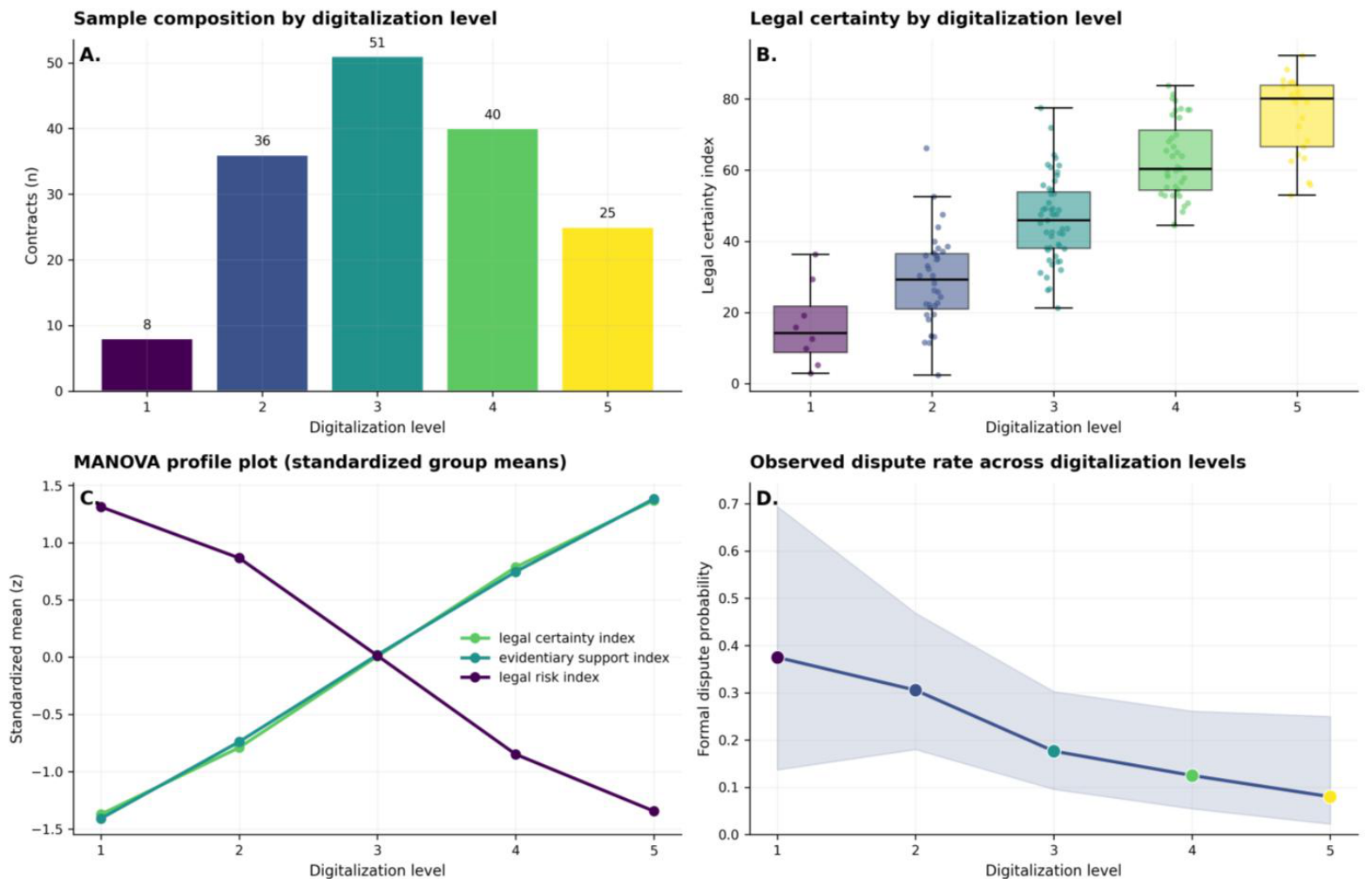
The analysis included 160 intercompany commercial contracts distributed across five ordered levels of contractual digitalization. The sample was concentrated in the intermediate categories, with level 3 accounting for the largest share (n = 51; 31.9%), followed by level 4 (n = 40; 25.0%), level 2 (n = 36; 22.5%), level 5 (n = 25; 15.6%), and level 1 (n = 8; 5.0%). At the dataset level, the contractual environment combined paper-based, hybrid, and fully electronic arrangements, but the distribution of legal-performance outcomes was clearly ordered by digitalization intensity.
A pronounced stepwise gradient was observed across the five strata. Mean legal certainty rose from 16.41 ± 11.57 in the least digitalized contracts to 75.51 ± 11.05 in the most digitalized group. The evidentiary support index followed the same direction, increasing from 15.19 ± 12.14 to 71.50 ± 11.01. The inverse pattern was equally clear for legal risk, which declined from 81.38 ± 12.33 at level 1 to 17.12 ± 12.91 at level 5. The downstream procedural endpoint behaved consistently with these structural indicators: the observed prevalence of formal dispute decreased from 37.5% in level 1 to 8.0% in level 5. Mean contingency resolution time also contracted sharply along the same gradient, from 38.25 days to 6.76 days.
These descriptive data indicate that the transition from low to high digitalization was accompanied by a simultaneous increase in legal certainty and evidentiary robustness, together with a marked decrease in legal exposure and dispute burden. The descriptive profile by digitalization level is presented in
Table 5.
The graphical summary reinforces the same pattern. Sample density was greatest in digitalization levels 3 and 4; the distribution of legal certainty shifted upward across successive strata; the multivariate profile plot showed legal certainty and evidentiary support moving in parallel against legal risk; and the observed dispute rate declined monotonically as digitalization increased. These patterns are displayed in
Figure 1.
3.2. Monotonic Association Structure Between Digitalization and Legal Outcomes
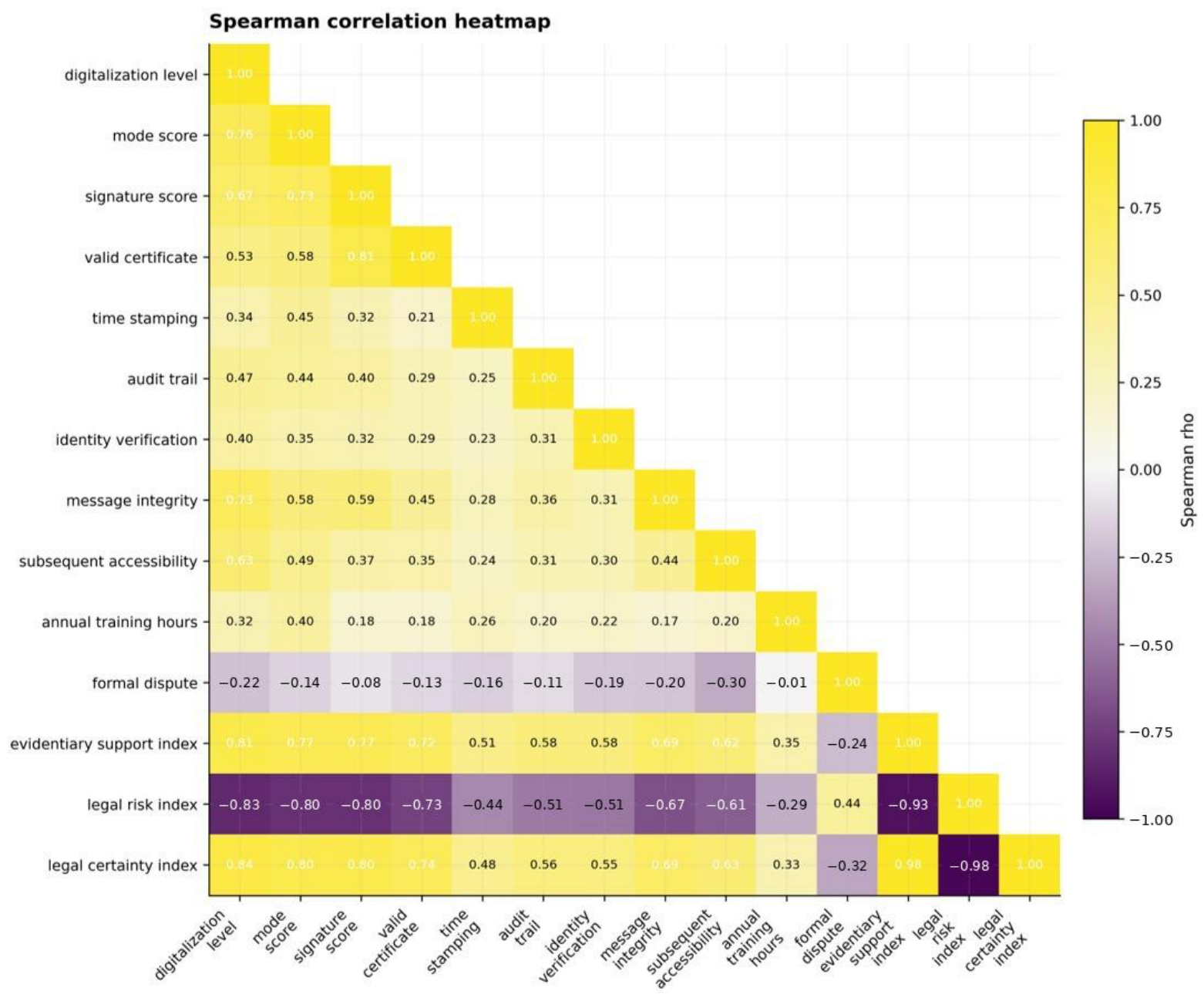
The correlation structure showed that contractual digitalization was closely embedded in the legal architecture of the agreements. The strongest monotonic association in the dataset linked digitalization level with the legal certainty index (Spearman’s ρ = 0.8379, p < 0.001). Nearly identical effect sizes were observed for the relationship between digitalization and the evidentiary support index (ρ = 0.8114, p < 0.001) and for the inverse relationship between digitalization and the legal risk index (ρ = −0.8334, p < 0.001). These coefficients indicate that contracts positioned higher on the digitalization scale were consistently characterized by greater legal certainty, stronger evidentiary infrastructure, and lower exposure to legal vulnerability.
At the level of constituent attributes, digitalization correlated strongly with contracting mode (ρ = 0.7555), message integrity (ρ = 0.7291), and signature score (ρ = 0.6735), while still showing meaningful positive associations with subsequent accessibility (ρ = 0.6350), valid certificate (ρ = 0.5290), audit trail (ρ = 0.4655), identity verification (ρ = 0.4047), time stamping (ρ = 0.3411), and annual training hours (ρ = 0.3152) (all p < 0.001). The association with formal dispute was weaker in magnitude but remained statistically significant and negative (ρ = −0.2173, p = 0.0058), suggesting that digitalization bears most directly on legal-documentary quality and only secondarily on the occurrence of contentious outcomes.
This matrix was not a collection of isolated pairwise effects. Instead, it defined a coherent monotonic structure in which legal certainty, evidentiary support, integrity, and accessibility clustered together as a positive block, while legal risk occupied the opposite pole of the same underlying axis. The main correlations and global inferential tests are reported in
Table 6.
The heatmap makes the internal organization of the data immediately visible. Variables related to digital maturity, signature architecture, document integrity, and evidentiary support were grouped into a dense positive-correlation field, whereas the legal risk index displayed strong negative coefficients against the same variables. The correlation structure is shown in
Figure 2.
3.3. Multivariate Separation Across Digitalization Strata
The nonparametric association pattern was corroborated by the multivariate group comparison. Contracts assigned to different digitalization levels occupied clearly distinct regions of the joint outcome space defined by legal certainty, evidentiary support, and legal risk. The MANOVA returned a Pillai’s trace of 0.7792 and a Wilks’ lambda of 0.2763, both highly significant (p < 0.001), indicating that the outcome profile differed substantially across the five digitalization strata.
This result is substantive, not merely formal. A significant multivariate test in this context means that digitalization was associated with simultaneous shifts in several related legal-performance dimensions rather than with isolated movement in a single indicator. The profile plot in
Figure 1C is particularly informative in this regard: legal certainty and evidentiary support increase almost in parallel across the ordered digitalization gradient, whereas legal risk decreases in a near-specular fashion. Such convergence suggests that digitalization reorganizes the contractual environment as a whole, affecting the quality of evidentiary retention, the predictability of juridical interpretation, and the exposure to legal vulnerabilities within one common structural process.
Categorical analyses converged on the same conclusion. The association between digitalization level and categorized legal certainty was strong (χ2 = 121.30, df = 8, Cramér’s V = 0.6157, p < 0.001). Strong associations were also observed for contracting mode and signature type relative to legal certainty classification, with Cramér’s V values above 0.55 in both cases. These results indicate that legal certainty is not only linked to a higher degree of digitalization in the abstract, but also to specific operational features of digital contracting, particularly the modality of execution and the signature framework.
In analytical terms, the multivariate evidence matters because it rules out a narrow interpretation of the findings. The data do not support the view that only one legal-quality indicator improves with digitalization, while the remainder remain unchanged. Instead, they show that digitalization levels are associated with a coordinated movement toward stronger documentary architecture and lower legal fragility.
3.4. Adjusted Robust OLS Model for Legal Certainty
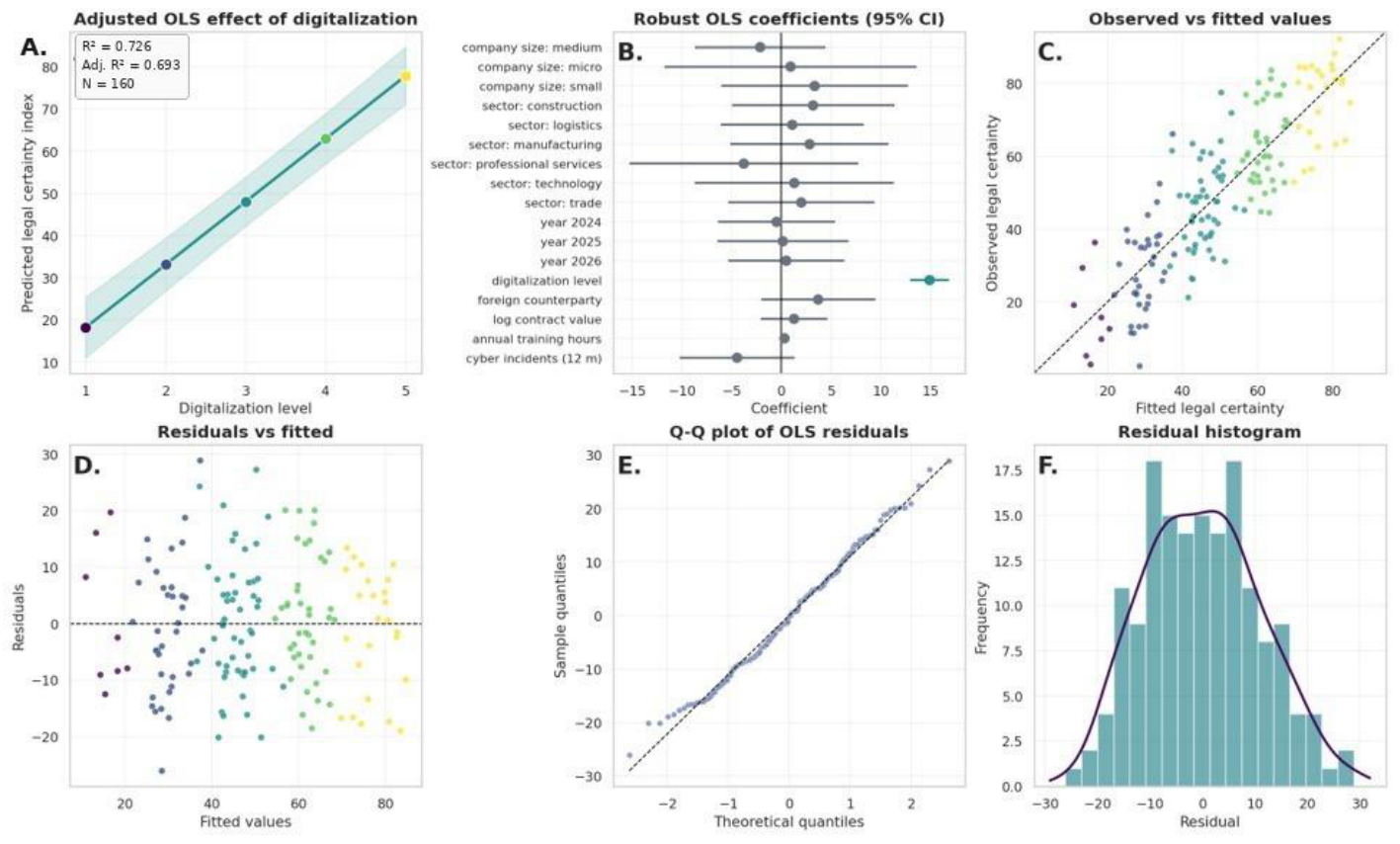
The adjusted linear model identified digitalization level as the principal independent determinant of the legal certainty index. After controlling for company size, company sector, year, contract value, foreign counterparty, annual training hours, and cyber incidents in the previous 12 months, each one-unit increase in digitalization was associated with a 14.90-point increase in legal certainty (β = 14.9037; 95% CI: 12.9381 to 16.8694; p < 0.001).
The magnitude of this coefficient is large in practical terms. Moving from one digitalization tier to the next corresponded to an average increase of nearly 15 points in the legal certainty scale, even after adjustment for commercial and organizational covariates. Across the full five-level range, this implies an expected shift of roughly 60 points between the least and most digitalized contractual environments, which is entirely consistent with the descriptive group means reported above.
The remaining predictors did not display independent effects of comparable strength. Foreign counterparty showed a positive but non-significant coefficient (β = 3.7016; p = 0.2073), log contract value had a small and non-significant association (β = 1.2792; p = 0.4563), annual training hours showed a weak positive tendency (β = 0.3169; p = 0.1957), and cyber incidents were associated with a negative but non-significant coefficient (β = −4.4434; p = 0.1305). None of the company-size, sector, or year controls reached statistical significance, which further underscores the centrality of digitalization in the model.
Model fit was strong for an observational institutional dataset. The OLS specification explained 72.57% of the variance in legal certainty (R2 = 0.7257; adjusted R2 = 0.6929). Internal cross-validation retained good performance, with a mean out-of-sample R2 of 0.6149 ± 0.0442 and a mean RMSE of 12.646 ± 0.612. Diagnostic tests did not suggest major violations of model assumptions: there was no evidence of heteroskedasticity (Breusch–Pagan p = 0.9151), residual normality was acceptable (Jarque–Bera p = 0.2783), the specification test was non-significant (RESET p = 0.4336), and the Durbin–Watson statistic of 1.903 was compatible with the absence of problematic residual autocorrelation.
The adjusted coefficients and model diagnostics are presented in
Table 7. The graphical diagnostics in
Figure 3 support the same interpretation, with the adjusted effect plot showing a steady increase in predicted legal certainty across digitalization levels and the residual diagnostics indicating no substantial distortion of the fitted structure.
3.5. Binary Logistic Model for Formal Dispute
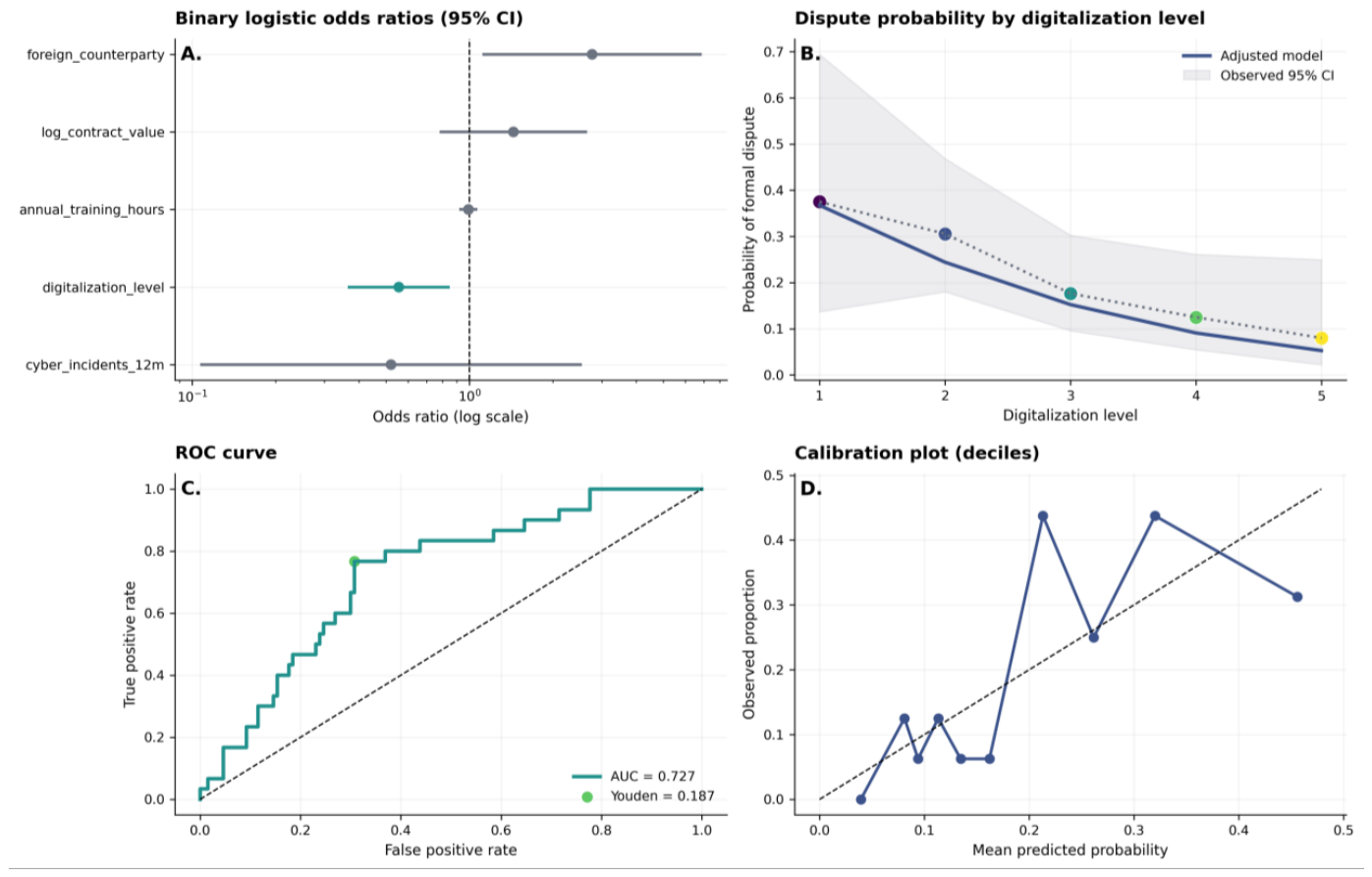
Digitalization also retained explanatory value when the outcome was reduced to a binary adverse event. In the adjusted logistic model, each one-unit increase in digitalization level was associated with a 44.4% reduction in the odds of formal dispute (OR = 0.5563; 95% CI: 0.3644 to 0.8495; p = 0.0066). This result indicates that the digitalization gradient was not limited to composite legal-quality scores but extended to the probability of an observable procedural escalation.
Among the other predictors, only foreign counterparty showed an independent association with dispute occurrence (OR = 2.7700; 95% CI: 1.1135 to 6.8907; p = 0.0284), suggesting that external or cross-border counterpart relationships may carry a distinct layer of transactional complexity. By contrast, log contract value (OR = 1.4414; p = 0.2428), annual training hours (OR = 0.9922; p = 0.8398), and cyber incidents (OR = 0.5215; p = 0.4209) did not show statistically significant independent effects.
The model’s discriminative capacity was moderate but acceptable for a relatively infrequent legal event. The fitted model yielded an AUC of 0.7267, with a Brier score of 0.1395, indicating fair separation between disputed and non-disputed contracts and reasonable probabilistic accuracy. Calibration was adequate, as the Hosmer–Lemeshow test was non-significant (χ2 = 10.318, df = 8, p = 0.2434). At the Youden-optimized threshold (0.1869), the model achieved 70.6% accuracy, 76.7% sensitivity, and 69.2% specificity. Cross-validated performance remained acceptable, with a mean AUC of 0.6885 ± 0.0908 and a mean Brier score of 0.1466 ± 0.0098.
These results are presented in
Table 8. The graphical representation in
Figure 4 shows the same substantive pattern: adjusted dispute probability decreases across digitalization levels, the digitalization odds ratio lies entirely below unity, and the calibration curve remains broadly aligned with the expected diagonal despite local variation at the decile level.
3.6. Ordination and Clustering of Contract Profiles
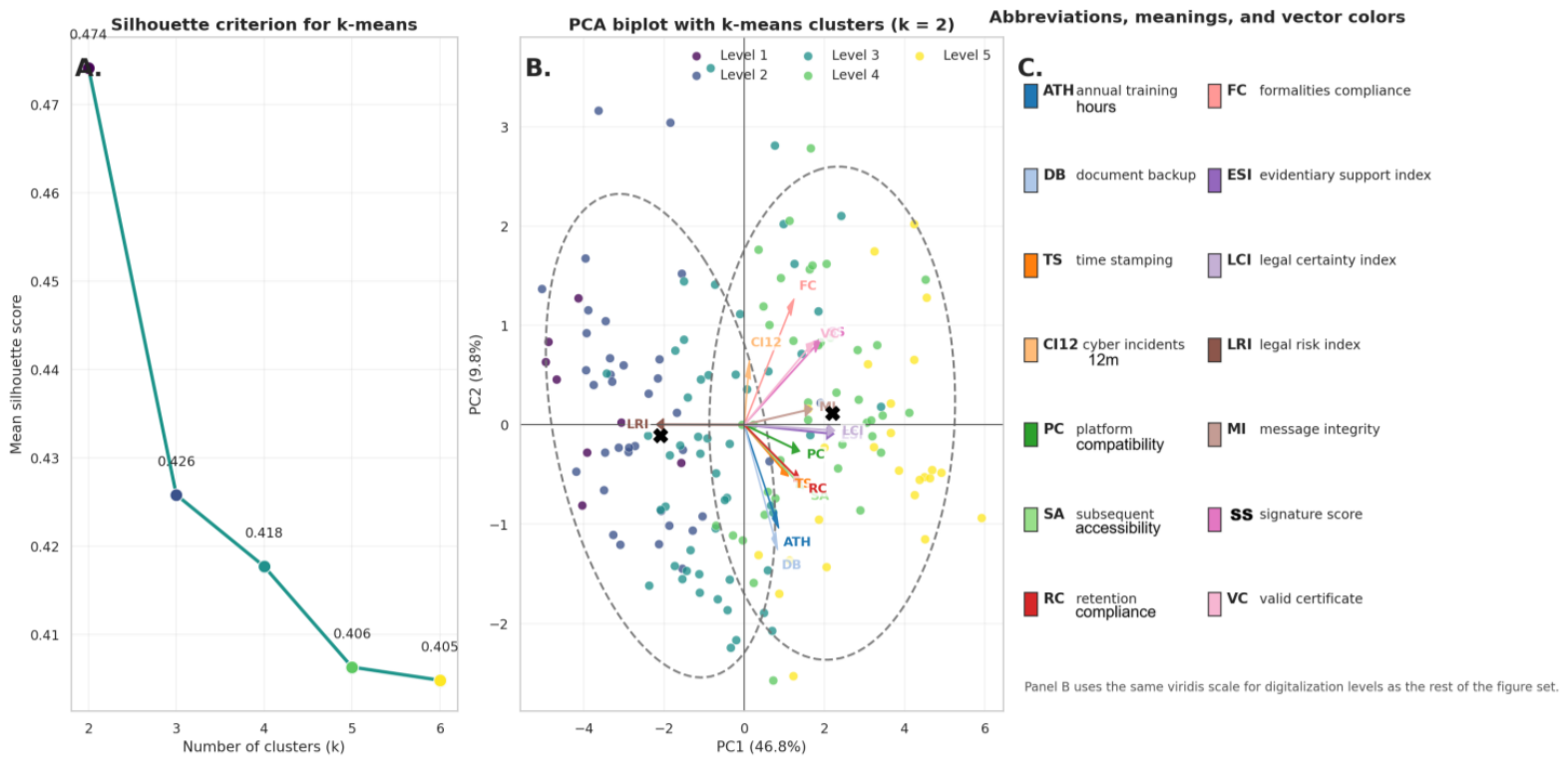
The unsupervised analyses showed that the contracts were organized around a dominant multivariate gradient closely aligned with digitalization and legal robustness. In the principal component analysis, PC1 explained 46.8% of the variance and was heavily defined by legal certainty (loading = 0.9865), evidentiary support (0.9764), digitalization level (0.8812), contracting mode (0.8480), and signature score (0.8136), whereas legal risk loaded in the opposite direction (−0.9575). This configuration identifies PC1 as the central legal-digital axis of the dataset.
The second component, PC2, explained 9.8% of the variance and was shaped mainly by annual training hours (0.6820) and document backup (0.5789), suggesting a secondary organizational-support dimension that is partly independent of the main legal-digital continuum. In practical terms, this means that contracts similar in overall legal-digital maturity could still differ in internal maintenance practices and institutional support routines.
The clustering structure was consistent with the ordination. The silhouette analysis favored a two-cluster solution, with the highest silhouette coefficient at k = 2 (0.2799), followed by lower values for larger partitions. This indicates that the sample is best described by two broad contract profiles rather than by a fragmented set of many small groups.
The cluster centroids reveal a sharp substantive contrast. Cluster 0 (
n = 82) represented a more advanced contractual environment, with a mean digitalization level of 4.0610, legal certainty of 66.2329, evidentiary support of 62.3780, and legal risk of 26.6463. Its formal dispute rate was 9.76%. Cluster 1 (
n = 78) showed the opposite structure: mean digitalization level of 2.3718, legal certainty of 32.0654, evidentiary support of 31.0064, and legal risk of 66.0000, with a formal dispute rate of 28.21%. These descriptive cluster profiles are reported in
Table 9.
The biplot in
Figure 5 makes the interpretation visually transparent. Contracts located toward the positive side of PC1 align with stronger signature architecture, better accessibility, higher evidentiary support, and greater legal certainty, whereas contracts located toward the negative side align with higher legal risk and lower digital maturity. The cluster structure therefore reinforces the conclusion already obtained from the regression models: digitalization is embedded in a broader institutional configuration of documentary reliability and juridical resilience.
The ordination and cluster solution are displayed in
Figure 5.
3.7. Bootstrap Stability of the Principal Effects
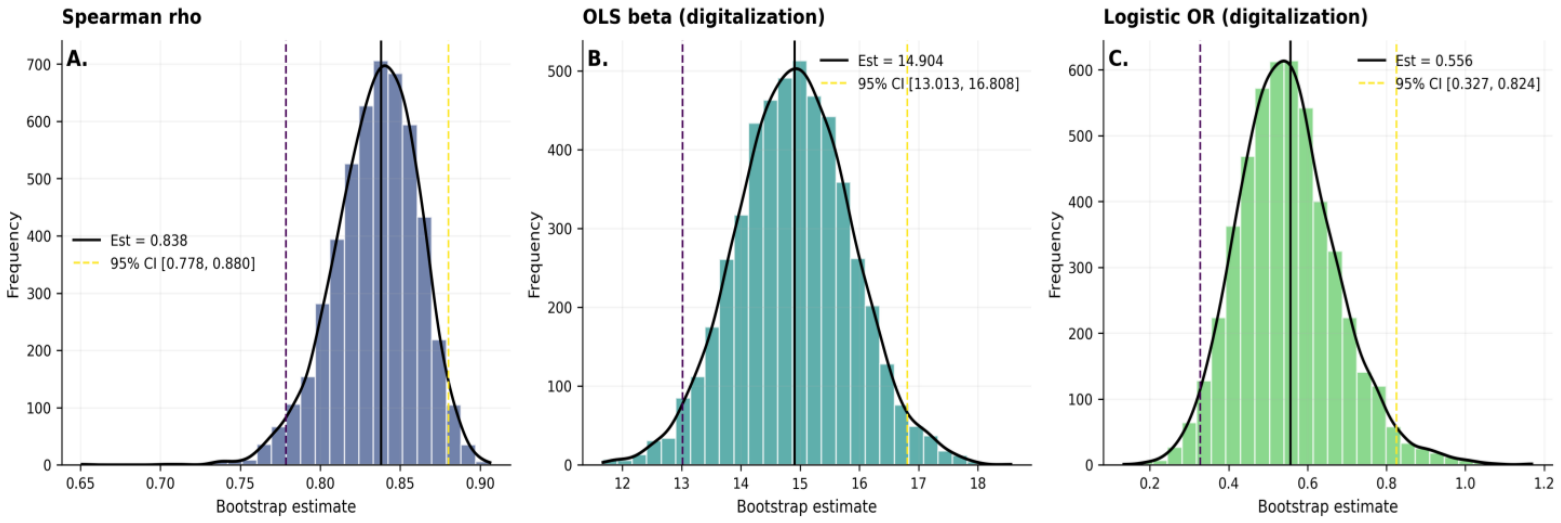
The primary findings remained stable under repeated resampling. Across 5000 bootstrap iterations, the association between digitalization and legal certainty, the adjusted OLS effect of digitalization on legal certainty, and the adjusted logistic effect of digitalization on formal dispute all remained clearly separated from their null values.
For the rank-based association, the original estimate of Spearman’s ρ = 0.8379 was nearly identical to the bootstrap mean (0.8350), with a narrow 95% percentile interval of 0.7784 to 0.8799. For the adjusted linear model, the original coefficient for digitalization (β = 14.9037) closely matched the bootstrap mean (14.9016), with a 95% interval of 13.0125 to 16.8083, entirely above zero. For the logistic model, the original digitalization odds ratio (0.5563) was reproduced by a bootstrap mean of 0.5494, with a 95% interval of 0.3271 to 0.8244, entirely below 1.
These estimates are presented in
Table 10. Their empirical bootstrap distributions, shown in
Figure 6, were compact and centered near the original point estimates, indicating that the direction and magnitude of the principal effects were not dependent on a narrow subset of observations.
The bootstrap distributions are shown in
Figure 6.
3.8. Overall Pattern of Findings
A consistent empirical picture emerges when the analyses are read together. Contracts with higher levels of digitalization occupied a markedly different legal environment from those at the lower end of the scale. They were characterized by stronger evidentiary support, higher legal certainty, lower legal risk, fewer formal disputes, and shorter contingency-resolution times. This pattern was visible in raw group means, preserved in the rank-based association structure, confirmed by multivariate testing, retained under adjustment in both linear and logistic models, reproduced in unsupervised clustering, and supported by bootstrap resampling.
The effect of digitalization was strongest for the proximal legal-organizational dimensions of the dataset, particularly legal certainty and evidentiary support. Its association with formal dispute, while weaker, remained statistically and substantively meaningful. That asymmetry is analytically coherent: documentary architecture and legal certainty are immediate properties of contract design, whereas dispute occurrence is a downstream event influenced by additional commercial and strategic factors. Even under that stricter endpoint, however, digitalization preserved an independent protective effect.
The only non-digitalization predictor to retain significance in the dispute model was foreign counterparty status, suggesting that transactional complexity may remain elevated in cross-border or externally exposed contractual relationships. Even so, the central result of the study remained unchanged after adjustment: higher digitalization was associated with a more secure contractual structure and a lower probability of formal legal escalation.
4. Discussion
4.1. Principal Interpretation of the Findings
The present study indicates that contractual digitalization should be interpreted as a legally relevant institutional condition rather than as a merely technological feature of contract execution. Across the analytical framework, higher digitalization levels were consistently associated with stronger evidentiary support, lower legal risk, higher legal certainty, and a lower probability of formal dispute. This convergence across descriptive, correlational, multivariate, regression, clustering, and bootstrap analyses suggests that the observed pattern is structurally coherent rather than model-specific.
This interpretation is consistent with legal and comparative scholarship showing that certainty in digital contracting does not arise simply from replacing paper with electronic media, but from the reliability of the mechanisms that support attribution, integrity, accessibility, and documentary continuity (
Pino, 2023;
Coelho, 2015;
Mik, 2011;
Brazell, 2025;
Pope, 2014;
Gregory, 2014;
Martin & Pascarelli, 2014;
Ou et al., 2016;
United Nations, 1996,
2001,
2005,
2022;
Asamblea Nacional del Ecuador, 2021,
2002;
Temoshok, 2025;
Wang, 2007;
King, 2022). In that sense, the present findings support a substantive conception of contractual modernization: a contract becomes legally more secure not because it is “electronic” in name, but because the digital environment is capable of preserving the evidentiary conditions on which legal predictability depends.
4.2. Digitalization as a Driver of Evidentiary Strength and Legal Certainty
One of the strongest findings of the study was the close relationship between digitalization and evidentiary support. Contracts located at higher digitalization levels also showed stronger values in message integrity, signature score, certificate validity, accessibility, and auditability. These same attributes clustered together in the correlation heatmap and occupied the positive pole of the principal component structure. This is a central point from a commercial-law perspective because legal certainty in contractual relations is rarely produced by formal recognition alone; it depends on whether the contract can function as a stable, attributable, and retrievable evidentiary object when challenged.
This reading is strongly supported by prior literature on electronic evidence and digital execution. Comparative work has repeatedly emphasized that the legal value of electronic records depends on authenticity, provenance, preservation, and the capacity to reconstruct documentary history over time (
Martin & Pascarelli, 2014;
Ou et al., 2016;
Sethia, 2016;
Makulilo, 2018;
John, 2021;
Biasiotti, 2017). The present results are therefore better understood not as evidence that digital contracts are automatically safer than paper contracts, but as evidence that a better-designed digital documentary architecture is associated with a more robust legal environment. In practical terms, the increase in legal certainty observed here appears to be anchored in improvements in evidentiary design.
4.3. Independent Effect of Digitalization After Adjustment
The adjusted OLS model showed that digitalization retained a strong independent association with legal certainty even after controlling for company size, economic sector, year, contract value, foreign counterparty, annual training hours, and cyber incidents. This is an important result because it indicates that digitalization was not merely proxying for firm sophistication, scale, or sectoral advantages. Rather, it behaved as a distinct explanatory condition with a large adjusted effect.
This pattern aligns with research treating digital execution and signature infrastructure as part of broader systems of governance, accountability, and risk management (
Pope, 2014;
Gregory, 2014;
Kinsara, 2021;
Wang, 2007;
Santiago & Nery, 2023;
Krawczyk, 2014). It also reinforces an important doctrinal point: recognition of electronic signatures in principle is not enough to guarantee certainty in practice. Certainty depends on whether the adopted method is sufficiently reliable, proportionate to the transactional context, and supported by evidentiary safeguards that remain usable in future review, compliance assessment, or dispute proceedings (
Brazell, 2025;
Pope, 2014;
Gregory, 2014;
Asamblea Nacional del Ecuador, 2021;
United Nations, 2001,
2022;
Wang, 2007;
Kinsara, 2021). The strong adjusted coefficient observed in the present study is therefore compatible with the idea that digitalization becomes legally meaningful when embedded in a reliable documentary infrastructure.
4.4. Why the Effect on Dispute Was Weaker than the Effect on Legal Certainty
The inverse association between digitalization and formal dispute was statistically significant but weaker than the associations observed for legal certainty and evidentiary support. This asymmetry is not a contradiction; rather, it is analytically and legally plausible. Legal certainty and evidentiary quality are proximal properties of contract design, whereas disputes are downstream events influenced by a wider range of commercial, strategic, and institutional factors.
This helps explain why digitalization produced a large effect on the legal certainty index but a more moderate effect in the logistic model for formal dispute. A contract may be well structured, evidentially robust, and digitally reliable, yet still become contentious because of performance failure, bargaining breakdown, economic shocks, opportunistic behavior, or enforcement costs. This interpretation is strengthened by the finding that foreign counterparty status was the only additional significant predictor of dispute. Cross-border transactions typically involve greater institutional distance, more complex expectations regarding applicable law and enforcement, and a heightened need for trust and redress mechanisms (
United Nations, 2005;
Omoola & Oseni, 2016;
Sun & Qu, 2025). Accordingly, digitalization appears capable of reducing dispute exposure, but not of eliminating all sources of commercial conflict.
4.5. Documentary Architecture, Trust, and Governance Implications
The multivariate analyses showed that digitalization did not operate as a single isolated variable. Instead, it formed part of a broader contract-governance profile defined by stronger signature architecture, better accessibility, higher evidentiary support, lower legal risk, and fewer disputes. The PCA and k-means results were especially informative in this regard, because they revealed two broad contractual environments: one characterized by higher digital maturity and stronger legal organization, and another characterized by lower digital maturity and greater legal fragility.
This finding resonates with broader governance-oriented literature in digital commerce. Research on supply-chain governance, platform trust, and digitally mediated exchange has shown that stability is usually produced by bundles of institutional assurances rather than by a single legal or technical control (
Santiago & Nery, 2023;
Sun & Qu, 2025;
Morić et al., 2024;
Ma et al., 2024;
He et al., 2022;
Sun et al., 2025). The present study supports the same interpretation in the contractual domain. Legal certainty appears to emerge from the interaction of authentication, traceability, preservation, accessibility, and compliance-related safeguards. From that perspective, the evidentiary and governance dimensions of digitalization should be understood as mutually reinforcing rather than analytically separate.
4.6. Security, Privacy, and Organizational Support Variables
Cyber incidents and annual training hours were not statistically significant in the adjusted models. However, this should not be interpreted as evidence that security and organizational learning are irrelevant to legal certainty. A more plausible interpretation is that, within the current analytical structure, the most direct determinants of legal certainty were documentary and evidentiary safeguards, whereas security and training likely exert more indirect effects through institutional trust, compliance maturity, and the long-term resilience of the digital contracting environment.
This interpretation is consistent with recent work on privacy, data protection, and trust in e-commerce ecosystems (
Shelly & Jackson, 2008;
United Nations, 1996;
Morić et al., 2024;
Ma et al., 2024). Security and privacy controls may not always reduce disputes directly in a short analytical horizon, but they can materially influence the reliability of the environment in which contractual commitments are created, stored, and later verified. Likewise, training may shape the correct use of digital tools, retention practices, and internal compliance behavior even when its isolated statistical effect is diluted once stronger documentary predictors are included in the same model.
4.7. Practical Implications for Commercial Contracting in Ecuador
From a practical and regulatory standpoint, the results suggest that the key question is not whether companies are using electronic contracts in a formal sense, but whether their digital contracting environments are supported by reliable identity verification, certificate validity, auditability, integrity controls, accessibility safeguards, and retention-compatible documentary practices. The strongest gains in legal certainty appear to arise when digitalization is accompanied by evidentiary design rather than by digitization alone.
This is particularly relevant for Ecuadorian commercial practice, where legal recognition of electronic messages and signatures exists, but practical certainty depends on implementation quality (
United Nations, 1996,
2001,
2005,
2022;
Asamblea Nacional del Ecuador, 2021,
2002;
Temoshok, 2025). The results therefore suggest that firms, compliance officers, legal departments, chambers of commerce, and policymakers should prioritize robust contractual ecosystems over purely symbolic digital adoption. The elevated dispute odds associated with foreign counterparties also indicate that digitally documented trust and traceability become especially important in transactions involving institutional distance or cross-border enforcement uncertainty (
Omoola & Oseni, 2016;
Sun & Qu, 2025;
Camacho et al., 2026).
Firms should not equate digital transformation with the mere replacement of paper documents. Priority should be given to certified electronic signatures, systematic timestamping, auditable trails, and secure backup routines, since these are the specific attributes most strongly associated with higher legal certainty and evidentiary support in the present sample.
Legal departments should treat evidentiary architecture, rather than the formal existence of an electronic signature, as the operative unit of risk management. Periodic auditing of certificate validity, retention compliance, and identity-verification protocols is advisable, particularly for contracts involving foreign counterparties, which showed elevated dispute odds in the adjusted logistic model.
Regulators and chambers of commerce in Ecuador and comparable Latin American jurisdictions may use contract-level evidentiary indicators, rather than binary electronic-signature recognition, as a basis for monitoring digital-contracting quality. Given the regulatory heterogeneity documented across the region (
United Nations, 1996), harmonizing minimum evidentiary standards (certification, timestamping, auditability) could reduce cross-jurisdictional uncertainty for firms operating internationally.
4.8. Overall Discussion Statement
Taken together, the discussion supports a clear conclusion: contractual digitalization appears to strengthen legal certainty not because digital form is inherently superior, but because a well-structured digital environment can improve attribution, evidentiary support, documentary integrity, accessibility, and governance reliability. The results therefore favor a substantive model of digital contractual modernization, centered on trust, traceability, and enforceability, over a merely formal model based on the presence of electronic execution alone.
4.9. Limitations
Several limitations should be considered when interpreting these findings. First, because the study was observational and contract-based rather than experimental, unmeasured organizational characteristics, such as legal department capability, compliance culture, or managerial sophistication, may partially explain the observed associations; the reported estimates should therefore be read as adjusted associations rather than causal effects. Second, the analytical dataset of 160 contracts was intentionally constructed as a methodological, contract-level framework rather than as a probabilistic national sample; inferential statistics accordingly reflect internal analytical consistency and effect stability, supported by 5000-resample bootstrap validation and internal cross-validation, rather than population-wide estimates. Third, because the dataset was methodologically constructed rather than drawn from an administrative census or court archive, external validity to the full range of real-world commercial practice in Ecuador should be assumed with caution, and replication with administratively sourced contract populations is recommended. Fourth, the cross-sectional design captures differences between digitalization strata at a single point in time and cannot, by itself, establish longitudinal or panel-based dynamics; terminology suggesting temporal evolution has accordingly been avoided throughout this paper in favor of language describing observational association between strata.
5. Conclusions
This study provides a structured empirical argument that contractual digitalization is not merely a technological modernization of commercial practice, but a legally meaningful factor associated with stronger legal certainty in intercompany relations. Across the analytical framework, contracts located at higher levels of digitalization consistently showed greater evidentiary support, lower legal risk, higher legal certainty, fewer formal disputes, and shorter contingency-resolution times. These patterns were not confined to descriptive comparisons. They were reproduced in monotonic association analysis, confirmed by multivariate group separation, retained in adjusted regression models, replicated in unsupervised clustering, and supported by bootstrap resampling. Taken together, these findings indicate that the relationship between digitalization and legal certainty is internally coherent and robust within the analytical architecture of the study.
The main contribution of the study lies in showing that legal certainty in digital commercial contracting should be understood through a substantive rather than merely formal lens. The decisive issue is not whether a contract exists in electronic form, but whether the digital contractual environment preserves the evidentiary conditions necessary for attribution, integrity, accessibility, traceability, and documentary continuity. In this sense, the present findings support the view that legal certainty emerges from a governance structure in which signature architecture, identity verification, message integrity, retention practices, auditability, and accessibility operate together. Digitalization appears to strengthen contractual reliability when it is embedded in this broader evidentiary ecosystem, rather than when it is reduced to the simple use of electronic documents or signatures.
The results also suggest that the effect of digitalization is strongest at the level of proximal legal-organizational outcomes, particularly legal certainty and evidentiary support, and weaker, though still meaningful, at the level of downstream contentious outcomes such as formal dispute. This distinction is important. It indicates that even well-structured digital contracts remain exposed to commercial conflict arising from bargaining breakdown, opportunistic behavior, transaction complexity, and enforcement conditions. The elevated dispute odds observed for contracts involving foreign counterparties reinforce that interpretation and suggest that institutional distance continues to matter even in digitally documented transactions.
From a practical standpoint, the study supports a policy and compliance agenda centered on the quality of digital contracting environments. Firms should not equate digital transformation with the mere replacement of paper. Rather, they should prioritize reliable identity controls, strong evidentiary preservation, interoperable retention systems, secure signature practices, and accessible documentary records. For regulators and business institutions in Ecuador, the findings suggest that the legal value of contractual digitalization depends on implementation quality and evidentiary design. Overall, the study supports a clear conclusion: higher contractual digitalization is associated with a more secure, more predictable, and more resilient commercial legal environment.