1. Introduction
Artificial Intelligence (AI) has emerged as a transformative force in contemporary service management, reshaping how organisations engage with customers, optimise operations, and create competitive advantage. In service-intensive industries such as tourism, where customer experience directly influences satisfaction, loyalty, and long-term profitability, AI-enabled Customer Relationship Management (CRM) systems offer strategic opportunities to personalise services, automate interactions, analyse customer sentiment, and forecast demand (
Huang & Rust, 2018;
Davenport et al., 2021). Globally, AI-driven CRM systems have shifted organisations from reactive customer service models toward predictive and proactive engagement strategies. Through machine learning algorithms, predictive analytics, and automated communication systems, firms can anticipate customer needs, enhance service responsiveness, and optimise marketing efforts (
Pushpakumara & Ahsan, 2025).
Despite these advancements, the adoption and implementation of AI-enabled CRM systems remain uneven, particularly in developing regions. While AI-powered CRM systems have been extensively studied in developed economies characterised by advanced digital ecosystems, high technological literacy, and supportive institutional environments (
Davenport et al., 2020;
Dwivedi et al., 2021), the transferability of these findings to resource-constrained contexts remains uncertain. Empirical evidence shows that AI-enabled CRM can enhance customer engagement, predictive accuracy, operational efficiency, and long-term loyalty through advanced analytics and automation (
Huang & Rust, 2018;
Verhoef et al., 2021). However, much of this evidence is concentrated in technologically advanced regions, limiting its broader applicability to emerging regional tourism contexts (
Dwivedi et al., 2021;
Mariani & Baggio, 2022).
In the tourism sector, these limitations are particularly significant. Systematic reviews of AI in tourism and customer experience highlight a strong concentration of studies in North America, Europe, and East Asia, with minimal empirical representation from African markets (
Li et al., 2019;
Mariani & Baggio, 2022).
Tourism was selected because it is an experiential, relationship-based, reputation-sensitive, and demand-sensitive service sector in which customer satisfaction depends strongly on personalized interaction, service responsiveness, trust, online reviews, and repeat visitation. Unlike many routine service sectors, tourism experiences are co-created through interactions between customers, employees, destinations, and digital platforms, making CRM central to competitiveness and long-term customer retention (
Gretzel et al., 2015;
Opute et al., 2020). These characteristics make tourism a suitable context for examining AI-enabled CRM because AI tools can support customer profiling, personalized recommendations, sentiment and feedback analysis, demand forecasting, and service recovery (
Huang & Rust, 2018;
Davenport et al., 2020;
Bulchand-Gidumal et al., 2024). The Eastern Cape context is particularly relevant because many tourism enterprises operate as small or medium-sized businesses under digital, financial, and infrastructural constraints, while empirical evidence on AI-enabled CRM in African regional tourism contexts remains limited (
Dwivedi et al., 2021;
Mariani & Baggio, 2022). Within South Africa, and specifically the Eastern Cape province, tourism plays a critical role in employment creation, SMME development, rural income diversification, and inclusive growth. However, tourism enterprises in this region often operate under substantial constraints, including limited digital infrastructure, restricted financial capacity, uneven ICT skills, and inconsistent institutional support (
Phoofolo & Ndlovu, 2024). These contextual realities raise important questions about whether AI-driven CRM can deliver similar strategic benefits in such environments as observed in more developed economies.
Furthermore, within the South African context, empirical research examining AI-driven CRM adoption in provincial tourism ecosystems remains scarce. Existing studies tend to focus on general CRM strategies, digital marketing, or service quality rather than AI-enabled CRM applications specifically (
Chinomona & Maziriri, 2017;
Phoofolo & Ndlovu, 2024). In addition, while prior research often examines discrete AI functionalities such as personalization, automation, chatbots, or predictive analytics, relatively few studies integrate multiple AI-enabled CRM dimensions, such as personalization, automation, sentiment analysis, and forecasting, within a single empirical structural model, particularly in emerging economies (
Huang & Rust, 2018;
Mariani & Baggio, 2022).
Against this backdrop, this study addresses these gaps by examining respondents’ perceptions of the role of Artificial Intelligence (AI) in enhancing Customer Relationship Management (CRM) effectiveness within the tourism sector in the Eastern Cape, South Africa. Specifically, the study investigates how key AI-enabled CRM dimensions, namely personalization and customer insights, automation of customer interactions, sentiment and feedback analysis, and sales forecasting with lead scoring, are perceived to individually and collectively influence CRM effectiveness. Accordingly, the study is guided by the central research question: How do respondents perceive AI-enabled capabilities to influence CRM effectiveness within the Eastern Cape tourism sector? This is further supported by the following sub-questions: (1) To what extent is personalization perceived to enhance CRM effectiveness? (2) How is automation of customer interactions perceived to influence CRM performance? (3) What role is sentiment and feedback analysis perceived to play in strengthening CRM? and (4) To what extent are sales forecasting and lead scoring perceived to improve CRM outcomes?
2. Theoretical Foundation
This study integrates the Technology Acceptance Model (TAM) (
Davis, 1989) and the Commitment–Trust Theory of Relationship Marketing (
Morgan & Hunt, 1994) to provide a dual-layered explanation of Artificial Intelligence (AI) adoption and its relational outcomes within the Eastern Cape tourism sector. The integration of these two theories is particularly appropriate in this context because AI-enabled CRM involves both technological adoption decisions and long-term relationship management dynamics.
2.1. Application of TAM in the Eastern Cape Tourism Context
The Technology Acceptance Model (TAM) posits that perceived usefulness and perceived ease of use are the primary determinants of technology adoption (
Davis, 1989). Perceived usefulness refers to the extent to which an individual believes that using a particular system will enhance job performance, while perceived ease of use reflects the degree to which the system is perceived as free of effort.
Within the Eastern Cape tourism ecosystem, these constructs are highly relevant. Many tourism enterprises in the province operate as small and medium-sized establishments with constrained financial and digital resources. For managers in such environments, AI-driven CRM adoption is not driven by technological novelty but by practical value. Technologies such as predictive booking analytics, chatbots, and sentiment analysis tools must demonstrate tangible benefits in terms of increased bookings, improved customer responsiveness, and operational efficiency before adoption is considered viable.
In this context, perceived usefulness is likely tied strongly to revenue predictability and cost efficiency. Predictive analytics that enhance seasonal demand forecasting, for instance, directly address the volatility inherent in tourism markets. This aligns with prior research indicating that performance expectancy and perceived utility are critical determinants of AI adoption in service industries (
Venkatesh & Davis, 2000;
Pushpakumara & Ahsan, 2025). Similarly, perceived ease of use becomes crucial in environments where digital literacy levels vary. If AI systems are overly complex or require significant technical expertise, adoption may be resisted despite their potential value (
Huang & Rust, 2018).
Thus, TAM explains the organizational-level decision to adopt AI-enabled CRM tools in the Eastern Cape by clarifying how managers evaluate the functional and operational benefits of these technologies under resource constraints.
2.2. Application of Commitment–Trust Theory in AI-Enabled CRM
While TAM explains why tourism enterprises adopt AI-driven CRM systems, Commitment–Trust Theory explains how these systems influence long-term customer relationships.
Morgan and Hunt (
1994) argue that successful relationship marketing is built upon two fundamental constructs: trust and commitment. Trust reflects confidence in a partner’s reliability and integrity, while commitment represents the desire to maintain a valued relationship. In tourism, where experiential value and service quality are central, trust and commitment are critical predictors of repeat visitation and positive word-of-mouth.
AI-enabled CRM systems can influence both constructs in several ways. First, reliable automation and accurate information provision enhance perceived competence, which strengthens trust. For example, chatbots that provide accurate booking confirmations and timely responses signal organizational reliability. Second, personalized recommendations based on prior behavior demonstrate customer recognition, which fosters relational commitment. Research suggests that data-driven personalization increases perceived relational investment and customer loyalty (
Huang & Rust, 2018).
However, AI systems must also manage transparency and data privacy carefully. Mishandling customer data may undermine trust, particularly in developing contexts where digital governance frameworks may still be evolving (
Martin & Murphy, 2017). Therefore, AI-driven CRM must combine efficiency with ethical data practices to reinforce relational durability.
Within the Eastern Cape tourism context, where reputation and word-of-mouth marketing play a central role, AI-enabled sentiment analysis may be particularly important. Rapid response to negative reviews strengthens service recovery mechanisms, reinforcing trust and reducing relational erosion.
Thus, Commitment–Trust Theory explains the relational consequences of AI-enabled CRM by clarifying how technology-mediated interactions shape long-term loyalty.
2.3. Complementarity of TAM and Commitment–Trust Theory
The integration of TAM and Commitment–Trust Theory provides a comprehensive explanatory framework that operates at two interconnected levels: the organizational adoption level and the relational outcome level.
TAM addresses the “why adopt?” question. It explains how tourism managers evaluate AI systems based on performance enhancement and usability considerations. In resource-constrained environments like the Eastern Cape, this evaluation is highly pragmatic and financially oriented.
Commitment–Trust Theory addresses the “what happens after adoption?” question. It explains how AI-enabled CRM tools influence customer trust, satisfaction, and commitment over time.
The two theories therefore complement one another by linking technological acceptance to relational performance outcomes. TAM focuses on managerial cognition and adoption decisions, while Commitment–Trust Theory focuses on customer perceptions and loyalty formation. Together, they create a logical progression: Perceived usefulness and ease of use influence AI adoption (TAM), AI-enabled CRM shapes customer trust and commitment (Commitment–Trust Theory), and trust and commitment enhance CRM effectiveness through loyalty and retention.
This theoretical integration strengthens the explanatory depth of the study by bridging technology adoption theory with relationship marketing theory. It also aligns with calls in digital marketing scholarship for multi-theoretical frameworks to better understand AI-enabled service ecosystems (
Davenport et al., 2021).
In the Eastern Cape tourism sector, where both digital transformation pressures and relational service norms coexist, the combined framework is particularly appropriate. AI adoption cannot be explained purely through technical utility, nor can relational outcomes be understood without considering technological capability. The integration of TAM and Commitment–Trust Theory therefore provides a coherent and contextually grounded foundation for analyzing AI-driven CRM effectiveness.
2.4. Conceptual Framework
This study conceptualises Artificial Intelligence (AI) as a multidimensional capability associated with Customer Relationship Management (CRM) effectiveness within the tourism sector in the Eastern Cape. Rather than treating AI as a single construct, the framework identifies four functional dimensions through which AI-enabled CRM capabilities may contribute to perceived CRM effectiveness: personalisation and customer insights, automation of customer interactions, sentiment and feedback analysis, and sales forecasting with lead scoring.
Personalisation enables tourism enterprises to tailor services and communication to individual customer preferences using behavioural analytics and predictive modelling (
Huang & Rust, 2018). In service-driven environments such as tourism, relevance and recognition can strengthen perceived value and customer engagement. Within the Eastern Cape context, where repeat visitation and word-of-mouth are important, personalised interaction is expected to support relational continuity.
Automation enhances operational responsiveness through chatbots and AI-driven communication systems (
Davenport et al., 2021). By reducing response time and service friction, automation may improve efficiency and accessibility. However, because tourism is relational in nature, automation should complement rather than replace human interaction. When appropriately integrated, automation may support CRM through improved service consistency and customer accessibility.
Sentiment and feedback analysis allow enterprises to monitor customer opinions and interpret customer concerns more systematically (
Liu, 2020). Tourism demand is highly reputation-sensitive, and the ability to detect dissatisfaction early may support effective service recovery. In emerging tourism regions such as the Eastern Cape, proactive reputation management may contribute to trust-building and long-term loyalty.
Sales forecasting and lead scoring represent the predictive dimension of AI-driven CRM (
Wamba et al., 2017). These tools may enable tourism enterprises to anticipate demand patterns, segment customers strategically, and allocate resources more effectively. Given the seasonal and fluctuating nature of tourism in the province, predictive capabilities are expected to support revenue planning and customer retention strategies.
Collectively, these four AI-enabled CRM dimensions are conceptualised as organisational capabilities that may enhance perceived CRM effectiveness, defined in terms of improved customer satisfaction, engagement, loyalty, and retention. The framework therefore proposes positive hypothesised relationships between each AI-enabled capability and perceived CRM effectiveness.
The proposed relationships are theoretically grounded in both technology adoption and relationship marketing perspectives. From the Technology Acceptance Model, AI-enabled CRM tools are expected to enhance CRM effectiveness when they are perceived as useful in improving service responsiveness, customer understanding, and operational decision-making (
Davis, 1989;
Venkatesh & Davis, 2000). From the Commitment–Trust Theory, CRM effectiveness depends on the ability of firms to build trust, strengthen commitment, and maintain long-term customer relationships (
Morgan & Hunt, 1994). In tourism, where service quality, responsiveness, and personalised engagement are central to customer experience, AI-enabled CRM capabilities can support stronger relationship outcomes when they improve customer understanding, communication, service recovery, and predictive decision-making (
Huang & Rust, 2018;
Davenport et al., 2020;
Kumar & Reinartz, 2018). Accordingly, the four AI-enabled CRM dimensions were selected because they represent practical technology-enabled capabilities that reflect TAM’s adoption logic while also supporting the relationship-building mechanisms emphasized in Commitment–Trust Theory.
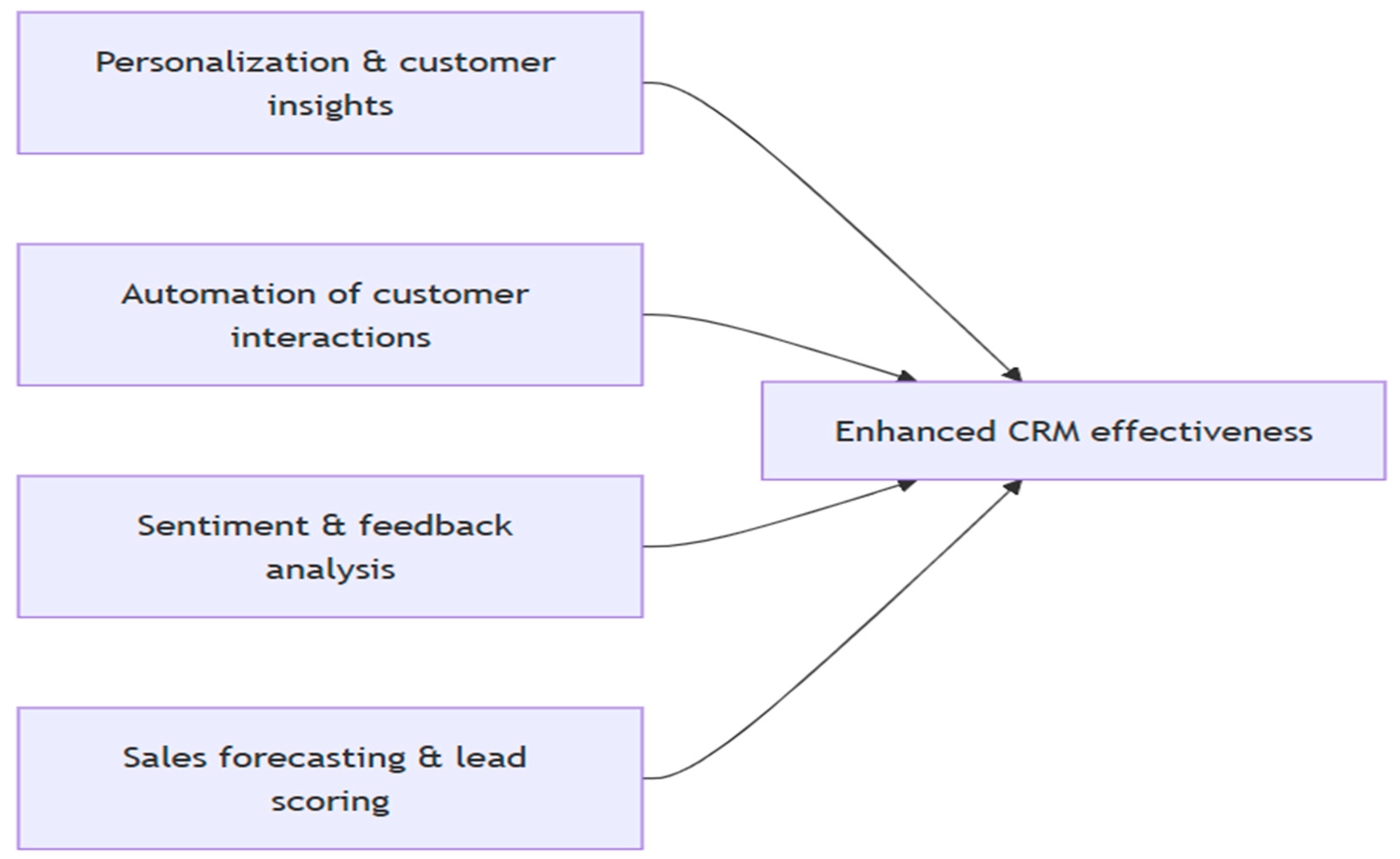
As shown in
Figure 1, Personalisation and customer insights are expected to improve CRM effectiveness because AI enables firms to analyse customer preferences, segment customers more accurately, and tailor services to individual needs. Such personalised engagement can increase perceived value, satisfaction, and relationship quality, which are central to CRM success (
Kumar & Reinartz, 2018;
Huang & Rust, 2018;
Chatterjee et al., 2021). Therefore, H1 proposes that personalisation and customer insights positively influence CRM effectiveness.
Figure 1 indicates that automation of customer interactions is also expected to enhance CRM effectiveness by improving response speed, service consistency, and the handling of routine customer enquiries. AI-enabled chatbots and automated service systems can reduce service delays and support continuous customer engagement, thereby improving operational efficiency and customer experience (
Adam et al., 2021;
Davenport et al., 2020;
Grewal et al., 2017). Therefore, H2 proposes that automation of customer interactions positively influences CRM effectiveness.
Also, sentiment and feedback analysis can strengthen CRM effectiveness by enabling firms to monitor customer opinions, identify dissatisfaction, and respond more quickly to service problems. In tourism, where reputation and word-of-mouth are important, AI-supported feedback analysis can improve service recovery, customer trust, and long-term relationship maintenance (
Liu, 2020;
Cambria et al., 2013;
Morgan & Hunt, 1994). Therefore, H3 proposes that sentiment and feedback analysis positively influence CRM effectiveness.
Sales forecasting and lead scoring are expected to improve CRM effectiveness by helping firms anticipate demand, identify high-potential customers, prioritise marketing efforts, and allocate resources more efficiently. Predictive analytics supports more informed decision-making and strengthens customer retention strategies by allowing firms to respond proactively to customer and market needs (
Wamba et al., 2017;
Syam & Sharma, 2018;
Choudhury & Harrigan, 2014). Therefore, H4 proposes that sales forecasting and lead scoring positively influence CRM effectiveness.
Based on the proposed conceptual framework, the following research hypotheses are formulated to examine the influence of AI-enabled capabilities on CRM effectiveness in the Eastern Cape tourism sector:
2.5. Research Hypothesis
H1. Personalization and customer insights are positively associated with perceived CRM effectiveness in the Eastern Cape tourism sector.
H2. Automation of customer interactions is positively associated with perceived CRM effectiveness in the Eastern Cape tourism sector.
H3. Sentiment and feedback analysis are positively associated with perceived CRM effectiveness in the Eastern Cape tourism sector.
H4. Sales forecasting and lead scoring are positively associated with perceived CRM effectiveness in the Eastern Cape tourism sector.
3. Methodology
This study adopted a positivist philosophical stance and a quantitative explanatory research design to examine the influence of Artificial Intelligence (AI)-enabled capabilities on Customer Relationship Management (CRM) effectiveness within the tourism sector in the Eastern Cape. A deductive research approach was employed, allowing hypotheses derived from the Technology Acceptance Model (TAM) and Commitment–Trust Theory to be empirically tested using statistical methods (
Creswell & Creswell, 2018;
Saunders et al., 2009).
As illustrated in
Table 1, a structured survey instrument was developed by adapting measurement items from existing validated studies on AI-enabled CRM and related constructs. The items were informed by prior literature on personalisation, automation, sentiment analysis, predictive analytics, and enhanced CRM, and were contextualised to reflect the operational realities of tourism enterprises in the Eastern Cape. The questionnaire consisted of closed-ended items measured on a five-point Likert scale ranging from 1 = strongly disagree to 5 = strongly agree (
Likert, 1932).
Given the survey-based design, the study analyses perceived relationships between AI-enabled CRM capabilities and CRM effectiveness. The data therefore reflects respondents’ perceptions of how AI tools influence CRM outcomes, rather than objective organizational performance records. Accordingly, CRM effectiveness is interpreted as perceived CRM effectiveness within the participating tourism enterprises.
To improve construct clarity, all latent variables were operationalised before data collection. Personalisation and customer insights measured the extent to which AI enables tourism enterprises to understand customer preferences, provide personalised services, improve customer segmentation, and increase knowledge of customer needs. Automation of customer interactions assessed the role of AI-supported tools such as chatbots, automated responses, and automated query handling in improving service efficiency, response timeliness, communication consistency, and customer experience. Sentiment and feedback analysis measured the use of AI tools to analyse customer feedback from multiple sources, understand customer satisfaction and concerns, support complaint resolution, improve services, and enable targeted communication. Sales forecasting and lead scoring assessed the extent to which AI-driven tools support planning, improve sales prediction accuracy, identify high-potential customers, prioritise leads, and improve conversion rates (
Hair et al., 2021).
In this study, CRM effectiveness was operationalised as Enhanced Customer Relationship Management (CRM). It refers to the perceived extent to which AI-enabled CRM tools improve customer relationship outcomes within tourism enterprises. Specifically, it was measured using five items assessing whether AI tools improve customer relationship management, strengthen personalised communication, help identify customer needs more effectively, improve customer retention, and enhance the overall customer experience. In the questionnaire, these items were labelled EC1–EC5 but were coded as CRM1–CRM5 during data analysis for consistency with the structural model. The questionnaire itself shows that Enhanced CRM was measured through five Likert-scale items covering CRM improvement, personalised communication, customer needs identification, retention, and customer experience. The instrument also used a five-point scale from strongly disagree to strongly agree. The full questionnaire, including the specific measurement items used for each construct, is provided as
Supplementary File.
The target population consisted of individuals involved in, or directly interacting with, tourism-related businesses and customer engagement activities in Mthatha, Eastern Cape Province, South Africa. The study area was selected as a representative tourism hub within the province. Accordingly, references to Mthatha throughout the discussion relate specifically to the study area, while references to the Eastern Cape provide the broader provincial context. The target population included employees, managers, business owners, marketing personnel, CRM-related staff, and customer stakeholders such as tourists who had interacted with tourism service providers.
The respondent pool included both organisational respondents and customer-side stakeholders. Organisational respondents included managers, owners, employees, and other tourism-related personnel with exposure to customer service, booking, marketing, or CRM-related activities. Tourists were included as customer-side stakeholders because they interact with customer-facing CRM outputs, including personalised communication, automated responses, booking-related communication, service responsiveness, and feedback mechanisms. However, the study does not claim that tourists assessed internal AI implementation processes such as data architecture, algorithmic design, or technical deployment. Rather, their responses were interpreted as perceptions of customer-facing AI-enabled CRM practices and CRM-related outcomes. A purposive sampling technique was used to prioritize respondents with exposure to tourism operations, customer interaction, digital platforms, or AI-enabled systems. The study did not assume that all participating organizations had fully implemented AI-enabled CRM systems. Rather, it examined respondents’ perceptions of AI-enabled CRM capabilities and CRM effectiveness based on their reported familiarity with AI, interaction with AI-based systems, and use of digital platforms for customer engagement.
Because the study used purposive non-random sampling, the findings are not intended to be statistically generalized to all tourism enterprises in the Eastern Cape. Instead, the statistical analysis was used to examine the strength and direction of relationships among the constructs within the surveyed sample. The results should therefore be interpreted as analytically generalizable to similar tourism enterprises and contexts with comparable levels of digital and AI-related exposure, rather than as population-level estimates.
Respondents were recruited through online distribution and face-to-face administration among tourism-related businesses in Mthatha, in the Eastern Cape. Respondents were eligible to participate if they were aged 18 years or older and were either involved in tourism-related business activities or had directly interacted with tourism service providers in Mthatha and were excluded if they had no tourism-sector involvement or no direct interaction with tourism services in Mthatha.
Participation was voluntary, and respondents could decline or withdraw without penalty. Although the survey was distributed across different tourism enterprise types to improve coverage, self-selection bias cannot be fully ruled out because individuals with a greater interest in AI or digital CRM may have been more likely to respond.
Data was collected over a three-week period in September 2025 through online distribution, including email and digital platforms, as well as face-to-face administration to accommodate varying levels of digital access among respondents.
Prior to the main data collection, the questionnaire was piloted with 16 respondents who were familiar with tourism operations, customer service, or digital customer engagement. The pilot was used primarily to assess clarity, face validity, wording, questionnaire flow, and the appropriateness of the response scale rather than to conduct formal statistical validation. Based on feedback from the pilot, minor wording and formatting refinements were made to improve readability and reduce ambiguity. No substantive changes were made to the underlying constructs. The same structured questionnaire, item wording, instructions, and five-point Likert scale were used for both online and face-to-face administration to maintain consistency across data collection modes. Face-to-face administration was used to improve access where digital participation was limited. However, possible mode-related response bias cannot be fully excluded.
A total of 121 valid responses were collected and included in the final analysis. Data were analysed using the Statistical Package for the Social Sciences (SPSS) version 32 and SmartPLS version 4. Although general structural equation modelling guidelines often recommend larger samples, Partial Least Squares Structural Equation Modelling (PLS-SEM) is suitable for smaller samples because of its variance-based estimation approach. Following
Hair et al. (
2021), sample adequacy was assessed using the “10-times rule,” which states that the minimum sample size should be at least ten times the maximum number of structural paths directed at any construct. The sample size of 121 exceeded this minimum requirement and was therefore considered acceptable, although the associated limitations are acknowledged.
All latent constructs in this study were specified as reflective measurement models. In reflective models, indicators are treated as manifestations of an underlying construct and are therefore expected to be conceptually related and empirically correlated. This differs from formative models, where indicators represent distinct components that collectively form the construct and are not necessarily interchangeable (
Jarvis et al., 2003;
Hair et al., 2021). Reflective specification was appropriate because the items measuring personalization, automation, sentiment analysis, sales forecasting, and CRM effectiveness were designed to capture related perceptions of the same underlying dimension.
Although alternative formative specifications may be possible for some AI-enabled CRM dimensions, the constructs were modelled reflectively because the indicators were conceptualized as manifestations of respondents’ underlying perceptions of each AI-enabled capability. As such, changes in the latent construct were expected to be reflected in the observed indicators, which were anticipated to be conveyed. This approach is consistent with the conceptual guidelines for reflective measurement models proposed by
Jarvis et al. (
2003) and
Hair et al. (
2021). Accordingly, internal consistency reliability, convergent validity, and discriminant validity were assessed, as these are standard evaluation procedures for reflective measurement models in PLS-SEM (
Hair et al., 2021;
Sarstedt et al., 2022).
This specification also aligns with the use of Cronbach’s alpha, composite reliability, AVE, Fornell–Larcker criterion, HTMT ratios, and cross-loadings, which are standard assessment criteria for reflective measurement models in PLS-SEM (
Hair et al., 2021;
Sarstedt et al., 2022).
Measurement reliability was evaluated using Cronbach’s alpha and composite reliability, with all values exceeding the recommended threshold of 0.70, indicating strong internal consistency (
Sarstedt et al., 2022). Convergent validity was confirmed through Average Variance Extracted (AVE) values above 0.50, demonstrating that the constructs adequately captured the variance of their respective indicators. Discriminant validity was further assessed using the Fornell–Larcker criterion, HTMT ratios, and cross-loadings to ensure that the constructs were empirically distinct.
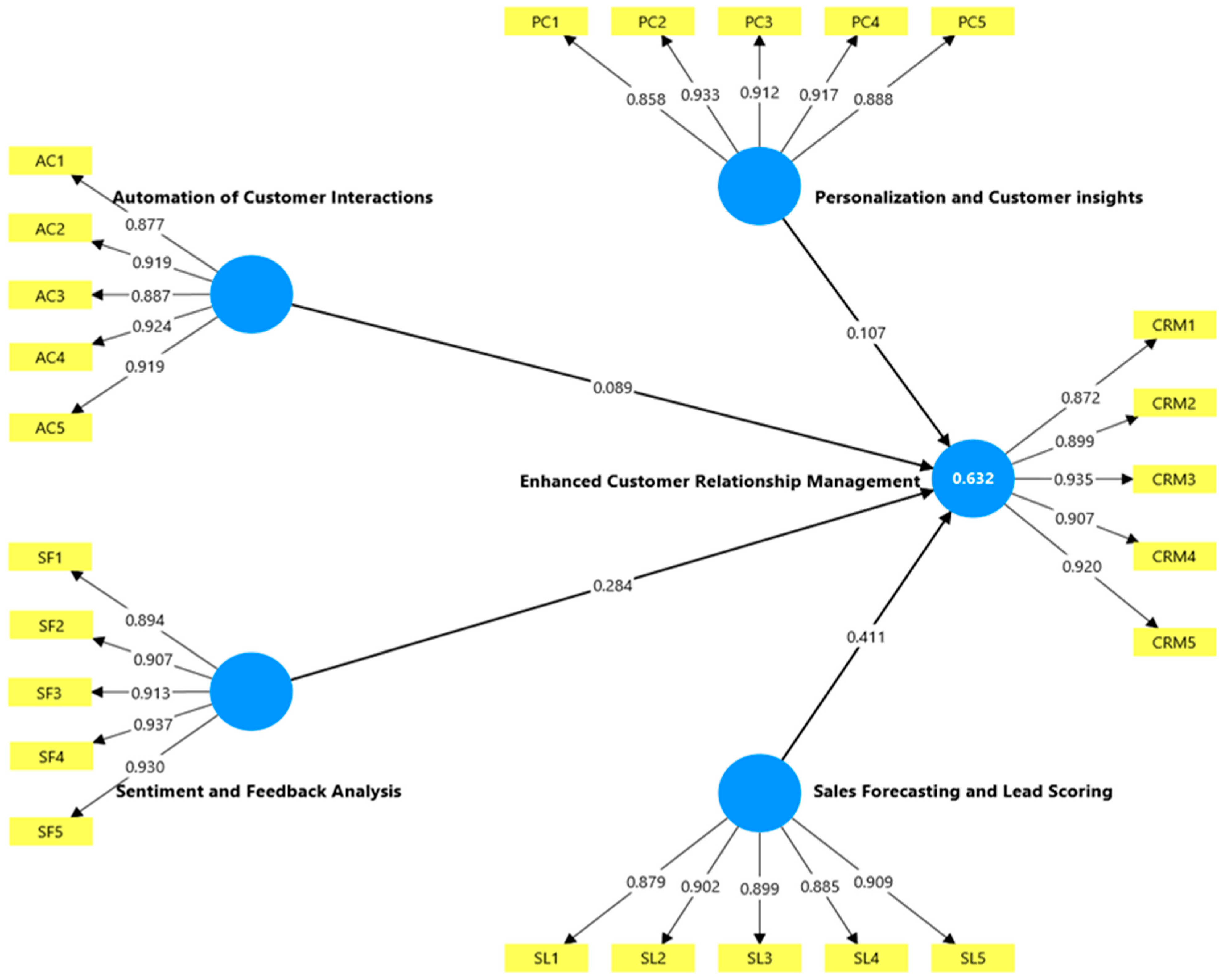
PLS-SEM was then used to test the hypothesised relationships among the constructs. The model accounted for 63.2% of the variance in CRM effectiveness (R2 = 0.632), indicating substantial explanatory power within the Eastern Cape tourism context.
Although PLS-SEM is appropriate for examining relationships among latent constructs in prediction-oriented models, it does not automatically resolve endogeneity concerns. Endogeneity may arise from omitted variables, simultaneity, measurement error, or common method variance, which can affect the interpretation of regression-based path estimates (
Antonakis et al., 2010;
Hult et al., 2018). In this study, the structural model was specified based on the Technology Acceptance Model, Commitment–Trust Theory, and prior AI–CRM literature. The included predictors were therefore theoretically selected to represent key AI-enabled CRM capabilities relevant to tourism enterprises. However, given the cross-sectional survey design, the findings are interpreted as perceived associations rather than definitive causal effects.
Common method bias was addressed procedurally because the study used a cross-sectional self-report survey. Participation was anonymous and voluntary, items were neutrally worded, and constructs were separated into different questionnaire sections to reduce response patterning. These procedures are consistent with recommended remedies for limiting common method bias in survey research (
Podsakoff et al., 2003;
MacKenzie & Podsakoff, 2012). Nevertheless, because both the predictor and outcome variables were collected through the same self-report instrument at a single point in time, common method bias cannot be entirely excluded. Future studies should incorporate statistical assessments of common method bias and multi-source data collection approaches.
5. Discussion of Findings
This study examined respondents’ perceptions of the relationship between Artificial Intelligence (AI)-enabled capabilities and Customer Relationship Management (CRM) effectiveness within the tourism sector in Mthatha, Eastern Cape. The findings reveal a differentiated pattern, suggesting that not all AI-enabled CRM capabilities are equally associated with perceived CRM effectiveness in resource-constrained and relationship-based service environments.
The results show that predictive and analytical AI capabilities were more strongly associated with perceived CRM effectiveness than interaction-focused tools. Sales forecasting and lead scoring emerged as the strongest significant predictor of CRM effectiveness (β = 0.411,
p < 0.001), suggesting that predictive analytics may support tourism enterprises in anticipating demand, prioritising customer segments, and allocating resources more strategically. This finding aligns with prior studies highlighting predictive AI and analytics as important drivers of marketing performance, customer value creation, and data-informed decision-making (
Huang & Rust, 2018;
Wamba et al., 2017). In the Mthatha tourism context, where enterprises may face limited resources and service variability, forecasting capabilities appear particularly useful for supporting customer planning, retention strategies, and relationship continuity.
Similarly, sentiment and feedback analysis demonstrated a statistically significant positive association with CRM effectiveness (β = 0.284,
p = 0.020). This finding supports literature suggesting that AI-enabled sentiment monitoring can improve firms’ ability to understand customer concerns, respond to dissatisfaction, and strengthen service recovery processes (
Dzreke & Dzreke, 2025;
Liu, 2020). In tourism markets where reputation, reviews, and word-of-mouth are important, the ability to capture and interpret customer feedback may provide actionable insights that support trust-building and long-term engagement. This is consistent with relationship marketing theory, which emphasises trust and commitment as central to sustained customer relationships (
Morgan & Hunt, 1994).
In contrast, automation of customer interactions (β = 0.089,
p = 0.309) and personalisation and customer insights (β = 0.107,
p = 0.190) showed positive but statistically insignificant associations with CRM effectiveness. While global literature often positions automation and personalisation as important contributors to CRM enhancement (
Davenport et al., 2021;
Kumar & Reinartz, 2018), the present findings suggest that their perceived value may be context dependent. The insignificant association for automation may reflect the relational nature of tourism services in Mthatha, where interpersonal trust, cultural familiarity, and direct human engagement remain central to customer experience. In such settings, automated interfaces may support efficiency but may not be sufficient on their own to strengthen customer relationships.
Likewise, the limited association between AI-driven personalisation and CRM effectiveness may reflect infrastructural constraints, limited customer data integration, uneven digital skills, or insufficient technical capacity among tourism enterprises. This supports the argument that AI value creation depends not only on the availability of technology, but also on organisational readiness, data quality, managerial capability, and the ability to integrate AI tools into existing service processes (
Brynjolfsson & McAfee, 2017). The findings therefore point to a practical implementation gap between the theoretical potential of AI-enabled CRM and the realities of adoption in emerging regional tourism contexts.
Overall, the results suggest that analytical AI capabilities that support decision-making and insight generation are currently more strongly associated with perceived CRM effectiveness than interaction-focused AI tools in the Mthatha tourism sector. AI use in this context appears to be pragmatic and performance-oriented, with greater value attached to tools that help enterprises forecast demand, interpret customer feedback, and make better customer-related decisions. However, given the cross-sectional and perception-based nature of the study, these findings should be interpreted as evidence of perceived associations rather than definitive causal effects.
These findings also contribute to broader AI-tourism literature by showing that the perceived value of AI-enabled CRM depends on the type of AI capability and the readiness of the service context. Prior AI-tourism and service research emphasizes the role of AI in personalization, smart service delivery, customer experience management, automation, and data-driven decision-making (
Erdős et al., 2025;
Nugroho et al., 2024). However, the present findings suggest that in emerging regional tourism contexts, analytical and predictive AI capabilities may be perceived as more immediately useful than customer-facing automation or advanced personalization. This indicates that AI adoption in tourism should not be understood as a uniform process, but as a context-dependent transformation shaped by digital infrastructure, data quality, organizational readiness, service culture, and customer expectations (
Dwivedi et al., 2021;
Bulchand-Gidumal et al., 2024).
6. Conclusions and Study Contribution
6.1. Conclusions
This study sought to examine respondents’ perceptions of the role of AI-enabled capabilities in enhancing CRM effectiveness within the tourism sector in Mthatha, in the Eastern Cape Province. The findings suggest that AI-enabled CRM capabilities are positively associated with perceived CRM effectiveness, although the strength of these associations varies across application types.
Predictive tools, particularly sales forecasting and lead scoring, together with sentiment and feedback analysis, showed significant positive associations with CRM effectiveness by supporting demand anticipation, customer prioritisation, feedback interpretation, and service responsiveness. Conversely, automation and personalisation showed weaker and statistically insignificant associations, suggesting that AI-driven CRM in this context may need to be balanced with human-centred engagement strategies.
The central research question is therefore answered as follows: respondents perceived AI to enhance CRM effectiveness within Mthatha in the Eastern Cape tourism sector primarily through predictive analytics and sentiment intelligence, while automation and personalisation capabilities appear less influential, possibly due to underutilisation, limited organisational readiness, or contextual constraints.
6.2. Theoretical Contribution
This study advances the AI–CRM literature in several important ways. First, it provides empirical evidence from a developing regional tourism economy, thereby extending AI–CRM scholarship beyond the predominantly developed-economy and large-firm contexts that dominate existing research. Empirical investigations of AI-enabled CRM in African tourism SMEs remain limited, and this study contributes context-specific insight into how AI-enabled capabilities are perceived within resource-constrained and relationship-based service environments. By grounding AI–CRM relationships within the Eastern Cape tourism sector, the study broadens the geographical and developmental scope of technology-enabled CRM research.
Second, the findings offer a more nuanced understanding of perceived AI effectiveness. While much of the literature positions automation and personalisation as important contributors to customer relationship management, the results suggest that their perceived contribution may be context dependent. In the Mthatha tourism setting, predictive and analytical capabilities, particularly sales forecasting, lead scoring, and sentiment analysis, showed significant positive associations with perceived CRM effectiveness, whereas automation and personalisation showed weaker and statistically insignificant associations. This challenges the deterministic assumptions that all AI applications automatically improve CRM outcomes and underscores the importance of contextual factors such as service culture, digital maturity, infrastructure, data quality, and organisational readiness.
Third, the study contributes theoretically by integrating the Technology Acceptance Model (TAM) and Commitment–Trust Theory within a service-intensive tourism context. The findings suggest that technology-related capabilities alone may not guarantee CRM effectiveness; rather, AI-enabled CRM tools need to support relational outcomes such as responsiveness, trust-building, customer understanding, retention, and long-term engagement. In tourism markets characterised by interpersonal interaction and experiential value creation, technology acceptance and relational commitment therefore operate as complementary lenses for understanding perceived CRM effectiveness.
Finally, the study provides practical insight for tourism enterprises operating in resource-constrained environments. The stronger associations observed for predictive analytics and sentiment intelligence suggest that firms may benefit from prioritising AI tools that support demand anticipation, customer feedback interpretation, and data-informed decision-making before investing heavily in fully automated customer interaction systems. This does not imply that automation and personalisation are unimportant, but rather that their effectiveness may depend on stronger digital infrastructure, better customer data integration, and careful alignment with human-centred service delivery.
6.3. Practical and Managerial Contribution
From a managerial standpoint, the study provides guidance on AI investment priorities for tourism enterprises. The findings suggest that predictive and analytical AI applications, particularly sales forecasting, lead scoring, and sentiment and feedback analysis, are more strongly associated with perceived CRM effectiveness than automation and personalisation. Managers should therefore prioritise AI tools that strengthen analytical decision-making, customer insight generation, demand anticipation, and feedback interpretation, rather than relying exclusively on automated customer interfaces.
The findings further highlight the importance of balancing digital innovation with human engagement. In relational service markets such as tourism, AI-enabled systems should augment rather than replace interpersonal interaction. Over-reliance on automation may weaken trust, service authenticity, and relationship quality, whereas strategically integrated AI can support responsiveness, personal relevance, and more informed customer engagement.
The study also underscores the need to invest in organisational digital capability. Effective AI-enabled personalisation and automation require staff training, data management competence, reliable digital infrastructure, and the ability to integrate customer information across service processes. Without these foundational capabilities, the potential value of AI-enabled CRM tools may remain underutilised.
From a policy perspective, the findings point to the need for stronger digital infrastructure and institutional support for AI adoption among small and medium tourism enterprises. AI literacy programmes, technical training initiatives, affordable digital tools, and ethical governance frameworks may help build trust, improve responsible adoption, and support more inclusive AI-enabled transformation within the tourism sector.
7. Recommendations
Based on the findings, several recommendations emerge for industry practitioners and policymakers. Tourism enterprises should consider prioritising investment in AI-based forecasting and lead scoring systems, as these tools showed the strongest positive association with perceived CRM effectiveness. Predictive tools may help firms anticipate demand fluctuations, identify high-potential customers, tailor marketing strategies, and support customer retention efforts.
Firms should also consider adopting sentiment and feedback analysis mechanisms to monitor customer experiences and respond more proactively to service gaps. Given the importance of reputation, online reviews, and word-of-mouth in tourism markets, effective feedback monitoring may strengthen service recovery, customer trust, and long-term relationship building.
Although automation and personalisation showed weaker and statistically insignificant associations, they should not be disregarded. Instead, these tools should be implemented gradually and strategically, ensuring that digital systems complement rather than substitute human engagement. Integrating chatbots, booking platforms, and personalised recommendations alongside direct interpersonal service may create a hybrid CRM approach suited to relationship-based tourism markets.
At the policy level, expanding digital infrastructure access for SMEs in the Eastern Cape remains important. Government and sector-level initiatives that provide AI adoption incentives, technical training, digital literacy programmes, and digital transformation support may facilitate broader and more responsible technology uptake. In addition, clear regulatory frameworks addressing data protection, ethical AI use, and consumer privacy may help build trust and support responsible AI adoption within the tourism sector.
8. Limitations and Future Research Directions
Despite its contributions, this study is subject to several limitations that should be considered when interpreting the findings and that provide avenues for future research. Methodologically, the cross-sectional quantitative design limits causal inference and restricts deeper exploration of the underlying processes shaping AI-driven CRM adoption. While Structural Equation Modelling enabled robust hypothesis testing, it does not capture the dynamic and evolving nature of AI implementation within tourism enterprises.
The sample size achieved of 121 valid responses, although adequate for PLS-SEM analysis, was lower than the initially targeted sample. This may limit statistical generalizability; however, the use of purposive sampling ensured that respondents possessed relevant expertise in CRM and AI-related practices. As such, the findings are more appropriately interpreted as analytically generalizable to similar tourism SME contexts rather than statistically representative of the broader population. In addition, the reliance on self-reported perceptual measures introduces the possibility of response bias, as participants may have overestimated or underestimated their AI adoption practices and CRM effectiveness.
In addition, the study relied on self-reported perceptual data rather than objective organizational CRM performance indicators. Therefore, the findings should be interpreted as evidence of perceived relationships between AI-enabled CRM capabilities and CRM effectiveness. Future studies could complement survey data with objective CRM metrics, such as customer retention rates, response times, repeat bookings, customer satisfaction scores, or sales conversion data.
The use of purposive non-random sampling limits the statistical generalizability of the findings. Therefore, the results should be interpreted as analytical evidence of perceived relationships among AI-enabled CRM capabilities and CRM effectiveness within the surveyed sample, rather than as representative estimates for the entire Eastern Cape tourism sector.
Endogeneity and omitted-variable bias cannot be completely ruled out in this study. The cross-sectional design does not permit causal inference and may be affected by omitted variables or reciprocal relationships among constructs. Factors such as organizational readiness, digital literacy, firm size, managerial capability, customer trust, infrastructure quality, and technology investment may also influence CRM effectiveness. Accordingly, the findings should be interpreted as perceived associations rather than causal effects. Future research should incorporate control variables, longitudinal or experimental designs, objective CRM performance measures, and endogeneity-correction techniques to strengthen causal interpretation.
The geographical focus on tourism enterprises within Mthatha in the Eastern Cape further limits the applicability of the findings to other provinces, countries, or industries with differing levels of technological maturity and institutional support. These contextual constraints highlight the need for broader and more diverse empirical investigations.
The sample included both organizational respondents and tourists. While this allowed the study to capture both provider-side and customer-side perceptions of AI-enabled CRM practices, tourists may not have direct knowledge of internal AI implementation, predictive analytics, or lead-scoring systems. Therefore, the findings should be interpreted as perceptions of AI-enabled CRM practices and CRM-related outcomes, rather than as objective managerial or technical assessments of AI deployment. Future studies should separate organizational respondents from tourists or conduct subgroup analyses to compare provider-side and customer-side perceptions.
Future research should address these limitations by adopting longitudinal research designs to examine how AI–CRM relationships evolve over time. As digital maturity increases within tourism enterprises, the relative influence of automation, personalization, and predictive analytics may shift, and longitudinal studies would provide valuable insights into these developmental trajectories. Additionally, mixed-method approaches that integrate qualitative interviews with quantitative modelling would offer a deeper understanding of managerial decision-making processes, organizational readiness, and the contextual factors influencing AI adoption.
Comparative studies across provinces, countries, or emerging market contexts would further enhance the generalizability of findings and enable the identification of structural, cultural, and infrastructural factors shaping AI effectiveness in tourism industries. Future research should also extend the theoretical model by incorporating additional variables such as customer trust, digital literacy, organizational readiness, and ethical considerations related to AI use.
Finally, incorporating the customer perspective would provide important complementary insights. Examining how tourists perceive and interact with AI-enabled CRM systems, and whether these perceptions align with managerial expectations, would strengthen both theoretical development and practical applicability in service-driven environments.