Article

The Strategic Role of Cultural Risk Management in International Business

School of Continuing Studies, McGill University, 680 Sherbrooke Street West, Montreal, QC H3A 2M7, Canada
Businesses 2026, 6(2), 30; https://doi.org/10.3390/businesses6020030
Submission received: 19 February 2026 / Revised: 21 April 2026 / Accepted: 24 April 2026 / Published: 1 June 2026

Abstract

This study examines cultural risk as a key factor in organizational strategy, bridging cultural studies and the risk management literature. Despite its significance, culture as a risk driver remains underexplored, partly due to a lack of consensus on its definition. Existing research predominantly relies on Hofstede’s model, treating culture as a static, measurable construct, overlooking its dynamic and heterogeneous nature. To address this gap, this study explores cultural risk components through 34 interviews with senior managers in international business. The findings suggest an innovative approach, integrating strategic management perspectives, considering external product-market positioning, and internal resource-based views to better capture cultural dynamics. The study proposes a unifying framework where cultural risk management functions as knowledge management, guided by the principle of requisite variety. This framework offers practical insights for both researchers and practitioners in managing cultural risk effectively.

1. Introduction

Recently, there has been an increase in the public focus on risks faced by firms caused by added uncertainties in the organizational environment due to the higher frequency of major risk events over the past decade, such as conflicts and terrorism, wars and political unrest, energy price shocks, large-scale involuntary migrations, natural disasters, and the recent COVID-19 pandemic, among others. Risks stem from every activity a firm undertakes. Financial risks are not the only risks faced by organizations. Risks that are unrelated to credit or markets are non-financial. While financial risks are well defined and accounted for in a company’s records, many of the non-financial risks are less precise and thus much harder to describe, predict and measure. This research outlines a view of cultural issues, connecting them to the risk literature. In today’s fast-paced, interactive business environment, where individuals from different cultures are intermingled in organizations, culture as a risk driver can greatly affect various activities of firms. Cultural risks stem from the scale and complexities of firms’ cross-border involvements, and the multicultural teams as the new workforce of cross-border business. If these risks are not identified, analyzed, and managed properly, they can negatively affect a firm’s performance.
Culture as a firm’s risk driver has not been fully explored. In actual cross-cultural management and international business (IB) studies, researchers seem to ignore either the external or the internal aspects of a firm’s cultural risk, emphasizing only one side: either cultural issues within the organization or foreign market cultural challenges. Using a strategic management conceptual framework, this study explores both the internal and external sides of a firm’s cultural risk to capture the essence of its cultural dynamics. It refers to the cultural issues within the organization as the firm’s internal cultural risk. External cultural risks refer to cultural issues related to foreign market challenges. Accordingly, a unifying cultural risk management framework suggests a holistic approach considering both external and internal views of the firm to address the cultural risk influence.
In addition, scholars almost universally use Hofstede’s static cultural model to explain the importance of cultural differences and how to measure them. From a positivist perspective, most of the research views culture as measurable and objective, static and independent of interactions with others, blind to the dynamic movement of cultural interactions or the heterogeneous nature of the construct of culture. More exploratory research in this area is required to better understand the multifaceted construct of culture to help address its influence.
Considering the above, this study primarily explored the components of cultural risk to help organizations better address their influence. Next, using a strategic management framework, this study suggests a holistic approach to cultural risk management. The suggested framework for cultural risk management can serve as a tool to benefit researchers as well as practitioners.
Firms involved in international trade, cross-border mergers and acquisitions (M&A), or industrial activities work in new markets with employees, customers, suppliers, competitors, and creditors—all from different cultures. Although doing business with these new emerging economies can open new opportunities for businesses, it can also be accompanied by several difficulties related to cultural differences. Operating in foreign markets takes on additional cultural risks compared with what manufacturers normally face at home. Textbooks and academic research commonly argue that business is considerably more difficult to conduct when the parties are from substantially different cultures, and many examples of cultural mistakes made by practitioners have been documented. These risks are sometimes insufficiently considered. The examples come from the industry,. such as the commercial failure of The Home Depot in China. A strong economy in China had created a middle class with money to spend, which led to a housing boom. Looking to expand internationally, The Home Depot spotted a big opportunity in the Chinese market. However, all of its efforts failed largely because of considerable cultural problems. Unlike North America, where labor costs are high, labor is cheap in China, so people tend to hire contractors to do everything. Therefore, the cheap labor do-it-for-me culture in China eliminated the do-it-yourself culture that The Home Depot was built on.
Like The Home Depot, the online auction eBay saw a very attractive market in China. Its global strategy is to grow through acquisitions. The company entered the Chinese market in 2004 by purchasing a local online trading company called EachNet.com, which enjoyed a 90% market share in China at the time. eBay took over the site, redesigned it to conform to eBay’s look and functionality, then spent millions of dollars on advertising to maintain the previous site’s market share. Meanwhile, Alibaba Group, the business-to-business auction site and eBay’s major rival in China, decided to defend its commercial territory by launching a competing consumer auction site. They called it Taobao, which is Chinese for “digging for treasure.” The company knew one critical thing: in China, goods are bought and sold based on personal bonds and mutual obligation. The Chinese call this guanxi. Taobao’s auction platform offered guanxi in the form of a chat feature that allowed buyers and sellers to get to know each other. On Taobao, buyers spent an average of 45 min using instant messaging to ask sellers about themselves and their products before purchasing. eBay did not appreciate the importance of guanxi and had no mechanism for encouraging it. Consequently, in two years, their market share shrank from 90% to 10%, and the company pulled out of China.
These examples justify the relevance of a study to target the identification and analysis of cultural risks related to international business, the understanding of their influence, and the exploration of actions required for reducing their impact for the success of global businesses. Specifically, this study explores the components of cultural risk and generates a theoretical model to address their influence.
The research outlines a view of cultural issues, connecting them to the risk literature. Cultural risk and its influence on firms have not been fully explored in previous research. This is partly due to a lack of consensus in the academic field about the construct of culture. While there are multiple definitions of culture, they tend to be vague and overly general. This confusion is compounded by the multiple disciplines interested in this topic, which, while increasing richness, do not necessarily bring clarity. Anthropologists, psychologists, and others bring with them their specific paradigms and research methodologies. This creates difficulties in reaching consensus on construct definition and composition. Another reason could be the lack of a holistic approach in cultural risk management. Scholars seem to ignore either the external or the internal aspects of a firm’s cultural environment, emphasizing only one side: either cultural issues within the organization or in the foreign market with its specific cultural challenges. Using a strategic management model, this study suggests that to address the influence of cultural risk, cultural risk management should consider both views: the external view, according to product-market-positioning concepts, and the internal view, with the resource-based view (RBV) of a firm, to capture the essence of the firm’s cultural dynamics. The study proposes a unifying framework where cultural risk management is a form of knowledge management based on Ashby’s (1956) requisite variety principle, in which a firm’s resource management would meet the required product-market cultures.

2. Literature Review: Key Definitions

This literature review establishes the foundation for understanding cultural risk by exploring its conceptual evolution and its intersection with risk management. This study builds on the historical perspectives of culture, which have evolved from anthropological origins to their application in international business and cross-cultural management.
Culture: The abstract sense of the word culture probably originated in Germany, where the word Kultur was used as early as the eighteenth century to refer to civilization. The German Kultur and Finnish kulttuuri suggest the intellectual side of civilization and society (Koivisto, 1999). However, the principal meanings of the generic term culture are not entirely similar across languages. The Russian word kultura encompasses the scientific meaning, referring to a milieu propagating micro-organisms (Grishina, 1993). The Japanese word bunka focuses attention on literary or artistic production, implying the creation of a sophisticated object and even an improvement of an earlier version. When the Japanese use their word for culture, it refers to the skilled production of artifacts after a master of the craft (Holden et al., 2015). This contrasts with European languages that derive their word from Latin, where the basic meanings are associated with the cultivation of land and deities (hence cult).
Research on culture dates back to Tylor (1924), who defines culture as a complex whole that includes knowledge, belief, art, law, morals, customs, and any other capabilities and habits acquired by man as a member of a society. Initially, the examination of culture was associated with anthropology, focusing on the origins and composition of culture. The studies of Herskovits (1967) or Malinowski (1968) are good examples. Other fields rapidly followed anthropology by proposing a comparative approach between nations and cultures. The recognition that culture in the context of cross-border operations may create challenges has produced a sub-discipline of international management studies called cross-cultural management. Cross-cultural management is an interdisciplinary research field (Phillips & Sackmann, 2015), developed out of intercultural communication (IC), international business (IB), international management (IM), and comparative management (CM) over the past fifty years (Barmeyer, 2023). The term cross-cultural management is used for compiling research and the practice of cross-national comparisons, intercultural interaction, and multiple culture studies, including research that focuses on culture at national, organizational, and sub-organizational levels (Primecz et al., 2009). Primecz et al. (2009) highlighted plural paradigms in cross-cultural management research. More recent reviews suggest the field has further evolved toward questions of inclusion, power, complexity, and critical reflexivity (Lee & Gyamfi, 2021; Hart, 2024; Romani et al., 2018).
In the broad cross-cultural management literature, cultural differences are assumed to lead to cross-cultural misunderstandings and clashes (Holden et al., 2015). The resultant unpleasant experiences are sometimes classed as culture shock, a term that has been described as a psychologically disorienting experience (Ferraro, 1994). Taking the academic contribution to international cross-cultural management, the literature reveals a preoccupation with three manifestly dominant core problem areas that have challenged international businesses: ethnocentrism, cultural diversity issues, and the disorientating effects of culture shock—reeling against the inexplicable, the confounding press of Adler’s uninterpretable clues (Adler & Gundersen, 2008). The literature in cross-cultural management argues that more knowledge about culture can allegedly induce cross-cultural sensitivity or awareness, which is the foundation for cross-cultural competence. Some scholars argue that, dominated by an interest in differences and difficulties in work-related situations (Hofstede, 1991), constructive and enriching aspects of culture have been largely neglected (Stahl & Tung, 2015), suggesting a shift from problem-oriented to constructive intercultural management (Barmeyer, 2023). The recently developed view of culture as an organizational resource and a form of knowledge and, in this context, a potential organizational resource or capital (Holden et al., 2015; Barney, 1986), connects it to strategic management.
While early research in cross-cultural management has primarily focused on cultural differences, challenges, and misunderstandings, more recent perspectives highlight culture as an organizational resource and a form of knowledge. This shift aligns with strategic management theories that view culture as a potential source of competitive advantage.
Similarly, risk literature has expanded from its financial roots to encompass non-financial risks, including cultural risk.
Risk: The emergence of risk in the literature dates back to the eighteenth century, when Condorcet (1784) introduced the first maritime insurance premium. Risk comes originally from the Latin resecum, denoting that which is cut; it is related both to the Italian richiare, meaning to run into danger, and the Spanish riesgo, referring to that which a ship might literally run into, namely, a reef. Condorcet (1784) advised that with the development of maritime commerce, a merchant must be assured of having a “sufficient” probability that his losses would not drive him out of business and of a “very large and continually increasing probability” that his profits would repay all troubles. Since then, risk has been widely studied, and the literature on the subject has grown.
Similar to the concept of culture, the concept of risk has been defined in many ways. Although many definitions exist, the common elements may be identified as concepts that seem to be based on the same foundation, despite differences in terminology. For example, Kaplan and Garrick (1981) identified three questions to define risk: What can happen? How likely is it that it will happen? And finally, if it does happen, what are the consequences? The International Standards Organization (ISO) defines risk as the combination of the probability of an event and its consequence, noting that consequences may be either positive or negative.
Fraser and Simkins (2010) classify risks according to their nature: financial and non-financial. Financial risk involves the relationship between an individual or an organization and an asset or expectation of income that may be lost or damaged (Vaughan, 1997). Such risk reflects a firm’s profitability level, its debt load and interest coverage, the firm’s capacity for indebtedness, its financing contracts, such as redemption dates and restrictive clauses, and the firm’s capacity for reinvesting by the current owners (St-Pierre & Bahri, 2006) and is related to credit or markets. However, financial risks are not the only risks faced by organizations. Risks that are not related to credit or markets are non-financial. Events such as the COVID-19 pandemic (healthcare and economic risk), the Brexit or Trump vote (political and economic risk), the Fort McMurray wildfire (disaster risk), hacking and cyber-attacks (technology risk) or the Target stores’ commercial failure in Canada (cultural risk) serve to highlight that the scope of risks extends beyond markets and credit. While financial risks are well defined and accounted for in a company’s records, many of the non-financial risks are less precise and thus much harder to describe, predict and measure.
Cultural Risk: This can be defined as the opportunity (gain) or loss faced by a firm related to an understanding of its internal and external cultural environment (Firsova, 2021; Firsova & Vaghely, 2018; Firsova et al., 2015). Being non-financial in nature, cultural risk is less precise and more uncertain, and is often ambiguous, which makes it harder to describe, predict, or measure. The difficulty in defining, predicting, and measuring cultural risk due to its ambiguous and dynamic nature underscores the need for further exploration. Cultural risk, as a non-financial factor, influences an organization’s internal and external environment, yet it remains less studied compared to other types of risk. This study addresses these gaps by examining cultural risk as a key factor in organizational strategy. By moving beyond static models like Hofstede’s and adopting a more dynamic perspective, this research seeks to uncover the components of cultural risk through qualitative analysis. Through 34 interviews with senior managers in international business, the study aims to develop a deeper understanding of cultural risk and its strategic implications, contributing to both cultural studies and the risk management literature. The following section outlines the theoretical foundation for a cultural risk management model.

3. Conceptual Framework

After an extensive survey of the literature on culture, risk, and risk management, we have not found a unifying conceptual framework to guide research on cultural risk management. Existing research seems to ignore either the external or the internal aspects of a firm’s cultural risk, emphasizing only one side: the cultural issues within the organization or foreign market cultural challenges. Holden et al.’s (2015) view of culture as an organizational resource and the core task of management is transforming various resources into customer benefits, connecting it to the strategic management’s resource-based view (RBV), inspired by Prahalad and Hamel’s (1990) article on the core competencies of organizations. Viewed as an internal strategic resource, culture, if it is not properly managed, can generate internal cultural risk to the firm (Gerhart & Fang, 2005; L. Pelled, 1996; L. H. Pelled et al., 1999). External cultural risks can include foreign market product-market-positioning issues (Hymer, 1976; Kostova, 1999; Kostova & Roth, 2002; Zou & Cavusgil, 2002; Brannen, 2004; Edman, 2016).
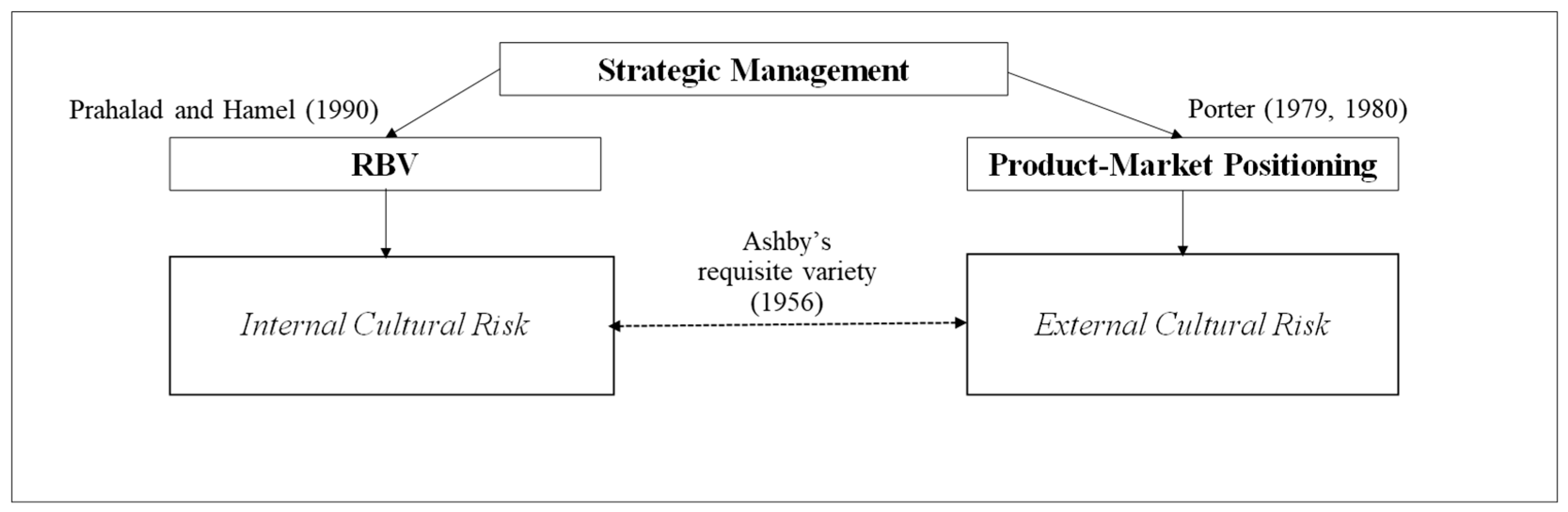
Contributions from strategic management helped to articulate concepts that had previously gone undetected. The conceptual framework of cultural risk management is built on two well-established strategic perspectives: the resource-based view (RBV) and the product-market positioning, with their cultural equilibrium based on Ashby’s (1956) requisite variety principle, where internal resource management variety meets the required external product-market cultural variety. Strategy’s resource-based view (RBV) and product-market positioning open up internal and external perspectives in strategic management.
Since the early 1990s, a perspective-relevant debate in strategy has been driven by two opposite but not necessarily conflicting perspectives on how to acquire competitive advantage: either through the firm’s positioning in the marketplace or by the firm’s internal resources; a debate between Porter’s (1980, 2008) activity-based view and the resource-based view (RBV), inspired by Prahalad and Hamel’s (1990) article on the core competencies of organizations.
According to Porter (1980, 2008), the superior performance of a company is derived from its competitive advantage in its unique product-market positioning in the industry’s relevant marketplace, in terms of product-cost and market-differentiation. Such product-market positioning is based on the activities of the company operating in specific industries with specific value chains. Going through the value chain of organizational activities will add more value to the product and services than the sum of added costs of these activities, and thus, the company will gain marginally superior rent-value for that product or service. If these activities run efficiently, the company gains a cost-competitive advantage on the product or service.
The resource-based view, a firm-internal strategic perspective, suggests that resources, dynamic capabilities, and competencies of a firm (Sanchez, 2001) help to achieve superior performance. Porter’s product-market or external positioning, in comparison, attempts to clarify the understanding of the impact of a firm’s external environment on performance.
Similarly, from a strategic management perspective, it is helpful to think that cultural risk management can have two different perspectives: the first, a firm’s internal cultural risk, that is the resource-based view (RBV) driven and related to a firm’s cultural internal issues, and the second, a firm’s external cultural risk, that is product-market driven, and related risks possibly mitigated by Ashby’s (1956) requisite variety principle, where resource management would meet the required product-market cultures. A unifying cultural risk management conceptual framework is presented in Figure 1:
Further, this unifying cultural risk management conceptual framework is developed and tested empirically. First, the study explores the elements of the internal cultural risk. It will then explore the components of the external cultural risk and investigate ways of cultural risk management based on Ashby’s (1956) requisite variety principle, where a firm’s resource management would meet the required product-market cultures.

4. Methods

Because of the exploratory nature of this research, we chose an inductive method in a social constructivist paradigm (M. Bennett, 2023; Robson & McCartan, 2016), where specific observations are used to construct general scientific principles. To address the main research question of what the components of a firm’s cultural risk are, we used qualitative techniques (semi-structured interviews). Verbal consent was chosen over written informed consent to reduce administrative burden and potential discomfort for participants, and because the study did not involve sensitive topics, interventions, or the collection of identifiable personal data. This approach is consistent with ethical guidance for minimal-risk research. Respondents of this study were selected based on three characteristics: (a) they were judged to be decision-makers, (b) they were judged to have significant managerial experience acquired in cross-border operations, and (c) they had the potential to add the “slices of data” needed to firm up on propositions or to provide new insights. In total, 85% of research participants were men, and 15% were women, with ages ranging from 35 to 65. A total of 44% of respondents were 56 years old or older. All respondents had managerial experience: 35% were CEOs, Presidents, or founders of companies, 26% of respondents had more than 20 years’ experience in cross-border operations, and 18% had more than 30 years of experience. Participants’ educational levels ranged from completion of a bachelor’s degree (24%) or a master’s degree (59%) to having a PhD (9%). All respondents spoke English; 21% of the respondents spoke more than three languages. We used quantitative data from a structured questionnaire to address the complementary research question of the importance (impact) of cultural risk compared with other risks. Thirty-four individual interviews were conducted and analyzed using the grounded theory method. They lasted 60–90 min and were conducted in person and virtually. The audio data were converted to written transcripts. Using NVivo 12 version 12 (QSR International, Melbourne, Australia), the data were further analyzed to identify patterns, themes, and relationships. Open coding was first applied to develop categories by examining line-by-line data, followed by axial coding, which explored interconnections between categories through a coding paradigm. Finally, selective coding integrated these categories into a framework, leading to theoretical propositions. Research validity was assured through transparency (i.e., a literature review, field notes and transcripts), consistency was accomplished through the process of inductive coding, and communicability was established, with each individual in-depth interview lasting from 60 to 90 min. To ensure the trustworthiness of the data, we relied on the process of triangulation. At the level of generalization and external validity, it is important to specify that since the research is exploratory by nature, it does not make any claims of truth or generalizability. As qualitative researchers, we understand that research outcomes are neither totally objective nor unquestionably certain. Thus, we are not looking for a statistical generalization but for an analytical generalization of this study. Lastly, since the interviewer in a qualitative interview takes a very active role in determining what data are collected, there is a higher probability that s/he may inadvertently bias the results of the study.

5. Findings and Discussion

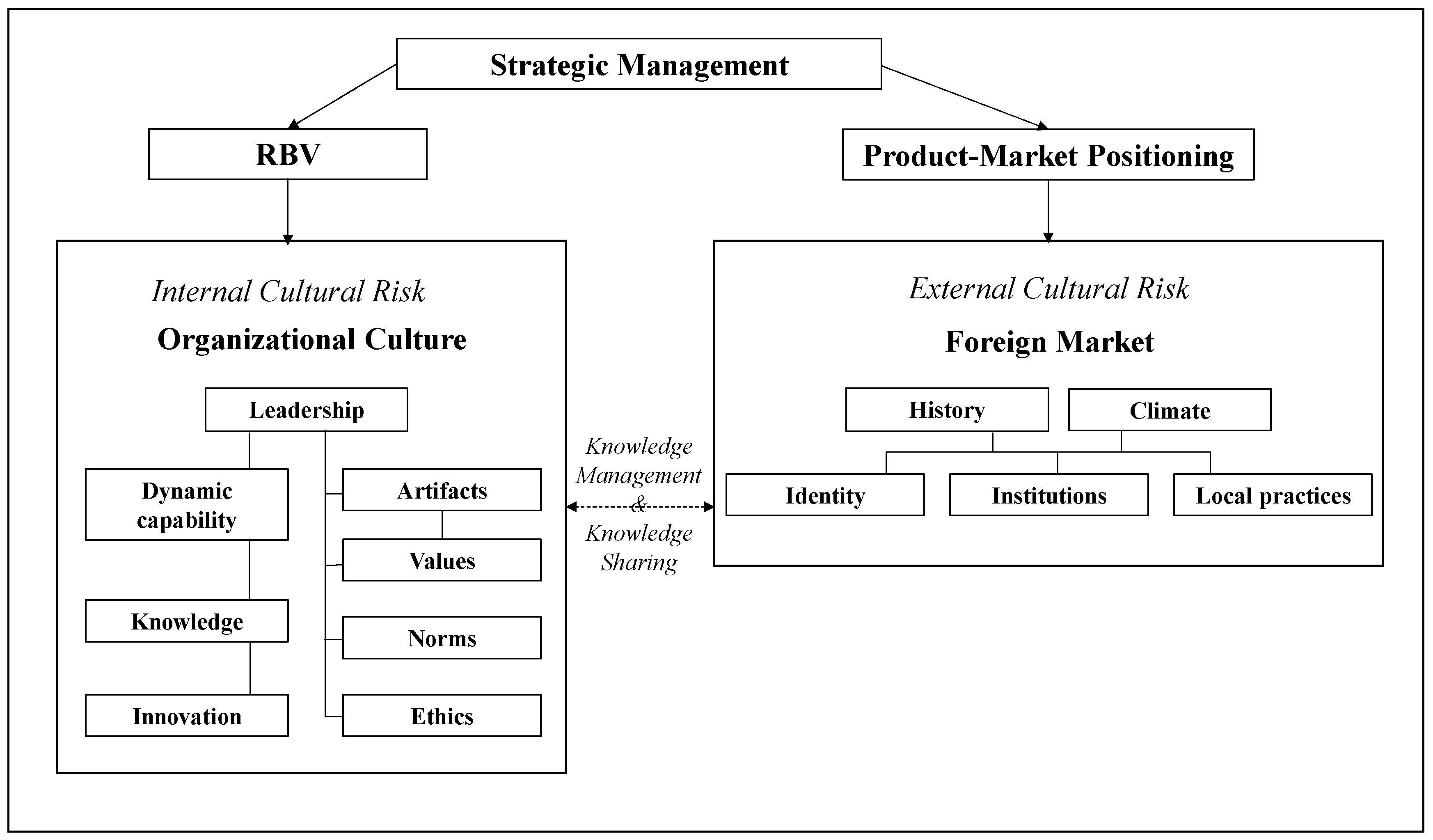
The concept of cultural risk as understood by the respondents of this study comprised the two interrelated themes: (a) a firm’s internal cultural risk, which is resource-based (RBV) driven and related to organizational culture as an organizational resource, and (b) a firm’s external cultural risk, which is product-market driven and related to a foreign market environment. The structural components and their relationships are embedded in the integrative framework presented in Figure 2:
To explore the components of cultural risk, the verbatim was initially coded into 17 primary categories. A further content analysis reduced the 17 primary categories to two major categories that we labeled organizational culture and foreign market. We referred to the terms “in-groups” and “out-groups” (Taijfel, 1970, 1974; Triandis, 1995), which are largely used in social science. In-group refers to what we intuitively feel to be “we,” while out-group refers to “they.” We found a similar we–they dynamic in most of the respondents’ answers. They relate to we for “firm,” “our company,” “our business” and use “new markets,” “foreign country,” or “local authorities” for they. These were indicators that pointed to what was later developed into two major categories that we labeled the organizational culture and the foreign market:
It is important to understand how our business works in foreign markets.
(Interviewee 6)
How you adapt yourself [a firm] to be considered by the buyer in the foreign country.
(Interviewee 16)
The second element is understanding the local business practices and trying to balance those practices with your company policies. Is there a fit between our culture and the one in the country?
(Interviewee 8)
Organizational Culture—Internal Cultural Risk:
In the organizational culture main category, the data revealed eight subcategories that can also be seen as different organizational layers. This is aligned with Hofstede et al.’s (2010) and Schein and Schein’s (2017) view, which argues that the organizational culture has different layers. Some layers are visible to the observer, but their cultural meaning is invisible and lies in the way they are interpreted by insiders. These subcategories are: artifacts, values, norms, ethics, innovation, knowledge, dynamic capabilities and leadership. Some examples from the interviewees are set out below:
In company X where I work, we have 1 h for a lunch and all team members eat together. We bring our meals, we eat and chat together, discuss news. It is symbolic, more like a ritual or something.
(Interviewee 2)
There were some wrong assumptions of a mindset and behaviour of our partners. Honesty related to delivering to deadlines was not met.
(Interviewee 18)
One respondent gave an example of his company’s compensation system. He specified that his firm “favours individual effort” with “a strong emphasis on productivity and performance.” He added that his compensation plan reflected that. Another respondent shared an example of his company’s shared norms and behavioral expectations:
Si j’appelle mon employé à 3 heures du matin, et on est les derniers à appeler le Président ou moi, c’est qu’il y a une raison. On attend qu’un employé réponde. Si on appelle c’est pour comprendre pourquoi le problème n’est pas encore résolu, c’est pour comprendre où est le maillon faible de la chaine.
(Interviewee 1)
Another statement by an interviewee exemplified the use of the code of ethics and conduct:
I think it is more like putting the right systems in place, the right training as well. For us to guarantee as a large organization, we have sixty-six thousand employees, and everybody will live to the same standards as there should be no bad apple in our basket as we aim to that. So, we have a code of conduct, and if we hire international agents or work with international partners, they must have the same obligations as well.
(Interviewee 3)
Respondents also shared examples of their firms’ ability to integrate, build, and reconfigure internal and external competences to address rapidly changing environments, also called dynamic capability (Teece et al., 1997) and internal knowledge (Easterby-Smith & Lyles, 2006):
La flexibilité et la capacité organisationnelle nous ont aidés dans la plupart de nos dossiers internationaux. Beaucoup de réactivité et de la flexibilité organisationnelle. Il m’appelle, je réponds, je te donne la réponse immédiate.
(Interviewee 23)
Si l’employé nous appelle pour dire qu’il faut adapter le produit aux besoins locaux, il faut qu’il y ait une réaction à l’interne.
(Interviewee 4)
Well, there is passive knowledge and then there is active knowledge. Passive knowledge obviously is when you do your research based on publicly available information. Active knowledge is determining whether you have the right people in your team.
(Interviewee 9)
The innovation was explained by one respondent as “a process in which our company creates and defines problems and then actively develops new knowledge to solve them”:
L’international est un terrain idéal pour l’innovation organisationnelle. Quand on est à l’international, on a besoin de produits qui sont adaptés localement. Par exemple, à Dubaï, il y a une membrane sur la fondation pour empêcher l’eau d’entrer dans les fondations. Dubaï est unique au monde, il y a le plus de pression hydrostatique: plus on descend plus on est au niveau de la mer, et eux ils n’aiment pas faire un étage en bas. On a un projet 7 étages, à travers le monde il n’y a jamais personne qui s’est rendu à 7 étages. Ils nous ont demandé de trouver la solution. On a travaillé, on a dépassé les normes, on a dépassé le produit, on a dépassé les solutions autant avec des équipes intérieures qu’avec les partenaires ici. On a trouvé la solution. Aujourd’hui, c’est un produit X qui nous apporte énormément de marge, de la profitabilité. On a répliqué ça au Canada, aux États Unis, en Turquie, en Afrique, en Europe, en Chine… partout dans le monde. L’innovation à partir d’un pays, on peut l’adapter rapidement.
(Interviewee 23)
One observation from the data was that values were interrelated with the artifacts. Values reflect a person’s inherent beliefs of what should or should not be (Schein & Schein, 2017) and manifest themselves in the behavior of individuals, which is an artifact of culture. At the individual level, values could include concepts such as caring, empathy, or trust. At the organizational level, examples of values might include accountability, customer service, or safety. As some respondents explained:
Il faut savoir à qui tu peux faire confiance. Par exemple, tu engages un chauffeur. Il faut comprendre ce qui se passe dans sa tête mais aussi comment il va réagir avant de donner la clé de ta voiture à cette personne.
(Interviewee 7)
More important is to know that the company will stand by you if something goes wrong. They will not just drop you and go away if [there is] a problem. So, the trust is built between the company and the project manager and to build that trust you need to pass by people the customers trust.
(Interviewee 11)
Another observation from the data is that artifacts, values, norms and ethics, knowledge, dynamic capability and innovation are all related to leadership. Leaders clarify expectations, set the direction for the organization, align people with that direction and motivate people to action, thus shaping their behavior (Kotter, 2012). This is aligned with the extensive GLOBE study (House et al., 2004) that argues that different leadership attitudes, styles and preferences shape organizational behavior:
C’est le CEO qui décide. C’est un facteur majeur. C’est lui qui va décider comment ça marche. Où est-ce qu’on va et comment. Le CEO arrive, il regarde le business… ça ne marche pas, je garde le choix 1 et 2 et on ferme le reste. Il ne se pose pas la question sur la culture… Le reste en découle. C’est devenu partie d’un ADN dans notre organisation pendent des années.
(Interviewee 7)
C’est notre Président, Richard V. qui a vu le potentiel. C’est ses ambitions de conquérir le monde qui nous ont guidées. Son souhait de faire de l’international nous a emmenés à être meilleurs dans notre domaine. Et on est toujours en mode d’amélioration.
(Interviewee 1)
What I mean is that we have to operate under the highest standards. These standards can go beyond the legal obligations. And this is my role as a President to make sure we implement these standards at all levels in the organization.
(Interviewee 11)
Organizational culture can be regarded as a form of organizational resource that encompasses values and beliefs held by individuals. However, it is an unused resource until its value and utility are recognized as knowledge. Once it is recognized as knowledge, then it forms a part of organizational capabilities to be further converted into core competencies to drive innovation. This is aligned with the strategic management view on a firm’s specific capabilities as a source of advantage (Teece et al., 1997), a firm’s knowledge and innovation (Prahalad & Hamel, 1990; Nonaka & Takeuchi, 1995; Nonaka & Von Krogh, 2009; Sanchez, 2001; Easterby-Smith & Lyles, 2006). All these subcategories are deep-seated. They interact with each other within the organizational culture category and, more significantly, with the other categories within the second category, the foreign market.
Foreign Market—External Cultural Risk:
The second main category, the foreign market, was expressed in words such as “international market,” “region,” “Middle East,” or “host country.” The foreign market includes countries but is not limited to the country level. The foreign market category comprises five subcategories: history, climate, identity, institutions and local practices. Identity was the largest subcategory in terms of attributable occurrences in the major category. Identity answers the question “to which group do I belong?” and is often rooted in language or religious affiliation (Hofstede et al., 2010). As emerged from the data, the core of this category is made up of two subcategories: language, as a means for communicating with the outside world (Vygotsky, 1986), and religion. As emerged from the data, “communication differs,” “language and meaning can completely differ,” “not the same language is spoken,” and “body language and nuances” can differ. As per the respondents’ comments:
Communication is fundamental because there is not just like linguistic differences. There are different modes of communication. Communication, the way you communicate, what you mean. It is a building block. But you can behave one way and communicate it in a different way. If you do not know that in a cultural environment, this is something that happens a lot, then you are going to make a mistake.
(Interviewee 19)
Translation is another important element. Some respondents specified that even a good translation of a message into the country’s language does not guarantee uniform comprehension. The meaning attributed to certain words depends on association norms that can differ cross-culturally. As one of our respondents noticed:
Do you know that the English ‘risk’ can be translated differently in the northern China versus in southern China? To Chinese from the South, the word ‘risk’ has two meaning, one is related to the ‘magnitude’ and the other to ‘strength.’
(Interviewee 27)
In addition, some interviewees acknowledged that the religious habits of daily life “play a role, particularly those that are related to what is locally considered polite or sacred”:
Another example for some Muslim countries is the holy period. For example, Ramadan is a four-week fasting period when locals do not work. They do not drink or they do not eat during the day from sunrise to sunset. So if you are there during Ramadan and you invite them out for drinks, well, actually that is a really bad example because Muslims do not tend to drink, but if you choose to invite them out for lunch during Ramadan, they will not take [that] well. You need to be aware of the environment you are working in.
(Interviewee 4)
The influence of religion, although strong, is not uniform across markets. Many differences depend on the religious beliefs held by individuals and groups. Furthermore, some respondents specified that the official religious doctrine and real local culture do not always go hand in hand. For instance, the Iranian religious system is unique in the sense that it identifies law with the personal command of the “one and only god, Almighty.” Iranian laws, known as Sharia, are the framework to which all legislation, existing and proposed, is referred and with which it must be compatible. The Sharia is a comprehensive code governing the duties, morals and behavior of all Iranians, individually and collectively, in all areas of life, including business. There are strict taboos, such as alcohol, gambling, cheating, idol worship, usury, adultery and so forth. For example, alcoholic products are banned. Promotions involving games of chance are illegal. However, these strict regulations and policies do not reflect reality. As one respondent explained:
Je peux dire que toutes les entreprises qui apportaient des produits cosmétiques avaient beaucoup de succès dans un marché sous-terrain en Iran. C.à.d. officiellement elles n’avaient pas le droit de vendre ces produits. Le casino serait un autre exemple. On n’a pas le droit de jouer au casino en Iran. C’est interdit. Mais il y a des gens qui ont transformé leur appartement en casino. Tu peux y aller. Il y a une autre vie, la vie ‘souterraine’. Par exemple, boire de l’alcool est interdit mais je peux te dire qu’il y a de tout. Dans deux heures, on va te livrer tout ce que tu veux.
(Interviewee 16)
The general observation from the data related to language and religion is that in a foreign market, words, gestures, beliefs, symbols or objects with meaning are recognized as such only by those who share them and are “different from others.”
The next subcategory, institutions, was largely represented in the data. As per a respondent’s comments:
Les autorités Chinoises refusaient presque la totalité des systèmes importés de la Floride. Ce sont les standards qui sont différents. Tous les systèmes doivent être approuvés selon les normes très strictes en Chine. Les façons d’approuver sont différentes. Il y a une association gouvernementale qui fait l’approbation de tous les normes (China Association). On a passé par eux pour approuver tous nos systèmes.
(Interviewee 23)
Scott (2014) defined institutions as regulative, normative, and cognitive structures and activities that provide stability and meaning to social behavior. Institutions evoke the behavioral patterns that shape individual behavior (Leung & Morris, 2015). As explained by one of our respondents:
La plupart de temps, en Chine ou au Brésil, c’est la personne de la douane en face de toi qui a l’autorité. C’est à elle de décider comment interpréter la norme. Ça peut être aussi aujourd’hui j’interprète la norme comme ça et le lendemain mon interprétation change. Donc il faut connaitre notre canal d’entrée, et il faut savoir qui est notre personne en arrivant donc il faut préparer tous les documents en avance et fournir la paperasse et la documentation avant pour savoir si on se fait refuser avant donc tout ce concept douanier est assez intense.
(Interviewee 23)
Institutions include political systems and regimes. One respondent explained that when the Berlin Wall fell in 1989, many people in Western democracies assumed that the teetering Soviet Union would quickly transform into an efficient free market economy. In reality, other than a tiny minority that profited from dubious processes of privatization, most of the former Soviet bloc, including Russia, has been in economic crisis throughout the 1990s and 2000s. He specified that:
There were many opportunities but that was a question of political culture. You can look at the other side of the coin at the Russian political culture that shows the lack of introspection and the lack of transparency—all that currently keeps Russia back.
(Interviewee 30)
However, to add to what was said earlier, the official political regime and real local culture are not necessarily aligned. For example, in Iran, applying makeup like women in the West is unapproved by the regime. Yet, Iranian women wear a lot of makeup as a form of protest. As explained by one manager working in the region:
Se maquiller comme des femmes à l’Occident au niveau du système n’est pas très bien vu. C’est un peu paradoxal mais entre-temps ceci ouvre un autre marché, un marché souterrain. Il a grandi en opposition des gens contre le régime. Par exemple, une femme qui met un rouge à lèvres très foncé montre qu’elle ne respecte pas le système. C’est une forme de protestation. Il y a un message politique derrière.
(Interviewee 16)
Numerous illustrations of differences in institutions were given by respondents. From the general observation of data, institutions can be understood as the rules that make an ordered society possible, such as norms, human rights, and laws. Institutions help individuals understand how to behave in a given situation, such as when driving in traffic, going through customs or doing business.
Local practices were the second largest subcategory in terms of attributable occurrences. They comprise visible artifacts and implicit values and are narrowly defined as activities with meaning that are recognized as such only by those who share them. In a foreign market, these activities are visible to an outside observer; their meaning, however, is invisible and lies only in the way these practices are interpreted by insiders. They relate to the foreign market and are expressed in words related to a country or a region, such as “in India,” “Chinese buyer,” “in Latin American countries,” or “here, in North America.” Some examples from the data demonstrated this:
But in different places politeness is sometimes shown as weakness and sometimes it is not. Other times, what you think you are doing is nice. In India, for example, there was quite a high up woman in the operations, and we were leaving a meeting and we both came to the door and about the same time and I sort of stood back and said ‘after you’ what I thought was being ‘gentlemen’. And she said: “Who are you to tell me when and what to do? I will go when I decide to go.” I was shocked. My custom of trying to be a gentleman obviously did not fit well with her.
(Interviewee 12)
If you are working with a Chinese buyer, it is not the same as working in North America. You must develop the relationship to a point of trust. China is a very good example of that. Whereas in North America, you can have a direct relationship and enter contract and you do not really know who the other party is. That would never happen in China because they want to get to know whom they are dealing with first. You must go there many times at first. You must gain a level of trust between both parties from a social standpoint to be able to then start a commercial discussion. That can take anywhere from a few months to a few years. China can be very long.
(Interviewee 5)
In the Middle East people buy from somebody they trust. Personal relationships are stronger in Egypt or in Saudi Arabia.
(Interviewee 29)
Have you heard of the manana culture in the Latin American countries? There is not as much sense of urgency. I can only imagine and the reaction of a Canadian company or any Western Anglo-Saxon type company who goes to Central or Latin America for the first time. These people do not know that time is money!
(Interviewee 31)
The data showed that in some markets, people learned how to plan outdoor activities in accordance with the air temperatures. Climate differences seem to help to shape human societies. For instance, in Iran:
En Iran, on commence à travailler très tôt. 6 h ou 7 h. On s’arrête à 13 h parce qu’on commence à avoir chaud. Après, on revient travailler vers 20 h. On fait ça en fonction du soleil.
(Interviewee 16)
The history of the region and the cultural heritage held by previous generations seem to affect how respondents view and understand the market. Some examples from the data are as follows:
Culture in a broader sense is knowing something about Russian history or about the post-soviet development since 1991. That helps in understanding their behaviour. Some parts of the Soviet culture have not died yet. It is an inheritance to the newer generation, it is in what they do and how they do.
(Interviewee 30)
Social classes may be another distinctive social element inherited from the past to a greater or lesser degree, depending on the country. As one respondent specified:
In France, the way one speaks immediately reveals his social class. Or in England. We do not have this here, in Canada. I have not noticed this in the Scandinavian countries neither. I guess, it differs.
(Interviewee 7)
In France, where there are traditions of inequalities, social class can be a distinctive element of culture. In India, this difference is even greater. As described by one of our respondents:
It is sometimes hard to understand why in India some people are treated so badly. This is because they are from a different class, the castes. It is hard to understand from the area where you would not do it but, I guess, it is because of their past.
(Interviewee 11)
The subcategories fairly reflect the reality, which does not favor the emergence of a culture in a nation-state. This, in turn, may lead to a confusion of culture with country and the treatment of market–country as a geographically culturally unified segment. The subcategories of the foreign market include countries but are not limited to the country level. They rely on more cohesive sociodemographic elements, such as language, religion, climatic and historical homogeneity, and institutional and political homogeneity.
One observation from the data in the foreign market category is that identity, institutions and local practices are rooted in history. Bauman (1996) argued that the question of identity, which comprises language and religious affiliation, particularly comes to the fore whenever people are uncertain about where they belong. The need to belong refers to the cultural heritage in which individuals view themselves in relation to previous generations. History affects society because the interaction between society and its past is mutual and continuous. As one of our respondents specified:
Even further communication cells are routed in historical terms. You know, I am an Orthodox Christian. In Latin America, I have been accused of being too blunt and of being a pessimist… But that is a part of me. That is where I came from, that is my culture and the way my parents behaved and the way my grandparents behaved. And that communication style also reflects your values. So, how you communicate, you do not explicitly communicate your values, you implicitly communicate your values. I think that is another element of communication.
(Interviewee 31)
The past exists in the minds and memories of those in the present. It covers both the memory of past events and the meaning it represents in the present. One of our respondents explained why Iranian people do not speak foreign languages:
Le dernier élément est la langue. L’isolement du pays durant les 40 dernières années avait des conséquences. Entre autres, les Iraniens ne parlent plus de langues étrangères.
(Interviewee 16)
Current institutions in Russia are influenced by historical factors such as centralization, authoritarian regime and the ideology of the Communist Party during the Soviet period:
In Russia, the post-soviet business is an example of a still very hierarchical, very vertical system. They have not bought into sort of the Microsoft campus, the new start-ups’ style. If you look at the company like X, it is a vertically integrated corporation and, just like many others, has basically grown up from the Soviet heavy industry. Its communication is very much top down and, unless you know that, looking at somebody’s business card and reading their title will tell you nothing about who makes decisions.
(Interviewee 30)
Similarly, the present centralized political and social system in France is rooted in the period known as the Ancien Régime, when France was transformed into a centralized absolute monarchy. One of the respondents wondered why:
En France, tout est très centralisé. Si tu as besoin de prendre la décision, il faut monter dans la structure organisationnelle, il faut aller à Paris. Tout se passe à Paris.
(Interviewee 1)
One observation from the data in the foreign market category is that identity, institutions and local practices are also rooted in climate. This is aligned with the recent statement that ambient temperature (that is, the temperature of the surrounding environment) is a crucial factor associated with an individual’s personality (Wei et al., 2017). It further suggested that, compared to people who grew up in areas with more extreme temperatures, individuals who grew up in regions with more clement temperatures (that is, closer to 22 °C) scored higher on personality factors related to socialization and stability (agreeableness, conscientiousness, and emotional stability) and personal growth and plasticity (extraversion and openness to experience). It seems that in comfortably warm weather, individuals are more likely to go outside. But, in cold or very hot weather, they tend to stay indoors, where the social interactions and activities are more limited. A few statements from the respondents exemplified this:
Par exemple en Iran, quand tu manges un produit comme le poisson, d’habitude, on ne mange pas le poisson pendent l’été. Parce que à l’époque il n’y avait pas de frigo. Donc en été le poisson n’était pas bon. Même aujourd’hui, avec tous les frigos, les congélateurs… Un jour j’ai été invité au resto, j’ai commandé du poisson et la personne qui m’a invité était étonnée que je mange du poisson. Il a vécu à Londres mais a gardé cette habitude de ne pas manger le poisson en été.
(Interviewee 16)
There, it comes from the climate, environment. It comes from religion and then it becomes a tradition, and it is a tradition to have dinner at 10 p.m.
(Interviewee 2)
On commence à travailler très tôt, à 6 h 30. Et on s’arrête à 13 h parce qu’il commence à avoir chaud. Après on revient travailler vers 20 h. Les écoles suivent. Elles s’ouvrent à 7 h 30. Les banques s’ouvrent à 8 heures, après les bureaux commencent à 9 h. On fait ça depuis 40 ans.
(Interviewee 28)
History and climate seem to shape identity, institutions and local practices in the foreign market category. Being aware of the climate difference and knowing the history of the foreign market seemed important to respondents. Many of them indicated that it would allow us to understand the past, which in turn would allow us to understand the present dynamics in a foreign market. As one of the respondents explained: “If we want to know how and why the local market is the way it is today, we have to look to history for answers.” He continued:
People often say that history repeats itself, but if we study the successes and failures of the past, we may be able to learn from our mistakes and avoid repeating them in the future when dealing with local people.
(Interviewee 17)
The example concerning Russia revealed the post-Soviet hierarchical top-down organizational structures and local business practices that cannot be totally understood without knowing the country’s Soviet past. The example with China and Middle East emphasized the necessity of trust, which is not a cultural factor as such, but which can work to alleviate cultural tensions. Much the same can be said about the example with Iran where current local practices and a nonspeaking foreign language population are the results of the country’s past of being a closed society for years. Studying history can provide insight into a market’s origins, thereby increasing cultural awareness and understanding.
(Interviewee 17)
As Figure 2 above shows, the dotted arrow connecting the two major categories illustrates the interrelationships between the organizational culture and the foreign market. This interaction is multidimensional, often linked at the subcategory level of each category, and very richly interwoven. With the help of a more thorough linguistic content analysis (Roberts, 1989), we identified this interaction by analyzing the action verbs connecting the two categories. These verbs were first coded and then grouped into an additional category entitled “interaction”.
The interrelationships were described through different connecting verbs used by respondents: 48 verbs of mental action (know, understand, believe…), 11 verbs of relationship building (establish, communicate…), 23 verbs of other human actions (create, develop…), and 16 verbs of rejection (fail, reject…). We organized these verbs into two meaningful clusters: the positive action verbs and the negative action verbs. The positive action verbs comprise four subcategories. They are listed below:
(1)
Verbs of mental action: “know,” “understand,” “being aware,” “perceive,” and “believe”;
(2)
Verbs showing a willingness to action: “willing to work,” “adapt,” “try to balance,” “accept,” “educate,” “meet,” and “expect”;
(3)
Verbs showing human action: “working on,” “collaborate,” “undertake,” “attract,” “foster,” “change,” “create,” or “develop”;
(4)
Verbs of relationship-building: “affecting” [the trust], “building” [an open dialogue], “establishing” [the relationships], or “communicate.”
The negative action verbs were expressed in rejection verbs, such as “opposing,” “misunderstanding,” “not considering,” “rejecting,” “failing,” or “differentiating.”
The interaction category serves as the liaison between the two major categories, the organizational culture and the foreign market. As further analysis revealed, it influences the relationships between the major categories and shapes the final outcome, which can be either positive or negative. As per one of our respondents’ comments, when describing cultural risk:
We failed in China because we were not aware the Chinese consumers were not interested in such products. What a flop!
(Interviewee 5)
This example describes the failure of the firm (the organizational culture category) in China (the foreign market category), as the firm “was not aware” of the Chinese customers’ preferences (the interaction category). Alternatively, the company failed in the foreign market due to a lack of knowledge or poor knowledge transfer. This challenge has been largely studied by scholars (Bertels & Savage, 1999; Doz & Santos, 1997; Bresman et al., 1999).
When specifically considering the international transfer of knowledge, Bresman et al. (1999) noted the lack of personal relationships, the absence of trust, and cultural misunderstandings. In a study of 121 acquisitions in other EU countries by UK firms, Schoenberg (2001) demonstrated that the firm’s ability to successfully transfer functional knowledge consistently falls short of their expectations. He found that while 79% of acquirers sought “some or more” knowledge transfer from the acquired firm, only 63% attained this level. This reinforces the conviction that cross-border knowledge transfer can fall, among other things, on what Szulanski (1996) called the arduous relationship between the source of the knowledge and the recipient. Venzin (1998) noted that knowledge transfer may be especially difficult in a cross-border setting, as knowledge is generated in different language systems, organizational cultures and work groups. Below is another extract from the interview that emphasizes the possibility of a negative outcome for a firm due to a lack of local knowledge:
Misunderstanding the norms, people behaviour or local authorities come with a price. If you try to express yourself in a not appropriate manner that can ruin your future business relationship.
(Interviewee 14)
However, the outcome can also be positive when knowledge transfer is done properly, as shown in the example below:
When you are planning to do business in these foreign countries, you have to go well beyond buying and selling your assets or services. To succeed, you have to understand the environment you are working in, the people and the local practices.
(Interviewee 9)
Knowledge sharing can be done internally, with the help of an external expert or market intelligence, as per the examples below:
Typically, the legal department of our company accesses the service to be able to identify a client. And we also collect all the public information related to the news events and things like that. And that is normally a starting point when you get your legal people working on this. Sometimes, along with the contract department. So, if there is any issue, they will tell you.
(Interviewee 18)
It is also useful to sit down with the Canadian Embassy representatives in foreign countries. We used to do that at my previous work, usually at the beginning of the project. It made work very easy and facilitated the relationship over time.
(Interviewee 26)
With foreign partners, we usually do the questionnaire entitled KYC [know your client]. We do this questionnaire every time before the project starts. This questionnaire does a due diligence of our clients’ business. It also shows who owns their businesses or any media assets. It also shows if the company or the company’s owners were involved in any not transparent business activities. The questionnaire became a routine to us.
(Interviewee 11)
Kleppesto (1998) took a social constructionist approach and argued that what most other researchers described as cultural differences are quests for social identity. He demonstrated that understanding companies and the way they really work is the key to success. Companies must adjust to the new conditions by negotiating meanings with each other. The creation of meanings in this way is termed sensemaking.
This agrees with Ashby’s (1956) law regarding levels of variety and regulation within biological systems. According to Ashby’s principles:
When the variety or complexity of the environment exceeds the capacity of a system (natural or artificial), the environment will dominate and ultimately destroy that system.
Alternatively, to deal properly with the diversity of problems the world throws at you, you need to have a repertoire of responses, which are (at least) as nuanced as the problems you face. Or, even more simply: variety absorbs variety. For organizations, Ashby’s principles mean that they must always remain more flexible with their approaches to strategy and operation than the levels of structure and complexity within their systems and operating environment.
In line with the view of cultural knowledge as an organizational resource, to mitigate cultural risk, cultural risk management should focus on the transfer of this resource, which is a form of organizational knowledge. Moving forward, based on the findings of this study, we suggest the following:
Cultural risk management is a form of knowledge management based on Ashby’s requisite variety principle, where resource management would meet the required product-market cultures.
This sets out the foundation of the unifying framework of cultural risk management. As Figure 2 above shows, the framework organizes the wide array of interrelated elements interacting at different levels. The internal perspective focuses on the internal-cultural-risk elements related to the organizational culture of a firm viewed as an organizational resource; the external perspective displays the external-cultural risk elements’ interrelationships related to the foreign market environment. Knowledge management and knowledge sharing are the link between the organizational culture as a form of organizational resource and the foreign market, which can mitigate the cultural risk. Cultural risk management is a form of knowledge management based on Ashby’s (1956) requisite variety principle, where resource management would meet the required product-market cultures (Firsova & Vaghely, 2018).
Under the suggested model, knowledge enters the firm externally from the foreign market environment and internally from the organizational resources held by individuals and resides in many forms, including books, databases, data files, management practices, or artifacts. The cultural risk management outcome is the result of the quality of knowledge sharing and the organizational efforts to manage such knowledge.
To mitigate the cultural risk, organizations can rely on culture as a utilizable resource, knowledge and capabilities transferred from the firm to the foreign market. This internal view seeks to improve a firm’s performance by leveraging its internal resources, dynamic capabilities and competencies. Organizations can also rely on knowledge transferred from the market to the firm. Knowledge about the market is imported from outside the organization and absorbed. This places an organization as a knowledge-creating value star at the center of many incoming flows of knowledge from suppliers, customers, and other partners. Knowledge is transformed into value not only within the organization but also through knowledge-based interactions with its customers, suppliers, and other partners.
Foreign markets shape knowledge driven by the industry, local practices, and institutions. A firm depends on expertise from the external environment: local employees, agents, advisors, and other stakeholders. The feedback of a foreign market shapes and modifies the internal knowledge of the organization via organizational capabilities. This new knowledge can further be converted into innovation. The process continues internally and externally to manage cultural risk and to create customer benefits. This external view builds on an economic perspective of industry structure and how a firm can make the most of competing in that structure.
The framework accommodates internal and external factors and suggests a way of viewing a firm as a manager of cultural resources and potential harmonizer of cultural risk. Such a model would enable the development of a firm-oriented perspective on culture. Future research can explore the other components of cultural risk to refine the concepts, constructs, and their relationships.
Recent scholarship increasingly conceptualizes cultural risk as a dynamic and multi-level challenge rather than a static matter of national cultural distance alone. In line with this view, studies have emphasized internally generated cultural risks linked to knowledge-sharing barriers, cross-functional misalignment, communication frictions, and the management of multicultural teams (Harzing et al., 2016; Caligiuri et al., 2020). At the same time, externally generated cultural risks are seen to arise from institutional complexity, stakeholder expectations, local market norms, and broader geopolitical uncertainty affecting international operations (Meyer et al., 2021; Doh, 2022). The recent strategy literature further argues that firms are better positioned to manage such risks when they develop dynamic capabilities that enable them to sense environmental change, absorb external knowledge, and reconfigure internal resources accordingly (Teece, 2020; Zahra, 2021). This supports the present framework’s proposition that cultural risk management is fundamentally a knowledge-based organizational capability linking internal resources with external market realities. Moreover, newer cross-cultural management research has highlighted the importance of language, identity, and boundary-spanning processes in shaping firms’ responses to cultural complexity, offering additional avenues for refinement of the model proposed here (Brannen et al., 2021).
The framework highlights how managers can manage these risks both internally and externally and how these result in varying levels of opportunities and losses. For example, in a foreign market, firms seeking to introduce innovations from the home country may be expected to mitigate their external cultural risk as a buffer against competition. Firms seeking to tap into local knowledge and form alliances with host country firms may attenuate their internal cultural risk by sharing and shaping this knowledge within the firm. In this way, an integrative framework recognizes how the degree and form of cultural risk may vary, depending on a firm’s strategy. A fruitful avenue for future research will be to investigate the link between a firm’s strategy and the cultural risks’ internal and external views across multiple foreign market contexts.
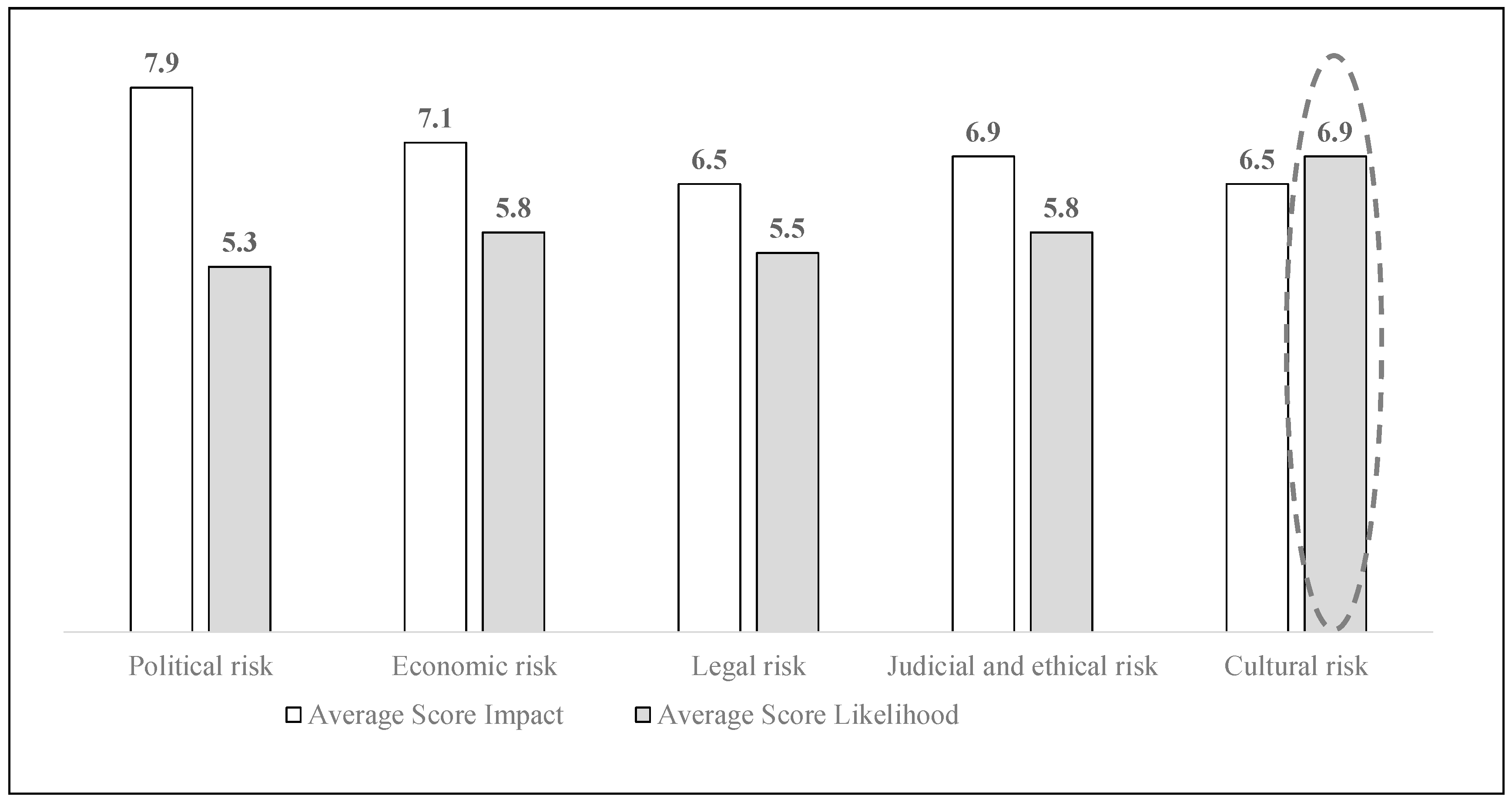
The impact of cultural risk was perceived to be medium–low compared with other risks (Figure 3). On a scale of 10, it obtained a score of 6.5, the lowest score among all risks. However, it ranked first in terms of the likelihood of occurrence, with the highest score of 6.9 specifying how costly it can become not to manage cultural risk within an organization. The dashed circle in the figure emphasizes this particularly high likelihood score. Cultural knowledge needs to be evaluated, codified, and diffused in an appropriate form to users.

6. Implications

This study began with an extensive literature review of culture, risk, and risk management to assemble the elements and to verify that the subject has not been fully covered elsewhere. Using the qualitative approach, it explored the components of cultural risk to refine and extend the current knowledge base with a more comprehensive conceptualization of cultural components. Using strategy’s resource-based view and firms’ product-market positioning, this study suggested that cultural risk management should consider both internal and external environments of the firms. The suggested unifying framework presents two sides of cultural risk and concurrently allows the incorporation of other cultural risk management perspectives. We then theorized some insights on how to manage cultural risk. The suggested framework contributes to extant research in several ways:
  • Unveiling components of cultural risk.
  • Opening up to external and internal perspectives of cultural risk.
  • Assessing the impact of cultural risk.
  • Highlighting knowledge management and sharing as a central mechanism to harmonize internal and external cultural risks.
  • Suggesting additional avenues for future research.
Lastly, the suggested framework can serve as a tool to benefit researchers as well as practitioners. It provides a structured approach for managers to navigate cultural complexities within organizations and foreign markets. Below are the key practical implications and applications for managers:
Managing Internal Cultural Risk (Organizational Culture)
Managers can use the framework to strengthen internal cultural resilience by developing leadership capabilities that foster adaptability, encourage diversity, and integrate cultural intelligence into decision-making. They can also enhance dynamic capability by continuously refining their organization’s ability to sense, seize, and transform cultural knowledge into a competitive advantage. Fostering a culture of innovation helps firms stay responsive to cultural shifts and align strategies with emerging global trends. Finally, institutionalizing knowledge sharing by embedding cultural understanding into operations ensures consistency in cross-cultural engagements.
Addressing External Cultural Risk (Foreign Markets)
For firms operating internationally, the framework supports managers in mitigating cultural risks across foreign markets. This involves understanding local institutions and practices so that business strategies align with regulatory and cultural environments, reducing the risk of misunderstandings or conflicts. Respecting and adapting to local identity and historical context strengthens brand acceptance and improves market positioning. At the same time, monitoring climate and social trends through continuous cultural assessments enables firms to anticipate societal changes that may affect operations.
Knowledge Management as a Bridge
Knowledge management and sharing serve as a central mechanism for harmonizing both internal and external cultural risks. The framework positions a firm as a manager of cultural resources and a potential harmonizer of cultural differences. In practice, managers can create cross-cultural training programs to build employee competencies, improving collaboration and global business interactions. They can develop adaptive market-entry strategies that draw on cultural intelligence to reduce operational friction. They can also implement cultural audits, assessing risks on a regular basis to ensure alignment with their firm’s strategic objectives.

7. Conclusions and Limitations

Businesses now operate in an entirely different environment compared with just a year ago. Firms exist in a global world that is constantly changing, becoming more unstable each day, where changes, big and small, are becoming more unpredictable and happening faster. As events unfold in completely unexpected ways, it is becoming impossible to determine cause and effect (N. Bennett & Lemoine, 2024). Risk exposure has increased and become more complex, diverse, and dynamic (Andersen & Schroder, 2010). At a time when the world faces what may be the largest crisis in generations, we addressed the phenomenon of cultural risk.
The increasing cultural diversity within organizations, as well as the adoption of international expansion strategies, such as cross-border mergers and acquisitions, foreign investments, outsourcing activities, global supply chains, and the development of innovative products, all increase a firm’s cultural risk exposure.
Until recently, globalization for businesses generally meant bringing Western ways to the East. Eastern leaders were invited to learn Western management and leadership principles. The reverse is happening. Now, Chinese companies are introducing new products (e.g., Huawei Technologies Co., Ltd., Shenzhen, China) and services (e.g., AliExpress, Alibaba Group Holding Limited, Hangzhou, China), along with their business philosophies on how to manage, to the West, adding to the influence already exercised by the Japanese. Also, corporations are recruiting from a much larger pool of diverse people with different cultural backgrounds.
When competition for both talent and customers is so fierce, many companies are now operating in more than one market. International managers must decide to choose and adjust their strategies to align with each market. This crossing of geographical boundaries by companies gives rise to multicultural organizations, where employees of more than one culture work together. It may be true that companies are finding these expansions attractive and lucrative, but operating and managing a global business is normally more difficult than managing a local company.
One of the possible reasons for the expansion of firms is to create global competitiveness by reducing production costs and exploiting market opportunities offered by trade liberalization and economic integration. This approach can admittedly be fruitful: local fieldworkers can draw upon their knowledge of local practices to come up with practical measures that facilitate detection, and local staff can often be more effective in contacting and persuading bureaucrats to change policies or approve resources. Just as important as the technological innovations is the ability of organizational members from various nationalities and backgrounds to work together in quickly developing innovative solutions to solve problems as they arise (Choo, 1998). However, cultural risk, if poorly managed, can interfere with the successful completion of organizational goals. A new market can be full of idiosyncratic customers, incomprehensible languages, and strange cultural laws and norms that even the local population might not fully understand.
This study makes contributions to the field by bridging cultural studies with risk management. Traditionally, culture has been examined either as a static variable influencing business operations or as a challenge to overcome. However, this study positions cultural risk as a strategic factor that must be actively managed within an organization’s broader risk framework. By integrating insights from both disciplines, it highlights the importance of cultural risk in shaping international business strategies.
A key contribution of this research is the development of an integrative framework for cultural risk management. This framework categorizes cultural risk into two main dimensions: internal cultural risk, which is rooted in an organization’s culture and leadership, and external cultural risk, which arises from foreign market conditions. Furthermore, it emphasizes the role of knowledge management in harmonizing these risks, demonstrating how organizations can leverage cultural awareness and knowledge-sharing practices to mitigate uncertainty and enhance decision-making.
From a practical standpoint, this study provides valuable insights for corporate leaders, particularly those involved in cross-border mergers, global supply chains, and international talent management. The failures of major companies, such as eBay and Home Depot’s commercial struggles in China, serve as cautionary examples of how cultural risk, if not properly managed, can undermine business success. By highlighting these real-world cases, the study reinforces the need for cultural intelligence and proactive risk management strategies in multinational enterprises.
While this study lays the groundwork for understanding cultural risk, further research is needed to refine and expand its findings. One crucial next step is empirical testing of the proposed framework across different industries and geographic regions. Future studies should validate its applicability through both qualitative and quantitative research, ensuring that its insights are relevant to a wide range of business contexts. Understanding how cultural risk changes in response to political, economic, and technological disruptions would help firms develop more resilient and forward-thinking approaches.
Another promising avenue for research is the exploration of industry-specific cultural risks. Different sectors, such as finance, technology, and healthcare, face unique cultural challenges, and examining these variations could lead to more tailored risk management strategies. Similarly, studying how emerging technologies, such as artificial intelligence, big data, and digital communication platforms, can aid in cultural risk detection and mitigation would provide practical applications for businesses navigating global markets.
Comparative studies between companies of different sizes and regions could also yield valuable insights. By analyzing how multinational corporations (MNCs) versus small and medium enterprises (SMEs) approach cultural risk, researchers can identify best practices for businesses at different scales.
Finally, conducting case studies on organizations that have successfully adapted to cultural risk would provide actionable insights for businesses seeking to expand internationally. Identifying companies that have effectively navigated cultural challenges can offer a roadmap for others looking to strengthen their cultural competence and global competitiveness. By addressing these areas, future research can further develop the field of cultural risk management, equipping businesses with the knowledge and tools needed to operate successfully in an increasingly complex and interconnected world.
While we hope the findings of this study are helpful in outlining the contours of cultural risk management, we make no claim that this constitutes a final answer to how to manage cultural risk. We believe discovering culture is an ongoing quest that requires continuous knowledge development.

Funding

This research received no external funding.

Institutional Review Board Statement

The study was conducted in accordance with the Declaration of Helsinki and approved by Human Information Processing in SMEs (small and medium-sized enterprises) (protocol code CER-11-165-06.10; approved on 18 January 2017).

Informed Consent Statement

Verbal informed consent was obtained from the participants. The rationale for utilizing verbal consent is to reduce administrative burden and potential discomfort for participants, and because the study did not involve sensitive topics, interventions, or the collection of identifiable personal data. This approach is consistent with ethical guidance for minimal-risk research.

Data Availability Statement

The data supporting the findings of this study are available from the author upon request.

Acknowledgments

This manuscript draws, in part, on the author’s doctoral thesis, which is publicly available and cited in references. Portions of the theoretical framework presented here are adapted and further developed from that earlier work.

Conflicts of Interest

The author declares no conflicts of interest.

References

  1. Adler, N. J., & Gundersen, A. (2008). International dimensions of organizational behavior (5th ed.). Cengage. [Google Scholar]
  2. Andersen, T. J., & Schroder, P. W. (2010). Strategic risk management practice. Cambridge University Press. [Google Scholar]
  3. Ashby, W. R. (1956). An introduction to cybernetics. Chapman and Hall. [Google Scholar]
  4. Barmeyer, C. (2023, October 25–27). Constructive intercultural management. Challenges, concepts, conditions [Keynote Speech]. 2023 IACCM Annual Conference, Naples, Italy. [Google Scholar]
  5. Barney, J. B. (1986). Organizational culture: Can it be a source of sustained competitive advantage? The Academy of Management Review, 11(3), 656–665. [Google Scholar] [CrossRef] [Scilit]
  6. Bauman, Z. (1996). Alone again: Ethics after certainty. Demos. [Google Scholar]
  7. Bennett, M. (2023, October 25–27). The case of engaging otherness as the core intercultural competence. 2023 IACCM Annual Conference, Naples, Italy. [Google Scholar]
  8. Bennett, N., & Lemoine, J. (2024). What VUCA really means for you. Harvard Business Review. [Google Scholar]
  9. Bertels, T., & Savage, C. M. (1999). A research agenda for the knowledge era: The tough questions. Knowledge and Process Management, 6(4), 205–212. [Google Scholar] [CrossRef]
  10. Brannen, M. Y. (2004). When Mickey loses face: Recontextualization, semantic fit, and the semiotics of foreignness. The Academy of Management Review, 29, 593–616. [Google Scholar] [CrossRef] [Scilit]
  11. Brannen, M. Y., Piekkari, R., & Tietze, S. (2021). The multifaceted role of language in international business: Unpacking communication and power. Journal of International Business Studies, 52(6), 1034–1052. [Google Scholar]
  12. Bresman, H., Birkinshaw, J., & Nobel, R. (1999). Knowledge transfer in international acquisitions. Journal of International Business Studies, 30(3), 439–462. [Google Scholar] [CrossRef] [Scilit]
  13. Caligiuri, P., De Cieri, H., Minbaeva, D., Verbeke, A., & Zimmermann, A. (2020). International HRM insights for navigating the COVID-19 pandemic: Implications for future research and practice. Journal of International Business Studies, 51(5), 697–713. [Google Scholar] [CrossRef] [Scilit] [PubMed]
  14. Choo, C. W. (1998). The knowing organization: How organizations use information to construct meaning, create knowledge, and make decisions. Oxford University Press. [Google Scholar]
  15. Condorcet, C. (1784). Assurances maritimes. In B. Bru, & P. Crepel (Eds.), Idem, Arithmétique politique—Textes rares ou inédits (1767–1789) (pp. 485–494). INED. [Google Scholar]
  16. Doh, J. (2022). Stakeholder strategy and nonmarket risk in international business. Academy of Management Perspectives, 36(4), 1185–1202. [Google Scholar]
  17. Doz, Y., & Santos, J. (1997). On the management of knowledge: From the transparency of collocation and co-setting to the quandary of dispersion and differentiation. Available online: https://pascal-francis.inist.fr/vibad/index.php?action=getRecordDetail&idt=6257647 (accessed on 23 April 2026).
  18. Easterby-Smith, M., & Lyles, M. (2006). Handbook of organizational learning and knowledge management. Blackwell Publishing. [Google Scholar]
  19. Edman, J. (2016). Cultivating foreignness: How organizations maintain and leverage minority identities. Journal of Management Studies, 53(1), 55–88. [Google Scholar] [CrossRef] [Scilit]
  20. Ferraro, G. P. (1994). The international dimension of international business. Prentice-Hall. [Google Scholar]
  21. Firsova, N. (2021). Facets of cultural risk management: A strategic perspective [Doctoral thesis, Univesité du Québec à Trois-Rivières]; 259p. [Google Scholar]
  22. Firsova, N., & Vaghely, I. (2018). Strategic options to cultural risk management: A theoretical framework. Universal Journal of Management, 6(7), 248–262. [Google Scholar] [CrossRef] [Scilit]
  23. Firsova, N., Vaghely, I., & Arcand, G. (2015, June 28–July 2). Does cross cultural risk management create competitive advantage: A strategic perspective? 9th Biennial Congress of the International Academy of Intercultural Research, Bergen, Norway. [Google Scholar]
  24. Fraser, J., & Simkins, B. (2010). Enterprise risk management: Today’s leading research and best practices for tomorrow’s executives. Wiley. [Google Scholar]
  25. Gerhart, B., & Fang, M. (2005). National culture and human resource management: Assumptions and evidence. The International Journal of Human Resource Management, 16(6), 971–986. [Google Scholar] [CrossRef] [Scilit]
  26. Grishina, E. A. (1993). Sovremenniy Slovar inostrannykh slov (Contemporary dictionary of foreign words). Russkii Yazik. [Google Scholar]
  27. Hart, R. K. (2024). Critiques of cross-cultural management research: Topics, paradigms and methods. In Handbook of cross-cultural management. Edward Elgar. [Google Scholar]
  28. Harzing, A.-W., Pudelko, M., & Reiche, B. S. (2016). The bridging role of expatriates and inpatriates in knowledge transfer in multinational corporations. Human Resource Management, 55(4), 679–695. [Google Scholar] [CrossRef] [Scilit]
  29. Herskovits, M. (1967). Les bases de l’anthropologie culturelle. François Maspero. [Google Scholar]
  30. Hofstede, G. (1991). Cultures and organizations. McGraw Hill. [Google Scholar]
  31. Hofstede, G., Hofstede, J. G., & Minkov, M. (2010). Cultures and organizations: Software of the mind. Intercultural cooperation and its importance for survival. McGraw Hill. [Google Scholar]
  32. Holden, N., Michailova, S., & Tietze, S. (Eds.). (2015). The routledge companion to cross-cultural management. Routledge. [Google Scholar]
  33. House, R. J., Hanges, P. J., Javidan, M., Dorfman, P., & Gupta, V. (2004). Culture, leadership, and organizations: The GLOBE study of 62 societies. SAGE Publications. [Google Scholar]
  34. Hymer, S. (1976). The international operations of nation firms: A study of foreign direct investment. MLT Press. [Google Scholar]
  35. Kaplan, S., & Garrick, J. (1981). On the quantitative definition of risk. Risk Analysis, 1(1), 11–27. [Google Scholar] [CrossRef] [Scilit]
  36. Kleppesto, S. (1998). A quest for social identity—The pragmatics of communication in mergers and acquisitions. In M. G. Gertsen, A.-M. Soderberg, & J. E. Torp (Eds.), Cultural dimensions of international mergers and acquisitions (pp. 147–166). De Gruyter. [Google Scholar]
  37. Koivisto, J. (1999). Cultural heritages and cross-cultural management: Cross-cultural synergy and friction in Finno-Japanese management [Ph.D. thesis, Helsinki School of Economics and Business Administration]. [Google Scholar]
  38. Kostova, T. (1999). Transnational transfer of strategic organizational practices: A contextual perspective. The Academy of Management Review, 24, 308–324. [Google Scholar] [CrossRef] [Scilit]
  39. Kostova, T., & Roth, K. (2002). Adoption of an organizational practice by subsidiaries of multinational corporations: Institutional and relational effects. The Academy of Management Journal, 45, 215–233. [Google Scholar] [CrossRef] [Scilit]
  40. Kotter, J. P. (2012). Leading change (rev. ed.). Harvard Business Review Press. [Google Scholar]
  41. Lee, Y. T., & Gyamfi, N. Y. A. (2021). The Sage handbook of contemporary cross-cultural management: Betina Szkudlarek, Laurence Romani, Dan V. Caprar and Joyce S. Osland (Eds) Sage, London and Thousand Oaks, 2020, 564 pp. ISBN: 978-1526441324. Journal of International Business Studies, 53(3), 568. [Google Scholar] [CrossRef] [Scilit]
  42. Leung, K., & Morris, M. (2015). Values, schemas, and norms in the culture–behaviour nexus: A situated dynamics framework. Journal of International Business Studies, 46(9), 1028–1050. [Google Scholar]
  43. Malinowski, B. (1968). Une théorie scientifique de la culture et autres essais. Maspero. [Google Scholar]
  44. Meyer, K. E., Estrin, S., Bhaumik, S. K., & Peng, M. W. (2021). Institutions, resources, and entry strategies in emerging economies. Journal of International Business Studies, 52(3), 389–412. [Google Scholar]
  45. Nonaka, I., & Takeuchi, H. (1995). The knowledge creating company. Oxford University Press. [Google Scholar]
  46. Nonaka, I., & Von Krogh, G. (2009). Tacit knowledge and knowledge conversion: Controversy and advancement in organizational knowledge creation theory. Organization Science, 20(3), 635–652. [Google Scholar] [CrossRef] [Scilit]
  47. Pelled, L. (1996). Demographic diversity, conflict and work group outcomes: An intervening process theory. Organization Science, 17, 615–631. [Google Scholar] [CrossRef] [Scilit]
  48. Pelled, L. H., Eisenhardt, K. M., & Xin, K. R. (1999). Exploring the black box: An analysis of work group diversity, conflict, and performance. Administrative Science Quarterly, 44, 1–28. [Google Scholar] [CrossRef] [Scilit]
  49. Phillips, M., & Sackmann, S. (2015). Cross cultural management rising. In N. Holden, S. Michailova, & S. Tietze (Eds.), The routledge companion to cross cultural management (pp. 8–18). Routledge. [Google Scholar]
  50. Porter, M. E. (1979). How competitive forces shape strategy. Harvard Business Review, 3(4), 137–145. [Google Scholar]
  51. Porter, M. E. (1980). Competitive strategy: Techniques for analyzing industries and competitors. The Free Press. [Google Scholar]
  52. Porter, M. E. (2008). The five competitive forces that shape strategy. Harvard Business Review. [Google Scholar]
  53. Prahalad, C. K., & Hamel, G. (1990). The core competence of the corporation. Harvard Business Review, 5(6), 79–91. [Google Scholar]
  54. Primecz, H., Romani, L., & Sackmann, S. (2009). Cross-cultural management research: Contribution from various paradigms. International Journal of Cross-Cultural Management, 9(3), 267–274. [Google Scholar]
  55. Roberts, C. W. (1989). Other than counting words: A linguistic approach to content analysis. Social Forces, 68(1), 148–177. [Google Scholar] [CrossRef] [Scilit]
  56. Robson, C., & McCartan, K. (2016). Real world research (4th ed.). Wiley. [Google Scholar]
  57. Romani, L., Barmeyer, C., Primecz, H., & Pilhofer, K. (2018). Cross-cultural management studies: State of the field in the four research paradigms. International Studies of Management & Organization, 48(3), 247–263. [Google Scholar] [CrossRef] [Scilit]
  58. Sanchez, R. (2001). Knowledge management and organizational competence. Oxford University Press. [Google Scholar]
  59. Schein, E. H., & Schein, P. (2017). Organizational culture and leadership (5th ed.). Wiley. [Google Scholar]
  60. Schoenberg, R. (2001). Knowledge transfer and resource sharing as value creation mechanisms in inbound continental European acquisitions. Journal of Euromarketing, 10(1), 99–114. [Google Scholar] [CrossRef] [Scilit]
  61. Scott, W. R. (2014). Institutions and organizations: Ideas, interests, and identities (4th ed.). Sage. [Google Scholar]
  62. Stahl, G., & Tung, R. (2015). Towards a more balanced treatment of culture in international business studies: The need for positive cross-cultural scholarship. Journal of International Business Studies, 46, 391–414. [Google Scholar]
  63. St-Pierre, J., & Bahri, M. (2006). The use of the accounting beta as an overall risk indicator for unlisted companies. Journal of Small Business and Enterprise Development, 13(4), 546–561. [Google Scholar] [CrossRef] [Scilit]
  64. Szulanski, G. (1996). Exploring internal stickiness: Impediments to the transfer of best practice within the firm. Strategic Management Journal, 17, 27–43. [Google Scholar] [CrossRef] [Scilit]
  65. Taijfel, H. (1970). Experiments in intergroup discrimination. Scientific American, 223(5), 96–102. [Google Scholar] [CrossRef] [Scilit]
  66. Taijfel, H. (1974). Social identity and intergroup behaviour. Social Science Information, 13(2), 65–93. [Google Scholar] [CrossRef] [Scilit]
  67. Teece, D. J. (2020). Dynamic capabilities and entrepreneurial management in large organizations: Toward a theory of the (entrepreneurial) firm. European Economic Review, 86, 202–216. [Google Scholar] [CrossRef] [Scilit]
  68. Teece, D. J., Pisano, G., & Shuen, A. A. (1997). Dynamic capabilities and strategic management. Strategic Management Journal, 18, 504–534. [Google Scholar] [CrossRef] [Scilit]
  69. Triandis, H. C. (1995). Individualism and collectivism. Westview. [Google Scholar]
  70. Tylor, E. B. (1924). Primitive culture. Smith. [Google Scholar]
  71. Vaughan, E. J. (1997). Risk management. Wiley. [Google Scholar]
  72. Venzin, M. (1998). Knowledge management. CEMS Business Review, 2(3), 205–210. [Google Scholar]
  73. Vygotsky, L. S. (1986). Thought and language (rev. ed.). MIT Press. [Google Scholar]
  74. Wei, W., Lu, J. G., Galinsky, A. D., Wu, H., Gosling, S. D., Rentfrow, P. J., Yuan, W., Zhang, Q., Guo, Y., Zhang, M., Gui, W., Guo, X.-Q., Potter, J., Wang, J., Li, B., Li, X., Han, Y.-M., Lv, M., Guo, X.-Q., … Wang, L. (2017). Regional ambient temperature is associated with human personality. Nature Human Behaviour, 1, 890–895. [Google Scholar] [CrossRef] [Scilit]
  75. Zahra, S. A. (2021). International entrepreneurship in the post Covid world. Journal of World Business, 56(1), 101143. [Google Scholar] [CrossRef] [Scilit]
  76. Zou, S., & Cavusgil, S. T. (2002). The GMS: A broad conceptualization of global marketing strategy and its effect on firm performance. Journal of Marketing, 66(4), 40–56. [Google Scholar] [CrossRef] [Scilit]
Figure 1. Cultural management conceptual framework adapted from Ashby’s requisite variety principle (Ashby, 1956), the resource-based view of strategy (Prahalad & Hamel, 1990), and product-market positioning theory (Porter, 1979, 1980).
Businesses 06 00030 g001
Figure 2. An integrative framework of cultural risk management in the firm.
Businesses 06 00030 g002
Figure 3. Impact of cultural risk compared to other risks.
Businesses 06 00030 g003
Disclaimer/Publisher’s Note: The statements, opinions and data contained in all publications are solely those of the individual author(s) and contributor(s) and not of MDPI and/or the editor(s). MDPI and/or the editor(s) disclaim responsibility for any injury to people or property resulting from any ideas, methods, instructions or products referred to in the content.