1. Introduction
The informal food sector in Africa’s urban centres plays a crucial role in urban economies, providing affordable meals, employment opportunities, and economic resilience for low-income communities (
Moments Log, 2023). However, it is often overlooked in public health policy. This sector is particularly significant in developing economies, where it serves as a livelihood strategy for individuals excluded from the formal job market (
Centre of Excellence, 2020). Health and safety practices are essential for ensuring safe working environments, reducing occupational hazards, and improving business performance. While these practices are well-regulated in formal sectors, they are often overlooked in the informal economy, particularly among street food vendors.
However, unlike businesses in the formal food industry, where compliance with health and safety regulations is strictly enforced, street food vendors often lack access to sanitation facilities, clean water, and proper food storage options (
Hariparsad & Naidoo, 2019;
Nortey et al., 2024). The informal nature of street food vending means that many vendors operate without proper licenses, regulatory oversight, or health and safety training. In Johannesburg, informal vendors are subject to dual regulatory obligations which includes the Business Act No. 71 of 1991 (
South Africa, 1991), which governs licensing, and the Regulations Governing General Hygiene Requirements for Food Premises (R638 of 2018) (
South Africa Department of Health, 2018), which mandate hygiene certification via a Certificate of Acceptability (COA). While these frameworks exist, enforcement and compliance remain fragmented, especially for vulnerable vendors (
South Africa Department of Health, 2018). Furthermore, in practice, many vendors face structural barriers that limit their ability to comply with these regulations. Financial constraints, lack of awareness, and weak enforcement mechanisms contribute to the persistent challenges of implementing adequate health and safety measures (
Khuluse & Deen, 2020).
Previous research has found that while awareness of hygiene practices may be high, actual compliance is hindered by infrastructural deficits, limited training, and inconsistent inspections (
Muinde & Kuria, 2005;
Barro et al., 2006). The Health Belief Model (HBM) is a robust framework for understanding these behaviours, incorporating dimensions such as perceived susceptibility, severity, barriers, and cues to action (
Rosenstock, 1974). These challenges expose both vendors and consumers to serious health risks, including foodborne illnesses, contamination, and unhygienic work environments (
Nyarugwe et al., 2018).
In Johannesburg’s inner city, where street food vending is widespread, vendors operate in crowded spaces with limited infrastructure. While some recognise the importance of hygiene for customer trust and business success, compliance is often seen as secondary to immediate business survival due to resource constraints (
Bautista-Bernal et al., 2024). Additionally, municipal authorities struggle to regulate informal vendors effectively, leading to inconsistent enforcement of health and safety laws (
Irawati et al., 2019). This creates a policy gap between regulatory frameworks and real-world vendor experiences, hindering the implementation of sustainable hygiene solutions.
Although research has established a strong link between health and safety compliance and business success in formal workplaces, little is known about how these practices influence the financial stability and customer retention of informal street food vendors (
Hariparsad & Naidoo, 2019;
Khuluse & Deen, 2020). This study also incorporates behavioural economics, particularly the role of incentives, risk perception, and trust in regulatory processes. From a behavioural economics perspective, compliance decisions in informal markets are often shaped by bounded rationality and the use of heuristics under uncertainty, particularly when vendors face constrained resources and inconsistent enforcement. Incentives (e.g., access to training, recognition, or simplified compliance pathways) can act as “nudges” that strengthen cues to action and reduce perceived barriers, thereby complementing HBM constructs. Behavioural economics also helps explain how trust in regulatory processes and perceived payoffs from compliance may influence vendors’ willingness to invest in hygiene practices, which, in turn, directly links to BSC performance outcomes such as operational risk reduction, customer satisfaction, and long-term business resilience.
This study adopts a mixed methods approach to explore how health and safety practices affect business performance among street food vendors in Johannesburg’s inner city. This research seeks to generate actionable insights for improving health and safety enforcement in the informal food sector by assessing vendors’ perceptions, customer trust, and actual compliance levels.
Problem Statement
Street food vendors in major South African cities play a vital role in providing affordable food and supporting the local economy. Their contribution to the informal economy is estimated at 6% of South Africa’s GDP (
Stats SA, 2022). These vendors not only provide essential services to commuters and local residents but also create employment opportunities and stimulate economic activity in urban areas. However, they often operate in informal settings with limited access to clean water, sanitation, and safe food handling facilities, posing risks to both public health and business sustainability (
Centre of Excellence, 2020). Despite the importance of health and safety compliance, many vendors face financial constraints, inadequate infrastructure, and limited awareness, which makes adherence to these standards challenging. While some recognise the benefits of compliance, such as improved customer trust and business reputation, these barriers prevent the consistent implementation of safety measures. The impact of health and safety practices on business performance in the informal food sector remains underexplored.
The protocol is aligned with the Sustainable Development Goals (SDGs), particularly:
SDG 3: Ensure healthy lives and promote well-being;
SDG 8: Promote sustained, inclusive economic growth;
SDG 11: Make cities inclusive, safe, and resilient.
2. Experimental Design
2.1. Aim and Objectives of the Study
To explore how health and safety practices influence the business performance and sustainability of street food vendors in Johannesburg’s inner city, using the Health Belief Model (HBM) and the Balanced Scorecard (BSC) as a theoretical lens.
- (1)
To explore street food vendors’ perceptions of health and safety practices and their role in business performance, customer trust, and competitiveness.
- (2)
To assess vendors’ adherence to health and safety standards and the challenges associated with their implementation.
- (3)
To evaluate the impact of health and safety compliance on operational efficiency, financial stability, business sustainability, and customer perception.
2.2. Research Questions
- (1)
How do street food vendors perceive health and safety practices, and what role do these practices play in their business performance, customer trust, and competitiveness?
- (2)
What challenges do street food vendors face in adhering to health and safety standards, and how do these challenges influence their ability to comply?
- (3)
How does health and safety compliance impact vendors’ operational efficiency, financial stability, business sustainability, and customer perception?
2.3. Theoretical Framework Summary
This study integrates the Health Belief Model (HBM) and the Balanced Scorecard (BSC) to examine the relationship between food safety compliance and vendor performance in the informal street food sector. The HBM explains vendors’ hygiene behaviours through their perceived susceptibility to foodborne risks, perceived benefits (e.g., customer trust), and barriers such as cost and infrastructure limitations. The BSC complements this by framing hygiene compliance as a strategic contributor to business success, enhancing customer satisfaction, reducing operational risks, and supporting long-term sustainability. Together, these frameworks offer a multidimensional lens to understand how both behavioural motivations and performance indicators shape health and safety practices among informal vendors.
This combined HBM–BSC framing advances existing work on food safety compliance by explicitly linking behavioural determinants of hygiene practice (e.g., perceived risk, perceived benefits, barriers, and cues to action) to business performance domains that are central to management and sustainability research. In doing so, the protocol positions hygiene compliance not only as a public health requirement but also as a strategic business capability with measurable implications for customer retention, operational risk reduction, and financial stability in informal microenterprises.
To operationalise the integration of behavioural and business perspectives, this study combines the HBM and the BSC into a unified analytical framework.
Table 1 illustrates how key HBM constructs align with BSC performance dimensions to explain how vendors’ health-related beliefs translate into observable hygiene practices and business performance outcomes within the informal street food sector.
2.4. Research Design
This study will employ a cross-sectional, mixed methods approach to examine the impact of health and safety practices on the business performance of street food vendors in Johannesburg’s inner city. A cross-sectional design enables data collection at a single point in time (
Wang & Cheng, 2020). This research adopts an exploratory approach, combining qualitative and quantitative techniques. Given the exploratory nature of the study, a mixed-methods approach is deemed most appropriate to capture both the measurable and experiential dimensions of the research problem (
Saunders et al., 2009;
Creswell, 2018).
The study follows a convergent mixed-methods design, with qualitative (vendor interviews) and quantitative (observations and surveys) components implemented concurrently and given complementary priority. Integration will occur during interpretation through structured comparison of findings across strands, linking HBM constructs (perceived susceptibility, severity, benefits, barriers, and cues to action) to BSC performance dimensions (customer, internal process, and financial perspectives). This enables the study to explain not only whether compliance relates to performance outcomes, but also why these relationships may occur in the informal street food context. The qualitative approach gains insights into their experiences, motivations, and barriers to health and safety compliance. The quantitative approach measures compliance levels, business performance indicators (e.g., sales, customer retention), and customer perceptions of hygiene standards (
Yakubu et al., 2023). This integrated method ensures a comprehensive analysis of both vendor perspectives and measurable business impacts.
2.5. Study Area and Research Population
The study will be conducted in Johannesburg’s inner city, Gauteng Province, a densely populated urban core shaped by the city’s mining-linked economic development and continued role as a national employment and trading hub (
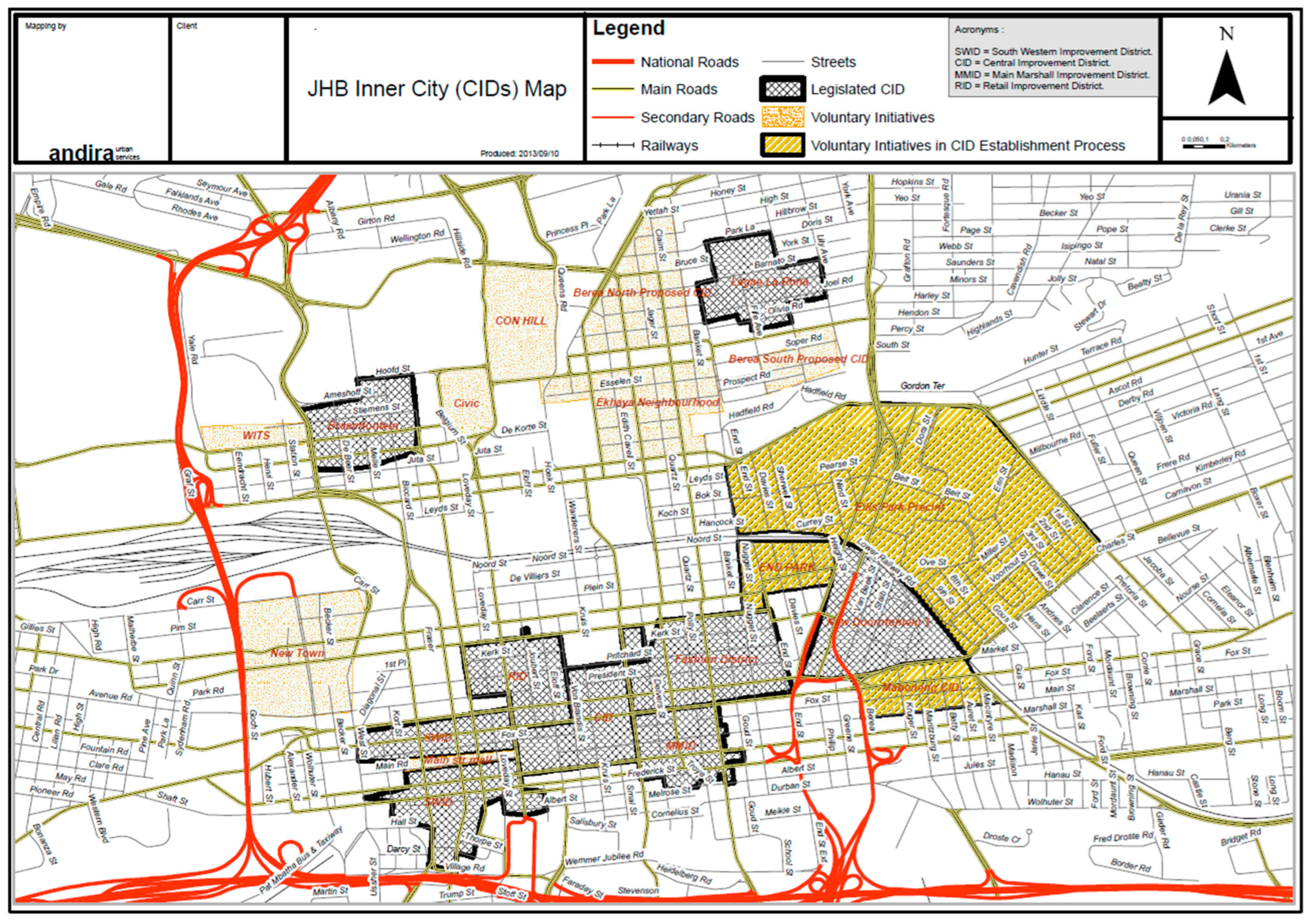
City of Johannesburg, 2018). The inner city hosts a vibrant informal economy, including a high concentration of street food vendors operating in commuter-heavy nodes and improvement districts, as shown in
Appendix A (
Centre of Excellence, 2020;
GPMA, 2014). These trading environments are characterised by high pedestrian traffic and sustained demand for affordable, ready-to-eat food. However, they often operate under constrained infrastructural conditions (e.g., limited access to sanitation services and inconsistent oversight), making them relevant for examining health and safety compliance challenges in informal food enterprises (
Nyarugwe et al., 2018;
Hariparsad & Naidoo, 2019;
Sepadi & Nkosi, 2023).
The research population comprises two groups: (i) informal street food vendors operating in selected inner-city trading areas of Johannesburg and (ii) customers who purchase food from these vendors. Johannesburg’s inner city has an estimated population of approximately 658,000, supporting a large and diverse customer base for informal food markets (
City of Johannesburg, 2018). The study will use a non-probability sampling approach suitable for hard-to-enumerate informal populations. Vendors constitute the primary unit of analysis for assessing health and safety compliance and business performance indicators, while customers provide complementary evidence on hygiene perceptions, trust, and purchasing behaviour.
2.6. Sampling and Sample Size
2.6.1. Inclusion and Exclusion Criteria
Inclusion criteria for street food vendors include operating within the inner city, selling ready-to-eat food, having at least 1 year of business experience, being 18 or older, and being willing to participate in an interview and provide informed consent. Customers included will be those who have purchased from inner city vendors in the past year, are 18 or older, and provide consent. Vendors outside the study area, not selling ready-to-eat food, with less than 1 year of operation, or unwilling to participate, as well as customers under 18, those who have not purchased in the inner city of Johannesburg, or those unwilling to consent, will be excluded.
2.6.2. Sample Size
Sample Size for Food Vendors
Purposive sampling selects food vendors based on a specific criterion, ensuring relevant insights from those with experience (
Saunders et al., 2009). The study will include 20–30 street food vendors for interviews, ensuring data saturation. Interviews will be conducted until data saturation is achieved, which is defined as the point at which no new themes, patterns, or insights emerge from successive interviews, indicating that additional data collection would be redundant (
Saunders et al., 2018).
The proposed interview sample of 20–30 vendors is designed to capture variation across vendor type, location, and experience within the informal street food sector. This sample size is consistent with qualitative research standards for achieving sufficient thematic coverage in heterogeneous populations and is appropriate for thematic analysis. This approach ensures sufficient depth and richness in the qualitative findings, supporting the reliability and credibility of the thematic analysis.
Sample Size for Customers of Food Vendors
Convenience sampling will be used for the customer survey, selecting participants based on availability and accessibility. The sample size was determined using Cochran’s formula for an unknown population size [
n = (Z
2 ×
p × (1 −
p)) ÷ E
2], ensuring statistical representativeness (
Cochran, 1977). Based on a 95% confidence level and a 5% margin of error, the required sample size is 384 respondents. A conservative proportion (
p = 0.5) was assumed in Cochran’s formula to maximise sample size robustness given the absence of a precise sampling frame for street food consumers. This calculation maximises accuracy in estimating customer perceptions of health and safety practices among street food vendors.
Recruitment feasibility is supported by the high pedestrian traffic and concentrated vending nodes in Johannesburg’s inner-city trading areas, enabling efficient access for both vendors and customers. The customer survey, multiple recruitment channels (QR codes at stalls, assisted completion, and social media circulation) will be used to support response rates and reduce barriers to participation.
3. Materials and Equipment
The data collection was done using three tools (
Table 2):
3.1. Semi-Structured Interviews for Vendors
Semi-structured interviews will explore vendors’ perceptions, compliance behaviours, and challenges related to health and safety, as well as the impact of compliance on business performance (
Supplementary Material S1). Open-ended and close-ended questions will be utilised, drawing on the BM and BSC frameworks and various other studies (
Huynh-Van et al., 2022;
Ramos et al., 2021;
Bautista-Bernal et al., 2024;
PHS BeSafe, 2024); (
Nyarugwe et al., 2018;
Hariparsad & Naidoo, 2019;
Sepadi & Nkosi, 2023).
3.2. Vendor Stall Observation Checklist
Structured observations (
Supplementary Material S1) will assess real-time compliance practices, including hygiene measures, food storage, and waste disposal, using a checklist based on South African General Hygiene Requirements (No. R638 of 2018) and WHO guidelines and other studies (
Nyarugwe et al., 2018;
Hariparsad & Naidoo, 2019;
Sepadi & Nkosi, 2023;
Desye et al., 2023). This technique is crucial in validating self-reported data collected through interviews, reducing the risk of bias or socially desirable responses. Moreover, observations provide insights into the contextual and environmental factors that influence vendor behaviour.
3.3. Customer Self-Administered Survey
An online questionnaire will collect data on customer perceptions of vendor hygiene practices, trust levels, and purchasing behaviours. It includes both closed-ended and open-ended questions aimed at capturing customer demographics, frequency of street food purchases, perceptions of vendor hygiene practices, and the influence of health and safety standards on trust, loyalty, and purchasing behaviour (
Balanced Scorecard Institute, 2024). The data to be gathered from customers complements vendor responses and observational findings, offering insight into whether visible hygiene practices influence customer decisions, satisfaction, and perceived food safety in the informal food sector (
PHS BeSafe, 2024;
WHO, 2022).
3.4. Data Collection Procedure
Data collection will occur over six weeks, using face-to-face interviews, vendor stall observations, and self-administered surveys.
3.4.1. Street Vendor Interviews
Face-to-face semi-structured interviews with street food Vendors will be conducted on-site at their workplaces, lasting 20 to 30 min each. Prior to each session, vendors will be informed of the study’s purpose, and verbal and written consent will be obtained. The researcher will conduct the study, and if any needs arise, trained field staff will assist the researcher. Interviews will be audio-recorded (with consent) and conducted in English or local languages to ensure comfort and clarity of communication.
3.4.2. Stall Direct Observations
In parallel, structured stall observations will be conducted using a standardised checklist. Observations will take place during regular business hours to capture natural behaviours. Each observation session will last approximately 15 to 20 min. Observers will systematically record compliance indicators to evaluate real-time adherence to public health standards. This ensures natural behaviour observation without researcher interference. This approach will ensure a cohesive understanding of vendor responses versus their actual behaviours and help identify gaps between self-reported compliance and real-world practice.
3.4.3. Customer Self-Administered Questionnaire
Customer surveys will be self-administered via Microsoft Forms, with QR codes available at vendor stalls and on social media. Researchers or research assistants will assist customers without digital access. Surveys will take approximately 5 to 7 min per customer to complete. The researcher and trained assistants will conduct interviews and observations, ensuring standardised data collection.
3.5. Trustworthiness and Validity in Mixed Methods Research
To ensure content validity, the observation checklist and interview guide were reviewed by a Registered Environmental Health Practitioner (EHP) and a Business Administration Graduate. The COSMIN framework (
Mokkink et al., 2018) guided the development and assessment of the instruments, ensuring they were relevant, comprehensive, and comprehensible. The observation tool was structured into domains (e.g., food protection, personal hygiene) to improve construct clarity. Observations were conducted during peak trading hours to capture real-time practices. Inter-observer agreement was ensured by training fieldworkers using mock observations. A codebook based on HBM constructs guided thematic coding, and inter-coder reliability was achieved through collaborative cross-checking.
The study employed a mixed methods approach to address these limitations, integrating qualitative and quantitative strands to triangulate findings and enhance contextual depth. This methodological triangulation enhanced the trustworthiness of the results by validating observed trends through multiple lenses, including interviews, survey data, and thematic coding, consistent with the recommendations of
Zohrabi (
2013).
In addition, the customer questionnaire and vendor interview guide will be pilot tested with a small number of participants to assess clarity, flow, and contextual appropriateness. For the customer survey, internal consistency will be assessed for multi-item Likert-scale measures (e.g., hygiene perception and trust-related item sets) using Cronbach’s alpha, and items will be reviewed and refined if reliability falls below acceptable thresholds. Minor wording adjustments may also be made following pilot feedback to reduce ambiguity and enhance comprehension across language contexts.
These efforts enhance the internal and external validity of the findings while supporting the study’s aim to draw credible, transferable insights into vendor practices in informal urban markets.
3.6. Ethical Approval and Consent to Participate
Ethical clearance for this study was obtained from the Tshwane University of Technology Human Research Ethics Committee (Reference number: HREC2025 = 07 = 030). In addition, the study was registered on the National Health Research Database (NHRD) under the registration number (NHRD-GP_202503_031). Participation in the study was entirely voluntary. All respondents were provided with an information leaflet outlining the purpose, procedures, risks, and benefits of the study, after which written informed consent was obtained prior to data collection. No personally identifiable information was recorded. Anonymity was maintained through coded identifiers, and confidentiality was maintained throughout the research process. The data were securely stored and used exclusively for academic purposes.
Potential risks to participants are minimal but may include time burden for vendors during trading hours and possible discomfort when discussing business challenges or compliance barriers. These risks will be minimised by scheduling interviews at convenient times, keeping interviews brief, reminding participants that they may skip any question, and reinforcing the right to withdraw at any stage without consequences. No enforcement or punitive actions are linked to participation, and no identifiable information will be recorded.
3.7. Data Analysis
Data analysis in this study is structured around the three research objectives to ensure clarity and alignment between the collected data and the study’s aims. A mixed-methods approach is adopted, with qualitative data analysed using ATLAS.ti (version 25) and quantitative analyses conducted using IBM SPSS Statistics (version 31.0.1.0) (
ATLAS.ti Scientific Software Development GmbH, 2024;
IBM Corp., 2025). Data will be screened for completeness prior to analysis, and cases with substantial missing values will be excluded using listwise deletion. Key outcome variables related to business performance will be operationalised using the Balanced Scorecard dimensions, including the customer perspective (customer trust and retention), the internal process perspective (hygiene compliance and operational efficiency), and the financial perspective (income stability and perceived profitability).
3.7.1. Analysis for Objective 1
Qualitative data from vendor interviews will be coded using thematic analysis in ATLAS.ti. Open coding will identify themes related to vendor perceptions, including perceived health risks, customer trust, and competitiveness. Both inductive (emergent) and deductive (HBM- and BSC-informed) coding will be used to ensure that thematic outputs reflect participants’ narratives while remaining aligned with the theoretical framework. These will be refined into broader categories and mapped using co-occurrence and network analysis tools. The coding process will follow an iterative approach, beginning with open coding and then consolidating codes into higher-order themes aligned with the study objectives. Coding decisions will be reviewed for consistency, and analytic memos will document emerging patterns and relationships across interviews.
3.7.2. Analysis for Objective 2
Quantitative data from stall observation checklists will be analysed using descriptive statistics in SPSS to measure compliance levels. Frequencies and percentages will be summarised according to practices such as food storage, cleanliness, and PPE use. Thematic analysis of interview data will provide complementary insights into vendors’ challenges, including financial and infrastructure barriers.
3.7.3. Analysis for Objective 3
Quantitative data from customer surveys and vendor responses will be analysed using inferential statistics in SPSS. Techniques to be included will include chi-square tests (for associations between compliance and trust), Pearson’s correlation (for relationships between hygiene practices and business performance), and multiple regression (for predicting outcomes such as profitability and sustainability). T-tests and ANOVA will be used to compare performance across groups with varying levels of compliance. A p-value ≤ 0.05 was used to determine statistical significance. Where appropriate, regression analyses will account for potential confounding variables such as vendor experience, location, and access to basic infrastructure. The assumptions underlying parametric tests will be assessed prior to analysis, and nonparametric alternatives will be considered if these assumptions are violated.
3.7.4. Data Triangulation and Integration
To enhance the validity and richness of the findings, this study will employ a triangulation approach that integrates quantitative and qualitative data collected from multiple sources. Specifically, data will be collected through structured stall observations, semi-structured interviews with street food vendors, and structured customer surveys. Each method captures a different dimension of hygiene practice and business behaviour, allowing for a more comprehensive understanding of compliance patterns.
The triangulation process will involve both methodological triangulation (using different data collection methods) and data source triangulation (drawing on multiple stakeholder perspectives). For instance, observational data on hygiene practices will be compared with vendors’ self-reported behaviours to identify discrepancies between stated awareness and actual implementation. Similarly, customer perceptions of hygiene and trust will be cross-referenced with vendor-reported challenges and practices.
Quantitative data will be analysed using SPSS to identify statistical associations between variables such as certification status, gender, experience, and hygiene practices. Qualitative data from interviews will be thematically analysed to explore behavioural drivers and perceived barriers. These results will be integrated during the interpretation phase, with convergence and divergence between data sets used to deepen insight and explain patterns.
Integration of qualitative and quantitative findings will occur primarily at the interpretation stage, where results will be compared and synthesised to identify areas of convergence, complementarity, or divergence. This approach enables behavioural insights derived from vendor and customer narratives to be directly linked to observed hygiene practices and quantified business performance indicators, thereby strengthening the explanatory power of the mixed-methods design. This mixed-methods integration will enable the study to address both the structural and behavioural factors influencing hygiene compliance and to generate actionable recommendations that reflect the lived realities of informal vendors and their customers.
4. Expected Results
The study is expected to reveal that regulatory compliance among informal street food vendors in Johannesburg remains uneven despite high levels of awareness. Vendors who have operated longer, are female, or possess higher levels of education are anticipated to demonstrate better hygiene practices and a greater likelihood of holding valid Certificates of Acceptability (COAs). Observational data will likely reveal inconsistencies between self-reported knowledge and actual hygiene behaviours, particularly in areas such as hand hygiene, protective clothing use, and food storage.
Using the HBM, the study anticipates identifying that vendors’ decisions to adopt safe hygiene practices are shaped by perceived benefits, such as customer trust and repeat business, and by perceived barriers, including infrastructure challenges, the cost of compliance, and limited regulatory clarity.
Customer data is expected to further reinforce the importance of visible hygiene as a determinant of trust and purchase behaviour. Customers may indicate that cleanliness indicators, such as handwashing, protective gear, and stall cleanliness, are critical to their continued patronage.
The integration of these findings is anticipated to demonstrate that hygiene is not only a public health concern but also a driver of business sustainability. Vendors who prioritise hygiene may experience enhanced business performance, including increased customer loyalty, fewer disruptions, and greater legitimacy. These findings will inform targeted interventions that promote inclusive and innovative business practices within the informal food sector.
5. Limitations and Directions for Future Research
This protocol is designed to provide a comprehensive understanding of the intersection between public health practices and business performance in the informal sector. While its mixed-methods approach ensures rich data collection, limitations may include self-reporting bias, limited generalisability beyond urban Johannesburg, and infrastructural constraints during data collection. Nonetheless, the inclusion of diverse data sources and triangulation strategies enhances the study’s reliability. Integrating qualitative and quantitative findings may present interpretive challenges; however, triangulation across interviews, observations, and survey data will be used to enhance analytical coherence. While this study provides critical insights into the hygiene behaviours of informal street food vendors in Johannesburg, several limitations must be acknowledged:
The research used a cross-sectional design, which limits the ability to establish causal relationships between hygiene practices and business outcomes. Longitudinal studies would allow for an assessment of how changes in hygiene behaviour over time influence vendor performance and public health risk.
Vendor interviews and some customer responses relied on self-reported data, which may be subject to social desirability bias. Although these were triangulated with direct observations, respondents may have overstated their hygiene practices or underreported challenges.
The study was conducted in the inner-city areas of Johannesburg, which have unique demographic, infrastructural, and regulatory characteristics. As such, the findings may not fully reflect the experiences of vendors in peri-urban or rural contexts, or in other South African cities with different governance systems.
Observation sessions were brief (5–10 min), which may not capture the full range of hygiene practices or lapses throughout a typical day. Extended or repeated observations could offer a more nuanced picture of compliance and behavioural routines.
6. Conclusions
This protocol outlines a mixed-methods study designed to investigate the intersection of hygiene practices, regulatory compliance, and business sustainability within Johannesburg’s informal street food sector. By integrating the Health Belief Model (HBM) and the Balanced Scorecard (BSC) framework, the study aims to explore both the behavioural drivers of hygiene compliance and the business performance outcomes associated with safe food handling practices.
The informal food economy plays a critical role in urban food access, employment, and entrepreneurship, particularly for economically marginalised groups (
Hilmi, 2020;
Menes et al., 2019). However, compliance with regulatory requirements such as obtaining a Certificate of Acceptability (COA) and adhering to hygiene standards remains inconsistent due to infrastructure barriers, limited training, and the dual regulatory burden under South Africa’s Business Act and food safety regulations.
This research contributes to filling key knowledge gaps by assessing not only vendors’ awareness and practices but also the perceived risks, benefits, and business implications of hygiene compliance. The findings are expected to inform more inclusive and practical regulatory frameworks, improve vendor training and support mechanisms, and reframe hygiene not merely as a compliance issue but as a pillar of business professionalism and sustainability.
Ultimately, the study aligns with several Sustainable Development Goals (SDGs), particularly SDG 3 (Good Health and Well-being), SDG 8 (Decent Work and Economic Growth), and SDG 11 (Sustainable Cities and Communities), by promoting safe, inclusive, and resilient informal food systems. Through this protocol, we propose a practical roadmap for data collection and policy engagement that can contribute to healthier urban environments and stronger microenterprise development.
Author Contributions
Conceptualization, M.M.S.; methodology, M.M.S.; software, M.M.S.; validation, M.M.S. and T.H.; Resources, M.M.S.; writing—original draft preparation, M.M.S.; writing—review and editing, M.M.S. and T.H.; visualization, M.M.S.; supervision, T.H.; project administration, M.M.S. All authors have read and agreed to the published version of the manuscript.
Funding
The APC was funded by the Tshwane School for Business and Society (TSB) at Tshwane University of Technology.
Institutional Review Board Statement
The study was approved on the 12th of August 2025 by the Tshwane University of Technology Human Research Ethics Committee (Reference number: HREC2025 = 07 = 030) for studies involving humans. In addition, the study was registered on the National Health Research Database (NHRD) and approved by The Johannesburg Destrict under the registration number (NHRD-GP_202503_031) on the 5 September 2025.
Informed Consent Statement
Informed consent will be obtained from all subjects involved in the study. Participation in the study is entirely voluntary. No personal identifiable information will be recorded. Anonymity will be maintained through coded identifiers, and confidentiality will be maintained throughout the research process. The data will be securely stored and used exclusively for academic purposes.
Data Availability Statement
The original contributions presented in this study are included in the article/
Supplementary Materials. Further inquiries can be directed to the corresponding author.
Acknowledgments
The authors would like to thank Tshwane University of Technology (Tshwane School for Business and Society) for the support provided to both the student and the supervisor during the student’s studies and the writing of this paper. We are also grateful to the Tshwane School for Business and Society for their insightful feedback on the study, which helped enhance the methods presented in this paper. Furthermore, the authors acknowledge the City of Johannesburg and vendors for their approval and consent for the study, and for their tireless efforts to improve health, safety, and hygiene in their jurisdiction.
Conflicts of Interest
The authors declare no conflicts of interest. The funders had no role in the design of the study; in the collection, analyses, or interpretation of data; in the writing of the manuscript; or in the decision to publish the results.
Abbreviations
The following abbreviations are used in this manuscript:
| COA | Certificate of Acceptability |
| HBM | Health Belief Model |
| BSC | Balanced Scorecard |
| H&S | Health and Safety |
| SME | Small and Medium-sized Enterprise |
| SDG | Sustainable Development Goal |
| R638 | Regulations Governing General Hygiene Requirements for Food Premises (R638 of 2018) |
| SPSS | Statistical Package for the Social Sciences |
| DoH | Department of Health (South Africa) |
Appendix A
Figure A1 is the Johannesburg Inner City (CIDs) Map, showing key vending and improvement districts (
GPMA, 2014).
References
- Abdullah, A., Bentum, H., Dwumah, P., Gyasi-Boadu, N., & Musah, M. (2020). Informal control and safety measures of street hawkers: Narratives from costermongers. Urban Forum, 31(3), 283–299. [Google Scholar] [CrossRef]
- ATLAS.ti Scientific Software Development GmbH. (2024). ATLAS.ti (Version 25). ATLAS.ti Scientific Software Development GmbH. [Google Scholar]
- Balanced Scorecard Institute. (2024). Balanced scorecard basics. Available online: https://balancedscorecard.org/bsc-basics-overview/ (accessed on 25 March 2025).
- Barro, N., Bello, A. R., Aly, S., Ouattara, C. A. T., Ilboudo, A. J., & Traoré, A. S. (2006). Hygienic status and assessment of dishwashing waters, utensils, hands and pieces of money from street food processing sites in Ouagadougou, Burkina Faso. African Journal of Biotechnology, 5(11), 1107–1112. [Google Scholar] [CrossRef]
- Bautista-Bernal, I., Quintana-García, C., & Marchante-Lara, M. (2024). Safety culture, safety performance, and financial performance: A longitudinal study. Safety Science, 172, 106409. [Google Scholar] [CrossRef]
- Centre of Excellence. (2020). Small informal vendors are big business. Centre of Excellence in Food Security. Available online: https://foodsecurity.ac.za/news/small-informal-vendors-are-big-business/ (accessed on 25 March 2025).
- City of Johannesburg. (2018). An information briefing on the inner city: COJ issue 14—March 2018. Available online: https://joburg.org.za/documents_/Documents/Statistical%20Briefs/Issue%2014_The%20Heart%20of%20a%20Global%20City.v2.pdf (accessed on 20 March 2025).
- Cochran, W. G. (1977). Sampling techniques (3rd ed.). John Wiley & Sons. [Google Scholar]
- Creswell, J. W. (2018). Qualitative inquiry and research design: Choosing among five approaches (3rd ed.). SAGE Publications. Available online: https://www.ceil-conicet.gov.ar/wp-content/uploads/2018/04/CRESWELLQualitative-Inquary-and-Research-Design-Creswell.pdf (accessed on 20 March 2025).
- Desye, B., Tesfaye, A. H., Daba, C., & Berihun, G. (2023). Food safety knowledge, attitude, and practice of street food vendors and associated factors in low- and middle-income countries: A systematic review and meta-analysis. PLoS ONE, 18(7), e0287996. [Google Scholar] [CrossRef] [PubMed]
- Greater Johannesburg City Improvement Districts Management Association (GPMA). (2014). Greater Johannesburg CID map. Available online: https://www.gpma.co.za/files/map_2014.pdf (accessed on 20 March 2025).
- Hariparsad, S., & Naidoo, R. N. (2019). The effects of occupational pollutants on the reproductive health of female informal street traders in Warwick Junction, Durban, South Africa: A cross-sectional study. BMC Women’s Health, 19(1), 163. [Google Scholar] [CrossRef] [PubMed]
- Hilmi, M. (2020). What are the Entrepreneurial Marketing Characteristics and Practices of Street Food Vendors in Tehran, Iran? Middle East Journal of Agriculture Research, 13(2), 244–268. [Google Scholar] [CrossRef]
- Huynh-Van, B., Vuong-Thao, V., & Huynh-Thi-Thanh, T. (2022). Factors associated with food safety compliance among street food vendors in Can Tho city, Vietnam: Implications for intervention activity design and implementation. BMC Public Health, 22, 94. [Google Scholar] [CrossRef] [PubMed]
- IBM Corp. (2025). IBM SPSS statistics for windows (Version 31.0.1). IBM Corp. [Google Scholar]
- Irawati, D., Rustono, R., & Farouk, U. (2019). Effects of occupational health and safety culture on employees’ performance at Agility International Ltd., Semarang branch. Journal of Business Studies, 4(2), 2467–8790. [Google Scholar] [CrossRef]
- JasonHreha. (2023). What is health belief model in behavior change? The Behavioral Scientist. Available online: https://www.thebehavioralscientist.com/glossary/health-belief-model (accessed on 20 March 2025).
- Khuluse, D. S., & Deen, A. (2020). Hygiene and safety practices of food vendors. African Journal of Hospitality, Tourism and Leisure, 9(4), 597–611. Available online: https://www.ajhtl.com/uploads/7/1/6/3/7163688/article_14_9_4__597-611.pdf (accessed on 20 March 2025).
- Menes, C. C., Japitana, M. A. F., Chua, J. G. D., Dico, M. R., Jr., Parcon, A. M. D., & Makilan, R. E. (2019). Street food: Stories and insights on production and operations, marketing strategies, and vending. Philippine Journal of Hospitality and Tourism Management, 1(1), 42–69. Available online: https://lcc.edu.ph/wp-content/uploads/2023/01/03-Street-Food-Stories-and-Insights-on-Production-and-Operations-Marketing-Strategies-Vending.pdf (accessed on 20 March 2025).
- Mokkink, L. B., Prinsen, C. A. C., Patrick, D. L., Alonso, J., Bouter, L. M., de Vet, H. C. W., & Terwee, C. B. (2018). COSMIN methodology for systematic reviews of patient-reported outcome measures (PROMs). Quality of Life Research, 27(5), 1147–1157. [Google Scholar] [CrossRef] [PubMed]
- Moments Log. (2023). The evolution of street food: From local delights to global sensations. Moments Log. Available online: https://www.momentslog.com/cuisine/the-evolution-of-street-food-from-local-delights-to-global-sensations (accessed on 20 March 2025).
- Muinde, O. K., & Kuria, E. (2005). Hygienic and sanitary practices of vendors of street foods in Nairobi, Kenya. African Journal of Food Agriculture Nutrition and Development, 5(1), 1–14. Available online: https://www.ajfand.net/Volume5/No1/Muinde1060.pdf (accessed on 20 March 2025). [CrossRef]
- Nortey, A. N., Amu, H., Senu, E., & Effah, A. (2024). Knowledge, attitude, and food safety practices among street food vendors at a metropolitan district in Ghana: A cross-sectional study. International Journal of Food Science, 2024, 5553942. [Google Scholar] [CrossRef] [PubMed]
- Nyarugwe, S., Linnemann, A., Nyanga, L., Fogliano, V., & Luning, P. (2018). Food safety culture assessment using a comprehensive mixed-methods approach: A comparative study in dairy processing organisations in an emerging economy. Food Control, 84, 186–196. [Google Scholar] [CrossRef]
- PHS BeSafe. (2024). The impact of health and safety on businesses. PHS BeSafe. Available online: https://www.phsbesafe.co.uk/news/the-impact-of-health-and-safety-on-businesses (accessed on 20 March 2025).
- Ramos, A. K., Carvajal-Suarez, M., Trinidad, N., Quintero, S. A., Molina, D., Johnson-Beller, R., & Rowland, S. A. (2021). Health and well-being of Hispanic/Latino meatpacking workers in Nebraska: An application of the health belief model. Workplace Health & Safety, 69(12), 564–572. [Google Scholar] [CrossRef] [PubMed]
- Rosenstock, I. M. (1974). Historical origins of the health belief model. Health Education Monographs, 2(4), 328–335. [Google Scholar] [CrossRef]
- Rural Health Information Hub. (2024). Health belief model. Available online: https://www.ruralhealthinfo.org/toolkits/health-promotion/2/theories-and-models/health-belief (accessed on 1 November 2025).
- Saunders, M., Lewis, P., & Thornhill, A. (2009). Research methods for business students (5th ed.). Pearson Education Limited. [Google Scholar]
- Saunders, M., Lewis, P., & Thornhill, A. (2018). Research methods for business students (7th ed.). Pearson Education Limited. [Google Scholar]
- Sepadi, M. M., & Nkosi, V. (2023). Health risk assessment of informal food vendors: A comparative study in Johannesburg, South Africa. International Journal of Environmental Research and Public Health, 20, 2736. [Google Scholar] [CrossRef] [PubMed]
- South Africa. (1991). Businesses act, 1991 (Act No. 71 of 1991). Available online: https://www.gov.za/sites/default/files/gcis_document/201505/act-71-1991.pdf (accessed on 20 March 2025).
- South Africa Department of Health. (2018). Foodstuffs, cosmetics, and disinfectants act: Regulations: General hygiene requirements for food premises, transport of food and related matters. Available online: https://www.health.gov.za/wp-content/uploads/2024/10/Regulations-governing-general-hygiene-requirements-for-food-premises-the-transport-of-food-and-related-matters-R638-of-2018.pdf (accessed on 20 March 2025).
- Statistics South Africa (Stats SA). (2022). South African GDP grows by 1.6%. Statistics South Africa. Available online: https://www.statssa.gov.za/ (accessed on 20 March 2025).
- Wang, X., & Cheng, Z. (2020). Cross-sectional studies: Strengths, weaknesses, and recommendations. Chest, 158(1), S65–S71. [Google Scholar] [CrossRef] [PubMed]
- World Health Organization (WHO). (2022). Food safety is everyone’s business in street food vending. World Health Organization. Available online: https://www.who.int/publications-detail-redirect/WHO-HEP-NFS-AFS-2022.4 (accessed on 20 March 2025).
- Yakubu, M., Gaa, P. K., Kalog, G. L. S., & Mogre, V. (2023). The competence of street food vendors to provide nutritious and safe food to consumers: A cross-sectional survey among street food vendors in Northern Ghana. Journal of Nutritional Science, 12, e83. [Google Scholar] [CrossRef] [PubMed]
- Zohrabi, M. (2013). Mixed method research: Instruments, validity, reliability and reporting findings. Theory and Practice in Language Studies, 3(2), 254–262. [Google Scholar] [CrossRef]
Table 1.
Integrated Health Belief Model (HBM) and Balanced Scorecard (BSC) framework applied to informal street food vending.
Table 1.
Integrated Health Belief Model (HBM) and Balanced Scorecard (BSC) framework applied to informal street food vending.
| HBM Construct | Definition (Health Belief Model) | Linked BSC Dimension | Application in Street Food Vending Context |
|---|
| Perceived susceptibility | The individual’s belief about the likelihood of experiencing a health-related problem or adverse outcome. | Internal Processes | Vendors’ perceptions of the likelihood that poor hygiene will lead to food contamination, inspections, or customer complaints influence adherence to hygiene procedures. |
| Perceived severity | The individual’s assessment of the seriousness of the consequences associated with a health problem, including health, social, and economic impacts. | Financial | Vendors who perceive severe consequences (e.g., illness outbreaks, loss of income, stall closure) are more likely to prioritise hygiene to protect business continuity. |
| Perceived benefits | Beliefs about the effectiveness of a behaviour in reducing risk or producing positive outcomes. | Customers and Stakeholders | Hygiene compliance is seen as a way to increase customer trust, satisfaction, and repeat patronage, thereby improving market reputation. |
| Perceived barriers | Perceived obstacles that hinder the adoption of a recommended behaviour, including financial, physical, or knowledge constraints. | Organisational Capacity (Learning and Growth) | Limited access to water, sanitation, training, or capital constrains vendors’ ability to comply, affecting long-term capacity for improvement. |
| Cues to action | Internal or external triggers that prompt behavioural change. | Internal Processes/Customers | Inspections, customer feedback, peer practices, or training opportunities serve as triggers that encourage hygiene compliance. |
| Self-efficacy | Confidence in one’s ability to perform and sustain a recommended behaviour. | Organisational Capacity (Learning and Growth) | Vendors with greater confidence in their skills and knowledge are more likely to implement and sustain hygiene practices effectively. |
Table 2.
Study Tools Table Summary.
Table 2.
Study Tools Table Summary.
| Tool/Instrument | Description |
|---|
| Semi-Structured Interviews for Vendors | Captures vendor demographics, training, awareness, perceptions, barriers, and business variables |
| Vendor Stall Observation Checklist | Assesses environmental, personal hygiene practices and compliance |
| Customer Self-Administered Survey | Explores attitudes and perceptions observed by customers |
| IBM SPSS Statistics for Windows (Version 31.0.1). | Used for quantitative statistical analysis |
| ATLAS.ti (Version 25)/Manual Coding Template | For qualitative data analysis |
| Disclaimer/Publisher’s Note: The statements, opinions and data contained in all publications are solely those of the individual author(s) and contributor(s) and not of MDPI and/or the editor(s). MDPI and/or the editor(s) disclaim responsibility for any injury to people or property resulting from any ideas, methods, instructions or products referred to in the content. |