1. Introduction
Tax evasion and the expansive informal economy in Greece constitute long-standing and mutually reinforcing challenges that have been widely associated with constraints on the country’s fiscal capacity and the broader social contract between the state and its citizens. Greece is frequently cited as a paradigmatic case: a developed economy characterized by an unusually large shadow sector and persistently high levels of tax non-compliance (
Dellas et al., 2024). These structural weaknesses became particularly visible during the sovereign debt crisis of the 2010s, when chronic revenue shortfalls and the failure to effectively broaden the tax base severely constrained fiscal consolidation efforts. Despite sustained external pressure to enhance tax collection, public revenues repeatedly fell short of official targets, underscoring the depth and durability of compliance failures embedded within the fiscal system (
Kaplanoglou & Rapanos, 2015).
Comparative perspectives further indicate that Greece is not an isolated case. Other Southern European countries, notably Italy and Spain, similarly display extensive informal economic activity and enduring tax compliance problems, often rooted in comparable historical trajectories and institutional fragilities (
Dell’Anno et al., 2007). Nevertheless, the severity and persistence of these phenomena have been consistently identified in the literature as particularly pronounced in the Greek context, rendering the country a focal point for both academic inquiry and policy-oriented debate on the challenge of combating tax evasion under conditions of weak institutional trust (
Kaplanoglou & Rapanos, 2012). Consequently, a substantial body of literature has emerged seeking to explain the comparatively high prevalence of tax evasion and to identify the institutional, cultural, and policy mechanisms capable of addressing it (
Angeliki & Thomas, 2025).
A broad consensus in the literature attributes Greece’s persistently high levels of tax evasion to deep-seated deficiencies in governance and institutional trust. More generally, comparative research demonstrates that countries characterized by weak institutions and pervasive corruption tend to exhibit higher rates of tax non-compliance (
Katsios, 2006). Early analyses of the Greek case emphasized that burdensome regulation, bureaucratic inefficiency, and endemic bribery had fostered a large underground economy well before the onset of the sovereign debt crisis (
Dreher & Schneider, 2010). Within Greece, longstanding shortcomings in tax administration, most notably inconsistent enforcement practices and highly complex, loophole-ridden regulations, have historically undermined the credibility and legitimacy of the tax system. These institutional weaknesses are further compounded by widespread public mistrust of government (
Sacchetti, 2014).
Citizens’ perceptions of fiscal inequity play a central role in this dynamic. Empirical survey-based studies indicate that a substantial share of respondents regard the tax system as fundamentally unfair, citing the poor quality of public services relative to taxes paid, alongside recurrent, highly visible instances of corruption and elite tax avoidance (
Drogalas et al., 2018). Under such conditions, tax evasion is frequently rationalized as a defensible response to a state perceived as failing to deliver reciprocal benefits for citizens’ contributions (
Feld & Frey, 2007). Survey-based studies consistently show that Greek respondents do not primarily justify evasion in terms of narrow self-interest, but rather invoke beliefs that public funds are mismanaged and that the political system is structurally corrupt (
Drogalas et al., 2018). In this sense, low institutional trust erodes tax morale, the intrinsic motivation to comply with tax obligations, contributing to the social normalization of evasion in certain contexts. This perspective helps explain why policies focused exclusively on higher tax rates or harsher legal sanctions have failed to produce decisive and lasting reductions in evasion (
Alm et al., 2016). When trust in government is weak, citizens feel little moral obligation to comply and may even interpret evasion as a form of self-protection or political protest (
Van Dijke & Verboon, 2010). Evidence from other Mediterranean contexts reinforces this pattern, suggesting that strong family networks and local patronage structures can substitute for trust in public institutions, thereby depressing tax morale and sustaining a large informal economy (
Suseno & Horak, 2024).
Against this background, recent scholarship has increasingly concentrated on the interaction between trust, deterrence, and compliance behavior, frequently employing the Slippery Slope Framework as an analytical lens (
Kirchler et al., 2008). This framework conceptualizes tax compliance as arising through two distinct but interacting pathways: voluntary compliance, driven by trust in authorities, and enforced compliance, driven by the perceived risk of detection and punishment (
Kogler et al., 2013). Greece constitutes a particularly revealing case in this regard, combining historically low institutional trust with chronically high evasion rates, and thus offering a natural laboratory for examining how trust and coercion interact (
Kaplanoglou & Rapanos, 2015). Empirical studies consistently demonstrate that trust in institutions plays a decisive role in fostering voluntary tax compliance in Greece (
Dimitras et al., 2025). For instance, survey evidence from Greek micro-firm owners indicates that higher levels of trust in tax authorities are strongly associated with willing, cooperative compliance, whereas perceptions of the state’s coercive power tend to generate only reluctant and forced compliance (
Fotiadis & Chatzoglou, 2022).
Across this and related studies, taxpayers’ perceptions of fairness, legitimacy, and corruption emerge as critical determinants of institutional trust, which in turn shapes their willingness to comply honestly (
Dimitras et al., 2025). Crucially, when trust is absent, reliance on enforcement alone may prove counterproductive. Experimental evidence from Greece suggests that aggressive increases in audits and penalties in a low-trust environment can actually reduce voluntary compliance, as taxpayers come to perceive authorities as oppressive, thereby crowding out intrinsic motivations to cooperate (
Kastlunger et al., 2013). Thus, while credible enforcement remains necessary, it cannot substitute for trust. The erosion of public confidence during the austerity years illustrates this point starkly. Following the crisis, Greece experienced what one study described as a “complete erosion of trust,” effectively deactivating the “trust paradigm” (
Vasilopoulou et al., 2013). Under such conditions, only coercive compliance could be achieved in the short term, and even this approach yielded diminishing returns (
Alm et al., 2012). The literature therefore converges on the conclusion that rebuilding institutional trust and tax morale is indispensable for achieving sustainable improvements in compliance. Taxpayers must be persuaded that taxation represents both a fair obligation and a collective investment, an outcome unattainable through punishment alone (
Levi et al., 2009).
The large informal labor market in Greece is both a cause and a consequence of this low-trust, low-compliance equilibrium (
Dreher et al., 2009). The informal economy encompasses not only unreported business income and off-the-books transactions, but also extensive undeclared work and under-the-table wages that evade income taxation and social security contributions (
Bitzenis et al., 2016). Informal labor is associated with substantial fiscal implications, depriving the state of tax revenues as well as vital social insurance funds (
Schneider et al., 2015). Practices such as cash payments or payroll misreporting directly weaken pension and healthcare systems, thereby reinforcing citizens’ skepticism that taxes and contributions will translate into tangible benefits (
Matsaganis, 2011). Notably, public attitudes in Greece tend to condemn social insurance evasion somewhat more strongly than tax evasion, possibly because the link between contributions and benefits is more immediate and visible. Nonetheless, both forms of non-compliance remain widespread (
Schneider & Enste, 2013).
Self-employed professionals and small firms, dominant actors within the Greek economy, have been repeatedly identified as frequent evaders, exploiting regulatory complexity and limited oversight to underreport income (
Artavanis et al., 2016). High levels of self-employment and microenterprise, combined with intricate tax rules, create extensive opportunities for income concealment and informal labor arrangements. Comparative research confirms that Greece has long maintained one of the largest informal sectors in Europe, closely associated with its exceptionally high share of self-employed workers and persistent regulatory complexity (
Buehn & Schneider, 2012). As a result, the informal economy constitutes a substantial “hidden” segment of national labor and output, providing short-term relief for liquidity-constrained households and firms while simultaneously eroding the formal tax base and the principle of broad, equitable participation in the fiscal system (
Vougiatzi et al., 2025).
Crucially, the interaction between informality and fiscal policy has generated a vicious cycle in Greece (
Pappa et al., 2015). Recent macroeconomic analyses document how the informal sector functioned as a buffer during periods of fiscal tightening, thereby undermining the effectiveness of policy adjustments (
Dellas et al., 2024). During the 2010–2015 austerity program, sharp tax increases induced significant economic activity to migrate into the shadow economy in order to escape the heightened tax burden (
Pappa et al., 2015). As a result, anticipated revenue gains failed to materialize, compelling the government to impose successive rounds of austerity to compensate for the shortfall (
Matsaganis & Leventi, 2014). This process produced a self-reinforcing spiral in which a large fiscal adjustment interacting with a large and elastic informal sector proved economically and socially destructive. The contraction of the formal tax base, coupled with deepening recessionary pressures, further eroded trust in institutions, entrenching Greece in a pernicious equilibrium of low compliance and increasingly severe fiscal measures (
Kouretas & Vlamis, 2010). This experience has reinforced the view that fiscal policy cannot be formulated in isolation from the structural realities of informality. In economies with extensive shadow activity, excessively punitive tax strategies may ultimately be self-defeating, as they incentivize further evasion and weaken the state’s long-term fiscal capacity (
Alm et al., 2004). The Greek case thus vividly illustrates how tax evasion and informality directly constrain macro-fiscal outcomes by limiting revenue collection and diluting the effectiveness of policy instruments during crises.
In light of these findings, the literature on Greece has increasingly advocated a holistic strategy for addressing tax evasion, one that combines institutional reform and the strengthening of tax morale with traditional enforcement mechanisms (
Dellas et al., 2024). Improving governance quality and transparency is widely viewed as paramount (
Kaufmann et al., 2011). If citizens are to be encouraged to re-enter the formal economy and comply with their tax obligations, they must observe tangible improvements in the management and allocation of public resources (
Torgler & Schneider, 2009). Empirical studies consistently conclude that investments in trust-building, through enhanced public service provision and credible anti-corruption efforts, yield long-term returns in the form of higher voluntary compliance (
Batrancea et al., 2019). In practical terms, this entails continued efforts to simplify the tax system, close regulatory loopholes, and render the distribution of tax burdens more visibly equitable (
Slemrod & Gillitzer, 2013). As several scholars have argued, streamlining Greece’s excessively complex tax framework and reducing administrative burdens could simultaneously limit opportunities for evasion and signal a renewed commitment to fairness and efficiency.
Another increasingly emphasized avenue is the digitalization of tax administration and payment systems (
Okunogbe & Pouliquen, 2022). Emerging evidence suggests that promoting cashless transactions and strengthening real-time data monitoring can substantially reduce the scope of the shadow economy. Following the introduction of incentives for electronic payments and tighter VAT reporting requirements, Greece has experienced measurable increases in VAT revenues, indicating that fewer transactions escape taxation when payments leave a digital trace (
Artavanis et al., 2016). Such modernization enhances enforcement by constraining under-the-table activity, while also contributing to trust-building by signaling procedural fairness and administrative competence (
Przekota et al., 2025). Early studies indicate that Greek taxpayers respond positively to these reforms: when tax authorities are perceived as service-oriented, transparent, and technologically capable, institutional trust, and thus tax morale, tends to improve.
From a business economics perspective, the persistence of tax evasion and the expansion of the informal economy generate systematic distortions within the competitive landscape (
La Porta & Shleifer, 2014;
Schneider & Enste, 2000). Firms that comply with tax and social security obligations face higher effective cost structures than their non-compliant counterparts, thereby eroding the conditions of fair competition and disincentivizing productive investment (
Auriol & Warlters, 2005). In economies characterized by a high concentration of small and medium-sized enterprises, such as Greece, these distortions may foster defensive forms of non-compliance, undermine entrepreneurial viability, and constrain long-term growth prospects (
Ulyssea, 2018). Consequently, tax evasion should be conceptualized not merely as a fiscal or institutional deficiency, but as a structural barrier to efficient market functioning and sustainable business development (
Acemoglu & Robinson, 2012).
Ultimately, the scholarly literature portrays tax evasion and informality in Greece not as the product of individual opportunism alone, but as systemic outcomes rooted in low institutional trust, weak tax morale, and longstanding governance failures. These elements are mutually reinforcing: distrust in the state fuels evasion and informality, which in turn undermine public finances and further corrode trust. Comparative analyses across Southern Europe reveal similar dynamics, but Greece is frequently discussed in comparative scholarship as a prominent case in which this trust deficit has placed extraordinary strain on fiscal governance. The incorporation of behavioral and institutional perspectives into tax compliance research, emphasizing trust, legitimacy, and social norms, has substantially deepened our understanding of the Greek experience, moving beyond the narrow logic of deterrence-based models. There is now broad agreement that durable solutions must address the human and institutional foundations of taxation by rebuilding trust in public authorities, fostering a culture of compliance, and aligning fiscal policy with the realities of an economy long accustomed to informality. Encouragingly, recent empirical work offers concrete insights into how such a transformation might be pursued, whether through participatory policymaking that enhances perceptions of fairness and ownership, or through targeted reforms such as digital enforcement and greater public transparency. While the challenge of tax evasion in Greece remains formidable, the evolving literature offers both cautionary lessons and credible pathways forward, suggesting that meaningful progress ultimately depends on establishing a virtuous cycle in which improved governance and stronger tax morale mutually reinforce one another, thereby strengthening the social contract between Greek citizens and the state. This institutional and trust-centered interpretation provides the conceptual foundation for the analytical expectations guiding the present study, linking governance quality, institutional credibility, and patterns of compliance attribution across both scholarly research and public evaluation.
In this context, the present study undertakes a systematic examination of how tax evasion and the informal economy in Greece are articulated across both scholarly research and public evaluation. The analysis advances two complementary objectives. First, it reconstructs the conceptual architecture and thematic priorities of the academic literature through bibliometric mapping. Second, it explores how citizens assess the salience, manifestations, and explanatory drivers of economic non-compliance using large-scale survey data. By integrating these analytical perspectives, the study seeks to determine whether convergent institutional reference points and explanatory logics inform both academic problem framing and socially embedded public interpretation, thereby providing a multidimensional account of how tax non-compliance is structured within the Greek institutional context. Through this integrative design, the study contributes to the existing literature by explicitly linking the internal organization of scholarly knowledge production with empirically observed patterns of public attribution, thereby extending prior research that has typically examined institutional determinants, taxpayer behavior, or macroeconomic dynamics in isolation.
Consistent with the institutional and governance-oriented perspectives outlined above, the empirical analysis is guided by three interrelated analytical expectations: (H1) that the academic literature on tax evasion in Greece displays thematic centrality around institutional structures and fiscal-system dimensions; (H2) that public evaluations attribute tax non-compliance predominantly to systemic and institutional conditions rather than to individual moral dispositions; and (H3) that institutional reference points function as shared organizing principles across both the bibliometric thematic configuration and the survey-based attribution patterns.
The structure of the manuscript is organized as follows.
Section 2 outlines the materials and methodological framework, providing a detailed account of both the survey design and the bibliometric procedures employed in the analysis.
Section 3 presents the empirical findings, beginning with the bibliometric results and subsequently reporting the survey-based statistical outcomes.
Section 4 advances an integrated discussion of these findings in relation to institutional trust, governance quality, and patterns of public attribution.
Section 5 concludes by synthesizing the principal results and delineating their implications for future research and policy development.
2. Materials and Methods
This study adopts a mixed-methods research design that integrates quantitative survey data with bibliometric analysis to examine public perceptions of tax evasion and the informal economy in Greece, alongside the structure of the academic literature addressing these issues (
Papavassiliou-Alexiou et al., 2023). The combination of these two methodological strands enables the analysis to capture both societal evaluations of non-compliant behavior and how such phenomena are conceptualized, structured, and prioritized within scholarly research (
Johnson & Onwuegbuzie, 2004). Principles of transparency, analytical consistency, and methodological reproducibility guide the overall design (
Munafò et al., 2017). The mixed-methods design follows a parallel-analytical structure, with bibliometric mapping and survey analysis serving as complementary empirical components that address the same institutional policy domain. Specifically, this comparison is operationalized through a structured analysis of (i) the dominant keyword clusters and thematic-map positions identified in the bibliometric corpus and (ii) the highest-ranked issue evaluations and attribution hierarchies observed in the survey data, with convergence and divergence interpreted across shared institutional reference points.
Primary data were collected through a structured online questionnaire designed to measure attitudes toward tax evasion, informal economic activity, and the institutional and economic conditions associated with compliance behavior. The instrument consisted predominantly of closed-ended items on seven-point Likert scales, enabling systematic quantification of respondents’ evaluations across multiple dimensions (
Joshi et al., 2015). These dimensions included assessments of economic practices, perceptions of major national problems, and evaluations of explanatory factors underlying tax evasion. The online mode of administration facilitated a broad geographical and occupational reach, enabling the inclusion of respondents from diverse demographic and employment backgrounds (
Wright, 2005).
A total of 1074 completed questionnaires were retained for analysis. This sample size provides a robust empirical basis for descriptive and comparative statistical assessment. The questionnaire also incorporated items capturing key demographic characteristics, including age, gender, and employment status, thereby allowing the empirical findings to be interpreted in light of the respondents’ social and economic profiles. While self-reported data are inherently subject to response bias, particular emphasis was placed on anonymity and voluntary participation throughout the data collection process to minimize social desirability effects and encourage candid responses. The survey instrument is designed to capture public evaluations of tax non-compliance as they emerge from everyday institutional experience and socio-economic interpretation rather than from specialized technical expertise. Accordingly, the analytical framework treats scholarly research themes and public perceptions as distinct but complementary representations of the same policy domain, each reflecting different forms of knowledge production and interpretive positioning. Given that the study focuses on patterns of perceived salience and explanatory framing, the comparison operates at the level of thematic orientation rather than assuming uniform levels of financial or tax-specific technical knowledge among respondents.
To complement the survey evidence, a bibliometric analysis examined how tax evasion and the informal economy in Greece have been addressed in the academic literature (
Ellegaard & Wallin, 2015). Bibliographic records were retrieved from the Scopus database using a structured search query designed to capture publications that explicitly link tax evasion, informal economic activity, or closely related concepts to the Greek context (
Baas et al., 2020;
Schotten et al., 2017;
Burnham, 2006). The search was restricted to English-language publications in order to ensure comparability across sources. The specific search query employed is reported below:
TITLE-ABS-KEY ((“tax evasion” OR “informal economy” OR “tax avoidance” OR “shadow economy”) AND (“Greece” OR “Greek”)) AND (LIMIT-TO (LANGUAGE, “English”))
The resulting bibliometric dataset was processed using the Bibliometrix package (version 5.2.1) in R (version 4.5.2; R Foundation for Statistical Computing, Vienna, Austria), which enables systematic analysis of publication output, authorship patterns, keyword co-occurrence, and thematic structures (
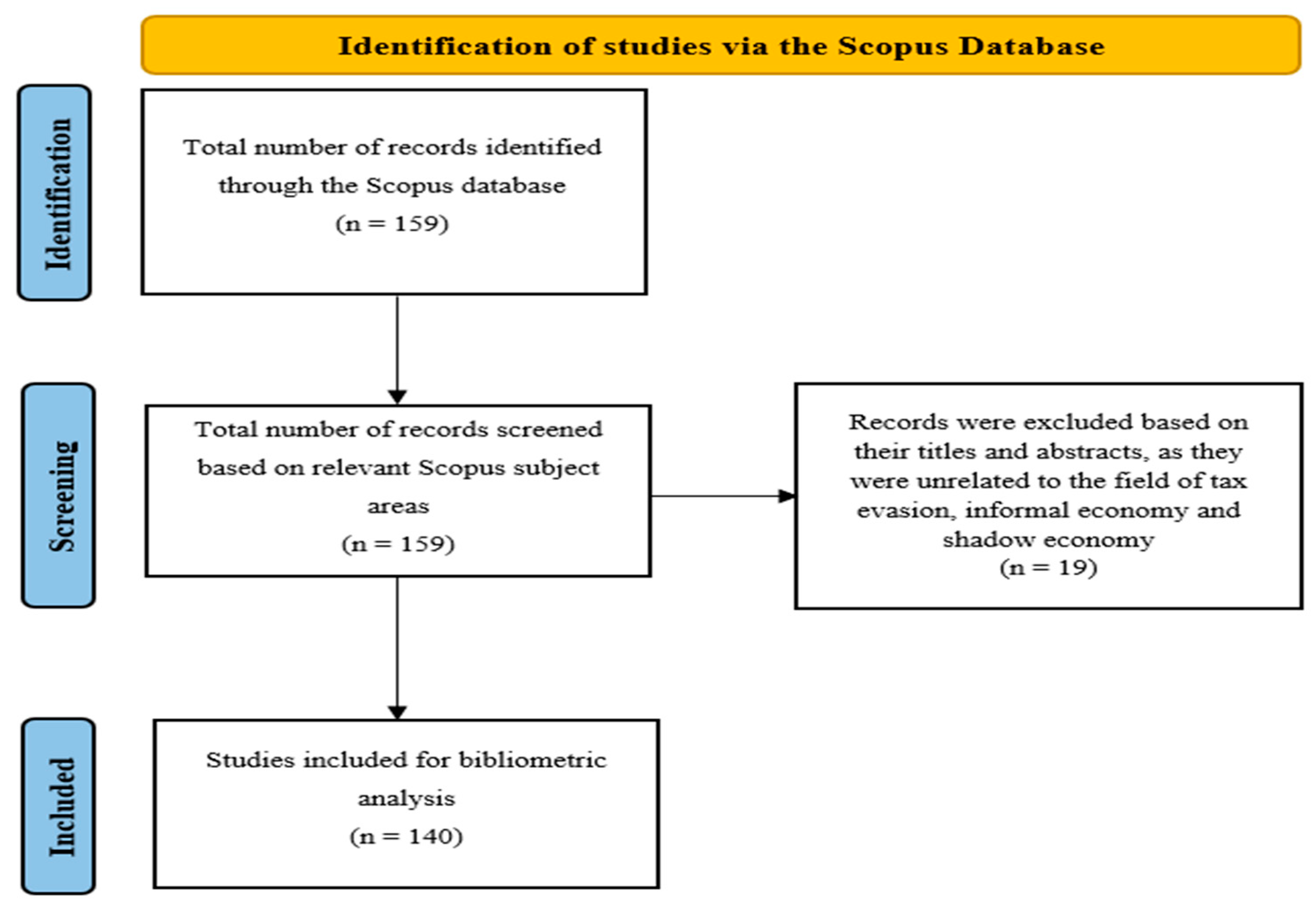
Aria & Cuccurullo, 2017). This software allows for the visualization of conceptual linkages within the literature and the identification of both dominant and peripheral research themes. Consistent with the study’s institutional-comparative objective, the bibliometric analysis concentrates on reconstructing patterns of thematic concentration, conceptual clustering, and the structural positioning of research topics within the literature, thereby offering a systematic mapping of the field’s dominant analytical orientations. The selection and filtering of records followed the PRISMA 2020 framework for systematic reviews (
Page et al., 2021), ensuring transparency in the inclusion process and facilitating replication by future researchers (see
Figure 1). Following retrieval, records were screened for topical relevance and document consistency through researcher-led evaluation based on systematic inspection of titles, abstracts, and keywords, with duplicate entries, non-substantive records, and items lacking a direct analytical linkage to tax evasion or informal economic activity in the Greek context removed prior to final dataset construction.
Survey data were analyzed using descriptive statistical techniques, including measures of central tendency (means and modes) and dispersion (standard deviations and ranges), in order to identify both the relative positioning of attitudes across different issues and behaviors and the degree of consensus or heterogeneity within the sample (
Thomos et al., 2023). In line with the study’s objective of examining perceived institutional salience and attribution patterns, this descriptive framework facilitates systematic comparison of evaluation levels and response dispersion across survey items. These measures provide insight into prevailing evaluations of tax-related phenomena and the variability underlying aggregate patterns. Data processing and visualization were conducted using Microsoft Excel and RStudio (Version 2026.01.1+403) to ensure consistency and accuracy across tables and figures (
Bitzenis & Koutsoupias, 2023).
Bibliometric indicators were similarly summarized using descriptive metrics and network-based visualizations, including keyword frequency distributions and thematic maps. These tools enabled examination of the conceptual organization of the academic literature alongside the survey findings (
Bitzenis et al., 2025). By integrating survey-based evidence with bibliometric mapping, the methodological framework offers a structured, empirically grounded approach to analyzing how tax evasion and the informal economy in Greece are understood by citizens and within the academic community (
Bitzenis et al., 2023).
3. Results
This section synthesizes the principal findings of the bibliometric analysis, detailing how research on tax evasion and the informal economy in Greece is distributed, structured, and organized within the academic literature. The results identify key publication patterns and dominant thematic configurations, offering an empirical overview of the field’s evolution and highlighting the areas in which scholarly attention has been most strongly concentrated.
3.1. Bibliometric Results
The descriptive statistics reported in
Table 1 provide an aggregated overview of the bibliographic composition and publication characteristics of the corpus addressing tax evasion and the informal economy in Greece. The dataset spans the period from 1990 to 2025 and comprises 140 documents published across 111 distinct sources. This distribution indicates a pronounced dispersion of research outputs across a wide array of publication venues, rather than a concentration in a limited set of specialized outlets. The combination of extended temporal coverage and a large number of sources suggests that scholarly work on this topic has been produced with notable continuity over several decades and disseminated across a diverse range of academic platforms. The mean document age of 8.89 years places the corpus primarily within a medium-term horizon of scholarly production, indicating that much of the literature remains relatively recent without being confined to the most current research cycle. At the same time, an average of 13.62 citations per document reflects a moderate level of scholarly visibility and engagement within the field. The inclusion of 5678 references further underscores the cumulative depth of the literature, highlighting the extent to which research on Greek tax evasion and informality is embedded in a dense and interconnected citation network.
Authorship and collaboration indicators shed light on the organizational structure of knowledge production in this research area. In total, 228 authors contributed to the 140 documents, yielding an average of 2.06 co-authors per publication. This figure points to a predominance of small-scale research teams rather than extensive, multi-author collaborations. The presence of 51 single-authored documents confirms that individual scholarship continues to play a significant role alongside collaborative research efforts. International co-authorship accounts for 17.86 percent of the corpus, indicating that fewer than one-fifth of the publications involve cross-border collaboration. This proportion situates the literature primarily within a domestic or nationally oriented research space, while still reflecting a non-negligible degree of international engagement. Taken together, these metrics depict a field characterized by moderate collaboration intensity, a continued reliance on individual or small-group research, and limited but clearly identifiable international integration.
The distribution of document types further clarifies the modes through which knowledge on tax evasion and the informal economy in Greece is formally communicated. Journal articles constitute the dominant format, accounting for 99 of the 140 documents and serving as the primary channel for disseminating empirical findings and theoretical contributions. This core output is supplemented by 16 book chapters and 12 conference papers, which together form a secondary layer of scholarly production. A smaller number of conference reviews, review articles, errata, notes, and a short survey complete the document profile, illustrating a diversified yet distinctly article-centered publication structure. The predominance of peer-reviewed journal articles suggests that the field is strongly oriented toward formal academic evaluation mechanisms and standardized modes of research dissemination.
Finally, the temporal dynamics of the corpus, as reflected in the reported annual growth rate, indicate a striking degree of stability in publication output. With a growth rate of zero percent, the volume of research on Greek tax evasion and the informal economy has neither expanded nor contracted over the observed period, remaining relatively constant. When considered alongside the dataset’s long temporal span and the medium-aged profile of the documents, this pattern points to a sustained but non-accelerating research trajectory. The absence of growth should not be interpreted as stagnation; rather, it reflects the steady reproduction of scholarly contributions that preserves the overall size of the literature without generating marked expansion. In combination with moderate citation averages and a highly dispersed set of publication venues, these dynamics portray a field that is well established and continuously active, yet structurally stable in both its scale and rate of knowledge production.
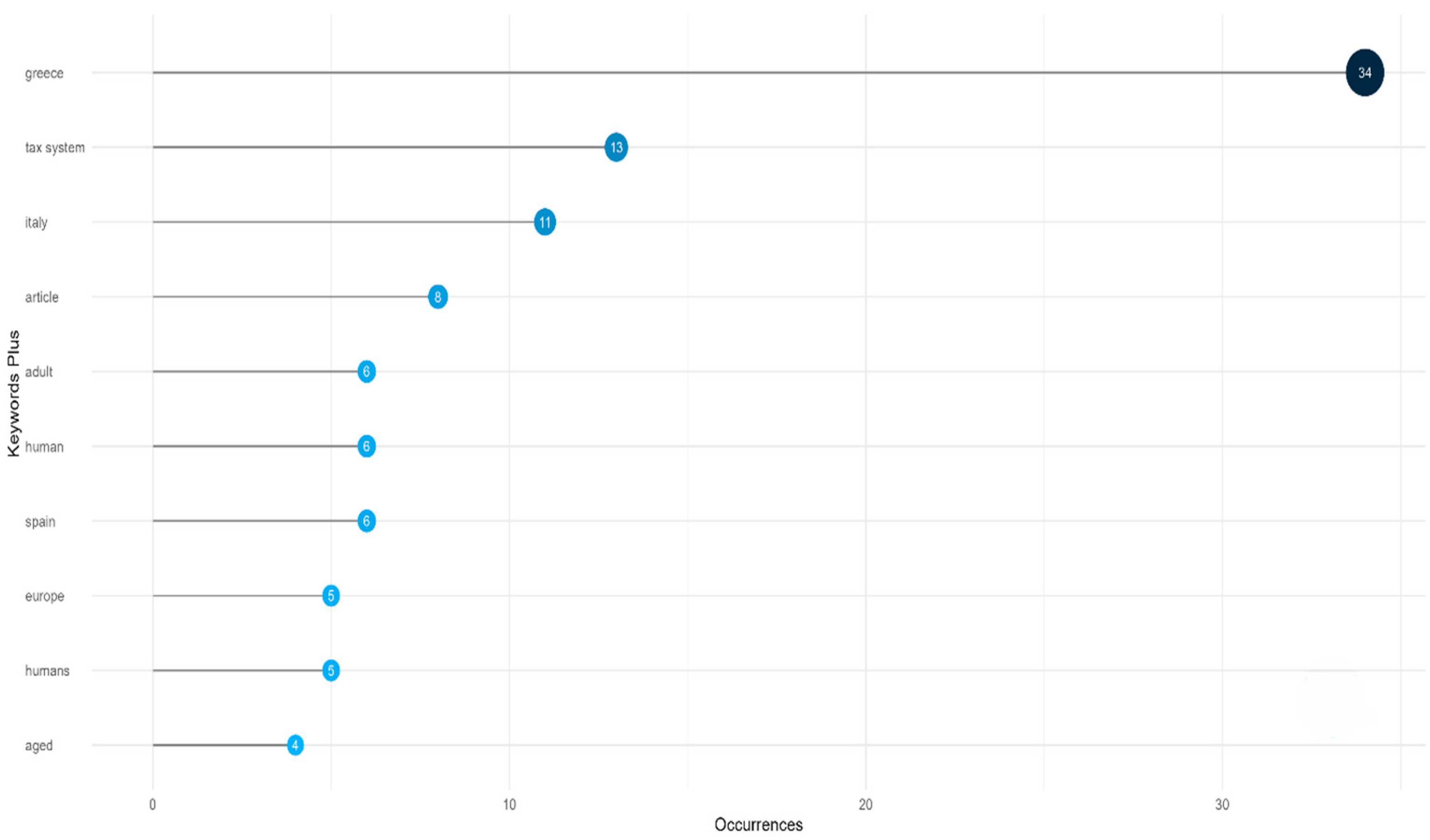
Figure 2 illustrates the distribution of the most frequently occurring Keywords Plus across the dataset, with each term plotted according to its absolute number of appearances. The horizontal axis records keyword frequency, while the vertical axis lists the individual terms, thereby enabling direct comparison of their relative prominence within the corpus. This visualization reveals a sharply uneven distribution, characterized by a small number of highly recurrent keywords alongside a longer set of more moderately represented concepts. The resulting configuration produces a ranked profile of the lexical elements that structure scholarly research on tax evasion and the informal economy in Greece.
Within this distribution, “greece” occupies a clearly dominant position, registering 34 occurrences and standing well above all other terms in the network. Its pronounced separation from the remaining keywords along the horizontal axis underscores its role as the dataset’s principal geographical and thematic anchor. All other entries are clustered at substantially lower frequencies. Among these, “tax system” emerges as the second most prominent keyword, with 13 occurrences, followed by “italy” at 11 and “article” at 8. This ordering reveals a steep gradient descending from the central focus on Greece to a secondary layer of institutional and comparative terminology. The proximity of “tax system” to “greece” at the top of the ranking highlights the close coupling between country-specific analysis and institutional or fiscal-system concerns, as these two terms jointly define the upper tier of the frequency distribution.
A further cluster of keywords, “adult,” “human,” and “spain,” each appearing six times, forms a mid-frequency band situated between the dominant terms and the lower-frequency tail. The juxtaposition of demographic descriptors such as “adult” and “human” with a country reference like “spain” suggests that population-related terminology and comparative geographical markers occupy similar levels of visibility within the literature. Below this band, “europe” and “humans” each register five occurrences, followed by “aged” with four, collectively constituting the lower-frequency segment of the distribution. These keywords appear more tightly clustered on the horizontal axis, indicating that while they are present across the corpus, their recurrence is notably less consistent than that of the leading terms.
Overall, the structure of
Figure 2 displays a clear hierarchical pattern. A single keyword, “greece”, dominates the keyword space, followed by a limited set of secondary terms encompassing institutional, comparative, and categorical dimensions. The appearance of Italy, Spain, and Europe within the upper and middle ranges situates the Greek-focused literature within a broader spatial and comparative context, even though none of these references approaches the centrality of “greece” itself. Simultaneously, the inclusion of demographic terms such as “human,” “humans,” “adult,” and “aged” introduces a parallel population-oriented strand into the keyword landscape. Taken together, the ranked frequencies depicted in
Figure 2 reveal a keyword environment in which country-specific emphasis, tax-system concepts, comparative references, and demographic descriptors are unevenly layered, reflecting the differentiated weighting of conceptual elements across the dataset.
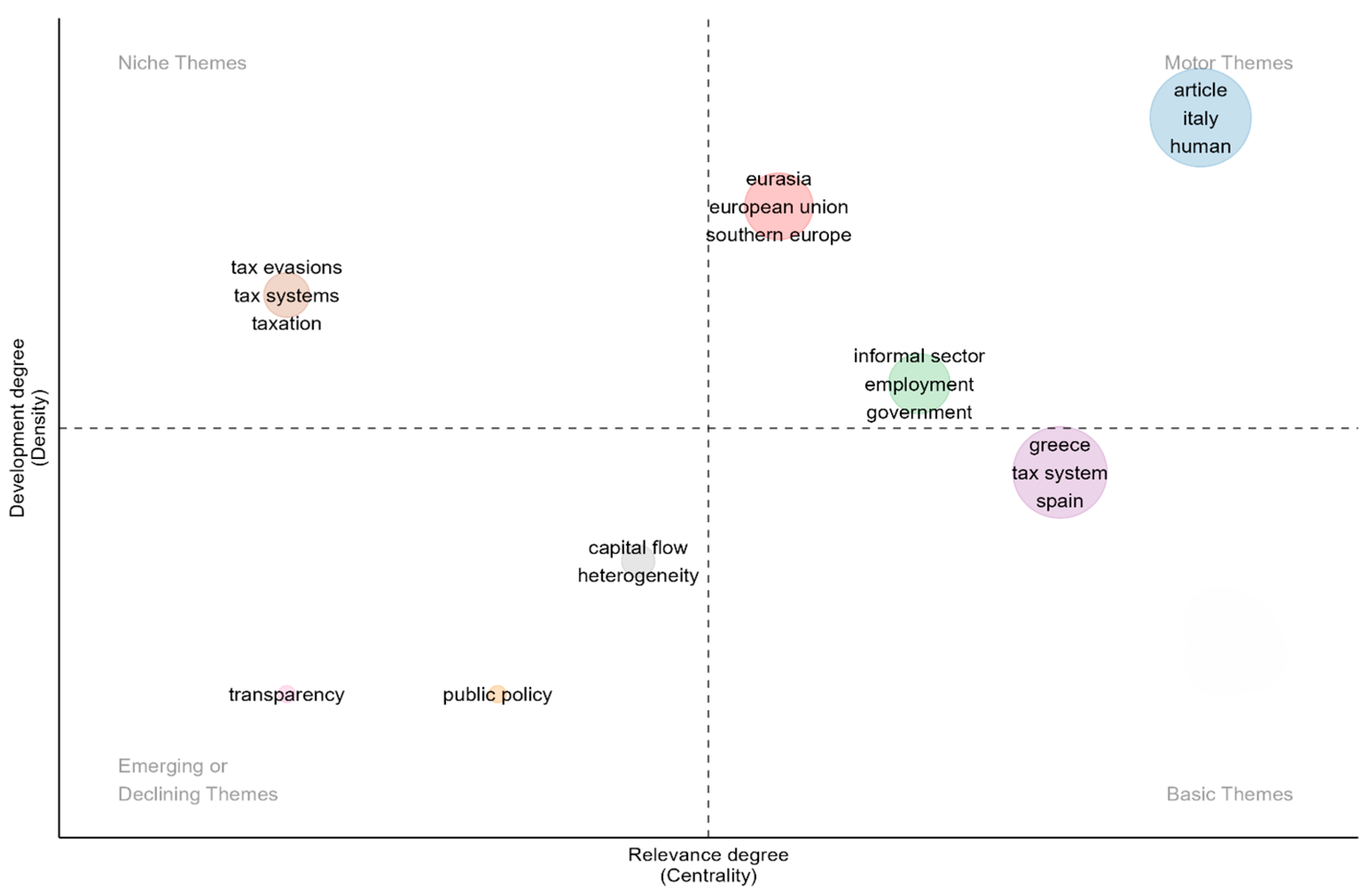
Figure 3 displays a thematic map in which keywords are positioned according to their relevance (centrality) on the horizontal axis and their development (density) on the vertical axis, thereby organizing the dataset’s conceptual structure into four quadrants. Each cluster is represented by a labeled bubble whose location reflects its degree of connection to the overall research field and its internal cohesion. This spatial configuration provides a systematic overview of how different topic areas relating to tax evasion and the informal economy in Greece are distributed across the literature.
In the lower-right quadrant, which groups themes with high centrality but lower density, the cluster composed of “greece,” “tax system,” and “spain” occupies a prominent position. Its placement indicates that these terms are closely connected to the broader research space while forming a relatively loose internal grouping. The proximity of these three keywords suggests that country-specific references and institutional terminology are firmly embedded in the field’s core discourse. At the same time, their location below the horizontal density threshold signals that, although these topics are highly relevant to the dataset, they are associated with a more dispersed internal structure, indicating that related publications connect these concepts across a wide variety of contexts rather than within a tightly bounded subtheme.
The upper-right quadrant, corresponding to motor themes characterized by both high centrality and high density, contains the cluster formed by “article,” “italy,” and “human.” This grouping is positioned at the far right of the map, showing that it is highly connected to the rest of the thematic landscape, while its elevated density reflects strong internal cohesion. The close association among these terms indicates that publications frequently combine comparative country references with human-centered descriptors within a consolidated body of work. The compactness and prominence of this cluster visually mark it as one of the most structurally developed regions of the thematic space.
On the upper-left side, the niche themes area includes “tax evasions,” “tax systems,” and “taxation.” These terms are placed high on the density axis but left of the centrality threshold, indicating that they form a well-developed but more self-contained cluster. Their strong internal connections suggest that these concepts co-occur frequently, while their lower centrality implies weaker links to the broader thematic structure of the dataset. This positioning highlights a specialized conceptual zone that is internally cohesive but less integrated with the dominant country- and system-oriented themes.
The lower-left quadrant, representing emerging or declining themes, contains “transparency” and “public policy,” along with “capital flow” and “heterogeneity” positioned near the central vertical axis but below the density threshold. These terms appear both weakly connected to the main research space and loosely clustered among themselves. Their scattered placement indicates limited co-occurrence with the dominant themes and comparatively low internal consolidation. Collectively, the thematic map in
Figure 3 depicts a structured research landscape in which country-focused and system-level keywords occupy the most central positions, while specialized fiscal terminology and governance-related terms are distributed across more peripheral and less densely connected regions.
3.2. Survey Results
Table 2 summarizes respondents’ evaluations of six major economic and social issues in Greece using a seven-point scale, reporting measures of central tendency and dispersion for each category. Across all six indicators, mean values are tightly clustered within a relatively narrow interval ranging from 5.53 to 6.09, indicating that all issues are evaluated toward the upper end of the response scale. The political system records the highest mean score at 6.09, followed closely by corruption at 6.02, placing these two variables at the top of the distribution. Tax evasion and the informal economy also rank highly, with a mean of 5.84, placing this issue alongside the core governance-related concerns. Public debt and the counterproductive public sector exhibit nearly identical mean values of 5.75 and 5.76, respectively, while the budget deficit registers the lowest mean at 5.53, though still substantially above the midpoint of the scale. This pattern produces a gently declining profile in which political and institutional dimensions dominate the upper range, followed by fiscal and administrative issues that remain comparably salient but slightly lower in relative placement.
The distributional characteristics further clarify how these evaluations are structured across the sample. All six variables share a modal value of 7, indicating that the highest possible rating is the most frequently selected response across all categories. This uniform modal outcome suggests that each issue attracts a substantial concentration of respondents assigning maximum importance, regardless of its precise mean ranking. At the same time, the standard deviations, ranging from 1.31 for corruption to 1.55 for public debt, point to moderate dispersion around the mean values. Corruption exhibits the most significant degree of consensus, as reflected in its comparatively lower standard deviation, whereas public debt and the counterproductive public sector show slightly greater variability in responses. These differences indicate that, while perceptions across issues are uniformly high, the degree of agreement among respondents varies modestly.
The complete response range from 0 to 7 is observed for all six variables, demonstrating that every possible scale value is represented in the data. Despite this formally wide range, the combination of elevated means and universally maximal modes indicates that responses are heavily concentrated toward the upper end of the scale rather than evenly distributed. The consistent sample size of 1074 observations across all categories further ensures that these comparisons are directly comparable and not confounded by differential missingness or unequal group sizes. Overall,
Table 2 portrays a tightly clustered pattern of high evaluations, with political, institutional, and fiscal concerns all positioned near the top of the scale, differentiated primarily by subtle variations in central tendency and dispersion rather than by pronounced contrasts in perceived importance (see
Table 2).
Table 3 reports respondents’ evaluations of three economic practices, concealment of financial activities, tax evasion, and social security evasion, using the same seven-point scale applied elsewhere in the survey. The mean values indicate a clear ordering among the three practices. Concealment of economic activity records the highest mean at 4.38, followed by tax evasion at 4.11, while social security evasion has the lowest mean at 3.77. These values place all three practices near the midpoint of the scale, but with noticeable differences in their relative positions. The progression from concealment to tax evasion and then to social security evasion produces a descending pattern in average ratings, suggesting that respondents differentiate among these behaviors rather than treating them as equivalent. The modes further reinforce this ordering: both concealment of economic activities and tax evasion share a modal value of 5, whereas social security evasion has a lower mode of 4, indicating that the most frequently selected response for the latter falls one scale point below the other two.
The dispersion measures reveal a high degree of variability in responses across all three practices. Standard deviations are consistently large, ranging from 2.03 to 2.05, indicating that individual evaluations are widely dispersed around the mean. This pattern suggests that while the average scores provide a general ordering, responses are not tightly clustered and instead encompass a broad range of positions. This interpretation is further supported by the identical range of 7 for all three variables and the presence of both minimum (0) and maximum (7) values in each case. The full use of the scale indicates that respondents expressed the entire spectrum of possible evaluations, from the lowest to the highest point.
When the three practices are considered jointly, the combination of mid-range means, shared upper-end modes for two categories, and large standard deviations points to a response structure characterized by differentiation without strong consensus. Concealment of economic activities and tax evasion appear closer to one another in both mean and modal values, forming a pair with relatively similar response profiles, while social security evasion is positioned somewhat lower on both measures. At the same time, the comparable dispersion across all three variables indicates that none of the practices is evaluated uniformly across the sample. Overall, the table depicts a nuanced distribution in which respondents distinguish among different forms of non-compliant economic behavior while simultaneously exhibiting substantial heterogeneity in their individual assessments.
Table 4 presents respondents’ evaluations of seven potential explanations for tax evasion. The mean values exhibit a clearly stratified structure. “There is very high taxation” and “there is injustice in the tax system” share the highest mean score of 5.44, placing them jointly at the top of the distribution. These are followed closely by “poor management of public revenues” (mean 5.23) and “because there is corruption” (5.19), forming a compact upper tier of four system-related factors with mean values exceeding five. By contrast, “because tax evasion is not punished” occupies an intermediate position with a mean of 4.60, while “lack of honesty” and “there is no reason to pay taxes” are positioned substantially lower, with means of 3.67 and 3.38, respectively. This ordering produces a transparent gradient in which institutional and systemic explanations dominate the upper end of the scale, whereas individually framed or attitudinal reasons are relegated to the lower end.
The modal values further reinforce this tiered structure. A mode of 7 is observed for high taxation, injustice in the tax system, poor management of public revenues, corruption, and lack of punishment, indicating that the highest possible response is the most frequently selected option for these five categories. In contrast, “lack of honesty” registers a mode of 4, while “there is no reason to pay taxes” exhibits a mode of 1, clearly distinguishing these two factors from the rest of the distribution. This sharp contrast in modal responses highlights a pronounced clustering effect: system-level and enforcement-related explanations receive peak evaluations at the top of the scale, whereas personal disposition and generalized disengagement are most frequently rated much lower.
Response dispersion, as captured by the standard deviations, is relatively uniform across all seven items, ranging from 1.86 to 2.04. These values indicate a broad spread of opinions around each mean, with no single factor displaying either unusually tight consensus or exceptional polarization. The identical response range of 7 and the presence of both minimum (0) and maximum (7) values for every item confirm that respondents made full use of the available scale across all explanatory categories. Collectively, these statistics depict a response pattern in which explanations linked to taxation levels, systemic fairness, revenue management, and corruption form a high-scoring and strongly endorsed group, while reasons framed in terms of personal morality or the absence of motivation to comply occupy a distinctly lower position within the overall distribution (see
Table 4).
Table 5 and
Table 6 present the age and gender composition of the survey sample, providing a demographic frame for interpreting the empirical findings. The gender distribution reveals a moderately balanced profile. Men account for 575 respondents, while women number 471, with an additional 28 individuals recorded as having provided no gender response. This configuration results in a relatively even distribution of male and female participants, with a small proportion of missing data. The close numerical proximity of the two primary categories indicates that neither gender dominates the sample, allowing for broadly comparable representation across the dataset. Moreover, the limited size of the non-response category ensures that the overall gender composition remains clearly defined by the two main groups.
The age distribution exhibits a more differentiated pattern across cohorts. The largest group comprises respondents aged 41–50, totaling 289 individuals, followed by those aged 31–40, with 259 respondents, and the 21–30 cohort, with 223 respondents. Collectively, these three age categories account for a substantial share of the sample, forming a pronounced concentration within early and mid-working-age brackets. The 51–60 age group contributes a further 151 respondents, creating a secondary cluster just beyond the central age range. At the lower end of the distribution, the 10–20 category includes only 15 respondents, indicating minimal representation of the youngest cohort. Representation declines sharply at older ages: the 61–70 group consists of 31 individuals, while the 71–80 and 80–89 categories contain only 7 and 3 respondents, respectively. In addition, 96 participants did not report their age, forming a non-response category that exceeds the size of any of the oldest age groups. Overall, this distribution produces a profile in which central age cohorts are heavily populated, while both extremes of the age spectrum are sparsely represented.
Ultimately,
Table 5 and
Table 6 depict a sample that is numerically anchored in the middle of the working-age cohorts and broadly balanced in gender composition. Age representation is clearly uneven, with a strong concentration between 21 and 60 years, particularly within the 31–50 range, rather than an even spread across all age brackets. The relatively small number of older respondents and the presence of a sizeable age non-response group add further structure to the dataset, indicating that the demographic composition is weighted toward a specific segment of the population rather than uniformly distributed across the full age range (see
Table 5 and
Table 6).
Table 7 reports the distribution of respondents across nine employment categories, providing a detailed depiction of the occupational structure of the survey sample. The largest group in the sample consists of self-employed individuals without employees, numbering 462 respondents. This category is followed by business owners who employ staff, comprising 330 individuals. Taken together, these two groups account for a substantial majority of the sample, forming a dominant bloc of respondents directly engaged in entrepreneurial or firm-owning activities. This concentration generates a pronounced structural skew in the employment profile, with independent and business-owning positions occupying most of the available response space. The next-largest category, private-sector employees, includes 110 respondents, constituting a secondary tier markedly smaller than the two leading groups. By contrast, public sector employees are represented by only 37 individuals, placing this category among the more marginal components of the distribution.
Beyond these principal employment categories, several additional groups appear with more limited representation. Students account for 45 respondents, while the unemployed category includes 41 individuals, positioning both groups within the mid-range of the lower-frequency categories. Pensioners are represented by 21 respondents, and farmers by just 6, placing these two groups at the lower extreme of the distribution. In addition, 22 respondents did not report their employment status, forming a small but distinct non-response category.
Overall, the employment profile reveals a highly uneven distribution across occupational statuses. The sample is heavily weighted toward self-employment and business ownership, while salaried employment, particularly in the public sector, and non-working statuses are comparatively underrepresented. This produces a layered occupational structure in which entrepreneurial and firm-based roles dominate the dataset, followed by private sector wage employment, and then by smaller clusters of students, unemployed individuals, retirees, and agricultural workers. The inclusion of all nine employment categories, combined with their markedly unequal sizes, yields a heterogeneous yet clearly skewed employment landscape that reflects the specific configuration of economic participation captured by the survey sample (see
Table 7).
4. Discussion
The results of this study provide a coherent empirical portrait of how tax evasion and the informal economy are situated within both the academic literature and public perceptions in Greece. The bibliometric analysis demonstrates that scholarly output is intensely concentrated on Greece as the national case and on the tax system as the central institutional reference point, indicating that academic engagement with the topic is structured primarily through country-specific and institutional lenses. This pronounced centralization is accompanied by a comparatively weaker integration of governance-related themes, such as transparency and public policy, which occupy more peripheral or less densely connected positions within the thematic space. This configuration corresponds to prior empirical research that underscores the central role of national institutional contexts and fiscal-system characteristics in structuring tax-compliance scholarship (
Torgler & Schneider, 2009;
Schneider & Enste, 2000). The resulting bibliometric architecture thus reflects a field predominantly organized around institutional and country-specific analytical anchors, while governance-related dimensions emerge as complementary explanatory strands within this established body of literature. The survey evidence closely mirrors this configuration. Political institutions, corruption, and tax evasion itself are consistently evaluated as the most salient national problems, with fiscal and administrative issues following closely behind. Crucially, this parallel structure indicates that the bibliometric centrality of the “tax system” closely corresponds to the prominence of institutional injustice, corruption, and weak governance in the survey data, such that the regulatory and fiscal architecture identified by scholars is experienced by respondents as a system lacking fairness, credibility, and effective reciprocity. Collectively, these findings suggest that both scholars and citizens conceptualize tax evasion in Greece not as an isolated economic irregularity but as an embedded phenomenon linked to a broader institutional environment shaped by governance quality, political legitimacy, and the state’s overall functioning.
Within this integrated design, scholarly publications and survey responses are conceptualized as articulating two analytically distinct yet substantively related perspectives on tax non-compliance. Academic research embodies formally structured analytical inquiry, shaped by disciplinary methodologies and cumulative theoretical development, whereas survey responses convey socially situated evaluations grounded in lived institutional interaction and mediated public discourse. The purpose of their joint examination is therefore not to establish direct equivalence between expert analytical reasoning and individual technical competence, but rather to determine whether shared issue hierarchies, institutional reference points, and explanatory narratives become discernible across these two domains. Interpreted in this manner, the observed correspondence between bibliometric centrality and public prioritization signals convergence in the social and analytical structuring of the phenomenon, even though the underlying modalities of knowledge production remain distinct.
This institutional framing becomes even more evident when examining how respondents differentiate among various forms of non-compliant economic behavior. Concealment of economic activity and tax evasion are evaluated more severely than social security evasion, yet none of these practices is assessed uniformly across the population, as reflected in the substantial dispersion of responses. This internal differentiation indicates that public attitudes toward informality are neither monolithic nor arbitrary, but rather organized along discernible gradients of evaluation. A comparable pattern emerges in respondents’ assessments of the reasons underlying tax evasion. Explanations rooted in systemic and institutional conditions, such as high taxation, perceived injustice in the tax system, poor management of public revenues, and corruption, consistently occupy the upper tier of the response distributions. In contrast, explanations framed in individual terms, such as a lack of honesty or a lack of motivation to pay taxes, are positioned markedly lower. This hierarchy suggests that respondents attribute the origins of tax evasion primarily to institutional arrangements and state performance rather than to individual moral dispositions. Notably, the recurrence of this pattern across multiple indicators points to a stable cognitive framework through which tax evasion is interpreted, one in which governance, fairness, and administrative effectiveness play a dominant role in the attribution of responsibility.
The demographic and occupational composition of the sample further situates these findings within a clearly defined social and economic context. The age distribution is heavily concentrated among the working-age population, with a robust representation of respondents aged 31 to 50, while the gender composition remains relatively balanced. More consequentially, the employment profile is strongly skewed toward self-employed individuals and business owners, who together constitute approximately three-quarters of the sample. This occupational structure places a substantial share of respondents in positions that entail direct responsibility for income reporting, ongoing regulatory compliance, and sustained interaction with tax authorities, thereby anchoring their perspectives in concrete fiscal obligations rather than abstract considerations. As a result, the survey captures attitudes that are closely intertwined with everyday economic practice and routine engagement with state institutions. At the same time, this pronounced entrepreneurial composition introduces a specific interpretive lens for assessing tax evasion and institutional performance. Behavioral economics and tax morale research consistently indicate that individuals operating in environments where compliance entails a degree of discretion are more likely to frame non-compliance as external structural constraints rather than as individual moral failure. In this context, the strong tendency of respondents to prioritize high taxation, corruption, and perceived injustice within the tax system may partially reflect the lived experiences of business owners who view themselves as bearing disproportionate fiscal, administrative, and bureaucratic burdens. Simultaneously, the pronounced concentration of self-employed respondents and business owners introduces a structural sampling asymmetry that may shape aggregate perceptions, particularly regarding tax burden, administrative fairness, and state credibility. Individuals operating within self-reporting fiscal environments typically encounter taxation through discretionary compliance decisions and sustained regulatory interaction; consequently, their evaluative orientations may differ systematically from those of salaried employees whose tax obligations are primarily administered through automatic withholding. The empirical results should therefore be interpreted as primarily reflecting the institutional perceptions of economically active entrepreneurial groups within the Greek context, with the observed attribution patterns understood as structurally grounded in this occupational composition and consequently assessed with explicit attention to the differentiated exposure of employment groups to taxation, regulatory interaction, and compliance-related decision environments. This structural concentration is treated analytically as a defining feature of the observed perception profile and is therefore explicitly accounted for when interpreting patterns related to perceived tax burden, institutional fairness, and compliance attribution across the surveyed population. From an analytical perspective, this occupational concentration also indicates that systematic comparison between self-employed respondents, business owners, and salaried employees represents a relevant dimension for future multivariate modelling designed to specify the relationship between employment position and perceptions of taxation, institutional trust, and compliance behavior.
The attribution patterns observed among self-employed respondents and business owners can be interpreted in light of
Sykes and Matza’s (
1957) conceptualization of “neutralization techniques,” in which actors cognitively reframe norm violations by deflecting responsibility and attributing blame to external agents. In particular, the prominence of high taxation, corruption, and institutional injustice in respondents’ explanations is consistent with patterns associated with the strategy of “condemning the condemners,” whereby tax evasion is framed not as an ethical transgression but as a legitimate response to a fiscal system perceived as unfair, inefficient, or extractive (
Ashforth & Anand, 2003). Closely aligned with this interpretive logic is what may be described as a “survival narrative,” which appears especially pronounced in the post-crisis Greek business environment. For many small firms and self-employed actors, tax noncompliance is construed less as opportunistic behavior than as a defensive mechanism aimed at preserving business viability and safeguarding employment (
Dreher & Schneider, 2010;
Perry et al., 2007). Within this narrative, the actor is repositioned from the role of fiscal offender to that of a victim of systemic dysfunction, reflecting a fractured social contract in which the absence of perceived reciprocity from the state attenuates the moral imperative to comply (
Rothstein, 2011;
Tyler, 2006). Importantly, the presence of such neutralization strategies should not be taken as evidence of uniform acceptance of tax evasion. On the contrary, the substantial dispersion observed across survey responses indicates persistent heterogeneity in public attitudes toward non-compliance (
Doerrenberg & Peichl, 2013). Rather than signaling moral consensus, these patterns illuminate why institutional and systemic explanations dominate public attributions of tax evasion, reinforcing the view that compliance behavior in Greece is deeply embedded in perceptions of governance quality, fairness, and institutional trust, rather than reducible to individual moral dispositions alone (
Rothstein & Teorell, 2008). Within this analytical framework, these theoretical perspectives situate the observed attribution patterns within established institutional and behavioral interpretations of compliance-related decision environments.
For self-employed individuals and small firms, the relationship with the state is mediated through complex tax regulations, frequent reporting obligations, and often perceived bureaucratic inefficiency. These conditions can foster a sense of internal injustice, in which tax obligations are perceived as misaligned with both the quality of public services received and the perceived fairness of enforcement practices. Within such a context, tax evasion may be cognitively reframed not as opportunistic or deviant behavior, but rather as a defensive response to what is viewed as a dysfunctional or extractive institutional environment. By contrast, salaried employees, particularly those in the public sector, typically encounter taxation primarily through automatic withholding mechanisms and face substantially fewer opportunities for evasion. For these groups, perceptions of tax evasion are more likely to be structured around forms of external injustice, namely the belief that others can evade tax obligations while they themselves cannot. Given that groups such as public-sector employees, pensioners, farmers, and older individuals are comparatively underrepresented in the sample, the findings predominantly reflect the institutional perceptions of economically active private-sector and entrepreneurial populations. Acknowledging this composition does not undermine the validity of the results; rather, it clarifies whose experiences and evaluative frameworks are most strongly represented. Future research could address this limitation through stratified sampling strategies that ensure broader representation across occupational and age groups, thereby enabling more systematic comparisons among population segments that differ in their exposure to taxation, public services, and regulatory environments. In parallel, the bibliometric analysis relies on the Scopus database, a curated, internationally recognized source of indexed publications; nevertheless, as with any single-database approach, the mapped corpus should be regarded as a structured segment of the scholarly landscape rather than an exhaustive inventory of all relevant contributions. Similarly, although the survey encompasses a substantial number of respondents, the empirical findings are interpreted as reflecting systematically observed perception patterns within the surveyed population, and any broader population-level generalization should be undertaken with due consideration of the sample’s demographic and occupational composition.
The combined use of bibliometric and survey evidence also points to several avenues for further investigation. Within the broader landscape of tax-compliance and shadow-economy scholarship, the thematic concentration identified in the bibliometric analysis aligns with the established tendency of empirical research to organize predominantly around national institutional configurations and fiscal-system structures, while governance transparency and policy-design dimensions tend to be more diffusely distributed analytical strands. Although the present analysis demonstrates a close structural alignment between dominant scholarly themes and public concerns, it does not capture how these domains evolve or how they may influence one another. Longitudinal bibliometric mapping, paired with repeated survey measurements, could shed light on whether shifts in public attitudes precede changes in academic agendas, or conversely, whether emerging research emphases shape how citizens understand tax evasion and informality. Future empirical extensions could incorporate scale-reliability assessment, exploratory factor modelling, and multivariate techniques to examine the internal structure of compliance-related perceptions and their statistical association with institutional trust and attribution patterns. In addition, more fine-grained sectoral and regional analyses could help determine whether the patterns observed at the national level are replicated across different industries, professions, and local economic contexts. Such extensions would allow future studies to examine how institutional trust, compliance attitudes, and informal practices vary across social and economic environments, thereby deepening the understanding of tax evasion as a multidimensional and context-dependent phenomenon.
5. Conclusions
This study set out to examine how tax evasion and the informal economy in Greece are simultaneously reflected in academic research and in public evaluation. By combining bibliometric mapping with survey evidence from more than 1000 respondents, the analysis offers a multidimensional perspective on how these phenomena are structured, prioritized, and differentiated across two distinct yet interconnected domains of knowledge production. The findings indicate that tax evasion in Greece is not treated as a marginal or isolated concern but rather as a central issue in both scholarly inquiry and public discourse, firmly embedded in broader debates about the tax system, political institutions, and the functioning of the state.
The bibliometric evidence demonstrates that research on Greek tax evasion is highly centralized around country-specific and institutional keywords, producing a thematic configuration in which Greece and the tax system constitute the primary organizing axes of the literature. At the same time, the placement of governance-related concepts, such as transparency and public policy, in less developed or less central regions of the thematic map suggests that the literature remains uneven in its incorporation of institutional reform and policy design into its dominant analytical frameworks. The survey findings display a strikingly parallel structure. Political and institutional variables occupy the upper end of the evaluative hierarchy, while fiscal and administrative dimensions are also strongly emphasized, confirming that public concern about tax evasion is embedded within a broader assessment of state performance and institutional effectiveness.
The patterns of differentiation observed in the evaluation of non-compliant practices and in the attribution of reasons for tax evasion further underscore the structured nature of public attitudes. Respondents do not approach informality as a single, undifferentiated behavior; instead, they distinguish clearly between different forms of non-compliance and between alternative explanations for why such behavior occurs. Systemic and institutional factors consistently occupy the most prominent positions in these evaluations, whereas explanations framed in terms of individual morality or personal disposition remain comparatively marginal. Simultaneously, the substantial dispersion observed across most measures indicates that these assessments are not uniform, pointing to the coexistence of multiple, sometimes competing, perspectives within the population.
When considered from a policy perspective, these empirical insights point toward the increasing emphasis in recent debates on digital transformation as a mechanism for restoring institutional trust rather than merely strengthening enforcement capacity. Beyond established reforms such as electronic invoicing and cashless transactions, more advanced tools, including AI-assisted, risk-based auditing systems and blockchain-enabled mechanisms for public spending transparency, may contribute to enhanced procedural fairness and accountability. By reducing discretionary human intervention and increasing the visibility of public resource allocation, such instruments have the potential to address concerns about corruption and perceived injustice, which respondents consistently identify as central drivers of non-compliance. While these technologies are not substitutes for broader institutional reform, their significance lies in signaling a credible commitment to rule-based governance and transparency within the Greek business environment.
Ultimately, integrating bibliometric and survey evidence provides a robust empirical foundation for understanding how tax evasion and the informal economy are conceptualized in the Greek context. The findings demonstrate that both academic research and public perception are organized primarily around institutional and systemic reference points, while simultaneously exhibiting substantial internal differentiation. From a policy perspective, this convergence suggests that efforts to curb tax evasion in Greece are unlikely to be effective if they rely exclusively on stricter enforcement or increased penalties. Given that respondents predominantly attribute non-compliance to poor management of public revenues, corruption, and perceived injustice within the tax system, policy interventions must also confront the underlying deficit of institutional trust. In this regard, the digitalization of tax administration, through instruments such as electronic invoicing, real-time VAT reporting, and the expansion of cashless transactions, can serve a dual function by reducing discretionary interaction between firms and authorities while simultaneously enhancing transparency and procedural fairness. For businesses, small and medium-sized enterprises, such reforms have the potential to lower compliance costs, limit informal competition, and signal a more predictable and credible fiscal environment. By framing digitalization not merely as a technical enforcement tool but as a mechanism for restoring institutional credibility, policy design can more effectively align with the trust-based foundations of voluntary compliance identified in this study. By explicitly linking the structure of scholarly knowledge production to the structure of public evaluation, the analysis contributes a comprehensive and empirically grounded perspective on one of Greece’s most persistent economic and social challenges, while underscoring the value of integrated methodological approaches for capturing tax evasion as both an analytical object and a lived social reality.