Article

The Effect of Tourism on Employment: A Meta-Analysis and Meta-Regression of 39 Empirical Studies (2002–2023)


Laboratory Teaching Personnel, Department of Tourism, Ionian University, 49132 Corfu, Greece
Businesses 2026, 6(1), 11; https://doi.org/10.3390/businesses6010011
Submission received: 17 December 2025 / Revised: 18 February 2026 / Accepted: 20 February 2026 / Published: 2 March 2026

Abstract

This study conducts a meta-analysis to assess the impact of tourism on employment, synthesizing 401 partial correlation coefficients extracted from 39 empirical studies. Employing partial correlation coefficients (PACs) as the effect size measure, the results indicate a modest but statistically significant positive association between tourism and employment, with an average effect size ranging from 0.095 to 0.113. The meta-regression results indicate that the estimated effect varies systematically with the type of tourism indicator, employment definition, use of fixed effects, panel data and macroeconomic controls. Evidence of publication bias and small-study effects is detected, yet robust estimation techniques confirm the presence of a genuine effect. The findings imply that tourism should be considered a complementary and context-dependent instrument for employment policy, with stronger effects associated with tourism intensity measures such as overnight stays and with weaker effects in studies employing more rigorous empirical designs.

1. Introduction

Tourism’s impact on employment has been a subject of extensive research in tourism literature, with pioneering work in the 1970s explicitly describing the direct economic impact of tourism on local economies, focusing on income and employment perspectives (Sadler & Archer, 1975). The creation of jobs through tourism is widely acknowledged as a beneficial outcome (Fateme, 2011). The influence of tourism extends to various sectors, including hotels, restaurants, transportation, entertainment, and retail, where the most immediate effects are felt (Naseem, 2021). Tourism development can also offer unique job opportunities, particularly in areas with limited alternative employment options (Nissan et al., 2010). Notably, tourism provides employment opportunities for demographics that often face challenges in the labor market, such as women, young people, immigrants, and low-skilled workers (Dorta-González & González-Betancor, 2021).
Empirical studies frequently demonstrate a positive correlation between tourism expansion and employment figures, and there is a consensus that tourism enhances a region’s employment prospects through direct, indirect, and induced channels, thereby bolstering the case for tourism as a vital instrument for employment generation (Oneţiu & Predonu, 2013). Direct employment arises from businesses catering directly to tourists, such as hotels, restaurants, and transportation services, while indirect employment encompasses jobs in supporting industries, like agriculture and infrastructure development (Kırca & Özer, 2021). Induced employment is generated through increased household income and spending resulting from tourism activities.
Given the body of literature on the tourism-employment nexus, a meta-analysis is necessary to provide a comprehensive and quantitative synthesis of existing findings (T. Stanley & Doucouliagos, 2012). To the best of my knowledge, this work represents the pioneering effort to employ meta-analysis techniques in exploring the employment effect of tourism. Furthermore, it addresses the call for meta-analyses in tourism research to strengthen evidence-based decision-making (Ustunel et al., 2021).
Within this framework, this study aims to investigate the impact of tourism on employment by utilizing a meta-sample of 39 empirical studies that generated 401 observations. By employing partial correlation coefficients (PACs) as the effect size metric, the analysis reveals a mean effect size ranging from 0.095 to approximately 0.113, indicating a positive association between tourism and employment. The findings suggest that tourism contributes to job creation, albeit with a modest effect size. Potential publication bias favoring favorable outcomes is also identified by the study. These insights are crucial for policymakers aiming to leverage tourism as a tool for employment generation.

2. Literature Review

Numerous studies have documented tourism’s potential to generate employment. According to the World Travel & Tourism Council (WTTC, 2023), the travel and tourism sector accounted for 9.1% of global employment, supporting over 330 million jobs worldwide. This includes both direct employment (e.g., hotels, restaurants, tour operators) and indirect employment (e.g., construction, agriculture, and services). Sinclair (1998) highlighted the sector’s employment multiplier effect, where increased tourism demand stimulates job creation not only in tourism enterprises but also in related sectors. Moreover, Dritsakis (2004) and Lee and Chang (2008) used time-series econometric models to show significant causal relationships between tourism expansion and job growth, especially in tourism-dependent countries. More recently, Kırca and Özer (2021) stated that employment is created by the rise in income and spending within the local economy that results from tourist activity, and Zhao et al. (2023) also affirmed the beneficial effect of tourism on employment levels.
While tourism creates jobs, the quality and stability of these jobs remain contested. Baum (2007) noted that many tourism-related jobs are characterized by seasonality, low pay, part-time or informal contracts, and limited career progression. This raises questions about tourism’s capacity to contribute to sustainable and inclusive employment. Within this framework, Sharpley and Telfer (2015) argued that employment benefits are unevenly distributed, with urban areas and established tourist destinations reaping more significant gains than rural or marginalized communities.
Literature has also dealt with regional and country levels. More specifically, Scheyvens and Momsen (2008) found that community-based tourism in small island states significantly increased local employment and income. Bakker and Messerli (2017) also observed that tourism can help reduce poverty through employment generation, although the outcomes are context-dependent. In contrast, studies from developed economies such as Seetanah (2011) in Mauritius and Cortes-Jimenez and Pulina (2010) in European countries showed that while tourism supports employment, the impact is more modest relative to other economic sectors. Tourism jobs in these regions tend to be more formalized and regulated, improving their quality but reducing rapid employment expansion.
Despite tourism’s employment potential, several challenges remain. A first issue regards seasonality, since many jobs are temporary and concentrated in peak seasons (Baum & Lundtorp, 2001). In addition, a second issue concerns vulnerability to shocks, as events like the COVID-19 pandemic showed how fragile tourism employment can be (Gössling et al., 2020). Finally, a third issue is related to the skills mismatch and the existing gap between the skills local workers possess and the demands of tourism employers (ILO, 2013). Not to mention that environmental degradation and over-tourism can erode long-term employment gains by undermining the sustainability of destinations (Hall, 2010).
Therefore, the literature overwhelmingly supports the idea that tourism contributes positively to employment, particularly in developing contexts. However, the magnitude, quality, and sustainability of that employment are influenced by a range of factors including governance, labor policy, and the type of tourism promoted. Policymakers should focus on inclusive tourism development that emphasizes long-term, decent job creation over short-term gains.
Despite the extensive empirical literature reviewed above, existing studies remain highly heterogeneous in terms of data, measurement, and econometric design, and their findings are often difficult to compare. Moreover, no previous study has systematically synthesised this evidence while accounting for publication bias and modelling heterogeneity. This study directly addresses these gaps by providing a quantitative meta-analysis and meta-regression framework that evaluates both the average effect of tourism on employment and the systematic sources of variation across empirical settings.

2.1. Methodology

To conduct a comprehensive meta-analysis, the methodological basis proposed by Stanley and his coauthors (T. Stanley & Doucouliagos, 2012; T. Stanley et al., 2013) was followed. Initially, the systematic search was performed using RePEc (Research Papers in Economics) due to its comprehensive indexing of scholarly work in economics, tourism and labor markets.
RePEc was selected as the primary data source because the objective of this study is to synthesise econometric evidence on the tourism-employment nexus, which is predominantly published in economics, regional science and policy-oriented outlets. RePEc provides particularly strong coverage of working papers and journal articles in these fields, including labour economics, regional and urban economics and applied econometrics, where the use of comparable regression-based estimates and reported test statistics is standard. This focus is especially important for meta-regression analysis, which requires a high degree of methodological consistency and the availability of sufficient statistical information to compute partial correlation coefficients.
Nevertheless, I acknowledge that relying on a single database may limit the coverage of some tourism and hospitality journals that are indexed primarily in broader multidisciplinary databases. While this choice was made to ensure a homogeneous and econometrically comparable evidence base, future meta-analyses could further extend the search to additional databases in order to examine whether the inclusion of a wider set of tourism-oriented outlets affects the magnitude and heterogeneity of the estimated employment effects.
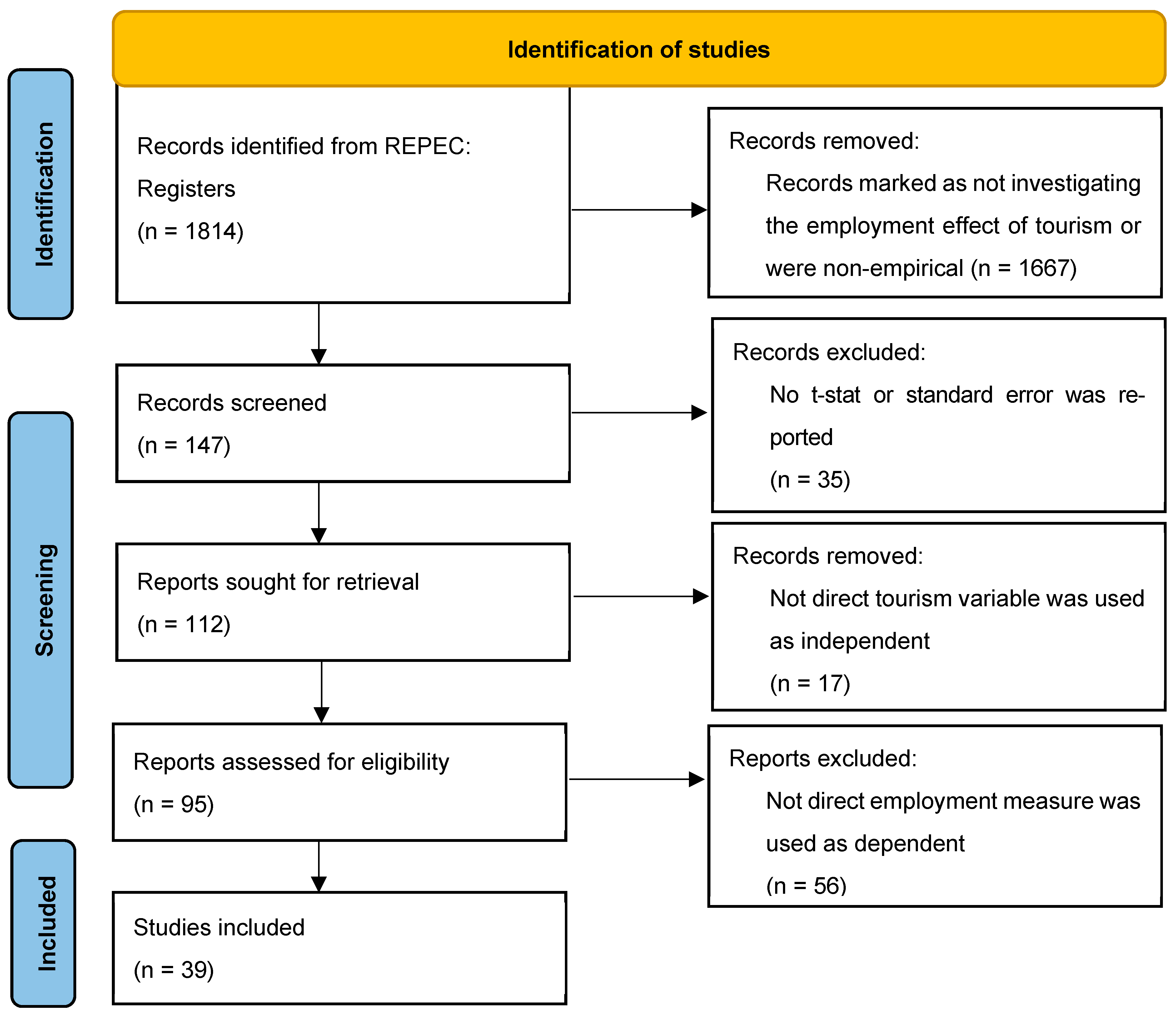
The literature search and selection process followed the Preferred Reporting Items for Systematic Reviews and Meta-Analyses (PRISMA) guidelines for meta-regression analysis, as summarised in the PRISMA flowchart (see Figure 1). The search spanned until 2023, and the final meta-sample consisted of studies published between 2002 and 2023. The keywords included: “tourism” AND “employment”, which generated 1814 results. To mitigate potential screening bias, the inclusion and exclusion criteria were defined ex ante and applied consistently across all retrieved records. The screening process focused exclusively on empirical studies that directly estimate the tourism–employment relationship and provide sufficient statistical information to compute partial correlation coefficients. Although the use of a single primary database may limit coverage of some tourism-oriented outlets, this strategy was adopted to ensure methodological comparability and reduce heterogeneity stemming from incompatible empirical designs.
A study to be included first had to be empirical, quantitative, and focus on the direct relationship between tourism and employment. Second, they needed to report sufficient statistical information to calculate effect sizes (partial correlations in this work), such as t-statistics, standard errors or number of observations. Third, the study’s measures of tourism and employment had to be clearly defined and comparable across different studies, such as total employment, sectoral employment, or employment rates. These criteria allowed for a focus on quantitative research that directly assessed the relationship between tourism and employment, with enough statistical detail for meta-analysis and comparable measurement.
After screening abstracts, 1667 studies were not found to be investigating the impact of tourism on employment measures or were non-empirical and hence were excluded. Of the 147 full-text articles screened, 35 studies that did not report t-statistics or standard errors were removed. In addition, studies that did not use a direct tourism variable as an independent one (e.g., the percentage of GDP for tourism) were excluded, and the studies that did not employ a direct employment measure (e.g., labor force participation rate) as the dependent variable were not taken into consideration. The final meta-sample contained 39 studies, of which 401 observations were extracted. Figure 1 presents a detailed flowchart of the above-mentioned criteria.
Once the relevant articles were identified, the effect sizes were calculated. Given that studies reported different statistical metrics, a common effect size measure was adopted. The partial correlation coefficient was preferred because it accounts for other variables in the model and is unit-free. Moreover, they are often used as the effect sizes in the meta-analysis (T. D. Stanley & Doucouliagos, 2023). If a study provided multiple estimates, each was treated as a separate observation. Only coefficients that directly measure the effect of tourism on employment were extracted from the primary studies; estimates referring to control variables were not included in the meta-dataset.
Because many primary studies report multiple estimates based on alternative model specifications, samples, or variable definitions, the resulting meta-dataset contains several partial correlation coefficients drawn from the same study. Treating these estimates as statistically independent would underestimate standard errors and may lead to overstated statistical significance. To address this within-study dependence, all baseline regressions are estimated using standard errors clustered at the study level. In addition, multilevel random-effects specifications, implemented through restricted maximum likelihood (REML) and empirical Bayes procedures, explicitly account for the hierarchical structure of the data, with estimates nested within studies. These approaches allow for both within-study and between-study heterogeneity and ensure that statistical inference is robust to the presence of multiple, correlated estimates originating from the same primary source.
Table 1 presents the basic descriptive statistics of the 39 studies that constitute the final meta-sample. It shows the summary statistics of the studies in the meta-sample, by study. It reports the names of the authors, the year and publication of the study, the number of estimates (PACs) from each study, the mean value of the PACs of the study, and their standard deviations as well as their minimum and maximum values, per study. In Table 1, the number of observations refers to the number of partial correlation coefficients extracted from each primary study.

2.2. Effect-Size Construction and Standardization

To ensure comparability across heterogeneous empirical specifications, all reported coefficients were transformed into partial correlation coefficients (PACs), which serve as the common effect-size metric in the meta-analysis. The PAC is unit-free and bounded between −1 and 1, facilitating comparability across studies employing different functional forms, variable scales, and estimation techniques.
For studies reporting t-statistics and degrees of freedom, PACs were calculated using the standard transformation:
r = t t 2 + d f
where t denotes the reported t-statistic and df the degrees of freedom of the corresponding regression estimate. When degrees of freedom were not explicitly reported, they were approximated using the reported sample size and number of regressors.
When studies reported standard errors instead of t-statistics, PACs were derived using the implied t-ratio (coefficient divided by standard error). The sign of the original coefficient was preserved in all transformations. Estimates obtained from OLS, fixed-effects, instrumental variables (IV), and other estimators were treated consistently, as the PAC standardizes magnitude independently of the original measurement scale.
While PACs harmonize effect magnitudes, they do not standardize identification quality. Differences in econometric design (e.g., OLS vs. IV, cross-sectional vs. panel, inclusion of fixed effects) are therefore explicitly modeled through moderator variables in the meta-regression framework.

3. Thematic and Trend Analysis

The 39 studies reviewed reveal a nuanced picture of how tourism affects employment across different contexts, time periods, and methodological designs. The general pattern is one of positive sectoral employment effects, but the scale, durability, and distribution of these gains are shaped by demand composition, industry structure, regional dynamics, and external shocks.
1.
Sectoral versus Aggregate Employment
Several studies demonstrate robust positive effects of tourism specialization on employment in tourism-related sectors. For example, some studies show that Brazilian municipalities with greater tourism specialization experienced stronger job growth. However, aggregate effects are less consistent.
2.
Domestic and International Demand
The role of domestic versus international tourism emerges strongly. Several studies find that domestic tourism is a stronger driver of employment than international arrivals.
3.
Industry Structure, Events, Spillovers and Competition
The composition of the industry is equally important. Dogru et al. (2020b) show that hotel investment in the U.S. increases jobs, particularly in midscale hotels. Cotti (2008) finds limited local employment effects of casinos. In addition, tourism produces both positive spillovers and competitive effects.
4.
Shocks, Volatility, and Resilience
The vulnerability of tourism-related employment is evident in studies of shocks. Thompson (2007) finds that regions with high tourism dependence in the U.S. experience greater volatility in employment growth. Mega-event studies (such as Feddersen & Maennig, 2013) similarly point to negligible long-run effects.
5.
Human Capital, Technology, and Sustainability
Tourism’s employment effects also depend on workforce characteristics and policy.
6.
Culture, Amenities, and Place Characteristics
Finally, cultural and locational endowments mediate employment effects. Studies also note that island economies face different growth and sustainability dynamics compared to mainland regions (Romão et al., 2016).
In summary, the evidence underscores that tourism consistently generates employment in directly linked industries, but broader labor market outcomes are shaped by the type of demand, structural characteristics of the industry, spatial spillovers, vulnerability to shocks, and institutional or cultural contexts.

4. Funnel Graph and FAT-PET of the Meta-Sample

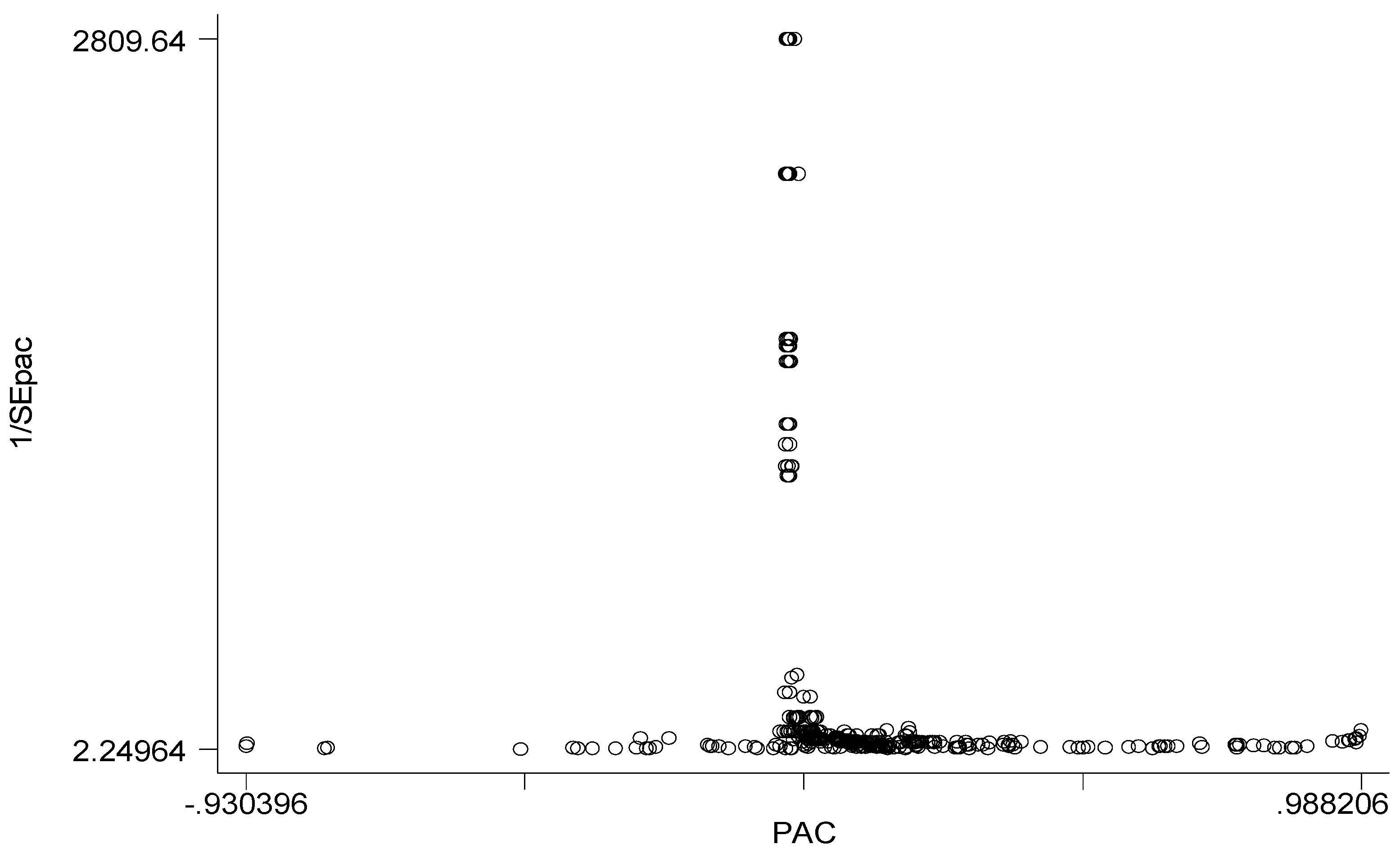
Typically, a funnel plot is a standard tool in meta-analysis to detect publication bias and systematic heterogeneity. In this context, the funnel plot depicts the distribution of effect sizes (partial correlation coefficients) from the included studies in relation to their precision (inverse of standard error). Funnel plots can visually indicate the presence of publication bias and small-study effects, which are crucial considerations in meta-analysis. Specifically, publication bias occurs when studies with statistically significant results are more likely to be published than those with non-significant results, leading to an overestimation of the true effect size. Small-study effects, on the other hand, refer to the phenomenon where smaller studies (i.e., those with smaller sample sizes) tend to report larger effect sizes than larger studies, potentially due to selective reporting or other biases (Mossbridge et al., 2012). Figure 2 presents the Funnel Graph of the Meta-Sample.
The horizontal axis represents the partial correlation coefficients of the tourism effect on employment, while the vertical axis represents the inverse of PACs’ standard error. Figure 2 shows that most of the observations are gathered around zero, yet the vast majority of them lie on the right side. In quantitative results, 347 PACs were positive, 53 were negative, and one was zero, implying that most of the studies provided evidence of a positive effect of tourism on employment.
However, to formally test publication bias, the FAT-PET approach has to be adopted. The test is based on the idea that in the absence of publication bias, there should be no systematic relationship between the effect sizes reported in studies and their standard errors. Under the absence of publication bias or small-study effects, the reported effect sizes should be symmetrically distributed around the underlying true effect and should not be systematically related to their standard errors. In the FAT–PET framework, the coefficient on the standard error captures funnel asymmetry and small-study effects, while the intercept represents the estimated underlying effect after correcting for such bias. The FAT-PET approach begins with estimating the following equation:
PACij = β0 + β1SEPACij + εij
where PAC denotes the partial correlation, SEPAC is its standard error, and ε is the error term. In addition, i is the study and j is the estimate of each study.
If β0 is statistically different from zero, this indicates the presence of a genuine underlying effect after accounting for publication bias (PET). If β1 is statistically significant, this suggests the presence of publication bias or small-study effects (FAT). The FAT-PET approach is valuable because it not only detects the presence of publication bias but also attempts to estimate the true effect size by correcting for this bias. In this study, since there are many observations deriving from the same study, a multilevel mixed-effects model has been adopted. Table 2 presents the results of the FAT-PET test.
Because many primary studies report multiple regression estimates based on alternative specifications, samples, or variable definitions, the meta-dataset contains 401 PACs nested within 39 studies. Treating these observations as statistically independent would underestimate standard errors and inflate statistical significance.
To account for this hierarchical structure, we estimate a two-level mixed-effects model:
r ij = β 0 + β 1 SE ij + γ Z ij + u i + ε ij
where rij denotes the partial correlation coefficient from estimate j in study i, ui captures study-level random effects, and εij represents within-study residual variation.
Variance decomposition indicates substantial clustering. The estimated between-study variance component equals 0.082, while the within-study residual variance equals 0.025. The implied intraclass correlation coefficient (ICC) equals 0.77, meaning that approximately 77% of total variance in reported effects is attributable to differences across studies rather than within-study specification variation.
This high degree of clustering validates the use of multilevel restricted maximum likelihood (REML) estimation and cluster-robust inference throughout the analysis.
The analysis employed a Funnel Asymmetry Test (FAT) and a Precision Effect Test (PET) using 401 partial correlation coefficients (PACs) extracted from 39 empirical studies to assess potential publication bias and determine the underlying effect size, respectively. Across all specifications, the constant term—which reflects the estimated true effect in the absence of bias—was positive and statistically significant. Depending on the model specification, the estimated true PAC ranged from 0.0947 to 0.1132. This suggests a small but meaningful positive relationship between tourism and employment, meaning that increases in tourism activity are associated with modest improvements in employment levels.
To account for within-study dependence and heterogeneity across studies, we employed a range of estimators, including clustered Ordinary Least Squares (OLS), weighted least squares (WLS), restricted maximum likelihood (REML), and empirical Bayes (EB) procedures. While simpler models did not detect significant publication bias, both the REML and EB specifications, which better handle heterogeneity, revealed statistically significant funnel asymmetry. The coefficients on the standard error of the PACs (SEPAC) in these models were positive and significant at the 1% level, indicating that smaller, less precise studies tend to report disproportionately higher effect sizes. Funnel asymmetry, however, may arise not only from publication bias but also from genuine effect heterogeneity, differences in model specification, or variation in study contexts. This asymmetry signals the presence of small-study effects or potential selective reporting.
The fact that asymmetry is detected primarily by the REML and empirical Bayes estimators reflects their ability to explicitly model between-study heterogeneity and the hierarchical structure of the data. Simpler pooled estimators do not fully account for this structure and therefore may lack sufficient power to detect small-study effects in the presence of substantial cross-study variation.
Despite this bias, the PET results from the more robust models consistently affirm the existence of a genuine effect that tourism contributes positively to employment, although the magnitude of this effect is modest. Given the wide variation in study design, context, and measurement, these results highlight the robustness of the tourism-employment link across settings, while also underscoring the importance of correcting for bias in synthesizing evidence from heterogeneous studies. These findings align with the increasing amount of research that supports the idea that tourism can be beneficial for employment on a local, national, and even international scale.
Among the alternative estimators reported, the multilevel REML specification is considered the preferred model. REML explicitly accounts for nested dependence, models between-study heterogeneity, and provides unbiased variance component estimates under hierarchical data structures. Simpler pooled estimators, while informative, do not fully capture clustering and may underestimate uncertainty in the presence of substantial heterogeneity.

Heterogeneity Diagnostics

Given the diversity of empirical contexts, econometric specifications, and measurement choices across the 39 primary studies, substantial heterogeneity is expected. To formally assess heterogeneity, we computed Cochran’s Q statistic, the I2 index, and between-study variance measures.
Cochran’s Q strongly rejects the null hypothesis of homogeneity (Q(400) = 34,967.25, p < 0.001). The I2 statistic equals 98.86%, indicating that nearly all observed dispersion reflects real differences in underlying effect sizes rather than sampling error. According to conventional thresholds, this level of heterogeneity is considered extremely high and justifies the use of random-effects and multilevel modeling approaches.
The DerSimonian–Laird estimator yields a between-study variance of τ2 = 0.000086. Although numerically small due to the bounded nature of PACs, this estimate confirms meaningful dispersion in true effects across studies. These diagnostics underscore the necessity of modeling heterogeneity explicitly through both random-effects estimators and meta-regression analysis.

5. Meta-Regression Analysis

To further investigate the heterogeneity in the reported effects of tourism on employment, we conducted a meta-regression analysis (MRA) that incorporates a comprehensive set of study-level moderator variables. Table 3 shows the characteristics of the moderator variables for Meta-regression Analysis, which attempt to control potential sources of heterogeneity within the results of each study.
Based on these moderators, a meta-regression analysis was performed using the following equation:
PACij = β0 + β1SEPACij + γΖij + εij
where Z is a vector of variables that reflect modeling differences. A total of 401 partial correlation coefficients (PACs) derived from 39 primary studies served as the dependent variable. The analysis employs multiple estimators—robust OLS, clustered standard errors, weighted least squares (WLS), restricted maximum likelihood (REML), and empirical Bayes (EB)—to assess the robustness of findings. The results of the meta-regression analysis using all moderators are illustrated in Table 4.
Across all models, the consistent and significant intercepts across models—ranging from 0.35 to 0.39—confirm a positive and statistically significant true effect of tourism on employment, even after controlling for publication bias and a rich set of moderators. It is important to distinguish between the PET benchmark effect reported in Section 6 and the intercept reported in the meta-regression models. The PET intercept (≈0.095–0.113) reflects the unconditional bias-corrected estimate of the average tourism-employment effect. In contrast, the meta-regression intercept represents a conditional effect evaluated at zero values of moderator variables.
Because moderator variables are coded as binary indicators reflecting study characteristics, the meta-regression intercept does not correspond to the unconditional average effect and should not be interpreted as directly comparable to the PET benchmark. The PET estimate therefore remains the preferred summary measure of the average underlying effect. Regarding the overall model fit, the explanatory power of the meta-regression is substantial relative to prior models, with adjusted R-squared values reaching up to 0.384 (REML). This improvement underscores the importance of accounting for methodological and contextual differences across studies.
Moreover, the meta-regression reveals several important sources of heterogeneity. The first dimension regards the type of tourism variable, since estimates based on overnight stays show a significantly stronger effect on employment compared to other tourism indicators, such as tourist arrivals, which do not yield significant results. Secondly, while PACs are generally higher when measuring overall employment or tourism-specific employment, these effects are only marginally significant in some models, indicating modest differences across employment categories. Thirdly, the negative and statistically significant coefficient associated with the use of fixed effects indicates that studies controlling for unobserved regional, sectoral or country-specific heterogeneity tend to report smaller employment effects of tourism. This suggests that part of the positive association identified in simpler specifications reflects unobserved structural characteristics of destinations, such as long-run development levels or institutional factors, rather than a pure causal effect of tourism activity. From a policy perspective, this finding implies that tourism-led employment gains are strongly conditioned by local structural conditions and cannot be expected to materialise uniformly across regions. The fourth dimension is related to the data and design features. More specifically, studies using panel data and those that include GDP or business cycle indicators also tend to report significantly smaller effects. These findings may reflect more rigorous empirical strategies that control for macroeconomic conditions. Notably, studies in which tourism’s impact on employment is the primary research focus report significantly larger PACs, raising concerns about potential confirmation or reporting biases.
In sum, the meta-regression confirms a positive but modest true effect of tourism on employment. However, the magnitude of this effect varies systematically depending on study design, data type, and measurement choices. These findings highlight the need for cautious interpretation of individual empirical estimates and suggest that future research should prioritize methodological rigor and transparent reporting to enhance comparability.

6. Policy Implications

The results of the FAT–PET analysis and the subsequent meta-regression provide a nuanced and policy-relevant assessment of the role of tourism in employment creation. After correcting for publication bias and within-study dependence, the estimated underlying effect of tourism on employment is consistently positive but modest in magnitude. The bias-adjusted partial correlation coefficients indicate that tourism expansion alone is unlikely to generate large-scale employment growth. Consequently, tourism should not be viewed as a standalone solution to labour market challenges, but rather as a complementary policy instrument within broader regional and national development strategies.
The meta-regression results further demonstrate that employment effects depend strongly on how tourism activity is measured. In particular, estimates based on overnight stays are associated with significantly stronger employment effects than those relying on tourist arrivals. From a policy perspective, this finding suggests that strategies aimed at increasing the intensity and duration of tourist stays—such as improving destination attractiveness, extending the tourism season, and promoting higher value-added and longer-stay segments—are more likely to translate into employment gains than policies focused solely on increasing visitor numbers.
A central policy implication also emerges from the strong sensitivity of estimated effects to methodological rigor. The systematic reduction in reported employment effects in studies that apply fixed effects, panel data structures, and macroeconomic or business-cycle controls indicates that part of the positive association observed in simpler empirical specifications reflects unobserved regional, sectoral, or country-specific characteristics rather than a purely causal impact of tourism activity. This implies that local structural conditions—such as the level of economic development, labour market institutions, infrastructure quality, and sectoral composition—play a critical role in shaping the employment response to tourism. Policymakers should therefore avoid uniform policy prescriptions and instead design tourism development strategies that are embedded within place-based and institutionally informed policy frameworks.
The substantial heterogeneity identified across studies further reinforces the importance of context in tourism-led employment policies. Employment effects vary systematically with data structure, model specification, and measurement choices, highlighting that tourism can generate different labour market outcomes across destinations and institutional environments. In addition, the presence of small-study effects and publication bias detected by the FAT–PET analysis underlines the risk of relying on selectively reported or overly optimistic empirical findings when designing tourism policies.
Finally, the documented vulnerability of tourism-related employment to shocks and structural change, together with the strong heterogeneity of estimated effects, calls for cautious and resilient policy design. Tourism employment is highly sensitive to external disturbances, such as economic downturns and health or geopolitical crises, and its employment benefits are uneven across regions and sectors. Policies that promote diversification of local economies, strengthen linkages between tourism and other productive sectors, and support workforce adaptability and skills development are therefore essential for ensuring that tourism contributes to more stable and sustainable employment outcomes.
Overall, the evidence from this meta-analysis indicates that tourism can support employment growth under appropriate conditions, but its effectiveness depends critically on demand composition, local structural characteristics, and policy design. Tourism-led employment strategies should thus be integrated into broader development and labour market policies that explicitly recognise heterogeneity, vulnerability, and the modest scale of the average employment effect identified in the empirical literature.
Despite methodological rigor, several limitations remain. First, heterogeneity across studies is extremely high, reflecting substantial contextual and methodological diversity. Although this is addressed through multilevel modeling and meta-regression, residual heterogeneity persists.
Second, while PAC standardizes effect magnitudes, it does not harmonize identification strategies. Differences in econometric rigor, causal identification, lag structures, and model specification may influence reported estimates beyond what moderator variables can fully capture.
Third, the meta-analysis focuses exclusively on employment quantity and does not address qualitative dimensions such as wages, contract stability, working conditions, or informality. Consequently, the positive effects identified should not be interpreted as evidence of high-quality or sustainable employment.
Future research would benefit from greater standardization of reporting practices and from extending meta-analytic approaches to employment quality outcomes.

7. Conclusions

This study presents a comprehensive meta-analysis of the relationship between tourism and employment, synthesizing 401 partial correlation coefficients drawn from 39 empirical studies. By employing meta-regression techniques and accounting for a wide range of study-level moderators, we estimate the true underlying effect while correcting for potential publication bias and methodological heterogeneity.
Our findings reveal a statistically significant but modest positive effect of tourism on employment outcomes, with a mean effect size ranging from 0.095 to 0.113. Importantly, the strength and direction of the effect are influenced by specific study characteristics. For instance, indicators based on overnight stays are associated with stronger employment effects than those using tourist arrivals. Likewise, studies that apply fixed-effects or log-log models tend to report smaller impacts, suggesting that more robust econometric techniques temper the observed relationship.
By addressing the lack of quantitative synthesis, the absence of systematic evidence on heterogeneity, and the limited treatment of publication bias identified in the literature, this study contributes to tourism economics by providing a unified empirical benchmark for the tourism–employment relationship. The results also support a conditional and context-dependent interpretation of tourism-led employment effects, reinforcing theoretical perspectives that emphasise structural, institutional and demand-side mechanisms rather than universal multiplier effects.
Finally, an important limitation of this study concerns the exclusive focus on employment quantity. The meta-analysis synthesises evidence on the number or level of jobs generated by tourism activity, but it does not capture qualitative dimensions of employment, such as job security, contract type, wages, working conditions, seasonality, or the prevalence of informal employment. These aspects are particularly salient in the tourism sector and are central to ongoing debates about the sustainability and inclusiveness of tourism-led development. As a result, the positive effects identified in this study should not be interpreted as evidence that tourism necessarily generates high-quality or stable employment. Future research would benefit from extending meta-analytical approaches to indicators of job quality and labour-market conditions, provided that a sufficiently comparable empirical evidence base becomes available.
Overall, the meta-regression supports the view that tourism can play a supportive role in job creation, particularly when leveraged through well-designed and targeted policies. However, it should not be viewed as a standalone strategy for employment growth. Future research should continue to refine methodological standards and explore the mechanisms through which tourism influences different segments of the labor market, including informal and seasonal employment.

Funding

This research received no external funding.

Institutional Review Board Statement

Not applicable.

Informed Consent Statement

Not applicable.

Data Availability Statement

The dataset used for the analysis can be found at: https://zenodo.org/records/15232300 (accessed on 20 January 2026).

Conflicts of Interest

The author declares no conflicts of interest.

References

  1. Aguayo, E., Exposito, P., & Vazquez, E. (2006). Potential tourism market in transition countries: A regional analysis (ERSA conference papers). European Regional Science Association. Available online: https://www-sre.wu.ac.at/ersa/ersaconfs/ersa06/papers/743.pdf (accessed on 25 September 2025).
  2. Al Saba, F., Mertzanis, C., & Kampouris, I. (2023). Employee empowerment and tourism sector employment around the world. Journal of Tourism, Heritage & Services Marketing, 9(2), 28–40. [Google Scholar] [CrossRef]
  3. Andraz, J. M., Norte, N. M., & Gonçalves, H. S. (2016). Do tourism spillovers matter in regional economic analysis? An application to Portugal. Tourism Economics, 22(5), 939–963. [Google Scholar] [CrossRef]
  4. Bakker, M., & Messerli, H. (2017). Inclusive growth versus pro-poor growth: Implications for tourism development. Tourism and Hospitality Research, 17(4), 384–391. [Google Scholar] [CrossRef]
  5. Baum, T. (2007). Human resources in tourism: Still waiting for change. Tourism Management, 28(6), 1383–1399. [Google Scholar] [CrossRef]
  6. Baum, T., & Lundtorp, S. (Eds.). (2001). Seasonality in tourism (1st ed.). Routledge. Available online: https://www.routledge.com/Seasonality-in-Tourism/Baum-Lundtorp/p/book/9780080436746 (accessed on 20 September 2025).
  7. Beneki, C. C., Rerres, K., Chionis, D. P., & Hassani, H. (2016). How to stimulate employment growth in the Greek hotel industry. Tourism Economics, 22(5), 865–883. [Google Scholar] [CrossRef]
  8. Cortes-Jimenez, I., & Pulina, M. (2010). Inbound tourism and long-run economic growth. Current Issues in Tourism, 13(1), 61–74. [Google Scholar] [CrossRef]
  9. Cotti, C. (2008). The effect of casinos on local labor markets: A county level analysis. Journal of Gambling Business and Economics, 2(2), 17–41. [Google Scholar] [CrossRef]
  10. Deloitte. (2013). Tourism: Jobs and growth. The economic contribution of the tourism economy in the UK. Oxford Economics. Available online: https://www.visitbritain.org/sites/ind/files/2023-08/The%20economic%20contribution%20of%20the%20tourism%20economy%20in%20the%20UK.pdf (accessed on 5 September 2025).
  11. Deng, T., Liu, S., & Hu, Y. (2022). Can tourism help to revive shrinking cities? An examination of Chinese case. Tourism Economics, 28(6), 1683–1691. [Google Scholar] [CrossRef]
  12. Dogru, T., McGinley, S., & Kim, W. G. (2020a). The effect of hotel investments on employment in the tourism, leisure and hospitality industries. International Journal of Contemporary Hospitality Management, 32(5), 1941–1965. [Google Scholar] [CrossRef]
  13. Dogru, T., Mody, M., Suess, C., McGinley, S., & Line, N. D. (2020b). The Airbnb paradox: Positive employment effects in the hospitality industry. Tourism Management, 77, 104001. [Google Scholar] [CrossRef]
  14. Dorta-González, P., & González-Betancor, S. M. (2021). Employment in tourism industries: Are there subsectors with a potentially higher level of income? Mathematics, 9(22), 2844. [Google Scholar] [CrossRef]
  15. Dritsakis, N. (2004). Tourism as a long-run economic growth factor: An empirical investigation for Greece. Tourism Economics, 10(3), 305–316. [Google Scholar] [CrossRef]
  16. Fang, B., Ye, Q., & Law, R. (2016). Effect of sharing economy on tourism industry employment. Annals of Tourism Research, 57, 264–267. [Google Scholar] [CrossRef]
  17. Fateme, T. (2011). Economic impacts of tourism industry. International Journal of Business and Management, 6, 206–215. [Google Scholar] [CrossRef]
  18. Feddersen, A., & Maennig, W. (2013). Mega-events and sectoral employment: The case of the 1996 Olympic games. Contemporary Economic Policy, 31, 580–603. [Google Scholar] [CrossRef]
  19. Fortanier, F., & van Wijk, J. (2010). Sustainable tourism industry development in sub-Saharan Africa: Consequences of foreign hotels for local employment. International Business Review, 19(2), 191–205. [Google Scholar] [CrossRef]
  20. Ganeshamoorthy, K. (2019). The employment effect of tourism: A dynamic analysis. International Journal of Humanities and Social Science, 3, 119–126. Available online: https://www.ajhssr.com/wp-content/uploads/2019/10/Q19310119126.pdf (accessed on 28 August 2025).
  21. Georgiou, M. N. (2015). Does tourism sector increase employment in tertiary sector in Greece? Economic Growth eJournal. [Google Scholar] [CrossRef]
  22. Gonzalez, L., & Surovtseva, T. (2020). Do more tourists promote local employment? IZA discussion paper no. 17518. Available online: https://ssrn.com/abstract=5050005 (accessed on 26 August 2025).
  23. Gómez López, C. S., & Barrón Arreola, K. S. (2019). Impacts of tourism and the generation of employment in Mexico. Journal of Tourism Analysis: Revista de Análisis Turístico, 26(2), 94–114. [Google Scholar] [CrossRef]
  24. Gössling, S., Scott, D., & Hall, C. M. (2020). Pandemics, tourism and global change: A rapid assessment of COVID-19. Journal of Sustainable Tourism, 29(1), 1–20. [Google Scholar] [CrossRef]
  25. Guisan, M.-C., & Aguayo, E. (2002). Employment and regional tourism in Europe, 1990–2000. Regional and Sectoral Economic Studies, 2(2), 53–70. Available online: https://www.usc.es/economet/reviews/eers223.pdf (accessed on 15 September 2025).
  26. Guisan, M.-C., & Aguayo, E. (2010). Second homes in the Spanish regions: Evolution in 2001–2007 and impact on tourism, GDP and employment. Regional and Sectoral Economic Studies, 10(2), 83–104. Available online: https://www.usc.es/economet/reviews/eers1026.pdf (accessed on 3 September 2025).
  27. Hagn, F., & Maennig, W. (2008). Employment effects of the Football World Cup 1974 in Germany. Labour Economics, 15(5), 1062–1075. [Google Scholar] [CrossRef]
  28. Hall, C. M. (2010). Changing paradigms and global change: From sustainable to steady-state tourism. Tourism Recreation Research, 35(2), 131–143. [Google Scholar] [CrossRef]
  29. ILO. (2013). Decent work and the informal economy in tourism. International Labour Organization. Available online: https://www.ilo.org/media/458111/download (accessed on 27 August 2025).
  30. Kadiyali, V., & Kosová, R. (2013). Inter-industry employment spillovers from tourism inflows. Regional Science and Urban Economics, 43(2), 272–281. [Google Scholar] [CrossRef]
  31. Kırca, M., & Özer, M. (2021). The effects of tourism demand on regional sectoral employment in Turkey. Regional Statistics, 11(1), 78–109. Available online: https://www.ksh.hu/statszemle_archive/regstat/2021/2021_01/rs110104.pdf (accessed on 5 September 2025). [CrossRef]
  32. Lanzara, G., & Minerva, G. A. (2019). Tourism, amenities, and welfare in an urban setting. Journal of Regional Science, 59, 452–479. [Google Scholar] [CrossRef]
  33. Lee, C. C., & Chang, C. P. (2008). Tourism development and economic growth: A closer look at panels. Tourism Management, 29(1), 180–192. [Google Scholar] [CrossRef]
  34. Lim, S. H., & Zhang, L. (2016). Does casino development have a positive effect on economic growth? Growth and Change, 48, 409–434. [Google Scholar] [CrossRef]
  35. Manzoor, F., Wei, L., Asif, M., Haq, M. Z., & Rehman, H. (2019). The contribution of sustainable tourism to economic growth and employment in Pakistan. International Journal of Environ Research and Public Health, 16(19), 3785. [Google Scholar] [CrossRef]
  36. Marques Santos, A., Madrid, C., Haegeman, K., & Rainoldi, A. (2020). Behavioural changes in tourism in times of COVID-19 (EUR 30286 EN). Publications Office of the European Union. Available online: https://publications.jrc.ec.europa.eu/repository/bitstream/JRC121262/report_covid_tour_emp_final.pdf (accessed on 29 August 2025).
  37. Mazzola, F., Pizzuto, P., & Ruggieri, G. (2022). Tourism and territorial growth determinants in insular regions: A comparison with mainland regions for some European countries (2008–2019). Papers in Regional Science, 101(6), 1331–1382. [Google Scholar] [CrossRef]
  38. Min, J., Agrusa, J., Lema, J., & Lee, H. (2020). The tourism sector and U.S. regional macroeconomic stability: A network approach. Sustainability, 12(18), 7543. [Google Scholar] [CrossRef]
  39. Monchuk, D. C. (2007). People rush in, empty their pockets, and scuttle out: Economic impacts of gambling on the waterways. Journal of Regional Analysis and Policy, 37(3), 223–232. Available online: https://ageconsearch.umn.edu/record/132993/files/07-3-5.pdf (accessed on 4 September 2025).
  40. Mossbridge, J., Tressoldi, P., & Utts, J. (2012). Predictive physiological anticipation preceding seemingly unpredictable stimuli: A meta-analysis. Frontiers in Psychology, 3, 390. [Google Scholar] [CrossRef]
  41. Naseem, S. (2021). The role of tourism in economic growth: Empirical evidence from Saudi Arabia. Economies, 9(3), 117. [Google Scholar] [CrossRef]
  42. Nissan, E., Galindo, M. A., & Méndez, M. T. (2010). Relationship between tourism and economic growth. The Service Industries Journal, 31(10), 1567–1572. [Google Scholar] [CrossRef]
  43. Oguchi, N. H., & Luo, F. (2021). Estimating the nexus of tourism on sustainable development goals in Nigeria. Technium Social Sciences Journal, 20(1), 751–771. [Google Scholar] [CrossRef]
  44. Oneţiu, A. N., & Predonu, A. Â. (2013). Effects of tourism on labour market. Procedia—Social and Behavioral Sciences, 92, 652–655. [Google Scholar] [CrossRef]
  45. Ribeiro, L. C. D. S., Lopes, T. H. C. R., Montenegro, R. L. G., & Andrade, J. R. D. L. (2017). Employment dynamics in the Brazilian tourism sector (2006–2015). Tourism Economics, 24(4), 418–433. [Google Scholar] [CrossRef]
  46. Romão, J., Guerreiro, J., & Rodrigues, P. M. M. (2016). Tourism growth and regional resilience: The ‘beach disease’ and the consequences of the global crisis of 2007. Tourism Economics, 22(4), 699–714. [Google Scholar] [CrossRef]
  47. Rotar, L. J. (2023). Carbon tax and tourism employment: Is there an interplay? Journal of Risk and Financial Management, 16, 193. [Google Scholar] [CrossRef]
  48. Sadler, P. G., & Archer, B. H. (1975). The economic impact of tourism in developing countries. Annals of Tourism Research, 3, 15–32. [Google Scholar] [CrossRef]
  49. Santos, E. (2023). Does inbound tourism create employment? In E. Santos, N. Ribeiro, & T. Eugénio (Eds.), Rethinking management and economics in the new 20’s (pp. 483–490). Springer. Available online: https://link.springer.com/book/10.1007/978-981-19-8485-3 (accessed on 23 August 2025).
  50. Scheyvens, R., & Momsen, J. H. (2008). Tourism and poverty reduction: Issues for small island States. Tourism Geographies, 10(1), 22–41. [Google Scholar] [CrossRef]
  51. Seetanah, B. (2011). Assessing the dynamic economic impact of tourism for island economies. Annals of Tourism Research, 38(1), 291–308. [Google Scholar] [CrossRef]
  52. Sharpley, R., & Telfer, D. J. (2015). Tourism and development: Concepts and issues. Channel View Publications. Available online: https://books.google.gr/books/about/Tourism_and_Development.html?id=XHlGBQAAQBAJ&redir_esc=y (accessed on 28 August 2025).
  53. Sinclair, M. T. (1998). Tourism and economic development: A survey. The Journal of Development Studies, 34(5), 1–51. [Google Scholar] [CrossRef]
  54. Stanley, T., & Doucouliagos, H. (2012). Meta-regression analysis in economics and business. Routledge. Available online: https://www.sea-stat.com/wp-content/uploads/2021/11/Meta-Regression-Analysis-in-Economics-and-Business-by-T.D.-Stanley-Hristos-Doucouliagos-.pdf (accessed on 29 August 2025).
  55. Stanley, T., Doucouliagos, H., Giles, M., Heckemeyer, J. H., Johnston, R. J., Laroche, P., Nelson, J. P., Paldam, M., Poot, J., Pugh, G., Rosenberger, R. S., & Rost, K. (2013). Meta-analysis of economics research reporting guidelines. Journal of Economic Surveys, 27(2), 390–394. [Google Scholar] [CrossRef]
  56. Stanley, T. D., & Doucouliagos, H. (2023). Correct standard errors can bias meta-analysis. Research Synthesis Methods, 14(3), 515–519. [Google Scholar] [CrossRef]
  57. Storm, R. K., Jakobsen, T. G., & Nielsen, C. G. (2020). The impact of Formula 1 on regional economies in Europe. Regional Studies, 54(6), 827–837. [Google Scholar] [CrossRef]
  58. Sun, Y.-Y., & Wong, K.-F. (2010). An important factor in job estimation: A nonlinear jobs-to-sales ratio with respect to capacity utilization. Economic Systems Research, 22(4), 427–446. [Google Scholar] [CrossRef]
  59. Škrabic Peric, B., Šimundic, B., Muštra, V., & Vugdelija, M. (2021). The role of UNESCO cultural heritage and cultural sector in tourism development: The case of EU countries. Sustainability, 13, 5473. [Google Scholar] [CrossRef]
  60. Thompson, E. C. (2007). Measuring the impact of tourism on rural development: An econometric approach. Journal of Regional Analysis and Policy, 37(2), 1–8. Available online: https://ageconsearch.umn.edu/record/132415/files/07-2-7.pdf (accessed on 2 September 2025).
  61. Ustunel, M., Celiker, N., & Guzeller, C. (2021). Systematic review of meta-analysis studies in the tourism and hospitality literature. European Journal of Tourism Research, 27, 2710. [Google Scholar] [CrossRef]
  62. Vecco, M., & Srakar, A. (2017). Blue notes: Slovenian jazz festivals and their contribution to the economic resilience of the host cities. European Planning Studies, 25(1), 107–126. [Google Scholar] [CrossRef]
  63. Wei, X., Qu, H., & Ma, J. (2009). Modeling tourism employment growth—An application in China. International CHRIE conference-refereed track. 1. Available online: https://scholarworks.umass.edu/bitstreams/e124f192-ccec-4b6f-a6d3-abcc4a2eb291/download (accessed on 20 January 2026).
  64. WTTC. (2023). Economic impact report 2023. World Travel & Tourism Council. Available online: https://wttc.org/Research/Economic-Impact (accessed on 5 September 2025).
  65. Zhao, J., Yang, D., Zhao, X., & Lei, M. (2023). Tourism industry and employment generation in emerging seven economies: Evidence from novel panel methods. Economic Research-Ekonomska Istraživanja, 36(3), 2206471. [Google Scholar] [CrossRef]
Figure 1. Identification of Studies on the Effect of Tourism on Employment.
Businesses 06 00011 g001
Figure 2. Funnel Graph of Tourism Effect on Employment (n = 401).
Businesses 06 00011 g002
Table 1. Basic statistics of the 39 studies in the meta-sample (number of extracted partial correlation coefficients per study).
NoAuthor(s)YearPublicationObsMean
(PAC)
Standard DeviationMinMax
1Al Saba et al. (2023)2023Journal of Tourism, Heritage & Services Marketing140.00695970.1007207−0.25186370.0611526
2Rotar (2023)2023Journal of Risk and Financial Management20.0811440.1321417−0.01229430.1745823
3Santos (2023)2023Springer Proceedings in Business and Economics1−0.4578501-−0.4578501−0.4578501
4Zhao et al. (2023)2023Economic Research-Ekonomska Istraživanja30.39202710.5200420.03171280.9882058
5Deng et al. (2022) 2022Tourism Economics10.1072127-0.10721270.1072127
6Mazzola et al. (2022)2022Papers in Regional Science230.15244850.01544610.11252760.1702743
7Kırca and Özer (2021) 2021Regional Statistics120.3140250.1579480.1224740.7094157
8Oguchi and Luo (2021)2021Technium Social Sciences Journal10.1775764-0.17757640.1775764
9Škrabic Peric et al. (2021)2021Sustainability10.9392337-0.93923370.9392337
10Dogru et al. (2020b)2020bTourism Management’610.11698330.05509770.03777610.253047
11Dogru et al. (2020a)2020aInternational Journal of Contemporary Hospitality Management340.20035220.0976450.0277070.4030564
12Gonzalez and Surovtseva (2020)2020Barcelona GSE Working Paper Series900.00264140.0040816−0.00281750.02065
13Marques Santos et al. (2020)2020Publications Office of the European Union130.1057590.0527870.03062260.2041036
14Min et al. (2020)2020Sustainability30.5478880.0395880.50869230.5878571
15Storm et al. (2020)2020Regional Studies4−0.11158250.028431−0.1322909−0.0700551
16Ganeshamoorthy (2019)2019American Journal of Humanities and Social Sciences Research20.50514760.29561260.2961180.7141773
17Gómez López and Barrón Arreola (2019)2019Journal of Tourism Analysis13−0.00644670.1990751−0.36001740.2965578
18Lanzara and Minerva (2019)2019Journal of Regional Science240.02695420.0257861−0.01215540.0982919
19Manzoor et al. (2019)2019International Journal of Environmental Research and Public Health10.3916171-0.39161710.3916171
20Ribeiro et al. (2017)2017Tourism Economics60.17200576.15 × 10−60.17199320.1720082
21Vecco and Srakar (2017)2017European Planning Studies160.79050060.18465620.48783220.9852265
22Andraz et al. (2016)2016Tourism Economics100.2269540.364174−0.23491570.8953072
23Beneki et al. (2016)2016Tourism Economics30.20936470.00257070.20687560.21201
24Fang et al. (2016)2016Annals of Tourism Research20.16580380.01385990.15600340.1756042
25Lim and Zhang (2016)2016Growth and Change50.03347180.01136850.01983460.0463696
26Romão et al. (2016)2016Tourism Economics80.41702650.6247139−0.79439430.8738743
27Georgiou (2015)2015SSRN Working Paper4−0.37132490.3260399−0.78996130.005803
28Deloitte (2013)2013Deloitte and Oxford Economics for VisitBritain10.9801555-0.98015550.9801555
29Kadiyali and Kosová (2013)2013Regional Science and Urban Economics140.0261240.01578150.00503430.0502369
30Fortanier and van Wijk (2010)2010International Business Review40.77390650.00335640.77164820.7788458
31Guisan and Aguayo (2010)2010Regional and Sectoral Economic Studies20.11489580.11082870.03652810.1932635
32Sun and Wong (2010)2010Economic Systems Research4−0.31510250.7646839−0.93039640.649574
33Wei et al. (2009)2009International CHRIE Conference-Refereed Track20.02563440.4515075−0.29362960.3448984
34Cotti (2008)2008Journal of Gambling Business and Economics60.01629630.163721−0.00389210.0401692
35Hagn and Maennig (2008)2008Labour Economics10.3828879-0.38288790.3828879
36Monchuk (2007)2007Regional Analysis and Policy30.19340740.06573540.15034710.2690716
37Thompson (2007)2007Regional Analysis and Policy40.08814770.0399960.03780540.1292215
38Aguayo et al. (2006)200646th. Congress of the European Regional Science Association10.5009283-0.50092830.5009283
39Guisan and Aguayo (2002)2002Estudios Económicos Regionales y Sectoriales20.3320460.14799880.22739510.436697
Table 2. Funnel Asymmetry Test (FAT) and Precision Effect Test (PET).
Column 1
Robust
Column 2
Cluster (Studies)
Column 3
WLS
Column 4
REML
Column 5
EB
Dependent Variable: PAC (Partial Correlation)
Constant0.113232 ***
(7.18)
0.113232 **
(2.19)
0.099407 **
(2.25)
0.0946982 ***
(6.03)
0.0954135 ***
(6.07)
SEPAC0.4278505
(1.16)
0.4278505
(0.81)
0.7334471
(1.17)
0.9637352 ***
(3.69)
0.9418995 ***
(3.63)
Studies3939393939
Observations401401401401401
R-squared0.00910.00910.00910.0543
(Adjusted R-squared)
0.0327
(Adjusted R-squared)
Notes: *, **, *** denote statistical significance at the 10%, 5% and 1% levels, respectively. T-statistics are reported in parentheses. Column 1 reports the robust regression version of the OLS (Ordinary Least Squares) estimation. Column 2 presents clustered data analysis to account for within-study dependence with cluster-robust standard errors in parentheses (39 clusters). Column 3 presents the results using the weighted-least-squares estimation method. Column 4 presents the results with restricted maximum likelihood (REML). Column 5 presents the results with the empirical Bayes iterative procedure (EB).
Table 3. Characteristics of Moderator variables for Meta-regression Analysis.
Moderator VariableDefinitionNumber% on Total 401 Observations
Constant=the constant of the regression.
SEPAC=the standard error of the partial correlation (PAC).
Overnight stays=1, if the independent variable regards overnight stays.10626.43%
Tourist arrivals=1, if the independent variable regards arrivals.13834.41%
Overall employment=1, if the dependent variable regards overall employment.9423.44%
Tourism employment=1, if the dependent variable regards tourism employment.14536.16%
Employment in specific sector=1, if estimates are for a specific tourism industry.9423.44%
Fixed Effects=1, if country/region/county/sector or relevant fixed effects are used.23959.60%
OLS=1, if estimate stems from ordinary least squares regression.29974.56%
IV=1, if estimate comes from instrumental variables (mostly 2SLS) regression.4410.97%
LogX=1, if estimate comes from a single log specification, having the tourism variable in log form.9323.19%
Double log=1, if estimate comes from a double log specification.12631.42%
GDP measurement of BCI=1, if a model includes GDP/GDP per capita or relevant GDP indices as a business cycle indicator.15538.65%
Panel=1, if estimate relates to panel data.35087.28%
Primary interest=1, if estimate comes from a study in which the effect of tourism on employment is of prime interest.31378.05%
Table 4. Meta-regression analysis using all moderators (Dependent variable: PAC).
Column 1
Robust
Column 2
Cluster (Studies)
Column 3
WLS
Column 4
REML
Column 5
EB
Moderators
Constant0.3859262 ***
(2.91)
0.3859262 *
(1.99)
0.382996 *
(1.71)
0.351725 ***
(5.13)
0.3533256 ***
(5.14)
SEPAC−1.491413 ***
(−3.04)
−1.491413 *
(−2.01)
−1.753291 *
(−1.77)
−0.9858512 ***
(−4.93)
−1.020095 ***
(−3.09)
X = Overnight stays0.1043858 *
(1.86)
0.1043858
(1.12)
0.1340044
(1.16)
0.0789574 **
(2.02)
0.0803453 **
(2.05)
X = Tourist arrivals−0.0117468
(−0.24)
−0.0117468
(−0.17)
−0.016296
(−0.12)
−0.086995
(−0.23)
−0.0092557
(−0.24)
Y = Overall employment0.0505104
(0.78)
0.0505104
(0.56)
0.1140596
(0.75)
0.0742007 *
(1.90)
0.0729462 *
(1.86)
Y = Tourism employment0.0217375
(0.44)
0.0217375
(0.33)
0.0664021
(0.48)
0.0352156
(0.91)
0.0342886
(0.88)
Y = Employment in specific sector−0.0767914
(−1.43)
−0.0767914
(−1.13)
−0.1594073
(−1.17)
−0.0403072
(−1.06)
−0.0427488
(−1.12)
Fixed Effects−0.1625251 **
(−4.70)
−0.1625251 ***
(−2.84)
−0.2686848 **
(−2.32)
−0.1413185 ***
(−4.93)
−0.1427745 ***
(−4.96)
OLS0.0270468
(0.43)
0.0270468
(0.28)
0.0220682
(0.19)
0.0409367
(1.12)
0.0402998
(1.09)
IV0.0537668
(0.86)
0.0537668 ***
(2.82)
0.0144247
(0.02)
0.0650231
(1.24)
0.0645456
(1.23)
LogX−0.2016768 ***
(−4.27)
−0.2016768 ***
(−2.82)
−0.206138
(−0.64)
−0.1992211 ***
(−4.26)
−0.1994612 ***
(−4.24)
Double log0.0420515
(0.79)
0.0420515
(0.52)
0.0443613
(0.46)
0.0524466 *
(1.71)
0.0515437 *
(1.67)
GDP measurement of BCI−0.0839153 *
(−1.82)
−0.0839153
(−1.08)
−0.1151781
(−1.01)
−0.0967386 ***
(−2.80)
−0.0959622 ***
(−2.76)
Panel−0.1441986
(−1.42)
−0.1441986
(−0.80)
−0.0350221
(−0.22)
−0.1794642 ***
(−3.66)
−0.1763164 ***
(−3.58)
Primary interest0.0660267
(1.47)
0.0660267
(1.01)
0.0471115
(0.49)
0.0780865 **
(2.53)
0.3533256 ***
(5.14)
Studies3939393939
Observations401401401401401
R-squared0.29160.29160.26530.3840
(Adjusted R-squared)
0.3356
(Adjusted R-squared)
See Notes of Table 2.
Disclaimer/Publisher’s Note: The statements, opinions and data contained in all publications are solely those of the individual author(s) and contributor(s) and not of MDPI and/or the editor(s). MDPI and/or the editor(s) disclaim responsibility for any injury to people or property resulting from any ideas, methods, instructions or products referred to in the content.