
The Effect of Tourism on Employment: A Meta-Analysis and Meta-Regression of 39 Empirical Studies (2002–2023)


Abstract
1. Introduction
2. Literature Review
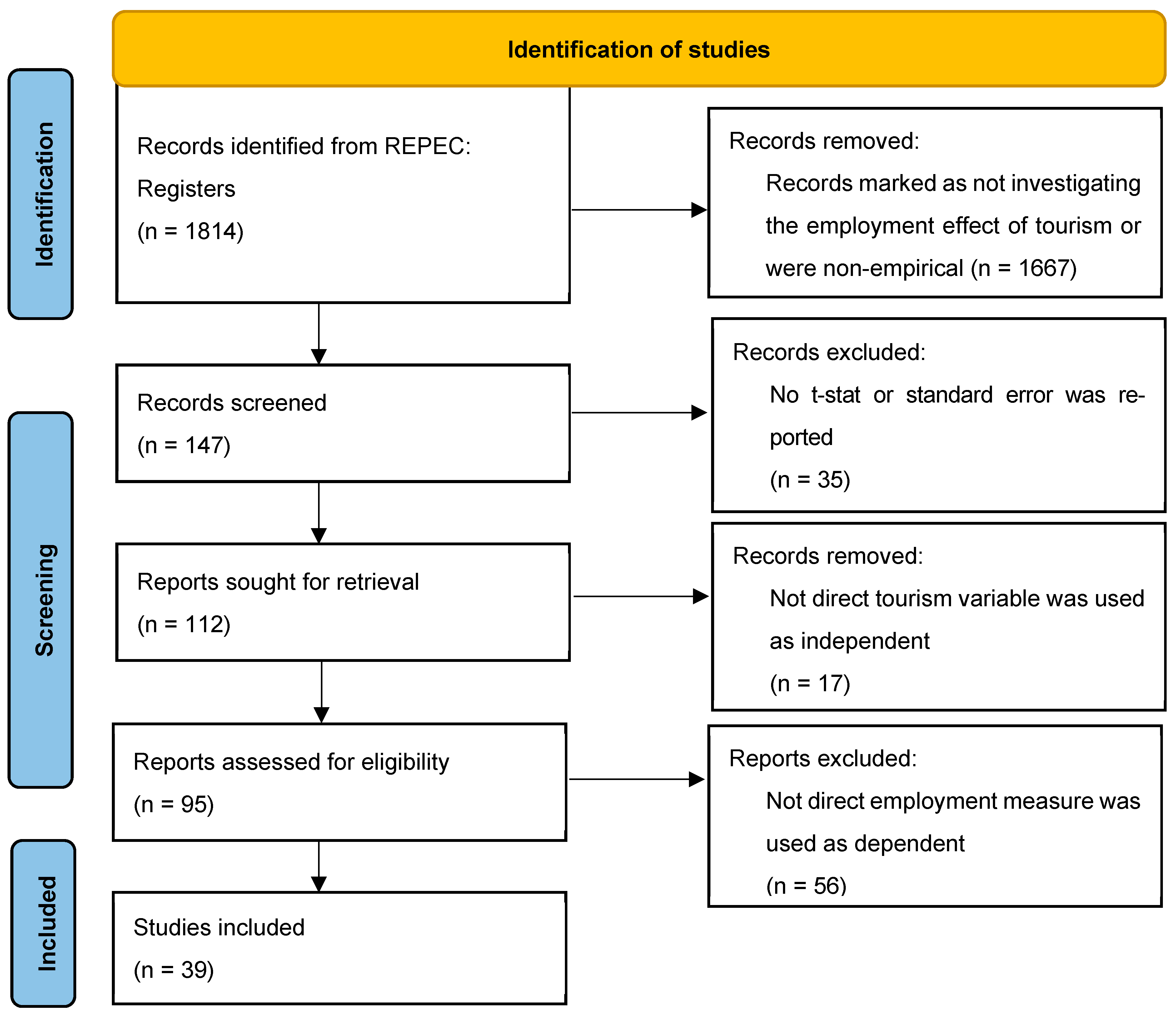
2.1. Methodology
2.2. Effect-Size Construction and Standardization
3. Thematic and Trend Analysis
- 1.
- Sectoral versus Aggregate Employment
- 2.
- Domestic and International Demand
- 3.
- Industry Structure, Events, Spillovers and Competition
- 4.
- Shocks, Volatility, and Resilience
- 5.
- Human Capital, Technology, and Sustainability
- 6.
- Culture, Amenities, and Place Characteristics
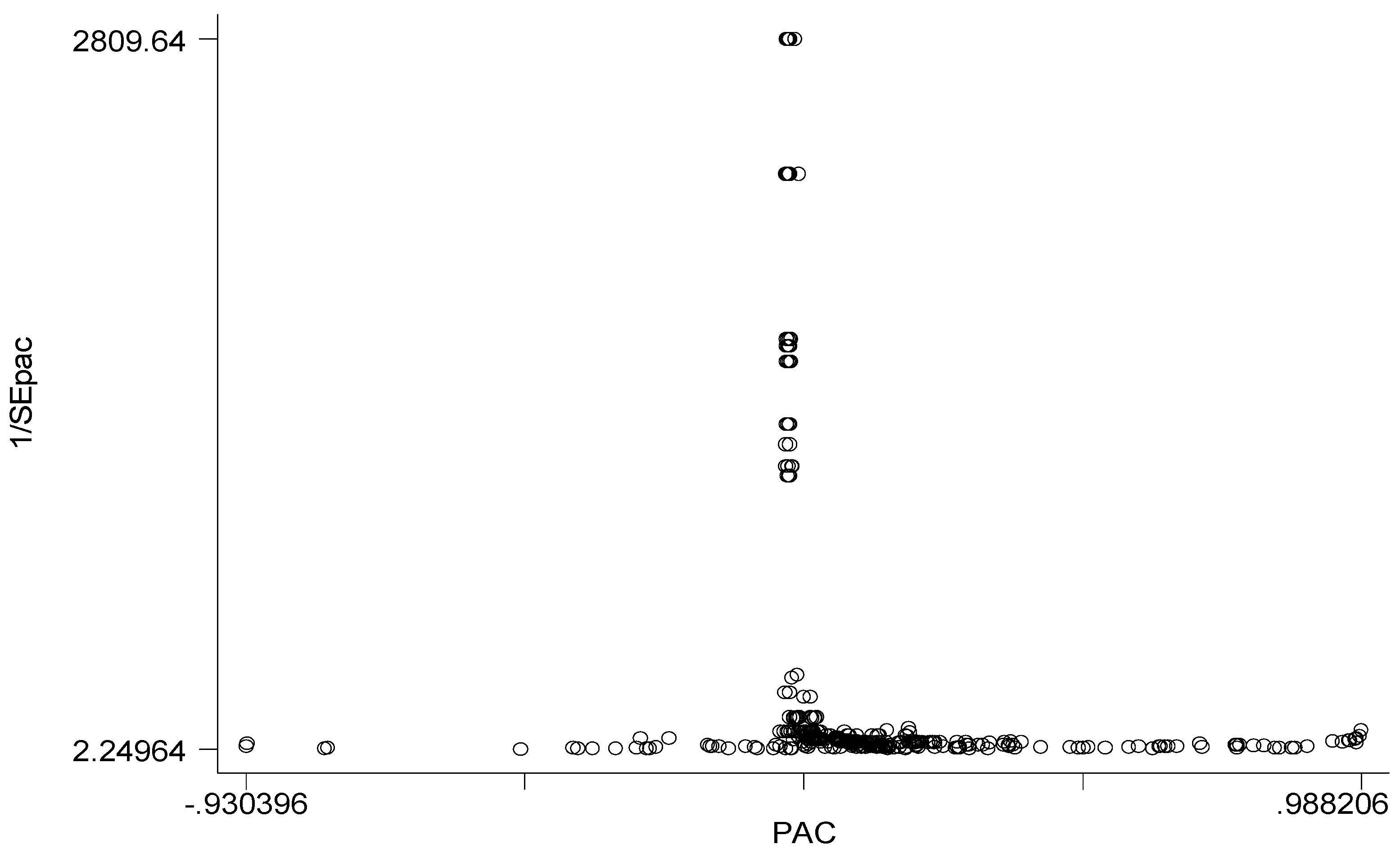
4. Funnel Graph and FAT-PET of the Meta-Sample
Heterogeneity Diagnostics
5. Meta-Regression Analysis
6. Policy Implications
7. Conclusions
Funding
Institutional Review Board Statement
Informed Consent Statement
Data Availability Statement
Conflicts of Interest
References
- Aguayo, E., Exposito, P., & Vazquez, E. (2006). Potential tourism market in transition countries: A regional analysis (ERSA conference papers). European Regional Science Association. Available online: https://www-sre.wu.ac.at/ersa/ersaconfs/ersa06/papers/743.pdf (accessed on 25 September 2025).
- Al Saba, F., Mertzanis, C., & Kampouris, I. (2023). Employee empowerment and tourism sector employment around the world. Journal of Tourism, Heritage & Services Marketing, 9(2), 28–40. [Google Scholar] [CrossRef]
- Andraz, J. M., Norte, N. M., & Gonçalves, H. S. (2016). Do tourism spillovers matter in regional economic analysis? An application to Portugal. Tourism Economics, 22(5), 939–963. [Google Scholar] [CrossRef]
- Bakker, M., & Messerli, H. (2017). Inclusive growth versus pro-poor growth: Implications for tourism development. Tourism and Hospitality Research, 17(4), 384–391. [Google Scholar] [CrossRef]
- Baum, T. (2007). Human resources in tourism: Still waiting for change. Tourism Management, 28(6), 1383–1399. [Google Scholar] [CrossRef]
- Baum, T., & Lundtorp, S. (Eds.). (2001). Seasonality in tourism (1st ed.). Routledge. Available online: https://www.routledge.com/Seasonality-in-Tourism/Baum-Lundtorp/p/book/9780080436746 (accessed on 20 September 2025).
- Beneki, C. C., Rerres, K., Chionis, D. P., & Hassani, H. (2016). How to stimulate employment growth in the Greek hotel industry. Tourism Economics, 22(5), 865–883. [Google Scholar] [CrossRef]
- Cortes-Jimenez, I., & Pulina, M. (2010). Inbound tourism and long-run economic growth. Current Issues in Tourism, 13(1), 61–74. [Google Scholar] [CrossRef]
- Cotti, C. (2008). The effect of casinos on local labor markets: A county level analysis. Journal of Gambling Business and Economics, 2(2), 17–41. [Google Scholar] [CrossRef]
- Deloitte. (2013). Tourism: Jobs and growth. The economic contribution of the tourism economy in the UK. Oxford Economics. Available online: https://www.visitbritain.org/sites/ind/files/2023-08/The%20economic%20contribution%20of%20the%20tourism%20economy%20in%20the%20UK.pdf (accessed on 5 September 2025).
- Deng, T., Liu, S., & Hu, Y. (2022). Can tourism help to revive shrinking cities? An examination of Chinese case. Tourism Economics, 28(6), 1683–1691. [Google Scholar] [CrossRef]
- Dogru, T., McGinley, S., & Kim, W. G. (2020a). The effect of hotel investments on employment in the tourism, leisure and hospitality industries. International Journal of Contemporary Hospitality Management, 32(5), 1941–1965. [Google Scholar] [CrossRef]
- Dogru, T., Mody, M., Suess, C., McGinley, S., & Line, N. D. (2020b). The Airbnb paradox: Positive employment effects in the hospitality industry. Tourism Management, 77, 104001. [Google Scholar] [CrossRef]
- Dorta-González, P., & González-Betancor, S. M. (2021). Employment in tourism industries: Are there subsectors with a potentially higher level of income? Mathematics, 9(22), 2844. [Google Scholar] [CrossRef]
- Dritsakis, N. (2004). Tourism as a long-run economic growth factor: An empirical investigation for Greece. Tourism Economics, 10(3), 305–316. [Google Scholar] [CrossRef]
- Fang, B., Ye, Q., & Law, R. (2016). Effect of sharing economy on tourism industry employment. Annals of Tourism Research, 57, 264–267. [Google Scholar] [CrossRef]
- Fateme, T. (2011). Economic impacts of tourism industry. International Journal of Business and Management, 6, 206–215. [Google Scholar] [CrossRef]
- Feddersen, A., & Maennig, W. (2013). Mega-events and sectoral employment: The case of the 1996 Olympic games. Contemporary Economic Policy, 31, 580–603. [Google Scholar] [CrossRef]
- Fortanier, F., & van Wijk, J. (2010). Sustainable tourism industry development in sub-Saharan Africa: Consequences of foreign hotels for local employment. International Business Review, 19(2), 191–205. [Google Scholar] [CrossRef]
- Ganeshamoorthy, K. (2019). The employment effect of tourism: A dynamic analysis. International Journal of Humanities and Social Science, 3, 119–126. Available online: https://www.ajhssr.com/wp-content/uploads/2019/10/Q19310119126.pdf (accessed on 28 August 2025).
- Georgiou, M. N. (2015). Does tourism sector increase employment in tertiary sector in Greece? Economic Growth eJournal. [Google Scholar] [CrossRef]
- Gonzalez, L., & Surovtseva, T. (2020). Do more tourists promote local employment? IZA discussion paper no. 17518. Available online: https://ssrn.com/abstract=5050005 (accessed on 26 August 2025).
- Gómez López, C. S., & Barrón Arreola, K. S. (2019). Impacts of tourism and the generation of employment in Mexico. Journal of Tourism Analysis: Revista de Análisis Turístico, 26(2), 94–114. [Google Scholar] [CrossRef]
- Gössling, S., Scott, D., & Hall, C. M. (2020). Pandemics, tourism and global change: A rapid assessment of COVID-19. Journal of Sustainable Tourism, 29(1), 1–20. [Google Scholar] [CrossRef]
- Guisan, M.-C., & Aguayo, E. (2002). Employment and regional tourism in Europe, 1990–2000. Regional and Sectoral Economic Studies, 2(2), 53–70. Available online: https://www.usc.es/economet/reviews/eers223.pdf (accessed on 15 September 2025).
- Guisan, M.-C., & Aguayo, E. (2010). Second homes in the Spanish regions: Evolution in 2001–2007 and impact on tourism, GDP and employment. Regional and Sectoral Economic Studies, 10(2), 83–104. Available online: https://www.usc.es/economet/reviews/eers1026.pdf (accessed on 3 September 2025).
- Hagn, F., & Maennig, W. (2008). Employment effects of the Football World Cup 1974 in Germany. Labour Economics, 15(5), 1062–1075. [Google Scholar] [CrossRef]
- Hall, C. M. (2010). Changing paradigms and global change: From sustainable to steady-state tourism. Tourism Recreation Research, 35(2), 131–143. [Google Scholar] [CrossRef]
- ILO. (2013). Decent work and the informal economy in tourism. International Labour Organization. Available online: https://www.ilo.org/media/458111/download (accessed on 27 August 2025).
- Kadiyali, V., & Kosová, R. (2013). Inter-industry employment spillovers from tourism inflows. Regional Science and Urban Economics, 43(2), 272–281. [Google Scholar] [CrossRef]
- Kırca, M., & Özer, M. (2021). The effects of tourism demand on regional sectoral employment in Turkey. Regional Statistics, 11(1), 78–109. Available online: https://www.ksh.hu/statszemle_archive/regstat/2021/2021_01/rs110104.pdf (accessed on 5 September 2025). [CrossRef]
- Lanzara, G., & Minerva, G. A. (2019). Tourism, amenities, and welfare in an urban setting. Journal of Regional Science, 59, 452–479. [Google Scholar] [CrossRef]
- Lee, C. C., & Chang, C. P. (2008). Tourism development and economic growth: A closer look at panels. Tourism Management, 29(1), 180–192. [Google Scholar] [CrossRef]
- Lim, S. H., & Zhang, L. (2016). Does casino development have a positive effect on economic growth? Growth and Change, 48, 409–434. [Google Scholar] [CrossRef]
- Manzoor, F., Wei, L., Asif, M., Haq, M. Z., & Rehman, H. (2019). The contribution of sustainable tourism to economic growth and employment in Pakistan. International Journal of Environ Research and Public Health, 16(19), 3785. [Google Scholar] [CrossRef]
- Marques Santos, A., Madrid, C., Haegeman, K., & Rainoldi, A. (2020). Behavioural changes in tourism in times of COVID-19 (EUR 30286 EN). Publications Office of the European Union. Available online: https://publications.jrc.ec.europa.eu/repository/bitstream/JRC121262/report_covid_tour_emp_final.pdf (accessed on 29 August 2025).
- Mazzola, F., Pizzuto, P., & Ruggieri, G. (2022). Tourism and territorial growth determinants in insular regions: A comparison with mainland regions for some European countries (2008–2019). Papers in Regional Science, 101(6), 1331–1382. [Google Scholar] [CrossRef]
- Min, J., Agrusa, J., Lema, J., & Lee, H. (2020). The tourism sector and U.S. regional macroeconomic stability: A network approach. Sustainability, 12(18), 7543. [Google Scholar] [CrossRef]
- Monchuk, D. C. (2007). People rush in, empty their pockets, and scuttle out: Economic impacts of gambling on the waterways. Journal of Regional Analysis and Policy, 37(3), 223–232. Available online: https://ageconsearch.umn.edu/record/132993/files/07-3-5.pdf (accessed on 4 September 2025).
- Mossbridge, J., Tressoldi, P., & Utts, J. (2012). Predictive physiological anticipation preceding seemingly unpredictable stimuli: A meta-analysis. Frontiers in Psychology, 3, 390. [Google Scholar] [CrossRef]
- Naseem, S. (2021). The role of tourism in economic growth: Empirical evidence from Saudi Arabia. Economies, 9(3), 117. [Google Scholar] [CrossRef]
- Nissan, E., Galindo, M. A., & Méndez, M. T. (2010). Relationship between tourism and economic growth. The Service Industries Journal, 31(10), 1567–1572. [Google Scholar] [CrossRef]
- Oguchi, N. H., & Luo, F. (2021). Estimating the nexus of tourism on sustainable development goals in Nigeria. Technium Social Sciences Journal, 20(1), 751–771. [Google Scholar] [CrossRef]
- Oneţiu, A. N., & Predonu, A. Â. (2013). Effects of tourism on labour market. Procedia—Social and Behavioral Sciences, 92, 652–655. [Google Scholar] [CrossRef]
- Ribeiro, L. C. D. S., Lopes, T. H. C. R., Montenegro, R. L. G., & Andrade, J. R. D. L. (2017). Employment dynamics in the Brazilian tourism sector (2006–2015). Tourism Economics, 24(4), 418–433. [Google Scholar] [CrossRef]
- Romão, J., Guerreiro, J., & Rodrigues, P. M. M. (2016). Tourism growth and regional resilience: The ‘beach disease’ and the consequences of the global crisis of 2007. Tourism Economics, 22(4), 699–714. [Google Scholar] [CrossRef]
- Rotar, L. J. (2023). Carbon tax and tourism employment: Is there an interplay? Journal of Risk and Financial Management, 16, 193. [Google Scholar] [CrossRef]
- Sadler, P. G., & Archer, B. H. (1975). The economic impact of tourism in developing countries. Annals of Tourism Research, 3, 15–32. [Google Scholar] [CrossRef]
- Santos, E. (2023). Does inbound tourism create employment? In E. Santos, N. Ribeiro, & T. Eugénio (Eds.), Rethinking management and economics in the new 20’s (pp. 483–490). Springer. Available online: https://link.springer.com/book/10.1007/978-981-19-8485-3 (accessed on 23 August 2025).
- Scheyvens, R., & Momsen, J. H. (2008). Tourism and poverty reduction: Issues for small island States. Tourism Geographies, 10(1), 22–41. [Google Scholar] [CrossRef]
- Seetanah, B. (2011). Assessing the dynamic economic impact of tourism for island economies. Annals of Tourism Research, 38(1), 291–308. [Google Scholar] [CrossRef]
- Sharpley, R., & Telfer, D. J. (2015). Tourism and development: Concepts and issues. Channel View Publications. Available online: https://books.google.gr/books/about/Tourism_and_Development.html?id=XHlGBQAAQBAJ&redir_esc=y (accessed on 28 August 2025).
- Sinclair, M. T. (1998). Tourism and economic development: A survey. The Journal of Development Studies, 34(5), 1–51. [Google Scholar] [CrossRef]
- Stanley, T., & Doucouliagos, H. (2012). Meta-regression analysis in economics and business. Routledge. Available online: https://www.sea-stat.com/wp-content/uploads/2021/11/Meta-Regression-Analysis-in-Economics-and-Business-by-T.D.-Stanley-Hristos-Doucouliagos-.pdf (accessed on 29 August 2025).
- Stanley, T., Doucouliagos, H., Giles, M., Heckemeyer, J. H., Johnston, R. J., Laroche, P., Nelson, J. P., Paldam, M., Poot, J., Pugh, G., Rosenberger, R. S., & Rost, K. (2013). Meta-analysis of economics research reporting guidelines. Journal of Economic Surveys, 27(2), 390–394. [Google Scholar] [CrossRef]
- Stanley, T. D., & Doucouliagos, H. (2023). Correct standard errors can bias meta-analysis. Research Synthesis Methods, 14(3), 515–519. [Google Scholar] [CrossRef]
- Storm, R. K., Jakobsen, T. G., & Nielsen, C. G. (2020). The impact of Formula 1 on regional economies in Europe. Regional Studies, 54(6), 827–837. [Google Scholar] [CrossRef]
- Sun, Y.-Y., & Wong, K.-F. (2010). An important factor in job estimation: A nonlinear jobs-to-sales ratio with respect to capacity utilization. Economic Systems Research, 22(4), 427–446. [Google Scholar] [CrossRef]
- Škrabic Peric, B., Šimundic, B., Muštra, V., & Vugdelija, M. (2021). The role of UNESCO cultural heritage and cultural sector in tourism development: The case of EU countries. Sustainability, 13, 5473. [Google Scholar] [CrossRef]
- Thompson, E. C. (2007). Measuring the impact of tourism on rural development: An econometric approach. Journal of Regional Analysis and Policy, 37(2), 1–8. Available online: https://ageconsearch.umn.edu/record/132415/files/07-2-7.pdf (accessed on 2 September 2025).
- Ustunel, M., Celiker, N., & Guzeller, C. (2021). Systematic review of meta-analysis studies in the tourism and hospitality literature. European Journal of Tourism Research, 27, 2710. [Google Scholar] [CrossRef]
- Vecco, M., & Srakar, A. (2017). Blue notes: Slovenian jazz festivals and their contribution to the economic resilience of the host cities. European Planning Studies, 25(1), 107–126. [Google Scholar] [CrossRef]
- Wei, X., Qu, H., & Ma, J. (2009). Modeling tourism employment growth—An application in China. International CHRIE conference-refereed track. 1. Available online: https://scholarworks.umass.edu/bitstreams/e124f192-ccec-4b6f-a6d3-abcc4a2eb291/download (accessed on 20 January 2026).
- WTTC. (2023). Economic impact report 2023. World Travel & Tourism Council. Available online: https://wttc.org/Research/Economic-Impact (accessed on 5 September 2025).
- Zhao, J., Yang, D., Zhao, X., & Lei, M. (2023). Tourism industry and employment generation in emerging seven economies: Evidence from novel panel methods. Economic Research-Ekonomska Istraživanja, 36(3), 2206471. [Google Scholar] [CrossRef]



| No | Author(s) | Year | Publication | Obs | Mean (PAC) | Standard Deviation | Min | Max |
|---|---|---|---|---|---|---|---|---|
| 1 | Al Saba et al. (2023) | 2023 | Journal of Tourism, Heritage & Services Marketing | 14 | 0.0069597 | 0.1007207 | −0.2518637 | 0.0611526 |
| 2 | Rotar (2023) | 2023 | Journal of Risk and Financial Management | 2 | 0.081144 | 0.1321417 | −0.0122943 | 0.1745823 |
| 3 | Santos (2023) | 2023 | Springer Proceedings in Business and Economics | 1 | −0.4578501 | - | −0.4578501 | −0.4578501 |
| 4 | Zhao et al. (2023) | 2023 | Economic Research-Ekonomska Istraživanja | 3 | 0.3920271 | 0.520042 | 0.0317128 | 0.9882058 |
| 5 | Deng et al. (2022) | 2022 | Tourism Economics | 1 | 0.1072127 | - | 0.1072127 | 0.1072127 |
| 6 | Mazzola et al. (2022) | 2022 | Papers in Regional Science | 23 | 0.1524485 | 0.0154461 | 0.1125276 | 0.1702743 |
| 7 | Kırca and Özer (2021) | 2021 | Regional Statistics | 12 | 0.314025 | 0.157948 | 0.122474 | 0.7094157 |
| 8 | Oguchi and Luo (2021) | 2021 | Technium Social Sciences Journal | 1 | 0.1775764 | - | 0.1775764 | 0.1775764 |
| 9 | Škrabic Peric et al. (2021) | 2021 | Sustainability | 1 | 0.9392337 | - | 0.9392337 | 0.9392337 |
| 10 | Dogru et al. (2020b) | 2020b | Tourism Management’ | 61 | 0.1169833 | 0.0550977 | 0.0377761 | 0.253047 |
| 11 | Dogru et al. (2020a) | 2020a | International Journal of Contemporary Hospitality Management | 34 | 0.2003522 | 0.097645 | 0.027707 | 0.4030564 |
| 12 | Gonzalez and Surovtseva (2020) | 2020 | Barcelona GSE Working Paper Series | 90 | 0.0026414 | 0.0040816 | −0.0028175 | 0.02065 |
| 13 | Marques Santos et al. (2020) | 2020 | Publications Office of the European Union | 13 | 0.105759 | 0.052787 | 0.0306226 | 0.2041036 |
| 14 | Min et al. (2020) | 2020 | Sustainability | 3 | 0.547888 | 0.039588 | 0.5086923 | 0.5878571 |
| 15 | Storm et al. (2020) | 2020 | Regional Studies | 4 | −0.1115825 | 0.028431 | −0.1322909 | −0.0700551 |
| 16 | Ganeshamoorthy (2019) | 2019 | American Journal of Humanities and Social Sciences Research | 2 | 0.5051476 | 0.2956126 | 0.296118 | 0.7141773 |
| 17 | Gómez López and Barrón Arreola (2019) | 2019 | Journal of Tourism Analysis | 13 | −0.0064467 | 0.1990751 | −0.3600174 | 0.2965578 |
| 18 | Lanzara and Minerva (2019) | 2019 | Journal of Regional Science | 24 | 0.0269542 | 0.0257861 | −0.0121554 | 0.0982919 |
| 19 | Manzoor et al. (2019) | 2019 | International Journal of Environmental Research and Public Health | 1 | 0.3916171 | - | 0.3916171 | 0.3916171 |
| 20 | Ribeiro et al. (2017) | 2017 | Tourism Economics | 6 | 0.1720057 | 6.15 × 10⁻⁶ | 0.1719932 | 0.1720082 |
| 21 | Vecco and Srakar (2017) | 2017 | European Planning Studies | 16 | 0.7905006 | 0.1846562 | 0.4878322 | 0.9852265 |
| 22 | Andraz et al. (2016) | 2016 | Tourism Economics | 10 | 0.226954 | 0.364174 | −0.2349157 | 0.8953072 |
| 23 | Beneki et al. (2016) | 2016 | Tourism Economics | 3 | 0.2093647 | 0.0025707 | 0.2068756 | 0.21201 |
| 24 | Fang et al. (2016) | 2016 | Annals of Tourism Research | 2 | 0.1658038 | 0.0138599 | 0.1560034 | 0.1756042 |
| 25 | Lim and Zhang (2016) | 2016 | Growth and Change | 5 | 0.0334718 | 0.0113685 | 0.0198346 | 0.0463696 |
| 26 | Romão et al. (2016) | 2016 | Tourism Economics | 8 | 0.4170265 | 0.6247139 | −0.7943943 | 0.8738743 |
| 27 | Georgiou (2015) | 2015 | SSRN Working Paper | 4 | −0.3713249 | 0.3260399 | −0.7899613 | 0.005803 |
| 28 | Deloitte (2013) | 2013 | Deloitte and Oxford Economics for VisitBritain | 1 | 0.9801555 | - | 0.9801555 | 0.9801555 |
| 29 | Kadiyali and Kosová (2013) | 2013 | Regional Science and Urban Economics | 14 | 0.026124 | 0.0157815 | 0.0050343 | 0.0502369 |
| 30 | Fortanier and van Wijk (2010) | 2010 | International Business Review | 4 | 0.7739065 | 0.0033564 | 0.7716482 | 0.7788458 |
| 31 | Guisan and Aguayo (2010) | 2010 | Regional and Sectoral Economic Studies | 2 | 0.1148958 | 0.1108287 | 0.0365281 | 0.1932635 |
| 32 | Sun and Wong (2010) | 2010 | Economic Systems Research | 4 | −0.3151025 | 0.7646839 | −0.9303964 | 0.649574 |
| 33 | Wei et al. (2009) | 2009 | International CHRIE Conference-Refereed Track | 2 | 0.0256344 | 0.4515075 | −0.2936296 | 0.3448984 |
| 34 | Cotti (2008) | 2008 | Journal of Gambling Business and Economics | 6 | 0.0162963 | 0.163721 | −0.0038921 | 0.0401692 |
| 35 | Hagn and Maennig (2008) | 2008 | Labour Economics | 1 | 0.3828879 | - | 0.3828879 | 0.3828879 |
| 36 | Monchuk (2007) | 2007 | Regional Analysis and Policy | 3 | 0.1934074 | 0.0657354 | 0.1503471 | 0.2690716 |
| 37 | Thompson (2007) | 2007 | Regional Analysis and Policy | 4 | 0.0881477 | 0.039996 | 0.0378054 | 0.1292215 |
| 38 | Aguayo et al. (2006) | 2006 | 46th. Congress of the European Regional Science Association | 1 | 0.5009283 | - | 0.5009283 | 0.5009283 |
| 39 | Guisan and Aguayo (2002) | 2002 | Estudios Económicos Regionales y Sectoriales | 2 | 0.332046 | 0.1479988 | 0.2273951 | 0.436697 |
| Column 1 Robust | Column 2 Cluster (Studies) | Column 3 WLS | Column 4 REML | Column 5 EB | |
|---|---|---|---|---|---|
| Dependent Variable: PAC (Partial Correlation) | |||||
| Constant | 0.113232 *** (7.18) | 0.113232 ** (2.19) | 0.099407 ** (2.25) | 0.0946982 *** (6.03) | 0.0954135 *** (6.07) |
| SEPAC | 0.4278505 (1.16) | 0.4278505 (0.81) | 0.7334471 (1.17) | 0.9637352 *** (3.69) | 0.9418995 *** (3.63) |
| Studies | 39 | 39 | 39 | 39 | 39 |
| Observations | 401 | 401 | 401 | 401 | 401 |
| R-squared | 0.0091 | 0.0091 | 0.0091 | 0.0543 (Adjusted R-squared) | 0.0327 (Adjusted R-squared) |
| Moderator Variable | Definition | Number | % on Total 401 Observations |
|---|---|---|---|
| Constant | =the constant of the regression. | ||
| SEPAC | =the standard error of the partial correlation (PAC). | ||
| Overnight stays | =1, if the independent variable regards overnight stays. | 106 | 26.43% |
| Tourist arrivals | =1, if the independent variable regards arrivals. | 138 | 34.41% |
| Overall employment | =1, if the dependent variable regards overall employment. | 94 | 23.44% |
| Tourism employment | =1, if the dependent variable regards tourism employment. | 145 | 36.16% |
| Employment in specific sector | =1, if estimates are for a specific tourism industry. | 94 | 23.44% |
| Fixed Effects | =1, if country/region/county/sector or relevant fixed effects are used. | 239 | 59.60% |
| OLS | =1, if estimate stems from ordinary least squares regression. | 299 | 74.56% |
| IV | =1, if estimate comes from instrumental variables (mostly 2SLS) regression. | 44 | 10.97% |
| LogX | =1, if estimate comes from a single log specification, having the tourism variable in log form. | 93 | 23.19% |
| Double log | =1, if estimate comes from a double log specification. | 126 | 31.42% |
| GDP measurement of BCI | =1, if a model includes GDP/GDP per capita or relevant GDP indices as a business cycle indicator. | 155 | 38.65% |
| Panel | =1, if estimate relates to panel data. | 350 | 87.28% |
| Primary interest | =1, if estimate comes from a study in which the effect of tourism on employment is of prime interest. | 313 | 78.05% |
| Column 1 Robust | Column 2 Cluster (Studies) | Column 3 WLS | Column 4 REML | Column 5 EB | |
|---|---|---|---|---|---|
| Moderators | |||||
| Constant | 0.3859262 *** (2.91) | 0.3859262 * (1.99) | 0.382996 * (1.71) | 0.351725 *** (5.13) | 0.3533256 *** (5.14) |
| SEPAC | −1.491413 *** (−3.04) | −1.491413 * (−2.01) | −1.753291 * (−1.77) | −0.9858512 *** (−4.93) | −1.020095 *** (−3.09) |
| X = Overnight stays | 0.1043858 * (1.86) | 0.1043858 (1.12) | 0.1340044 (1.16) | 0.0789574 ** (2.02) | 0.0803453 ** (2.05) |
| X = Tourist arrivals | −0.0117468 (−0.24) | −0.0117468 (−0.17) | −0.016296 (−0.12) | −0.086995 (−0.23) | −0.0092557 (−0.24) |
| Y = Overall employment | 0.0505104 (0.78) | 0.0505104 (0.56) | 0.1140596 (0.75) | 0.0742007 * (1.90) | 0.0729462 * (1.86) |
| Y = Tourism employment | 0.0217375 (0.44) | 0.0217375 (0.33) | 0.0664021 (0.48) | 0.0352156 (0.91) | 0.0342886 (0.88) |
| Y = Employment in specific sector | −0.0767914 (−1.43) | −0.0767914 (−1.13) | −0.1594073 (−1.17) | −0.0403072 (−1.06) | −0.0427488 (−1.12) |
| Fixed Effects | −0.1625251 ** (−4.70) | −0.1625251 *** (−2.84) | −0.2686848 ** (−2.32) | −0.1413185 *** (−4.93) | −0.1427745 *** (−4.96) |
| OLS | 0.0270468 (0.43) | 0.0270468 (0.28) | 0.0220682 (0.19) | 0.0409367 (1.12) | 0.0402998 (1.09) |
| IV | 0.0537668 (0.86) | 0.0537668 *** (2.82) | 0.0144247 (0.02) | 0.0650231 (1.24) | 0.0645456 (1.23) |
| LogX | −0.2016768 *** (−4.27) | −0.2016768 *** (−2.82) | −0.206138 (−0.64) | −0.1992211 *** (−4.26) | −0.1994612 *** (−4.24) |
| Double log | 0.0420515 (0.79) | 0.0420515 (0.52) | 0.0443613 (0.46) | 0.0524466 * (1.71) | 0.0515437 * (1.67) |
| GDP measurement of BCI | −0.0839153 * (−1.82) | −0.0839153 (−1.08) | −0.1151781 (−1.01) | −0.0967386 *** (−2.80) | −0.0959622 *** (−2.76) |
| Panel | −0.1441986 (−1.42) | −0.1441986 (−0.80) | −0.0350221 (−0.22) | −0.1794642 *** (−3.66) | −0.1763164 *** (−3.58) |
| Primary interest | 0.0660267 (1.47) | 0.0660267 (1.01) | 0.0471115 (0.49) | 0.0780865 ** (2.53) | 0.3533256 *** (5.14) |
| Studies | 39 | 39 | 39 | 39 | 39 |
| Observations | 401 | 401 | 401 | 401 | 401 |
| R-squared | 0.2916 | 0.2916 | 0.2653 | 0.3840 (Adjusted R-squared) | 0.3356 (Adjusted R-squared) |
Disclaimer/Publisher’s Note: The statements, opinions and data contained in all publications are solely those of the individual author(s) and contributor(s) and not of MDPI and/or the editor(s). MDPI and/or the editor(s) disclaim responsibility for any injury to people or property resulting from any ideas, methods, instructions or products referred to in the content. |
© 2026 by the author. Licensee MDPI, Basel, Switzerland. This article is an open access article distributed under the terms and conditions of the Creative Commons Attribution (CC BY) license.
Share and Cite
Giotis, G. The Effect of Tourism on Employment: A Meta-Analysis and Meta-Regression of 39 Empirical Studies (2002–2023). Businesses 2026, 6, 11. https://doi.org/10.3390/businesses6010011
Giotis G. The Effect of Tourism on Employment: A Meta-Analysis and Meta-Regression of 39 Empirical Studies (2002–2023). Businesses. 2026; 6(1):11. https://doi.org/10.3390/businesses6010011
Chicago/Turabian StyleGiotis, Georgios. 2026. "The Effect of Tourism on Employment: A Meta-Analysis and Meta-Regression of 39 Empirical Studies (2002–2023)" Businesses 6, no. 1: 11. https://doi.org/10.3390/businesses6010011
APA StyleGiotis, G. (2026). The Effect of Tourism on Employment: A Meta-Analysis and Meta-Regression of 39 Empirical Studies (2002–2023). Businesses, 6(1), 11. https://doi.org/10.3390/businesses6010011