You are currently viewing a new version of our website. To view the old version click .
Construction Materials
  • Article
  • Open Access

5 January 2026

Design of Recycled Aggregate Fiber-Reinforced Concrete for Road and Airfield Applications Using Polypropylene Fibers and Fly Ash

,
,
and
1
Department of Building Materials, TU Dortmund University, 44227 Dortmund, Germany
2
Department of Highways and Airfields, Odessa State Academy of Civil Engineering and Architecture, Didrihsona Street 4, 65029 Odessa, Ukraine
3
Department of Chemistry and Ecology, Odessa State Academy of Civil Engineering and Architecture, Didrihsona Street 4, 65029 Odessa, Ukraine
*
Author to whom correspondence should be addressed.
This article belongs to the Special Issue Advances in the Sustainability and Durability of Waste-Based Construction Materials

Abstract

Driving the circular economy in road construction requires the effective use of secondary materials like recycled concrete aggregate (RCA) and fly ash (FA). A key obstacle is the performance trade-off in concretes incorporating both materials. This research investigates feasible mix designs for road concrete, using RCA as a full gravel replacement and FA as a cement substitute. Polypropylene fiber (36 mm) and a superplasticizer were utilized to mitigate fresh and hardened state drawbacks. The experimental program included 15 modified mixtures with recycled aggregate and 3 control mixtures with natural aggregate. The workability of all concrete mixtures was kept constant at slump class S1. Road concretes with RCA, containing a 10–12% FA by cement replacement, at least 2 kg/m3 of polypropylene fiber (PF), and 4 kg/m3 of superplasticizer (SP), achieve compressive strength of at least 50 MPa and flexural strength of no less than 5 MPa at the design age. This performance is comparable to that of control mixtures. Furthermore, the abrasion resistance ranges between 0.48–0.50 g/cm2, and the brittleness index falls within 0.095–0.100, significantly enhancing the durability of concrete for rigid pavement applications. The conducted cradle-to-gate life-cycle assessment (stages A1–A3) of the constituent materials for 1 m3 of concrete indicates the following environmental impacts: Global Warming Potential (GWP) of 195 kg CO2 equation, Non-renewable Primary Energy Demand (PENRE) of 1140 MJ, Abiotic Depletion Potential for Fossil resources (ADPF) of 1120 MJ, Acidification Potential (AP) of 0.45 mol H+ equation, and Eutrophication Potential (EP) of 0.07 kg PO43− equation It is established that the modified compositions not only meet the required performance criteria but also contribute to the goals of resource conservation in road construction.

1. Introduction

Contemporary road construction is increasingly focused on developing pavements with high resistance to both mechanical loads and environmental challenges. The advancement of material recycling technologies promotes the incorporation of secondary resources into concrete composition—such as recycled concrete aggregates (RCA) [1,2] and fly ash (FA) [3,4]. These materials represent valuable secondary raw materials that can be effectively utilized to produce sustainable road concrete. Given the substantial volumes of concrete required in transportation infrastructure, this sector represents one of the most promising applications for RCA-based materials. The addition of fibers into concrete mixtures enhances strength and durability parameters [5,6,7,8], leading to a comprehensive improvement in the performance characteristics of rigid road and airfield pavements.

1.1. FA as a Cement Replacement in Road Concretes

FA is widely recognized as an effective supplementary cementitious material (SCM) capable of partially replacing Portland cement in concrete. This approach contributes to more efficient resource utilization and reduces the environmental impact over the life cycle in road construction. For instance, the replacement of up to 40% of 42.5-grade cement with FA allows for the production of road concrete with a compressive strength of 30.4 MPa at 28 days of curing while maintaining workability comparable to the reference mixture [9]. Similarly, the introduction of 30% FA as a cement replacement in the concrete mixture resulted in road pavement concretes with a compressive strength of 34.6 MPa and flexural strength of 5.7 MPa at 7 days, reaching 46 MPa and 6.9 MPa, respectively, at the design age of 28 days [10]. At the same time, with the use of 52.5-grade cement partially substituted by 30% FA, the concrete exhibited compressive strengths of 54.5 MPa at 7 days and 72.4 MPa at 28 days [11]. Laboratory tests further confirm specimens for cement-concrete pavements, demonstrating the effectiveness of substituting ordinary Portland cement of 42.5-grade with up to 50% FA. The design strength indicators were around 30 MPa for compression and 5 MPa for flexural strength [12]. Alongside this, a reduction in the abrasion of FA concrete pavements by 6–10% compared to the reference mixture has been observed. When 5–10% of cement was replaced with FA, the compressive strength of the road concrete was no less than 42 MPa, and the flexural strength was at least 6.2 MPa. Furthermore, the environmental impact indicators were 2–2.5 times lower than those of the base concrete composition [13]. Machine learning-based modeling has identified that in 70% of cases, FA is an effective additive for reducing the abrasion of concrete pavements [14]. Road concretes containing 40–50% FA exhibited low abrasion rates at a design compressive strength of 26–28 MPa [15].

1.2. RCA for Road Concrete Applications

Data from the European Commission indicate that the average annual generation of concrete waste may exceed 160 million tons [16]. The United Nations Department of Sustainable Development emphasizes the importance of reusing construction and demolition waste (CDW), particularly crushed concrete [17]. Fortunately, technical advancements in recycling technology now enable the use of this reclaimed concrete as aggregate in road pavement concretes [18]. For example, a test section of a concrete road incorporating 100% RCA demonstrated a high potential for utilizing this waste material [19]. The use of 90–100% RCA yielded a road concrete with a compressive strength of at least 35 MPa, while its flexural strength was no less than 6 MPa [20]. Testing of an experimental rigid pavement concrete track demonstrated the effectiveness of utilizing up to 50% RCA. The designed compressive strength of the concrete at 28 days was 30 MPa, and the flexural strength was 6.4 MPa [21]. However, a weak point in the microstructure formation of recycled concrete is the interfacial transition zone (ITZ), which can lead to a significant reduction in strength [22,23]. Moreover, the use of RCA in pavement concrete is associated with negative effects, including impaired workability [20,24] and increased open porosity [21,25]. Despite the existing regulatory framework for the use of RCA in concrete production [26,27,28], the requirements of these standards are insufficient to fully ensure the quality of rigid pavement constructions. Therefore, researchers consistently stress that strict quality control of the recycled raw material is a prerequisite to ensure the designed performance characteristics of the concrete [19,29,30].

1.3. Fiber Reinforcement of Pavement Concrete Based on RCA

To enhance the strength characteristics of pavement concrete incorporating RCA, fiber reinforcement is recommended. This approach works by redistributing internal tensile stresses at the boundaries of the weak ITZ originating from external loading (bridging effect) [31,32]. This mechanism contributes to an improvement in the concrete’s physical and mechanical performance. Among the various types of dispersed reinforcement used in road construction, polymeric fibers are the most common. O’Hare Airport successfully implemented a rigid pavement utilizing 100% RCA in combination with 1.8 kg/m3 of synthetic macrofibers. The concrete achieved a flexural strength of 6.2 MPa and a compressive strength of 36 MPa at the design age [33]. For another pilot project concerning rigid airfield pavement, the optimal amount of polypropylene fibers (PF) was established at 3 kg/m3. This dosage enabled the effective use of 100% RCA to replace natural aggregates [34]. The modification of road concrete with PF in the range of 3–9 kg/m3 also induces a positive synergistic effect when combined with 100% RCA. The 28-day compressive strength ranged from 27 to 34 MPa, which is comparable to the control mixture [35]. The combination of 4.5 kg/m3 of PF with 15% RCA resulted in a fiber-reinforced concrete with a flexural strength of 6.9 MPa and a compressive strength of 40 MPa [36]. However, it is important to note that the effect of PF incorporation on the strength and elastic modulus of RCA concretes can be ambiguous [37]. Ultimately, inadequate mix design or non-compliance with construction technology when using PF can result in failure to meet the design strength requirements for rigid highway and airfield pavements.
Literature data confirm the potential for improving the properties of road concretes through partial cement replacement with FA. The use of dispersed reinforcement in combination with RCA as a substitute for traditional natural aggregates in rigid road and airfield pavements has also demonstrated high efficiency. However, it is necessary to consider the fact that a definite knowledge gap exists regarding the changes in concrete properties when simultaneously modified by these three components. Moreover, maintaining the design workability of concrete mixtures without increasing the water-to-cement ratio (W/C ratio) remains an important challenge, which necessitates the use of modern water-reducing admixtures. Thus, the composition of road concrete evolves into a multi-factor system of “FA-RCA-PF-superplasticizer (SP)”. To address this gap, our study employs a systematic approach based on experimental planning and experimental-statistical modeling to investigate the complex influence of these variable mix design factors on the properties of both fresh and hardened concrete.

2. Materials and Methods

The following components were used in the production of concretes and fiber-reinforced concretes:
-
Portland cement CEM II/A-S 42.5 R [38] produced by VIPCEM (Kyiv, Ukraine);
-
Quartz sand with a fineness modulus of 2.3 [39];
-
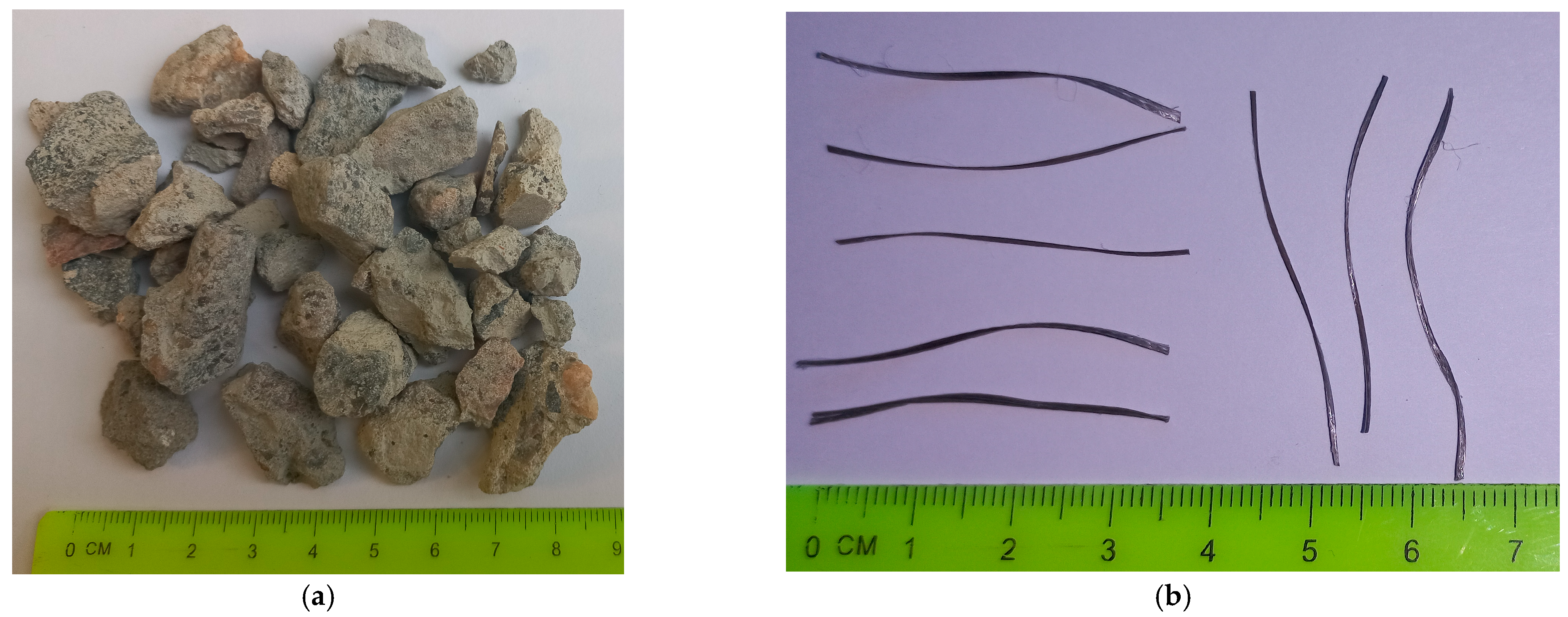
RCA, 5–20 mm fraction, obtained from the processing of reinforced concrete structures (Figure 1a);
Figure 1. RCA (a) and PF (b) used in the study.
-
Granite crushed stone (NA), 5–20 mm fraction [40] (used in control concrete mixtures);
-
PF “Baumesh” produced by Bautech-Ukraine (Odessa, Ukraine), characterized by a length of 36 mm, a diameter of 0.68 mm, and an ultimate tensile strength of 530 MPa [41], Figure 1b;
-
Polycarboxylate-ether-based SP, “MC-PowerFlow 3200” produced by MC-Bauchemie (Bottrop, Germany), conforming to [42];
-
FA was sourced from the Darnytsia Thermal Power Plant (Kyiv, Ukraine), with the chemical and mineralogical composition of the FA presented in Table 1.
Table 1. Chemical and mineralogical composition of the FA sample.
-
Tap water, compliant with the requirements of [43], was used for mixing all concrete mixtures.
As evidenced by the data in Table 1, the elevated CaO content and the presence of characteristic high-calcium phases indicate that the FA can be classified as Class C [44].
The water absorption (WA) of the NA and RCA was determined using the standard gravimetric method [45]. The test procedure commenced by drying the aggregate samples to a constant mass in a ventilated oven at 110 ± 5 °C. The saturated, surface-dried condition was achieved by immersing the dried samples in water for 24 h, followed by careful surface drying with a lint-free cloth. The WA was calculated as a percentage using the following Formula (1):
W A = m 2 m 1 m 1 · 100 %
where
m1—the mass of the oven-dried sample;
m2—the mass of the saturated sample.
The aggregate crushing value (ACV) was determined for NA and RCA following the methodology [46]. The 10–20 mm fraction was used for testing. A standard mass of aggregate was compacted into a steel cylinder and subjected to a compressive load of 200 kN. After crushing, the entire sample was sieved on a 2.5 mm sieve. The ACV was calculated as the percentage loss in mass, using the following Formula (2):
A C V = m m 1 m · 100 %
where
m—the initial mass of the aggregate specimen;
m1—the mass of the fraction retained on the 2.5 mm sieve after the crushing test.
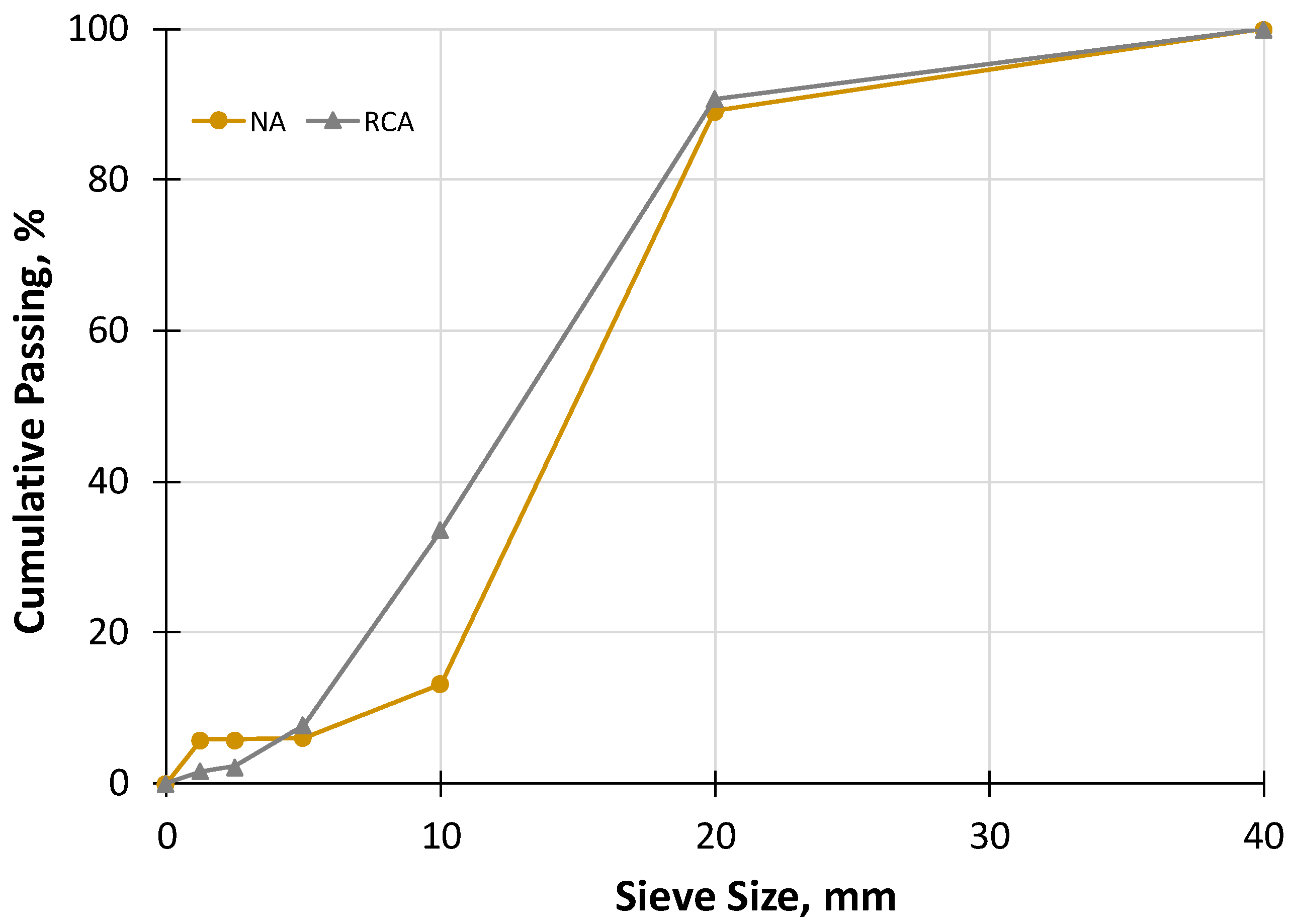
The resulting data are given in Table 2. The particle size distribution of the NA and RCA is shown in Figure 2 [40].
Table 2. Physical and mechanical properties of the NA and RCA.
Figure 2. Particle size distribution curves of the NA and RCA.
The investigation of the properties of concrete and fiber-reinforced concrete was conducted using methods of experimental design and experimental-statistical modeling [47,48]. A symmetric D-optimal 15-point design [49,50] was employed, varying three key mixture factors for RCA-based concretes:
X1—the proportion of cement replaced by FA, ranging from 0 to 20%. The base composition of concretes and fiber-reinforced concretes was designed with a Portland cement content of 300 kg/m3. According to the three-level design, replacements of 30 kg and 60 kg of cement were replaced as 70 kg and 140 kg of FA, respectively, following the methodology [50] and considering previous research findings [51]. The concrete mixture proportions were adjusted accordingly.
X2—the amount of the SP, varying from 1 to 1.6% by mass of cement, equivalent to 3 to 4.8 kg/m3 of concrete. This specific SP type and its dosage range were selected based on the authors’ previous research on the properties of concrete and fiber-reinforced concrete for rigid pavements and transport structures [5,6], as well as preliminary exploratory tests.
X3—the PF content was varied from 0 to 3 kg/m3. The selection of this fiber type and its dosage range was based on the results of previous studies on fiber-reinforced concrete properties [5,52] and a series of preliminary tests.
The experimental design and compositions of the investigated concretes and fiber-reinforced concretes with RCA are presented in Table 3.
Table 3. Experimental design and mix proportions of the concretes and fiber-reinforced concretes with RCA.
To establish a performance baseline, three control mixtures based on NA were also prepared and tested. These control mixtures were designed without fiber reinforcement and with a fixed SP dosage of 3 kg/m3 (1% by cement mass). The same range of FA replacement (0–20% of cement) was applied to these control mixtures as in the main experimental series with RCA. The compositions of the investigated granite-based concrete compositions are presented in Table 4.
Table 4. Compositions of the investigated control concrete with NA.
The mixing process commenced with the dry homogenization of cement, sand, NA or RCA, and FA. Subsequently, water with the dissolved SP was added. To prevent balling, the PFs were introduced in the final stage in two or three separate batches, ensuring their uniform distribution throughout the fresh concrete.
All investigated concrete and fiber-reinforced concrete mixtures with NA and RCA were designed to have equal workability class S1 corresponding to a slump value of 3–4 cm [53]. This was ensured by preliminarily determining the optimal water content and subsequent adjustment of the concrete or fiber-reinforced concrete mixture composition. This experimental design enabled an analysis of the effect of the variable factors and the aggregate type (natural or recycled) considering their real contribution to the change in the water demand of the fresh concrete mixtures. That is, it closely simulated practical production conditions. The target consistency was set at slump class S1, consistent with standard specifications for concrete in road and airfield pavement applications.

2.1. Compressive and Flexural Strength

The evaluation of compressive strength was conducted to determine the general load-bearing capacity of the concrete matrix. Concurrently, flexural strength testing was prioritized to simulate the in-service conditions of road pavements, which are primarily subjected to bending moments rather than pure compression. Resistance to tensile stress is crucial, considering the action of multidirectional loads on the pavement structure during service [54]. These stresses arise from vehicle wheel loads and, over time, can lead to the formation of cracks and other pavement distress.
For compressive strength testing at 3 and 28 days, three 10 × 10 × 10 cm cubes were produced from each batch of concrete and fiber-reinforced concrete [55]. Furthermore, each batch of specimens for the 28-day flexural strength testing comprised three 10 × 10 × 40 cm prisms. The tests were conducted using a four-point loading scheme to ensure a uniform bending moment within the central span and a more accurate representation of the material’s tensile behavior [56].
Concrete and fiber-concrete specimens (cubes and prisms) were cast in standard molds immediately after mixing. The molds were filled in layers, each compacted by tamping and additionally vibrated on a laboratory vibration table to ensure uniform consolidation. The top surface was leveled, and molds were covered with a plastic sheet to prevent moisture loss. Specimens were kept in the molds at 20 ± 2 °C for 24 ± 2 h. After demolding, the specimens were transferred to a curing environment at 20 ± 2 °C with ≥95% relative humidity until testing age [57]. This procedure ensured proper early hydration and minimized moisture loss throughout the curing period.

2.2. Brittleness Index (BI)

As part of a comprehensive analysis of mechanical characteristics, alongside the determination of compressive strength (fcm) and flexural strength (fctk) according to standard procedures, the brittleness index (BI) was calculated. This parameter was quantitatively defined as the ratio fctk/fcm. This index provides a transition from a mere assessment of strength to an evaluation of structural crack resistance. Ordinary concrete is characterized by a low BI value, indicating its tendency for brittle failure. An elevated BI indicates greater specific fracture energy and reduced brittleness, a result of the fibers’ ability to redistribute stresses and inhibit microcrack propagation [58]. Therefore, the BI quantifies the effectiveness of dispersed reinforcement in enhancing the deformation characteristics of modified RCA concretes, which is crucial for the durability of rigid pavements under alternating loads.

2.3. Abrasion Resistance (AR)

For highway and airfield pavements, assessing abrasion resistance (AR) is critical for predicting service life. The impact of tires and abrasive de-icing materials leads to progressive degradation of the surface macro-texture, directly reducing skid resistance and traffic safety. Moreover, concrete abrasion serves as an indirect indicator of resistance to freeze–thaw cycles with de-icing agents and dynamic impacts, which is crucial for road pavement structures and transportation infrastructure [59].
Abrasion tests were performed on cube specimens measuring 7 × 7 × 7 cm. A Bohme abrasion testing wheel was used as the test equipment, with an abrasive material (electrocorundum, 160 µm) under a load of (300 ± 5) N, creating a pressure of (60 ± 1) kPa [60]. The total abrasion path was 600 m (4 cycles of 150 m each). After each cycle, the specimens were rotated by 90°. The abrasive material was replaced with a new portion weighing (20 ± 1) g after every 30 m of the path. After testing, the specimens were weighed, and the AR was calculated as the mass loss per unit of abraded surface area.

2.4. Life-Cycle Assessment (LCA)

For a comprehensive assessment of the environmental impact of the concrete and fiber-reinforced concrete compositions (Table 3 and Table 4) designed for road and airfield pavements, a life-cycle assessment (LCA) was conducted in accordance with the standards [61,62,63,64].
The system boundaries were defined according to the “cradle-to-gate” principle, encompassing the following stages:
A1—Extraction and production of raw materials: cement, mineral and chemical additives, aggregates, fiber, and water.
A2—Transportation of constituent materials to the concrete production site is included in aggregated form according to the [65] dataset and does not provide explicit transport distances. Since transport distances in concrete production are highly project-specific and can vary substantially between regions, suppliers, and supply chains, no additional modeling of transport routes was performed in this study.
A3—Production of 1 m3 of fresh concrete mixture.
The analysis excludes the use and end-of-life stages (B–D), as the objective is to assess the material-related impacts and the efficiency of the concrete composition at the component level.
The functional unit is defined as the set of components equivalent to 1 m3 of concrete or fiber-reinforced concrete, allowing the comparison of the specific contribution of each material to the overall environmental impact. Inventory data, including the mass of raw materials, energy consumption during production, as well as emissions to air (e.g., CO2-equivalents) and water use, were obtained from the [65,66] databases. For processes not covered in these databases, data provided by manufacturers were used.
To ensure a clear integration of environmental and mechanical performance results, a reduced set of impact indicators was selected:
-
Global warming potential (GWP);
-
Non-renewable primary energy demand (PENRE);
-
Abiotic depletion potential (ADPF);
-
Use of secondary materials (USM);
-
Acidification potential (AP);
-
Eutrophication potential (EP).
The contribution of each component was assessed separately, which made it possible to identify the most significant sources of the carbon footprint and resource consumption in the composition of the investigated modified concretes.

3. Research Results and Analysis

3.1. Water Demand of Modified Concrete Mixtures

Since all investigated concrete and fiber-reinforced concrete mixtures had equal workability (slump class S1), their water demand was dependent on their composition, and consequently, on the factors varied in the experiment.
Based on the data presented in Table 3, the following adequate experimental-statistical (ES) model (1) was developed to describe the influence of the varied mix composition factors [47,48] on the water demand of modified concrete mixtures with RCA. In fact, the W/C ratio varied depending on the mix composition. However, since the experimental design involved replacing part of the cement with a larger mass of FA, it is methodologically more appropriate to analyze the overall water demand of the mixture rather than the W/C ratio.
For the calculation of this and subsequent ES-models, the accepted experimental error with a two-sided risk of α = 0.1 was considered. At the specified risk level, the significance of the ES-model coefficients was tested using the Gaussian accuracy criterion. Insignificant coefficients, which, according to the test results, did not differ from zero, were sequentially eliminated from the model. After the sequential elimination of all insignificant coefficients, the ES-model, with all significant coefficient estimates (bᵢ), was tested for adequacy using Fisher’s F-test. When recording the polynomials of the three-factor ES-models, a coefficient of ±0 was placed in the position of the omitted insignificant coefficients.
W ( l / m 3 ) = 131.66 ±   0 x 1 +   2.86 x 1 2   0.75 x 1 x 2 +   0.75 x 1 x 3   4.10 x 2 ±   0 x 2 2   1.75 x 2 x 3 +   1.30 x 3   1.64 x 3 2
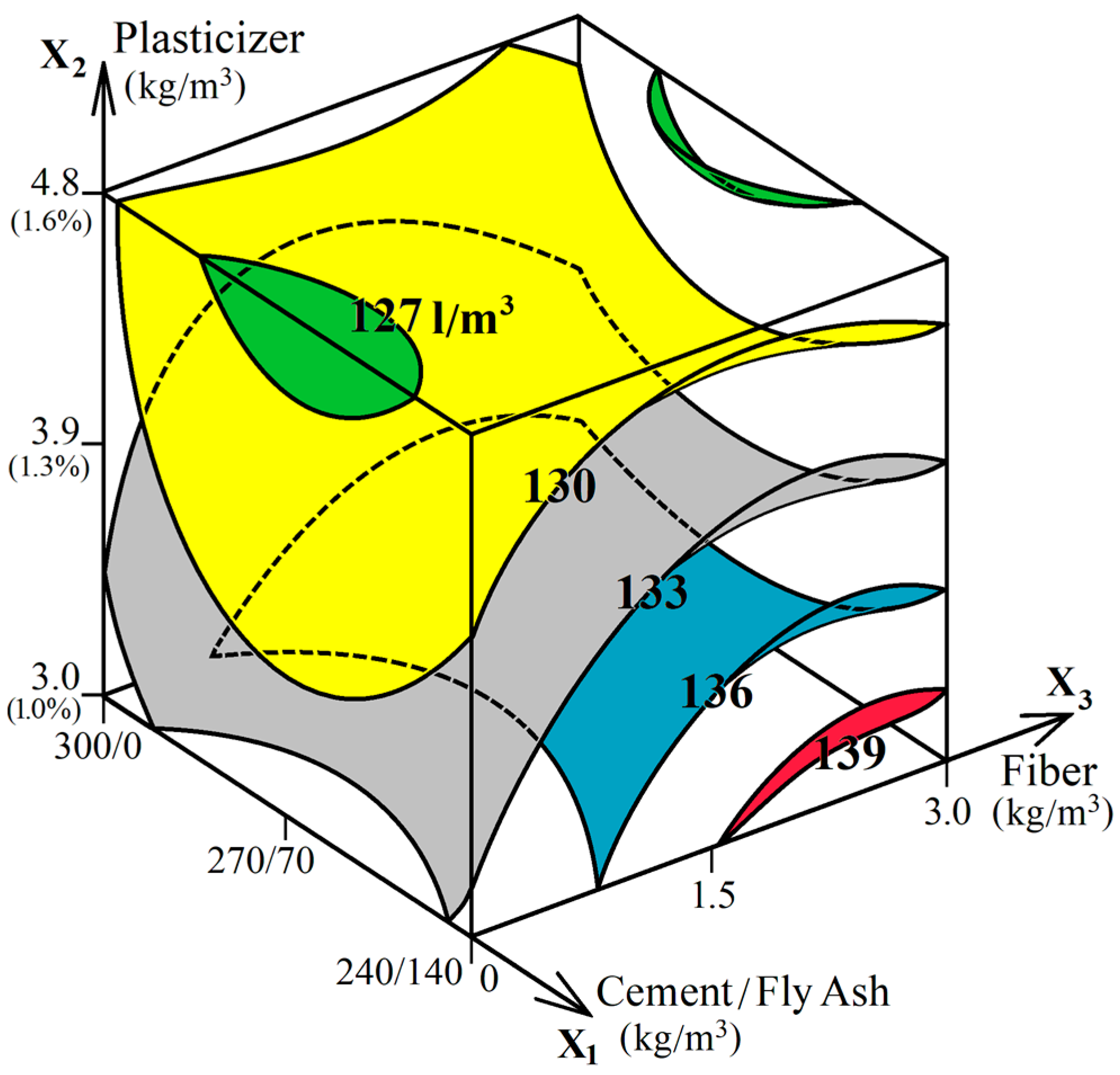
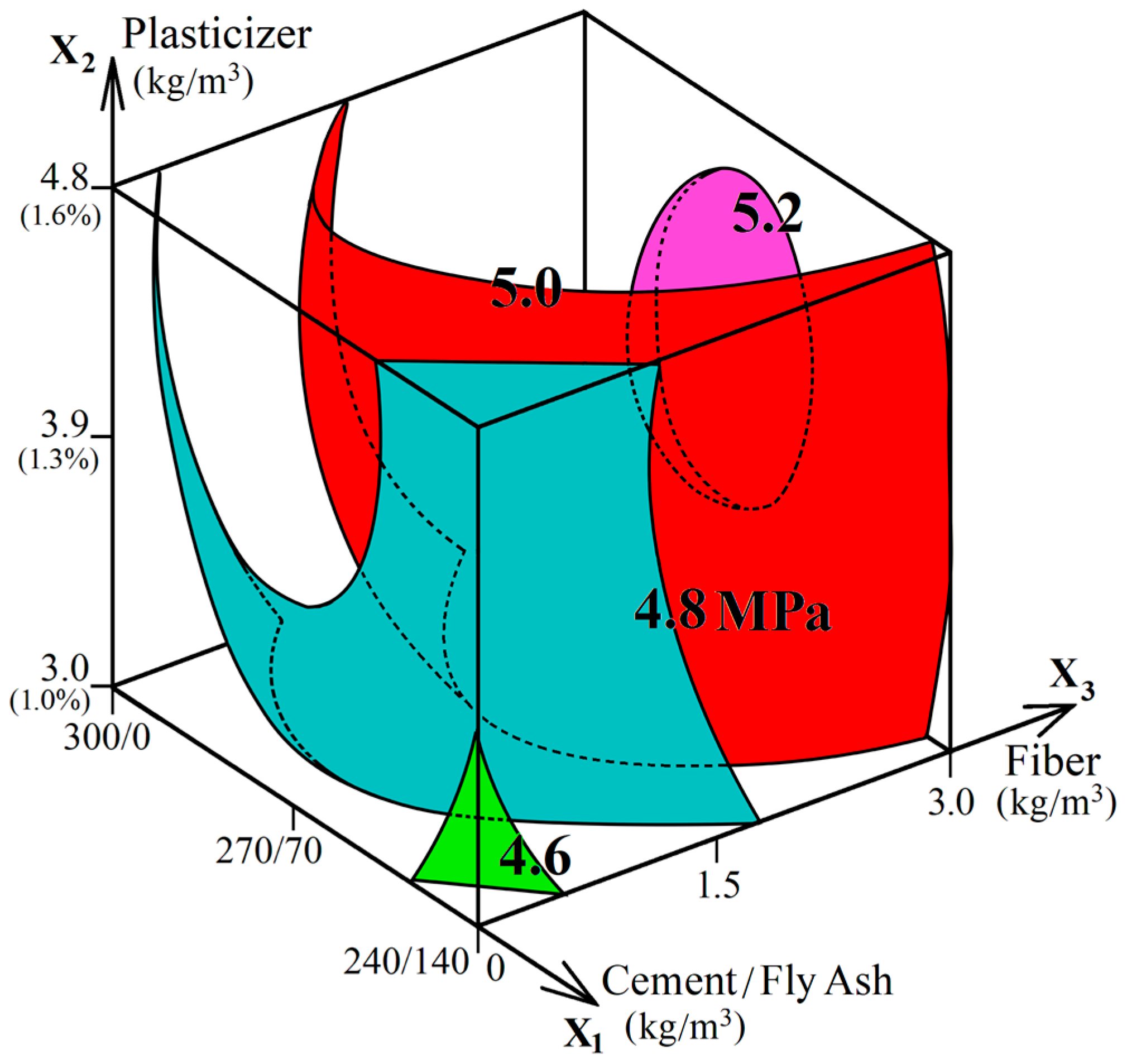
Based on the ES-model (3), a cube-type diagram (Figure 3) was constructed, demonstrating the influence of the varied composition factors on the water demand of concrete and fiber-reinforced concrete mixtures with equal workability.
Figure 3. Impact of composition factors on the water demand in concrete and fiber-reinforced concrete mixtures with equivalent workability based on RCA.
Analysis of the ES-model (3) and the diagram in Figure 3 shows that the amount of SP (factor x2) has the most significant influence on the water demand of concrete and fiber-reinforced concrete mixtures. Replacing 10% of cement (30 kg) with 70 kg of FA leads to a slight reduction in water demand. However, when the replacement level is increased to 20% (60 kg of cement with 140 kg of FA), no further reduction in water demand is observed, and its value does not differ from the reference mixture without FA. The influence of dispersed reinforcement on water demand depends on the SP dosage. At its maximum content, the introduction of PF does not have a substantial impact. In contrast, at the minimum SP amount (3 kg/m3), the addition of 3 kg/m3 of PF increases the water demand by approximately 5 L/m3. Increasing the SP content from 3 to 4.8 kg/m3 (from 1 to 1.6% of the cement mass in the reference composition) significantly reduces water demand: by 8–9 L/m3 for plain concrete and by 10–11 L/m3 for fiber-reinforced concrete with the maximum PF dosage. Thus, the efficiency of the SP in reducing water demand is higher in mixtures containing dispersed reinforcement.
For the control concrete mixtures with NA (Table 4), the water demand ranged from 121 to 122 L/m3. This value is predictably lower than that of concretes with RCA, which has a more porous structure. The partial replacement of cement with FA had a comparatively minor effect on the water demand of the mixture; however, the general trend of a slight reduction in water demand upon replacing 10% of cement with FA was still observed.

3.2. Compressive Strength

The data on the determined strength indicators at the 15 points of the experimental design (for concretes with RCA) and for the three control mixtures (Con1–Con3) are presented in Table 5. The compressive strength was determined with an uncertainty of ±0.2 MPa.
Table 5. Compressive strength of concrete and fiber-reinforced concrete at 3 and 28 days.
Based on the data from Table 5, adequate ES-models (4) and (5) were developed, reflecting the influence of the varied factors on the compressive strength of concrete and fiber-reinforced concrete with RCA at the ages of 3 and 28 days.
f c m . 3 ( M P a ) = 28.60   3.36 x 1   2.38 x 1 2 ±   0 x 1 x 2 +   0.27 x 1 x 3 +   0.69 x 2 ±   0 x 2 2 ±   0 x 2 x 3 +   0.31 x 3 ±   0 x 3 2
f c m ( M P a ) = 53.17   4.10 x 1   6.11 x 1 2 ±   0 x 1 x 2 +   1.62 x 1 x 3 +   1.58 x 2 ±   0 x 2 2 ±   0 x 2 x 3 +   0.75 x 3 +   1.41 x 3 2
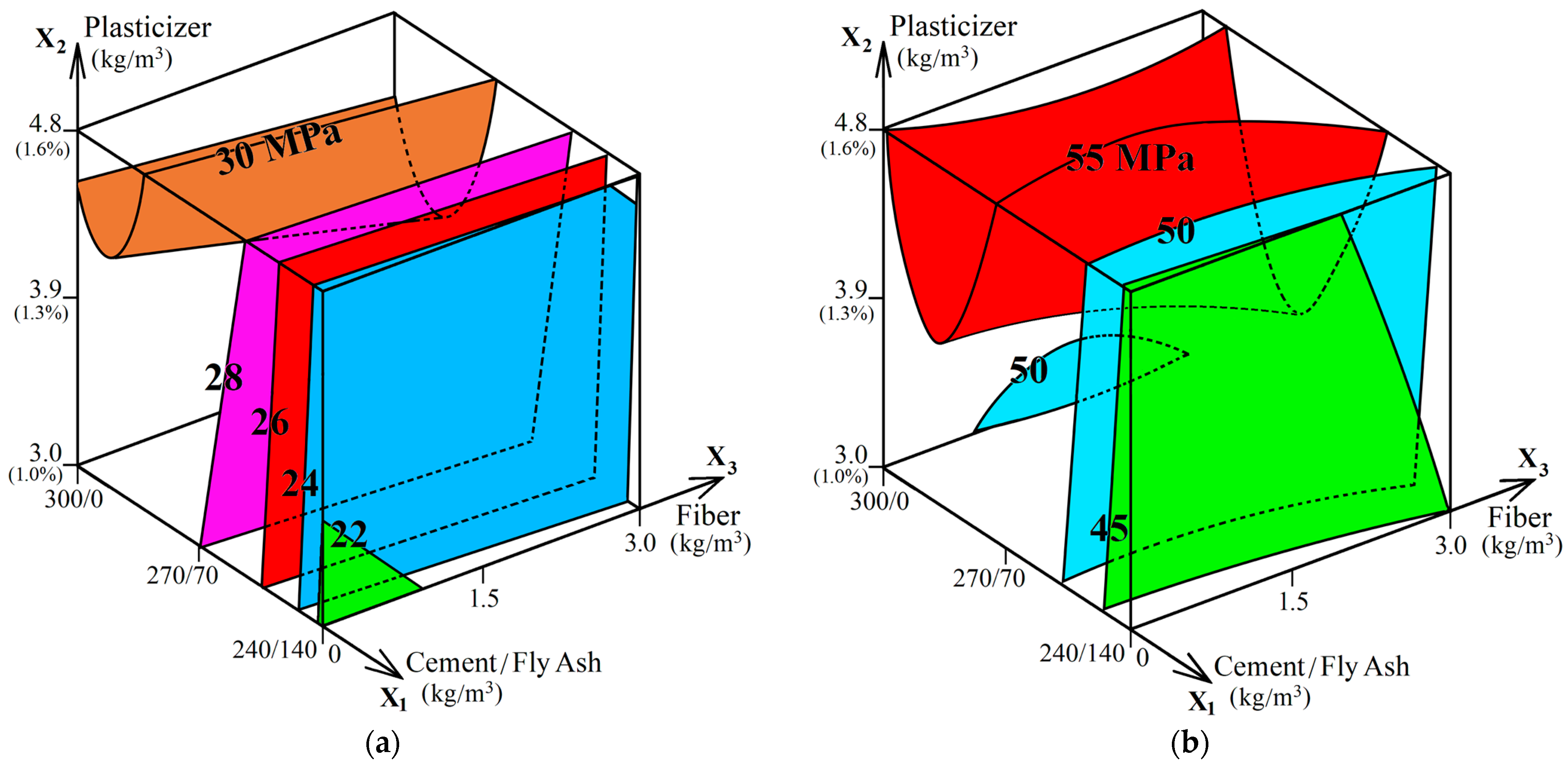
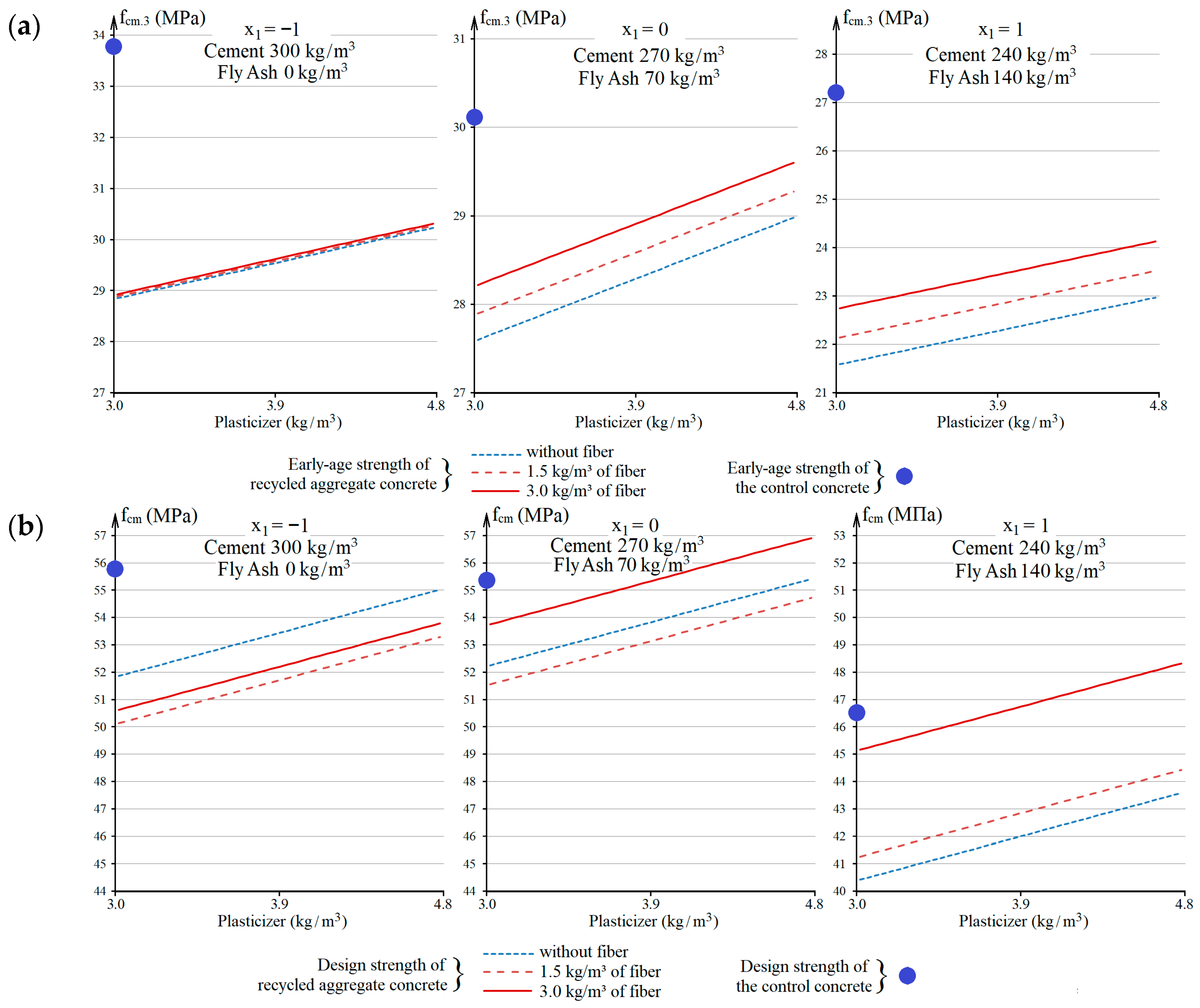
Figure 4a,b provide a graphical interpretation of these models, demonstrating the relationship between the varied mix factors and the strength characteristics of the investigated composites.
Figure 4. Influence of varied composition factors on the compressive strength of concrete and fiber-reinforced concrete based on RCA: at 3 days (a), at 28 days (b).
Analysis of the diagrams in Figure 4 and ES-models (4) and (5) indicates that replacing 10% of cement (30 kg/m3) with 70 kg/m3 of FA lowers early-age compressive strength by 1.0–1.5 MPa. In contrast, at the design age, the same replacement increases the concrete strength by 0.9–3.1 MPa. It should be noted that the efficiency of cement replacement with FA is higher when a greater amount of SP is used. The enhanced efficiency of this substitution at higher SP content is due to better dispersion of the FA particles, which ensures a more homogeneous structure and promotes long-term pozzolanic reactivity [67]. Replacing 20% of cement (60 kg/m3) with 140 kg/m3 of FA reduces the compressive strength of concrete by 6.0–6.5 MPa at an early age and by 5.5–11.0 MPa at the design age.
Notably, concretes with 6–8% cement replaced by FA demonstrate early-age compressive strength equivalent to that of the reference mixtures and exceed this value by 1.2–3.2 MPa at 28 days. This follows from the analysis of ES-models (4) and (5) after substituting the corresponding coordinates of variable x1. Although substitution of more than 9% of cement with FA reduces the strength development rate, FA content of up to 12–14% still allows the design compressive strength to match that of concretes without FA (i.e., with the maximum cement content).
Increasing the SP dosage from 3 to 4.8 kg/m3 linearly improved the concrete strength at all curing ages, with the most intensive growth observed at the design age. Within the factorial space of the experiment, an increase in the SP content raised the fcm.3 value by 1.4 MPa and the fcm value by 3.1 MPa. The slightly smaller strength gain at early ages may be attributed to the retardation of cement hydration caused by the plasticizing admixtures [68]. This difference is explained by the fact that the strength of the mature composite depends more heavily on the porosity of the cement–sand matrix, which, in turn, is determined by the W/C ratio.
Dispersed reinforcement does not have a substantial effect on the early-age compressive strength of concrete. At the design age, a slight strength increase of 0.7–2.2 MPa is observed when the maximum PF dosage is used. This result aligns with established principles: all fiber types, except for steel fiber, only marginally improve compressive strength, and their effectiveness increases in a stronger matrix due to enhanced bonding [69]. In our case, the cement–sand matrix naturally possessed higher strength at 28 days of curing than at 3 days, which explains the slight increase in fiber efficiency at the design age.
In addition to the concretes and fiber-reinforced concretes with RCA, three control mixtures with NA were investigated. Similarly, to the main series, 0–20% of the cement in these compositions was replaced by FA. The determined compressive strength values of the control concretes at the ages of 3 and 28 days are presented in Table 5.
Under the experimental conditions, the three control concrete mixtures with NA had compositions analogous to the concretes with RCA containing the minimum amount of SP and without PF (accounting for mix proportion corrections due to their lower water demand). Therefore, their strength can be compared to the strength of concretes with RCA having corresponding contents of cement and FA. Within the factorial space of the experiment, these correspond to the concretes with factor x1 fixed at levels −1, 0, and +1, respectively, while factors x2 and x3 are set at level −1.
The conducted analysis revealed that the control concretes with NA had a compressive strength 17% higher at 3 days and 10% higher at 28 days compared to concretes with RCA with an analogous FA and PF content (at x3 = −1, i.e., without fibers). This difference is expected, since NA possesses higher intrinsic strength compared to RCA.
However, as the results demonstrate, the application of optimal SP and PF dosages allows for a significant increase in the strength of concretes with RCA. Therefore, for an objective assessment of the effectiveness of these additives, it is advisable to compare the control mixtures with NA to concretes with RCA that contain a similar proportion of FA but different amounts of SP and PF. In other words, the strength of each control concrete (at a fixed level of x1) should be compared with all strength values of the main series at the corresponding level of cement replacement by FA, as visualized in Figure 5.
Figure 5. Comparison graph of compressive strength between control specimens (with NA) and the value range of the main series (with RCA) at an equal rate of cement substitution by FA: (a) 3 days, (b) 28 days.
As can be seen from the diagrams presented in Figure 5a, at the age of 3 days, the compressive strength of concrete and fiber-reinforced concrete with RCA is lower than that of the control concrete with NA, regardless of the amount of SP or PF, and for an equivalent rate of cement replacement by FA. Notably, with 10% cement substitution by FA (70 kg/m3), the difference between the fiber-reinforced concrete with the maximum modifiers content (4.8 kg/m3 SP, 3 kg/m3 PF) and the control concrete (3 kg/m3 SP, without PF) is only 0.5 MPa (<2%), demonstrating the effectiveness of mix composition optimization. After 28 days of curing (Figure 5b), the strength difference between the control concrete (NA) and the main composition (RCA) without FA is approximately 4 MPa. Increasing the SP dosage to 4.8 kg/m3 reduces this difference to 1 MPa, demonstrating the compensatory potential of SP.
With 10% cement replacement by FA (70 kg/m3), the compressive strength of concretes with RCA lagged behind the control by 1.5–4.0 MPa. However, the combination of maximum SP (4.8 kg/m3) and PF (3 kg/m3) dosages not only compensated for this difference but also provided a strength excess of 1.5 MPa. A similar effect was observed at 20% replacement: the compressive strength of the fiber-reinforced concrete with RCA and optimized composition surpassed the performance of the control specimen.
The higher quality of NA provides control concretes with a strength advantage at an equal content of binder and superplasticizer. However, this advantage is offset by synergistic use of an optimal PF dosage and increased SP content. Consequently, fiber-reinforced RCA concretes can achieve 28-day strength parity with NA-based controls. These results confirm the practical feasibility of effectively utilizing secondary resources in road concrete.

3.3. Flexural Strength

Table 6 presents the determined flexural strength values for the investigated concrete and fiber-reinforced concrete mixtures with RCA at the 15 points of the experimental design and for the three control concrete mixtures with NA. The flexural strength was determined with an uncertainty of ±0.05 MPa.
Table 6. Flexural strength of concrete and fiber-reinforced concrete.
Based on the data provided in Table 6, an adequate ES-model (6) was developed, reflecting the influence of the three varied factors on the flexural strength of the investigated concrete and fiber-reinforced concrete mixtures with RCA at the design age.
f c t k ( M P a ) = 5.092   0.056 x 1   0.168 x 1 2 ±   0 x 1 x 2 ±   0 x 1 x 3 +   0.048 x 2   0.058 x 2 2   0.036 x 2 x 3 +   0.191 x 3   0.063 x 3 2
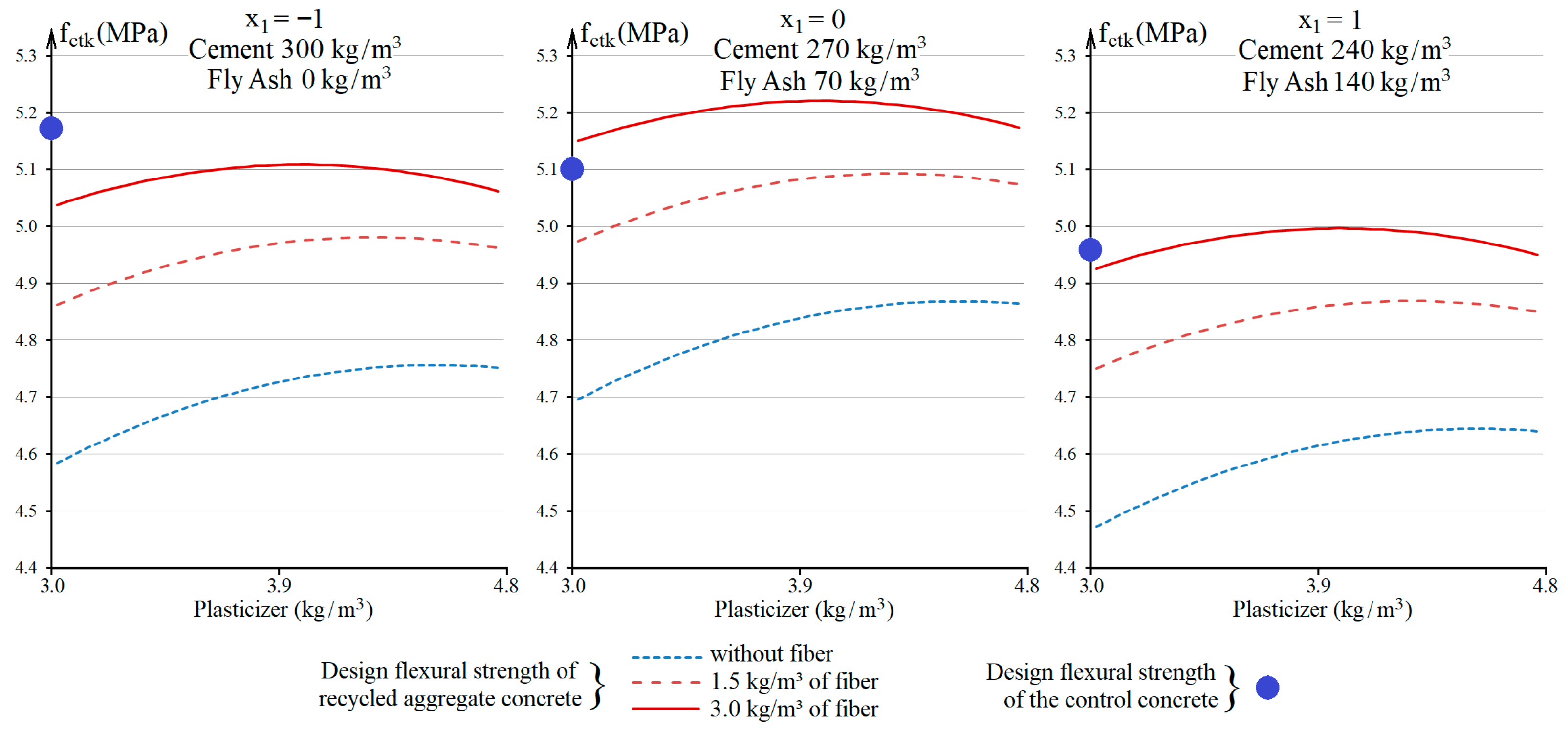
The response surface visualization, built based on the ES-model (6), illustrating the influence of composition factors on the flexural strength of concretes and fiber-reinforced concretes, is shown in Figure 6.
Figure 6. Influence of the varied composition factors on the flexural strength of concrete and fiber-reinforced concrete with RCA at 28 days.
Analysis of the ES-model (6) and the diagram reflected in Figure 6 suggests that the PF content (factor x3) has the greatest influence on the flexural strength. The observed effect is primarily due to the crack-bridging capability of the fibers. This mechanism enables the fibers to carry tensile forces across microcracks, thereby strengthening the composite structure under deformation.
Substituting 8–10% of cement (24–30 kg/m3) with a corresponding amount of FA (56–70 kg/m3) increases the flexural strength by 0.1–0.15 MPa. Although this gain is modest, it demonstrates that flexural strength at this replacement level is not compromised relative to concrete with maximum cement content. Further replacement of cement with FA (exceeding 10–12%, i.e., an increase in factor x1 closer to its maximum level) leads to a decrease in flexural strength. An increase in the SP content from 3 kg/m3 to 4–4.4 kg/m3 raises the flexural strength by 0.09–0.18 MPa. This effect is more pronounced in the region of the minima, specifically in the absence of dispersed reinforcement.
In general, the nature of the influence of factor x1 (replacement of a part of cement with FA) on the flexural strength is similar to its influence on the concrete compressive strength. Specifically, replacing 7–10% of the cement with a corresponding amount of FA leads to an increase in strength. This is associated with the pozzolanic reaction, which promotes the formation of additional strong bonds, and the matrix densification effect [70]. However, a further increase in the replacement ratio leads to a decrease in strength, which reaches a minimum at 20% cement substitution. This is primarily caused by the cement dilution effect: an excessive amount of FA reduces the content of cement available to form the primary hydrate structure, and the pozzolanic activity does not compensate for the loss of the primary binder [71].
Through dispersed reinforcement using the maximum amount of PF (3 kg/m3), the flexural strength of concrete with RCA increases by 0.4–0.45 MPa, or by 9–10%. In total, through the use of PF, partial replacement of cement with FA, and an increase in the SP content to 4–4.4 kg/m3, can enhance flexural strength by 0.6–0.65 MPa (13–14%).
Analogous to the compressive strength investigation, the study of flexural strength was carried out not only for concretes and fiber-reinforced concretes with RCA (the main series) but also for three control concrete mixtures with NA (Table 6).
Within the experimental design framework, the flexural strength of the control specimens can be compared with the strength of concretes with RCA having an equivalent content of cement and FA, i.e., at a fixed value of factor x1 (Figure 7). Analogous to Figure 5 and Figure 7 displays a comparison of the control concrete strength with the entire range of flexural strength values from the main experimental series at the corresponding fixed levels of factor x1 (levels: −1, 0, and +1).
Figure 7. Comparison graph of flexural strength between control specimens (NA) and the value range of the main series (RCA) at an equal rate of cement replacement by FA at 28 days.
Analysis of the diagrams in Figure 7 shows that the flexural strength of the control concretes is 8–11% higher than that of the concretes with RCA, including an equivalent content of FA and SP (when comparing the strength of concretes without fibers, i.e., at x3 = −1). Nevertheless, with the introduction of 3 kg/m3 of PF and an increase in SP dosage to 4–4.4 kg/m3, the flexural strength of fiber-reinforced concretes with RCA becomes practically equivalent (for mixtures without FA) or even slightly higher than that of the control concretes at an analogous rate of cement replacement by FA.
Hence, in terms of flexural strength, fiber-reinforced concretes with RCA, including those with partial cement replacement by FA, are not inferior to concretes with NA. The obtained results confirm the potential for effective application of such composites in rigid road and airfield pavement structures.

3.4. BI

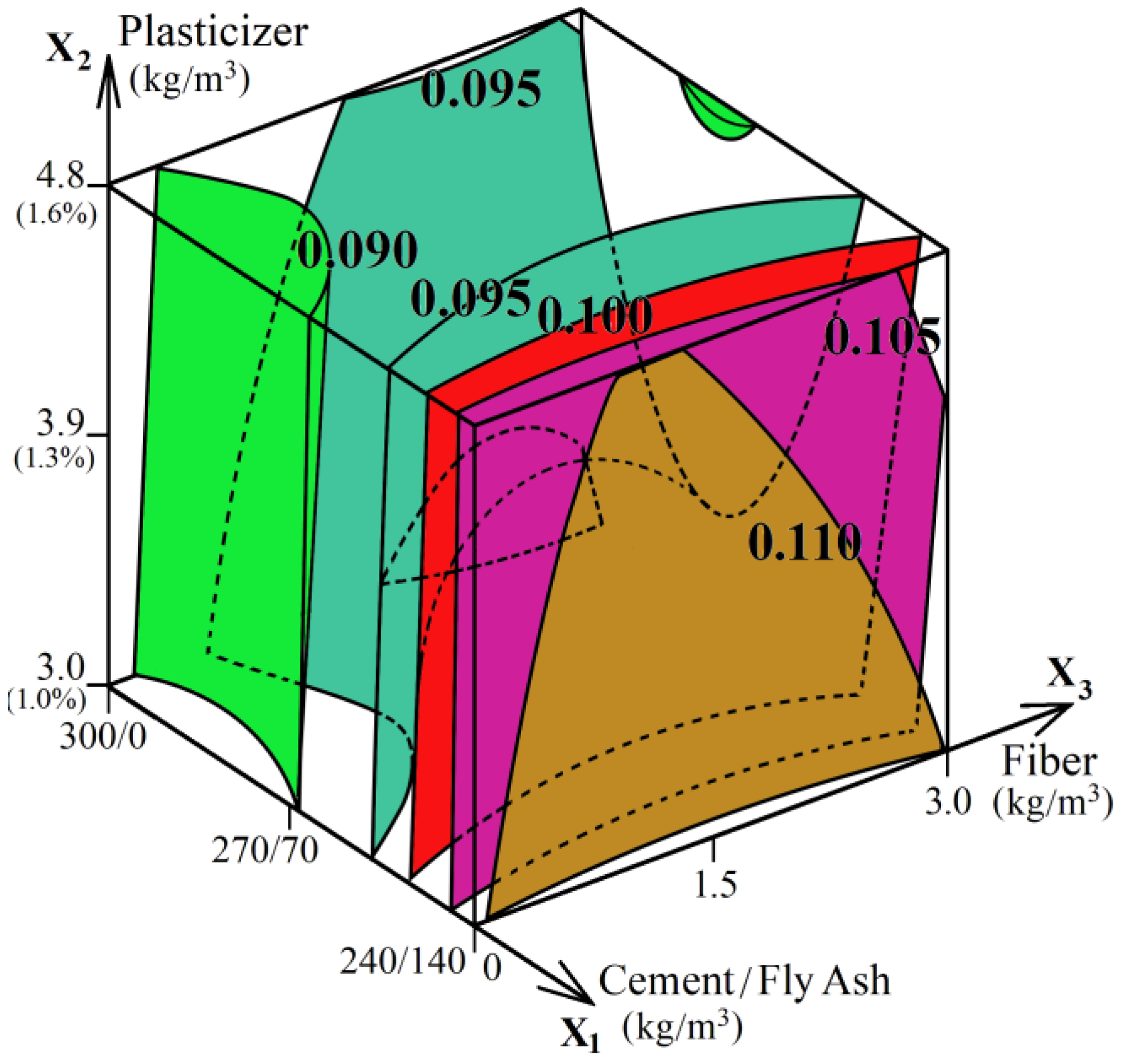
Based on the calculated BI values, defined as the fctk/fcm ratio for the modified concretes and fiber-reinforced concretes, an ES-model (7) was developed to describe the influence of the varied mixture factors on this parameter. The graphical interpretation of the response surface, constructed using ES-model (7), is shown in Figure 8.
B I = 0.0956   0.0074 x 1 +   0.0087 x 1 2 ±   0 x 1 x 2   0.0031 x 1 x 3   0.0021 x 2 ±   0 x 2 2   0.0014 x 2 x 3 +   0.0019 x 3   0.0042 x 3 2
Figure 8. Influence of the varied composition factors on the BI of concrete and fiber-reinforced concrete with RCA.
Experimental analysis of ES-model (7) and the diagram (Figure 8) shows that the maximum BI values (0.105–0.110) were observed in mixtures with maximum cement replacement by FA and a PF content ranging from 1.5 to 3 kg/m3, almost independently of the SP dosage. When using less than 1.5 kg/m3 of PF and simultaneously reducing the FA content (i.e., with up to 10% cement replacement by FA), the BI decreased to a level of 0.09–0.095. These results demonstrate that using an optimal combination of FA and PF is the key to enhancing the deformability and reducing the brittleness of concretes. Such optimization of road concrete compositions will prevent local stress concentrations through uniform dispersion of FA particles and PF throughout the composite volume, ensuring its high crack resistance.

3.5. AR

The determined AR values for the investigated concrete and fiber-reinforced concrete mixtures with RCA at the 15 points of the experimental design and for the three control concrete mixtures with NA are presented in Table 7. The AR for road concretes and fiber-reinforced concretes was determined with an uncertainty of ±0.01 g/cm2.
Table 7. AR of concrete and fiber-reinforced concrete.
Based on the data provided in Table 7, an ES-model (8) was developed, reflecting the influence of the three varied mixture factors on the AR of concrete and fiber-reinforced concrete with RCA.
A R ( g / c m 2 ) = 0.471 +   0.007 x 1 +   0.008 x 1 2 +   0.002 x 1 x 2 ±   0 x 1 x 3   0.005 x 2 +   0.004 x 2 2 +   0.0036 x 2 x 3   0.020 x 3 +   0.0073 x 3 2
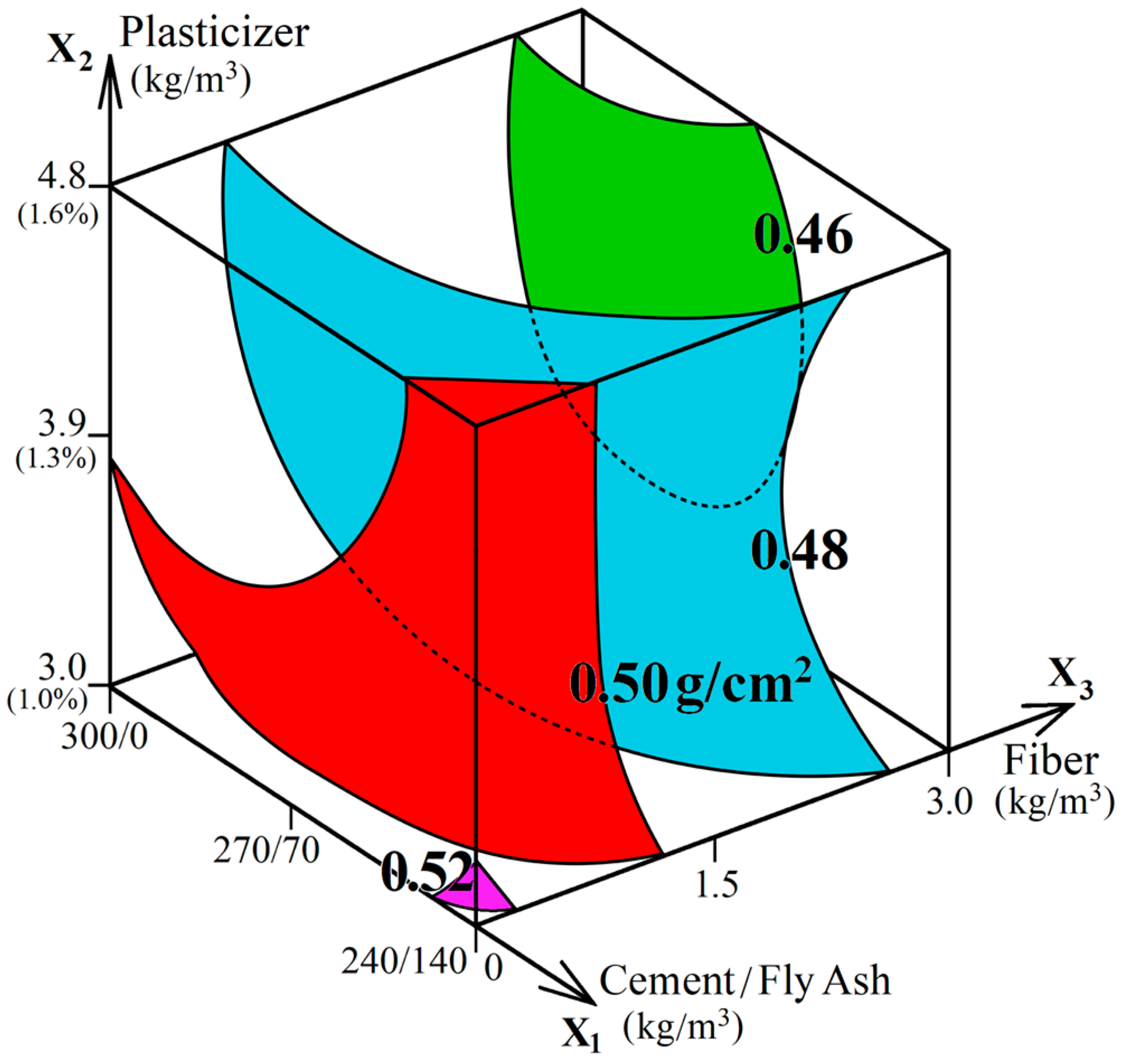
The response surface diagram, constructed based on ES-model (8) and presented in Figure 9, illustrates the influence of the investigated composition factors on the AR of concretes and fiber-reinforced concretes.
Figure 9. Influence of the varied composition factors on the AR of concrete and fiber-reinforced concrete with RCA.
Analysis of the ES-model (8) and the diagram in Figure 9 indicates that the PF content has the most significant influence on the AR of the investigated concretes and fiber-reinforced concretes with RCA. The application of PF at a dosage of 1.5 kg/m3 reduces AR by 0.03 g/cm2 (6–7%), while at the maximum dosage of 3 kg/m3, the reduction reaches 0.04 g/cm2 (8–9%).
An increase in the SP content from 3 to 4.4 kg/m3 leads to only a minor reduction in the AR of concretes and fiber-reinforced concretes. The replacement of up to 10–11% of cement with FA does not impair the material’s wear resistance: under these conditions, the AR does not exceed the value for concretes with the maximum cement content. A further increase in the cement substitution level to 20% results in a minimal increase in AR—by only 0.01 g/cm2 compared to concretes without substitution.
Provided that 1.4 kg/m3 of PF, the AR of fiber-reinforced concretes with RCA does not exceed 0.5 g/cm2, regardless of the SP content and the proportion of cement replaced by FA. Optimization of the composition (2.6–3 kg/m3 of PF, 3.4–4.8 kg/m3 of SP, and replacement of up to 11% of cement with FA) enables an even lower AR value—no more than 0.46 g/cm2. The obtained AR values of the investigated modified concretes (≤0.5 g/cm2) comply with the requirements of the standard [72], confirming their sufficient wear resistance for use in transportation structures and road pavements.
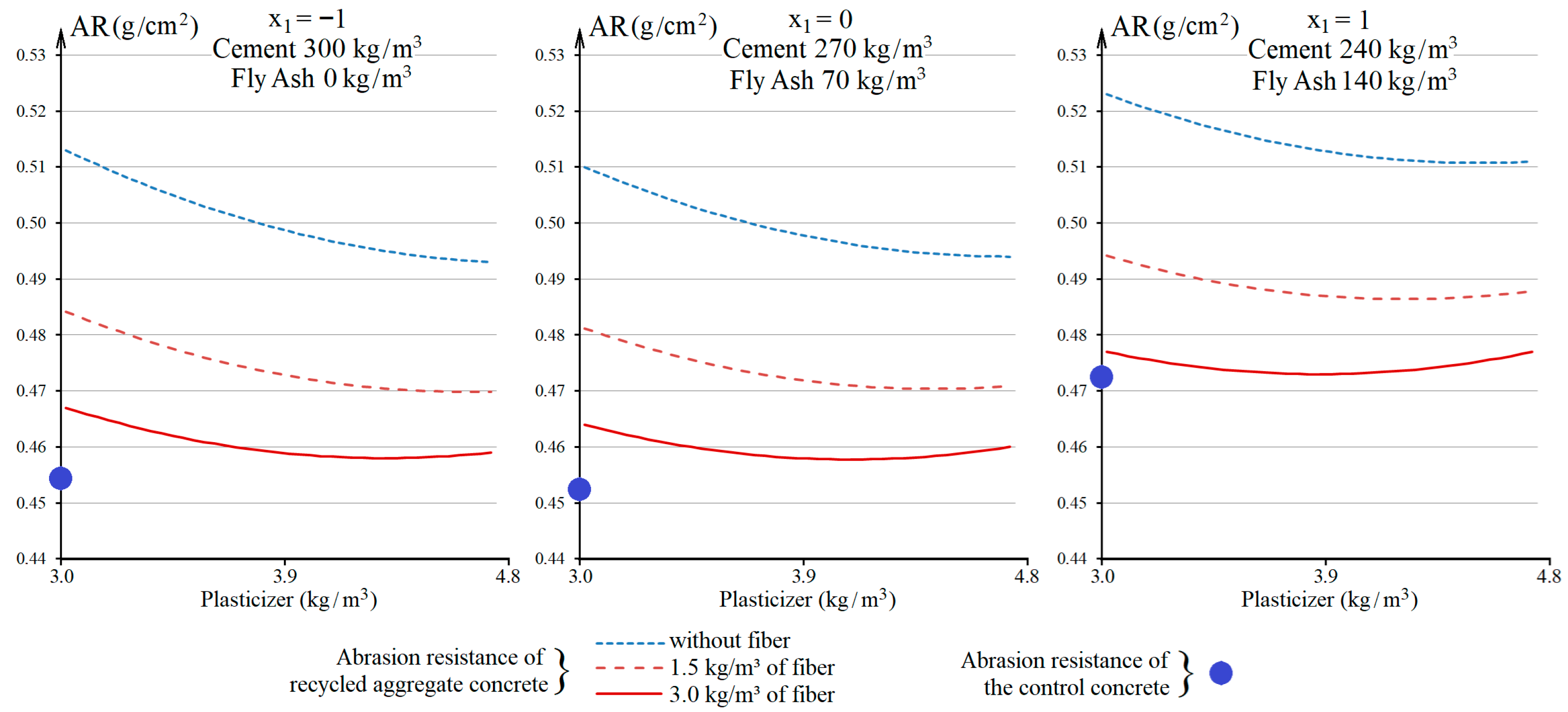
AR was also determined for the three NA control mixtures. Following a methodology consistent with Figure 5 and Figure 7, and 10 presents a comparison of the AR of control specimens with the full spectrum of values from the main series at fixed levels of factor x1 (−1, 0, and +1). Thus, the diagram graphically compares the AR indicators of the control concretes and the RCA-based concretes with equivalent cement and FA contents.
Analysis of the diagrams in Figure 10 shows that the AR of concretes with NA is predictably lower than that of concretes with RCA, given an equivalent content of FA and SP in their composition. The difference in the AR level between the control and the corresponding RCA mixtures ranges from 0.05 to 0.06 g/cm2. This indicates that concretes with the stronger NA possessed higher wear resistance. This suggests that the wear resistance of concrete as a composite material was influenced not only by the inherent strength of the RCA but also by the presence of cracks and other technological defects in the RCA structure that arose during the processing of the old concrete [73].
Figure 10. Comparison of the AR of control concretes with NA with the range of abrasion values for concretes from the main series at an equal rate of cement replacement by FA.
At a PF dosage of 1.5 kg/m3, the AR of RCA fiber-reinforced concrete exceeds that of the NA control by only 0.03 g/cm2. Importantly, at the maximum PF dosage (3 kg/m3), the AR of RCA-based concrete becomes practically equivalent to that of the NA control. Thus, dispersed fiber reinforcement enables RCA composites to achieve the AR level of natural aggregate concrete, given equal FA and SP content.
In summary, with optimized dosages of PF and SP, RCA-based fiber-reinforced concretes incorporating FA demonstrate sufficient AR for use in most transportation structures and rigid road pavements.

3.6. LCA

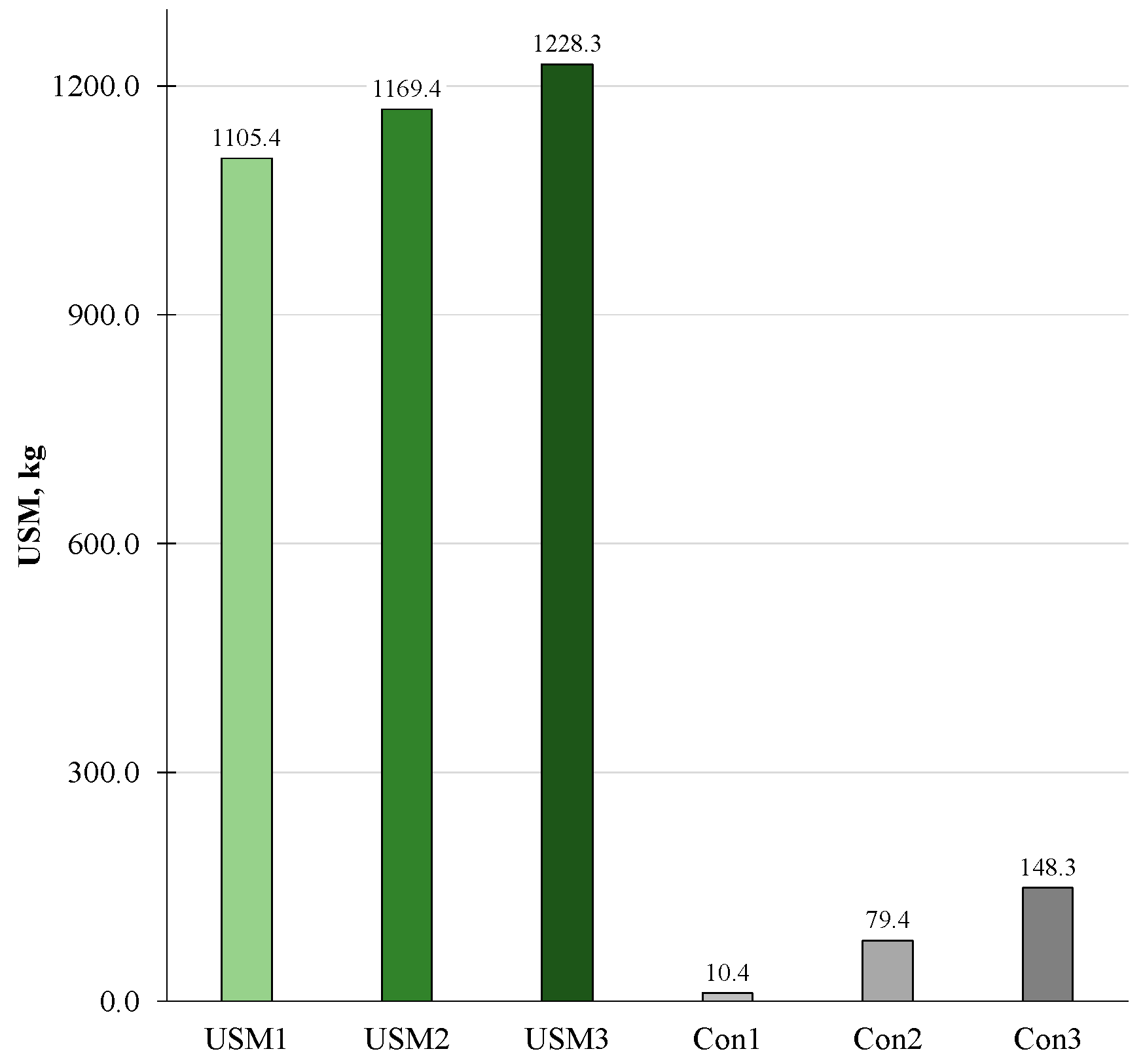
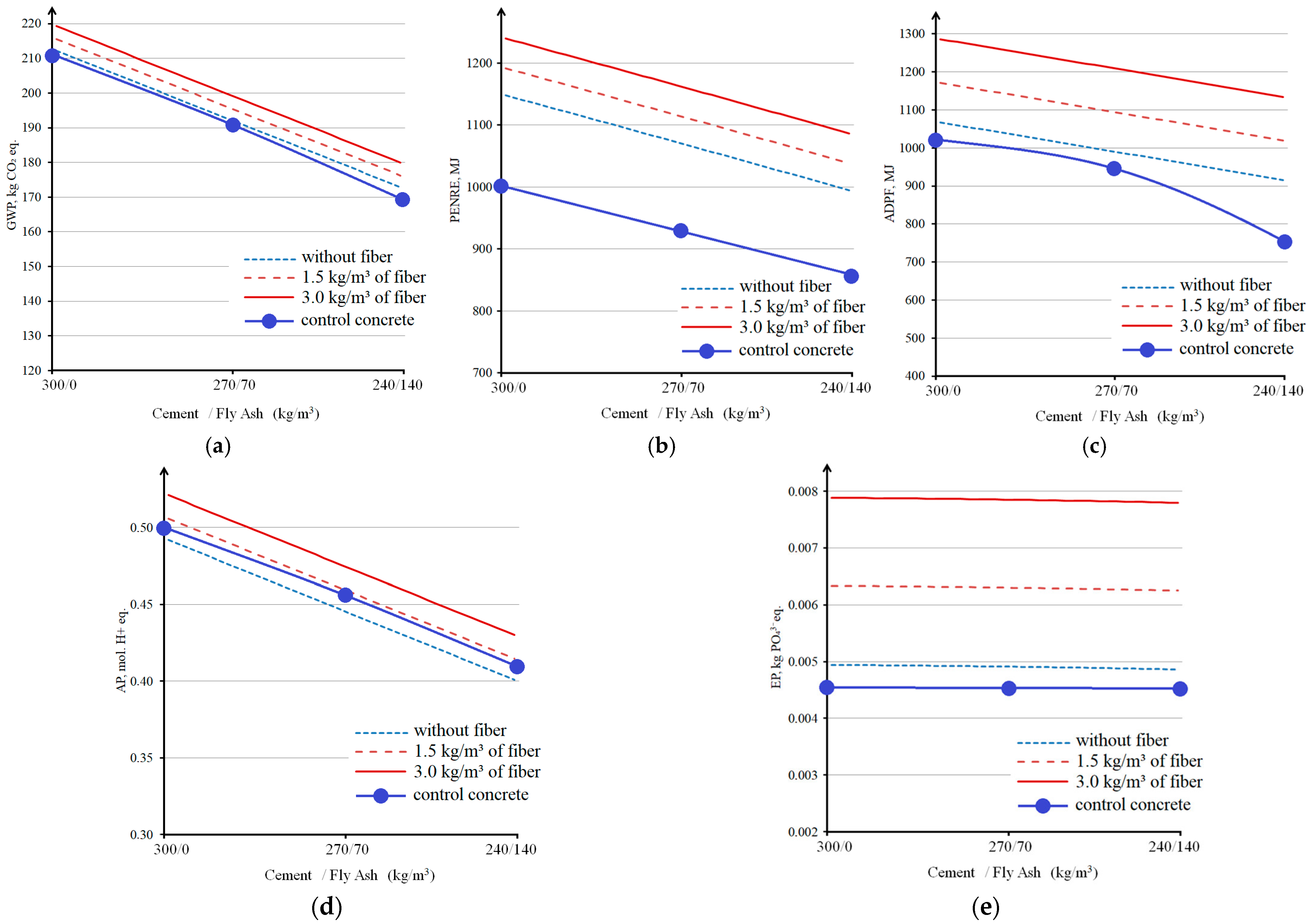
In the calculation and comparison of LCA data for the main batch of concretes and fiber-reinforced concretes using RCA, as well as for the control batch based on NA, factor x2 (SP content) was excluded from the calculation. This exclusion is justified by the fact that, based on a worst-case contribution analysis, the impact of SP remains minor and does not affect the comparative conclusions of the study. When recalculated per 1 m3 of concrete at the maximum dosage of SP (4.8 kg/m3), its contribution to the total environmental impacts was limited (1.1% for GWP, 5.6% for ADPF, 2.2% for EP, 1.2% for AP, and 3.7% for PENRE). In accordance with the goal and scope definition of the study, such contributions were considered insignificant compared to the other concrete mix components to influence the overall interpretation of the results, which is consistent with the applied cut-off criteria [61,63]. Figure 11 shows the corresponding LCA diagrams for concretes based on RCA and NA, constructed using the calculated experimental-statistical models, with the exception of the diagram for the use of secondary materials (Figure 12). This grouping was necessary because the proportion of secondary materials is determined by the origin and type of the main components (RCA, FA), which are used across several compositions simultaneously. Therefore, the 15 main experimental mixtures were grouped into 3 categories based on the dominant secondary component, with a single USM value obtained for each category (compositions No. 1–5—USM1, compositions No. 6–10—USM2, compositions No. 11–15—USM3).
Figure 11. LCA indicators at the A1–A3 stage for the investigated modified concretes based on RCA and NA: GWP (a), PENRE (b), ADPF (c), AP (d), EP (e).
Figure 12. Amount of secondary materials used for the main and control series of concrete mixtures.
The data in Figure 11 show a clear trend of decreasing GWP, PENRE, and ADPF indicators with an increasing proportion of FA (factor x1) used for cement replacement. A change in AP is also observed, but is more moderate, while the EP indicator shows low sensitivity to changes in factor x1. In contrast, dispersed reinforcement has the opposite effect on GWP, PENRE, and ADPF levels—a significant increase is observed with higher PF dosage, as polypropylene production is energy-intensive and relies on non-renewable resources. AP and EP values also increase, reflecting the emissions of acidifying and eutrophying compounds generated during polymer production. The findings detailed in Section 3.2, Section 3.3, Section 3.4 and Section 3.5. indicate that an optimized dosage of PF facilitates greater substitution of cement with FA without compromising the target compressive strength, flexural strength, or AR. Crucially, PF incorporation enables RCA-based concrete to attain mechanical and durability performance equivalent to control mixtures with NA. Thus, the strategic use of PF in pavement concrete represents a dual-purpose approach: it serves as a key technical enabler for high-volume secondary material utilization while concurrently improving the environmental sustainability of the composite. The use of RCA leads to a moderate increase in all indicators (GWP, PENRE, ADPF, AP, and EP) compared to concrete with NA. However, this contribution is notably smaller than the influence of PF and significantly smaller than that of the cement component. Conversely, compositions with RCA and the maximum FA content facilitate the highest USM value (Figure 12) for manufacturing concretes and fiber-reinforced concretes for rigid pavement applications. The observed environmental impact trends are consistent with the effects of recycled materials and additives on the environmental performance of concrete in life-cycle assessment studies [74,75].

4. Conclusions

A comprehensive analysis of modified fiber-reinforced concretes with recycled aggregate allowed for a comparative assessment of their technological, mechanical, and environmental performance relative to conventional natural-aggregate concrete. The methods of experimental design and experimental-statistical modeling provided the means to efficiently evaluate the combined effect of variable concrete composition factors. The key findings are as follows:
-
The application of recycled concrete aggregate with a higher fiber dosage increases water demand. Replacing 30 kg of cement with 70 kg of fly ash and adjusting the superplasticizer dosage to 4–4.8 kg/m3 normalizes water demand to the level of natural aggregate control mixtures.
-
To achieve a target flexural strength of 5 MPa in recycled aggregate concrete, a minimum of 2 kg/m3 of polypropylene fiber and 4 kg/m3 of superplasticizer is required. This composition allows for a 10–12% reduction in cement content while producing C32/40 class concrete with mechanical properties comparable to those of conventional concrete.
-
Durability and service life of pavements are enhanced through the low abrasion and high crack resistance of the mixtures. The required abrasion resistance of ≤0.5 g/cm2 can be obtained using 1.2–1.4 kg/m3 of fiber and 3.2–3.5 kg/m3 of superplasticizer. This combination permits an additional 8–10% cement replacement by fly ash while maintaining a brittleness index (0.095–0.100) comparable to granite-based concrete.
-
Life-cycle assessment identifies increased fly ash substitution as the primary driver for reducing environmental impact, while the mechanical advantages of fiber reinforcement incur an environmental trade-off. Recycled aggregate shows a lower impact than natural aggregate, supporting circular economy goals. These factors are crucial for designing sustainable concrete for transport infrastructure.
Further research will focus on investigating the influence of varied mixture factors on the frost and corrosion resistance of concretes. This approach will enable the simulation of real operating conditions for transportation concretes, allowing for more comprehensive characterization of the durability of the developed composites. An additional prospective task involves the optimization of the developed road concrete mixtures to achieve an optimal balance between environmental footprint, mechanical properties, and long-term durability.

Author Contributions

Conceptualization, V.K. and S.K.; methodology, S.K., V.K. and P.S.; formal analysis, S.K. and I.A.; investigation, P.S. and I.A.; resources, V.K. and P.S.; data curation, P.S. and S.K.; writing—original draft preparation, S.K. and V.K.; writing—review and editing. S.K., P.S. and I.A.; visualization. S.K. and P.S.; supervision. S.K. and V.K.; project administration. P.S. and S.K.; funding acquisition, V.K. All authors have read and agreed to the published version of the manuscript.

Funding

This research received no external funding.

Institutional Review Board Statement

Not applicable.

Data Availability Statement

The original contributions presented in this study are included in the article. Further inquiries can be directed to the corresponding author.

Conflicts of Interest

The authors declare no conflict of interest.

References

  1. Spyridis, P.; Synofczik, L.; Mellios, N.; Mikulic, Z.; Skocek, J.; Bergmeister, K. Multi-Criteria Assessment of Anchors in Sustainable Concrete with Blended Cements and Recycled Aggregates. Case Stud. Constr. Mater. 2025, 23, e05463. [Google Scholar] [CrossRef]
  2. Skocek, J.; Ouzia, A.; Vargas Serrano, E.; Pato, N. Recycled Sand and Aggregates for Structural Concrete: Toward the Industrial Production of High-Quality Recycled Materials with Low Water Absorption. Sustainability 2024, 16, 814. [Google Scholar] [CrossRef]
  3. Dvorkin, L.; Bordiuzhenko, O.; Mierzwiński, D.; Tracz, T.; Sitarz, M. Water Impermeability of Self-Compacting Fly-Ash-Containing Concrete. Appl. Sci. 2024, 14, 5373. [Google Scholar] [CrossRef]
  4. Sanytsky, M.; Kropyvnytska, T.; Ivashchyshyn, H. Sustainable Modified Pozzolanic Supplementary Cementitious Materials Based on Natural Zeolite, Fly Ash and Silica fume. IOP Conf. Ser. Earth Environ. Sci. 2023, 1254, 012004. [Google Scholar] [CrossRef]
  5. Kroviakov, S.; Kryzhanovskyi, V.; Hedulian, D. Comparison of the Corrosion Resistance of Fiber-Reinforced Concrete with Steel and Polypropylene Fibers in an Acidic Environment. Constr. Mater. 2025, 5, 6. [Google Scholar] [CrossRef]
  6. Kos, Z.; Kroviakov, S.; Kryzhanovskyi, V.; Crnoja, A. Influence of Fibres and Hardening Accelerator on Concrete for Rigid Pavements. Mag. Concr. Res. 2023, 75, 865–873. [Google Scholar] [CrossRef]
  7. Khan, M.; Ali, M. Effectiveness of Hair and Wave Polypropylene Fibers for Concrete Roads. Constr. Build. Mater. 2018, 166, 581–591. [Google Scholar] [CrossRef]
  8. Kessal, O.; Achour, Y.; Noui, A.; Belkadi, A.A.; Benouadah, A.; Belagraa, L.; Benammar, A. Bio-Fiber Reinforced Roller Compacted Concrete Designed for Road Construction: Feasibility of Date Palm Fibers in Pavements. Eur. J. Environ. Civ. Eng. 2022, 27, 1224–1246. [Google Scholar] [CrossRef]
  9. Solikin, M.; Izutholibin, G.A.A.; Handayani, N.K.; Nurchasanah, Y. Analysis of the Use of Fly Ash Variations as a Partial Cement Substitute for Roller Compacted Concrete (RCC) Mixtures. Eng. Proc. 2025, 84, 38. [Google Scholar] [CrossRef]
  10. Ahirwar, E.A.K.; Joshi, R.; Soni, E.K. Laboratory Analysis of Fly Ash Mix Cement Concrete for Rigid Pavement. Int. J. Eng. Res. Appl. 2015, 5, 86–91. [Google Scholar]
  11. Kalyan, V.V.; Chandra, P.S.; Ibrahim, M. Study and Analysis of Rigid Pavements Using Fly Ash. Int. J. Innov. Res. Sci. Eng. Technol. 2018, 7, 1371–1379. [Google Scholar]
  12. Nassar, R.U.D.; Soroushian, P.; Ghebrab, T. Field Investigation of High-Volume Fly Ash Pavement Concrete. Resour. Conserv. Recycl. 2013, 73, 78–85. [Google Scholar] [CrossRef]
  13. Ondova, M.; Stevulova, N.; Meciarova, L. The Potential of Higher Share of Fly Ash as Cement Replacement in the Concrete Pavement. Procedia Eng. 2013, 65, 45–50. [Google Scholar] [CrossRef]
  14. Khan, A.; Khan, M.; Ali, M.; Khan, M.; Khan, A.U.; Shakeel, M.; Fawad, M.; Najeh, T.; Gamil, Y. Predictive Modeling for Depth of Wear of Concrete Modified with Fly Ash: A Comparative Analysis of Genetic Programming-Based Algorithms. Case Stud. Constr. Mater. 2024, 20, e02744. [Google Scholar] [CrossRef]
  15. Siddique, R. Wear Resistance of High-Volume Fly Ash Concrete. Leonardo J. Sci. 2010, 17, 21–36. [Google Scholar]
  16. European Cement Association. Available online: https://www.cembureau.eu/policy-focus/sustainable-construction/circularity-construction (accessed on 1 November 2025).
  17. United Nations. Department of Economic and Social Affairs. Available online: https://sdgs.un.org/2030agenda (accessed on 1 November 2025).
  18. Dokic, O.; Radevic, A.; Zakic, D.; Dokic, B. Potential of Natural and Recycled Concrete Aggregate Mixtures for Use in Pavement Structures. Minerals 2020, 10, 744. [Google Scholar] [CrossRef]
  19. Strieder, H.L.; Dutra, V.F.P.; Graeff, A.G.; Núñez, W.P.; Merten, F.R.M. Performance Evaluation of Pervious Concrete Pavements with Recycled Concrete Aggregate. Constr. Build. Mater. 2022, 315, 125384. [Google Scholar] [CrossRef]
  20. Zhang, Y.; Gao, L.; Bian, W. Mechanical Performance of Concrete Made with Recycled Aggregates from Concrete Pavements. Adv. Mater. Sci. Eng. 2020, 2020, 5035763. [Google Scholar] [CrossRef]
  21. Smith, J.T.; Tighe, S.L.; Norris, J.; Kim, E.; Xu, X. Coarse Recycled Aggregate Concrete Pavements—Design, Instrumentation, and Performance. In Proceedings of the TAC/ATC 2008. Annual Conference and Exhibition of the Transportation Association of Canada: Transportation—A Key to a Sustainable Future, Toronto, ON, Canada, 21–24 September 2008. [Google Scholar]
  22. Lu, C.; Yu, Q.; Wei, J.; Niu, Y.; Zhang, Y.; Lin, C.; Chen, P.; Shi, C.; Yang, P. Influence of Interface Transition Zones (ITZ) and Pore Structure on the Compressive Strength of Recycled Aggregate Concrete. Constr. Build. Mater. 2024, 456, 139299. [Google Scholar] [CrossRef]
  23. Ji, H.; Yang, X.; Luo, Z.; Bai, F. Tensile Fracture Property of Concrete Affected by Interfacial Transition Zone. Int. J. Concr. Struct. Mater. 2023, 17, 2. [Google Scholar] [CrossRef]
  24. Mark, B.S. Concrete Pavement Recycling and the Use of Recycled Concrete Aggregate in Concrete Mixtures Concrete Pavement Recycling Series 2018; Federal Highway Administration: Washington, DC, USA, 2022; 10p. [Google Scholar]
  25. Wang, J.; Zhang, J.; Cao, D. Pore Characteristics of Recycled Aggregate Concrete and its Relationship with Durability under Complex Environmental Factors. Constr. Build. Mater. 2021, 272, 121642. [Google Scholar] [CrossRef]
  26. DIN EN 13242:2002+A1:2007; Aggregates for Unbound and Hydraulically Bound Materials for Use in Civil Engineering Work and Road Construction. Deutsches Institut für Normung: Berlin, Germany, 2008.
  27. DIN EN 206-1:2024; Concrete—Specification, Performance, Production and Conformity—Part 1. Performance, Requirements, Factory Production Control and Assessment Criteria for Individual Values. Deutsches Institut für Normung: Berlin, Germany, 2024.
  28. ASTM C33/C33M-24; Standard Specification for Concrete Aggregates. ASTM International: West Conshohocken, PA, USA, 2024.
  29. Martín-Morales, M.; Zamorano, M.; Valverde-Palacios, I.; Cuenca-Moyano, G.M.; Sánchez-Roldán, Z. 11-Quality Control of Recycled Aggregates (RAs) from Construction and Demolition Waste (CDW). In Handbook of Recycled Concrete and Demolition Waste; Woodhead Publishing Series in Civil and Structural Engineering; Woodhead Publishing: Cambridge, UK, 2013; pp. 270–303. [Google Scholar] [CrossRef]
  30. Chystiakov, A.; Kroviakov, S.; Bershadskyi, A.; Medveď, I.; Slaný, M. Sustainable Effect of Using Recycled Aggregates for Road Concrete Production. In Sustainability in Energy and Buildings. Smart Innovation, Systems and Technologies; Littlewood, J.R., Howlett, R.J., Jain, L.C., Eds.; Springer: Singapore, 2024; Volume 113, pp. 177–188. [Google Scholar] [CrossRef]
  31. Htet, P.; Chen, W.; Hao, H.; Li, Z.; Skaikh, F. Hybrid Fibre Reinforced Recycled Aggregate Concrete: Dynamic Mechanical Properties and Durability. Constr. Build. Mater. 2024, 415, 135044. [Google Scholar] [CrossRef]
  32. Li, P.; Liu, Z.; Lin, C.; Li, S.; Lu, Y. Biaxial Behavior of Steel Fiber–Reinforced Recycled-Aggregate Concrete Subjected to Dynamic Compression. J. Mater. Civ. Eng. 2024, 36, 04024390. [Google Scholar] [CrossRef]
  33. Lange, D.; Salas, A.; Roesler, J. Batching Effects on Properties of Recycled Concrete Aggregates for Airfield Rigid Pavements. In Proceedings of the 2010 FAA Worldwide Airport Technology Transfer Conference, Atlantic City, NJ, USA, 20–22 April 2010. [Google Scholar]
  34. Novak, J.; Kohoutková, A.; Chylik, R.; Trtík, T. Study on Pervious Recycled Aggregate Fiber-Reinforced Concrete for Airfield Pavement. IOP Conf. Ser. Mater. Sci. Eng. 2020, 770, 012040. [Google Scholar] [CrossRef]
  35. Liu, G.; Toši’c, N.; de la Fuente, A. Recycling of Macro-Synthetic Fiber-Reinforced Concrete and Properties of New Concretes with Recycled Aggregate and Recovered Fibers. Appl. Sci. 2023, 13, 2029. [Google Scholar] [CrossRef]
  36. Ayoob, A.H.M.; Khan, A. Performance Evaluation of Polypropylene Fiber Reinforced Concrete Made with RHA for Rigid Pavement. Int. J. Trend Sci. Res. Dev. 2025, 9, 679–682. [Google Scholar]
  37. Xie, J.; Kou, S.C.; Ma, H.; Long, W.J.; Wang, Y.; Ye, T.H. Advances on Properties of Fiber Reinforced Recycled Aggregate Concrete: Experiments and Models. Constr. Build. Mater. 2021, 277, 122345. [Google Scholar] [CrossRef]
  38. DIN EN 197-1:2011; Cement—Part 1: Composition. Specifications and Conformity Criteria for Common Cements. Deutsches Institut für Normung: Berlin, Germany, 2011.
  39. DIN EN 12620:2008-07; Aggregates for Concrete. Deutsches Institut für Normung: Berlin, Germany, 2008.
  40. DSTU B V.2.7-75-98; Building Materials. Dense Natural Crushed Stone and Gravel for Construction Materials, Products, Structures and Works. Specifications. Derzhavni Standarty Ukrainy: Kyiv, Ukraine, 1998. Available online: https://online.budstandart.com/ua/catalog/doc-page.html?id_doc=4674 (accessed on 14 November 2025).
  41. DIN EN 14889-2:2006; Fibres for Concrete—Part 2: Polymer Fibres–Definitions. Specifications and Conformity. Deutsches Institut für Normung: Berlin, Germany, 2006.
  42. DIN EN 934-2:2012; Admixtures for Concrete. Mortar and Grout Concrete Admixtures. Definitions. Requirements. Conformity. Marking and Labelling. Deutsches Institut für Normung: Berlin, Germany, 2012.
  43. DIN EN 1008:2002; Mixing Water for Concrete—Specification for Sampling, Testing and Assessing the Suitability of Water, Including Water Recovered from Processes in the Concrete Industry, as Mixing Water for Concrete. Deutsches Institut für Normung: Berlin, Germany, 2002.
  44. ASTM C 618-22; Standard Specifiation for Coal Fly Ash and Raw or Calcined Natural Pozzolan for Use in Concrete. ASTM International: West Conshohocken, PA, USA, 2022.
  45. DIN EN 1097-6:2022; Tests for Mechanical and Physical Properties of Aggregates—Part 6: Determination of Particle Density and Water Absorption. Deutsches Institut für Normung: Berlin, Germany, 2022.
  46. DSTU B V.2.7-71-98; Crushed Stone and Gravel from Dense Rocks and Industrial Waste for Construction Works. Methods of Physical and Mechanical Testing. Derzhavni Standarty Ukrainy: Kyiv, Ukraine, 1998. Available online: https://online.budstandart.com/ua/catalog/doc-page.html?id_doc=6621 (accessed on 14 November 2025).
  47. Lyashenko, T.V.; Voznesenskiy, V.A. Composition-Process Fields Methodology in Computational Building Materials Science; Astroprint: Hartford, CT, USA, 2017; 168p. [Google Scholar]
  48. Dvorkin, L.; Dvorkin, O.; Ribakov, Y. Mathematical Experiment Planning in Concrete Technology; Nova Science Publishers: Hauppauge, NY, USA, 2012; 172p. [Google Scholar]
  49. Jeff Wu, C.F.; Hamada, M.S. Experiments: Planning, Analysis, and Optimization, 3rd ed.; Wiley & Sons: Hoboken, NJ, USA, 2021; 736p. [Google Scholar]
  50. Dvorkin, L.; Dvorkin, O.; Ribakov, Y. Construction Materials Based on Industrial Waste Products; Nova Publisher: New York, NY, USA, 2015; 252p, ISBN 978-1-63483-486-5. [Google Scholar]
  51. Kroviakov, S.; Shymchenko, P. The Effect of Partial Replacement of Cement with Fly Ash on the Strength of Concrete for Transportation Structures and Road Pavements. Mod. Constr. Archit. 2024, 10, 82–88. [Google Scholar] [CrossRef]
  52. Kos, Ž.; Kroviakov, S.; Kryzhanovskyi, V.; Hedulian, D. Strength, Frost Resistance, and Resistance to Acid Attacks on Fiber-Reinforced Concrete for Industrial Floors and Road Pavements with Steel and Polypropylene Fibers. Materials 2022, 15, 8339. [Google Scholar] [CrossRef]
  53. DIN EN 12350-2:2019; Testing Fresh Concrete. Slump Test. Deutsches Institut für Normung: Berlin, Germany, 2019.
  54. Jiang, S.; Wang, Y.; Wang, X.; Liu, Z.; Liu, Q.; Li, C.; Li, P. Numerical Analysis on the Structure Design of Precast Cement Concrete Pavement Slabs. Coatings 2022, 12, 1051. [Google Scholar] [CrossRef]
  55. DIN EN 12390-3:2019; Testing Hardened Concrete. Compressive Strength of Test Specimens. Deutsches Institut für Normung: Berlin, Germany, 2019.
  56. DIN EN 12390-5:2019; Testing Hardened Concrete. Flexural Strength of Test Specimens. Deutsches Institut für Normung: Berlin, Germany, 2019.
  57. DIN EN 12390-2:2019; Testing Hardened Concrete. Making and Curing Specimens for Strength Tests. Deutsches Institut für Normung: Berlin, Germany, 2019.
  58. Geng, K.; Chai, J.; Qin, Y.; Li, X.; Duan, M.; Liang, D. Exploring the Brittleness and Fractal Characteristics of Basalt Fiber Reinforced Concrete under Impact Load based on the Principle of Energy Dissipation. Mater. Struct. 2022, 55, 78. [Google Scholar] [CrossRef]
  59. Tolmachov, S.; Belichenko, O.; Moskalenko, O.; Doroshenko, N.; Pokusa, Y. Study of the Influence of Modern Superplastificators on the Properties of Road Cement Concrete. Bull. Kharkov Natl. Automob. Highw. Univ. 2021, 2, 74–79. [Google Scholar] [CrossRef]
  60. DSTU B V.2.7-212:2009; Building Materials. Concrete. Methods for Determining Abrasion Resistance. Derzhavni Standarty Ukrainy: Kyiv, Ukraine, 2009. Available online: http://online.budstandart.com/ru/catalog/doc-page?id_doc=25953 (accessed on 5 November 2025).
  61. ISO 14040:2006; Environmental Management-Life Cycle Assessment—Principles and Framework. International Organization for Standardization: Geneva, Switzerland, 2006.
  62. ISO 14044:2006; Environmental Management-Life Cycle Assessment—Requirements and Guidelines, 1st ed. International Organization for Standardization: Geneva, Switzerland, 2006.
  63. DIN EN 15804:2022; Sustainability of Construction Works—Environmental Product Declarations—Core Rules for the Product Category of Construction Products. Deutsches Institut für Normung: Berlin, Germany, 2022.
  64. DIN EN 16757:2023; Sustainability of Construction Works—Environmental Product Declarations—Product Category Rules for Concrete and Concrete Elements. Deutsches Institut für Normung: Berlin, Germany, 2022.
  65. Federal Ministry for Housing, Urban Development and Building (BMWSB). ÖKOBAUDAT. German National Database for Life Cycle Assessment in the Construction Cector. Available online: https://www.oekobaudat.de (accessed on 18 November 2025).
  66. Umweltbundesamt. The German Environment Agency. Available online: https://www.umweltbundesamt.de/ (accessed on 18 November 2025).
  67. Jiang, Z.; Mao, Y.; Jiao, D.; Hu, X.; Ghafoor, M.T.; Shi, C. Effect of SCM and Superplasticizer on Excessive Paste Thickness and Properties of Concrete. Cem. Concr. Compos. 2025, 164, 106233. [Google Scholar] [CrossRef]
  68. Zhang, L.; Miao, X.; Kong, X.; Zhou, S. Retardation Effect of PCE Superplasticizers with Different Architectures and Their Impacts on Early Strength of Cement Mortar. Cem. Concr. Compos. 2019, 104, 103369. [Google Scholar] [CrossRef]
  69. Abbas, W.; Khan, M.I.; Mourad, S. Evaluation of Mechanical Properties of Steel Fiber Reinforced Concrete with Different Strengths of Concrete. Constr. Build. Mater. 2018, 168, 556–569. [Google Scholar] [CrossRef]
  70. Kropyvnytska, T.; Sanytsky, M.; Rykhlitska, O. The Effect of Pozzolanic Additives on the Performance of the Cementitious Matrix of Recycled Aggregate Concrete. Chem. Chem. Technol. 2024, 18, 592–600. [Google Scholar] [CrossRef]
  71. Kryzhanovskyi, V.; Orlowsky, J.; Skocek, J.; Macias Barrientos, M. Utilization of Brick Powder in Blended Cement Compositions: Rheological, Mechanical, and Microstructural Properties. Materials 2025, 18, 5120. [Google Scholar] [CrossRef]
  72. DSTU 8858:2019; Road Cement Concrete Mixtures and Road Cement Concrete. Technical Specifications. Derzhavni Standarty Ukrainy: Kyiv, Ukraine, 2019. Available online: https://online.budstandart.com/ua/catalog/doc-page.html?id_doc=82987 (accessed on 8 November 2025).
  73. Deng, Q.; Zhang, R.; Liu, C.; Duan, Z.; Xiao, J. Influence of Fiber Properties on Abrasion Resistance of Recycled Aggregate Concrete: Length, Volume Fraction, and Types of Fibers. Constr. Build. Mater. 2023, 362, 129750. [Google Scholar] [CrossRef]
  74. Park, W.J.; Kim, T.; Roh, S.; Kim, R. Analysis of Life Cycle Environmental Impact of Recycled Aggregate. Appl. Sci. 2019, 9, 1021. [Google Scholar] [CrossRef]
  75. Yin, S.; Tuladhar, R.; Sheehan, M.; Combe, M.; Collister, T. A Life Cycle Assessment of Recycled Polypropylene Fiber in Concrete Footpaths. J. Clean. Prod. 2016, 112, 2231–2242. [Google Scholar] [CrossRef]
Disclaimer/Publisher’s Note: The statements, opinions and data contained in all publications are solely those of the individual author(s) and contributor(s) and not of MDPI and/or the editor(s). MDPI and/or the editor(s) disclaim responsibility for any injury to people or property resulting from any ideas, methods, instructions or products referred to in the content.

Article Metrics

Citations

Article Access Statistics

Multiple requests from the same IP address are counted as one view.