Article

Principal Component and Multiple Linear Regression Analysis for Predicting Strength in Fiber-Reinforced Cement Mortars


1
College of Engineering and Technology, American University of the Middle East, Egaila 54200, Kuwait
2
Spie Batignolles Malet, Research and Development Department, 22 Avenue de Palarin, Portet sur Garonne, 31120 Toulouse, France
*
Authors to whom correspondence should be addressed.
Constr. Mater. 2026, 6(1), 11; https://doi.org/10.3390/constrmater6010011
Submission received: 16 December 2025 / Revised: 22 January 2026 / Accepted: 2 February 2026 / Published: 5 February 2026
(This article belongs to the Topic Advanced Composite Materials)

Abstract

Accurate prediction of the mechanical performance of fiber-reinforced cement mortars (FRCM) is challenging because fiber geometry and properties vary widely and interact with the cement matrix in a non-trivial way. In this study, we propose an interpretable, computationally light framework that combines principal component analysis (PCA) with multiple linear regression (MLR) to predict compressive strength (Cs) and flexural strength (Fs) from mix proportions and fiber parameters. The literature-based dataset of 52 mortar mixes reinforced with polypropylene, steel, coconut, date palm, and hemp fibers was compiled and analyzed, covering Cs = 4.4–78.6 MPa and Fs = 0.75–16.7 MPa, with fiber volume fraction Vf = 0–15% and fiber length Fl = 4.48–60 mm. PCA performed on the full dataset showed that PC1–PC2 explain 53.4% of the total variance; a targeted variable-selection strategy increased the captured variance to 73.0% for the subset used for regression model development. MLR models built using PC1 and PC2 achieved good accuracy in the low-to-mid strength range, while prediction errors increased for higher-strength mixes (approximately Cs ≳ 60 MPa and Fs ≳ 10 MPa). On an independent validation dataset (n = 10), the refined model achieved mean absolute percentage errors of 11.3% for Fs and 18.5% for Cs. The proposed PCA-MLR approach provides a transparent alternative to more complex data-driven predictors, and it can support preliminary screening and optimization of fiber-reinforced mortar designs for durable structural and repair applications.

1. Introduction

The growing emphasis on sustainability in the construction industry has led to extensive research on optimizing the performance of cementitious materials while minimizing waste. One of the most effective approaches in this regard is the incorporation of fibers, which enhance the mechanical properties, durability, and crack resistance of cement-based composites. Fiber-reinforced cementitious materials (FRCMs) integrate fibers such as polypropylene, steel, coconut, hemp, and fishing net fibers, significantly influencing compressive and flexural strengths—two key performance indicators in structural applications [1]. These mechanical properties depend on multiple interrelated factors, including fiber type, volume fraction, length, orientation, and fiber–matrix interaction [2,3]. The inherent variability in these parameters presents a challenge in predicting the behavior of FRCMs, necessitating robust modeling techniques to optimize material design and ensure reliability in construction applications [4,5]. Most predictive models rely on empirical methods and linear assumptions, which do not account for the heterogeneity of FRCM and, consequently, fail to capture the non-linear behavior of the results [6,7,8,9].
The use of FRCM in modern construction is widening, due to its improved mechanical properties, especially under compression and bending. The addition of fibers improves the mechanical properties of cement mortars by enhancing crack resistance and load-bearing capacity [10].
For example, Polypropylene fibers are known to be lightweight and corrosion-resistant. They show a high contribution in increasing toughness, crack resistance, ductility, and shrinkage control of FRCM. Liang et al. [11] reported that blending polypropylene fibers with different geometries can improve crack control by enabling multi-scale crack bridging, where finer fibers limit microcrack growth and coarser fibers contribute to bridging and arresting wider cracks. Ajwad et al. [12] studied polypropylene fibers’ impacts on concrete mechanical properties such as compressive, tensile, flexural, and shear strength, as well as shrinkage crack resistance. Authors highlighted that the optimum polypropylene fiber dosage depends on the targeted performance objective, such as plastic-shrinkage crack mitigation, post-cracking toughness, or flexural strength enhancement, which is particularly relevant for cementitious layers used in repair mortars, overlays, and crack-resistant rendering systems [12,13]. According to Pereira et al. [14] the fiber length was found to be the main factor influencing materials’ shrinkage. In general, increasing fiber length can improve crack-bridging capacity, although the optimum depends on fiber type, dispersion, and workability constraints [14]. In the present dataset, the investigated fiber lengths span Fl = 4.48–60 mm (Table 1), and fiber length is therefore treated as a continuous predictor rather than a qualitative ‘short/long’ descriptor. The authors stated that polypropylene fibers reduce plastic shrinkage by 70% and that cracks appeared 9 to 20 days after mixing. Pereira et al. [14] concluded that the geometry of the fibers highly affects the materials’ crack resistance, whereas steel fibers are mainly used to improve cement mortars’ mechanical properties, particularly flexural strength, compressive strength, and post-cracking behavior. This statement is supported by Yazıcı et al. [15]. The latter found that the addition of steel fibers improves the compressive strength of concrete materials. The authors found that steel fibers acted as reinforcing and energy-absorbing elements under applied load [15]. Steel fibers have also been found to effectively prevent crack initiation and propagation by increasing the flexural strength and toughness of cementitious composites [16]. Similarly to polypropylene fibers, the length and orientation of steel fibers affect the material’s strength and toughness according to Yoo et al. (2016) [17].
To improve thermal insulation and energy absorption in cementitious materials, sheep wool fibers are added to the mix. The use of these fibers increases cement mixes’ post-cracking strength by bridging microcracks within the matrix. The addition of sheep wool fibers induces air pockets into the matrix; thus, decreasing thermal conductivity according to Jóźwiak-Niedźwiedzka and Fantilli (2020) [18]. Korjenic et al. [19] studied the use of sheep wool fibers as a sustainable and eco-friendly alternative to increase the insulation of fiber composites in construction materials. The authors stated that by trapping air within the mix, heat rates can be lowered [19]. Pacheco-Torgal and Jalali [1] found that sheep wool fibers improve FRCMs’ lifespan exposed to harsh conditions, minimizing cracks’ propagation within the matrix [1]. Coconut fibers are a type of natural fiber, commonly known as coir. Due to their distinctive properties, they enhance the strength and durability of cementitious composites [20,21]. Ghavami (2005) found that adding coconut fibers increased tensile strength and improved the cracking resistance of cementitious materials [22]. Research has also been conducted on the addition of coconut fibers, concluding that these fibers enhance the impact resistance and improve the mechanical properties of cement composites [23,24].
Table 1. The dataset of tests used for PCA and MLR analysis.
Sample No.Sand (g)Cement (g)W/C RatioVolume of Fibers (%)Fiber Length (mm)Fiber Diameter (mm)Density of Fibers (kg/m3)Tensile Strength of Fibers (N/mm2)Compressive Strength (N/mm2)Flexural Strength (N/mm2)Reference
117275130.5000008.681.93[25]
217275130.55100.3190041514.682.03
317275130.52100.3190041526.829.93
417275130.51100.3190041516.837.73
517275130.510100.131153904.401.39
617275130.54350.97850110010.333.22
717275130.52350.97850110017.886.85
817275130.51350.97850110015.225.08
917275130.55101101025015.868.80
1017275130.52101101025017.243.32
1117275130.51101101025015.342.81
1217275130.50.510110102507.131.80
1317275130.51.5100.25140022225.2110.21
1417275130.51100.25140022223.002.69
1517275130.50.5100.2514002229.711.73
1617275130.52250.294041314.131.20
1717275130.51250.294041314.570.75
1817275130.58200.151452067.082.49
1917275130.55200.151452068.221.75
2023084500.981120.319100.7713.002.80[26]
2123084500.982120.319100.779.002.70
2223084500.981120.2130023015.503.90
2323084500.982120.2130023017.703.80
2423084500.981120.3158072815.603.30
2523084500.982120.315807287.802.30
264301700.50000032.257.79[27]
274201600.550.41450.2151821524.245.05
284201650.60.415100.2151821526.755.83
294201650.60.418300.2151821526.166.29
304101500.650.80350.2151821514.683.91
314101500.50.808100.2151821518.034.13
324151600.50.819300.2151821521.835.09
334001400.651.17850.2151821510.793.06
344101500.61.191100.2151821513.973.73
354151500.61.211300.2151821517.794.46
364101500.61.52650.215182156.032.39
374101500.61.544100.215182158.402.72
384001500.651.584300.2151821510.153.61
3911974000.490000033.003.40[28]
4011734000.520.5200.2116027530.003.10
4111574000.541200.2116027525.002.60
4211274000.552200.2116027520.001.70
43200010000.330000039.444.13[29]
44200010000.330.254.480.29150075036.223.78
45200010000.330.255.220.25150069031.032.97
46200010000.330.256.840.13144023037.073.65
4716586030.350000075.0014.90[30]
4816586030.43600.2130022277.0015.40
4916586030.456600.2130022278.6016.70
5016586030.59600.2130022270.0016.00
5116586030.5512600.2130022244.0014.00
5216586030.615600.2130022228.0413.80
Another source of natural fiber that can be used is hemp fiber. These fibers provide tensile and toughness improvements, as well as crack control to cementitious materials [31]. The addition of flax and hemp fibers to cementitious materials improves their mechanical properties. These types of fibers improve load distribution, in this manner improving tensile strength and post-cracking behavior of the cementitious materials [32]. Likewise, Ferrara et al. [33] proved that hemp fibers improve the bridging of cracks in mortars, therefore increasing the composite toughness and resistance to impact. Fishing net fibers are sourced from discarded fishing nets and reused to reduce marine pollution. These nets are typically made of high-density polyethylene or nylon [34]. Studies have shown that adding fishing net fibers to cementitious materials enhances their toughness and impact resistance [20,35]. Park (2021) stated that adding fishing net fibers can improve crack resistance by 25% due to their elasticity and ductility, thus increasing the mechanical strength of cement composites [21]. Glass fibers are mainly used in cementitious materials as they enhance the mechanical properties of cement composites, especially under bending and tensile loading [36]. Zollo (1997) stated that adding glass fibers improved concrete flexural strength by preventing the initiation and propagation of cracks [37]. Similarly, Purnell (2017) concluded that glass fibers increase the toughness of cementitious materials [38]. Sisal (S) and Jute (J) are natural fibers often mixed with cement composites to enhance their mechanical properties and promote sustainability. Sisal fibers are derived from the Agave sisalana plant and are known to improve crack resistance and ductility of cement composites [39]. Jute fibers come from Corchorus olitorius and Corchorus capsularis plants. They enhance the toughness and energy absorption of cement composites [40]. Date palm fibers are used to improve the mechanical and thermal properties of cementitious composites. Al-Oqla and Sapuan (2014) incorporated date palm fibers into these composites and found that the addition improved durability without compromising mechanical properties [41]. Depending on structural needs, specific fibers are chosen to enhance certain mechanical properties, such as toughness and flexural strength.
Numerous methods have been proposed to determine predictive results for cement composites. Recently, progress in the field of materials science, particularly with the implementation of machine learning, has improved the accuracy of predictions. These innovative models can integrate multiple factors, providing a tool to optimize mix design proportions [42]. These methods include artificial neural networks (ANNs), multivariate regression, principal component analysis (PCA), and support vector machines (SVMs). For dimensionality reduction, PCA is one of the most widely used techniques in materials science. PCA helps process complex data by identifying relationships between variables, and it can isolate important factors such as the water-to-cement ratio, aggregate size, and additives that affect the mechanical properties of cement composites [43,44]. Many researchers have demonstrated that PCA can highlight the main elements influencing material performance [45]. Machine learning also includes the Multiple Linear Regression (MLR) method, which is statistical and capable of modeling the relationship between variables such as compressive strength and independent variables (e.g., fiber content, mixture composition). Using MLR, it is possible to predict the mechanical properties of cementitious materials, even though this method has limitations when addressing nonlinear effects [46]. By combining MLR and PCA, studies have shown increased prediction accuracy by first reducing dimensionality with PCA, then modeling material properties by applying MLR to the principal components [6,47]. The application of machine learning, especially PCA and MLR, to predict the behavior of cementitious composites or identify relationships between variables enhances understanding of the mechanical performance of these materials.
This research applies the PCA-MLR approach to a dataset of experimental test results on mortar samples reinforced with different fiber types, aiming to develop a predictive model for compressive and flexural strengths. The study evaluates the effectiveness of PCA in identifying dominant material properties and investigates the predictive capabilities of MLR models in comparison with conventional regression-based approaches. By leveraging data-driven insights while ensuring model interpretability, this study provides a statistically robust method for optimizing the mechanical behavior of FRCMs, contributing to the advancement of sustainable and high-performance cementitious materials. We focus specifically on FRCM, and we target two widely reported performance indicators that govern structural and serviceability behavior in many practical uses (e.g., repair mortars, overlays, and crack-resistant cementitious layers), compressive strength (Cs), and flexural strength (Fs).
The novelty of this study is not the use of MLR itself, but the interpretability-driven integration of PCA and regression for FRCM compiled from multiple literature sources. The contribution is threefold: (i) PCA is used to identify the dominant combinations of mix and fiber parameters that govern strength while reducing multicollinearity, (ii) two practical strategies, dataset segregation in PCA space and variable exclusion guided by PCA contributions, are used to improve the representativeness of the first two PCs for subsequent regression, and (iii) the resulting models are presented with explicit equations, residual diagnostics, and independent validation so that engineers can understand and apply the framework for preliminary screening and mix-design optimization.

2. Materials and Methods

In this study, a dataset comprising 52 experimentally recorded tests sourced from the literature was utilized [48,49,50,51,52,53] to evaluate the mechanical properties of fiber-reinforced cement mortars through PCA and MLR analysis, using XLSTAT 2024.3.0 (Addinsoft, Paris, France). All input variables were standardized before PCA to ensure comparability across different sources and to prevent variables with larger numerical ranges from dominating the analysis. The primary objective was to assess the influence of individual components such as cement, sand, water/cement ratio, amount of fibers, and characteristics of fibers on the mechanical performance of cementitious composites. Table 1 presents a detailed summary of the constituent materials for each sample. The dataset includes structural cement mortars both in their unreinforced state (control specimens) and those incorporating various fiber types, including polypropylene, steel, coconut, date palm, and hemp fibers. To ensure consistent notation across the different literature sources, each mix was assigned a sample ID (Sample 1–52), while the original reference for each data point is retained in Table 1. The compiled dataset covers compressive strength Cs = 4.4–78.6 MPa and flexural strength Fs = 0.75–16.7 MPa (Table 1). For fiber-reinforced mixes (Vf > 0), the fiber volume fraction spans 0.25–15%, and fiber length spans 4.48–60 mm.

3. Results and Discussion

3.1. Application of PCA for Cementitious Materials

Flexural strength and fiber length are critical factors influencing the performance of fibrous cementitious materials, which are widely used in construction for enhanced durability and resilience [48,51]. Fiber length plays a key role in reinforcing the cement matrix, as longer fibers tend to provide better crack bridging and energy dissipation, improving the material’s toughness and crack resistance [49]. Together, these properties ensure that fiber-reinforced mortars can withstand mechanical stresses, reduce the risk of brittle failure, and enhance long-term durability, making them highly relevant in modern construction practices [48,51]. Fibers, such as steel, glass, or synthetic polymers, are added to cementitious matrices to improve their mechanical properties by arresting crack propagation and providing better stress distribution under load [50]. The optimal fiber volume must be carefully chosen to maximize compressive strength without compromising workability [52]. Generally, higher fiber content can increase strength, but excessive amounts may lead to reduced compactness and negatively impact the matrix’s overall performance [53]. Therefore, a balanced fiber volume ensures improved compressive strength while maintaining the material’s structural integrity [53].

3.1.1. PCA for the Entire Dataset

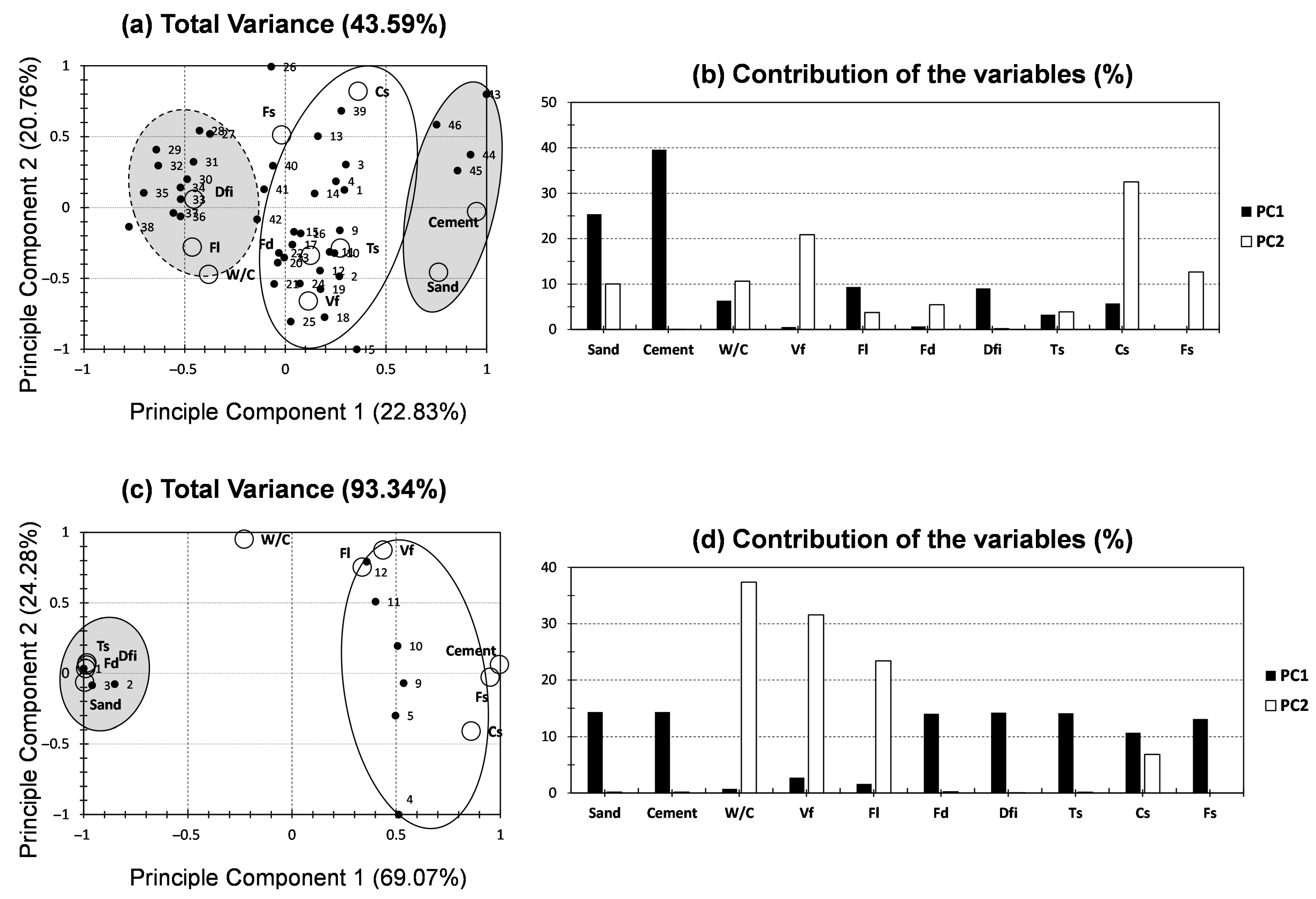
Figure 1 shows the PCA biplot representation of the entire datasets for the cementitious materials presented in Table 1. The first two PCs exhibited 53.44% of the total variance (28.56% and 24.88% for PC1 and PC2, respectively; Figure 1a). This value is moderately acceptable if compared to previous findings attempting to apply PCA for a better understanding of the physical features of materials [54,55,56,57,58]. For the variables, Fs and Fl scored the highest contributions towards PC1 (22.589% and 20.304%, respectively; Figure 1b). For cement, Vf, and Cs, they scored moderate contributions towards this PC (10–20%), and the rest of the variables exhibited a minor one (Figure 1b).
For PC2, Fd, Dfi, and Ts showed the dominant contributions, scoring 23.806%, 26.088%, and 29.876%, respectively (Figure 1b). The rest of the variables showed low to minor contributions along PC2. For the cementitious materials (individuals of the PCA), three clusters can be identified (Figure 1a). The white cluster contained all of the mortar samples in hand, with the exception of samples 6, 7, 8, 47, 48, 49, 50, 51, and 52. Samples of this cluster showed low contributions to either of the variables in hand and were more likely located near the node. The dashed line gray cluster contained cementitious materials 6, 7, and 8. This cluster exhibited a moderate positive influence around PC1 and a strong positive influence along PC2. The contained materials showed a positive correlation with Fd, Dfi, and Ts as variables. For the full line gray cluster, it contained cementitious materials 48, 49, 50, 51, and 52 and showed a positive influence along PC1, with a low to moderate negative influence along PC2. As expected for cement mortars, the samples of this cluster showed a high correlation with cement, sand, Fl, Vf, Cs, and Fs, as variables (Figure 1a). The mechanical properties of mortars are closely dependent on those parameters.
Following the application of PCA for the entire dataset of cementitious material in hand, a moderate contribution of the total variance has been identified. In addition, most of the individuals have been skewed near the node. This distribution would raise multiple possibilities, and several data separation and/or variable exclusion strategies could be acquired for the sake of raising the total variance of the first two PCs and/or increasing the segregation between the different data points [56,58]. The yielded patterns, especially the clustering of most cementitious materials around the node, could be attributed to the following: (1) the low influence of the investigated variables towards the materials in hand; (2) the high discrepancy between the materials of the white cluster and the other two clusters; this would contribute to a skewing effect of the other clusters on the main white cluster; (3) the relatively higher influence of the investigated variables, towards cementitious materials located outside the white cluster [56,58]. In order to confirm or refute either of the three possibilities, several data segregation and exclusion of certain variables could be attempted. The following decision will be taken based on the yielded patterns of PCA, when the entire dataset has been taken into consideration (Figure 1). More interesting findings could be reflected by an increase in the total variance, and/or a higher dispersion of the studied samples, in order to obtain a more significant cluster distribution.

3.1.2. PCA: Dataset Segregation Approach

Figure 2 shows the PCA biplot representation of the separation of the dataset. This segregation has been performed based on the different trends yielded with the entire dataset PCA approach (Figure 1). In fact, the dataset has been separated into two, yet all variables were considered: (1) samples composing the white cluster localized around the node and (2) samples outside this cluster (Figure 1a). For the first case, these samples were presented by the PCA of Figure 2a,b. For the variables, the highest contributions for PC1 have been scored for cement and sand, accounting for 39.58% and 25.39%, respectively (Figure 2b). The rest of the variables exhibited low to minor contributions, along with PC1. For PC2, the highest contribution has been yielded for Cs (32.48%; Figure 2b). A moderate contribution has been noticed for Vf (20.86%; Figure 2b), and the rest of the variables showed low to minor contributions, along PC2. This would indicate that the dataset, in the entire dataset approach (Figure 1), was more likely skewed by considering cement and sand as variables.
For the cement mortar samples, higher dispersion of data points can be distinguished, as a higher distribution of samples within three different clusters occurred (Figure 2a). The dashed line gray cluster showed a moderate negative correlation on PC1, with a fluctuating correlation on PC2, from a minor negative to a moderately positive one. The individuals of this cluster showed a high positive correlation along Dfi, Fl, and W/C. This fact can be explained by the importance of the W/C ratio in the overall mechanical strength of cement mortars. Fiber characteristics such as diameter, Df, and fiber length, Fl, are also closely related to the improvement of compressive and flexural strength of mortars.
For the second PCA data separation approach, samples were presented by the PCA of Figure 2c,d. The first two PCs accounted for 93.34% of the total variance (69.07% and 24.28% for PC1 and PC2, respectively; Figure 2c). These high contributions would highlight the effectiveness of the data separation technique [17,18,19,22,23]. For the variables, it is noticeable that there is a high separation between contributions towards the first two PCs (Figure 2d). In other words, the variables having a high contribution towards one of the first two PCs would not have a high one on the other. For PC1, all variables with the exception of W/C, Vf, and Fi exhibited moderate contribution, yielding between 10% and 20% (Figure 2d). For PC2, the highest contribution has been yielded for W/C (scoring 37.37%; Figure 2d). An extensive contribution has been noted as well for Vf and Fi (31.57% and 23.42%, respectively; Figure 2d). The rest of the variables exhibited very low contributions towards PC2.
For the cementitious materials that compose the outliers, samples were divided into two clusters (Figure 2c). The white cluster showed a moderate to high positive correlation along PC1 and highly fluctuating trends between negative and positive correlations along PC2 (Figure 2c). It is composed of materials 4, 5, 9, 10, 11, and 11 and showed a strong positive influence on the variables Vf, Fl, cement, Fs, and Cs (Figure 2c).
The gray cluster showed a high negative correlation along PC1, with a negligible one for PC2 (Figure 2c). It is composed of materials 1, 2, and 3, and showed a strong positive influence on Ts, Fd, Dfi, and sand (Figure 2c).
Following the yielded trends, it is evident that data separation plays a pivotal role in yielding a higher total variance to be captured by the first two PCs (Figure 2c). When the dataset contains well-separated groups or patterns, PCs can more easily capture the major directions of sample discrepancy [58,59] (Figure 2a). This separation ensures that the first two PCs can effectively distinguish between the different clusters or distinct characteristics in the data. By aligning with the major axes of variation, these components maximize the discrepancy between samples (cementitious materials), making them more informative in representing the underlying trends. In contrast, if the data points are tightly clustered or overlapping [58,59] (Figure 1a), PCs will struggle to capture significant variance, and more components will be needed to describe the dataset effectively. This will be limited by the two-dimensional perspective. Thus, better separation within the dataset leads to a more substantial portion of the total variance being captured by the first two PCs, improving the overall efficiency and interpretability of the PCA [58,59].
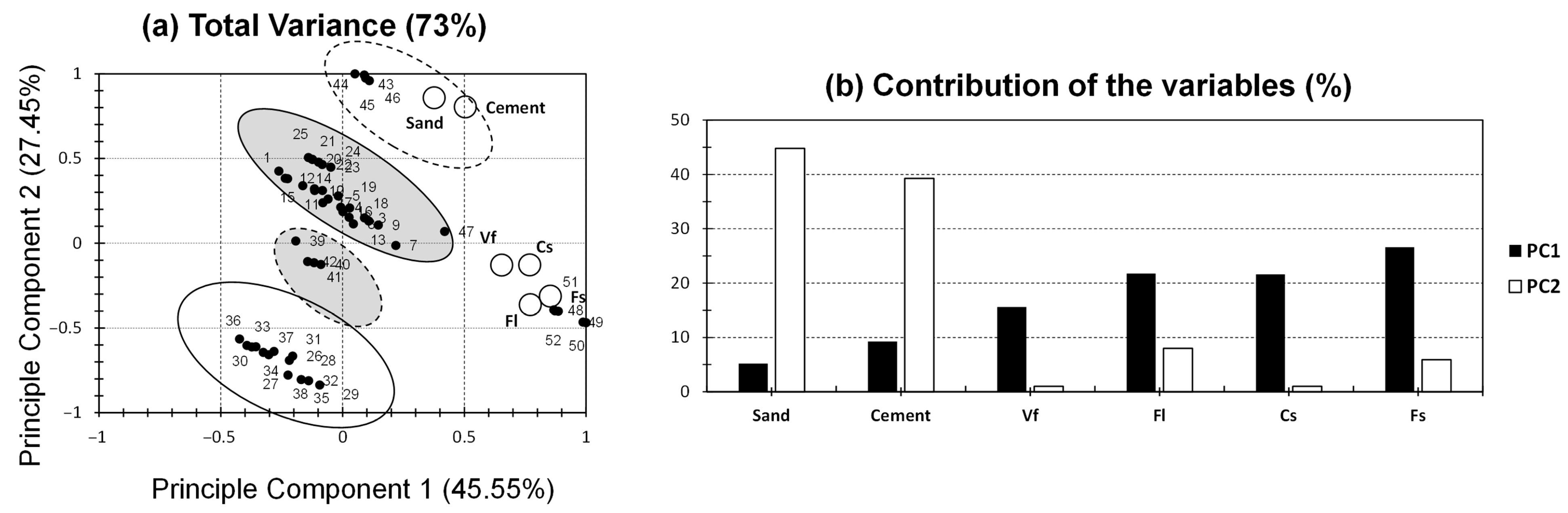
Figure 3 shows the PCA biplot representation with only the variables included in the gray full line cluster of Figure 1a. The first two PCs accounted for 73% of the total variance (45.55% and 27.45% for PC1 and PC2, respectively; Figure 3a). Interestingly, a higher variance from the case of the entire dataset with all variables has been considered (Figure 1a), highlighting the effectiveness of the used approach [60]. For PC1, Fl, Cs, and Fs showed a moderate contribution between 20% and 30%, and the rest of the included variables highlighted a low to minor contribution (Figure 3b). For PC2, the highest contribution has been scored for sand and cement (44.8% and 39.29%, respectively; Figure 3b). The rest of the variables showed a minor to negligible contribution. These trends would indicate a certain dependency between the variables in hand.
For the individuals, different cementitious materials were arranged in four distinct samples (Figure 3a). The biggest arrangement of samples has been noted for the full-line white and gray clusters. The gray clusters showed a certain pattern with all of the variables except for sand and cement. These variables most likely positively correlated along with contentious samples 43, 44, 45, and 46 (forming the dashed line white cluster; Figure 3a). For the full-line white cluster, the relative samples were grouped away from all variables (Figure 3a). This would more likely indicate a more similar negative influence of the different samples on the materials in hand.
Excluding certain variables when performing PCA can be highly beneficial for improving the analysis’s clarity and effectiveness [59,60]. This has been highlighted, in our case, by the increase in the total variance from 43% (Figure 1a) to 73% (Figure 3a). Removing redundant or irrelevant variables can help reduce noise, ensuring that the PCs focus on capturing the most meaningful variation in the dataset [59,60]. When variables are highly correlated or provide little additional information, they can dilute the importance of key patterns and cause the results to be skewed, leading to misinterpretation [59,60]. In our case, a better focalization on Vf and Fl would bring better explanations for Fs and Cs since these variables were more likely to influence one of the biggest arrangements of samples (full line gray cluster; Figure 3a). By carefully selecting and excluding variables that have an insignificant contribution, the model can be simplified, and the interpretability of trends can be better understood. [59,60]. In addition, excluding unnecessary variables may help prevent overfitting, increasing PCA robustness as an explanatory analysis tool, and ensuring that the most important axes of variation in the data are clearly highlighted [59,60].

3.2. MLR: A PCA-Driven Approach

The previous part aimed to refine the selection of data for an attempt to apply MLR. The selected cementitious materials and corresponding variables were selected based on the different trends yielded in PCA, following data segregation (Figure 2a) and exclusion of variables (Figure 3a). A special emphasis has been given to the samples and variables of the full-line white cluster of the previously mentioned two approaches.

3.2.1. Application of MLR and Residual Analysis for Data Separation Approach

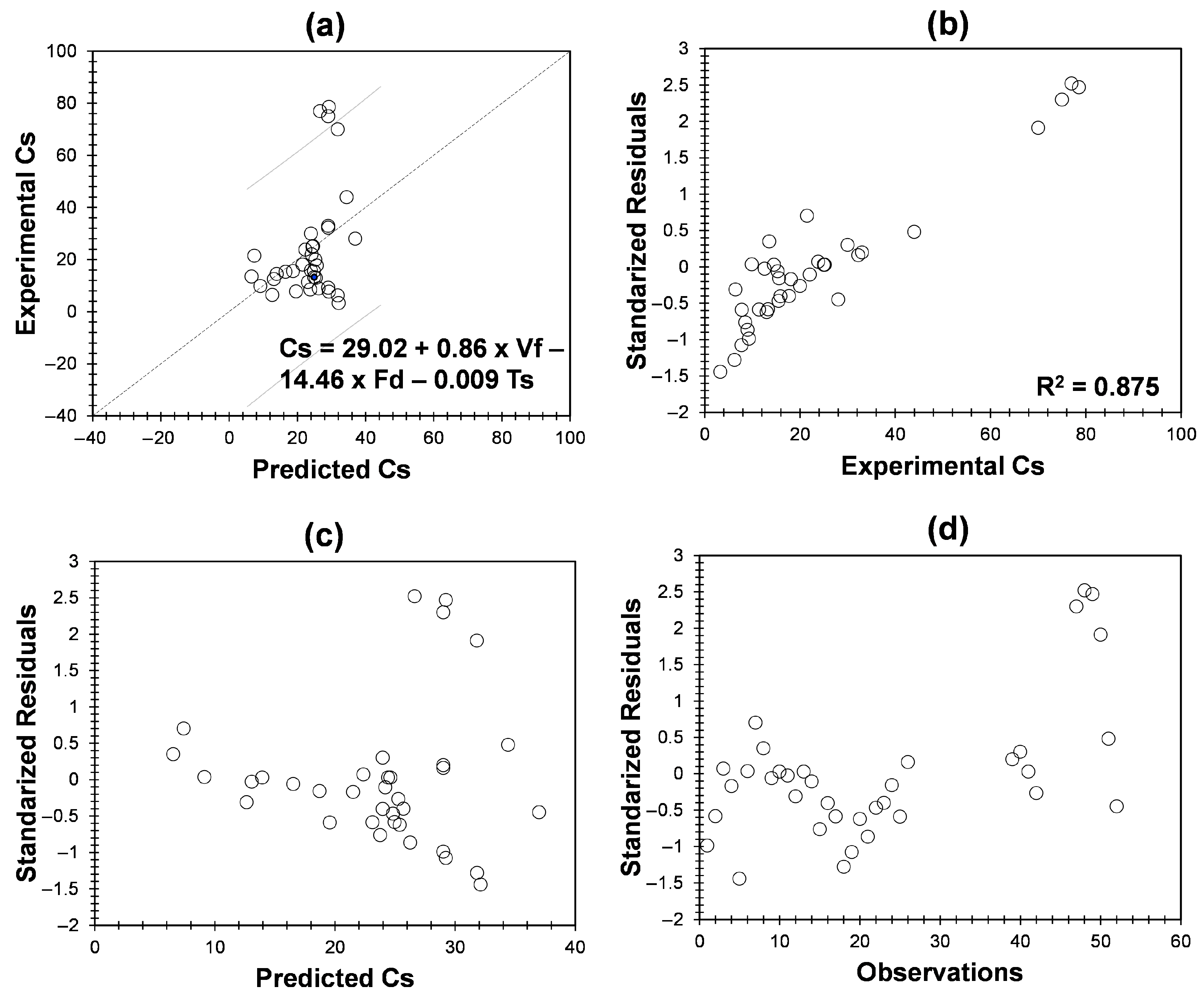
The analysis of the scatter plots in Figure 4 provides a comprehensive evaluation of the model’s performance in predicting Cs. The scatter plot of Figure 4a compares the predicted Cs with the actual Cs, with the dashed line representing the ideal case of perfect prediction. Most data points are clustered between compressive strength values of 0 and 40, where the model’s predictions are generally accurate. However, for higher actual compressive strength values (above 60), the model tends to underpredict, as some points fall outside the 95% confidence interval. Despite this, the model demonstrates reasonable accuracy in lower and mid-range values, suggesting that the overall performance is solid, though further refinement could enhance predictions for higher strength values.
The scatter plot of Figure 4b shows the actual Cs against the standardized residuals, illustrating the model’s performance across the dataset. The residuals are concentrated around zero for lower and mid-range compressive strength values, confirming that the model performs well in these regions. However, as actual Cs increase beyond 60 units, the residuals become more positive, signaling underprediction for higher values. A few outliers are observed at very high Cs (above 70), where the residuals exceed 2.5, further indicating areas where the model may struggle. Although many conventional cement mortars used in routine applications fall below roughly 70 MPa, higher-strength mortars do exist and are relevant for high-performance or specialized applications.
The scatter plot of Figure 4c predicts Cs against standardized residuals, highlighting the model’s general accuracy. The residuals are mainly concentrated around zero, suggesting that the model is effective for many observations. The scatter plot of Figure 4d shows standardized residuals across 36 observations and provides further insight into the model’s predictive power. Most residuals are close to zero, reflecting that the model performs well for the majority of cases. However, a few observations (particularly 47, 48, and 49) show large positive residuals, indicating an underprediction of Cs for these higher-strength observations. On the other hand, some negative residuals, such as those for observation 5, reflect instances of overprediction, though these are less severe. Overall, the model demonstrates strong performance for most predictions, with occasional underprediction of high Cs values that could be addressed through model adjustments.
In brief, the application of MLR to the full line white cluster of Figure 2a gives a model that exhibits solid predictive performance, particularly in the lower and mid-range Cs values (Figure 4). In these latter ranges, most residuals are close to zero. While the model tends to underpredict for higher Cs values, especially above 60, it generally provides accurate predictions for most observations. The presence of some heteroscedasticity and outliers suggests areas for further refinement, but the model is effective overall, particularly for the majority of the dataset, where predictions align well with actual values. Adjustments aimed at improving predictions for high compressive strength values would enhance the model’s accuracy further.
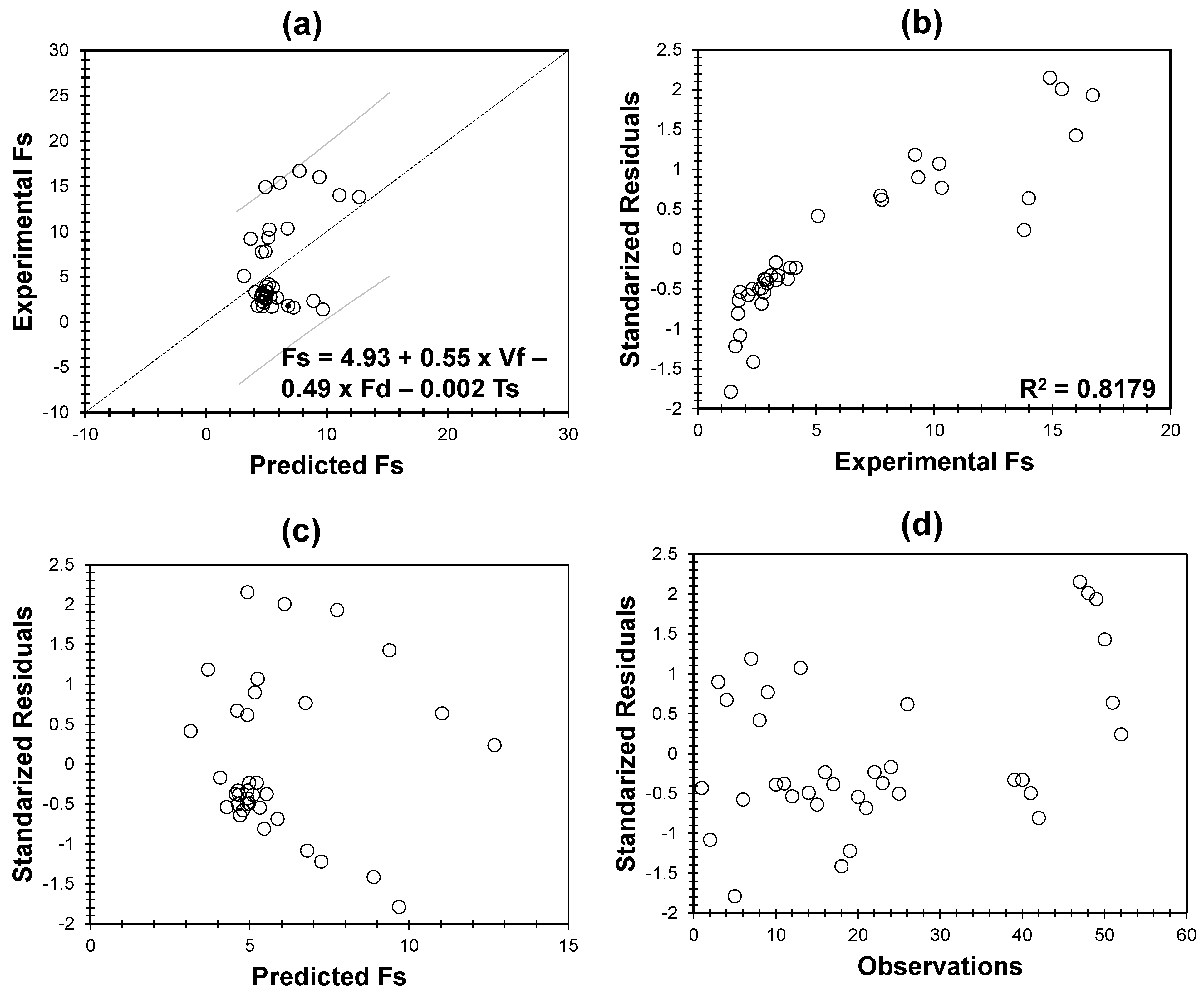
Figure 5 highlights the model’s overall solid performance in predicting Fs for samples and variables of the full-line white cluster of Figure 2a. The scatter plot comparing Fs with actual Fs shows that most data points are clustered between 0 and 10 (Figure 5a), where the model’s predictions align closely with actual values. The model demonstrates accuracy for the majority of cases in the lower range. Similarly, in Figure 5b, a scatter plot of actual Fs vs. standardized residuals confirms the model’s strong performance for Fs values between 0 and 5, with residuals tightly clustered around zero. However, as actual Fs increase beyond 10, residuals become more positive, indicating underprediction, and a few outliers at higher values (above 14) highlight the model’s tendency to struggle with higher Fs. This growing residual spread suggests some heteroscedasticity, where the variance increases for higher values. Figure 5c further illustrates this pattern, showing that for predicted Fs values between 4 and 6, residuals remain near zero, reflecting good accuracy. Yet, as predictions rise above 6, the residuals become more dispersed, with some significant underprediction and occasional overprediction, indicating that the model’s accuracy diminishes for higher values.
Figure 5d shows a scatter plot of standardized residuals across 36 observations, emphasizing the model’s general accuracy, with most residuals close to zero. However, several observations, particularly 47, 48, and 49, show large positive residuals, suggesting underprediction for these high-strength cases. While negative residuals are less frequent, with one notable overprediction in observation 5, the overall residual distribution shows a slight bias toward underprediction. In brief, while the Fs model consistently delivers accurate predictions for lower and moderate flexural strength values, improvements are needed to address underprediction, heteroscedasticity, and occasional overprediction for higher values.

3.2.2. Application of MLR and Residual Analysis for Variables Exclusion Approach

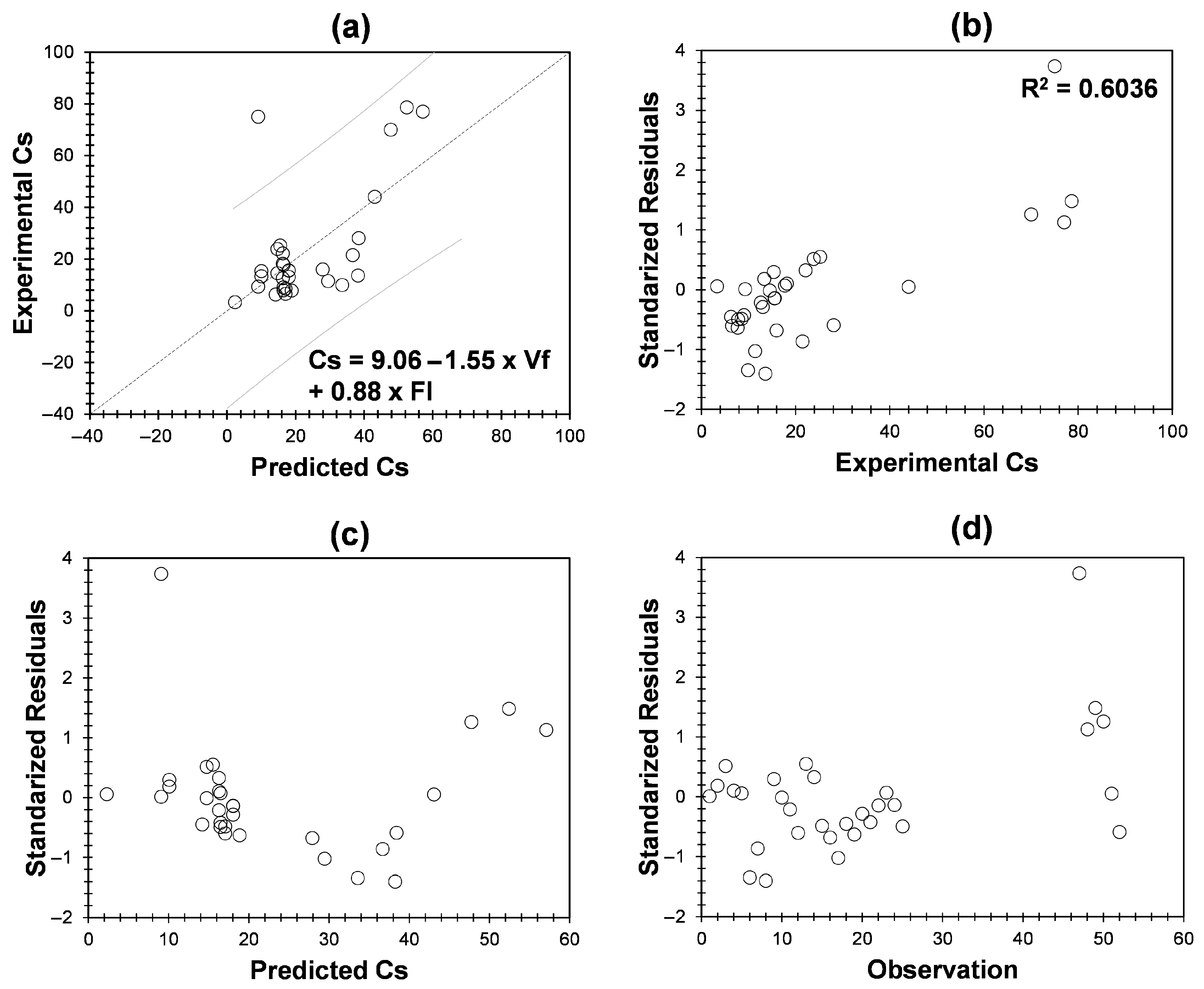
Figure 6 highlights the model’s solid performance in predicting Cs for samples and variables of the full-line white cluster of Figure 3a. The scatter plot of Figure 6a compares predicted Cs with actual ones and shows that the model performs well for values between 0 and 40, where most data points are clustered near the diagonal line. For higher Cs (above 60), the model tends to underpredict, as several points fall above the line and outside the confidence interval of 95%. While this suggests some challenges in predicting higher Cs, the model shows strong predictive accuracy for most cases in the lower range. Similarly, Figure 6b illustrates the relationship between actual Cs and standardized residuals, where the model performs well for values up to 30, with residuals tightly clustered around zero. However, as Cs increase, particularly above 60, larger positive residuals emerge, indicating underprediction.
In Figure 6c, the scatter plot of predicted Cs against standardized residuals further supports these findings, with accurate predictions in the lower range (0 to 30), while higher predicted values beyond 40 reveal a tendency for underprediction. One peculiar outlier, with a standardized residual above 3, highlights significant underprediction in a specific case, suggesting areas for refinement in handling extreme values. Figure 6d reinforces the overall accuracy of the model, as shown by the bar plot of standardized residuals across the 31 observations in hand. Most residuals are close to zero, reflecting good performance in many cases, but a few large positive residuals, particularly in sample 47, indicate significant underprediction for high-strength values. Negative residuals exist, suggesting that overprediction is not a major issue. In brief, the model demonstrates strong accuracy for the majority of observations, especially for lower and mid-range Cs values.
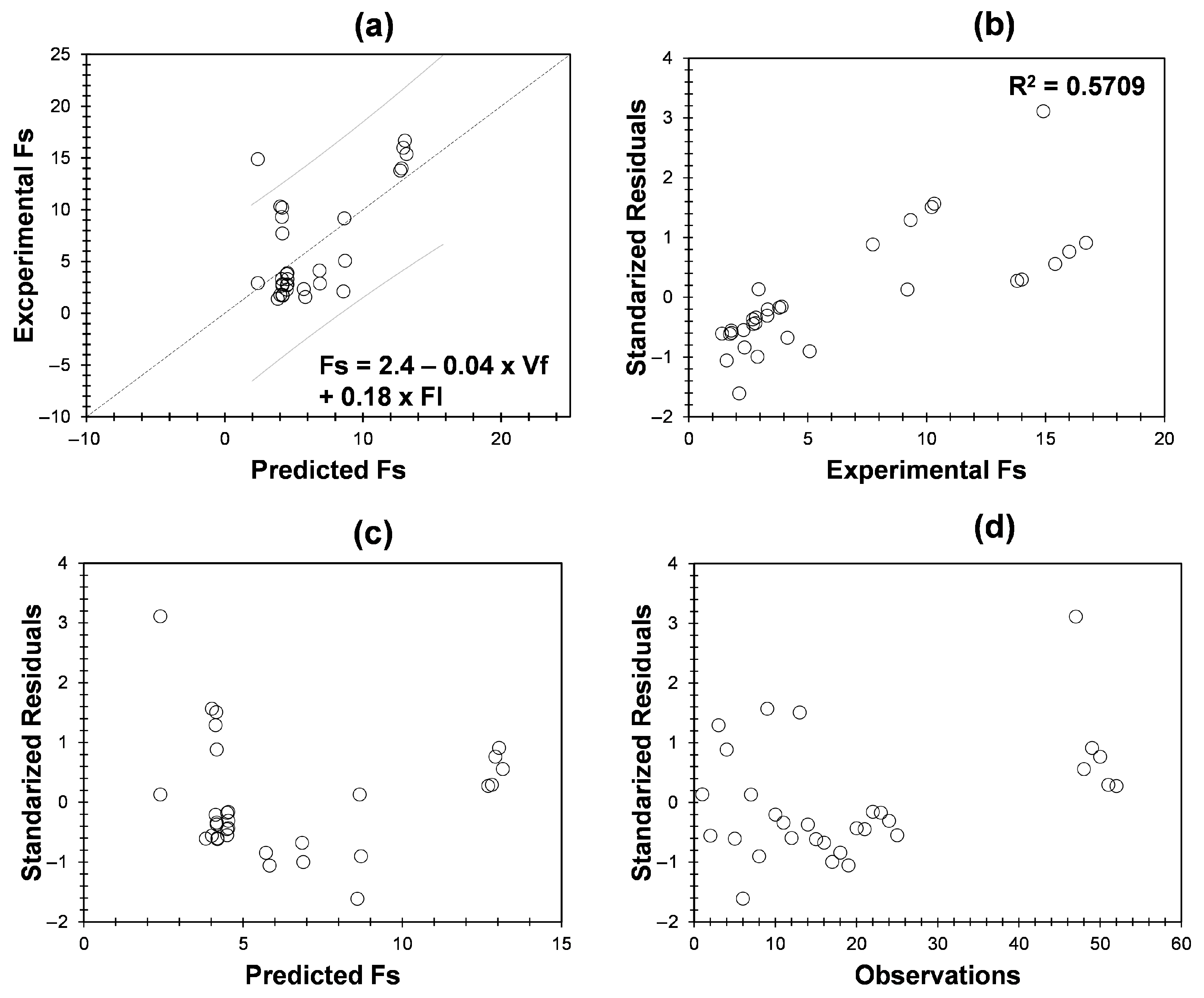
Figure 7 highlights the model’s performance in predicting Fs for samples and variables of the full line white cluster of Figure 3a. Figure 7a shows the scatter plot comparing predicted Fs with the actual ones and shows that the model performs well between 0 and 10, where most data points cluster near the ideal prediction line. This would indicate reliable and accurate predictions, while the model tends to underpredict for higher values (above 10), with residuals widening as Fs increases. The yielded model rarely overpredicts, suggesting overall good performance for the majority of cases.
Figure 7b highlights the relationship between actual Fs and standardized residuals and reveals that the model performs accurately for lower values (0 to 6), where residuals are tightly clustered around zero. However, underprediction becomes more evident as Fs rises above 10, with a residual exceeding +2 for an Fs value around 15, though overprediction is not a significant issue. Figure 7c further illustrates this pattern, with the model showing strong accuracy for average predicted values of Cs (around 5). For low and high values, residuals show the spreading of predicted values, indicating a tendency for underprediction at very high and low Fs values. Despite this, the model rarely overpredicts, with few negative residuals. Figure 7d shows the scatter plot of standardized residuals across the 31 investigated observations. This shows that the model provides accurate predictions for many cases. Yet one instance of underprediction is observed for sample 47, where the residual score exceeds +2. Significant negative residuals are less common, suggesting that overprediction is rare. In brief, the proposed model demonstrates strong accuracy for average Fs values and performs well in most cases, while there is some underprediction for lower and higher values.

3.3. Model Validation

The predicted Cs and Fs values were validated using the experimental results in Table 2. The results consist of 10 different mortar types reinforced with various fibers. Due to several factors, accurate prediction of the fiber-reinforced mortar’s mechanical properties is very difficult. The main goal of this validation is to assess the accuracy of the model.
Table 3 summarizes the comparisons of the predicted Fs and Cs from the functions of Figure 4 and Figure 5 with the real experimental result for each of the 10 data points. For the Fs, the percentage error ranges from 7.07% (Sample 1) to 41.37% (Sample 7). The model has moderate accuracy in most cases, with 7 out of 10 samples showing errors below 20%. For the Cs, the error ranges from 12.28% (Sample 4) to 37.67% (Sample 7). It is observed that the model overestimates compressive strength in most cases.
Table 3 and Table 4 summarize the predicted Fs and Cs from the functions obtained from Figure 6a and Figure 7a. For Fs, the percentage error varies from 0.10% (Sample 7) to 31.78% (Sample 4). The majority of predictions have errors below 15%, suggesting a reasonable level of accuracy. Sample 4 exhibits the highest error (31.78%), while Sample 7 is almost perfectly predicted. For Cs, the error ranges from 7.31% (Sample 8) to 31.48% (Sample 3). The predictions are more balanced between overestimation and underestimation.

4. Conclusions

This study proposed an interpretable predictive framework combining Principal Component Analysis (PCA) and Multiple Linear Regression (MLR) to estimate the compressive strength (Cs) and flexural strength (Fs) of fiber-reinforced cement mortars (FRCM). The literature-based dataset comprising 52 mortar mixes reinforced with polypropylene, steel, coconut, date palm, and hemp fibers was analyzed. The mechanical performance investigated covered a wide range, with Cs values between approximately 4.4 and 78.6 MPa and Fs values between 0.75 and 16.7 MPa, encompassing both conventional and high-performance mortar systems.
For the full dataset, PCA showed that the first two principal components (PC1 and PC2) captured 53.44% of the total variance, which represents a moderate but meaningful level of variance for a heterogeneous dataset compiled from multiple experimental sources [58,62,63]. By applying targeted dataset segregation and variable-exclusion strategies guided by PCA contributions, the variance captured by PC1–PC2 increased to approximately 73% for the subset used in regression modeling. These two components were therefore explicitly retained as the basis for interpretation and prediction throughout the study.
The PCA-driven MLR models demonstrated good predictive accuracy for low-to-mid strength ranges, which represent the majority of practical mortar applications. Validation using an independent dataset (n = 10) yielded mean absolute percentage errors generally below 20% for both Cs and Fs. A systematic tendency toward underprediction was observed for higher-strength mixes, particularly for Cs ≳ 60 MPa and/or Fs ≳ 10 MPa, a range that is herein operationally defined as high-strength FRCMs within the context of the present dataset.
The present framework focuses deliberately on strength-based performance indicators (Cs and Fs), as deformation-related properties such as elastic modulus, fracture energy, tensile strain capacity, and post-cracking ductility are not consistently reported across the source studies and cannot be harmonized without introducing additional uncertainty. These properties nonetheless remain essential for structural performance assessment and should be incorporated in future extensions of the model as more comprehensive datasets become available.
Compared with more complex non-linear data-driven predictors, the proposed PCA-MLR approach prioritizes transparency, interpretability, and low computational cost, allowing engineers and researchers to directly relate dominant material and fiber parameters to mechanical performance trends. Within its defined scope, the framework provides a robust and practical tool for performance comparison of FRCM, while also offering a clear foundation for future developments incorporating broader datasets, additional mechanical descriptors, and regime-specific modeling strategies.

Author Contributions

Conceptualization, E.M. and K.Y.; methodology, E.M. and K.Y.; validation, E.M., E.L., C.E.S., E.Z. and K.Y.; formal analysis, E.M., E.L. and K.Y.; investigation, E.M., E.L. and K.Y.; resources, E.M., E.L., C.E.S. and K.Y.; data curation, E.M., E.L. and K.Y.; writing—original draft preparation, E.M., C.E.S. and K.Y.; writing—review and editing, E.M., E.L., C.E.S., E.Z. and K.Y.; visualization, E.M., E.L., C.E.S., E.Z. and K.Y.; project administration, E.M. and K.Y. All authors have read and agreed to the published version of the manuscript.

Funding

This research received no external funding.

Data Availability Statement

Most of the data have been acquired from an open-access repository. Copyright permissions were acquired when needed.

Conflicts of Interest

The authors declare no conflict of interest.

References

  1. Pacheco-Torgal, F.; Jalali, S. Cementitious Building Materials Reinforced with Vegetable Fibres: A Review. Constr. Build. Mater. 2011, 25, 575–581. [Google Scholar] [CrossRef]
  2. Georgiou, A.V.; Pantazopoulou, S.J. Effect of Fiber Length and Surface Characteristics on the Mechanical Properties of Cementitious Composites. Constr. Build. Mater. 2016, 125, 1216–1228. [Google Scholar] [CrossRef]
  3. Başsürücü, M.; Fenerli, C.; Kına, C.; Akbaş, Ş.D. Effect of Fiber Type, Shape and Volume Fraction on Mechanical and Flexural Properties of Concrete. J. Sustain. Constr. Mater. Technol. 2022, 7, 158–171. [Google Scholar] [CrossRef]
  4. Guo, P.; Meng, W.; Xu, M.; Li, V.C.; Bao, Y. Predicting Mechanical Properties of High-Performance Fiber-Reinforced Cementitious Composites by Integrating Micromechanics and Machine Learning. Materials 2021, 14, 3143. [Google Scholar] [CrossRef]
  5. Kazemi, F.; Shafighfard, T.; Yoo, D.Y. Data-Driven Modeling of Mechanical Properties of Fiber-Reinforced Concrete: A Critical Review. Arch. Comput. Methods Eng. 2024, 31, 2049–2078. [Google Scholar] [CrossRef]
  6. Zhang, P.; Yang, Y.; Wang, J.; Jiao, M.; Ling, Y. Fracture Models and Effect of Fibers on Fracture Properties of Cementitious Composites—A Review. Materials 2020, 13, 5495. [Google Scholar] [CrossRef]
  7. Belyakov, N.; Smirnova, O.; Alekseev, A.; Tan, H. Numerical Simulation of the Mechanical Behavior of Fiber-Reinforced Cement Composites Subjected to Dynamic Loading. Appl. Sci. 2021, 11, 1112. [Google Scholar] [CrossRef]
  8. Farhan, A.H.; Dawson, A.R.; Thom, N.H. Recycled Hybrid Fiber-Reinforced & Cement-Stabilized Pavement Mixtures: Tensile Properties and Cracking Characterization. Constr. Build. Mater. 2018, 179, 488–499. [Google Scholar]
  9. Decky, M.; Papanova, Z.; Juhas, M.; Kudelcikova, M. Evaluation of the Effect of Average Annual Temperatures in Slovakia between 1971 and 2020 on Stresses in Rigid Pavements. Land 2022, 11, 764. [Google Scholar] [CrossRef]
  10. Bentur, A.; Mindess, S. Fibre Reinforced Cementitious Composites; CRC Press: Boca Raton, FL, USA, 2006. [Google Scholar]
  11. Liang, N.H.; Liu, X.R.; Sun, J. Experimental Study of Crack Resistance for Multi Scale Polypropylene Fiber Reinforced Concrete. J. China Coal Soc. 2012, 37, 1304–1309. [Google Scholar]
  12. Ajwad, A.; Ilyas, U.; Muzammal, L.; Umer, A.; Haider, S.M. Evaluation of Strength Parameters of Plain and Reinforced Concrete with the Addition of Polypropylene Fibers. Mehran Univ. Res. J. Eng. Technol. 2024, 43, 111–118. [Google Scholar] [CrossRef]
  13. Zeng, Y.; Chen, Y.; Liu, Y.; Wu, T.; Zhao, Y.; Jin, D.; Xu, F. Prediction of Compressive and Flexural Strength of Coal Gangue-Based Geopolymer Using Machine Learning Method. Mater. Today Commun. 2025, 44, 112076. [Google Scholar] [CrossRef]
  14. Pereira, J.R.; Silva, J.B.L.P.E.; Gachet, L.A.; Santos, A.C.D.; Lintz, R.C.C. Evaluation of the Addition of Polypropylene (PP) Fibers in Self-Compacting Concrete (SCC) to Control Cracking and Plastic Shrinkage between Different Methods. Mater. Res. 2023, 26, e20220567. [Google Scholar] [CrossRef]
  15. Yazıcı, Ş.; İnan, G.; Tabak, V. Effect of Aspect Ratio and Volume Fraction of Steel Fiber on the Mechanical Properties of SFRC. Constr. Build. Mater. 2007, 21, 1250–1253. [Google Scholar] [CrossRef]
  16. Mobasher, B.; Li, C.Y. Mechanical Properties of Hybrid Cement-Based Composites. ACI Mater. J. 1996, 93, 284–292. [Google Scholar] [CrossRef] [PubMed]
  17. Yoo, D.Y.; Banthia, N.; Yoon, Y.S. Predicting the Flexural Behavior of Ultra-High-Performance Fiber-Reinforced Concrete. Cem. Concr. Compos. 2016, 74, 71–87. [Google Scholar] [CrossRef]
  18. Jóźwiak-Niedźwiedzka, D.; Fantilli, A.P. Wool-Reinforced Cement Based Composites. Materials 2020, 13, 3590. [Google Scholar] [CrossRef]
  19. Korjenic, A.; Petránek, V.; Zach, J.; Hroudová, J. Development and Performance Evaluation of Natural Thermal-Insulation Materials Composed of Renewable Resources. Energy Build. 2011, 43, 2518–2523. [Google Scholar] [CrossRef]
  20. Park, J.K.; Kim, M.O.; Kim, D.J. Pullout Behavior of Recycled Waste Fishing Net Fibers Embedded in Cement Mortar. Materials 2020, 13, 4195. [Google Scholar] [CrossRef]
  21. Park, J.K.; Kim, D.J.; Kim, M.O. Mechanical Behavior of Waste Fishing Net Fiber-Reinforced Cementitious Composites Subjected to Direct Tension. J. Build. Eng. 2021, 33, 101622. [Google Scholar] [CrossRef]
  22. Ghavami, K. Bamboo as Reinforcement in Structural Concrete Elements. Cem. Concr. Compos. 2005, 27, 637–649. [Google Scholar] [CrossRef]
  23. Borg, R.P.; Baldacchino, O.; Ferrara, L. Early Age Performance and Mechanical Characteristics of Recycled PET Fibre Reinforced Concrete. Constr. Build. Mater. 2016, 108, 29–47. [Google Scholar] [CrossRef]
  24. Ali, M.; Liu, A.; Sou, H.; Chouw, N. Mechanical and Dynamic Properties of Coconut Fibre Reinforced Concrete. Constr. Build. Mater. 2012, 30, 814–825. [Google Scholar] [CrossRef]
  25. AlMuhanna, M.; AlSenan, R.; Mustafaraj, E.; Luga, E.; Corradi, M. Fibre Reinforcement of Cement Mortars for Reinforcement of Masonry Buildings: An Experimental Investigation. J. Build. Rehabil. 2024, 9, 142. [Google Scholar] [CrossRef]
  26. Nayak, J.R.; Bochen, J.; Gołaszewska, M. Experimental Studies on the Effect of Natural and Synthetic Fibers on Properties of Fresh and Hardened Mortar. Constr. Build. Mater. 2022, 347, 128550. [Google Scholar] [CrossRef]
  27. Majumder, A.; Stochino, F.; Frattolillo, A.; Valdes, M.; Mancusi, G.; Martinelli, E. Jute Fiber-Reinforced Mortars: Mechanical Response and Thermal Performance. J. Build. Eng. 2023, 66, 105888. [Google Scholar] [CrossRef]
  28. Ozerkan, N.G.; Ahsan, B.; Mansour, S.; Iyengar, S.R. Mechanical Performance and Durability of Treated Palm Fiber Reinforced Mortars. Int. J. Sustain. Built Environ. 2013, 2, 131–142. [Google Scholar] [CrossRef]
  29. Choi, Y.C. Hydration and Internal Curing Properties of Plant-Based Natural Fiber-Reinforced Cement Composites. Case Stud. Constr. Mater. 2022, 17, e01690. [Google Scholar] [CrossRef]
  30. Nawab, M.S.; Ali, T.; Qureshi, M.Z.; Zaid, O.; Kahla, N.B.; Sun, Y.; Anwar, N.; Ajwad, A. A Study on Improving the Performance of Cement-Based Mortar with Silica Fume, Metakaolin, and Coconut Fibers. Case Stud. Constr. Mater. 2023, 19, e02480. [Google Scholar] [CrossRef]
  31. Arnaud, L.; Gourlay, E. Experimental Study of Parameters Influencing Mechanical Properties of Hemp Concretes. Constr. Build. Mater. 2012, 28, 50–56. [Google Scholar] [CrossRef]
  32. Baley, C.; Perrot, Y.; Busnel, F.; Guezenoc, H.; Davies, P. Transverse Tensile Behaviour of Unidirectional Plies Reinforced with Flax Fibres. Mater. Lett. 2006, 60, 2984–2987. [Google Scholar] [CrossRef]
  33. Ferrara, L.; Park, Y.D.; Shah, S.P. A Method for Mix-Design of Fiber-Reinforced Self-Compacting Concrete. Cem. Concr. Res. 2007, 37, 957–971. [Google Scholar] [CrossRef]
  34. Bertelsen, I.M.G.; Lima, A.T.M.; Ottosen, L.M. Possible Applications for Waste Fishing Nets in Construction Material. In Marine Plastics: Innovative Solutions to Tackling Waste; Springer Nature: Cham, Switzerland, 2023; pp. 211–241. [Google Scholar]
  35. Spadea, S.; Farina, I.; Carrafiello, A.; Fraternali, F. Recycled Nylon Fibers as Cement Mortar Reinforcement. Constr. Build. Mater. 2015, 80, 200–209. [Google Scholar] [CrossRef]
  36. Wei, J.; Meyer, C. Degradation Mechanisms of Natural Fiber in the Matrix of Cement Composites. Cem. Concr. Res. 2015, 73, 1–16. [Google Scholar] [CrossRef]
  37. Zollo, R.F. Fiber-Reinforced Concrete: An Overview after 30 Years of Development. Cem. Concr. Compos. 1997, 19, 107–122. [Google Scholar] [CrossRef]
  38. Purnell, P. Mechanical Behaviour and Properties of Composites; CRC Press: Boca Raton, FL, USA, 2017. [Google Scholar]
  39. de Andrade Silva, F.; Toledo Filho, R.D.; de Almeida Melo Filho, J.; Fairbairn, E.D.M.R. Physical and Mechanical Properties of Durable Sisal Fiber–Cement Composites. Constr. Build. Mater. 2010, 24, 777–785. [Google Scholar] [CrossRef]
  40. Jamil, K.; Shabbir, F.; Raza, A. Performance Evaluation of Jute Fiber-reinforced Recycled Aggregate Concrete: Strength and Durability Aspects. Struct. Concr. 2023, 24, 6520–6538. [Google Scholar] [CrossRef]
  41. Al-Oqla, F.M.; Sapuan, S.M. Natural Fiber Reinforced Polymer Composites in Industrial Applications: Feasibility of Date Palm Fibers for Sustainable Automotive Industry. J. Clean. Prod. 2014, 66, 347–354. [Google Scholar] [CrossRef]
  42. Hosseinzadeh, M.; Mousavi, S.S.; Hosseinzadeh, A.; Dehestani, M. An Efficient Machine Learning Approach for Predicting Concrete Chloride Resistance Using a Comprehensive Dataset. Sci. Rep. 2023, 13, 15024. [Google Scholar] [CrossRef]
  43. Kobaka, J. Principal Component Analysis as a Statistical Tool for Concrete Mix Design. Materials 2021, 14, 2668. [Google Scholar] [CrossRef]
  44. Kobaka, J.; Katzer, J. A Principal Component Analysis in Concrete Design. Constr. Optim. Energy Potential Bud. O Zoptymalizowanym Potencjale Energetycznym 2022, 11, 203–214. [Google Scholar] [CrossRef]
  45. Zhao, B.; Xue, E.W.; Gu, X.B. Evaluation of Coarse Aggregate Quality Grade of Recycled Concrete Based on the Principal Component Analysis-Cloud Model. Front. Mater. 2023, 10, 1291434. [Google Scholar] [CrossRef]
  46. Charhate, S.; Subhedar, M.; Adsul, N. Prediction of Concrete Properties Using Multiple Linear Regression and Artificial Neural Network. J. Soft Comput. Civ. Eng. 2018, 2, 27–38. [Google Scholar]
  47. Wan, Z.; Xu, Y.; Šavija, B. On the Use of Machine Learning Models for Prediction of Compressive Strength of Concrete: Influence of Dimensionality Reduction on the Model Performance. Materials 2021, 14, 713. [Google Scholar] [CrossRef]
  48. Khan, M.I.; Abbas, Y.M.; Fares, G. Review of High and Ultrahigh Performance Cementitious Composites Incorporating Various Combinations of Fibers and Ultrafines. J. King Saud Univ.-Eng. Sci. 2017, 29, 339–347. [Google Scholar] [CrossRef]
  49. Balea, A.; Fuente, E.; Monte, M.C.; Blanco, Á.; Negro, C. Fiber Reinforced Cement Based Composites. In Fiber Reinforced Composites; Elsevier: Amsterdam, The Netherlands, 2021; pp. 597–648. [Google Scholar]
  50. Chandrathilaka, E.R.K.; Baduge, S.K.; Mendis, P.; Thilakarathna, P.S.M. Structural Applications of Synthetic Fibre Reinforced Cementitious Composites: A Review on Material Properties, Fire Behaviour, Durability and Structural Performance. Structures 2021, 34, 550–574. [Google Scholar] [CrossRef]
  51. Xie, C.; Cao, M.; Khan, M.; Yin, H.; Guan, J. Review on Different Testing Methods and Factors Affecting Fracture Properties of Fiber Reinforced Cementitious Composites. Constr. Build. Mater. 2021, 273, 121766. [Google Scholar] [CrossRef]
  52. Ji, Y.; Zou, Y.; Wan, X.; Li, W. Mechanical Investigation on Fiber-Doped Cementitious Materials. Polymers 2022, 14, 1663. [Google Scholar] [CrossRef] [PubMed]
  53. Wen, C.; Zhang, P.; Wang, J.; Hu, S. Influence of Fibers on the Mechanical Properties and Durability of Ultra-High-Performance Concrete: A Review. J. Build. Eng. 2022, 52, 104370. [Google Scholar] [CrossRef]
  54. Younes, K.; Abdallah, M.; Hanna, E.G. The Application of Principal Components Analysis for the Comparison of Chemical and Physical Properties among Activated Carbon Models. Mater. Lett. 2022, 325, 132864. [Google Scholar] [CrossRef]
  55. Mouhtady, O.; Obeid, E.; Abu-samha, M.; Younes, K.; Murshid, N. Evaluation of the Adsorption Efficiency of Graphene Oxide Hydrogels in Wastewater Dye Removal: Application of Principal Component Analysis. Gels 2022, 8, 447. [Google Scholar] [CrossRef]
  56. Younes, K.; Mouhtady, O.; Chaouk, H.; Obeid, E.; Roufayel, R.; Moghrabi, A.; Murshid, N. The Application of Principal Component Analysis (PCA) for the Optimization of the Conditions of Fabrication of Electrospun Nanofibrous Membrane for Desalination and Ion Removal. Membranes 2021, 11, 979. [Google Scholar] [CrossRef]
  57. Gazo Hanna, E.; Younes, K.; Amine, S.; Roufayel, R. Exploring Gel-Point Identification in Epoxy Resin Using Rheology and Unsupervised Learning. Gels 2023, 9, 828. [Google Scholar] [CrossRef]
  58. Younes, K.; Kharboutly, Y.; Antar, M.; Chaouk, H.; Obeid, E.; Mouhtady, O.; Abu-samha, M.; Halwani, J.; Murshid, N. Application of Unsupervised Learning for the Evaluation of Aerogels’ Efficiency towards Dye Removal—A Principal Component Analysis (PCA) Approach. Gels 2023, 9, 327. [Google Scholar] [CrossRef]
  59. Joliffe, I.; Morgan, B. Principal Component Analysis and Exploratory Factor Analysis. Stat. Methods Med. Res. 1992, 1, 69–95. [Google Scholar] [CrossRef] [PubMed]
  60. Chaouk, H.; Obeid, E.; Halwani, J.; Abdelbaki, W.; Dib, H.; Mouhtady, O.; Gazo Hanna, E.; Fernandes, C.; Younes, K. Investigating the Physical and Operational Characteristics of Manufacturing Processes for MFI-Type Zeolite Membranes for Ethanol/Water Separation via Principal Component Analysis. Processes 2024, 12, 1145. [Google Scholar] [CrossRef]
  61. Alhabib, W.; Alhawal, J.; AlRashidi, B.; AlAbdulqader, S.; AlSayegh, Z.; Mustafaraj, E. The Impact of Recycled Material Reinforcement on the Performance of Mortars. Eng. Technol. Appl. Sci. Res. 2024, 14, 17214–17221. [Google Scholar] [CrossRef]
  62. Obeid, E.; Younes, K. Uncovering Key Factors in Graphene Aerogel-Based Electrocatalysts for Sustainable Hydrogen Production: An Unsupervised Machine Learning Approach. Gels 2024, 10, 57. [Google Scholar] [CrossRef] [PubMed]
  63. Younes, K.; Grasset, L. Carbohydrates as Proxies in Ombrotrophic Peatland: DFRC Molecular Method Coupled with PCA. Chem. Geol. 2022, 606, 120994. [Google Scholar] [CrossRef]
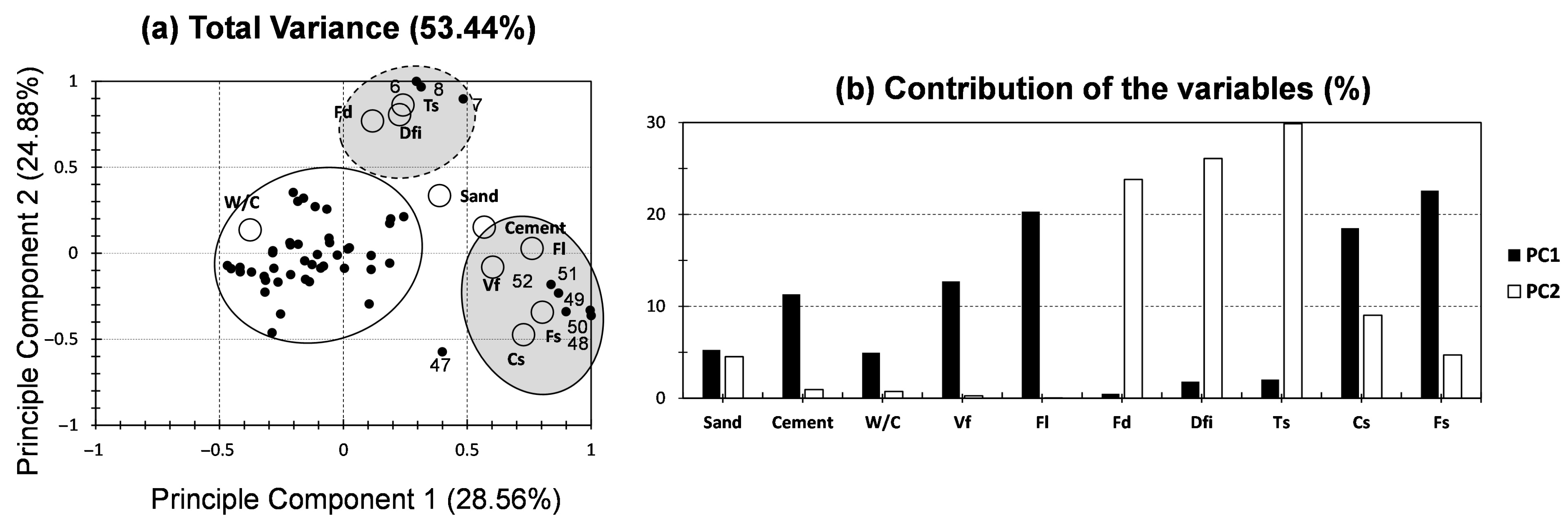
Figure 1. (a) PCA biplot representation of datasets for the mortar samples (Table 1), small black bullets indicate different materials in hand, big white bullets indicate the different properties involved. (b) contribution of the variables (%) following the first two PCs. Abbreviations: Cs = compressive strength (MPa); Fs = flexural strength (MPa); Vf = volume of fibers (%); Fl = fiber length (mm); Fd = fiber diameter (mm); Dfi = density of fibers (kg/m3); Ts = tensile strength (MPa); W/C = water-to-cement ratio.
Constrmater 06 00011 g001
Figure 2. (a) PCA biplot representation of datasets for the white cluster of Figure 1a, black small bullets indicate different materials in hand, white big bullets indicate the different properties involved. (b) contribution of the variables (%) following the first two PCs of (a). (c) PCA biplot representation of datasets outside of the white cluster of Figure 1a. (d) contribution of the variables (%) following the first two PCs of (c).
Constrmater 06 00011 g002
Figure 3. (a) PCA biplot representation of datasets for the cementitious materials (Table 1), with only the variables included in the gray full line cluster of Figure 1a, black small bullets indicate different materials in hand, white big bullets indicate the different properties involved. (b) contribution of the variables (%) following the first two PCs.
Constrmater 06 00011 g003
Figure 4. Predicted Cs by MLR (upper and lower bounds of 95%) modeling and relative residual analysis for the full line white cluster of Figure 2a: (a) Experimental Cs vs. Predicted Cs; (b) Standarized Residuals vs. Experimental Cs; (c) Standarized Residuals vs. Predicted Cs; (d) Standarized Residuals vs. Observations.
Constrmater 06 00011 g004
Figure 5. Predicted Fs by MLR (upper and lower bounds of 95%) modeling and relative residual analysis for the full line white cluster of Figure 2a: (a) Experimental Fs vs. Predicted Fs; (b) Standarized Residuals vs. Experimental Fs; (c) Standarized Residuals vs. Predicted Fs; (d) Standarized Residuals vs. Observations.
Constrmater 06 00011 g005
Figure 6. Predicted Cs by MLR (upper and lower bounds of 95%) modeling and relative residual analysis for the full line white cluster of Figure 3a: (a) Experimental Cs vs. Predicted Cs; (b) Standarized Residuals vs. Experimental Cs; (c) Standarized Residuals vs. Predicted Cs; (d) Standarized Residuals vs. Observations.
Constrmater 06 00011 g006
Figure 7. Predicted Fs by MLR (upper and lower bounds of 95%) modeling and relative residual analysis for the full line white cluster of Figure 3a: (a) Experimental Fs vs. Predicted Fs; (b) Standarized Residuals vs. Experimental Fs; (c) Standarized Residuals vs. Predicted Fs; (d) Standarized Residuals vs. Observations.
Constrmater 06 00011 g007
Table 2. Experimental test results were used to validate the prediction model (adopted from [61]).
Sample No.Vf *
(%)
Fd *
(mm)
Ts *
(MPa)
Fl *
(mm)
Experimental Flexural Strength, Fs
(MPa)
Experimental Compressive Strength, Cs
(MPa)
12.000.341104.4021.04
23.000.341103.7919.88
31.600.453104.0726.03
41.000.8155103.1914.31
52.000.8155104.6425.14
63.000.8155103.6922.74
70.750.3900155.0926.62
80.100.31415154.5424.01
90.200.31415154.5224.72
100.300.31415154.4827.37
* Vf = fiber volume fraction (%); Fd = fiber diameter (mm); Ts = fiber tensile strength (MPa); Fl = fiber length (mm); Fs = flexural strength (MPa); Cs = compressive strength (MPa).
Table 3. Validation of PC1 results.
Sample No.Experimental Flexural Strength, Fs (MPa)Predicted Fs
(MPa)
Error (%)—Predicted vs. ExperimentalExperimental Compressive Strength, Cs (MPa)Predicted Cs
(MPa)
Error (%)—Predicted vs. Experimental
14.404.717.07%21.0424.3315.62%
23.794.7224.61%19.8824.3422.44%
34.074.6414.01%26.0322.7712.51%
43.194.2332.85%14.3116.0712.28%
54.644.248.72%25.1416.0736.06%
63.694.2414.93%22.7416.0829.27%
75.092.9941.37%26.6216.5937.67%
84.543.9512.95%24.0120.8013.37%
94.523.9512.68%24.7220.8015.83%
104.483.9511.88%27.3720.8023.99%
Table 4. Validation of PC2 results.
Sample No. Experimental Flexural Strength, Fs (MPa)Predicted Fs
(MPa)
Error (%) Predicted vs. ExperimentalExperimental Compressive Strength, Cs (MPa)Predicted Cs
(MPa)
Error (%)—Predicted vs. Experimental
14.404.204.58%21.0417.8315.28%
23.794.2010.91%19.8817.8110.39%
34.074.203.25%26.0317.8431.48%
43.194.2031.78%14.3117.8424.72%
54.644.209.57%25.1417.8329.08%
63.694.2013.70%22.7417.8121.66%
75.095.100.10%26.6222.2516.41%
84.545.1012.43%24.0122.267.31%
94.525.1012.76%24.7222.269.95%
104.485.1013.79%27.3722.2618.69%
Disclaimer/Publisher’s Note: The statements, opinions and data contained in all publications are solely those of the individual author(s) and contributor(s) and not of MDPI and/or the editor(s). MDPI and/or the editor(s) disclaim responsibility for any injury to people or property resulting from any ideas, methods, instructions or products referred to in the content.