
Article

Coupled Effects of Confining Pressure and Freeze–Thaw Cycles on Shear Strength and Deformation Characteristics of Moraine Soil

1
Faculty of Geosciences and Engineering, Southwest Jiaotong University, Chengdu 611756, China
2
The 1st Geological Brigade of Sichuan, Chengdu 610072, China
*
Author to whom correspondence should be addressed.
Geotechnics 2026, 6(3), 87; https://doi.org/10.3390/geotechnics6030087
Submission received: 18 July 2026 / Revised: 29 August 2026 / Accepted: 2 September 2026 / Published: 4 September 2026
(This article belongs to the Special Issue Failure Mechanisms in Rock and Soil Masses Research)

Abstract

The mechanical properties of moraine soil in cold regions are significantly influenced by freeze–thaw cycles (FTCs). However, current understanding of the quantitative characteristics of its shear behavior under the coupled effect of FTCs and confining pressure is still insufficient. To address this, a series of triaxial unconsolidated-undrained shear tests were conducted on saturated moraine soil, with different numbers of FTCs (N = 0, 1, 4, 8, 10, 12, 15, 20) and various confining pressures (σ3 = 100, 200, 300, 400 kPa). The experimental results reveal that: (1) With an increase in the number of FTCs, the stress–strain curves gradually change from strain-softening to strain-hardening types. Correspondingly, the pore water pressure development shifts gradually from a peak-decay pattern to a growth-stabilization pattern. The peak pore water pressure rises linearly with increasing confining pressure, whereas it decays linearly with an increasing number of FTCs. (2) Both the secant modulus E50 and the shear strength increase with higher confining pressure and decrease with more FTCs. Confining pressure exerts a significant inhibitory and compensatory effect on freeze–thaw-induced damage, markedly reducing the deterioration rate under high confining pressure. (3) Quantitative prediction models for E50 and qmax were established, effectively capturing the coupled effect of confining pressure and FTCs. It can be inferred that confining pressure mitigates structural damage by compressing frost-induced cracks and enhancing interparticle contacts, while FTCs exacerbate the degradation of soil mechanical properties because of ice crystal expansion or contraction and weakening of cementation. This study quantifies the coupled effect of confining pressure and FTCs, and the proposed prediction model provides a useful reference or preliminary estimation for relevant geotechnical engineering designs.

1. Introduction

Moraine soil, a typical soil type prevalent in high-altitude and high-latitude regions such as the Qinghai–Tibet Plateau, the Alps, and polar areas, plays a critical role in the construction and long-term safety of engineering projects in cold environments—e.g., [1,2,3]. Characterized by a complex particle composition spanning clay, silt, gravel, and even boulders, this soil exhibits pronounced anisotropy and nonlinear mechanical behavior, which complicates its response to external environmental factors—e.g., [4,5]. Its poorly graded nature often includes large pores and high permeability, facilitating water migration and ice crystal formation—e.g., [6]. In glacial regions, seasonal FTCs act as a key driver of physical property deterioration and geomorphic evolution, altering the soil’s internal structure and influencing both regional stability and hydrological responses—e.g., [7].
In cold regions, the climate and freeze–thaw environment exhibit unique characteristics, manifested as long-term low temperatures, significant diurnal temperature variations, and frequent alternating FTCs. Research indicates that the freeze–thaw process typically leads to a decrease in soil strength, stiffness, and durability [8,9]. The research conducted by [10] indicates that the number of high-frequency FTCs and initial moisture content are key factors affecting the failure strength of moraine soil. Specifically, moraine soil strength undergoes significant deterioration of 30% to 40% under high-frequency freeze–thaw conditions, and this deterioration process tends to stabilize after 15 to 20 cycles. Ref. [11] studied the effects of FTCs and initial moisture content on the mechanical properties of moraine soil through triaxial tests. The results indicated that as the number of FTCs increases, the elastic modulus and shear strength of moraine soil initially decrease rapidly and then stabilize. The cohesion decreases exponentially, while the internal friction angle changes insignificantly. Similarly, Ref. [12] pointed out that after FTCs, the strain softening phenomenon of tillite is evident under high confining pressure, with cohesion decreasing exponentially as the number of FTCs increases. Ref. [13] demonstrated that shear strength gradually decreases with an increasing number of FTCs, accompanied by reductions in both the internal friction angle and cohesion. Ref. [14] observed similar patterns in Tibetan clay, finding that soil deformation under the same load significantly increases after FTCs. Ref. [15] highlighted the need to study the evolution of the physical and mechanical properties of loess under freeze–thaw conditions. Ref. [16] found that the strength, stiffness, and viscosity of frozen soil in a −6 °C environment gradually decrease with the increase in the number of FTCs until reaching a stable state. Focusing on moraine soil from the Qinghai–Tibet Plateau, ref. [17] noted that while porosity and uniaxial compressive strength undergo significant changes with increasing FTCs, particle characteristics and the internal friction angle remain relatively stable. This reflects the differential responses of various mechanical parameters to FTCs. Similarly, ref. [18] found that in red sandstone, FTCs not only affect its wave velocity and mechanical behavior but also alter its permeability characteristics, thereby compromising the stability of geological engineering. Different soils exhibit significant differences in their response to FTCs. Due to their large particle size and good pore connectivity, coarse-grained cohesionless soils experience rapid water migration and particle rearrangement, leading to distinct patterns in their mechanical behavior changes compared to cohesive soils [19]. Conversely, cohesive soils, with their fine particles, large specific surface area, and complex interparticle interactions, are more significantly affected by FTCs in terms of their structure and mechanical properties [20]. Furthermore, the initial state of the soil, particularly moisture content and dry density, is a crucial factor. Soils with high initial moisture content experience more pronounced ice expansion effects and more severe structural damage, whereas soils with high initial dry density, due to their compact structure, exhibit a certain degree of resistance to freeze–thaw damage [21,22]. These research findings confirm that freeze–thaw cycles induce irreversible structural damage in rock and soil masses in cold regions through the volumetric expansion and water migration triggered by water phase change. This damage manifests macroscopically as nonlinear degradation of strength and stiffness, which eventually stabilizes; microscopically, it is characterized by the loss of cohesion. Further elucidating the underlying mechanisms governing the variation in the internal friction angle and cohesion under different soil conditions, as well as developing a rigorous quantitative control equation for how initial state parameters influence the freeze–thaw damage threshold, can provide a theoretical foundation for the stability assessment of engineering projects in cold regions.
Moraine soil is frequently subjected to repeated FTCs. The volumetric expansion and contraction associated with water phase changes within the soil continuously modify its microstructure, which in turn significantly influences its macroscopic mechanical properties [23]. Advanced investigations such as CT scanning have revealed that freeze–thaw action can markedly alter the pore structure of moraine soil samples, affecting their permeability and mechanical behavior [24,25]. During freezing, water expansion compresses soil particles and disrupts the initial fabric; during thawing, cementation weakens and pores reorganize. Furthermore, freeze–thaw processes drive physical weathering mechanisms including recrystallization, ice lens growth, and cryosuction, promoting both the breakdown and formation of micro-scale features in moraine soil, and even contributing to the shaping and expansion of blockfield landscapes. Particularly during glacier retreat, the ice-wedge effect exerts a notable influence on slope stability [26]. It can be observed that the water phase transition (volume expansion and contraction) in glacial till soils induced by freeze–thaw cycles leads to alterations in the pore structure, cementation failure, and particle reorganization, thereby influencing their macroscopic mechanical properties. These findings provide valuable insights for understanding the degradation mechanisms of glacial till soils in cold regions. Particularly in the context of glacial retreat, conducting in-depth research on the cumulative damage effect in glacial till soils under freeze–thaw cycle conditions holds significant research relevance for the prevention and prediction of geological hazards in cold regions.
Despite the significant progress made to date, there remains a lack of systematic quantification of the coupled effects of confining pressure and FTCs on the shear characteristics of moraine soil, such as pore water pressure evolution and deformation modulus. To address this gap, this study employs systematic triaxial testing to investigate key parameters including the stress–strain response, strength characteristics, and deformation behavior of moraine soil subjected to FTCs. By analyzing the coupled mechanism through which confining pressure and FTCs influence moraine soil damage, this work quantitatively characterizes their interactive effects. The findings contribute to a deeper understanding of the evolution mechanisms governing moraine soil mechanics in complex cold-region environments and support the advancement of cold-region soil mechanics theory.

2. Materials and Testing Methods

2.1. Test Material

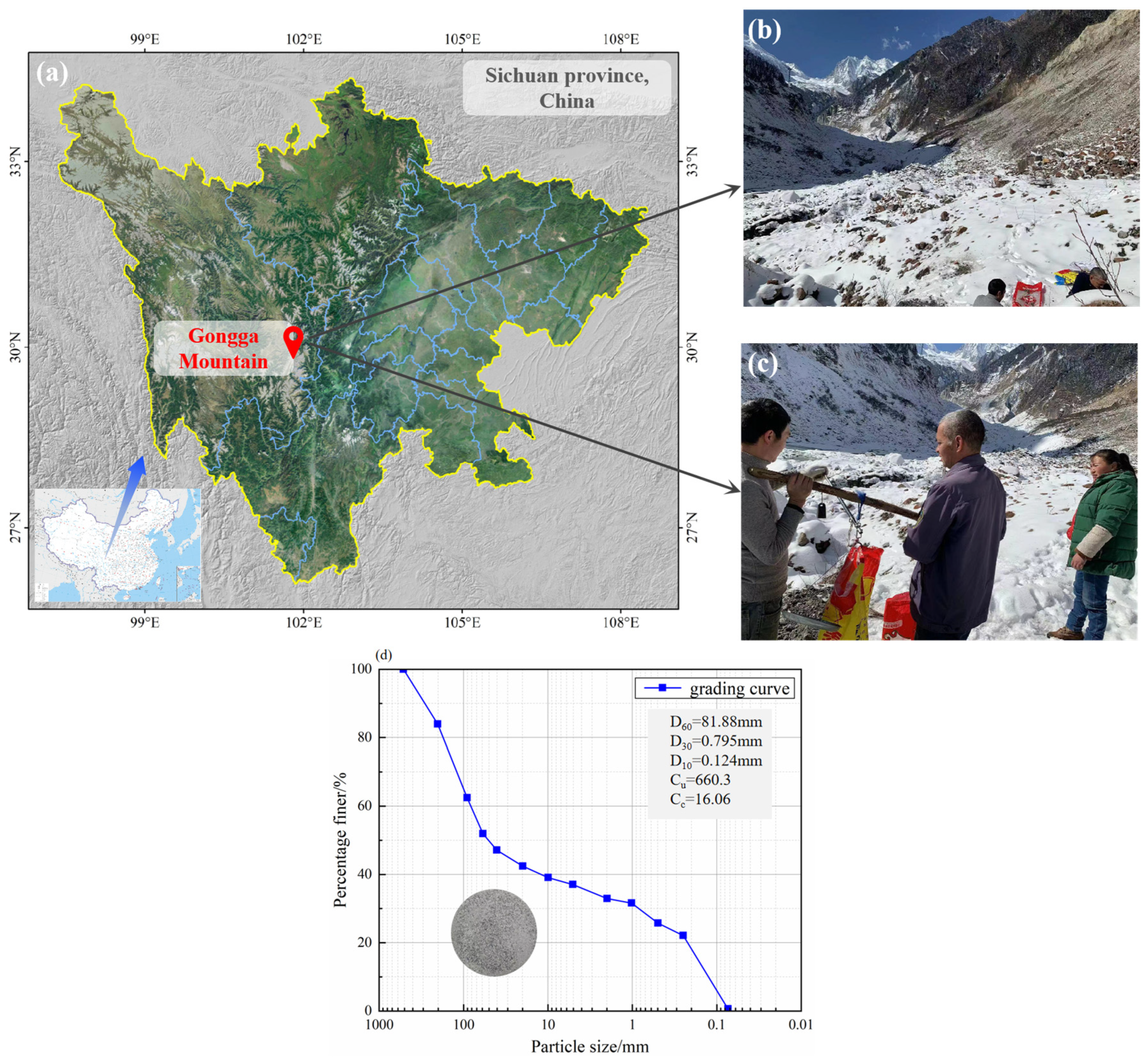
The moraine soil used in this study was obtained from Yanzigou in the Ganzi Tibetan Autonomous Prefecture of Sichuan Province, China, at a sampling elevation of approximately 2953 m. The specific sampling location is shown in Figure 1a–c. Basic physical property tests, including particle size distribution, natural density, and natural moisture content, were conducted on the undisturbed samples. The results are presented in Figure 1 and Table 1, respectively. Particle gradation analysis shows that the natural moraine soil has a uniformity coefficient of 660.3 and a curvature coefficient of 0.0624. According to the Unified Soil Classification System, the soil is classified as poorly graded.
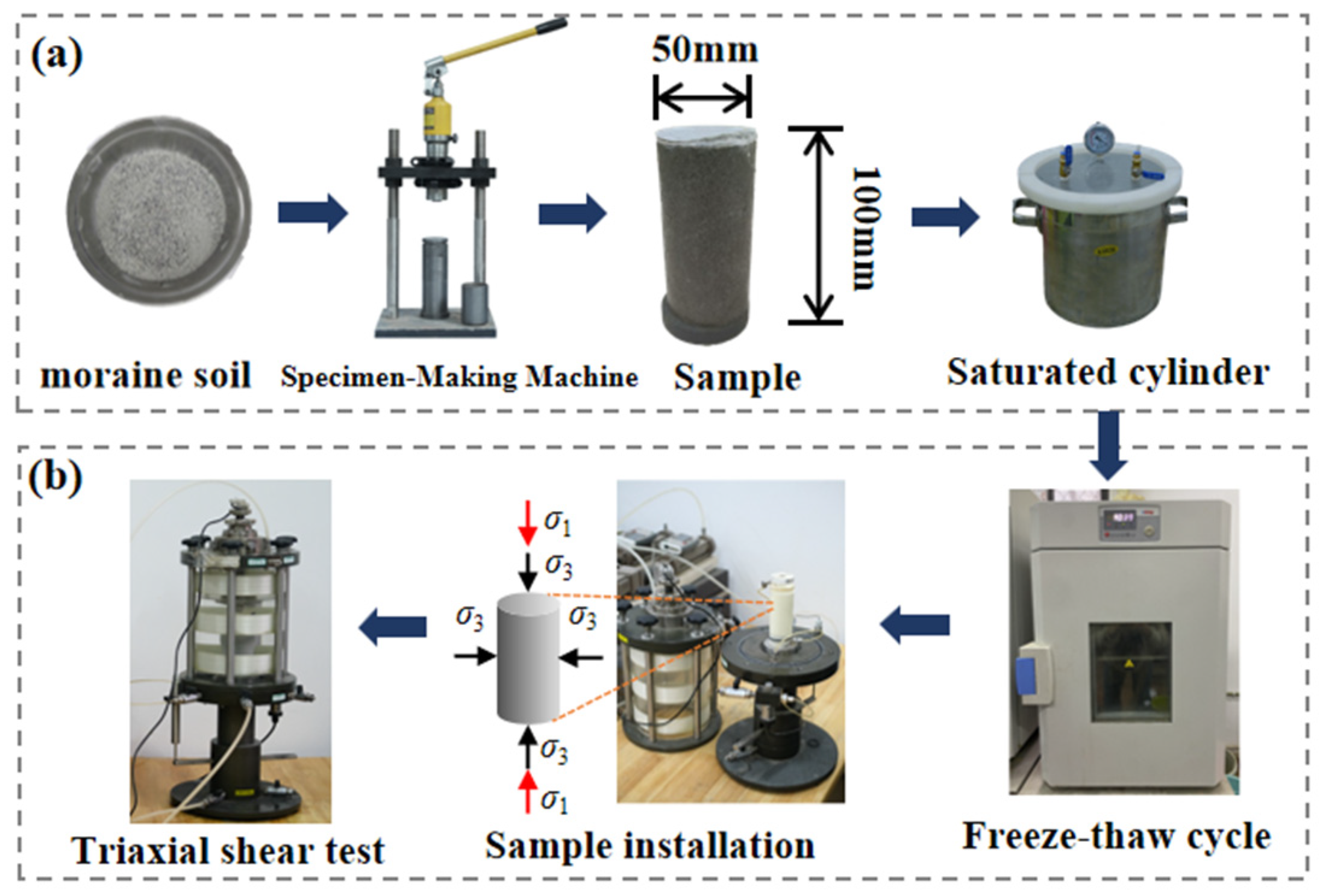
Soil samples with particle sizes less than 5 mm were prepared according to particle size distribution; the moisture content and dry density of these samples were controlled at 6% and 1.73 g/cm3, respectively. The soil sample mixture was divided into three equal portions and compacted into standard specimens measuring 100 mm in height and 50 mm in diameter using the YL-15T hydraulic sample preparation machine made in Yuhuan, China. The soil samples were saturated using the vacuum saturation method, with a vacuum extraction time of 2 h and a saturation time of 12 h. To prevent changes in the moisture content of the specimens during the freeze–thaw cycle, the specimens were sealed with plastic film.

2.2. Freeze–Thaw Cycles Tests

Given that the mechanical properties of soil typically stabilize after approximately 10~15 FTCs [27], this study defined eight levels of FTCs (0, 1, 4, 8, 10, 12, 15, and 20). The experiments were conducted using a high-precision temperature-controlled chamber capable of precisely regulating both the temperature range and the rate of change. The specific procedure was as follows: First, the prepared saturated specimens were sealed in plastic bags to prevent moisture evaporation and then placed in the temperature chamber. The temperature was lowered from room temperature to −15 °C at a rate of 1 °C/h and maintained for 12 h, after which it was raised at the same rate to 15 °C and similarly held for 12 h. This protocol ensured that each freeze–thaw cycle included sufficient durations of freezing and thawing, allowing complete phase transitions and microstructural adjustments to occur within the specimens.

2.3. Triaxial Tests

Triaxial shear testing was performed using a GDS stress-path triaxial testing system, which comprises a triaxial pressure chamber, confining pressure controller, back-pressure controller, axial load controller, and data acquisition system. The main technical specifications of the system are as follows: maximum axial load of 7 kN, axial displacement 25 mm, confining pressure range 0~1.3 MPa, and back-pressure range 0–3 MPa. Standard cylindrical specimens (50 mm in diameter and 100 mm in height) were prepared by compacting moraine soil with a YL-15T hydraulic sample preparation machine. To examine the influence of freeze–thaw action on soil behavior under different loading conditions, particularly to simulate its pronounced effect on shallow soil layers, four levels of confining pressures (100 kPa, 200 kPa, 300 kPa, and 400 kPa) were applied. Strain-controlled loading was adopted for the shear tests, with an axial strain rate of 0.5 mm/min under unconsolidated undrained conditions until the axial strain reached 15%. The sample preparation process and key testing instruments are illustrated in Figure 2.

3. Mechanical Properties

3.1. Stress–Strain Behaviors

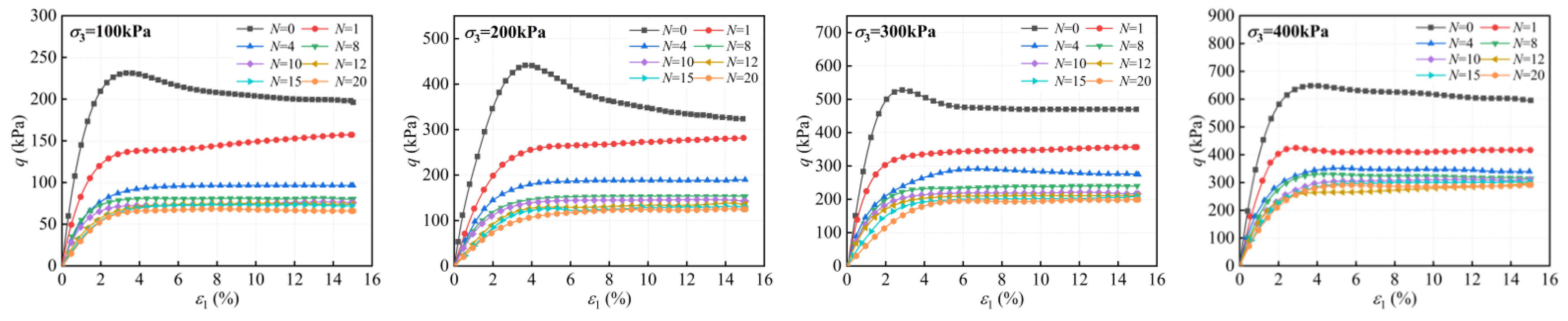
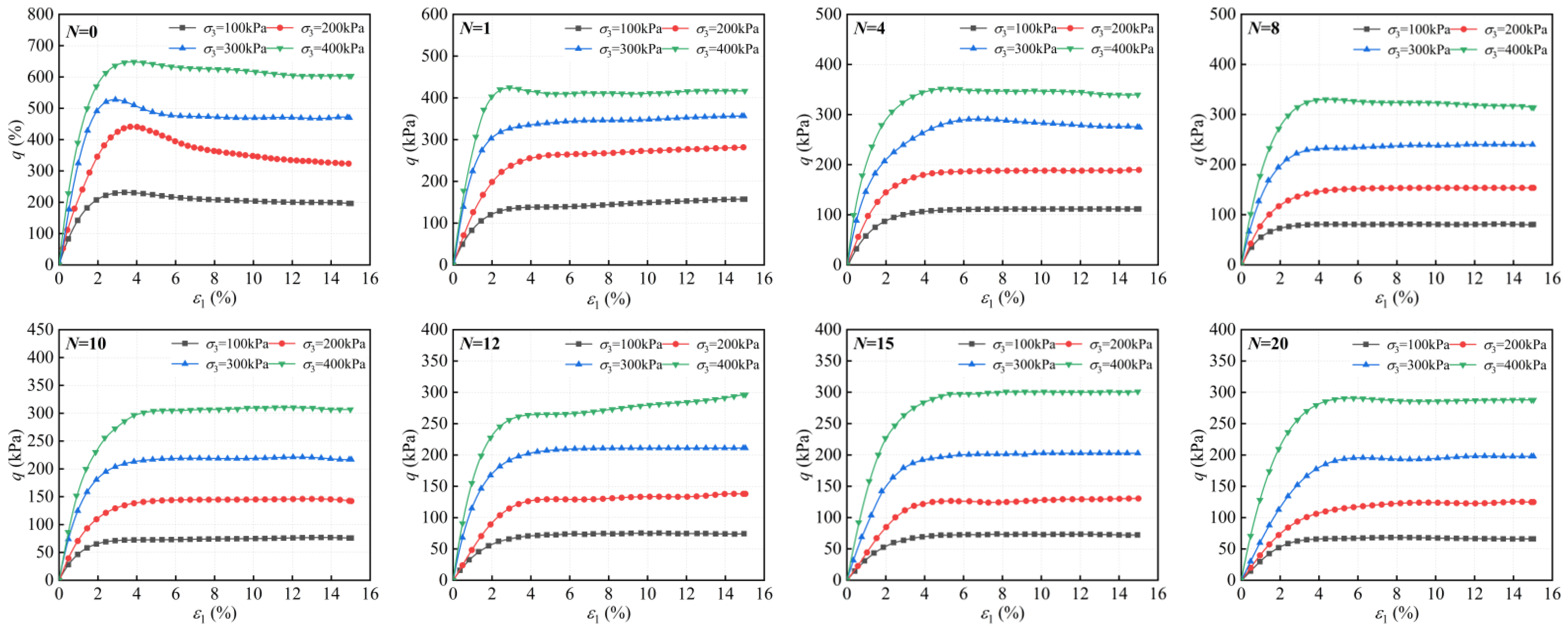
Figure 3 illustrates the stress–strain behavior of moraine soil under different confining pressures from 100 kPa to 400 kPa, subjected to various numbers of FTCs (0–20). All specimens without freeze–thaw history exhibited marked strain-softening behavior. As the number of FTCs increased, the shape of the curves gradually transitioned from strain softening toward strain hardening. This transition reflects the profound influence of freeze–thaw action on the deformation mechanism of the soil. These results are consistent with [12], who reported that strain softening in moraine soil becomes more pronounced under higher confining pressures. Additionally, the peak stress was maximal in the initial state and underwent progressive degradation as the number of FTCs increased, demonstrating the complete evolution of the soil’s deformation characteristics.
Figure 4 further illustrates the influence of confining pressure on the shear strength. As the confining pressure rises from 100 kPa to 400 kPa, the peak stress of the stress–strain curve increases markedly, by approximately threefold. This demonstrates the pronounced strengthening effect of confining pressure on the shear strength of moraine soil. Moreover, the residual strength of the specimen increases synchronously with increasing confining pressure, indicating that under high confining pressure the soil can retain considerable load-carrying capacity even after shear failure. This behavior provides important insight for assessing long-term stability and for the design of engineered foundations and slopes in cold regions.
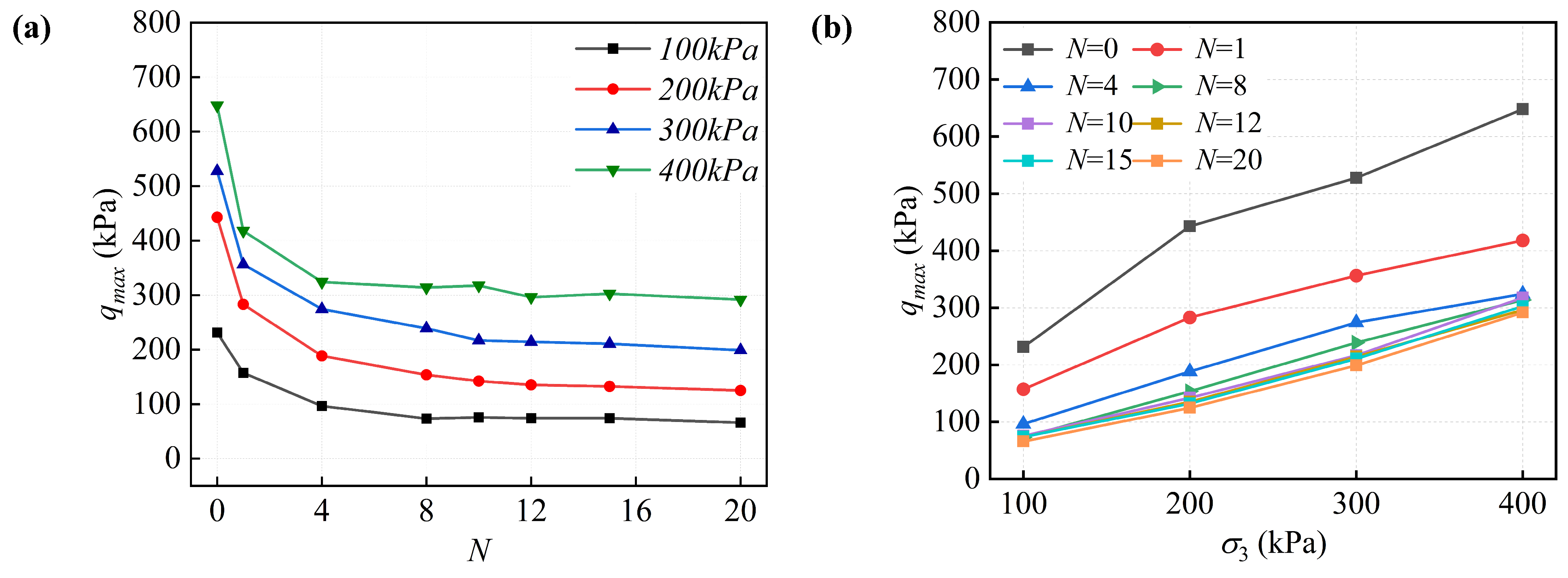
Following the established criterion for determining shear strength-namely, taking the peak stress for strain-softening curves and the stress at 15% axial strain for strain-hardening curves [28]. Figure 5a reveals the evolution pattern of shear strength with increasing number of freeze–thaw cycles. The analysis indicates that shear strength exhibits a decreasing trend as the number of FTCs rises, with the decay rate gradually slowing. For a given number of FTCs, the shear strength shows an approximately linear increase with confining pressure in Figure 5b. Specifically, during the initial stage of freeze–thaw cycling (approximately the first four cycles), the reduction in strength is most pronounced. However, beyond four cycles, the decay rate noticeably moderates.
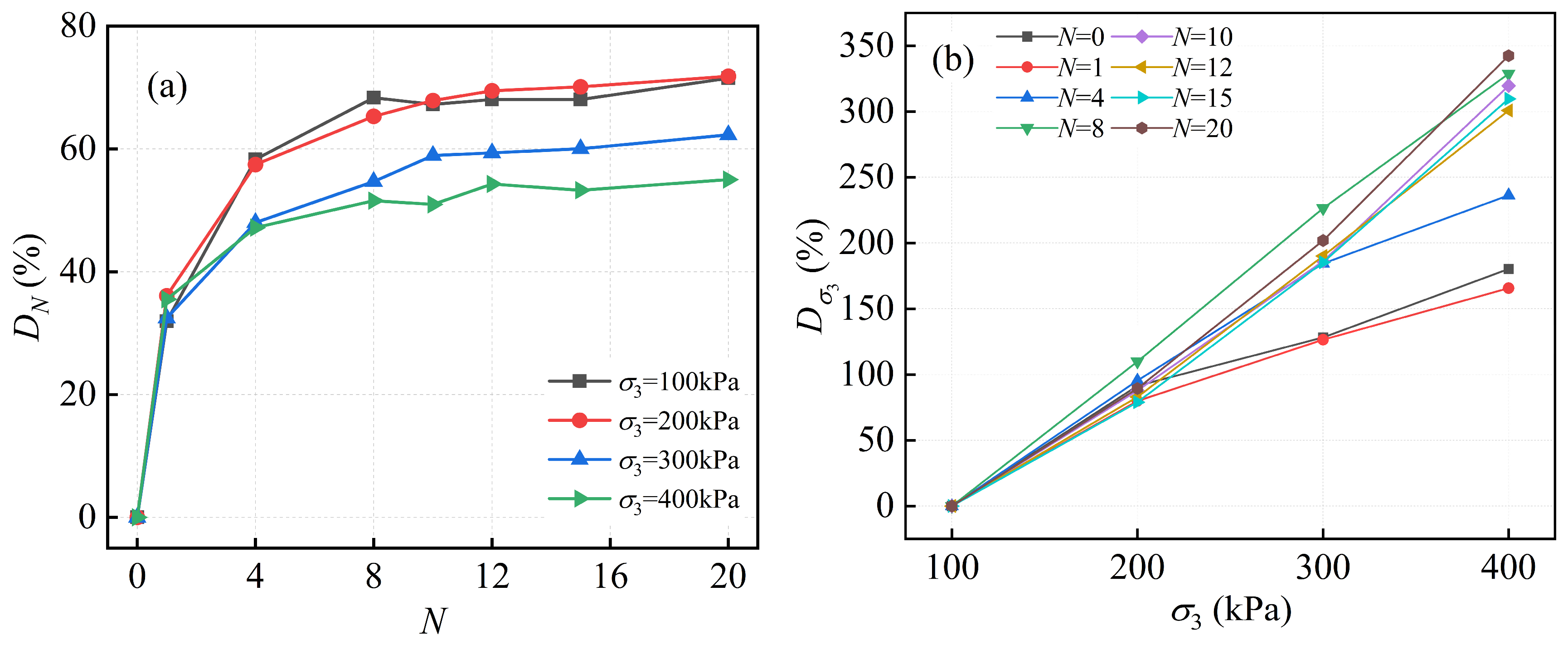
The freeze–thaw and thawing process of water in soil, which is a repeated phase transition process, is the main mechanism causing damage to soil structure. It disrupts the original soil fabric and weakens interparticle cementation, resulting in strength degradation, i.e., an attenuation effect. In contrast, increased confining pressure enhances interparticle constraints and contact forces, effectively inhibiting particle sliding and displacement during shearing, thereby producing an enhancement effect. To quantitatively assess the degradation induced by freeze–thaw action and the enhancement due to confining pressure, two indices are introduced: the shear strength attenuation rate D N , which characterizes the degree of strength reduction caused by FTCs, and the shear strength growth rate D σ 3 , which reflects the extent of strength improvement resulting from confining pressure. Their mathematical expressions are defined as follows:
D N = ( 1 q m a x , N q m a x , 0 ) × 100 %
D σ 3 = ( q m a x , σ 3 q m a x , σ 0 1 ) × 100 %
where D N denotes the attenuation rate of shear strength, while D σ 3 represents the growth rate of shear strength; q max , N is the shear strength after N FTCs, and q max , 0 is the shear strength of the specimen without freeze–thaw treatment; q max , σ 3 denotes the shear strength under a given confining pressure, and q max , σ 0 is the shear strength under the reference confining pressure of 100 kPa.
Figure 6 illustrates the variation patterns of the shear strength attenuation rate and the corresponding strength enhancement rate in the moraine soil. The analysis results indicate that the strength attenuation rate under high confining pressure is consistently lower than that under low confining pressure. For example, after 20 FTCs, the strength at a confining pressure of 400 kPa decreased from 648 kPa to 291 kPa, corresponding to a reduction of approximately 55%. In contrast, at a confining pressure of 100 kPa, the strength declined sharply from 231 kPa to 65.9 kPa, representing a decrease of about 71%. Simultaneously, the enhancing effect of confining pressure becomes more pronounced with an increasing number of FTCs. In the absence of FTCs, raising the confining pressure from 100 kPa to 400 kPa increased the shear strength from 231 kPa to 648 kPa, representing an enhancement of approximately 180%. After 20 FTCs, however, the same increase in confining pressure raised the strength from 65.9 kPa to 292 kPa, corresponding to an increase of about 343%. These results suggest that as freeze–thaw damage becomes more severe, the compensatory and stabilizing effects of confining pressure on shear strength become more prominent, further supporting the inhibitory role of confining pressure on freeze–thaw-induced deterioration.

3.2. Pore Water Pressure

Under undrained shear conditions, the development of pore water pressure is a key factor controlling the deformation and strength behavior of saturated soil. Its evolution is influenced by multiple factors, including the stress–strain relationship and the stress path [29]. Figure 7 illustrates the influence of freeze–thaw cycles on the pore pressure—axial strain curves of the moraine soil under the same confining pressure. As shown, at low numbers of FTCs (0 and 1 cycles), the pore water pressure rises rapidly to a peak at the onset of shearing and then decreases markedly, exhibiting a typical peak-decline pattern. As the number of FTCs increases, the pore pressure curve still rises quickly in the initial stage, with no distinct peak followed by a drop; instead, it gradually stabilizes or continues to increase slowly, transitioning to a monotonic increase or stabilization pattern. This evolution indicates that freeze–thaw cycling significantly alters the shear response of the moraine soil. This transition visually reflects the restructuring effect of freeze–thaw action on the internal fabric of the soil: freeze–thaw damage weakens interparticle bonds and reduces skeleton stability, making the soil more prone to compression and particle rearrangement.
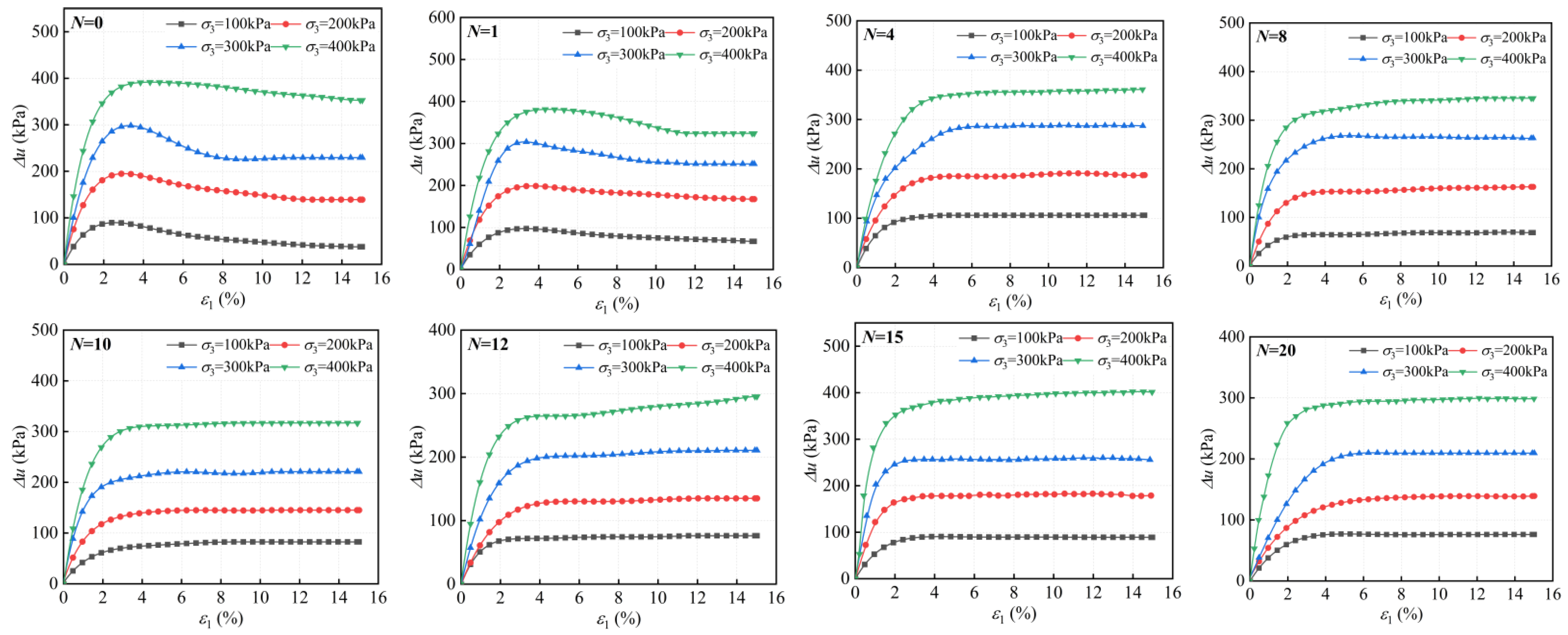
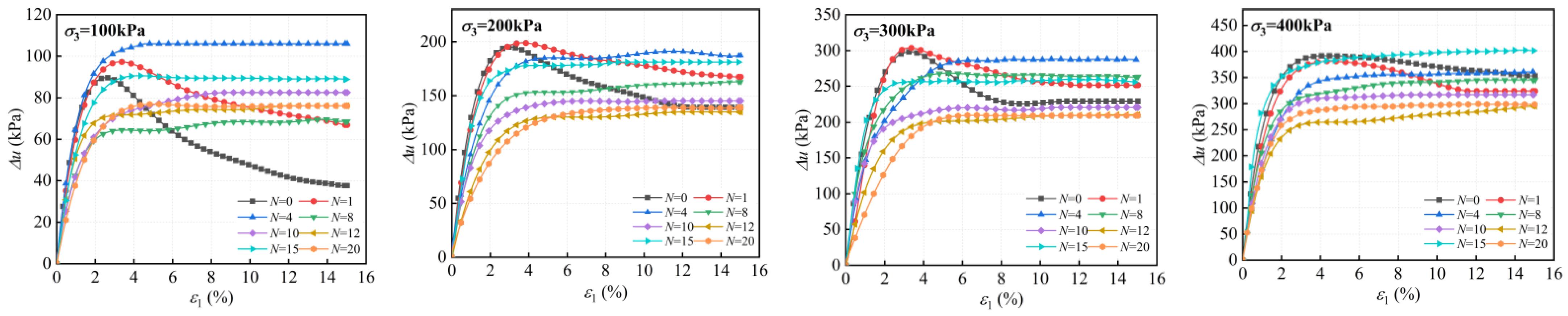
Figure 8 illustrates the influence of different confining pressures on the pore pressure-axial strain curves of the moraine soil under the same number of FTCs. Overall, higher confining pressure leads to a more rapid increase in pore water pressure ( Δ u ) and a significantly higher peak value ( Δ u max ). For instance, without FTCs, Δ u max reaches 185 kPa at a confining pressure of 400 kPa, whereas it is only 85 kPa at 100 kPa. Specifically, when the number of FTCs is relatively low (0 and 1 cycle), the pore pressure curves under various confining pressures exhibit a typical three-stage pattern: rapid rise, peaking and subsequent gradual decline. This trend is particularly pronounced under low confining pressures. When the number of FTCs reaches or exceeds 4, the pore pressure curves evolve into a monotonically increasing trend followed by gradual stabilization, with no significant peak drop observed. This evolution reflects the systematic alteration of the soil’s internal structure induced by freeze–thaw action. In the early stages of freeze–thaw cycling, the soil structure remains relatively intact, and the dilative behavior during shearing governs the peak pore pressure response. As FTCs increase, continuous internal restructuring effectively suppresses volumetric changes during shearing, thereby stabilizing the pore pressure response. These findings further confirm the profound impact of freeze–thaw damage on the shear mechanism of the soil.
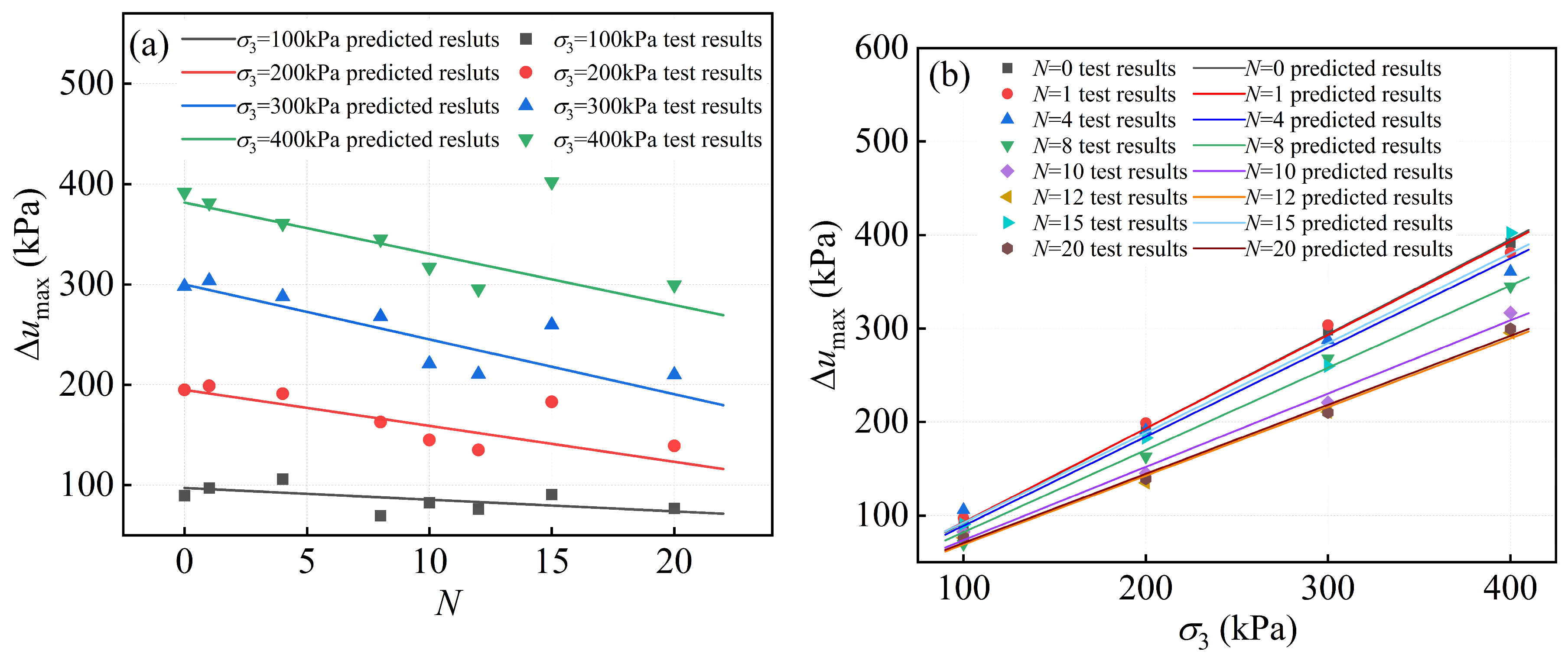
Figure 9 presents the peak pore water pressure Δ u max of the moraine soil under different numbers of FTCs and different confining pressures. As shown in Figure 9a, Δ u max gradually decreases as the number of FTCs increases. Taking a confining pressure of 400 kPa as an example, after 20 FTCs Δ u max decreases by approximately 65% compared with the initial state (N = 0). This reduction is primarily attributed to the continuous alteration of the soil pore structure and the weakening of skeleton stability induced by freeze–thaw cycling, which diminishes the soil’s ability to generate and accumulate pore water pressure during shearing. Moreover, this alteration process exhibits an early stage of rapid change followed by a tendency to stabilize in later cycles. Furthermore, Δ u max increases markedly with rising confining pressure, as illustrated in Figure 9b. For instance, at N = 20, Δ u max under 400 kPa confining pressure is about 65% higher than that under 100 kPa. Mechanistically, higher confining pressure effectively compresses the pore space and enhances skeletal constraints, thereby improving the transmission and accumulation efficiency of pore water pressure. As shown in Figure 9, Δ u max exhibits an approximately negative linear correlation with the number of FTCs and a positive linear correlation with confining pressure, which can be represented by Equations (3) and (4), respectively.
u m a x = a N + b
u m a x = l σ 3 + m
where a, b, l and m are fitting parameters; the number of freeze–thaw cycles (N) was set to 0, 1, 4, 8, 10, 12, 15, and 20; and the confining pressures ( σ 3 ) were 100 kPa, 200 kPa, 300 kPa, and 400 kPa.
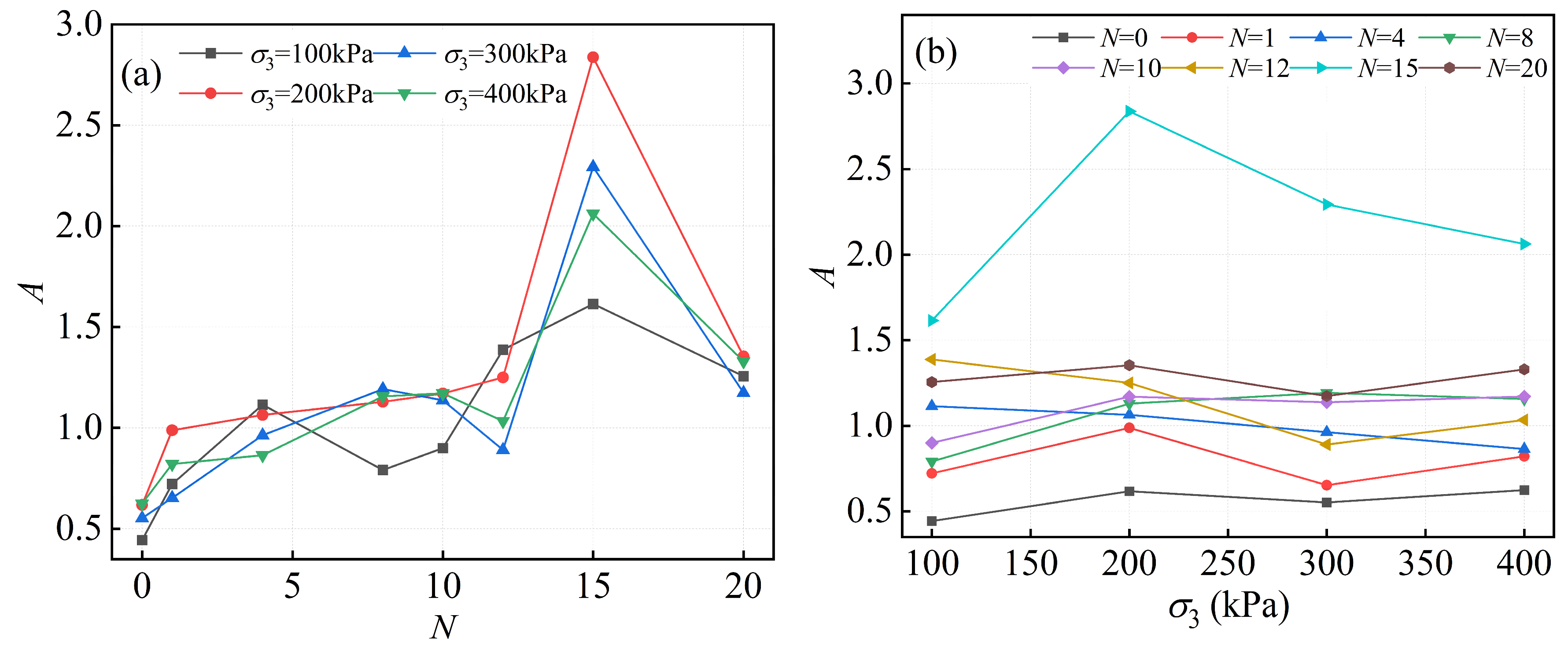
The pore pressure coefficient A (defined as the ratio of pore water pressure increment Δ u to deviatoric stress increment Δ q at failure) is the response of pore water pressure to stress changes in saturated soil. As shown in Figure 10a, A increases significantly with the number of FTCs. Taking a confining pressure of 400 kPa as an example, after 20 FTCs, A rises from an initial value of 0.62 to 1.33. This transition is primarily due to the structural loosening caused by freeze–thaw action, which facilitates particle sliding and rearrangement during shearing. When A exceeds 1, the tendency for shear failure increases markedly, a phenomenon that becomes particularly pronounced after a high number of FTCs. The relationship between the pore pressure coefficient A and confining pressure is shown in Figure 10b. Under low confining pressures, it can be inferred that soil structural constraints are weaker, and particle sliding and structural instability during shearing occur abruptly, leading to sharp pore-pressure release and thus a wider variation in A. In contrast, under high confining pressures, soil structural stability is enhanced; shear failure manifests as a more gradual process dominated by particle reorganization and compaction, with a gentler pore-pressure release, resulting in a narrower range of A values. Furthermore, confining pressure changes the initial state and volumetric trend of the soil during shearing. Low confining pressure promotes dilation and pore-pressure drop, while high confining pressure enhances contraction and pore-pressure rise. In addition, it should be noted that a distinct non-monotonic peak is observed around N = 15 in Figure 10. We suggest that this peak may be attributed to the transitional state of the soil internal structure between structural degradation and particle rearrangement at 15 freeze–thaw cycles, leading to a transient fluctuation in the pore pressure response.
Based on the above analysis, there is a coupled interaction between FTCs and confining pressure on the evolution of pore pressure coefficient A. FTCs induce the degradation of soil structure and aggravate structural instability to promote the increase in A, while confining pressure provides stronger structural constraints to suppress the fluctuation of A and partially compensates for the mechanical damage caused by freeze–thaw cycles.

3.3. Deformation Modulus Evolution

In geotechnical engineering, the secant modulus is a key mechanical parameter characterizing the stress–strain relationship. It reflects the soil’s deformation resistance and forms an important basis for foundation settlement estimation, subgrade stiffness design, and slope stability analysis [12]. To investigate the influence of FTCs and the confining pressure on the deformation characteristics of moraine soil, the secant modulus is defined as follows in Equation (5).
E 50 = ( σ 1 σ 3 ) 50 % ε 1,50 %
where E 50 denotes the secant modulus, ( σ 1 σ 3 ) 50 % refers to 50% of the peak deviatoric stress, and ε 1 , 50 % represents the axial strain corresponding to ( σ 1 σ 3 ) 50 % .
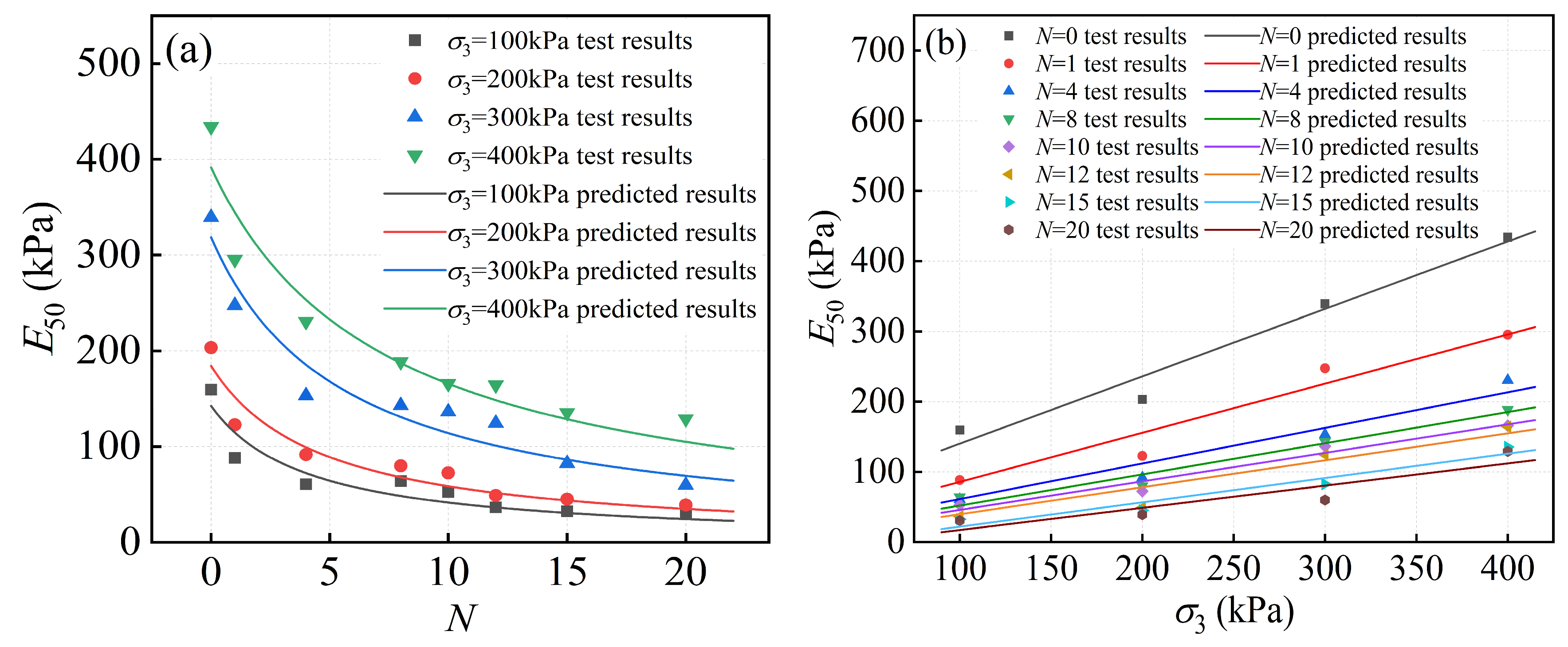
Figure 11 illustrates the evolution of the secant modulus E 50 with the number of FTCs and confining pressure. Figure 11a shows the relationship between E 50 of the moraine soil and the number of FTCs (N) under different confining pressures. For instance, under a confining pressure of 100 kPa, E 50 decreases from 160 kPa to 30 kPa after 20 freeze–thaw cycles, representing a reduction of 81%. In contrast, under 400 kPa, it declines from 434 kPa to 129 kPa, corresponding to a reduction of 70%. Notably, beyond 4 FTCs, the rate of decrease in E 50 slows markedly, with subsequent variations limited to approximately 5% per cycle. Overall, E 50 gradually decreases as the number of FTCs increases, and its variation can be described by the following empirical relationship.
E 50 = a b + N
where a and b are fitting parameters, N denotes the number of FTCs, and the number of freeze–thaw cycles (N) was set to 0, 1, 4, 8, 10, 12, 15, and 20.
Figure 11b indicates a pronounced positive correlation between E 50 and confining pressure ( σ 3 ). For each 100 kPa increase in confining pressure, E 50 rises by an average of approximately 37% (using N = 0 as an example), illustrating the enhancing effect of confining pressure on soil stiffness. However, with an increasing number of FTCs, this enhancement gradually diminishes.
This behavior can be attributed to two main mechanisms: On one hand, the frost-heave pressure generated during FTCs expands and interconnects pores within the soil, resulting in the progressive accumulation of structural damage and thus reducing the soil’s resistance to deformation (with the damage rate initially increasing rapidly and then decelerating as FTCs proceed). On the other hand, confining pressure effectively suppresses freeze–thaw-induced structural damage by strengthening interparticle contact constraints, thereby enhancing the stiffness of the soil. Ultimately, the interplay between freeze–thaw cycles and confining pressure collectively governs the evolution of stiffness parameters in moraine soil.

3.4. Shear Strength Parameters

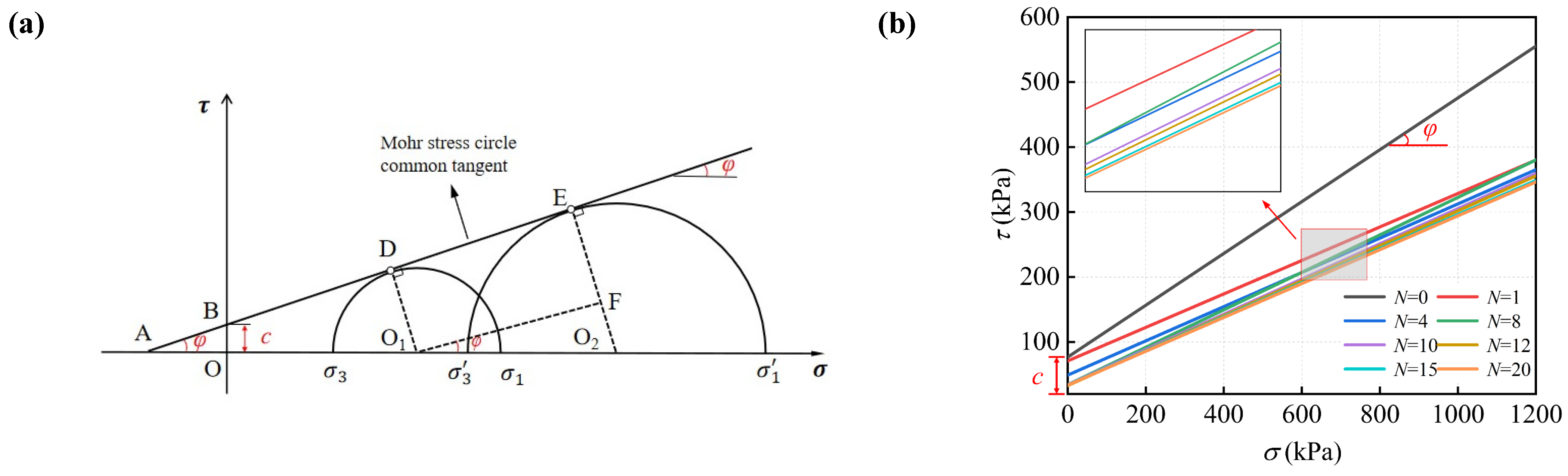
Based on the Mohr-Coulomb strength theory, strength envelope curves for the moraine soil under different numbers of FTCs were derived from triaxial test results under various confining pressures, as shown in Figure 12. It should be noted that the stresses used to plot the Mohr’s circles in Figure 12a are effective stresses; consequently, the strength parameters determined from the strength envelope in Figure 12b are effective stress strength parameters. These strength envelopes exhibit clear linearity, consistent with the Mohr-Coulomb failure criterion. The results show that with increasing FTCs, both the slope (reflecting the internal friction angle φ) and the intercept (representing the cohesion c) of the strength envelope decrease significantly.
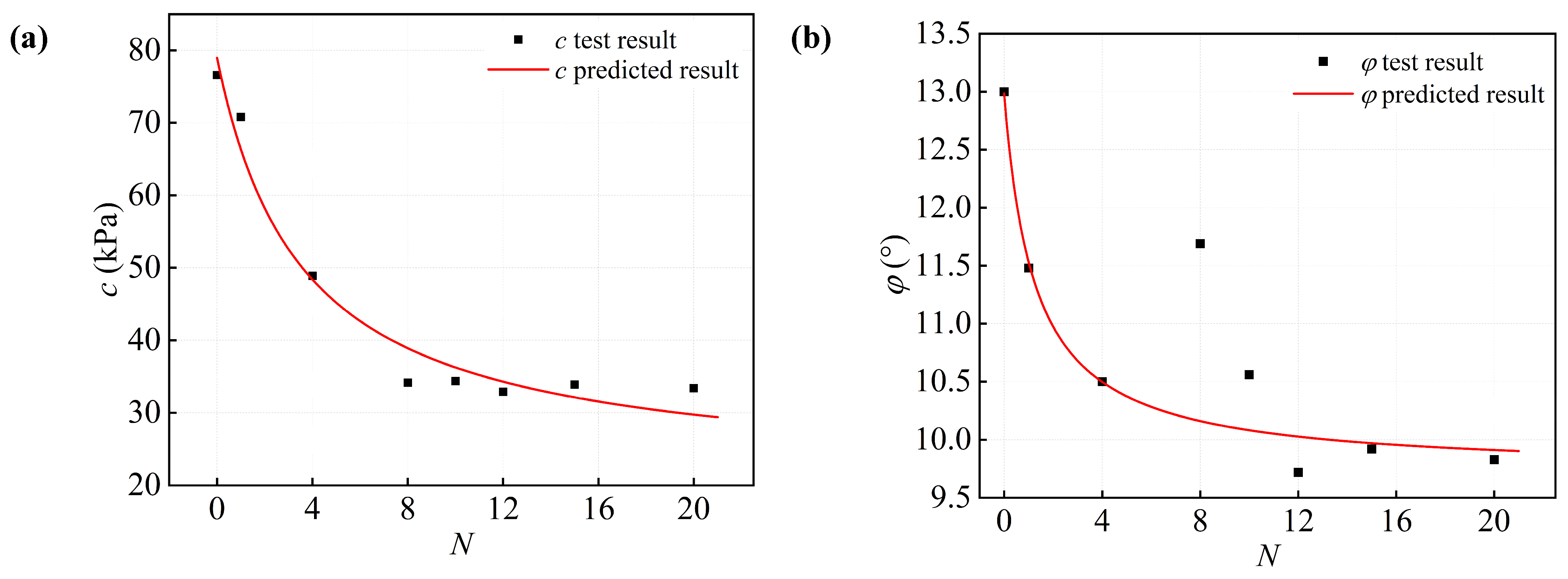
Based on the strength envelopes, the cohesion (c) and internal friction angle (φ) of the moraine soil were determined for different numbers of FTCs, and their evolution is presented in Figure 13. Both cohesion and internal friction angle generally decrease as the number of FTCs increases. After 20 cycles, cohesion decreases markedly from an initial value of 78 kPa to 39 kPa, while the internal friction angle declines from 13° to 9.5°. Fitting analysis shows that the relationship between cohesion and the number of FTCs follows a negative exponential function, as expressed in Equation (7).
c = c 0 e x p ( a × N )
where c 0 represents the cohesion prior to freeze–thaw cycling, N denotes the number of FTCs, and a is a fitting parameter. In this study, the number of freeze–thaw cycles (N) was set to 0, 1, 4, 8, 10, 12, 15, and 20.
This relationship indicates that cohesion decreases most rapidly during the initial FTCs, after which the rate of decay gradually slows. This behavior is attributed to the progressive disruption and weakening of cementitious bonds between soil particles induced by freeze–thaw action. As cycling continues, the soil fabric gradually reorganizes toward a new equilibrium, and the remaining cementation exhibits greater resistance to further freeze–thaw damage, leading to a stabilized decay trend. In contrast, the internal friction angle shows relatively little variation with freeze–thaw cycling, remaining largely stable overall. This suggests that FTCs have limited influence on the intrinsic frictional characteristics of the moraine soil particles. The internal friction angle is primarily controlled by particle shape, surface roughness, and gradation-properties that do not undergo fundamental alteration during freeze–thaw processes. Although freeze–thaw may induce local particle rearrangement and cause minor fluctuations in the internal friction angle, the interlocking and frictional behavior between particles remains relatively consistent throughout the cycling.

3.5. Coupled Effects of Confining Pressure and FTCs

This study reveals that key mechanical parameters of the moraine soil, including the secant modulus ( E 50 ), shear strength (qmax), and peak pore water pressure ( Δ u max ), exhibit a dual dependence on confining pressure and FTCs. The evolution patterns and quantitative prediction models for each parameter are summarized below.
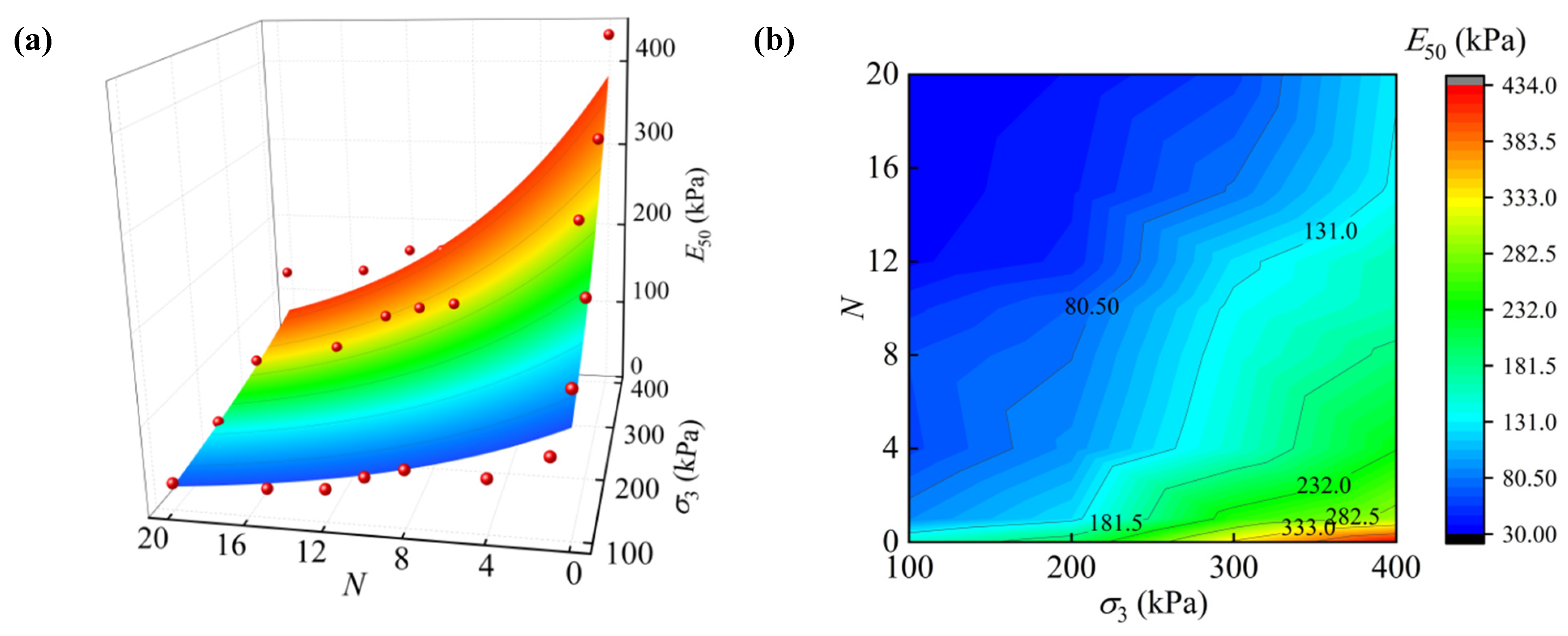
For a given number of FTCs, E 50 increases with increasing confining pressure; under a fixed confining pressure, it decreases as FTCs accumulate. After 15 FTCs, the value of E 50 at 400 kPa confining pressure is approximately 3.5 times that at 100 kPa, whereas for unfrozen specimens, the corresponding increase is only 2.8 times. This indicates that confining constraints can effectively compensate for stiffness loss induced by freeze–thaw action. In this study, the number of freeze–thaw cycles (N) was set to 0, 1, 4, 8, 10, 12, 15, and 20, and the confining pressures ( σ 3 ) were 100 kPa, 200 kPa, 300 kPa, and 400 kPa; a coupled prediction model derived from the experimental data is given in Equation (8). The model comprehensively captures both the strengthening role of confining pressure and the damaging effect of freeze–thaw cycles as illustrated in Figure 14.
E 50 = 12.8 + 5.4 ( σ 3 6.4 ) / ( N + 5.4 )
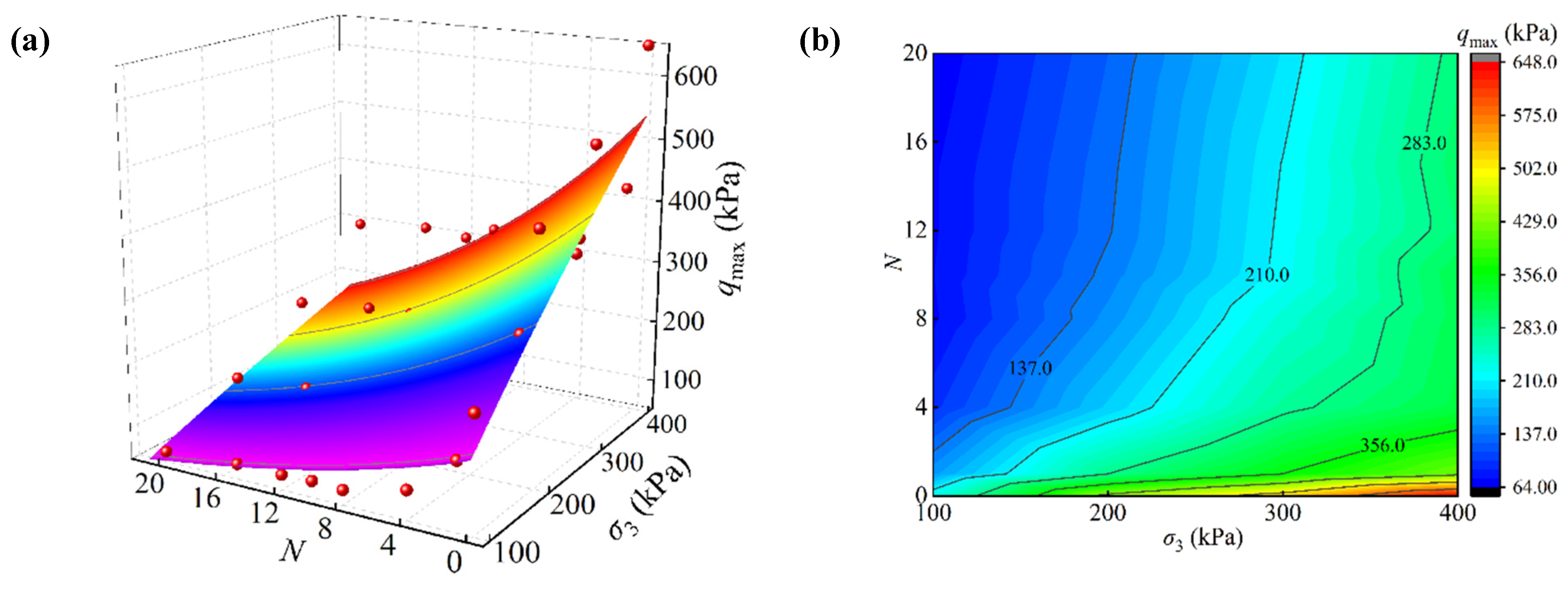
Figure 15 illustrates the variation in shear strength qmax. The shear strength increases markedly with rising confining pressure, showing a clear positive correlation, as higher confining pressure enhances interparticle constraints and frictional resistance. In contrast, qmax gradually decreases as the number of FTCs increases, with the reduction being especially pronounced under low confining pressure, reflecting the degrading effect of freeze–thaw action on soil structure. By fitting a three-dimensional surface to the data, the prediction model given in Equation (9) is obtained. Specifically, the number of freeze–thaw cycles (N) was set to 0, 1, 4, 8, 10, 12, 15, and 20, while the confining pressures ( σ 3 ) were 100 kPa, 200 kPa, 300 kPa, and 400 kPa.
q m a x = 2.643 + 4.141 σ 3 0.812 e x p ( 0.053 N )
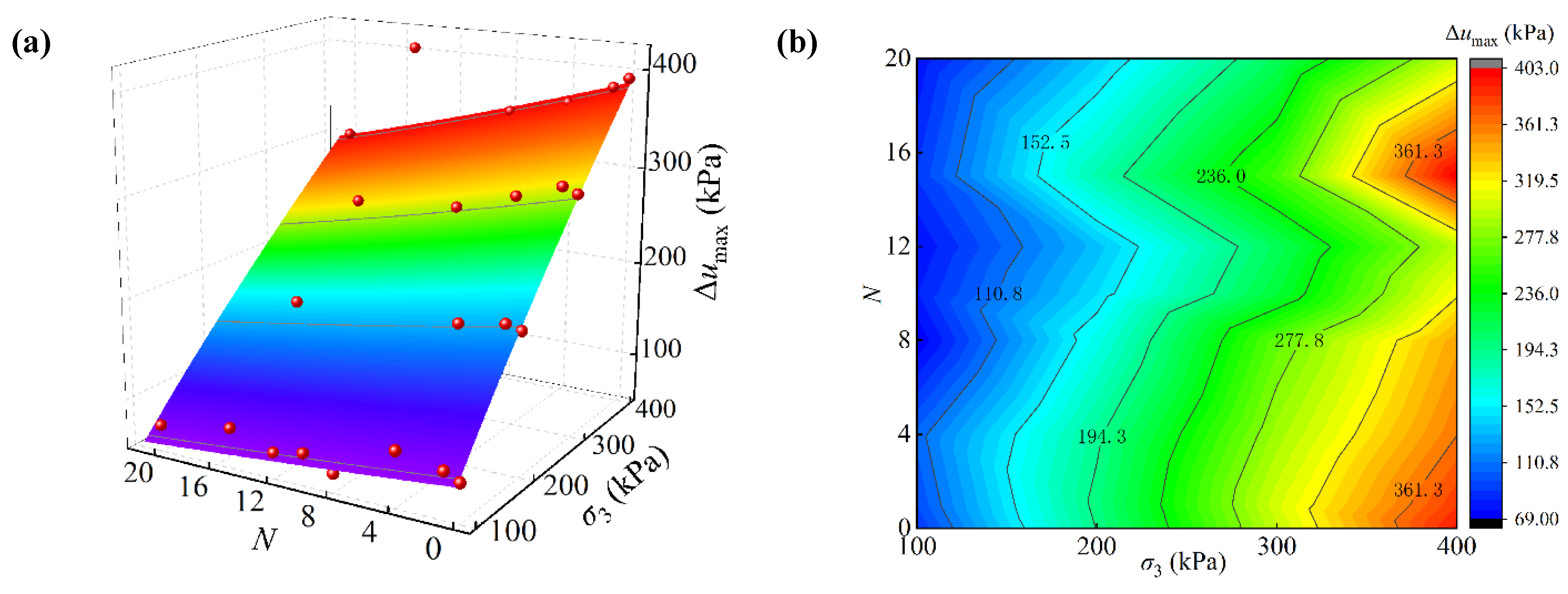
Figure 16 presents the variation trend of the peak pore water pressure Δ u max . Confining pressure enhances Δ u max by compacting the soil and restricting drainage, whereas an increase in FTCs causes structural damage and promotes the development of preferential flow paths, thereby weakening the soil’s ability to sustain high pore water pressure. Similarly, the number of freeze–thaw cycles (N) was set to 0, 1, 4, 8, 10, 12, 15, and 20, while the confining pressures ( σ 3 ) were 100 kPa, 200 kPa, 300 kPa, and 400 kPa.
High confining pressure enhances both stiffness and strength by increasing soil density, while also restricting pore-water drainage and thereby promoting pore-pressure buildup. In contrast, freeze–thaw cycles progressively degrade the stiffness and strength of the soil structure and, through the development of internal cracks, suppress the accumulation of pore pressure. In summary, a competitive coupling mechanism exists between confining pressure (as a strengthening factor) and freeze–thaw cycling (as a deterioration factor). As freeze–thaw damage intensifies, the dependence of soil mechanical properties on confining pressure becomes markedly more pronounced. Therefore, in cold-region engineering, ensuring adequate overburden thickness or applying appropriate external confinement is essential for maintaining the long-term stability of foundations constructed on moraine soil. The quantitative models developed in this study offer a direct theoretical foundation and practical basis for performance evaluation and optimized design of related engineering projects.

4. Discussion

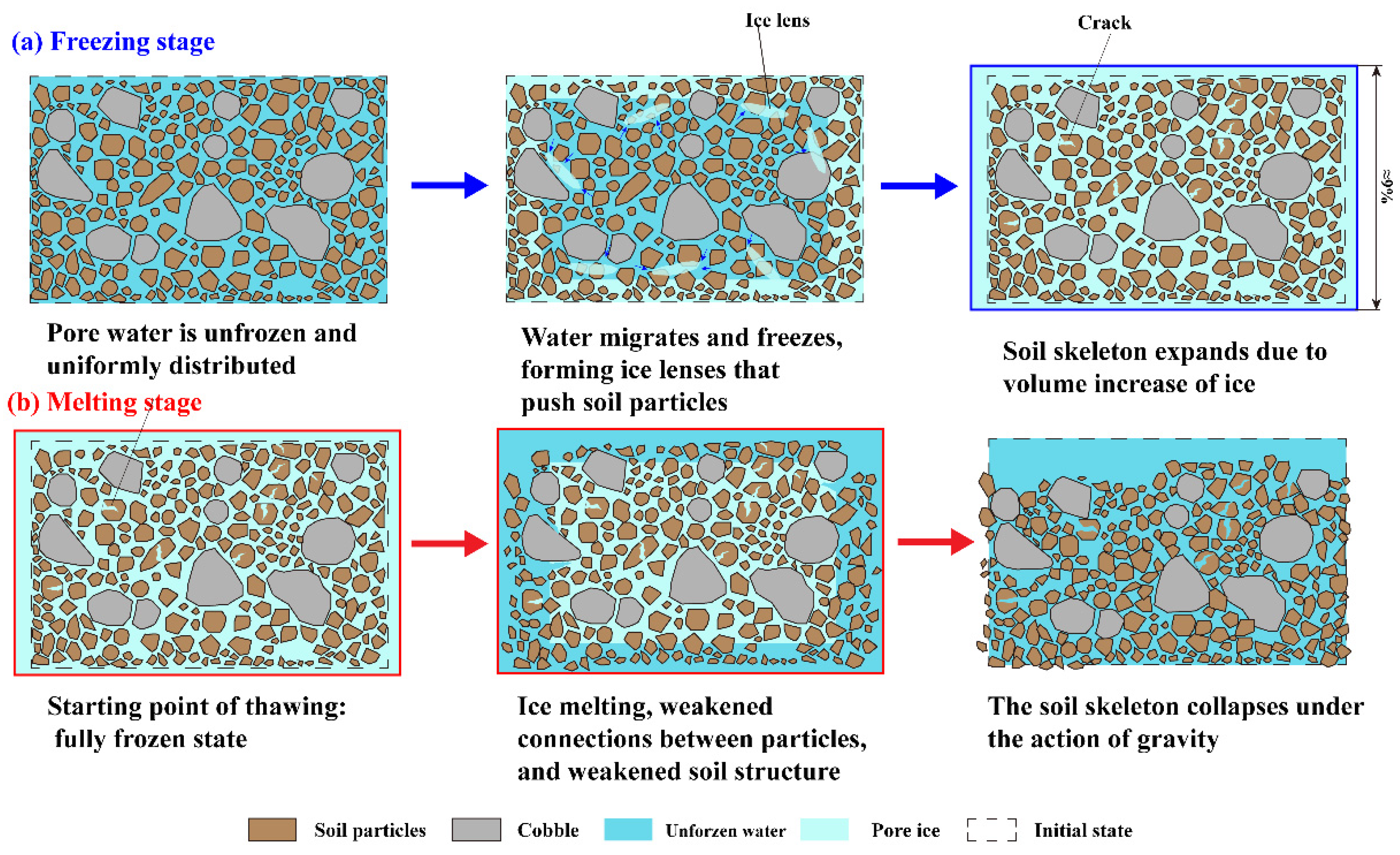
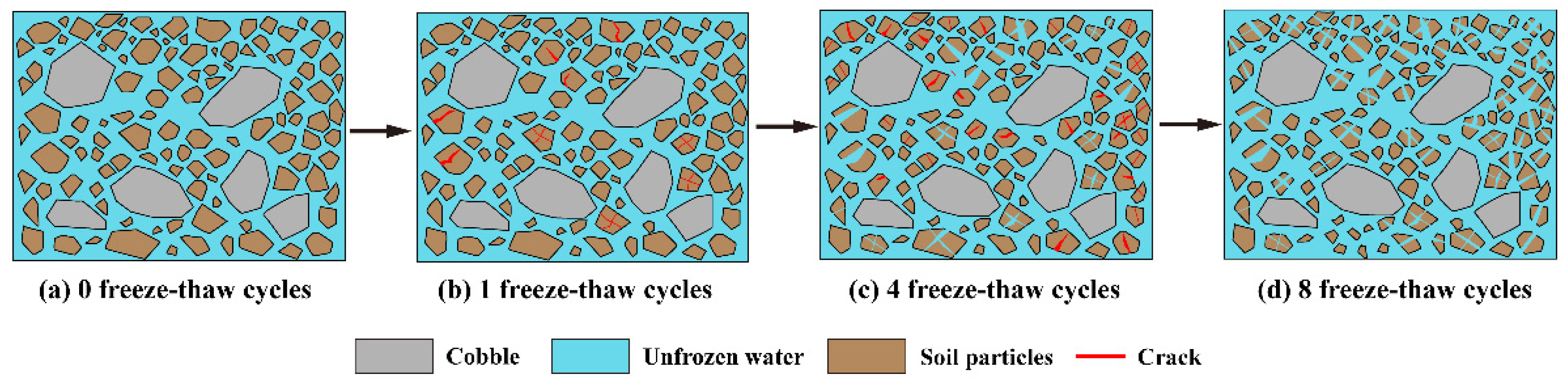
The freeze–thaw damage process of moraine soil is a complex physico-mechanical phenomenon driven by water phase changes, involving repeated structural adjustments that ultimately lead to degradation of macroscopic performance. Confining pressure plays a key controlling and regulating role in this process. During the freezing stage, the crystallization of pore water causes approximately a 9% volumetric expansion, which has two primary effects: first, it disrupts the original bonding structure between soil particles; second, water migration and ice crystal growth lead to the formation of micro-cracks and ice lenses. These ice lenses exert significant compressive forces on the surrounding soil skeleton, forcing particle rearrangement and resulting in macroscopic frost heave deformation, as illustrated in Figure 17a. During the thawing stage, the ice within the soil gradually melts, weakening interparticle connections. Pore spaces previously supported by ice become unstable and collapse, leading to settlement of the soil under gravity, as shown in Figure 17b. As the number of FTCs increases, damage accumulates progressively. This repeated expansion and contraction causes micro-cracks to continuously propagate and interconnect. Local structural units gradually detach from the skeleton, eventually forming a continuous damage network. This results in reduced soil integrity, coarsening of the pore structure, and significant deterioration of macroscopic mechanical properties, as presented in Figure 18. Such freeze–thaw damage directly contributes to the attenuation of mechanical performance. During shearing, particles in the damaged soil are more prone to slippage and rearrangement. Due to the increased void space, the peak pore water pressure Δ u max decreases accordingly. Simultaneously, the secant modulus E50 diminishes as the proportion of plastic deformation rises. Repeated FTCs also cause abrasion at particle edges and corners, further weakening the interlocking effect between particles.
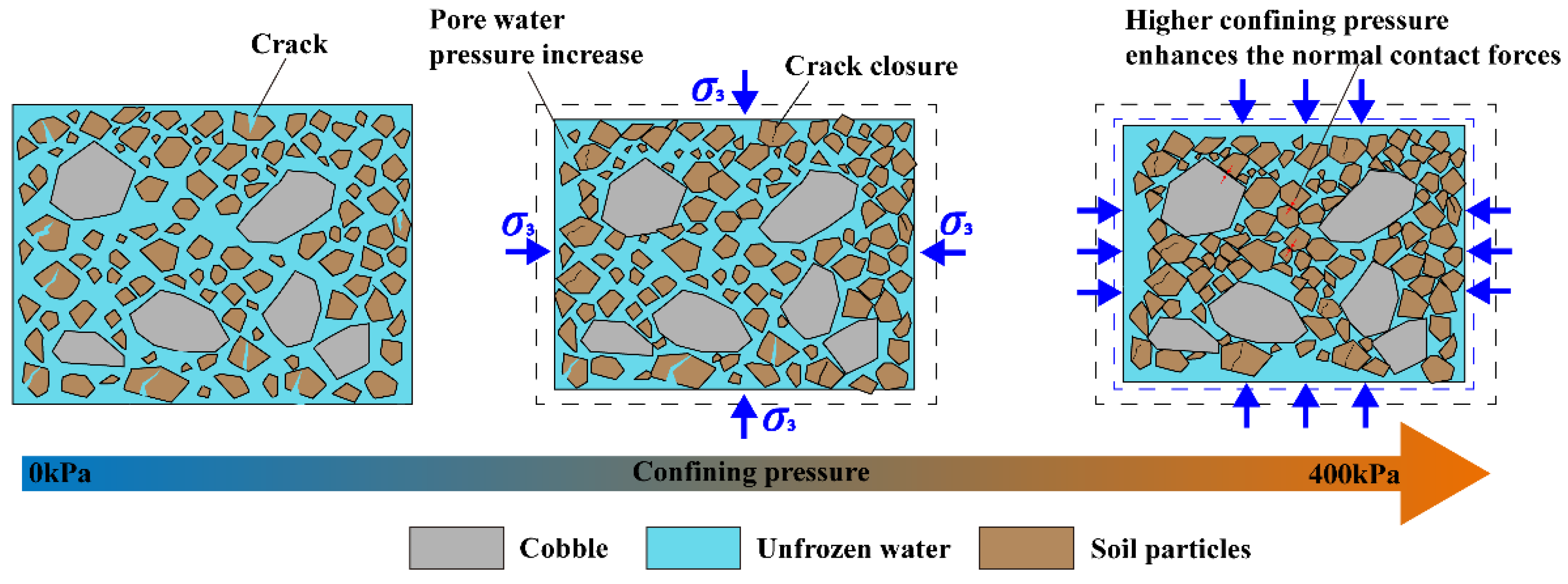
From the macroscopic experimental results, it can be inferred that confining pressure (σ3) compensates for freeze–thaw damage through the dual-path mechanism, as illustrated in Figure 19. On one hand, the lateral constraint imposed by confining pressure directly compresses existing freeze–thaw cracks, restricting their further propagation and promoting closer interparticle contact. On the other hand, higher confining pressure enhances the normal contact forces between particles, thereby increasing particle interlocking and frictional resistance during shearing and limiting particle displacement and rotation. In terms of macroscopic response, this constraining effect manifests as follows: with increasing confining pressure, the soil exhibits a stronger tendency toward volumetric contraction during shearing, and pore water pressure development becomes more pronounced. At the same time, the proportion of elastic deformation increases, leading to a significant rise in the secant modulus (E50) and a marked reduction in shear strength attenuation. Notably, the compensatory effect of confining pressure becomes less apparent as freeze–thaw damage intensifies. This indicates that in high-altitude engineering environments, appropriate confining pressure conditions can effectively retard the structural performance degradation induced by FTCs.
This study elucidates the coupled effects of freeze–thaw cycle number (N) and confining pressure σ3 on the undrained shear behavior of moraine soil and establishes corresponding quantitative predictive models. The results indicate that the peak pore water pressure Δ u max increases with σ3 and decreases with N; both the secant modulus E50 and shear strength qmax exhibit a similar coupled dependence. The developed model E50 = f(σ3, N) effectively captures the competition between the mechanisms of confining pressure and freeze–thaw cycles on soil stiffness and strength: freeze–thaw action dominates structural damage and performance degradation, whereas confining pressure suppresses damage progression by enhancing interparticle constraints.
This study is limited to experiments conducted on saturated moraine soil under a fixed temperature amplitude (−15 °C to 15 °C). It does not yet account for the effects of unsaturated conditions (commonly encountered in practice), varying freeze–thaw temperature ranges, more severe low-temperature scenarios, or variations in stress paths. Furthermore, the quantitative relationship between microstructural evolution and macroscopic mechanical response requires further clarification. Future work will involve freeze–thaw shear tests on unsaturated moraine soil under different thermal regimes, combined with micro-CT and digital image analysis to quantitatively characterize the evolution of pore structure and crack networks during freeze–thaw cycling. Additionally, an elastoplastic constitutive model that comprehensively incorporates saturation, freeze–thaw history, and stress state will be developed. This model will be validated and applied at the engineering scale using numerical platforms such as FLAC3D, thereby enhancing its applicability and predictive capability for real-world cold-region engineering projects.

5. Conclusions

(1)
FTCs dominate the mechanical degradation and evolution of the deformation mechanism in moraine soil. As the number of FTCs increases, the stress–strain behavior shifts from strain softening to strain hardening, while shear strength and secant modulus ( E 50 ) decrease significantly. Cohesion is highly sensitive to FTCs, decaying according to a negative exponential function, whereas the internal friction angle remains relatively stable. The development of pore water pressure progressively transitions from a peak-decay pattern (0 and 1 cycles) to a growth-stabilization pattern (4, 8, 10, 12, 15, and 20 cycles).
(2)
Confining pressure exerts a significant mitigating and compensatory effect on freeze–thaw damage. Increasing confining pressure markedly enhances the peak strength, residual strength, and secant modulus ( E 50 ) of the soil. By compressing freeze–thaw-induced cracks and strengthening interparticle friction and interlocking, confining pressure effectively suppresses the propagation of structural damage and slows the deterioration of mechanical parameters.
(3)
Quantitative predictive models incorporating the coupling effect of confining pressure and FTCs were established. Specific models were developed for the secant modulus E 50 and shear strength qmax, quantifying the competitive mechanism between confining pressure and FTCs regarding soil stiffness and strength. These models can serve as a reference or preliminary estimation for relevant geotechnical designs.

Author Contributions

Y.Z.: Writing—original draft, Visualization, Data curation, Writing—review and editing, Methodology, Funding acquisition. X.H.: Visualization, Study design, Supervision. All authors have read and agreed to the published version of the manuscript.

Funding

This research was supported by the National Natural Science Foundation of China (Grant No. 12372376, No. 42671181), and the Program of the State Key Laboratory of Cryospheric Science and Frozen Soil Engineering, CAS (Grant No. CSFSE-KF-2423).

Institutional Review Board Statement

Not applicable.

Informed Consent Statement

Not applicable.

Data Availability Statement

The raw data supporting the conclusions of this article will be made available by the authors on request.

Acknowledgments

The authors would like to thank Fei Luo for his guidance and assistance with the experimental techniques. The authors have reviewed and edited the output and take full responsibility for the content of this publication.

Conflicts of Interest

The authors declare no conflict of interest.

References

  1. Luo, F.; Liu, E.L.; Zhu, Z. A strength criterion for frozen moraine soils. Cold Reg. Sci. Technol. 2019, 164, 102786. [Google Scholar] [CrossRef] [Scilit]
  2. Qiu, E.X.; He, Q.L.; Chen, Q.L.; Sun, X.W.; Zhang, R.; Qu, M.F.; Wan, X.S. Influence of freeze–thaw cycles on mechanical properties of moraine soils. Transp. Geotech. 2023, 42, 101097. [Google Scholar] [CrossRef] [Scilit]
  3. Zuo, Z.Q.; Li, Z.N.; Liu, J.N.; Li, M.L.; Zheng, H.J. Strength Deterioration Characteristics and Microscopic Mechanism of the Tibetan Plateau Moraine Under Freeze-Thaw. J. Jilin Univ. (Earth Sci. Ed.) 2024, 54, 1–11. [Google Scholar] [CrossRef]
  4. Feng, J.D.; Li, J.G.; Wang, R.; Hu, M.J.; Wei, H.Z.; Xu, X.Y. Large scale direct shear test on strength behavior of railway moraine soils in Yunnan. Rock Soil Mech. 2008, 29, 3205–3210. [Google Scholar] [CrossRef]
  5. Gun, X.T. Freeze-Thaw Characterization and Strength Parameter Deterioration Research of Moraine Soils in Chada Gully. Master’s Thesis, Shijiazhuang Tiedao University, Shijiazhuang, China, 2024. [Google Scholar] [CrossRef]
  6. Shen, Y.J.; Wei, X.; Zhang, L.; Zhang, Y.X.; Li, X.T.; Chen, X. Hydrothermal Migration of Moraine Soil and the Mechanism of Ice Accumulation and Frost Swelling in Alpine-Cold Mountain Region. J. Eng. Geol. 2022, 30, 1450–1465. [Google Scholar] [CrossRef]
  7. Qu, J.T.; Shi, Q.Z.; Guo, Y.J.; Zhang, X.; Zhang, Y.; Jiang, D.Y. Characteristics and damage mechanisms of ice deposits under freeze-thaw cycles. Rock Soil Mech. 2025, 46, 2859–2872. [Google Scholar] [CrossRef]
  8. Tang, L.; Cong, S.Y.; Geng, L.; Ling, X.Z.; Gan, F.D. The effect of freeze-thaw cycling on the mechanical properties of expansive soils. Cold Reg. Sci. Technol. 2018, 145, 197–207. [Google Scholar] [CrossRef] [Scilit]
  9. Ma, Q.H.; Zhang, K.L.; Jabro, J.D.; Ren, L.; Liu, H.Y. Freeze–thaw cycles effects on soil physical properties under different degraded conditions in Northeast China. Environ. Earth Sci. 2019, 78, 321. [Google Scholar] [CrossRef] [Scilit]
  10. Fan, J.K.; Yue, Z.R.; Han, Z.H.; Sun, T.C.; Hu, T.F.; Zhang, S. Study on prediction model of strength deterioration of moraine soil under high frequency freeze-thaw cycles. J. Glaciol. Geocryol. 2024, 46, 602–611. [Google Scholar] [CrossRef]
  11. Jiang, T.T.; Pan, H.L.; Ai, Y.F.; Xiong, W. Effect of freeze-thaw cycles and water content on the mechanical properties of moraine soil. Bull. Geol. Sci. Technol. 2024, 43, 238–252. [Google Scholar] [CrossRef]
  12. Qiu, E.X.; Pan, H.Y.; He, Q.L.; Sun, X.W.; Wan, X.S.; Zhang, R.; Wang, Z.S. Tests on the mechanical properties of moraine soils under freeze-thaw conditions and the modified Duncan-Zhang model. J. Eng. Geol. 2024, 32, 772–784. [Google Scholar] [CrossRef]
  13. Wang, W.P.; Zhang, X.Y.; Wang, Y.; Yu, S.S.; Xu, Z.J.; Sun, B.J. Variation characteristics and influencing factors of loess shear strength in seasonal frozen soil region. J. Harbin Inst. Technol. 2022, 54, 143–150. [Google Scholar] [CrossRef]
  14. Lang, R.Q.; Pei, L.X.; Sun, L.Q.; Feng, S.Z. Experimental study on unconsolidated mechanical properties of soft clay under freeze-thaw cycles with confining pressure. Chin. J. Geotech. Eng. 2024, 46, 43–48. [Google Scholar] [CrossRef]
  15. Bi, G.Q. Study on influence of freeze-thaw cycles on the physical-mechanical properties of loess. Adv. Mater. Res. 2012, 442, 286–290. [Google Scholar] [CrossRef] [Scilit]
  16. Zhou, Z.; Ma, W.; Zhang, S.; Li, G. Effect of freeze-thaw cycles in mechanical behaviors of frozen loess. Cold Reg. Sci. Technol. 2018, 146, 9–18. [Google Scholar] [CrossRef] [Scilit]
  17. Xie, S.B.; Qu, J.J.; Lai, Y.M.; Zhou, Z.W.; Xu, X.T. Effects of freeze-thaw cycles on soil mechanical and physical properties in the Qinghai-Tibet Plateau. J. Mt. Sci. 2015, 12, 999–1009. [Google Scholar] [CrossRef] [Scilit]
  18. Yu, J.; Chen, X.; Li, H.; Zhou, J.W.; Cai, Y.Y. Effect of freeze-thaw cycles on mechanical properties and permeability of red sandstone under triaxial compression. J. Mt. Sci. 2015, 12, 218–231. [Google Scholar] [CrossRef] [Scilit]
  19. Liu, Q.; Zhang, Z.; Zhang, S.R.; Li, X.L.; Long, H.C.; Meng, X.X.; Melnikov, A.; Gagarin, L. The influence of particle morphology on the long-term strength of sandy soil under freeze-thaw cycles. Case Stud. Constr. Mater. 2023, 18, e02196. [Google Scholar] [CrossRef] [Scilit]
  20. Kravchenko, E.; Liu, J.; Niu, W.; Zhang, S. Performance of clay soil reinforced with fibers subjected to freeze-thaw cycles. Cold Reg. Sci. Technol. 2018, 153, 18–24. [Google Scholar] [CrossRef] [Scilit]
  21. Wang, L.; Zuo, X.; Zheng, F.; Wilson, G.V.; Fu, H. The effects of freeze-thaw cycles at different initial soil water contents on soil erodibility in Chinese Mollisol region. Catena 2020, 193, 104615. [Google Scholar] [CrossRef] [Scilit]
  22. Fouli, Y.; Cade-Menun, B.J.; Cutforth, H.W. Freeze–thaw cycles and soil water content effects on infiltration rate of three Saskatchewan soils. Can. J. Soil Sci. 2013, 93, 485–496. [Google Scholar] [CrossRef] [Scilit]
  23. Yao, J.; Lu, X.S.; Liu, Z.M.; Wang, N.Q.; Xu, P.F.; Li, P.F. Experimental study on the engineering properties and failure mechanism of moraine in Southeast Tibet under freeze–thaw cycles conditions. Eng. Fail. Anal. 2024, 163, 108551. [Google Scholar] [CrossRef] [Scilit]
  24. Tang, Y.F.; Yong, B.T.; Liu, J.F.; Yang, J.X.; Zhang, L.Q.; Zhu, A.Q. Pore structure analysis of glacial till under freeze-thaw cycles based on calibration CT data. Nondestruct. Test. Eval. 2025, 40, 271–288. [Google Scholar] [CrossRef] [Scilit]
  25. Zhang, Y.Z.; Zhu, X.D.; Liu, W.L.; Wang, H.Y.; Wei, J. Macro-and mesoscopic experimental study of the effects of water content on moisture migration in coarse-grained fillings under freeze–thaw cycles and loads. Cold Reg. Sci. Technol. 2022, 196, 103491. [Google Scholar] [CrossRef] [Scilit]
  26. Woronko, B. Frost weathering versus glacial grinding in the micromorphology of quartz sand grains: Processes and geological implications. Sediment. Geol. 2016, 335, 103–119. [Google Scholar] [CrossRef] [Scilit]
  27. Xu, W.B.; Wang, J.B.; Luan, M.X. Mechanical Properties and Stability Analysis of Dump Bulk Materials Under Freeze-Thaw Cycles. J. Min. Sci. 2022, 7, 154–165. [Google Scholar] [CrossRef]
  28. Zheng, J.M.; Xu, M.; Liu, Y.S.; Geng, M.M.; Tian, Y.S.; Sun, J.W.; Yang, Z.J. Study on time effect and prediction model of shear strength of root-soil complex under dry-wet cycle. Biogeotechnics 2024, 2, 100079. [Google Scholar] [CrossRef] [Scilit]
  29. Hu, T.F.; Liu, J.K.; Wang, Q.Z.; Fang, J.H. Experimental Study on Undrained Shear Behavior of Silty Clay Under Freeze-thaw Cycles. J. Cent. South Univ. (Nat. Sci. Ed.) 2018, 49, 1481–1490. [Google Scholar] [CrossRef]
Figure 1. Sampling diagram of moraine soil: (a) location; (b) landform; (c) site photos; (d) particle grading curve.
Geotechnics 06 00087 g001
Figure 2. Sample preparation and testing instruments: (a) sample preparation; (b) test equipment.
Geotechnics 06 00087 g002
Figure 3. Stress–strain curve of moraine soil under different FTCs.
Geotechnics 06 00087 g003
Figure 4. Stress–strain curves of moraine soil under different confining pressures.
Geotechnics 06 00087 g004
Figure 5. Shear strength pattern of moraine soil: (a) Shear strength—FTCs; (b) Shear strength—confining pressure.
Geotechnics 06 00087 g005
Figure 6. Change rate of shear strength of moraine soil: (a) attenuation rate; (b) growth rate.
Geotechnics 06 00087 g006
Figure 7. Pore pressure-strain curve of moraine soil under different freeze–thaw cycle numbers.
Geotechnics 06 00087 g007
Figure 8. Pore pressure-strain curve of moraine soil under different confining pressures.
Geotechnics 06 00087 g008
Figure 9. Evolution law of maximum pore water pressure: (a) Pore pressure—FTCs; (b) Pore pressure—confining pressure.
Geotechnics 06 00087 g009
Figure 10. Evolution law of pore pressure coefficient: (a) Pore pressure—FTCs; (b) Pore pressure—confining pressure.
Geotechnics 06 00087 g010
Figure 11. Evolution law of secant modulus of moraine soil: (a) secant modulus—FTCs; (b) secant modulus—confining pressure.
Geotechnics 06 00087 g011
Figure 12. Strength envelope of moraine soil: (a) Definition of strength envelope; (b) Strength envelope under different FTCs.
Geotechnics 06 00087 g012
Figure 13. Shear strength parameters of moraine soil: (a) cohesion; (b) internal friction angle.
Geotechnics 06 00087 g013
Figure 14. E 50 - σ 3 - N three-dimensional surface diagram: (a) three-dimensional surface diagram; (b) horizontal plane projection.
Geotechnics 06 00087 g014
Figure 15. q max - σ 3 - N three-dimensional surface diagram: (a) three-dimensional surface diagram; (b) horizontal plane projection.
Geotechnics 06 00087 g015
Figure 16. Δ u max - σ 3 - N three-dimensional surface diagram: (a) three-dimensional surface diagram; (b) horizontal plane projection.
Geotechnics 06 00087 g016
Figure 17. The influence of FTCs on the mechanical behavior of moraine soil.
Geotechnics 06 00087 g017
Figure 18. The influence of FTCs on the mechanical behavior of moraine soil.
Geotechnics 06 00087 g018
Figure 19. The influence of confining pressure on the mechanical behavior of moraine soil.
Geotechnics 06 00087 g019
Table 1. Basic physical property indicators of moraine soil.
Natural Density/g·cm−3Natural Moisture Content/%Dry Density/g·cm−3Specific GravityVoid Ratio
1.6415.41.5522.3240.482
Disclaimer/Publisher’s Note: The statements, opinions and data contained in all publications are solely those of the individual author(s) and contributor(s) and not of MDPI and/or the editor(s). MDPI and/or the editor(s) disclaim responsibility for any injury to people or property resulting from any ideas, methods, instructions or products referred to in the content.