
A Critical Review of the Physical Properties and Geotechnical Behaviors of Tailing Materials


Abstract
1. Introduction
2. Review Methodology
2.1. Review Type and Research Question
2.2. Literature Search Strategy
2.3. Screening Process
2.4. Scope and Limitations
3. Physical and Chemical Properties of Tailings
3.1. Particle Size Distribution
3.2. Mineralogical Composition
3.3. Chemical Composition
3.4. Specific Gravity and Atterberg Limits

| Tailings Type | Specific Gravity Gs | Liquid Limit LL (%) | Plastic Limit PL (%) | Plasticity Index PI (%) | Reference |
|---|---|---|---|---|---|
| Gold | 2.9 | 22.5 | 20 | 2.5 | Al-Tarhouni et al. [36] |
| Gold | 2.89 | - | - | - | Li et al. [41] |
| Gold | 2.75 | - | - | - | Fotovvat et al. [39] |
| Gold | 2.78 | 18 | 16 | 2 | Reid et al. [44] |
| Gold | 2.75 | 22.8 | 13.04 | 9.76 | Zhang et al. [47] |
| Gold | 2.77 | 24 | 18.7 | 5.3 | Nayanthara et al. [43] |
| Gold | 2.78 | 20 | 16 | 4 | Urbina et al. [95] |
| Iron (Coarse) | 3.23 | - | - | - | Hu et al. [16] |
| Iron (Fine) | 3.08 | 28 | 19 | 9 | Hu et al. [16] |
| Iron | 2.91 | 21.3 | 15.8 | 5.5 | Wei et al. [46] |
| Iron | 2.9 | 25.2 | 15.6 | 9.6 | Ke et al. [40] |
| Iron | 3.71 | 39 | 21 | 18 | Mmbando et al. [38] |
| Iron | 3.05 | - | - | - | Wagner et al. [45] |
| Iron | 2.97 | - | - | - | Wagner et al. [45] |
| Iron (Flotation) | 2.76 | Wagner et al. [63] | |||
| Iron (Slime) | 3.26 | 31 | 24 | 7 | Wagner et al. [63] |
| Copper | 2.79 | 26–39 | 22–27 | 4–12 | Shamsai et al. [96] |
| Copper (Coarse) | 2.77 | - | - | - | Hu et al. [16] |
| Copper (Fine) | 2.76 | 28 | 13 | 15 | Hu et al. [16] |
4. Permeability Behavior
4.1. Macroscopic Factors Affecting the Permeability of Tailings
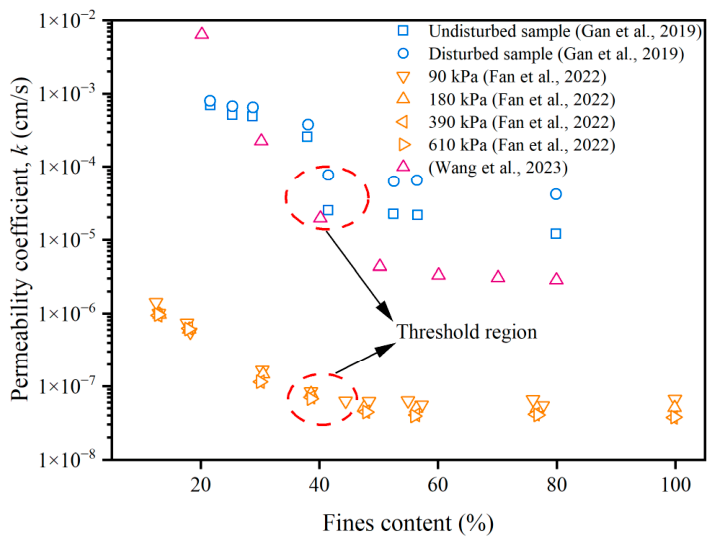
4.1.1. Threshold for Fine Particle Content
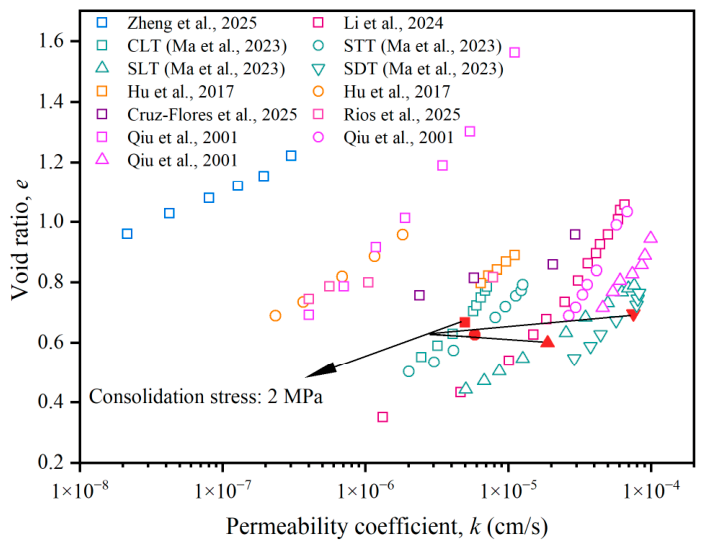
4.1.2. Void Ratio and Stress Levels
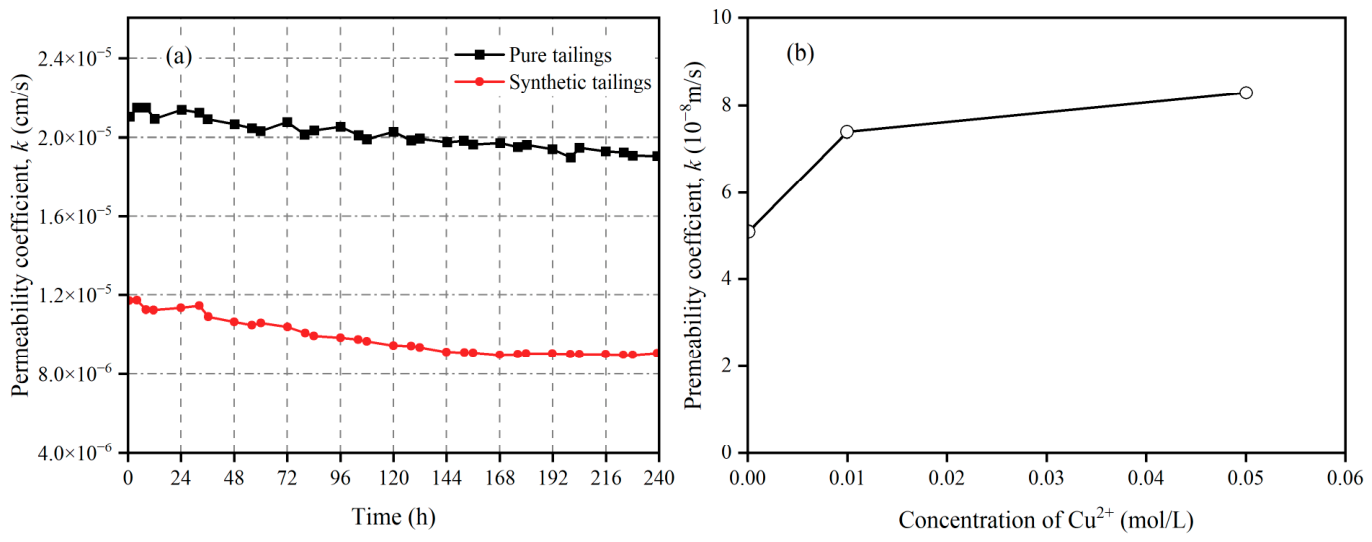
4.1.3. Chemical and Biological Effects
4.2. Microstructure and Seepage Mechanisms
4.3. Permeability Coefficient Prediction Model
5. Compression and Consolidation Behavior
5.1. Theoretical Model of Consolidation and Compression
5.2. Compression Characteristics and Key Parameters
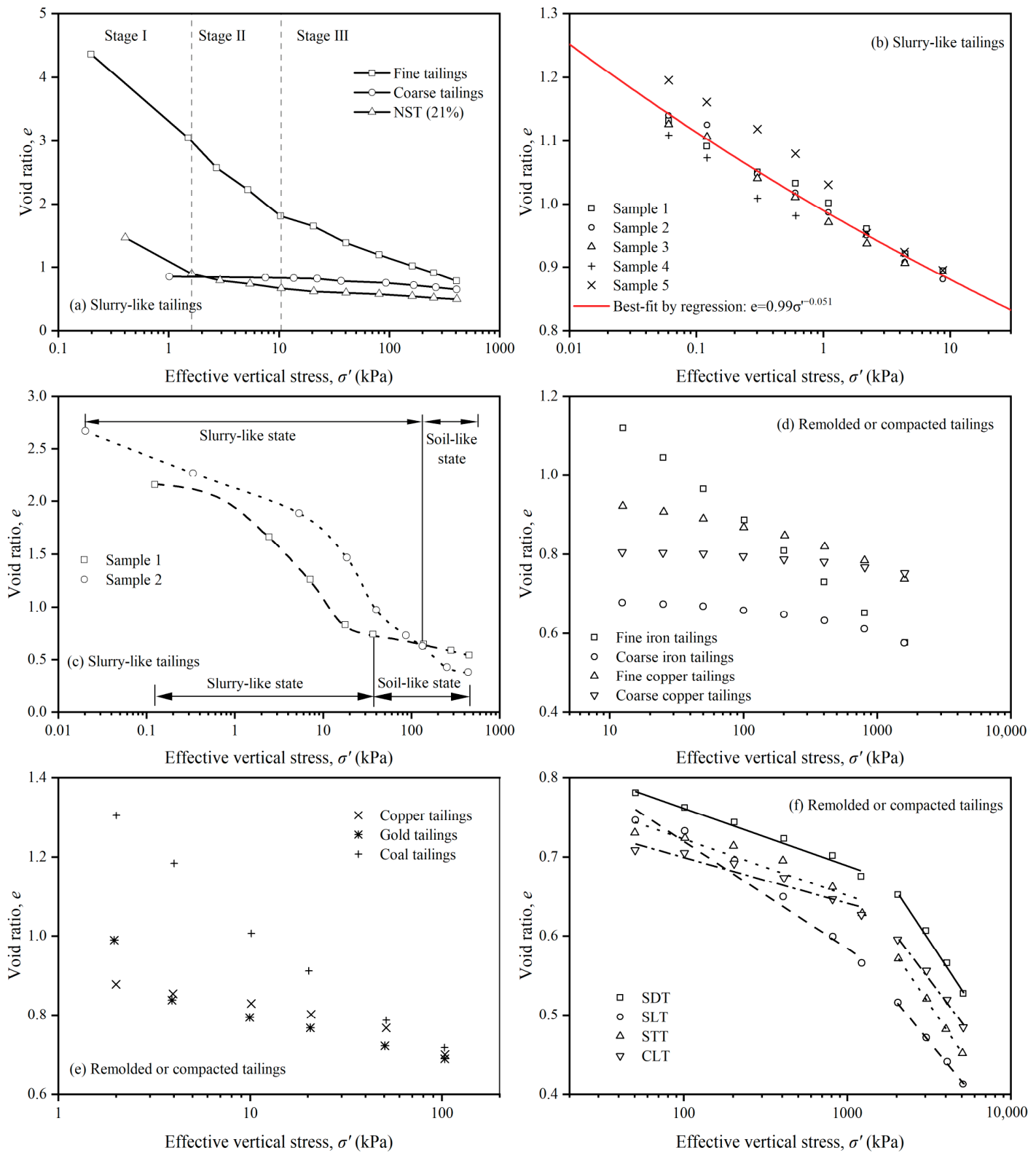
5.2.1. Influence of Initial Structure and Specimen Preparation on Compression Curve Shape
5.2.2. Compression Index
5.2.3. The Coefficient of Consolidation
6. Shear Behavior
6.1. The Strength and Deformation Characteristics of Tailings Under Monotonic Loading Conditions
6.1.1. Stress–Strain Relationship
6.1.2. Strength Parameters
6.2. Anisotropy and the Effects of Stress Paths
6.2.1. Structural Anisotropy
6.2.2. The Effects of Stress Paths
6.3. Critical States and Transitional Behavior
6.3.1. Classical Critical State Theory
6.3.2. Transitional Behavior
6.4. Shear Behavior Under Special Conditions
6.4.1. Cyclic Loading and Liquefaction
6.4.2. The Effects of Freeze–Thaw Cycles
7. Future Work
- With the continuous advancement of mineral processing technologies and the steady decline in the grade of raw ore, tailings are exhibiting a marked trend towards finer grain sizes. Compared to the silt tailings that have been the primary focus of existing research, clayey tailings resulting from this refinement display significant differences in their geotechnical behavior. However, research on such clayey fine-grained tailings remains insufficient. It is recommended that future studies investigate their permeability, consolidation and compression, and shear behavior.
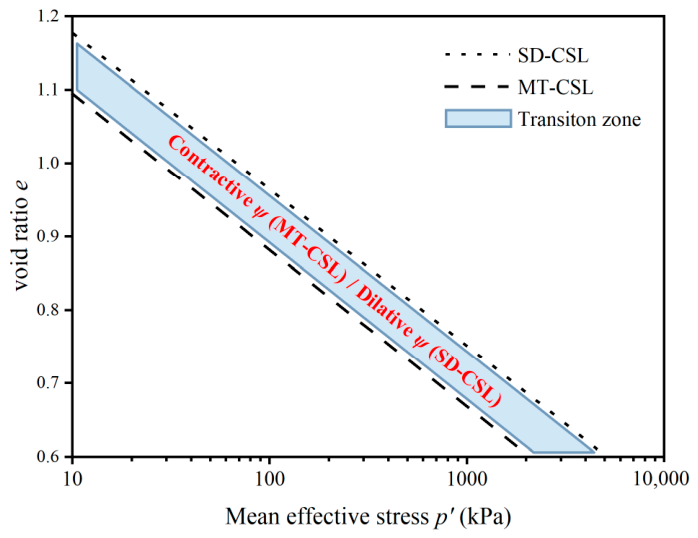
- As discussed in Section 6.3.2, transitional behavior is widespread in tailings, which severely impacts the assessment of their liquefaction behavior. At present, the specific causes of this transitional behavior in tailings remain unclear. Subsequent research should aim to elucidate the key controlling factors underlying the formation of transitional behavior, thereby enabling a correct assessment of tailings liquefaction behavior and providing a reliable theoretical basis for the stability analysis of tailings dams.
- Tailings constitute a three-phase medium comprising solid, liquid and gas phases. However, most existing studies on the shear behavior of tailings are based on saturated specimens, overlooking the actual influence of the gas phase on soil mechanical behavior. Future research should prioritize the study of the shear characteristics of tailings under unsaturated conditions, systematically investigating the mechanisms by which changes in matrix suction influence the strength, deformation and pore pressure response of tailings, with a view to establishing a mechanical analysis model for tailings that more closely reflects engineering practice.
8. Conclusions
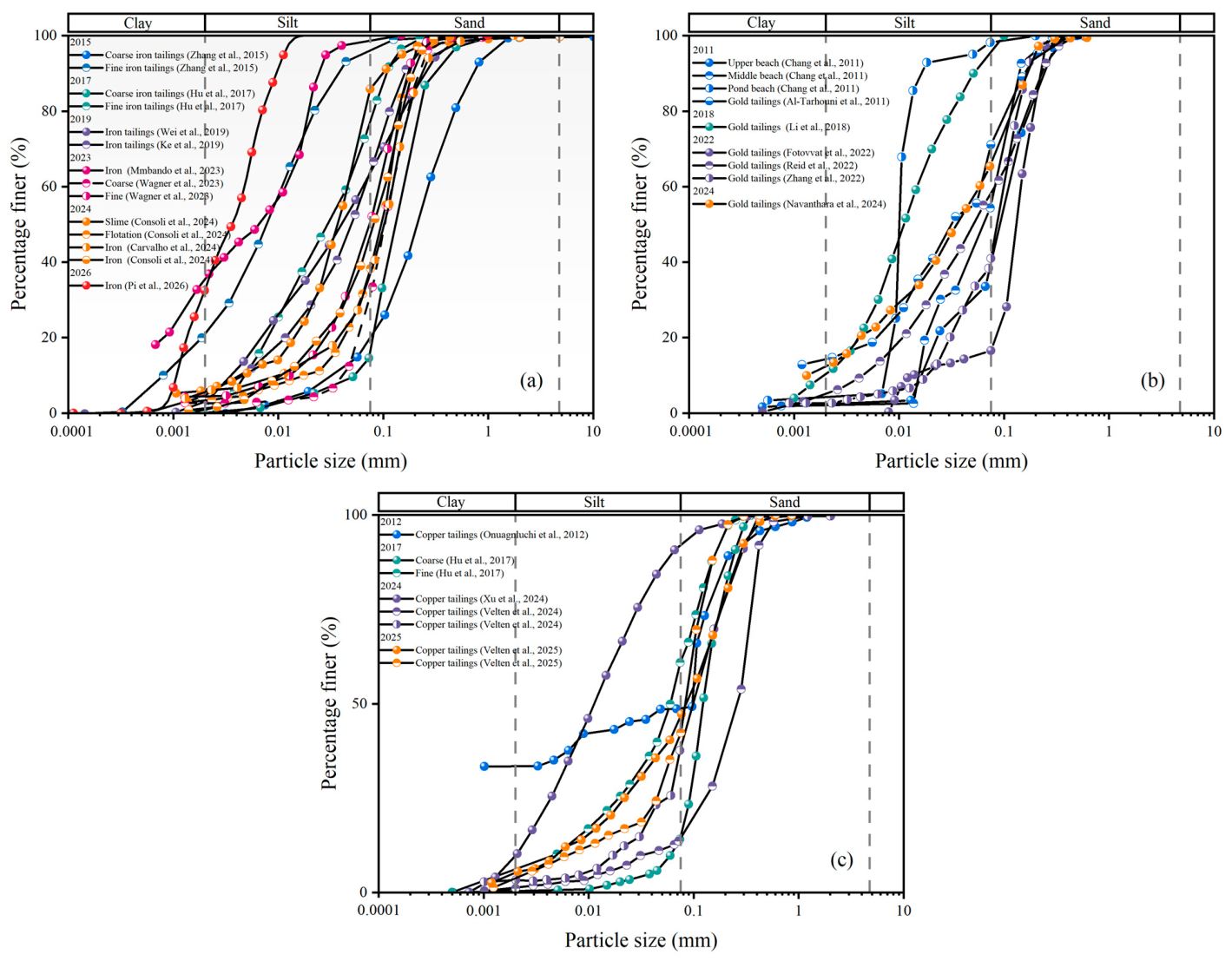
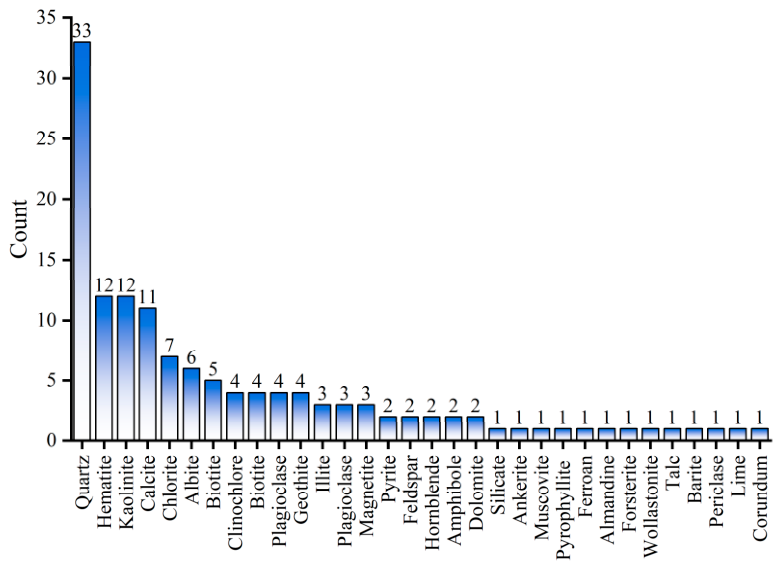
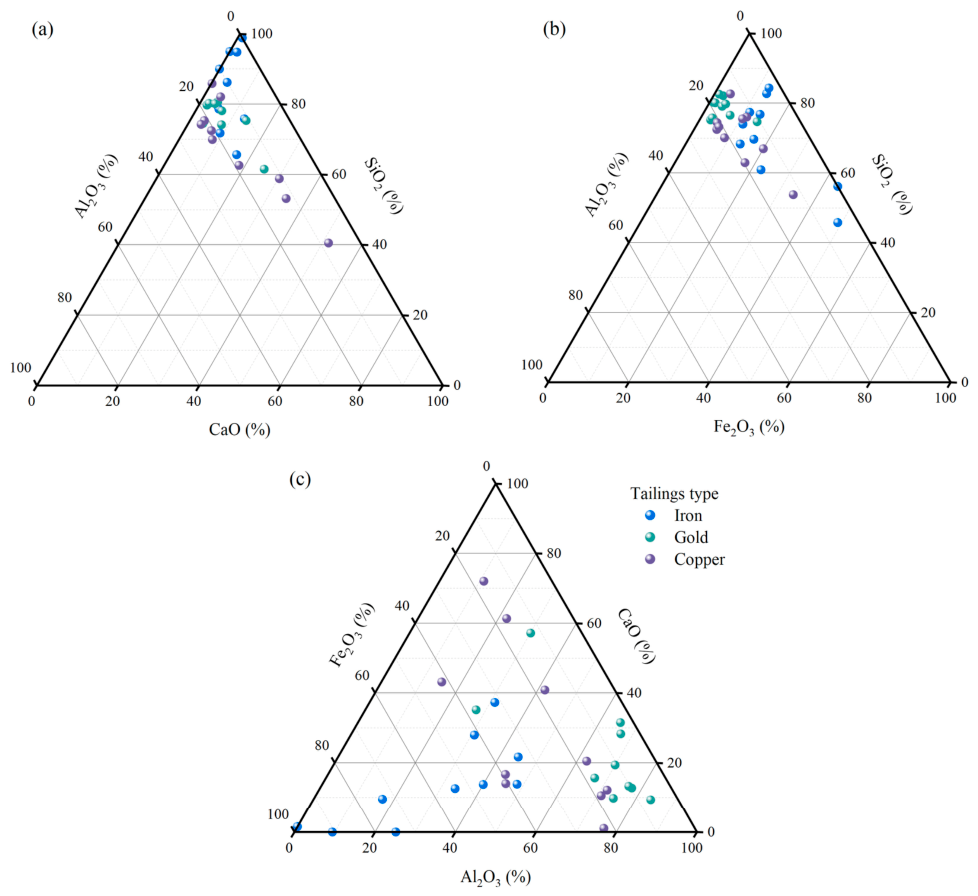
- The particle size distribution of tailings exhibits distinct characteristics of hydraulic grading within the tailings pond, consisting primarily of silt-sized particles; their mineral and chemical composition is dominated by quartz, hematite and silicates, but there is significant spatial variability both between different tailings and at different locations within the same tailings pond. Consequently, each tailings dam project requires a separate and appropriate analysis. At the same time, there is currently a marked trend towards finer-grained tailings; in the future, research should be conducted into the seepage, consolidation, compression and shear behavior of clayey fine-grained tailings.
- The permeability behavior of tailings is influenced by numerous factors. With regard to particle size distribution, there is a threshold for the content of fine particles; prior to this threshold, permeability deteriorates as the fine particle content increases, whilst beyond the threshold, permeability gradually stabilizes. Furthermore, high pressure significantly alters the permeability characteristics of tailings. In addition, chemical and biological processes must be taken into account during the design of tailings dam impermeabilization measures to prevent the formation of blockages and rapid seepage pathways.
- With regard to the consolidation and compression behavior of tailings, when tests are conducted using slurry specimens, the compression curves exhibit non-linear or piecewise linear characteristics, which are primarily described using the modified Gibson model. As the slurry method more accurately simulates the initial deposition state of tailings in tailings dam engineering, it more closely approximates actual engineering conditions. When tests are conducted using remolded specimens, although the compression curve can be linearly described using traditional compression indices, it similarly exhibits piecewise linear characteristics under high pressure. These observations demonstrate that the compressibility of tailings is strongly dependent on depositional state and stress level, both of which should be considered when extrapolating laboratory results to field conditions.
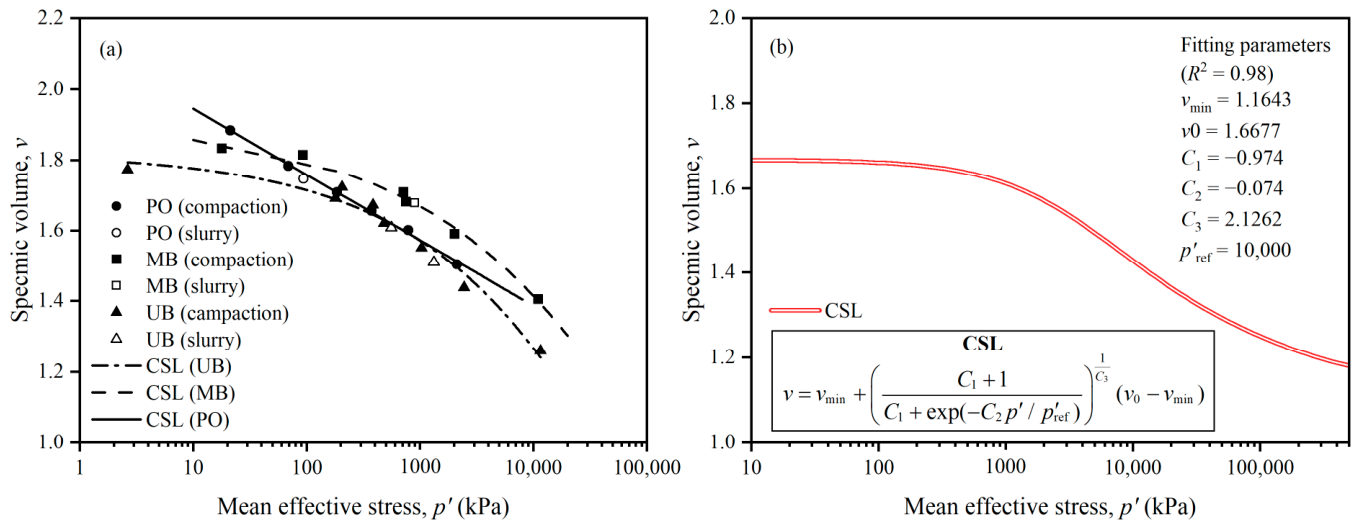
- The shear behavior of tailings is significantly influenced by confining pressure, drainage conditions, anisotropy and stress paths. The presence of transitional behavior means that CSL determined using a single sampling method may lead to an incorrect assessment of the shear dilation/contraction characteristics of in situ tailings, thereby affecting the assessment of liquefaction risk. Future research should focus on elucidating the key controlling factors underlying the formation of transitional behavior, in order to enhance the reliability of tailings dam stability assessments. These findings emphasize the importance of considering state-dependent behavior when evaluating tailings strength, deformation characteristics, and liquefaction susceptibility.
Author Contributions
Funding
Institutional Review Board Statement
Informed Consent Statement
Data Availability Statement
Conflicts of Interest
References
- Simonsen, A.M.T.; Solismaa, S.; Hansen, H.K.; Jensen, P.E. Evaluation of Mine Tailings’ Potential as Supplementary Cementitious Materials Based on Chemical, Mineralogical and Physical Characteristics. Waste Manag. 2020, 102, 711–721. [Google Scholar] [CrossRef]
- Global Tailings Review Global Industry Standard on Tailings Management. Available online: https://globaltailingsreview.org/wp-content/uploads/2020/08/global-industry-standard_EN.pdf (accessed on 16 March 2026).
- Holley, E.A.; Fahle, L.; Malone, A.; Zaronikola, N.; Nelson, P.P.; Erik Spiller, D. U.S. Industry Practices and Attitudes towards Reprocessing Mine Tailings for Metal Recovery. Resour. Policy 2025, 107, 105643. [Google Scholar] [CrossRef]
- Feng, W.; Yu, Z.; Bao, R.; Xiong, J.; Yan, K.; Liu, R.; Zhang, R.; Lu, X. From Waste to Resource: Advanced Activation Techniques for Tailings in Sustainable Cement Production. J. Build. Eng. 2024, 97, 110780. [Google Scholar] [CrossRef]
- Ruppen, D.; Runnalls, J.; Tshimanga, R.M.; Wehrli, B.; Odermatt, D. Optical Remote Sensing of Large-Scale Water Pollution in Angola and DR Congo Caused by the Catoca Mine Tailings Spill. Int. J. Appl. Earth Obs. Geoinf. 2023, 118, 103237. [Google Scholar] [CrossRef]
- Dudka, S.; Adriano, D.C. Environmental Impacts of Metal Ore Mining and Processing: A Review. J. Environ. Qual. 1997, 26, 591–602. [Google Scholar] [CrossRef]
- Wu, Z.; Yu, F.; Sun, X.; Wu, S.; Li, X.; Liu, T.; Li, Y. Long Term Effects of Lespedeza bicolor Revegetation on Soil Bacterial Communities in Dexing Copper Mine Tailings in Jiangxi Province, China. Appl. Soil Ecol. 2018, 125, 192–201. [Google Scholar] [CrossRef]
- Kwon, M.J.; Yang, J.-S.; Lee, S.; Lee, G.; Ham, B.; Boyanov, M.I.; Kemner, K.M.; O’Loughlin, E.J. Geochemical Characteristics and Microbial Community Composition in Toxic Metal-Rich Sediments Contaminated with Au–Ag Mine Tailings. J. Hazard. Mater. 2015, 296, 147–157. [Google Scholar] [CrossRef]
- Li, Z.; Wang, J.; She, Z.; Gu, J.; Lu, H.; Wang, S.; He, X.; Yue, Z. Tailings Particle Size Effects on Pollution and Ecological Remediation: A Case Study of an Iron Tailings Reservoir. J. Hazard. Mater. 2024, 476, 135024. [Google Scholar] [CrossRef]
- Owen, J.R.; Kemp, D.; Lèbre, É.; Svobodova, K.; Pérez Murillo, G. Catastrophic Tailings Dam Failures and Disaster Risk Disclosure. Int. J. Disaster Risk Reduct. 2020, 42, 101361. [Google Scholar] [CrossRef]
- Bussiere, B. Colloquium 2004: Hydrogeotechnical Properties of Hard Rock Tailings from Metal Mines and Emerging Geoenvironmental Disposal Approaches. Can. Geotech. J. 2017, 44, 1019–1052. [Google Scholar] [CrossRef]
- Davies, M.P.; Rice, S. An Alternative to Conventional Tailing Management—“Dry Stack” Filtered Tailings. In Tailings and Mine Waste 2001; CRC Press: Boca Raton, FL, USA, 2001. [Google Scholar]
- Edraki, M.; Baumgartl, T.; Manlapig, E.; Bradshaw, D.; Franks, D.M.; Moran, C.J. Designing Mine Tailings for Better Environmental, Social and Economic Outcomes: A Review of Alternative Approaches. J. Clean. Prod. 2014, 84, 411–420. [Google Scholar] [CrossRef]
- Xu, W.; Tian, M.; Li, Q. Time-Dependent Rheological Properties and Mechanical Performance of Fresh Cemented Tailings Backfill Containing Flocculants. Miner. Eng. 2020, 145, 106064. [Google Scholar] [CrossRef]
- Azam, S.; Li, Q. Tailings Dam Failures: A Review of the Last One Hundred Years. Eng. Environ. Sci. 2010, 28, 50–54. [Google Scholar]
- Hu, L.; Wu, H.; Zhang, L.; Zhang, P.; Wen, Q. Geotechnical Properties of Mine Tailings. J. Mater. Civ. Eng. 2017, 29, 4016220. [Google Scholar] [CrossRef]
- Sapata Gonzalez, R.; Aparecida da Silveira Rossi, R.; Gustavo Martins Vieira, L. Economic and Financial Consequences of Process Accidents in Brazil: Multiple Case Studies. Eng. Fail. Anal. 2022, 132, 105934. [Google Scholar] [CrossRef]
- Qiu, Y.; Sego, D.C. Laboratory Properties of Mine Tailings. Can. Geotech. J. 2001, 38, 183–190. [Google Scholar] [CrossRef]
- Wijewickreme, D.; Khalili, A.; Wilson, G.W. Mechanical Response of Highly Gap-Graded Mixtures of Waste Rock and Tailings. Part II: Undrained Cyclic and Post-Cyclic Shear Response. Can. Geotech. J. 2010, 47, 566–582. [Google Scholar] [CrossRef]
- Wijewickreme, D.; Sanin, M.V.; Greenaway, G.R. Cyclic Shear Response of Fine-Grained Mine Tailings. Can. Geotech. J. 2005, 42, 1408–1421. [Google Scholar] [CrossRef]
- Wong, R.C.; Mills, B.N.; Liu, Y.B. Mechanistic Model for One-Dimensional Consolidation Behavior of Nonsegregating Oil Sands Tailings. J. Geotech. Geoenviron. Eng. 2008, 134, 195–202. [Google Scholar] [CrossRef]
- Schnaid, F.; Bedin, J.; Viana Da Fonseca, A.J.P.; De Moura Costa Filho, L. Stiffness and Strength Governing the Static Liquefaction of Tailings. J. Geotech. Geoenviron. Eng. 2013, 139, 2136–2144. [Google Scholar] [CrossRef]
- Islam, S.; Williams, D.J.; Llano-Serna, M.; Zhang, C. Settling, Consolidation and Shear Strength Behaviour of Coal Tailings Slurry. Int. J. Min. Sci. Technol. 2020, 30, 849–857. [Google Scholar] [CrossRef]
- Delgado, B.G.; Viana Da Fonseca, A.; Bittar, R.J.; Besenzon, D.; Molina-Gómez, F.; Cordeiro, D.; Mendonça, A.; Rios, S. Critical State Loci of Superheavy Iron Ore Tailings from Sampling in Brumadinho Reservoir. J. Geotech. Geoenviron. Eng. 2025, 151, 4025104. [Google Scholar] [CrossRef]
- Dias Neto, S.L.S.; Ferraz, R.L.; Da Silva, T.O.; Marques, E.A.G.; Pitanga, H.N.; Cândido, E.S. Numerical Evaluation of Hydraulic and Stability Responses in Filtered Tailings Stacks under Variable Construction Conditions. Geotech. Geol. Eng. 2025, 43, 337–369. [Google Scholar] [CrossRef]
- Yıldız, T.D.; Güner, M.O.; Kural, O. Effects of EU-Compliant Mining Waste Regulation on Turkish Mining Sector: A Review of Characterization, Classification, Storage, Management, Recovery of Mineral Wastes. Resour. Policy 2024, 90, 104836. [Google Scholar] [CrossRef]
- Bragagnolo, L.; Prietto, P.D.M.; Korf, E.P. Compositional Properties and Geotechnical Behavior of Mining Tailings: A Review. Int. J. Environ. Sci. Technol. 2025, 22, 6305–6318. [Google Scholar] [CrossRef]
- Cao, G.; Wang, W.; Yin, G.; Wei, Z. Experimental Study of Shear Wave Velocity in Unsaturated Tailings Soil with Variant Grain Size Distribution. Constr. Build. Mater. 2019, 228, 116744. [Google Scholar] [CrossRef]
- Macedo, J.; Vergaray, L. Properties of Mine Tailings for Static Liquefaction Assessment. Can. Geotech. J. 2022, 59, 667–687. [Google Scholar] [CrossRef]
- González-Díaz, E.; García, S.; Soto, F.; Navarro, F.; Townley, B.; Caraballo, M.A. Geochemical, Mineralogical and Geostatistical Modelling of an IOCG Tailings Deposit (El Buitre, Chile): Implications for Environmental Safety and Economic Potential. J. Geochem. Explor. 2022, 239, 106997. [Google Scholar] [CrossRef]
- Wang, H.; Yang, S.; Wu, A.; Ruan, Z.; Li, H.; Xiao, B. Desiccation Cracking of Thickened Tailings Stack: A Systematic Review. Miner. Eng. 2025, 229, 109373. [Google Scholar] [CrossRef]
- Xu, Z.; Yang, Y.; Chai, J.; Yang, X.; Qin, Y.; Li, Y. Mesoscale Experimental Study on Chemical Composition, Pore Size Distribution, and Permeability of Tailings. Environ. Earth Sci. 2017, 76, 707. [Google Scholar] [CrossRef]
- Carvalho, J.V.d.A.; Wagner, A.C.; Scheuermann Filho, H.C.; Consoli, N.C. The Role of Fabric, Stress History, Mineralogy, and Particle Morphology on the Triaxial Behavior of Nontextbook Geomaterials. J. Geotech. Geoenviron. Eng. 2024, 150, 4024055. [Google Scholar] [CrossRef]
- Chang, N.; Heymann, G.; Clayton, C. The Effect of Fabric on the Behaviour of Gold Tailings. Géotechnique 2011, 61, 187–197. [Google Scholar] [CrossRef]
- Consoli, N.C.; de Azambuja Carvalho, J.V.; Wagner, A.C.; Scheuermann Filho, H.C.; Carvalho, I.; Cacciari, P.P.; Sousa Silva, J.P. de Determination of Critical State Line (CSL) for Silty-Sandy Iron Ore Tailings Subjected to Low-High Confining Pressures. J. Rock Mech. Geotech. Eng. 2024, 16, 1684–1695. [Google Scholar] [CrossRef]
- Al-Tarhouni, M.; Simms, P.; Sivathayalan, S. Cyclic Behaviour of Reconstituted and Desiccated–Rewet Thickened Gold Tailings in Simple Shear. Can. Geotech. J. 2011, 48, 1044–1060. [Google Scholar] [CrossRef]
- Consoli, N.C.; Silva, J.P.S.; Wagner, A.C.; Carvalho, J.V.d.A.; Baudet, B.A.; Coop, M.R.; Scheuermann Filho, H.C.; Carvalho, I.; de Sousa, G.M.; Cacciari, P.P. Critical State Analysis of Two Compacted Filtered Iron Ore Tailings with Different Gradings and Mineralogy at Different Stages of Treatment. Acta Geotech. 2024, 19, 881–898. [Google Scholar] [CrossRef]
- Mmbando, E.; Fourie, A.; Reid, D. Mechanics of an Iron Ore Tailings Exhibiting Transitional Behaviour. Geotech. Geol. Eng. 2023, 41, 2211–2220. [Google Scholar] [CrossRef]
- Fotovvat, A.R.; Sadrekarimi, A. Instability of a Gold Mine Tailings Subjected to Different Stress Paths. J. Geotech. Geoenviron. Eng. 2022, 148, 4022020. [Google Scholar] [CrossRef]
- Ke, X.; Chen, J.; Shan, Y. A New Failure Criterion for Determining the Cyclic Resistance of Low-Plasticity Fine-Grained Tailings. Eng. Geol. 2019, 261, 105273. [Google Scholar] [CrossRef]
- Li, W.; Coop, M.R.; Senetakis, K.; Schnaid, F. The Mechanics of a Silt-Sized Gold Tailing. Eng. Geol. 2018, 241, 97–108. [Google Scholar] [CrossRef]
- Pi, Z.; Liu, W.; He, J.; Yu, X.; Chen, J.; Imanov, A.; Zhang, N. Experimental Studies and Molecular Dynamic Simulations of Tailings-Based Geopolymers Incorporated with FA and GGBFS. J. Build. Eng. 2026, 121, 115641. [Google Scholar] [CrossRef]
- Nayanthara, P.N.; Rajapakse, J.; Gallage, C.; Biyanvilage, S.S.S.D.; Rowles, T. Laboratory Investigation on the Transitional Behaviour of Tailings from a Gold Mine Site in Australia. Results Eng. 2024, 24, 103481. [Google Scholar] [CrossRef]
- Reid, D.; Fourie, A.; Ayala, J.L.; Dickinson, S.; OchoaCornejo, F.; Garfias, J.; Fanni, R.; Viana Da Fonseca, A.; Ghafghazi, M.; Ovalle, C.; et al. Results of a Critical State Line Testing Round Robin Programme. Geotechnique 2020, 71, 616–630. [Google Scholar] [CrossRef]
- Wagner, A.C.; de Sousa Silva, J.P.; de Azambuja Carvalho, J.V.; Cezar Rissoli, A.L.; Cacciari, P.P.; Chaves, H.M.; Scheuermann Filho, H.C.; Consoli, N.C. Mechanical Behavior of Iron Ore Tailings under Standard Compression and Extension Triaxial Stress Paths. J. Rock Mech. Geotech. Eng. 2023, 15, 1883–1894. [Google Scholar] [CrossRef]
- Wei, C.; Apel, D.B.; Zhang, Y. Shear Behavior of Ultrafine Magnetite Tailings Subjected to Freeze-Thaw Cycles. Int. J. Min. Sci. Technol. 2019, 29, 609–616. [Google Scholar] [CrossRef]
- Zhang, N.; Hedayat, A.; Han, S.; Ma, S.; Bolaños Sosa, H.G.; Huamani Bernal, R.P.; Tupa, N.; Yanqui Morales, I.; Canahua Loza, R.S. Fracture Properties of Tailings-Based Geopolymer Incorporated with Class F Fly Ash under Mode I Loading Conditions. Eng. Fract. Mech. 2022, 271, 108646. [Google Scholar] [CrossRef]
- Zhang, Q.; Yin, G.; Wei, Z.; Fan, X.; Wang, W.; Nie, W. An Experimental Study of the Mechanical Features of Layered Structures in Dam Tailings from Macroscopic and Microscopic Points of View. Eng. Geol. 2015, 195, 142–154. [Google Scholar] [CrossRef]
- Xu, W.; Zhang, Y.; Yan, J.; Chen, Z.; Wei, Q.; Wang, H.; Lu, Y. Microstructure and Properties of High-Strength Lightweight Ceramsites Customised with Ultra-Fine Copper Tailings. Constr. Build. Mater. 2024, 429, 136433. [Google Scholar] [CrossRef]
- Velten, R.Z.; Consoli, N.C.; Filho, H.C.S.; Wagner, A.C.; Schnaid, F.; Da Costa, J.P.R. Influence of Grading and Fabric Arising from the Initial Compaction on the Geomechanical Characterisation of Compacted Copper Tailings. Géotechnique 2024, 74, 461–472. [Google Scholar] [CrossRef]
- Velten, R.Z.; Ulsen, C.; Rodrigues da Costa, J.P.; Alves Lima, C.A.; Mafessoli, M.; Carvalho, J.V.d.A.; Consoli, N.C. Role of Mineralogy on the Undrained Monotonic Simple Shear Response of Compacted Filtered Copper Tailings. Soils Found. 2025, 65, 101636. [Google Scholar] [CrossRef]
- Onuaguluchi, O.; Eren, Ö. Recycling of Copper Tailings as an Additive in Cement Mortars. Constr. Build. Mater. 2012, 37, 723–727. [Google Scholar] [CrossRef]
- Mitchell, J.K.; Soga, K.; O’Sullivan, C. Fundamental Engineering Characterization of Soils. In Fundamentals of Soil Behavior; John Wiley & Sons, Ltd.: Hoboken, NJ, USA, 2025; pp. 123–167. [Google Scholar]
- Behzadipour, H.; Sadrekarimi, A. Effect of Microbial-Induced Calcite Precipitation on Shear Strength of Gold Mine Tailings. Bull. Eng. Geol. Environ. 2023, 82, 331. [Google Scholar] [CrossRef]
- Carneiro, A.A.; Alelvan, G.M.; Pierozan, R.C.; Casagrande, M.D.T. Improvement of Iron Ore Tailings through Polymeric Solution Stabilization and Polypropylene Fiber Reinforcement. J. Mater. Civ. Eng. 2025, 37, 4025392. [Google Scholar] [CrossRef]
- Dias Neto, S.L.S.; Ferraz, R.L.; da Silva, T.O.; Marques, E.A.G.; Pitanga, H.N.; Cândido, E.S. Hydraulic Characteristics of Silt-Sized Iron Ore Tailings. Geotech. Geol. Eng. 2024, 42, 3731–3753. [Google Scholar] [CrossRef]
- Fang, K.; Fall, M. Chemically Induced Changes in the Shear Behaviour of Interface between Rock and Tailings Backfill Undergoing Cementation. Rock Mech. Rock Eng. 2019, 52, 3047–3062. [Google Scholar] [CrossRef]
- Fanni, R.; Reid, D.; Fourie, A. Drained and Undrained Behaviour of a Sandy Silt Gold Tailings under General Multiaxial Conditions. Géotechnique 2025, 75, 195–214. [Google Scholar] [CrossRef]
- Medina, G.S.; Farenzena, H.P.; Bruschi, G.J.; Rodrigues, B.d.A.; Silva, J.P.d.S.; Festugato, L.; Consoli, N.C. The Behaviour of Hydraulically Disposed Silty Iron Ore Tailings under Static and Cyclic Loading. Geotech. Geol. Eng. 2024, 42, 4205–4223. [Google Scholar] [CrossRef]
- Okewale, I.A.; Coop, M.R.; Grobler, C.H. On the Laboratory Investigations into the One-Dimensional Compression Behaviour of Iron Tailings. Geomech. Eng. 2023, 35, 437–447. [Google Scholar] [CrossRef]
- Panchal, S.; Deb, D.; Sreenivas, T. Mill Tailings Based Composites as Paste Backfill in Mines of U-Bearing Dolomitic Limestone Ore. J. Rock Mech. Geotech. Eng. 2018, 10, 311–322. [Google Scholar] [CrossRef]
- Sá, T.S.W.; Oda, S.; Balthar, V.C.B.L.M.; Toledo Filho, R.D. Use of Iron Ore Tailings and Sediments on Pavement Structure. Constr. Build. Mater. 2022, 342, 128072. [Google Scholar] [CrossRef]
- Wagner, A.C.; Carvalho, J.V.D.A.; Scheuermann Filho, H.C.; Consoli, N.C. Influence of Grading in Compacted Tailings Behaviour: Towards Resilient Design. Géotechnique 2024, 75, 150–163. [Google Scholar] [CrossRef]
- Wang, W.; Wei, P.; Jiang, P.; Li, N.; Chu, F.; Fu, J.; Wang, X. Composite Geopolymer Based on Copper Tailings: Mechanical Properties, Strength Models and Microstructure. J. Environ. Chem. Eng. 2025, 13, 117112. [Google Scholar] [CrossRef]
- Zhang, C.; Guo, J.; Taheri, A.; Song, W.; Wang, X.; Xia, W. Mechanical Characteristics and Constitutive Model of Cemented Tailings Backfill under Temperature-Time Effects. J. Build. Eng. 2024, 96, 110630. [Google Scholar] [CrossRef]
- Santamarina, J.C.; Cho, G.C. Soil Behaviour: The Role of Particle Shape; Emerald Publishing Limited: Leeds, UK, 2004; pp. 1–14. [Google Scholar] [CrossRef]
- Zhang, C.; Pan, Z.; Yin, H.; Ma, C.; Ma, L.; Li, X. Influence of Clay Mineral Content on Mechanical Properties and Microfabric of Tailings. Sci. Rep. 2022, 12, 10700. [Google Scholar] [CrossRef]
- Rodrigues Oliveira Patrocínio, F.; Bizawu, S.K.; Moreira Silva, I. Barragens de Rejeitos de Mineração: Desafios e Avanços Na Perspectiva Da Sustentabilidade. Pensar Acad. 2024, 22, 153–172. [Google Scholar] [CrossRef]
- Cao, L.; Zhou, J.; Zhou, T.; Dong, Z.; Tian, Z. Utilization of Iron Tailings as Aggregates in Paving Asphalt Mixture: A Sustainable and Eco-Friendly Solution for Mining Waste. J. Clean. Prod. 2022, 375, 134126. [Google Scholar] [CrossRef]
- Li, X.; Zhang, N.; Yuan, J.; Wang, X.; Zhang, Y.; Chen, F.; Zhang, Y. Preparation and Microstructural Characterization of a Novel 3D Printable Building Material Composed of Copper Tailings and Iron Tailings. Constr. Build. Mater. 2020, 249, 118779. [Google Scholar] [CrossRef]
- Xia, R.; Zhang, N.; Zhang, Y.; Zhang, S.; Wang, Y.; Wang, Y.; Zhang, Y.; Zhou, Y. Effects of Halloysite-Decorated Basalt Fiber on Mechanical Properties and Microstructure of Iron Tailings-Based Cementitious Mortar. Constr. Build. Mater. 2024, 417, 135300. [Google Scholar] [CrossRef]
- Cheng, Y.; Huang, F.; Li, W.; Liu, R.; Li, G.; Wei, J. Test Research on the Effects of Mechanochemically Activated Iron Tailings on the Compressive Strength of Concrete. Constr. Build. Mater. 2016, 118, 164–170. [Google Scholar] [CrossRef]
- Jia, J.; Lu, X.; Zhu, J.; Wang, J.; Zhang, L.; Cheng, X. Effect of Ionic Soil Stabilizer on the Properties of Lime and Fly Ash Stabilized Iron Tailings as Pavement Base. Constr. Build. Mater. 2024, 450, 138558. [Google Scholar] [CrossRef]
- Wang, B.; Yang, L.; Li, Q.; Shu, X.; Kang, M. Mechanical Behavior, Acoustic Emission and Principal Strain Field Evolution Properties of Layered Cemented Paste Backfill under Unconfined Compression. Constr. Build. Mater. 2024, 415, 135111. [Google Scholar] [CrossRef]
- Chen, B.; Pang, L.; Zhao, Y.; Fu, P.; Chang, Q.; Sun, L. Effect of Activated Gold Tailings Replacing Fly Ash on the Properties of Cement-Based Grouting Material. J. Mater. Civ. Eng. 2022, 34, 4022066. [Google Scholar] [CrossRef]
- Chen, B.; Pang, L.; Zhou, Z.; Chang, Q.; Fu, P. Study on the Hydration Properties of a Ternary Cementitious Material System Containing Activated Gold Tailings and Granulated Blast Furnace Slag. J. Build. Eng. 2023, 63, 105574. [Google Scholar] [CrossRef]
- Pyo, S.; Tafesse, M.; Kim, B.-J.; Kim, H.-K. Effects of Quartz-Based Mine Tailings on Characteristics and Leaching Behavior of Ultra-High Performance Concrete. Constr. Build. Mater. 2018, 166, 111–117. [Google Scholar] [CrossRef]
- Liu, Q.; Li, X.; Cui, M.; Wang, J.; Lyu, X. Preparation of Eco-Friendly One-Part Geopolymers from Gold Mine Tailings by Alkaline Hydrothermal Activation. J. Clean. Prod. 2021, 298, 126806. [Google Scholar] [CrossRef]
- Cao, S.; Yilmaz, E.; Song, W. Dynamic Response of Cement-Tailings Matrix Composites under SHPB Compression Load. Constr. Build. Mater. 2018, 186, 892–903. [Google Scholar] [CrossRef]
- Wang, Z.; Wang, Q.; Zhao, W.; Xia, C.; Tian, X.; Jiang, Y.; Zhou, X.; Chen, G.; Wang, L.; Chen, M. Influence of Carlin-Type Gold Mine Tailings Addition on the Synthesis Temperature, Alkali-Resistant Performance, and Hydration Mechanism of Portland Cement. Constr. Build. Mater. 2022, 359, 129458. [Google Scholar] [CrossRef]
- Li, Q.; Wang, B.; Yang, L.; Zhou, H.; Kang, M.; Li, R.; Shu, X. Synthesis of Cemented Paste Backfill by Reutilizing Multiple Industrial Waste Residues and Ultrafine Tailings: Strength, Microstructure, and GA-GPR Prediction Modeling. Powder Technol. 2024, 434, 119337. [Google Scholar] [CrossRef]
- Yang, S.; Yao, X.; Li, J.; Wang, X.; Zhang, C.; Wu, S.; Wang, K.; Wang, W. Preparation and Properties of Ready-to-Use Low-Density Foamed Concrete Derived from Industrial Solid Wastes. Constr. Build. Mater. 2021, 287, 122946. [Google Scholar] [CrossRef]
- Liu, S.; Wang, L.; Li, Q.; Song, J. Hydration Properties of Portland Cement-Copper Tailing Powder Composite Binder. Constr. Build. Mater. 2020, 251, 118882. [Google Scholar] [CrossRef]
- Zhang, Y.; Shen, W.; Wu, M.; Shen, B.; Li, M.; Xu, G.; Zhang, B.; Ding, Q.; Chen, X. Experimental Study on the Utilization of Copper Tailing as Micronized Sand to Prepare High Performance Concrete. Constr. Build. Mater. 2020, 244, 118312. [Google Scholar] [CrossRef]
- Thomas, B.S.; Damare, A.; Gupta, R.C. Strength and Durability Characteristics of Copper Tailing Concrete. Constr. Build. Mater. 2013, 48, 894–900. [Google Scholar] [CrossRef]
- Barzegar Ghazi, A.; Jamshidi-Zanjani, A.; Nejati, H. Utilization of Copper Mine Tailings as a Partial Substitute for Cement in Concrete Construction. Constr. Build. Mater. 2022, 317, 125921. [Google Scholar] [CrossRef]
- Chen, S.-C.; Gao, M.-Y.; Lin, W.-T.; Liang, J.-F.; Li, D.-W. Effects of Incorporating Large Quantities of Copper Tailings with Various Particle Sizes on the Strength and Pore Structure of Cement-Based Materials. Constr. Build. Mater. 2022, 329, 127150. [Google Scholar] [CrossRef]
- Ince, C. Reusing Gold-Mine Tailings in Cement Mortars: Mechanical Properties and Socio-Economic Developments for the Lefke-Xeros Area of Cyprus. J. Clean. Prod. 2019, 238, 117871. [Google Scholar] [CrossRef]
- Opiso, E.M.; Tabelin, C.B.; Maestre, C.V.; Aseniero, J.P.J.; Park, I.; Villacorte-Tabelin, M. Synthesis and Characterization of Coal Fly Ash and Palm Oil Fuel Ash Modified Artisanal and Small-Scale Gold Mine (ASGM) Tailings Based Geopolymer Using Sugar Mill Lime Sludge as Ca-Based Activator. Heliyon 2021, 7, e06654. [Google Scholar] [CrossRef] [PubMed]
- Kiventerä, J.; Sreenivasan, H.; Cheeseman, C.; Kinnunen, P.; Illikainen, M. Immobilization of Sulfates and Heavy Metals in Gold Mine Tailings by Sodium Silicate and Hydrated Lime. J. Environ. Chem. Eng. 2018, 6, 6531–6536. [Google Scholar] [CrossRef]
- Kiventerä, J.; Piekkari, K.; Isteri, V.; Ohenoja, K.; Tanskanen, P.; Illikainen, M. Solidification/Stabilization of Gold Mine Tailings Using Calcium Sulfoaluminate-Belite Cement. J. Clean. Prod. 2019, 239, 118008. [Google Scholar] [CrossRef]
- Musiige, D.; Mundike, J.; Makondo, C. Evaluation of Potentially Toxic Metals in Tailings from Busia Gold Mine Fields of Eastern Uganda. J. Clean. Prod. 2024, 469, 143222. [Google Scholar] [CrossRef]
- Bouckovalas, G.D.; Andrianopoulos, K.I.; Papadimitriou, A.G. A Critical State Interpretation for the Cyclic Liquefaction Resistance of Silty Sands. Soil Dyn. Earthq. Eng. 2003, 23, 115–125. [Google Scholar] [CrossRef]
- Muhunthan, B.; Worthen, D.L. Critical State Framework for Liquefaction of Fine Grained Soils. Eng. Geol. 2011, 117, 2–11. [Google Scholar] [CrossRef]
- Urbina Espinosa, F.; Reid, D.; Fourie, A. Experimental Program for the Determination of the Saturation Threshold for Brittle Behavior in Loose Sandy Silt Gold Tailings. J. Geotech. Geoenviron. Eng. 2026, 152, 4025186. [Google Scholar] [CrossRef]
- Shamsai, A.; Pak, A.; Bateni, S.M.; Ayatollahi, S.A.H. Geotechnical Characteristics of Copper Mine Tailings: A Case Study. Geotech. Geol. Eng. 2007, 25, 591–602. [Google Scholar] [CrossRef]
- Gan, D.; Yang, X.; Zhang, Y. Experimental Analysis on Permeability Characteristics of Iron Tailings. Math. Probl. Eng. 2019, 2019, 6539846. [Google Scholar] [CrossRef]
- Fan, J.; Rowe, R.K.; Brachman, R.W.I. Compressibility and Permeability of Sand–Silt Tailings Mixtures. Can. Geotech. J. 2022, 59, 1348–1357. [Google Scholar] [CrossRef]
- Wang, G.; Zhao, B.; Zhao, K.; Wu, B.; Zhong, W.; Liu, W. Piping-Seepage Mechanism of Tailings with Different Fine Particle Contents. Int. J. Geomech. 2023, 23, 4023201. [Google Scholar] [CrossRef]
- Cruz-Flores, L.G.; Botero, E.; Mánica, M.A.; Arroyo, M. Strength and Critical State Characteristics of Lime-Stabilised Mine Tailings. Can. Geotech. J. 2025, 62, 1–22. [Google Scholar] [CrossRef]
- Li, Q.; Ma, C.; Zhang, C.; Guo, Y.; Zhou, T. Study on the Microstructure and Permeability Characteristics of Tailings Based on CT Scanning Technology. Appl. Sci. 2024, 14, 12032. [Google Scholar] [CrossRef]
- Ma, C.; Li, R.; Zhang, C.; Guo, X.; Li, X. A Study on Compressibility and Permeability of Tailings with Different Particle Sizes under High Pressure. Bull. Eng. Geol. Environ. 2023, 82, 106–121. [Google Scholar] [CrossRef]
- Rios, S.; Viana Da Fonseca, A.; Caetano, I.; Delgado, B.; Pereira, G. Comparison of Geomechanical Behavior of an Iron Ore Tailings and Natural Siliceous Silty Sand with the Same Particle Size Distribution. Can. Geotech. J. 2025, 62, 1–19. [Google Scholar] [CrossRef]
- Zheng, B.; Wang, Y.; Zhang, D.; Tang, F.; Yang, Y. The Pore Structure and Permeability Evolution of Thickened Fine Grained Tailings during Deposition Consolidation. Powder Technol. 2025, 452, 120582. [Google Scholar] [CrossRef]
- Gan, D.; Yang, X.; Zhang, Y. Permeability Prediction of Iron Tailings Including Degree of Compaction and Structure. Complexity 2019, 2019, 3591628. [Google Scholar] [CrossRef]
- Yin, S.; Shao, Y.; Wu, A.; Wang, S.; Li, G. The Effect of Ferrous Ions on Hydraulic Conductivity in Fine Tailings. Eng. Geol. 2019, 260, 105243. [Google Scholar] [CrossRef]
- He, Y.; Li, Z.; Zhang, K.; Ye, W.; Chen, Y. Effect of CuSO4 on the Hydromechanical Behavior of Compacted Tailings. Mine Water Environ. 2020, 39, 103–111. [Google Scholar] [CrossRef]
- Pardo, M.D.L.; Sittoni, L.; Van Kessel, T.; Herman, P.; Hanssen, J.; Van Rees, F.; Buffarini, L.; Le Galeze, S.; Kuznetsov, P.; Ulrich, A. Effect of Oligochaete Worms on the Permeability of Fluid Fine Tailings and Thickened Tailings under Operational Parameters: Consequences for Dewatering and Strengthening. Can. J. Civ. Eng. 2025, 52, 811–823. [Google Scholar] [CrossRef]
- Babaoglu, Y.; Simms, P. Improving Hydraulic Conductivity Estimation for Soft Clayey Soils, Sediments, or Tailings Using Predictors Measured at High-Void Ratio. J. Geotech. Geoenviron. Eng. 2020, 146, 6020016. [Google Scholar] [CrossRef]
- Hazen, A. Some Physical Properties of Sands and Gravels, with Special Reference to Their Use in Filtration; Harvard University Press: Cambridge, MA, USA, 1917. [Google Scholar] [CrossRef]
- Terzaghi, K.; Peck, R.B.; Mesri, G. Soil Mechanics in Engineering Practice; John Wiley & Sons: Hoboken, NJ, USA, 1964. [Google Scholar]
- Kozeny, J. Ueber kapillare Leitung des Wassers im Boden. Sitzungsber Akad. Wiss. Wien 1927, 136, 271–306. [Google Scholar]
- Carman, P.C. Fluid Flow through Granular Beds. Chem. Eng. Res. Des. 1997, 75, S32–S48. [Google Scholar] [CrossRef]
- Chapuis, P.P. Predicting the Saturated Hydraulic Conductivity of Sand and Gravel Using Effective Diameter and Void Ratio. Can. Geotech. J. 2004, 41, 787–795. [Google Scholar] [CrossRef]
- Jeeravipoolvarn, S.; Scott, J.D.; Chalaturnyk, R.J. 10 m Standpipe Tests on Oil Sands Tailings: Long-Term Experimental Results and Prediction. Can. Geotech. J. 2009, 46, 875–888. [Google Scholar] [CrossRef]
- Wong, C.K.; Hu, T.; Graham, M.; Wong, R.C.K. Feasibility Study of Using Bench-Scale Centrifugation for Segregation and Consolidation Behaviour of Oil Sands Tailings Products. Can. Geotech. J. 2024, 61, 16–30. [Google Scholar] [CrossRef]
- Gibson, R.E.; England, G.L.; Hussey, M.J.L. The Theory of One-Dimensional Consolidation of Saturated Clays: 1. Finite Non-Linear Consildation of Thin Homogeneous Layers. Géotechnique 1967, 17, 261–273. [Google Scholar] [CrossRef]
- Gibson, R.E.; Schiffman, R.L.; Cargill, K.W. The Theory of One-Dimensional Consolidation of Saturated Clays. II. Finite Nonlinear Consolidation of Thick Homogeneous Layers. Can. Geotech. J. 1981, 18, 281–293. [Google Scholar] [CrossRef]
- Bonin, M.D.; Nuth, M.; Dagenais, A.-M.; Cabral, A.R. Experimental Study and Numerical Reproduction of Self-Weight Consolidation Behavior of Thickened Tailings. J. Geotech. Geoenviron. Eng. 2014, 140, 4014068. [Google Scholar] [CrossRef]
- Li, W.; Coop, M.R. Mechanical Behaviour of Panzhihua Iron Tailings. Can. Geotech. J. 2019, 56, 420–435. [Google Scholar] [CrossRef]
- Proskin, S.; Sego, D.; Alostaz, M. Freeze–Thaw and Consolidation Tests on Suncor Mature Fine Tailings (MFT). Cold Reg. Sci. Technol. 2010, 63, 110–120. [Google Scholar] [CrossRef]
- Liu, Q.; Montoya, B.M. Experimental Study of Consolidation Behavior of Mature Fine Tailings Treated with Microbial Induced Calcium Carbonate Precipitation. In Proceedings of the Geo-Congress 2020; American Society of Civil Engineers: Minneapolis, MN, USA, 2020; pp. 196–204. [Google Scholar]
- Islam, S.; Williams, D.J.; Bhuyan, M.H. Consolidation Testing of Tailings in a Slurry Consolidometer Using Constant Rate and Accelerated Loading. Proc. Inst. Civ. Eng. Geotech. Eng. 2021, 176, 295–305. [Google Scholar] [CrossRef]
- Carrera, A.; Coop, M.; Lancellotta, R. Influence of Grading on the Mechanical Behaviour of Stava Tailings. Géotechnique 2011, 61, 935–946. [Google Scholar] [CrossRef]
- Silva, J.P.S.; Rissoli, A.L.C.; Cacciari, P.P.; Viana Da Fonseca, A.J.P.; Scheuermann Filho, H.C.; Wagner, A.C.; Carvalho, J.V.D.A.; Festugato, L.; Consoli, N.C. Triaxial Testing Response of Compacted Iron Ore Tailings Considering a Broad Spectrum of Confining Pressures. Soils Found. 2024, 64, 101438. [Google Scholar] [CrossRef]
- Zhang, C.; Chen, Q.; Pan, Z.; Ma, C. Mechanical Behavior and Particle Breakage of Tailings under High Confining Pressure. Eng. Geol. 2020, 265, 105419. [Google Scholar] [CrossRef]
- Consoli, N.C.; Guedes, J.P.C.; de Azambuja Carvalho, J.V.; Wagner, A.C.; Scheuermann Filho, H.C.; Carvalho, I.D.; Delgado, B.G.; de Sousa Silva, J.P.; Coop, M.R. Mechanical Behavior of Artificially Cemented Iron Ore Tailings under High Confining Pressures. Geotech. Geol. Eng. 2025, 43, 209. [Google Scholar] [CrossRef]
- Islam, S. A Study on the Mechanical Behaviour of Three Different Fine-Grained Mine Tailings. J. King Saud Univ. Eng. Sci. 2023, 35, 335–341. [Google Scholar] [CrossRef]
- Chen, R.; Lei, W.; Li, Z. Anisotropic Shear Strength Characteristics of a Tailings Sand. Environ. Earth Sci. 2014, 71, 5165–5172. [Google Scholar] [CrossRef]
- Chen, Q.; Zhang, C.; Yang, C.; Ma, C.; Pan, Z.; Daemen, J.J.K. Strength and Deformation of Tailings with Fine-Grained Interlayers. Eng. Geol. 2019, 256, 111–120. [Google Scholar] [CrossRef]
- Hou, Y.; Shao, L.; Xia, P.; Sun, X. Progressive Failure Mechanisms of Lenticles Interlayered Tailings Composites under Layered Anisotropy. Indian Geotech. J. 2025. Available online: https://link.springer.com/article/10.1007/s40098-025-01449-3 (accessed on 16 March 2026).
- Sarkar, G.; Sadrekarimi, A. Undrained Shearing Behaviour of Oil Sands Tailings. Soil Dyn. Earthq. Eng. 2022, 161, 107410. [Google Scholar] [CrossRef]
- Riveros, G.A.; Sadrekarimi, A. Static Liquefaction Behaviour of Gold Mine Tailings. Can. Geotech. J. 2021, 58, 889–901. [Google Scholar] [CrossRef]
- Torres-Cruz, L.A.; Santamarina, J.C. The Critical State Line of Nonplastic Tailings. Can. Geotech. J. 2020, 57, 1508–1517. [Google Scholar] [CrossRef]
- Cartwright, A.; Coop, M.; Wei, L.; Fourie, A. Cyclic Liquefaction in Transitional and Non-Transitional Tailings. Geotechnique 2025, 75, 446–458. [Google Scholar] [CrossRef]
- Zhang, C.; Yang, C.H.; Bai, S.W. Experimental Study on Dynamic Characteristics of Tailings Material. Rock Soil Mech. 2006, 27, 35–40. [Google Scholar]
- Huang, X.; Cai, X.; Bo, J.; Li, S.; Qi, W. Experimental Study of the Influence of Gradation on the Dynamic Properties of Centerline Tailings Sand. Soil Dyn. Earthq. Eng. 2021, 151, 106993. [Google Scholar] [CrossRef]
- Huang, X.; Cai, X.; Yang, P.; Zheng, X.; Zhang, S.; Bo, J. Study on the Dynamic Pore Water Pressure Model of Centerline Tailings Sand Based on Dynamic Triaxial Tests. Géoméch. Geophys. Geo-Energy Geo-Resour. 2023, 9, 79. [Google Scholar] [CrossRef]
- Liu, H.; Yang, C.; Zhang, C.; Ma, C.; Zeng, X.; Han, X.; Liu, Y. Cyclic Failure Mechanisms of Tailings with Various Equivalent Void Ratios Based on Dynamic Triaxial Tests. J. Earthq. Eng. 2025, 29, 2905–2932. [Google Scholar] [CrossRef]
- Liu, Y.; Liu, E. Study on Cyclically Dynamic Behavior of Tailing Soil Exposed to Freeze-Thaw Cycles. Cold Reg. Sci. Technol. 2020, 171, 102984. [Google Scholar] [CrossRef]
- Liu, Y.; Huang, R.; Liu, E.; Hou, F. Mechanical Behaviour and Constitutive Model of Tailing Soils Subjected to Freeze-Thaw Cycles. Eur. J. Environ. Civ. Eng. 2021, 25, 673–695. [Google Scholar] [CrossRef]
- Sun, L.; Liu, E.; Luo, F. Micromechanics-Based Strength Criterion for Tailings Silty Clay Considering the Influence of Freeze-Thaw Cycles. Cold Reg. Sci. Technol. 2025, 237, 104536. [Google Scholar] [CrossRef]




| Tailings Type | D50 (mm) | Cu | Cc | Reference |
|---|---|---|---|---|
| Iron | 0.2161 | 2.25 | 1.52 | Zhang et al. [48] |
| Iron | 0.0109 | 13.32 | 1.37 | Zhang et al. [48] |
| Iron | 0.12 | 3.11 | 1.05 | Hu et al. [16] |
| Iron | 0.03 | 8.82 | 0.59 | Hu et al. [16] |
| Iron | 0.04 | 19.31 | 0.68 | Wei et al. [46] |
| Iron | 0.05 | 15.24 | 1.67 | Ke et al. [40] |
| Iron | 0.007 | - | - | Mmbando et al. [38] |
| Iron | 0.037 | 9 | 2.15 | Consoli et al. [37] |
| Iron | 0.097 | 5.75 | 1.57 | Consoli et al. [37] |
| Iron | 0.075 | 8.8 | 3.25 | Wagner et al. [45] |
| Iron | 0.104 | 1.82 | 0.94 | Wagner et al. [45] |
| Iron | 0.103 | 11.87 | 3.06 | Carvalho et al. [33] |
| Iron | 0.081 | 10 | 1.98 | Consoli et al. [35] |
| Iron | 0.005 | 2.57 | 0.68 | Pi et al. [42] |
| Gold | 0.095 | 7.3 | 1.4 | Chang et al. [34] |
| Gold | 0.053 | 24.1 | 2.2 | Chang et al. [34] |
| Gold | 0.006 | 10.5 | 0.8 | Chang et al. [34] |
| Gold | 0.032 | - | - | AI-Taehouni et al. [36] |
| Gold | 0.011 | 7.3 | 1.4 | Li et al. [41] |
| Gold | 0.133 | 10.4 | 5.76 | Fotovvat et al. [39] |
| Gold | 0.05 | 17.9 | 1 | Reid et al. [44] |
| Gold | 0.076 | 32.33 | 2.89 | Zhang et al. [47] |
| Gold | 0.033 | 44.67 | 1.6 | Nayanthara et al. [43] |
| Copper | 0.097 | - | - | Onuagnluchi et al. [52] |
| Copper | 0.123 | 2.29 | 1.14 | Hu et al. [16] |
| Copper | 0.06 | 14.84 | 2.03 | Hu et al. [16] |
| Copper | 0.011 | 7.53 | 0.82 | Xu et al. [49] |
| Copper | 0.26 | 9.06 | 2.49 | Velten et al. [50] |
| Copper | 0.11 | 5.23 | 2.75 | Velten et al. [50] |
| Copper | 0.086 | 23.93 | 1.54 | Velten et al. [51] |
| Copper | 0.084 | 14.49 | 4.34 | Velten et al. [51] |
| Tailings Type | Main Composition (wt %) | Reference | |||||||
|---|---|---|---|---|---|---|---|---|---|
| SiO2 | Al2O3 | CaO | Fe2O3 | Na2O | MgO | K2O | SO3 | ||
| Iron | 56.18 | 6.53 | 2.44 | 10.45 | - | 3.43 | - | - | Wei et al. [46] |
| Iron | 44.00 | 4.90 | - | 47.1 | - | 1.4 | - | - | Medina et al. [59] |
| Iron | 82.67 | 4.35 | - | 12.91 | - | - | - | - | Carneiro et al. [55] |
| Iron | 50.80 | - | 0.60 | 39.69 | - | - | 1.56 | - | Schatzmayr et al. [62] |
| Iron | 63.47 | 12.55 | 3.59 | 9.79 | - | 2.87 | 3.22 | 0.37 | Cao et al. [69] |
| Iron | 60.60 | 12.26 | 4.23 | 14.16 | - | 3.05 | 2.32 | 0.14 | Cao et al. [69] |
| Iron | 42.06 | 11.51 | 10.50 | 15.50 | - | 2.54 | 5.37 | - | Li et al. [70] |
| Iron | 48.10 | 6.97 | 8.36 | 7.08 | 0.517 | 26.53 | 1.03 | 0.262 | Xia et al. [71] |
| Iron | 75.23 | 2.64 | 1.47 | 11.31 | 0.49 | 2.10 | 0.40 | 0.08 | Cheng et al. [72] |
| Iron | 51.40 | 13.60 | 6.58 | 10.20 | 2.21 | 5.07 | 3.06 | 3.84 | Jia et al. [73] |
| Gold | 71.16 | 13.40 | 3.70 | 2.04 | 1.94 | 0.55 | 5.54 | 0.26 | Zhang et al. [65] |
| Gold | 65.21 | 19.13 | 3.15 | 2.42 | 2.75 | 0.83 | 5.32 | 0.41 | Wang et al. [74] |
| Gold | 70.37 | 13.83 | 5.85 | 0.99 | 3.62 | 0.18 | 1.74 | 0.20 | Chen et al. [75] |
| Gold | 66.43 | 15.62 | 7.54 | 0.77 | 2.49 | 0.14 | 4.38 | 0.13 | Chen et al. [76] |
| Gold | 59.60 | 8.57 | 10.94 | 11.59 | 0.09 | 1.83 | 1.53 | - | Pyo et al. [77] |
| Gold | 70.29 | 16.12 | 1.79 | 1.31 | 3.35 | 0.38 | 5.38 | 0.16 | Liu et al. [78] |
| Gold | 65.70 | 14.30 | 1.88 | 3.05 | - | 0.49 | - | 0.13 | Cao et al. [79] |
| Gold | 42.93 | 9.25 | 17.56 | 3.92 | 3.99 | 2.58 | 0.28 | - | Wang et al. [80] |
| Gold | 64.97 | 18.29 | 3.17 | 2.47 | 2.84 | - | 5.64 | - | Li et al. [81] |
| Gold | 71.25 | 14.28 | 3.34 | 3.77 | - | 0.49 | - | 0.21 | Yang et al. [82] |
| Copper | 56.26 | 9.38 | 2.89 | 8.35 | - | 2.88 | 0.98 | 8.6 | Wang et al. [64] |
| Copper | 47.92 | 14.44 | 14.14 | 6.00 | - | 1.44 | 3.38 | 1.07 | Li et al. [70] |
| Copper | 50.82 | 15.82 | 5.97 | 14.06 | 3.39 | 2.17 | 4.09 | - | Onuaguluchi et al. [52] |
| Copper | 28.15 | 5.49 | 35.76 | 8.39 | - | 0.13 | 1.32 | 11.21 | Liu et al. [83] |
| Copper | 40.04 | 7.40 | 20.59 | 5.59 | - | 9.85 | - | 2.32 | Zhang et al. [84] |
| Copper | 75.00 | 12.16 | 0.16 | 3.60 | 4.30 | 0.49 | 1.85 | - | Thomas et al. [85] |
| Copper | 60.90 | 17.03 | 2.90 | 3.86 | 0.60 | 1.63 | 2.63 | 4.50 | Barzegar et al. [86] |
| Copper | 31.85 | 7.22 | 20.82 | 20.17 | - | 5.92 | - | 9.33 | Chen et al. [87] |
| Copper | 62.73 | 18.92 | 2.82 | 4.93 | - | 2.47 | - | 1.82 | Chen et al. [87] |
| Copper | 59.70 | 17.10 | 5.60 | 4.70 | 0.20 | 0.90 | 7.50 | 2.70 | Xu et al. [49] |
| Main Composition (ppm) | Reference | |||||||||
|---|---|---|---|---|---|---|---|---|---|---|
| Cu | Pb | Zn | Sb | Cr | Mn | As | V | Hg | Cd | |
| 20.80 | 22.30 | 11.50 | 41.70 | 14.50 | 52.10 | 37.60 | 16.90 | - | - | Chen et al. [75] |
| 18.60 | 20.30 | 11.30 | 39.70 | 14.50 | 50.10 | 35.60 | 15.20 | - | - | Chen et al. [76] |
| 35.10 | 32.60 | 85.80 | - | 44.90 | 425.30 | - | 280.40 | - | - | Wang et al. [80] |
| 32.00 | 62.00 | 287.00 | - | 7.00 | - | - | - | - | - | Ince et al. [88] |
| 120.00 | 87.10 | 1990.00 | - | - | - | 0.03 | - | 34.61 | 20.80 | Opiso et al. [89] |
| 120 | 4.3 | 71 | 32 | 74 | 1500 | 1520 | 59 | - | 0.3 | Kiventerä et al. [90] |
| 310 | 4.3 | 71 | 32 | 74 | - | 1520 | 85 | - | 85 | Kiventerä et al. [91] |
| 195.05 | 590.79 | 84.03 | - | 103.65 | - | 1788 | - | 146.8 | 2.78 | Musiige et al. [92] |
| Reference | Formula | Key Parameter | Model Description |
|---|---|---|---|
| Hazen et al. [110] | C, d10 | The classical empirical model, which posits that permeability is determined entirely by the finest particles in the soil, is applicable to clean sandy soils with a uniform grain size distribution. | |
| Terzaghi et al. [111] | d10, e | The empirical model has been refined by incorporating the e into the Hazen formula to account for the influence of soil compaction on permeability. | |
| Kozeny et al. [112] | e, d9 | The capillary theory model treats porous media as a bundle of parallel capillaries and establishes the relationship between the permeability coefficient and the porosity and characteristic particle size. | |
| Carman et al. [113] | e, S, C | The Kozeny–Carman model is the most widely used semi-theoretical model; it incorporates the specific surface area(S), taking into account the effects of fluid properties and particle shape. | |
| Chapuis et al. [114] | d10, e | The empirical regression model, derived from a large volume of experimental data, establishes a non-linear relationship between k and d10 and e, and is applicable to specific types of soil. | |
| Gan et al. [97] | R, ef, d10 | A new model for tailings introduces the silty void ratio ef = e/FC (where FC represents the fine-grain content), which comprehensively accounts for the effects of effective particle size and the packing state of fine grains on permeability. | |
| Zheng et al. [104] | Based on a microstructural model and utilizing NMR technology, a power-law relationship was established using the spectral area corresponding to pores with diameters greater than 0.1 μm T2 as an indicator of effective e. | ||
| Ma et al. [102] | Gs, wl, Br | The high-pressure correction model incorporates the effective e (excluding the pores occupied by bound water) and Br, and is suitable for predicting the permeability of tailings under high-stress conditions. | |
| Fan et al. [98] | A, e, S, C | The model introduces a coefficient A that accounts for the influence of particle angularity, thereby providing a better description of the permeability of angular particles. | |
| Babaoglu et al. [109] | k0, e0, e | Single-point calibration of a power-law model using a measured permeability coefficient k0 to calibrate the relationship k∝e5 or k∝e5/(1 + e). | |
| Wong et al. [21] | kf, eg | The NST permeability model, based on mixture theory, assumes that permeability is controlled by the fine-grained tailings matrix, whilst coarse particles act to block the flow pathways. |
| Reference | Tailings Type | Compression Index, CI | Reference | Tailings Type | Compression Index, CI |
|---|---|---|---|---|---|
| Wong et al. [21] | Fine oil sands tailings | 0.447 | Wong et al. [21] | Coarse oil sands tailings | 0.036 |
| Wong et al. [21] | NST (Fine content: 21%) stage 1 | 0.419 | Wong et al. [21] | NST (Fine content: 21%) stage 2 | 0.092 |
| Wong et al. [21] | NST (Fine content: 21%) stage 3 | 0.041 | Bonin et al. [119] | Gold tailings | 0.052–0.070 |
| Islam et al. [123] | Coal tailings | 0.223 | Hu et al. [16] | Fine iron tailings | 0.260 |
| Hu et al. [16] | Coarse iron tailings | 0.046 | Hu et al. [16] | Fine copper tailings | 0.085 |
| Hu et al. [16] | Coarse copper tailings | 0.025 | Qiu and Sego [18] | Copper tailings | 0.056–0.094 |
| Qiu and Sego [18] | Gold tailings | 0.083–0.156 | Qiu and Sego [18] | Coal tailings | 0.370–0.396 |
| Carrera et al. [124] | Fine Stava tailings | 0.19 | Carrera et al. [124] | Coarse Stava tailings | 0.11 |
| Li et al. [120] | Fine iron tailings | 0.38 | Li et al. [120] | Coarse iron tailings | 0.20 |
| Ma et al. [102] | SDT (low pressure) | 0.069 | Ma et al. [102] | SDT (high pressure) | 0.355 |
| Ma et al. [102] | STT (low pressure) | 0.162 | Ma et al. [102] | STT (high pressure) | 0.265 |
| Ma et al. [102] | SCT (low pressure) | 0.086 | Ma et al. [102] | SCT (high pressure) | 0.311 |
| Ma et al. [102] | CLT (low pressure) | 0.077 | Ma et al. [102] | CLT (high pressure) | 0.324 |
| Reference | Tailings Type | c (kPa) | (°) |
|---|---|---|---|
| Qiu and Sego [18] | Copper | 0 | 34 |
| Gold | 0 | 33 | |
| Islam [128] | Coal | 38.9 | 22.2 |
| Red mud | 26.3 | 34.4 | |
| Gold | 10.7 | 36.6 | |
| Hu et al. [16] | Iron coarse | 8.8 | 41 |
| Iron fine | 7.4 | 32 | |
| Copper coarse | 32 | 40 | |
| Copper fine | 0 | 38 |
Disclaimer/Publisher’s Note: The statements, opinions and data contained in all publications are solely those of the individual author(s) and contributor(s) and not of MDPI and/or the editor(s). MDPI and/or the editor(s) disclaim responsibility for any injury to people or property resulting from any ideas, methods, instructions or products referred to in the content. |
© 2026 by the authors. Licensee MDPI, Basel, Switzerland. This article is an open access article distributed under the terms and conditions of the Creative Commons Attribution (CC BY) license.
Share and Cite
Liu, W.; Wang, S.; He, J.; Xu, Q.; Tupa, N.; Wang, D.; Zhang, N. A Critical Review of the Physical Properties and Geotechnical Behaviors of Tailing Materials. Geotechnics 2026, 6, 55. https://doi.org/10.3390/geotechnics6020055
Liu W, Wang S, He J, Xu Q, Tupa N, Wang D, Zhang N. A Critical Review of the Physical Properties and Geotechnical Behaviors of Tailing Materials. Geotechnics. 2026; 6(2):55. https://doi.org/10.3390/geotechnics6020055
Chicago/Turabian StyleLiu, Wenpeng, Shengli Wang, Junbiao He, Qingyun Xu, Nestor Tupa, Di Wang, and Nan Zhang. 2026. "A Critical Review of the Physical Properties and Geotechnical Behaviors of Tailing Materials" Geotechnics 6, no. 2: 55. https://doi.org/10.3390/geotechnics6020055
APA StyleLiu, W., Wang, S., He, J., Xu, Q., Tupa, N., Wang, D., & Zhang, N. (2026). A Critical Review of the Physical Properties and Geotechnical Behaviors of Tailing Materials. Geotechnics, 6(2), 55. https://doi.org/10.3390/geotechnics6020055