


Abstract
This study re-examines two geologically and geotechnically similar geosynthetic-reinforced soil walls with modular block facings (GRS-MBs) that exhibited markedly different seismic performances during the 1999 Chi-Chi earthquake (ML = 7.3). Integrating a multi-wedge failure mechanism that captures soil–facing–reinforcement interactions with a nonlinear hyperbolic soil model representing shear stress–displacement behavior along the slip surface, the Force–equilibrium-based Finite Displacement Method (FFDM) provides consistent and robust displacement evaluations over a wide range of input seismic inertial forces. A systematic sensitivity investigation confirms that the FFDM framework responds to parameter variations in a physically meaningful manner, and that displacement predictions remain stable with respect to reasonable uncertainties in soil, reinforcement, and facing properties. The analysis clarifies why two similar GRS-MBs responded so differently during strong shaking and demonstrates the broader applicability of FFDM for displacement-based seismic assessment, including under shaking levels (e.g., kh ≈ 0.3) that would drive conventional limit–equilibrium calculations to Fs < 1.0, a physically impossible state requiring shear resistance greater than the soil’s ultimate strength. A comparative evaluation of seismic displacement predictions using the Newmark method and FFDM shows that FFDM successfully generates displacement-based seismic resisting curves and reproduces field-observed displacements. In contrast, the Newmark method yields order-of-magnitude variability in predicted movements and may be unsuitable for displacement-sensitive engineered slopes where deformations on the order of several 10−3–10−2 m are practically significant. For interaction-rich GRS-MBs with high values of khc, beyond the predictive capability of Newmark’s equation, FFDM offers a practical and physically grounded tool for seismic displacement assessment of reinforced soil structures.
1. Introduction
The seismic performance of soil retaining structures—including highway and railway embankments, bridge abutments, and slope protection systems—has received increasing attention following major earthquakes, such as the 1995 Hyogo Ken Nambu earthquake in Japan [1]. Similar post-earthquake investigations in New Zealand, Europe, Turkey, and Italy have also demonstrated the importance of integrating field evidence and modern remote-sensing tools for understanding seismic damage mechanisms [2]. These events have highlighted the need for reliable methods to evaluate the seismic-resisting capacity expressed by the displacement (or deformation) of the structure under earthquake excitation. Performance-based or displacement-based assessments of seismic capacity have a relatively short history compared with traditional force-based approaches. The force-based method evaluates seismic capacity through a safety factor (Fs) against a pseudo-static horizontal seismic force represented by the horizontal seismic coefficient (kh), defined as λ·HPGA/g, where λ is an empirical scaling factor (typically 0.3–0.5), HPGA is the horizontal peak ground acceleration, and g is gravitational acceleration. However, several limitations of Fs-based seismic evaluation are well recognized: (1) increasing Fs beyond 1.5–2.0 often leads to overly conservative and cost-inefficient designs, with unclear implications for actual field performance; (2) the value of λ is empirically determined; and (3) the operational soil strength parameters, c and φ, are also selected empirically, requiring judgment that varies among practitioners.
A major shift toward displacement-based evaluation began with Newmark’s sliding-block method [3], which combines limit–equilibrium analysis with the dynamics of a rigid block sliding on a planar surface. Successful application of the original Newmark method requires calibration of a critical seismic coefficient (khc), obtained from the Fs–kh curve at Fs = 1.0. This calibration depends on iterative adjustments to identify an operational internal friction angle that produces an acceptable Fs–kh relationship. Numerous studies have attempted to improve the Newmark method in five main areas: (1) enhancing the accuracy of khc and horizontal slope displacement (Δh) through improved failure mechanisms [4,5,6,7,8,9,10,11]; (2) incorporating lumped-mass or soil–column dynamics to overcome rigid-block assumption [12,13,14,15,16]; (3) improving khc and Δh predictions by allowing evolving slip-surface geometry and/or strength degradation [17,18,19,20,21,22]; (4) accounting for interactions among multiple soil blocks within the sliding mass [23,24]; and (5) comparing or improving displacement-prediction equations [25,26,27]. Although these enhancements broaden the applicability of Newmark-type analyses, they introduce new challenges. A fundamental drawback remains: Newmark-type approaches predict zero displacement prior to yielding acceleration, in contrast to observed slope behavior, as emphasized in [28]. The lumped-mass approach requires additional parameters such as spring and dashpot constants, which often demand specialized laboratory or in situ testing not commonly available in routine design. Improvements related to slip-surface geometry are most relevant for large displacements on the order of 10−1 m or more, whereas engineered transportation slopes typically require attention at much smaller displacement levels. The Newmark-based displacement-prediction equations simplify the double-integration step of Newmark’s method but still produce displacement estimates that vary by more than an order of magnitude, making them unsuitable for displacement-sensitive soil structures.
Other analytical approaches for evaluating seismic performance include: (1) finite-element and discrete-element methods that compute seismic displacements using nonlinear dynamic response analysis [29,30,31,32,33], and (2) energy-based theories for sliding-block displacement estimation [34]. Numerical analyses in item (1) require extensive effort for validation and calibration of input soil properties and remain research-oriented tools rather than practical design methods. The energy-based theory integrates wave-propagation concepts and earthquake energy release to estimate seismic displacement of a simple block with a friction angle φ on a planar slip surface. Because the method idealizes the slope as a simple block sliding on a planar surface, it is inherently unsuitable for evaluating complex, interaction-rich systems, such as GRS-MB walls, and remains oriented toward regional hazard mapping rather than engineered structures.
Given the limitations of existing approaches, this study adopts the Force–equilibrium-based Finite Displacement Method (FFDM) proposed in [35,36] as an efficient, design-oriented tool for re-examining the seismic performance of two geosynthetic-reinforced soil walls with modular block facings (GRS-MBs). FFDM offers several key advantages: (1) it accommodates peak strength and post-peak degradation without requiring iterative derivation of operational strength parameters, consistent with the direction of recent improvements to Newmark-type methods; (2) it directly incorporates peak ground acceleration (HPGA/g) to represent the primary inertial force induced by ground shaking, reducing uncertainties associated with seismographic interpretation; and (3) the multi-wedge framework adopted in the FFDM explicitly incorporates an essential mechanism in interaction-rich GRS-MB systems, namely the interactions among adjacent components, such as soil–soil, soil–facing, and reinforcement–facing. This capability overcomes the common limitation of most improved Newmark-type methods, which still overlook or oversimplify interactions among soil blocks. In addition, GRS-MB walls often exhibit relatively high values of khc due to the presence of closely spaced reinforcement, which makes Newmark-type displacement-prediction equations unreliable, as demonstrated later in the case study. Building on these strengths, the FFDM-based multi-wedge analytical tool is used here to re-evaluate the two Chi-Chi GRS-MB walls to identify the mechanistic causes of their contrasting seismic responses, and to propose seismic-resisting curves (expressed by Δh vs. kh) that resemble the monotonic pushover curves for displacement-based seismic performance evaluations in structural engineering [37].
Previous studies [35,36,38] focused on developing prototype versions of the FFDM framework and associated hyperbolic and post-peak soil models. Those efforts validated the FFDM by computing displacement along a known or observed slip surface, either in natural slopes subjected to groundwater-induced movement or in reinforced model slopes tested in a tilting box. No previous FFDM study has attempted to search for a critical failure surface, incorporate multi-wedge mechanisms, or evaluate reinforced slopes under high seismic loading. These earlier works, therefore, represent the first phase of FFDM development, in which the method was verified under controlled or predefined failure geometries. The present study represents a conceptual and methodological expansion into the second phase of FFDM development, implemented in a structured computer program and capable of identifying critical failure mechanisms and evaluating reinforced slopes under realistic seismic and hydraulic loading scenarios.
The remainder of this paper presents the analytical framework, summarizes the case histories, evaluates the FFDM results, and discusses implications for seismic design of reinforced soil structures.
2. Study Sites and Methodology
The 1999 Chi-Chi earthquake provided rare opportunities to uncover structural vulnerabilities that had been masked by facing elements or by inherent misdesign. Among the affected systems were two geosynthetic-reinforced soil walls with modular block facings (GRS-MBs), located on the upstream side of a 40 m wide highway, and constructed using similar backfill materials and reinforcement products. Despite their apparent similarity, the two walls exhibited markedly different seismic performances during the earthquake, prompting detailed post-event investigations.
2.1. GRS-MB Walls at Sites 1 and 3
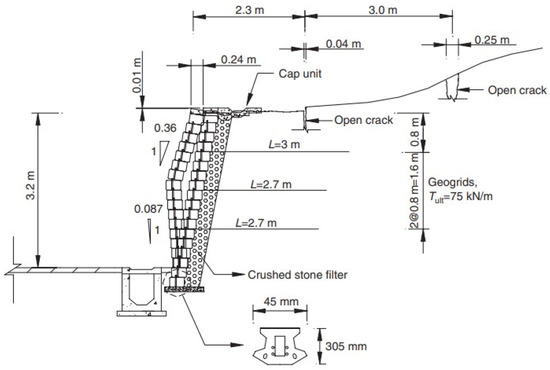
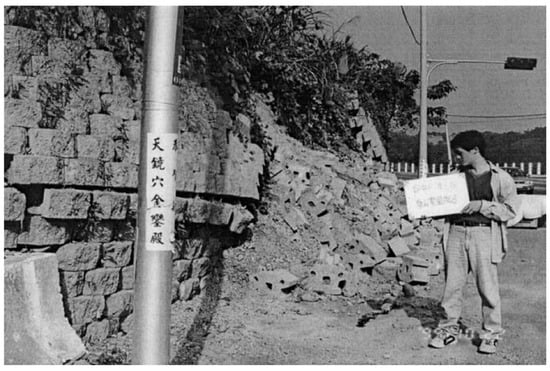
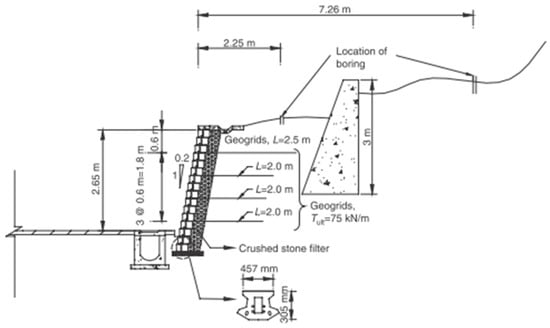
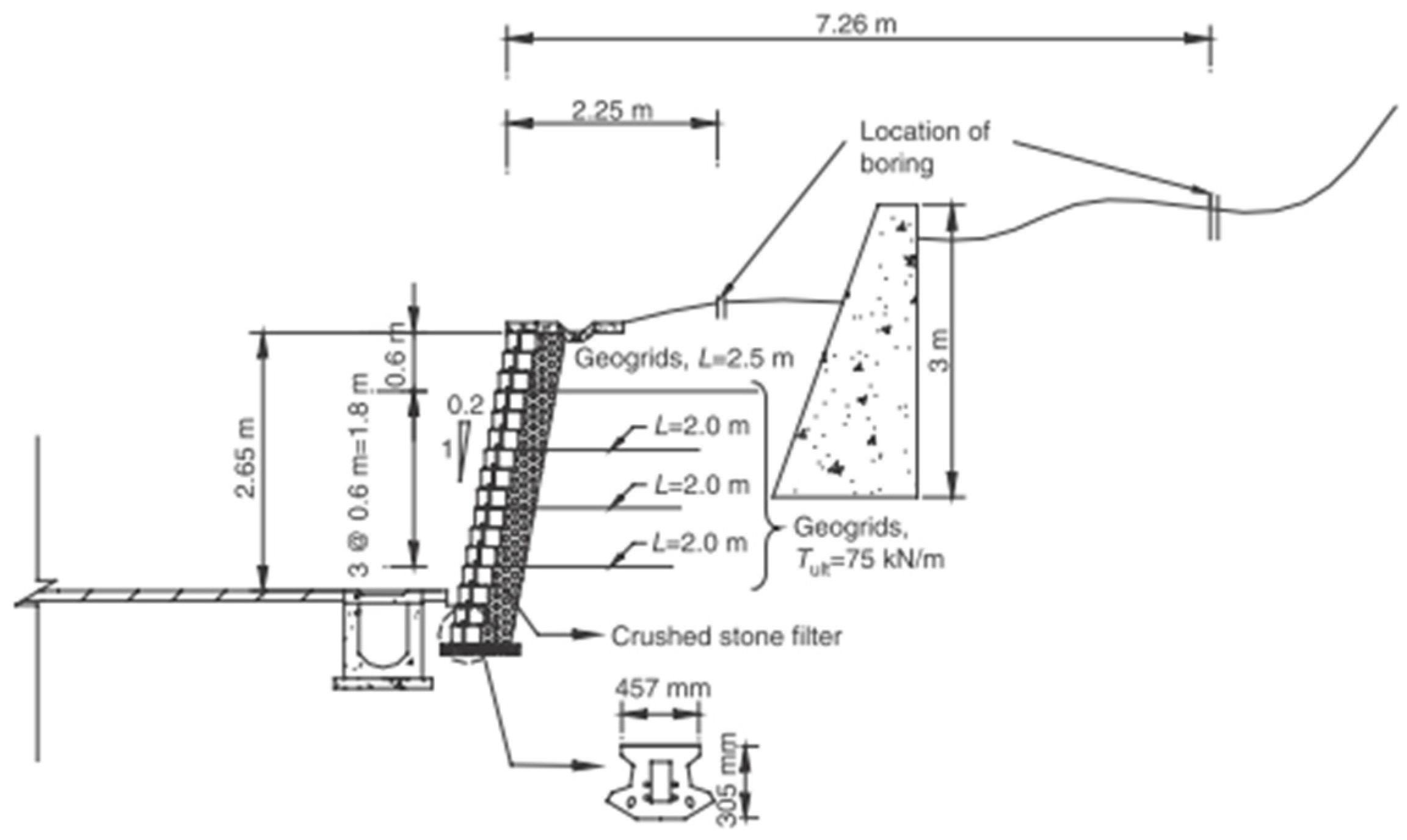
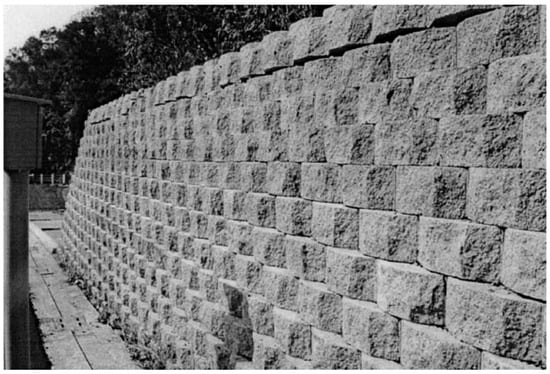
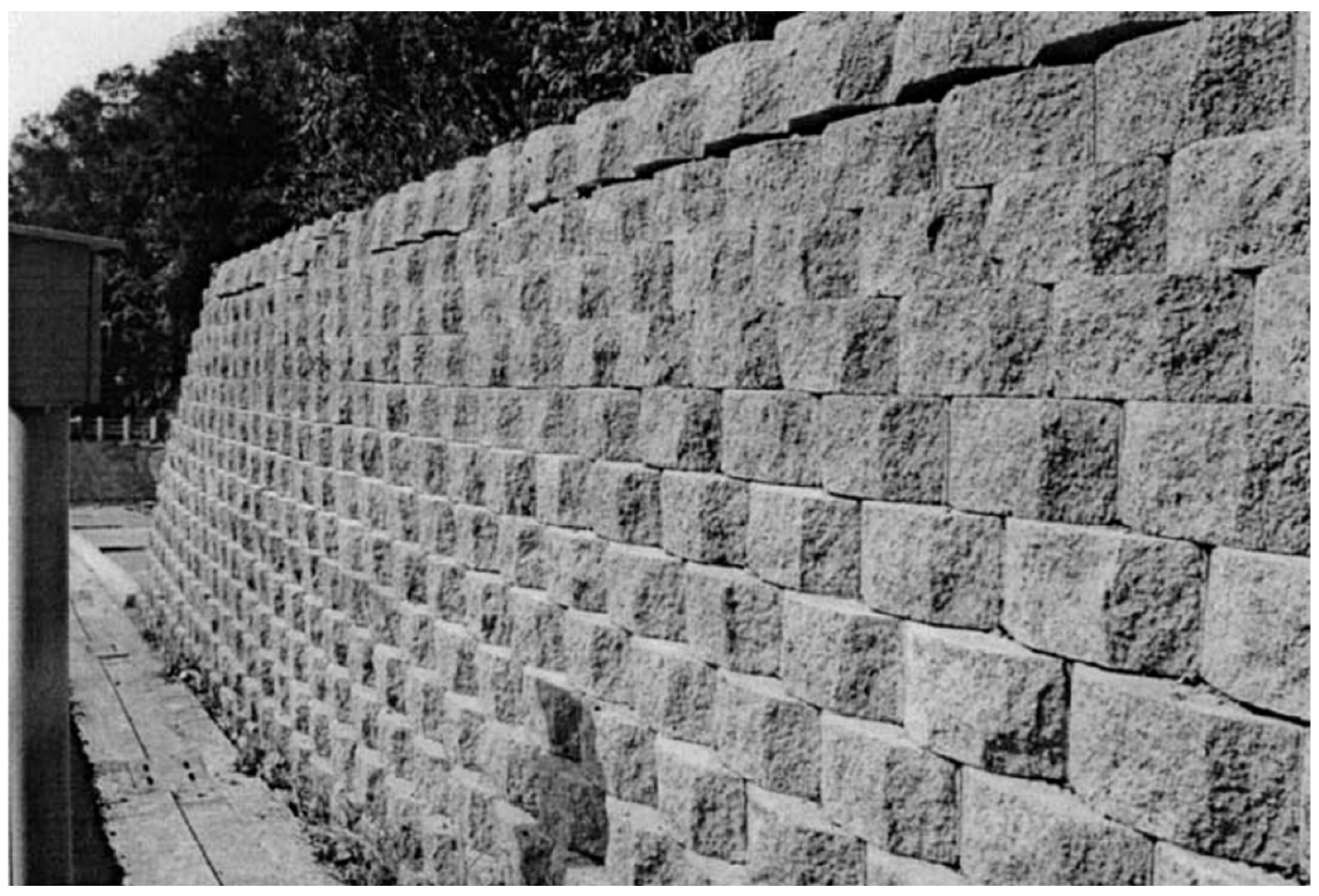
The studied slopes [23] are steep-faced geosynthetic-reinforced soil walls with modular block facings (GRS-MBs) located in Taichung County, in central Taiwan. The wall at Site 1 experienced severe damage during the 1999 Chi-Chi earthquake (ML = 7.3), as shown in Figure 1, Figure 2 and Figure 3. In contrast, a similar GRS-MB at Site 3, located approximately 2 km south of Site 1, exhibited only light damage, with facing displacement almost undetectable (Figure 4 and Figure 5). Although the overall deflection and displacement of the wall were minimal, the slight misalignment at the top of the facing column (Figure 5) suggests that a small amount of movement—on the order of a few centimeters (or tens of millimeters)—is an appropriate description of the post-earthquake condition of the Site-3 wall. At a nearby seismograph station (TCU052, N–S component), a peak horizontal ground acceleration of HPGA = 0.45 g (g: gravitational acceleration) was recorded.
Figure 1.
Cross-section 1 of the severely damaged GRS-MB at Site 1 [23].
Figure 2.
Cross-section 2 of severely deformed GRS-MB at Site 1 [23].
Figure 3.
Severely damaged GRS-MB at Site 1 [23].
Figure 4.
Lightly damaged (or lightly displaced) GRS-MB at Site 3 [23].
Figure 5.
Lightly displaced GRS-MB at Site 3 [23].
For the two Chi-Chi sites examined here, the simultaneous occurrence of vertical and horizontal accelerations was analyzed comprehensively [23], using recordings from nearby seismographs during the 1999 earthquake. Their study showed that the ratio of vertical to horizontal peak ground acceleration around the major pulses was approximately kv/kh = 0.2 (kv and kh: vertical and horizontal seismic coefficients positive for upward and outward inertial forces, respectively). This ratio has been adopted directly in the present work, and the corresponding vertical inertial force is explicitly included in the FFDM calculations in the same manner as the horizontal inertial force. In reinforced soil retaining structures, the vertical component primarily modifies the normal stress acting on potential failure wedges. In the FFDM framework, using a positive kv/kh ratio means that upward and outward inertial forces are applied simultaneously to the wedges during strong shaking. As noted in [23], this upward inertial force represents the more critical condition because it reduces the effective normal stress and thus the mobilized shear resistance along the slip surface. The adopted kv/kh = 0.2, therefore, provides a realistic representation of the vertical shaking intensity for the studied sites and ensures that its influence on the stress state and displacement response is appropriately accounted for in the FFDM analysis.
2.2. Hyperbolic Soil Stress–Displacement Model
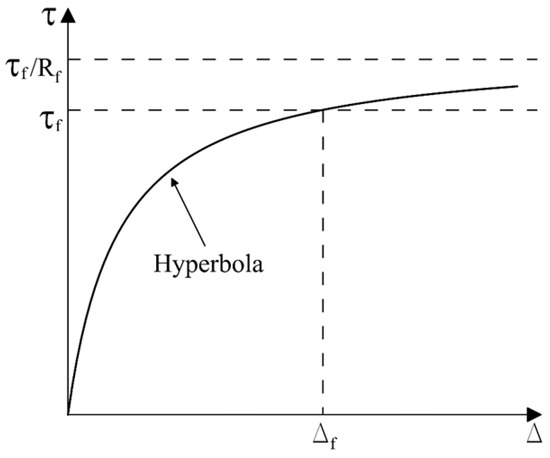
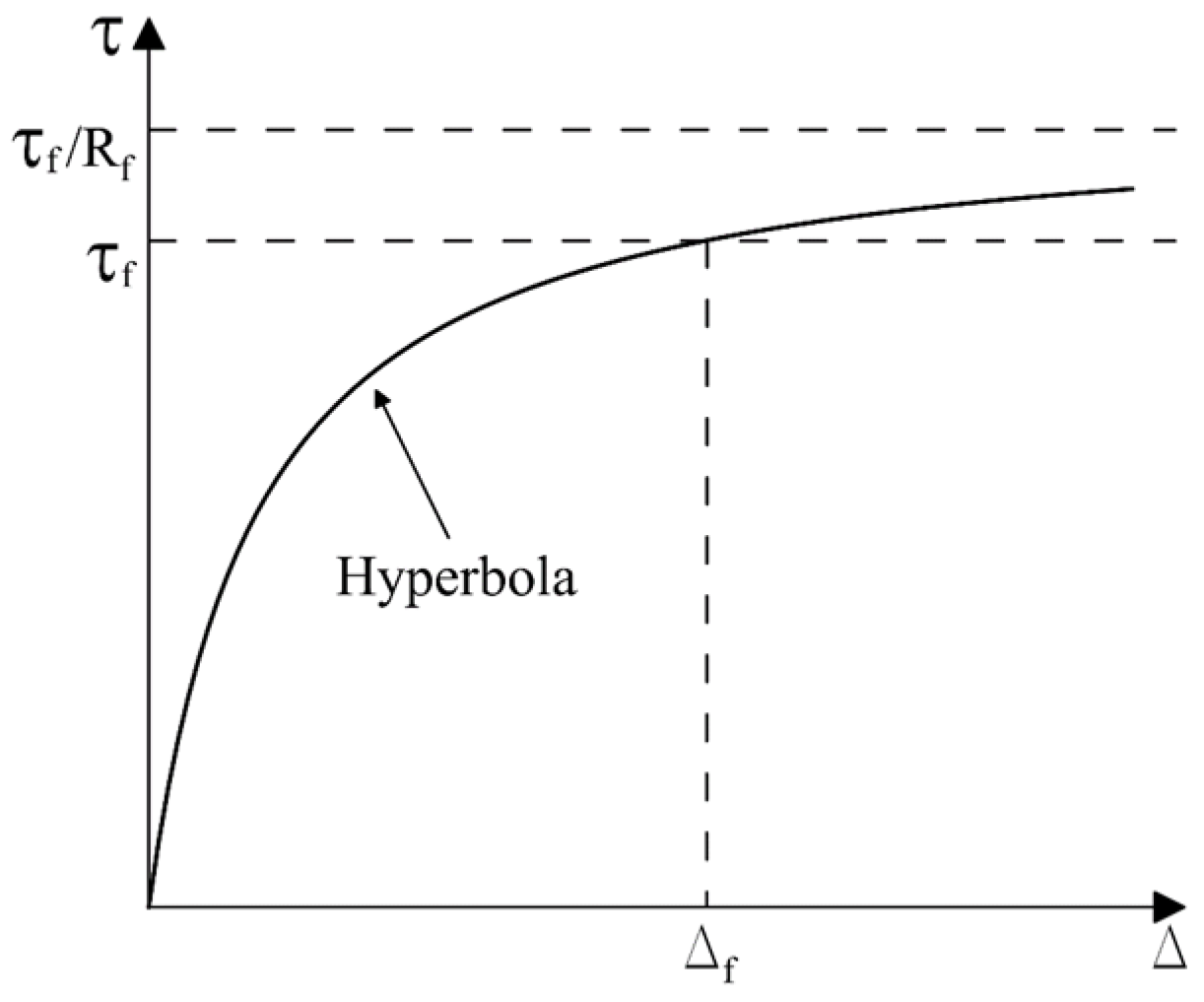
As illustrated in Figure 6, a hyperbolic model describing the normalized shear stress (τ/τf)–shear displacement (Δ) response along the potential failure surface was proposed in [35]). This model is an adaptation of the well-known hyperbolic relationship for shear stress–strain behavior developed in [39].
where a = τf/kinitial, b = Rf, and Rf = τf/τult
τ/τf = ∆/(a + b × ∆)
Figure 6.
Hyperbolic normalized shear stress–displacement curve used in FFDM.
- kinitial: Initial shear stiffness of soils.
- τult: Asymptote strength at infinite displacement.
- τf: Shear strength of soil according to the Mohr–Coulomb failure criterion.
- Rf: Failure ratio (=τf/τult).
The shear strength of soils (τf) is defined by the Mohr–Coulomb failure criterion:
τf = c + σ‘n × tan φ
- σ‘n: Effective normal stress.
- c: Cohesion intercept.
- φ: Internal friction angle of soils.
Equation (1) can be viewed as a reciprocal formulation of the local safety factor FSi at the base of the soil block (or slice) i:
FSi = τf i/τi
The initial shear stiffness kinitial is given as a power function of effective normal pressure, proposed in [38]:
kinitial = K × G × (σ’n/Pa)n
- K: Initial shear stiffness number (dimensionless).
- Pa: Atmospheric pressure (=101.3 kPa).
- G: Reference shear stiffness (=101.3 kPa/m).
- n: Pressure dependency exponent.
2.3. Multi-Wedge Failure Mechanism
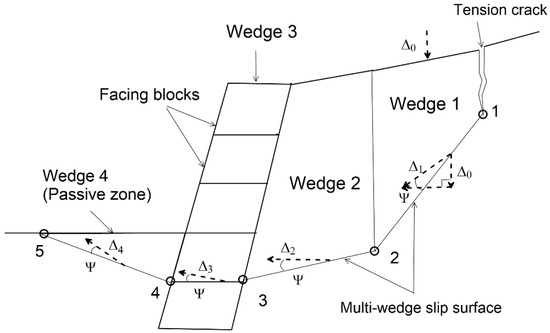
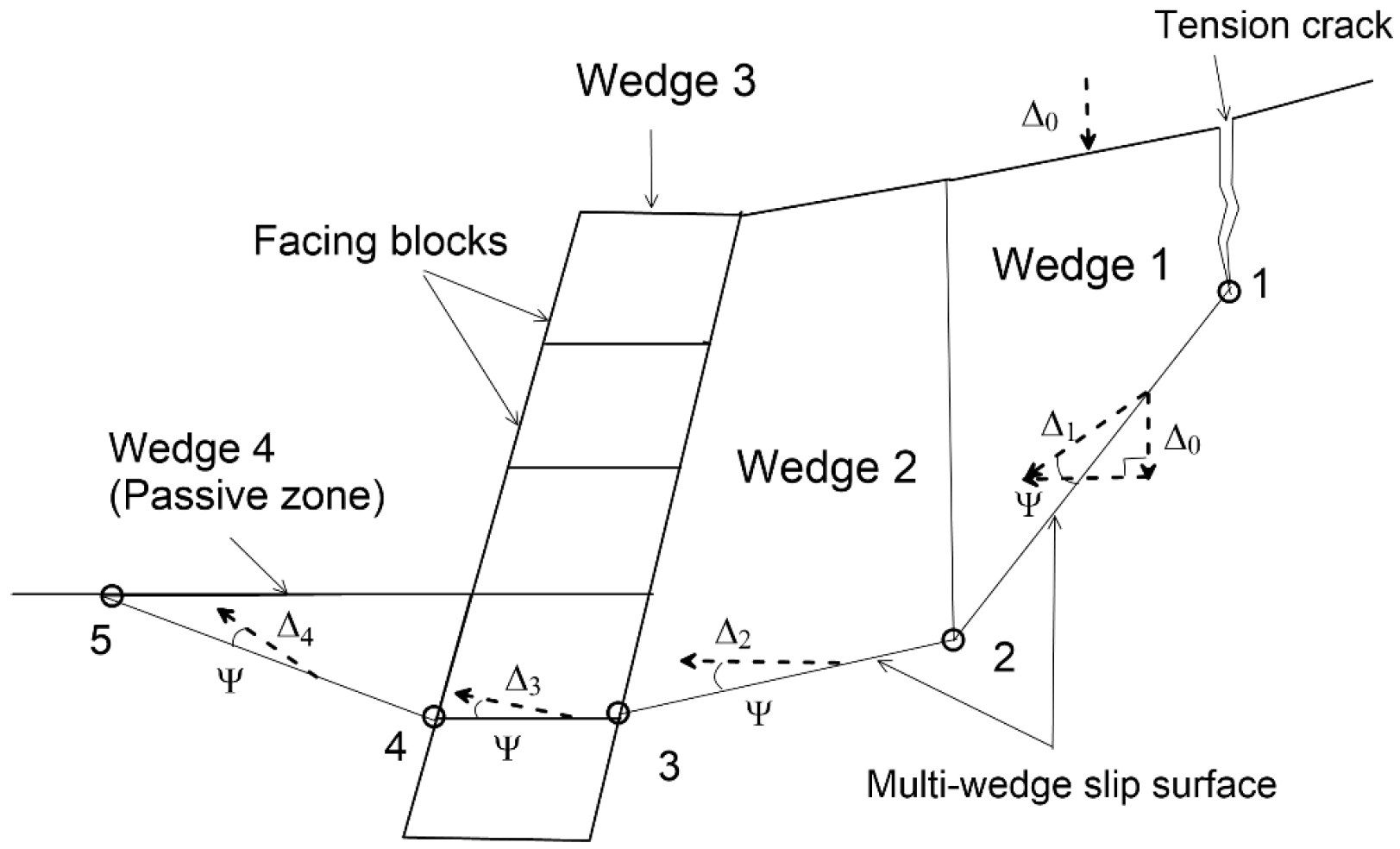
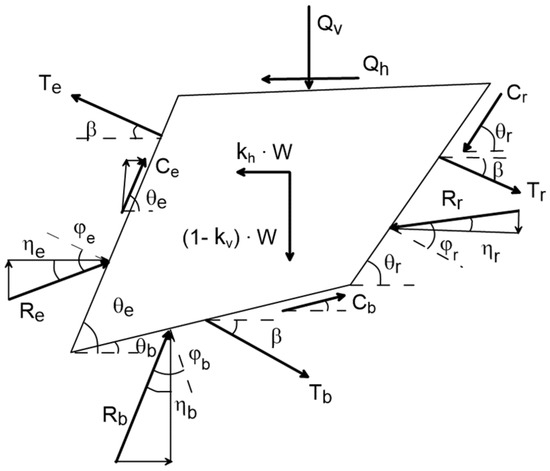
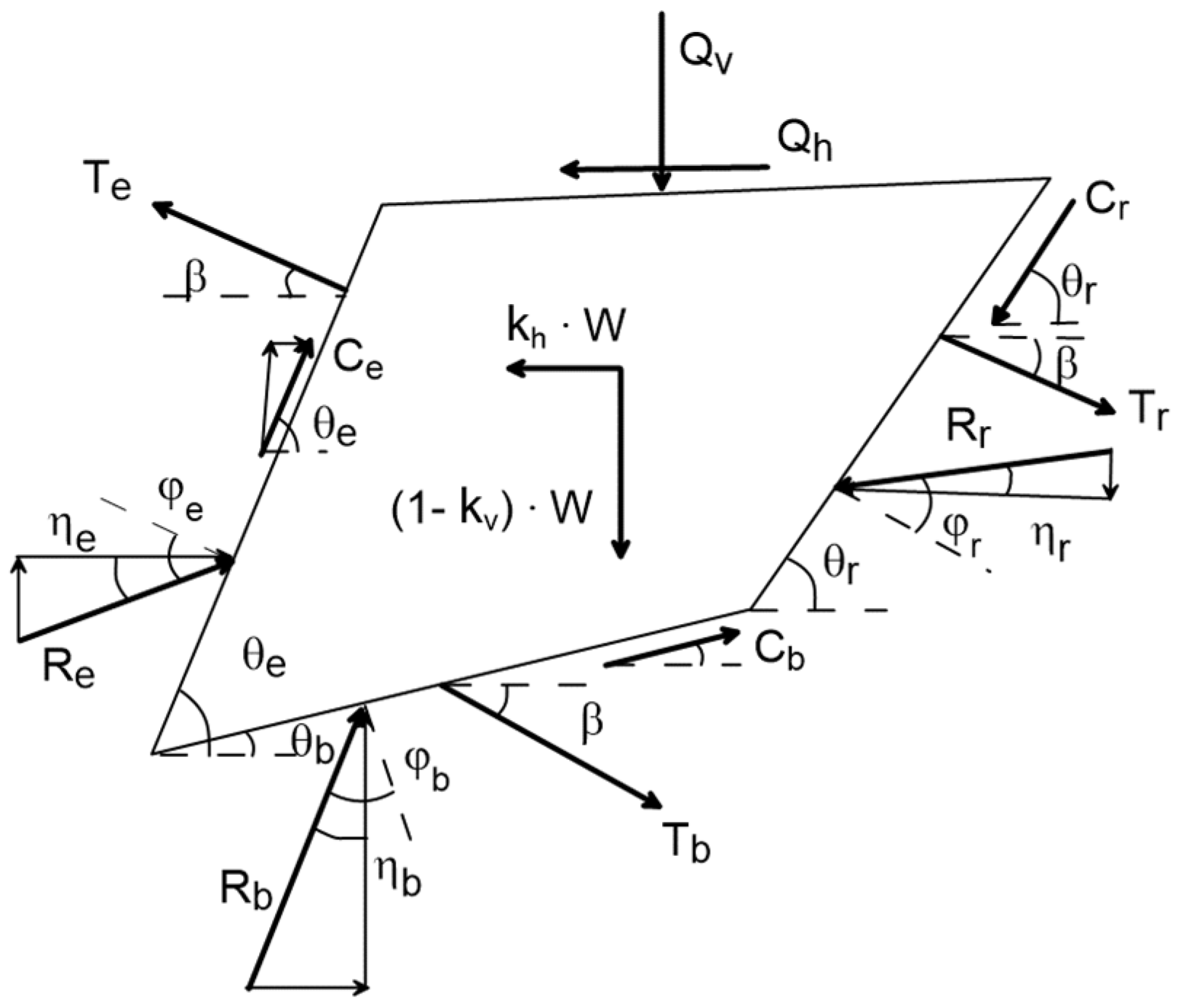
Figure 7 illustrates the multi-wedge failure mechanism adopted in this study. This mechanism evolved from the classical “two-wedge” or “bi-linear” failure model, which has long been used to simulate the failure of engineered slopes with steep faces, such as mechanically stabilized earth (MSE) walls and geosynthetic reinforced slopes with rigid or near vertical facings. An enhanced version of the two-wedge mechanism was proposed in [23], comprising two active wedges (Wedges 1 and 2), a facing column (Wedge 3), and—when present—a passive wedge located in front of the toe of the facing (Wedge 4). This multi-wedge formulation provides deeper insight into the contribution of the facing system to overall slope stability. Its advantages are further amplified when combined with the FFDM, which enables displacement-based performance evaluation of the slope. Figure 8 presents the body forces and reaction forces acting on a generalized polygon wedge configuration. Triangular wedges, exemplified by Wedges 1 and 4, constitute special cases where the soil strength and reaction forces along one boundary are assumed to be negligible or zero.
Figure 7.
A schematic illustration of the multi-wedge failure mechanism used in the FFDM.
Figure 8.
Force equilibrium conditions for a generalized wedge in the multi-wedge system.
By applying force equilibrium in both horizontal (x) and vertical (y) directions, the reaction force on the left side of each wedge can be expressed as:
Re = f (Rr, Rb, Te, Tr, Tb, Ce, Cr, Cb, φe, φr, φb, kh, kv, Qv, Qh)
Ce = c × le/FSi, Cr = c × lr/FSi, Cb = c × lb/FSi,
φe = tan−1 (tan φ/FSi), φr = tan−1 (tan φ/FSi), φb = tan−1 (tan φ/FSi)
- Ce, Cr, Cb: Cohesive resistance along soil–block interfaces.
- le, lr, lb: Lengths of soil–block interfaces.
- φe, φr, φb: Mobilized internal friction angles at interfaces.
- Te, Tr, Tb: Reinforcement force at interfaces.
- Rr, Rb: Reaction forces at interfaces.
To determine the reaction force acting on the left side of each wedge in the conventional Fs analysis, the computation advances sequentially from Wedge 1 to Wedge 3 (or Wedge 4, if present). A constant safety factor, Fs, is assumed and applied uniformly to all wedges. With this assumption, all terms on the right-hand side of the governing force–equilibrium relationship are known, except for the base reaction force Rb. Because both horizontal and vertical force equilibrium are imposed, the system is statically determinate. The Fs is updated through iterative equilibrium calculations, typically starting with an initial trial value of Fs = 1.0, and is adjusted until the virtual external force Re on the left side of wedge 3 (or wedge 4) becomes negligibly small (Re < 0.1 kN is used in this study).
In contrast, when the same governing relationship is solved within the FFDM framework, the safety factor for each soil block (FSi) and the mobilized reinforcement force (Tr, Tb, Te) depend on its displacement (Δi). The system remains statically determinate, but the FSi is updated iteratively according to the displacement field at the block base and along the interfaces. The detailed computational procedure for the FFDM is summarized in Section 2.7, Algorithmic procedure for FFDM implementation.
2.4. Post-Peak Stress–Displacement Relationship
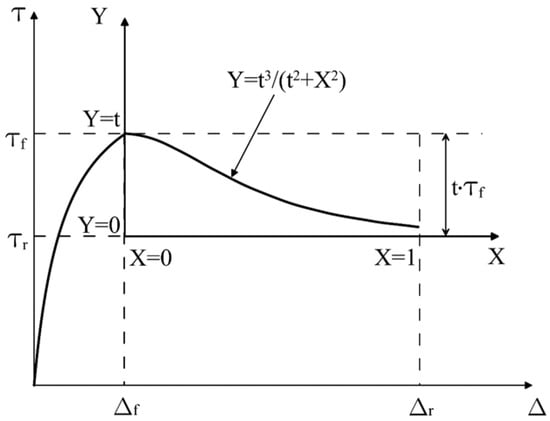
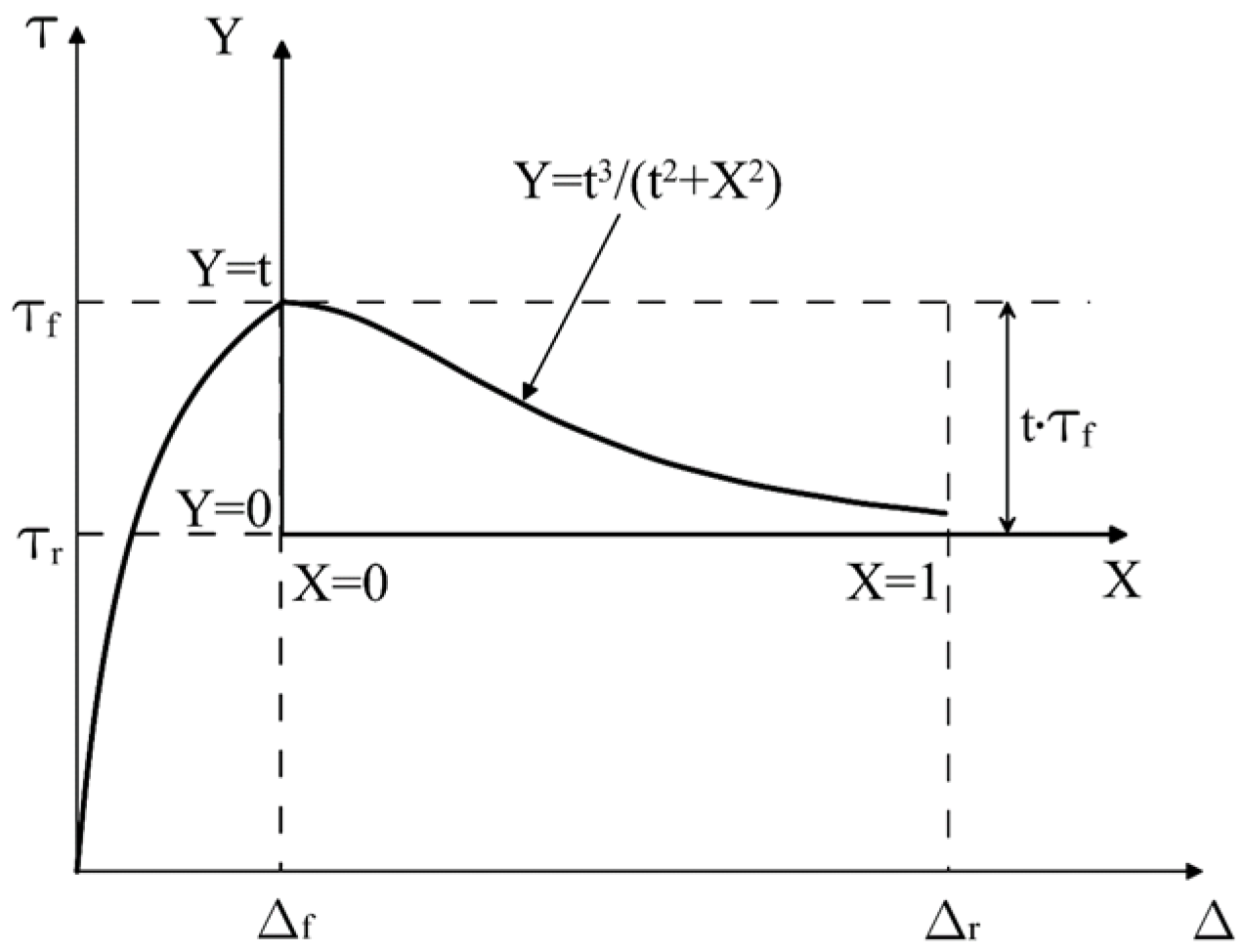
The post-peak segment of the shear stress–displacement (τ–Δ) curve is modeled using the Versoria (or Witch of Agnesi) curve [40,41], schematically illustrated in Figure 9. For efficient integration into the overall stress–displacement framework, a normalized local coordinate system (X–Y) is adopted. The X-axis origin (X = 0) aligns with the peak stress point (τf). The Y-axis origin (Y = 0) corresponds to the asymptotic value of the residual stress (τr). A distinctive feature of this curve is that the residual state (τr) is theoretically reached at an infinite Δ. In practice, however, a finite displacement (Δr), observed experimentally at the onset of the residual state (defined at X = 1), can be used to approximate τr with a negligibly small error (normally less than 1% error). The shear strength in the post-peak regime (τpost-peak) can be expressed as:
τpost-peak = τf − τf × (t − Y) = τf × (1 − t + Y)
Y = t3/(t2 + X2)
X= (Δ − Δf)/(Δr − Δf)
t = (τf − τr)/τf
Δr = Δf × Δratio
Figure 9.
The transformed coordinate system for the “Versoria” curve, representing post-peak stress–displacement behavior.
- t: Normalized strength reduction between peak and residual states.
- Y: Normalized post-peak shear stress.
- X: Normalized post-peak shear displacement.
- Δf: Shear displacement at peak stress state (obtained from Equation (1) by setting τ = τf).
- Δr: Shear displacement at the entrance of the residual state.
- Δratio: Residual-to-peak displacement ratio.
In geotechnical applications of post-peak soil behavior, the generalized and widely accepted term “residual friction angle, φres” is preferred over the parameter t used in Equation (6). To maintain consistency with common geotechnical practice and to improve interpretability, t is reformulated based on Equation (9) in terms of φres as follows:
t = 1 − τr/τf = 1 − (σ‘n × tan φ res)/(c + σ‘n × tan φ peak)
This formulation is incorporated directly into the FFDM iterative procedure. When post-peak behavior is considered in the slope displacement analysis using SLOPE-ffdm 2.0 [41], Equation (6) is applied to update the available soil strength along the slip surface whenever the condition FSi < 1 is detected during the iterative displacement computations. In this situation, the available shear strength τpost-peak corresponding to intermediate states between “peak” and “residual” is represented through a “transient friction angle,” denoted as φtransient:
φtransient = tan−1 (τpost-peak/σ‘n)
The value of τpost-peak in Equation (12) is obtained from Equation (6), using the normalized displacement X and normalized stress Y defined by Equations (8) and (7), respectively. This ensures that the reduction from peak to residual strength is consistently captured within the displacement-driven FFDM framework.
2.5. Displacement Compatibility
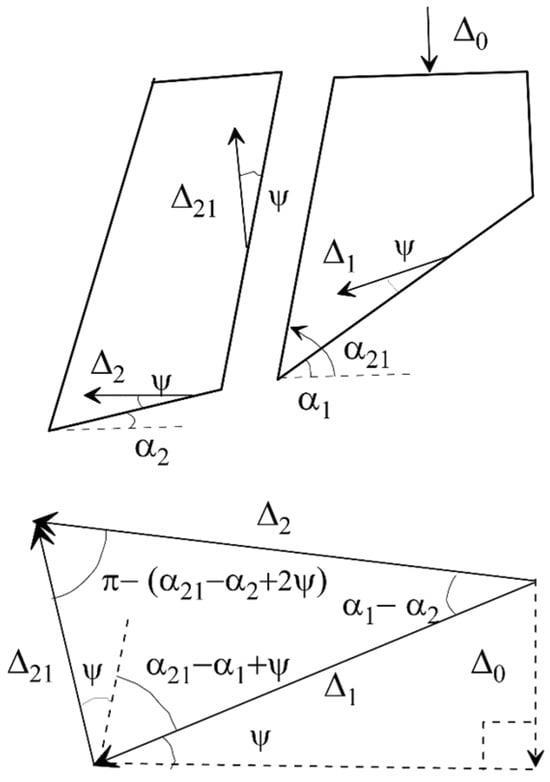
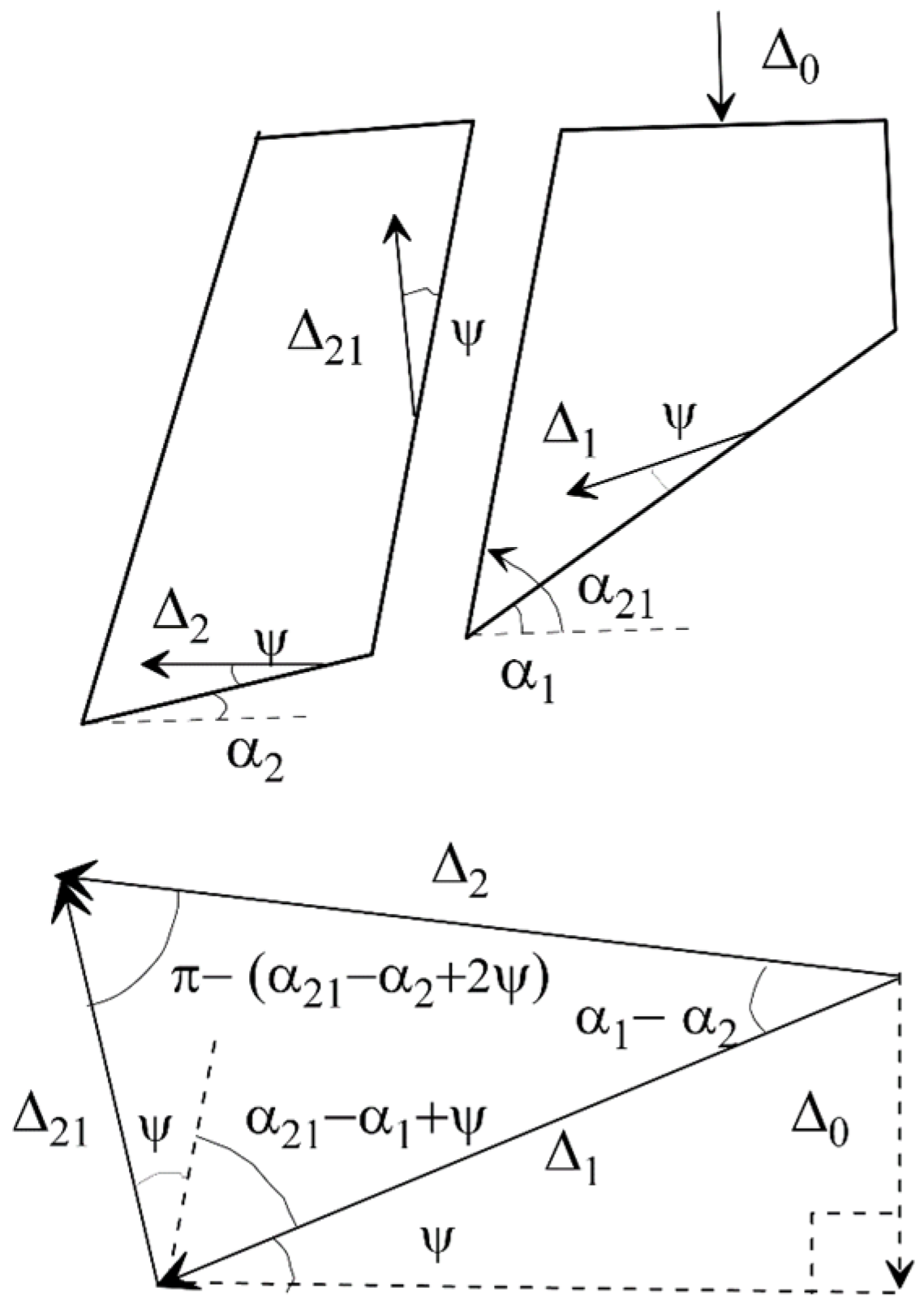
A hodograph (displacement diagram) that satisfies displacement compatibility—as schematically illustrated in Figure 10—is derived following the approach in [42]. This formulation maintains displacement compatibility across soil interfaces and forms the basis for kinematic analysis of the sliding block system. The displacement at the soil wedge (or slice) i can be expressed as:
Δi = Δ0 × f (αi)
f (αi) = cos (α1 − 2Ψ)/[sin (α1 − Ψ) × cos (2Ψ − α1)]
Figure 10.
The displacement compatibility conditions between adjacent soil blocks in the multi-wedge failure mechanism.
2.6. Displacement Increment
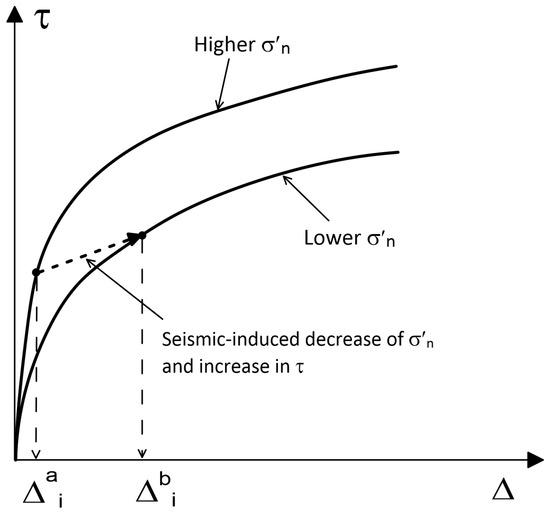
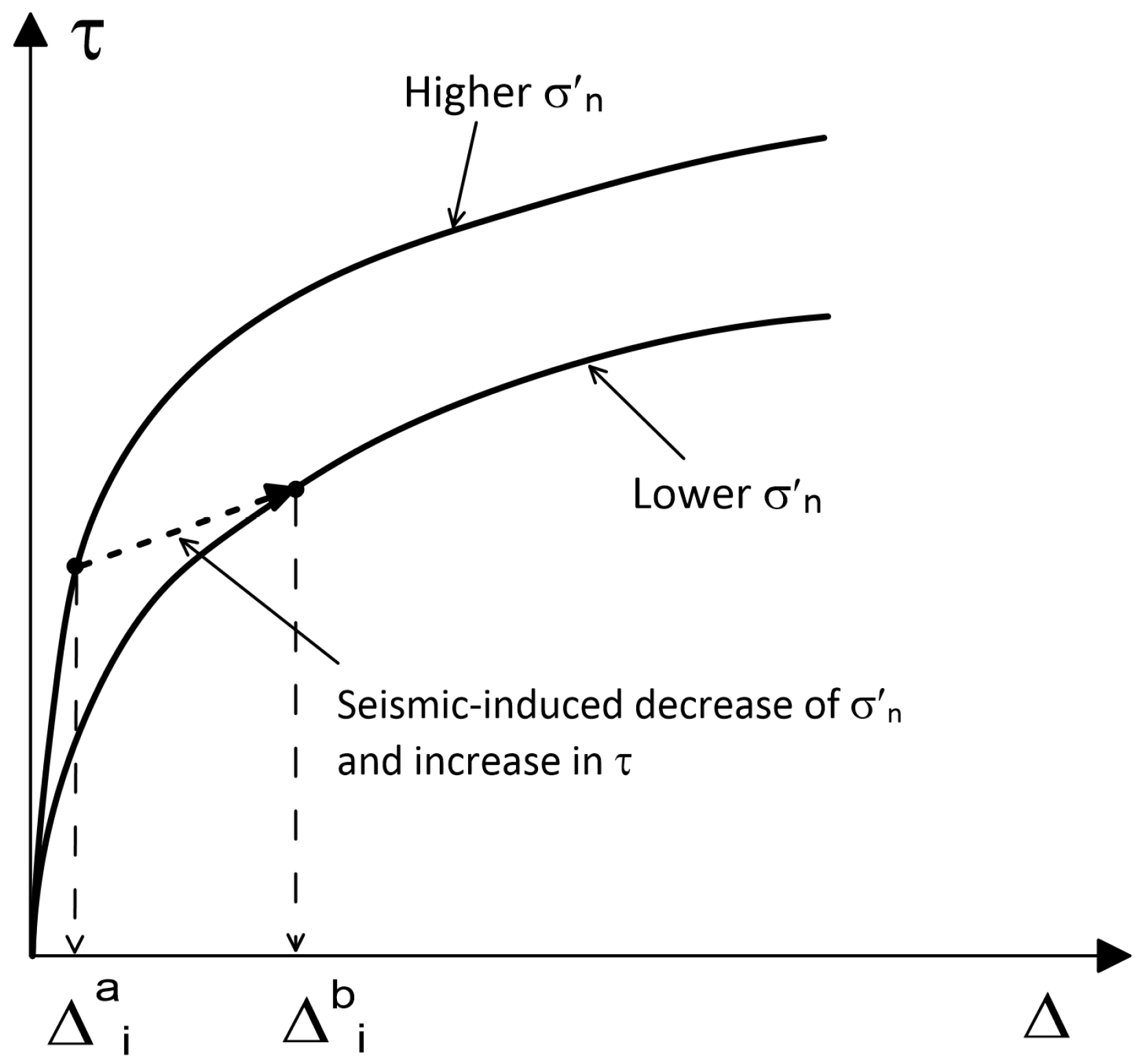
To evaluate slope displacements resulting from changes in external or internal conditions—such as seismic loading, variations in the water table, or pore water pressure—two displacement values for each slice (Δᵢ) are calculated: one representing the state prior to the event and the other representing the state afterward. The displacement increments for slice i, induced by the change in stress conditions, are schematically illustrated in Figure 11 and defined as:
Δi = Δbi − Δai
Figure 11.
Schematic stress path illustrating shear displacement response to seismic-induced stress changes.
2.7. Algorithmic Procedure for FFDM Implementation
The FFDM analysis implemented in SLOPE-ffdm 2.0 follows the algorithmic sequence below:
- (1)
- Input slope geometry, soil strength parameters, water table position, and reinforcement or anchor strength data.
- (2)
- For each trial failure surface, assign an initial vertical displacement at the crest, denoted as Δ0 (for example, Δ0 = 0.001 m).
- (3)
- Compute the displacements of all wedges using the displacement-compatibility functions described in Equation (13).
- (4)
- Calculate the reinforcement or anchor forces Tr, Tb, and Te at the pullout displacement corresponding to the local shear displacement Δi at the intersection between the reinforcement and the slip surface, following the pullout model in reference [36].
- (5)
- Calculate the peak shear strength τf and the initial stiffness kinitial using Equations (2) and (4). Then compute the local safety factors FSi using Equations (1)–(3). If FSi is greater than 1, or if post-peak strength is not considered, proceed directly to step (7).
- (6)
- For wedges where post-peak strength applies, compute the post-peak shear strength τpost-peak and the transient friction angle φtransient using Equations (6) and (12). Reset FSi to 1.0. The values φtransient and FSi = 1.0 are used in Equation (5).
- (7)
- Starting from wedge 1 at the right-hand crest, use the known boundary value of Rr for wedge 1 as input and compute Re, using Equation (5) together with the FSi values obtained above.
- (8)
- Sequentially compute Re for Wedges 2 through n, with the value of Re for wedge i serving as the value of Rr for wedge i + 1.
- (9)
- The value of Re for wedge n becomes Pex, the virtual external force acting at the left boundary of the wedge at the toe of the slope.
- (10)
- Adjust Δ0 and iterate steps (3) through (9) until Pex satisfies the convergence criterion (e.g., within plus or minus 0.1 to 0.01 kN/m).
- (11)
- Iterate steps (2) through (10) for all trial failure surfaces and identify the critical failure surface associated with the maximum value of Δ0.
2.8. Site Explorations
Ground explorations [23] included disturbed and undisturbed soil sampling, standard penetration tests (SPT), and direct shear tests using both small-size specimens (63 mm diameter × 42 mm) and large-size specimens (200 mm diameter × 113 mm). The resulting soil properties are summarized in Table 1. Table 1 indicates that Site 1 exhibits slightly higher N-values (8–10) than Site 3 (6–7), which would suggest higher friction angles at Site 1 (25–36°) compared with Site 3 (23–34°). However, the results from large-specimen direct shear tests show the opposite trend: soils at Site 3 exhibit higher friction angles (33.6–34.8°) than those at Site 1 (29.2–30.4°). Overall, the site explorations indicate that soils at Sites 1 and 3 have comparable strength characteristics. Based on these findings, a cohesive intercept of cpeak = 5 kPa is adopted for soils with an in situ water content of 16.5% in the subsequent analysis. Accordingly, two representative strength conditions are defined: a “low soil strength” case, with cpeak = 0 and φpeak = 30.4°, and a “high soil strength” case, with cpeak = 5 kPa and φpeak = 35°, consistent with the data summarized in Table 1. The low soil strength case with cpeak = 0 and φpeak = 30.4° is consistent with the c = 0 and φ = 30.4° used in the post-earthquake analysis [23]. In addition, a strength reduction factor finter-wedge = 1.0 is adopted, indicating that full soil strength is mobilized along the interfaces between soil wedges in the multi-wedge analysis.
Table 1.
Soil properties at Sites 1 and 3.
2.9. Input Soil and Reinforcement Parameters
The input parameters summarized below were selected based on published experimental databases and site-specific material information. Their uncertainty ranges and influence on computed seismic displacements are further examined through the sensitivity analyses in Appendix A. The sensitivity analysis in Appendix A quantifies the influence of both high-sensitivity and low-sensitivity parameters and shows that the soil-uncertainty-induced variations in the computed seismic displacements are well bounded. The results confirm that, despite the variability of individual input parameters, the overall conclusions drawn in this study remain robust and reliable.
- (1)
- Peak soil strengths (cpeak, φpeak): Three sets of soil strengths are used to represent possible variations in in situ conditions. The low-strength case uses cpeak = 0 and φpeak = 30.4°. The high-strength case uses cpeak = 5 kPa and φpeak = 35°. The integrated pre- and post-peak soil strength model uses cpeak = 5 kPa and φpeak = 35°, and cres = 0 kPa and φres = 31°. The adopted residual-to-peak friction ratio φres/φpeak = 0.88 is close to the median of the range 0.82–0.93 reported from a series of direct shear tests on various soil types [43,44].
- (2)
- Post-peak soil stress–displacement model: A residual displacement ratio Δratio = 2.0 is adopted, consistent with the post-peak soil stress–displacement relationships reported in [38,43,44]. For medium to dense sands, reported values of Δratio typically range from 2.0 to 6.0.
- (3)
- Shear stiffness number K: Stiffness values of K = 200 and K = 350 are adopted based on a database of direct shear tests [45]. These values represent approximately the lower-bound and median stiffnesses for soils with φ = 35°.
- (4)
- Pressure dependency exponent n: Approximate median values of n = −0.1 and n = 0.2, obtained from the same database [45], for sands with φ = 30°and 35° are used here.
- (5)
- Failure ratio Rf: A majority of data on soils with φ ≥ 30° indicates that Rf values typically fall within the range 0.79 and 0.87 [45]. A median value of Rf = 0.83 is used throughout the main analysis.
- (6)
- Displacement-dependent reinforcement pullout model: The mobilized reinforcement force in the backfill is computed using the hyperbolic reinforcement pullout model described in [36,46]. The peak adhesion at the soil–reinforcement interface is taken as cs-r = 0, and the peak interface friction angles are φs-r = 24° and 28°, approximately 0.8 φpeak. The hyperbolic pullout model parameters are the median values for geogrid pullout from silty sands, including the initial pullout stiffness number Kt = 12, stress-dependency exponent nt = −0.1, and strength ratio Rt = 0.7, as summarized in [46].
- (7)
- Tie-break strength of reinforcement: In the FFDM hyperbolic pullout model, the tie-break strength Ttie-break = 75 kN/m is assigned based on the available design and analysis documents for the studied walls.
- (8)
- Inter-wedge strength ratio: The inter-wedge strength ratio finter-wedge, defined as the ratio of failure shear strength to the shear strength available at the soil block–block interface in the force–equilibrium calculations, is set to 1.0. This choice is consistent with field observations indicating that no permanently open tension cracks developed at the interface between reinforced and unreinforced zones at the investigated sites.
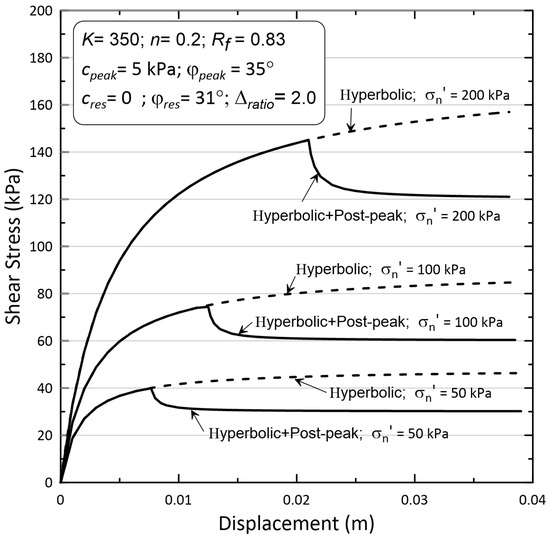
Both the hyperbolic curves and the integrated curves combine a pre-peak hyperbolic model with a post-peak strength degradation model, as presented in Figure 12. The conditions of “high soil strength” with cpeak = 5 kPa, φpeak = 35°, and cres = 0, φres = 31°, associated with hyperbolic parameters of K = 350, n = 0.2, and Rf = 0.83, are used. These soil strength parameters are determined from the results of ground exploration and from Table 2, as discussed previously. The use of these soil parameters is further supported by the consistent and physically meaningful trends observed in the sensitivity investigation presented in Appendix A.
Figure 12.
Hyperbolic and composed stress–displacement curves used in the FFDM analyses.
Table 2.
Material properties used in the FFDM analysis for the Chi-Chi GRS-MB walls.
2.10. FFDM Displacement Analysis
In the Type 4 (multi-wedge) FFDM analysis implemented in SLOPE ffdm 2.0, more than 18,000 trial facing surfaces are evaluated to identify the critical failure mechanism, defined by the minimum safety factor (Fs) and the maximum vertical displacement at the slope crest (Δ0), for a specified pseudo-static seismic coefficient kh (=HPGA/g). The seismic displacement at the base of the facing (Δ3) is then computed using Equation (11). The horizontal component of Δ3, denoted Δ3h, is used to evaluate the seismic resistance behavior of the wall. To ensure the robustness of the analytical procedure and the hyperbolic stress–displacement model used in the subsequent analyses, a systematic sensitivity investigation is conducted and presented in Appendix A.
The facing and reinforcement properties, except the friction angle-related terms, are kept identical for all cases.
3. Results
3.1. Results of Comparative Study on Sites 1 and 3
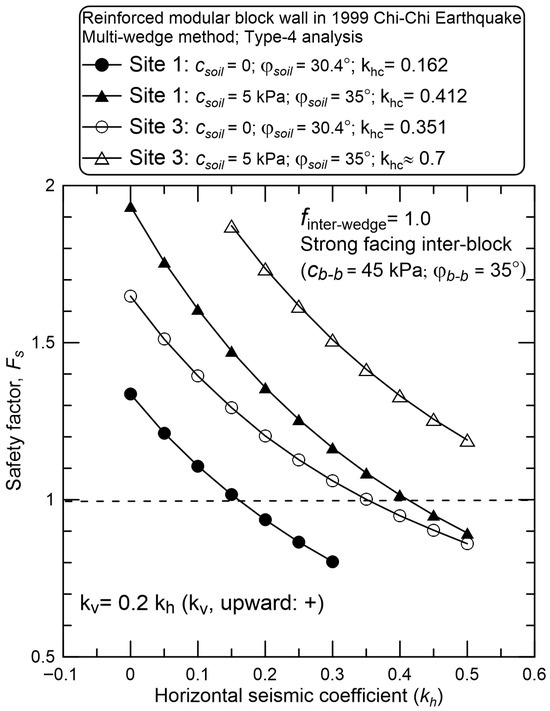
Figure 13 presents the Fs–kh curves obtained from conventional slope stability analyses using SLOPE ffdm 2.0. For both Sites 1 and 3, two soil strength conditions were examined: a low-strength case, with c = 0 and φ = 30.4°, and a high-strength case, with c = 5 kPa and φ = 35°. The two strength conditions produce distinctly different Fs–kh relationships, with the high-strength case yielding khc values nearly twice those of the low-strength case. In addition, Site 3 exhibits a markedly different set of Fs–kh curves compared with Site 1, despite their similar reinforcement, soil, and facing properties. This contrast will be examined further later.
Figure 13.
Fs–kh relationships obtained from conventional LEM slope stability analyses implemented in SLOPE-ffdm 2.0.
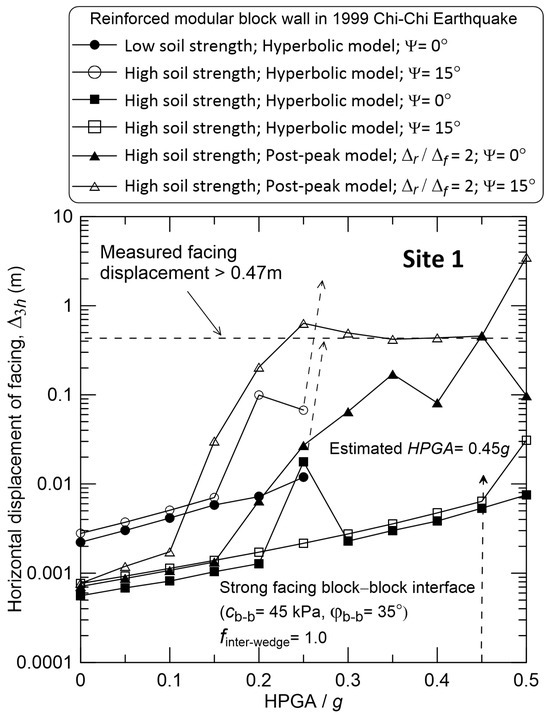
Figure 14 summarizes the Δ3h–kh relationships computed using the FFDM for Site 1, where Δ3h denotes the horizontal displacement at the base of the facing column. Three input conditions were analyzed: low soil strength with a hyperbolic model, high soil strength with a hyperbolic model, and high soil strength with a post-peak model. For each condition, two dilation angles (Ψ = 0° and Ψ = 15°), representing large-displacement and peak states, respectively, for the soil with φ = 30°, were used to evaluate the influence of Ψ on the displacement distribution along the failure surface. The resulting Δ3h–kh curves show limited sensitivity to Ψ. The low-strength hyperbolic model predicts extremely large Δ3h values at kh ≈ 0.25, whereas the high-strength hyperbolic model yields negligible displacements (approximately 0.007–0.008 m) at kh = 0.45. The curve with integrated pre- and post-peak model exhibits yielding behavior beginning around kh ≈ 0.15–0.20, and approaches Δ3h ≈ 0.4 m at kh = 0.45. This behavior contrasts sharply with the low-strength hyperbolic model, which predicts unrealistically large displacements for kh > 0.25. In this regard, the curve with integrated post-peak provides a more realistic representation of the observed performance than the low-strength hyperbolic model.
Figure 14.
The calculated Δ3h vs. kh curves for Site 1 obtained from the FFDM analysis.
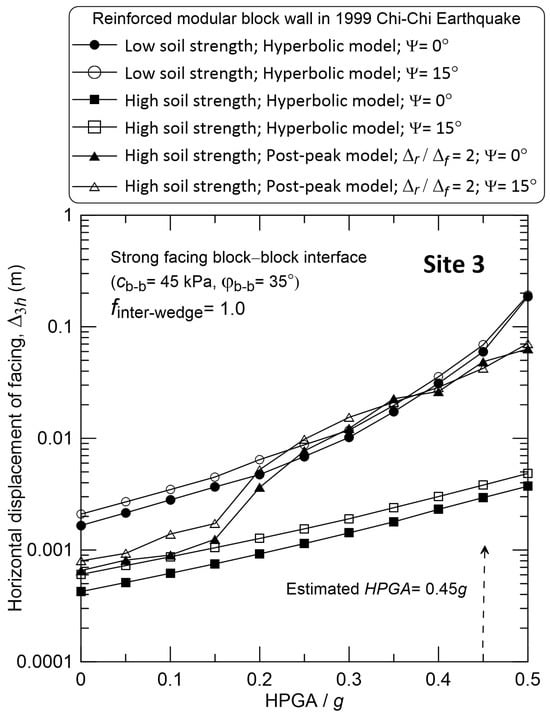
Figure 15 presents the corresponding results for Site 3. Compared with Site 1, the Δ3h–kh curves for Site 3 exhibit more numerically stable behavior. All three input conditions show consistent trends. The low-strength hyperbolic model predicts Δ3h = 0.07–0.08 m at kh = 0.45, comparable to the displacement predicted by the integrated post-peak model (Δ3h = 0.06–0.07 m). In contrast, the high-strength hyperbolic model produces much smaller displacements (0.003–0.005 m) at the same seismic coefficient, indicating a highly stable response. Overall, regardless of the assumed soil strength model, all curves for Site 3 indicate a stable condition, with wall movements that would go unnoticed in the field unless a displacement monitoring system were used.
Figure 15.
The calculated Δ3h vs. kh curves for Site 3 obtained from the FFDM analysis.
3.2. Factors Influencing the Failure Mechanism of Site 3
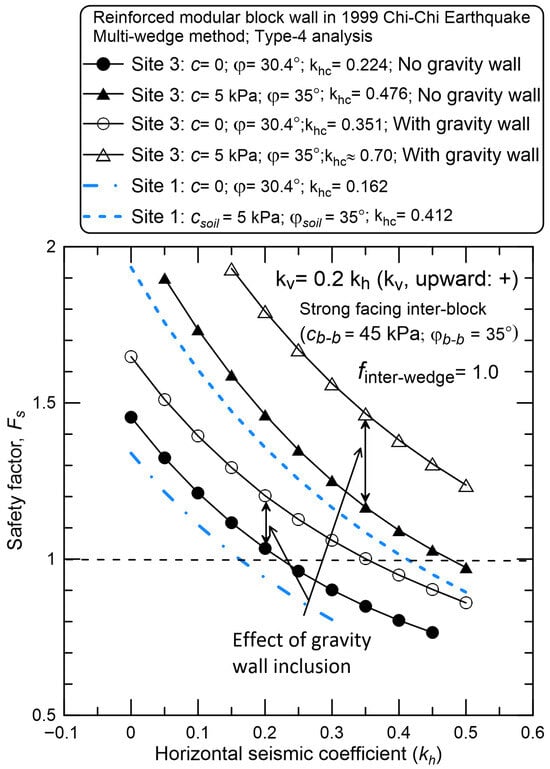
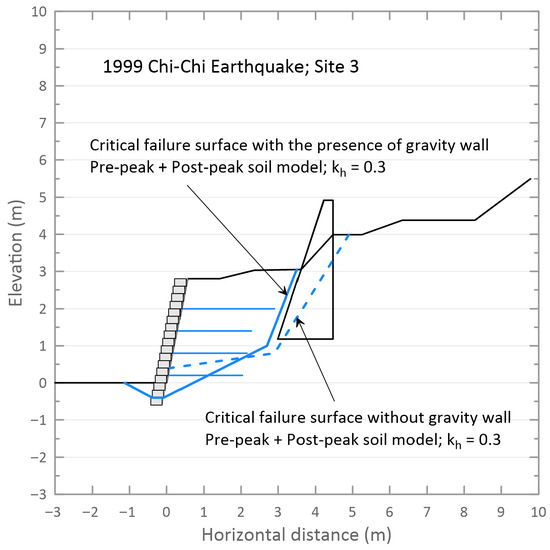
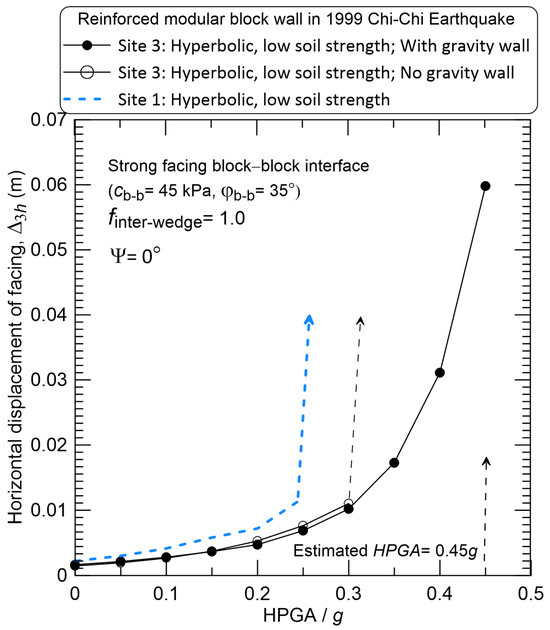
To investigate the primary cause of the higher stability of the GRS-MB at Site 3 compared with Site 1, the gravity concrete wall located behind the GRS-MB at Site 3 was removed from the slope profile, and is referred to as “Site 3, no gravity wall.” In contrast, the actual configuration is referred to as “Site 3, with gravity wall”. Figure 16 shows that the Fs values obtained from conventional stability analyses for the no-gravity-wall case are significantly smaller than those for the with-gravity-wall case. This difference arises because the no-gravity-wall condition allows the critical failure surface to extend freely into the backfill, whereas the presence of the gravity wall constrains the failure mechanism by forcing the critical surface to pass outside the wall (as shown in Figure 17). The resulting difference in khc between the two cases exceeds 50%. For reference, two dotted curves representing Site 1 are also included in Figure 16. The difference in Fs between these dotted curves and the curves for the no-gravity-wall case reflects factors other than the presence of the gravity wall, including reinforcement configuration and the slight difference in wall height. These factors account for differences in khc on the order of 13–38%, which are comparatively smaller than the influence of the gravity concrete wall.
Figure 16.
Fs—kh relationships for Site 3, comparing cases with and without the gravity wall.
Figure 17.
Examples of critical failure surfaces obtained from the FFDM analyses with and without the gravity wall.
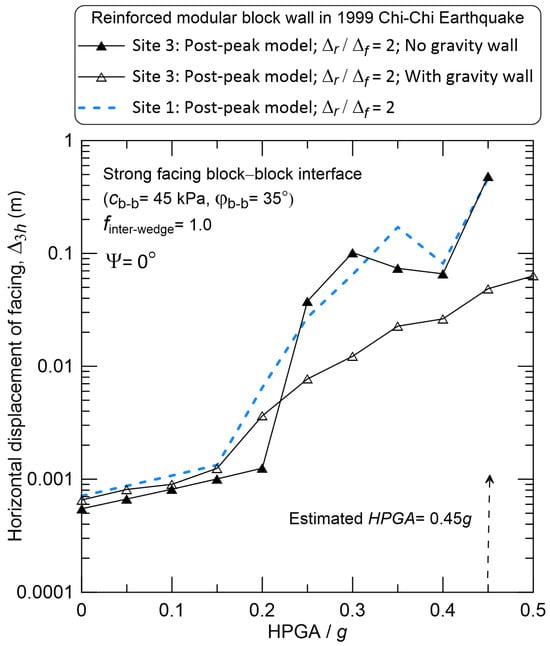
From the perspective of the FFDM, differences in seismic displacement behavior are also evident. Figure 18 shows that, for a given value of kh, the resulting Δ3h values follow the sequence Site 1 > Site 3 (no gravity wall) > Site 3 (with gravity wall). This ordering is the reverse of the Fs–kh relationships shown in Figure 16. Figure 19 presents results similar to those in Figure 18 but based on the soil model integrating pre- and post-peak soil strengths. The sequence of Δ3h among the three cases remains the same as in Figure 18, with a minor exception at kh = 0.25–0.30, where Δ3h for Site 1 becomes slightly smaller than that for Site 3 (no gravity wall).
Figure 18.
Δ3h–kh relationships for Site 3 with and without the gravity wall (using the hyperbolic soil model).
Figure 19.
Δ3h–kh relationships for Site 3 with and without the gravity wall (using post-peak soil model).
3.3. Comparisons Between Newmark’s Chart and the FFDM
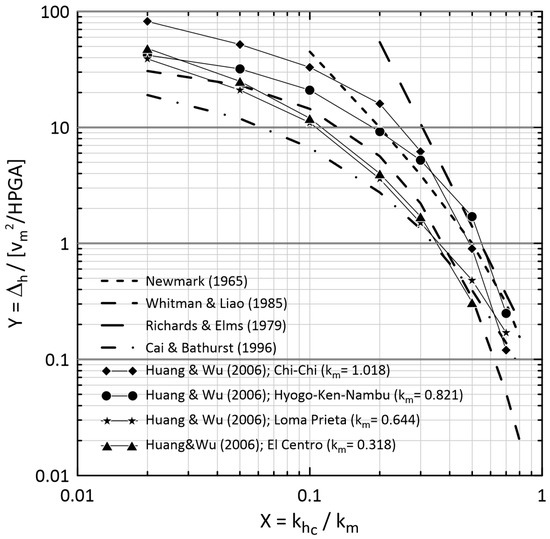
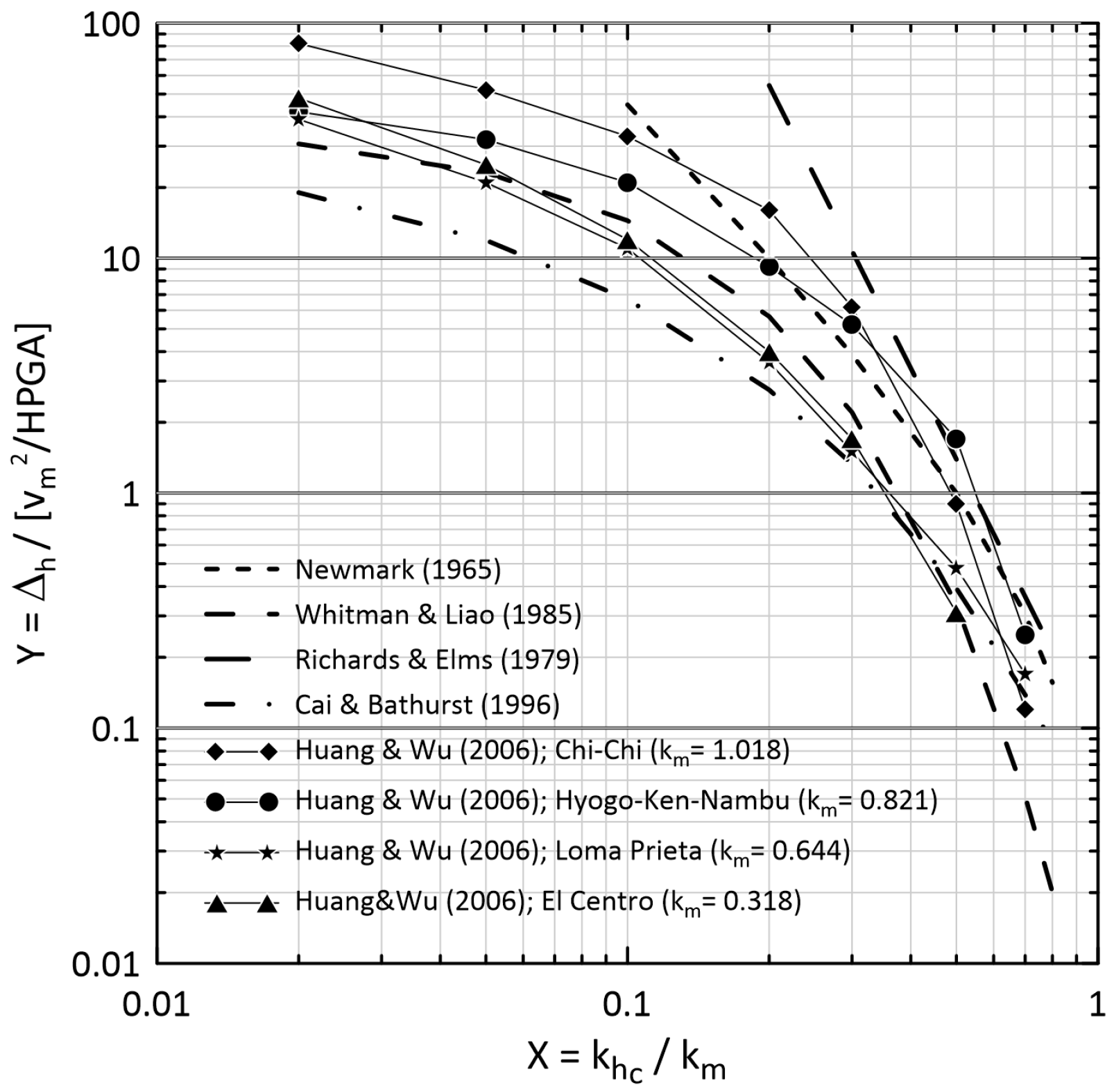
To compare the effectiveness of the FFDM with Newmark’s method, a Newmark chart compiled from [3,25,47,48,49] is presented in Figure 20. In this chart, the seismic displacement of slopes is normalized by vmax (maximum velocity) and HPGA of selected seismographs, and the critical seismic coefficient khc is normalized by km (design value of seismic coefficient, or seismic coefficient corresponding to an anticipated ground shaking). Among these curves, those associated with the El Centro and Chi-Chi earthquakes reported in [49] are selected for comparison. These two curves approximately represent the lower and upper bounds of the reported range and are used in the following comparative study.
Figure 20.
Normalized Newmark’s seismic displacement chart [3,25,47,48,49].
Table 3 compares the predicted Δ3h for Site 1 under a ground shaking intensity of km = 0.45 using Newmark’s chart and the FFDM. Newmark’s chart estimates Δ3h values ranging from 0.044 to 0.575 m for the Chi-Chi and El Centro earthquakes, respectively. This range spans more than a factor of 13, covering conditions from lightly damaged to severely damaged. In contrast, the FFDM predicts Δ3h = 0.456–0.460 m for km = 0.45 (Figure 14). The FFDM-predicted displacement of Δ3h = 0.456–0.460 m is consistent with the observed displacement of 0.47 m at Site 1, where part of the facing column collapsed.
Table 3.
Comparisons of Δ3h for Site 1 (khc = 0.162, km = 0.45 for Newmark’s chart; with post-peak model, K = 350, n = 0.2, Rf = 0.83, Ψ = 0–15°, and km = 0.45 in the FFDM analysis).
For Site 3, the FFDM predicts seismic displacements of Δ3h = 0.042–0.048 m under km = 0.45 (Figure 15). This displacement range is consistent with the misalignment observed at the top of the facing column during the post-earthquake investigation, as shown in Figure 5. When applying Newmark’s chart to Site 3, the parameter X = 0.361/0.45 = 0.802 falls beyond the upper limit of the charted range, even when the lowest possible soil strength is used. This illustrates the difficulty of applying Newmark’s chart to reinforced soil structures such as GRS-MBs, which typically exhibit higher khc values than conventional soil slopes.
4. Discussion
- (1)
- The distinctive responses of the two GRS-MB walls (Sites 1 and 3), despite their similar geological and geotechnical conditions, are attributed primarily to the presence of the gravity concrete wall behind the reinforced zone (Figure 4). The concrete gravity wall impeded the development of the slip surface and strongly influenced the critical failure mechanism in both force-based Fs analyses and displacement-based FFDM analyses. Secondary factors include the smaller vertical reinforcement spacing (Sv = 0.6 m) used at Site 3 and its smaller wall height (2.6 m) compared with Site 1 (3.2 m).
- (2)
- For a unified interpretation of the seismic resistance of the two sites, the FFDM response curves, based on the soil model integrating pre- and post-peak strengths, provide a consistent explanation. These curves indicate Δ3h = 0.456–0.460 m at kh = 0.45 for Site 1 (Figure 14), and a much smaller Δ3h ≈ 0.042–0.048 m for Site 3 (Figure 15), consistent with the observed performance.
- (3)
- The use of high soil strength with a hyperbolic model may underestimate seismic displacement. This is evident for Sites 1 and 3, as shown in Figure 14 and Figure 15, where Δ3h values on the order of 10−3 m are predicted under kh = 0.45. These results arise from the inherent approximation of the hyperbolic model, which does not capture soil behavior as accurately as the model incorporating both pre- and post-peak strengths. The discrepancy, therefore, reflects limitations of the hyperbolic curve itself rather than uncertainty in the selected soil parameters.
- (4)
- For the two GRS-MB walls examined, the FFDM does not require a pre-determined critical acceleration (khc). Instead, seismic displacements are computed directly through a displacement-driven formulation that enforces compatibility and equilibrium at each iteration. In these case histories, this feature allowed the FFDM to capture deformation patterns that were not represented in conventional approaches, such as Newmark’s method, which relies on a pre-determined critical acceleration and does not explicitly model the evolution of soil deformation. The constitutive model adopted in the FFDM enabled a more detailed representation of pre- and post-peak soil behavior than was possible with the operational strength parameters used in limit-equilibrium-based methods. These observations suggest potential advantages of the FFDM for reinforced soil structures similar to those studied here.
- (5)
- For the GRS-MB walls analyzed in this study, the critical seismic coefficient khc, derived from limit–equilibrium analyses, was relatively high, making direct application of Newmark’s chart difficult. For example, at Site 3, khc remained as high as 0.361 even under the lowest plausible soil strength. Given the recorded HPGA of 0.45 g at station TCU052, the resulting khc/km ratio exceeded the upper limit of Newmark’s chart. This illustrates a practical challenge when applying Newmark’s method to reinforced soil structures with relatively high stability margins, at least for the two cases examined here. In these specific situations, the FFDM provided an alternative means of estimating seismic displacement by explicitly incorporating interaction effects and pre- and post-peak soil behavior.
- (6)
- In these case histories, Newmark’s chart provided only order-of-magnitude displacement estimates and did not resolve the small but engineering-significant movements (several 10−3 to 10−2 m) observed in the field. In contrast, the FFDM is capable of generating displacements in the 10−3 to 10−2 m range in response to small to intense seismic inertial forces. For the wall systems examined here, this capability was essential for interpreting performance where millimeter- to centimeter-scale movements governed serviceability.
- (7)
- For the two GRS-MB walls studied, the FFDM served as a useful complement to Newmark’s sliding-block method. The two approaches differ fundamentally in how they treat soil behavior and seismic loading: Newmark’s method relies on operational strength parameters and double integration of ground accelerations, whereas the FFDM incorporates additional deformation-related soil parameters to represent progressive strength and stiffness changes. In these case histories, the simplified inertial loading used in the FFDM, combined with its mechanistic soil modeling, provided displacement estimates that aligned with observed performance. Nevertheless, uncertainties in deformation-related soil parameters and variability in ground-motion characteristics remain important considerations, underscoring the need for continued calibration of the FFDM against additional well-documented case histories before broader generalization.
5. Conclusions
The contrasting seismic responses of the two geologically and geotechnically similar GRS-MB walls (Sites 1 and 3) during the 1999 Chi-Chi earthquake can be mechanistically explained through force-based Fs analysis and displacement-based FFDM. Although the walls shared comparable backfill soils and reinforcement materials, the FFDM revealed the primary factor governing their divergent behaviors: the presence of a concrete gravity retaining wall behind the GRS-MB at Site 3, which restricted the development of the critical slip surface and fundamentally altered the failure mechanism. Secondary influences included the smaller reinforcement spacing at Site 3, which enhanced internal stability, and its slightly smaller wall height. These findings illustrate how site-specific structural constraints can dominate seismic performance even when soil and reinforcement conditions are nominally similar.
Using these site-specific conditions, the FFDM successfully reproduced the observed seismic displacements when the high in situ soil strength was combined with a post-peak strength model. In contrast, lower-bound and upper-bound hyperbolic soil models tended to overestimate or underestimate the observed displacements. This highlights the importance of incorporating post-peak soil behavior and mechanistic soil parameters (c, φ, K, n, and Rf) when modeling reinforced soil structures under strong shaking, and underscores the need for a more comprehensive database of deformation-related soil parameters—particularly those governing peak and post-peak response.
For these two case histories, Newmark’s displacement method produced a wide range of predicted displacements due to its reliance on operational soil strength parameters and its sensitivity to ground-motion variability. These characteristics limited its ability to resolve the small but engineering-significant movements observed in the field. For the GRS-MB walls examined, the FFDM provided a more consistent interpretation of seismic displacement by combining simplified inertial loading with deformation-related soil parameters. While these findings demonstrate the usefulness of the FFDM for the specific wall systems studied, broader validation across additional case histories is needed to fully establish its general applicability.
As demonstrated in both the main analysis and the sensitivity study, the FFDM remains applicable at strong shaking levels (e.g., kh ≥ 0.3) that would cause conventional limit-equilibrium calculations to yield Fs < 1.0—a non-existent equilibrium state implying mobilized shear resistance greater than the soil’s ultimate strength. This capability is fundamental to the FFDM’s usefulness for displacement-based seismic assessment. The sensitivity investigation further shows that most database-derived soil, reinforcement, and facing parameters influenced predicted displacements only on the order of a few 10−3 m, while the parameters exerting the greatest influence, such as the internal friction angles of soils and the friction angle at the base of facing, were well constrained by site exploration. These results confirm that the main conclusions are robust with respect to reasonable uncertainties in input properties.
For the studied walls—and, potentially, for similar reinforced soil systems—the FFDM offers a practical balance between simplified inertial loading and deformation-related soil behavior, enabling displacement estimates that align with observed field performance across a wide range of shaking intensities. Because the FFDM produces displacement-based seismic resistance curves during the design phase, it may serve as a useful component of seismic resilience planning for reinforced soil structures, particularly those resembling the systems analyzed here. Despite these advantages, several limitations remain. In the short history of reinforced-soil seismic case studies, the lack of a comprehensive database for deformation-related soil parameters, the need for engineering judgment when selecting input soil properties, and the reliance on prescribed failure–surface patterns all constrain current modeling accuracy. These limitations also indicate that the present findings should be viewed as case-specific until additional well-documented seismic case histories become available.
Looking forward, automated back-analysis systems, AI-assisted estimation of soil parameters, AI-based seismic displacement prediction frameworks, and self-updating slope displacement monitoring systems functioning as digital twin models represent promising directions for improving the reliability, adaptability, and resilience of displacement-based seismic design.
Funding
This research received no external funding.
Institutional Review Board Statement
Not applicable.
Informed Consent Statement
Not applicable.
Data Availability Statement
The original contributions presented in this study are included in the article. Further inquiries can be directed to the corresponding author.
Conflicts of Interest
The author declares no conflict of interest.
Appendix A
This appendix presents a systematic sensitivity investigation of the input parameters used in the hyperbolic stress–displacement model. The purpose of this analysis is twofold: (1) to verify that the model responds to parameter variations in a physically consistent manner, and (2) to demonstrate the robustness of the FFDM-based displacement framework under a wide range of soil conditions. These checks provide additional confidence that the main text results are not artifacts of a particular parameter choice but instead reflect stable and interpretable model behavior. In this parametric study, all parameters fall within practically meaningful ranges based on preliminary investigations reported in [43,44,45,46]. The database used to establish these ranges encompasses soils ranging from coarse granular materials to fine-grained cohesive deposits, ensuring that the selected values are representative of backfill conditions commonly encountered in practice.
Site 3, which exhibited significant seismic stability during the intense ground shaking of the Chi-Chi earthquake, is adopted as the reference case. Throughout the analysis, an intensive shaking level of HPGA = 0.3 g (kh = 0.3) is used. It is worth noting that such a high value of kh is generally not permissible in conventional limit–equilibrium-based seismic stability analyses because the resulting safety factor Fs would often fall below 1.0. An Fs value less than 1.0 implies that the slope has already reached a failed or non-existent equilibrium state, and that the soil would need to mobilize shear resistance exceeding its ultimate strength—an outcome that is physically impossible. For this reason, engineers avoid Fs < 1.0 scenarios in traditional analyses. In contrast, the FFDM-based displacement method does not rely on the existence of a statically admissible equilibrium (i.e., Fs > 1.0) as a prerequisite for meaningful results, allowing it to remain applicable even under strong shaking levels that may be physically impermissible in conventional Fs-based approaches. Consequently, this parametric analysis also highlights the capability of the FFDM framework to transcend limitations inherent in traditional limit-equilibrium methods.
Figure A1 shows that the horizontal displacement at the base of the facing (Δ3h) decreases with increasing K; increases with increasing Rf and Ψ; and remains essentially unchanged with variations in n. These trends are consistent with the physical meaning of the parameters. A higher initial stiffness K reduces Δ3h. A larger failure ratio Rf increases Δ3h because a higher Rf produces a flatter stress–displacement segment beyond the peak state, which in turn generates larger displacements than a soil with a lower Rf. A positive dilatancy angle Ψ corresponds to volumetric expansion during shearing, which magnifies the displacement field toward the slope toe due to displacement compatibility requirements among soil wedges. Although Ψ > 0 represents dilation, assigning a negative Ψ is also possible within the model to simulate contractive soil behavior when needed. The insensitivity of Δ3h to the stress-dependency exponent n arises because the confining stress within the backfill of the 2.6 m high wall at Site 3 is not sufficiently large to induce notable changes in soil shear stiffness.
Figure A1.
Sensitivities of K, n, Rf, and Ψ on the Δ3h of Site 3.
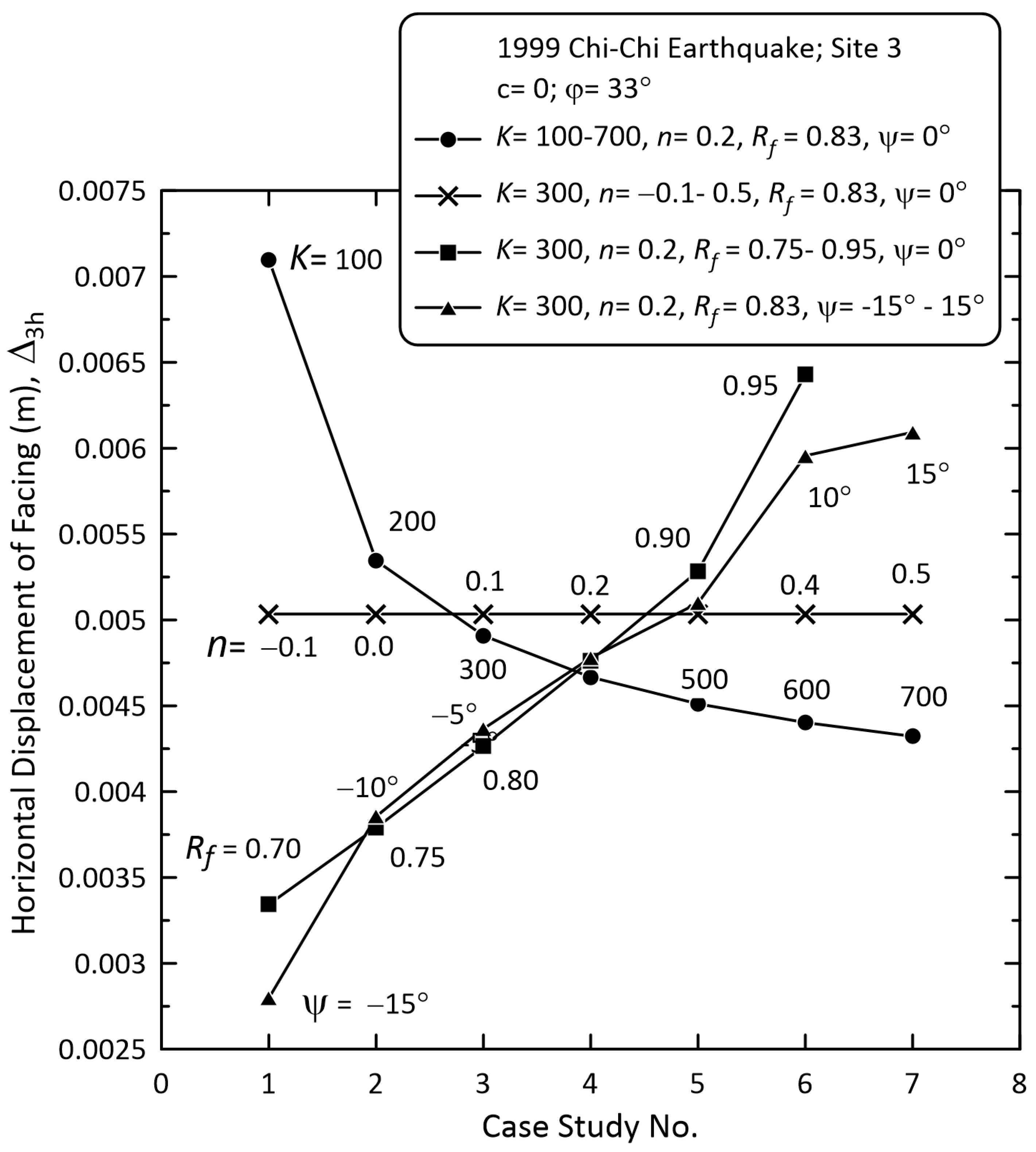
Figure A2 shows the sensitivity of the internal friction angle φ on the Δ3h–K curves. The consistent trends observed under different combinations of φ and K further demonstrate the precision and robustness of both the hyperbolic soil model and the computational algorithm.
Figure A2.
Sensitivities of φ on the Δ3h of Site 3.
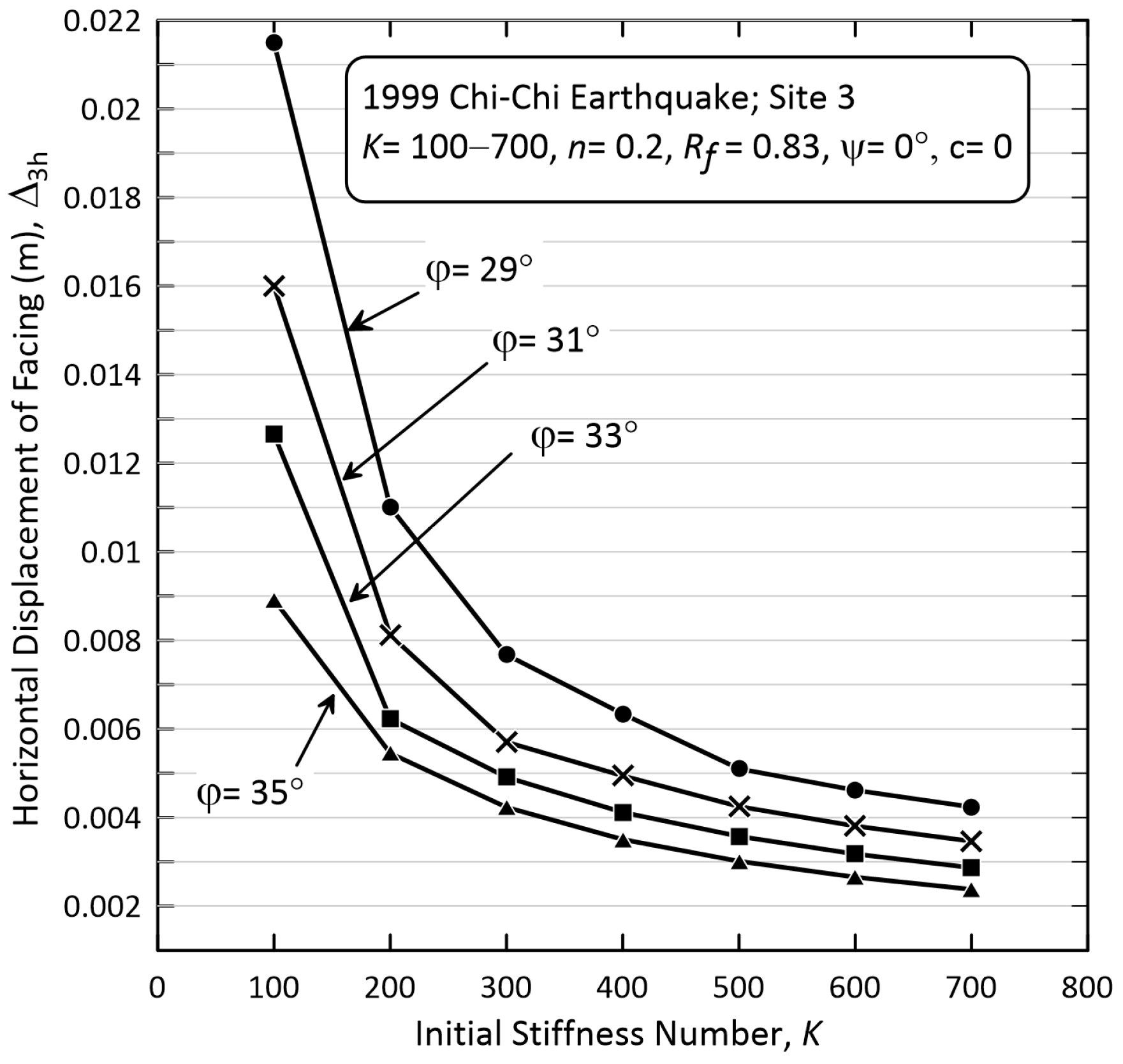
Figure A3 presents the results of the sensitivity analysis for the two post-peak model parameters, φres and Δratio, using peak soil strengths of cpeak = 5 kPa and φpeak = 35°, which were validated earlier. In this analysis, K = 300, n = 0.2, and Rf = 0.83 are adopted because they represent median values for soils with φpeak in the range of 30–35°. The results show clear trends of decreasing Δ3h with increasing φres and Δratio. The physical meaning of the φres curve is straightforward. For the Δratio curve, a larger Δratio indicates a longer transitional stage between the peak and residual states because Δratio represents the ratio of shear displacements between these two states. A longer transition implies a slower rate of strength deterioration, which in turn leads to a smaller Δ3h.
Figure A3.
Sensitivities of φres and Δratio on Δ3h.
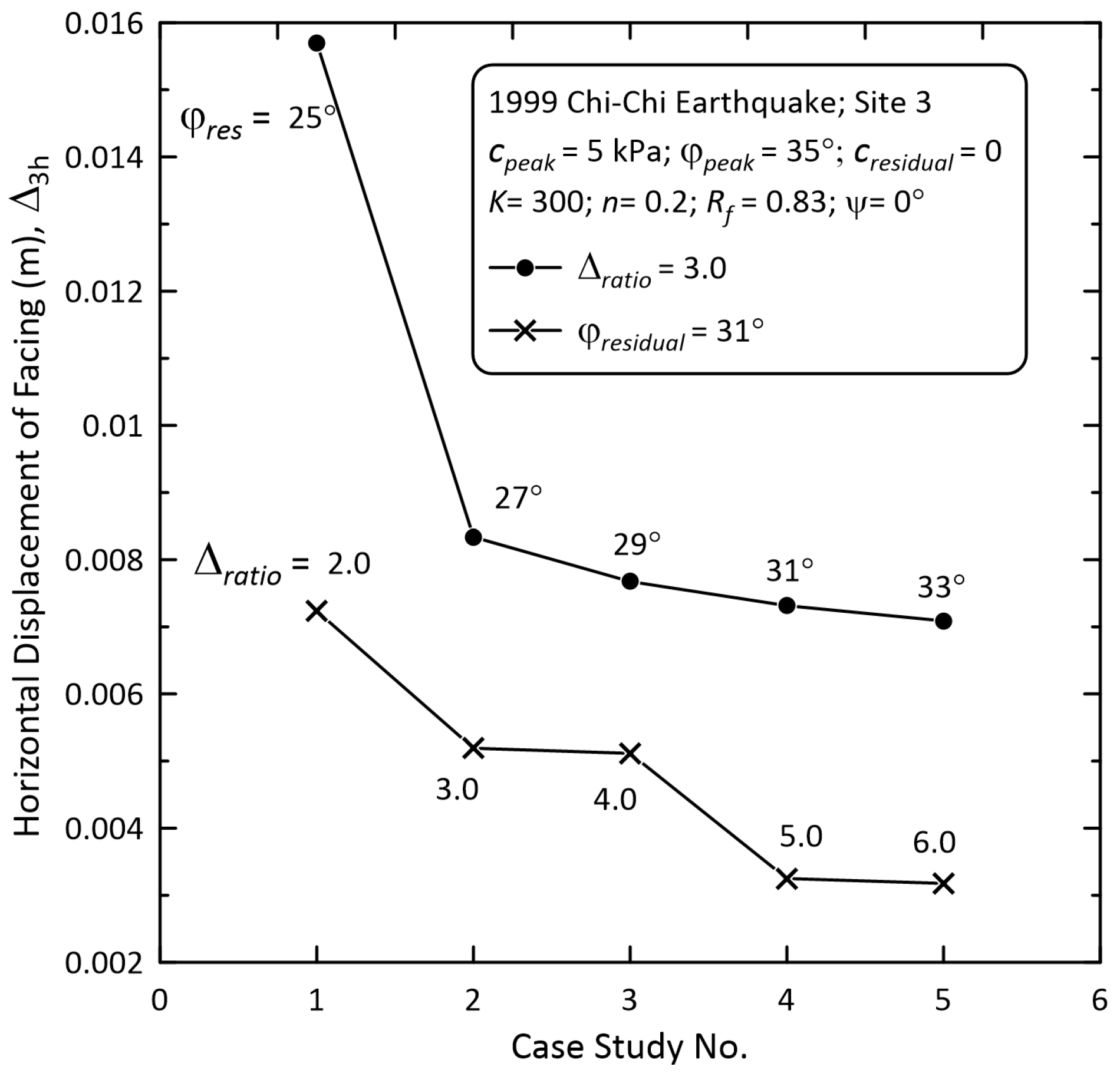
Figure A4 shows the sensitivity of the hyperbolic reinforcement pullout parameters—including the initial pullout stiffness Kt, the stress-dependency exponent nt, the failure ratio Rt, the tie-break strength Tf, and the soil–reinforcement interface friction angle φs-r—on the horizontal displacement of the facing, Δ3h. Ranges for these parameters were determined based on the reinforcement pullout database reported in [46]. Among these parameters, Kt, nt, and Rt were assigned approximately median values from the database to represent typical reinforcement behavior. In contrast, Tf was selected based on field exploration results at the studied sites, and the soil–reinforcement interface friction angle φs-r was taken from pullout tests conducted using a geogrid similar to that employed in the field.
Among the parameters investigated, nt exhibits a negligible influence on Δ3h. The reason is similar to that discussed for the soil parameter n in Figure A1: the confining stress levels in the reinforced zone are not sufficiently high to activate meaningful stress-dependent stiffness changes. A subtle but consistent trend of increasing Δ3h with increasing Rt is observed. The underlying mechanism is analogous to that described in Figure A1, although the influence of Rt on Δ3h is much smaller than the influence of Rf on Δ3h. This difference arises because, in the present case, the shear resistance of the soil contributes to wall stability more directly and significantly than the reinforcement pullout resistance.
The influence of Tf on Δ3h is noticeable only when Tf is as small as 25 kN/m. For Tf ≥ 50 kN/m, further increases in Tf have no measurable effect on reducing Δ3h. Among the parameters examined, Kt has the most pronounced influence on Δ3h. When Kt increases fivefold from 5 to 25 kN/m, Δ3h decreases from 0.0068 m to 0.0038 m, a reduction of approximately 0.003 m. This investigation confirms the accuracy and consistency of the computational algorithms governing hyperbolic reinforcement pullout behavior in the FFDM-based displacement analysis.
Figure A4.
Sensitivities of reinforcement parameters on Δ3h.
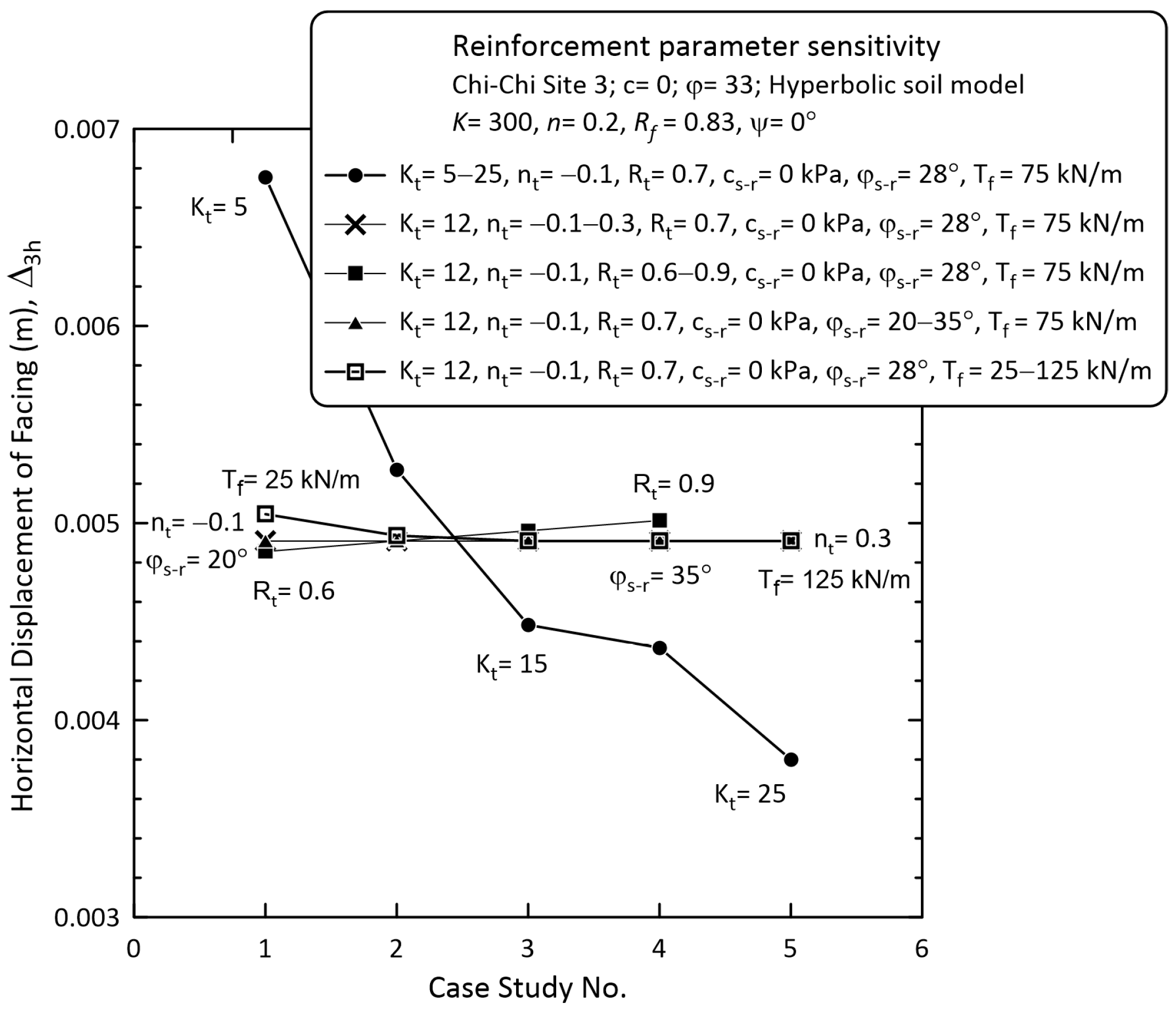
Figure A5 shows the sensitivity of the facing-block-related parameters on Δ3h (investigation-1). Δ3h consistently decreases with increasing block–reinforcement connection adhesion, cb-r, and friction angle φb-r. The mechanism is straightforward: increasing cb-r and φb-r enhances the pullout resistance of the reinforcement from the facing block, thereby improving the stability of the facing column. Increasing the block–block interface adhesion, cb-b, from 0 to 3 kPa produces a small reduction in Δ3h of approximately 2 × 10⁻⁴ m. For cb-b values greater than 3 kPa, no further reduction in Δ3h is observed. This behavior occurs because the reduction in Δ3h is associated with cases where the failure surface passes through the block–block interface. When cb-b exceeds 3 kPa, the facing column becomes effectively impenetrable, and a passing-through-base failure mechanism becomes dominant. The block–block interface friction angle φb-b exhibits negligible influence on Δ3h throughout the investigated range of 25–45°. This is because a large value of cb-b = 45 kPa is used in the main analysis for Sites 1 and 3, based on site exploration findings that reported FRP rods were used to connect the facing blocks. The value cb-b = 45 kPa corresponds to the converted shear strength at the block–block interface derived from the FRP rod strength. Due to this large cb-b value, Δ3h remains essentially unchanged with variations in φb-b.
Figure A5.
Sensitivities of modular-block-related properties on Δ3h.
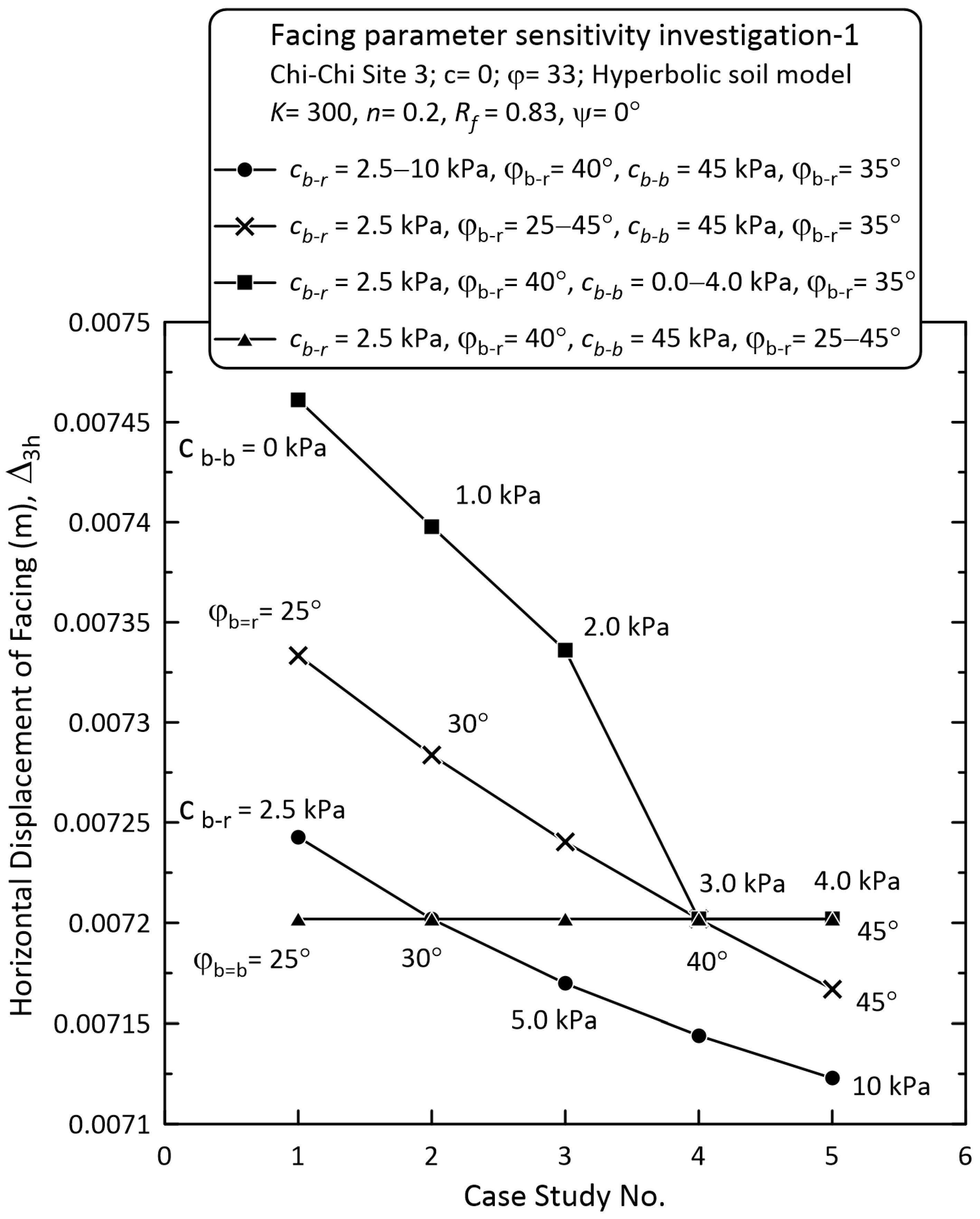
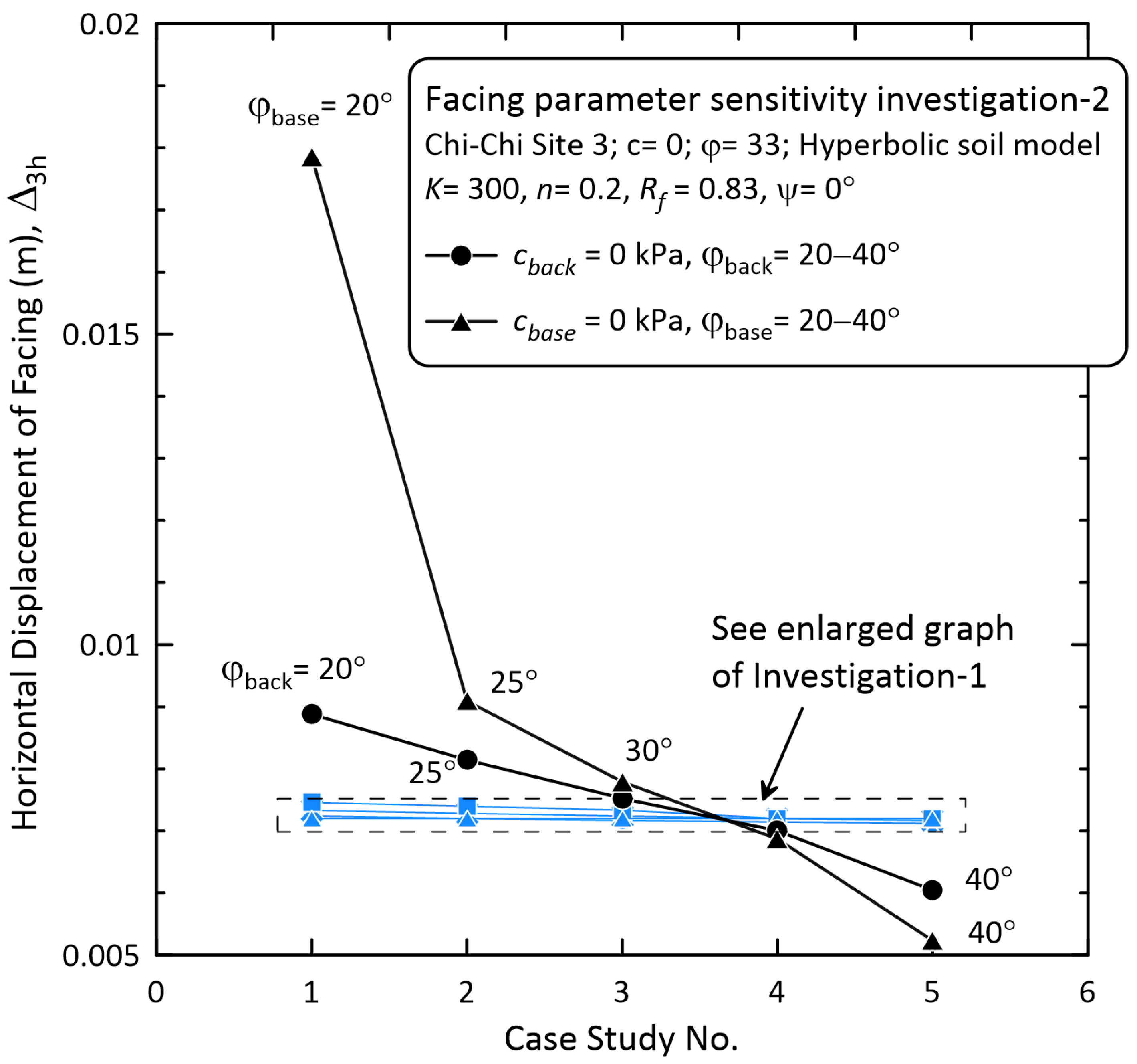
Figure A6 presents a similar sensitivity investigation to that in Figure A5, but with a broader set of parameters (investigation-2). In addition to the parameters in Figure A5, Figure A6 includes the soil–facing interface friction angle at the back of the facing column, φback, and the interface friction angle at the base of the facing column, φbase. The influence of φbase and φback on Δ3h differs markedly from the trends shown in Figure A5, particularly for φbase. The range of Δ3h variations associated with the parameters in Figure A5 now appears as a negligibly small zone in Figure A6. Increasing φbase from 20 to 40 degrees reduces Δ3h by approximately 0.01 m, an amount comparable to the influence of the internal friction angle φ discussed in Figure A2. The physically and computationally consistent results revealed in this parameter sensitivity analysis confirm the accuracy of the FFDM as a displacement-based analytical tool for movement-sensitive and interaction-rich soil structures, such as geosynthetic-reinforced soil retaining walls with modular block facing.
Figure A6.
Sensitivities of facing–soil friction angles on Δ3h.
In summary, the sensitivity investigation shows that variations in database-derived soil, reinforcement, and facing parameters typically influence Δ3h only on the order of several 10−3 m, whereas the parameters exerting the greatest influence—such as φpeak, φres, φbase, and φback—were determined with confidence from site exploration. Taken together, these sensitivity results confirm that the FFDM-based displacement framework responds to parameter variations in a physically consistent manner and that the conclusions of the main analysis remain robust with respect to reasonable uncertainties in soil, reinforcement, and facing properties.
References
- Tatsuoka, F.; Koseki, J.; Tateyama, M.; Munaf, Y.; Horii, K. Seismic stability against high seismic loads of geosynthetic-reinforced soil retaining structures, Keynote Lecture. In Proceedings of the 6th International Conference on Geosynthetics, Atlanta, GA, USA, 25–29 March 1998; pp. 103–142. [Google Scholar]
- Di Pietro, A.; Squeglia, N.; Silvestri, F. Earthquake-induced failures in Europe, New Zealand, Turkey, and Italy: Insights from satellite-based damage assessment and forensic evidence. Eng. Fail. Anal. 2024, 158, 108282. [Google Scholar]
- Newmark, N.M. Effects of earthquakes on dams and embankments. Geotechnique 1965, 15, 139–160. [Google Scholar] [CrossRef] [Scilit]
- Sarma, S.K. Seismic displacement analysis of earth dams. J. Geotech. Eng. Div. 1981, 107, 1735–1739. [Google Scholar] [CrossRef] [Scilit]
- Chang, C.-J.; Chen, W.-F.; Yao, J.T.P. Seismic displacements in slopes by limit analysis. J. Geotech. Eng. 1984, 110, 860–874. [Google Scholar] [CrossRef] [Scilit]
- Zeng, X.; Steedman, R.S. Rotating block method for seismic displacement of gravity walls. J. Geotech. Geoenviron. Eng. 2000, 126, 709–717. [Google Scholar] [CrossRef] [Scilit]
- Aminpoor, M.M.; Ghanbari, A. Design charts for yield acceleration and seismic displacement of retaining walls with surcharge through limit analysis. Struct. Eng. Mech. 2014, 52, 1225–1256. [Google Scholar] [CrossRef] [Scilit]
- Shinoda, M. Seismic stability and displacement analyses of earth slopes using non-circular slip surface. Soil Found. 2015, 55, 227–241. [Google Scholar] [CrossRef] [Scilit]
- Leshchinsky, B.A. Nested Newmark model to calculate the post-earthquake profile of slopes. Eng. Geol. 2018, 233, 139–145. [Google Scholar] [CrossRef] [Scilit]
- Song, J.; Fan, Q.; Feng, T.; Chen, Z.; Chen, J.; Gao, Y. A multi-block sliding approach to calculate the permanent seismic displacement of slopes. Eng. Geol. 2019, 255, 48–58. [Google Scholar] [CrossRef] [Scilit]
- Jing, P.; Zheng, W.; Li, L.; Ning, B.; Lu, M.; Yang, Q.; Nan, Y.; Li, J.; Xu, Y.; Liu, J. Seismic slope permanent displacement calculation based on improved Newmark model using upper bound solution of plastic mechanics. Sci. Rep. 2025, 15, 11991. [Google Scholar] [CrossRef] [Scilit]
- Kramer, S.L.; Matthew, W.S. Modified Newmark Model for seismic displacement of compliant slopes. J. Geotech. Geoenviron. Eng. 1997, 123, 635–644. [Google Scholar] [CrossRef] [Scilit]
- Rathje, E.M.; Bray, J.D. Nonlinear coupled seismic sliding analysis of earth structures. J. Geotech. Geoenviron. Eng. 2000, 126, 1002–1014. [Google Scholar] [CrossRef] [Scilit]
- Cascone, E.; Rampello, S. Decoupled seismic analysis of an earth dam. Soil Dyn. Earthq. Eng. 2003, 23, 349–365. [Google Scholar] [CrossRef] [Scilit]
- Ji, J.; Wang, C.-W.; Cui, H.-Z.; Li, X.-Y.; Song, J.; Gao, Y. A simplified nonlinear coupled Newmark displacement model with degrading yield acceleration for seismic slope stability analysis. Int. J. Numer. Anal. Methods Geomech. 2021, 45, 1303–1322. [Google Scholar] [CrossRef] [Scilit]
- Song, J.; Lu, Z.; Ji, J.; Gao, Y. A fully nonlinear coupled seismic displacement model for earth slope with multiple slip surfaces. Soil Dyn. Earthq. Eng. 2022, 159, 107353. [Google Scholar] [CrossRef] [Scilit]
- Stamatopoulos, C. Sliding system predicting large permanent co-seismic movements of slopes. Earthq. Eng. Struct. Dyn. 1996, 25, 1075–1093. [Google Scholar] [CrossRef]
- Nguyen, V.B.; Jiang, J.-C.; Yamagami, T. Modified Newmark analysis of seismic permanent displacements of slopes. Landslides 2005, 41, 458–466. [Google Scholar] [CrossRef] [Scilit] [PubMed]
- Bandini, V.; Biondi, G.; Cascone, E.; Rampello, S. A GLE-based model for seismic displacement analysis of slopes including strength degradation and geometry rearrangement. Soil Dyn. Earthq. Eng. 2015, 71, 128–142. [Google Scholar] [CrossRef] [Scilit]
- Cui, Y.; Liu, A.; Xu, C.; Zheng, J. A modified Newmark method for calculating permanent displacement of seismic slope considering dynamic acceleration. Adv. Civ. Eng. 2019, 2019, 9782515. [Google Scholar] [CrossRef] [Scilit]
- Le, P.H.; Nishimura, S.; Nishiyama, T.; Nguyen, T.C. Modified Newmark approach for evaluation of earthquake-induced displacement of earth dam- Applying for re-division of sliding mass. Int. J. GEOMATE 2021, 21, 1–8. [Google Scholar] [CrossRef] [Scilit]
- Ji, J.; Lin, Z.; Li, S.; Song, J.; Du, S. Coupled Newmark seismic displacement analysis of cohesive soil slopes considering nonlinear soil dynamics and post-slip geometry changes. Comput. Geotech. 2024, 174, 106628. [Google Scholar] [CrossRef] [Scilit]
- Huang, C.-C.; Chou, L.H.; Tatsuoka, F. Seismic displacements of geosynthetic-reinforced soil modular block walls. Geosynth. Int. 2003, 10, 2–23. [Google Scholar] [CrossRef] [Scilit]
- Conti, R.; Viggiani, G.M.B.; Cavallo, S. A two-rigid block model for sliding gravity retaining walls. Soil Dyn. Earthq. Eng. 2013, 55, 33–43. [Google Scholar] [CrossRef] [Scilit]
- Cai, Z.; Bathurst, R.J. Deterministic sliding block methods for estimating seismic displacements of earth structures. Soil Dyn. Earthq. Eng. 1996, 15, 255–268. [Google Scholar] [CrossRef] [Scilit]
- Nadim, F.; Whitman, R.V. Seismically induced movement of retaining walls. J. Geotech. Eng. 1983, 109, 915–931. [Google Scholar] [CrossRef] [Scilit]
- Al-Homoud, A.S.; Tahtamoni, W. Comparison between predictions using different simplified Newmark’s block-on-plane models and field values of earthquake induced displacements. Soil Dyn. Earthq. Eng. 2000, 19, 73–90. [Google Scholar] [CrossRef] [Scilit]
- Kokusho, T. Spring-supported Newmark model calculating earthquake-induced slope displacement. J. Geotech. Geoenviron. Eng. 2024, 150, 04024024. [Google Scholar] [CrossRef] [Scilit]
- Wu, J.-H. Seismic landslide simulations in discontinuous deformation analysis. Comput. Geotech. 2010, 37, 594–601. [Google Scholar] [CrossRef] [Scilit]
- Ning, Y.; Zhao, Z. A detailed investigation of block dynamic sliding by the discontinuous deformation analysis. Int. J. Numer. Anal. Methods Geomech. 2013, 37, 2373–2393. [Google Scholar]
- Goldgruber, M.; Shahriari, S.; Zenz, G. Dynamic sliding analysis of a gravity dam with fluid-structure-foundation interaction using finite elements and Newmark’s sliding block analysis. Rock Mech. Rock Eng. 2015, 48, 2405–2419. [Google Scholar] [CrossRef] [Scilit]
- Wang, C.; Hawlader, B.; Islam, N.; Soga, K. Implementation of a large deformation finite element modelling technique for seismic slope stability analyses. Soil Dyn. Earthq. Eng. 2019, 127, 105824. [Google Scholar] [CrossRef] [Scilit]
- Ahmadi, A.; Noorzard, A. Investigating the effects of slope changes of asphaltic concrete core of rockfill dam on the fragility curves. Discov. Civ. Eng. 2025, 2, 153. [Google Scholar] [CrossRef] [Scilit]
- Kokusho, T.; Mori, J.; Mizuhara, M.; Fang, H. Energy-based newmark method for seismic slope displacements revisited. Soil Dyn. Earthq. Eng. 2022, 162, 107449. [Google Scholar] [CrossRef] [Scilit]
- Huang, C.-C. Developing a new slice method for slope displacement analyses. Eng. Geol. 2013, 157, 39–47. [Google Scholar] [CrossRef] [Scilit]
- Huang, C.-C. Force equilibrium-based finite displacement analyses for reinforced slopes: Formulation and verification. Geotext. Geomembr. 2014, 42, 394–404. [Google Scholar] [CrossRef] [Scilit]
- Gunes, N. Comparison of monotonic and cyclic pushover analyses for the near-collapse point on a mid-rise reinforced concrete framed building. Earthq. Struct. 2020, 19, 189–196. [Google Scholar] [CrossRef]
- Lo, C.-L.; Huang, C.-C. Displacement analyses for a natural slope considering post-peak strength of soils. GeoHazards 2021, 2, 41–62. [Google Scholar] [CrossRef] [Scilit]
- Duncan, J.M.; Chang, C.Y. Nonlinear analysis of stress and strain in soils. J. Soil Mech. Found. Div. 1970, 96, 1629–1653. [Google Scholar] [CrossRef] [Scilit]
- Lawrence, J.D. Witch of Agnesi. In A Catalog of Special Plane Curves; Dover Publications: New York, NY, USA, 1972; pp. 20–23. [Google Scholar]
- SLOPE-ffdm 2.0: Computer Programs for Slope Stability and Displacement Analyses Using Force-Equilibrium-Based Finite Displacement Method (FFDM). 2025. Available online: https://slope.it.com/ (accessed on 16 April 2026).
- Atkinson, J.H. An Introduction to the Mechanics of Soils and Foundations; McGraw-Hill: Berkshire, UK; London, UK, 1993; pp. 215–239. [Google Scholar]
- Chiang, Y.-J. Analyses for Rainfall-Induced Slope Displacements Taking into Account Various Displacement Fields and Failure Criteria. Master’s Thesis, National Cheng Kung University, Tainan, Taiwan, July 2017. (In Chinese) [Google Scholar]
- Software Development Series 11—Modelling Post-Peak Behavior of Soils. Available online: https://slope.it.com/product/?goto=product (accessed on 16 April 2026).
- Software Development Series 10—Modelling Material Behavior. Available online: https://slope.it.com/product/?goto=product (accessed on 16 April 2026).
- Software Development Series 13—Modelling Pullout Behavior of Reinforcement Material. Available online: https://slope.it.com/product/?goto=product (accessed on 16 April 2026).
- Richards, R.; Elms, D.G. Seismic behavior of gravity retaining walls. J. Geotech. Eng. Div. 1979, 105, 449–464. [Google Scholar] [CrossRef] [Scilit]
- Whitman, R.V.; Liao, S. Seismic Design of Gravity Retaining Walls; Miscellaneous Paper GL-85-1; Department of the Army, US Army Corps of Engineers: Washington, DC, USA, 1985. [Google Scholar]
- Huang, C.-C.; Wu, S.-H. Simplified approach for assessing seismic displacements of soil-retaining walls. Part I: Geosynthetic-reinforced modular block walls. Geosynth. Int. 2006, 13, 219–233. [Google Scholar] [CrossRef] [Scilit]

Disclaimer/Publisher’s Note: The statements, opinions and data contained in all publications are solely those of the individual author(s) and contributor(s) and not of MDPI and/or the editor(s). MDPI and/or the editor(s) disclaim responsibility for any injury to people or property resulting from any ideas, methods, instructions or products referred to in the content. |
© 2026 by the author. Licensee MDPI, Basel, Switzerland. This article is an open access article distributed under the terms and conditions of the Creative Commons Attribution (CC BY) license.