1. Introduction
1.1. Background and Motivation
Open-ended steel pipe piles are widely used as foundation piles for bridges and as monopile foundations for offshore wind power generation, as well as for marine structures and temporary foundations (foundations assumed to be removed and reused), among others. In conventional research and design practice, the influence of embedment length and plugging on tip resistance has typically been characterized by classifying the pile behavior into plugged and unplugged modes. The tip resistance is then evaluated using different empirical formulas depending on this classification.
However, limited studies have quantitatively evaluated, along the depth direction beneath the pile tip, how much of the tip resistance is carried by the steel pipe ring and how much is provided by the internal soil core, particularly under unplugged or partially plugged conditions. In other words, while the tip resistance of open-ended piles is of great practical importance, a mechanistic understanding and evaluation framework that can consistently handle conditions ranging from non-plugged to highly plugged states have not been sufficiently established. Major design codes (e.g., Japanese highway bridge specifications, API, Eurocode 7, and FHWA) treat plugged and unplugged conditions using separate equations. However, they do not provide a unified framework that handles plugging ratio or internal soil contribution in a continuous manner. Some specifications adopt conservative assumptions by considering only shaft friction of the internal soil under unplugged conditions, whereas others assume fully mobilized tip resistance without explicitly confirming the degree of plugging, as long as sufficient embedment into the bearing layer is achieved. As a result, a framework to continuously handle plugging judgment and the internal soil contribution ratio is lacking, and conservative evaluation and full-cross-section effective treatment coexist, making unified design treatment difficult.
These issues highlight the need to systematically clarify the tip resistance mechanism for open-ended piles ranging from unplugged to partially and highly plugged states, and to establish a load-sharing framework that accounts for the distinct roles of the ring and soil core in developing tip resistance.
In this study, through virtual static vertical loading tests using the discrete element method (DEM), the changes in the load-sharing contribution of the tip ring zone and the internal soil core, as well as the plugging ratio, are quantified, and the development and collapse process of interparticle high-contact-force regions are visualized at the particle level. Through this, the tip resistance mechanisms from unplugged to partially plugged and highly plugged conditions are organized, and this study aims to provide a fundamental framework toward systematization of bearing capacity equations in the future.
1.2. Previous Studies and Knowledge Gaps
Regarding the evaluation of the tip resistance of open-ended steel pipe piles, in addition to examinations based on model tests and field tests, comprehensive reviews organization with design practice in mind has also been conducted [
1]. As numerical analysis methods, the finite element method (FEM) based on continuum models and the discrete element method (DEM) that directly treats interparticle contacts, are representative, and the observed quantities targeted by the two differ, the main focus of this study is to systematically organize, under the same conditions, the particles’ high-contact-force regions formed near the tip of an open-ended pile and the load sharing between the ring and internal soil core. Therefore, DEM, which can visualize at the particle level the development and collapse processes of the interparticle high-contact-force region, was adopted.
Previous experimental and numerical studies have reported that, for open-ended piles, the majority of tip resistance is carried by the steel pipe ring, while the frictional resistance mobilized by the internal soil is relatively small [
2,
3,
4]. In addition, experimental studies focusing on the loading behavior of large-diameter open-ended steel pipe piles have also been reported [
5]. Moreover, attempts to organize the plugging condition of open-ended piles as plugged/unplugged have been organized as judgment indices based on geometric conditions such as pile diameter, but they are primarily intended for a priori judgment of the plugging condition and are not a framework to continuously evaluate, with the same index, the mechanical role sharing between the ring and the internal soil core directly beneath the pile tip [
6].
More recent studies using DEM analyses have visualized stress transmission and particle-scale structure near the pile tip, examining the formation of soil plugs and the influence of plugging ratio [
7,
8]. In addition, studies focusing on construction processes and internal stress states have been reported, including evaluations of stress distributions within the internal soil core during impact driving [
9], the influence of vibratory construction and post-installation treatment [
10], and the correspondence between model tests and DEM simulations under monotonic penetration conditions [
11].
Nevertheless, under unplugged and partially plugged conditions, only limited studies have quantitatively evaluated the load sharing between the ring and internal soil core and incorporated such information into a design-oriented resistance expression. Furthermore, when the particle-scale ratio (D/d50) in model tests or DEM simulations differs from field conditions, no unified correction framework exists to account for scale effects or soil chamber dimensions (W/D, L/D).
Thus, although previous research has interpreted tip resistance primarily through the presence or absence of a plug (plug/unplug) or plugging length ratio (PLR), the relative contribution of the ring and internal soil core has not been directly quantified, nor has a continuous framework linking plugging ratio and load-sharing contribution been established. This constitutes the primary knowledge gap addressed in this study.
1.3. Objectives and Contributions
The objective of this study (part I) is to quantitatively evaluate the differences in tip resistance mechanisms between plugged and unplugged states of open-ended steel pipe piles, with particular focus on the load-transfer mechanism immediately beneath the pile tip, and to propose a minimal structural framework that can be connected to future design formulations. Rather than rejecting conventional plug/unplug concepts or PLR-based evaluation frameworks, this study reinterprets the plugging mechanism by decomposing the tip region into the ring and internal soil core, enabling a higher-resolution assessment of their respective roles.
In this analysis, the driving, rest, and static loading of an open-ended steel pipe pile are handled continuously within the same model, and the objective is to conduct a relative comparison and mechanism organization of the contact structure formed near the pile tip. For this objective, in order to reduce computational load while securing a sufficient number of particles, and because ease of visualizing the mechanism becomes important, this study adopted 2D-DEM. Note that this study does not claim direct reproduction of the three-dimensional arching mechanism or equivalence between 2D and 3D, and mechanism organization is performed based on indices defined within the 2D model.
A composite particle model (one particle represented by two circular elements) [
12], which mimics real sand grains, is used to capture the localized crushing and re-formation of high-contact-force struts beneath the ring. This allows particle-scale visualization of failure modes specific to open-ended piles that differ from those of closed-ended piles. The principal contributions of this work are summarized as follows:
- (1)
Quantification of ring/core contribution using the K-density share
By decomposing the DEM-derived tip resistance Rt into ring and core components, the ring contribution index (K-density share) was defined. For the sand conditions and particle-scale ratios (25×–100×) examined, the ring carried approximately 85–90% of the tip resistance regardless of the examined cases and still maintained about 60% contribution even in the plastic regime.
- (2)
Visualization of load-bearing zones using HCF and density index K
Using HCF mapping and the density index K_R = ϕRI*R, the development of truss-like and isolated high-contact-force struts originating beneath the ring was visualized. As plugging progressed, struts became more pronounced, and beyond the ultimate state, these struts repeatedly crushed and re-formed, which was associated with reductions and redistributions in the ring contribution (K-density share).
- (3)
Linkage between driving and static loading processes
It was shown that the “ring-origin strut + surrounding shear band” structure formed during dynamic driving strongly influences the static tip resistance response Rt–s/D. Furthermore, the driving-phase plugging ratio CR and ring contribution index (K-density share) were related, providing a unified interpretation across unplugged to partially plugged conditions.
- (4)
Toward a design-oriented framework
By comparing DEM-derived load–settlement behavior, ring contribution (K-density share), and contact-force distributions, a basic design backbone centered on the ring area and relevant geotechnical indices was organized. Detailed calibration of design coefficients and scale regression is left for part II.
2. Terminology and Design Standards
2.1. Terminology and Notation (ASCII Format)
The principal symbols and abbreviations used in this paper are summarized below. Units are indicated in brackets [ ] where necessary. Although the 2D-DEM model outputs quantities per unit thickness (e.g., [kN/m]), their physical meanings correspond to those of a 3D pile–soil system.
[Loads and Stresses]
Rt: Tip resistance of the pile [kN] (per unit thickness in 2D: [kN/m]);
Rp: Ring component of tip resistance [kN];
Rc: Core component of tip resistance [kN];
qd: Tip resistance stress [kPa].
[Geometric and Dimensionless Quantities]
D: Pile diameter [m];
t: Wall thickness [m];
Ab: Effective base area [m2] (ring + internal soil core);
As: Effective shaft area [m2];
L: Embedment length (penetration during driving) [m];
s: Pile-tip settlement during static loading [m];
s/D: Dimensionless settlement [–];
d50: Representative particle diameter [m];
D/d50: Particle-scale ratio (pile diameter/representative particle size) [–].
[Plugging and Contribution Indices]
Hplug: Plug height inside the pile [m];
PLR: Plug length ratio;
CR: Plugging ratio (used synonymously with PLR in this paper);
IFR: Incremental filling ratio (incremental following ratio per driving step).
HCF: High-contact-force point;
ϕ_r: Occupancy ratio of HCF points in region r (ring/core);
I∗r: Mean normalized HCF intensity in region r;
K_R: Density index on the ring side;
K_C: Density index on the core side;
wR, wC: Horizontal widths of the ring and core regions;
K_share,R: K-density share (relative density contribution of the ring).
[Energy and Quasi-Static Indicators]
Wext: External work (work applied at the pile head);
E_fr: Frictional energy (cumulative energy dissipated by contact friction);
E_fr,norm: Normalized frictional energy (scaled by a reference value);
R_f: Friction ratio (fraction of external work dissipated as frictional energy);
rflux: Energy-flux residual (rflux = ∣err∣(∣Wext∣ + E_fr));
rstd: Instantaneous residual normalized by energy scale;
drift: Trend component of net contact force (during hold stage);
CV: Coefficient of variation (variability during hold stage);
W: Evaluation window beneath the pile tip (horizontal range: [−0.60, +0.60] m about the pile center).
2.2. Design Standards and Related Studies
Major design standards such as API, Eurocode 7, and FHWA treat open-ended piles by discretely distinguishing between plugged and unplugged states, evaluating tip resistance based on plug/unplug criteria or PLR. However, the treatment of internal soil and ring contributions is not unified among standards, and neither is the definition of plugging ratio nor the load-transfer mechanism directly beneath the pile tip systematically formalized.
For example, Eurocode 7 does not explicitly define criteria for distinguishing plugged and unplugged conditions and requires designers to adopt the smaller of the internal soil shear resistance and the full-base resistance [
13]. In contrast, API clearly distinguishes plugged and unplugged behavior as follows: in the unplugged case, the tip resistance of the annular ring and the friction of the internal soil are considered, while design practice generally assumes the plugged condition as the governing case [
14]. The Japanese highway bridge specifications adopt a displacement criterion of
s/
D = 0.1 (10%
D) for evaluating tip resistance in static loading tests and do not distinguish between plugged/unplugged conditions; instead, full-base resistance is assumed once the pile penetrates approximately two diameters into the bearing layer [
15].
While these standards treat plug/unplug behavior primarily in terms of reaction magnitude, they do not provide a framework that captures the evolution of ring/core resistance during driving or static loading, nor do they offer continuous interpretation from unplugged to highly plugged states. Addressing this gap, the present study introduces a density-based evaluation framework using high-contact-force (HCF) distributions and the K-density field, enabling both plugging ratio CR and the K-density share to be treated as continuous quantities representing the load sharing between the ring and internal soil core.
Note that this study does not target evaluating the mobilization of shaft friction in the serviceability limit state and focuses on organizing the mechanism of the ultimate state related to the pile tip resistance of open-ended piles. Discussion on the verification of the serviceability limit state is outside the scope of this paper.
3. Overview of the Analysis
Section 3 organizes and presents the overall picture of the analysis settings in the order of “common evaluation conditions”, “analysis conditions”, and “evaluation indicators”. In
Section 3.1, the evaluation window common to all cases, the normalization procedure, and the HCF extraction conditions are defined. In
Section 3.2, the analysis cases and analysis conditions are presented. In
Section 3.3, the evaluation indicators are defined.
3.1. Common Evaluation Conditions (Evaluation Window, Normalization, and Threshold)
In this section, in order to conduct subsequent case comparisons on the same criteria, the evaluation window W, the ring/core classification, the normalization population, and the HCF extraction conditions are defined as common conditions for all cases.
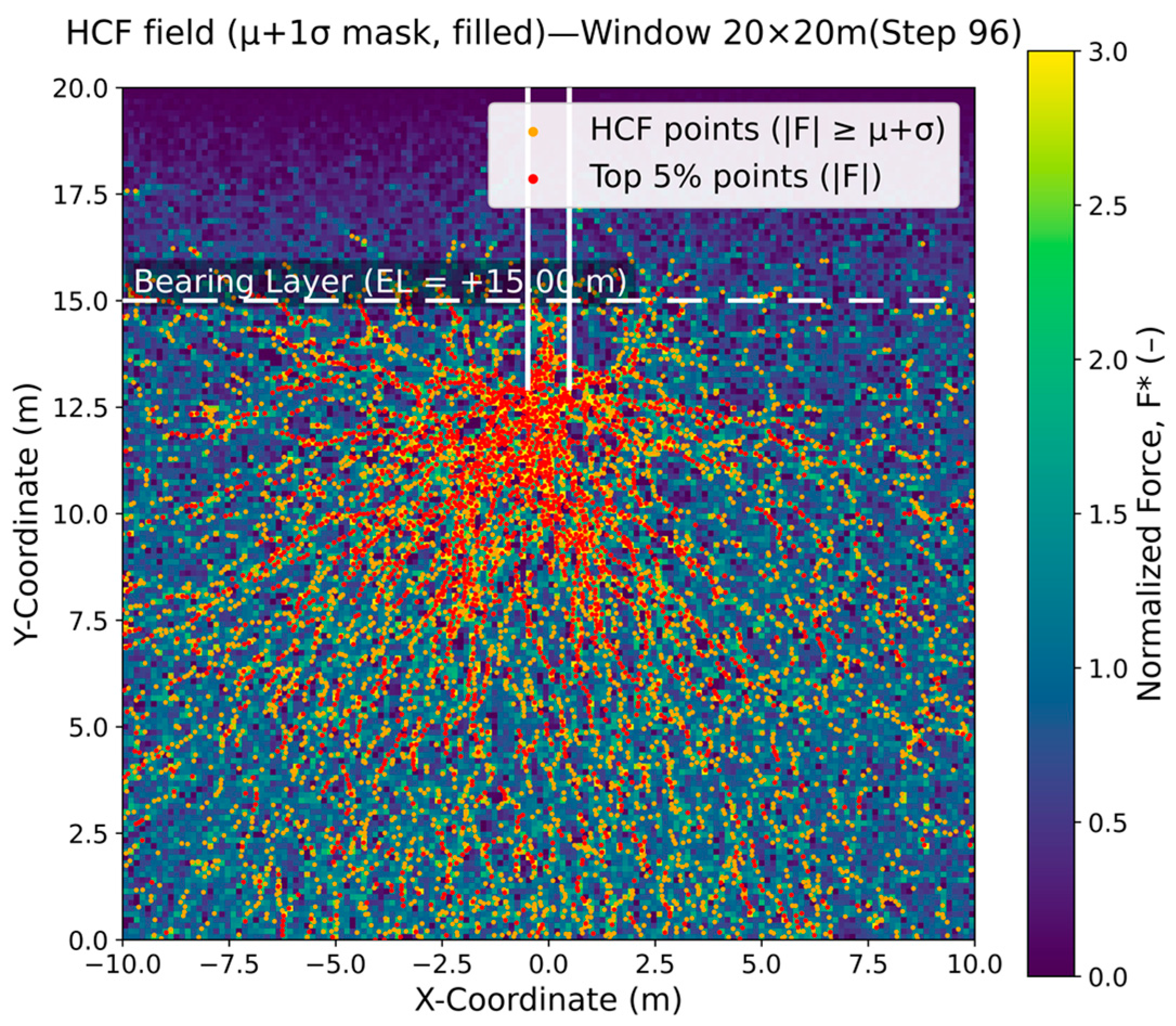
To consistently evaluate the localized load-bearing zones formed immediately beneath the pile tip, a fixed evaluation window W was defined, as shown in
Figure 1.
In the horizontal direction (x-axis), the window spans [−0.60 to 0.60] m about the pile center and is subdivided into core (∣x∣ ≤ 0.40 m) and ring (0.40 < ∣x∣ ≤ 0.55 m). These regions are continuous without gaps, allowing direct comparison of ring/core load-bearing structures.
In the vertical direction (y-axis), the evaluation band is defined as
where the following four depths are considered:
d = 0.20, 0.25, 0.30, and 0.50 m.
This enables consistent evaluation of changes in the bearing zone from shallow to deeper regions under identical procedures.
For force normalization, the region “Half 10 m × 10 m” (x ∈ [−5, 5] m,
y ∈ [8, 18] m), independent of the evaluation window, was used as the normalization population. The normalized force is defined as
where
μ is the mean contact-force magnitude within Half10 × 10. The threshold for high-contact-force (HCF) points is set as
with
σ being the standard deviation. Points satisfying ∣
F∣ ≥
τ are classified as HCF.
The evaluation window W, ring/core subdivision, normalization domain (Half10 × 10), and threshold condition (τ = μ + σ) are common to all analysis cases, ensuring reproducibility and consistency in comparing ring/core roles.
3.2. Analysis Cases
In this study, mechanistic interpretation is performed with the large model as the main analysis. The small model is a robustness check to confirm that the main tendencies are maintained even when the particle-size ratio and the pile-diameter conditions are different, and there is no intention to directly compare the two on the same basis.
The primary analysis cases are summarized in
Table 1a.
The large-scale model consists of a pile (diameter D = 1.0 m, length L = 12.0 m, and wall thickness t = 22 mm) embedded in a soil chamber of 20 m × 20 m, composed of a 5 m surface layer over a 15 m bearing layer. To simulate overburden pressure, the density of the surface layer (5 m) was increased by a factor of four, corresponding to an equivalent overburden of 20 m. The bearing layer represents dense sand with roughly N ≈ 50.
The small-scale model consists of a pile (diameter D = 0.8 m, length L = 2.0 m, and wall thickness t = 12 mm) embedded in a 5 m × 5 m chamber with a 0.5 m surface layer and a 4.5 m bearing layer. The surface layer density was increased by a factor of twenty to simulate an equivalent overburden of 10 m. In both models, the particle-scale ratio D/d50 was set to 100× (large) and 25× (small), respectively.
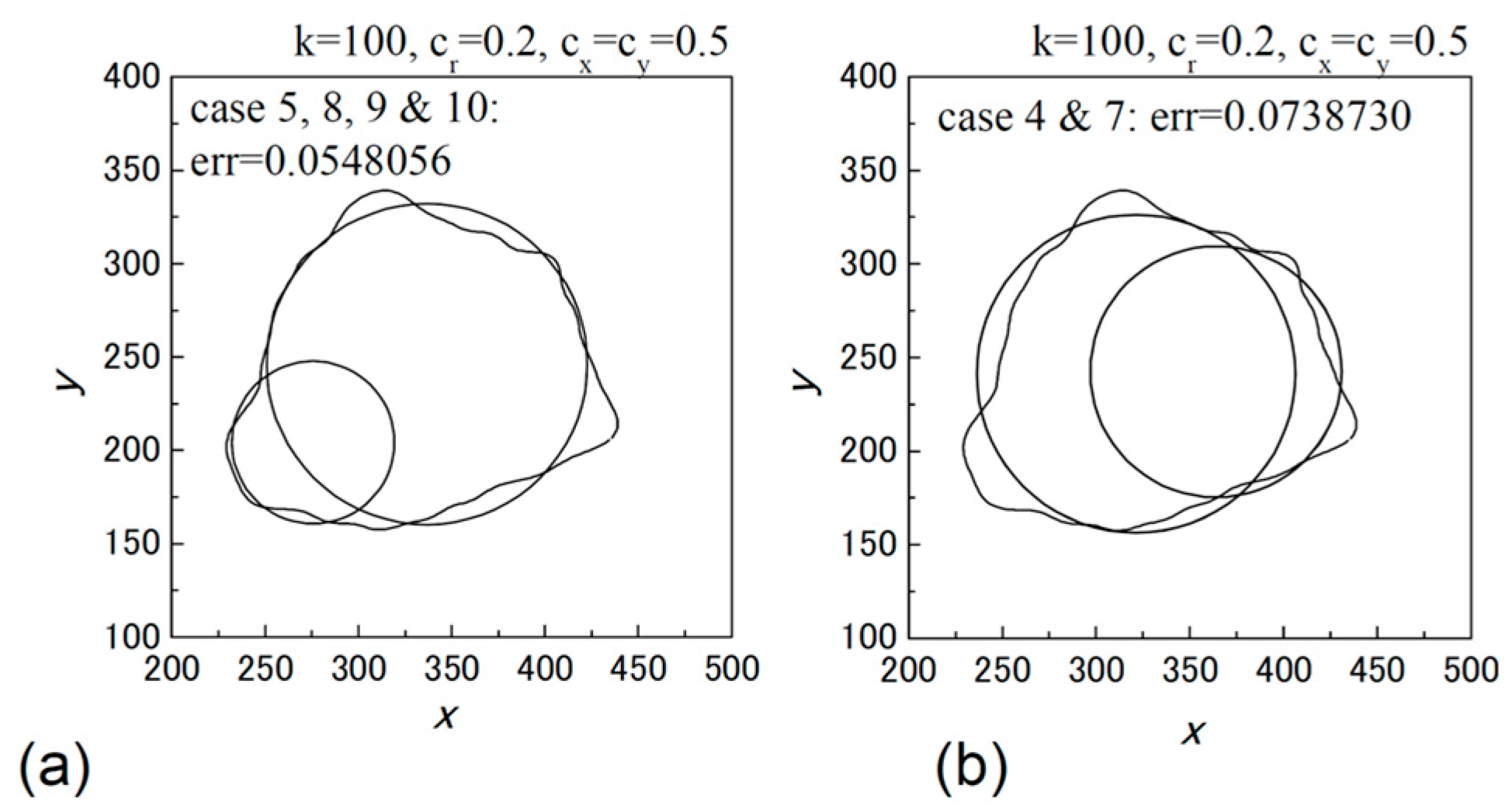
A composite particle model (one grain represented by two circular elements) was employed to better capture the irregular particle geometry and localized failure behavior observed in real sand in
Figure 2.
Compared to isotropic single-circle particles, this model enhances geometric heterogeneity of the contact network, facilitating development and collapse of force chains with rotation and slip. As a result, the model successfully reproduced high-contact-force struts beneath the pile-tip ring and their localized crushing/re-formation, enabling realistic simulation of the rapid settlement drop beyond the ultimate state.
Fifty Toyoura sand grains were digitized using a digital microscope, and their shapes were approximated by connecting two circular elements to represent each particle. This two-element particle model reproduces particle angularity and rotational resistance more realistically than single-sphere particles, facilitating the formation and collapse of localized force chains beneath the pile tip.
3.3. Evaluation Indices
The localized bearing zone immediately beneath the open-ended pile tip is characterized using “spread” (occupancy) and “intensity” (normalized force average) of high-contact-force (HCF) points. These are combined into density indices to define the ring contribution (K-density share). All evaluation settings—window, threshold, spatial subdivision, and normalization—are kept constant across cases to ensure reproducible comparison.
- (1)
Energy balance and quasi-static conditions
During driving, rest, and static loading phases, the external work
Wext and internal energy (elastic strain energy + frictional dissipation
E_fr) were monitored, and loading parameters were identified such that
As supplementary indicators, drift (trend) and coefficient of variation (CV) of contact-force series were monitored, and drift ≤ 3% and CV ≤ 5% were used as practical criteria for quasi-static behavior. Static loading was evaluated primarily up to s/D = 0.1; loading up to s/D = 0.2 was conducted to examine post-peak mechanisms.
- (2)
HCF binarization and spread/intensity of bearing zones
Within the evaluation window W (depths d = 0.20, 0.25, 0.30, and 0.50 m; width [−0.60, +0.60] m), normalized force F∗ = ∣F∣/μ was used to compute threshold τ = μ + σ and extract HCF points (MHCFM).
The window is subdivided into ring/core, and the following are computed:
Normalized intensity (strength):
A density index is defined as
which serves as an auxiliary indicator of the bearing-zone structure (
Section 4.2 and
Section 5.6).
- (3)
Ring contribution (K-density share)
The relative ring/core contribution is quantified as the K
-density share:
where
K_R and
K_C are density indices for the ring and core, and
wR, wC are the corresponding widths in the x-direction (e.g., core = 0.80 m, ring = 0.30 m).
K_share,R ranges from 0 to 1, with larger values indicating that the ring region carries a greater share of tip resistance.
In this study, K-density share is adopted as the primary contribution index.
Reaction-force decomposition (Rt = Rring + Rcore) is computed only as supplementary information (ηring).
- (4)
Ensuring comparability across cases
By unifying evaluation window, threshold, spatial resolution, normalization domain, and visualization settings across all analyses, the indices (CR, K-density share, R_f, E_fr,norm, etc.) can be compared within a consistent framework across plugged/unplugged states, particle-scale ratios, and loading conditions.
4. Results
4.1. Energy Balance and Load History
Regarding the static loading behavior of open-ended steel pipe piles, studies that reproduce the load test results by the finite element method (FEM) based on continuum models and verify the validity of the numerical model have also been reported (Baca et al., 2021 [
18]). This study, by DEM analysis, regards the installation effect as “the influence of the internal state formed by driving and rest on the static loading response”, and continuously analyzes driving, rest, and static loading within the same model.
Static loading in this study was initiated after a rest period following pile driving, during which kinetic energy had sufficiently decayed. Quasi-static conditions were verified in all of the following three phases: driving, rest, and static loading.
While driving, the energy residual was evaluated within the final window. The acceptance criterion was set to
In the present case, the final value was rflux = 4.10%.
The supplementary indicator, the instantaneous normalized residual, yielded rstd = 7.86%, and after removing the linear drift component of the error (drift = −1.07 MJ/s), the residual decreased to 0.74%. These results indicate that the energy accounting in the late driving stage was satisfactory.
During the rest period, the five-step moving average of the net contact force was used to evaluate drift and the coefficient of variation (CV) within the final window. Using drift ≤ 3% and CV ≤ 5% as the criteria, the values obtained (drift = 2.4%, CV = 4.9%) were within acceptable limits.
During static loading, the hold-stage check (drift and CV) used in the rest period was applied rather than the full energy-residual method. The criteria were satisfied with drift = 2.7% and CV = 1.8%, although individual components slightly exceeded thresholds; the composite values remained acceptable. Therefore, quasi-static behavior up to s/D = 0.1 (10% D) was confirmed.
Loading up to s/D = 0.2 (20% D) was performed only to investigate post-peak failure and redistribution mechanisms, and design evaluation is based primarily on the 10% D displacement criterion.
In this study, the installation effect is regarded as “the influence of the internal state formed by driving and the rest period on the static loading response”, and driving, the rest period, and static loading are continuously analyzed within the same model.
4.2. HCF Distribution and K Indices
As a representative example of the
HCF field at the ultimate state defined by
s/
D = 0.1 (10%
D; step 96),
Figure 1 shows the distribution of normalized contact force and the extracted HCF network beneath the pile tip. A narrow and strongly concentrated high-contact-force zone develops directly beneath the ring and forms a vertically continuous strut-like high-intensity structure.
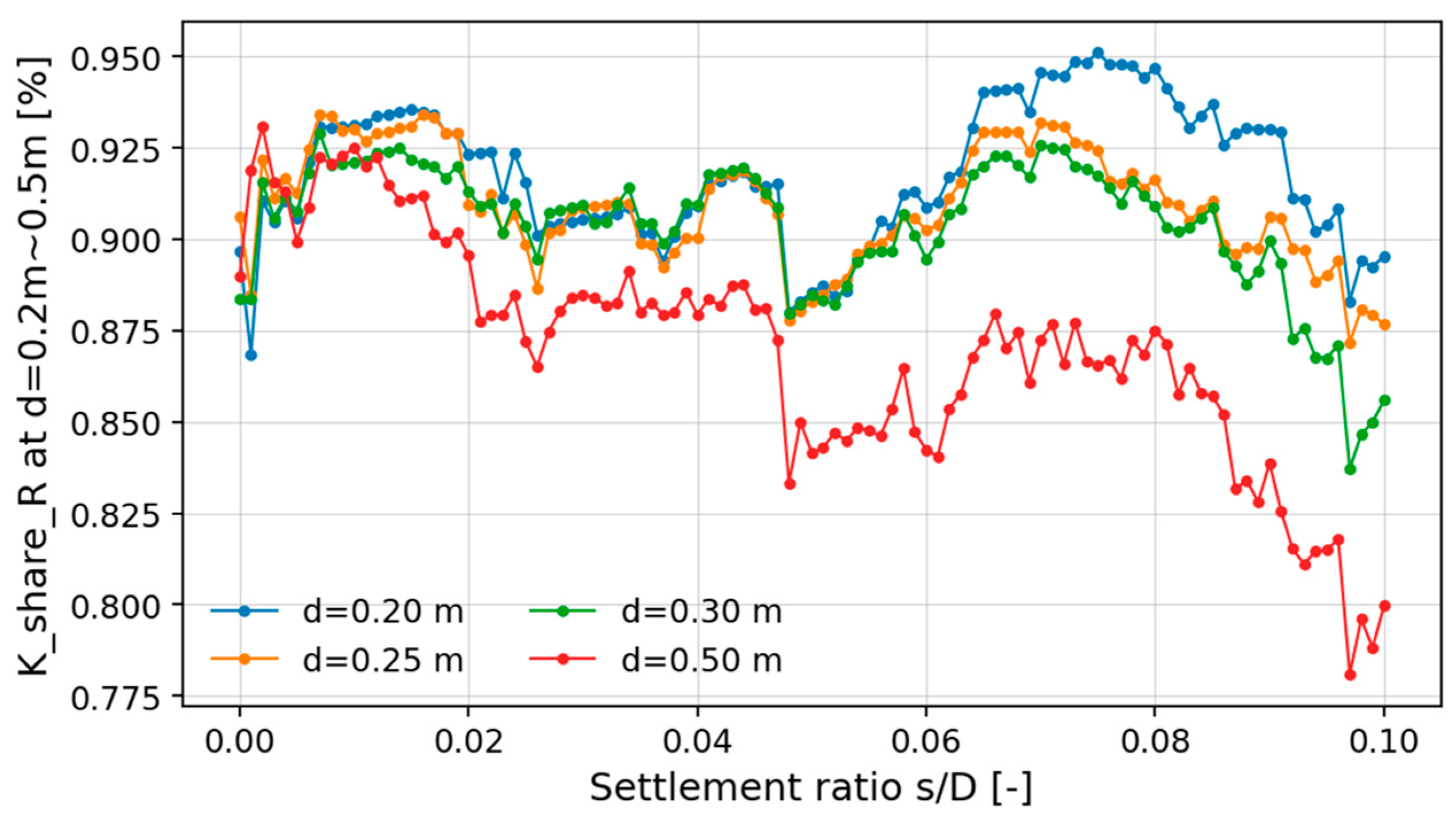
Figure 3 shows the relationship between the ring contribution
Kshare,R and settlement ratio
s/
D. At shallow depths (e.g., d = 0.20 m),
K_share,R exceeds 0.90, suggesting that the ring region tends to carry the majority of tip resistance under the present analysis conditions.
As the depth band becomes thicker, the occupancy ϕ on the core side gradually increases, expanding the vertical extent of the load-bearing zone; however, K_share,R remains consistently larger on the ring side over all depths.
Based on these results, within the range of the present analysis conditions, the primary location of the tip resistance is just beneath the ring, while the core is mobilized only secondarily as settlement progresses, suggesting a load-transfer mechanism unique to open-ended piles.
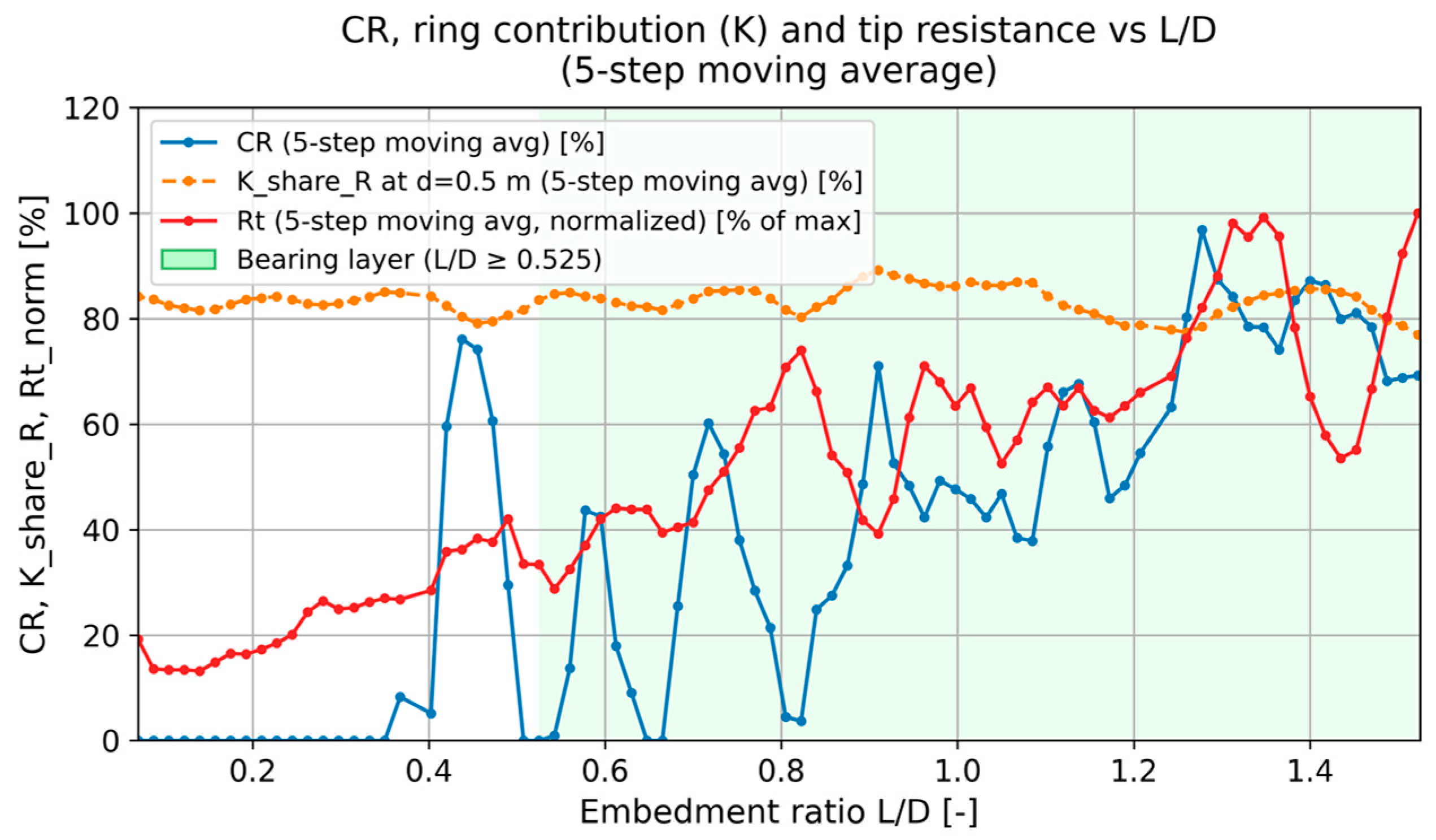
4.3. Development of Plugging Ratio, Ring Contribution, and Energy During Dynamic Driving
This section summarizes the evolution of plugging ratio CR (=PLR), ring contribution K_share,R, and energy indicators during dynamic driving.
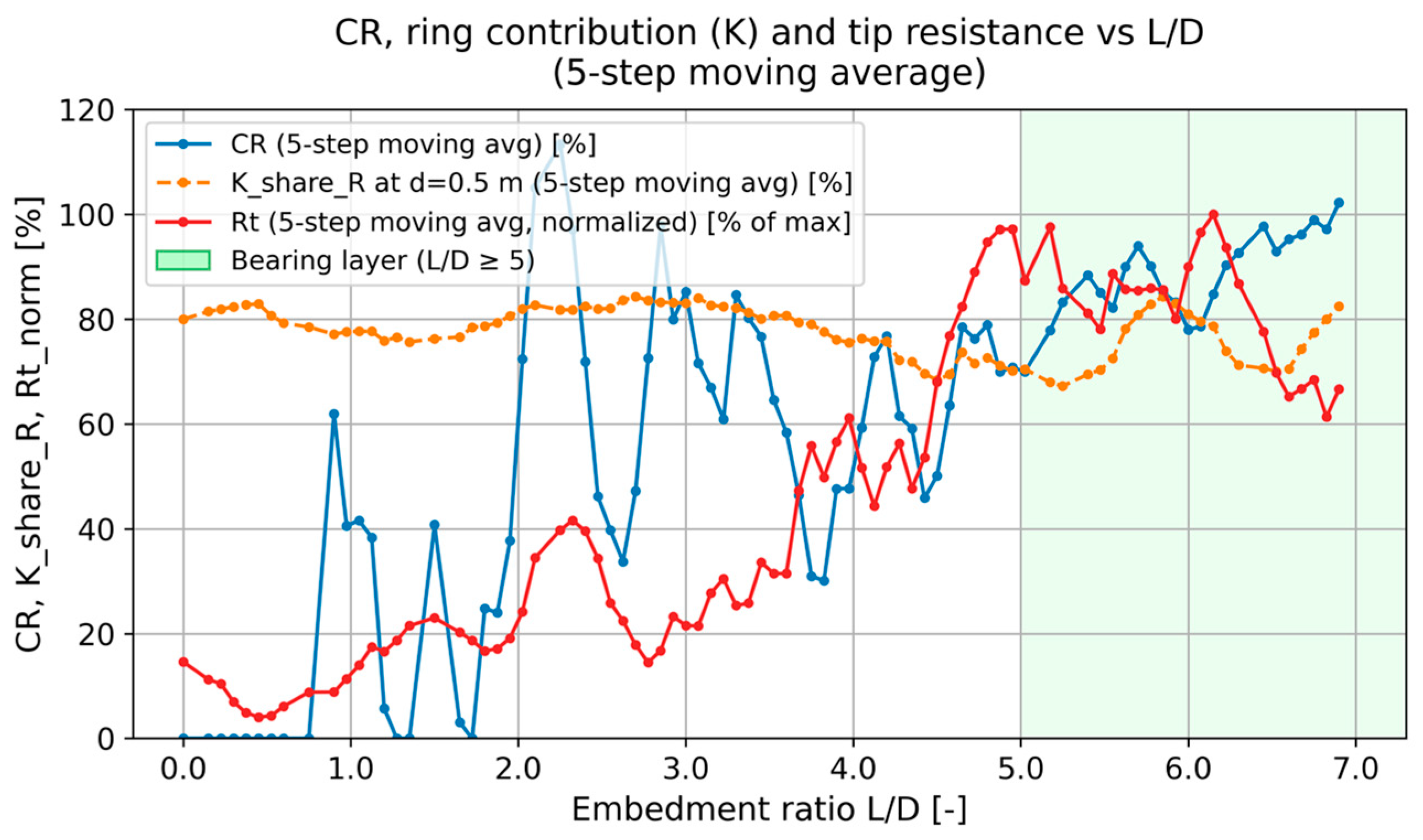
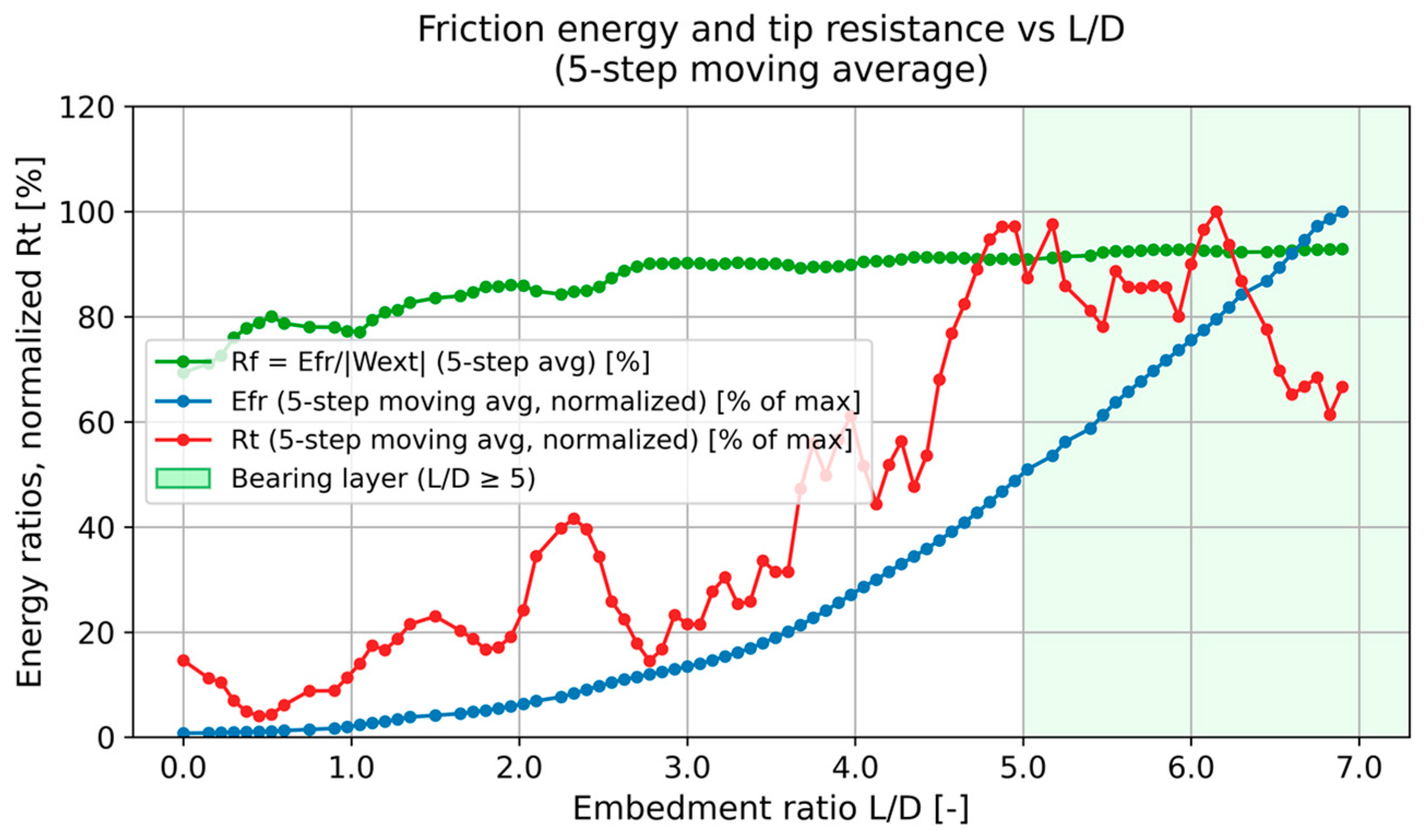
Figure 4 shows the relationships among
CR,
K_share,R, and normalized tip resistance
Rt_,norm (all smoothed using a five-step moving average).
Figure 5 shows the friction ratio
R_f, normalized frictional energy
E_fr,norm, and
Rt,norm versus embedment ratio
L/
D. Here,
Rt,norm denotes the tip resistance normalized by the maximum value mobilized during static loading.
The plugging ratio CR increases with embedment and reaches approximately 88% at L/D ≈ 7.0. In addition, around L/D ≃ 2–3 before reaching the bearing layer, behavior in which the plugging ratio CR temporarily fluctuates greatly is observed. At this stage, the internal soil is formed as a soil column of a certain height, and due to the influence of lateral confinement and particle arrangement, it is considered that a state close to “clogging” (pseudo-plugging) occurs for a short time. However, at the same time, the manifestation of Rt_norm is limited, and this increase in CR does not mean stable plug formation or an increase in the tip resistance. In contrast, the ring contribution K_share,R remains consistently high (80–90%) throughout driving, suggesting that, within the ring, the dominant resistance source remains, regardless of the plugging development.
Thus, based on the results of the present analysis, plugging does not imply a transition to core-dominated behavior; instead, the core gradually functions as a confining element while the ring remains dominant. This trend corresponds to the energy behavior in
Figure 5, where
R_f remains high (80–90%) and
E_fr,norm increases smoothly with embedment. In such internal behavior during the impact-driving process, studies have also been reported that evaluated the stress state of the internal soil core by DEM (Kim et al., 2024 [
9]).
The normalized tip resistance Rt,norm increases with L/D, consistent with the development of CR and K_share,R. This suggests that the ring-origin load-bearing zone forms progressively during driving, while the internal core plays a secondary confining role.
Energy indicators reveal that R_f remains high (80–90%) throughout driving, reaching approximately 93% at completion.
This means that most external work is dissipated frictionally, indicating that the driving process is dissipation-dominated.
The steady increase in E_fr,norm corresponds to the development of Rt,norm. These results indicate that frictional energy tends to accumulate around the ring and surrounding shear bands, while the internal soil core is suggested to act as a confining and reinforcing element during driving.
4.4. Development and Collapse of Strut Structures Beneath the Pile Tip
This section evaluates normalized tip resistance
Rt_norm (smoothed using a five-step moving average), ring contribution
K_share,R,(evaluated at d = 0.5 m), and energy indicators during static loading, and discusses the collapse process of strut structures beneath the pile tip.
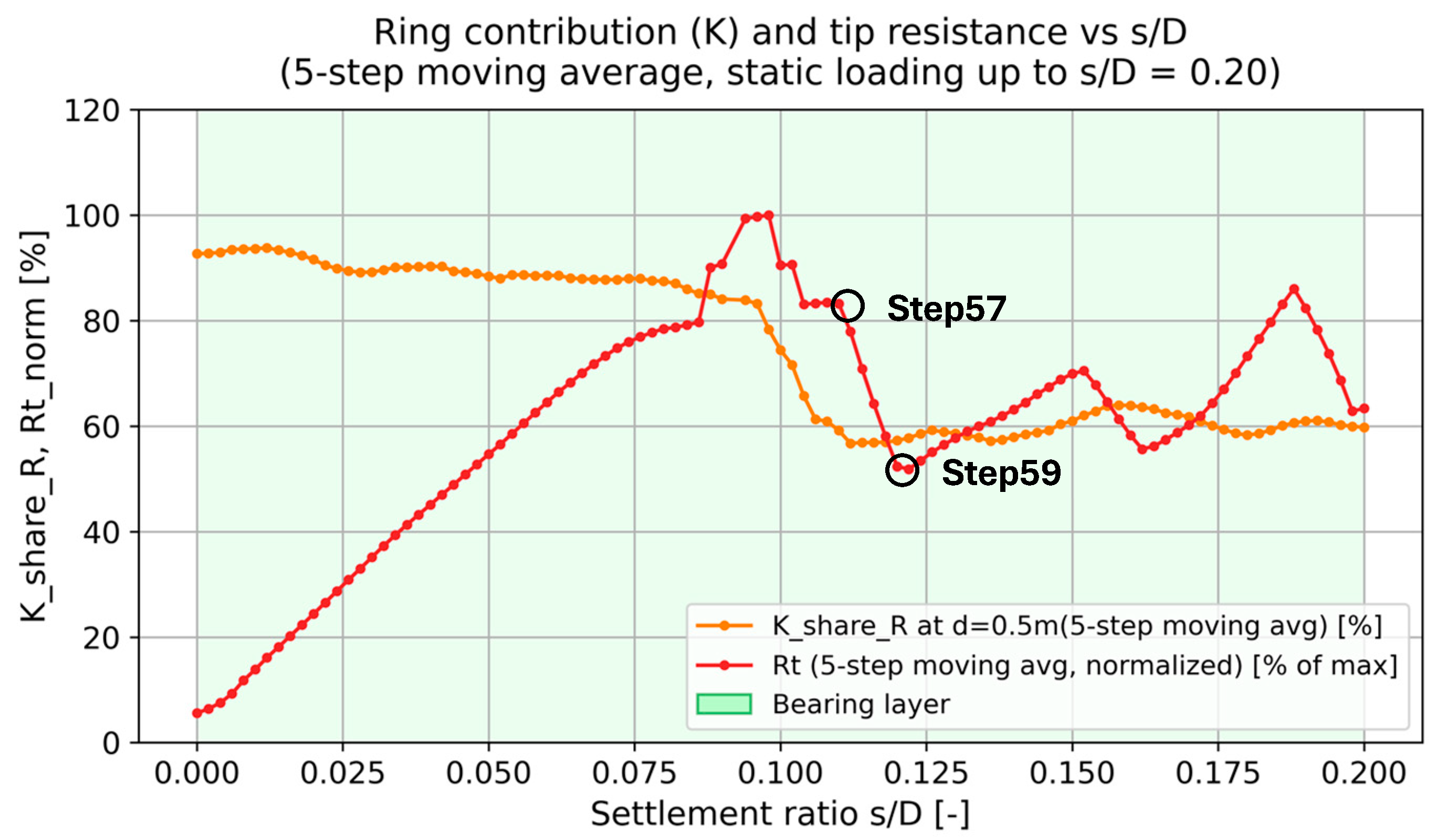
Figure 6 shows
Rt and
K_share,R versus settlement ratio
s/
D, and
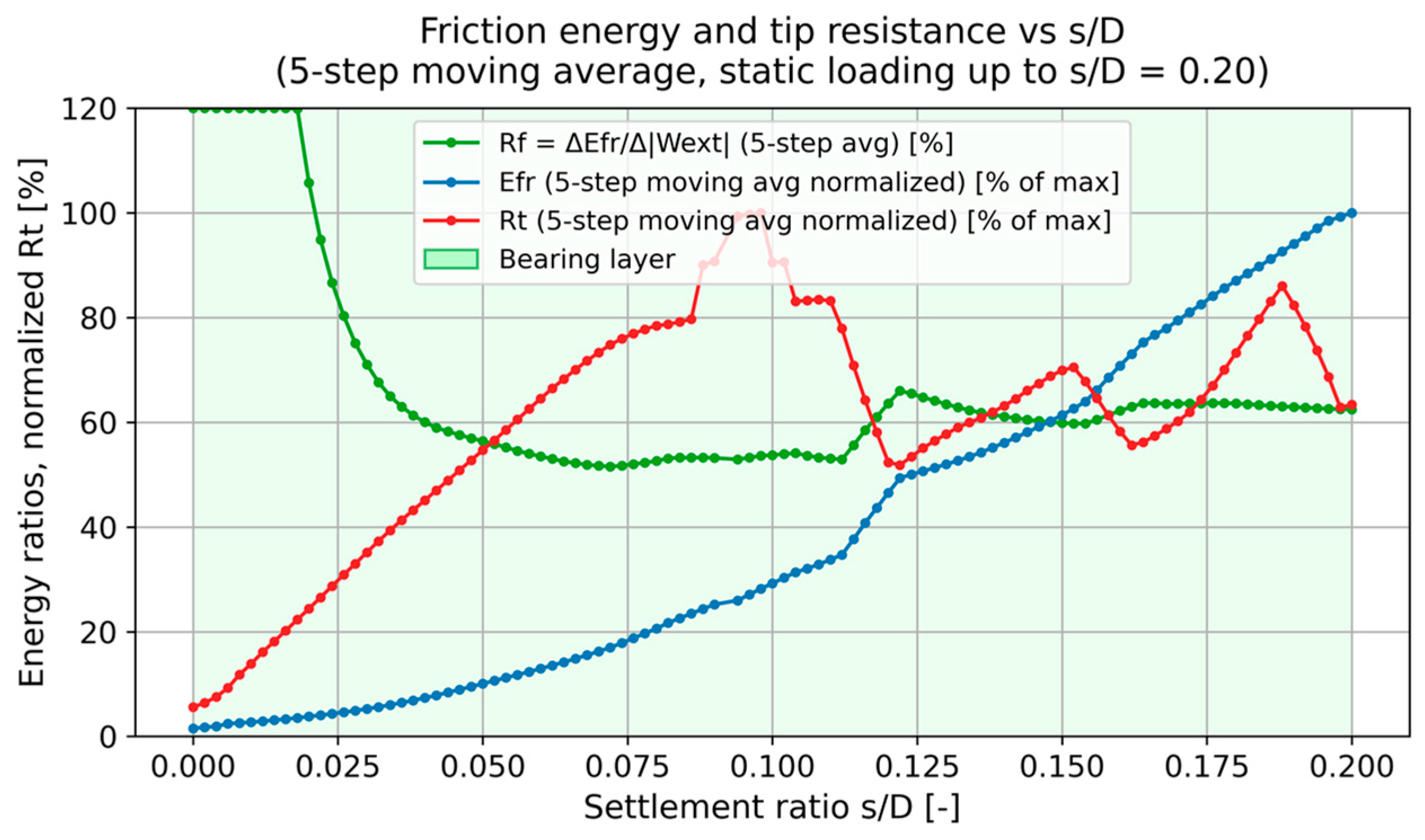
Figure 7 shows
Rt,norm, R_f, and
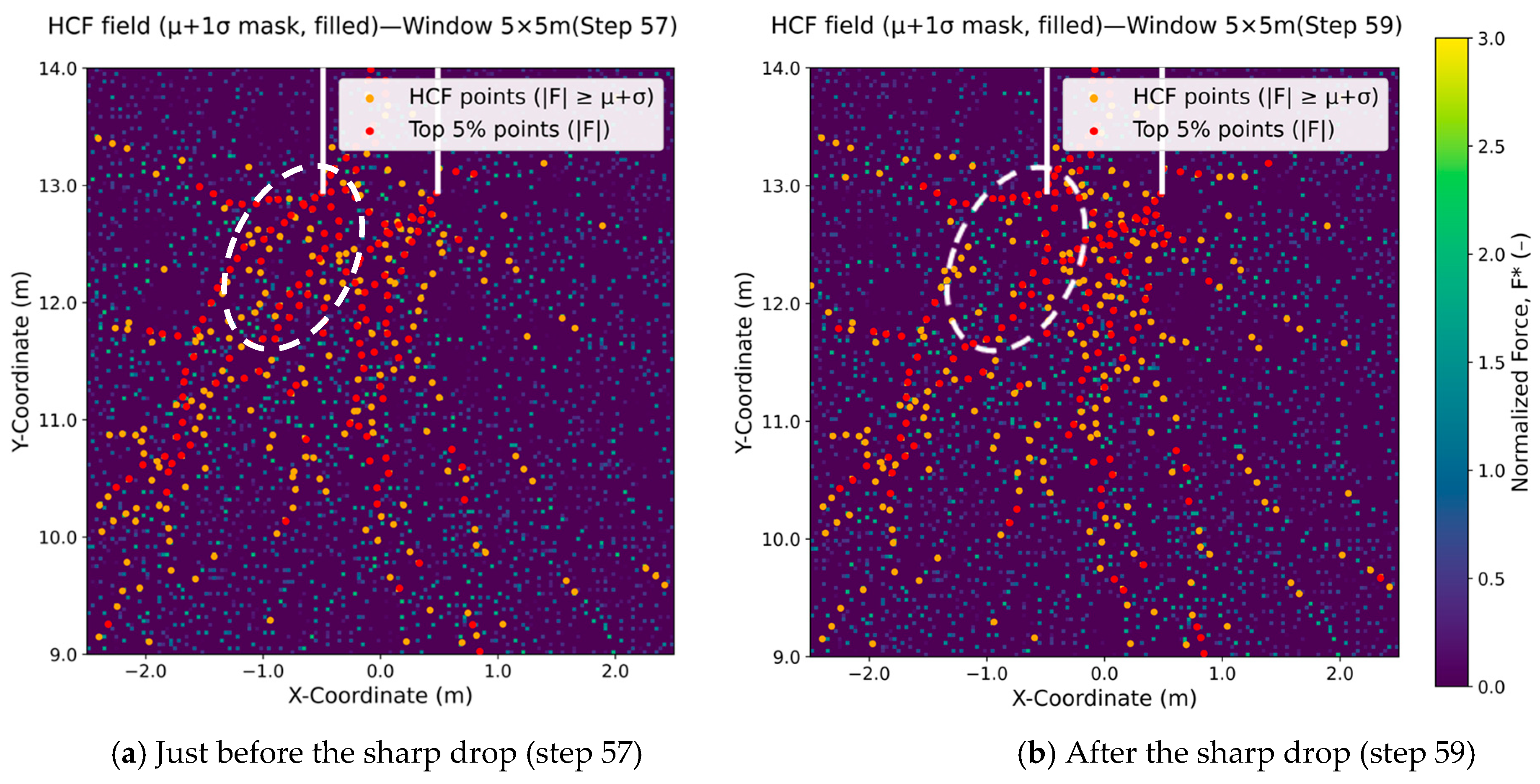
E_fr,norm along with HCF fields (5 m × 5 m) at a stage immediately before the sharp drop in tip resistance (step 57) and a stage after the sharp drop (step 59).
As shown in
Figure 6,
Rt_norm increases monotonically up to
s/
D ≈ 0.1, where the ultimate resistance is reached, followed by a sharp drop. Before this drop, localized collapse of high-contact-force struts beneath the ring initiates the reduction in
Rt_norm.
During continued loading to s/D ≈ 0.2, Rt_norm decreases to approximately 60% of the peak value and enters a “softening + redistribution” regime characterized by alternating recovery and reduction.
From an energy perspective (
Figure 7),
R_f during static loading generally ranges between 50% and 65%, indicating that a greater portion of external work is stored elastically rather than dissipated—contrasting with the dissipation-dominated driving phase.
Temporary spikes in R_f occur during strut collapse, while E_fr,norm increases smoothly throughout loading. No abnormal energy leakage is observed even beyond the peak, confirming stable quasi-static behavior.
HCF fields (
Figure 8) show that just before the sharp drop (step 57), a strong strut exists beneath the ring within the dashed ellipse on the left side. After the sharp drop (step 59), this strut largely collapsed, indicating localized failure along the ring-side load-transfer path.
The right-side strut remains largely intact, and as a result, K_share,R decreases after the peak but stabilizes around 60%. This behavior is suggested to reflect alternating collapse and re-formation of ring-side struts during load redistribution, while the internal soil core is suggested to continue to play a secondary, confining role throughout the post-peak sage.
5. Discussion
5.1. Elucidation of the Tip Resistance Mechanism (Ring Dominance and Functionalization of the Internal Soil Core)
The validity of the analysis results in this study is judged based on (i) multifaceted checks of quasi-static conditions (energy balance, drift, and coefficient of variation), (ii) confirmation that the main tendencies are maintained even when the particle-scale ratio and evaluation depth are changed, and (iii) qualitative comparison with previous large-scale loading test results. This study is not intended to directly verify at the real-structure level; however, from these viewpoints, the present results can be regarded as reasonable within the scope of this study.
Based on the results presented in
Section 4.2,
Section 4.3 and
Section 4.4, this section provides an integrated interpretation of the tip resistance mechanism of open-ended steel pipe piles from the perspective of
“ring dominance with functionalization of the internal soil core”.
During driving (
Section 4.3), the plugging ratio
CR increases to approximately 80–90% with increasing embedment
L/
D, while the ring contribution index (K
-density share) consistently remains above 80%.
The HCF distribution and K-indices (
Section 4.2) show that, even under partially plugged conditions near
CR = 88%, arch-shaped chains of high-contact-force develop directly beneath the ring, forming a pronounced strut-like load-bearing structure.
During static loading (
Section 4.4), the tip resistance
Rt is mobilized gradually on top of the strut-and-shear-band structure formed during driving. Just before
s/
D ≈ 0.1, a sequence of localized strut collapses beneath the ring—sometimes not fully captured by HCF visualization—initiates the reduction in ring contribution, leading to the ultimate state of
Rt.
After reaching the peak, the increase in core contribution remains limited: the ring retains approximately 60% contribution even in the post-peak regime.
HCF fields confirm that high-contact-force struts persist beneath the ring beyond the peak, and alternating collapse and re-formation of the left and right struts contribute to load redistribution. The re-formation of struts is attributed to particle dilatancy and strain hardening.
Overall, the partially plugged open-ended piles analyzed in this study are suggested to exhibit a mechanism in which high-contact-force struts beneath the ring serve as the primary load-bearing paths, while the internal soil core provides secondary confining and supplemental resistance as plugging progresses.
Also, a design framework that organizes load transfer by separating the base resistance into the ring part (annulus) and the internal soil (plug) has been proposed [
19]. The mechanistic picture suggested in this study, “ring dominance with functionalization of the internal soil core”, is consistent with such a separation concept and is characterized by the point that changes in contribution in a partially plugged condition can be continuously organized by the ring contribution index (K
-density share).
5.2. Comparison of Energy Mechanisms in Dynamic Driving and Static Loading
This section compares the distinct energy mechanisms in dynamic driving and static loading using
Figure 4 and
Figure 6 and discusses their implications for the tip resistance mechanism.
During dynamic driving, the contact network around the pile tip and annulus undergoes rapid collapse and re-formation, with continuous interparticle sliding. As a result, most external work is immediately dissipated as frictional energy, and only a small fraction is stored elastically.
High particle velocities and localized plastic deformation further enhance dissipation, and the friction ratio R_f reaches 80–95%, indicating a dissipation-dominated (plastic) energy structure.
In contrast, during static loading, the internal soil core, surrounding shear band, and ring-origin strut structure formed during driving are stabilized and most contacts remain within the elastic regime.
Because loading rates are extremely small, large sliding events are limited, and external work is primarily stored as elastic potential energy. Consequently, R_f decreases to 50–65%, with only temporary increases during localized strut collapse events.
Overall, the static phase exhibits an elastic-dominated energy structure.
These observations indicate that tip resistance development in open-ended piles is governed by the following two distinct yet sequential energy mechanisms: plastic rearrangement during driving and elastic strut development during static loading, and this difference manifests as a significant contrast in R_f between the two phases.
5.3. Relationship Between Plugging (IFR/PLR) and Load-Sharing Indices
This section examines the relationship between plugging indicators (IFR/PLR, here CR = PLR) and the load-sharing contribution of the ring and internal soil core expressed by the ring contribution index (K-density share).
As shown in
Section 4.3,
CR increases monotonically with embedment during driving, reaching approximately 88% at the end of driving.
In contrast, the ring contribution (K-density share) remains high (80–90%) even at the same L/D, demonstrating that an increase in CR does not imply a transition to core-dominated resistance. Thus, plugging mainly enables the internal soil core to function as a confining element, while the primary bearing role remains with the ring.
Because CR represents the kinematic degree of filling (“how much soil has entered the pile”), it does not directly indicate load sharing (“which region carries how much load”).
In contrast, the K-density share reflects the mechanical contribution based on the spread and intensity of HCF-bearing zones.
Therefore, combining the plugging ratio CR with the K-density share allows one to distinguish “how much plugging has progressed” from “how load-sharing between ring and core evolves due to plugging”.
From a design perspective, the combined use of these two indices enables a continuous interpretation bridging unplugged, partially plugged, and highly plugged states.
5.4. Interpretation of Embedment, Settlement, and Q–S Response
This section relates embedment ratio L/D during driving to settlement ratio s/D during static loading and interprets the resulting Q–s response. From a design standpoint, the relevant question is “What embedment length L/D is required to mobilize a given static tip resistance at settlement s/D?”
As observed in
Section 4.3, a substantial portion of the tip resistance is already mobilized by the time the pile reaches
L/
D = 2 during driving, and both
CR and the ring contribution (K
-density share) are high. This agrees with
Figure 4 and the HCF fields (
Figure 8), in which the core-side occupancy and intensity do not increase markedly, and the core-side strut development remains limited.
During static loading (
Section 4.4), the
Q–
s curve shows curvature around
s/
D ≈ 0.05–0.1, reaching the ultimate tip resistance at
s/
D ≈ 0.1, followed by softening. Cases with higher
CR and ring contribution at the end of driving tend to exhibit greater initial stiffness and higher peak
Rt, with a clearer curvature point.
Thus, the “ring-dominant + core-confining” mechanism established during driving strongly influences the Q–s response.
Combining the relationships L/D–CR–K-density share and s/D–Rt–K-density share helps provide a design-oriented interpretation for relating the embedment length L/D required to obtain the required static tip resistance (peak Rt).
Finally, comparing these behaviors with closed-ended piles highlights the distinct response of open-ended piles.
Closed-ended piles mobilize resistance through compression of the entire tip area, leading to smoother post-peak settlement.
In contrast, open-ended piles rely on a limited number of high-contact-force struts beneath the ring; once these struts crush locally, the load shifts to neighboring struts, triggering chain-like collapse and rapid settlement.
Thus, the characteristic rapid post-peak settlement of open-ended piles may be attributed to their dependence on discrete ring-side struts rather than full-section bearing.
5.5. Correspondence Between End-of-Driving State and Static Loading Results (Bridge Table Synthesis)
Table 2 summarizes representative values at the end of driving and during static loading at
s/
D = 0.1 and 0.2, including
L/
D,
s/
D, plugging ratio
CR, ring contribution
K_share,R (evaluated at z = 0.5 m), friction ratio
R_f, tip resistance
Rt, and the ratio
Rp/
Rt.
At the end of driving (end of driving, L/D = 7.0), the values are CR ≈ 88.3%, K_share,R ≈ 84.6%, and R_f ≈ 92.9%, indicating a highly plugged, ring-dominant, and friction-dominated state.
Upon initiating static loading and reaching s/D = 0, the plugging ratio remains CR = 88.3% (estimated, as plug height cannot be tracked during loading), while the ring contribution decreases only slightly to K_share,R = 80.0% and R_f decreases to 53.7%. The corresponding tip resistance is Rt = 28,342 kN, yielding Rp/Rt ≈ 0.87, indicating that the majority of tip resistance is carried by the ring.
When loading continues to
s/
D = 0.2 (20%
D), the plugging ratio
CR is assumed to remain at 88.3%, while
K_share,R decreases further to 58.7%, indicating progressive strut collapse beneath the ring and load redistribution. The friction ratio
R_f is relatively low at 62.4%, and, in contrast to the impact-driving stage discussed in
Section 5.2, where most of the external work is dissipated by friction, a higher proportion of elastic energy is accumulated during static loading.
Although R_f remains high (62.4%), suggesting continued frictional dissipation, the tip resistance decreases to Rt = 22,359 kN. These results suggest that, while the plugging ratio is assumed to remain nearly constant throughout driving and static loading, both K_share,R and Rp/Rt decrease during static loading, indicating a reduction in that the burden carried by the ring diminishes as struts fail, even though plugging is assumed to remain unchanged.
5.6. Robustness of the Mechanism with Respect to Particle-Scale Ratio (25× vs. 100× Models)
This section qualitatively examines the robustness of the proposed mechanism—“ring dominance with functionalization of the internal soil core”—by comparing a large-scale model (D/d50 = 100×) and a small-scale model (D/d50 = 25×).
The objective is not to derive quantitative scale-regression relations but to verify whether the underlying mechanism remains qualitatively consistent across particle scales.
Figure 9 shows the relationship among
CR,
K_share,R, and
Rt,norm during driving for both models, and
Table 3 summarizes the representative values of
L/
D,
CR,
K_share,R, and
R_f.
Although the peak value of Rt differs due to scale effects, the development of plugging ratio CR, the consistently high ring contribution K_share,R, and the high friction ratio R_f characteristic of friction-dominated driving are common to both models.
In particular, at the end of driving, both models show a high ring contribution (K-density share), and although the core-side occupancy and intensity gradually increase with plugging, the ring-side bearing zone also remains strong.
These findings indicate that the essential mechanism—a ring-dominant structure supplemented by a functionally mobilized internal soil core—is qualitatively preserved across particle-scale ratios.
Thus, the interpretation of the tip resistance mechanism presented in this study exhibits a degree of scale robustness.
5.7. Reproducibility and Analytical Considerations (Quasi-Static Conditions, Evaluation Window, and Thresholds)
This section summarizes the quasi-static criteria, evaluation window settings, threshold definitions, and moving-average filtering used in the present analysis to ensure reproducibility.
As described in
Section 3.1 and
Section 4.1, quasi-static behavior was verified using the following two criteria:
- (i)
energy-flux residual rflux ≤ 5% (with confirmation of rstd);
- (ii)
drift ≤ 3% and CV ≤ 5% during rest and static loading.
These criteria ensured stable quasi-static behavior during driving, rest, and static loading. Static evaluation was focused on s/D = 0.1, while loading to s/D = 0.2 was treated as a reference analysis for post-peak mechanisms.
For HCF and density-index evaluation, common evaluation windows were used across all cases as follows: depth bands d = 0.20, 0.25, 0.30, and 0.50 m from the pile-tip level, and horizontal subdivision into ring (0.40–0.55 m) and core (∣x∣ ≤ 0.40 m).
Normalization employed the mean μ from the Half 10 m × 10 m region, and HCF points were extracted using the threshold τ = μ + σ.
The occupancy ϕ, normalized intensity I∗, and density indices KR and KC were computed under unified conditions.
Temporal smoothing used a five-step moving average to suppress high-frequency noise.
The ring contribution (K-density share) was computed at each step as KR/(KR + KC) and used together with other indicators (CR, R_f, E_fr,norm, etc.) to evaluate ring/core load sharing.
5.8. Limitations and Future Work (Connection to Part II)
This study has several limitations.
First, the analysis is based on a two-dimensional DEM model, and three-dimensional effects (such as circumferential non-uniformity and 3D shear-band development) are not explicitly considered.
Second, the ground conditions modeled here represent a specific sand profile; applicability to clay, layered soils, or strongly anisotropic soils requires further investigation.
Third, the particle-scale ratio D/d50 is finite, and complete similitude with field-scale behavior cannot be ensured.
Nevertheless, in this study (part I), even under these limitations, the fundamental framework of the tip resistance mechanism—namely, ring dominance with functionalization of the internal soil core—is suggested within the range of the present analysis conditions and the plugging ratio CR and ring contribution (K-density share) are suggested to have potential applicability for design-oriented interpretation.
The density indices KR and KC, along with K_share,R, serve as supplementary indicators for characterizing the spread and intensity of ring and core bearing zones.
This study aims to provide a mechanistic understanding and a design-oriented framework, whereas coefficient calibration, quantitative scale regression, and mapping to practical site indices (e.g., N-values) will be examined in part II.
Future work is planned to include scale regression considering D/d50, W/D, and L/D, development of a tip resistance prediction formula based on ring area and geotechnical indices, as well as the validation through 3D DEM analyses and centrifuge model tests.
Also, in this study, direct verification by field loading tests at the real-structure level is not conducted, which remains an important issue for future investigation. However, based on comparisons with previous large-scale loading tests, it is qualitatively suggested that the trend of the ring contribution ratio does not show significant deviation.
6. Conclusions
This study evaluated the tip resistance mechanism of open-ended steel pipe piles—including partially plugged conditions—through virtual static loading tests using two-dimensional DEM and provided a basis for a design-oriented interpretation. The main findings are summarized as follows:
- (1)
Ring dominance and its weak correlation with plugging ratio
Decomposition of the tip resistance Rt, analysis of the ring contribution (K-density share), and HCF distributions revealed a tendency that, in both driving and static loading phases, a large portion of the tip resistance (on the order of 85–90% within the observed cases) tends to be carried by the ring. Within the range of the present analysis conditions, no clear correlation was suggested between plugging ratio CR and ring contribution.
- (2)
Mechanistic origin of ring resistance
During driving, the increase in Rt corresponds to the progressive formation of high-contact-force struts beneath the ring. Near the ultimate state, these struts undergo localized crushing; the subsequent chain-like propagation of such failures is suggested to be associated with enhanced settlement beyond the peak, suggesting that post-peak rapid settlement in open-ended piles may arise from the collapse of discrete ring-origin struts.
- (3)
Framework for evaluating tip resistance
The results suggest that the failure mode unique to open-ended piles may be interpreted as a dependence on discrete high-contact-force struts beneath the ring, distinct from the full-area bearing observed in closed-ended piles.
The combined use of plugging ratio CR and ring contribution (K-density share) is suggested to provide a useful framework for tip resistance evaluation, offering a load-sharing interpretation applicable across unplugged to partially plugged states.
The K-density-share-based load-sharing structure proposed in this study may complement traditional plug/unplug criteria and contribute to a design-oriented interpretation that treats plugging effects in a continuous manner.
Finally, the framework presented here is suggested to serve as a possible conceptual basis for the development of a design-oriented tip resistance formulation in part II, where its applicability as a core structure of the estimation method will be further examined.