
A One-Dimensional Model Used for the Analysis of Seismic Site Response and Soil Instabilities: A Review of SCOSSA 1.0 Computer Code


Abstract
1. Introduction
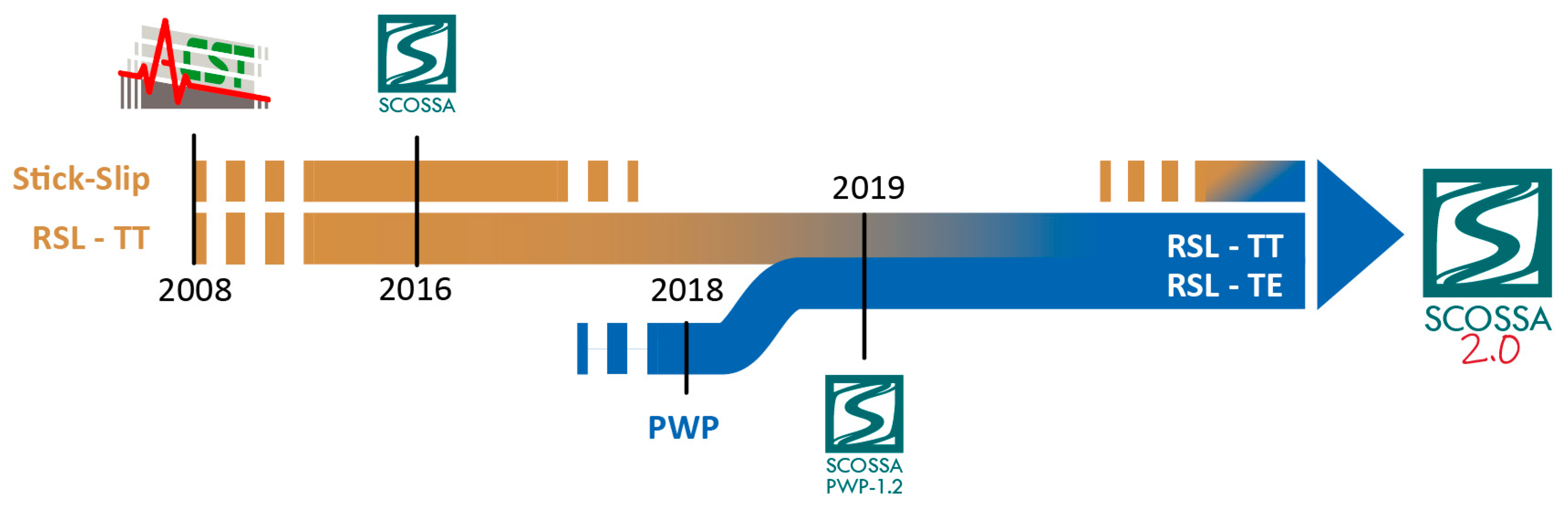
2. Main Steps in the Development of the SCOSSA Code
3. Seismic Response Analysis in Total Stress
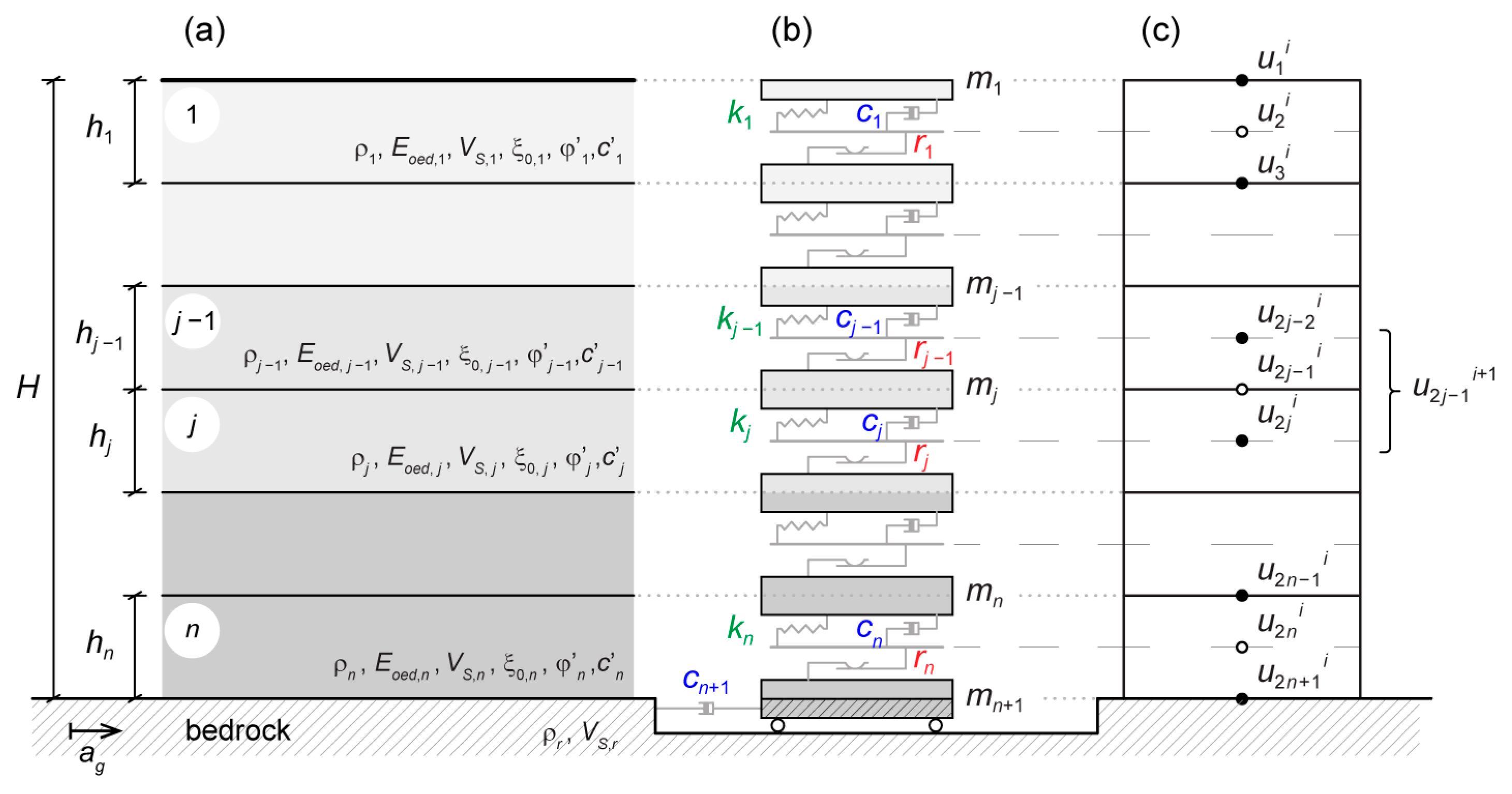
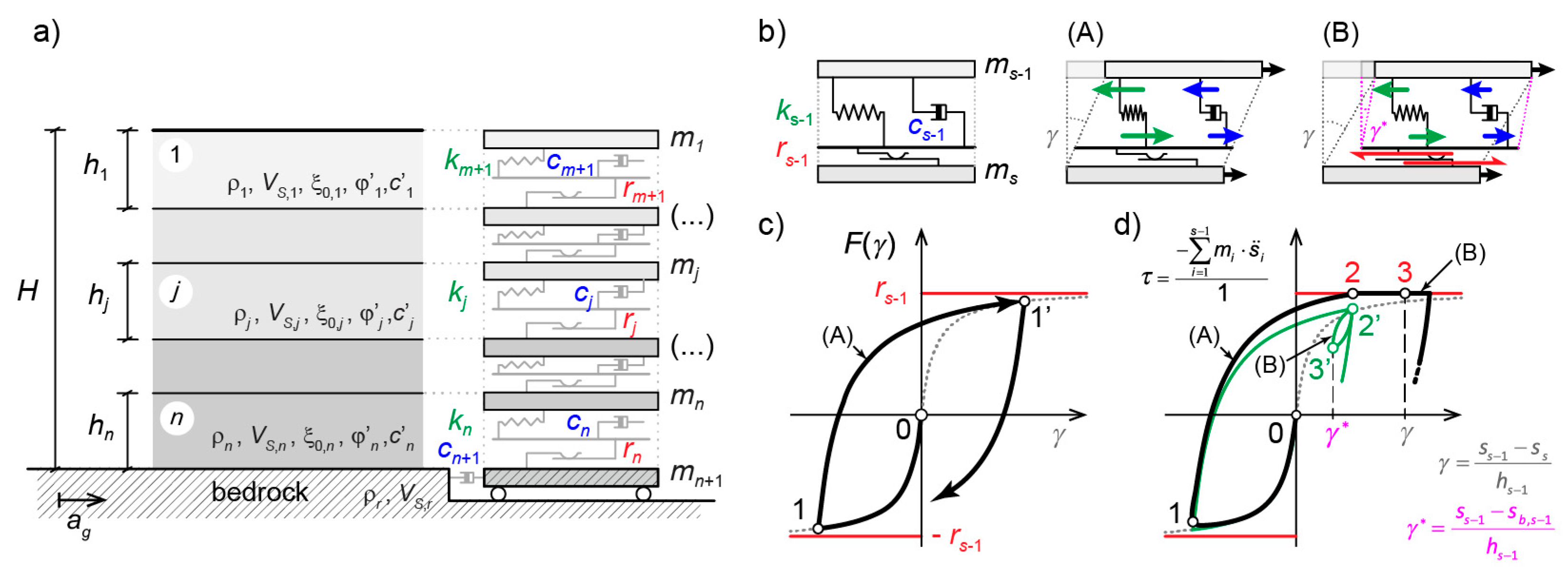
- i is a vector with each element equal to zero, except for the n-th (for inside motion), or (n + 1)th (for outcrop motion), equal to unity;
- vg(t) and sg(t) are, respectively, the velocity and the displacement time histories obtained by numerical integration of input acceleration, ag(t);
- cn and kn are, respectively, the viscous damping coefficient and the spring elastic stiffness for the n-th element;
- cn+1 = ρrVS,r is the bedrock seismic impedance.
3.1. Cyclic Response Model
3.2. Code Performances at Low–Medium Strains
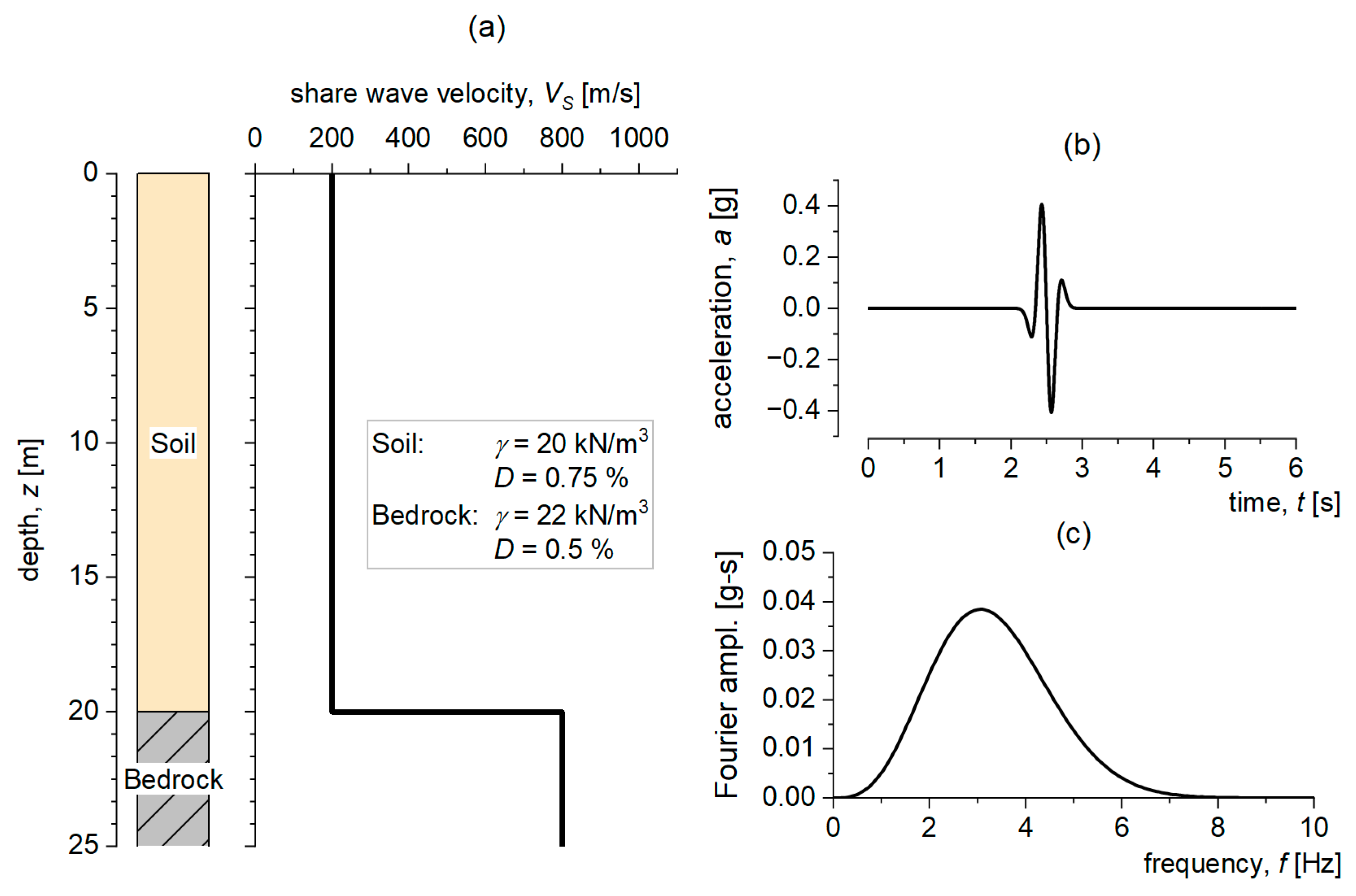
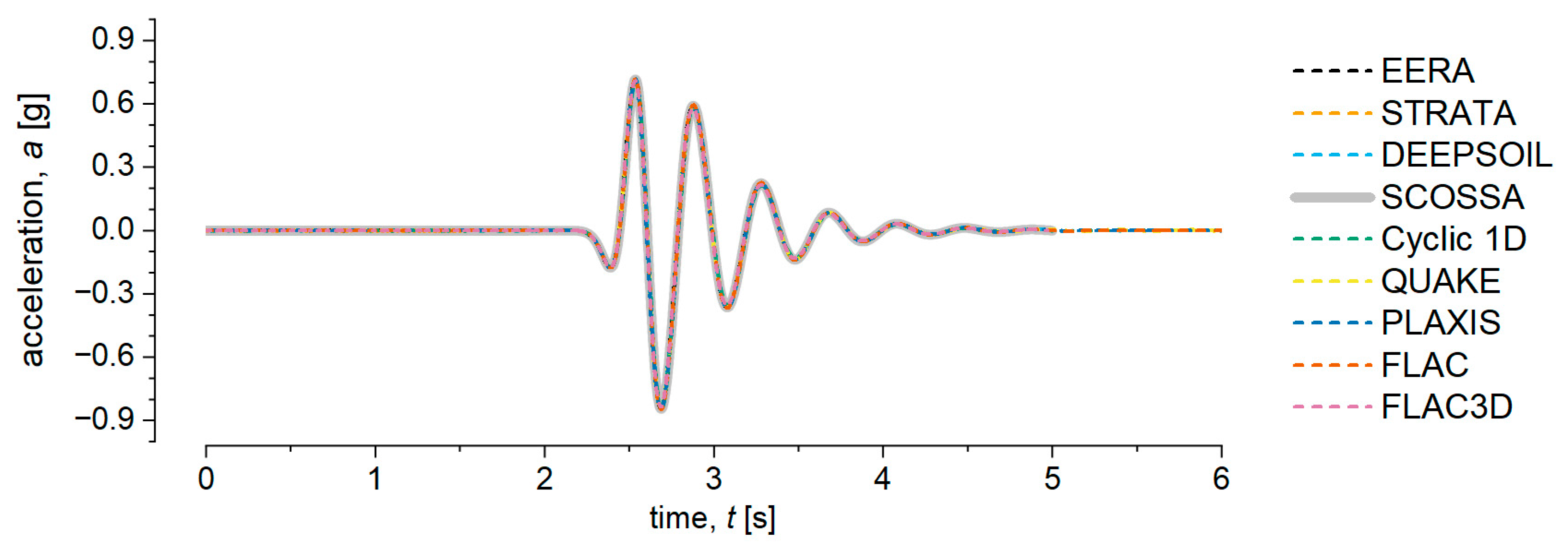
3.2.1. Verification on Ideal Soil Profiles
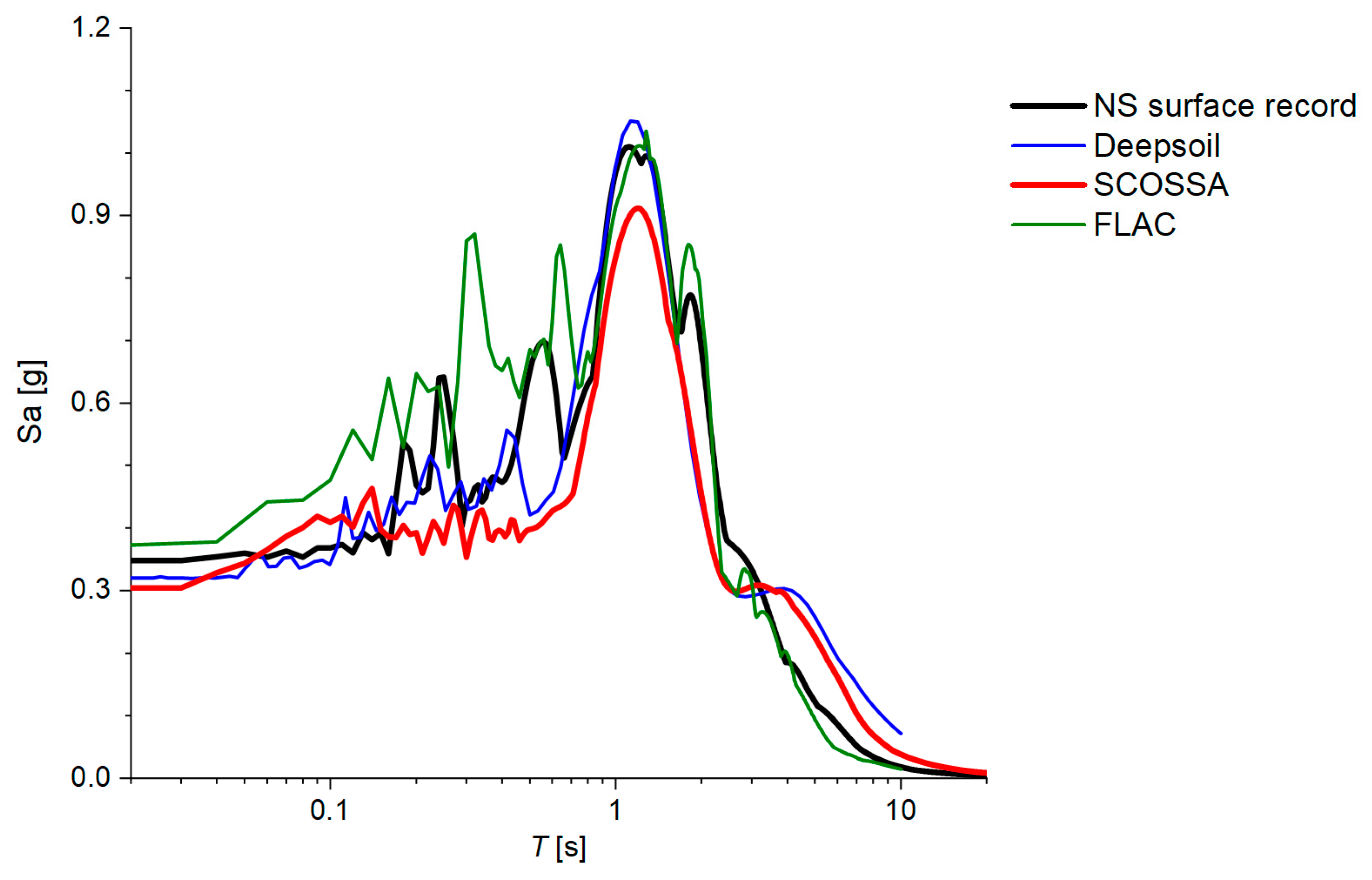
3.2.2. Validation on Case Histories
4. Stick–Slip Model
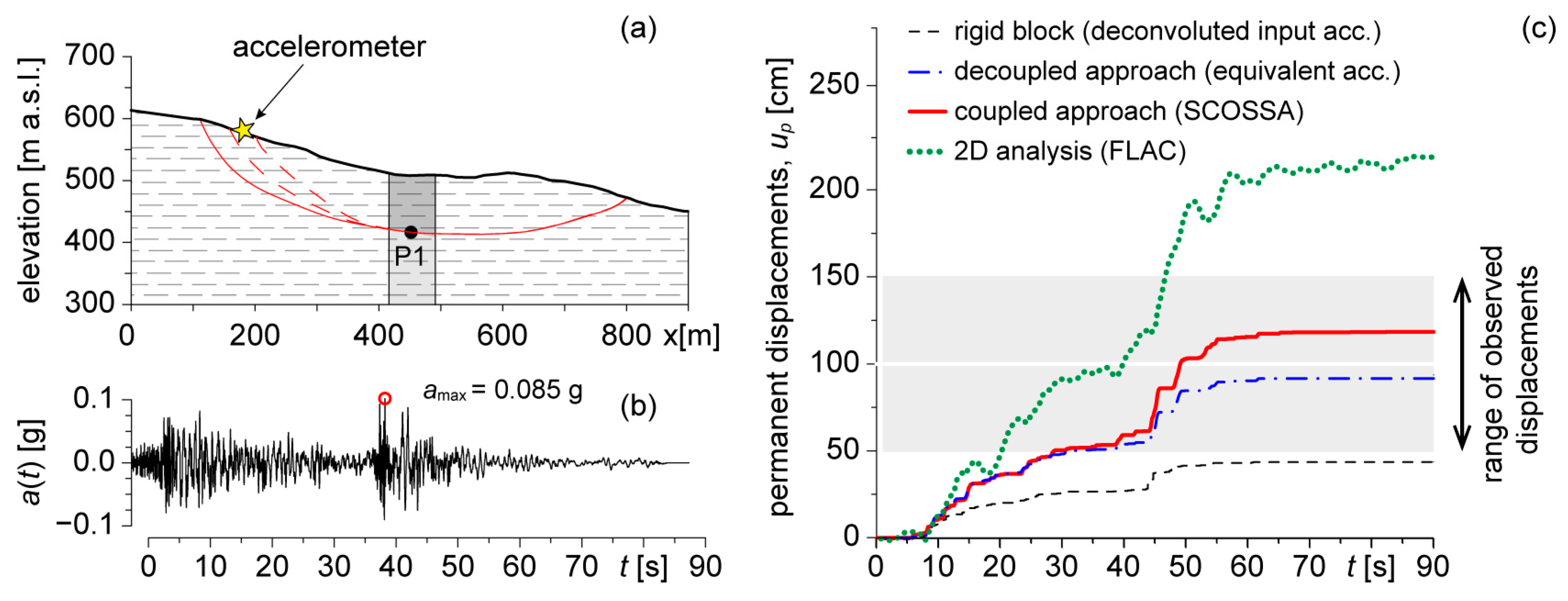
Validation on Calitri Landslide
5. Liquefaction
- Decoupled approach: this method calculates excess pore pressure using semi-empirical relationships based on total stress analysis results.
- Coupled approach: this method performs effective stress dynamic analysis, calculating the time history of excess pore water pressure [66].
- Loosely coupled: predicts pore pressure using relationships combined with total stress constitutive models [67].
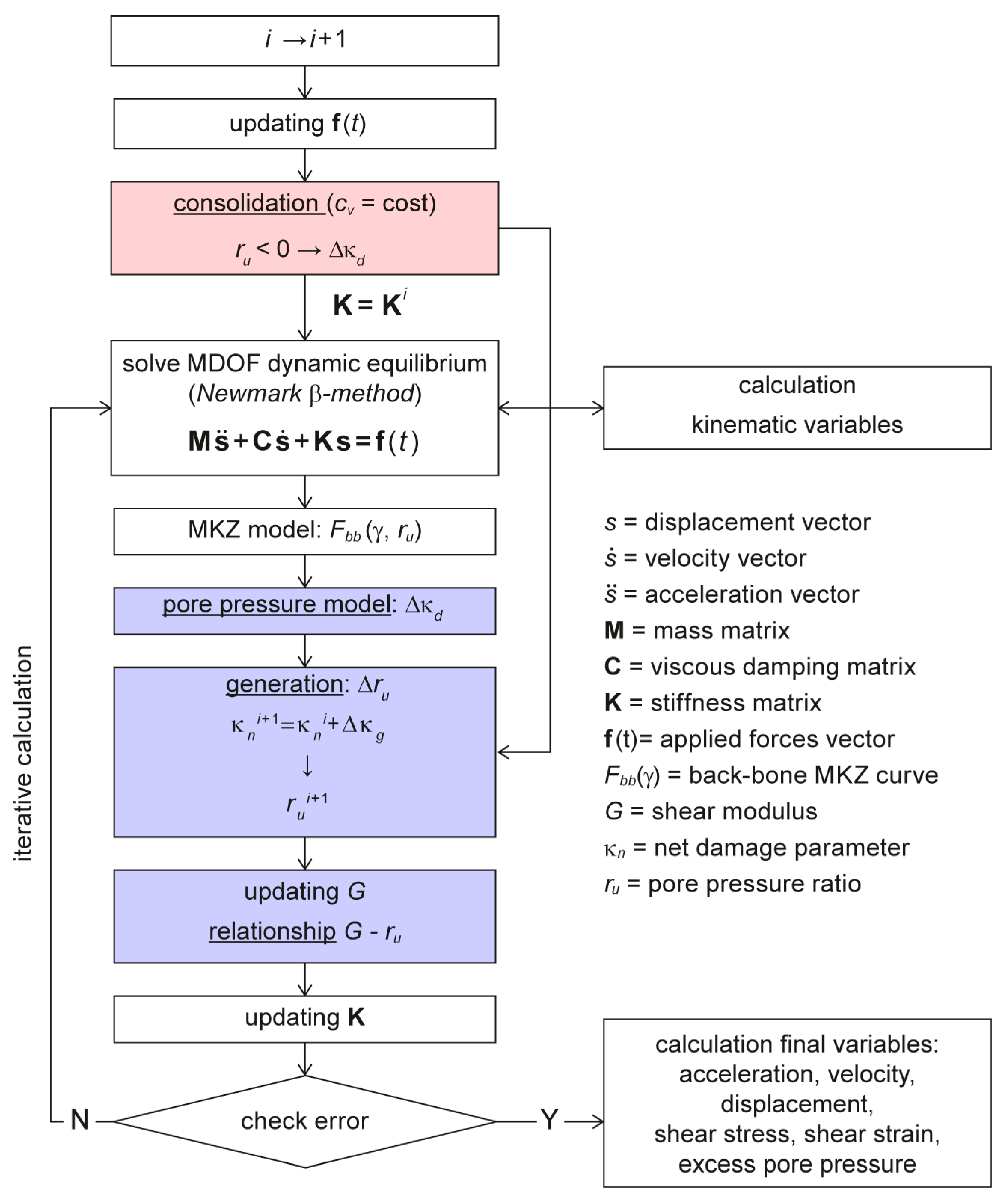
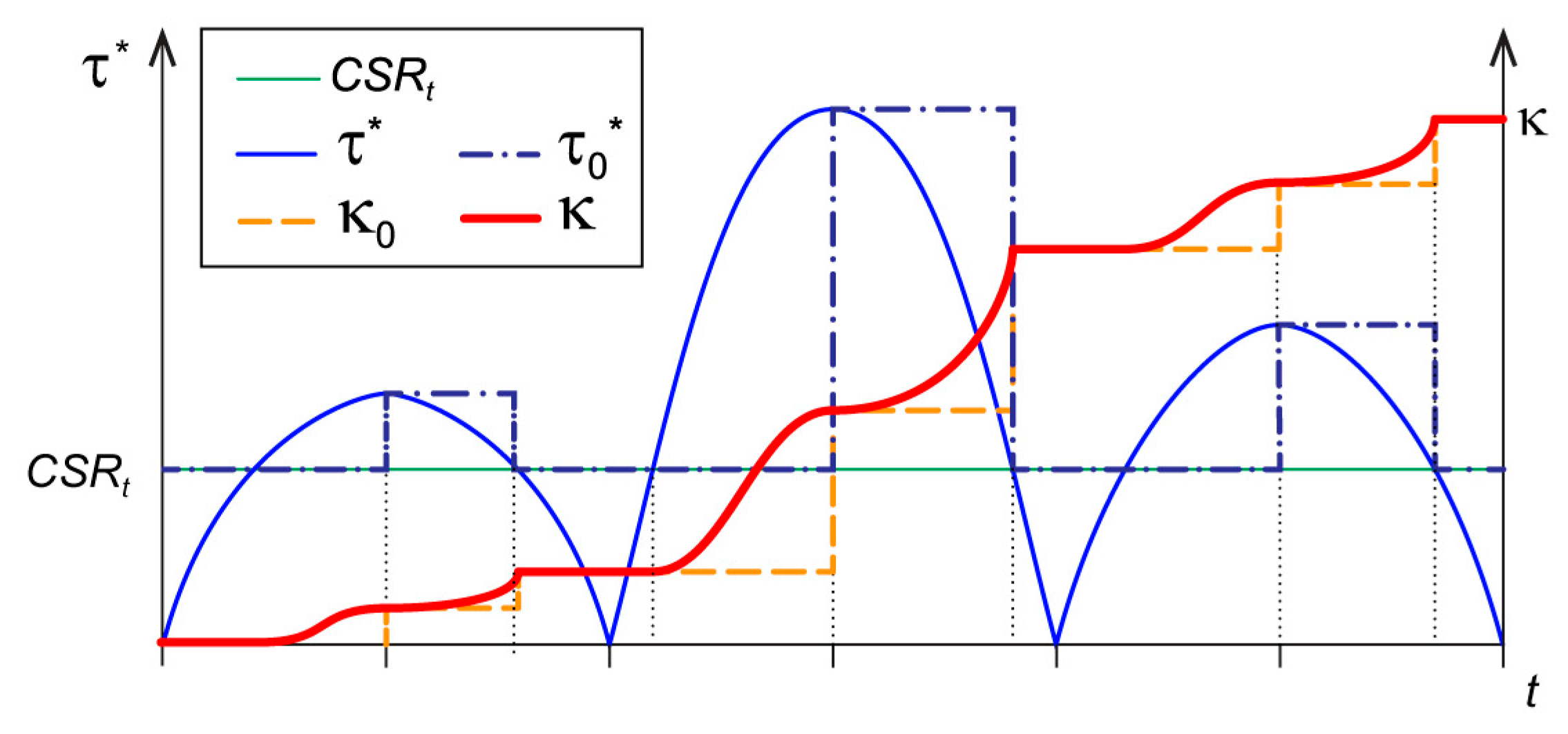
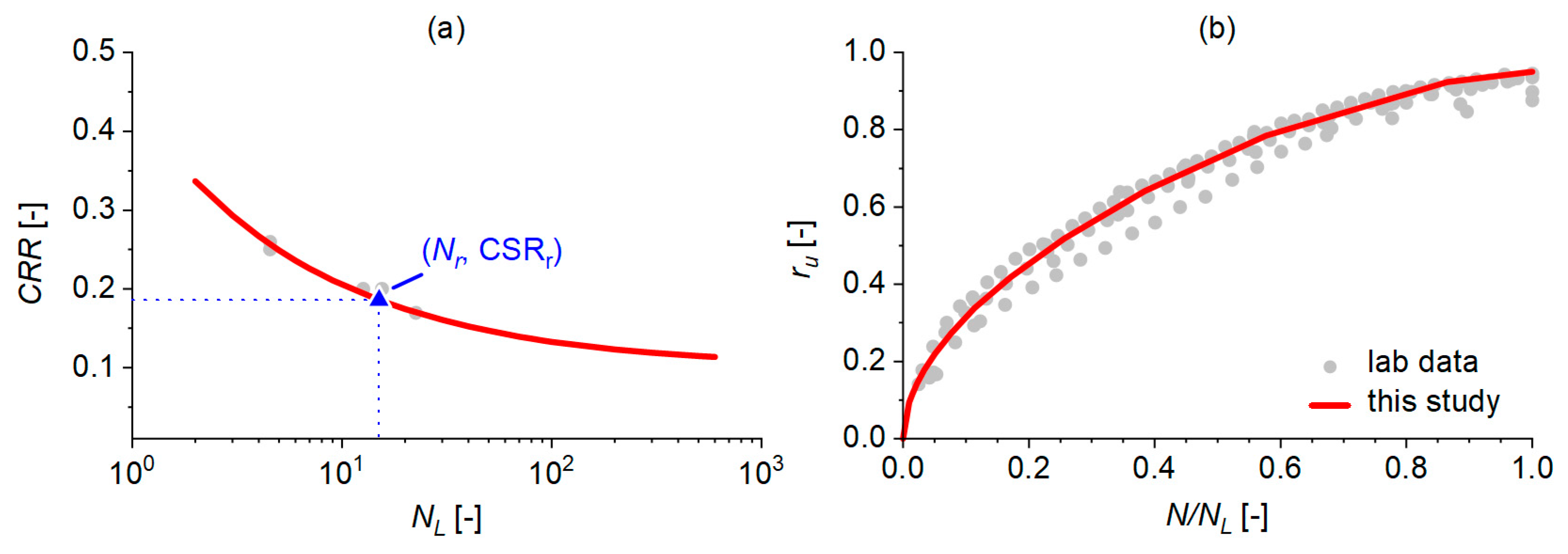
5.1. PWP Model
5.2. Review of Applications and Case Studies
5.2.1. Validation on Sendai Case Study
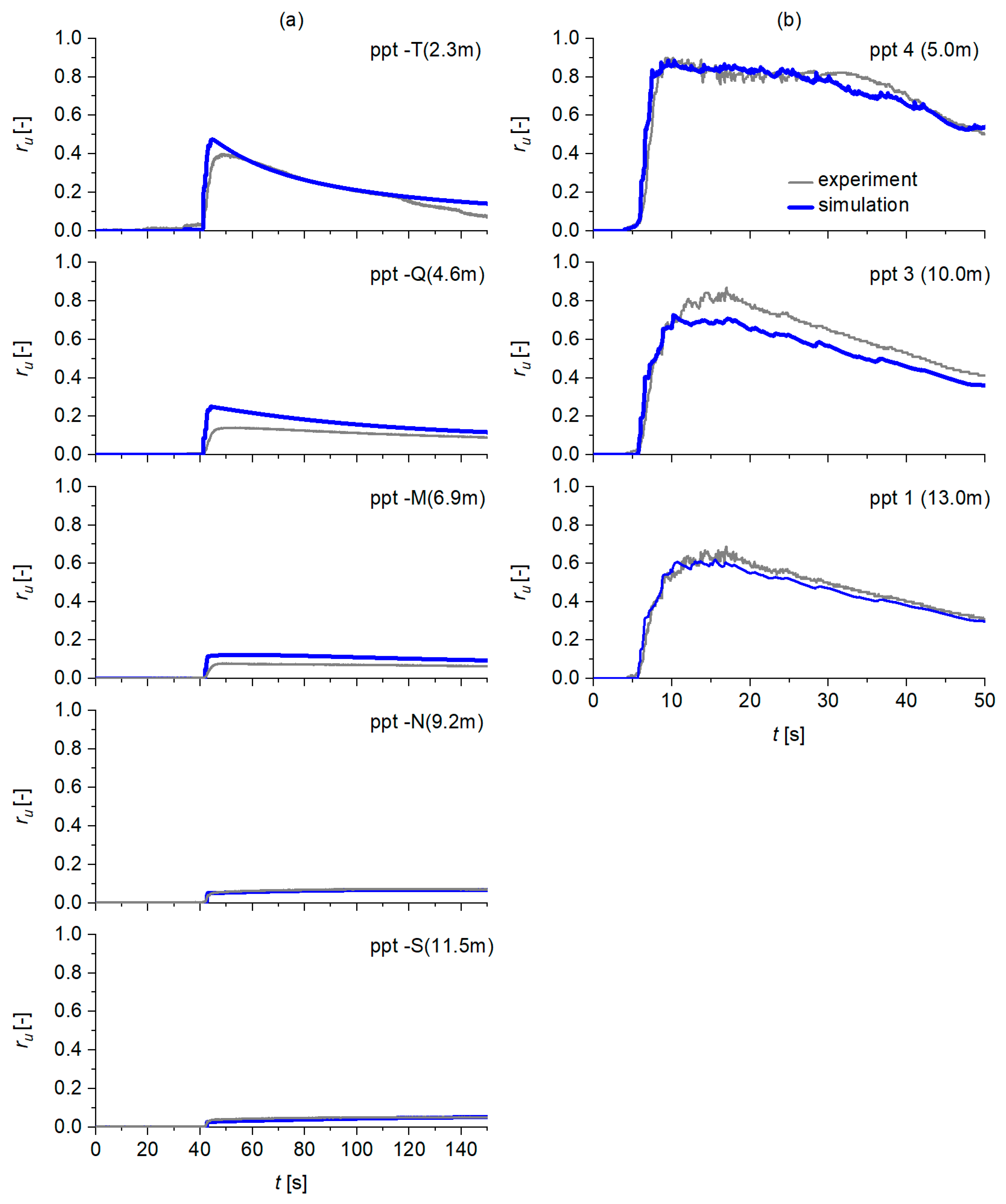
5.2.2. Validation on Port Island Case Study
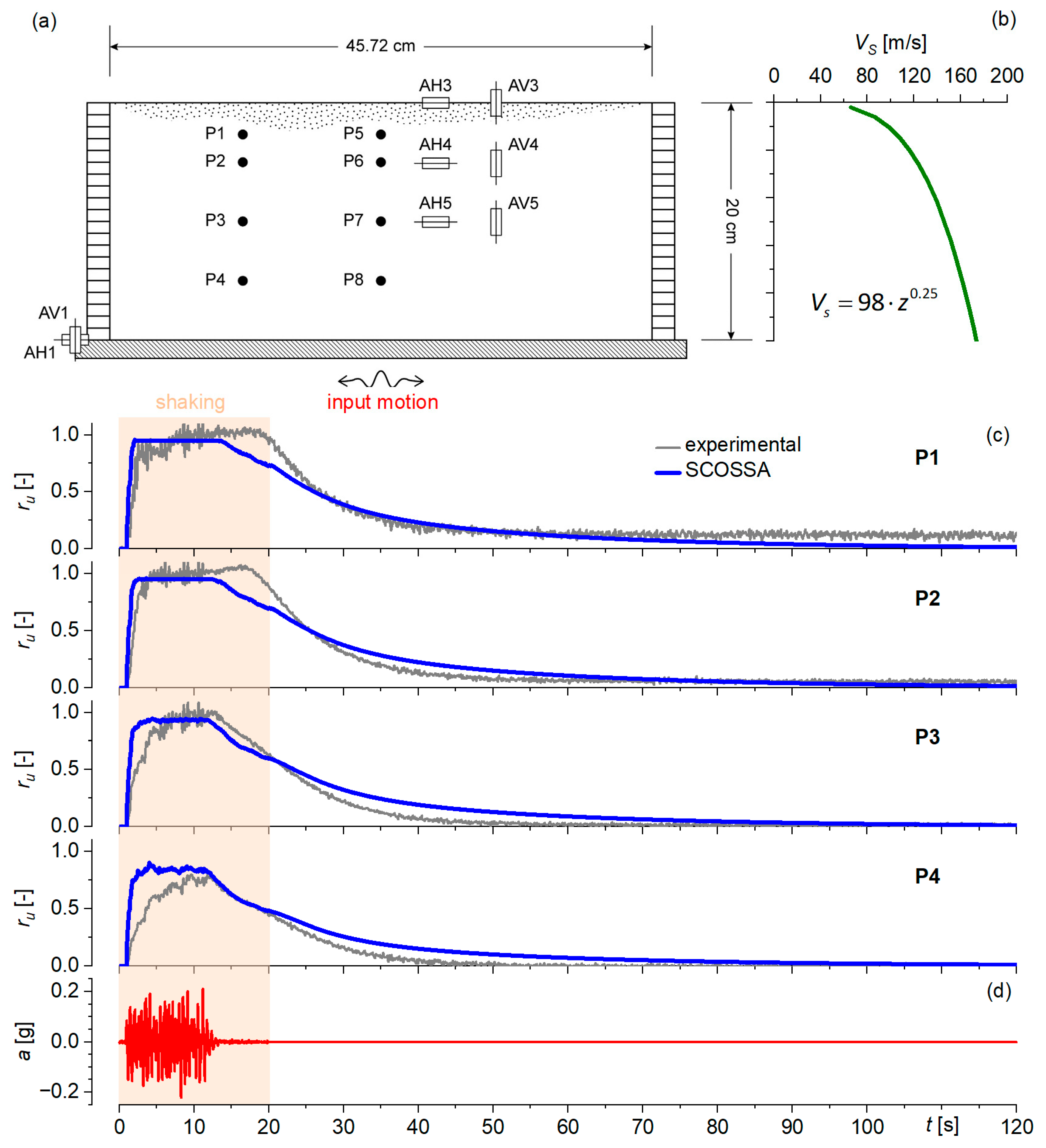
5.2.3. Validation Against Centrifuge Test Results
5.3. Detected Limitations
- The stick–slip model is validated against a few case studies and needs to be extended. To the best of the authors’ knowledge, there are no other codes where the stick–slip model is implemented. As a consequence, the lack of comparison and verification in real cases implies that caution should be exercised in using the results.
- The numerical errors detected in the stick–slip scheme can be substantial. As a consequence, the results are suggested to be compared with simpler approaches before reaching a conclusion.
- The proposed method for liquefaction is not able to properly model the actual soil behavior after the triggering of liquefaction. Similarly to the codes which incorporate a loosely coupled approach reported in Table 1, the model does not account for the dilatative behavior of the soil observed after liquefaction triggering. This implies that the results are not adequate if the after-triggering behavior wants to be reproduced, and it is necessary to move to advanced constitutive models, such as those implemented in CYCLIC 1D [51], able to perform a fully coupled analysis.
- The PWP model calibration on in situ tests is based on the cyclic resistance curve analytically described by an exponential law, so the parameter CSRt tends to be zero. This implies that the in situ-based PWP model calibration is less effective when the range of considered seismic action is around low CSR values, i.e., moderate- to low-intensity earthquakes. In the latter cases, the correct identification of the volumetric threshold strain and related CSRt can be obtained with specific laboratory tests.
- The calibration of the PWP model for a specific relative density of the soil cannot be extended to a different relative density, but a new calibration of the model parameters is necessary even though the soil is the same. This makes the calibration process a bit long and repetitive compared to other models, where soil calibration is independent of the relative density.
- The boundary conditions for dissipation and redistribution of excess pore water pressure are imposed only at the base of the soil profile. This limitation constrains the cases that can be analyzed. The same limitation can be detected in other 1D codes, such as DEEPSOIL [43], while the use of more complex codes is necessary.
- Validation of soil models tested in centrifuge tests is limited to models with a single layer of sand, while layered configurations have not yet been considered. This implies that results from layered soil configurations should be used with caution because of the lack of specific validation.
6. Conclusions and Future Developments
Author Contributions
Funding
Institutional Review Board Statement
Informed Consent Statement
Data Availability Statement
Conflicts of Interest
Abbreviations
| PWP | Pore Water Pressure. |
| SCOSSA | Seismic Computer Code for Stick–Slip Analysis. |
| CRR | Cyclic Resistance Ratio. |
| CSR | Cyclic Stress Ratio. |
| PreNoLin | Prediction of Non-linear Soil Behaviour. |
| PGA | Peak Ground Acceleration. |
| MASW | Multichannel Analysis of Surface Waves. |
| MDOF | Multiple-Degree-Of-Freedom. |
References
- NTC. Aggiornamento Delle Norme Tecniche per le Costruzioni. 2018. Available online: https://www.gazzettaufficiale.it/eli/id/2018/2/20/18A00716/sg (accessed on 21 December 2025).
- Rathje, E.M.; Bray, J.D. Nonlinear coupled seismic sliding analysis of earth structures. J. Geotech. Geol. Eng. 2000, 126, 1002–1014. [Google Scholar] [CrossRef]
- Tropeano, G.; Chiaradonna, A.; d’Onofrio, A.; Silvestri, F. An innovative computer code for 1D seismic response analysis including shear strength of soils. Geotechnique 2016, 66, 95–105. [Google Scholar] [CrossRef]
- Cubrinovski, M.; Rhodes, A.; Ntritsos, N.; Van Ballegooy, S. System response of liquefiable deposits. Soil. Dyn. Earthq. Eng. 2018, 124, 212–229. [Google Scholar] [CrossRef]
- Dhakal, R.; Cubrinovski, M. Liquefaction response of reclaimed soils from effective stress analysis. Soils Found. 2025, 65, 101677. [Google Scholar] [CrossRef]
- Hutabarat, D.; Bray, J.D. Effective stress analysis of liquefiable sites to estimate the severity of sediment ejecta. J. Geotech. Geoenviron. Eng. 2021, 147, 4021024. [Google Scholar] [CrossRef]
- Bassal, P.C.; Boulanger, R.W.; Dejong, J.T. System Response of an Interlayered Deposit with Spatially Distributed Ground Deformations in the Chi-Chi Earthquake. J. Geotech. Geoenviron. Eng. 2022, 148, 05022004. [Google Scholar] [CrossRef]
- Bassal, P.C.; Boulanger, R.W. System Response of an Interlayered Deposit with Spatially Preferential Liquefaction Manifestations. J. Geotech. Geoenviron. Eng. 2021, 147, 05021013. [Google Scholar] [CrossRef]
- Boulanger, R.W.; Bassal, P. 9th Ishihara lecture: Effects of subsurface heterogeneity on liquefaction-induced ground deformation during earthquakes. Jpn. Geotech. Soc. Spec. Publ. 2024, 10, 1–27. [Google Scholar] [CrossRef]
- Hutabarat, D.; Bray, J.D. Estimating the severity of liquefaction ejecta using the cone penetration test. J. Geotech. Geoenviron. Eng. 2022, 148, 4021195. [Google Scholar] [CrossRef]
- Dhakal, R.; Ntritsos, N.; Cubrinovski, M. Evaluation of liquefaction ejecta potential from case histories and insights from nonlinear dynamic analyses. J. Geotech. Geoenviron. Eng. 2026, 152, 4025174. [Google Scholar] [CrossRef]
- Iai, S.; Matsunaga, Y.; Kameoka, T. Parameter identification for a cyclic mobility model. Rep. Port. Harb. Res. Inst. 1990, 29, 57–83. [Google Scholar]
- Iai, S.; Matsunaga, Y.; Kameoka, T. Strain space plasticity model for cyclic mobility. Rep. Port. Harb. Res. Inst. 1990, 29, 27–56. [Google Scholar] [CrossRef] [PubMed]
- Beaty, M.; Byrne, P.M. An effective stress model for predicting liquefacion behaviour of sand. Geotech. Earthq. Eng. Soil. Dyn. III ASCE Geotech. Spec. Publ. 1998, 1, 766–777. [Google Scholar]
- Zhang, J.-M.; Wang, G. Large post-liquefaction deformation of sand, part I: Physical mechanism, constitutive description and numerical algorithm. Acta Geotech. 2012, 7, 69–113. [Google Scholar] [CrossRef]
- Karamitros, D.K.; Bouckovalas, G.D.; Chaloulos, Y.K. Insight into the Seismic Liquefaction Performance of Shallow Foundations. J. Geotech. Geoenviron. Eng. 2013, 139, 599–607. [Google Scholar] [CrossRef]
- Montoya-Noguera, S.; Lopez-Caballero, F. Effect of coupling excess pore pressure and deformation on nonlinear seismic soil response. Acta Geotech. 2016, 11, 191–207. [Google Scholar] [CrossRef]
- Galavi, V.; Petalas, A.; Brinkgreve, R.B.J. Finite element modelling of seismic liquefaction in soils. Geotech. Eng. 2013, 44, 55–64. [Google Scholar]
- Santisi d’Avila, M.P.; Pham, V.A.; Lenti, L.; Semblat, J.F. Extended Iwan-Iai (3DXii) constitutive model for 1-directional 3-component seismic waves in liquefiable soils: Applicationto the Kushiro site (Japan). Geophys. J. Int. 2018, 215, 252–266. [Google Scholar] [CrossRef]
- Mei, X.; Olson, S.M.; Hashash, Y.M.A. Evaluation of a simplified soil constitutive model considering implied strength and pore-water pressure generation for one-dimensional (1D) seismic site response. Can. Geotech. J. 2020, 57, 974–991. [Google Scholar] [CrossRef]
- Olson, S.M.; Mei, X.; Hashash, Y.M.A. Nonlinear site response analysis with pore-water pressure generation for liquefaction triggering evaluation. J. Geotech. Geoenviron. Eng. 2020, 146, 4019128. [Google Scholar] [CrossRef]
- Tropeano, G.; Chiaradonna, A.; d’Onofrio, A.; Silvestri, F. A Numerical Model for Non-Linear Coupled Analysis on Seismic Response of Liquefiable Soils. Comput. Geotech. 2019, 105, 211–227. [Google Scholar] [CrossRef]
- Chiaradonna, A.; Tropeano, G.; d’Onofrio, A.; Silvestri, F. Development of a simplified model for pore water pressure build-up induced by cyclic loading. Bull. Earthq. Eng. 2018, 16, 3627–3652. [Google Scholar] [CrossRef]
- Terzaghi, K. Theoretical Soil Mechanics; John Wiley & Sons, Inc.: Hoboken, NJ, USA, 1943. [Google Scholar]
- Chiaradonna, A.; Flora, A.; d’Onofrio, A.; Bilotta, E. A pore water pressure model calibration based on in-situ test results. Soils Found. 2020, 60, 327–341. [Google Scholar] [CrossRef]
- Chiaradonna, A.; Monaco, P.; Tropeano, G. Variability of the seismic response of a liquefiable soil with the fines content as estimated via dilatometer tests. In Proceedings of the 7th International Conference on Geotechnical and Geophysical Site Characterization, Barcelona, Spain, 17–21 June 2024; pp. 1548–1554. [Google Scholar]
- Chiaradonna, A.; d’Onofrio, A.; Bilotta, E. Assessment of post-liquefaction consolidation settlement. Bull. Earthq. Eng. 2019, 17, 5825–5848. [Google Scholar] [CrossRef]
- Mele, L.; Chiaradonna, A.; Lirer, S.; Flora, A. A robust empirical model to estimate earthquake-induced excess pore water pressure in saturated and non-saturated soils. Bull. Earthq. Eng. 2021, 19, 3865–3893. [Google Scholar] [CrossRef]
- Chiaradonna, A.; Ntritsos, N.; Cubrinovski, M. CPT-based model calibration for effective stress analysis of layered soil deposits. In Cone Penetration Testing 2022; CRC Press: Boca Raton, FL, USA, 2022; pp. 876–882. [Google Scholar]
- Chiaradonna, A.; Santisi D’Avila, M.P.; Lenti, L. Seismic response of a 1D soil profile using two modeling approaches in effective stress condition. In Proceedings of the 3rd International Conference on Natural Hazards and Infrastructure, Athens, Greece, 5–7 July 2022. [Google Scholar]
- Chiaradonna, A.; Tropeano, G.; d’Onofrio, A.; Silvestri, F. Interpreting the deformation phenomena of a levee damaged during the 2012 Emilia earthquake. Soil Dyn. Earthq. Eng. 2019, 124, 389–398. [Google Scholar] [CrossRef]
- Ausilio, E.; Costanzo, A.; Silvestri, F.; Tropeano, G. Prediction of seismic slope displacements by dynamic stick-slip analyses. AIP Conf. Proc. 2008, 1020, 475–484. [Google Scholar] [CrossRef]
- Tropeano, G.; Ausilio, E.; Costanzo, A. Non-linear coupled approach for the evaluation of seismic slope displacements. In Proceedings of the V International Conference on Earthquake Geotechnical Engineering, Santiago, Chile, 10–13 January 2011. [Google Scholar]
- Régnier, J.; Bonilla, L.F.; Bard, P.Y.; Bertrand, E.; Hollender, F.; Kawase, H.; Sicilia, D.; Arduino, P.; Amorosi, A.; Asimaki, D.; et al. International benchmark on numerical simulations for 1D, nonlinear site response (Prenolin): Verification phase based on canonical cases. Bull. Seismol. Soc. Am. 2016, 106, 2112–2135. [Google Scholar] [CrossRef]
- Régnier, J.; Bonilla, L.F.; Bard, P.Y.; Bertrand, E.; Hollender, F.; Kawase, H.; Sicilia, D.; Arduino, P.; Amorosi, A.; Asimaki, D.; et al. PRENOLIN: International Benchmark on 1D Nonlinear Site-Response Analysis—Validation Phase Exercise. Bull. Seismol. Soc. Am. 2018, 108, 876–900. [Google Scholar] [CrossRef]
- Tropeano, G.; Evangelista, L.; Silvestri, F.; d’Onofrio, A. 1D seismic response analysis of soil-building systems including failure shear mechanisms. Procedia Eng. 2016, 158, 308–313. [Google Scholar] [CrossRef][Green Version]
- Chiaradonna, A.; Tropeano, G.; d’Onofrio, A.; Silvestri, F. A Simplified Method for Pore Pressure Buildup Prediction: From Laboratory Cyclic Tests to the 1D Soil Response Analysis in Effective Stress Conditions. Procedia Eng. 2016, 158, 302–307. [Google Scholar] [CrossRef]
- Kuhlemeyer, R.L.; Lysmer, J. Finite element method accuracy for wave propagation problems. J. Soil. Mech. Found. Div. 1973, 99, 421–427. [Google Scholar] [CrossRef]
- Rayleigh, J.W.S.; Lindsay, R.B. The Theory of Sound; Macmillan: New York, NY, USA, 1896. [Google Scholar]
- Hashash, Y.M.A.; Park, D. Viscous damping formulation and high frequency motion propagation in non-linear site response analysis. Soil. Dyn. Earthq. Eng. 2002, 22, 611–624. [Google Scholar] [CrossRef]
- Newmark, N.M. A method of computation for structural dynamics. J. Eng. Mech. Div. 1959, 85, 67–94. [Google Scholar] [CrossRef]
- Matasovic, N.; Vucetic, M. Cyclic Characterization of Liquefiable sands. J. Geotech. Eng. 1993, 119, 1805–1822. [Google Scholar] [CrossRef]
- Hashash, Y.M.A.; Musgrove, M.I.; Harmon, J.A.; Ilhan, O.; Xing, G.; Numanoglu, O.; Groholski, D.R.; Phillips, C.A.; Park, D. DEEPSOIL 7.0, User Manual; Board Trust Univ Illinois Urbana-Champaign: Urbana, IL, USA, 2020; pp. 1–170. [Google Scholar]
- Demir, S. Numerical assessment of the performance of different constitutive models used to predict liquefiable soil behavior. Int. Adv. Res. Eng. J. 2021, 5, 260–267. [Google Scholar] [CrossRef]
- Phillips, C.; Hashash, Y.M.A. Damping formulation for nonlinear 1D site response analyses. Soil. Dyn. Earthq. Eng. 2009, 29, 1143–1158. [Google Scholar] [CrossRef]
- Kramer, S.L. Geotechnical Earthquake Engineering; Prentice Hall: Upper Saddle River, NJ, USA, 1996. [Google Scholar]
- Kramer, S.L.; Stewart, J.P. Geotechnical Earthquake Engineering; CRC Press: Boca Raton, FL, USA, 2024. [Google Scholar]
- Chiaradonna, A. Defining the Boundary Conditions for Seismic Response Analysis—A Practical Review of Some Widely-Used Codes. Geosciences 2022, 12, 83. [Google Scholar] [CrossRef]
- Bardet, J.P.; Ichii, K.; Lin, C.H. EERA a Computer Program for E quivalent-Linear E Arthquake Site Response Analyses of Layered Soil; University of Southern California: Los Angeles, CA, USA, 2000; p. 40. [Google Scholar]
- Kottke, A.R.; Wang, X.; Rathje, E.M. Strata Technical Manual. 2018. Available online: https://github.com/arkottke/strata/releases (accessed on 21 December 2025).
- Lu, J.; Elgamal, A.-W.M.; Yang, Z. Cyclic1D: A Computer Program for Seismic Ground Response; Department of Structural Engineering, University of California: San Diego, CA, USA, 2006. [Google Scholar]
- GEO-SLOPE International Ltd. Dynamic Modeling with QUAKE/W; GEO-SLOPE International Ltd.: Calgary, AB, Canada, 2014; pp. 1–173. [Google Scholar]
- Brinkgreve, R.B.J.; Engin, E.; Swolfs, W.M. PLAXIS 2D Reference Manual 2016. Plaxis 2016, 2016, 454. [Google Scholar]
- Itasca Consulting Group. Online Manual, FLAC Man; Itasca Consulting Group: Minneapolis, MN, USA, 2016. [Google Scholar]
- Itasca Consulting Group. FLAC3D—Fast Lagrangian Analysis of Continua in 3 Dimensions, User’s Guide; Itasca Consulting Group: Minneapolis, MN, USA, 2021. [Google Scholar]
- OYO Corporation. Report of Soil Investigation: Sendai District and Onahama District; Report from the PreNoLin Project; OYO Corporation: Nice, France, 2014. [Google Scholar]
- Vucetic, M.; Dobry, R. Effect of soil plasticity on cyclic response. J. Geotech. Eng. 1991, 117, 89–107. [Google Scholar] [CrossRef]
- Cotecchia, V. The reactivation of large flows in the parts of Southern Italy affected by the earthquake of November 23, 1980, with reference to the evolutive mechanism. In Proceedings of the 4th International Symposium on Landslides, Toronto, ON, Canada, 16–21 September 1984; pp. 33–38. [Google Scholar]
- Hutchinson, J.N.; Del Prete, M. Landslides at Calitri, southern Apennines, reactivated by the earthquake of 23rd November 1980. Geol. Appl. Idrogeol. 1985, 20, 1–9. [Google Scholar]
- Martino, S.; Mugnozza, G.S. The role of the seismic trigger in the Calitri landslide (Italy): Historical reconstruction and dynamic analysis. Soil. Dyn. Earthq. Eng. 2005, 25, 933–950. [Google Scholar] [CrossRef]
- Palazzo, S. Progetto Irpinia—Elaborazione dei Risultati Delle Indagini Geotecniche In Sito ed in Laboratorio Eseguite Nelle Postazioni Accelerometriche di Bagnoli Irpino, Calitri, Auletta, Bisaccia, Bovino, Brienza, Rionero in Vulture, Sturno, Benevento e Mercato S; Sev e Garigliano Ente Naz Energ Elettr (ENEL), Dir delle Costr Rome: Rome, Italy, 1991. [Google Scholar]
- Ausilio, E.; Costanzo, A.; Tropeano, G.; Silvestri, F. Evaluation of seismic displacements of a natural slope by simplified methods and dynamic analyses. In Performance-Based Design in Earthquake Geotechnical Engineering; Taylor & Francis: London, UK, 2009; pp. 955–962. [Google Scholar]
- Stewart, J.P.; Blake, T.M.; Hollingsworth, R.A. Seismic Slope Stability Analyses. In Guidelines for Analyzing and Mitigating Landslides Hazards in California; ASCE Los Angeles Section Geotechnical Group: Los Angeles, CA, USA, 2002; Chapter 11; pp. 76–91. [Google Scholar]
- Bray, J.D. Simplified seismic slope displacement procedures. In Earthquake Geotechnical Engineering: 4th International Conference on Earthquake Geotechnical Engineering-Invited Lectures; Springer: Berlin/Heidelberg, Germany, 2007; pp. 327–353. [Google Scholar]
- Itasca, I. FLAC (Fast Lagrangian Analysis of Continua) Version 7.0; Itasca Consulting Group: Minneapolis, MN, USA, 2011. [Google Scholar]
- Hashash, Y.; Phillips, C.; Groholski, D.R. Recent Advances in Non-Linear Site Response Analysis. Fifth International Conference on Recent Advances in Geotechnical Earthquake Engineering and Soil Dynamics, San Diego, CA, USA, 24–29 May 2010. [Google Scholar]
- Matasovic, N.; Hashash, Y.M.A.; National Academies of Sciences, Engineering, and Medicine. Practices and Procedures for Site-Specific Evaluations of Earthquake Ground Motions; The National Academies Press: Washington, DC, USA, 2012. [Google Scholar]
- Aubry, D.; Modaressi, A. GEFDYN, Manuel Scientifique; Ec Cent Paris: Paris, France, 1996. [Google Scholar]
- Dafalias, Y.F.; Manzari, M.T. Simple plasticity sand model accounting for fabric change effects. J. Eng. Mech. 2004, 130, 622–634. [Google Scholar] [CrossRef]
- Boulanger, R.W.; Ziotopoulou, K. PM4Silt (Version 1): A Silt Plasticity Model for Earthquake Engineering Applications; Center for Geotechnical Modeling, Department of Civil and Environmental Engineering, University of California: Davis, CA, USA, 2018. [Google Scholar]
- Matasovic, N. Seismic Response of Composite Horizontally-Layered Soil Deposits; University of California: Los Angeles, CA, USA, 1993. [Google Scholar]
- Matasovic, N.; Ordonez, G.A. DMOD 2000: A Computer Program for Nonlinear Seismic Response Analysis of Horizontally Layered Soil Deposits, Earthfill Dams and Solid Waste Landfills; GeoMotions, LLC.: Lacey, WA, USA, 2011. [Google Scholar]
- Moreno-Torres, O.; Hashash, Y.M.A.; Olson, S.M. A simplified coupled soil-pore water pressure generation for use in site response analysis. In Proceedings of the GeoFlorida 2010: Advanced in Analysis, Modeling & Design, West Palm Beach, FL, USA, 20–24 February 2010; pp. 3080–3089. [Google Scholar]
- Bažant, Z.P.; Krizek, R.J. Endochronic constitutive law for liquefaction of sand. J. Eng. Mech. Div. 1976, 102, 225–238. [Google Scholar] [CrossRef]
- Valanis, K.C. A theory of viscoplasticity without a yield surface. Arch. Mech. Stos. 1971, 23, 515–553. [Google Scholar]
- Finn, W.D.L.; Bhatia, S.K. Prediction of seismic porewater pressures. Nucl. Phys. Sect. A 1981, 10, 201–206. [Google Scholar]
- Ivšić, T. A model for presentation of seismic pore water pressures. Soil. Dyn. Earthq. Eng. 2006, 26, 191–199. [Google Scholar] [CrossRef]
- Park, D.; Ahn, J. Accumulated stress based model for prediction of residual pore pressure. In Proceedings of the 18th International Conference on Soil Mechanics and Geotechnical Engineering, Paris, France, 2–6 September 2013; pp. 1563–1566. [Google Scholar]
- Park, T.; Park, D.; Ahn, J.-K. Pore pressure model based on accumulated stress. Bull. Earthq. Eng. 2015, 13, 1913–1926. [Google Scholar] [CrossRef]
- Seed, H.B. Representation of Irregular Stress Time Histories by Equivalent Uniform Stress Series in Liquefaction Analyses; College of Engineering, University of California: Berkeley, CA, USA, 1975. [Google Scholar]
- Annaki, M.; Lee, K.L. Equivalent uniform cycle concept for soil dynamics. J. Geotech. Eng. Div. 1977, 103, 549–564. [Google Scholar] [CrossRef]
- Liu, A.H.; Stewart, J.P.; Abrahamson, N.A.; Moriwaki, Y. Equivalent number of uniform stress cycles for soil liquefaction analysis. J. Geotech. Geoenviron. Eng. 2001, 127, 1017–1026. [Google Scholar] [CrossRef]
- Green, R.A.; Terri, G.A. Number of equivalent cycles concept for liquefaction evaluations—Revisited. J. Geotech. Geoenviron. Eng. 2005, 131, 477–488. [Google Scholar] [CrossRef]
- Seed, H.B.; Martin, P.P.; Lysmer, J. Pore-water pressure changes during soil liquefaction. J. Geotech. Eng. Div. 1976, 102, 323–346. [Google Scholar] [CrossRef]
- Boulanger, R.W.; Idriss, I.M. CPT and SPT based liquefaction triggering procedures. Cent. Geotech. Model. 2014, 1, 134. [Google Scholar]
- Mandokhail, S.J.; Park, D.; Yoo, J.-K. Development of normalized liquefaction resistance curve for clean sands. Bull. Earthq. Eng. 2017, 15, 907–929. [Google Scholar] [CrossRef]
- Ntritsos, N.; Cubrinovski, M. A CPT-based effective stress analysis procedure for liquefaction assessment. Soil. Dyn. Earthq. Eng. 2020, 131, 106063. [Google Scholar] [CrossRef]
- Cubrinovski, M.; Ishihara, K. Modelling of sand behaviour based on state concept. Soils Found. 1998, 38, 115–127. [Google Scholar] [CrossRef]
- Cubrinovski, M.; Ishihara, K. State concept and modified elastoplasticity for sand modelling. Soils Found. 1998, 38, 213–225. [Google Scholar] [CrossRef]
- de Cristofaro, M.; Asadi, M.S.; Chiaradonna, A.; Damiano, E.; Netti, N.; Olivares, L.; Orense, R.P. Modeling the Excess Porewater Pressure Buildup in Pyroclastic Soils Subjected to Cyclic Loading. J. Geotech. Geoenviron. Eng. 2024, 150, 6024007. [Google Scholar] [CrossRef]
- Khalil, C.; Régnier, J.; Lopez-caballero, F. LICORNE a benchmark on numerical method for non-linear site response analysis involving pore water pressure. In Proceedings of the 3rd European Conference on Earthquake Engineering & Seismology, Bucharest, Romania, 4–9 September 2022. [Google Scholar]
- Chiaradonna, A.; Bilotta, E.; D’Onofrio, A.; Flora, A.; Silvestri, F. A Simplified Procedure for Evaluating Post-Seismic Settlements in Liquefiable Soils. In Geotechnical Earthquake Engineering and Soil Dynamics V GSP 293 394, Geesd V; American Society of Civil Engineers: Reston, VA, USA, 2018; pp. 394–403. [Google Scholar]
- Chiaradonna, A.; Reder, A. Influence of initial conditions on the liquefaction strength of an earth structure. Bull. Eng. Geol. Environ. 2020, 79, 687–698. [Google Scholar] [CrossRef]
- Chiaradonna, A.; Lirer, S.; Flora, A. A liquefaction potential integral index based on pore pressure build-up. Eng. Geol. 2020, 272, 105620. [Google Scholar] [CrossRef]
- Abdoun, T.; Kokkali, P.; Zeghal, M. Physical Modeling of Soil Liquefaction: Repeatability of Centrifuge Experimentation at RPI. Geotech. Test. J. 2018, 41, 141–163. [Google Scholar] [CrossRef]
- Manzari, M.T.; El Ghoraiby, M.A.; Kutter, B.L.; Zeghal, M. Modeling the cyclic response of sands for liquefaction analysis. In Earthquake Geotechnical Engineering for Protection and Development of Environment and Constructions; CRC Press: Boca Raton, FL, USA, 2019; pp. 385–396. [Google Scholar]
- Kokkali, P.; Abdoun, T.; Zeghal, M. Physical modeling of soil liquefaction: Overview of LEAP production test 1 at Rensselaer Polytechnic Institute. Soil. Dyn. Earthq. Eng. 2017, 113, 629–649. [Google Scholar] [CrossRef]
- Ghofrani, A.; Arduino, P. Prediction of LEAP centrifuge test results using a pressure-dependent bounding surface constitutive model. Soil. Dyn. Earthq. Eng. 2017, 113, 758–770. [Google Scholar] [CrossRef]
- Adamidis, O.; Madabhushi, G.S.P. Post-liquefaction reconsolidation of sand. Proc. R. Soc. A Math. Phys. Eng. Sci. 2016, 472, 20150745. [Google Scholar] [CrossRef]
- Adamidis, O.; Madabhushi, S.P.G. Experimental investigation of drainage during earthquake-induced liquefaction. Géotechnique 2018, 68, 655–665. [Google Scholar] [CrossRef]
- Ramirez, J.; Barrero, A.R.; Chen, L.; Dashti, S.; Ghofrani, A.; Taiebat, M.; Arduino, P. Site Response in a Layered Liquefiable Deposit: Evaluation of Different Numerical Tools and Methodologies with Centrifuge Experimental Results. J. Geotech. Geoenviron. Eng. 2018, 144, 04018073. [Google Scholar] [CrossRef]
- Ziotopoulou, K. Seismic response of liquefiable sloping ground: Class A and C numerical predictions of centrifuge model responses. Soil. Dyn. Earthq. Eng. 2018, 113, 744–757. [Google Scholar] [CrossRef]
- Cubrinovski, M.; Ishihara, K.; Tanizawa, F. Numerical simulation of the Kobe Port Island liquefaction. In Proceedings of the 11th World Conference on Earthquake Engineering, Acapulco, Mexico, 24–29 June 1996. [Google Scholar]
- Zeghal, M.; Elgamal, A.; Parra, E. Analysis of site liquifaction using downhole array seismic records. In Proceedings of the 11th World Conference on Earthquake Engineering, Acapulco, Mexico, 24–29 June 1996. [Google Scholar]
- Cubrinovski, M.; Ishihara, K.; Furukawazono, K. Analysis of Two Case Histories on Liquefaction of Reclaimed Deposits. In Proceedings of the 12th World Conference on Earthquake Engineering, Auckland, New Zealand, 30 January–4 February 2000; pp. 1–8. [Google Scholar]
- Ishihara, K.; Cubrinovski, M. Characteristics of ground motion in liquefied deposits during earthquakes. J. Earthq. Eng. 2005, 9, 1–15. [Google Scholar] [CrossRef]
- Ziotopoulou, K.; Boulanger, R.W.; Kramer, S.L. Site Response Analysis of Liquefying Sites. GeoCongress 2012, 2012, 1799–1808. [Google Scholar]
- Shibata, T.; Oka, F.; Ozawa, Y. Characteristics of ground deformation due to liquefaction. Spec. Issue Soils Found. 1996, 36, 65–79. [Google Scholar] [CrossRef] [PubMed]
- Das, R.; Sharma, M.L.; Wason, H.R.; Choudhury, D.; Gonzalez, G. A seismic moment magnitude scale. Bull. Seismol. Soc. Am. 2019, 109, 1542–1555. [Google Scholar] [CrossRef]
- Carlton, B. An Improved Description of the Seismic Response of Sites with High Plasticity Soils, Organic Clays, and Deep Soft Soil Deposits; University of California: Berkeley, CA, USA, 2014. [Google Scholar]
- Paul, S.M.; Chiaradonna, A.; Chiaro, G. Numerical modelling of the dynamic behavior of gravel-rubber mixtures and their efficiency as liquefaction countermeasures. Jpn. Geotech. Soc. Spec. Publ. 2024, 10, 2414–2419. [Google Scholar]
- Dobry, R.; Pierce, W.G.; Dyvik, R.; Thomas, G.E.; Ladd, R.S. Pore Pressure Model for Cyclic Straining of sand; Rensselaer Polytechnic Institute: Troy, NY, USA, 1985. [Google Scholar]
- Vucetic, M.; Dobry, R. Cyclic triaxial strain-controlled testing of liquefiable sands. Adv. Triaxial Test. Soil Rock 1988, 977, 475. [Google Scholar]
- Chiaradonna, A.; Mohammadi, R.; Monaco, P. Simulation of the Seismic Response of a Man-Made Well-Graded Gravel as Recorded by a Vertical Instrumented Array. Geo-Congress 2024, 2024, 132–140. [Google Scholar]
- Boulanger, R.W.; Ziotopoulou, K. PM4Sand (Version 3.1): A Sand Plasticity Model for Earthquake Engineering Applications. Rep. No, UCD/CGM-17/01; Center for Geotechnical Modelling, Department of Civil and Environmental Engineering, University of California: Davis, CA, USA, 2017; 108p. [Google Scholar]
- Ziotopoulou, A. Evaluating Model Uncertainty Against Strong Motion Records at Liquefiable Sites. Master’s Thesis, University of California, Berkeley, CA, USA, 2010. [Google Scholar]
- Arulanandan, K.; Manzari, M.; Zeng, X.; Fagan, M.; Scott, R.F.; Tan, T.S. Significance of the VELACS project to the solution of boundary value problems in geotechnical engineering. In Proceedings of the Third International Conference on Recent Advances in Geotechnical Earthquake Engineering and Soil Dynamics, St. Louis, MI, USA, 1995, 2–7 April 1995. [Google Scholar]
- Arulmoli, K.; Muraleetharan, K.K.; Hossain, M.M.; Fruth, L.S. VELACS Laboratory testing program Soil data report. In The Earth Technology Project n. 90-0562; The Earth Technology Corporation: Irvine, CA, USA, 1992; Available online: https://www.researchgate.net/publication/269167975_VELACS_Verification_of_Liquefaction_Analyses_by_Centrifuge_Studies_Laboratory_Testing_Program_Soil_Data_Report (accessed on 21 December 2025).



| Parameter | Source | Calibration |
|---|---|---|
| Low-strain shear modulus (G0) | Shear wave velocity measurements | Internally computed during the analysis as product of soil density ρ and shera wave velocity VS, i.e., G0 = ρ VS2 |
| MKZ parameters (β, s and γr) | G/G0 vs. shear strain curve from laboratory tests (e.g., resonant column; cyclic torsional shear; strain-based cyclic triaxial) | Nonlinear multi-regression analysis of the experimental data points integrated in a dedicated utility of SCOSSA |
| Damping ratio (ξexp vs. γ) | Damping ratio vs. shear strain curve from laboratory tests (e.g., resonant column; cyclic torsional shear; strain-based cyclic triaxial) | Not needed |
| Damping ratio control coefficients (p1, p2, and p3) | Damping ratio vs. shear strain curve from laboratory tests compared with analytical Masing formaultation. | Nonlinear multi-regression analysis of the experimental data points inte-grated in a dedicated utility of SCOSSA |
| Computer Code | Reference | Geometry | Frequency Control Approach for Rayleigh Damping | Rayleigh Damping Parameters Requested as Input Data | Total Stress | Effective Stress | Computational Effort | ||
|---|---|---|---|---|---|---|---|---|---|
| Equivalent Linear | Non-Linear | Loosely Coupled | Fully Coupled | ||||||
| EERA | [49] | 1D | - | - | ✓ | Low | |||
| STRATA | [50] | - | - | ✓ | Low | ||||
| DEEPSOIL | [43] | double/fourth | no | ✓ | ✓ | ✓ | Low | ||
| SCOSSA | [22] | double | no | ✓ | ✓ | Low | |||
| Cyclic1D | [51] | double | yes | ✓ | Low | ||||
| Quake/W | [52] | 2D | double | yes | ✓ | ✓ | ✓ | High | |
| PLAXIS | [53] | double | yes | ✓ | ✓ | High | |||
| FLAC | [54] | single | yes | ✓ | ✓ | ✓ | High | ||
| FLAC3D | [55] | 3D | single | yes | ✓ | ✓ | ✓ | Very High | |
| Parameter | Source | Calibration |
|---|---|---|
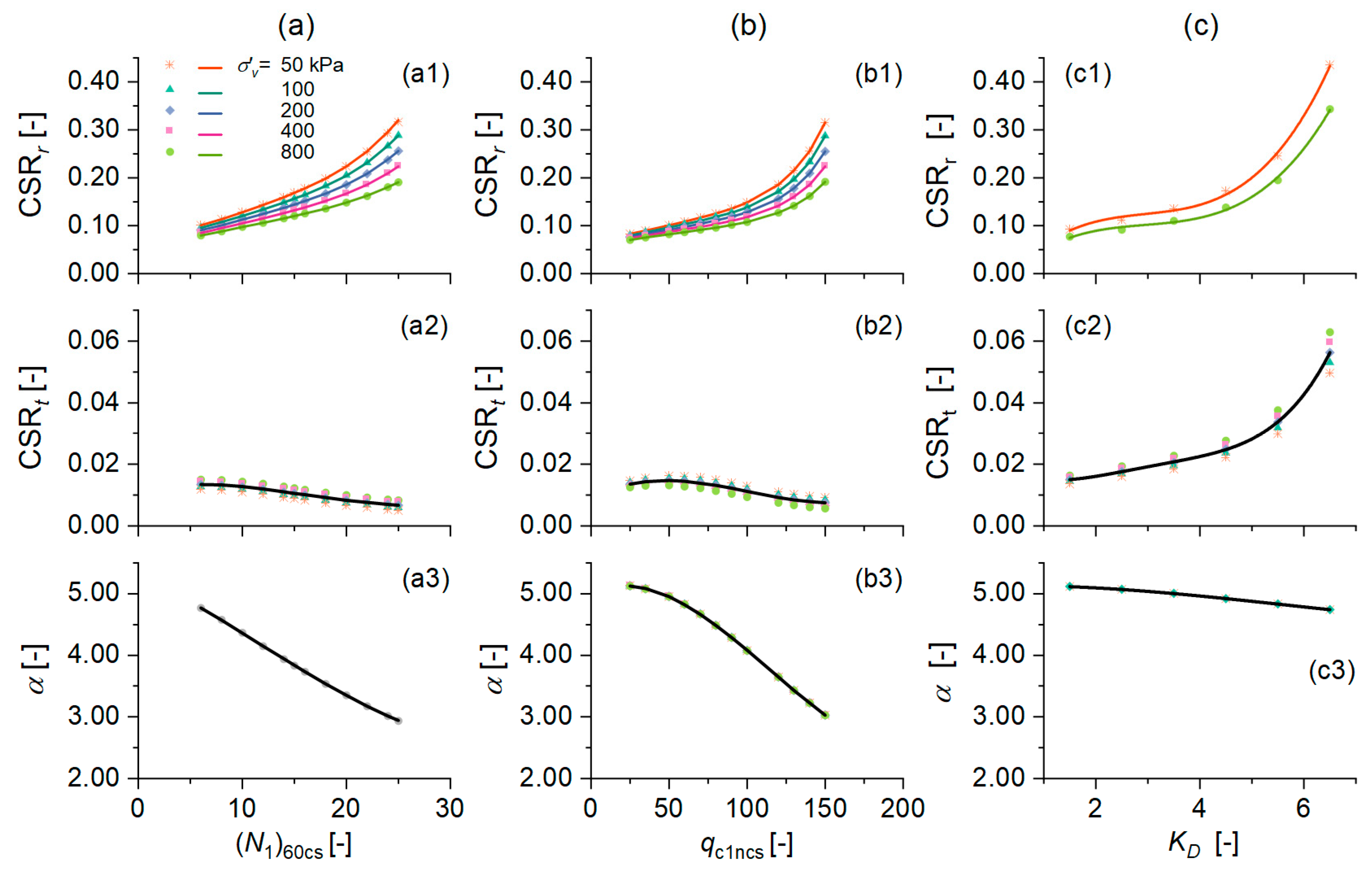
| Cyclic resistance curve parameters (α, CSRr, CSRt) | Cyclic resistance curve from laboratory tests (e.g., cyclic simple shear; stress-based cyclic triaxial) | Nonlinear multi-regression analysis of the experimental data points to fit Equation (34) |
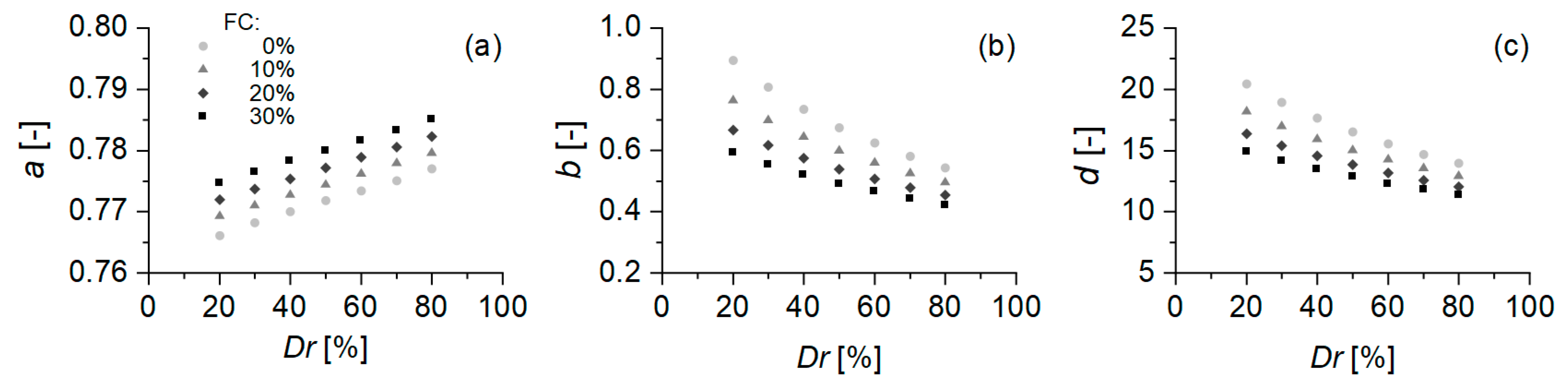
| Pore pressure ratio coefficients (a, b, and d) | Excess pore pressure ratio vs. normalized number of cycles from laboratory tests (e.g., cyclic simple shear; stress-based cyclic triaxial) | Nonlinear multi-regression analysis of the experimental data points to fit Equation (37) |
| Cyclic resistance curve parameters (α, CSRr, CSRt) | CPT | Using the charts (a1, a2, a3) in Figure 13 with SPT data |
| Cyclic resistance curve parameters (α, CSRr, CSRt) | CPT | Using the charts (b1, b2, b3) in Figure 13 with CPT data |
| Cyclic resistance curve parameters (α, CSRr, CSRt) | DMT | Using the charts (c1, c2, c3) in Figure 13 with DMT data |
| Pore pressure ratio coefficients (a, b, and d) | SPT, CPT, DMT | Using the charts in Figure 14 with relative density and fines content estimated via correlation with SPT or CPT of DMT results |
| Computer Code | Constitutive Model | Effective Stress Approach | Required Parameters | Calibration | Computational Demand |
|---|---|---|---|---|---|
| SCOSSA | MKZ + PWP | Loosely coupled | 3 MKZ (β, s, and γr) + 6 PWP (α, CSRr, CSRt, a, b, d) | straightforward | Low |
| DEEPSOIL | MKZ + Vucetic and Dobry [97] | Loosely coupled | 3 MKZ (β, s, and γr) + 6 PWP (γtvp, f, F, s, and p) | straightforward | Low |
| FLAC | PM4Sand [115] | Fully coupled | 3 primary parameters (Go, DR, hpo) | Trial and error for hpo | High |
Disclaimer/Publisher’s Note: The statements, opinions and data contained in all publications are solely those of the individual author(s) and contributor(s) and not of MDPI and/or the editor(s). MDPI and/or the editor(s) disclaim responsibility for any injury to people or property resulting from any ideas, methods, instructions or products referred to in the content. |
© 2025 by the authors. Licensee MDPI, Basel, Switzerland. This article is an open access article distributed under the terms and conditions of the Creative Commons Attribution (CC BY) license.
Share and Cite
Tropeano, G.; Chiaradonna, A. A One-Dimensional Model Used for the Analysis of Seismic Site Response and Soil Instabilities: A Review of SCOSSA 1.0 Computer Code. Geotechnics 2026, 6, 2. https://doi.org/10.3390/geotechnics6010002
Tropeano G, Chiaradonna A. A One-Dimensional Model Used for the Analysis of Seismic Site Response and Soil Instabilities: A Review of SCOSSA 1.0 Computer Code. Geotechnics. 2026; 6(1):2. https://doi.org/10.3390/geotechnics6010002
Chicago/Turabian StyleTropeano, Giuseppe, and Anna Chiaradonna. 2026. "A One-Dimensional Model Used for the Analysis of Seismic Site Response and Soil Instabilities: A Review of SCOSSA 1.0 Computer Code" Geotechnics 6, no. 1: 2. https://doi.org/10.3390/geotechnics6010002
APA StyleTropeano, G., & Chiaradonna, A. (2026). A One-Dimensional Model Used for the Analysis of Seismic Site Response and Soil Instabilities: A Review of SCOSSA 1.0 Computer Code. Geotechnics, 6(1), 2. https://doi.org/10.3390/geotechnics6010002